Introduction
Between 1934 and the time of the 1940 Census (April 1, 1940), the US government built and leased 30,151 units of public housing across 46 cities in 22 different states, Puerto Rico and the US Virgin Islands (US Department of the Interior 2004). Built under the auspices of Roosevelt’s Public Works Administration (PWA) New Deal program and the fledgling US Housing Authority (USHA) created by the Housing Act of 1937, this wide geographic distribution indicates an attempt to spread this housing across much of the United States. Though these early public housing units are relatively small in number, they are notable because they are the first foray of the federal government into building and operating housing in US history and paved the way for hundreds of thousands of public housing units built in subsequent decades.
The PWA New Deal housing program was designed to stimulate the economy by injecting money into the construction industry and provide secure and affordable housing for households with modest incomes, especially those negatively affected by the Great Depression (the so-called submerged middle class) (Friedman Reference Friedman1966). The Housing Act of 1937 had similar legislative intent. With a limited supply of public housing built in these early years, housing managers could carefully screen for tenants from the thousands of households that applied (Anbinder Reference Anbinder2016; Marcuse Reference Marcuse1986). The fact that rents for these units assumed residents worked in working-class jobs indicates that program administrators did not intend for the housing to serve the neediest residents (Friedman Reference Friedman1966; Vale Reference Vale2013). Still, the transition between housing created under the PWA program and housing created under the Housing Act of 1937, also called the Wagner-Steagall Act, signaled an important shift in legislation toward an intent to serve lower income households for public housing over time.
Aside from archival accounts about residents in particular public housing projects (Bloom Reference Bloom2008; Fairbanks Reference Fairbanks1988; Radford Reference Radford1996; Vale Reference Vale2000) and the general income limit criteria for tenant selection provided to housing authorities by Congress, we have a relatively shallow understanding of the demographic and socioeconomic characteristics of early public housing tenants. We also know little about how the demographic and socioeconomic profile of residents in public housing changed after the shift in income criteria introduced by the Housing Act of 1937. While archival research has found evidence that administrators selected relatively prosperous households to live in the first public housing projects (Bloom Reference Bloom2008; Radford Reference Radford1996; Vale Reference Vale2000), to date no research has systematically confirmed this practice across a wide set of projects through an examination of household income, educational attainment, and employment status of residents. Similarly, existing research has neglected to document in a systematic fashion a number of other demographic characteristics of public housing residents, such as age, gender, marital status, household size, nativity, and citizenship.
These gaps in our knowledge suggest three related research questions. First, what was the relationship between socioeconomic status and public housing residence for the first residents of public housing? Second, how did the relationship between socioeconomic status and residence in public housing change for public housing built in the PWA era and the USHA era? Third, what other demographic or life-course factors were associated with living in the first public housing projects? Each of these questions exist under the larger question that animates much of the scholarship on poverty and welfare: Who should government welfare programs help (Katz Reference Katz2013)? These questions also speak to the ongoing debate about how race, nativity, class, and other social characteristics influenced who benefited from major New Deal welfare programs prior to the 1960s (Cates Reference Cates1983; Katznelson Reference Katznelson2005; Mink Reference Mink1995).
To answer these questions we use a unique methodology that compares addresses of recently constructed public housing to complete-count data from the 1940 Census to identify residents of public housing in New York City at the time of the census. Because we use the complete-count 1940 Census, the approximately 28,000 public housing residents that we include in our data set represent the universe of public housing residents in New York City at the time of the census. We compare characteristics of these residents to the characteristics of a larger pool of residents living in New York City in 1940 who were eligible to apply for the housing to gain insight into how closely housing managers adhered to the legislative intent for this housing, but also how they used discretion to create unique resident profiles in each development. Documenting these characteristics for early public housing residents helps to reveal elected officials and public housing administrators’ preferences for what sort of residents were deserving of public housing and contributes to the ongoing scholarly discussion of the “deserving poor” in the US welfare system (Gordon Reference Gordon2001; Katz Reference Katz2013; Moffitt Reference Moffitt2015).
We focus on public housing in New York City during this era for two reasons. First, more than one-quarter of the public housing units built in the United States and inhabited at the time of the 1940 Census were located in New York City. As such, New York City is a crucial context for understanding the early years of public housing in the United States. Second, scholars have used historical archives to document public housing in New York City (Bloom Reference Bloom2008; Marcuse Reference Marcuse1986; Radford Reference Radford1996), making it possible for us to compare our research findings to those of other published research. While historical archives grant scholars nuance and detail, this type of research is limited by the information maintained in the archives and lacks the breadth of information on residents available from the census. Thus, findings from our research provide a more thorough account of the demographic, social, and economic characteristics of public housing residents during this era that complements other existing research.
Results indicate that, on average, residents living in public housing in New York City tended to be of higher socioeconomic status than those eligible to live in public housing. Socioeconomic status of public housing residents did vary over time, with public housing built in the USHA era serving households with lower educational attainment, less secure attachment to the labor market, and lower incomes than the households served by public housing built under the PWA. All the public housing developments had a consistent preference for households with a “nuclear family” structure (married, headed by a male, and containing children), but policies favoring racial segregation and other points of discretion on the part of housing authorities for tenant selection created distinct tenant demographic profiles in different housing developments. In particular, results point to resident citizenship and nativity as potentially important factors in determining who government officials considered deserving of public benefits during this era.
Public Housing and the New Deal
In the late nineteenth and early twentieth centuries, as crowded and unsanitary living conditions in large cities of the United States became impossible to ignore (Riis Reference Riis1996 [1890]), the federal government refrained from promulgating policies to improve conditions in slum areas. Instead, policy agendas at the municipal and state levels took the lead and focused on slum redevelopment, best illustrated by regulatory-oriented legislation to increase access to ventilation, daylight, and sanitary facilities in tenements in large cities of the United States (Freidman and Spector Reference Freidman and Spector1965; Lubove Reference Lubove1962). These regulatory efforts sought to push private property developers to offer higher quality housing in slum areas and, in the cases of demonstration projects, to show that such housing arrangements could simultaneously be of high quality, affordable to working-class residents and profitable for developers (Lubove Reference Lubove1962; Radford Reference Radford1996; von Hoffman Reference Von Hoffman2000).
Social reformers and nascent urban planners in the early twentieth century ultimately found regulatory efforts to improve slum conditions insufficient and pushed for more radical approaches. Rooted in the settlement house movement, social reformers such as Jane Addams drew direct connections between living in slum conditions and high rates of communicable disease, crime, and questionable moral character among slum residents (Addams Reference Addams1990). The reformers’ strong bent toward environmental determinism held that improving the living conditions for slum residents would have a predictably positive effect on the lives of these residents (Bauman Reference Bauman1994). From a strategic perspective, reformers such as Catherine Bauer also began to argue that focusing narrowly on impoverished households living in slums in their crusade to provide high-quality housing ran the risk of alienating key political constituencies in the middle class (von Hoffman Reference Von Hoffman2000). Using early examples of public housing in Europe (Radford Reference Radford1996) and communitarian ideals that were instilled in these communities, social reformers such as Edith Elmer Wood, Louis Pink, and Catherine Bauer began to conceive of large-scale housing efforts that would provide housing to a substantial proportion of the American public (von Hoffman Reference Von Hoffman2000).
In addition to pressure from social reformers, the arrival of the Great Depression ultimately led to substantial experimentation with public housing in the United States, despite long-standing resistance to this practice on the part of the federal government. The initial foray into public housing by the federal government came in the form of the Housing Division of the Federal Emergency Administration of Public Works, more commonly known as the Public Works Administration (PWA). Signed into law by President Roosevelt in 1933, the National Industrial Recovery Act (NIRA) created a public works program designed to “prime the pump” of the American economy by injecting capital into the economy through job creation (Radford Reference Radford1996). At least part of this job creation would come through the construction of low-cost housing and slum-clearance projects. Initially, the Housing Division of the PWA focused on limited-dividend projects, which offered low-interest loans to local entities in exchange for the construction of housing for moderate-income households. While the decentralized, local nature of the limited-dividend program brought the planning of these developments closer to those who would ultimately use it, the lack of capacity at the local level crippled the program, resulting in only 3,100 units of housing constructed across seven projects (ibid.).
A more ambitious attempt by the Housing Division of the PWA to build housing involved a direct build approach. In the direct build approach, the Housing Division acted as a housing developer that worked with local architects and builders to construct housing in municipalities across the United States. To achieve this outcome, the Housing Division received approval from Congress to offer grants equivalent to up to 45 percent of development costs, and lower interest rates (3 percent) and longer amortization periods (60 years) on loans to pay for construction of the new housing (ibid.: 99). The direct build approach also required that public entities have the legal ability to build, own, and operate housing (ibid.). Creating such public entities required state legislation that established state housing authorities. State housing authorities begat local housing authorities that, at least in the case of New York, only came about because of the promise of job creation in construction and an organizational structure that would insulate them from undue influence from local political machines (Bloom Reference Bloom2008). The result of the PWA Housing Division initiative was the construction of more than 21,000 units of housing in 51 projects across 36 cities (Radford Reference Radford1996: 101). Perhaps equally important to establishing a track record of constructing housing units, this initiative created a decentralized infrastructure of housing authorities around the United States with the ability to construct housing using public resources that would be used in future decades to build hundreds of thousands of units of housing (Hunt Reference Hunt2005).
The provision of public housing by the Housing Division of the PWA during this era faced a critical question of whom to house. Secretary of the Interior Harold Ickes claimed that the Housing Division would target households with the lowest incomes, but the relatively modest subsidies available to developers and the high quality of the materials and construction meant that the housing eventually built was unaffordable to the poorest households (Radford Reference Radford1996). Specifically, 55 percent of construction costs for PWA projects came from low-interest loans amortized over 60 years (ibid.: 99). Because the program lacked an operating subsidy that would eventually become a cornerstone of public housing in the United States (Smith Reference Smith, Bennett, Smith and Wright2006), repaying the loans used to construct the housing required an adequate, and relatively high, level of rents for the apartments. Thus, the Housing Division made no pretense that it was serving poor households, eventually stating that it was targeting the “middle third” of the housing market (Radford Reference Radford1996: 97).
In addition to the funding realities of PWA housing that pushed the rents of the housing out of the reach of the neediest households, the program may have seen a political advantage to serving households that experienced negative economic mobility during the Great Depression. This so-called submerged middle class was a politically potent group that had joined the masses of the poor in the United States due to the Great Depression, but lacked the stigma associated with long-term “problem poor” residents (Friedman Reference Friedman1966: 646). These economic realities notwithstanding, PWA housing was initially open in a technical sense to any household, rich or poor, that filled out an application and was awarded a unit.
This policy ended in 1936 with the passage of the George-Healey Act that set income limits for residents of housing owned by public housing authorities (Radford Reference Radford1996). Households needed sufficient income to pay no more than 20 percent of their household incomes for shelter costs, creating a minimum household income. At the same time, the George-Healey Act specified that households living in PWA housing could not earn more than five times the maximum rent charged in the project plus utility charges (rents varied by apartment sizes, with larger apartments associated with higher rents) (ibid.: 167). In effect, residents of PWA housing were required to have modest incomes, but not so modest that they could be considered “charity” cases (Friedman Reference Friedman1966: 648).
In addition to income considerations, PWA policies also confronted questions about the race of residents for PWA projects. The Housing Division allocated housing, typically by project, to either white or African American residents. The PWA designated approximately one-third of total housing projects for African Americans, though six projects served both white and African American residents (Radford Reference Radford1996: 104). When allocating projects to different racial groups, the Housing Division built African American and white projects in neighborhoods already dominated by residents from each of these racial groups, respectively. Thus, the policy that guided the location and residential base of PWA housing projects reinforced existing patterns of racial residential segregation in the United States (ibid.: 105).
The successes and challenges experienced by PWA housing informed the 1937 Wagner-Steagall Act that governed the public housing program. The Wagner-Steagall Act maintained household income limits for eligible households based on the five-to-one ratio of household income to maximum rent in the project spelled out in the George-Healey Act, though the act also provided a more generous ratio of six-to-one for households with three or more minor dependents (Hunt Reference Hunt2005; US Housing Act 1937). In all other matters related to tenant selection, including levels of minimum household income, the Wagner-Steagall Act is silent. In contrast to the more modest government subsidies allowed for PWA housing, the Wagner-Steagall Act allowed loans to cover up to 90 percent of development costs associated with public housing developments (US Housing Act 1937). In addition, the Wagner-Steagall Act placed limits on construction costs that were considerably more stringent than those found in PWA allowances, resulting in less compelling architectural designs and lower quality building materials (Hunt Reference Hunt2005; Plunz Reference Plunz1990; Radford Reference Radford, Bauman, Biles and Szylvian2000). The larger subsidies for construction combined with the limit to construction costs lowered the eventual rents charged for the housing units. Because maximum household limits used to determine eligibility for public housing were a function of the rents charged in a project, the lower construction costs for public housing under the Wagner-Steagall Act combined with more generous subsidies meant that housing authorities charged lower rents and targeted households with lower incomes than public housing built during the PWA program. This suggests the following research hypothesis concerning public housing residents in 1940:
H1: The socioeconomic status of households living in PWA-era housing projects was higher than the socioeconomic status of households living in public housing constructed under Wagner-Steagall.
Other than income, the NIRA and Wagner-Steagall Act left questions about desirable characteristics of public housing residents unanswered. To fill this void, the PWA Housing Division drafted a tenant-selection manual that specified the process and criteria that local housing authorities should use to choose tenants for public housing. Housing authorities divided their assessment of potential tenants into three parts, including the need for housing, the desirability of the prospective tenants, and the financial security of prospective tenants (Federal Emergency Administration of Public Works n.d.). Investigators visited the current housing of prospective tenants to assess the physical condition of their housing, the presence of amenities (e.g., indoor toilets), the size of rooms, adequacy of space, and presence of undesirable neighborhood institutions (e.g., pool halls). In addition, the inspectors assessed the cleanliness and level of maintenance of the current housing, and interviewed the property owner and neighbors about the prospective tenants. Finally, inspectors assessed the credit worthiness, record of paying rent, and the stability of income over time for prospective tenants. These inspections and interviews indicate an attempt to identify and deny access to public housing prospective tenants marked as “paupers” that policy makers and social reformers have historically associated with indolence and moral failing (Katz Reference Katz2013).
Housing authorities could be selective because of the tremendous demand for public housing units. For example, New York City’s First Houses and Harlem River Houses developments received approximately 25 applications for each available unit (Radford Reference Radford1996: 155, 165). The housing authority was so selective that relatively few households formerly living on the sites of the new public housing developments were able to secure housing units in the developments (Bloom Reference Bloom2008: 80). Historical archival research findings suggest a second research hypothesis related to the characteristics of public housing residents in 1940:
H2: Relative to the pool of households eligible for public housing because of their income, those households selected for public housing were of higher socioeconomic status.
Data and Methodology
1940 Census
In this analysis, we use the individual records from the 1940 Census. To protect the confidentiality of respondents, census records less than 72 years old have limited geographic identifiers (US Census Bureau 2008). After 72 years, the National Archives and Records Administration (NARA) release the census records to the public, including names and addresses. NARA released the 1940 census responses in 2012, and a digitized version of those responses form the basis of the data analyzed for this article.Footnote 1 We use a restricted access version of the 1940 Census microdata, which contains string variables for housing unit addresses that we used to identify public housing residents (Ruggles et al. Reference Ruggles, Genadek, Goeken, Grover and Sobek2017). In addition to the microdata, we also use 1940 enumeration district (ED) maps and descriptions to identify the EDs where public housing developments were located. We accessed the maps through One-Step Webpages (Morse and Weintraub Reference Morse and Weintraub2017), a website with an interface that helps users quickly find maps and descriptions for individual EDs in the 1940 census. Finally, we use Sanborn fire insurance maps to determine the addresses of the buildings in each public housing development (Sanborn Map Company 1983).
Public Housing Developments in 1940
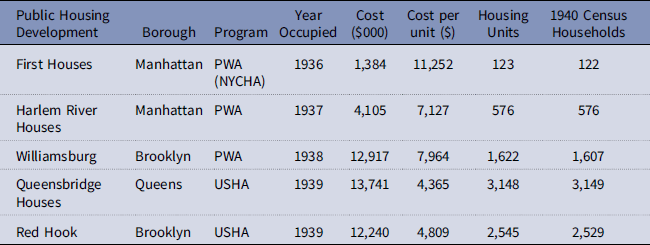
We compiled a list of the 66 public housing developments built in a US state or the District of Columbia and occupied between 1936 and April 1, 1940, the date of the 1940 Census (US Department of the Interior 2004). As described in table 1, there were five public housing developments in New York City occupied before the date of the 1940 Census (April 1, 1940). The size of the developments varied substantially, ranging from 123 units in First Houses, a public housing project that predated the beginning of the PWA housing program, to 3,148 units in Queensbridge Houses. Together, the five developments accounted for 8,014 units of public housing spread across three boroughs of New York City and more than one-quarter of all the public housing units that existed in the United States at the time of the 1940 Census.
New York City public housing developments at the time of the 1940 Census

Note: Data from Public Housing in the United States, 1933–49 (US Department of the Interior 2004) and author’s calculations of 1940 Census data (Ruggles et al. Reference Ruggles, Genadek, Goeken, Grover and Sobek2017). Cost and cost per unit are expressed in nominal dollars.
Identifying Public Housing Residents
We used addresses of the public housing units in each of the five developments to identify public housing residents in the 1940 census. The public housing developments have multiple buildings, each with its own street address. We identified all building addresses for the five developments from the Sanborn fire insurance maps (1983). We then entered the addresses into Google Maps to get a general sense of the development’s location. Next, we used One-Step Webpages to access the 1940 ED map(s) and created a list of the EDs that contained the development. Finally, we selected the census microdata records included in the EDs that contained a development.
In most cases, the EDs that included the public housing developments also included addresses that were not public housing units, so it was necessary to distinguish which records in the microdata were living in public housing developments and which were not. Working from the Sanborn fire insurance maps and the street addresses in the census, we manually flagged the census records whose address matched one of the building addresses in the public housing developments. After finishing the flagging process for each development, we performed data quality checks on our public housing households and excluded households reporting that they owned their housing. Ultimately, this strategy identified 28,056 residents in 7,983 households living in one of the five public housing developments in New York City at the time of the 1940 Census.
As table 1 demonstrates, our strategy for identifying public housing residents proved to be highly accurate. In two developments (First Houses and Harlem River Houses), our identification strategy resulted in a perfect or nearly perfect match between the number of housing units in the development and the households we identified as living in the development. In the three other developments we either had a slight underestimate (Red Hook and Williamsburg) or a slight overestimate (Queensbridge Houses). The underestimates could be explained by vacant units at the time of the census or the census enumerator not finding anyone at home during the visits to the development. The slight overestimate is likely due to inadvertently including a nonpublic housing household in our public housing designation because of a data error in the address field of the enumeration sheets used to digitize the 1940 Census data. Overall, we underestimate the number of households living in public housing in New York City at the time of the 1940 Census by 31 households, or less than one-half of a percent of the total number of public housing units in New York City at the time.
Identifying Eligible Public Housing Residents
We identified a pool of eligible public housing residents for each public housing development from the universe of New York City residents based on three factors: household size, household income, and race. We excluded residents living in group quarters and households that owned their homes from our analysis. In the relatively small proportion of cases in which multiple families lived in the same household, we split the household into families for the purpose of assessing eligibility. As specified in the Housing Act of 1937, the only legislative restriction placed on who could live in public housing of this era was a maximum household income equal to five or six times the amount of rent charged for an apartment in a public housing project. The ratio that determined the maximum household income depended upon whether a household had three or more minor dependents present (ratio of six) or not (ratio of five). Because the version of the 1940 Census we use in this analysis does not include any information on the number of rooms in a dwelling, we derived the household income limits for different sized households in each development by assessing the monthly rent paid by households of various sizes living in each public housing development. When calculating the maximum household income, we used the 90th percentile of the reported rent amount for households of different sizes. We multiplied the 90th percentile of the monthly reported rent by 12 months and then by five or six to create household income limits by family size for families with and without three dependent minors, respectively. In comparison to using the mean or median reported rent, using the 90th percentile minimizes the chance that the income limits we use in the analysis are lower than the income limits used by the housing authority when determining eligibility. Using the 90th percentile rather than the maximum rent reported in the data reduces the likelihood that a large rent recorded in error by the census enumerator erroneously inflated the maximum household income used to determine the pool of eligible households.
While the Wagner-Steagall Act does not specify a minimum household income required for those living in public housing, different administrators within public housing and elected officials during this era routinely specified that public housing tenants were expected to pay rent to ensure that the public housing authority had an operating budget and could pay back the loans used for construction. Thus, when determining the pool of eligible households we also included a minimum household income equal to the amount of the 90th percentile of rent each year in the housing developments for households of various sizes. Though there is some evidence of slight racial integration in public housing during this era (Bloom Reference Bloom2008), in keeping with the broader intent to segregate public housing during this era by race, we restricted eligibility for households living in Harlem River Houses to African American households and households living in the other four developments to white households. Because rents were determined by the amount of the loan used to pay for the unsubsidized portion of the project’s construction costs and each project required a different size loan due to variations in the construction costs, rents for households with the same sizes and compositions differed slightly across the public housing projects. Crucially, this difference in rents resulted in variation in income limits and produced a different pool of eligible households for each public housing project.
Analytic Strategy
We first focus our analytic strategy on comparing descriptive statistics for the populations of interest to test our research hypotheses. Of particular concern are differences between residents living in PWA- and USHA-era public housing developments, and differences between residents living in public housing developments and residents eligible to live in the public housing developments. In the former case, we aggregate resident data for developments in the PWA and USHA eras. In the latter case, we consider the residents and eligible residents separately for each development since the pools of eligible residents differed for each development. Because these data represent the universe of residents rather than samples it is not necessary to use statistical tests to determine whether observed differences are statistically significant.
The second step of our analytic strategy uses logistic regression models to assess the relationship between different demographic and socioeconomic characteristics of households and living in public housing. Because the eligibility pools differ for each development it is not possible to group the developments into a single model or into two models that group developments by the PWA and USHA eras. Instead, we estimate predictive models for each public housing project separately, using models with consistent sets of independent variables. One exception is our model for First Houses that uses a simplified version of the marital status independent variable (a dummy variable equal to one if the householder was married and zero otherwise) and gross reported household income rather than a more detailed set of dummy variables for various marital statuses and the natural log of household income, respectively. The relatively small number of households living in First Houses (122) combined with the fact that about 90 percent of householders were married resulted in the more detailed set of marital status dummy variables being unnecessary in this model. Similarly, a small number of households living in First Houses reported a household income of zero, making it impossible to use the transformed variable of household income without dropping observations and losing statistical power.
Results
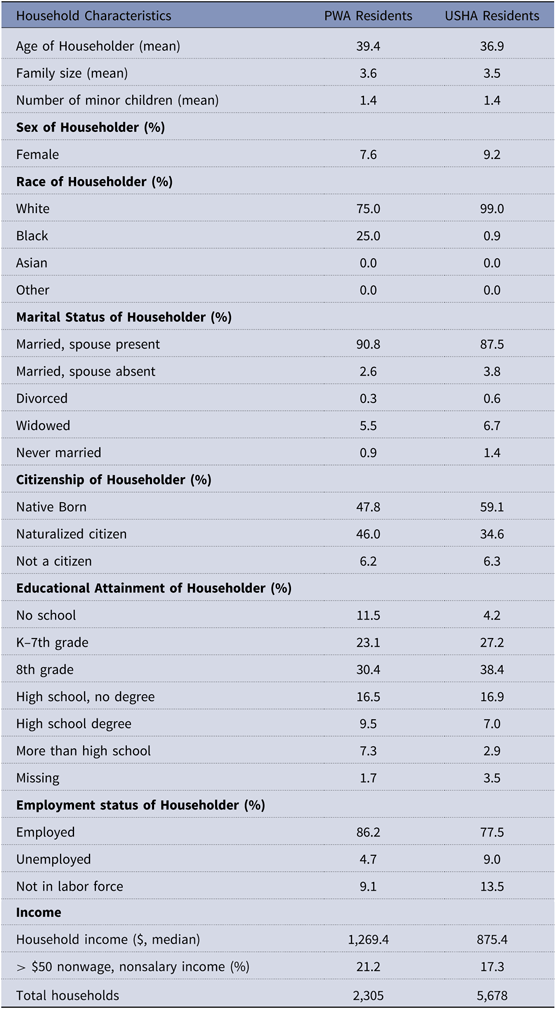
Table 2 indicates the characteristics of households living in public housing projects in New York City from the PWA and USHA eras. Households living in public housing in these two eras have notable similarities and differences. Heads of households had similar mean ages, family sizes, and marital statuses across the eras, suggesting that “nuclear family” structures were common in both periods. Heads of households in the PWA era were less likely to be native born and more likely to be naturalized citizens compared to the USHA era. Larger proportions of heads of households in the PWA era had no schooling or more than a high school degree compared to heads of households in the USHA era. Finally, heads of households in the PWA era were more likely to be employed and have higher household incomes in comparison to heads of households in the USHA era. Together, these descriptive results suggest that the socioeconomic status of public housing residents in the PWA era was higher than the socioeconomic status of public housing residents in the USHA era, lending support to Hypothesis 1.
Household characteristics of PWA- and USHA-era residents of public housing developments in New York City, 1940

Note: Authors’ calculations of complete-count 1940 Census data (Ruggles et al. Reference Ruggles, Genadek, Goeken, Grover and Sobek2017).
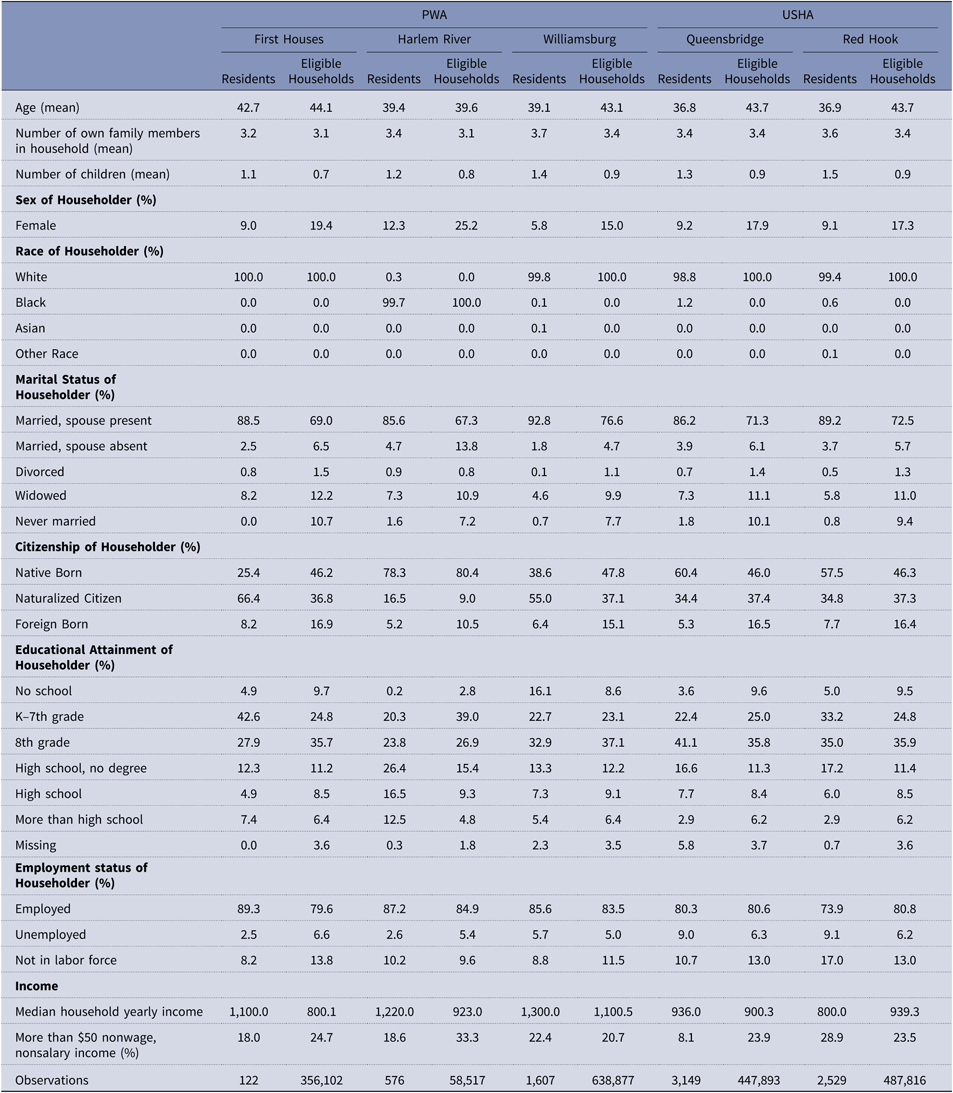
Examining household characteristics in aggregate across the PWA and USHA eras may mask important differences between residents across public housing projects. Table 3 indicates the characteristics of households living in public housing projects and those who were living in New York City and met the income eligibility criteria for living in each project. Several factors suggest that, relative to all eligible households, the households selected to live in public housing were more likely to resemble nuclear families. Across all projects, the household size and number of children of public housing households were substantially larger than the household size and number of children of eligible households. Similarly, the proportion of households headed by a male was dramatically higher among households living in public housing compared to households eligible to live in public housing. Finally, more than 90 percent of households in public housing included a married couple, compared to 67 to 77 percent of eligible households.
Household characteristics of residents and eligible residents of public housing developments in New York City, 1940

Note: Authors’ calculations of complete-count 1940 Census data (Ruggles et al. Reference Ruggles, Genadek, Goeken, Grover and Sobek2017).
In contrast to the consistent preference among public housing developments for residents living in households approximating nuclear families, public housing developments differed substantially in the profile of their residents by citizenship. Consistently, noncitizens were underrepresented among the householders living in public housing across developments. However, public housing developments from the PWA era (First Houses, Harlem River, and Williamsburg) had overrepresentations of naturalized citizen householders, while public housing developments from the USHA era had representations of naturalized citizens as householders that nearly matched the proportion of naturalized citizens that headed eligible households. In some cases, the discrepancies among the households living in PWA-era housing and those eligible to live in the PWA-era housing were dramatic. For example, in First Houses naturalized citizens headed about 35 percent of eligible households compared to nearly two-thirds of households that lived in First Houses. In contrast, Queensbridge and Red Hook had a significant overrepresentation of native-born householders.
The educational attainment of heads of household marks another significant difference between public housing developments. As measured by the proportion of households headed by residents with at least a high school degree, First Houses, Williamsburg, Queensbridge, and Red Hook all had less educated residents than the households eligible to live in the housing. In contrast, a resident with at least a high school degree headed nearly 30 percent of households living in Harlem River compared to only 14 percent of the households eligible to live in Harlem River. Similar to findings from previous research (Radford Reference Radford1996), households living in Harlem River represented upwardly mobile households with relatively high socioeconomic status compared to the households eligible to live in the development. Notably, the educational attainment of householders in Harlem River was significantly higher than the educational attainment of householders in any of the other public housing projects in New York City as of the 1940 Census.
Finally, the households living in public housing developments tended to outperform eligible households in earnings, but have a more mixed record on unemployment. Across four public housing developments the median household earnings were substantially higher for households living in the developments than households eligible to live in the developments, though the gap in median earnings in the USHA-era housing developments was considerably smaller than the gap in the PWA-era housing developments. In the case of Red Hook, the median earnings of eligible households outpaced the median earnings of resident households. Reflecting the lower income limits that characterized the USHA-era housing developments, median earnings in Queensbridge and Red Hook were lower than median earnings in the PWA-era housing developments. At the same time, we note substantial variation in the proportion of households living in each project that received more than $50 in nonwage income, a proxy measure for the receipt of welfare relief. Notably, the variation in receipt of substantial sums of nonwage income does not appear to be associated with living in PWA-era or USHA-era housing despite historical accounts that indicate an increased tolerance for the receipt of welfare relief for public housing tenants in the USHA era (Bloom Reference Bloom2008). Compared to eligible householders, public housing householders were less likely to be unemployed in two PWA-era projects, but more likely to be unemployed in all other projects. Heads of household in the PWA-era projects were consistently more likely to be employed than heads of household eligible to live in those projects, whereas the opposite was true for USHA-era projects.
These results support both of the research hypotheses developed in the preceding text. Specifically, households living in public housing from the PWA era were better educated, more likely to be employed, and had higher earnings than households living in USHA-era public housing, suggesting a distinction in socioeconomic status (Hypothesis 1). At the same time, the housing authority selected households to live in public housing from the pool of eligible households in such a way that public housing residents tended to be of a higher socioeconomic status than eligible households across most public housing projects at the time of the 1940 Census (Hypothesis 2).
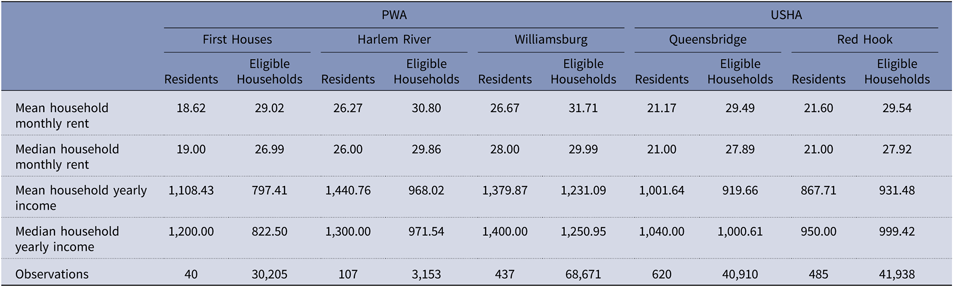
To determine whether public housing households paid a different rent than households not living in public housing but eligible to do so, we compared rents for households living in a public housing development and households eligible to live in the same public housing development. The 1940 Census collected rent data at the household level. In this analysis, we treated multiple subfamilies living in the same household in the 1940 Census as separate households when considering eligibility for living in public housing. Because it is impossible to know how the rent for an apartment was distributed across subfamilies that shared a household in the 1940 Census, to ensure the validity of the results for this part of our analysis we limited the sample to households without subfamilies that lived in public housing or were eligible to live in public housing. When comparing rents, we further constrained our sample to households that lived in a public housing development or were eligible to live in the same public housing development, and were four-person, married-couple households with two minor children and a head of household that was employed. These household characteristics match the nuclear-family, working-class ideal embraced by housing authorities during this era (Radford Reference Radford1996). A comparison of the characteristics of the constrained sample and the larger pool of households eligible to live in each project revealed only marginal differences, easing concerns about selection bias in the constrained sample.
Table 4 shows that households living in public housing paid substantially lower rent than similar households that did not live in public housing but were eligible to do so. Differences in mean monthly rents for households living in and eligible to live in public housing developments varied considerably, from about $5 for Harlem River to more than $10 for First Houses. Differences in median monthly rents follow a similar pattern but are narrower. With the exception of the Red Hook development, the households living in public housing had considerably higher household incomes than the households eligible to live in public housing. Considering rents and incomes together, this meant that across all developments “typical” households living in public housing paid a lower proportion of their household income for housing costs than households eligible to live in public housing. Rules against overcrowding in public housing and the high quality of public housing construction relative to the older tenements that still dominated the New York City housing market in 1940 (Plunz Reference Plunz1990) magnified this financial advantage for public housing households.
Household incomes and rents for typical households eligible to live in public housing in New York City in 1940, by project

Note: For the purposes of this analysis we define a typical family as a four-person, married couple household with two minor children and a head of household that is employed. Authors’ calculations of complete-count 1940 Census data (Ruggles et al. Reference Ruggles, Genadek, Goeken, Grover and Sobek2017).
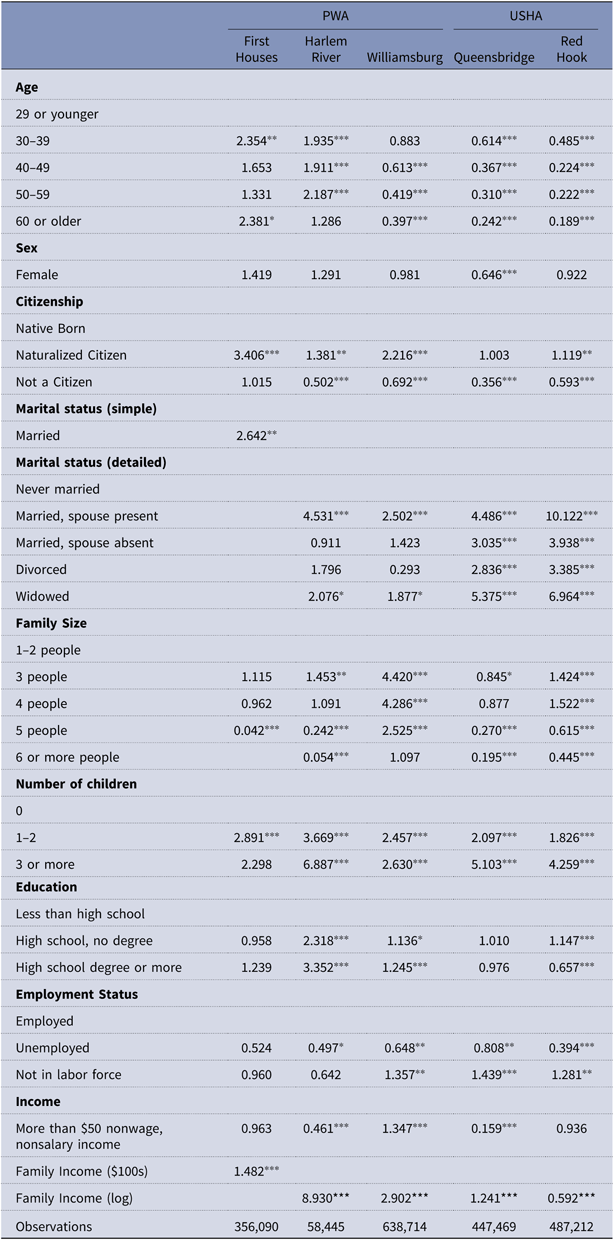
Table 5 presents results from logistic regression models that predict residence in public housing projects in New York City for households eligible to live in public housing at the time of the 1940 Census. The models confirm the positive association between characteristics of a “nuclear family” and living in public housing suggested in table 3. Relative to householders who were never married, married householders had higher odds of living in public housing for the PWA-era projects (First Houses, Harlem River, and Williamsburg), suggesting an advantage for married households during the PWA era. In the USHA era, householders from all other marital statuses had higher odds of living in public housing than never married householders, suggesting a shift in tenant selection that put never married householders at a disadvantage for accessing public housing compared to all other marital statuses. With the exception of the Williamsburg project, families with five or more people had a negative relationship with living in public housing compared to households with one or two people. This result may reflect the limited size of public housing apartments, but also the rules on overcrowding instituted by public housing authorities. Finally, in each project households with children had higher odds of living in public housing compared to those without children. These results support the idea that public housing in 1940 displayed a preference for a nuclear family ideal of households with a married couple and children.
Logistic regression results predicting residency in New York City public housing for eligible households in 1940, by project

Note: Reported data are odds ratios. Authors’ calculations of complete-count 1940 Census data (Ruggles et al. Reference Ruggles, Genadek, Goeken, Grover and Sobek2017).
∗ p < 0.10; ∗∗ p < 0.05; ∗∗∗ p < 0.01
Socioeconomic characteristics of householders also had mostly consistent relationships with living in public housing across projects. For example, relative to employed householders, unemployed householders had lower odds of living in four of the five public housing projects. With the exception of Red Hook, households with higher incomes also had higher odds of living in public housing. For Red Hook, household income had a negative relationship with living in the project. This result signals that the shift in policy in the USHA era to focus on lower income households may have begun to affect the profile of residents admitted to public housing. The potential receipt of relief in a household had a more complex relationship with living in public housing. Households that received more than $50 in nonwage, nonsalary income had higher odds of living in Williamsburg, but lower odds of living in Harlem River or Queensbridge compared to households that did not receive this type of income. In First Houses and Red Hook, receipt of such income had no relationship with living in public housing. Together, these results suggest that households with a firmer attachment to and demonstrated success in the labor market had greater success accessing the first public housing projects in New York City, but that the role of earnings may have changed to reflect a shift in policy. These results indicate that across projects households living in public housing tended to have higher socioeconomic status than those eligible to live in public housing, but that household income had a different relationship with living in public housing for PWA-era housing and at least one USHA-era housing project. As a body, these results lend additional support for research hypotheses 1 and 2.
For all public housing projects except Queensbridge, naturalized citizen householders had higher odds of living in public housing than native-born householders. The fact that this result holds for Harlem River is notable because the proportion of eligible households with a naturalized citizen head of household for Harlem River was only one-quarter as large as the proportion of eligible households with a naturalized citizen head of household for the other, whites-only, developments. However, outside of First Houses noncitizen householders had lower odds of living in public housing relative to native-born householders. Holding all else constant, public housing developments generally seemed to have preferred foreign-bornresidents who had obtained citizenship over native-born residents.
Discussion
While the research presented in this article only assessed public housing residents in New York City, which may have differed from public housing residents in other parts of the country in important ways, research findings confirm many of the insights provided by archival research on public housing during this era. In relatively short order, the PWA-era public housing program championed by Catherine Bauer shifted from a program designed to house the “submerged middle class” to the USHA-era public housing program that focused on poorer households. This shift in policy intent on the part of Congress is clearly represented in the data from the 1940 Census, with residents living in the PWA-era housing developments in New York City wealthier and better educated than residents living in USHA-era housing developments in New York City. Consistently across the PWA and USHA eras, most measures of socioeconomic status indicate that households admitted to public housing were of higher status than the overall pool of households eligible to live in public housing. In addition to any moral judgments about the kinds of residents who deserved access to public housing, admitting households of moderate income was also a practical necessity because of the need to charge rents sufficient to cover operational expenses of the projects and service the substantial loans that financed the construction of these early public housing projects. The nuclear-family ideal and the strong preference for households with firm attachments to the labor market indicate a particular view of who deserved access to public housing that is in keeping with some notions of “deservedness” in earlier periods of welfare policy in the United States (Katz Reference Katz2013). At the same time, the focus on families headed by men reinforced gender inequality within welfare policies that made it difficult for women to maintain households outside of marriage (Mink Reference Mink1995: 8).
One novel finding from this research is the positive relationship between being a naturalized citizen and living in public housing. The profile of the neighborhood where public housing projects were located could have played a role in the overrepresentation of naturalized citizens. For example, during these early years of public housing the Boston Public Housing Authority gave preference to tenants whose homes were demolished to make way for newly constructed public housing projects, so long as the tenants met other selection criteria related to household income, the quality of their previous homes, longer term residency in Boston, and US citizenship (Vale Reference Vale2000). If the neighborhoods where public housing projects were constructed had large proportions of naturalized citizens, this could explain the overrepresentation of naturalized residents in public housing in New York City. Evidence from the Williamsburg development suggests that a very low proportion of residents displaced by the construction of public housing eventually obtained a unit in the public housing project (Bloom Reference Bloom2008: 80), throwing some doubt on the efficacy of this explanation.
Other potential explanations for the overrepresentation of naturalized citizens in public housing are more promising, but difficult to assess. For example, public housing may have patterned itself after settlement houses that provided services to immigrants and played an important, if sometimes controversial, role in assimilating immigrants (Barrett Reference Barrett1992). The fact that Mary Simkhovitch, the former head of a settlement house called Greenwich House, lobbied for the housing program in the NIRA (Thomas Reference Thomas2018) and served as vice-chairman of the New York City Housing Authority (Radford Reference Radford1996) provides some evidence to support this explanation. The social service role that some public housing developments played, for example offering onsite childcare and English classes (Bloom Reference Bloom2008), further suggests that the assimilation function originally played by settlement houses and the related focus on immigrants may have transferred to public housing over time giving naturalized immigrants some advantage for living in public housing. Harkening back to machine politics of Tammany Hall in New York City and supported by research findings from studies of public housing in Boston (Vale Reference Vale2000), naturalized immigrants may have received public housing units as a form of political patronage, despite the claim of some scholars that the public housing system in New York City was insulated from political patronage (Bloom Reference Bloom2008).
Another potential explanation, based on the contention that municipal welfare relief was more generous and more likely to rely on public funding in cities with larger proportions of European immigrants (Fox Reference Fox2010), is that naturalized immigrants had a systematic advantage in accessing public housing because administrators perceived them, either consciously or subconsciously, as more deserving than other groups (Mink Reference Mink1995). This finding indicates that in addition to race and gender (Katznelson Reference Katznelson2005; Mink Reference Mink1995), nativity status and, in particular, citizenship may have played a role in determining who was judged to be deserving of welfare benefits during the New Deal era. Future research should focus on whether the relationship between naturalized citizen householders and living in public housing during this era holds for a broader sample of public housing projects in other cities or if this finding is idiosyncratic for New York City.
Another finding that requires additional explanation is the exceptional nature of African American residents of public housing in New York City in 1940. In general, African American residents of Harlem River Houses had higher educational attainment than white residents in other public housing projects. African American households in Harlem River had higher median household incomes than nearly all other households living in public housing projects and the largest gap in median household incomes between eligible households and the households living in public housing. One potential explanation for this finding is that, in the face of structural racism in the New York City labor market, African Americans needed higher levels of educational attainment than whites to earn enough money to be competitive for securing a unit of public housing. Data from the 1940 Census for households eligible to live in public housing in New York City support this explanation. Employed African Americans who were eligible to live in Harlem River Houses earned an average of $614 and $697 per year, depending upon whether they had a high school degree or were educated beyond high school, respectively. In comparison, employed whites who were eligible to live in one of the four other public housing projects and had a high school degree or were educated beyond high school earned an average of $787 and $802 per year, respectively. These earnings disparities indicate that African Americans needed more education than their white peers to earn an income that would be large enough to increase their chances of living in public housing that gave preference to relatively affluent households.
The systematic analysis of the socioeconomic and demographic characteristics of the first public housing residents of New York City described in this article confirm some of the findings of archival research focused on the first public housing in the United States. Namely, the characteristics of residents of the first public housing in New York City relative to households eligible to live in public housing substantiate that public housing served relatively economically secure households. This practice highlights the link between attachment to the labor market and ideas about who deserves welfare (Katz Reference Katz2013), even during the economically tumultuous period of the Great Depression. In addition to serving households with moderate incomes, the public housing that existed in New York in 1940 was of high quality, architecturally refined, and characterized by low density. As such, it may have influenced contemporary modifications to public housing projects in the HOPE VI program that stress higher quality construction materials and practices, and low density (Hanlon Reference Hanlon2010). A crucial difference between the public housing in 1940 and HOPE VI housing is the consistently moderate-income households served in the former and the mixed-income households served in the latter.
Public housing’s focus on the “submerged middle class” did not last long, however, and a telling shift toward serving relatively less prosperous households in the USHA era portended the gradual evolution of public housing in the United States to become housing for increasingly needy households in later decades (Vale and Freemark Reference Vale and Freemark2012). Equally important, the overrepresentation of naturalized immigrants in the first public housing corroborates findings from research on other facets of the welfare system (Fox Reference Fox2010) that point toward the importance of nativity and citizenship as factors that influenced conceptions of the “deserving poor.” While New York City had a substantial proportion of the existing public housing in the United States in 1940, it also may represent a unique case given how stringently the New York City Housing Authority contested federal regulations that lowered the maximum household income limits for households living in public housing during the USHA era (Bloom Reference Bloom2008: 81–86). Assessing whether the findings from public housing residents in New York City hold for a larger sample of public housing residents from other cities in 1940 is necessary before it is possible to make broader statements about how the fledgling public housing program conceived of deservedness and what kinds of residents benefited most from the early years of this government intervention in the housing market.
Acknowledgments
This research was partially supported by the Minnesota Population Center (MPC), funded by the Eunice Kennedy Shriver National Institute of Child Health and Human Development (P2C HD041023). An earlier version of this article was presented at the Annual Meeting of the Social Science History Association in Montréal, Québec, Canada, November 2017. We are grateful for the comments we received from Evan Roberts, Joe Soss, Steve Ruggles, and two anonymous reviewers for Social Science History. Scott Dallman and Angira Mondal assisted with the data analysis.