Introduction
Insomnia is a common, distressing, and impairing outcome informal cancer caregivers (ICs) (Carter, Reference Carter2003). Despite evidence supporting behavioral and integrative interventions for insomnia in psycho-oncology (Garland et al., Reference Garland, Xie and DuHamel2019), none have been tested among cancer ICs. While cognitive behavioral therapy for insomnia (CBT-I) is recommended as a first line treatment (Rossman, Reference Rossman2019), it is not clear whether it will be acceptable and effective for ICs given the challenges of adhering to sleep restriction and stimulus control in the context of caregiving. Similarly, there is evidence for the use of acupuncture for insomnia (Yin et al., Reference Yin, Gou and Xu2017), but it is not clear whether acupuncture will be acceptable or effective for ICs.
There is a clear need to test effects of existing evidenced-based non-pharmacological therapeutic interventions for insomnia among cancer ICs. The purpose of this feasibility study was to determine whether a future randomized controlled trial can be done, should be done and if so, how it should be done (Eldridge et al., Reference Eldridge, Chan and Campbell2016). This involves evaluation of the acceptability of CBT-I and acupuncture for insomnia and related distress among cancer ICs, and considerations of measurement, recruitment, retention, and elements of future study design.
Methods
Participants
Participants were recruited from Memorial Sloan Kettering Cancer Center (MSK) over 15 months and were (i) ≥18 years of age; (ii) a self-reported IC to a patient with any site/stage of cancer; (iii) able to read English and provide informed consent; and (iv) scored ≥7 on the Insomnia Severity Index (Bastien et al., Reference Bastien, Vallieres and Morin2001) and met DSM-5 criteria for Insomnia Disorder. Participants were excluded if they reported: (i) presence of sleep disorder other than insomnia; (ii) alcohol or drug dependence that compromises comprehension of assessments; (iii) engaging in night shift work; or (iv) being a daily smoker.
Procedure
ICs were randomized to seven sessions of CBT-I or ten sessions of acupuncture. Questionnaires were completed at baseline (T1), after intervention completion (T2), and at 3 months (T3).
Interventions
CBT-I included sleep restriction, stimulus control, cognitive restructuring, relaxation training, and sleep hygiene (Rossman, Reference Rossman2019). CBT-I consisted of four 60-minute weekly sessions, followed by three sessions over four weeks. Our manual incorporated the caregiving context as a key contributor to the onset and maintenance of insomnia. Participants kept nightly sleep logs and records of caregiving-related activities interfering with sleep.
Acupuncture is a component of Traditional Chinese Medicine in which an acupuncturist inserts needles at specific locations on the body. Our manualized acupuncture protocol included standardized points commonly used to address sleep problems with additional points to treat comorbid symptoms like pain and anxiety if needed. Licensed acupuncturists inserted 8–16 Seirin needles (0.16–0.25 mm × 15–40 mm) and manipulated the needles to achieve De Qi (a sensation of aching and soreness) (Mao et al., Reference Mao, Farrar and Armstrong2007b). Participants received acupuncture twice weekly for 2 weeks, then weekly for six more weeks, for a total of ten treatments for eight weeks. The first acupuncture visit involved a detailed history and examination lasting 60 min, with each subsequent session lasting 30 min, for a total time of 330.
Measures
Questionnaire measures included the Causal Attributions of my Insomnia Questionnaire (CAM-I; Harvey et al., Reference Harvey, Soehner and Lombrozo2013) and the Acupuncture and CBT-I Expectancy Scales (AES; Mao et al., Reference Mao, Armstrong and Farrar2007a).
Subjective measures of insomnia included the Insomnia Severity Index (ISI; Bastien et al., Reference Bastien, Vallieres and Morin2001), the Pittsburgh Sleep Quality Index (PSQI;; Buysse et al., Reference Buysse, Reynolds and Monk1989), the Multidimensional Fatigue Inventory-Short Form (MFSI-SF; Stein et al., Reference Stein, Jacobsen and Blanchard2004), and the Hyperarousal Scale (HAS; Pavlova et al., Reference Pavlova, Berg and Gleason2001).
Objective sleep and stress measures included: Wrist Actigraphy (Morgenthaler et al., Reference Morgenthaler, Kramer and Alessi2006), and Diurnal Cortisol, which were measured over two days prior to T1 and after T2. Additional assessments included the Hospital Anxiety and Depression Scale (HADS; Snaith and Zigmond, Reference Snaith and Zigmond1986), and a Qualitative Interview at T1 and T2 that assessed perceptions of causes of insomnia and strategies used to improve sleep. The interview explored participants’ experiences with the treatment.
Data analyses
Feasibility was informed by the number of eligible ICs, the percentage who participated, and completion rates. Acceptability was assessed as the percentage of participants completing ≥4 of 7 sessions of CBT-I and ≥8 of 10 sessions of acupuncture. Acceptability was also observed through interviews. Descriptive statistics and mean change scores examined person-level patterns of change. The study was approved by the MSK Institutional Review Board (protocol 17-001).
Results
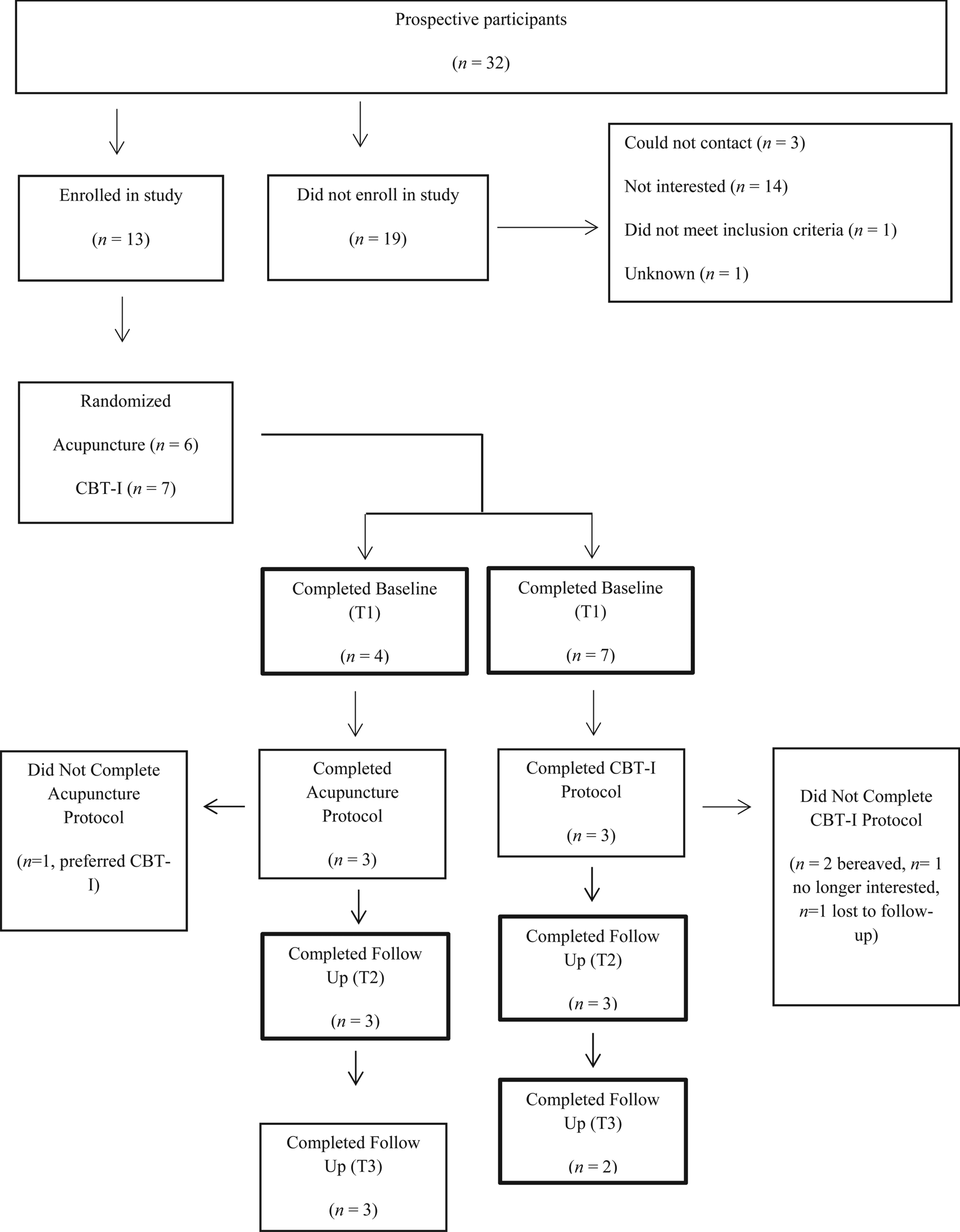
Among 32 prospective participants, 41% (N = 13 ICs) enrolled and were randomized, 7 to CBT-I and 6 to acupuncture. Among non-enrollees, one was not eligible, 14 were not interested, and three were unreachable (Figure 1). All participants were female and had a college degree. The majority (N = 11, 92%) were white, married/cohabitating (N = 8, 62%), and provided care since the patient's diagnosis (N = 9, 70%). Most lived with the patient (N = 10, 77%) and were his/her spouse/partner or child (N = 10, 77%). Participants were, on average, 51 years old (range 25–73).
Trend data.

Acceptability
All participants randomized to CBT-I completed T1, three completed T2 and two completed the T3 assessment. Two participants randomized to acupuncture dropped before T1 and one did not complete the acupuncture protocol; the remaining three completed all acupuncture sessions and assessments. Of the 11 participants completing T1, only six agreed to provide salivary cortisol and actigraph data. Reasons for attrition included bereavement, preference for CBT-I when randomized to acupuncture, and loss of interest in treatment.
Semi-structured interviews were completed by 11 participants at T1 and five at T2. At T1, four participants preferred CBT-I and five preferred acupuncture. Those preferring CBT-I desired skills they could use over the long-term (e.g., “I can't put the needles in me after treatment”). Those preferring acupuncture anticipated it would “provide relaxation” and expressed interest in a modality that “required very little effort.” At T2, participants described CBT-I as “demanding and emotionally challenging” but ultimately “incredibly effective” in reducing insomnia. Sleep restriction was identified as a powerful but challenging technique, and the accountability built into sessions particularly helpful. Regarding acupuncture, participants reported satisfaction with the limited effort required, and two believed that it helped with non-sleep related symptoms.
Perceived causes of insomnia and expectancy of treatment
The most frequently endorsed category of causes of insomnia was thinking patterns (e.g., can't shut off thoughts), endorsed by 11 participants, followed by sleep-related thoughts (e.g., thinking about falling asleep; endorsed by five participants) and sleep-related emotions (stress, anxiety; endorsed by four participants). Participants endorsed relatively similar expectation of acupuncture and CBT-I (13.75 versus 12.43) in addressing insomnia and their ability to cope with related distress.
Impact of CBT-I and acupuncture on insomnia
At T2, CBT-I participants had lower mean scores for insomnia severity (CBT-I 11.67–6.33, acupuncture 10.33–9.00, d = 0.59), hyperarousal (CBT-I 42–35, acupuncture 53.0–47.0, d = 1.39), anxiety (CBT-I 11.83–7.67, acupuncture 15.60–15.00, d = 1.37), depression (CBT-I 7.14–6.00, acupuncture 10.25–10.00, d = −1.57), and fatigue (CBT-I 15.00–6.67, acupuncture 19.00–11.67, d = −0.96) than acupuncture participants.
When given the option only six participants (three in each arm) provided salivary cortisol data at T1 and T2 and six participants (four randomized to CBT-I and two to acupuncture) completed data collection via wrist actigraphy.
Discussion
Results provide only modest evidence of feasibility of both non-pharmacological modalities for the treatment of insomnia among ICs and highlight key challenges in recruitment and feasibility of objective assessments. Only 32 potential participants were identified over 15 months despite multipronged recruitment (e.g., direct referral by treating physician, recruitment in-person at clinics, fliers). Though study staffing was limited, this may reflect ICs’ need for treatment that addresses multiple facets of quality-of-life (e.g., three potential participants reported desire for psychotherapy and did not want to risk randomization to acupuncture). Framing insomnia as an element of IC burden that is related to other facets of functioning may have made the trial more appealing.
The most frequent reason for non-enrollment was lack of interest; only one IC did not meet insomnia symptom threshold criteria. Both CBT-I and acupuncture are time-intensive and require a commitment from ICs that may not be possible during intense periods of caregiving. Future studies are needed to identify optimal timing of recruitment to accommodate more ICs who are willing and capable of participation.
Treatment preference emerged as an important indicator of potential impact of these approaches; interviews highlighted preferences for CBT-I among participants desiring skills they could independently use post-treatment, and preference for acupuncture among those preferencing minimal effort. Data also underscored the acceptability of these modalities, with CBT-I participants characterizing the intervention as demanding but incredibly effective, and those to acupuncture reporting great satisfaction with the limited effort required to participate with perception of benefit beyond insomnia management. At baseline, most participants attributed their insomnia to thinking patterns, which highlights the appropriateness of CBT-I in this particular population.
Th challenges of collecting objective measures of insomnia and related distress (i.e., salivary cortisol and actigraphy) are evident. Adherence to these protocols may be difficult and future studies will need to consider alternate strategies that provide similar data with more limited effort.
Conclusions and future directions
Our study highlighted the challenges of recruitment and retention of ICs. Data provide preliminary evidence for CBT-I and acupuncture to positively impact insomnia and related distress, though suggest these approaches may fit unique IC needs. Future studies should consider matching treatment modality to IC preference and stated needs and offer telehealth-delivered CBT-I to ameliorate the burden associated with participation in-person.
Funding sources
This research was supported by funding from the National Institutes of Health (T32CA009461, PI: Jaime Ostroff, PhD; P30CA008748, PI: Craig Thompson, MD).
Data sharing
The data that support the findings of this study are available on request from the corresponding author; the data are not publicly available due to privacy or ethical restrictions.
Conflicts of interest
The authors have no conflicts of interest to report.