INTRODUCTION
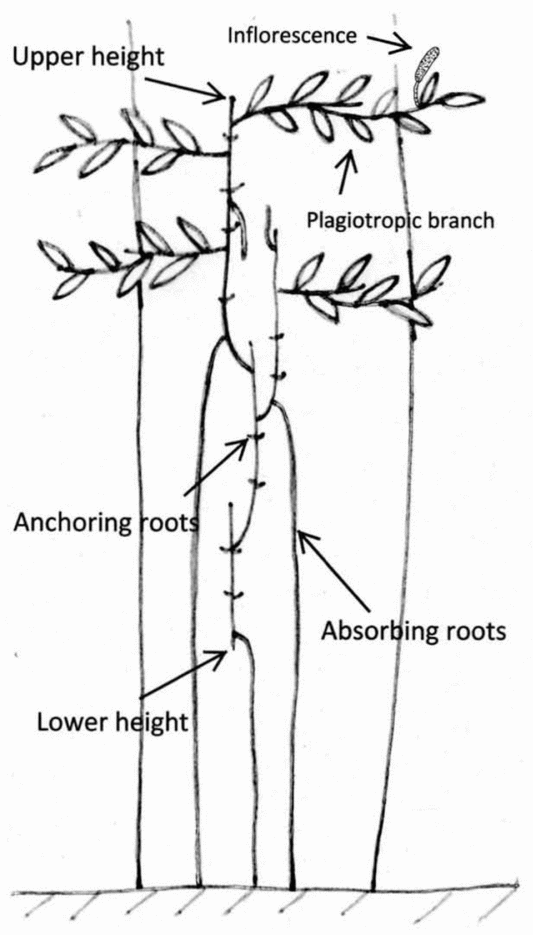
Secondary hemiepiphytes are characteristic elements of tropical forests. These plants rely on other plants (hosts or phorophytes) to grow vertically (Williams-Linera & Lawton Reference WILLIAMS-LINERA, LAWTON, Lowman and Nadkarni1995) and are also known as pseudo-epiphytes (Schimper Reference SCHIMPER1903) or nomadic vines (Moffett Reference MOFFETT2000, Zotz Reference ZOTZ2013). Secondary hemiepiphytes germinate on the forest floor. Their seedlings search a host by growing towards dark spots (skototropism; Strong & Ray Reference STRONG and RAY1975) or by random movement (Balcázar-Vargas et al. Reference BALCÁZAR-VARGAS, PEÑUELA-MORA, VAN ANDEL and ZUIDEMA2012). Once a shoot tip of a seedling has reached a host, it climbs up using adventitious anchoring roots (Wilder Reference WILDER1992). When the plant is attached, absorbing roots are formed growing downwards and as the plant ascends the host tree, it produces orthotropic (vertical) and plagiotropic (horizontal) branches and more absorbing roots, while gradually shedding its lower parts (Knab-Vispo et al. Reference KNAB-VISPO, HOFFMAN, MOERMOND and VISPO2003, Plowden et al. Reference PLOWDEN, UHL and OLIVEIRA2003, Putz & Holbrook Reference PUTZ and HOLBROOK1986; Figure 1). Secondary hemiepiphytes reproduce sexually once they have reached a threshold size or height on the host, which implies that small host trees are not suitable (Balcázar-Vargas et al. Reference BALCÁZAR-VARGAS, PEÑUELA-MORA, VAN ANDEL and ZUIDEMA2012). Some species are also capable of vegetative reproduction (Andrade & Mayo Reference ANDRADE and MAYO1998, Reference ANDRADE and MAYO2000; Ray Reference RAY1976, Reference RAY1992), which can be a strategy to encounter a suitable host after falling from or climbing in an unsuitable host (Balcázar-Vargas et al. Reference BALCÁZAR-VARGAS, PEÑUELA-MORA, VAN ANDEL and ZUIDEMA2012). Like lianas, secondary hemiepiphytes can survive after falling down from a tree (Balcázar-Vargas et al. Reference BALCÁZAR-VARGAS, PEÑUELA-MORA, VAN ANDEL and ZUIDEMA2012, Peñalosa Reference PEÑALOSA1984, Putz Reference PUTZ1984), an ability that distinguishes them from most other rain-forest plants.
Structural details of a Heteropsis individual. Illustration by M.P. Balcázar-Vargas.

The peculiar life history of secondary hemiepiphytes has fascinated tropical biologists for a long time and is described qualitatively in many biology textbooks. However, surprisingly little is known about the quantitative description of their life history, i.e. the rates by which these species grow, survive and reproduce. Also, very little is known about how these vital rates change over the range of plant sizes and heights on the host tree, and what drives these vital rates. For instance, the rates of growth and survival of secondary hemiepiphytes probably depend on the height on the host tree, but these relations have not been investigated. Also, it may be expected that secondary hemiepiphytes on small, unsuitable hosts experience a higher mortality risk than those on large, suitable hosts, as the former have a higher rate of damage and mortality (Clark & Clark Reference CLARK and CLARK1991). Insights into the size dependency and drivers of vital rates are important to improve understanding of the life history of secondary hemiepiphytes.
We studied size-dependent patterns in vital rates of three secondary hemiepiphytes of the genus Heteropsis in a Colombian rain forest. Specifically, we tested three hypotheses. (1) Light level and plant size (leaf size, number of plagiotropic branches and number of absorbing roots) of Heteropsis individuals increase with height on host trees. (2) Rates of survival, height growth, vegetative propagation and sexual reproduction all increase with light level, height on the host tree and plant size. In addition we expected a higher survival for climbing compared with non-climbing seedlings because the former experience a lower mortality risk (Ray Reference RAY1976). (3) Survival and growth rates are higher when secondary hemiepiphytes are present on suitable compared with unsuitable hosts.
METHODS
Species studied
Heteropsis flexuosa (Kunth) G.S. Bunting, H. macrophylla A.C. Sm. and H. oblongifolia Kunth are three species of secondary hemiepiphyte (Araceae) that occur in non-flooded primary forest in the Amazon region and, in the case of H. oblongifolia, in Central America (Croat Reference CROAT1988). These species differ in the maximum height they reach on host trees: 14 m for H. oblongifolia, 25 m for H. flexuosa and 35 m for H. macrophylla. They also differ in the height at which they become reproductive: H. flexuosa and H. macrophylla produce inflorescences at ≥ 10 m and H. oblongifolia at heights of > 1.5 m (Balcázar-Vargas et al. Reference BALCÁZAR-VARGAS, PEÑUELA-MORA, VAN ANDEL and ZUIDEMA2012).
Study site
Fieldwork was conducted in the period between February 2007 and September 2009 at El Zafire Biological research station (ZBS) of the Universidad Nacional de Colombia, located in the southernmost part of the Colombian Amazon (4°0′S, 69°53′W, 80 m asl); the mean annual temperature is 26°C with a relative humidity of 86% (Jiménez Reference JIMÉNEZ2007). This area has sandy soils and four major forest types: non-flooded terra firme, floodplain, white sand and transition forest. All are old-growth forests with no evidence of human disturbance except for hunting. Vouchers of all species were collected and identified at the Herbario Nacional Colombiano (COL), where they are deposited as MPB 1615 (H. flexuosa), MPB 1614 (H. macrophylla) and MPB 1604 (H. oblongifolia).
Sample design and field measurements
We conducted the study in three plots (0.7, 1 and 20 ha) in undisturbed terra firme forest; two of which are permanent plots included in the RAINFOR network. In these plots, we categorized Heteropsis individuals into four life-cycle stages: fallen (which either fell with the host or from the host), seedlings, juveniles and adults on hosts. The classification of the last three stages was based on the upper height on the host and the minimum height at which a species becomes reproductive. Heteropsis flexuosa and H. macrophylla were considered to be seedlings if they were searching for a host or climbing to ≤1 m height on a host. Juveniles were defined as having an upper height of 1–10 m and adults ≥10 m. In H. oblongifolia, seedlings were ≤50 cm tall; juveniles had an upper height of 0.5–1.5 m, and adults ≥1.5 m, the height at which reproduction started (Balcázar-Vargas et al. Reference BALCÁZAR-VARGAS, PEÑUELA-MORA, VAN ANDEL and ZUIDEMA2012).
In 2007, we located, tagged and measured adults, juveniles, seedlings and fallen plants of the three Heteropsis species in the three plots (20, 1 and 0.7 = 21.7 ha), following the standard practice for nested plot design (Elzinga et al. Reference ELZINGA, DANIEL, SALZER, WILLOUGHBY and GIBBS2001). Differences in sampled area were due to differences in species abundance. The adults were located in 5.7 ha (H. oblongifolia), 3.2 ha (H. flexuosa) and 21.7 ha (H. macrophylla) of the total 21.7 ha; juveniles in a varying number of 20 × 20-m subplots (H. oblongifolia = 2.48 ha, H. flexuosa = 1.56 ha, H. macrophylla = 2.4 ha) and seedlings and fallen plants in a varying number of 10 × 10-m subplots (H. oblongifolia and macrophylla = 0.82 ha and H. flexuosa = 0.5 ha). All subplots were randomly chosen within the plots, until we found about 300 seedlings and 200 juveniles and around 100 adults. For each Heteropsis ortet (‘parent’ plant) on a host we recorded the following variables: (1) the plant's upper and lower height on the host tree were measured (Figure 1), employing a fibreglass telescopic rod or a measuring tape using climbing techniques. With permanent paint we marked the upper and lower height of the secondary hemiepiphyte on its host. (2) The plant length (m) was estimated as upper height minus lower height. We used upper height and length as complementary measures to explain the variation in the vital rates. (3) The leaf length and width (cm) of three leaves on the highest plagiotropic branch were measured in order to calculate leaf size, employing a measuring tape using different climbing techniques that depended on the accessibility of each tree and secondary hemiepiphyte measured. Heteropsis leaves have an oval form, so the formula to calculate leaf size was: leaf size = (π × leaf length × leaf width)/4. (4) The total number of absorbing roots (roots: have reach and enter into the soil) was counted and each root was tagged (Figure 1). (5) The light level of each individual was assessed using the crown exposure index (CE; Clark & Clark Reference CLARK and CLARK1992, Dawkins & Field Reference DAWKINS and FIELD1978, Poorter et al. Reference POORTER, BONGERS, STERCK and WÖLL2005), with modifications according to the life form of secondary hemiepiphytes: 1 = no direct light (canopy closed); 2 = slight lateral direct light (small sized canopy openness); 3 = some lateral direct light (medium sized canopy openness); 4 = partial overhead light; 5 = almost direct overhead light or emergent crown with direct light from all directions. (6) We recorded whether the ortet had a branch (ramet) that climbed up another host, and tagged this branch if present. (7) For fallen plants, we counted the number of ramets. (8) We recorded the coordinates of ortets and ramets of all measured individuals. (9) We noted the reproductive status for 132 (H. flexuosa), 93 (H. macrophylla) and 109 (H. oblongifolia) individuals, every month from 2007 to 2009. (10) We recorded inflorescence and infructescence of all reproductive individuals. (11) We recorded ramet production in 2008 and 2009. When the branches (ramets) had lost connection with its parent (ortet) at the next census, we recorded this ramet as a new individual, produced by vegetative propagation. (12) We recorded fallen individuals and as well as the occurrence of each of the five types of vegetative reproduction described earlier (Balcázar-Vargas et al. Reference BALCÁZAR-VARGAS, PEÑUELA-MORA, VAN ANDEL and ZUIDEMA2012). (13) In 2009, we counted the total number of plagiotropic branches per plant. The measurements were repeated in June–September 2008 and 2009. In total, we measured 758 individuals of H. flexuosa, 674 of H. macrophylla and 647 of H. oblongifolia.
Finally, we categorized hosts as ‘unsuitable’ or ‘suitable’, based on the minimum height at which the three Heteropsis species reproduce, the host's height, inclination, whether it was alive or dead and the expected height growth rates of host trees (Balcázar-Vargas et al. Reference BALCÁZAR-VARGAS, PEÑUELA-MORA, VAN ANDEL and ZUIDEMA2012). For instance, a suitable host tree for H. oblongifolia had to be alive, taller than 1.5 m and with an inclination < 45 degrees.
Statistical analyses
Change in plant size and architecture with height
All statistical analyses mentioned below only included Heteropsis plants on hosts. We used logarithmic regressions to determine the relation between length and upper height. Length was log-transformed to normalize the residuals to meet the assumptions of normality and equal variance. Multinomial logistic regression was used to analyse the relationship between the upper height of the plant on a host and the crown exposure (CE). This analysis predicts CE at first census as a function of secondary hemiepiphyte upper height. The probability of a hemiepiphyte (p) being in a certain CE class i (i = 1, 2, 3, 4, 5) is a function of its height (Poorter et al. Reference POORTER, BONGERS, STERCK and WÖLL2005). To find out whether there was a relationship between length or upper height and number of absorbing roots, Spearman's correlations were carried out. Furthermore, we evaluated the relation between the number of plagiotropic branches and the upper height or length using regressions. Finally, we assessed the relationship of leaf size to the upper height of the plant using logarithmic regression.
Calculation of vital rates
We pooled data on vital rates (survival (σi), growth (gi) and fecundity (fi)) of the three plots, as they did not differ between plots (one-way ANOVA; P ≥ 0.05). We decided to calculate annual vital rates based on 2 y of observations (i.e. two inter-census intervals), as no differences between years were found in any of the vital rates. Size-dependent survival was related to the initial upper height and suitability of the host using forward multiple logistic regressions.
Rates of growth in upper height were found to have large variation, while a substantial percentage (31–62%) of the individuals were not growing, or drying out and then rotting, or experienced a partial fall of the upper orthotropic branches. Since we were interested in factors governing positive growth in upper height, we performed analyses on a subset of individuals with positive growth rates. First, we performed an analysis of covariance (ANCOVA) to evaluate if positive growth rates differed between suitable and unsuitable hosts. If host suitability was not significant (≥0.05), a forward multiple linear regression over the entire height range to evaluate whether crown exposure, total number of absorbing roots (immature and mature; Balcázar-Vargas & van Andel Reference BALCÁZAR-VARGAS and VAN ANDEL2005) could explain variation in (log-transformed) upper height growth. We assessed whether reproduction probability depended on the number of plagiotropic branches and upper height, using multiple logistic regressions.
We evaluated the probability of two types of vegetative propagation: dividing into two segments on the same host and changing host through ramet production (Balcázar-Vargas et al. Reference BALCÁZAR-VARGAS, PEÑUELA-MORA, VAN ANDEL and ZUIDEMA2012). To evaluate whether the probability of vegetative propagation was size-dependent and related to the suitability of the host, we applied forward multiple logistic regressions. We assessed whether there were differences between the unsuitable and suitable host by using a Chi-square test.
Finally, exclusively for fallen individuals, we calculated the probability of survival on the ground, to produce a climbing ramet, to divide in two, plus the probability that the ramet climbed up an unsuitable or suitable host. All statistical analyses were conducted using the software SPSS 16 (SPSS Inc., Chicago, IL).
RESULTS
Changes in architecture and light conditions with height
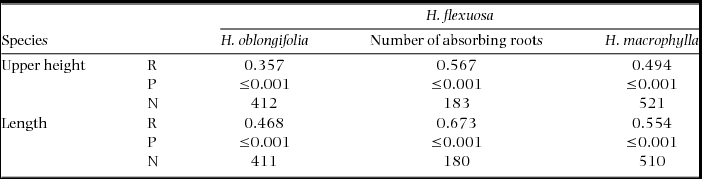
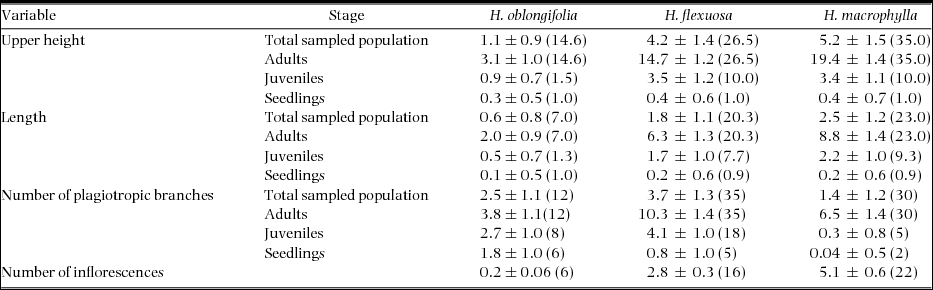
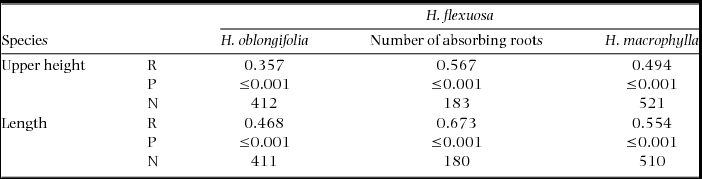
Our study species reached heights on a host of 14–35 m and total lengths of 7–23 m (Appendix 1). Length and upper heights were closely related in all species (Appendix 2), showing that height on the host is a good proxy for plant size. The average number of absorbing roots of adult individuals was 2.3–3.1 per plant, and maximum number of roots was 6–11. The number of absorbing roots increased slightly with length (Table 1). The number of plagiotropic branches (NPB) increased with upper height (UH): linearly in H. oblongifolia and H. flexuosa and exponentially in H. macrophylla (Appendix 2). This increase was linear with increasing length (L) for H. oblongifolia and H. macrophylla and quadratic for H. flexuosa (Appendix 2).
Relation between the upper height, and length, and the number of absorbing roots. Spearman's correlations were conducted for the three Heteropsis species in the Colombian Amazon. Significance: correlation is significant at the 0.01 level (two-tailed).
Leaf size (LS) was quite variable within species, increasing logarithmically with upper height (Appendix 2). Maximum leaf size ranged from 140 to 160 cm2. In brief, our study species showed gradual increase in length, leaf size, number of roots and plagiotropic branches as they climbed up host trees.
Crown exposure index increased strongly and non-linearly with upper height for the two (sub)-canopy species (H. macrophylla: n = 534, Nagelkerke r2 = 0.640, P ≤ 0.0001 and H. flexuosa: n = 481, Nagelkerke r2 = 0.592, P ≤ 0.0001; Multinomial logistic regressions), but almost no increase was observed for the understorey species (H. oblongifolia: n = 471, Nagelkerke r2 = 0.042, P ≤ 0.0001; Multinomial logistic regressions). The largest increase in crown exposure occurred between 9.5 and 17 m height. For all three species, about half of the individuals (43–50%) were strongly shaded (CE = 1), while few adults (1–5%) in the two canopy species received direct overhead light (CE = 5).
Relation of survival to height
We found that annual survival of non-climbing seedlings was very low: 28% for all three species pooled (N = 39; H. macrophylla: 17 and H. flexuosa: 22). This value differs markedly from annual survival of climbing Heteropsis seedlings, which ranged from 84 to 94%. Survival of climbing seedlings did not differ between suitable and unsuitable hosts for any of the studied species (Table 2). For H. oblongifolia and H. flexuosa, survival probability increased with the upper height (Appendix 3), but these logistic regressions explained just a small percentage of the variation. The annual survival probability based on 2 y for fallen individuals varied between 68% and 78%.
Survival in relation to upper height and suitability of the hosts of three Heteropsis species in the Colombian Amazon, using multiple logistic regressions. Significance: – = not tested; ns = P ≥ 0.05; * = P ≤ 0.05; ** = P ≤ 0.01; *** = P ≤ 0.001. The maximum upper height included in this analysis was restricted to the maximum height of unsuitable hosts: H. oblongifolia: 0.01–1.5; H. flexuosa: 0.01–8.4 m; H. macrophylla: 0.01–6.0 m. UH = upper height; Suitability = Suitable host = 1, Unsuitable host = 0.

Relation of growth to height
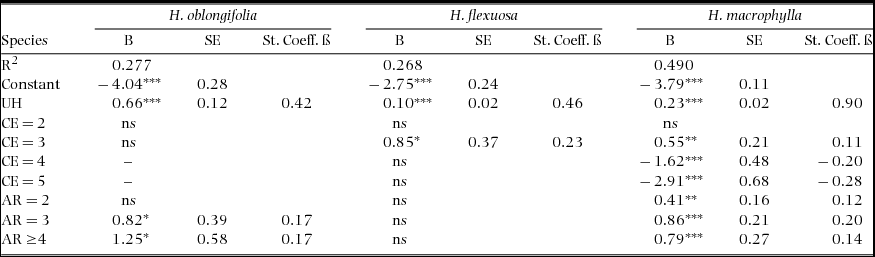
The three Heteropsis species grew slowly, and growth variation among individuals was large. In general, 2-y growth rate increased faintly with height (Figure 2). Remarkably, 31–62% of the plants did not change in size at all, dried out and then rotted, or lost the upper orthotropic branch. Average growth in upper height ranged from 0.02–0.08 m y−1 and maximum growth rate ranged from 0.8–2.9 m y−1. First, of the plants with positive growth, individuals grew no faster on suitable than unsuitable hosts (H. oblongifolia: F1–115 = 1.93, P = 0.167; H. flexuosa: F1–180 = 0.003, P = 0.960; H. macrophylla: F1–255 = 0.67, P = 0.413; ANCOVA). Second, the positive upper height growth rate was positively related to initial upper height, crown exposure and number of absorbing roots in H. macrophylla (Table 3). In contrast, in the understorey species, H. oblongifolia, the positive growth rate did not vary with respect to crown exposure, but did so with the number of absorbing roots (Table 3). These variables explained 27% to 49% of the variation in positive upper height growth. So, individuals with more access to light and a higher number of absorbing roots had more positive growth rates.
Ln-transformed positive upper height growth rate in relation to upper height, crown exposure index and number of absorbing roots of three Heteropsis species in the Colombian Amazon, using multiple linear regressions. Dummy variables were assigned to each crown index and categories for the number of absorbing roots. Significance: – = not tested; ns = P ≥ 0.05; * = P ≤ 0.05; ** = P ≤ 0.01; *** = P ≤ 0.001. Crown exposure index: 1 = no direct light (canopy closed); 2 = slight lateral direct light (small sizes canopy openness); 3 = some lateral direct light (medium sizes canopy openness); 4 = partial overhead light; 5 = almost direct overhead light or emergent crown with direct light from all directions. UH = upper height; CE = crown exposure index; AR = number of absorbing roots.
Size-dependent pattern in upper height growth of three Heteropsis species in the Colombian Amazon. Green dots represent individuals on suitable hosts and black dots represent individuals on unsuitable hosts. H. oblongifolia (a), H. flexuosa (b) and H. macrophylla (c). Note the difference in scale.
Sexual reproduction in relation to height
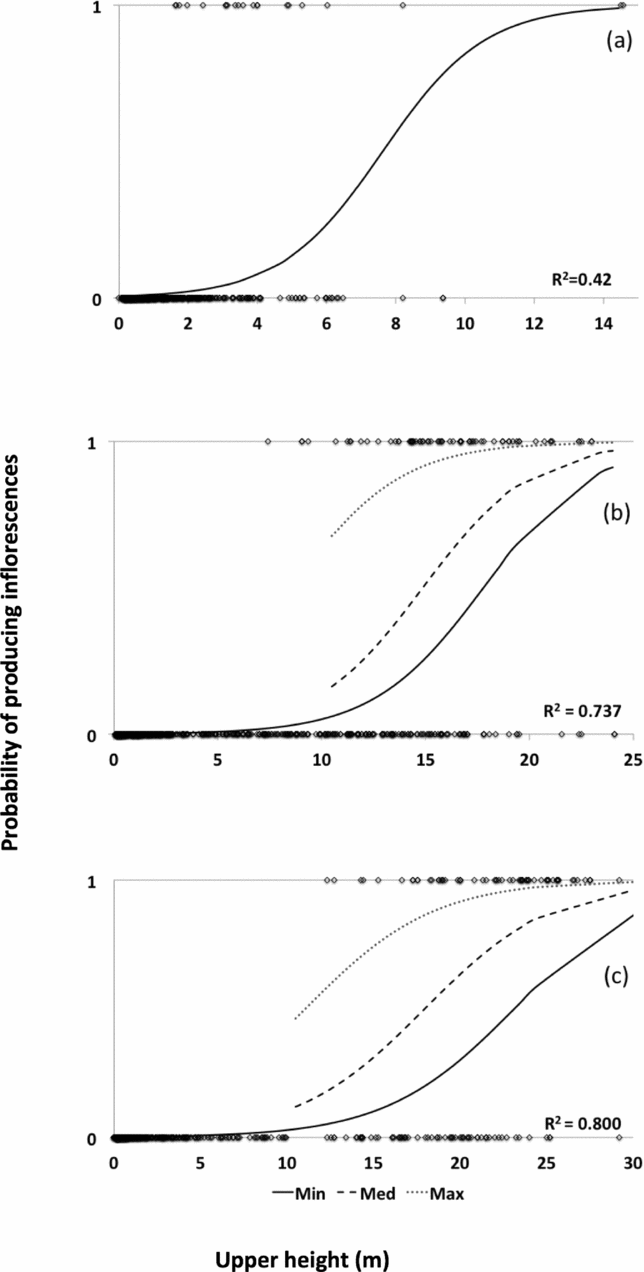
The three study species reproduced both sexually and vegetatively during the two observation years. For H. flexuosa however, the effect of the upper height did change over the 2 y (Appendix 3). The chance of being sexually reproductive was strongly related to upper height and the number of plagiotropic branches in the two canopy species (H. flexuosa and H. macrophylla), but only to upper height in the understorey species H. oblongifolia (Figure 3, Appendix 3). The canopy species produced inflorescences at ≥ 10 m upper height, while this started at 1.5 m for the understorey species. Among individuals originally classified as reproductive on the basis of height, 33% and 51% produced inflorescences for the canopy species respectively and 15% for the understorey species. The mean number of the inflorescences produced per reproductive plant ranged from 0.2 to 5 (Appendix 1).
Probability of inflorescence production for three Heteropsis specis in the Colombian Amazon as a function of upper height (UH) and number of plagiotropic branches (PB). Dots are observed values for inflorescence production; lines are fitted by multiple logistic regression. For H. flexuosa and H. macrophylla: The continuous line represents the minimum, the dashed the median and the dotted the maximum observed number of plagiotropic branches per height. H. oblongifolia (a), H. flexuosa (b) and H. macrophylla (c); multiple logistic regressions. Note the difference in scale in the upper height.
Vegetative reproduction in relation to host suitability
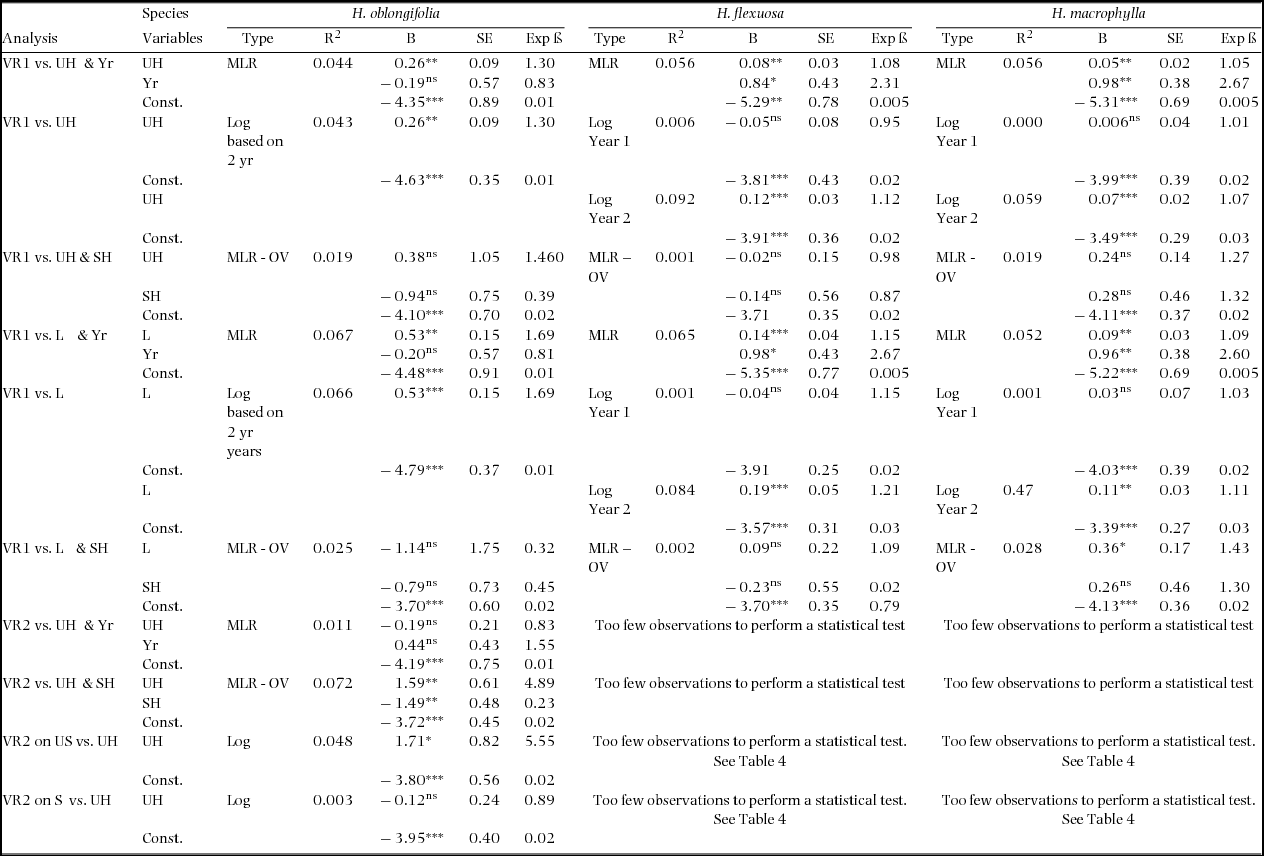
The probability of segregating into two segments based on length or height did not differ between individuals growing on suitable and unsuitable hosts (Appendix 4), but it increased with length for the three species (Appendix 4).
Heteropsis individuals on unsuitable hosts occasionally produced flagellar shoots with long internodes and reduced leaf size, which grew towards the forest floor. After reaching the ground they became terrestrial stolons without leaves. Stolons that found a new host generally lost their connection with the ortet after one to two years, becoming an independent ramet (Table 4). The probability that an individual produced a ramet that descended to the ground (VR2), and then climbed a host and split was different between the types of host in the understorey species (Appendix 4). For this species, changing host through ramet production (VR2) was significantly related to the upper height in unsuitable hosts, but not in suitable hosts (Appendix 4). We could not test for differences in the probability of this type of vegetative reproduction between years and between the two types of host in the two canopy species, due to the low number of observations. They had a low probability of vegetative propagation on unsuitable hosts, while almost no ramet production was found on suitable hosts (Table 4).
Annual probability of ramet production and of connection loss with the ortet in three Heteropsis species in the Colombian Amazon for individuals on unsuitable or suitable hosts. Observed probabilities are shown except for H. oblongifolia on unsuitable hosts, which gives a range based on a logistic regression with increasing probability with upper height.

The probability of falling (from or with the host) did not differ between the types of host in the two canopy species (H. flexuosa: χ2 = 3.53, P ≥ 0.05, df = 1 and H. macrophylla: χ2 = 2.14, P ≥ 0.05, df = 1; Pearson Chi-square). In contrast, for the understorey species it did differ between host types (H. oblongifolia: χ2 = 28.0, P = 0.0001, df = 1; Pearson Chi-square). The probability of falling was not related to upper height in any of the species (Appendix 5). The annual chance of falling ranged from 0.9% (suitable host) to 7% (unsuitable host) in the understorey species to around 2% in the canopy species. After an individual fell, the absorbing roots had to remain intact and attached to the forest floor; otherwise the plant had no chance of survival. If the plant survived, it produced shoots that eventually could climb a host and might separate from the ortet in 1–2 y. This type of vegetative reproduction occurred in all three species: 15–46% of the fallen individuals showed this type of vegetative propagation, and 43–70% of these climbed onto unsuitable hosts.
DISCUSSION
Changes in plant size and architecture with height
Our study species started their life on the dark forest floor, climbed up until they reached the understorey (H. oblongifolia) or the (sub-)canopy (H. flexuosa and H. macrophylla). Once these plants ascended a host, they extended in height, increased slowly in length, leaf size, number of roots and plagiotropic branches. Individuals that had reached the (sub-)canopy had the highest number of absorbing roots and the longest orthotropic stems.
The number of plagiotropic branches increased linearly and leaf size increased logarithmically with the upper height, but there was no change in leaf form in any of the three species. The trend shown by our Heteropsis species is an example of allomorphic or ambiguous heteroblasty (Ray Reference RAY1992, Zotz et al. Reference ZOTZ, WILHELM and BECKER2011), in which leaves change in size but not in form. Ray (Reference RAY1987, Reference RAY1990, Reference RAY1992) and Lee & Richards (Reference LEE, RICHARDS, Putz and Mooney1991) also recorded that some hemiepiphytic Araceae increased their leaf size as they reached higher positions on their hosts.
Factors influencing survival
The highest mortality (72% y−1) in our three Heteropsis species was found among non-climbing seedlings, mainly killed by falling palm leaves, branches or other debris. This was also described for Monstera species (Ray Reference RAY1976) and other plants in tropical forest understorey conditions (Clark & Clark Reference CLARK and CLARK1989, Oyama Reference OYAMA1990). Mortality also occurred when germinated seeds depleted their resources because they did not find a host in time (Ray Reference RAY1976). Non-climbing Heteropsis seedlings are still attached to their seeds. Each germinated seed has a slender stem with various cataphylls at the nodes (Soares et al. Reference SOARES, MAYO and GRIBEL2013), lacking leaves to photosynthesize (although their slender stem does), which makes the seedling much more vulnerable to exhaustion of reserves and limits its ability to recover from damage. The mortality rate of non-climbing Heteropsis seedlings was much higher than that of free-standing (not yet climbing) liana seedlings, for which mortality rates were reported of 14–17% y−1 (<30 cm length, Nabe-Nielsen Reference NABE-NIELSEN2004) to 29% y−1 (<50 cm tall; Gerwing Reference GERWING2004). Mortality risks of our Heteropsis species decreased dramatically once they climbed a host (6–15% y−1), a phenomenon also observed among lianas (Gerwing Reference GERWING2004, Nabe-Nielsen Reference NABE-NIELSEN2004). The fact that Heteropsis individuals are appressed to trunks may reduce damage and mortality from falling debris (Ray Reference RAY1976). Thus, the high mortality rate of non-climbing seedlings of secondary hemiepiphytes may constitute an important demographic bottleneck. Overcoming this high-mortality phase by quickly encountering a host is thus critical in the life history of these species.
Branch and tree-falls are frequent in tropical forests (van der Meer & Bongers Reference VAN DER MEER and BONGERS1996). The longevity of the host might thus limit the longevity of plants that depend on it (such as epiphytes, secondary hemiepiphytes and lianas) unless these plants are able to survive such events. Fallen Heteropsis individuals had a remarkably high survival (up to 78% y−1), which is substantially higher than survival of fallen epiphytes (27% y−1; Matelson et al. Reference MATELSON, NADKARNI and LONGINO1993), but comparable to survival values obtained for rattans (Putz Reference PUTZ1990) and lianas (90%; Putz Reference PUTZ1984). The survival of fallen lianas, their ability to reach the canopy again and to produce physiologically independent ramets, has been suggested to result in very long-lived genets (Nabe-Nielsen & Hall Reference NABE-NIELSEN and HALL2002). Similarly, the high survival probabilities of climbing Heteropsis individuals together with their ability to reproduce vegetatively, suggest that genets of these species may also become quite old (Balcázar-Vargas, unpubl. data).
Factors governing growth
Our study shows that the three Heteropsis species grow very slowly in height (0.02–0.08 m y−1) with a third to two-thirds of the individuals not growing at all, drying out and then rotting, or losing their upper orthotropic branches over a 2-y period. These results contrast with a study on H. flexuosa in Guyana, in which a mean height growth rate of 0.11 m was recorded during a 6-mo period (Hoffman Reference HOFFMAN1997). But in this study it was also noted that 48% of the plants did not grow (Hoffman Reference HOFFMAN1997). The slow growth rates observed in our study contrast sharply with those of fast-climbing rattans and lianas. Growth rates reported for natural rattan populations varied from 0.15 to 1.42 m y−1 (Binh Reference BINH2009, Bøgh Reference BØGH1996). For lianas, height growth amounted 0.15 to 0.94 m y−1 for five species that were experimentally supported (Putz Reference PUTZ1984) or around 0.12 m y−1 for naturally growing lianas (Schnitzer Reference SCHNITZER2005). However, the tropical liana Machaerium cuspidatum Kuhlm. & Hoehne had similar growth rates of 0.08 m y−1 for small individuals 30–100 cm tall (Nabe-Nielsen Reference NABE-NIELSEN2002). Thus, height growth rates of our Heteropsis species were generally lower than most other climbing species.
Growth rates in upper height varied widely among individuals. There was a high incidence of negative growth, with up to 27% of the plants drying out and then rotting, or a partial fall of the upper orthotropic branches. This occurred when orthotropic branches dried out, fell off because of falling debris, as a result of herbivory, or when canopy animals detached them from the host.
Positive height growth rates were found to be size-dependent, with the lowest rates among seedlings and increasing rates among juveniles and adults as they grew higher up in their hosts. The variation in positive growth rates in Heteropsis macrophylla can be explained by crown exposure and the number of absorbing roots and by just the number of roots in another species. The results of H. macrophylla are similar to those of the shade-tolerant lianas Machaerium cuspidatum and Connarus turczaninowii (Aide & Zimmerman Reference AIDE and ZIMMERMAN1990, Nabe-Nielsen Reference NABE-NIELSEN2002), and for six rattan species (Binh Reference BINH2009, Bøgh Reference BØGH1996), in which height growth rates increased with increasing light levels. Although upper height growth in Heteropsis is certainly light-limited, water limitation may play an additional role, suggested by the effect of the number of absorbing roots on height growth rate. As Heteropsis plants ascend on hosts both the number and the thickness of their absorbing roots increases, leading to higher hydraulic efficiency, defined as the amount of water transported per unit of time and pressure gradient (Burgess et al. Reference BURGESS, PITTERMANN and DAWSON2006, Martínez-Vilalta & Piñol Reference MARTÍNEZ-VILALTA and PIÑOL2003, Turriago-García Reference TURRIAGO-GARCÍA2013). In other words, as the roots increase their diameter, they are able to transport more water and therefore to sustain a larger amount of biomass (Turriago-García Reference TURRIAGO-GARCÍA2013).
High proportions of Heteropsis and tendrillate liana seedlings climb up on unsuitable hosts where they cannot complete their life cycle (Balcázar-Vargas et al. Reference BALCÁZAR-VARGAS, PEÑUELA-MORA, VAN ANDEL and ZUIDEMA2012, Nabe-Nielsen Reference NABE-NIELSEN2001, Putz Reference PUTZ1984, Putz & Holbrook Reference PUTZ, HOLBROOK, Putz and Mooney1991, Sakai et al. Reference SAKAI, NOMIYA and SUZUKI2002). Because individuals growing on unsuitable hosts have limited vertical support, and they tend to invest more resources in producing shoots that move downwards searching for new hosts, we expected that plants on suitable hosts would grow faster than those on unsuitable ones. However, no significant differences in the upper height growth rates between unsuitable and suitable host were found in any of the species. The suitability of the host did not affect survival and growth in the short term of our three Heteropsis species. In contrast, lianas were found to grow two to seven times faster when suitable supports were experimentally provided (Putz Reference PUTZ1984).
Sexual and vegetative reproduction
The three study species reproduced both sexually and vegetatively during the 2 y of observations. Like many other plants, Heteropsis species must reach a threshold size before beginning to reproduce (Gross Reference GROSS1981, Klinkhamer et al. Reference KLINKHAMER, DE JONG and MEELIS1987, Méndez & Obeso Reference MÉNDEZ and OBESO1993, Ohlson Reference OHLSON1988, Primack & Hall Reference PRIMACK and HALL1990). The probability of inflorescence production for the canopy Heteropsis species increased with the upper height and the number of plagiotropic branches. Plants with the same upper height but with more branches could produce more inflorescences, because they are only formed on those branches.
The probability of segregating into two segments in our Heteropsis species did not differ significantly on the two host types, although the average and maximum length between the two differed considerably. Nonetheless, the probability of segregating did increase with the length in the three species. In the field we observed that, without signs of animal or fungus attacks, small stem sections slowly changed from green to black, after which the split took place. We hypothesize that because Heteropsis (Turriago-García Reference TURRIAGO-GARCÍA2013) and Monstera species (Lopez-Portillo et al. Reference LOPEZ-PORTILLO, EWERS, ANGELES and FISHER2000) have conductive vessels that increase in diameter as the orthotropic stem increases in height or grows (acropetal growth), the models of the theoretical pressure gradients that a plant should have are reversed in these individuals. This implies an increase of the possibility that the water column is exposed to greater tension, raising the likelihood of breakdown of the water column. The longer the orthotropic stem, the larger the difference between the bottom and the top of the stem will be. Therefore we hypothesize that this increases the likelihood of cavitation and embolism (Lopez-Portillo et al. Reference LOPEZ-PORTILLO, EWERS, ANGELES and FISHER2000, Turriago-García Reference TURRIAGO-GARCÍA2013, Tyree & Sperry Reference TYREE and SPERRY1989).
As the majority of the Heteropsis seedlings climbed unsuitable hosts, these plants were obliged to search for a new host. Vegetative propagation allows Heteropsis to move from an unsuitable host to a suitable one (Balcázar-Vargas et al. Reference BALCÁZAR-VARGAS, PEÑUELA-MORA, VAN ANDEL and ZUIDEMA2012). The probability that an individual produced a ramet that descended to the ground, and then climbed a host and split, was significantly different between the two host types (unsuitable vs. suitable) in H. oblongifolia. Changing host through ramet production was size-dependent on unsuitable hosts, but not on suitable hosts. In contrast, the canopy species had a low probability of vegetative propagation on unsuitable hosts, while almost none was found on suitable ones. This type of vegetative propagation was described for other aroids (Andrade & Mayo Reference ANDRADE and MAYO1998, Reference ANDRADE and MAYO2000; Ray Reference RAY1976, Reference RAY1992). In the three Heteropsis species, this behaviour seems more a dispersion-propagation strategy to find a suitable host than a growth strategy to increase the size of the genet (Balcázar-Vargas et al. Reference BALCÁZAR-VARGAS, PEÑUELA-MORA, VAN ANDEL and ZUIDEMA2012, Ray Reference RAY1976).
Heteropsis individuals that have climbed a host, experience the risk of falling from the host or the death of the host. The probability of falling did not differ between host types for the two canopy species, whereas the understorey species did present significant differences. This divergence might be attributed to the differences in the definition of host suitability between the canopy and understorey species: where unsuitable hosts of H. oblongifolia are those ≤1.5 m, for H. flexuosa and H. macrophylla these are ≤9 m height. Seedlings and saplings ≤1.5 m run a higher risk of dying or being buried under branches or fallen debris than small trees ≤9 m (Clark & Clark Reference CLARK and CLARK1989, Oyama Reference OYAMA1990, Zuidema & Boot Reference ZUIDEMA and BOOT2002).
The three Heteropsis species showed sprouting after falling from or with a host, especially H. oblongifolia (with a probability of 46%). Although fallen epiphytes may not die immediately, their chance of ever producing successful progeny is virtually zero (Hietz et al. Reference HIETZ, AUSSERER and SCHINDLER2002). Lianas, however, vigorously sprout after falling in natural and selectively logged forests (Appanah & Putz Reference APPANAH and PUTZ1984, Putz Reference PUTZ1984). The capacity to survive falls from the canopy confers a considerable advantage on lianas in that they attain a degree of immortality – at least in a biomechanical sense (Putz & Holbrook Reference PUTZ, HOLBROOK, Putz and Mooney1991). To conclude, we hypothesize that vegetative propagation may allow Heteropsis to survive hydraulic failure, and acts as a dispersion-propagation strategy to find a suitable host and reach the canopy again after falling.
ACKNOWLEDGEMENTS
We thank Marinus Werger and J.D. Turriago for invaluable comments and contributions on versions of the manuscript. We are grateful for valuable comments of our reviewers: Robert Lawton and Ian Turner. M.P.B-V. was supported by the Netherlands Organization for Scientific Research (NWO—Mozaïek programme, no. 017.003.007), Alberta Mennega Stichting, Miquel Fonds and Tropenbos-Colombia. P.A.Z. was supported by ERC grant 242955. We are particularly grateful to Maria Cristina Peñuela, Adriana Aguilar and Eliana Jimenez for their logistical support and collaboration in El Zafire, to Gustavo Hichamón, Sara Flores and Edilberto Rivera for their field assistance and to Cecilia Prada and Ever Kuiro for their crucial role in the phenology data collection. We acknowledge logistic and institutional support from Carlos Rodriguez and R. Boot (Tropenbos-Colombia).
Mean, SE and maximum values observed of upper height on a host, length of the individual, plagiotropic branches and number of inflorescences in three Heteropsis species in the Colombian Amazon.
Statistical analyses performed to determine changes in architecture in relation to height/length in three Heteropsis species in the Colombian Amazon. Significance: ns = P ≥ 0.05, * = P ≤ 0.05, ** = P ≤ 0.01, *** = P ≤ 0.001. Type of analysis: Ln: logarithmic regression; Linear: linear regression; Exp: exponential regression; Quadr: quadratic regression. Variables: L: length; LS: leaf size; NPB: number of plagiotropic branches; UH: upper height.
Regressions performed to calculate the survival and fecundity rates in relation to upper height in three Heteropsis species in the Colombian Amazon. Significance: ns = P ≥ 0.05, * = P ≤ 0.05, ** = P ≤ 0.01, *** = P ≤ 0.001. Type of analysis: Log: logistic regression; MLR: multiple logistic regression. Variables: NPB: number of plagiotropic branches; PIP: probability of inflorescences production; S: survival; UH: upper height; Yr: years.
Regressions performed to determine the relation between vegetative reproduction vs. year, suitability of the host, upper height and length in three Heteropsis species in the Colombian Amazon. Significance: ns = P ≥ 0.05, * = P ≤ 0.05, ** = P ≤ 0.01, *** = P ≤ 0.001. Type of analysis: Log: logistic regression; MLR: multiple logistic regression; MLR – OZ: multiple logistic regression – only overlapping zone: H. oblongifolia: only individuals ≤ 1.5 m (overlapping zone US and S host); H. flexuosa: only individuals ≤ 8.4 m (overlapping zone US and S host); H. macrophylla: only individuals ≤ 6.0 m (overlapping zone US and S host). Variables: L: length; SH: suitability of the host; S: suitable hosts; US: unsuitable hosts; UH: upper height; VR1: probability an individual split in two segments; VR2: probability that an individual produced a ramet that descended to the ground, and then climbed a host; Yr: year.
Probability of falling in 2 years (from or with the host) in relation to upper height of three Heteropsis species in the Colombian Amazon, using logistic regressions. Significance: ns = P ≥ 0.05, * = P ≤ 0.05, ** = P ≤ 0.01, *** = P ≤ 0.001. Variables: UH: upper height; US: unsuitable host; S: suitable host.