

1 Introduction
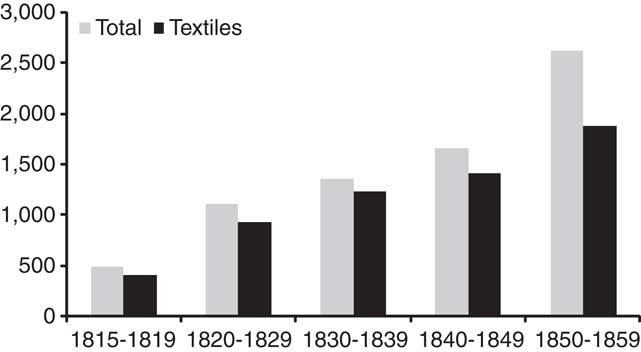
Very little has been written about the economic history of Chile and the River Plate provinces during the first half of the 19th century, «probably the most under-researched period in Latin American history» (Miller Reference Miller1993, p. 71). Consequently, the historiography of economic relationships between Britain and the Southern ConeFootnote 1 during this period largely ignores trade. Yet neither direct British nor portfolio investment was important during c.1810-1859. After the British loans to Buenos Aires and Chile in the 1820s (which were on a very limited scale, that is, around £1.4 million in real value), nothing was lent to the Southern Cone governments until the 1860s. Furthermore, British direct investment in Chile and the River Plate in mining and in farming was very restricted before 1860 (Rippy Reference Rippy1948, pp. 11, 15-17; Ferns Reference Ferns1950, p. 204; Mayo Reference Mayo1987, p. 236; Irigoin and Schmit Reference Irigoin and Schmit2003, p. 21). In contrast, between 1815 and 1859, Britain's exports to Chile and the River Plate amounted to £70 million in aggregated values (Figure 1). As these valuations are on a free-on-board basis, profits need to be added, as well as gains from packing, shipping freights, general commissions, insurance and credit. The value of visible trade and associated invisible earnings is therefore well beyond £70 million. During this period, Britain's exports to Chile and the River Plate accounted for 3 per cent of Britain's exports to the world, the Southern Cone being the second most important destination within Latin America (second only to Brazil, which took £118 million during the same period)Footnote 2.
UNITED KINGDOM EXPORTS TO THE SOUTHERN CONE, 1815-1859: ANNUAL AVERAGES IN DECLARED VALUE (£m)
Source: Llorca-Jaña (Reference Llorca-Jaña2009a, p. 604).
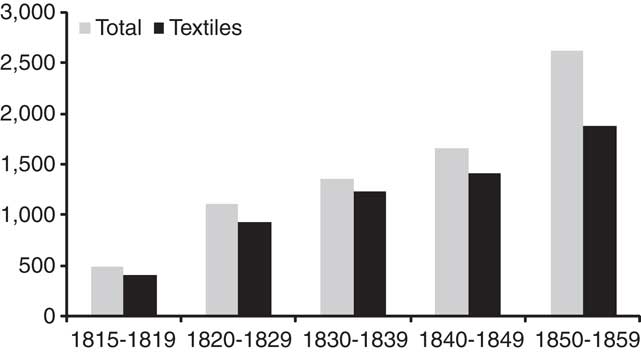
As displayed in Figure 1, between 1815 and 1859, textiles comprised over 80 per cent of British exports to the Southern Cone. However, there are no specific considerations of textile exports to any Latin American market after independence. The neglect these exports have suffered may be the result of British exports being regarded as a variable diminishing or increasing according to the situation on the spot. The most widely accepted view is that early British textile exports after the Napoleonic Wars glutted the markets of the recently independent republics and that, thereafter, the small, low-income and scattered rural population of the Southern Cone had little to offer in exchange. Furthermore, it was put forward that the high internal transport costs made this former backwater of the Spanish Empire nothing but a marginal market. According to this view, the economies of the Southern Cone are regarded as solely «responsible» for the supposedly low volume of British exports to this region. Post-1850 developments, such as an increasing European demand for raw materials, the laying of long-distance railways in the Southern Cone and European migration on a sizeable scale, were regarded as the reasons for the subsequent growth of Britain's exports to Chile and the River PlateFootnote 3.
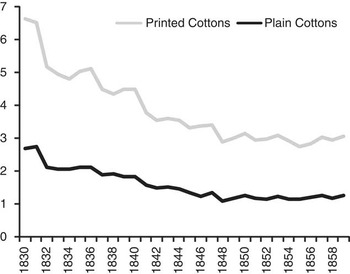
Yet, to explain the growth of British exports to the Southern Cone solely in terms of developments taking place on the spot would be inexcusable Eurocentricism. At the beginning of the period of our study (c.1810), Britain was not yet an overwhelming industrial power and Latin American imports from Lancashire and Yorkshire were still costly. From the 1810s, there were material technological advances taking place in the British textile industries, which were translated into dramatic export price falls (see, e.g. Mathias Reference Mathias1983, pp. 271-278; Halperín-Donghi Reference Halperín-Donghi1987, p. 8). Figure 2 illustrates this phenomenon for exports of cottons to the Southern Cone, the main staple exported by Britain to my markets during this period. Furthermore, British exporters benefited from other important developments such as improvements in shipping (i.e. in shipbuilding, cartography and communications)Footnote 4, fall in freight ratesFootnote 5, gradual introduction of free trade in BritainFootnote 6 and, finally, the advanced packing of textiles so as to make bales waterproof. This last positive development fostering British exports to the Southern Cone is the main topic of this paper.
UNITED KINGDOM COTTONS EXPORT PRICES TO THE SOUTHERN CONE (PENCE PER YARD), 1830–1859
Source: Own elaboration from CUST/8.

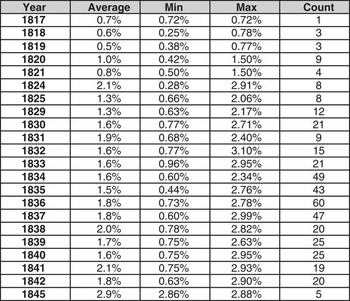
It is difficult to account for economic historians’ lack of attention to the importance of the packing of textiles in exports to distant regions; there seems to be not even a single reference in the secondary literature. This is all the more surprising because packing costs could be an important addition to export costs (Figure 3) and, above all, because all the extant evidence from the business correspondence of British exporters and British mercantile housesFootnote 7 in the Southern Cone indicates that, from the 1810s to the 1830s (in particular), textiles frequently arrived greatly damaged by saltwater or freshwater. In turn, this temporary inability of British exporters to ensure that textiles arrived in sound condition to remote regions constrained the growth of British exports to the Southern Cone during c.1810-1830s by discouraging British manufacturers from consigning to these markets. This period in British textile manufacturing was typically characterised by small and medium businesses (Chapman Reference Chapman1985, pp. 230, 231; Chapman Reference Chapman1992, p. 181). Competition among textile manufacturers was high and profit margins thin (Chapman Reference Chapman1996, p. 84). If a given textile cargo arrived seawater damaged, profits were wiped out and this manufacturer would probably not consign again to this remote market.
PACKING COSTS AS A SHARE OF THE INVOICE COST. A SUMMARY FOR A SAMPLE OF 427 TEXTILE SHIPPING OPERATIONS FROM LIVERPOOL TO BUENOS AIRES, 1817–1845
Sources: own elaboration from transactions recorded at Green Hodgson & Robinson papers and Owen Owens & Son papers.

In 1830, for example, Bashall & Co., a textile manufacturer of Manchester, sent a first consignment to Huth, Gruning & Co. of Valparaiso, who upon receiving the goods wrote home reporting that «the domesticks [sic] of Messrs. Bashall & Co. is one of the best parcels we have received»Footnote 8. Unfortunately for all involved, the domestics arrived severely seawater damaged and Bashall & Co. never consigned again, despite Huth's requests for further consignments. This was not an isolated example. In 1825, Green & Hodgson received a mildewed cargo of nankeens and satteens from a first-time consignor, and despite writing to this supplier that «we trust that you will not let this first failure deter you for shipping again», the manufacturer never consigned againFootnote 9. Even the mighty Fielden Brothers of Manchester suffered:
We much regret that the damaged state in which these goods arrived should have proved so prejudicial to the sale, but we trust that as both from Chile and Peru large shipments of white goods and more particularly domestics are recommended, you will continue to supply our friendsFootnote 10.
Despite Huth's entreaties, the Fieldens never consigned again to Huth's establishments in the Pacific.
Thereafter, during the 1830s, important improvements were developed in textile packing to protect the contents from water damage and, as a consequence, «particular averages» were far less common. For those unfamiliar with packing and marine insurances, «particular averages», as the term is used here, happened «when the goods arrive in a damaged state … [and] the measure of the loss shall be the difference between the value of landing when sound, and the value as damaged» (Martin Reference Martin1823, p. 126)Footnote 11.
As a direct result of better packing and shipping advancesFootnote 12, insurance premiums for textile exports fell significantly. During the early 1820s, premiums at Lloyds for textile shipments from Liverpool to Valparaiso were around 5 per cent of the invoice cost value of the cargoes, but in the mid-1840s the rate gradually decreased to 1.625 per centFootnote 13. Yet, until recently, the literature lacked reference not only to packing improvements but also to this significant reduction in the costs of marine insurance. This is an additional and material development taking place in Britain explaining the growth of exports to the Southern Cone and other markets of the «new world» (Llorca-Jaña Reference Llorca-Jaña2010, pp. 25-35). It may be the case that packing has been so overlooked in studies of Anglo-South American trade because it was not a big issue for exports to continental Europe or to North America, where the lion's share of British exports went before the Napoleonic Wars.
2 Packing of Textiles: Preliminary Remarks
It has already been established that during the first half of the 19th century, textiles were the backbone of British exports to the Southern Cone. It has also been noted that textile exports have received very little attention. Thus, there is a crucial stage in the market chain, which has been completely neglected in the historiography, namely, packing. The impact that improvements in packing had on British textile exports is treated in full in section 3, but some preliminary remarks are needed.
First, British textiles heading for the Southern Cone were packed by the manufacturer, usually following specific instructions from the merchant handling the exports, or packed by a specialised intermediary, or forwarded to the merchant who would do the packing on behalf of the manufacturerFootnote 14. It all depended on who was taking the most risks in the export operation. If consignee merchants were making advances on consignments, then most probably they would take care of both insuring and packing, except when the manufacturer had a good reputation for packing well. If, instead, the goods were shipped at the exclusive risk of the manufacturer, the merchant had less interest in their packing.
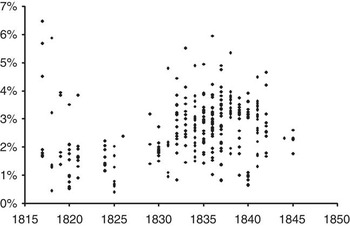
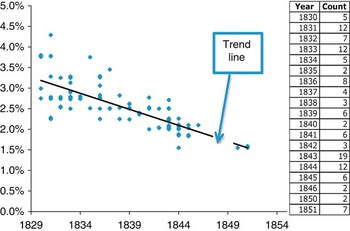
Second, the mode of packing was not a trivial matter. Figure 3, which contains a summary of the average cost of packing for a sample of over 400 textile shipments from Liverpool to Buenos Aires, shows that the costs of packing as a proportion of the invoice cost could be anything between 0.25 and 3.1 per cent. That is, packing could be more expensive than the cost of freight from Liverpool to Buenos Aires (most usually costing 2-4 per cent, as seen in Figure 4), and sometimes even more expensive than insurance charges (most usually costing 1.5-4 per cent; Llorca-Jaña Reference Llorca-Jaña2010, p. 35; see also Figure 5). In turn, the great diversity in packing costs reflected the willingness of exporters to take or avoid risk. In 1837, for instance, for all export operations included in our sample, packing costs accounted for between 0.6 and 3 per cent. This is not a result of cost differences for a given packing material but reflects the differences in the costs of alternative packing materials.
SHIPPING FREIGHT RATES AS SHARES OF INVOICE COSTS: A SAMPLE FOR 290 SHIPMENTS OF TEXTILES FROM LIVERPOOL TO THE RIVER PLATE, 1817-1845
Sources: Own elaboration from transactions recorded at Green Hodgson & Robinson papers, Owen Owens & Son papers and Hugh Dallas & Co. archive, loose papers.

Packing costing 0.5 per cent was made of ordinary canvas, whereas packing that was close to 3 per cent was either very good tarpaulin or tin boxes. Why would one textile exporter decide to spend 0.5 per cent of the invoice costs of the goods on packing while another shipping would choose packing costing over six times more for similar fabrics? The cheapest packing would not offer much protection against seawater damage, but should the goods arrive in sound condition the savings were substantial (i.e. around 2.5 per cent). Likewise, expensive packing would ensure most of the time that textiles were delivered as dry as when they had been packed in Britain and, therefore, there was probably no need to insure the goods against seawater damage (thus saving the premium). These were all subjective decisions to be taken by exporters, and they reflected the level of risk avoidance or risk tolerance of individuals. For example, in 1839, Huth's Liverpool branch reported that cottons sent by Longworthy (of Manchester) to Valparaiso were «packed with great care in tarpaulin and Mr Longworthy expects that the insurance will be done at a very low figure or else he would rather not insure them against particular average», fully trusting tarpaulin to protect against seawater damagesFootnote 15.
3 The Impact and Extent of Seawater and Freshwater Damages on Textiles
There are not enough words, charts or tables to stress how serious an issue seawater damage was for British textile exporters after the Southern Cone was opened to direct and legal trade with Britain (c.1810). Probably the best way of illustrating the seriousness of this issue is to provide the reader with a few illustrative examples. Starting in the River Plate in 1809, one of the first British merchants to open a house at Buenos Aires reported that his first textile cargo arrived completely rotted by seawaterFootnote 16, and that most of the shipments that followed did not do anything betterFootnote 17. Another merchant reported 10 years later to his main woollen supplier that most of their goods had arrived seawater-damagedFootnote 18. Three years later, writing to his main cottons provider, the same merchant reported that most bales «were found to be very badly damaged by saltwater»Footnote 19. On another occasion, a London cambric supplier received the news that a cargo had been sold for $285 per bale but that «the same goods had they arrived in sound state would have produced according to certificate $515»Footnote 20. At the same port in 1835, a Manchester merchant was «sorry to learn the Hannah Moore has damaged her goods, we suppose that they must be very materially injured from the most miserable prices you have let them go by auction»Footnote 21. Copious evidence for other merchant houses in Buenos Aires shows a similar pictureFootnote 22. No wonder then that in one of the first meetings of British merchants at Buenos Aires ever reported by The British Packet and Argentine News, one of the four points treated was the procedure to follow when British merchants were called to survey seawater-damaged textilesFootnote 23.
On the other side of the Andes, in Valparaiso, the situation mirrored that in Buenos Aires: textile cargoes arriving seawater damaged was a habitual issue. On one occasion, in the mid-1830s, a whole cargo of woollens sent by Rawson & Saltmarshe, a prominent merchant-manufacturer of Halifax, to Huth, Gruning & Co. arrived badly damaged by seawater. The original invoice cost of the cargo was $4,533, but after being sold in public auction the goods produced only $2,701Footnote 24. In previous years, there are plenty of other examples within the business correspondence of these British merchants (Huth & Co., with headquarters in London)Footnote 25. Indeed, within the Huth papers, in nearly every month of correspondence for the period c.1827-1830 (the earliest period for which correspondence linked to Chile is available), mention is made of cargoes arriving seawater damaged to Chile. Likewise, for other British mercantile houses in Chile, the Valparaiso judicial papers contain plenty of disputes about this recurring issue (ANCH-AJV)Footnote 26.
It may be thought that, if cargoes were insured, exporters would escape most such losses. To a certain extent, this was the caseFootnote 27. Nonetheless, merchants and manufacturers were automatically deprived of potentially handsome profits from the damaged goods had they been landed undamaged. Besides, as noted by Huth: «we cannot forget that every [insurance] claim of £100 causes us a loss of £12, which independent of other considerations, gives us as much interest in providing against their occurrence [seawater-damage], as the underwriters themselves»Footnote 28. Losses on account of marine insurance claims for damaged textiles were due to brokerage fees, charges for producing a certificate of damage, a certificate of market value in a sound stateFootnote 29 and a certificate of exchange rateFootnote 30. Furthermore, obtaining compensation from underwriters was always a longFootnote 31 and tedious process. Finally, even if the goods arrived damaged, exporters had to pay all the associated import duties and sales commissions as if the goods had arrived in a perfect stateFootnote 32.
In addition, although damaged goods were sold at public auctions (a practice enforced by underwriters), guarantee charges (which supposedly only applied when selling on credit), as well as storage charges, could not be avoided by British consignors. As explained by Huth & Co. to one of their textile suppliers:
You may be sure that the charge for guarantee and storage would not have been made by our friends if nor risk or expense had been incurred, but the fact is that although sales at auction are nominally for cash, yet credits for a fortnight, a month and longer are generally given … As regards the storage we believe the goods in question have been in the store for more than a month, so that the charge could not be avoidedFootnote 33.
More importantly, after being sold in public auctions at trifling prices, the seawater damaged goods depressed the market prices of sound goods. Seawater-damaged goods were not perfect substitutes for sound goods, but there was still a significant degree of consumption substitution. Indeed, Huth's agent in Valparaiso reported that the Dyson arrived with great:
Quantities of damaged goods, which are now selling off at auction, and producing the most injurious effects upon our market. Our sales for home consumption of the same description of goods must naturally become more confined and our prices keep down by such an overflow of damaged fabricsFootnote 34.
Had the reader thought that seawater-damaged textiles had to be thrown away, then witness this fascinating story. In late 1840, the Captain of the British fishing brigantine Mary Ann (then stationed in the Malvinas), after having heard of the wreckage of the Galston, decided to go to the wreck place and to recover part of the cargo:
Having found the wreck in a totally deserted condition … he succeeded in recovering about five thousand pieces of various descriptions of cottons, woollens, &c., with which he returned to the Falkland Islands, there disembarked the goods, had them washed in fresh water, dried, and reloaded, and has brought them to this port, where he desires to sell the goods for the benefit of all the parts interestedFootnote 35.
Associated with this problem was a further inconvenience: underwriters enforced the public auction's sale of all the goods included in the policy, even if some of them had escaped damage. This point was well explained in a letter to the editor of The British Packet and Argentine News:Footnote 36
Another cause which has for a time materially affected our market has been the very extensive sales by public auction of damaged goods, or said to be so, for account of the underwriters, whereas about 7/8 of the contents of the packages have been as sound as the day they were shipped; this abuse is of long standing here, and always has the most pernicious influence upon our market, as at these sales the shopkeepers can supply themselves generally with sound goods … at lower rates than what they can be sold at in bondFootnote 37.
On the other hand, underwriters were reluctant to insure for «particular averages» on routes where insurance claims for water damage were made too often. The limits were clear. In the early 1830s, as a result of the mounting claims for «particular averages» received by marine insurers during the first stages of legal and direct commercial intercourse between Britain and the Southern Cone, many British underwriters ceased to accept policies against «particular averages» if textiles were not packed in tin cases or good tarpaulin (otherwise offering insurance against «total loss» only). In this context, effective packing of textiles acquired great importance, particularly for exporters reluctant to take risks.
Under these circumstances, the availability of waterproof packing was a relevant factor for those exporting to the Southern Cone. The quality of the «envelope» for textiles determined whether they would arrive dry, or partially damaged or completely wet. There were two options: waterproofed or soaked. As a prominent British exporter regarding cottons supplies explained:
It is difficult for the underwriters to point out the mode in which Messrs. Howard's [cotton] goods should be packed, but it is clear that their present method affords no protection whatever, for almost every shipment of theirs has been landed in a damaged state; there must be a great difference in the quality of packing, for the goods of Messrs. Du Fay & Co. [also cottons] have invariably arrived sound for the last three years, although they have often been shipped in the same vessels with Messrs. Howard's, which shows that the fault must be in the packingFootnote 38.
Likewise, the same merchants remarked to one of their main woollens suppliers, who used to pack solely with good tarpaulin, that «the Mary Walker had arrived at Valparaiso, and we regret to say, delivered her goods in a very damaged condition, many quite rotten; we hope that your 2 bales will have escaped, as usual»Footnote 39.
4 The Main Sources of Risk For Textile Exports
To better understand both the recurrence of seawater damage and the importance of textile packing, we ought to take into consideration how precarious the transportation and storage of goods in transatlantic trades was during the first half of the 19th century. Let us start with the physical path followed by a textile truss from a British manufacturer to the final consumer in the Southern Cone and identify the main risks of water damage during its journey. The first risk lay in the packing process itself, which presented some technical difficulties in reducing moistureFootnote 40. This was a matter for serious concern, as reported by a local house to one of its suppliers:
you must be careful not to have the goods packed up in the slightest manner damp or heated. We say this because, although packed in tin & consequently impervious to moisture on the voyage, a number of pieces … turned out slightly mildewedFootnote 41,
adding that
this mildewing evidently arises from the goods having been packed too fresh from the calendars, either in a heated or particularly damp state as neither the paper in which the pieces were wrapped nor the cases externally exhibited the slightest symptoms for access of moistureFootnote 42.
The next risk was to be found in the manufacturer's storehouse. Once the goods were finished, they were usually stored for some time when not sent immediately to the Mersey. It would be reasonable to think that early industrial Britain's warehouses were good enough to keep rain and moisture away from trusses. Though this may usually have been true, textiles were damaged, as a Liverpool merchant exporting to Buenos Aires reported: «five of the bales … appear to have been placed in a damp warehouse as the hoops are rusted and the canvas discoloured. The master of the Fame refused to sign for them unless a letter of indemnity was given to him»Footnote 43. Similarly, as late as 1840, complaints were made to a manufacturer producing for the River Plate market «that nearly the whole … of the bocking [coarse woollen baize] delivered today have got wet by the rain which fell last night. The tillots are quite spoiled and they will require to be retillotted»Footnote 44.
Third, bales from both Lancashire and Yorkshire were sent to Liverpool by canal, carriage or train. During the period of our study, we can reasonably assume that this phase was probably the least risky; nonetheless, some precautions had to be taken. For example, in 1824, an exporter to the Southern Cone reported to one of his suppliers that «the flannels advised … just arrived and have suffered some damage» during transportation within BritainFootnote 45. Fourth, once the manufactures had arrived in Liverpool, they were most usually stored in dock warehouses or left on docksides before being loaded. In the latter case, the risks were obviously higher, as rain could easily damage a whole cargo that had been inadequately packed. In one case in 1839, which is equally relevant to the textile trade, Huth & Co. reported a sugar cargo being severely damaged by rain at Liverpool while being loadedFootnote 46.
Until the trusses were nearly on board, it would seem that they did not require particular packingFootnote 47. However, when trading with South America, many perils lay ahead. With the Southern Cone being so far away from Britain, shippers at Liverpool (by far the most important British port trading with the Southern Cone) tried to maximise the tonnage taken on board, paying little attention to stowageFootnote 48. As Huth & Co. explained to one of their suppliers after a long run of bad deliveries: «[particular] averages have been very numerous on the ships from Liverpool to the Pacific within the last few years, chiefly owing to the careless and injurious mode of storing the goods»Footnote 49. Early on, another merchant had a similar opinion about these shippers: «the Liverpool ships, I am sorry to say, discharge their cargoes in a very bad state … I conceive the risk by them to be considerable more than by vessels from London»Footnote 50.
By overloading vessels, Liverpool shippers generated unbearable pressure on the wooden hull's joints, which resulted in leaks and, therefore, in «particular averages» for textile cargoes. Owing to this behaviour, in the mid-1830s, for example, there was a nasty turn in the relationships between Huth & Co. and some Mersey shippers:
some underwriters can prove the damage to be chiefly owing to the mode of storage adopted at Liverpool by the persons who are in the habit of chartering the ships in the lumps, and have no other interest but to screw as many goods into them as they will hold, the necessary consequence of which is that the seams of the ship give way and admit the seawaterFootnote 51.
The story ended with Huth & Co. «marking and punishing» bad shippers «to correct the evil»Footnote 52. The strategy used is summarised as follows:
It is unfortunately not in our power to exercise much influence with the ship owners at Liverpool, who alone are the real authors of the evil, and who alone can effectually correct it … We propose in the first place that our agents in Liverpool should ship no goods whatever in such vessels as we may point out to them … In the next place we shall decline giving such ships any homeward freight whatever, either of specie, bullion or produce, as far as it may be possible to avoid doing so without delaying our remittances too much. With strict attention to these points we think they cannot fail to produce at least some change for the better … We are quite sure that our refusal to ship money by the obnoxious vessels will prove of some avail as we are the largest exporters on the coastFootnote 53.
Huth & Co. were not alone in their war against unscrupulous shippers. Gibbs & Sons, one of their main rivals in the West Coast, joined them:
The John Brooks, one of the regular ships in the line to the West Coast, has again made very heavy average on her outward voyage. This has been so repeatedly the case, that according to the rules & principles laid down for that branch of shipping she has forfeited her right, & we have to request that you will in our name protest against her being again put on the berth. We have spoken on the subject to Messrs. Gibbs, who have pioneered to write respecting the same to their Liverpool friends, & there is not doubt that it is necessary to be very strict on this respect if we wish to avoid recurrence of the disgraceful averages on shipments to the PacificFootnote 54.
Until the 1840s, British exports to the Southern Cone were transported in relatively small wooden sailing vessels, sometimes of just 150 tons registered and seldom more than 300 tons. These precarious vessels had to face not only the usual hazards of any deep-sea passage, but also two other major natural perils. These were, on the one hand, the pampero winds in the River Plate area and, on the other, for those continuing to Chile, the ferocity of the weather at Cape Horn or in the Strait of Magellan. The pampero, or «hurricane of La Plata», proved to be devastating for many vessels involved in the United Kingdom–Southern Cone trades. D'Orbigny, after arriving at Montevideo in 1826, was impressed by the great number of wrecked and damaged ships he saw in the River Plate after the port had been hit by pampero winds (D'Orbigny Reference D'Orbigny1945, p. 44). As an American seaman after experiencing a terrible pampero noted: «a new and beautiful English bark, that had left her anchorage for Buenos Ayres the night before, we saw two days afterwards; but she was nothing but a dismantled hulk, with only the stump of her mizzenmast left: every spar had been blown away, and one of her men killed by a falling mast» (Bishop Reference Bishop1869, pp. 32-34). This coincides with Beaumont's more poetic narrative: «I can confirm the fact of the elasticity of the pamperos; their vigour is proverbial, blowing down houses, and destroying the shipping in the river — nay, it may seem blowing away the mighty river itself» (Beaumont Reference Beaumont1828, p. 47).
If the pampero was respected, nothing caused more fear among sailors than Cape Horn, «a maritime graveyard for centuries» (Rydell Reference Rydell1952, p. 1). In the words of one of the most eminent British maritime historians: «no ship ever approached the latitude of the Horn without carefully preparing for the extreme limit to which bad weather could go» (Lubbock Reference Lubbock1927, p. 94). Indeed, a local British merchants’ newspaper claimed — with some exaggeration — that «being situated in the West of the American continent, beyond the tempestuous ocean which lashes Cape Horn, Chili has been neglected, with regard to commerce been always unknown»Footnote 55. No doubt, then, vessels engaged in these trades were greatly exposed to seawater and rain floods, liable to unexpected and improvised repairs and, ultimately, to wreck. It can be safely stated that during the first decades of commercial intercourse between Britain and the republics, most textile bales arrived at the ports of Chile and the River Plate after being in permanent contact with water. Ordinary canvas — extensively used to pack bales by British textile exporters to nearby markets — provided no protection whatsoever to the staples exported by Britain to the region.
Furthermore, the arrival of vessels did not mean that perils had now passed: bales were still exposed to the dangers of unloading. This was done by hand, using insecure lighters and cartsFootnote 56, which greatly exposed packages to more contact with seawater and river water, not to mention the perils of the rainy seasonFootnote 57. As an eminent Chilean historian observed, Valparaiso's labourers unloaded vessels with the seawater covering half their bodies and sometimes even their shoulders, carrying bales of over two quintals each (Encina 1945-Reference Encina1952, p. 185). After being unloaded, goods were kept in improvised stores, which further exposed bales to rain damageFootnote 58. Finally, textiles were redistributed from Buenos Aires or Valparaiso to the interior, not in coaches, boats or trains as in Britain or in continental Europe, but mostly on mule back, which entailed an additional risk of water damage. After exposure to all these risks, it is not surprising then that before the 1830s seawater damage was such a recurring issue.
5 Improvements in the Packing of Textiles and Its Positive Consequences
The preceding paragraphs have shown that, when exporting to remote and less-developed outlets, packing was very important. The question, then, is what sort of packing was required to keep out both fresh and saltwater?Footnote 59 As mentioned above, the ordinary packing most usually used for exports to continental Europe was not enough. As a Mancunian merchant exporting to Buenos Aires put it to one of his Halifax suppliers:
we have delayed the remittances for the last four bales having on opening one bale found it insecurely packed and not agreeable to our orders. There is no oilcloth round the trusses, nothing but a single canvas. This you must know from your own experience is quite insufficient to secure the goods from [seawater] damageFootnote 60.
Textiles heading for the Southern Cone had to be packed with more expensive materials, such as oilclothFootnote 61, tarpaulinFootnote 62 or soldered tin cases.
During the 1810s, 1820s and 1830s, oilcloth was extensively used and, though providing more protection than single canvas, it was not always good enough to keep water and moisture away from textile trusses. Furthermore, oilcloth used for exports to the Southern Cone needed so much oil that often oil soaked through into the packages and damaged the textilesFootnote 63; the cure could be worse than the illness. In addition, as time passed, oilcloth was «looked upon as affording little or no protection»Footnote 64. The main reason put forward by underwriters was that «the slightest friction removed the oil at once»Footnote 65. In the early 1840s, for instance, Huth & Co. were convinced that oilcloth was a material that was by no means «calculated to keep out the seawater» in the trades to ChileFootnote 66. Indeed, by 1844, there was, among underwriters, a decided «objection to oil cloth packing»Footnote 67 for shipments to the Pacific to such an extent that those who were able to insure against «particular averages» their goods packed in oilcloth should consider themselves «fortunate in having been enabled to effect the insurance at all»Footnote 68.
Instead, a good tarpaulin was as waterproof as any of today's plastic materialsFootnote 69, and it started to be increasingly used by British exporters to the Southern Cone. For instance, from the early 1830s, Huth & Co.'s headquarters started to give clear indications to their textile suppliers that the whole of the bales consigned to them had «to be carefully packed in tarpaulin»Footnote 70, and nothing but tarpaulin (excepting tin cases). As a newcomer in the trade was informed: «we are happy to observe … that our goods are ready for packing and now beg you will fit them up in long square packages covered with tarpaulin»Footnote 71.
As to the high reputation enjoyed by tarpaulin, a local merchant wrote to his headquarters:
if the goods are properly and honestly packed as we have suggested it is impossible they can become damaged, which it is evident from the baizes of Mr. Rawson which always come in the most perfect order. We have had in some instances bales of his goods which to all outward appearances were completely rotten but when the tarpaulins & linens and brown paper were removed the baizes appeared as fresh and dry as when they were first packed. We remember also that when the Collins & Mariana was wrecked few leagues south of us all the baizes which were washed on shore in entire packages were entirely uninjuredFootnote 72.
This being the case, tarpaulin really was a remarkable British innovation. Indeed, in the dispute between Huth & Co. and some Liverpool shippers, previously described, the head of this house had the idea that, rather than marking and punishing shippers, «a much better plan … would be to recommend our friends to pack their goods in tarpaulins» onlyFootnote 73.
Tarpaulin was so highly regarded that underwriters refused to pay compensation for seawater damage if the merchant had declared the bales to be wrapped in tarpaulin. For many underwriters, a good tarpaulin should be nearly 100 per cent waterproof, an opinion shared by Huth's head office:
We were not aware that the Daniel Grant had been nearly full of water … had this however been the case, we still think that goods packed in real tarpaulin might have escaped if not without damage certainly with much less deterioration than the now in question, as a proof we could mention that Messrs. Jacomb's goods shipped at the same time and insured in the same policy with Messrs. Garnett & Hornfall have escaped altogether, and we have known and instance of Mr. W. H. Rawson's goods were virtually under water some days and yet arrived in a sound conditionFootnote 74.
While tarpaulin enjoyed a high reputation, soldered tin boxes were regarded as superior protection, though certainly much more expensive. Owing to their higher costs, tin cases were largely confined to luxury textiles, such as silks, for which packing costs represented a less important proportion within total export costs and which, in turn, could not bear a long oceanic passage if exposed to any moistureFootnote 75. Indeed, a local British merchant was of the opinion that silk goods «could not stand the voyage from Europe [to Chile] unless in a tin case properly closed without arriving here full of stains and spots caused by damp»Footnote 76.
Last but not least, as I suggested at the beginning of this paper, there was a crucial link between packing and marine insurance that ought to be addressed. As a London merchant remarked: «we have effected the insurances you order … but cannot fix the premium until you state how the goods are packed»Footnote 77. The better the packing, the lower the premiums for «particular averages»Footnote 78, though the crucial point was whether lower premiums compensated for the higher costs of packing. Insurance rates, as a share of the invoice value of the cargoes, could be as much as 4–5 per cent, if packed in ordinary canvas, or as little as 1.5 per cent, if packed in tin cases. In turn, the cheapest of all packages could cost 0.5–1 per cent of the invoice value of the cargoes, while the most expensive packing never cost more than 3 per cent (Figure 3)Footnote 79. Adding these extreme rates together, the combined costs of cheap packing and expensive insurance were similar to those of expensive packing and cheap insurance, though, in the former case, there was a greater risk of being deprived of profits as there was a higher likelihood of textiles arriving damaged. It was certainly a matter of individual choice. Indeed, some exporters opted for cheap packing and no insurance at all, while Huth & Co. always professed «the necessity of using the best possible packing, the additional cost of which will be saved in the premium»Footnote 80. No wonder a Baring Brothers’ agent portrayed the head of this house, Frederick Huth, as «a more prudent circumspect man»Footnote 81.
6 Other Dimensions of Textile Packing
Besides water protection, the packing of textiles had other functions that make it a variable worth examining. Good packing also ensured that, once the merchandise arrived at its destination, it could be quickly unloaded from British ships and re-loaded on local means of transport for redistribution. This was a matter of great concern for textile exporters, who transmitted clear indications to their agents in this respect. Indeed, in the first memorandum sent by Gibbs & Son of London to his branch house in Valparaiso, it was remarked that one of the first objects of the branch was to forward home the best «directions for the proper mode of packing»Footnote 82.
Because in Chile and Argentina there were no good roads, canals or railways before the 1860s, textile trusses were specially designed to be put in horse/ox carts and above all on mule back. One London merchant requested that textile bales should have a weight of no more than 150 lbs, adding that «this point is important as the packages are to form loads for mules and the goods must be carefully packed and wrapped … so as not to suffer injury from such a mode of carriage»Footnote 83. As in many other aspects, exporters learnt as they went along:
Mr. Zalayeta is quite in despair at this mistake, as the bales … are too heavy for that part of the country where they are intended for, and he would therefore find himself under the necessity of having them opened and repacked, in the place of landing, which would be a very costly operation there, and would be attended with great trouble and inconvenience, if not altogether impossible in some places. We feel therefore under the absolute necessity of requesting your Halifax friends to have them repackedFootnote 84.
Small trussesFootnote 85 were preferred to facilitate loading mules, as well as to promote sales on board (i.e. before import duties were paid)Footnote 86. Furthermore, the «army» of small native merchants buying from the British local houses could only take textiles in small amounts. In Hodgson's opinion: «smaller packages are certainly more saleable»Footnote 87 as «the smaller dealers and traders in general cannot take more than 600 to 1000 yards» eachFootnote 88. Moreover, packing was also seen as an instrument to prevent robberies:
You are aware of the frequent robberies which take place in the launches in landing the goods here … It will be well therefore for you to suggest to shippers some mode of packing their goods which externally will immediately show whether or not the packages have been open on its wayFootnote 89.
Last but not least, packing also served the purpose of cheating the customs authorities to reduce the payment of high import duties:
I before desire you to mark the two shortest pieces in the bale correctly. Pray have this done always, & what is more important pray desire the balers always to put the shortest pieces with their faces to the mark of the bale, [so] that they may be seen & they only see you … This is of consequence as (without opening both sides of the bales) the Custom House Officer usually averages the length of the whole bale by the mean of those pieces which he sees, viz. those with the faces to the markFootnote 90.
Adding that
[These] two centre pieces in each truss … being of same width as the others & externally the same in every respect, might be of much more inferior quality. On despatching clothes you will observe they do not open the bales out entirely, & always open on the top or face of the bale, where the mark is placedFootnote 91.
This was no isolated example. In neighbouring Brazil, another merchant advised his partners at Leeds:
It is possible perhaps to fold 3 stockings together instead of 2 so as to be counted for single pairs. By this mean if fortunate we may save 50 per cent in the duties, besides some other expenses … In hardware also 15 are put in parcels instead of 12 for the dozenFootnote 92.
For this purpose, the packing in bales (ideally with tarpaulin) was regarded as superior to the packing in tin cases because the case contents could be inspected without difficulty by local Custom officers, and therefore it was «easier to pass fine goods at a low rate by being packed in bales than in [tin] cases»Footnote 93.
7 Conclusions
The preceding sections have shown that after the collapse of the Spanish American Empire, British textile exports to the recently created republics during the 1810s, 1820s and 1830s often arrived in a very damaged state. This important topic has been neglected in Anglo-Latin American trade studies. During this early period, most textile bales were packed in ordinary canvas or at most in oilcloth. The main cause of damage for textiles thus packed — the main staple exported by Britain to the Southern Cone during the first half of the 19th century — was seawater and freshwater. Water-damaged textiles were sold at public auctions at very reduced prices, which also depressed sale prices of sound goods. If textile bales had not been insured, the costs associated with water damage were substantial. At best, had the textiles been insured, losses were less considerable, but in any case British textile exporters were deprived of potentially handsome profits had the goods arrived in a sound state. Likewise, bad experiences with seawater damage discouraged many British manufacturers from exporting to the Southern Cone altogether, as the examples given above have shown.
From the early 1830s, British textile exporters increasingly used tarpaulin, a packing material far superior to ordinary canvas or oilcloth. The experience of a dominant merchant such as Huth & Co. is illustrative of this phenomenon. With the evidence provided in this paper, it is clear that, thanks to the use of tarpaulin, British exporters who followed Huth's path avoided water damage at reasonable costs. This development, ceteris paribus, greatly promoted British textile exports to the Southern Cone.
The central point of my argument is that better packing promoted exports not because it was cheaper but because it was waterproof. This is not about cost reductions, but about a new British technology introduced to protect textile bales from the inclemency of seawater. Indeed, following this innovation, many underwriters refused to insure against «particular averages» if goods were not packed in tarpaulin. Furthermore, the use of tarpaulin reduced considerably the associated marine insurance charges, a further positive development fostering British exports to Latin America during the first half of the 19th century. Figure 5 shows clearly the substantial decline in the cost of marine insurances for Huth's textile exports to Valparaiso.
A SAMPLE OF MARINE INSURANCES (AS SHARE OF INVOICE COSTS) EFFECTED BY HUTH & CO. FOR TEXTILE SHIPMENTS FROM LIVERPOOL TO VALPARAISO, 1830-1851 (125 OPERATIONS)
Source: Transactions recorded at Huth & Co. papers, English Letters.

I have based many of my conclusions on most of the extant evidence of British merchant houses trading with the Southern Cone (Huth & Co. in particular), since they are most fully documented. As Jones notes, the main difficulty in our study on trading companies lies in the fact that «the historical records of most firms have disappeared» (Jones Reference Jones2000, p. 14). Yet Huth & Co. was no ordinary exporter. Rather, it was the main exporter of textiles to Chile during my period of study. Furthermore, Huth & Co. was also very active in the marine insurance market, unlike other shippers. Huth insured not only textiles from Britain to Chile, but also other diverse cargoes from almost anywhere in the world to any destinationFootnote 94. Its experience, therefore, provides a unique source with which to assess the importance of packing in tarpaulin and the links with the marine insurance market (Figure 5). I am not aware of any other mercantile house trading with the Southern Cone that was so active in the marine insurance market during the 1830s-1840s. If anyone knew about the links between packing and marine insurance, it was Frederick Huth of London. Huth's strategy was surely adopted by many other exporters to Chile and Argentina.