1. Introduction
Let me begin by providing the basic rationale for what almost amounts to a preoccupation that I have had with the field of pragmatics – that is, with meaning as communicated by speakers (or writers) and interpreted by listeners (or readers), with a focus on intended meanings, assumptions, and actions performed when speaking (e.g., making a request) (based on Yule Reference Yule1996: 3–4). I have formally and informally studied eleven languages beyond my native English over the course of my lifetime, and while I have achieved relative pragmatic control in, say, four of these, I have the sense that with little effort I can produce pragmatic failure in other languages such as Japanese (see Cohen Reference Cohen, Cook, Hijirida and Tahara1997, Reference Cohen, Belcher and Connor2001). It is probably more my pragmatic failures than my successes which have made me acutely aware that pragmatic performance benefits from explicit instruction – that learners do not just get it through osmosis.
My concern as an applied linguist is to provide for learners of an L2Footnote 1 a means for developing pragmatic ability more readily in that language, especially with regard to one aspect of pragmatics, namely, speech acts. Speech acts are often, but not always, the patterned, routinized language that natives and pragmatically competent nonnative speakers and writers in a given speech community (with its dialect variations) use to perform functions such as thanking, complimenting, requesting, refusing, apologizing, and complaining (see Olshtain & Cohen Reference Olshtain, Cohen, Wolfson and Judd1983: 19–21; Cohen Reference Cohen, McKay and Hornberger1996: 384–385). So, the focus is both on speech acts as performed by members of the dominant language group (e.g., English speakers in the USA) and by members of minority language groups as well (e.g., the pragmatics in Spanish of Spanish-speaking immigrants to the USA, where the speakers may be increasingly drawing on the pragmatic norms of the dominant language group in their native language use).
I find speech acts a fascinating aspect of pragmatics because of the possible misfit between what one does or does not say or write in a language in the given speech act and what is meant by it. Speech act theory, in fact, provides a reliable and valid basis for examining pragmatic patterns that are primarily focused on selected utterances from the discourse (Mey Reference Mey1993). Nonetheless, there is increasing interest in moving beyond a traditional approach to focusing on speech act theory and on speech acts in isolation from situated interaction. This new approach is referred to by Kasper (Reference Kasper and Bardovi-Harlig2006) as discursive pragmatics, which entails applying conversation analysis to speech act research. According to Kasper and others, this approach does not just advocate the study of speech acts in discourse or in interaction, but through discourse, employing the approach of conversation analysis (CA) to action, meaning, and context in studying speech acts.
While I can see real value in this approach to empirical research and look forward to seeing substantial growth in this line of investigation, I can also see for the sake of foreign language pedagogy the benefits of continuing to focus on the more traditional speech act research avenues as well. I feel the findings from the more traditional speech act work can benefit both teachers and learners. For the purposes of the present paper, reference to pragmatics will be to that domain of pragmatics which is represented by the more traditional speech act literature with its emphasis on isolated speech acts (Mey Reference Mey1993), ideally informed as much as possible by situated interaction.
What has prompted a considerable amount of research is the seeming disconnect between the apparent meaning of a speech act such as a request, referred to as the propositional meaning (e.g., ‘Do you have a watch?’ = inquiry as to whether the other person possesses a watch and has it with him/her) and the intended illocutionary meaning or effect as conceived by the speaker (e.g., a request that that the other person say what time it is). Such a mismatch between propositional and intended meanings occurs because requests are often made indirectly. The interesting component of a speech act set is the perlocutionary effect or actual illocutionary force of the speech act – namely, what the other person will do or say, which in the ‘watch’ example is likely to be that the addressee will say what time it is. When the addressee's response is not within the expected parameters of the situation for native speakers, it may be a source of mirth or possibly annoyance, such as if ‘Do you have a watch?’ is met with ‘Yes, I do’ or ‘Yes, it's a Seiko’. Sometimes in a phone call the perlocutionary effect of a speech act (e.g., a complaint) is that the hearer hangs up the phone.
The current interest in approaching language performance in terms of multicompetence (see Cook Reference Cook1992) gives pause for thought. This approach would claim that it is inappropriate to evaluate language performance as in the realm of pragmatics in terms of an ideal native speaker model, as has usually been the case. Hall, Cheng & Carlson (Reference Hall, Cheng and Carlson2006) would argue that even multicompetence research has fallen prey to this same problem of using the native speaker as the model. They would argue that language knowledge is provisional, grounded in and emergent from language use in concrete social activity for specific purposes that are tied to specific communities of practice. Thus, it would not necessarily be appropriate to use English native-speaker norms to evaluate, say, an English-medium apology made by a native German-speaking sales person to a native Japanese-speaking client.
There is another approach to pragmatics that expects and perhaps even encourages learners to express their own subjectivity in language learning by not adhering to L2 norms (see LoCastro Reference LoCastro2003: 291–308; Ishihara Reference Ishihara2006). So in this case, therefore, deviation from the native-speaker (NS) norms would be out of choice, rather than due to lack of pragmatic ability. Ishihara (Reference Ishihara2006) gives an example from her research of a learner of Japanese who chose to use the higher level of keigo (exalted and humble forms of honorifics) in casually conversing with a much younger employee, when he was not expected to use it at all. His rationale was that he believed in equality among all human beings and that he did not want to be disrespectful of anyone by using an informal speech style.
While I can see an advantage to applying both a multicompetence and a subjectivity approach to dealing with speech acts, I am still not convinced that it pays to abandon the approach of encouraging learners to model their performance after native-speaker norms in the given community of practice within the given speech community. I am especially concerned with helping L2 learners avoid pragmatic failure in high-stakes situations where they must interact with native speakers of the L2 and where approximating the sociocultural norms for the given context norms is a priority.
2. An empirical basis for materials about L2 pragmatics
If we use ‘books on the topic’ as our benchmark,Footnote 2 the field of L2 pragmatics was a lonely place in which to conduct research in the 1980s (see Wolfson & Judd Reference Wolfson and Judd1983; Wolfson Reference Wolfson1989, for two pioneering efforts). Then, the 1990s saw advances with books appearing which focused both on the pragmatics of a particular language such as Japanese and Chinese, and on particular speech acts such as refusals (e.g., Kasper Reference Kasper1992, Reference Kasper1995; Gass & Neu Reference Gass and Neu1996; Gass & Houck Reference Gass and Houck1999). And now in the first decade of the 2000s, there is a veritable upsurge of interest in the research literature on L2 pragmatic performance, as marked by a number of recent volumes on the subject (e.g., Rose & Kasper Reference Rose and Kasper2001; Kasper & Rose Reference Kasper and Rose2002; LoCastro Reference LoCastro2003; Martínez Flor, Usó Juan & Fernández Guerra Reference Martínez Flor, Usó Juan and Fernández Guerra2003; Marquéz Reiter & Placencia Reference Márquez Reiter and Placencia2004, Reference Márquez Reiter and Placencia2005; Bardovi-Harlig & Hartford Reference Bardovi-Harlig and Hartford2005; Tatsuki Reference Tatsuki2005). Commensurate with this growing interest in pragmatics, there has been an increase in efforts to determine just how knowledgeable about pragmatics our language learners are and also to explicitly teach pragmatics to L2 learners. There has been modest attention given over the years to the assessment of that L2 pragmatic behavior as well (see Cohen & Olshtain Reference Cohen and Olshtain1981; Hudson, Detmer & Brown Reference Hudson, Detmer and Brown1994; Yamashita Reference Yamashita1996; Cohen & Shively Reference Cohen and Shively2002/2003; Cohen Reference Cohen, Boxer and Cohen2004; Roever Reference Roever, Boxer and Cohen2004; McKlean Reference McLean2005; McNamara & Roever Reference McNamara and Roever2006: 54–78).
There is an increase in pragmatics research that draws extensively on discourse analysis and especially on conversational analysis, in an effort to better understand actual pragmatic performance. For example, a study of responses to compliments among native German speakers found that discourse completion tasks (DCTs) prompted an extension of the response beyond what was found in naturalistic data (Golato Reference Golato2003). A more recent study comparing expressions of gratitude elicited from native English speakers with corpus data would suggest that there are advantages to collecting both kinds of data since they complement each other (Schauer & Adolphs Reference Schauer and Adolphs2006). Corpus data allowed for a broader picture than that provided by the DCT, offered a picture of how collaborative negotiation in the expression of gratitude occurred repeatedly in the data, and indicated the predominance of extended turns. DCT data were found to provide a wide range of interactional formulaic sequences such as the use of three possible language learner strategiesFootnote 3 for thanking which were not found in the corpus data. In addition, the data raised awareness as to recent changes in word meanings and use in formulaic sequences, such as the use of wicked in a positive sense.
So, it would appear beneficial when possible to use multiple approaches to data collection (Kasper Reference Kasper and Spencer-Oatey2000: 340; Félix-Brasdefer Reference Félix-Brasdefer, Kempchinsky and Piñeros2003; Schauer & Adolph Reference Schauer and Adolphs2006). Félix-Brasdefer (Reference Félix-Brasdefer and Bardovi-Harlig2006) describes analytic tools from CA and shows how they can be applied to teaching the negotiation of speech acts across multiple turns, using an interaction involving an invitation and refusal with its various sequences and multiple turns. He demonstrates how the teacher can lead an analysis of such discourse to help learners unpack and understand how it works. Also working with corpus data, Vyatkina & Belz (Reference Vyatkina, Belz and Bardovi-Harlig2006) studied the interlanguage development over an eight-week period of modal particles in the natural data of 16 college-level American learners of German as a foreign language, who were telecollaborating with 23 German keypals at a teachers' college in Germany.
Whereas elicited data may be less authentic than corpus data, such data are conveniently condensed and accessible since they are focused on specific speech acts. What has emerged from at least two decades of elicited data collection on speech acts such as requests, refusals, apologies, and complaints is that certain patterns tend to reoccur regularly enough to warrant their instruction to L2 learners. Also, while there are unquestionably shortcomings to the use of elicited data, the results of research based on elicited tasks should not be discarded for failing to reflect natural data. The fact is that the data collected are likely to serve as a more authentic instructional model in the L2 classroom than what are presented as examples of pragmatic behavior in the intuitively-derived instructional materials.
We will now look at the issues that arise if we wish to incorporate the teaching of L2 pragmatics into the regular curriculum, namely, how materials are selected, how teachers are prepared, and what the actual role of teachers in the teaching of pragmatics might be. Then we will look at the accompanying issues, namely, the learning and assessment of it. In all three cases, a number of questions will be posed since there are still far more questions than there are answers with regard to the teaching, learning, and assessment of L2 pragmatics.
3. Issues in the teaching of L2 pragmatics
As Olshtain & Blum-Kulka (Reference Olshtain, Blum-Kulka, Gass and Madden1985) constituted some years ago with regard to positive politeness strategies in Hebrew, it can take ten years or more for L2 learners to perform pragmatics in a way indistinguishable from natives. If learners indeed develop pragmatic ability slowly when left to their own devices, the question arises as to what can be done to enhance their pragmatic acquisition. It is probably safe to say that typical course work provides only incomplete and often ambiguous treatment of L2 pragmatics. For this reason, the door is open for the development of materials aimed at complementing what learners already know about L2 pragmatics. But what would learners actually do with this fine-tuned pragmatic information? Section 5.5 below will report on a small-scale study which looked at this issue, but first we will consider issues in the teaching and assessment of pragmatics.
3.1 Selecting material on L2 pragmatics
What material on L2 pragmatics do teachers teach or make explicitly available to learners? Where might a teacher look for examples of teachable pragmatics? Thirty sample pragmatics lessons were collected and posted on the Internet by Bardovi-Harlig & Mahan-Taylor (Reference Bardovi-Harlig and Mahan-Taylor2003). They were all intended to help English learners use socially appropriate language in a variety of informal and formal situations. They cover awareness, conversational management, opening and closings, requests, refusals, compliments, and complaints. Where else might teachers find pragmatic material? Films and TV shows usually provide larger-than-life language. They are heavily scripted and rehearsed. It has been found, for example, that in data from Larry King Live (an American talk show hosted by Larry King on CNN), males give and receive as many compliments as females, whereas in naturally-occurring data females give and receive them more than males. And in films, it is males who are seen to give and receive more compliments than females (Tatsuki & Nishizawa Reference Tatsuki and Nishizawa2005). So, contrived media samples of pragmatics may not be true to life.
Recent research on the impact of L2 pragmatics instruction in the classroom included a target group of 94 second-semester learners of Spanish who watched scenes from the pedagogical video series Destinos (VanPatten Reference VanPatten1992). The students were asked to identify four speech acts in the video material (thanks, apologies, commands, and polite requests) and then to practice the speech acts in role-plays (Pearson Reference Pearson and Bardovi-Harlig2006). They tended to find the videos inauthentic, out-of-date, and somewhat boring – a reminder that it is not enough just to teach pragmatics; rather, both the nature of the context and the content of the materials are crucial factors.
To what extent are corpora teacher-friendly if the purpose is to glean insights about pragmatics? The problem is that it may not be easy to extract examples of speech acts from corpus data since the focus in such data sets is on forms, not functions, and speech acts occur across numerous turns. With complex speech acts (e.g., apologies, complaints, and the like) tagging pragmatic behavior for analysis can be a challenge. Félix-Brasdefer (Reference Félix-Brasdefer and Bardovi-Harlig2006) has provided a model for analyzing speech acts occurring in unscripted role-play interaction (in this case, a refusal to an invitation). The data are approached with conversation-analytic tools, considering the various sequences and multiple turns, and suggestions are provided for how this analysis could be applied to classroom instruction. Given the time-consuming nature of this kind of rigorous analysis, it could be viewed as an area for future materials development consistent with available time and resources.
3.2 Teacher preparation in L2 pragmatics
How much knowledge about the pragmatics curricula do teachers have and how important is this knowledge in the teaching/learning process? How much instruction in pragmatics have they received in their teacher development programs, and how comfortable are they with teaching this material to their students? Would these teachers feel confident about giving fine-tuned feedback to their learners regarding the subtle innuendos associated with, say, a high-stakes request (e.g., requesting a raise)?
Vásquez & Sharpless (Reference Vásquez and Sharpless2007) conducted a telephone survey primarily with the directors of some 100 Master's level TESL degree programs across the United States. Almost all of them reported including pragmatics in their curriculum, although there was considerable variability in (a) the extent to which pragmatics was reportedly dealt with, (b) exactly where in the curriculum it was addressed, and (c) how well-conceptualized pragmatics was at the programmatic level. In several programs, pragmatics was reportedly dealt with for one week in an ‘Introduction to Linguistics’-type course. In other programs, pragmatics topics were said to be addressed for 2–3 weeks in a sociolinguistics or a discourse analysis course (where the emphasis was on politeness and speech acts but where there might be little or no discussion about pragmatics in terms of L2 development, teaching applications, and assessment). Only about 11% of the programs reported having a ‘dedicated course’ dealing with pragmatics as applied to language teaching. Finally, there was a subset of other programs in which pragmatics topics were reportedly sprinkled throughout or touched on in a number of courses.
In summer 2006, Ishihara (Reference Ishihara2007a) conducted a study on the impact of an intensive five-day summer institute on teachers' knowledge and beliefs about pragmatics at the Center for Advanced Research on Language Acquisition. This CARLA Institute (which I team-taught with Ishihara) provided an opportunity to conduct an ethnographic case study of the development of teacher knowledge and beliefs about pragmatics among sixteen practicing L2 teachers. The institute was found to enhance the teachers' knowledge about L2 pragmatics and contributed to their ability to design pragmatic instruction and to assess it. Among other things, the participating teachers came to realize during the institute that at times approximating the NS model was not always the learners' goal. Ishihara concluded that for teachers to incorporate the learners' actual goals into pragmatics instruction and assessment, the teachers would most likely need explicit modeling of how that would be done in the classroom.Footnote 4 Ishihara analyzed follow-up data with participants in a similar institute in summer 2007.
3.3 The role of teachers in facilitating the learning of L2 pragmatics
If we assume that learners need explicit instruction in L2 pragmatics (see Bardovi-Harlig Reference Bardovi-Harlig, Rose and Kasper2001; Rose Reference Rose2005), then the question is how to do it. Is it the teachers' responsibility to teach it and, if so, what can actually be learned about speech acts in the classroom and how much time should be allotted to this effort? How high should teachers set the bar in terms of what is expected of learners in their learning and performance? How many speech acts would be selected altogether? Would teachers focus on just one at a time? How would it be determined whether to spend time on one speech act more than another? Would the materials we might present in class or on the web cover a robust range of information about, for example, the speech act of requesting (e.g., requesting hot tea from a busy stewardess vs. requesting a second opinion in a hospital ward)? If not, what would be left out and with what consequences? Is actual or idealized pragmatic behavior taught? Should an attempt be made to teach tone (e.g., an apology expressed sarcastically; Beebe & Waring Reference Beebe and Waring2002)? And should the focus be both on speech acts delivered orally and in writing? And what about the oral/written hybrid language of e-mail requests, since it is through e-mail that pragmatic failure is often found (see Biesenbach-Lucas Reference Biesenbach-Lucas and Bardovi-Harlig2006)?
What about the option of having the learners gather information from native speakers? The learners would need to be sufficiently aware of what to ask a native speaker in order to complement the knowledge that they already have (e.g., fine-tuning a date refusal, see Widjaja Reference Widjaja1997).Footnote 5 Of course, there is always the question of whether native speakers actually deliver speech acts (e.g., requests) in that fashion – namely, the way that a teacher might teach them to. In principle, a well-crafted corpus would provide instructors an effective means to verify the authenticity of textbook language. It would appear that at present corpora do not yet have a major role in L2 pragmatics instruction.
Let us now look at the learner's side – at the performance of L2 pragmatics and its assessment.
4. Learners' performance of L2 pragmatics and its assessment
4.1 Ways to learn and perform L2 pragmatics
If it is our intention that learners be exposed to explicit information about how to perform L2 pragmatics, how is this best done? Learning speech acts in the classroom may be a challenge depending on the extent to which cultural and contextual meanings can be made clear and accessible, such as through effective use of the Internet (see Belz & Thorne Reference Belz and Thorne2006). Submersion in the L2 language and culture as through travel and study abroad can have an impact, but the process may be slow. With regard to acquiring speech acts through submersion in the language community, what if the speech act is low-frequency, like knowing how to extend condolences to the family of a deceased person at a funeral? Even the best corpus may not have useful data for teachers and learners to draw on with regard to domains such as this one.
What if despite the fact that the speech act is a relatively common one, approximating NS behavior in the L2 is nonetheless elusive? Let us assume that learners have been exposed to various complaints in the L2, and that they want to complain to a professor about a grade. Will they have acquired from those various exposures what they would need in order to perform the complaint appropriately? A complaint of this kind would call for tactful mitigation (e.g., ‘I think uh it's just in my opinion maybe the grade was a little low’) and then effective delivery of the complaint statement (e.g., ‘I was kind of upset with my grade. I know that a lot of the problems are mine but there are certain areas that I wasn't totally in agreement with what you said.’).
If learners rely on textbooks and on classroom interaction, what if the textbook writers rely solely on their somewhat inaccurate intuition about what native speakers might say or write? The textbook may, for example, list a series of intensifiers for an apology, such as ‘so’, ‘awfully’, and ‘terribly’, without indicating which are the most frequently used, or more importantly, the most appropriate for the given instance (since frequency is not necessarily the best criterion). Textbooks based on corpora may also indicate the frequency of collocations, but not necessarily the appropriateness for a given situation. Turning to a self-access pragmatics website may be an option, as will be discussed below. Finally, what factors on the learners' side may support or hinder their ability to both learn and then perform speech acts in ways that are appropriate for the given situations in which they find themselves (e.g., their language proficiency, learning style preferences, and personality)? And if nonnatives exercise subjectivity in how native-like they choose to be in their L2 pragmatics (LoCastro Reference LoCastro2003; Ishihara Reference Ishihara2006), are there consequences for this choice that they should be aware of in the given speech community?
4.2 Assessing the performance of L2 pragmatics
Assuming that students learn pragmatics in the classroom, how do we go about assessing their pragmatic behavior, and especially what they have learned from instruction? Do we use DCTs, role play, real play (i.e. where learners interact with real-world individuals as part of class activities), or even have students put together their own digital speech act portfolios (e.g., a sampling over time of oral and written speech act performance in a number of situations under different conditions)? If we use the DCT approach, to what extent can we create a viable situational context by means of a single prompt? Varghese & Billmyer (Reference Varghese and Billmyer1996), for example found that adding more detail to a prompt produced longer responses. The alternate prompt that they constructed for each situation had not only information on the requestive goal, social distance, and social dominance, but also the gender of the interlocutor, the role relationship, the length of acquaintance, the frequency of their interaction, whether the relationship was optional, and a description of the setting. If a solution is to use lengthy prompts, then the concern arises that lengthy prompts are difficult to construct and difficult for respondents to read through (Roever Reference Roever, Boxer and Cohen2004).
Would we use multiple-rejoinder DCTs, whereby the respondent is asked to give an appropriate initial response to the situation and then must supply at least two more responses which are prompted by the rejoinders that are provided for that situation (Cohen & Shively Reference Cohen and Shively2002/2003)? The use of multiple rejoinders represents an effort to make DCTs more reflective of the conversational turn-taking of natural speech, the lack of which has been a criticism of written DCTs (Bardovi-Harlig & Hartford Reference Bardovi-Harlig and Hartford1993).
When assessed using a multiple-rejoinder format, test takers are instructed to read the description of the situation and all the rejoinders before writing in the target language what they would say in each of the response situations for the given vignette. The following is an apology DCT in which the severity of the infraction is major, the social distance is high, and the relative status of the test taker is low (from Cohen & Shively Reference Cohen and Shively2002/2003):
You completely forget a crucial meeting with the distinguished professor with whom you are doing an internship. An hour later you call him to apologize. The problem is that this is the second time you've forgotten such a meeting with your professor.
Professor: What happened to you?
You:
Professor: I can imagine that you have a lot on your mind these days, but this is the second time you've missed a meeting you agreed to attend.
You:
Professor: Yes, indeed. I hope you won't forget it next time.
You:
Professor: I'm afraid I can't reschedule it for today. Let's try again next week at the same time.
Each rejoinder used in the example above is intended to elicit a strategy for apologizing. The query by the professor would presumably be answered by some explanation or excuse and then by an expression of apology with the appropriate intensity attached (‘I'm really sorry about that’). The professor's rejoinder might be met by a promise of non-recurrence (‘It won't happen again’). The next rejoinder calls for an offer of repair (e.g., ‘Can we reschedule for later today?’). As indicated above, knowing which strategies are minimally required in each case simplifies the raters' task in judging test-taker responses and reduces scoring differences between individual raters.
Once we establish that L2 pragmatics is to be assessed, what are some suggested areas for assessment? Teachers could perhaps assess for the use of the appropriate semantic formulas for that speech act situation (i.e. the speech-act-specific strategies which alone or in combination with other strategies serve to constitute the speech act – in the above example: explanation/excuse, apology expression, promise of non-recurrence, offer of repair; for more on the apology speech act, see Olshtain & Cohen Reference Olshtain, Cohen, Wolfson and Judd1983).Footnote 6 But this type of learner assessment would depend on whether this set of strategies has been taught in the material and can be measured with relative ease. Teachers could also check for adherence to sociopragmatic and pragmalinguistic norms for appropriateness.Footnote 7 In addition, they could check to see if learners are able to make appropriate modifications in the delivery of the speech act (e.g., showing proper intensity given the seriousness or importance of the situation; adjusting the speech act for age, gender, or relative status of the inter-locutors).
Finally, how do teachers rate for oral and written speech act production? Do they try to anchor the student responses to baseline data from native speakers for each assessment criterion? Although in principle NS data may well serve as the model for rating learner language, what if native respondent data are terse, disjointed, or incomplete? To what extent would teachers use pre-determined criteria for each speech act – namely, those which reflect what they taught in a particular speech act unit? Do teachers determine their own intuitive coding holistically and then give their rationale for it (e.g., for each rejoinder within a given vignette, the teacher takes notes on what is inappropriate and incorrect)? Since pragmatic behavior by its very nature varies, the best approach is to collect data from more than one measure and all the same, to view these measures as an approximation of the respondent's speech act ability. This approach might suggest the use of a cumulative portfolio of measures, rather than relying on just one or another. While pre-existing measures of speech act performance may be appropriate in a given L2 classroom, designing speech act tasks that really capture the characteristics and interests of the given group of L2 students may be preferable. And finally, how does a teacher go about determining what can be scored and how grades for pragmatic performance are determined based on these scores?Footnote 8
It is apparent from this discussion that there are more questions about assessing pragmatics for instructional purposes than there are answers. Yet while the means for assessing pragmatic ability are still in need of development, this should not deter teachers from including pragmatics in their instruction as it is an often high-stakes area for language learners where pragmatic failure in the L2 speech community can lead to frustrating situations such as waiting for someone who had no intention of coming and completely misinterpreting what the boss wanted.
Now that we have looked at pragmatic performance and the assessment of it, let us consider the role that technology can play in dealing with L2 pragmatics, and especially the newer technologies as applied to language learning.
5. The role of technology in making L2 pragmatics accessible to learners
Technology brings with it the promise of exciting new venues for language learners: rapid evolution of communication technologies has changed language pedagogy and language use, enabling new forms of discourse, new forms of authorship, and new ways to create and participate in communities (Kern Reference Kern2006). The use of computer-assisted language learning (CALL) allows for the creation of technologically-enhanced instructional materials focusing on pragmatics. CALL research has looked at the benefits of different technologies for pragmatic and cultural instruction: multimedia and authentic materials (Hoven Reference Hoven1999; Kramsch & Andersen Reference Kramsch and Andersen1999; LeLoup & Ponterio Reference LeLoup and Ponterio2001), both synchronous and asynchronous computer-mediated communication (Biesenbach-Lucas Reference Biesenbach-Lucas2005; Sykes Reference Sykes2005), and telecollaboration – whereby language learners engage in projects with students from other cultures through the use of on-line communication tools such as e-mail and message boards (Furstenberg et al. Reference Furstenberg, Levet, English and Maillet2001; Belz Reference Belz2002, Reference Belz2003).
While websites are not the only vehicle for disseminating information about L2 pragmatics to learners, they provide a convenient way given the propensity for undergraduates to be on the Internet (Belz & Thorne Reference Belz and Vyatkina2006), and so let us take a look at some of the options. There are now user-friendly websites for learners with material to support L2 pragmatic development. The Center for Language Education and Research, for example, offers a series of interactive multimedia modules for language learning, practice, and assessment (see CLEAR 2007). The modules are based on video clips that show native speakers and nonnative speakers interacting in natural, unscripted situations. Interactive exercises reinforce language and cultural topics that come up in the scenarios which take place in Arabic, Chinese, German, Korean, Russian, and Vietnamese at the beginning, intermediate, and advanced levels. The video clips include speech acts such as greetings, requests, complaints, and compliments, as well as culture notes and activities based on each clip.
The Center for Advanced Research on Language Acquisition (CARLA) has three websites dedicated to L2 pragmatics, a general one, one focusing on Japanese (Cohen & Ishihara Reference Cohen and Ishihara2005), and a third one focusing on Spanish (Cohen & Sykes Reference Cohen and Sykes2006). Since Internet environments may lack familiar social cues (Thatcher Reference Thatcher2005), the challenge for website designers is to make sure that the technology is accompanied not only by content, but also by information about how to make use of the content strategically. Strategies deployed by learners for managing their language learning and language use (i.e. strategies for planning, monitoring, and evaluating their efforts, usually referred to as metacognitive strategies) have, for example, been found to provide the impetus for more effective L2 distance learning experiences (White Reference White1999, Reference White2006). A study of distance learning found that ‘language learners at a distance need to be shown more clearly and with more concrete examples why and how developing strategies, in particular metacognitive ones, can help promote more effective learning and by doing so, be time-saving rather than time-consuming in the long run’ (Hurd Reference Hurd2000: 77). In the domain of pragmatics, a learner could use metacognitive strategies to plan out an L2 request, monitor how well the request is actually being made (making mid-course corrections if necessary), and then evaluate how well the request went.
5.1 Website for teachers, curriculum writers, and learners
With funding from the Office of International Education to the Language Resource Center at CARLA, a project was initiated to provide self-access Internet sites for the learning and performance of L2 pragmatics. The first project involved the construction of a pragmatics website for teachers, curriculum writers, and learners with detailed information about the six speech acts for which there were sufficient empirical studies available to facilitate such descriptions (requests, refusals, apologies, complaints, compliments, and thanking) in as many as ten different languages (see <http://www.carla.umn.edu/speechacts/> accessed 22/7/2007). Suggested strategies for teaching the particular speech acts and sample teaching materials are provided, along with an extensive annotated bibliography which includes information on numerous other speech acts as well.Footnote 9
5.2 Website for learners of Japanese
The self-access website for learners of Japanese was constructed to include instructional units for five speech acts: requests, refusals, compliments, thanks, and apologies (see Cohen & Ishihara Reference Cohen and Ishihara2005; Ishihara Reference Ishihara2007b). The website was intended to be used either on a stand-alone basis or as a supplement to an intermediate course in Japanese (see <http://www.iles.umn.edu/IntroToSpeechActs> accessed 22/7/2007). Language learning strategies deemed supportive for the learning and performance of speech acts, and especially for speech acts in Japanese, were identified and built into the curriculum. The website materials included elicited but unscripted, audio-recorded pragmatic performance of native speakers to assist students in becoming more pragmatically adept at both receptive and productive skills, and at self-evaluation. A small group of native speakers then verified that the sample dialogs represented what natives would most likely say in those situations.
A pedagogical choice was made to consolidate from the empirical research literature those findings regarding Japanese pragmatics that could aid in comprehension, since especially English-speaking learners of Japanese might find it difficult to develop pragmatic comprehension (Kasper & Rose Reference Kasper and Rose2002). However, with regard to the learners' spoken or written Japanese, the introductory section of the website makes it clear that it is left up to learners to determine how native-like they want to present themselves.Footnote 10 On our instructional website, we have a link to communication strategiesFootnote 11 as a way for learners to get their message across using their own devices, rather than the normative ones. By raising learners' awareness about what natives do and what the consequences of various performances are, it gives them choices. If they were previously unaware of native-speaker norms, after being made aware of them, they can decide to what extent they wish to act like native speakers (see Ishihara Reference Ishihara2006).
5.3 Website for learners of Spanish
The more recent effort at pedagogical applications of pragmatic information involves the design, construction, and evaluation of the Spanish pragmatics website <http://www.carla.umn.edu/speechacts/sp_pragmatics/home.html> (accessed 22/7/2007), which developed over eleven months and launched in August of 2006 (see Cohen & Sykes Reference Cohen and Sykes2006). It called for the following:
(i) the selection of empirically-based speech act material from the empirical literature, including data from both naturalistic and elicited sources (cited on the website),
(ii) efforts to accommodate conversational dynamics in the presentation of the material by including numerous video clips of speech act interactions by native Spanish-speakers with transcripts provided,
(iii) attention to directness/indirectness and relative politeness, and
(iv) guidelines for enhancing strategies for learning and performing speech acts.
Unlike the Japanese site, the Spanish site includes video interchanges between natives of various regional varieties of Spanish. Also, scaffolding is used for the purpose of addressing the learners' varying levels of language/pragmatic ability. Speech acts are dealt with sequentially – first as a core, then in interaction, and then as a naturally occurring sequence.
One of the features of both the Japanese and the Spanish pragmatics websites is the inclusion of a taxonomy of learner strategies to enhance pragmatic development (Cohen Reference Cohen2005). The Spanish website ‘Dancing with Words’ (<http://www.carla.umn.edu/speechacts/sp_pragmatics/home.html> accessed 6/12/2007) has a more fine-tuned framework for strategies for learning and performing pragmatics than does the Japanese website. Aside from an introductory unit, it has the following modules:
• Compliments
• Gratitude & Leave Taking
• Requests
• Apologies
• Invitations
• Service Encounters
• Advice, Suggestions, Disagreements, Complaints, and Reprimands
• Considerations for Pragmatic Performance
Each module contains the following elements:
• Introduction
• Encountering the Speech Act
• Strategies for Pragmatic Performance:
• Sociopragmatic and Pragmalinguistic Strategies
• Important Sociocultural Factors
• Language Varieties
• Summary
Although the model dialogues on the website are based on elicited interactions rather than natural data, they are nonetheless unscripted and largely spontaneous, thus making them more naturalistic than the scripted dialogs such as those appearing in Destinos (VanPatten Reference VanPatten1992). The website also calls attention to the fact that the patterns will vary (something that would have to be done all the more so when using natural data). Other features of the website include a focus on varieties of Peninsular and Latin American Spanish (for which empirical data were available from the research literature), video clips to provide examples of speech act interactions, coverage of directness/indirectness and relative politeness, guidelines for enhancing strategies for learning and performing speech acts, and extended exercises for learners to work their way through these strategy sections. The reason why so much attention has been given to the actual pedagogical design and execution of the website was so as not to rest on the laurels of technological advances at the expense of content, which has been a limitation of various web-based projects in the past (see Salaberry Reference Salaberry2000).
A small-scale research study conducted in February 2007 with advanced learners of Spanish (to be further described below) had as one of its goals to determine the impact of ‘Dancing with Words’ on learners' pragmatic skills. Students indicated that they had never before studied pragmatics systematically and that they were likely to continue working with the materials to improve their pragmatic skills (Cohen & Sykes Reference Cohen and Sykes2007). In a reflective interview one student, Paco (his pseudonym), made the following observation:
[W]hat you are getting at with the program is really, really positive because I really don't think there is enough emphasis on real world application . . . what I am always super, super frustrated with is you always end up with a class full of people who can write A+ papers and perfect grammar, and they can't speak it to save their lives . . . the fact that you're emphasizing a lot more on real world situations than on grammar is something that the Spanish curriculum desperately needs.
As noted by this student, many advanced language learners are able to utilize complex linguistic systems, but are unable to express and interpret meaning in order to perform language functions (e.g., apologies, requests) appropriately. Even when pragmatics is addressed in the classroom, the focus tends to remain on linguistic forms, rather than on the essential socio-cultural aspects of their use (Félix-Brasdefer Reference Félix-Brasdefer2002).
5.4 Assessing Spanish pragmatic abilities in a virtual environment
A major component of this small-scale study was the creation of a synthetic immersive environment (SIE) for assessing L2 Spanish pragmatics. Using content from the Spanish pragmatics website ‘Dancing with Words’ as the core, University of Minnesota doctoral student Julie Sykes and I included a virtual online environment for the purpose of assessing Spanish pragmatics. This new virtual space allows for assessment of both speech act performance and students' use of the resources within the virtual space for successful interaction. It builds on experiences over the last decade with synchronous computer-mediated communication (SCMC; Healy-Beauvois Reference Healy-Beauvois1992; Payne & Whitney Reference Payne and Whitney2002; Belz Reference Belz2004, Reference Belz2005; Payne & Ross Reference Payne and Ross2005; Sykes Reference Sykes2005). The current work attempts to apply the positive features of SCMC to the design of virtual environments for learning, and in this specific case, for assessing the pragmatics which the students have learned from the ‘Dancing with Words’ website (see Sykes Reference Sykes2007, for further discussion of the relationship between SCMC and SIEs as related to learning L2 pragmatics). The idea was to create an environment that is less imposing and more conducive to oral interaction (through avatars, i.e. a graphical image of a user) than a face-to-face one might be.
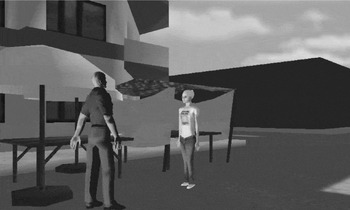
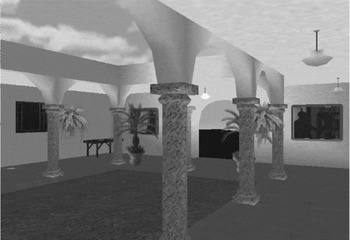
The SIE used in conjunction with ‘Dancing with Words’ was an online virtual world named Croquelandia that was designed by Sykes and a team of designers and programmers as part of a larger project financed by the University of Minnesota. The graphics in the space were created utilizing photographs taken by Sykes in the Spanish-speaking world. The photographs were then adapted and redesigned into the space by the graphic design and programming team. In the SIE, learners were able to move their avatar throughout the environment, interact with built-in content and non-player characters (computer-generated avatars), and talk with a native speaker playing the role of several avatars.Footnote 12Figures 1 and 2 show images of the SIE space based on Croquelandia.
Sample of SIE from Croquelandia.

Sample house setting in SIE space.

5.5 A small-scale study
Thanks to a grant from the Instructional Technology Fellowship Program at the University of Minnesota, the small-scale study mentioned above was conducted in February 2007 with the following two objectives:
• to examine how learners use strategies-based materials on a website and virtual, immersive environment for learning L2 pragmatics (e.g., strategies for the learning and performance of the material, time spent on videos, answers to questions posed, and comparisons of learner approaches to the website);
• to examine the effect that using the website for learning Spanish pragmatics has on their ability to perform a subset of the speech acts on the website (i.e. requests, apologies, and service encounters) during actual interaction.
We note that no effort was made to compare the use of the website and virtual environment with more traditional approaches to teaching pragmatics, such as the study of print materials and face-to-face interactions. Hence, the study was simply exploring the impact of these more recent vehicles for learning of L2 pragmatics.
5.5.1 Research design
The research design and available budget called for the recruitment of ten advanced learners of Spanish to study pragmatics modules appearing on the ‘Dancing with Words’ website and then to have that learning assessed in the SIE. The first ten students who volunteered were selected as subjects (out of approximately 50 who responded to the request). They received a technology orientation. When learning tasks were performed on the ‘Dancing with Words’ website, all actions and oral language were recorded using the Camtasia Studio screen recorder <www.techsmith.com/camtasia.asp> (accessed 22/7/2007). In the SIE, interactions were recorded for assessment purposes using similar screen capture software and in-space audio archiving. The pre-test called for the students to perform three role-plays in the SIE for assessment purposes: a request to borrow their host sister's course notes, a service encounter with a street vendor (buying souvenirs), and apologizing to their sister for spilling Coke on the notes in their backpack and ruining them. The pre-test also included a written multiple-rejoinder DCT, with five situations based on material from ‘Dancing with Words’ calling for two requests, two apologies, and a service encounter (buying food at the market).
There was then a content orientation session, focusing on the strategies taxonomy, after which each of the participants completed three online modules from ‘Dancing with Words’, calling for requests, service encounters, and apologies (1–2 hours per module). After the completion of these modules, the participants took part in a reflective interview (10–20 minutes) which was recorded and transcribed. There then was an immediate post-test in the SIE, consisting of a virtual role-play with avatars for assessment purposes like in the pre-test, but with a different request and apology. The students had to make a request to borrow money from their host sister, who only had a large croquedo bill which they needed to get changed and return the change. The service encounter was the same, but the apology was for losing the rest of the money. There was also a delayed post-test, which was the same as the pre-test.
The analysis of data called for comparing pre- and post-test results for both the oral role-plays and the written DCTs to determine the impact of the three modules from the ‘Dancing with Words’ website on the subjects. Both quantitative and qualitative analyses were conducted to compare the frequency of speech act strategies and their nature (e.g., the use of speaker-oriented or hearer-oriented strategies), the complexity of interactions, and the number of turns taken before and after exposure to the material. In addition, the data from the interviews were analyzed for insights that students had in dealing with the website and SIE.
5.5.2 Results
The following are initial results based on preliminary analysis of data. In the pre-test virtual interaction with the native Spanish-speaker playing the role of the avatar for the host country sister and the one for the vendor, students experienced some stumbling and difficulty with the tasks. The students indicated that they had not had previous practice with this type of interaction, and, in fact, three of the subjects reported not having had any experience talking to a native speaker outside of the language classroom. As for their strategies for using the pragmatics material from the online modules, there was notable individual variation. While all ten students used the written transcripts provided along with the video clips, two used them in order to answer questions and six used them to help comprehend the video clips.
As the ‘Dancing with Words’ website provides built-in comments (i.e. ideas and suggestions about the pragmatics material on the site) following questions calling for learners' written responses, there was interest in determining what users of the site did with this built-in feedback. Two used it as instructional input prior to completing the activities, while eight used it afterwards, just to check their answers. Since in piloting it was not clear whether the website provided more information than students would want, we were curious as to the students' reaction to the level of detail provided along with the online activities (e.g., not just a listing of strategies for making requests but also a detailed exemplification of the alternate forms that each request strategy might take, such as those for conventionally-indirect requests). While interest in details varied by module, learner, setting, and time of day, in general students were found to want even more details about the speech acts about which they were interested, as well as more practice and learning activities. There was only minimal difficulty with the technology itself, with only one student indicating trouble with the embedded videos on the website.
The website's focus on strategies for learning, performing, and evaluating speech acts seemed to have produced the desired effect. Participants demonstrated an increase in reported use of almost all strategies for the learning and use of pragmatics, with notable increases in awareness and consciousness-raising strategies, such as: ‘I pay attention to what native speakers do by noting what they say, how they say it, and their non-verbal behavior, and I will identify the communicative act I need to focus on’. About half the students focused on the specific pragmalinguistic strategies for performing a given speech act, saying things like, ‘Now I can memorize what language to use in different situations’. The other half considered the general awareness of sociopragmatic strategies associated with the given speech act, saying things like, ‘I may not know exactly what to say, but I am more aware of what is going on’.
Findings from the reflective interviews showed that the students had varying reactions to the features found in ‘Dancing with Words’ and in the virtual environments. Here are some examples:
Susana: [The website] kind of puts into written order what you kind of hear on your own, but you don't really know how to order it. . .it helps to have it all written down and put together.
Henry: I'm kind of a fan of interactive things like if they were drop-down boxes.
Abril: I don't need like fancy stuff to help me learn, I guess.
So Susana appreciated having this information in one place, Henry felt that the way it was packaged made a difference, and the packaging of it was not important to Abril.
The following are a few student comments relating to their awareness of the impact of the ‘Dancing with Words’ website on their own language, learning process, and social interaction:
Interviewer: Do you think you'll use the other modules?
Callie: I think so, yes. Spanish is a big part of my life. . .I want not just to be able to know the words, but be able to use the same pragmatics as native people would.
Ronaldo: Before I would just ramble on, but now I would use. . .steps. You can start on one and work on that. Once you get done with that, then move on to the next.
Interviewer: What did you like about the materials?
Veronica: The one on Ecuador stood out. That's where I want to go.
While results from detailed analysis of the data set are forthcoming, these preliminary findings would suggest various types of gains in pragmatic performance from pre- to post-test. The students' work in the online modules was evident in the post-test data in a number of areas. First of all, there was more use of apparent ‘memorized chunks’, indicative of appropriate pragmatic behavior. For example, in the case of apologies, the post-tests demonstrated the use of more varied forms for realizing the semantic formula of apology, such as discúlpame ‘I apologize’ and perdóname ‘Forgive me’ in addition to the commonly used phrase lo siento ‘I'm sorry’. In the pre-test, lo siento was used almost exclusively. Furthermore, learners were better at organizing their interaction as a whole from beginning to end. While the middle of the conversations still tended to contain errors and confusion, the addition of greetings and leave takings was evident and made an important impact on the interactions. Finally, the results indicated more general awareness of pragmatic issues. This heightened awareness of pragmatics was evidenced in the reflective interviews as well as in the increased amount of self-corrections and repairs in the post-test interactions. According to self-report from the learners, this added awareness also resulted in added nervousness since the learners now knew what they did not know. Along with the noticeable gains in pragmatic performance, there were still numerous instances of learners engaging in pragmatic miscommunication, suggesting the importance of additional practice and instruction.
6. Discussion and conclusions
This plenary started by giving a rationale for explicit teaching of pragmatics to L2 learners. The importance of having an empirical research basis for choosing pragmatics material was emphasized, and the controversy over acceptable means for obtaining these materials was considered. With regard to the teaching of pragmatics, issues concerning the selection of material, teacher preparation, and the ultimate role of the teacher in facilitating the learning of pragmatics were raised. The position taken in this talk is that of having the teachers give initial guidance and then leaving the actual learning of pragmatics to the students – giving them strategy instruction and directing them to websites where they can learn and practice pragmatics material according to their own interests.Footnote 13 While the means for determining a learner's pragmatic ability are still in need of refinement, the high-stakes nature of pragmatics warrants efforts both by teachers and by learners themselves to assess this ability.
Finally, attention was given to the role of technology in making pragmatics more accessible to learners, looking both at websites for teachers and curriculum writers, and at websites expressly designed for learner self-access to L2 pragmatics for specific languages such as Japanese and Spanish. Recent work on virtual environments for practicing Spanish pragmatic was presented and preliminary results from a small-scale study of this effort were reported. Regarding the experience using the ‘Dancing with Words’ website and the SIE, Croquelandia, there was found to be strong learner motivation to improve pragmatic skills. It was also seen that strategy instruction can be an important component to pragmatics instruction. Such strategy instruction needs to be salient and explicit, and targeted at what the learners want/need/are motivated to know. In addition it needs to be varied to include all types of learning and interactive styles. Furthermore, self-access instructional materials must include a variety of activities and ways to interact with the content. It would appear that synthetic immersive environments present promising possibilities for pragmatics instruction and assessment as well as a means of data collection.
Acknowledgements
Let me first extend my deep gratitude to Kathleen Bardovi-Harlig and César Félix-Brasdefer for inviting me to give the lead-off plenary at AAAL 2007 and for helping me to shape the topic. Next, my heartfelt thanks go to Noriko Ishihara and Julie Sykes for their fine work in making the Japanese and Spanish pragmatics websites a reality. Finally, let me acknowledge the anonymous readers for Language Teaching, and one of whom in particular whose extensive critical feedback prompted me to do considerable revision of this plenary address while at the same time attempting to preserve its genre.
Andrew D. Cohen is Professor and Chair of the ESL MA Program and Undergraduate Minor, University of Minnesota, Minneapolis. He has published on language learner strategies, pragmatics, language testing, bilingual and immersion education, and research methods. Recent publications include Language learner strategies: 30 years of research and practice (co-edited with Ernesto Macaro; Oxford University Press, 2007) and an online course on assessing language ability in adults in the ELT Advantage series (Heinle/Cengage Learning).