In 2012, I was fortunate enough to meet Tom Phillips at his exhibition at the Book Art Bookshop in Hoxton.Footnote 2 Signing my 5th edition of A humument, Footnote 3 he declared himself surprised that it features in the MA Library and Information Studies, and wrote an inscription, ‘For the bibliographers at UCL.’ He wondered what his work, originally envisioned to prove that he could make art from anything – even an old Victorian novel – is teaching future librarians.
This article highlights some of the lessons intrinsic to a mass-produced artist's book that also exists as a series of prints, USB with audio recording, web app, celestial and terrestrial globes, and a skull, and which Phillips refers to himself as ‘a work in progress’ and ‘Gesamtkunstwerk.’Footnote 4
Object-based learning
Object-based learning (OBL), which has been summarized pragmatically by Barbara Rockenbach as ‘learning that is done through direct interaction with objects,’Footnote 5 has gained attention within Higher Education. As Paris has pointed out, ‘objects, although concrete, actually represent a vast continuum of abstract ideas and inter-related realities.’ Taking the examples of a boot and an aeroplane, he states they ‘assume particular meanings for the visitor only because he or she has a repertoire of experiences with both footwear and transportation.’Footnote 6 Drawing on the work of BiggsFootnote 7 and of Romanek and LynchFootnote 8 , Chatterjee and Duhs assert that objects ‘have the power to help students to cope with challenging aspects of the curriculum. Working with objects strengthens learning, as the sense of touch can lead to a more memorable learning experience.’Footnote 9
At University College London (UCL), object-based learning is actively promoted, and, as Chatterjee has described, ‘OBL with our collections is an integral part of undergraduate and postgraduate teaching for a large range of students.’Footnote 10 Within the MA Library and Information Studies, experiential learning, as advocated by John DeweyFootnote 11 and particularly by Kolb,Footnote 12 is an important component of teaching design and delivery and has been found to aid in the synthesis of information.Footnote 13 Students have reported that kinetic learning activities have aided understanding of complex processes,Footnote 14 in line with recent versions of Bloom's Taxonomy – progressing from knowledge at the bottom of the hierarchy of learning through comprehension, application, analysis and synthesis to the highest order of learning, evaluation.Footnote 15
Object lessons
Object-based learning forms part of this educational approach, and can be seen to be derived from educational philosophers dating back to John Locke,Footnote 16 whose 1690 Essay concerning human understanding theorized that our experiences, mediated by our senses, fill the tabula rasa of our natural state to form our understanding of the world. The teaching and learning activities described in this article are descended more directly from the work of 19th century Swiss educator Johann Heinrich PestalozziFootnote 17 whose ‘object lessons’ had an impact on the Scottish education system, resulting in lesson plans in which teacher and students began with an object from their everyday surroundings and used it as a launchpad for activities from a variety of disciplines.
The University of Roehampton has digitized and made available one of the early Object lesson manuals published by W&R Chambers.Footnote 18 Teachers in Scottish schools used these manuals, in various editions, from the late 19th century to the mid-20th century. Their aim was ‘to furnish practical outlines of an interesting and educative method of treatment calculated to arouse the curiosity and maintain the interest of the child, rather than to give a mere agglomeration of facts.’Footnote 19 If we look at the object lesson on trees on pages 28–32, we see a plan to describe trees, discuss their biology, life cycle and constituent parts, and think about their uses – food, shelter, building materials, firewood and as a habitat for animals. Significantly, we might note that the first of the uses described is ‘Make the world beautiful.’Footnote 20
In discussing the teaching and learning undertaken from A humument, we can take a similar approach, beginning with the artist's book as our object and drawing out some lessons, never forgetting, that, just like trees, Phillips's artwork, while teaching us much about librarianship, exists firstly to ‘Make the world beautiful.’
A human document
The genesis of A humument is well-known, but is a good teaching point for a mixed class of students, including some who have had no professional contact with artists and so are not familiar with the diverse ways in which they seek for materials and information. As Phillips wrote in the artist's notes at the end of the first edition, ‘I had read an interview with William Burroughs, and, as a result, had played with the “cut-up” technique, making my own variant (the columnedge poem) from current copies of the New Statesman. It seemed a good idea to push these devices into more ambitious service. I made a rule; that the first (coherent) book that I could find for threepence (i.e. 1¼p) would serve.’Footnote 21
The description Phillips gives of serendipitously finding his source material in a furniture shop is, for some students, the first time they have heard or even considered a non-linear search process. Philips goes on, ‘I found, for exactly threepence, a copy of A Human Document by W.H. Mallock, published in 1892 as a popular reprint of a successful three-decker. I had never heard of W.H. Mallock.’Footnote 22
Paratext and palimpsest
There are several things about which students often remark when confronted with Phillips's account of the book that he went on to use in his art. The first is the concept of paratext, with which they are familiar from other classes. In particular, someone usually raises comparisons with the binder's waste that they have encountered as a constituent in early printed books – scraps of manuscript or earlier printed matter used to strengthen the boards and spine in which a book has been bound.
Phillips's choice of text is deliberate, even if selected in a liminal way: ‘For what were to become my purposes, [Mallock's] book is a feast … Its vocabulary is rich and lush and its range of reference and allusion large.’Footnote 23 Related to this discussion of paratext is the idea of the palimpsest, and students who have not encountered this form of working with a pre-existing text to form art find it exciting to consider the text below the surface.
There is usually some discussion about Phillips's discomfort with Mallock: ‘He does not seem a very agreeable person … he emerges from his works as a snob and a racist (there are some extremely distasteful anti-semitic passages in A Human Document itself).’Footnote 24 Usually there is some debate around whether, by erasing Mallock's more offensive words in the creation of A humument Phillips has silenced them, or whether by creating art from it, a problematic text has been brought to attention it would not otherwise receive today. Someone always spots that while I own copies of the commercial editions of A humument, I have not yet found a copy of A human document within the price-range I am prepared to pay for teaching materials, and so we use the digitized version of University of Toronto's 1892 copy on archive.org,Footnote 25 which is not entirely satisfactory (because of differences in pagination and layout) but at least gives us an idea of the relationship between the two books.
Certainly, it is hard to imagine A human document as being outwith my budget were it not Phillips's source. Discussing this aspect of the work provides the opportunity to recap on censorship and freedom of speech issues and to introduce consideration of the anachronistic application of standards from one era to another – an ethical concern for which each student has to find their own balance if they progress to write a dissertation on an historical topic.
Making A humument
Finally, students always remark on Phillips's awareness of his retrieval process. He presents his find as coincidental and romantic – ‘Austin's furniture repository stands on Peckam Rye, where Blake saw his first angels and along which Van Gogh had probably walked on his way to Lewisham. At this propitious place, on a routine Saturday morning shopping expedition, I found, for exactly threepence, a copy of A Human Document.’Footnote 26 However, later in the same paragraph, he shows himself to have attempted more direct search strategies – ‘I have never come across its equal in later and more conscious searchings.’Footnote 27 Although I am not the lecturer responsible for teaching Information Retrieval, I am always keen to confront students with accounts of search strategies in published works, because as bibliographers and cataloguers, it is possible to become so expert in how data is structured that we lose sight of the different approaches taken by searchers who are not so familiar with the data and its foibles.
If there is a student with experience in an art library, they may point out the longevity of Phillips's project – ‘I started work on the book late in 1966’Footnote 28 – and the artist's awareness that he was being innovative in his way of working – ‘All the work on A Humument has been done in the evenings so that I might not, had the thing become a folly, regret the waste of days.’Footnote 29 In the absence of someone with subject knowledge, these are issues that need to be drawn out of the class from the front of the room.
So far, I have also had to ask leading questions to spark discussion around print technology and the differences between artists' books published by a small press that deals specifically with such materials, and books produced by commercial publishing houses. Phillips's “Notes on A humument” are useful for this – ‘The first edition in book form differs from the private press edition in that several new pages have been substituted for the first versions and many other pages have been reworked by hand, using the advantages of revision offered by the preparatory stages for colour offset lithography.’Footnote 30 My own collection of artists' books, which we use in class, is centred on those that are commercially produced, with artist-printed, private press-printed and ephemeral items to throw the core items into relief. A humument is both foundational and central to this collection.
Another important aspect of this introduction to A humument in class is the order in which students approach the work. Following the artist's wishes in his preface – ‘Hoping that the reader would want to meet the book head on I have put the introduction at the end’Footnote 31 – we consider the main body of A humument in its five editions, then we look briefly at Mallock's A human document and then we read and discuss Phillips's “Notes on A humument.” This draws students into the topic, allowing them to encounter the book as an artwork first, before considering how it was made, published and distributed and its social and historical context.
‘Book as mass-produced object’
The typical discussions described so far occur in the optional module on Historical Bibliography which is available to students on the MA Library and Information Studies, MA Digital Humanities, MA Early Modern Studies and MA Early Lives and Letters, and as a short course to librarians undertaking CPD.Footnote 32 We have to cap numbers at 25, and the class is usually taught at full capacity.
The module considers the printed book and its history of production from the birth of printing to the modern day. Having heard about, read about, discussed and handled books forming a deceptively simple linear narrative from the 15th–19th centuries, our session on ‘Book as mass-produced object; book as craft; book as objet d'art’ provides an opportunity to consider materials that do not tell the tale of ‘progress’ from individually created to mass-produced items. We think about the private press movement in England and Wales, the French livres d'artistes, modern book arts and artists' books, small press poetry, zines and webzines.
UCL has a strong collection of ‘Little Magazines’Footnote 33 that is now curated by our Art Librarian, Liz Lawes, and the module usually ends, after the students’ title page transcription assessment, with a talk by Liz to which she brings items from the collection. This is regarded as a great treat by the students, and in designing the curriculum, I felt it important that following the undoubtedly unpleasant experience of being examined, they should finish the module with a reminder of the joy and the beauty that these objects bring to our work as librarians and researchers. Bibliography can be described most briefly as the study of the book as object, and those of us engaged in it professionally have been attracted by the way that, like Chambers's trees, such objects ‘Make the world beautiful.’
Information retrieval and collocation
A humument also has lessons to teach students in knowledge organization, and I have used it within the core module in cataloguingFootnote 34 and the optional module in advanced cataloguing and classification,Footnote 35 as well as in trainings on international cataloguing standard Resource Description and Access (RDA) for ARLIS/UK & Ireland.Footnote 36 – Footnote 37
A key aim in information retrieval is to find the specific resource that is sought. Once a publication has multiple editions, this begins to be more challenging. Cutter discussed this in the third of his ‘Objects’ for cataloguing: ‘to assist in the choice of a book as to its edition (bibliographically).’Footnote 38 In other words, once we have run a search and retrieved some records, we should be able to determine which of them represents the one we really want.
A humument is a good case study. It is a distinctive title, created by Phillips from A human document . A combined search for author ‘Phillips’ and title ‘humument’ retrieves only A humument (and potentially any works about it by Phillips himself). Running such searches on a variety of good quality catalogues allows us to see differences between the catalogue display and, in some cases, local cataloguing decisions.
When teaching about an art resource, I encourage students to compare and contrast the National Art Library and the Tate catalogues, as these are the two main UK institutions involved in national-level collecting and documentation. We also look at non-specialist catalogues – usually the British Library and UCL, which both use Aleph for cataloguing and Primo as their discovery layer. Finally, students look on the catalogue of the institution for which they currently work or have worked in the past, as these are the catalogue input and display with which they are most familiar.
Finding and displaying records
A search for ‘name: Phillips’ and ‘title: humument’ on the Tate Library catalogueFootnote 39 on 29 February 2016, returned nine records, in the following order of display:
-
1. 7 PHIL (ARTISTS' BOOKS) 2012
A humument : a treated Victorian novel 5th ed.
Phillips, Tom, 1937-
London : Thames & Hudson, 2012.
Artist's Books – Zines – Photobooks Collection; advanced appointments required
-
2. PHILLI 2007
A humument : a treated Victorian novel
Phillips, Tom, 1937-
Dean Gallery (Edinburgh)
6 Oct. 2007–6 Jan. 2008
Solo exhibition catalogue
-
3. 7 PHIL (ARTISTS' BOOKS) 2005
A humument : a treated Victorian novel 4th ed.
Phillips, Tom, 1937-
London : Thames & Hudson, 2005.
Artist's Books – Zines – Photobooks Collection; advanced appointments required
-
4. 7 PHIL (ARTISTS' BOOKS) 1997
A humument : a treated Victorian novel 2nd rev. ed.
Phillips, Tom, 1937-
London : Thames & Hudson, 1997.
Artist's Books – Zines – Photobooks Collection; advanced appointments required
-
5. 7 PHIL/T (ARTISTS' BOOKS) 1987
A humument : a treated Victorian novel Rev. ed.
Phillips, Tom, 1937-
London : Thames & Hudson, 1987.
Artist's Books – Zines – Photobooks Collection; advanced appointments required
-
6. 7 PHIL (ARTISTS' BOOKS) 1985
A humument : a treated Victorian novel 4th ed.
Phillips, Tom, 1937-
Stuttgart : Hansjörg Mayer, 1985.
Artist's Books – Zines – Photobooks Collection; advanced appointments required
-
7. TAV 830D 1980
‘A Humument’, American format VHS video, British Council, November 1980
Phillips, Tom, 1937-
Tate Archive Audiovisual Collection
(restrictions may apply)
-
8. 7 PHIL/T (ARTISTS' BOOKS) 1980
A humument : a treated Victorian novel
Phillips, Tom, 1937-
London : Thames & Hudson, 1980.
Artist's Books – Zines – Photobooks Collection; advanced appointments required
-
9. V7 PHIL PHI 1970
A humument : [sheet]
Phillips, Tom, 1937-
London : Tetrad Press, 1970.
Tetrad Press Publications.
Library Special Collection Item
Here we can see that the default display for the results list is reverse publication date, and the repetition of the publication year in the first line and in the publication field, as well as the inclusion of the edition statement (where it exists) next to the title field, aids the researcher in locating the specific item they are seeking. We can also understand the differences between each of these records (and the publications they describe).
A similar search on the National Art Library catalogueFootnote 40 (Advanced Keyword Search: ‘Name (as Author or Subject) Keyword (e.g. leonardo vinci): Phillips’ and ‘Title Keyword: humument’) returned 14 items. The default display order is ‘by title’, and by selecting to ‘sort by Publication date (newest first)’ we can compare the basic display with the Tate's.
Even before we click through to the detailed display of each record, we can start to see different local cataloguing and catalogue display decisions. Because there are only five commercial editions, plus other items, both results lists are manageable, but we can see how and where different formats appear within the lists, and can discuss whether or not we like this. Reverse date order usually provides an easy approximation for most recent edition first, and we discuss the limits of this strategy.
The limits of bibliographic models and discovery
Since 1998, when IFLA published Functional Requirements for Bibliographic Records (FRBR),Footnote 41 there has been an emphasis on collocating different editions of the same work.
Students encounter the collocation of editions on some discovery engines, and A humument provides good examples of this. Repeating our search for ‘author/creator: Phillips’ and ‘title: humument’ on UCL Explore's advanced search,Footnote 42 and leaving the ‘search scope’ set to its default ‘All resources’ (which means that as well as searching material in the library catalogue, it will retrieve anything meeting the search terms in the journals and other databases to which UCL subscribes), we receive a very clean search results list, with only two entries:
-
1. A humument : a treated Victorian novel
Tom Phillips, 1937-
Multiple versions found which may include different formats
To view, click on the title of the link below
View 4 versions
-
2. A Humument: notes on a work in progress
Phillips, Tom
London Magazine, Feb 1, 1970, Vol.9(11), p.37
Full text available
SFX@UCL
The appearance of the second item reflects the limitations of our search strategy – we have retrieved a journal article by Tom Phillips about his work. The results list also allows us to discuss important issues such as Name Authority. We know from the practical session that Head of Current Cataloguing Tom Meehan leads for the class that UCL's implementation of Aleph includes a Name Authority File,Footnote 43 but here we can see that the discovery layer straightens out the name inversion, so that MARC's ‘100 1_ |aPhillips, Tom,|d1937- ’ appears in the display as ‘Tom Phillips, 1937–.’ This opens up a discussion on the relationship between catalogue input and display, and the decisions that cataloguing managers and systems teams can make. We can also see that the journal database from which the second result has been retrieved does not use the same Name Authority system. However, because of the way we have run our search, the results have been retrieved. We can, if we want, open up a discussion on Name Authority workflows, the time that they take, and the age-old balancing act of precision and comprehensiveness in retrieval.
Versions of the same work
When we click through the link in the first result to “View 4 versions”, we see a new results list displaying the four editions of A humument that UCL has in stock:
-
1. A humument : a treated Victorian novel / Tom Phillips.
Tom Phillips, 1937- W.H. Mallock, 1849–1923
London : Thames & Hudson 5th ed. 2012
-
2. A humument : a treated Victorian novel / Tom Phillips.
Tom Phillips, 1937- W.H. Mallock, 1849–1923
London : Thames & Hudson 4th ed. 2005
-
3. A humument : treated Victorian novel / Tom Phillips.
Tom Phillips, 1937- W.H. Mallock, 1849–1923
London : Thames & Hudson 1st rev. ed. c1987
-
4. A humument : a treated Victorian novel / Tom Phillips.
Tom Phillips, 1937- W.H. Mallock, 1849–1923
London : Thames & Hudson 1980
For the researcher, it is certainly very convenient to have shorter results lists and to have the different editions of the same work collocated so that all the editions can be browsed together without the interpolation of different works. However, look at the system-generated note in the initial results list: ‘Multiple versions found which may include different formats.’ The italics are present in the original display screen, and highlight how important the system designer realizes this issue may be.
The note is also indicative that the display has been generated automatically by the discovery layer following algorithms that mostly work, but sometimes result in an eventuality that the library does not desire, because it may be misleading or inconvenient. Indeed, when I was looking for the copy of Locke's Essay concerning human understanding that I used seven years ago when I was designing the current Historical Bibliography module, I found a results list that displayed 24 results, of which 19 are different editions of the work, and of these 19, five represented multiple versions. Because of differences in the ways in which the records were created (justified by the different cataloguing standards in use by the different creator agencies), the discovery system was unable to recognize which really were different editions of the same work, and so the neat collocation that we have seen with A humument had not taken place for Locke's Essay.
WEMI model
FRBR provides a bibliographic model which, if implemented at the data creation stage, should result in the collocation of materials that represent different versions of the same creative work. FRBR is foundational to RDA, and so we spend some time in class discussing it.
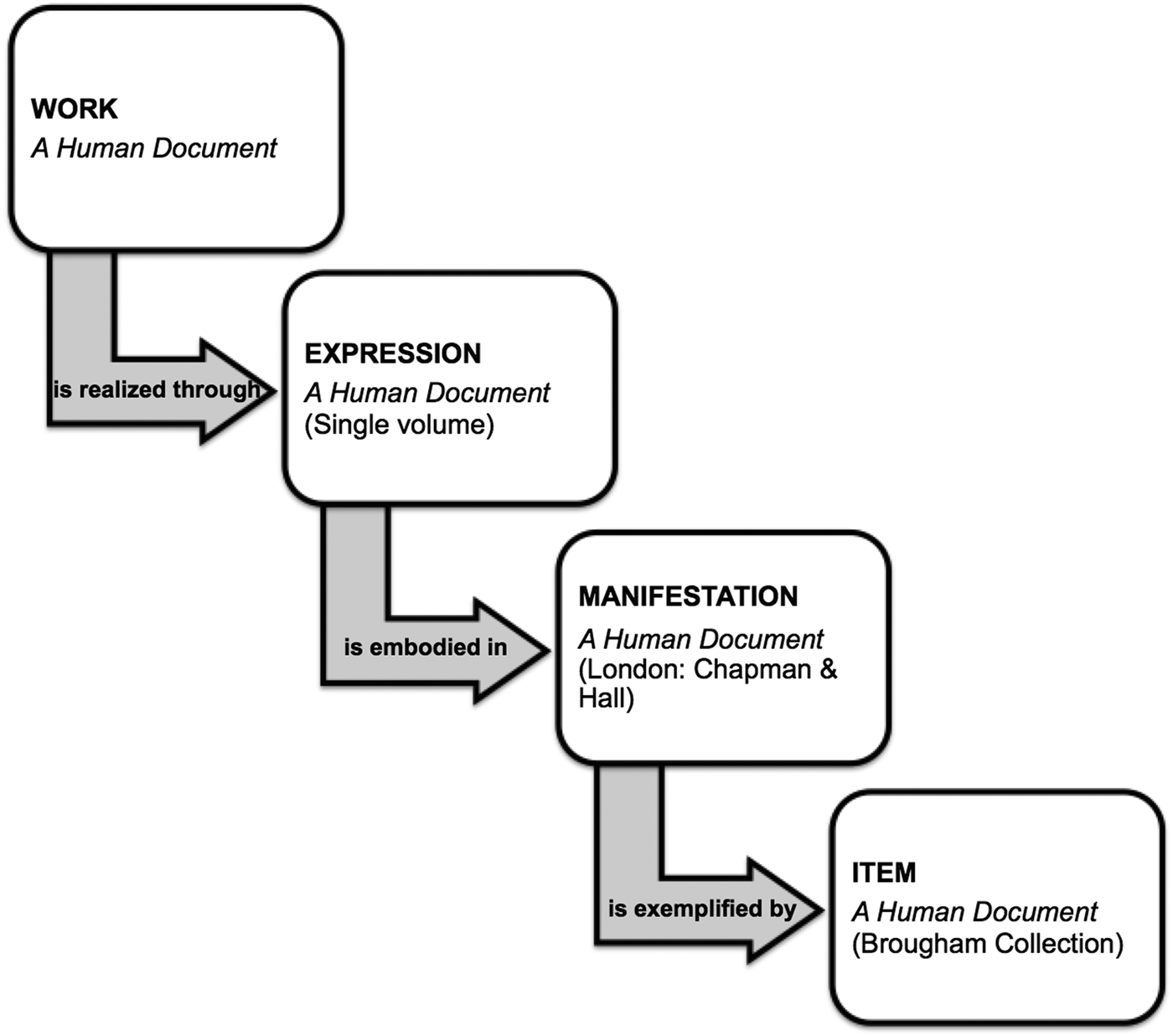
Referred to as the WEMI Model, FRBR presents a hierarchical structure in which a “Work is realized through [an] Expression [which] is embodied in [a] Manifestation [which] is exemplified by [an] Item.” Of the three entities in the WEMI model, the Work is the most abstract, and, as we put it in Practical cataloguing, a simple way to visualize it is to think of something that exists in several different editions, formats and languages. The Work is the essence that remains when it is expressed and that still remains through each and every imprint, edition and translation.Footnote 44 Figure 1 provides a diagram of the WEMI for the copy of Mallock's A human document held in Sheffield's Bullough Collection.Footnote 45 – Footnote 46
WEMI for A human document held by University of Sheffield. Reproduced courtesy of the author.

As Karen Coyle stresses,Footnote 47 it is important to bear in mind that this form of diagrammatic representation is an entity-relationship model: it shows the different concepts with which we are working when we create catalogue data. It does not mean that we are expected necessarily to create a separate record for each level of the WEMI model. Coyle's analogy to explain the inter-dependence of these levels is a good one: ‘We can use the example of car model and color options. Obviously there is no car being offered that has no color, but color options can be stored in a separate table from car models in a database so that models and colors can be combined as needed in database output. This is similar to the separation of attributes into the WEMI entities in FRBR.’Footnote 48
Limits of automated FBFRization
So, depending on how the system used to input catalogue data is designed, it may (or may not) remain the case that we continue to record data on the same screen, but that this information is coded to identify the different WEMI levels. Indeed, when we look at discovery layers like those implemented at UCL and the British Library, or at catalogues that have been ‘FRBRized’, we are looking at results lists in which computer algorithms have been used to create collocation by Work level so that all the records that express the same Work appear together. In order to achieve this, essentially, a Work-level title is created from the existing uniform title field (where it exists) or title field (where there is no uniform title). In class, we look at the BL and UCL results display lists for A human document and at its results on OCLC FictionFinderFootnote 49 in order to discuss the pros and cons of such automatic clustering.
The biggest drawback of this type of retrospective work is that it has to be high-level – it cannot automate implementation of all four levels of the WEMI model. As OCLC puts it in its description of FictionFinder, it ‘applies principles of the FRBR model to aggregate bibliographic information above the manifestation level … The algorithm collects bibliographic records into groups based on author and title information from bibliographic and authority records. Author names and titles are normalized to construct a key. All records with the same key are grouped together in a work set.’Footnote 50
Relationships
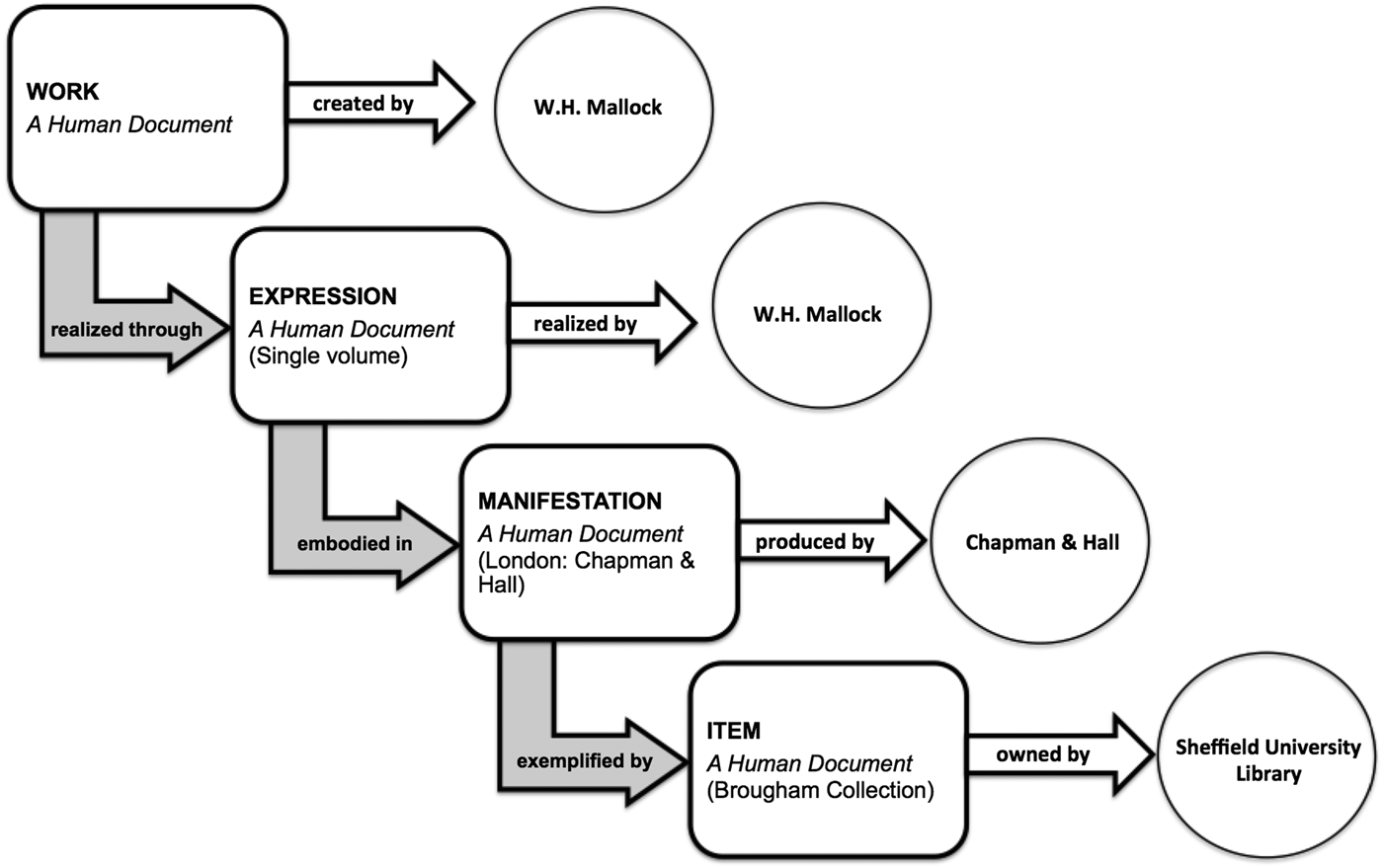
This description hints at one of the key characteristics of entities in the WEMI model: their relationships. Figure 2 represents the key relationships that pertain to the WEMI for A human document.
WEMI for A human document with key relationships. Reproduced courtesy of the author.

Thinking about the various people involved with publications can help us to clarify the WEMI in our own minds. Works have creators. In order to come into being, there are sometimes other people involved. For example, in a book that is created by its author and then illustrated by someone, the illustrator usually becomes involved at Expression level. Walter de la Mare's Desert Islands and Robinson Crusoe,Footnote 51 is a clear example of this, and we discuss it in full, with diagrams, in a recent article.Footnote 52 At Manifestation level, the expression has to be made concrete and for books this is usually achieved by a publisher. Finally, at Item level, someone owns the item.
It is important to realise that one Work can have many Expressions and that an Expression can have many Manifestations. Figure 3 shows the Work and Expressions for the three versions of A human document that Tom Phillips mentions in the Notes at the end of A humument 5th ed.
Work and Expressions mentioned by Tom Phillips in “Notes on A humument” 5th ed. Reproduced courtesy of the author.

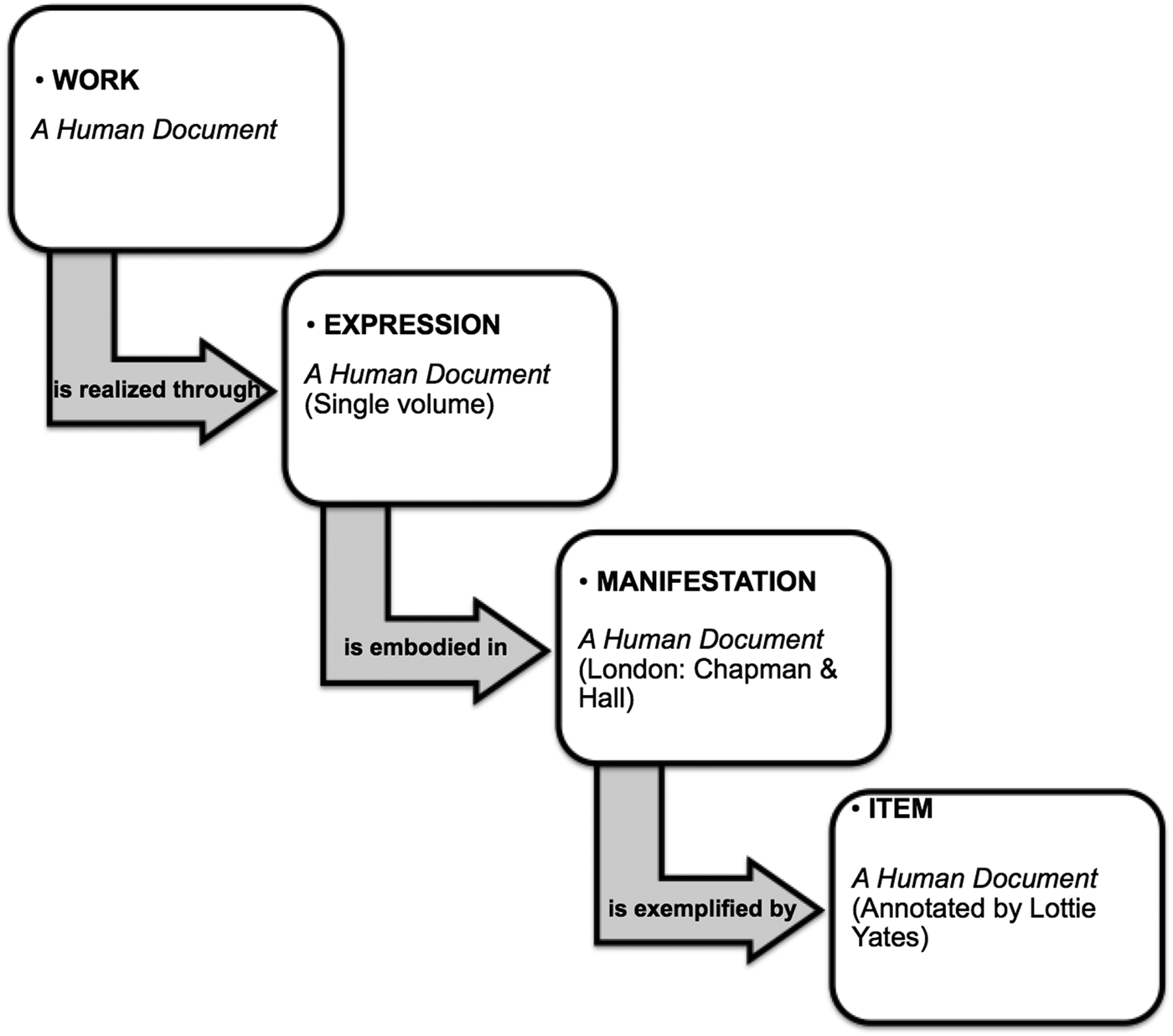
Figure 4 explores one of these further – again, using the example Phillips gives us of Lottie Yates's copy.
WEMI for Lottie Yates's copy of A human document. Reproduced courtesy of the author.

Mallock's book is clearly a relatively straightforward example that aids students in understanding how the WEMI model works. A humument provides them with examples that challenge the limits of the model. It is important for them to realize that no conceptual model is perfect.
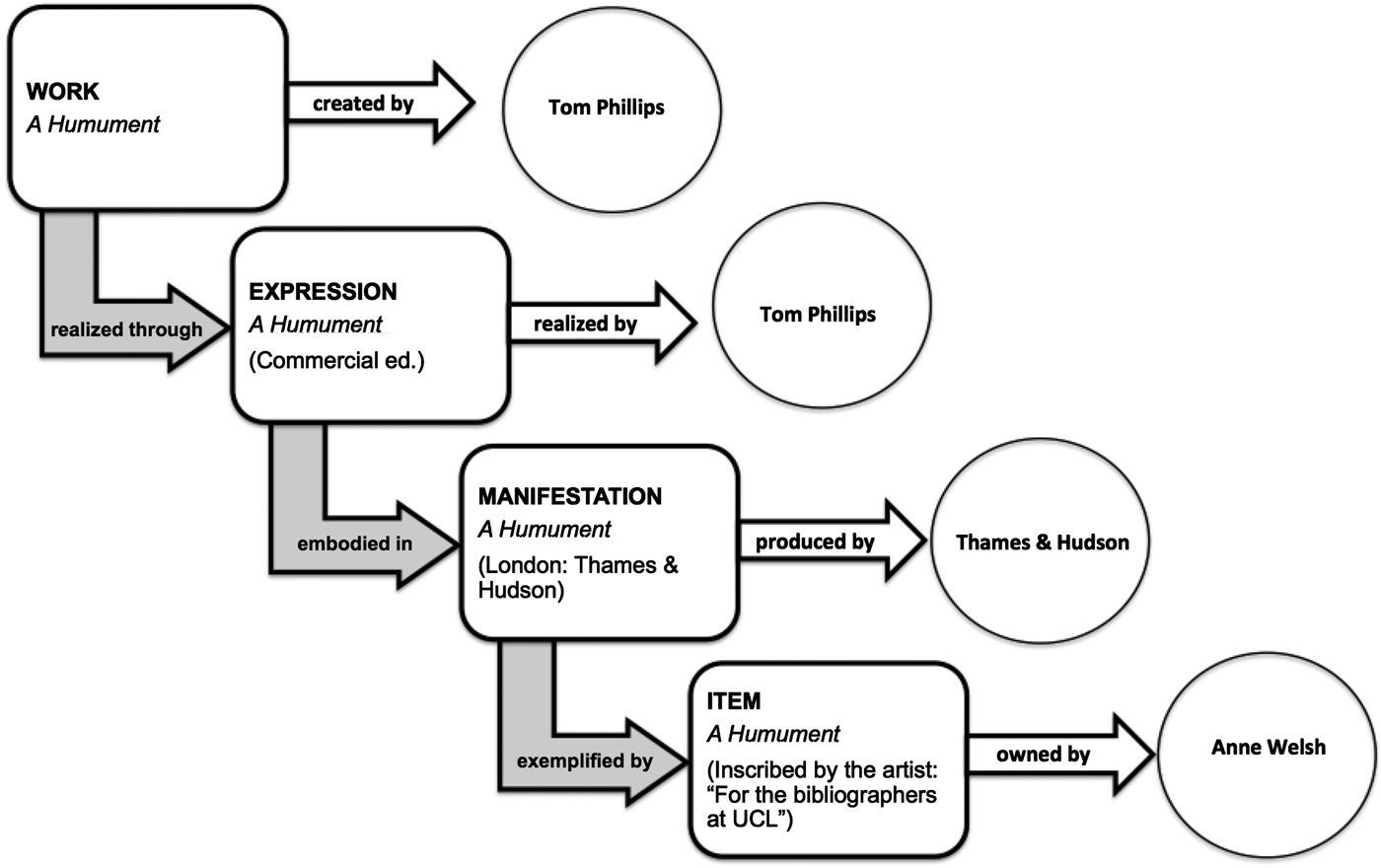
Starting with the WEMI for an edition of A humument (Figure 5) is straightforward. I've used the example of the copy that Tom Phillips signed for me, and from which the title of this article is derived.
WEMI and key relationships for A humument 5th ed. owned by Anne Welsh. Reproduced courtesy of the author.

We know that this was the 5th edition of A humument, and that there are four other commercial editions, plus an earlier publication by Tetrad Press, which included different images on some of the pages. We can represent these expressions of A humument as in Figure 6.
WEM for the book-format versions of A humument. Reproduced courtesy of the author.

This way of representing what we might call the ‘book formats’ of A humument is helpful, as it teases out what is happening conceptually. Phillips tells us in the “Notes” at the end of each commercial edition that there are substantial differences between them (and we can check this by comparing and contrasting the pages). So we can feel confident that he has realized his Work in six different Expressions. These are each embodied in a Manifestation: the first by Tetrad Press and the others by Thames & Hudson. We can see where Figure 5 would fit into Figure 6.
The next discussion point in class is, of course, ‘What about all the non-book versions of A humument?’ Here, Phillips's clarity that each version really is a version of A humument is helpful, and we might set out some of the Expressions as in Figure 7.
WEM for book and some non-book versions of A humument. (Not definitive). Reproduced courtesy of the author.

Different interpretations
However, some of these examples seem more straightforward than others. It's easy to see parity between a sound recording of a text and the text itself – and Tom Meehan's visualization of Tom Delsey's example of the FRBRization of The English patient is a helpful point of comparison here.Footnote 53 However, is Heart of a humument, in bibliographic terms, another version of A humument, or is it closer to an abridgement, since it shows only the central portions of each page? Is the phone app, for which Phillips had to use the design and programming skills of others to realize, “just” another version of the same Work as the text, or, like the film of The English patient, is it another, related Work? Then there are the terrestrial and celestial globes, the skull, and the prints of individual pages. Are they different Expressions of the same Work, or related Works? And how does A humument relate to A human document? If Lottie Yates's artwork is an Item of A human document, is Phillips's original of A humument the same? Why not?
Asking the right questions
Ultimately, this is the real strength of A humument as an object lesson, in my eyes. It facilitates discussion of a wide range of cataloguing issues, allowing students the opportunity to synthesize their prior learning and evaluate it alongside that of their classmates. I hope that these learning experiences encourage the type of creative thinking that Alan Danskin (British Library) sought when he wrote ‘The curriculum should equip the student[s] with the knowledge to ask the right questions about the resource they are cataloguing.’ I have not had the chance to ask Tom Phillips, but I hope that he too would approve an educational plan that involves creative thinking and questioning … and one that, in the words of W & R Chambers's object lesson on trees, ‘Make(s) the world beautiful.