




No CrossRef data available.
Article contents
Factors affecting left ventricular remodelling and mechanics in the long-term follow-up after successful repair of aortic coarctation
Published online by Cambridge University Press: 22 April 2005
Abstract
Aims: To identify factors predisposing to abnormal left ventricular geometry and mechanics in 52 patients after successful repair of aortic coarctation. Methods and results: We evaluated left ventricular remodelling, systolic midwall mechanics, and isthmic gradient by echo-Doppler, systemic blood pressure at rest/exercise and by ambulatory blood pressure monitoring, and the aortic arch by magnetic resonance imaging. Echocardiographic findings were compared with those of 142 controls. The patients with aortic coarctation showed an increased indexed left ventricular end-diastolic volume, increased mass index, increased ratio of mass to volume and systolic chamber function. The contractility, estimated at midwall level, was increased in 21 percent of the patients. In 26 (50 percent) of the patients, we found abnormal left ventricular geometry, with 9 percent showing concentric remodelling, 33 percent eccentric hypertrophy, and 8 percent concentric hypertrophy. These patients were found to be older, underwent a later surgical repair, and to have higher systolic blood pressures at rest and exercise as well as during ambulatory monitoring. The relative mural thickness and mass index of the left ventricle showed a significant correlation with different variables on uni- and multivariate analysis. Age and diastolic blood pressure at rest are the only factors associated with abnormal left ventricular remodelling. Conclusions: Patients who have undergone a seemingly successful surgical repair of aortic coarctation may have persistently abnormal geometry with a hyperdynamic state of the left ventricle. This is more frequent in older patients, and in those with higher diastolic blood pressures.
Keywords
Information
- Type
- Original Article
- Information
- Copyright
- © 2005 Cambridge University Press
An increased left ventricular systolic function has been reported in some patients following successful repair of aortic coarctation,1–4 a group known to have an increased incidence of left ventricular hypertrophy,1–3 systemic hypertension and a significant late risk of death.5,6 There are few reports, however, addressing the topic of left ventricular remodelling after successful repair of aortic coarctation.3, 7 Children and adolescents with systemic hypertension, however, are known to have an increased left ventricular mass and an abnormal geometry.8 Studies in adults with essential hypertension have related the cardiovascular risk to the pattern of left ventricular remodelling.9–11 Our study, therefore, was performed to evaluate, first, left ventricular remodelling, as well as midwall mechanics, as estimated by echocardiography in a group of children, adolescents, and young adults after successful coarctectomy, and second, factors that might predispose to such persistent abnormalities.
Materials and methods
Population studied
We examined 52 subjects, with a mean age of 21.1 plus or minus 10.5 years, and with a range from 2 to 40 years, after successful repair of aortic coarctation. All the patients gave their written informed consent to the collection of their clinical and laboratory data. The study was approved by the local Ethical Committee. The anthropometric findings, heart rate, systolic and diastolic blood pressure of patients and controls, as well as age, type of surgical repair and follow-up duration at the time of the study, are reported in Table 1. In 28 patients, the aortic valve was bifoliate, with trivial aortic regurgitation in 15, and 7 showed mild dilation of the aortic root. The criterions for inclusion were:
Table 1. Clinical characteristics of the population with coarctation and their controls.

- normal resting blood pressure according to the Second Task Force on Blood Pressure control in children,12
- no associated cardiac anomalies other than bicuspid aortic valve with minimal aortic insufficiency,
- residual isthmic gradient by Doppler less than 20 millimetres of mercury, and
- no treatment with cardiac medications.
Echocardiography
The echocardiographic and Doppler investigations were all performed with a phased array Sonos 5500 Hewlett-Packard device, using a 4 or 8 megahertz transducer. The examinations included cross-sectional echocardiographic imaging of the left ventricle from subcostal, apical and parasternal views, and complete Doppler scanning. A circular short axis configuration of the left ventricle throughout the cardiac cycle was confirmed in all patients. Measurements of the left ventricular internal diameter, interventricular septal, and inferior wall thickness were assessed at end-diastole and end-systole according to the criterions of the American Society of Echocardiography.13 Left ventricular ejection time was measured from the Doppler envelope recording the velocity of flow across the aortic valve, and was corrected for the heart rate by dividing by the square root of the RR interval on the electrocardiogram. Peak systolic and diastolic blood pressures were measured with a Dynamap vital sign monitor at the time of echocardiographic examination. End-systolic pressure was estimated from peak systolic and diastolic pressures based on a previously validated equation.14 All parameters were obtained by averaging at least three consecutive cardiac cycles.
Analysis of left ventricular volume, mass, and shape
Left ventricular end-diastolic volume, mass, and the ratio of mass to volume were calculated using M-mode measurements,15, 16 and indexed to body surface area. Relative mural thickness was measured at end-diastole as the ratio of inferior mural plus septal thickness over left ventricular internal dimension. Cut-off levels for left ventricular mass, and relative mural thickness, were defined to assess left ventricular geometry. The sex-specific 95th centile for the left ventricular mass index of normal children, adolescents and young adults17 was the first cut point. We used a relative wall thickness of 0.41, which represents the 95th centile, as the second cut point.9, 18 According to a previous report,9 these values were used to define the 4 patterns of geometric remodelling:
- normal geometry with left ventricular mass and relative wall thickness inferior to the 95th centile
- concentric remodelling with normal left ventricular mass index but elevated relative wall thickness
- eccentric hypertrophy with elevated left ventricular mass index but normal relative wall thickness and
- concentric hypertrophy with both left ventricular mass index and relative wall thickness superior to the 95th centile.
Left ventricular shape was assessed using the end-diastolic ratio of long to minor axes, which reflects the degree of sphericity of the cavity. The long axis of the left ventricle was measured from the apical endocardium to the midpoint of the plane of the mitral valve in the apical 4-chamber view, and the minor axis from parasternal short axis directed M-mode echocardiographic recordings obtained perpendicularly to the long axis between the tips of the mitral valvar leaflets and the papillary muscles.
Analysis of left ventricular systolic function, afterload and contractility at midwall level
Midwall left ventricular systolic function was evaluated by using the modified two-shell cylindrical model with uniform wall thickness proposed by Shimizu et al.19 and Gentles et al.,20 which reflects the relative transmural position of a theoretical midwall fibre during the cardiac cycle. The left ventricular end-diastolic midwall dimension was calculated as

and the end-systolic midwall dimension as

where Dd and Ds are left ventricular enddiastolic- and endsystolic endocardial diameters, mwDd and mwDs are enddiastolic- and endsystolic midwall diameters, IWd and IWs are enddiastolic- and endsystolic inferior wall thickness.
These formulas are based on the assumption that thickness of the septum is equal to that of the inferior wall. The left ventricular midwall fractional shortening (mwFS percent) was calculated from these midwall dimensions, and the midwall rate-corrected mean velocity of circumferential shortening (mwVCFc) as mwVCFc = mwFS/ETc, where ETc corresponds to ejection time corrected for heart rate. Because it is theoretically more correct to relate the extent or velocity of fibre shortening with the stress calculated in circumferential direction, we estimated the left ventricular circumferential end-systolic stress also at the level of the midwall according to a cylindrical model as previously reported:21, 22

where mwESSc is left ventricular circumferential end-systolic stress at midwall and Pes is end-systolic pressure.
The relation of the midwall rate-corrected mean velocity of circumferential shortening to end-systolic circumferential stress was used to assess the left ventricular contractility and expressed as Z-score of stress-velocity index.23
Magnetic resonance
Magnetic resonance imaging of the aortic arch was performed to evaluate the success of the surgical repair of coarctation. The degree of residual stenosis was determined by spin-echo magnetic resonance imaging of the thoracic aorta. The smallest diameter was measured by hand callipers from internal edge to internal edge of the vascular walls from a combination of transverse and sagittal oblique views through the centre of the vessel. The smallest diameter was compared with the diameter of the aorta at the diaphragm. Percent narrowing was calculated as: % stenosis = 100(1 − smallest diameter/diameter at diaphragm).24
Exercise test and residual isthmic gradient
A bicycle exercise test according to the James protocol25 was performed in all patients older than seven years. At rest and peak exercise, with the patient sitting on the bicycle, the peak isthmic gradient was assessed with a stand-alone 1.9 megahertz continuous-wave Doppler probe using the modified Bernoulli equation 4(V22 − V12), where V2 was the maximum velocity in the descending aorta and V1 was the velocity in the ascending aorta.26 All Doppler gradients were considered as the mean of at least 3 consecutive measurements. Systolic blood pressure was measured at rest and every minute during exercise from the right arm utilizing cuffs of adequate size.
Ambulatory monitoring
Ambulatory recordings with the cuff positioned on the right arm were performed in adolescents and adults using a fully automatic recorder (TM-2430 of A&D Instruments LTD) within 2 weeks from the echocardiographic examination. Day-time and night-time blood pressures were determined as median measurements of at least three technically satisfactory readings in each setting, as well as the percentage of measurements superior to 130/80 millimetres of mercury, indicated as the cut-off value of normal blood pressure for adults.27
Statistical analysis
Statistical analysis was performed by using the statistical package Statview 5.0.1. Quantitave data are presented as mean plus or minus standard deviation. Comparisons of clinical characteristics, parameters of left ventricular geometry, systolic function, afterload, and contractility between the patients and their controls were assessed using Student's t-test for unpaired data. Difference in various clinical, echocardiographic, exercise and ambulatory blood pressure monitoring variables among the four groups were assessed by analysis of variance and the post hoc Bonferroni modification. A univariate analysis was performed in the study group in order to identify the single variables that correlate to mass index and relative wall thickness. Then, using the variables showing a significant correlation by univariate analysis, a multivariate stepwise analysis was performed. A p value inferior to 0.05 was considered statistically significant. Finally, a stepwise multivariate logistic analysis using the echo variables was used in order to identify independent factors associated with abnormal left ventricular geometry.
Results
In the patients undergoing coarctectomy, the left ventricular end-diastolic volume, mass, ratio of mass to volume, and relative wall thickness were all increased. The shape of the ventricle was altered, with a slight reduction of the ratio of the long to the minor axis. Left ventricular hypertrophy was present in 21/52 (40 percent) patients. The midwall systolic function was increased, the end-systolic circumferential stress decreased, and the contractility estimated by stress/velocity index, measured at midwall level, increased (Z-score superior to the 95th percentile) in 11 of the 52 (21 percent) patients, four of these having normal geometry but seven showing eccentric hypertrophy (Table 2). The percent of narrowing of the aortic diameter obtained by magnetic resonance was less than 20 percent in all patients. The systolic blood pressures at rest and exercise, the isthmic gradients, as well as the data from ambulatory monitoring, are shown in Table 3.
Table 2. Comparison of the parameters of left ventricular geometry, systolic function, afterload and contractility between the patients with coarctation and their controls.

Table 3. Results of magnetic resonance imaging, exercise testing and ambulatory monitoring of blood pressure in the patients with coarctation. All measurements of pressure are in millimetres of mercury.

Of the patients, half had normal left ventricular geometry, 5 (9 percent) had a pattern of concentric remodelling, 17 (33 percent) eccentric hypertrophy, and 4 (8 percent) concentric hypertrophy. Comparisons among the 4 different patterns of left ventricular geometry in relation to the various echocardiographic parameters are reported in Table 4. In contrast to the group with normal left ventricular geometry, those with abnormal geometry had an increased end-diastolic volume, and except those with concentric remodelling, also had increased mass index, increased ratio of mass to volume, and increased relative wall thickness of the left ventricle. The shape was more spherical in those with eccentric hypertrophy. Those with normal geometry had reduced afterload, increased systolic function and contractility. Those with concentric remodelling had only increased systolic function. Those with eccentric hypertrophy also had increased parameters for systolic function and contractility, whereas those with concentric hypertrophy did not differ from their controls in terms of systolic mechanics.
Table 4. Comparison of the parameters of left ventricular geometry, systolic function, afterload and contractility between the patients with coarctation divided in the four patterns of remodelling and the controls.

Comparisons of age, age at surgery, duration of follow-up, and proportional narrowing of aortic diameter among the four patterns of left ventricular remodelling are reported in Table 5, and those of exercise test and ambulatory monitoring in Table 6. Compared with those with normal left ventricular remodelling, the patients with abnormal geometry are older, had later surgical repair, but do not differ in duration of follow-up. They have higher systolic blood pressures at rest and during exercise, but do not differ in isthmic gradients either at rest or during exercise. They have higher mean systolic and diastolic blood pressures, both when awake and during sleep, and have a higher percent of systolic blood pressure superior to 130 millimetres of mercury. Those with concentric hypertrophy also showed a higher percent of diastolic blood pressure superior to 80 millimetres of mercury. Age, age at surgery, body surface area, systolic and diastolic blood pressure, exercise systolic blood pressure, mean systolic and diastolic blood pressure awake, mean systolic and diastolic blood pressure asleep, percent of systolic blood pressure measurements superior to 130 millimetres of mercury, percent of diastolic blood pressure measurements superior to 80 millimetres of mercury, end diastolic volume index were all significantly associated with abnormal relative mural thickness at univariate analysis. The aforementioned variables, together with midwall end-systolic circumferential stress and left ventricular shape, were significantly associated with abnormal mass index at univariate analysis. At multivariate analysis, only systolic blood pressure, percent of diastolic blood pressure measurements superior to 80 millimetres of mercury, and end-diastolic volume index were independently associated with abnormal relative mural thickness. Only systolic blood pressure, mean systolic blood pressure when awake, and end diastolic volume index were independently associated with an abnormal mass index. Age and diastolic blood pressure at rest were the only factors associated with abnormal left ventricular remodelling after successful repair of coarctation (Fig. 1).
Table 5. Comparison of the clinical variables and percent narrowing of aortic diameter as judged using magnetic resonance imaging among the four patterns of left ventricular remodelling seen in the patients with coarctation. All ages are given in years.

Table 6. Comparison of the parameters of exercise testing and ambulatory monitoring among the four patterns of remodelling seen in the patients with coarctation. All pressures are measured in millimetres of mercury.


Figure 1. Results of multiple logistic regression analysis. The upper panel shows the relation between the proportions of patients with abnormal left ventricular geometry and age, while the lower panel shows the relation between the proportions of patients with abnormal left ventricular geometry and diastolic blood pressure at rest (DBP). RR: relative risk; CI: confidence interval.
Discussion
Asymptomatic patients following successful repair for aortic coarctation often exhibit abnormal left ventricular geometry and increased systolic function indexes. Half of our patients had normal left ventricular geometry, whereas the others had various types of abnormal remodelling. The most frequent pattern was eccentric hypertrophy, seen in one-third, which is difficult to explain. Ganau et al.9 found this pattern of remodelling in about one-quarter of a large group of untreated hypertensive patients, and postulated that this pattern reflects peculiar haemodynamics with increased cardiac output and chamber dilation, possibly due to an increased venous tone, blood volume or both. The elevated end diastolic volume index, the more spherical shape, and the hyperdynamic state of the left ventricle seen in our patients with eccentric hypertrophy support this hypothesis. We found concentric remodelling in just under one-tenth of our patients. These patients have ventricles with a more elliptical shape and reduced end diastolic volume index. The mechanism responsible for an increase of relative wall thickness with normal mass index is unknown, although pressure-induced contraction of intravascular volume by natriuretic hormone may be postulated. It has been shown that the left ventricular concentric remodelling with normal mass index in essential hypertension is also an independent predictor of cardiovascular risk.11 It is unknown whether these findings also apply to patients after coarctectomy, but simply measuring left ventricular mass seems to be inadequate to define a late risk for cardiovascular morbidity and mortality. The last type of left ventricular remodelling was the concentric form of hypertrophy, also seen in just under one-tenth, where relative mural thickness and mass index are increased, but the chamber maintains an elliptical shape. This is the pattern usually associated with pressure overload of the left ventricle. In contrast to the other types of left ventricular remodelling, these patients did not show a hyperdynamic state of the left ventricle. They have the highest degree of left ventricular hypertrophy, having been subjected to a long-term pressure-overload, which could have led to a decrease of the hyperdynamic state of the left ventricle.
Some investigators1–4 have reported an increased left ventricular systolic performance in patients after successful repair of aortic coarctation, the mechanisms of which are not yet completely understood. Most of our patients have increased indexes of left ventricular systolic pump, except those with concentric hypertrophy. Kimball et al.4 concluded that the hyperdynamic state seen after successful repair of coarctation is related to low afterload and elevated contractility. Others20 have found that the afterload is within the normal range in post-coarctectomy patients, and that the enhanced contractility previously reported appears partly artifactual, related to the overestimation of fibre shortening due to the use of endocardial rather than midwall shortening, particularly when wall thickness is increased. Nevertheless, midwall shortening indexes show enhanced contractility, particularly in those subjects with residual coarctation. In our group of patients, those with normal geometry and concentric remodelling showed a lower afterload, while in those with eccentric and concentric hypertrophy the afterload was normal. We found an enhanced myocardial contractility, estimated using stress/velocity index assessed at the level of the midwall in one-fifth of our patients with normal geometry and eccentric hypertrophy. These data indicate that enhanced performance and contractility are only partly explained by the hypertrophy and that an increased sympathetic tone may also play a role.4
The postoperative regression of left ventricular hypertrophy depends obviously on the surgical reconstruction of the aortic arch, the age at which the pressure overload has been established, and the duration of this overload.4, 28 Some authors29, 30 reported the persistence of an increased left ventricular mass in a small number of patients successfully operated in the first year of life and evaluated after a mid-term follow-up, probably due to the residual isthmic gradients seen during exercise and/or in association with paroxysmal arterial hypertension. Whatever the pathogenetic mechanism, the increased left ventricular mass is responsible for the increased myocardial consumption of oxygen and reduced coronary reserve,31 which could influence the long-term prognosis, especially later in life when coronary arteriosclerosis develops. If an unsatisfactory result of aortic coarctation repair has been excluded, the problem of persistent or paroxysmal systemic hypertension often remains. Systemic hypertension has been reported in up to half of patients with good surgical results evaluated after a long-term follow-up,5, 6 and it is more frequent in subjects operated at an older age in comparison with those operated during infancy.6, 32 Different pathogenetic mechanisms are responsible for persistent systemic hypertension, with altered baroreflex function,33 reduced compliance of the ascending aorta and brachiocephalic arterial vessels,34 altered vascular reactivity,35 residual isthmic gradients during exercise,36 and slight hypoplasia of the transverse aortic arch3, 37 having been documented in these patients. Systemic hypertension during exercise is often reported following surgical repair of aortic coarctation, and it is attributed to reduced distensibility of the arterial district, minimal residual gradient in the aortic arch, and an increased cardiac output.36–38 All our patients have a normal blood pressure at rest, and the magnetic resonance showed good surgical results in all of them. An elevated systolic blood pressure during exercise was documented in the groups with abnormal remodelling, albeit the isthmic gradient did not differ from those with normal left ventricular geometry either at rest or during exercise. There was a normal circadian rhythm of blood pressure on the ambulatory blood pressure monitoring in all patients. The groups with abnormal left ventricular remodelling showed higher mean systolic and diastolic pressure and percent of systolic measurements superior to 130 millimetres of mercury, whereas only those with concentric hypertrophy showed a higher percent of diastolic measurements superior to 80 millimetres of mercury.
In order to estimate the surgical results of repair of aortic coarctation during a long-term follow-up, we would like to stress the importance of obtaining functional variables by exercise testing, estimation of residual isthmic gradients, and ambulatory monitoring of blood pressure, in conjunction with the echocardiographic data. Various clinical, echo, exercise and ambulatory monitoring parameters correlated with the mass index and the relative wall thickness of the left ventricle on univariate and multivariate analysis, but age and diastolic blood pressure were the only independent variables associated with abnormal left ventricular remodelling.
The principal limit of our study lies in the broad range of age of the patients and the age at repair. Mean age at repair was 11 years, which does not represent the standard practice nowadays, but unfortunately many of these patients were referred late and for this reason underwent surgery after childhood. The post surgical follow-up duration is similar in the four patterns of left ventricular remodelling groups, but since chamber remodelling might be an age-dependent process, we do not know what will happen to those with normal geometry when they get older. Those with concentric remodelling and concentric hypertrophy are unfortunately rather small to do relevant subgroup analysis.
In conclusion, children, adolescents, and young adults after successful surgical repair of aortic coarctation and normotensive at rest, evaluated after a long-term follow-up, may have an abnormal left ventricular remodelling, more frequent in older subjects and in those who underwent a late operation. The evaluation of left ventricular mechanics by midwall indexes may show a hyperdynamic state in these patients, except in those with concentric hypertrophy.
Acknowledgements
The authors are greatly indebted to Professor Stephen P. Sanders for having kindly revised the manuscript.
References
Moskowitz WB, Schieken RM, Mosteller M, Bossano R. Altered systolic and diastolic function in children after successful repair of the aorta. Am Heart J 1990; 120: 103–109.Google Scholar
Carpenter MA, Dammann JF, Watson DD, et al. Left ventricular hyperkinesias at rest and during exercise in normotensive patients 2 to 27 years after coarctation repair. J Am Coll Cardiol 1985; 6: 879–886.Google Scholar
Leandro J, Smallhorn JF, Benson L, et al. Ambulatory blood pressure monitoring and left ventricular mass and function after successful surgical repair of coarctation of the aorta. J Am Coll Cardiol 1992; 20: 197–204.Google Scholar
Kimball BP, Shurvell BL, Houle S, et al. Persistent ventricular adaptation in postoperative coarctation of the aorta. J Am Coll Cardiol 1986; 8: 172–178.Google Scholar
Presbitero P, Demarie D, Villani M, et al. Long term results (15–30 years) of surgical repair of aortic coarctation. Br Heart J 1987; 57: 462–467.Google Scholar
Clarkson PM, Nicholson MR, Barrat-Boyes BG, Neutze JM, Whitlock RM. Results after repair of coarctation of the aorta beyond infancy: 10 to 28 year follow-up with particular reference to late systemic hypertension. Am J Cardiol 1983; 51: 1481–1488.Google Scholar
Pacileo G, Pisacane C, Russo MG, et al. Left ventricular remodelling and mechanics after successful repair of aortic coarctation. Am J Cardiol 2001; 87: 748–752.Google Scholar
Daniels SR, Loggie JMH, Khoury P, Kimball TR. Left ventricular geometry and severe left ventricular hypertrophy in children and adolescents with essential hypertension. Circulation 1998; 97: 1907–1911.Google Scholar
Ganau A, Devereux RB, Roman MJ, et al. Patterns of left ventricular hypertrophy and geometric remodelling in essential hypertension. J Am Coll Cardiol 1992; 19: 1550–1558.Google Scholar
Koren MJ, Devereux RB, Casale PN, Savage DD, Laragh JH. Relation of left ventricular mass and geometry to morbility and mortality in men and women with essential hypertension. Ann Intern Med 1991; 114: 345–352.Google Scholar
Verdecchia P, Schillaci G, Borgioni C, et al. Adverse prognostic significance of concentric remodelling of the left ventricle in hypertensive patients with normal left ventricular mass. J Am Coll Cardiol 1995; 25: 871–878.Google Scholar
Second Task Force on Blood Pressure Control in Children: Report of the Second Task Force on Blood Pressure Control in Children – 1987. Paediatrics 1987; 79: 1–25.
Sahn DJ, DeMaria A, Kisslo J, Weyman A. The committee on M-Mode Standardization of the American Society for Echocardiography. Recommendations regarding quantitations in M-Mode echocardiography; results of a survey of echocardiographic measurements. Circulation 1978; 58: 1072–1083.Google Scholar
Iwahara M, Benson LN, Freedom RM. Noninvasive estimation of end-systolic aortic pressure in children. Echocardiography 1991; 8: 559–562.Google Scholar
Teichholz LE, Kreulen T, Herman MV, Gorlin R. Problems in echocardiographic volume determinations: echocardiographic– angiographic correlations in the presence or absence of asynergy. Am J Cardiol 1976; 37: 7–11.Google Scholar
Deveroux RB, Alonso DR, Lutas A, et al. Echocardiographic assessment of left ventricular hypertrophy: comparison to necropsy findings. Am J Cardiol 1986; 57: 450–458.Google Scholar
Daniels SR, Meyer RA, Liang Y, Bove KE. Echocardiographically determined left ventricular mass index in normal children adolescents and young adults. J Am Coll Cardiol 1988; 12: 703–708.Google Scholar
De Simone G, Daniels SR, Devereux RB, et al. Left ventricular mass and body size in normotensive children and adults: assessment of allometric relations and impact of overweight. J Am Coll Cardiol 1992; 20: 1251–1260.Google Scholar
Shimizu G, Zile MR, Blaunstein AS, Gaash WH. Left ventricular chamber filling and midwall fibre lengthening in patients with left ventricular hypertrophy: overestimation of fibre velocity by conventional midwall measurements. Circulation 1985; 71: 266–272.Google Scholar
Gentles TL, Sanders SP, Colan SD. Misrepresentation of left ventricular contractile function by endocardial indexes: clinical implications after coarctation repair. Am Heart J 2000; 140: 585–595.Google Scholar
Gaash WH, Zile MR, Hoshino PK, Apstein CS, Blaunstein AS. Stress-shortening relations and myocardial blood flow in compensated and failing canine hearts with pressure-overload hypertrophy. Circulation 1989; 79: 872–883.Google Scholar
De Simone G, Devereux RB, Roman MJ, et al. Assessment of left ventricular function by midwall fractional shortening/end-systolic stress relation in human hypertension. J Am Coll Cardiol 1994; 23: 1444–1451.Google Scholar
Colan SD. Noninvasive assessment of myocardial mechanics; a review of analysis of stress-shortening and stress-velocity. Cardiol Young 1992; 2: 1–13.Google Scholar
Stern HC, Locher D, Wallnoefer K. Noninvasive assessment of coarctation of the aorta: comparison measurements by two-dimensional echocardiography, magnetic resonance and angiography. Ped Cardiol 1991; 12: 1–5.Google Scholar
James F, Blomqvist CG, Freed MD, et al. Standard for exercise testing in paediatric age group. American Heart association Council on Cardiovascular Disease in the Young. Circulation 1982; 66: 1377A–1397A.Google Scholar
Aldousany AW, DiSessa TG, Alpert BS, Birnbaum SE, Willey ES. Significance of the Doppler-derived gradient across a residual coarctation. Ped Cardiol 1990; 11: 8–14.Google Scholar
Ernst ME, Bergus GR. Noninvasive 24-hour ambulatory blood pressure monitoring. Overview of technology and clinical applications. Pharmacotherapy 2002; 5: 597–612.Google Scholar
Pacileo G, Pisacane C, Russo MG, Di Donato RM, Vosa C, Calabrò R. Left ventricular mechanics after early successful repair of aortic coarctation. Cardiol Young 1995; 5: 310–318.Google Scholar
Krogman ON, Kramer HH, Rammos S, Heush A, Bourgeois M. Non-invasive evaluation of left ventricular systolic function late after coarctation repair: influence of early vs late surgery. Eur Heart J 1993; 14: 764–769.Google Scholar
Kimball BP, Shurvell BL, Houle S, Fulop JG, Rakowsky H, McLaughlin PR. Persistent ventricular adaptation in postoperative coarctation of the aorta. J Am Coll Cardiol 1986; 8: 172–178.Google Scholar
Balderston SM, Dakerkow E, Clarke DR, Wolfe RR. Maximal voluntary exercise variables in children with postoperative coarctation of the aorta. J Am Coll Cardiol 1992; 19: 154–158.Google Scholar
Beekman RH, Rocchini AP, Behrendt DN, et al. Longterm outcome after reapair of coarctation in infancy: subclavian angioplasty does not reduce the need for reoperation. J Am Coll Cardiol 1986; 8: 1406–1411.Google Scholar
Brili S, Dernellis J, Aggeli C, et al. Aortic elastic properties in patients with repaired coarctation of aorta. Am J Cardiol 1998; 82: 1140–1143.Google Scholar
Gidding SS, Rocchini AP, Moorehead C, Schork MA, Rosenthal A. Increased forearm vascular reactivity in patients with hypertension after repair of coarctation. Circulation 1985; 71: 495–499.Google Scholar
Guenthard J, Wyler F. Doppler echocardiography during exercise to predict residual narrowing of the aorta after coarctation resection. Ped Cardiol 1996; 17: 370–374.Google Scholar
Weber HS, Cyran SE, Grzeszczak M, Meyers JL, Gleason NM, Baylon BG. Discrepanciens in aortic growth explain aortic arch gradients during exercise. J Am Coll Cardiol 1993; 21: 1002–1007.Google Scholar
Cyran SE, Grzeszczak M, Kaufman K, et al. Aortic recoarctation at rest versus exercise in children evaluated by stress-Doppler after good repair. Am J Cardiol 1993; 71: 963–970.Google Scholar
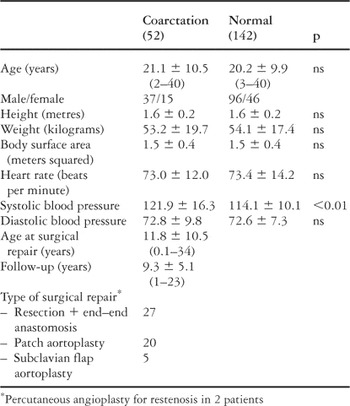
Table 1.
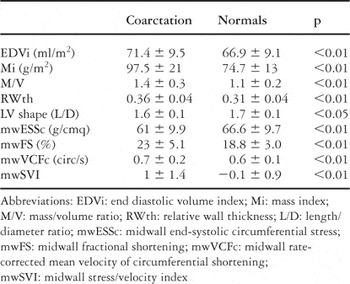
Table 2.
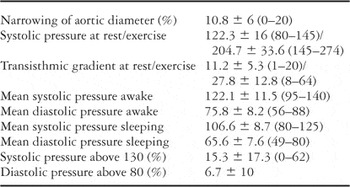
Table 3.
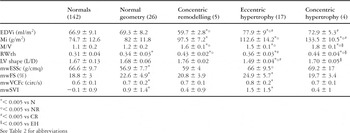
Table 4.
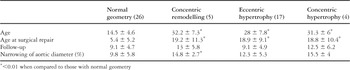
Table 5.
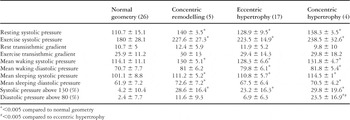
Table 6.

Results of multiple logistic regression analysis. The upper panel shows the relation between the proportions of patients with abnormal left ventricular geometry and age, while the lower panel shows the relation between the proportions of patients with abnormal left ventricular geometry and diastolic blood pressure at rest (DBP). RR: relative risk; CI: confidence interval.
 You have
Access
- 18
- Cited by