Among athletes older than 35 years, myocardial infarction is by far the leading cause of sudden death; however, even among younger athletes who have had sudden cardiac arrests, conditions related to coronary insufficiency comprise the second largest category of aetiologies. According to the Minneapolis Heart Institute Foundation Registry, among 1435 young competitive athletes who died because of sudden cardiac arrest from 1980 to 2005, about 20% was caused by coronary artery abnormalities.Reference Maron, Thompson and Ackerman 1 This review will discuss both acquired and congenital coronary artery diseases that pose risk to the young athlete.
Acquired coronary artery abnormalities
Kawasaki disease
Acquired coronary artery abnormalities can occur in Kawasaki disease, Ehlers–Danlos syndrome, Marfan syndrome, Takayasu arteritis, polyarteritis nodosa, scleroderma, neurofibromatosis, dyslipidaemias, and systemic lupus erythematous. Of these, Kawasaki disease is the leading cause of acquired coronary artery disease in children. The cause of Kawasaki disease is still unknown. The largest national incidence is in Japan, where in 2006 it was 188 per 100,000 children <5 years of age. There is a significant difference in incidences according to ethnic group, as highlighted by the ethnically diverse population of Hawaii, where the incidence of Kawasaki disease per 10,000 children under age 5 years was 266.8 for Japanese ancestry, 94.8 for Chinese, 76.5 for Polynesian, 55.7 for Filipino, 11.4 for mixed race, and 7.3 for Caucasian ancestry.Reference Wu, Burns and Rowley 2 This condition can result in inflammatory myocarditis and small- and medium-sized blood vessel vasculitis. It mainly affects children<5 years of age, but the disease sequelae can extend into adulthood and can include sudden death.
The diagnostic criteria for Kawasaki disease is regional, and in United States of America the proposed criteria were published in 2004Reference Newburger, Takahashi and Gerber 4 ; however, there are cases that are considered atypical Kawasaki disease, presenting with less than four criteria. Infants below 6 months of age are especially prone to present atypically. Unfortunately, young infants and older children tend to develop more coronary artery pathology.Reference Chang, Hwang, Chen, Lee, Meng and Lu 3 Intravenous immunoglobulin administered in the early stage reduces the chance of developing coronary artery abnormalities from 25 to 4%.Reference Newburger, Takahashi and Gerber 4 When a coronary artery aneurysm is identified, usually in the acute or subacute period, low-dose aspirin should be prescribed until the aneurysm regresses.Reference Newburger, Takahashi and Gerber 4 If there is a giant coronary artery aneurysm, which is defined variously as a coronary artery diameter of ⩾4 times that of the diameter of a normal adjacent reference segment or ⩾8 mm internal diameter, warfarin and low-dose aspirin are recommended.
Late coronary artery sequelae include aneurysm, stenosis, thrombosis, fistula, myocardial ischaemia/infarction, and ventricular fibrillation.Reference Halliday, Murgatroyd, Whitaker and Dworakowski 5 Myocardial infarction is the leading cause of death in patients with Kawasaki disease.Reference Kato, Ichinose and Kawasaki 6 Giant coronary artery aneurysm can also lead to aneurysm rupture and sudden death. In adulthood, the coronary artery lesions may also cause accelerated atherosclerosis. When adult patients present with unexpected cardiac events and findings of calcified giant coronary artery aneurysms involving the proximal portion of the major branches of the coronary arteries, segmental stenosis, and multi-vessel disease, undiagnosed Kawasaki disease from childhood should be suspected.Reference Tsuda, Matsuo, Naito, Noguchi, Nonogi and Echigo 7 It is recommended that among patients who had had Kawasaki disease and moderate (4–8 mm internal diameter) or giant (⩾8 mm) aneurysms in infancy or childhood, lifelong diligent follow-up with some combination of serial electrocardiograms, stress tests, and appropriate imaging studies to detect coronary artery abnormalities and myocardial ischaemia is necessary. Among those whose aneurysms resolved or in the presence of residual small aneuryms and when there is no coronary artery stenosis, sports participation is usually permitted. In all cases, meticulous lifelong adherence to a “heart healthy” lifestyle, including proper diet, activity, tobacco avoidance, and prevention of hypertension, is emphasised. The interested reader is referred to comprehensive guidelines on the management of cardiovascular sequelae in Kawasaki disease. 8
Congenital coronary artery abnormalities
Anomalous left coronary artery from the pulmonary artery
Anomalous left coronary artery from the pulmonary artery is a rare form of congenital heart disease occurring in about 1/300,000 live births.Reference Cowles and Berdon 9 It is usually detected in infancy at 2–3 months of age when the patient presents with poor feeding and irritability. The chest X-ray usually will show evidence of heart failure with cardiomegaly and pulmonary oedema. The electrocardiogram shows signs of myocardial ischaemia or infarction. An echocardiogram will reveal a dilated left ventricle with myocardial dysfunction and often severe mitral regurgitation. The anomalous left coronary artery is seen arising from the pulmonary artery with a reversed Doppler flow pattern. After confirmatory imaging, patients are referred for surgical repair, most commonly involving direct left coronary artery translocation to the aortic root.
In rare cases, patients with anomalous left coronary artery from the pulmonary artery can develop abundant collateral coronary circulation from the right coronary artery during the critical period when the pulmonary artery pressure decreases after birth, thereby preserving ventricular perfusion. Therefore, myocardial ischaemia or infarction does not occur in infancy. These patients have subclinical ischaemia and are often asymptomatic, but may develop ventricular arrhythmias and sudden death in adulthood.Reference Pena, Nguyen, Merchant and Dennie 10 – Reference Pachon, Bravo and Niemiera 14
Anomalous origin of the coronary artery from the opposite sinus of Valsalva with an interarterial course
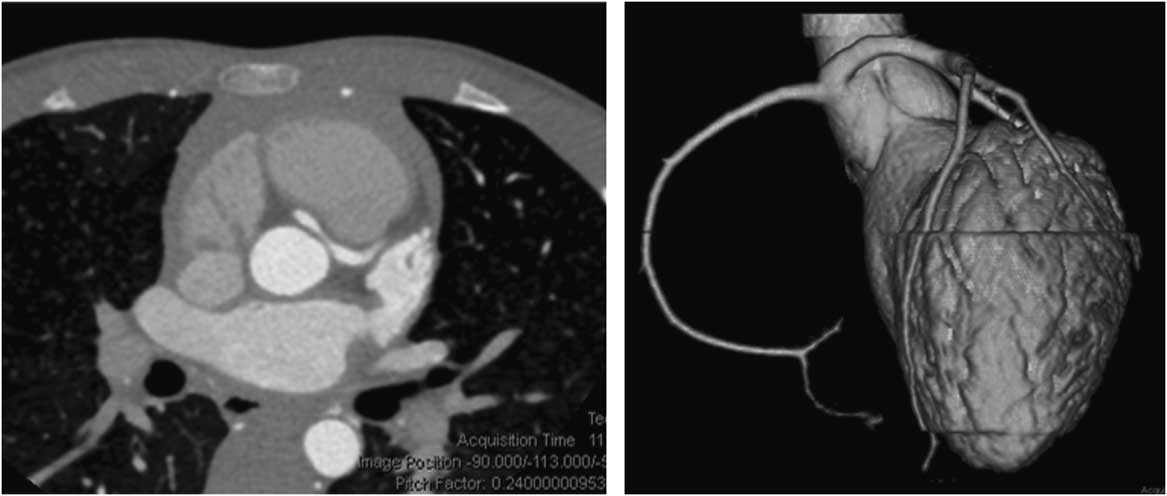
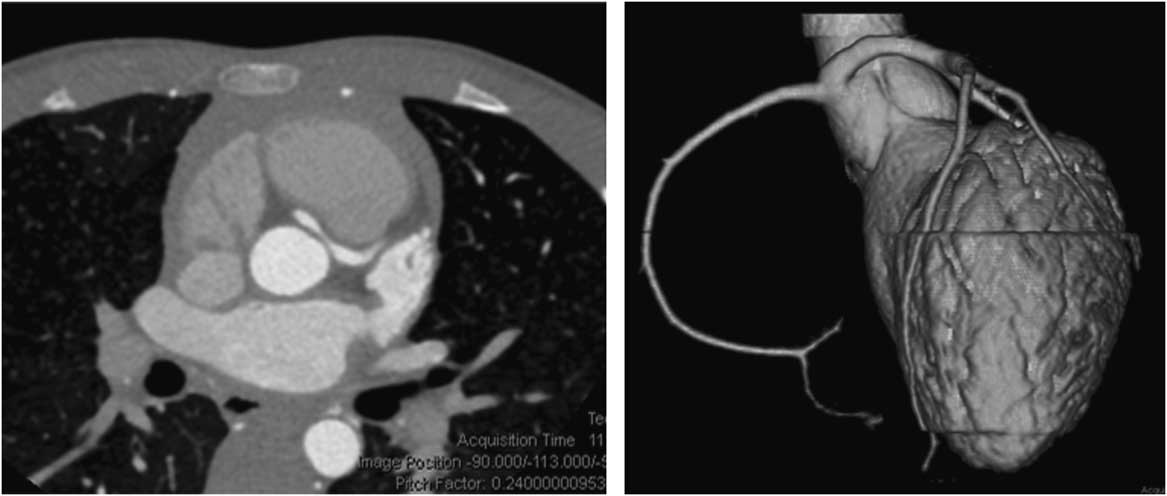
By echocardiographic screening, the estimated prevalence rate of anomalous origin of a right or left coronary artery from the opposite sinus of Valsalva is probably around 0.1–0.2% in the general populationReference Davis, Cecchin and Jones 15 , Reference Pelliccia 16 ; however, using magnetic resonance angiography as the screening tool, which is more precise, the prevalence rate is higher (0.7% in the young general population aged between 11 and 15 years).Reference Angelini 17 An anomalously arising right coronary artery is far more common than the left. Anomalous origin of the coronary artery from the opposite sinus of Valsalva is usually harmless and not detected during life; however, if the anomalous coronary artery courses intramurally between the pulmonary artery and the aorta (interarterial), sudden cardiac death may occur during or shortly after vigorous exercise, especially in patients with the anomalous left coronary artery originating from the right sinus of Valsalva (Fig 1).Reference Mainwaring, Reddy and Reinhartz 18
A 6-year-old asymptomatic patient presented with a heart murmur. An echocardiogram showed both left and right coronary arteries arising from the right sinus of Valsalva. The CT angiography (left) and its three-dimensional reconstruction (right) show a common origin of the coronary arteries from the right sinus of Valsalva. The left main coronary artery courses between the right ventricular outflow tract and aorta with the coronary artery narrowed from 3.5 to 2.2 mm.
Anomalous origin of the coronary artery from the opposite sinus of Valsalva may cause the coronary artery to arise from the aortic wall at an acute angle and with a slit-like orifice. This can potentially compromise coronary blood flow. In addition, it may also contain a narrowed intramural – inside the aortic wall – segment. During vigorous exercise, the combination of an increased oxygen demand, decreased blood supply to the myocardium caused by the narrow coronary artery segment, additional narrowing of the coronary artery due to the dynamic state of the aorta, and a shorter diastolic periodReference Angelini 17 may result in cardiac ischaemia, ventricular arrhythmias, and sudden cardiac death.Reference Pelliccia 16 Surprisingly, even high-sensitivity exercise testing usually does not provoke ischaemic changes in affected patients, even when they present after a history of exertional chest pain, syncope, or shortness of breath.Reference Basso, Maron, Corrado and Thiene 19
The presence of anomalous coronary artery arising from the opposite sinus of Valsalva and having an intramural, interarterial course is usually detected by echocardiogram as an incidental finding. Suspected cases should have additional coronary computerised tomographic angiography to confirm the diagnosis and to delineate the detailed coronary artery anatomy. As sudden cardiac death usually occurs only during strenuous exercise, many experts believe that such patients should avoid vigorous sports; however, this is still highly controversial, especially for patients having a more common anomalously arising right coronary artery. For patients having an intramural, interarterial anomalous coronary artery arising from the opposite sinus of Valsalva and whose symptoms during exercise are highly suggestive of acute myocardial ischaemia, surgical correction is recommended.Reference Pelliccia 16 Unroofing of the anomalous coronary so that the ostium extends to the proper aortic sinus is the most common procedure for patients with an intramural segment within the aortic wall and in whom surgery is considered appropriate.Reference Frommelt 20 This may require lifting and re-suspending the inter-sinus commissure.
As there are both short- and long-term risks of such coronary artery surgery, it is still controversial regarding how to treat asymptomatic patients with incidental findings of anomalous coronary artery from the opposite sinus with an interarterial course. In general, many experts believe that asymptomatic patients with an anomalous right coronary artery from the left sinus of Valsalva carry little risk of sudden cardiac death and should not be operated.Reference Mainwaring, Reddy and Reinhartz 18 That said, different centres have developed their own therapy algorithms for this condition that usually include some combination of coronary ostial anatomy and coronary artery dominance. For asymptomatic patients with an anomalous left coronary artery from the right sinus of Valsalva, the ongoing multicentre anomalous aortic origin of coronary artery registry of the Congenital Heart Surgeons Society may be able to provide an evidence-based management protocol in the future.Reference Poynter, Williams, McIntyre, Brothers and Jacobs 21
Coronary artery ostial disease
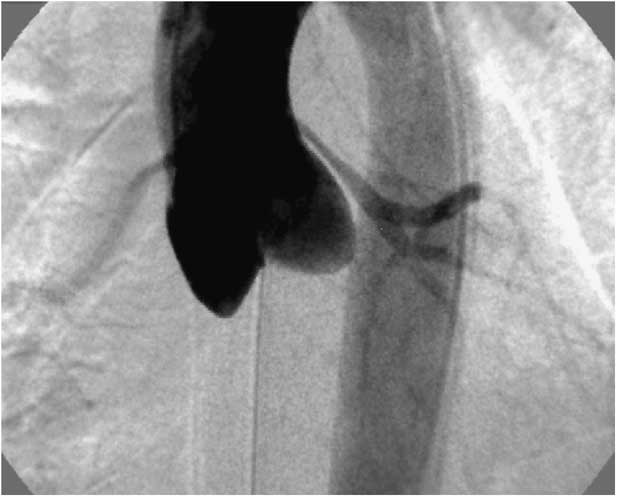
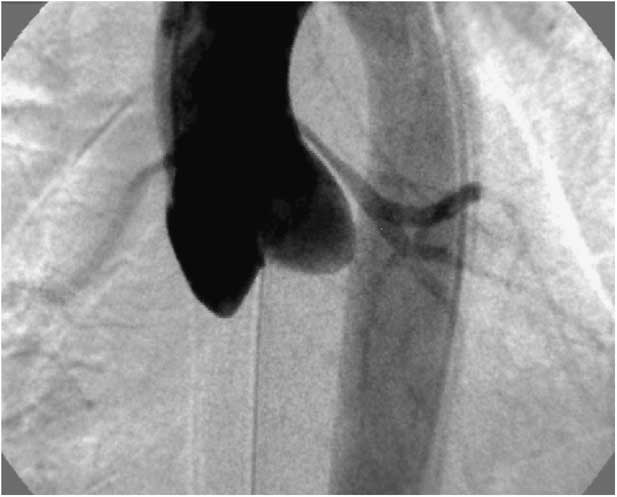
Although ostial stenosis or atresia at birth may rarely accompany other congenital heart defects, this condition should more properly be considered acquired in the context of congenital disease. An ectopic location of a coronary artery ostium can result in progressive coronary artery ostial stenosis or atresia.Reference Angelini 22 This rare congenital heart defect may not be recognised until later in life and may cause exercise-induced chest pain, palpitations, or sudden cardiac death due to ventricular arrhythmias. Figure 2 shows a 17-years-old young man who presented with exertional chest pain and was resuscitated with ventricular fibrillation. The aortic angiogram shows a high take-off of the left coronary artery from the ascending aorta and at an acute angle, presumably resulting in coronary artery ostial stenosis and myocardial ischaemia. Surgical correction is indicated in this situation.
A 17-year-old young man presented with exertional chest pain and was resuscitated ventricular fibrillation. His aortogram showed a high take-off of the left coronary artery from the ascending aorta at an acute angle, resulting in coronary artery ostial stenosis.
Coronary artery ostial pathology may also be a progressive component of William’s syndrome and congenital aortic valve disease. Finally, any congenital heart surgery that involves translocation and/or re-attachment of the coronary arteries should be considered as relatively high risk for coronary ostial stenosis. This especially includes the arterial switch operation for d-transposition of the great arteries, the Ross operation for aortic valve disease, and aortic root surgery for aortopathies. Periodic stress testing is, at a minimum, recommended for these patients before engagement in sports participation.
Myocardial bridging
Myocardial bridging is present when a portion of a major epicardial coronary artery is covered by myocardium and is observed in 1.5–16% of angiography and up to 80% of autopsy series.Reference Mohlenkamp, Hort, Ge and Erbel 23 – Reference Hill and Sheppard 25 Myocardial bridging is most commonly localised in the middle segment of the left anterior descending coronary artery.Reference Mohlenkamp, Hort, Ge and Erbel 23 When myocardial bridging is detected by angiography as an incidental finding, it is usually clinically insignificant; however, in rare cases, it can lead to exercise-induced acute coronary syndrome, coronary artery vasospasm, and sudden cardiac death, especially if the vessel tunnels deeper than 3 mm beneath the epicardium.Reference Gowd and Thompson 26 , Reference Thompson, Myerburg, Levine, Udelson and Kovacs 27
Asymptomatic athletes with incidental finding of myocardial bridging are allowed to participate in all sport activities; however, they may need stress testing to detect myocardial ischaemia during exercise. Symptomatic patients with myocardial bridging can be treated with β-adrenergic blockers to reduce exercise heart rate and be restricted to low-intensity sports. Symptomatic patients refractory to medical therapy may need surgical un-bridging.Reference Gowd and Thompson 26 Athletes who have undergone surgical un-bridging or stenting of the bridge may participate in low-intensity sports. If there is no further evidence of ischaemia 6 months after the procedure, they may participate in all competitive sports.Reference Thompson, Myerburg, Levine, Udelson and Kovacs 27
Acknowledgements
None.
Financial Support
This research or review received no specific grant from any funding agency or from commercial or not-for-profit sectors.
Conflicts of Interest
None.
Ethical Standards
The authors assert that all referenced work contributing to this review complies with the ethical standards of biomedical or medicolegal investigation.