In the fall of 2008, the work of John Maynard Keynes returned to fashion. As in the 1930s, the industrial world confronted the prospect of mass unemployment, this time induced by falling housing prices that imploded the financial system. Governments rediscovered interventionism and passed stimulus packages, then did so again, as political leaders turned to the economist whose ideas, they recalled, had once rescued their countries from the Great Depression. Keynes's biographer, Robert Skidelsky, produced a triumphant volume, The Return of the Master. Magazines reprinted Milton Friedman's quip from 1965 that “We are all Keynesians now.” Right-of-center scholars finally cracked open The General Theory of Employment, Interest, and Money and then wrote confessional essays with titles like “How I Became a Keynesian.”Footnote 1
As the world economy has unsteadily recovered, however, a different work by Keynes has increasingly caught the attention of economists, historians, and other scholars, as well as popular writers and cultural critics. In “Economic Possibilities for Our Grandchildren,” first delivered before a crowd of schoolboys in 1928, Keynes attempted to peer a hundred years into the future. By 2028, he predicted, developments in industry and agriculture would allow each person to experience a material standard of life eight times greater than that currently enjoyed by those in his audience. Automation would mean that individual wants could be satisfied with an absolute minimum of labor, and rather than fifty hours a week, citizens of the industrial world would work no more than fifteen. “Mankind,” he insisted, “is solving its economic problem.”Footnote 2 Events since 2008 seem to have proved that Keynes got so much right, which is precisely why many have begun to ask how “Economic Possibilities for Our Grandchildren” got so much wrong. The solution, this article suggests, lies in understanding the importance of eugenics to Keynes's visions of the future, and how closely eugenics was linked to other domains of his work.
Materially, Keynes's prediction has been borne out. The industrial world really is able to feed, clothe, and amuse its citizens using a fraction of the labor required in the 1920s. Yet those citizens seem to work more than ever. Worse, robots and algorithms threaten to eliminate jobs performed by human beings, whose lost incomes would accrue as rents to the owners of capital. The new fear is not mass Depression-style unemployment but mass technological disemployment. Keynes wrote that the citizens of 2028 would have to find ways to “spread the bread thin on the butter,” but he glossed over the inequities of distribution and ownership of wealth, especially on a global scale, that have come to define early twenty-first-century capitalism.Footnote 3 At the same time, the very possibility of a utopian post-scarcity and post-labor economic system—what a new, widely discussed book calls Trekonomics Footnote 4—has inspired questions about how human beings would actually behave in an abundant universe.
In “Economic Possibilities,” Keynes worried about this, too. The “real, permanent” question about the future of mankind, he argued, was how it would manage its world of leisure. What would people do when they had nothing to do? The specter of futile idleness haunted his cornucopian dream. “There is no country and no people,” he wrote, “who can look forward to the age of leisure and abundance without a dread.” The vast majority of industrial citizens were unsuited to carry the burden of civilization forward: “It is a fearful problem for the ordinary person, with no special talents, to occupy himself, especially if he no longer has roots in the soil or in custom or in the beloved conventions of a traditional society.”Footnote 5
The most common explanation for Keynes's utopian error is that he held unreasonable expectations for how humans would behave in a post-economic paradise. As society grew more prosperous, Keynes famously hoped, “there will be great changes in the code of morals … The love of money as a possession … will be recognised for what it is, a somewhat disgusting morbidity, one of those semi-criminal, semi-pathological propensities which one hands over with a shudder to the specialists in mental disease.”Footnote 6 At the very least, it would seem that Keynes underestimated humans’ propensity to compete and to conspicuously consume beyond their basic wants.
Instead, this article argues that Keynes foresaw a change in human behavior because he foresaw a change in human beings themselves. He did not expect human nature to transform; he expected to transform it. A future of abundance posed moral problems of leisure and capitalism, democracy and social stability. Keynes's answer to those problems lay in the constitution of the people who would inhabit that future. That made it a eugenic answer.
The outline of Keynes's long engagement with the eugenic movement is well known. His involvement spanned his entire professional career, from service as treasurer of the new Cambridge University Eugenics Society in 1911 to a seat on the council of its parent national society in the 1940s. Just before his death in April 1946, Keynes assured the nationwide body that eugenics was “the most important, significant, and, I would add, genuine branch of sociology which exists.”Footnote 7 Such statements have been particularly discomfiting to his later followers, while to his critics, Keynes's name on eugenics membership lists has seemed an excellent shortcut to discrediting his and his successors’ economic advice.Footnote 8 And to historians of eugenics, Keynes's name has at times seemed a kind of prize, demonstrating the status of eugenics and its appeal to left as well as right.Footnote 9
In fact, it would be far more surprising, given his intellectual and social circles, if Keynes had never joined a eugenic society at all.Footnote 10 He was part of a large group of Edwardian intellectuals who were involved with eugenic campaigns of one form or another, campaigns that retained intellectual legitimacy until the Second World War. Yet it is also too simple to assume that Keynes should merely be counted as a member of a uniform eugenic movement. Eugenics contained many different ideologies and policies, and Keynes was among many enthusiasts who never endorsed forcible sterilization or other state violence. Indeed part of the reason historians have neglected Keynes's eugenics may be that, other than birth control, he never advocated any specific policies in print.Footnote 11
To understand Keynes's idiosyncratic eugenics requires seeing how it was part of other controversies in which he was engaged, especially the study of ethics and probability. Eugenics was no intellectual pastime. Instead, Keynes's early study of heredity and its societal implications shaped his later programs and plans for the future of industrial democracy. At the moment he began his career in academic economics, eugenics seemed on the verge of granting industrial nations an unprecedented degree of control over their own future. Yet the potential of eugenics to restructure the relationship between state and citizen depended on the outcome of contests over the specific forms of knowledge about human heredity. These contests lasted from the 1880s to the 1920s and pitted advocates of Mendelian genetics, who understood heredity as the material transfer of discrete traits, against those who proposed to study heredity through the aggregation and analysis of continuous biometrical statistics.
As the first part of this article shows, Keynes came down firmly on the side of the former. Between 1908 and 1910 he worked with William Bateson, Britain's leading Mendelian biologist, on a genetic mechanism for the inheritance of color-blindness. This was a trait laden with theoretical and practical significance, yet historians and biographers have surprisingly missed both the fact and the significance of Keynes's unusual engagement with biological science.Footnote 12 Keynes's efforts to solve the puzzles of heredity reveal how directly he linked the conflict between genetics and biometry to ethically grounded theories of probability and statistics, especially when applied to human populations. To Keynes, as the second section of this article explains, a proper system of ethics could only be founded on a correct notion of probability, and statistical biometry was based on a false conception of human knowledge.
The third part of this article argues that, after the First World War, eugenics played a key role in Keynes's project for liberal economic government. The war's destruction threatened to return a supposedly overpopulated continent into the clutches of the Malthusian trap. Keynes reckoned that Britain's problems were rooted in the hereditary weaknesses of its leadership, and he spent those years grasping for a system of societal and economic management that would engineer a new escape. Importantly, that system of management would depend on control over the quality of population as well as its quantity. In more ways than one, liberal governments of the future would be built on a proper and sophisticated understanding of how human characteristics were inherited.
By the end of the 1920s, the receding Malthusian problem highlighted that creating a world of ethical goodness remained Keynes's goal. Contemporaries easily saw how eugenics was an ethical problem. What has been missed, however, is how Keynes turned ethics into a eugenic problem too. He sought to use technocratic control over the quality of the human population to rescue a world of goodness from the wreckage of a world war.
GENETICS AND PROBABILITY
In the summer of 1909, while Cambridge welcomed hundreds of biologists and naturalists for a party in honor of Charles Darwin's hundredth birthday, Keynes and his family were on holiday in the Pyrenees.Footnote 13 While there, as he had done every day for four years, he worked on the subject of probability, though he was now trying to turn his prize-winning dissertation into a book.Footnote 14 But Keynes was distracted: “I spend the mornings working at the theory of heredity,” he wrote to his lover, the painter Duncan Grant. “I may have got out some results which will be worth sending to the Prof. of Biology. It's become, in the light of the recent discoveries, an astonishingly interesting subject.”Footnote 15
The “Prof.” was William Bateson, the reviver and chief proponent of Gregor Mendel's theories of inheritance in England.Footnote 16 It was Bateson who had coined the word “genetics” in 1905, as a suggestion for the name of a newly endowed Cambridge professorship.Footnote 17 The Keyneses and the Batesons belonged to close Cambridge networks. Both patriarchs were mathematicians, classicists, and university administrators. The families were next-door neighbors in the mid-1890s, and Maynard's brother, Geoffrey Keynes, later provided Bateson with drawers of butterflies as specimens for the study of heredity.Footnote 18 In the fall of 1909, both Bateson and John Maynard Keynes also had found new positions in Cambridge. Keynes had graduated in mathematics in 1905 and then spent two years at the India Office in London. Having failed in his first attempt at a prize fellowship at King's College during the winter of 1908, he returned as a lecturer in economics instead, a position his mentor Alfred Marshall had secured for him. Marshall had consulted Bateson for a decade and a half on questions of human inheritance.Footnote 19 Bateson's perpetual scramble for funds, meanwhile, had finally led to his election to the new, if underfunded, Balfour professorship of biology.Footnote 20
Keynes's engagement with the science of heredity may have begun in October 1908, when he likely attended Bateson's inaugural lecture, “The Methods and Scope of Genetics.” There, Bateson made the case for his particular physiological interpretation of Mendelism and of the patterns of inheritance as a whole.Footnote 21 The dominance of certain traits, he proposed, was best explained as the presence of some biochemical “factor,” while recessiveness was explained by the absence of that factor. For instance, albinism seemed to be recessive in rabbits, but an albino rabbit did not carry an albino factor per se. Instead it merely lacked any of the various factors that produced colored fur.Footnote 22 This notion of presences and absences led him to an equally novel idea about what determined sex. It was simple to demonstrate that there was only one parental distribution of genes that produced an even split among the offspring, namely, when a single parent possessed one dominant form of a gene and one recessive form. Since sex was an evenly-split characteristic, it was therefore determined by something present in men and absent in women, or vice versa. Bateson had concluded, he told his audience, that it was males who lacked the factor for femaleness.
Among his strongest evidence for this theory of presence and absence was its power to explain the puzzling pattern of the inheritance of human color-blindness. Color-blind parents of either sex could pass the affliction to their sons. So could normal-sighted women, but normal-sighted men seemed incapable of transmitting color-blindness to their offspring. Bateson argued that since color-blindness was undoubtedly caused by “the presence of something which affects the sight,” women must possess something else to combat the color-blindness factor. “It is not improbable,” he ventured, “that the counteracting element is no other [sic] than the femaleness factor itself.”Footnote 23 Thus Bateson wagered his own credibility and that of Mendelism on the ability of his theory to explain a particular condition.
Not long after Bateson's inaugural lecture, the odds on that wager lengthened in ways that would render Keynes's help invaluable. For decades, Bateson had performed his own experiments on plants and small animals, but for human heredity he relied on informants. The most valuable by far was a retired London ophthalmologist named Edward Nettleship, who, starting in 1904, sent Bateson vast data on families suffering from ocular diseases.Footnote 24 In early 1909, Bateson published his theory of color-blindness in his new book, Mendel's Principles of Heredity, liberally illustrated with impressive pedigrees taken from Nettleship's material. These both justified and were justified by Bateson's explanations of inheritable traits.Footnote 25 But by April 1909, he was forced to insert an apologetic correction into copies of the book, next to a color-blindness pedigree that was now contradicted by new data from Nettleship.Footnote 26 The new data endangered the validity of the “counteracting element” of femaleness and with it the edifice of Bateson's theory.
Bateson had promised Cambridge that genetics would bring “certainty into a region of human affairs and concepts which might have been supposed reserved for ages to be the domain of the visionary.” He consistently emphasized that the social utility of genetics depended on its eugenic potential—its power to distinguish citizens on the basis of their heritable characteristics, in order to ensure that “each individual shall so far as possible get into the right class and stay there, and usually his children after him.”Footnote 27 When its certainty was threatened, so too was the “higher usefulness” of his new science.
Color-blindness was doubly significant. Not only did it provide a test of the theory of presences and absences, but as a trait it had long held serious eugenic implications for social and economic progress. Following an 1875 Swedish railway accident in which a color-blind engineer had allegedly failed to distinguish between red and green signals, inquiries across Europe had revealed the extent to which color-blindness was a “danger to life and property.” In 1890 the Royal Society empaneled the Committee on Colour-Vision, whose members included the pioneering eugenicist Francis Galton, the physicists Lords Rayleigh and Kelvin, the Cambridge physiologist Michael Foster, and the mathematician and MP Sir George Stokes. The committee tested five hundred people, using instruments designed by Rayleigh and Galton, and heard testimony from the railways, the merchant marine, and medical experts, including Bateson's future informant Nettleship. Its report urged mandatory and repeated testing of all employees whose work depended on distinguishing colors. They would be required to identify not only simple colors but also the “confusion colors,” name them all correctly, and demonstrate proper “form-vision.”Footnote 28 The Royal Society pressed the Board of Trade to establish methods and places for trials of color-blindness. But labor unions challenged both the efficacy of tests under laboratory conditions and the ability of the Board's experts to know what sailors or railway men needed to see.Footnote 29
Color sensibility signified not just competence but culture as well. Five years before the Committee on Colour-Vision, many of its future members had debated the relationship between “civilisation and eyesight” in an exchange of letters to Nature.Footnote 30 Children were accepted to have an undeveloped sense of color, much like the ancient Greeks, in accord with the notion that the evolution of the species mirrored the growth of a child.Footnote 31 Most dramatically, the famous 1898 anthropological expedition to the Torres Strait near New Guinea showed how a color sense could be taken as an index of contemporary human development. Among the expedition's leaders was the Cambridge anthropologist and physiologist William H. R. Rivers, a fellow Fellow of Marshall and Bateson at St. John's College and like both an early supporter of the university's Eugenics Society.Footnote 32 He reported the Murray Islanders as being less sensitive to blue than Europeans and as having a less abstract vocabulary for colors in general, but he remained unsure whether this difference was “a function of [the islander's] primitiveness or of his pigmentation.” Rivers told the Royal Institution in 1900 that the islanders’ insensitivity to blue might indicate the absence “of some physiological substance or mechanism, which acts as the basis of the sensation blue in ourselves,” or it might depend on the coloration of the retina itself.Footnote 33 The ambiguity of Rivers's “mechanism” belies its kinship to Bateson's theory of presence and absence.Footnote 34 What was decidedly not ambiguous was that color-blindness marked an uncreative mind and childlike person who endangered society and hindered progress. If color-blindness was to be eliminated as a eugenic issue, the particular method of its inheritability mattered.Footnote 35 More generally, the demonstration of an intelligible hereditary pattern of color-blindness would evince Mendelism's power to solve social problems. Otherwise, while color-blindness among the elite could remain a curiosity, its causes among the working classes might easily be attributed to material conditions of poverty.Footnote 36
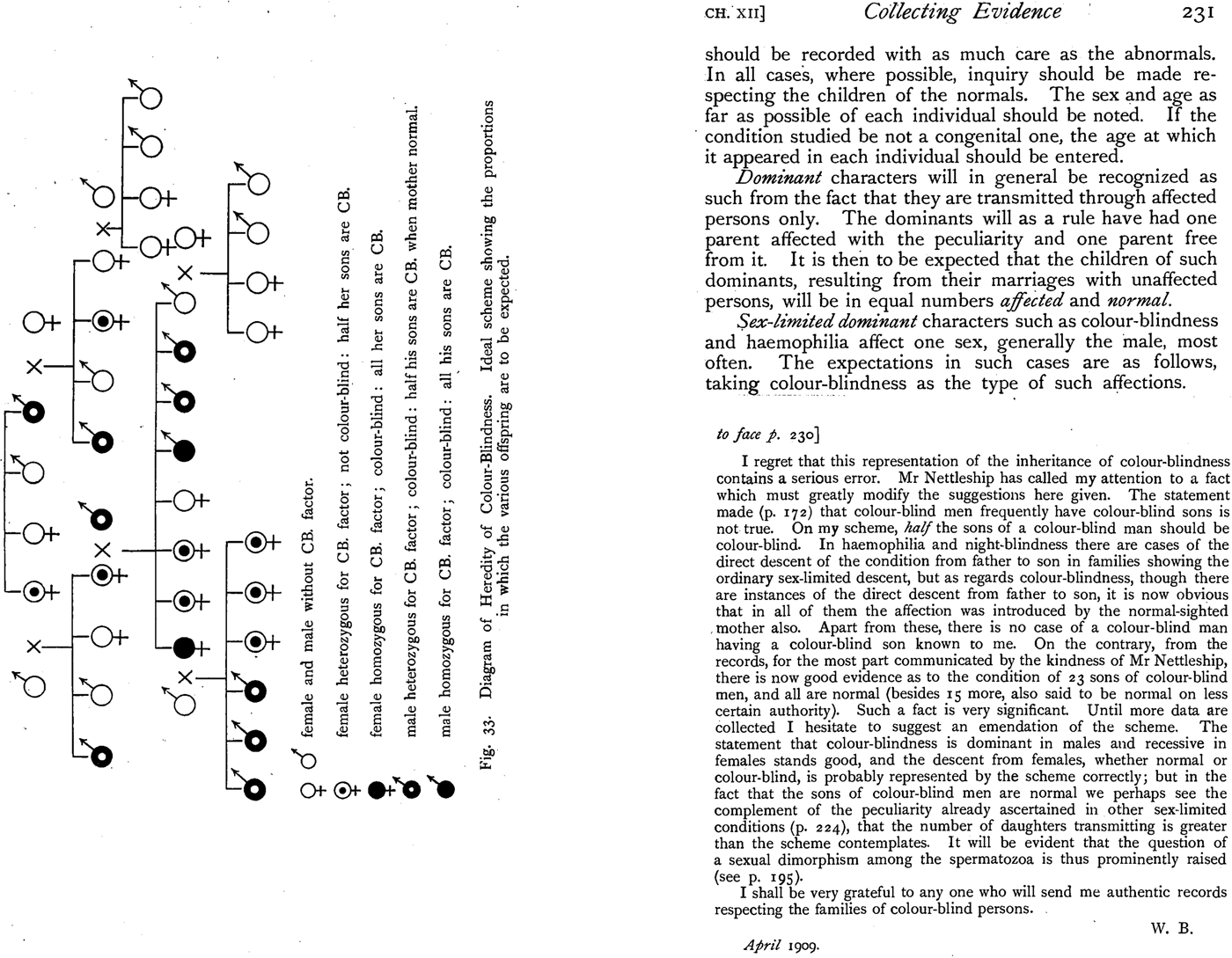
As the fall term of 1909 began, Bateson continued to grapple with incorporating Nettleship's new data into his theories of sex and color-blindness. Keynes served as a valuable collaborator on paper and on the blackboard. “The scheme I put in my book p. 230 is certainly not right for C. B.,” he wrote to Keynes in late October (figure 1). “In the new impression p. 231 I have given an amended scheme which is in all probability right or nearly so.” He considered complicating his theory of sex even more. Now he proposed an elaborate system in which male sperm fertilized only non-female ova, and non-male sperm fertilized only female ova. “Till we get bigger numbers we can't be quite positive,” Bateson lamented.Footnote 37 Everything still depended on Nettleship's data.
Bateson's color-blindness pedigree using Nettleship's data, with April 1909 correction notice. Center for Research Libraries.

To Keynes, Bateson's “somewhat novel theory of sex” seemed unnecessary. He further wondered whether it was really the case, as Bateson supposed, that it was impossible for non-carrying females to emerge from two heterozygous parents: “This is the point I doubt à priori.” Keynes also enclosed “a very simple scheme which would explain why all the sons but not all the daughters of a colourblind woman are colourblind” (figure 2). By rewriting the possible combinations without worrying about their proportions, he saw the way to clean up Bateson's additional layer of “selective mating.” But he observed that under his system heterozygous males and females would both seem normal, while he again asked: “according to you, [a heterozygous female] appears colorblind and [a heterozygous male] appears normal. Is this proved?”Footnote 38
Keynes's “scheme” for Bateson, 1909. John Innes Archives, courtesy of the John Innes Foundation.
Epistemological questions of prediction, certainty, and proof link genetics to larger and more familiar aspects of Keynes's work, ones at which he labored during the period in which he worked with Bateson. The Mendelian analysis of the inheritance of traits aligned with the theory of logical probability that Keynes had been developing since his undergraduate years, and which he finally articulated in the form of a dissertation titled “Principles of Probability,” submitted for a prize fellowship at King's College at the end of 1907.Footnote 39 In its pages he attempted to restore probability to what he felt was its rightful place as a branch of logic rather than of statistics.Footnote 40 Between a set of evidence and a particular related hypothesis, he argued, there existed a logical relationship that could be “perceived” or “cognised.” But probability was not, crucially, just a matter of opinion or judgment. Instead, given the set of evidence, “then the probability of every possible conclusion is absolutely and objectively determined.”Footnote 41 For any pairing of evidence and conclusion, there was only one probabilistic relation, one likelihood, that a rational mind should accept.Footnote 42
Pedigrees accorded with and manifested this notion of probability. By setting into a pedigree the available information about parental generations, a geneticist could establish the likely mechanism for the inheritance of a trait, and thus determine the probabilities that a member of the next generation would possess that trait and express it.Footnote 43 In his “simple scheme” for Bateson, Keynes had reformulated the pedigree's display of hereditary mechanics in order to highlight this deductive character. As in Keynes's theory of probability, the pedigree's relation between evidence and conclusion was “absolutely and objectively determined,” but once that evidence changed, so, too, would the objective likelihood that constituted the logical relation. This is precisely what had happened in the spring of 1909, when Nettleship's new reports punched holes in Bateson's careful constructs. Changes in his data had forced Bateson to reevaluate the mechanics of inheritance and thus of the genetic composition of the offspring. For his part, Bateson told Keynes he was grateful “to get a clear-headed person to look into things of this sort,” and Keynes was similarly enthused at the prospect of continued cooperation on color-blindness.Footnote 44
Just as significantly, the theorists of logical probability and of Mendelian heredity faced, in Karl Pearson and his disciples, a common foe. Pearson was Francis Galton's protégé, and, as director of both the Galton Eugenics Laboratory and the Drapers’ Biometric Laboratory at the University of London, he had systematically developed his mentor's methods for the statistical analysis of biological traits.Footnote 45 Bateson and Pearson concurred that the identification, segregation, and sterilization of dysgenic individuals was important to the future of both the nation and the state, but they disagreed vehemently about what form of knowledge would make that possible.Footnote 46
To Bateson, biometric work might demonstrate “statistical accord” but could only ever approximate the true facts of hereditary transmission. While professing admiration for Galton himself, Bateson felt that Mendelian concepts had rendered his theories obsolete—not least the so-called law of ancestral heredity, which postulated that on average parents contributed one half of the constitution of an individual, grandparents one fourth, great-grandparents one eighth, and so on. Bateson particularly criticized biometry for what he saw as its inability to explain sex-linked traits like color-blindness. Only a theory of inheritance built on the analysis of individuals’ particular combinations of traits could show how “purity of type” might arise in future generations after the crossing of heterozygous individuals.Footnote 47
Pearson retorted that categorical divisions such as “albino” and “not albino” only existed in Mendelians’ minds, not in nature. “When you come to analyse individual cases … [it] is an extraordinarily difficult thing to put your cases under two classes.” There was an artificial clarity to claims of a “distinction between an ordinary variation and a mutation, or a distinction between one form of inheritance and a second.”Footnote 48 He further objected to Bateson's “factors” as speculative entities for which there existed no chemical evidence.Footnote 49 Thus Mendelism was hopelessly simplistic for phenomena as complicated as those of heredity, and the statistical, continuous approach was the one “true method.”Footnote 50 Pearson and his laboratories instead studied the distribution of traits within species “just as if they were single entities,” calculating correlations among continuous biological variables rather than sifting for discrete units of inheritance.Footnote 51 Such studies were the only method that would let Britain arrest the decline in its human stock.
At the same time that Keynes analyzed color-blindness with Bateson, he also mounted a philosophical attack on the mathematical and logical supports of Pearson's biometry. In doing so, he drew on his own research on color-blindness in order to highlight fundamental problems in the application of statistical reasoning to inherited characteristics. Bateson had promised that his genetic theories would bring “certainty” to the determination of patterns of human traits. If eugenicists really were to draw correctly the boundaries between hereditary and environmental influences on individuals, Keynes argued, they needed the morally proper instruments for measuring that heredity.
STATISTICS AND ETHICS
At the heart of eugenics was an ethical dilemma: how to balance one's duty to oneself with one's duty to the world. In a 1907 public lecture titled “Probability, the Foundation of Eugenics,” Galton had argued that eugenicists’ most difficult task would be convincing vast numbers of people that it was their duty to society never to have children.Footnote 52 Pearson's close assistant, William Palin Elderton, wrote in a review of those lectures that “if Eugenics is to be of much use, biometric results must be appreciated by the general thinking public.”Footnote 53 More generally, the connection between eugenics and obligation was often invoked. In 1911, to Keynes and the rest of the Cambridge Eugenics Society, Bateson's protégé R. C. Punnett argued that “eugenics is concerned with the present conduct of life in so far as it affected the generations of the future.”Footnote 54 And the next year, the undergraduate R. A. Fisher—who in 1918 would help begin to synthesize Mendelism and biometry—told the society that eugenics’ “great problem is how far will the individual come to act as a mere part of the social machine, with his instincts perfectly adapted to his life of social service.”Footnote 55 It was just this tension between individual and global goodness that had attracted Keynes to probability in the first place.
Keynes was a member of the generation of the British “intellectual aristocracy” that came of age just before the Great War. As Skidelsky argues, this cohort “was close enough to the ‘believing’ generation to have a need for ‘true beliefs.’”Footnote 56 For Keynes and his circle of Cambridge Apostles, the secret and select conversation society, that need was, famously, filled by the work of G. E. Moore—especially his 1903 Principia Ethica.Footnote 57 Moore argued that good was self-evident and could not be defined or reduced to any other quality.Footnote 58 Keynes's circle wanted beliefs that would justify their escape, largely already complete in practice, from Victorian social rules and mores. And by grounding ethics in the pursuit of indefinable good, Moore endowed the Apostles with “the right to judge every individual case on its merits, and the wisdom to do so successfully,” as Keynes later put it, echoing his own concept of “cognised” probability.Footnote 59
But in freeing themselves from conventional codes in practice, Keynes's circle had to disregard Moore's conclusions. If a good action was one that brought about good things, then the task of ethics was to find such universally good actions, which it would then be a person's duty to perform. But Moore, in his chapter titled “Ethics in Relation to Conduct,” made impossibly tough demands of any such duty. Knowledge of an action's outcome had to be inhumanly certain for it to be judged obligatory: it had to “cause more good to exist in the Universe than any possible alternative.” That definition stretched to “all the events which will be in any way affected by our action throughout an infinite future,” and to all the effects of every possible alternative action. And incompleteness of our knowledge, “our utter ignorance of the far future,” made it impossible that there would ever be enough evidence for such certainty. “Accordingly,” Moore claimed, “we never have any reason to suppose that an action is our duty.” From his belief in the incompleteness of knowledge, Moore drew the uninspiring conclusion that most customary and “common sense” rules of behavior—like “industry, temperance and the keeping of promises”—ought to be followed as duties, because they seemed likely to produce an environment conducive to good ends in any plausible society.Footnote 60
Much of Cambridge mocked such limp reasoning. The Trinity classicist Francis Cornford, for instance, ridiculed Moore's notion that incomplete knowledge should lead to “suspense of judgment.”Footnote 61 More concretely, however, Keynes felt that Moore had been led astray by his flawed theory of probability. If that theory could be corrected, then perhaps a useful ethics could be saved. In a 1904 paper read to the Apostles, also called “Ethics in Relation to Conduct,” he blamed Moore's error on the “frequency theory” of probability championed by Karl Pearson. To frequentists, the probability of a proposition's truth was the actual, historical fraction of instances in which it or similar propositions had been true. In The Chances of Death, Pearson had averred that the statistician's knowledge was therefore as empirically based as that of a physicist.Footnote 62 To Keynes, however, probability lived in a logical relation between evidence and conclusion. It was not subjectively determined, but neither was it a property of reality that could be measured in the world. The task Keynes set for himself in his 1904 paper, which it took his entire dissertation to achieve, was to construct a notion of probability in reference to available evidence and rational judgment.Footnote 63 Only thus could he show that a duty was an action that seemed likely to do good, not only one that was certain to do so.
In his dissertation, Keynes devoted a section to alternative mathematical theories of probability. He singled out the frequency theory as “the most dangerous of delusions,” whose proponents “have been the worst offenders and have proved the most dangerous deceivers of the people.”Footnote 64 Unfortunately for him, the mathematician and philosopher Alfred North Whitehead was both a frequentist and one of his dissertation's examiners. Whitehead voted against the dissertation, which he felt had shortchanged the frequency theory—not least because Keynes had relegated its refutation to a mere appendix to the introduction. Worse, he complained, Keynes “invariably considers the arguments in its favour at their stupidest.”Footnote 65 Thus denied a fellowship, Keynes added to the next year's dissertation a lengthy new chapter, “The Frequency Theory of Probability,” as well as a substantial section elsewhere on correlation. These constituted the bulk of his revisions, which he diplomatically credited to a “perusal of some notes of Dr. Whitehead's.”Footnote 66
This new effort against frequentism was more robust. Keynes noted, first, that defining the probability of an event's occurrence by how often it or events just like it actually occurred depended on the statistician's accurate determination of the “class” of events “of a similar character” from which such a “truth frequency” might be measured. But any proposition would be a member of many such classes. He reckoned “insurmountable” the difficulties in constructing in advance a method for defining a class that would not routinely include irrelevant events or exclude relevant ones.Footnote 67 In purporting to be merely measuring the world, the frequentist would remain hopelessly mired in subjectivity.
Second, and more worryingly, frequentism could not sustain some of probability's basic theorems. One of the most problematic was the addition theorem, which holds that the chance of either of two outcomes occurring is given by the sum of the probabilities that each occurs alone, minus the probability that they both do. This last term was universally acknowledged to be equal to the product of the two independent probabilities. Yet Keynes pointed out that this arithmetic truth would hold, under the frequency theory, not for all events but only for particular classes. He provided a specific illustration that connected probability to Mendelian genetics, and his work with Bateson to his statistical critique of Pearson:
We are given that the proportion of black-haired men in the population is (p 1)/q and the proportion of colour-blind men (p 2)/q, and there is no known connection between black-hair and colour-blindness: what is the probability that a man, about whom nothing special is known, is either black-haired or colour-blind?Footnote 68
The addition theorem would hold only if the term p 1p2/q 2 was actually the proportion of people who were both color-blind and had black hair. But the evidence q that indicated the occurrences of color-blindness and black hair need not have yielded any information about the number of individuals who were both black haired and color-blind. And whether this was in fact the proportion of people with both traits could not be inferred from the absence of “any known probable connection” between the two traits. At most, the frequency theorist could determine that the necessary proportions “are the most probable,” which was not enough to prove the arithmetic inevitability of this identity of logic.Footnote 69
Whitehead conceded defeat and voted for Keynes's election to the fellowship. “I now accept his contention,” Whitehead wrote, “that probability cannot be solely derived from ideas of ‘frequency’, more or less obscurely present in the mind.”Footnote 70 In the new chapter's conclusion Keynes had done nothing to dilute his venom, but he had clarified his purposes in making “so detailed a criticism” of frequentism: “to show that the logical development of the theory is not at present so secure as to permit controversial applications of it in practice.” And by explicitly aiming the work “against the theories [of] Professor Karl Pearson,” he left no doubt whom he considered controversial.Footnote 71
The links among genetics, ethics, and probability help explain why, a few years later, Keynes joined Marshall and others in a famous public offensive against a publication by Pearson and his disciples.Footnote 72 In 1910, the Galton Laboratory published a memoir entitled A First Study of the Influence of Parental Alcoholism on the Physique and Ability of the Offspring. Ethel Elderton, another of Pearson's assistants, conducted much of the laborious calculation and was the primary author of the memoir, above Pearson himself.Footnote 73 The pair used data from Manchester and Edinburgh to conclude that the children of parents who drank were almost exactly as healthy as the children of sober parents, at least with respect to “intelligence, physique, or disease.” Neither the circumstances of a child's upbringing nor the family's disposable income after the purchase of liquor seemed to have any effect. “On the whole the balance turns as often in favour of the alcoholic as of the non-alcoholic parentage,” Elderton reported.Footnote 74 Thus they satisfied themselves that it was heredity, and not environment, that caused feeble-mindedness and other disorders.
At the request of Pearson's disenchanted protégé, George Udny Yule, Keynes reviewed the study for the Journal of the Royal Statistical Society.Footnote 75 The weakness of the frequency theory, as Keynes had insisted in his dissertation, was its dependence on the fiction of clear kinds and types. As a result, he had written, “we must not incautiously accept conclusions which depend on nothing but the observation of high statistical correlation when they are offered in solution of practical problems of politics or science.”Footnote 76 In his review, Keynes charged that the alcoholism study, which drew on data collected by a physician and by the Charity Organisation Society, used categories that were fundamentally flawed. In rebutting Pearson's indignant response, Keynes wrote that statistical methods required “much more care and caution” than Elderton had employed before they could be applied to complex social problems. The “unavoidable vagueness and want of precision in the data” made the construction of statistical categories impossible.Footnote 77
Keynes himself had recently experienced data's “vagueness” as editor of the India Office's 1907−1908 annual report on the subcontinent's “moral and material progress and condition.”Footnote 78 Internally, he urged the appointment of a “real trained statistician” by the Indian government—someone who not only had “very wide knowledge of theoretical statistics,” but had overseen their collection and “directed practical statistical operations on a large scale.” In 1909, when the Economist asked Keynes to review the latest report, he again emphasized the danger of figures collected for “simple” purposes, such as “the troublesome and often trifling curiosity of the academic statistician.”Footnote 79 In his rebuttal to the alcoholism study, Keynes likewise wrote that Pearson “cannot hope to mend … the gaps, beyond repair, in his original materials.”Footnote 80 They might not stand up to scrutiny when deployed for “controversial applications” in which the effect of individuals’ heredity might be measured and based upon which real policies might be enacted.
Bateson was pleased to have prominent allies against Pearson. “The further I pursue my researches into K. P.'s production,” Keynes wrote him, “the more convinced do I become that the man's a liar.” Bateson agreed, to an extent. “I don't know that he has ever stated a notion in full knowing it to be untrue, or knowingly falsified data,” he cautioned, but conceded that distinctions between such behavior and outright deceit “may be fine.”Footnote 81 In “practical statistical operations” like the alcoholism study, which purported to reveal the relationship between human biology and human outcomes, epistemological choices were always moral ones as well.
A proper theory of probability, Keynes had argued in his dissertation, was the only sure foundation for a correct epistemology of duty. It was no coincidence that, when attacking Pearson's frequentism, Keynes had chosen as his weapon the color-blindness research he and Bateson had conducted. The biological question at stake between Mendelism and biometry was how to identify those individuals with traits society wanted reproduced; the ethical question at the core of eugenics was how to persuade those people to act on that knowledge. As Leonard Hobhouse wrote, in an essay in which he also criticized the alcoholism study's data, “to succeed in eugenics we need a competent understanding both of the eu and of the genics.”Footnote 82 Moore's philosophy, absent Keynes's new probabilistic structure, had given little guidance on how to weigh one's own individual goodness against devotion to the good of the world.Footnote 83
In May 1914, he made this question—“my favourite dilemma”—the subject of a now-notorious lecture at Oxford. There Keynes considered the eugenic connection between personal duty and social good in terms of a global racial struggle.Footnote 84 The average European was not at the point of starvation, but the planet had passed the point where each additional human decreased the average standard of life. Thus the “English bishops, French politicians and German economists” who claimed it was the duty of “all patriotic citizens to procreate” were misguided, or worse. The declining Western birthrate was in fact to be applauded, and intentional overpopulation in the name of “race patriotism” would present more problems than it solved.
At the same time, thanks to international food markets, there could no longer be a purely national population policy, and viewed within a putative conflict among the world's peoples reducing the number of Britons might even be counterproductive. There was little use “weakening internationally the stock we think is the best,” Keynes suggested, if that act “will have but a negligible effect on the material prosperity of the world. It would have no more sense in it than for everyone, who has the intelligence and the imagination to appreciate the terrors of Malthusianism, to remain a bachelor.” Keynes was not merely observing that no individual could avert overpopulation on his own. By maintaining legal prohibitions on contraception, pronatalists ensured only that a disproportionate fraction of children would be born to those “incapable of virtue.”Footnote 85 Those with sufficient intelligence and imagination were precisely the people whom society needed to reproduce most of all. How to identify those members of society who possessed desirable inheritable traits and how confident one could be in those identifications were precisely the questions that geneticists like Bateson and biometricians like Pearson so fiercely disputed.
Keynes hoped that over the coming years the “western nations” would focus less on the worldwide balance among races and more on their own quality of life. His optimism that they might do so depended on a fusion of morality and economics. “If custom and practice are encouraged to develop along their present lines,” then Britain could sooner rather than later “be in a position to mould law and custom deliberately to bring about that density of population which is the best.”Footnote 86 Yet war shortly interrupted those “present lines” of economic progress, and made clear just how questions of population and duty were inseparable.
THE QUALITY OF POPULATION IN POSTWAR BRITAIN
During the war Keynes served in the Treasury, and after the Armistice he went to Versailles as an advisor to the British negotiators. By June 1919, however, he had become disgusted at the looming shape of the treaty, which he felt would not save Europe from another military catastrophe but instead bring about an economic one. He resigned and returned to England to work on a book. The Economic Consequences of the Peace sold, in six months, a hundred thousand copies in a dozen languages. William Bateson, among many others, wrote to express congratulations on the book's sales and compliment Keynes on its arguments.Footnote 87
Keynes's own views on the trajectory of Britain's population would evolve during the subsequent two decades. He worried about an overpopulated world in 1919 and toasted the fall in population growth rates in 1928. By the late 1930s, however, Keynes had come to warn—in the 1937 Galton Lecture to the Eugenics Society—that a declining population would cause unemployment.Footnote 88 John Toye has noted that “the actual rate of population growth in England and Wales was much less unstable than Keynes's opinions about both it and its consequences.”Footnote 89 Nonetheless, it was Economic Consequences of the Peace that helped to frame “the population problem” as one of the crucial issues of the postwar decade.
What has been missed is that for Keynes, “quality” was as important as “quantity” to the solution to the “population problem” in postwar Britain. Just as crucial, and just as neglected, are the precise ways in which the notion of quality was central to his proposals for liberal—and Liberal—technocratic governance. Quality mattered both for the means of social management and for its ends. First, the selection of those individuals who could best manage economy and society in the postwar world would depend on harnessing proper biological understandings of human nature, to which Keynes himself had contributed and which he had helped defend. Second, and more fundamentally, the goals of that management itself needed to include shaping the qualities of the many. In the long term, once the industrial nations had solved the problem of scarcity, the goodness of the world itself would depend on whether the human beings who populated it were capable of leading ethical lives. “Shall you and I begin our works on population together and at the same time?” Keynes asked his future wife, the ballerina Lydia Lopokova, in 1923. “When you make your contribution to the population, it will be a poet that comes out.”Footnote 90 The quality of future generations of the governed depended, for Keynes, on selecting the right qualities among their governors.
Keynes's 1919 bestseller, The Economic Consequences of the Peace, Skidelsky suggests, transformed the perception that political dilemmas were choices between wickedness and idealism into a sense that the choice was now between stupidity and competence.Footnote 91 Between 1870 and 1914, Keynes argued, the Malthusian devil had been chained by the falling real price of food, thanks to the coincidence of increasing technological returns to scale of agriculture and production. This confluence had let Europe's population grow at a rate unprecedented in world history. Such a miraculous escape from historical laws of economic gravity had depended, he suggested, on a delicate mechanism of free trade and stable currencies with Germany at its center, and on a precarious “psychological” accord in the interest of progress. Workers had agreed to earn less than their fair share of income, and capitalists had agreed not to consume their share frivolously. The cake kept getting bigger, in Keynes's analogy, so long as nobody ever ate it.Footnote 92
The task at Versailles had been to reconstruct these mechanisms, but to Keynes's dismay the Allies had opted instead for reparations whose payment would reduce not just Germany but all of Europe to poverty. Staggering numbers of people now had to be fed and clothed by a continent that no longer had the means to provide for them. Keynes, not alone, feared the worst:
The danger confronting us, therefore, is the rapid depression of the standard of life of the European populations to a point which will mean actual starvation for some … And those in their distress may overturn the remnants of organization, and submerge civilization itself in their attempts to satisfy desperately the overwhelming needs of the individual.Footnote 93
The consequences could already be seen in Russia, where overpopulation, Keynes argued, had spilled over into revolution. While revolution seemed unlikely in Britain, the problem of population manifested itself in the form of stubborn mass joblessness, which remained in double digits throughout the whole decade.Footnote 94 By 1923, Keynes resigned himself to a Malthusian reality, arguing that even significant improvements in productivity could not achieve full employment for Britain's annual crop of a quarter million new workers without lowering their wages. Thus “the problem of unemployment is already, in part, a problem of population.”Footnote 95 More so than he had in 1914, Keynes saw Europe's future in the India of his “Moral and Material Progress” reports, where “it is a point of honour with the Government … to keep skeletons just alive.”Footnote 96 This fate only made developing an economic and political program seem all the more urgent.
Here Keynes was far from alone among the fractured liberalism of the postwar decade. The Economic Consequences of the Peace lofted Keynes among Britain's most prominent thinkers and writers. He and the rest of the Liberal Party brain trust—industrialists, journalists, economists, social scientists, and politicians—gathered at its Summer Schools to build policies that would return them to power under the banner of “stabilization.” They hoped to steer a course between the “stupid party” of the Conservatives, who futilely hoped to restore the world before the War, and the “silly party” of Labour, who sought radically direct redistribution. Both appeared equally blind to the realities of this new and less abundant era.Footnote 97
As publisher of the Nation, as a member of the Liberal Industrial Inquiry, and in his own public writing, Keynes pressed this “scientific reinvigoration of liberalism,” in Michael Freeden's phrase. Laissez-faire policies on their own would no longer provide efficiency and progress, because the once-flexible adjusters of the industrial economy had become ossified by powerful unions resisting uncompetitive monopolies. A form of progress that did not disrupt “the interests of social stability and social justice” would be possible only if society were steered by intelligent governors, and its affairs managed by experts. He and his cohort, however, struggled to escape the persistent tension between democratic individualism and supervision by experts.Footnote 98 Those experts, not politicians, would be the future's Platonic guardians. As Keynes argued in the introduction to a series of supplements on “Reconstruction in Europe,” which he produced and edited for the Manchester Guardian between 1921 and 1923:
No! The economist is not king; quite true. But he ought to be! He is a better and wiser governor than the general or the diplomatist or the oratorical lawyer. In the modern overpopulated world, which can only live at all by nice adjustments, he is not only useful but necessary.Footnote 99
It was no longer possible to rely on “enlightened self-interest” to produce the socially necessary outcomes of stability and predictability, he argued in one of his most famous essays, “The End of Laissez-faire.” Instead, it was important for some public organ to make decisions “which fall outside the sphere of the individual … which are made by no one if the State does not make them.” In that same essay, he anticipated a future when “the community as a whole must pay attention to the innate quality as well as to the mere numbers of its future members.”Footnote 100
Sometime in the early 1920s, Keynes outlined a book he planned to call “Essays on the Economic Future of the World” (figure 3).Footnote 101 The chapter titles mostly represent the issues—inequality, agricultural prices, the singular circumstances of the nineteenth century—that occupied him throughout the decade, and whose resolution constituted his various versions of the Liberal platform. Population, the third chapter, was always at the top of his agendas for the next Liberal government. The concluding chapter, however, is the more enigmatic “Education, Eugenics and Φυσει δουλοι.”Footnote 102 Keynes took the phrase “Φυσει δουλοι” (phusei douloi), “slaves by nature,” from the first book of Aristotle's Politics. It is with the qualities of human beings that Aristotle begins: “One that can foresee with his mind is naturally ruler and naturally master, and one that can [work] with his body is subject and naturally a slave.”Footnote 103 For Aristotle, an enlightened polity recognizes that these two kinds of people are bound by their mutual interest, and social stability requires that both embrace their natural and symbiotic relationship. Keynes, envisioning a new kind of relationship between state and citizen, had in mind a similar symbiosis, but one in which the eugenic cultivation of talent might reshape rather than harden existing social strata.Footnote 104
Projected work, to be titled “Essays on the Economic Future of the World,” including no. 10, “Education, Eugenics, and Φυσει δουλοι.” Courtesy of King's College Library, Cambridge. JMK/A/2/9.
Universities of the 1920s struggled to balance demands by “the democracy” for access to knowledge against their primary and traditional concern for cultivating the “character” of social and economic elites.Footnote 105 At the same time, an educated electorate constituted a “liberal fetish.” In the absence of mass education, Liberal leaders questioned, in the industrialist and politician Ernest Simon's words, whether technocratic “Summer School policy can ever be made to appeal to more [sic]—or even understood by—the mass of voters.”Footnote 106 For his part, Keynes was affected by a working-class audience of three thousand he addressed while campaigning for the Liberals in 1923. They were “serious and intelligent … the more serious a speech is, the better they seem to like it.”Footnote 107
Just as he weighed biometrics and Mendelism before the war, in the 1920s Keynes was concerned not to conflate social heredity with the biological kind. The shape of the hierarchy produced by better knowledge of the latter might be quite different from that supplied by the former. In 1925, he rose to defend miners whose industries had been hit hard by Winston Churchill's policies as Chancellor of the Exchequer. Colliers suggested that miners’ wages be cut to make up the difference. Why, Keynes asked, should the miners be the victims of monetary policy? “They may be lazy, good-for-nothing fellows who do not work so hard or so long as they should,” he conceded. “But is there any evidence that they are more lazy or more good-for-nothing than other people?”Footnote 108 On similar grounds, Keynes praised Harold Wright's 1923 treatise Population, part of the Cambridge Economic Handbooks series that he edited. In the concluding chapter, “Quality,” Wright questioned the eugenic dismissal of the working class. “Those who know the poor best,” he wrote, “assert that only a superiority over the other classes in stamina and courage could enable them to face the risks and hardships of their way of life.”Footnote 109 Social status by birth did not index genetic superiority.
Quite the opposite might hold true. Keynes decried the effects of hereditary power among Britain's Conservative elite. In the 1925 essay “Am I a Liberal?” he wrote that “the hereditary principle in the transmission of wealth [is] the reason that the leadership of the Capitalist Cause is weak and stupid … Nothing will cause a social institution to decay with more certainty than its attachment to the hereditary principle.”Footnote 110 In particular, that leadership had abdicated responsibility through its mismanagement of the war effort. It was out of the pieces of the shattered prewar compact between industry and labor that Keynes hoped to forge a new social partnership. In 1928, in the report of the Liberal Industrial Inquiry, Keynes and the rest of the party's brain trust identified the fundamental cause of “industrial discontent” as, essentially, the end of Φυσει δουλοι: “The root of the matter is that the relation of master and servant, upon which the organisation of industry has rested during so many centuries, has become untenable in a democratic era.”Footnote 111 The Liberals proposed that in place would have to come “a new system of relations, based upon partnership, in which the position of the worker will not be out of accord with his standing as an equal citizen in a democratic State.”Footnote 112 Before the war, the “gloomy” Dean Inge of St. Paul's Cathedral had lectured to the Cambridge Eugenics Society about the “fetish of the ballot-box” and other dangers of democracy in an era of “feeble-mindedness.”Footnote 113 Now, the economic and political future of the nation depended on “our ability as a nation to give its children scope and freedom for the development of their natural endowments.”Footnote 114 The cornerstone of a Liberal eugenic society was to be liberal democracy.
In the shadow of the Great War, “Peace Questions” also crowded the top of Keynes's agenda.Footnote 115 Education and eugenics were inseparable from pacifism and rational government. In the Cambridge handbook, Wright decried the phenomenon by which “every few years the fittest members of the community are selected to be taken away from their wives in the prime of life,” to either die or be returned as weak shells of their former selves.Footnote 116 War was not only materially and socially destructive: it was also dysgenic. After a public medical review in 1918 found that the draft-eligible population was in abysmal health, Prime Minister Lloyd George told a cheering crowd “we cannot maintain an A1 empire with a C3 population.”Footnote 117
In 1914, Bateson had told the British Association that “Genetic research will make it possible for a nation to elect by what sort of beings it will be represented.”Footnote 118 A proper population policy, Wright now wrote, “would be designed to develop the latent qualities of mind and body and character which lie obscured by poverty, and to permit an educated democracy to select and control its own rulers.”Footnote 119 Keynes had in mind both a new kind of natural master and a new kind of relationship to those mastered, in which hard work would be rewarded by expert guidance.Footnote 120
Keynes himself was already working as one of these expert managers, helping to coordinate and shape population policy on an international scale. He navigated the animosity between Margaret Sanger in America and Marie Stopes in England, who were responsible for much of the effort in the 1920s at controlling the growth and character of the world's peoples. Stopes left the Malthusian League before 1920 to found her own organization, the Society for Constructive Birth Control and Racial Progress.Footnote 121 Keynes served as a vice president of the “C.B.C.,” defending it from legal attack and protecting its ability to advertise.Footnote 122 At the same time, he was part of Sanger's network and traveled to New York in 1925 to attend her Sixth International Neo-Malthusian and Birth Control Conference.Footnote 123 Sanger pleaded with Keynes to lend his name to the World Population Conference planned for Geneva in 1927.Footnote 124 This latter meeting would address the quantitative “spectre of a world which is rapidly being filled up with people,” but its promotional materials also warned that quality could not be ignored: its speakers would address “whether the quality of natural stock is deteriorating, and if so, what steps could be taken to stem the process.”Footnote 125 Keynes was persuaded to be on its Advisory Council—a catholic body which could join the Communist biologist J. B. S. Haldane and the archconservative Dean Inge—despite fears among the League of Nations that the conference's speakers would arouse nationalist sentiments.Footnote 126
By the end of the decade, Keynes had become convinced that the pressure of population was easing. The postwar economies had recovered faster than he and most had expected, and the neo-Malthusians’ efforts at promulgating birth control had been more successful than they could have hoped.Footnote 127 In the same year as the Geneva conference, he chaired a dinner commemorating the fiftieth birthday of the Malthusian League, founded after two socialists were tried for publishing an obscene pamphlet (figure 4).Footnote 128 In his toast, “Malthus in piam memoriam,” Keynes declared victory: within a decade or two Britain's absolute numbers would start to fall. Yet the League's mission was not over. It had been created to promote contraceptives, but now it could wholly embrace its new motto, “Non Quantitas Sed Qualitas.”Footnote 129 Keynes was cheered by the prospect of this next step. As he revised his speech, he made telling emendations to the text.
I believe that for the future the problem of population will emerge in the much greater problem of Heredity and Eugenics. Quality must become the preoccupation Mankind has taken into his own hands & out of the hands of Nature the task and the duty of moulding history and his soul to a pattern.Footnote 130
In seeking to assert control over the quality of its population, civilization faced its “greater problem, which it will take centuries to solve.”
Program for Keynes's 1927 Malthusian League dinner speech, including doodle of Lydia Lopokova Keynes by Ernest Kilburn-Scott, a breeder of Samoyed dogs. Courtesy of King's College Library, Cambridge, JMK/PS/3/117.
In “Economic Possibilities for Our Grandchildren,” Keynes looked toward the same horizon. The speed at which the world's “economic bliss” would be reached depended on three primary factors: “our power to control population,” the avoidance of war, and “our willingness to entrust to science the direction of those matters which are properly the concern of science.”Footnote 131 All three were eugenic questions. It was not only the class of Aristotle's natural slaves, in short, who needed a policy on population; so too did the class of the natural masters. The shaping of the quality of population was both the object of technocratic governance and the guarantor of its ultimate success.
CONCLUSION
To Keynes, material plenty was not the index of true progress. Instead, he told his audience in 1928, once wealth had been secured, he expected that man could turn itself to “his real, his permanent problem … how to occupy the leisure, which science and compound interest will have won for him, to live wisely and agreeably and well.”Footnote 132 What Keynes meant was that citizens of the post-scarcity paradise should be able to devote themselves to cultivating good states of mind. This was the ultimate goal of Moore's ethics.Footnote 133 Neither material progress nor social “stability” would be enough. Moral progress was necessary, too.
In society's journey toward that abundant future, the wealthy classes of the late 1920s were already the vanguard, “those who are spying out the promised land for the rest of us and pitching their camp there.” Early reports from the front were not promising. Most of the elite, he judged in “Economic Possibilities for Our Grandchildren,” had failed to solve the problem of how to live well, failing either by their superfluous expenditures on luxury or by their inability to realize the possibilities of their new life. It was no surprise that the wealthy led morally unsatisfying lives—after all, as Keynes had inveighed, their stock, like their capacity to lead, had been made “weak and stupid” by the “hereditary principle.” But Keynes worried what this implied about how “the ordinary person, with no special talents,” would use his or her newfound leisure in the future.Footnote 134
Keynes concluded that citizens both rich and poor would have to be led gradually out of capitalism, a base and repugnant system of morals. His fellow liberals in the 1920s debated the morality and efficacy of capitalism, as well as the correctness of the view that, as one Liberal politician put it, “man's primary concern is to satisfy in ever ampler degree his physical needs.”Footnote 135 For Keynes, this might be human nature, but his entanglement with Bateson and Pearson had immersed him in the notion that biological nature was malleable.
Greed would be driven out not just by education but by the eugenic cultivation of “special talents.” It would be replaced by “some of the most sure and certain principles of religion and traditional virtue—that avarice is a vice, that the exaction of usury is a misdemeanour, and the love of money is detestable, that those walk most truly in the paths of virtue and sane wisdom who take least thought for the morrow.”Footnote 136 In the meantime, however, Keynes conceded capitalism's efficacy. In order to improve productivity to the point where everyone's needs could be easily satisfied, the coming century still demanded devotion to the god of greed. The goal of the next hundred years of capitalism would be its own extirpation.
As this article has argued, Keynes's intellectual projects for economic management in the 1920s were shaped by his early involvement in genetics, probability, eugenics, and Moorean philosophy in ways that prior historians and biographers have failed to recognize. In the early years of the twentieth century, it was obvious that eugenics raised questions of moral behavior, at scales from the personal to the national and even the international. In his prewar work with William Bateson, Keynes hoped to show genetics to be a science of heredity that conformed with the moral and logical basis of probability that he was simultaneously developing in his dissertation. At the same time, he opposed Karl Pearson's biometrical program for eugenics, finding his method of acquiring knowledge both incorrect and immoral.
After the catastrophe of the Great War, Keynes continued to link ethics and eugenics as he sought to construct a moral society. A crippled continent faced unemployment, starvation, and revolution, so achieving a world of good things and good states of mind was possible only through technocratic management of population and economy. At the same time, this very mechanism for building an ethical society itself required attention to the nature of population as well as the number. The creation of both the caste of technocratic managers and the educated democratic citizenry who would follow them demanded active—if always ambiguous—measures to address the biological characteristics of those citizens. By the end of the 1920s, Keynes judged the immediate pressure of overpopulation to have receded. He could begin to foresee how material progress could positively combine with biological science, to produce individuals both taught and shaped to make good use of the absence of want.
It would take expert navigators, like economists, to steer the world through the purgatory of capitalism and arrive at a future not just of leisure but also of morality. To ensure that human beings would be able to seize their opportunity for an ethical society, one devoted to good ends and rid of foul means, society would have to concern itself with both quality and quantity of population. As long as there was unsatisfied need, Keynes said in 1928, it would “remain reasonable to be economically purposive for others after it has ceased to be reasonable for oneself.” Here was the objective of Keynes's idiosyncratic eugenics, one that connected the ethics of obligation to plans for social and economic management. Only when the condition of wantlessness “has become so general that the nature of one's duty to one's neighbour is changed” would progress truly have been made.Footnote 137