I. INTRODUCTION
Synthesis and investigation of the triple molybdates, containing various combinations of mono- and polyvalent cations are of great importance for obtaining new advanced materials with ionic-conductive, laser, ferroelectric, and other functional properties (Khaikina et al., Reference Khaikina, Bazarova, Solodovnikov and Klevtsova2011).
Molybdates of 1-, 2-, and 3-charged cations are one of the most extensive families of the triple molybdates class. Depending on the size and the coordination capabilities of constituent cations these phases crystallize in the structural types of NASICON (rhombohedral and monoclinic distorted), NaMg3In(MoO4)5, α-ZnMoO4, K5In(WO4)4, BaLn 2(MoO4)4, α-KSm(MoO4)2, and CaWO4 (Kozhevnikova and Mokhosoev, Reference Kozhevnikova and Mokhosoev2000). The most numerous among them are compounds crystallizing in the structural types of NASICON and triclinic NaMg3 R(MoO4)5 (R = In, Al) (Klevtsova et al., Reference Klevtsova, Vasiliev, Kozhevnikova, Glinskaya, Kruglik and Kotova1993; Hermanowicz et al., Reference Hermanowicz, Maczka, Wolcyrz, Tomaszewski, Paściak and Hanuza2006), which are formed in the systems involving molybdates of sodium (silver)-, divalent, and trivalent metals (Lazoryak and Efremov, Reference Lazoryak and Efremov1987; Kozhevnikova and Mokhosoev, Reference Kozhevnikova and Mokhosoev2000; Kotova and Korsun, Reference Kotova and Korsun2010a, Reference Kotova and Korsun2010b; Kotova, Reference Kotova2014). It should be noted that these structural organizations are implemented in the systems where 2- and 3-charged cations have potential octahedral coordination and the trivalent metals with r(R 3+) < 1 Å. The phases obtained were found to have a high ionic conductivity (Kozhevnikova and Mokhosoev, Reference Kozhevnikova and Mokhosoev2000; Kotova et al., Reference Kotova, Belov and Stefanovich2011, Reference Kotova, Solodovnikov, Solodovnikova, Belov, Stefanovich, Savina and Khaikina2016).
Earlier we synthesized and characterized silver-containing triple molybdates AgA 3 R(MoO4)5 (A = Mg, R = Cr, Fe; A = Mn, R = Al, Cr, Fe, Sc, In) (Kotova et al., Reference Kotova, Solodovnikov, Solodovnikova, Belov, Stefanovich, Savina and Khaikina2016). The single crystals of AgMg3 R(MoO4)5 (R = Cr, Fe), AgMnII 3(MnIII 0.26Al0.74)(MoO4)5, Ag0.90Al1.06Co2.94(MoO4)5, and AgFeII 3FeIII(MoO4)5 were obtained and their crystal structures were determined (Balsanova, Reference Balsanova2015; Bouzidi et al., Reference Bouzidi, Frigui and Zid2015; Nasri et al., Reference Nasri, Chérif and Zid2015; Kotova et al., Reference Kotova, Solodovnikov, Solodovnikova, Belov, Stefanovich, Savina and Khaikina2016).
It was noted that the deviation of the composition from the stoichiometric was observed for Ag0.90Al1.06Co2.94(MoO4)5, which can be caused by essentially higher crystallization temperature of this phase compared with our conditions. The formation of AgMnII 3(MnIII 0.26Al0.74)(MoO4)5 can also be explained by relatively extreme crystallization conditions with oxidation of Mn(II) to Mn(III) in the melt (Kotova et al., Reference Kotova, Solodovnikov, Solodovnikova, Belov, Stefanovich, Savina and Khaikina2016).
In this work, synthesis and crystal structure of a new triple molybdate AgMg3Ga(MoO4)5 are reported.
II. EXPERIMENTAL
Starting simple molybdates were obtained by gradual annealing of stoichiometric mixtures of AgNO3 (analytical grade), MgO (reagent grade), and MoO3 (reagent grade) at 623–723 K for Ag2MoO4, 673–1023 K for MgMoO4, respectively. Polycrystalline AgMg3Ga(MoO4)5 was prepared by solid-state reaction from stoichiometric mixture of Ag2MoO4, MgMoO4, Ga2O3, and MoO3 at 773 for 20 h, 873 for 20 h, and 923 K for 40–60 h in the air with intermittent grindings every 15 h for better sample homogenization. No further changes were found from the diffraction patterns during the course of the reaction. The title compound was obtained as a white powder and found to melt at 1079 K.
X-ray powder diffraction (XRD) patterns were collected at room temperature on a Bruker D8 ADVANCE diffractometer using CuKα radiation in the 2θ range from 5° to 100° with a step of 0.02076°. Possible impurity phases were checked by comparing their XRD patterns with those in the Powder Diffraction File. The crystal structure refinement was carried out with the GSAS program suite using XRD data (Toby, Reference Toby2001; Larson and Von Dreele, Reference Larson and Von Dreele2004). Lattice parameters and individual scale factors were established for the compound, and five common peak-shape parameters of the pseudo-Voigt function (No. 2), one asymmetry parameter and one parameter for the zero-point correction were used to describe the powder pattern. The background level was described by a combination of 16-order Chebyshev polynomials. Isotropic displacement parameters (U iso) were refined, and grouped by chemical similarity by used constrains.
Thermoanalytic studies were carried out on a STA 449 F1 Jupiter NETZSCH thermoanalyser (Pt crucible, heating rate of 10° min−1 in Ar stream).
III. DISCUSSION
The XRD pattern of AgMg3Ga(MoO4)5 was indexed in triclinic symmetry (space group P
 $\bar 1$
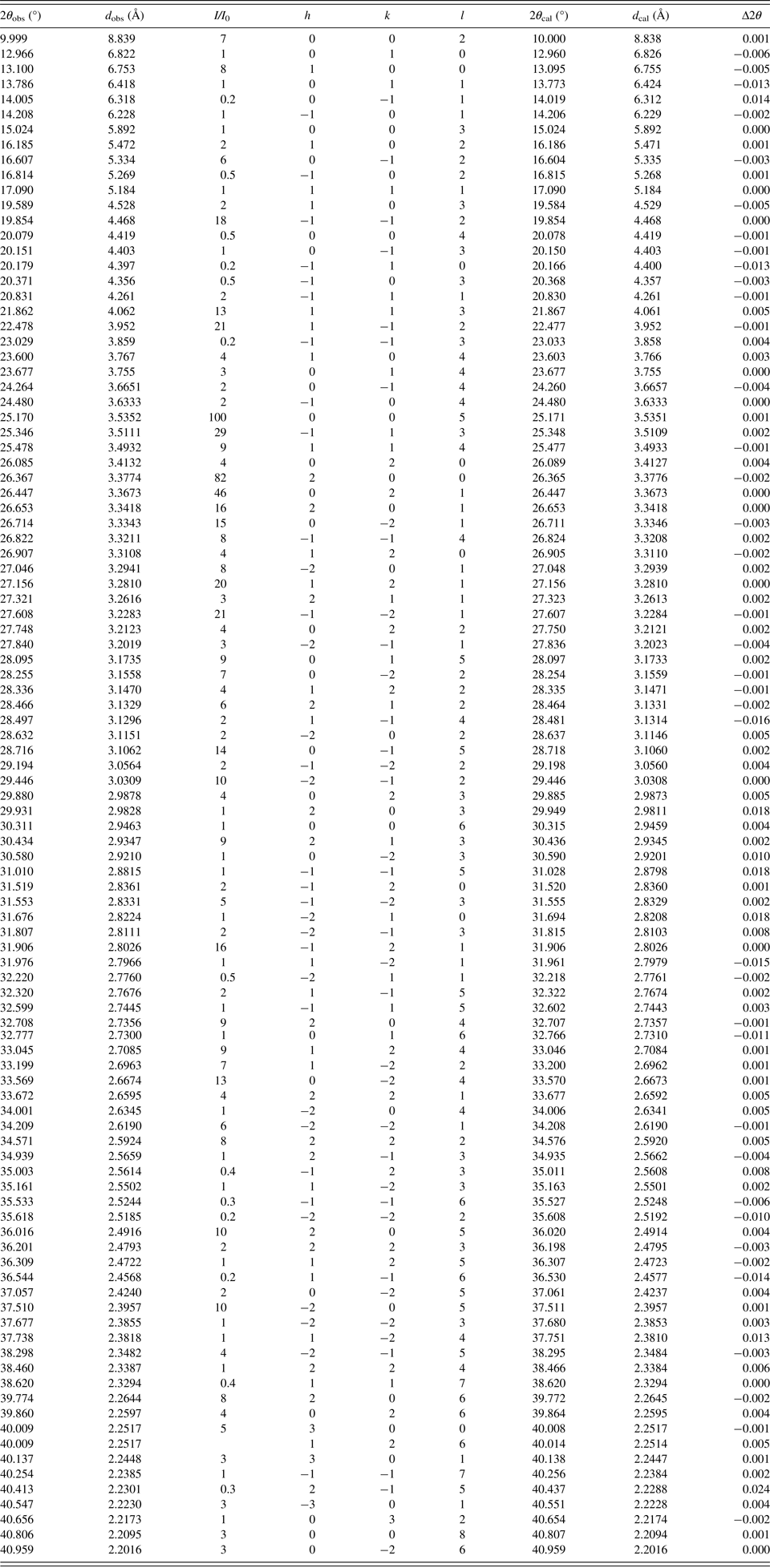
, Z = 2). The calculated and observed values of XRD data are listed in Table I. The Smith–Snyder figure-of-merit (Smith and Snyder, Reference Smith and Snyder1979) is F
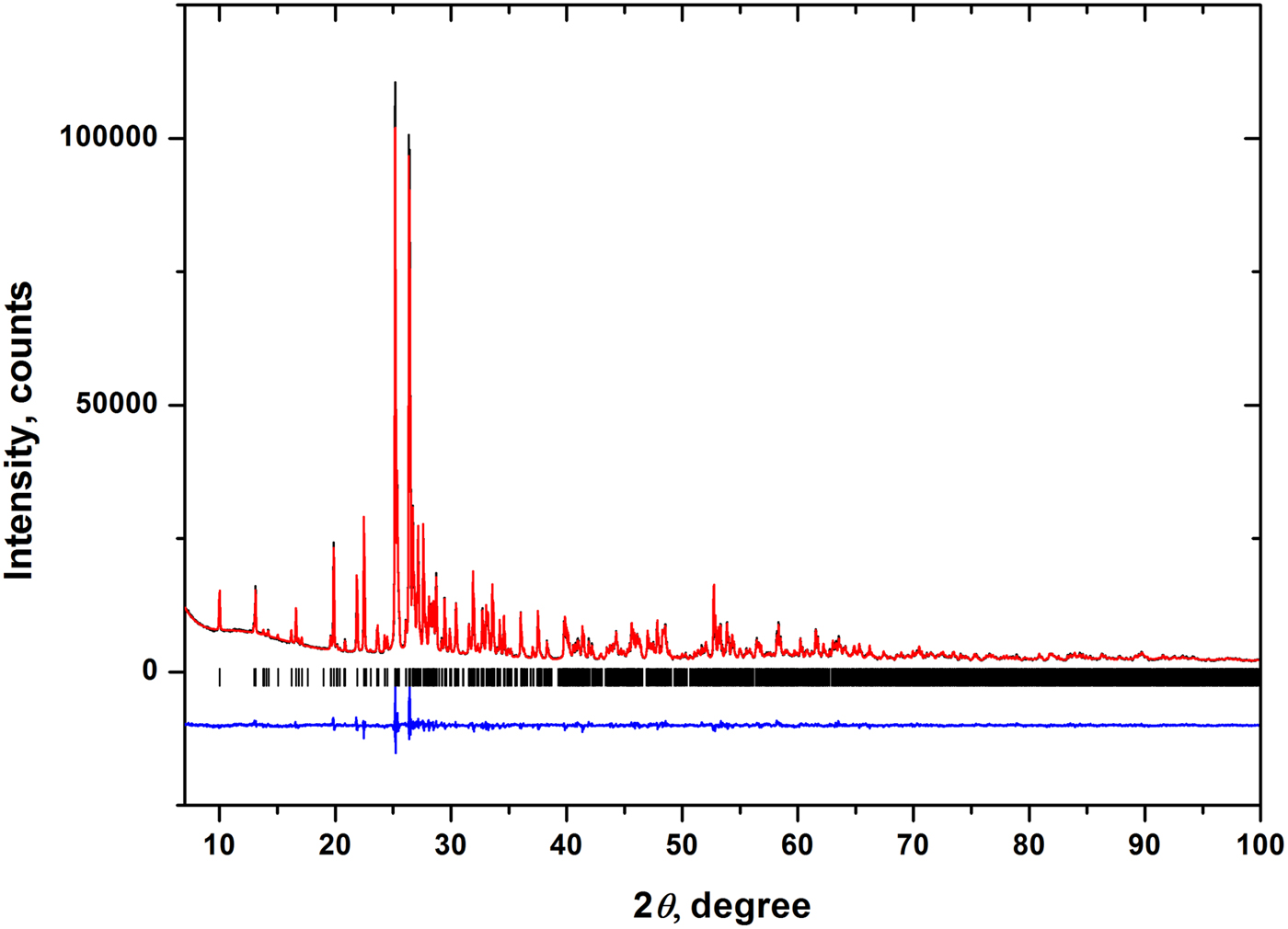
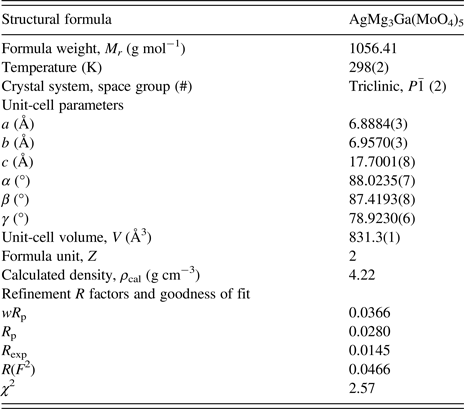
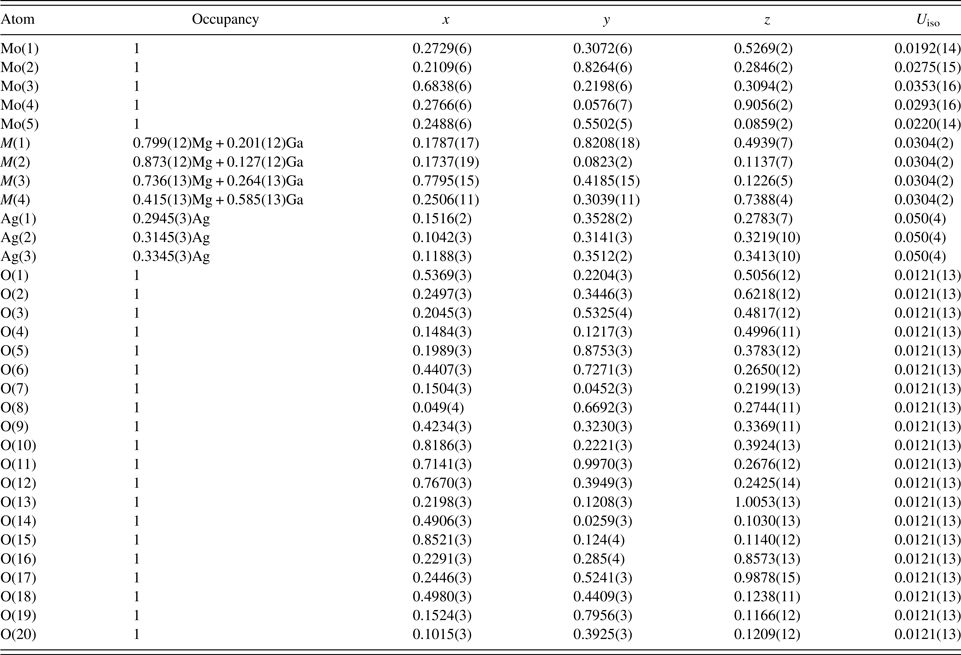
30 = 221.8 (0.0033, 41). The crystal structure was refined according to the Rietveld method (Rietveld, Reference Rietveld1969), starting with the atomic coordinates of AgMg3Fe(MoO4)5 structure (Kotova et al., Reference Kotova, Solodovnikov, Solodovnikova, Belov, Stefanovich, Savina and Khaikina2016). The compound obtained was found to crystallize in the NaMg3In(MoO4)5 structure (Klevtsova et al., Reference Klevtsova, Vasiliev, Kozhevnikova, Glinskaya, Kruglik and Kotova1993). Crystal data, data collection, and structure refinement details are summarized in Table II. Figure 1 shows experimental, theoretical, and difference XRD patterns for the AgMg3Ga(MoO4)5 sample. The fractional atomic coordinates, isotropic atomic displacement parameters, cation occupancies, and main selected interatomic distances for title compound are listed in Tables III and IV. The populations of four independent positions M = (Mg, Ga) were refined along with three incompletely occupied Ag sites with keeping the electrical neutrality of the chemical formula. The final compositions of the crystals are close to stoichiometric AgMg3Ga(MoO4)5 with a negligible silver deficiency (Table III). This confirms the previously obtained data on the lack of noticeable homogeneity regions for triple molybdates of this series at moderate temperatures, but also demonstrates deviations from stoichiometry because of small silver deficiency.
(Color online) Observed (black line) and calculated (red line) XRD patterns of AgMg3Ga(MoO4)5. Vertical bars indicate the positions of the Bragg peaks. The lower trace depicts the difference between the experimental and calculated intensity values.

The calculated and observed values of XRD data for AgMg3Ga(MoO4)5.

Crystal data and structure refinement for AgMg3Ga(MoO4)5.

Structural parameters for AgMg3Ga(MoO4)5.

Selected interatomic distances (Å) in AgMg3Ga(MoO4)5.

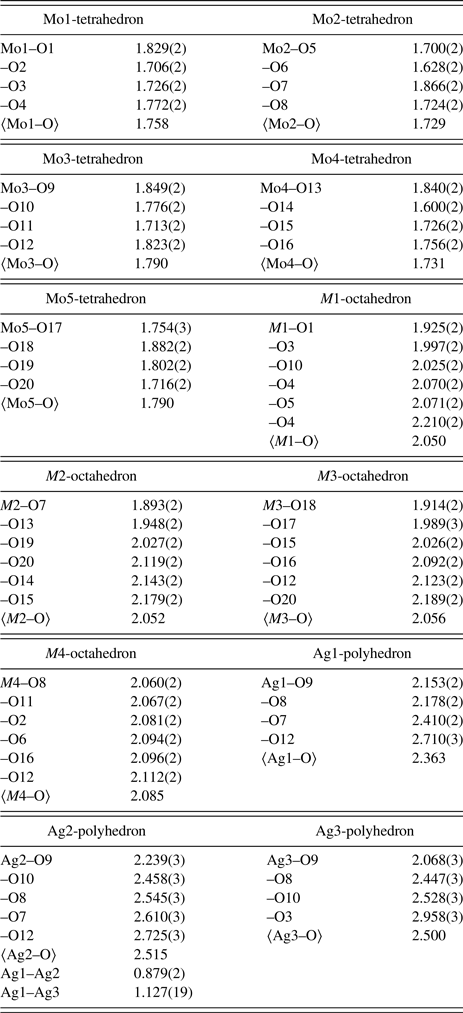
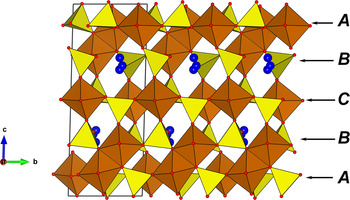
The crystal structure of AgMg3Ga(MoO4)5 is shown in Figures 2 and 3. All the atoms are located in general positions in this structure. The Mo1O4–Mo5O4 tetrahedra have average Mo–O distances in the range 1.729–1.790 Å, similar to the values found in other molybdates. Cations Mg2+ and Ga3+ are statistically distributed on octahedral M1–M4 positions with the (Mg, Ga)–O bond lengths of 2.050–2.085 Å. Cations Ag1 and Ag3 are coordinated by four O atoms (Ag1–O 2.363, Ag3–O 2.500 Å), while cation Ag2 has CN = 5 (Ag2–O 2.515 Å). Analogous coordinations and disordering of Ag+ and Na+ ions were also found in AgMg3 R(MoO4)5 (R = Cr, Fe) (Kotova et al., Reference Kotova, Solodovnikov, Solodovnikova, Belov, Stefanovich, Savina and Khaikina2016), AgMnII 3(MnIII 0.26Al0.74)(MoO4)5 (Bouzidi et al., Reference Bouzidi, Frigui and Zid2015), Ag0.90Al1.06Co2.94(MoO4)5 (Nasri et al., Reference Nasri, Chérif and Zid2015), and NaMg3In(MoO4)5 (Klevtsova et al., Reference Klevtsova, Vasiliev, Kozhevnikova, Glinskaya, Kruglik and Kotova1993). In the framework organization of AgMg3Ga(MoO4)5 there are three sorts of the adjacent layers along the c-axis, A, B, and C (Figure 2), as well as layers inverted relative to initial layers A and B. The polyhedral layer A is composed of pairs of edge-shared M 2O6 and M 3O6 octahedra connected by through common vertices with Mo4O4 and Mo5O4 tetrahedra [Figure 2(a)], as well as layer C is formed by those of M1O6 octahedra connected with Mo1O4 tetrahedra [Figure 2(b)]. In the layer B individual M4O6 octahedra are connected by common vertices with Mo2O4 and Mo3O4 tetrahedra [Figure 2(c)].
(Color online) Three kinds of polyhedral layers in the structures of AgMg3Ga(MoO4)5: a – layer A; b – layer B; c – layer C. Projection onto (001) plane.

(Color online) Projection views of the structure of AgMg3Ga(MoO4)5 along the a-axis.

These polyhedral layers are stacked in sequence A−B−C−B−A−A… via the bridge MoO4 tetrahedra in a three-dimensional (3D) framework with large cavities filled by Ag+ ions (Figure 3). In these cavities, the silver cations are disordered on three close positions with the distances Ag−Ag 0.879(2) and 1.127(19) Å. Such a disordering is also typical for other compounds of this isostructural series (Klevtsova et al., Reference Klevtsova, Vasiliev, Kozhevnikova, Glinskaya, Kruglik and Kotova1993; Hermanowicz et al., Reference Hermanowicz, Maczka, Wolcyrz, Tomaszewski, Paściak and Hanuza2006; Bouzidi et al., Reference Bouzidi, Frigui and Zid2015; Nasri et al., Reference Nasri, Chérif and Zid2015; Kotova et al., Reference Kotova, Solodovnikov, Solodovnikova, Belov, Stefanovich, Savina and Khaikina2016).
SUPPLEMENTARY MATERIAL
The supplementary material for this article can be found at https://doi.org/10.1017/S0885715617000811.
ACKNOWLEDGEMENTS
The authors are grateful to Alena I. Vandysheva for participating in the synthesis of the title compound. This work was partially supported by the Russian Foundation for Basic Research (Grant no. 17-03-00333) and International Centre for Diffraction Data.