Introduction
Aedes aegypti (Stegomyia aegypti) (L.) (Diptera: Culicidae) is the main vector of dengue and urban yellow fever in the world (Gubler, Reference Gubler2004). Aedes aegypti is highly adapted to the human environment, and artificial containers are its most common larval habitat (Forattini, Reference Forattini2002). Nevertheless, in some countries in Africa, where the species might have originated, it is a regular component of the tree hole fauna (Anosike et al., Reference Anosike, Nwoke, Okere, Oku, Asor, Egbe and Adimike2007). Observations of Ae. aegypti developing in tree holes and other natural water containers such as coconut shells, axils of banana leaves (Marquetti et al., Reference Marquetti, Suárez, Bisset and Leyva2005) and bromeliads are also occasionally reported from other regions of the world (Malta Varejão et al., Reference Malta Varejão, Dossantos, Rezende, Bevilacqua and Falqueto2005; Mocellin et al., Reference Mocellin, Simões, Fernandes Silvado Nascimento, Teixeira, Lounibos and Lourenço De Oliveira2009).
In Argentina, Campos et al. (Reference Campos, Spinelli and Mogi2011) observed the species in the axils of Araceae, at the Puerto Iguazú National Park. Stein et al. (Reference Stein, Dantur Juri, Oria and Ramirez2013) found Ae. aegypti larvae in the epiphyte Aechmea distichantha Lemaire (Poales: Bromeliaceae) both in semi-urban and rural localities of pedemontane forest of the subtropical mountainous Yungas rainforest in the province of Tucumán, north western Argentina. In Aguaray city, Salta province, we detected larvae and pupae using tree holes as larval habitat (Mangudo et al., Reference Mangudo, Aparicio and Gleiser2011). Reports of Ae. aegypti breeding in natural habitat in forested areas far from urbanization are less frequent.
Knowing whether Ae. aegypti may use water holding tree holes in a region may be relevant within the vector control framework. If it is assumed that Ae. aegypti breeds almost exclusively in artificial containers, other potential larval habitats such as tree holes may be overlooked by vector control personnel; thereafter these untreated cavities could serve as foci to reinfest treated areas (Porter et al., Reference Porter, Evans and Hughes1961).
Small outbreaks of dengue are common in northwest Argentina and high Ae. aegypti densities increase the risk of large epidemics as the one observed in 2009 which affected 18 provinces and about 26,000 people (Torres, Reference Torres2010). This outbreak started in the Oran Department, province of Salta, one of the most affected by the disease. San Ramón de la Nueva Oran city (Orán) is located along the National Highway Number 50, a principal terrestrial transport and commercial road connecting northwest Argentina with Bolivia, the main route of introduction of dengue to northwest Argentina (Rondan Dueñas et al., Reference Rondan Dueñas, Albrieu Llinás, Panzetta-Dutari and Gardenal2009). Because the area is within the Yungas subtropical montane moist forests, a high diversity ecosystem (Brown et al., Reference Brown, Grau, Malizia, Grau, Brown and Kappelle2001), phytothelmata (water holding plants) may be a relevant larval habitat for several mosquito species of medical importance. This study assessed whether tree holes in the urban, suburban and the surrounding forest area of San Ramón de la Nueva Orán are relevant as larval habitat for Ae. aegypti. This may allow answering three main questions. Firstly, are tree holes consistently used by Ae. aegypti along the city? Secondly, are tree holes in the forest area also used as larval habitat? And thirdly, is the abundance of Ae. aegypti immature (larvae + pupae) related to characteristics of the tree hole such as hole type or water volume?
Materials and methods
Study area
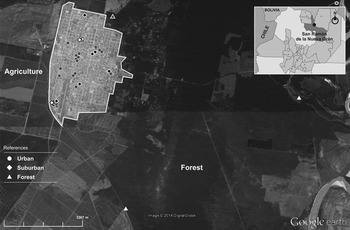
San Ramon de la Nueva Orán is located in northwest Argentina 270 km from the city of Salta, the capital of Salta province, 44 km from the border with Bolivia (23°08′S, 64°20′W, elevation 337 m.a.s.l.; fig. 1). It is the second largest urban centre of Salta province with a population of approximately 82,000 (INDEC, 2010) covering an area of 20 km2. The climate is subtropical, with an average summer temperature of 27.7°C and winter temperature of 16.4°C. The mean annual rainfall is 1000 mm, occurring mostly during the warmer months (October–April). The area is included in the Yunga subtropical montane moist forests (Brown et al., Reference Brown, Grau, Malizia, Grau, Brown and Kappelle2001) and has been subjected to ecological modifications related to human activities, mainly urbanization, industrial development, agriculture and forestry.
Location of study area and tree holes that harboured Aedes aegypti larvae and/or pupae on every sample (black figures), at least once (grey figures), or never (white figures).

The city is characterized by a densely built central area where houses with small or no front yards predominate and there are few low buildings. Suburban areas have a lower building density with bigger gardens, more trees and are closer to the border with the seminatural region. Native Yunga forest remains to the east, north-east and south-east of the city, while the western and southern regions are covered by crops areas and forest trees (INTA, Reference Arroyo2004). Yunga forest is characterized by a strong altitudinal gradient; consequently vegetation is organized in distinctive floors. Orán is located in the Pedemontane rain-forest floor, where jungles of Palo Blanco (Calycophyllum multiflorumy Griseb; Rubiales: Rubiaceae) and Palo Amarillo (Phyllostylon rhamnoides (Poisoon) Taub; Urticales: Ulmaceae) predominate. Vines are also important in pedemontane areas (Brown et al., Reference Brown, Grau, Malizia, Grau, Brown and Kappelle2001).
Tree hole selection
To detect tree holes that were later sampled for mosquitoes, the main forested areas of the city were chosen, including parks and areas within the graveyard and the sports centre. Trees on some sidewalks were also examined to include different areas of the city. Trees were examined to assess whether they bore holes that could hold water and tree holes until the height of 2 m were registered. Additionally, trees were inspected within a square area (50 × 50 m2) at three Yunga forest sites located at 0.5 km to the northeast, 7 km to the east and 4 km to the southeast from the urban border. The forested areas were connected to downtown by rural paths, through which local people sporadically go into the woods for wood extraction and other activities. Each tree was assigned to one of three categories according to its location and urbanization degree: urban (central area of the city, with a mean density of 81 homes per ha, and at least 40% built surface (including roads)), suburban area (peripheral area of the city, with a mean density of 23 homes per ha and 20% or less built surface) and forest (out of the city, without buildings). Tree species and the presence or absences of water holding holes, as well as location of trees with holes (Garmin global positioning system, Garmin eTrex Legend, Olathe, KS) were recorded.
Entomological sampling
The presence of water and immature stages in each tree hole was recorded approximately once a month from January to April of 2011 and from January to March of 2012 and 2013. Those time frames comprise the season when rainfall is most likely to flood the tree holes. The average rainfall of the sampling season was 135 ± 13 mm. Within a given month, inspecting all water holding tree holes took 3–5 consecutive days. The same holes were re-sampled every month. Since all water content was removed from the site on each visit, and based on previous (unpublished) observations indicating that the majority of tree holes dried within 3 weeks after a rainfall, each new sample was considered a new event. The larvae and pupae were collected using a siphon bottle (Müller & Marcondes, Reference Müller and Marcondes2006); contents were examined on site in a white plastic tray to separate potential predators and were transported to the laboratory for further processing. Fourth instar larvae were killed and stored in 80% ethanol, while first, second and third instars and pupae were reared either to the fourth instar or to adult emergence. Taxonomic determinations were based on morphological characteristics of the fourth instar larvae and/or adults, using Darsie (Reference Darsie1985) and Forattini (Reference Forattini1996, Reference Forattini2002) keys. Abbreviations for mosquito genera and subgenera are those proposed by Reinert (Reference Reinert2001). Only data on Ae. aegypti are presented in this work.
Data analysis
Data on larvae and pupae were pooled together for analyses and referred as immature stages. Since the occurrence of Ae. aegypti in the forest was an isolated event (see results), only city tree holes were considered. Effects of tree hole habitat within the city (urban or suburban) on mosquito abundance and proportion of Ae. aegypti per tree hole were evaluated using a generalized linear and mixed model (GLMM) (assuming a Poisson distribution) and a general linear and mixed model (GLM) (Infostat; Di Rienzo et al., Reference Di Rienzo, Casanoves, Balzarini, Gonzalez, Tablada and Robledo2014), respectively. For all tests, a P value <0.05 was considered to represent significant differences. Throughout the text, the results are presented as the mean plus/minus the standard error. Dependent variables were Ae. aegypti abundance (total number of larvae + pupae per sampling date per tree hole) and proportion of Ae. aegypti from the total mosquitoes collected (per sampling date and tree hole; data transformed to Arcsin). Fixed effects were month (January, February, March and April) and environment (urban and suburban); random effects were year and tree hole.
We also analyzed effects of tree hole type on mosquito abundance and proportion of Ae. aegypti per tree hole using GLMM (assuming a Poisson distribution) and a GLM (data transformed to Arcsin) (Infostat; Di Rienzo et al., Reference Di Rienzo, Casanoves, Balzarini, Gonzalez, Tablada and Robledo2014), respectively. Tree hole type included pans formed as branch intersection (those that maintain an unbroken bark lining throughout their existence) and rot holes (those that lack this lining and penetrate into the wood of the tree); throughout the text, cavities formed by branch intersection and rot holes are named BI and RH, respectively.
Correlation between immature mosquito abundance per tree hole in each sampling date and water volume was assessed with Spearman r S nonparametric correlation.
The Breteau Index (Number of positive containers per 100 premises inspected) and Housing Index (Percentage number of houses infested per number of houses inspected) for January 2011, 2012 and 2013 were provided by San Vicente de Paul Orán Hospital, for the city divided in western and eastern areas.
Estallo et al. (Reference Estallo, Más, Vergara-Cid, Lanfri, Ludueña-Almeida, Scavuzzo, Introini, Zaidenberg and Almirón2013) analyzed the spatial patterns of Ae. aegypti oviposition activity and identified hot spot areas in central and southern regions of Orán city. The maps generated by these authors also show a northwest region that had low or none oviposition activity. In order to compare our results with these maps, we divided the city into three sectors: northeast, northwest and south. The effects of sector on Ae. aegypti abundance were assessed using GLMM as described above, including year and tree hole as random effects.
Results
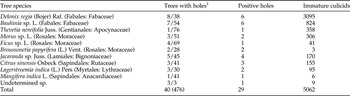
A total of 1213 trees were examined of which 63 (5%) had 69 holes that held water. In 42% of those holes Ae. aegypti larvae and/or pupae were found at least once, totalling 5062 specimens. Aedes aegypti was the most frequent species, representing 92% of the specimens collected from 11 species of tree (table 1). The average percentage of tree holes holding immature mosquitoes that were positive for Ae. aegypti throughout the survey was 53 ± 7% and ranged from 36 to 70%. The average number of immature Ae. aegypti per tree hole was 55 ± 13, ranging from 1 to 733. Aedes aegypti immature stages were found as the only mosquito species in 35% of the samples, and with other culicid species as follows: Haemagogus spegazzini Bréthes (20%), Sabethes purpureus (Theobald) (10%), Toxorinchytes guadalupensis Dyar and Knab (3%) and Aedes terrens Walker (4%). Average water volume was 155 ± 94 ml and ranged from 10 to 2789 ml. Abundance of Ae. aegypti immature was significantly and positively correlated to water volume (Spearman r S = 0.33, P < 0.0001).
Tree species that were positive for Aedes aegypti immature stages (larvae and/or pupae) in sidewalks and public access areas in urban, suburban and Yunga Forest sites in San Ramón de la Nueva Orán, Salta province, Argentina.

1 Trees with water holding holes in relation to trees examined.
In the Yunga forest sites, out of 62 samples, Ae. aegypti larvae were found only in one sampling date in one tree hole (nine specimens), and thus were excluded from further statistical analysis.
There were significant interactions between month and habitat (urban or suburban) on Ae. aegypti abundance (P < 0.0001). Aedes aegypti abundance on urban tree holes in April (43.14 ± 21.01; ranging from 1 to 238) and suburban tree holes in March (192.43 ± 118.56; ranging from 1 to 733) were significantly higher than on suburban tree holes in April (237.00 ± 0.00; only one positive tree hole). There were no significant differences on abundance of immature stages between habitats on the remaining months. Regarding the proportion of Ae. aegypti in relation to total immature culicids, there was a significant interaction between habitat and month (F 3,85 = 3.11; P = 0.03). In the urban area, the proportion of immature Ae. aegypti was significantly lower in January in urban tree holes (0.34 ± 0.08) and April in suburban tree holes (0.20 ± 0.20), compared with urban tree holes in February (0.66 ± 0.10) and April (0.78 ± 0.09).
There was no significant interaction between habitat and tree hole type on Ae. aegypti abundance (P = 0.79). Although the abundances were numerically higher in BI tree holes compared with RH tree holes, these differences were not significant (P = 0.44). The proportion of Ae. aegypti in relation to total immature culicids was significantly higher in BI tree holes (0.76 ± 0.06) than in RH (0.41 ± 0.05) (F 1,28 = 14.32; P < 0.0001), independently of habitat type, urban and suburban (P = 0.52).
Breteau and Housing indexes did not differ significantly between western and eastern areas of the city during the present study. Considering data from January for the 3 sampling years, there were no significant differences between these areas on Ae. aegypti abundance (P = 0.09) nor on the proportion of tree holes where the species was found (P = 0.08). No significant differences (P = 0.67) were detected either regarding oviposition activity sectors based on Estallo et al. (Reference Estallo, Más, Vergara-Cid, Lanfri, Ludueña-Almeida, Scavuzzo, Introini, Zaidenberg and Almirón2013).
Discussion
Tree holes appear as foci for reinfestation of Ae. aegypti. Although we found that tree holes holding water represent a small proportion of the total sampled trees (5% in Oran, this work, and 6% in Aguaray, Mangudo et al., Reference Mangudo, Aparicio and Gleiser2011) a considerably high proportion of them harboured Ae. aegypti larvae and/or pupae (78%). Moreover, Ae. aegypti was the most frequent species, representing 92% of all specimens collected; likewise in Aguaray (another locality within the Yunga forests) all the specimens collected were Ae. aegypti (Mangudo et al., Reference Mangudo, Aparicio and Gleiser2011).
Aedes aegypti productivity from natural cavities (leaf axils of plantain/banana, cocoyams, coconut shells) is usually low compared with artificial containers such as used tires (for example, Anosike et al., Reference Anosike, Nwoke, Okere, Oku, Asor, Egbe and Adimike2007; Burkot et al., Reference Burkot, Handzel, Schmaedick, Tufa, Roberts and Graves2007). The number of Ae. aegypti immature collected from tree holes in Aguaray ranged from 1 to 13 (Mangudo et al., Reference Mangudo, Aparicio and Gleiser2011) similar to collections reported from other areas, like tropical rainforests in South-East Nigeria (up to ten larvae, Anosike et al., Reference Anosike, Nwoke, Okere, Oku, Asor, Egbe and Adimike2007), and American Samoan villages (16 larvae in 22 tree holes, Burkot et al., Reference Burkot, Handzel, Schmaedick, Tufa, Roberts and Graves2007). However, the number of Ae. aegypti immature per tree hole collected in Orán was considerably higher and sustained throughout the sampling period (55 ± 13, ranging from 1 to 733). This and the fact that the species was found breeding in tree holes through the whole city stress the importance of taking into account these natural cavities as potential reinfestation foci. One tree hole had exceptional high abundances of immature (237–733). Still, excluding this tree hole, 18% of the samples held more than 40 larvae each, a considerably higher number of larvae-pupae compared with those reported in tree holes in other studies as those mentioned above. This difference may be due to a higher number of samples (Anosike et al., Reference Anosike, Nwoke, Okere, Oku, Asor, Egbe and Adimike2007 examined 20 tree holes; Burkot et al., Reference Burkot, Handzel, Schmaedick, Tufa, Roberts and Graves2007 sampled 30 tree holes) which may increase chances of detecting more productive tree-holes. Alternatively, it may reflect a higher productivity of tree holes in Orán.
Aedes aegypti was mostly constrained to the urban environment, because the finding of the species in forested areas in Orán was an isolated event, since only nine larvae of Ae. aegypti were collected from the same tree hole and only in one sampling date. This region is wooded and could be considered as a partially disturbed natural area (not urbanized, with wild vegetation growing freely). It is 300 m away from the urban border, surrounded by farms and crops areas and connected to downtown by a rural path, through which local people sporadically go into the wood mainly for wood extraction; this occasional human presence could supply the mosquito with a human blood source. Bergero et al. (Reference Bergero, Ruggerio, Lombardo, Schweigmann and Solari2013) studied the dispersal of Ae. aegypti from a housing area towards semi-natural adjacent areas and suggested that human presence influences this dispersal. They found that the maximum distance from the peri-domicile detected was observed when human activity was present. The present study shows the mosquito presence further from houses, but still within flight dispersal range (Reiter et al., Reference Reiter, Amador, Anderson and Clark1995) and thus is partially consistent with their results because the forested site where Ae. aegypti was collected has more human activity and is closer to the city than the other natural regions sampled, where immature Ae. aegypti were absent. The knowledge about the dispersal distance of the species is useful for determining the area of comprehensive vector control in cases of dengue infections (Bergero et al., Reference Bergero, Ruggerio, Lombardo, Schweigmann and Solari2013). Taking this into account and especially due to frequent occurrence of dengue outbreaks in Orán city, we consider important to mention this record of Ae. aegypti in a forested area near the city.
Aedes aegypti abundances in tree holes did not show differences between environments along the study, except for April when the number of larvae and pupae was higher in the urban environment, which may be an artefact due to the low number of positive samples detected this month on the suburban tree holes. Despite these fluctuations on immature abundance, the species was present and even predominant over other culicids during the whole period. These results are consistent with those recorded by Micieli & Campos (Reference Micieli and Campos2003), who studied oviposition activity of Ae. aegypti in Tartagal, Aguaray and Salvador Mazza cities (Salta province) and showed a permanent immature population throughout the year, with a low number of individuals and eggs laid in winter and a prominent peak in March.
We conducted a previous survey in Aguaray city, Salta province during March and April, 2010 and detected that immature stages use tree holes as larval habitat in this city (Mangudo et al., Reference Mangudo, Aparicio and Gleiser2011). In the present study we confirmed the presence of the species in tree holes in Salta province and its continuity along the 3 sampling years. Furthermore, most of the cavities harboured immature Ae. aegypti consistently throughout the survey. We also found that tree holes positive for Ae. aegypti immature are widespread in Orán city and throughout the wet season. Aedes aegypti abundances were also similar between urban and suburban sites, probably indicating that these areas do not represent different environmental conditions for the species. These findings confirm that the use of tree holes as breeding sites by Ae. aegypti is not a sporadic event and suggests that it may be independent from the availability of artificial containers in surrounding areas, although a detailed survey of containers in proximity to the tree holes should be carried out to support this hypothesis.
The form and physical characteristics of water filled tree holes are factors that contribute to the composition and relative abundance of the fauna they contain. Moreover, Copeland & Craig (Reference Copeland and Craig1990) have demonstrated clear patterns in the distribution of mosquitoes in the Great Lakes region of the USA reflecting differences in tree hole type (i.e., BI versus RH). Our results showed that Ae. aegypti abundance and proportion in relation to other culicids were higher in BI tree holes compared with RH. BI are bark-lined cavities, but RH grow into the heartwood and lack the continuous bark lining, in some of them this loss is permanent and tree hole water stays in contact with the vascular system of the tree, hence in contact with dissolved tannins (Copeland & Craig, Reference Copeland and Craig1990). Although there are contradictory results about the effect of dissolved tannins on mosquito development (Bradshaw & Holzapfel, Reference Bradshaw and Holzapfel1986; Copeland & Craig, Reference Copeland and Craig1990; Mercer, Reference Mercer1991), differential detrimental effects of dietary tannins have been reported for culicid species, and high concentrations of tannins have shown to be lethal for Ae. aegypti larvae by cell destruction in the midgut (Valotto et al., Reference Valotto, Silva, Cavasin, Geris, Rodrigues Filho and da Silva2011). Consequently, tanning-lignin content may be a selective factor responsible for the lower abundances and proportion of Ae. aegypti in RH compared with BI holes.
The relevance of tree holes in Orán as breeding sites would be restricted to the rainy season since the capability to retain water could not be sustained during the dry season. Nevertheless, the significance of tree holes as reinfestation foci would remain latent during the whole year as Ae. aegypti eggs are resistant to desiccation and may survive the dry season on these natural cavities.
Acknowledgements
The authors are grateful to Dr, Pedro Cortada, Head of Epidemiology, San Vicente de Paul Orán Hospital for providing information on Stegomyia Indexes. This project is partially funded by SECYT Universidad Nacional de Córdoba, CONICET grants PIP 114-2011-00334, 112-2013-0100315 and CIUNSA grant 1912. Carolina Mangudo holds a doctoral scholarship from CONICET. Raquel M. Gleiser and J. P. Aparicio are career members of CONICET-Argentina. The authors would like to thank Prof, Gustavo Rossi for his valuable advice and help on the identification of some culicids and Alejandro Barbeito with the design of fig. 1.