In late May 2015, more than 50 participants (10 experts and more than 40 students, post-docs, and young researchers) from 12 different European and African Countries gathered in Como, Italy, for an International Workshop co-organized by the University of Insubria and the Institute of Crystallography of the Italian National Council of Research. The scope of this workshop was introducing innovative wide angle X-ray total scattering (WAXTS) techniques based on the Debye scattering equation (DSE) for the study of nanocrystalline materials, and their complementary nature with small-angle X-ray and static/dynamic light scattering. Lectures on characterization methods were supplemented by a few presentations focusing on the synthesis and applications of advanced organic, inorganic, and hybrid nanomaterials. This brief account highlights the topics discussed during the conference, and the future of WAXTS, falling beyond the classical Rietveld-Bragg approach.
In the past years, Members of the University of Insubria and the Crystallography Institute of the Italian National Council of Research (IC-CNR) have organized, also with the help of other volunteering colleagues, several National (Masciocchi and Guagliardi, Reference Masciocchi and Guagliardi2006) and International (Masciocchi et al., Reference Masciocchi, Guagliardi and Gozzo2008, Reference Masciocchi, Galli, Guagliardi, Gozzo, Cervellino, Cheptiakov and Černý2010, Reference Masciocchi, Guagliardi and Galli2012; Zema et al., Reference Zema, Milanesio, Galli and Guagliardi2011) Summer Schools. More recently, they have co-organized the MISSCA2013 Conference in Como (Masciocchi et al., Reference Masciocchi, Galli and Guagliardi2014), with more than 230 attendees and co-founded a Total Scattering Laboratory (To.Sca.Lab). This laboratory, according to the intentions of the founders (Guagliardi, Masciocchi, and Ferri), merges theoretical and experimental expertise in chemistry, crystallography, and physics within a unifying project based on Scattering Techniques (from X-rays to Visible Light). To.Sca.Lab scientific activities aim at reconstructing structural, microstructural and dynamic behaviour of nanocrystalline, partially ordered and disordered materials at different length scales (ranging from atomic resolution to the mm size), and to correlate it with materials functional properties. Details of this project can be found in the toscalab.uninsubria.it website.
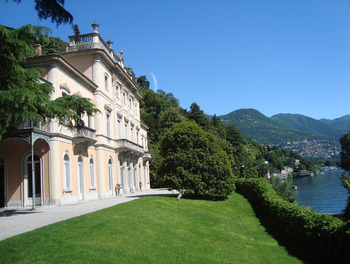
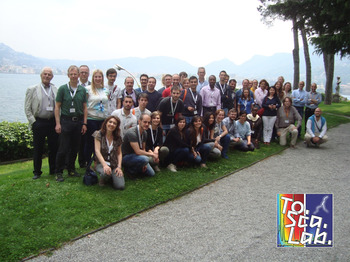
Innovative wide angle X-ray total scattering (WAXTS) methods based on the Debye scattering equation have a central role among the topics developed at To.Sca.Lab. In May 2015, within the list of dedicated events within the To.Sca.Lab activities and aiming at celebrating 100 years of the DSE (Debye, Reference Debye1915), the University of Insubria and IC-CNR organized an International Workshop, To.Sca.Lake, Total Scattering for Nanotechnology at Como Lake. This event was specifically addressed to an international audience of students, post-docs, and young researchers, scheduling a scientific program that included lectures on fundamentals of scattering techniques, synthesis and applications of advanced engineered nanomaterials, and hands-on tutorials. The Conference location, the 18th Century Villa del Grumello in Como (shown in Figure 1), was well-suited for the limited audience, fixed at 50 attendees (portrayed in Figure 2) in order to make the afternoon hands-on tutorial sessions easily manageable and highly effective. As lecturers for To.Sca.Lake, world renowned experts in the field of scattering methods, in the preparation and characterization of inorganic and organic nanoparticles, were invited.
(Color online) The conference venue, the 18th Century Villa del Grumello, facing the Como Lake.

(Color online) The group photo of the all attendees of the To.Sca.Lake Workshop. In the insert, the To.Sca.Lab logo.

On the first day, three introductory presentations on X-ray scattering techniques were delivered. Hans-Beat Bürgi (University of Bern and Zurich, Switzerland) gave a brilliant lecture on diffuse scattering measurement and interpretation in ionic and molecular crystals, with particular emphasis on correlated defectiveness; Norberto Masciocchi (University of Insubria and To.Sca.Lab, Italy) presented the basics of the powder diffraction methods for structural analysis, highlighting the differences between the Bragg and non-Bragg scattering approaches. Finally, Antonio Cervellino (Paul Scherrer Institut, Switzerland) presented the theoretical basis of radiation–matter interaction, and the rigorous derivation of the DSE (Debye, Reference Debye2015), valid for isotropic systems, such as liquids, colloidal suspensions, and randomly oriented powders.
On the following day, Maksym Kovalenko (ETH Zurich, Switzerland) delivered a fascinating presentation on inorganic nanoparticles (quantum dots), their synthesis, characterization, and applications in a number of technologically relevant fields. Ruggero Frison (University of Zurich, Switzerland) proposed a talk on theoretical and experimental aspects and data preprocessing analyses required to obtain “pure” sample-dependent scattering traces, cleaned from instrumental and other undesirable physical effects (like absorption and incoherent scattering). This lecture was followed by Antonella Guagliardi's (Institute of Crystallography-CNR and To.Sca.Lab, Italy) mesmerizing presentation on the innovative Debye Function Analysis implemented in the high-performing Debussy Suite of programs (Cervellino et al., Reference Cervellino, Giannini and Guagliardi2010).
On the third day, Nora Ventosa (ICMAB-CSIC, Spain) presented the enchanting organic chemistry nanoworld, illustrating the nature, preparation, and characterization of micelles, liposomes and quatsomes, together with their innovative applications in nanomedicine. In her second talk, Antonella Guagliardi presented several case studies of the Debye Function Analysis taken from the recent literature, with particular emphasis on photocatalytic titania nanoparticles (Cernuto et al., Reference Cernuto, Masciocchi, Cervellino, Colonna and Guagliardi2011a) and titania-silica hybrids (Cernuto et al., Reference Cernuto, Galli, Trudu, Colonna, Masciocchi, Cervellino and Guagliardi2011b), superparamagnetic iron oxides (Frison et al., Reference Frison, Cernuto, Cervellino, Zaharko, Colonna, Guagliardi and Masciocchi2013), and biomimetic nanoapatites (Delgado-López et al., Reference Delgado-López, Frison, Cervellino, Gómez-Morales, Guagliardi and Masciocchi2014). Finally, Jan Skov Pedersen (University of Aarhus, Denmark) nicely entertained the audience with a brilliant presentation of small-angle X-ray scattering (SAXS) technique in biosciences.
On the last day, Fabio Ferri (University of Insubria and To.Sca.Lab, Italy) introduced the (visible) light scattering techniques, in static and dynamic mode, with emphasis on the theoretical aspects and applications to submicrometer-sized materials. His lecture was supplemented by a simple light scattering experiment, performed with a portable laser beam and a large sample cell filled with soap or monodispersed nanoparticles of certified spherical shape and particle size. Jan Skov Pedersen closed the whole event by delivering a final talk on SAXS applications and presenting a demo session on SAXS data analysis.
Two afternoons sessions were completely devoted to hands-on computational exercises on WAXTS data and the Debussy Suite 2.0 (organized by the Debussy team: Antonella Guagliardi, Federica Bertolotti, Ruggero Frison, and Antonio Cervellino), starting from preprocessing and data reduction, to the building of isotropic and anisotropic populations of atomistically defined nanocrystals, to the final Debye Function Analysis of simple nanomaterials (magnetite and titania) using both synchrotron and laboratory data. Students were given self-installing executables of the Debussy suite, running on their portable PCs under Linux, Mac, or (Windows-based) Unix Virtual Box emulators. This software was here distributed for the first time, and will soon appear on the debussy.sourceforge.net website as Debussy 2.0.
Finally, four technical presentations were also given by Peter Laggner (Bruker, Germany) on SAXS instrumentation and applications, Paul Pennartz (Rigaku, Japan) on recent advances in X-ray optics, Dubravka Sisak-Jung (Dectris, Switzerland) on new fast X-ray detectors and Marco Sommariva (Panalytical, The Netherlands) on SAXS and total scattering analyses performed on laboratory instruments, all receiving a wide interest from the young audience.
Following these presentations, the future of total scattering techniques in reciprocal space was also foreseen, and discussions on their implementation in the laboratory, without resorting to large scale facilities (including neutron sources), were undertaken.
Of course, this event could not have existed without the help of several public bodies and private companies, here collectively gathered in a non-ordered list: the University of Insubria, IC-CNR, the Italian Crystallographic Association, the International Union of Crystallography, the Chamber of Commerce of Como, and, as generous commercial sponsors, Bruker, Panalytical, Assing/Rigaku, and Dectris. We are heartily indebted to all of them for their financial support.
For the sake of completeness, we provide hereafter the email addresses of the speakers, to whom the interested reader can ask the pdf copy of the slides. A few teaching aids already appear on toscalab.uninsubria.it/news web page for free download.
H.B. Bürgi: hans-beat.buergi@krist.unibe.ch; N. Masciocchi: norberto.masciocchi@uninsubria.it; A. Cervellino: antonio.cervellino@psi.ch; M. Kovalenko: mvkovalenko@ethz.ch; R. Frison: ruggero.frison@ic.cnr.it; A. Guagliardi: antonella.guagliardi@ic.cnr.it; N. Ventosa: ventosa@icmab.it; J.S. Pedersen: jsp@chem.au.dk; F. Ferri: fabio.ferri@uninsubria.it.