

It is important to learn as much as possible about variables that might impact the quality of intimate relationships. Indeed, some researchers (Lukaszewski & Roney, Reference Lukaszeski and Roney2010; Shackelford, Schmitt, & Buss, Reference Shackelford, Schmitt and Buss2005) have detailed the lengthy history of research designed to identify attitudes and behaviours associated with successful intimate relationships (see Cottrell, Neuberg, & Li, Reference Cottrell, Neuberg and Li2007; Li & Kenrick, Reference Li and Kenrick2006; Pillsworth, Reference Pillsworth2008, for relatively recent research in this area). As part of this continuing effort, there have been several scales that have been developed in an attempt to measure one's own value as a mate, or to measure the mate value of a partner or other target, and all of them have strengths and weaknesses (Edlund & Sagarin, Reference Edlund and Sagarin2014). In an attempt to improve upon some of the older measures, Edlund and Sagarin (Reference Edlund and Sagarin2014) developed the Mate Value Scale (MVS). The MVS appears to be an important new scale for at least three reasons. First, it has flexibility. By modifying a few words, it can be used to measure one's own value as a mate, or that of an intimate partner or other target person. Second, it has good reliability in spite of its brevity (four items). Third, it has other good psychometric properties, such as good validity, a single-factor structure, and an absence of social desirability. However, because it is relatively new, there is a need to know more about it. Specifically, because Edlund and Sagarin (Reference Edlund and Sagarin2014) used it solely as a self-report instrument, it is not clear if the MVS would be equally reliable and valid as a measure of the mate value of one's partner.
The purpose of the present study was to explore the pattern of correlations between the MVS and four other measures of intimate relationships. The most important reason for choosing these four measures was that none of them were studied by Edlund and Sagarin (Reference Edlund and Sagarin2014). The validation of a new instrument is an ongoing process, so it is useful to know how the MVS correlates with as many different measures of intimate relationships as possible. Each of the four measures we chose attempts to address issues that are germane to intimate relationships, as does the MVS. Furthermore, they each address different types of intimate relationship issues (e.g., how individuals deal with partner conflict and the amount of anxiety individuals experience in intimate relationships). They are also relatively short, which helps to reduce fatigue when administering several scales to the same participants in one sitting.
The Love Attitudes Scale (LAS) examines one's self-reported preferences for each of six different love styles. We also measured the extent to which one feels anxiety about intimate relationships, the way in which disagreements are resolved with a partner, and the extent to which one's partner is regarded as a ‘soulmate’. Franiuk, Cohen, and Pomerantz (Reference Franiuk, Cohen and Pomerantz2002) found that a ‘soulmate theorist’ is one who believes that there is just one person (or very few) with whom they are destined to have a great intimate relationship. Soulmate theorists are plentiful, in large part due to American culture and its obsession with songs, movies and books that promote the soulmate theory (Franiuk et al., Reference Franiuk, Cohen and Pomerantz2002). We chose the soulmate measure because it has been underused in the study of intimate relationships. The goal of the present study was to explore associations between the MVS (used to assess one's partner's mate value) and multiple measures of the quality of intimate relationships. Given that there is no prior work on the MVS as a measure of one's partner's mate value, we made no directional hypotheses.
Method
Participants
Undergraduate students (N = 330) at four universities in the eastern and central United States participated in the current study. Participants ranged in age from 18 to 60 years old (M = 20.97; SD = 4.82), and 74% were female. Students identified their race/ethnicity as White (62%), African American (26%), Asian (4%), Hispanic (3%), two or more races (5%), and other (1%), with 1% of the participants not reporting their ethnicity.
Measures
The MVS (Edlund & Sagarin, Reference Edlund and Sagarin2014) was developed as a self-report measure of one's own value as a mate. Its four items show a one-factor structure, it has good test–retest and internal consistency reliability, as well as adequate convergent and discriminant validity. The authors found no sex difference in MVS scores. Responses are entered on a Likert-type scale with response choices ranging from 1 = extremely undesirable to 7 = extremely desirable on two items, 1 = very much lower than average to 7 = very much higher than average on one item, and 1 = very bad catch to 7 = very good catch on one item. Edlund and Sagarin suggested that the MVS could easily be modified to measure the mate value of one's intimate partner by changing a few words in each of the four items. They did not collect data using the MVS as a measure of the mate value of one's partner. Thus, the present study is an attempt to establish additional reliability and validity for the MVS by measuring the overall desirability of a partner in an intimate relationship. We modified the directions as follows: ‘Please answer the questions below about your current romantic partner. If you are not currently in a relationship, answer the questions about your most recent relationship partner. If you have never been in a romantic relationship, answer in terms of what you think your response would most likely be.’ A sample item is: ‘Overall, how would you rate your partner's level of desirability as a partner on the following scale?’ Internal consistency reliability in the current study was satisfactory (α = .88), and similar to those obtained by Edlund and Sagarin (Reference Edlund and Sagarin2014; α = .86, .89, .81) in their three studies using the MVS as a self-report measure.
The Romantic Partner Conflict Scale (RPCS; Zacchilli, Hendrick, & Hendrick, Reference Zacchilli, Hendrick and Hendrick2009) has six subscales that include: Compromise (14 items; e.g., ‘We try to find solutions that are acceptable to both of us’), Domination (6 items; e.g., ‘When we argue or fight, I try to win’), Submission (5 items; e.g., ‘When we have conflict, I usually give in to my partner’), Separation (5 items; e.g., ‘When we have conflict, we separate but expect to deal with it later’), Avoidance (3 items; e.g., ‘My partner and I try to avoid arguments’), and Interactional Reactivity (6 items; e.g., ‘When my partner and I disagree, we argue loudly’). Response choices range from 4 = strongly agree with statement to 0 = strongly disagree with statement. Therefore, higher scores on each subscale indicate greater endorsement of that strategy of dealing with partner conflict. There was a coding error in the online survey, so the majority (78%) of the sample completed the measure using a 1 to 5 scale. Therefore, the response scale was changed to 1 to 5 for the remaining participants for the purpose of data analysis. The subscales have good validity and test–retest reliability. In prior work, internal consistency reliabilities ranged from .82 to .96 (Zacchilli et al., Reference Zacchilli, Hendrick and Hendrick2009). In the current study, reliabilities were similar (Compromise, α = .93; Domination, α = .91; Submission, α = .88; Separation, α = .88; Avoidance, α = .82; and Interactional Reactivity, α = .85).
The anxiety subscale from the Experiences in Close Relationships Scale (ECR-Anxiety; Wei, Russell, Mallinckrodt, & Vogel, Reference Wei, Russell, Mallinckrodt and Vogel2007) was used to measure anxiety in intimate relationships. It has six items (e.g., ‘My desire to be very close sometimes scares people away’) with response options ranging from 1 = strongly disagree to 7 = strongly agree. Higher scores indicate experiencing more anxiety in intimate relationships. This subscale has demonstrated adequate test–retest and internal consistency reliability, and validity is demonstrated by its correlations of .45 and .42 with measures of excessive reassurance seeking and depression, respectively (Wei et al., Reference Wei, Russell, Mallinckrodt and Vogel2007). Internal consistency reliability in the current study was acceptable (α = .70).
We used a revised version of the Love Attitudes Scale (LAS; Hendrick, Hendrick, & Dicke, Reference Hendrick, Hendrick and Dicke1998) to measure six different love styles. Each subscale has four items, and response options range from 1 = strongly disagree to 5 = strongly agree. Higher scores indicate greater endorsement of a particular love style. The six love styles include Passionate (e.g., ‘I feel that my partner and I were meant for each other’), Game-playing (e.g., ‘I believe that what my partner doesn't know about me won't hurt him/her’), Friendship (e.g., ‘Our love is the best kind because it grew out of a long relationship’), Practical (e.g., ‘A main consideration in choosing my partner was how he/she would reflect on my family’), Dependent (e.g., ‘I cannot relax if I suspect that my partner is with someone else’), and Selfless (e.g., ‘I cannot be happy unless I place my partner's happiness before my own’). This revised version of the LAS has better psychometric properties than the original version (Hendrick et al., Reference Hendrick, Hendrick and Dicke1998). Internal consistency reliabilities in the present study were acceptable (Passionate, α = .79; Game-playing, α = .63; Friendship, α = .83; Practical, α = .74; Dependent, α = .76; and Selfless, α = .85).
The Soulmate subscale from the Relationship Theories Questionnaire (RTQ-Soulmate; Franiuk et al., Reference Franiuk, Cohen and Pomerantz2002) was used to assess endorsement of soulmate beliefs; that is, the idea that there is only one (or at least very few) person with whom individuals can have a satisfactory intimate relationship, and they are destined to meet that individual (e.g., ‘Success in a romantic relationship is based mostly on whether the people are “right” for each other’). It has 11 items (two items are reverse scored) and response options range from 1 = strongly disagree to 7 = strongly agree. In previous research, this subscale demonstrated good reliability and validity (Burnette & Franiuk, Reference Burnette and Franiuk2010; Franiuk et al., Reference Franiuk, Cohen and Pomerantz2002; Franiuk, Shain, Bieritz, & Murray, Reference Franiuk, Shain, Bieritz and Murray2012). In the current study, internal consistency reliability was acceptable (α = .75).
Procedure
Participants completed a survey on ‘Intimate Relationships and Attitudes Toward Celebrities’ that included demographic questions, the relationship measures described above, and questions about celebrities (not included in the current manuscript). At three of the colleges/universities, participants completed the survey online, and at one college/university, participants completed a paper-and-pencil version of the survey in a classroom setting. Students who completed it online received course credits and students who completed the paper-and-pencil version received extra credits in a course. The measures were ordered in 10 different ways and distributed randomly in order to reduce the likelihood of an order effect. This study was approved by the Institutional Review Boards (IRBs) at all four colleges/universities.
Some cases were removed from analyses due to not following directions (N = 17) and because of a data pattern that indicated the participant was not paying careful attention to the items (N = 1). If 20% or less of data were missing within a measure, mean substitutions were performed. If more than 20% of data were missing in that (sub)scale, then that (sub)scale was left as missing.Footnote 1
Results and Discussion
We first performed an exploratory factor analysis to determine the factor structure of the altered MVS. A principal components analysis with varimax rotation was performed on the four scale items. Results show one factor (eigenvalue = 2.98) that explained 74.5% of the variance. All items loaded on one factor with loadings >.8. Thus, like the original measure, the altered measure utilised in the current study has a single-factor structure.
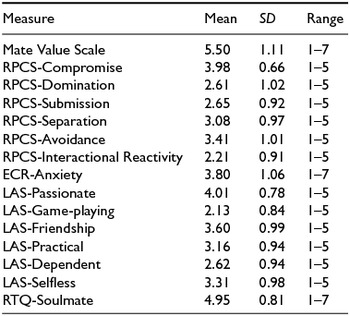
The mean score on the MVS (Edlund & Sagarin, Reference Edlund and Sagarin2014) was in the upper part of the possible range (M = 22.01, SD = 4.45, range 4–28), indicating that participants, on average, felt that their romantic partners had a high mate value. We performed a t test to examine sex differences on the MVS. There were no significant sex differences on this measure (men: M = 22.01, SD = 4.42, women: M = 22.01, SD = 4.45, p > .05), indicating that men and women tended to evaluate their intimate partners in similar ways. Edlund and Sagarin (Reference Edlund and Sagarin2014) also found no significant sex difference using the MVS as a self-report measure. For mean scores on all measures used in the current study, see the table with these scores in Appendix A.
The correlations between the MVS and all study variables are: RPCS-Compromise (r = .35, p < .001), RPCS-Domination (r = −.03, p = .58), RPCS-Submission (r = −.12, p = .03), RPCS-Separation (r = −.06, p = .30), RPCS-Avoidance (r = −.10, p = .07), RPCS-Interactional Reactivity (r = −.23, p < .001), ECR-Anxiety (r = −.21, p < .001), LAS-Passionate (r = .64, p < .001), LAS-Game Playing (r = −.18, p = .001), LAS-Friendship (r = .29, p < .001), LAS-Practical (r = .11, p = .06), LAS-Dependent (r = .07, p = .23), LAS-Selfless (r = .22, p < .001), and RTQ-Soulmate (r = .13, p = .02). Thus, using .01 as the significance level because of the large number of correlations computed, individuals who perceived that their partner had a higher mate value reported engaging in significantly more compromise and less interactional reactivity during conflict with a romantic partner. They also reported significantly less anxiety in close relationships and love styles that included significantly more passion, less game-playing, more friendship, and more selflessness. For intercorrelations between all study variables, see the table in Appendix B.
We also computed a multiple regression in an effort to determine the relative contribution of the relationship scales and/or subscales and their combined power in predicting MVS scores. In Step 1 we entered whether or not the survey was completed online as a control variable. In Step 2 we entered all of the relationship scales and/or subscales. The second step was significant. Taken together, the relationship variables explained 45% of the variance in MVS scores, F(308) = 15.70, p < .001. The significant predictors were RPCS-Compromise (β = .13, p < .05), ECR-Anxiety (β = ‒.13, p < .05), and LAS-Passion (β = .58, p < .001). Individuals who report engaging in more compromise with their partners, who have less anxiety in intimate relationships, and who have a more passionate love style saw their romantic partners as having a higher mate value.
The MVS correlated significantly with RPCS-Compromise, and Compromise was also a significant predictor in the regression. Those participants who highly valued their mate tended to compromise more when attempting to resolve a conflict with their partner. When romantic partners are perceived to have a higher value, individuals may be more willing to compromise with them in an effort to sustain the relationship. Stinnett (Reference Stinnett and Henslin1992), in a study of over 600 families, found that happy families — ones presumably in which mates are highly valued — tended to deal with crises in a positive manner and frequently talked and listened to one another. Gottman (Reference Gottman1998) found that healthy marriages tended to be ones in which couples were able to reconcile conflict. Equity theory, in which partners expect to get out of a relationship roughly what they put into it, does a nice job of explaining this result (Hatfield, Walster, & Berscheid, Reference Hatfield, Walster and Berscheid1978). Compromise implies that both partners gain and lose something when an agreement is reached, and that the compromise is perceived by both parties as being equitable. In turn, a partner who consistently compromises, rather than bullying or insisting on getting his or her way, is likely to be perceived as a highly valued mate.
The MVS was also significantly associated with ECR-Anxiety in both bivariate and multiple regression contexts. Individuals who perceive their mate as more valuable also appear to have less anxiety about their relationship. This may be because these are socially confident individuals with lower levels of relational anxiety who attract partners who are also ‘high value’. A study of over 300 married couples found that unhappy marriages, in which presumably mate values would be low, were marked by a high level of depressive symptoms in both men and women (O'Leary, Christian, & Mendell, Reference O'Leary, Christian and Mendell1994). As noted earlier, ECR-Anxiety was associated with a measure of depression (Wei et al., Reference Wei, Russell, Mallinckrodt and Vogel2007). Lauer and Lauer (Reference Lauer, Lauer and Henslin1992) found that healthy intimate relationships were characterised by (among other things) agreement with a spouse's aims and goals, and time spent laughing together. Stinnett (Reference Stinnett and Henslin1992) found that healthy, intimate relationships were characterised by couples talking together and listening to each other. Thus, another possible explanation for these findings is that the failure to agree on important goals and the failure to communicate in a positive way might create a great deal of anxiety about a relationship and contribute to devaluing of an uncommunicative partner.
The strongest relationship we observed with the MVS was with LAS-Passion; the MVS was significantly associated with LAS-Passion in both the correlations and regression. Perceiving one's partner as a ‘good catch’ may mean that someone is very physically attracted to their partner, which can create more passionate relationships. Hendrick and Hendrick (Reference Hendrick, Hendrick, Sternberg and Hojjat1997) cited passion as one of the strongest predictors of relationship satisfaction. Further, Jonason, Webster, and Gesselman (Reference Jonason, Webster and Gesselman2013) found that physical attractiveness, an important component of passion, was a strong predictor of mate value. Simpson, Campbell, and Berscheid (Reference Simpson, Campbell and Berscheid1986) pointed out that passionate love tends to be very strong in the beginning stages of an intimate relationship, but it fades with the passage of time. It should be noted that our participants were undergraduates with a mean age just short of 21. Most of them were unmarried and it is quite likely that the relationships they were describing in our study were mostly of short duration, short enough that passion was still running high for highly valued partners. A future study might determine if MVS scores would still correlate highly with LAS-Passion in a sample of older participants who had been in a close relationship for at least several years.
The MVS also correlated significantly with several other variables, although they were not significant predictors in the regression models, and therefore results should be interpreted with greater caution. Specifically, the MVS was significantly correlated with RPCS-Interactional Reactivity, indicating that individuals who were more reactive during conflicts with a romantic partner tended to value their mates less. Perhaps they are more reactive because they have less fear about how poor conflict management (i.e., reactivity) may harm the relationship. Valuing a mate less may mean taking fewer steps to preserve and protect the relationship, including controlling one's temper during conflict.
The MVS was also significantly correlated with LAS-Game Playing. Not surprisingly, mates who ‘play games’ involving deceit, lack of commitment, and trying to keep one partner from finding out about the other, tend not to be highly valued. Lukaszewski and Roney (Reference Lukaszeski and Roney2010) found that trustworthiness was strongly preferred in a mate, while Lauer and Lauer (Reference Lauer, Lauer and Henslin1992) found that happy long-term couples, who would presumably rate their partners highly on the MVS, tended to value commitment to the relationship, seemingly the polar opposites of the deceit and non-commitment shown by ‘game players’.
Scores on the MVS correlated significantly with LAS-Friendship as well. In other words, individuals tend to value mates more with whom they have a friendship (Kenrick, Sadall, Groth, & Trost, Reference Kenrick, Sadall, Groth and Trost1990) and thus who are kind (Lukaszewski & Roney, Reference Lukaszeski and Roney2010) and warm (Jonason et al., Reference Jonason, Webster and Gesselman2013). Hendrick and Hendrick (Reference Hendrick, Hendrick, Sternberg and Hojjat1997) found that friendship was highly related to relationship satisfaction with a mate. Other researchers have found that even when successful couples argue, they tend to avoid saying hurtful things that might tend to weaken their relationship (Markman, Floyd, Stanley, & Storaasli, Reference Markman, Floyd, Stanley and Storaasli1988; Yovetich & Rusbult, Reference Yovetich and Rusbult1994).
Scores on the MVS also correlated significantly with LAS-Selflessness. That is, individuals who are more selfless within their relationship tend to place a higher value on their mate. There is evidence that married persons who are addicted to video games ignore their spouses, fail to do household chores, and become irritable (Northrup & Shumway, Reference Northrup and Shumway2014). Narcissists tend to be selfish and less committed to their relationships (Campbell & Foster, Reference Campbell and Foster2002); then, when the relationship sours, they tend to blame their partners (Campbell, Reeder, Sedikides, & Elliot, Reference Campbell, Reeder, Sedikides and Elliot2000). Such behaviours would not likely cause their partners to give them high scores on the MVS. On the other hand, Stinnett (Reference Stinnett and Henslin1992) found that happy couples are committed to promoting each other's welfare, and Wieselquist, Rusbult, Foster, and Agnew (Reference Wieselquist, Rusbult, Foster and Agnew1999) found that acts of self-sacrifice on the part of one partner tended to build trust in the other partner.
This study has several limitations. One limitation might result from the decision to group those persons who have never been in an intimate relationship and those who are not currently in one with those who are currently involved. Future research with the MVS might separate these three groups in an attempt to determine if any differences are significant and, if so, to interpret their meaning. Also, some participants completed the study online and others in person. Using a different method of data collection may have had an impact on how participants answered survey questions, although we controlled for this potential effect in the regression.
In conclusion, we believe we have demonstrated the reliability of the MVS when used as a measure of the value of one's mate. Findings also demonstrate that perceiving one's partner as having a high mate value appears to be associated with some positive relationship qualities. Also, using the MVS as a measure of a partner's mate value correlates in similar ways with intimate relationship variables as when the MVS is used as a measure of one's own mate value. We argue that the MVS is a promising research tool, and we encourage its continued use in a two-pronged effort to learn more about intimate relationships and more about the strengths and limitations of the scale itself.
APPENDIX A
Means, Standard Deviations (SD), and Ranges for Each Scale or Subscale
APPENDIX B
Correlation Matrix for All Variables Used in the Study



