Citizens’ support for political authorities and institutions is considered indispensable to the stability and viability of democratic systems.Footnote 1 While a critical view of government performance and outputs is seen as unproblematic or even desirable for the promotion of assertive citizenry,Footnote 2 a well-functioning democracy also requires citizens’ support for democratic principles and institutions. This fundamental, albeit diffuse, support is not only built on evaluations of performance and policy outputs,Footnote 3 but also derives from a match between citizens’ democratic ideals and the actual quality of democratic procedures.Footnote 4 Equal rights, impartial treatment by officials, and procedural fairness are core democratic principles that come under pressure through discrimination and group-based inequalities.Footnote 5
This study examines whether (and how) antidiscrimination laws foster political support in Europe among both the targeted groups and the general population. The implementation of antidiscrimination laws aims to reduce discrimination based on group characteristics such as gender, ethnic origin, disability and sexual orientation.Footnote 6 These regulations concern the promotion of equal rights, participation and incorporation, which we argue should influence citizens’ evaluation of political responsiveness and democratic practice.Footnote 7
As objects of political support, we focus on the democratic system and its institutions. To gauge this support, we look at evaluations of public administration in general, satisfaction with the way democracy works and political trust in basic institutions. All three objects concern general institutional aspects and have been shown to be influenced by both performance and normative evaluations.Footnote 8
In conceptual terms, our study draws on the policy feedback literature, which suggests that policies act as institutions that affect subsequent policy development by generating constituencies of supporters.Footnote 9 Broadly speaking, this literature addresses the question of ‘whether policies render citizens more or less engaged in politics and how public programs shape citizens’ beliefs, preferences, demands, and power’.Footnote 10 More specifically, it posits that policies shape citizens’ attitudes and behavior by allocating resources and creating incentives, on the one hand, and providing information and normative content, on the other.Footnote 11
According to its functional logic, antidiscrimination policy mainly addresses members of groups at risk of discrimination. In terms of policy feedback, these groups represent potential beneficiaries of the implemented policy measures, and should thus be particularly likely to respond with political activation and support.Footnote 12 While the policy feedback literature largely focuses on specific target groups, less is known about policy effects among the general public. Implemented antidiscrimination measures may prove to be relevant for a broader public because they signal a government’s willingness to promote basic civil rights to equal treatment and non-discrimination. In this case, citizens with complementary issue preferences should be expected to respond with increasing political support because they feel their voices are being heard in the political arena.Footnote 13
Methodologically, the policy feedback literature has identified a number of limitationsFootnote 14 that should be addressed in the following ways: (1) citizens’ reactions should be studied across a wider range of public policies, (2) studies should focus on the attitudes and behavior of recipients of public policies as well as those of the broader public and (3) greater methodological sophistication should improve the resolution of causality issues. We respond to these limitations by investigating a policy domain that has not been addressed in the literature so far, which largely focuses on social and economic policies instead. We examine both target groups and the general public by utilizing a time-series design and more valid measures than those used in previous studies that will help us address endogeneity concerns. Specifically, we not only look at concrete legislation, but also at knowledge measures that tell us what people know about these policies. This allows us to address a general problem in this field: It is often argued that ordinary people hardly know anything about the policies in their country, a fact that would hamper researchers’ ability to infer the effects of a specific policy on individual attitudes.
To test our argument, we use data from the Eurobarometer (EB) studies (2009–2012) and the European Social Survey (ESS) (2006–2012) merged with time-varying information on antidiscrimination laws and citizens’ knowledge of their rights. Our findings show that an increase in policy knowledge over time systematically predicts higher satisfaction with public administration, higher political trust and greater satisfaction with democracy. Moreover, individuals who hold egalitarian values respond with disproportionately high political support when policy knowledge is expanding, while people who are discriminated against are particularly responsive to expansions in actual antidiscrimination laws and measures.
MECHANISMS OF ANTIDISCRIMINATION POLICY FEEDBACK
Antidiscrimination Policy and Material Interests
Applying the policy feedback framework to the area of antidiscrimination policy, one may posit that people who actually or potentially experience discrimination based on group membership constitute the main group of beneficiaries, and may thus be considered constituencies of supporters. Individuals who experience discrimination are likely to be directly impacted by policy content. Moreover, women and immigrants are, on average, at higher risk of being discriminated against, which renders both groups potential target groups.Footnote 15
Regarding the underlying mechanisms, antidiscrimination policy measures can be directly linked to material concerns, especially in the domain of employment. Being discriminated against in the job market or the workplace affects one’s career chances and thus one’s income and work-related motivation.Footnote 16 Similarly, restricting access to social services and housing represents further instances of discrimination that involve material interests.Footnote 17 We thus expect antidiscrimination policies to play a particular role among people who are at least potentially discriminated against, and who thus belong to the constituency that is most affected by these regulations. Related arguments come from the general literature on electoral accountability and economic voting. This literature investigates how voters react to changes in the economy and the welfare state, and how material interests can explain voting behavior.Footnote 18
Research on policy feedback has either ignored the responses of the larger public, or found no systematic evidence that policies impact citizens’ support.Footnote 19 The absence of policy effects might be explained by the fact that people who are not targeted by a certain policy either do not feel that these policies affect them, or are unaware that they exist. Material self-interest should be of limited relevance for those who are unlikely to experience discrimination, such as heterosexual white men. Nonetheless, anticipated risks of discrimination related to age, social status, health and disability could also play a role for these groups. A similar argument comes from research on welfare support, which indicates that younger cohorts also support old-age pension programs because they expect to rely on them in the future.Footnote 20 People learn about antidiscrimination measures through the mass media, civic education, antidiscrimination disclaimers in job advertisements and workplace diversity training.
Antidiscrimination Policy and Interpretive Effects
In addition to material interests, the implementation of antidiscrimination policies may also affect political support by shaping individuals’ views on the government’s level of interest in promoting civil rights and protecting minorities. This relates to a second mechanism of policy feedback that is centered on the role of information and normative cues, usually called interpretive effects.Footnote 21 In this vein, perceptions of government responsiveness to citizens’ needs and demands represent such an interpretive mechanism influencing political support.Footnote 22 In accordance with the policy feedback framework, we expect specific groups of constituencies to benefit from the implemented policies in terms of interpretive effects. The implementation of antidiscrimination measures should be particularly meaningful and informative for groups exposed to discrimination. People who have been discriminated against are thus expected to respond with increased political support. This might be due to a heightened perception of political efficacyFootnote 23 and/or an altered sense of obligation to the polity in response to improvements in status and/or incorporation.Footnote 24
Apart from the potential impact on target groups, interpretive effects may be of particular relevance for the general public, as a considerable proportion of people in European countries support legal measures against discriminationFootnote 25 and anti-prejudice norms.Footnote 26 People might disagree on the relative importance of the egalitarian principle of non-discrimination compared to other political issues, or about the specific measures used to prevent discrimination. Nonetheless, those who agree on the importance of non-discrimination are expected to support antidiscrimination measures, even if they are not directly affected by such regulations. In terms of mechanisms, the implementation of antidiscrimination measures serves as an informational cue about how interested political authorities are in strengthening civil rights (and thus their responsiveness to citizens’ needs), which in turn fosters citizens’ political support.
Specifically, we expect that citizens with egalitarian values will respond to an expansion of antidiscrimination measures by offering more political support. This argument draws upon research on representation and public opinion, which shows that citizens are more satisfied with democratic practice when they live in a regime where political actors resemble their ideological profile.Footnote 27 The mechanism underlying this relationship links citizens’ evaluation of the political system to the perceived representation of their views and preferences by political actors.Footnote 28 Research on ideological proximity between citizens and the incumbent government,Footnote 29 between citizens and political parties,Footnote 30 and between citizens and political elitesFootnote 31 generally supports a positive relationship between ideological congruence and political support. Nonetheless, the relationship appears to be contingent upon institutional features of the political system.Footnote 32 Applying this rationale, citizens who advocate the principle of equal treatment interpretively evaluate policy content in light of their needs and preferences, and should respond by offering particularly strong political support when equal treatment policies are implemented.Footnote 33
Investigating how citizens react to policy decisions, we should not forget that a considerable body of research focuses on how public opinion influences the adoption of policies in a number of areas.Footnote 34 We, however, think that the issue of reverse causality should be of limited concern here, as we focus on support for the democratic system and its institutions rather than support for specific political actors or policy preferences. Decision makers may change regulations depending on the support they receive or the attitudes voters have toward certain issues. As our outcome variable of interest is less directed toward the realization of specific policies, reverse causation is unlikely.
THE ROLE OF POLICY KNOWLEDGE AND MAIN ARGUMENTS
Studies looking at policy effects on public opinion assume that citizens know something (or at least have a certain heuristic they can infer from) about implemented policies. However, this assumption is problematic, as it is often unclear how much people know about the policies in their country.Footnote 35 Similarly, studies on economic voting assume that people are correctly informed about unemployment rates, GDP growth or inflation. However, this research literature has also contested whether or not citizens’ knowledge about these issues is accurate, and has explored the extent to which perceptions are influenced by subjective considerations.Footnote 36
The visibility and traceability of policies and related benefits are crucial to understanding policy effects. These characteristics affect the information people have about the issue and therefore make it easier to connect policy measures to public responses.Footnote 37 Following Kumlin’sFootnote 38 proposal to incorporate subjective measures, we rely on indicators related to objective policy content as well as subjective knowledge. This strategy is better suited to capturing general processes of policy diffusion and related policy effects on citizens, as it does not focus on indicators based on laws and their administrative implementation alone.
In one study incorporating subjective measures, Ziller finds that, on average, citizens are more aware of their right to equal treatment in countries with comprehensive antidiscrimination laws than those in countries with less comprehensive laws.Footnote 39 This research also shows that changes in knowledge levels are meaningfully related to individuals’ perceptions and experiences of discrimination, which illustrates the importance of considering policy knowledge alongside traditional indicators of implemented laws and measures. Some policy makers have also been active in this regard. For example, the European Commission has launched a number of initiatives to promote citizens’ awareness of their right to equal treatment.Footnote 40 These knowledge-enhancing initiatives address both victims and offenders, and are thus conceived as strategies to combat actual discrimination and prevent unequal treatment.
Against this background, citizens’ knowledge of antidiscrimination policies reflects the degree to which information about policy content has been diffused within society. As we argued above, material self-interest is relevant particularly for the target groups (that is, people who are discriminated against), whereas interpretive effects are assumed to be relevant for both the target groups and the members of the broader public with corresponding issue preferences. This means that knowledge of policies, rather than the measures stipulated in laws, is particularly indicative of policy effects among members of the general public (with corresponding preferences). In contrast, individuals who experience discrimination are likely to be exposed to specific antidiscrimination measures. We may assume that, on average, these groups know more about their rights than other citizens and follow the implementation of policy measures more closely. Hence, an effect of expanding knowledge levels should only be marginally relevant to them compared to expanding antidiscrimination laws and measures.
We expect to see that the implementation of antidiscrimination policies leads to higher political support among people who are discriminated against (compared to those who do not experience discrimination) (Hypothesis 1). The implementation of antidiscrimination policies leads to greater political support among people who advocate egalitarian values (compared to those who are less concerned with egalitarianism) (Hypothesis 2). An increase in policy knowledge represents a more valid indicator of policy effects, especially with regard to potential interpretive effects among the general public (Hypothesis 3).
DATA AND METHODS
Data and Variables
To test our arguments empirically, we use survey data from (1) two waves of the EB (EB 71.2 2009 and EB 77.4 2012) and (2) four waves of the ESS (2006, 2008, 2010 and 2012). Both data sources cover most European countries and contain indicators of political support. A question from the EB data on how respondents assess the quality of public administration in their country (four-point rating scale, ranging from ‘very bad’ to ‘very good’) serves as the dependent variable. The outcome variables in the ESS data are political trust and satisfaction with democracy. Political trust is measured with items on how much trust respondents have in the country’s parliament and legal system. Scales range from 0 (‘no trust at all’) to 10 (‘complete trust’), and we computed a mean index over both items (Cronbach’s α=0.78). Satisfaction with democracy is measured using a question on how satisfied respondents are with the way democracy works in their country. This indicator ranges from 0 (‘extremely dissatisfied’) to 10 (‘extremely satisfied’). All three outcome variables are conceptualized as sub-dimensions of political support and should therefore correlate substantially.Footnote 41 At the same time, they reflect different degrees of abstraction. This means that an assessment of public administration is more strongly influenced by perceived outputs and performance than satisfaction with democracy and political trust, while the latter two are more closely related to normative evaluations of democratic practice.
The main independent variables are country scores on antidiscrimination laws and antidiscrimination policy knowledge. For antidiscrimination laws, we rely on a sub-index of the Migrant Integration Policy Index (MIPEX).Footnote 42 The country-specific scores are based on expert ratings of national antidiscrimination laws and measures. They range from 0 to 100, with higher values indicating more comprehensive laws. Recently, the MIPEX scores have become available as a yearly time series covering the period of 2007–2014, which we merge with the EB and ESS survey data.
Policy knowledge is assumed to be influenced by policy measures.Footnote 43 Policy knowledge as a complement indicator therefore has to be measured at the macro level, because an assessment of the effects of differences in policy knowledge as a result of (macro-level) differences in policy measures necessarily refers to macro-level differences (for example, countries) and not individual differences.Footnote 44 Antidiscrimination policy knowledge is measured using an item on whether respondents know their rights as victims of discrimination or harassment.Footnote 45 Affirmative responses to this question were coded as 1, other responses as 0. The item is available for four EB waves containing special modules on discrimination in the European Union.Footnote 46 We aggregated this EB variable to sample-weighted country-year averages, serving as an aggregated indicator of (changes in) citizens’ policy knowledge. This country-year indicator was then combined with the respective survey data waves of both the EB and ESS.
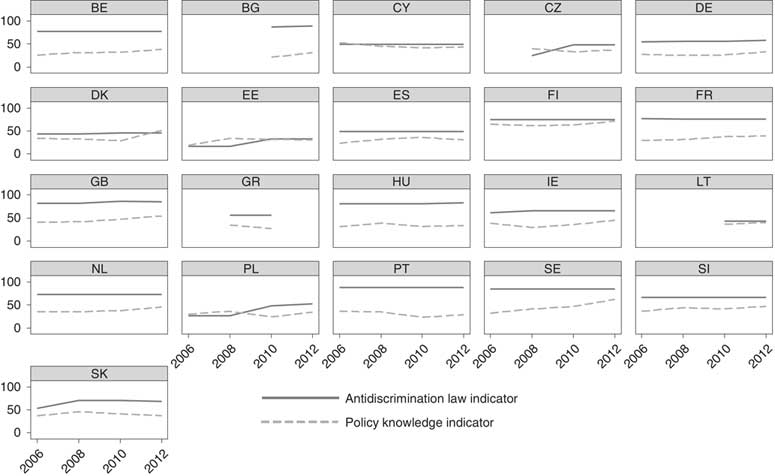
Figure 1 displays the time series of the antidiscrimination law indicator and the policy knowledge indicator for the countries and country-years included in the subsequent analyses. For the knowledge indicator, about 33 per cent (ESS dataset) and about 42 per cent (EB dataset) of the total variance is due to over-time variations.Footnote 47 For the law indicator, about 7 per cent of the variance (in both the ESS and EB data) is situated at the country-year level. Despite the relatively small amount of over-time variance for the law indicator, we obtain systematic results for a number of empirical models, as reported below.
Policy indicators – time series by country Note: BE, Belgium; BG, Bulgaria; CY, Cyprus; CZ, Czech Republic; DE, Germany; DK, Denmark; EE, Estonia; ES, Spain; FI, Finland; FR, France; GB, Great Britain; GR, Greece; HU, Hungary; IE, Ireland; LT, Lithuania; NL, Netherlands; PL, Poland; PT, Portugal; SE, Sweden; SI, Slovenia; SK, Slovakia.

For the EB data, we also include policy knowledge as an individual variable that accounts for compositional effects.Footnote 48 For the ESS data, we lack this information and hence include political interest (0, ‘not interested at all’ to 3, ‘very interested’). People with high levels of political interest tend to possess higher levels of general and specific political knowledge than those with low interest.Footnote 49 Some authors even combine political knowledge, perceived political competence and political interest into one latent concept, termed ‘political capital’.Footnote 50 It is, however, important to note that using political interest as a proxy for individual political knowledge is an imperfect approximation. Nevertheless, these variables are included here only to control for compositional differences between country-years, and a supplementary analysis using EB survey data shows that the empirical results are not sensitive to omitting individual-level policy knowledge. This gives us confidence that the contextual effects – which we are interested in – are largely independent of compositional differences.
For additional specifications exploring the role of discrimination, for the EB dataset we use items on whether respondents have been discriminated against or harassed in the past twelve months based on gender, age, ethnic origin, religion, disability, sexual orientation or other grounds. We build a binary index of discrimination experience that is coded 1 when discrimination based on one or more grounds was mentioned, and 0 otherwise. For the ESS data, we employ self-identification with a group experiencing discrimination on different grounds, including color or race, ethnicity, nationality, religion, language, age, gender, sexuality, disability and other.Footnote 51 Responses indicating one or more grounds were coded as 1, and no discrimination as 0. Both forms of discrimination refer to experiences of unequal treatment and are potentially overlapping. However, while the experience of discrimination refers to specific acts of unequal treatment, identification with a discriminated group indicates whether or not discrimination has been absorbed as part of one’s identity, most likely as a result of repeated experiences of discrimination and marginalization. This assumption is underlined by the finding that an average of 15 per cent report that they have experienced discrimination (EB data; between 8 per cent and 21 per cent, on average, per country), while only an average of 6 per cent report identification with a discriminated group (ESS data; between 3 per cent and 13 per cent, on average, per country).Footnote 52
To gauge the moderating role of egalitarian values, we draw from Katz and Hass’s definition of egalitarianism in terms of equality of opportunity, care for the well-being of others, and protection of others’ interest and rights.Footnote 53 In our study, we employ measures derived from the Schwartz’ human values measures implemented in the ESS.Footnote 54 Respondents were asked to rate how similar to fictitious persons they perceive themselves to be (ranging from 1 ‘not like me at all’ to 6, ‘very much like me’ [recoded]). Specifically, we use the items ‘He/She thinks it is important that every person in the world should be treated equally. He/She believes everyone should have equal opportunities in life’, ‘It is very important to him/her to help the people around him/her. He/She wants to care for their well-being’, and ‘It is important to him/her to listen to people who are different from him/her. Even when he/she disagrees with them, he/she still wants to understand them’. The three items are collapsed into a mean index (Cronbach’s α=0.63), in which high values indicate high levels of egalitarianism.Footnote 55
Additionally, we include the following individual-level control variables in the empirical models: Age in years (EB and ESS), gender (1=female, EB and ESS), immigration status (1=foreign-born, EB and ESS), education in years (EB and ESS), comfort with current income situation (EB: 0, ‘Most of the time difficult to pay bills’, to 2, ‘almost never / never difficult’ ESS: 0, ‘very difficult on present income’, to 3, ‘living comfortable at present income’), employment status (1=being unemployed, EB and ESS) and dummy variables on urbanization of living area (EB and ESS). Age, gender, education and employment status are routinely included in studies on political support.Footnote 56 Most of this research suggests that political support is higher among people who are older, male, better educated, not currently unemployed and wealthier.Footnote 57 Being foreign born is also positively associated with political support.Footnote 58
As country-level control variables, we include time-varying country-level information on unemployment rates derived from the Eurostat database, as well as proportions of foreign-born immigrants derived from the European Union Labour Force Surveys.Footnote 59 These controls aim to tackle changes in societal conditions that may confound the indicative role of antidiscrimination policy and related knowledge, such as externalities of the European economic crisis or a changing demographic composition due to immigration. For ease of interpretation, all continuous variables included in the empirical models were linearly transformed to range between 0 and 1. An overview of the included variables is presented in Appendix Tables A1 and A2 (online appendix).
Analytical Strategy
To provide an assessment of policy effects, we use multilevel modeling that accounts for non-independence due to clustered observational units and enables estimating relationships between macro- and individual-level variables.Footnote 60 In a first series of multilevel regression models, we estimate the average effects of antidiscrimination policy scores and policy knowledge on citizens’ evaluation of the public administration, political trust and satisfaction with democracy. To trace the net effects of each indicator, we include both simultaneously. All models include individual-level control variables, dummy variables for country and time, and a country-year random effect to account for the nesting of survey responses.Footnote 61 Country fixed effects control for time-invariant variance between countries.Footnote 62 We thus rely on within-country variance over time, which mutes potential endogeneity bias caused by time-constant unobserved confounders such as institutional differences or historical trajectories. We nonetheless include the time-varying control variables on unemployment and immigration in order to prevent potential bias from these time-varying influences. Time fixed effects are included to avoid spurious correlations caused by trending or periodical effects.
Since we are interested in effects in the general population as well as group-specific effects, we separately estimate models for all available respondents, female respondents and foreign-born immigrant respondents. As we have limited interest in the control variables, we only present the coefficient estimates of the law indicator and policy knowledge graphically. Full model details are available in the online appendix.
Secondly, we interact the law indicator and policy knowledge with discrimination to test whether policy effects are particularly relevant for people who have experienced discrimination. This allows us to compare how within-country gaps in political support between the majority population and people discriminated against are influenced by over-time variations in policy and related knowledge. Like the main models, these models consider all respondents, as well as women and immigrants only. To avoid over-fitting or collinearity issues, we incorporate only one interaction at a time. Models include the interaction term, its constitutive terms and individual- and macro-level control variables. Moreover, we include a random slope for discrimination, which means that we do not restrict the effect of discrimination to being equal over time and across countries. Instead, we allow the relationship to vary across country-years, which means, for instance, that there might be a particularly negative correlation between discrimination and political support in countries that were disproportionately impacted by the economic crisis. Likelihood-ratio tests indicate that the inclusion of this random slope is justified from an empirical point of view. For the sake of parsimony, we only show coefficient estimates for the interaction term, and place full model specifications in the online appendix.
Thirdly, we examine whether policy effects are contingent upon egalitarian values. To do so, we interact the law indicator and policy knowledge with individual egalitarianism. Here also, the models include control variables, the interaction, constitutive terms and a random slope for egalitarianism. Full model details appear in the online appendix.
RESULTS
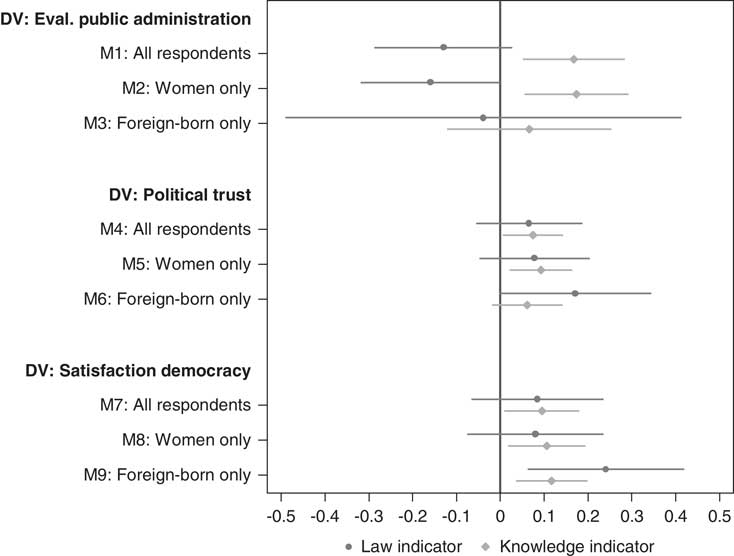
In a first step, we estimate average effects of antidiscrimination laws and policy knowledge. The results are presented in Figure 2. The estimates show that the antidiscrimination law indicator is negatively related to evaluations of public administration, but positively related to Political Trust and satisfaction with democracy. In most cases, these relationships are not systematic, as indicated by large standard errors. Regarding policy knowledge, we find systematic positive relationships with all three indicators of political support. The associations are systematic for most specifications, except for immigrants’ political trust and evaluation of public administration. Overall, this lends empirical support to the hypothesis that increasing awareness of civil rights fosters perceived political responsiveness, which leads to greater political support.Footnote 63
Law and knowledge effects on political support Note: DV, dependent variable. Solid bars represent 95 per cent confidence intervals. Models include control variables as well as country and time fixed effects. Full model details appear in the online appendix. Number of Level-1 (Level-2) observations are for M1: 38406 (42), M2: 20825 (42), M3: 2170 (42), M4: 121397 (77), M5: 64618 (77), M6: 8953 (77), M7: 121397 (77), M8: 64618 (77), M9: 8953 (77).

Regarding the effect sizes, the interpretation is facilitated by rescaling the included variables. Thus, the coefficient estimates reflect the change in the outcome when moving from the minimum to the maximum observed values of the predictor variables. Hence, moving from the lowest to the highest policy knowledge context is associated with an increase in positive evaluation of public administration by two-thirds of a standard deviation (Model M1), an increase in political trust by two-thirds of a standard deviation (Model M4) and an increase in satisfaction with democracy by two-fifths of a standard deviation (Model M7). Compared to other factors, the average effects of policy knowledge across models are slightly higher than those of antidiscrimination laws, and they are about two-thirds as strong as the effect of unemployment rates.Footnote 64
In the next step, we turn to the role of discrimination as a conditioning factor. Before estimating interactions, we examine the average effects of discrimination (not shown). Having experienced discrimination is related to a less favorable assessment of public administration (B=−0.05, SE=0.00, CIs [−0.05, −0.04]). Being a member of a group that is discriminated against is associated with lower levels of political trust (B=−0.07, SE=0.00, CIs [−0.07, −0.06]), and satisfaction with the way democracy works in the respondent’s country (B=−0.09, SE=0.00, CIs [−0.09, −0.08]). The reported effects refer to the full sample, but they occur in comparable strength and precision when we consider women or immigrants separately.
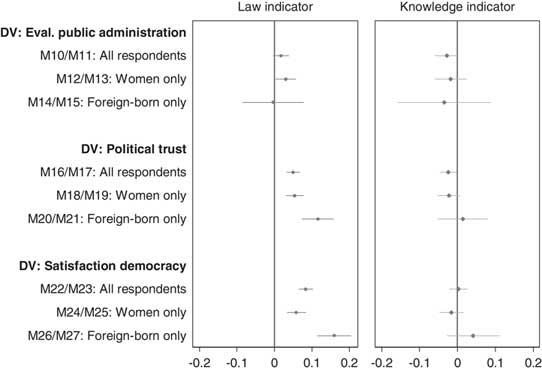
The results of the estimated interactions between antidiscrimination laws and discrimination, as well as policy knowledge and discrimination, are presented in Figure 3.
Discrimination as conditioning variable – interaction effects Note: DV, dependent variable. Estimates of interaction terms are shown. Solid bars represent 95 per cent confidence intervals. Models include constitutive terms, control variables as well as country and time fixed effects. Full model details appear in the online appendix. Number of Level-1 (Level-2) observations are for M10/M11: 38270 (42), M12/M13: 20749 (42), M14/M15: 2160 (42), M16/M17/M22/M23: 121397 (77), M18/M19/M24/M25: 64618 (77), M20/M21/M26/M27: 8953 (77).

The results show substantial positive interactions for the law indicator over all three outcomes, while the results are least systematic for evaluations of public administration (statistically significant relationship only for women). Nonetheless, they indicate that an expansion of antidiscrimination measures is related to disproportionately high levels of political support for people who experience discrimination. Interpreted symmetrically, the negative relationship between discrimination and political support is mitigated in contexts where antidiscrimination laws are expanding. Corresponding marginal effects plots are presented in Appendix Figures A1 and A2 (online appendix). Moreover, the results provide no systematic empirical support for the hypothesis that changes in policy knowledge and discrimination meaningfully interact. This supports our expectation that target groups of antidiscrimination measures are especially responsive to changes in laws and implemented measures, while changes in general knowledge levels have a limited impact on these groups.
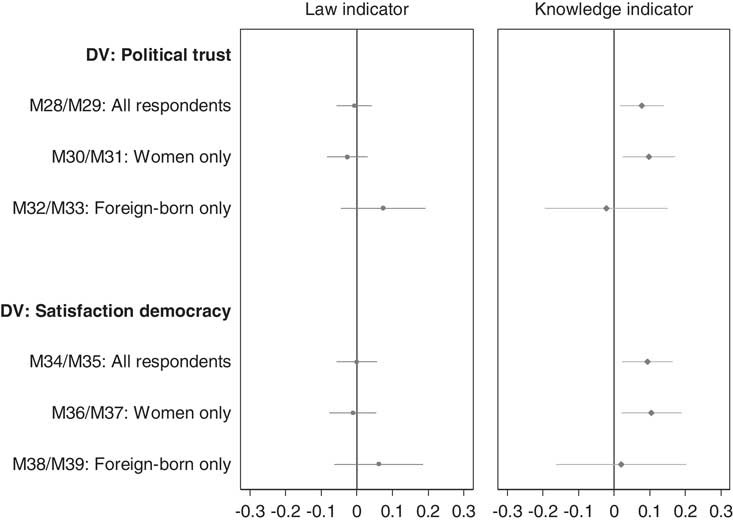
As another hypothesis test, we interact the law and knowledge indicators with egalitarian values. The corresponding estimates of the interaction terms appear in Figure 4. Models testing the average effects of egalitarian values (not shown) exhibit negligible relationships with political trust (B=−0.01, SE=0.00, CIs [−0.02,0.00]) and satisfaction with democracy (B=−0.00, SE=0.00, CIs [−0.01,0.00]). For interactions with the law indicator, the coefficient estimates show no systematic relationships. In contrast, we find positive significant interactions between egalitarian values and policy knowledge for most model specifications, except for models on immigrants only. In substantive terms, this means that increasing policy knowledge is more strongly associated with higher political support for people who hold egalitarian values. Alternatively, egalitarianism is linked more strongly to political support in the context of expanding policy knowledge. Corresponding marginal effects plots are presented in Appendix Figures A3 and A4, and show that people low in egalitarianism are largely unaffected, while the found interaction is driven by people high in egalitarianism gaining political support when policy knowledge increases.
Egalitarian values as conditioning variable – interaction effects Note: DV, dependent variable. Estimates of interaction terms are shown. Solid bars represent 95 per cent confidence intervals. Models include constitutive terms, control variables as well as country- and time-fixed effects. Full model details appear in the online appendix. Number of Level-1 (Level-2) observations are for M28/M29/M34/M35: 121397 (77), M30/M31/M36/M37: 64618 (77), M32/M33/M38/M39: 8953 (77).

Robustness
To ensure the robustness of our findings, we test a number of additional specifications. First, we consider group-specific aggregation of policy knowledge for women and foreign-born immigrants only. The policy knowledge of the general public is almost perfectly correlated with women’s policy knowledge (r=0.97) across the included 21 countries, while the correlation with immigrants’ knowledge is lower, but still substantial (r=0.62). Using policy knowledge of women as an alternative indicator in the multivariate models, we find virtually congruent estimates for the general indicator. When we incorporate immigrants’ policy knowledge when focusing on immigrants, the results are comparable to those shown in the Results section, with slightly smaller coefficient estimates and higher standard errors.
Secondly, we estimate models without a random effect for country-years. The resulting coefficient estimates largely resemble those reported, while the standard errors are considerably smaller. When country fixed effects are omitted, estimates rely on cross-country variance rather than changes over time, and yield similar results to those obtained when omitting the country-year intercept. Overall, these alternate specifications indicate that the policy effects reported in the Results section are conservative in terms of statistical testing.
CONCLUSION
This study examined antidiscrimination policy effects on political support. In doing so, we connect a rather narrow policy area to general questions about democratic governance. Thus our study complements research on the foundations of political support that focuses on broad indicators of economic performance and institutional quality.Footnote 65 At the same time, it is essential to empirically investigate the specific claims that are made about the effects of antidiscrimination policies. Our study not only tests the effectiveness of these policies, but – in a broader sense – is also relevant for debates about the impact of European Union directives on political and societal change within member states.Footnote 66
In the central argument of our study, we contended that antidiscrimination measures initiate resource effects and enhance perceptions of government responsiveness, which in turn foster political support. While we expected particularly strong effects for groups targeted by policy content (that is, people who experience discrimination), we also made a case for policy effects among the general public. The argument was that antidiscrimination policies are particularly relevant – in terms of political support – for citizens who advocate equal treatment. Moreover, we expected that (changes in) policy knowledge is a crucial element linking policy effects with individual political support, especially for individuals who are usually not directly exposed to antidiscrimination measures. The results show that, on average, public knowledge about their right to equal treatment predicts higher satisfaction with public administration, higher political trust and higher satisfaction with democracy. By contrast, expert ratings of implemented laws yield few systematic average relationships. This suggests that policy knowledge is particularly suited to capturing policy effects in the general population that would have been overlooked when relying solely on indicators measuring law.
With regard to the specific social mechanisms, we find that those who advocate egalitarian values express more political support for antidiscrimination policies under expanding policy knowledge levels. This lends additional empirical support to interpretive mechanisms, operating in particular for the general public. A societal diffusion of knowledge about civil rights increases perceptions of government responsiveness, which increases political support. With regard to group-specific effects, we find only minor differences in policy knowledge effects when focusing on women or immigrants only. Similarly, we find no systematic evidence that people who report discrimination are disproportionately affected by increasing knowledge levels. This suggests that policy knowledge is less indicative for people who are discriminated against, most likely because these groups already have substantive knowledge of their rights. Instead, we find that these groups respond by increasing their political support when antidiscrimination laws are expanded. This indicates that individuals who are targeted by (and exposed to) policy content respond measurably to policy changes over time.
From an analytical viewpoint, our results are one of only a few comparative longitudinal studies on policy effects investigating both the general public and target groups. Our research design avoids the bias typical of cross-sectional studies on policy effects, which arises due to unobserved historical or institutional factors that may determine both policy implementation and patterns of political support. Moreover, in relying on survey data from large random samples, we circumvent a problem that has been identified in laboratory studies on information or framing effects on political opinion. In real-world settings, people are much more selective in collecting information, which calls the external validity of the effects of information primes in controlled lab settings into question.Footnote 67 However, using available survey data comes with the limitation of an imperfect connection between given variables and the theoretical concepts under study. For instance, it would be useful to examine the specific role of material and interpretive mechanisms more explicitly in future research. Another important avenue for future studies is to extend the research design to policy areas other than antidiscrimination. This would allow for the generation of additional evidence on policy knowledge effects and underlying mechanisms. Our study also informs strategies for political communication and civic education that emphasize knowledge enhancement related to civil rights.
Finally, it would also be interesting to study the effects of antidiscrimination policy and policy knowledge on political participation. In additional analyses using ESS data, we investigated relationships with electoral and non-electoral participation. For electoral participation, the law indicator showed modest (negative) but non-significant associations. In contrast, the coefficient estimates of policy knowledge were positive for all groups, and they were statistically significant for the general public and women. This means that an increase in knowledge levels is systematically associated with higher rates of electoral participation. For non-electoral participation, however, we found no systematic relationships.
These preliminary findings suggest an interesting avenue for further research. However, that would require more detailed measures of political participation and theories that allow us to causally link antidiscrimination policies and political behavior. One could argue that electoral participation signifies that someone supports the democratic system, while non-electoral participation signals opposition. If this were true, these findings would be in line with the main results of this article, namely that antidiscrimination measures and related policy knowledge lead to higher support for the democratic system. However, one could also argue that electoral participation decreases when people are satisfied with current policies, or that non-electoral participation is an essential part of a democratic decision-making process that requires a certain degree of confidence in that process. Hence, in addition to more detailed information on why people are politically engaged, we need to elaborate on which mechanisms not only lead to more political support, but also to certain political behavior.
Most importantly, this study shows that an expansion in antidiscrimination measures and increasing awareness of and knowledge about rights to equal treatment are vital for generating political support for specific groups as well as a broader public with corresponding issue preferences. Against the background of increasing ethnic and social diversity in modern societies, this research suggests avenues for strengthening citizens’ support for democratic institutions and political engagement.