Introduction
There is a growing interest in fostering the development of Dementia Friendly Communities as a humane and economically responsible response to the rising number of people with dementia. Most of this interest has been focused on the education of community members, particularly those likely to encounter a person with dementia, e.g. hospitality staff, policemen, shop workers, so that they are better prepared to be able to respond to their needs.
There has also been an increasing appreciation of the role the built environment plays in promoting quality of life of people with dementia. Dementia friendly environments have been defined as those which enable and support personhood (Topo and Kotilainen, Reference Topo, Kotilainen, Topo and Ostlund2009) and “compensate for disability, maximise independence. . .enhance self-esteem and confidence. . .and reinforce personal identity” (Marshall, Reference Marshall and Benson2001). They facilitate access to public spaces and support the person with dementia as they undertake the ordinary activities of daily living outside their home (Burton, Reference Burton2012). Davis et al. (Reference Davis, Byers, Nay and Koch2009) have drawn attention to the need to take into consideration the lived experiences of the person with dementia as central to informing the design of the environments that they use.
The interest in designing for people with dementia began in the residential aged care setting (Fleming and Purandare, Reference Fleming and Purandare2010; Fleming et al., Reference Fleming, Goodenough, Low, Chenoweth and Brodaty2014) and has resulted in the development of a number of tools that enable the quantification of the quality of the built environment used to accommodate people with dementia. One of these tools is the Environmental Audit Tool (EAT)(Fleming, Reference Fleming2011; Smith et al., Reference Smith, Fleming, Chenoweth, Jeon, Stein-Parbury and Brodaty2012) which has been used extensively in research and practice in Australia (Low et al., Reference Low2013; Chenoweth et al., Reference Chenoweth2014; Fleming et al., Reference Fleming, Goodenough, Low, Chenoweth and Brodaty2014). This paper describes the process and results of modifying the EAT to make it suitable for assessing the support provided to people with dementia by public and commercial buildings. In its original form, the EAT comprises 72 items and is organized around ten principles of design (Fleming and Bennett, Reference Fleming, Bennett, Nay, Garratt and Fetherstonhaugh2013).
The principles
Unobtrusively reduce risks
People with dementia require an internal and external environment that is safe and easy to move around in to assist them to lead a full life. The environment needs to be designed to be enabling. Potential risks must be removed or hidden unobtrusively, as obvious safety features and barriers can lead to frustration, agitation, and anger.
Provide a human scale
The scale of the environment can have a positive effect on the behavior and feelings of a person with dementia. The number of people that a person interacts with, the overall size of the building and the size of the individual components (such as doors and rooms) are three key factors that influence scale. A person should not be intimidated by the number of people or the size of the surroundings he or she encounters, or be confronted with a multitude of interactions and choices. Rather the scale should encourage a sense of well-being and enhance the competence of a person.
Allow people to see and be seen
The provision of an easily understood environment will help to minimize confusion. It is particularly important for people with dementia to be able to recognize where they are, where they have come from, and what they will find if they head in a certain direction. When a person can see key places they are more able to make choices and find their way to where they want to go. It is also important that carers can see the person with dementia to assist them to avoid difficulties. Environments that provide these opportunities are said to have good visual access. Good visual access offers opportunities for engagement and gives the person with dementia the confidence to explore their environment.
Manage levels of stimulation
Reduce unhelpful stimulation – a person with dementia becomes stressed by prolonged exposure to large amounts of stimulation, because dementia reduces the ability to filter stimulation and attend to only those things that are important. The environment should be designed to minimize exposure to stimuli that are not helpful, such as competing noises and images. The full range of senses must be considered. Too much visual stimulation is as stressful as too much auditory stimulation.
Enhance helpful stimulation – enabling the person with dementia to see, hear, and smell things that give them cues about where they are and what they can do, can help to minimize their confusion and uncertainty. Consideration needs to be given to provide a number of cues to the same thing, recognizing that what is meaningful to one person will not necessarily be meaningful to another.
Support movement and engagement
Purposeful movement can increase engagement and maintain a person's health and well-being. It is supported by providing a well-defined pathway or route, free of obstacles and complex decision points, that guides people past points of interest and opportunities to engage in desired activities or social interaction. The pathway should be both internal and external, providing an opportunity and reason to be outside when the weather permits.
Create a familiar space
A person with dementia is more able to use and enjoy spaces and objects that were familiar to them in their early life. The environment should afford people the opportunity to maintain their competence through the use of familiar building design (internal and external), layout, furniture, fittings, and colors. Objects need to be clearly identifiable and recognizable if a person with dementia is to be enabled to use them.
Provide a variety of places to be alone or with others
In the building – people with dementia need to be able to choose to be on their own or spend time with others. This requires the provision of a variety of spaces, some for quiet conversation and some for larger groups, as well as spaces where people can be by themselves. These need to be attractive and comfortable to encourage people to use them. These internal and external spaces should offer a variety of experiences and aim to stimulate different emotional responses.
In the community – without constant reminders of who they are, a person with dementia will lose their sense of identity. Frequent interaction with friends, relatives, and the wider community can help to maintain that identity. Stigma remains a problem for people with dementia. The environment should offer “bridges into the community” by providing attractive, de-stigmatizing places that are easily shared by the community, including children, and people with dementia.
Design in response to a vision for way of life
People with dementia need an environment that gives a clear invitation to engage with activities and events that are meaningful to them. People live differently. Some choose, for example, to focus on the ordinary activities of daily living such as cooking and gardening. Others focus on a relaxing lifestyle, while some emphasize a healthy way of life or spiritual reflection. The environment needs to be designed in response to a clear understanding of the person's interests and abilities and to enable them to continue a way of life that is meaningful to them.
These principles were developed from the practical experience of designing facilities for confused and disturbed elderly people (Fleming and Bowles, Reference Fleming and Bowles1987) and refined by the accumulation of research findings on desirable characteristics in environments for people with dementia (Fleming and Purandare, Reference Fleming and Purandare2010). The psychometric properties of the EAT have been investigated (Smith et al., Reference Smith, Fleming, Chenoweth, Jeon, Stein-Parbury and Brodaty2012) and found to compare favorably with the most widely accepted environmental assessment tool, the TESS-NH (Sloane et al., Reference Sloane2002)
This project intentionally brought together four sources of information to extend our ability to identify and quantify those supportive features of the buildings that are required by people with dementia. These were the information generated by research on the evaluation of residential aged care facilities for people with dementia as summarized in the EAT, the existing literature on evaluating public spaces and buildings used by people with dementia, the views of potential users of the tool, i.e. professionals likely to be involved in evaluating buildings, and central to “dementia-friendly” the view of the users of the buildings, i.e. people with dementia and their carers.
Methods
The conduct of this research was governed by the University of Wollongong/Illawarra Shoalhaven Local Health District Social Sciences HREC approval HE14/445.
A three-step process was followed to develop the tool and establish its reliability.
-
1. A review of principles and available tools informed the development and modification of an EAT of proven utility. The search terms (dementia OR alzheimers) AND (neighbourhood* OR neighborhood* OR “environment* design” OR “dementia friendly” OR “public space”) were used to identify potentially relevant articles in three data bases – Art and Architecture Complete, Medline, and Scopus.
-
2. The draft tool was subjected to an iterative process of evaluation involving a team of two town planners, architect, graphics designer, psychologist, occupational therapist, physiotherapist, two community development officers, and two people with early dementia and their partners who cared for them at home. The professional members of the team were selected to represent potential users of the tool. The town planners and community development officers were employed by the local council in the town in which the research took place. The remaining professional team members were university based and linked to the town council through a project aimed at developing a dementia friendly community. All members of the team, including the people with dementia with the help of their carers, evaluated each draft of the tool by using it in the evaluation of a public building. Three buildings were evaluated approximately one week apart with the discussion of the results of each evaluation and the experience of using the tool, used by the authors to refine the tool.
-
3. Inter-rater reliability and internal consistency were assessed. This involved two people, familiar with carrying out assessments using the EAT (Fleming, Reference Fleming2011) carrying out independent assessments on a convenience sample of public and commercial buildings. The sample comprised ten sets of six types of buildings, 60 buildings in total. The locations of the sets of buildings were selected to cover the range of metropolitan areas to small regional towns. Each set comprised a bank, shopping mall, medical facility, council building, small shop, and a supermarket. The results were used to evaluate each question in the tool and the tool as a whole. The data were analyzed using IBM SPSS Statistics 19. Inter-rater reliability was assessed using the intra-class correlation coefficient and internal consistency with Cronbach's α.
Results
Informing the development of the tool
A total of 360 potentially relevant papers were identified. Duplicates were eliminated and the titles and abstracts of these papers were read to screen out papers that were anecdotal in nature or not relevant to the topic of measuring the quality of dementia friendly communities. The remaining 28 articles were read thoroughly to identify articles that provided information of direct relevance to the construction of a tool for auditing the quality of public buildings and spaces likely to be used by people with dementia. Fifteen such papers were identified (Blackman et al., Reference Blackman2003; Mitchell et al., Reference Mitchell, Burton, Raman, Blackman, Jenks and Williams2003; Burton et al., Reference Burton, Mitchell and Raman2004; Mitchell et al., Reference Mitchell, Burton and Raman2004; Andrews, Reference Andrews2006; McCabe and Sim, Reference McCabe and Sim2006; van Schaik et al., Reference van Schaik, Martyr, Blackman and Robinson2008; Topo and Kotilainen, Reference Topo, Kotilainen, Topo and Ostlund2009; Mitchell and Burton, Reference Mitchell and Burton2010; Brorsson et al., Reference Brorsson, Öhman, Lundberg and Nygård2011; Boex and Boex, Reference Boex and Boex2012; Burton, Reference Burton2012; Keady et al., Reference Keady2012; Brorsson et al., Reference Brorsson, Öhman, Cutchin and Nygård2013; Crampton and Eley, Reference Crampton and Eley2013) including a review of the literature by Keady et al. (Reference Keady2012).
The Keady review and our search of the literature both pointed to the pre-eminence of the work of Mitchell and Burton and their colleagues (Mitchell et al., Reference Mitchell, Burton, Raman, Blackman, Jenks and Williams2003; Burton et al., Reference Burton, Mitchell and Raman2004; Mitchell et al., Reference Mitchell, Burton and Raman2004; Mitchell and Burton, Reference Mitchell and Burton2010; Burton, Reference Burton2012). It is methodologically pioneering, utilizing walking interviews with people with dementia and has resulted in a clear statement of the desirable aspects of the streetscape of a dementia friendly community. These aspects are described in relation to six principles (Mitchell and Burton, Reference Mitchell and Burton2010):
Familiarity – Familiar surroundings enable people to recognize and understand their surroundings, which helps to prevent and alleviate spatial disorientation and confusion and to aid short-term memory.
Legibility – People can understand where they are and identify which way they need to go, helping to prevent and alleviate spatial disorientation, confusion and anxiety.
Distinctiveness – People's attention and concentration are captured by the distinctiveness of the various parts of the neighborhood, which aids orientation and way-finding.
Accessibility – People are able to reach, enter, use, and move around the places and spaces they need or wish to visit, regardless of any physical, sensory, or cognitive impairment.
Comfort – People feel at ease and are able to visit, use, and enjoy places and spaces of their choice without physical or psychological discomfort.
Safety – People are able to use, enjoy, and move around the neighborhood without fear of coming to harm.
These principles were utilized to produce a checklist of the enabling characteristics of outdoor environments (Burton et al., Reference Burton, Mitchell and Raman2004).
The use of the walking interview in the development of this checklist hints at the need for a dynamic understanding of the environment, an understanding based on movement through the environment and the opportunity the environment provides for positive or negative possibilities. The latter theme is developed in the work of Topo and Kotilainen (Reference Topo, Kotilainen, Topo and Ostlund2009) who use the term affordance to describe the enabling and restrictive qualities of a living environment and explores how a knowledge of these can be used to produce an environment that supports a full and meaningful life.
The work of van Schaik et al. (Reference van Schaik, Martyr, Blackman and Robinson2008) has shown, by the use of a virtual environment, that navigability, legibility, safety, and environmental attractiveness are the key elements for successful way-finding and enjoyment of outdoor spaces. A key message from this research was that real town centers offered relatively few obstacles for people with mild to moderate dementia, and that sometimes relatively straightforward changes, such as improvements to signage, could lead to measurable differences in way-finding and thereby improve quality of life and well-being.
He also highlights the advantages of involving the person with dementia in evaluating the environments through, for example, the accompanied walks used by Mitchell et al. (Reference Mitchell, Burton and Raman2004). This strategy has revealed valuable insights into the sensory experience of getting out and about for people with dementia. The research found that noise, smells, and a multitude of visual stimuli had an influence on how participants negotiated journeys around their neighborhood. This research also helped to identify the strategies that people with dementia used in order to navigate outdoor spaces and highlighted the importance of access to a local familiar neighborhood for well-being.
The sense of a journey to a destination and the ability of that destination to support the desired activity is captured in a very practical way in the work of Boex and Boex (Reference Boex and Boex2012). They have introduced the idea of “touch points” that can be used to map the physical journey taken by a person with dementia. The first touch point in a typical journey may be the car park, followed by the entrance to the building, then the entry space (perhaps a waiting room), corridors (or aisles in a supermarket), and finally the work area (the counter in a bank, the interior of a library the shelves in a supermarket). This approach leads to the recognition that a tool that is intended to assess the quality of the environment encountered by a person with dementia interacting with their community must sample that environment at points along the journey. A one off, cross-sectional assessment is likely to miss critical elements and strip the dynamism from the experience.
The Boex work also clearly shows the need for an approach that will accommodate a movement from the outside to the inside (and vice versa). This is reinforced by the work Brorsson et al. (Reference Brorsson, Öhman, Lundberg and Nygård2011, Reference Brorsson, Öhman, Cutchin and Nygård2013) who chart the problems encountered by people with dementia as they negotiate the various stages of shopping. This highlights the advantages of developing a tool able to provide data on the internal aspects of buildings as well as on their external context.
The review identified the work of Mitchell and Burton (Mitchell et al., Reference Mitchell, Burton, Raman, Blackman, Jenks and Williams2003; Mitchell et al., Reference Mitchell, Burton and Raman2004; Mitchell and Burton, Reference Mitchell and Burton2010; Burton, Reference Burton2012) and Boex and Boex (Reference Boex and Boex2012) as providing rich sources for additional items to be used in the modification of the EAT.
Iterative tool development
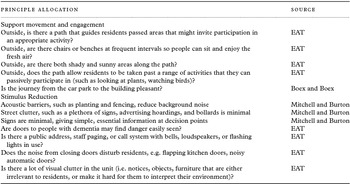
A set of 79 potential items were identified from these sources and presented one by one to the team for a decision to be made on their inclusion in the first draft of the tool. The first draft of the tool was produced by adding these items to those EAT items that were not obviously only relevant to a residential environment. Table 1 provides examples of the original items and their source.
Examples of initial items, their source, and allocation to an EAT principle

The first draft of the tool was tested by the team using it on a walk-through of a council building in a small town on the south coast of New South Wales, Australia. They then carefully considered the results of the assessment and the usability of the tool. This led to significant changes including the clarification of the desirability of the tool being formatted to enable the assessment of the impact of the building on eight stages experienced during the journey from the car park, the approach to the entrance, the entrance area, the journeys from the entrance to the destination, from the destination to the exit, the exit area, and the journey back to the car park.
The draft was significantly revised and the process repeated, this time by walking through a shopping mall. This resulted in changes and these were evaluated by assessing a library and discussing the experience and the findings. This resulted in the final draft that was then subjected to the evaluation of its inter-rater reliability and internal consistency.
Testing inter-rater reliability and internal consistency
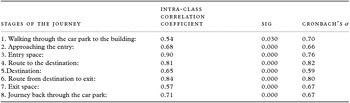
The analysis showed that the inter-rater reliability was poor when the assessors were assessing the journey from the car park to the building (ICC 0.54) and the internal space around the exit of the building (ICC 0.57), see Table 2. These levels of inter-rater reliability were considered to be too low to support the inclusion of these stages in the final tool. The exclusion of journey through the car park to the building led to the conclusion that it would be illogical to include the journey back through the car park stage. The final tool therefore comprises stages 2 to 6.
Inter-rater reliability and internal consistency

The retention of the individual items was determined by the calculation of the κ coefficient (Landis and Koch, Reference Landis and Koch1977) and the percentage of absolute agreement. An item was retained if κ > 0.2 and absolute agreement exceeded 70%. This resulted in the exclusion of one item resulting in the final scale comprising 37 items. The mean percentage of absolute agreement on these items was 83%.
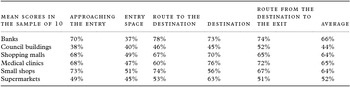
The data collected in the inter-rater reliability study provides an opportunity to compare the support provided to people with dementia by the six types of buildings assessed, as shown in Table 3.
Comparison of DFC EAT scores from six types of buildings

Banks, shopping malls, medical clinics, and small shops appear to be more supportive of people with dementia than council buildings and supermarkets.
Discussion
The trajectory of dementia can take a long time and it is only in the latter stages that people with dementia are admitted to residential care. Even then many people choose, in so far as they are able or allowed to, to stay at home. While experience in Australia has shown that it is possible to provide care in the home to a greater extent than was expected even ten years ago, there is no room for complacency. The number of people with dementia in Australia, as in the rest of the developed world, is very likely to double in the next 30 years and it is very unlikely that the provision of residential aged care will keep pace. It is therefore essential that careful consideration is given to all aspects of life in the community so that even more people with dementia can be supported in it and lead satisfying lives. This must involve the development of a greater understanding of the supportive role that the built environment can play.
It is anticipated that the availability of tools that allow us to begin the quantification of the supportive features of the built environment will enable us to improve our understanding of what it means to have a dementia friendly community. This work has been started by the seminal contributions of Mitchell and Burton and their colleagues (Mitchell et al., Reference Mitchell, Burton, Raman, Blackman, Jenks and Williams2003; Mitchell et al., Reference Mitchell, Burton and Raman2004; Mitchell and Burton, Reference Mitchell and Burton2010; Burton, Reference Burton2012); however, as far as the authors could determine there was no environmental assessment tool designed for this type of work that has undergone a rigorous examination of its inter-rater reliability and internal consistency and includes the collection of data on the internal, as well as external, experience of the buildings. Furthermore, the authors were unable to find any data that allowed a comparison of different types of buildings to be made.
The development of the tool described here, now known as the Dementia Friendly Communities Environmental Assessment Tool, the DFC EAT, was undertaken to assist those people who can make a difference to the quality of the built environment to evaluate their buildings, i.e. the owners, managers, and designers of public and commercial buildings. It followed the key principles of tool development, literature review, iterative development with potential tool users, and tool testing.
Consistent with the principles of the “dementia friendly” movement, people with dementia were involved in the drafting and development of the tool to ensure that the “lived experience” was also informing the tool (Davis et al., Reference Davis, Byers, Nay and Koch2009). This part of the project was undertaken in collaboration with a local dementia consumer advisory group which has been formed as part of the Dementia Friendly Kiama project (Phillipson and Rees, Reference Phillipson and Rees2014) and shows the value of the creation of such groups to enable the “civic participation” of people with dementia.
Consistent with the principles of good tool development – potential users of the tool were also involved in its initial drafting and development including town planning staff and an architect. While the literature has previously emphasized the value of this process for improving tool usability, particularly in the development of software (Lieberman et al., Reference Lieberman, Paternò, Klann, Wulf, Lieberman, Paternò and Wulf2006), we reflect that the process also had other outcomes. For many of those involved in the process, while familiar with the conduct of environmental audit, it was the first time they had considered it from the perspective of the person with dementia. In this way, being involved in the drafting and testing of the tool, especially in a process that also involved people with dementia, achieved the additional outcome of enhancing their knowledge of the “lived experience” of the person with dementia and thus becoming more “dementia friendly.” This suggests that the inclusion of a person with dementia and their carer in the actual assessment of a building with the new tool would enhance the assessors understanding of the results.
The final version of the DFC EAT is available as supplementary material attached to the electronic version of this paper (see Table S1 available at http://journals.cambridge.org/ipg). Its inter-rater reliability is substantial in all stages of the journey through the building with minimum ICC being 0.652. This is supported by the very high percentage of absolute agreement between the raters on the majority of items and the high average absolute agreement of 83%.
The internal validity, as measured by Cronbach's α, is greater than the commonly agreed minimum of 0.7 (Nunnally, Reference Nunnally1970) when the tool is used in three of the five stages. The scales assessing two stages of the journey, Approaching the Entry and being at the Destination, have lower than desirable internal validity, Cronbach's α, 0.66 and 0.59, respectively. Alpha could be improved in these scales by deleting some items; however, it was decided that, at this stage in the development of our knowledge, it would be better to retain the items until more experience is gained in the use of the tool. They appear to the authors to be providing information that is important to those planning refurbishments.
The data collected for the inter-rater reliability evaluation has enabled a start to be made on comparing the “dementia friendliness” of different types of buildings. While the samples are small and no generalizations are justifiable, it is interesting to note that the tool indicates that the hardest places to get out of are supermarkets. Perhaps, there is a vested interest in keeping people in. Banks appear to provide more support for people with dementia than do council buildings. This may be the result of the very specific purpose of visiting a bank as compared with the more generic nature of council buildings. It is probably easier to design a building that will meet one specific need, to have access to a bank teller, than to design one that will be used by people with various needs, e.g. to pay rates, get information, visit a library.
It is too early to make comparisons, a much larger data base is required to enable us to do that. It is hoped that the DFC EAT will be used by others who will, subject to ethical considerations, share their data, and contribute to a database that will help us to explore the current state of the friendliness of buildings used by people with dementia. They will be able to do this by uploading their data to the Alzheimer Australia WA web site www.enablingenvironments.com.au where they will also be able to access more information on the development and use of the DFC EAT, including a spreadsheet that will assist with the scoring.
Conclusion
The combination of the literature review, experience gained from the development of tools for the evaluation of residential care environments, the insights of a team containing experts in design and users of public buildings who are, or are caring for, people with dementia provided a good foundation for the first draft of the new tool. The experience of refining the draft tool by walking through buildings with the team and reflecting on the experience of using it was invaluable. The final stage of evaluating its inter-rater reliability and internal consistency not only provided confidence in the tool but began the collection of data that will be useful in promoting discussions on what makes a dementia friendly building.
Conflict of interest
None.
Description of authors’ roles
R. Fleming designed the study, supervised the data collection, and wrote the paper. K. Bennet collected the data and contributed in writing the paper. T. Preece collected the data and contributed in writing the paper. L. Phillipson contributed in data collection and writing the paper.
Acknowledgments
The development of the draft tool was supported by a grant from Alzheimers Australia WA and the National Office of Alzheimers Australia. The inter-rater reliability study was supported by a grant from the Dementia Collaborative Research Centre – Assessment and Better Care, based in the University of New South Wales. Grateful thanks are extended to the people with dementia and their carers who assisted with the development of the draft tool and Kiama Council for the contribution of their town planning and community development staff and the provision of meeting space. Thanks are also due to the owners and managers of the public and commercial buildings that were evaluated.
Supplementary material
To view supplementary material for this article, please visit http://dx.doi.org/10.1017/S1041610216001678