Early in the fall of 1786, several men entered the French office of the Director General of Finance, Charles Alexandre de Colonne, intent on making an offer for a portion of France's holdings of American bonds. The ‘Dutch Company’, as Thomas Jefferson called them, represented an Amsterdam investment bank led by Nicolaas and Jacob Van Staphorst. At this meeting the Dutch had proposed to buy 24,000,000 livres of US debt (approximately 4,363,636 specie dollars) for 20,000,000 livres (approximately 3,636,363 specie dollars),Footnote 1 a 17 percent discount that suggested weakness of American credit in Europe (Jefferson Reference Jefferson and Boyd1954b [1786], pp. 519–23). The Van Staphorsts did not know that their offer – which was in fact for less of the debt than Jefferson had been led to believe – would trigger a series of events that would soon spin out of their control and threaten the Dutch bank's position as protector of American credit in Europe. Over the next four years, multiple groups comprising American and French financial adventurers, far less well financed than the Van Staphorsts, made competing bids for France's holdings in American bonds. At the eleventh hour, when the Van Staphorsts – realizing the risks for future American borrowing on the Amsterdam capital markets if large numbers of US securities were to fall into the hands of buyers whose financial weakness might force them to sell again, at deeply discounted prices – conjured up a bold, unprecedented, scheme to persuade the French that it would be unnecessary to sell their American bonds at a loss.
This crucial moment in the history of American sovereign finance has largely escaped the notice of scholars, probably for two reasons. First, because the matter ended with France's holdings of American bonds passing into the hands of well-financed Dutch rentiers as opposed to poorly funded American speculators, it has been too easy to assume that this had to be the case. Second, the critical role played by the Van Staphorst brothers and those in their orbit in transforming American finance during the Confederation Era has never been fully understood or appreciated. A close look at the bidding war that took place between 1786 and 1790 illuminates both a key moment in that transformation and the significance of the Dutch financiers in the creation of a stable, modern system of finance in the United States under the Constitution of 1787 (Ferguson Reference Ferguson1961; Van Winter Reference Van Winter1977; Riley Reference Riley1980; Schulte Reference Schulte and Rowan1982).
I
A combination of financial disrepair and intrigue from the Office of the Superintendent of Finance in the United States ignited the bidding war for France's holdings of American bonds. The disrepair dated from 1780 when the Continental Congress voted to liquidate all existing Continental currency at 2 cents on the specie dollar, effectively declaring bankruptcy. The devaluation also signaled a sweeping reorganization of financial governance. In mid 1781 Congress replaced the committee – the regionally balanced Board of Treasury – that had previously managed the public debt of the United States with a single new officer, the Superintendent of Finance. The member of Congress appointed as Superintendent, Robert Morris, was by common assent the most knowledgeable financier and the wealthiest man in the United States at that time. Morris and his deputy, Gouverneur Morris, believed that the problem with American finance was the result of conducting a war under the weak Articles of Confederation that withheld the authority to tax from Congress, compelling it to requisition financial support from the sovereign state governments in proportion to the estimated size of their populations and the perceived value of their citizens' property holdings. Because Congress could not enforce its requisitions by any means more effective than moral suasion, the two Morrises believed the only way to put the United States on a solid financial footing was to empower Congress to levy impost and excise taxes. These aspirations, however, were stoutly resisted both by the state governments and by members of the general public, who – mindful of the maxim that taxation without representation is tyranny – opposed vesting the power to raise revenue in any governmental body not directly elected by taxpayers.
In 1781 Morris suspended the interest payments on the Loan Office notes, a category of US securities that since 1777 had paid annual interest of 6 percent, which were mainly held by prominent merchants. Previously annual interest on Loan Office notes had been paid in silver; with the suspension of the specie payments the Treasury began issuing ‘indents’ – promissory notes for the sums due, bearing an additional annual interest of 6 percent – to cover obligations due on the notes issued by various states, but mostly in Pennsylvania, to finance the war. When representatives of the Loan Office note holders protested, Morris simply told them that if they wanted their interest payments in specie, they had better openly support Congressman James Madison's proposal to amend the Articles of Confederation to grant Congress authority to levy a 5 percent impost on all imported goods. Madison's proposed amendment had been defeated, but each state government had taken up the issue to consider revisions to the amendment that would make it acceptable.
Morris, in an attempt to prove that congressional inaction was driving talented servants away from public service, offered his resignation. When Congress accepted, Morris played his last card: he cut off the interest payments to France. Whether this was done to coerce Francophile elements in Congress into supporting the impost bill or simply an acknowledgment that congressional coffers were empty is unclear, but the fact remained that the United States was now in default to its own domestic creditors and France, its largest foreign creditor.
The loans in question had been procured by Benjamin Franklin after France and the United States signed a treaty of alliance in 1778, which ushered in a new era of Franco-American relations. The treaty opened the spigot for French aid in the form of specie, some of which went directly to the United States to pay for the Continental Army's supplies in North America and some of which stayed in France to purchase supplies. The evolving nature of the war caused Franco-American finance to evolve as well. Initially, the French king agreed to a 750,000-livre subsidy payable once every three months with the stipulation that the money should be paid back when America could. As the war dragged on following Cornwallis's surrender at Yorktown in the autumn of 1781, the subsidy amounts accumulated, and the two sides formalized the arrangement.
In July 1782, France and the United States signed an agreement consisting of seven articles, which enumerated the subsidies and designated them as loans. The total specified, 18 million livres, which did not include monies that Congress owed French merchants and the loan for 10 million livres taken out in Amsterdam by France on behalf of the United States. Originally, the French required repayment by 1788. Later, the French deemed that unfeasible and amended the schedule to 12 separate payments of 1,500,000 livres each, starting three years after the signing of the peace treaty. In addition, the French waived the 5 percent interest rate that accrued up to the date of the contract and stipulated that interest would accrue beginning in 1782. Of course, America could repay the loans earlier if possible (Continental Congress 1936 [1787], pp. 21–3). Crucially, Franklin assured the French that if any losses were to be incurred over the financing of the American Revolution, it would be the American citizens who would bear the losses. By telling the French this, America's ambassador eventually created a repayment hierarchy that placed the French loans above the Loan Office notes in the American capital structure (Wharton Reference Wharton1889 [Franklin 1780], p. 844).
The loan contract of 1782, which in modern parlance would be called a bond indenture, reflected both French admiration for the American cause and recognition of the fragility of American finance. Its overall laxity indicates that these loans were based on geopolitical and mercantile goals, not French investment objectives. Several questions, accordingly, arose. Did the Continental Congress have the right of first refusal if the French wished to sell their holdings in American debt? What recourse did the French have if America defaulted on any of these loans? The answers to these important questions had not been specified in the bond indenture, but as soon as the Van Staphorsts made their offer, these questions loomed large indeed.
II
While Franklin and the French were coming to terms on the French loans, John Adams was chasing Dutch financial support in Amsterdam. He had been in the United Provinces since the summer of 1780, patiently promoting the reputation of the revolutionary United States in the vibrant Dutch- and French-language newspapers of the Netherlands, building relationships with the investment banks, and pursuing diplomatic recognition for the US in The Hague. His persistence had been rewarded when the Stadtholder finally accepted his diplomatic credentials and recognized the independence of the United States on 19 April 1782. Shortly thereafter he retained the firm run by Nicolaas and Jacob Van Staphorst as Congress's banker, and they had come through with a loan of 750,000 guilders by autumn, a loan that was increased to 5,000,000 guilders over four years, 2,000,000 specie dollars. That was a start. For the Van Staphorsts, who hoped to gain access to American commodities and eventually to capitalize on their connections to promote the stability of the US financial structure, it represented a foot in the door. For Congress it was a tenuous lifeline to a source of funding not dependent on French goodwill, but nothing like enough to calm the Treasury's insatiable need for cash.
Meanwhile, back in Philadelphia, Robert Morris and a group of like-minded nationalists, prodded the political process along with actions that tended to cast doubt on the loyalty of the Continental Army and of the competency of Congress's management. Neither was good news for American credit prospects and the Van Staphorsts' plans. Fortunately for both Congress and its banker, the Dutch investing public was too interested in the progress of Anglo-American peace negotiations, and then, once the Treaty of Paris was signed in 1783, too intrigued by the future prospects of the United States, to pay close attention to the details of American public finance and the political dysfunctionality of Congress. The Van Staphorsts and their chief salesman, Pieter Stadnitski, completed a second loan for 2,000,000 guilders, 800,000 specie dollars, in the autumn of 1784, giving Congress enough cash to pay the interest due on the 1782 Dutch loan and thereby avoiding default. By 1785, however, it was clear to the Van Staphorsts and their associates that large sums of money in the primary market were not going to be available for the United States. It was in this year that the Van Staphorsts met with an American speculator who made them aware that the American Loan Office notes were trading at a steep discount to par.
That speculator, Daniel Parker, who had arrived in Europe in 1784, laid bare the true state of disrepair of the Continental Congress's financial affairs. In 1786, when Parker closed a deal with the Van Staphorsts for their share of a bankrupt company, all the domestic debt of the United States totaled $27,383,917 face value in liquidated Loan Office notes; another 2 million in unliquidated debt (Downing Reference Downing2005, p. 273); and the 3 percent indents that had been given since 1781 to cover unpaid interest on the Loan Office notes, worth an additional 8,215,775 specie dollars, and growing annually by 1,643,035 specie dollars (6 percent of 27,983,917). Because Congress could not afford to pay interest or redeem the Loan Office notes at par in specie, the value of individual securities as they changed hands between individual investors had declined to about 25 percent of their face value, which meant that the interest yield rate on these annuities was approximately 24 percent.
The debts owed to Europe was another matter entirely. Those debts consisted principally of two components: the relatively small Dutch loans of 1782 and 1784, which were worth near 1,500,000 specie dollarsFootnote 2 and were current in their interest and, if they were trading at all, did so at a yield of around 6 percent; and the 4,356,000 specie dollars of French debt which, when unpaid compounding interest was added, amounted to more than 5,200,000 specie dollars in 1786. Neither principal nor interest on the French loans was being traded in any secondary market.
Thanks to the repayment hierarchy Franklin had established in the negotiations of 1782, the first priority of the American government was to repay the French loans in full, and to do so by 1788. Congress could only meet this heavy obligation by borrowing money, and Amsterdam was the only capital market where it could do so. To open loans in the Dutch primary markets and use the money to pay the French back, however, yields on the domestic debt and the foreign debt of the United States had to be close to each other in terms of yield. Both species of debt had to run together and achieve a relatively common yield rate; until they did, investors would refrain from investing in American debt in the Dutch primary market in favor of the higher-yielding American domestic debt in the secondary market. The Van Staphorsts' associate and investment specialist Pieter Stadnitski estimated that when the yield on the Loan Office notes dropped from 24 to 8 percent (25 to 75 in dollar price), the Loan Office notes would no longer interfere with America's primary market aspirations (Hamilton Reference Hamilton and Syrett1963b [Short 1790], pp. 175–87). The problem was that no one in the United States had access to the kind of specie that would allow them to buy enough of the domestic debt to drive up its face value.
The process of equilibrium between foreign and domestic debt began in 1784, when Parker arrived in Europe fleeing embezzlement charges in the United States. He had three assets: bags stuffed with Loan Office notes; a detailed knowledge of these and other domestic debt instruments created willy-nilly by Congressional borrowing throughout the war; and knowledge of the current state of the secondary market in Loan Office notes in the major American cities where they were traded. Parker wangled a meeting with the Van Staphorsts and made them aware that the domestic Loan Office notes were trading at a heavy discount.Footnote 3 Parker's explanations reduced the disastrous state of American debt to its simplest form. The United States, he argued, was bereft of hard specie, and until that situation was remedied, the securities Congress had issued would remain inert, at rock-bottom value, on a stagnant secondary market. If substantial supplies of specie became available, however, the value of the Loan Office notes, the indents and miscellaneous other American public debt instruments would rise commensurately, and an orderly secondary market, like the market for sovereign debt on the Amsterdam bourse, would emerge (Jay Reference Jay, Nuxoll and Gallagher2013 [Van Staphorst 1785], pp. 531–2).
The Van Staphorsts agreed with Parker's analysis and began the process of due diligence but Stadnitski saw no reason to wait. Soon after the meeting between the Van Staphorsts and Parker in 1785, Pieter Stadnitski acquired $800,000 face value of Loan Office notes from European sources, including Parker, and was intent on packaging them into an investment trust and selling shares in that trust on the Amsterdam bourse. Since Dutch investors had purchased American debt in the primary markets when initially offered without any real idea of what was going on in the United States, Stadnitski set about writing a comprehensive research report on American sovereign finance. Stadnitski's report and his investment trust were an unqualified success. This was a clear sign to the Van Staphorsts and other investment professionals that there was a market on the Amsterdam bourse for depreciated American securities. The Van Staphorst brothers, Stadnitski and Sons, Ten Cate and Vollenhoven, and P. and C. Van Eeghan entered into a partnership called the House of Four, with the intent of accumulating large amounts of Loan Office notes. They hired a buying agent, Théophile Cazenove, and sent him to Philadelphia in early 1790 with instructions to operate under strict secrecy. They also hired the French journalist and philosopher Jacques-Pierre Brissot de Warville – who was, not coincidentally, a trusted correspondent of Thomas Jefferson's – to travel to the United States as an undercover asset scout to find out what he could about the domestic debt of the United States under the guise of writing a book on the Revolutionary War and researching American land investment opportunities. Between late 1789 and 1792, the House of Four and other Dutch investors went about accumulating large amounts of American Loan Office notes, the 3 percent indents and debts of the various states. All of these, shipped back to Amsterdam, were packaged into investment trusts by the various members of the House of Four, who offered them for sale on the bourse, in the form of investment trust shares, to retail investors.Footnote 4
When John Adams, Minister to The Hague, and Thomas Jefferson, Minister to France, discovered what Stadnitski, the Van Staphorsts and their partners were doing, they did not approve; indeed, they were aghast. Insofar as their disapproval stemmed from a mistrust of bankers and speculators in general and a dread of foreign influence in American finance in particular, it reflected ignorance, fear and a misplaced sense of honor. That mattered not in the least, for they were also helpless in the face of the increasing popularity of the shares of the funds Stadnitski had created. Once Europe was swept clean of American Loan Office notes, the House of Four and other Dutch investors, with bags of letters of credit, set their sights on the American domestic market.
The Van Staphorsts’ foray into American domestic debt was highly significant. The two brothers were, by the late 1780s, two-thirds of the way to having substantial control of American sovereign debt in Europe and in the United States. They were raising money in the Amsterdam capital markets, albeit in small amounts, to keep the American government current on the interest payments of the earlier Dutch loans, while buying up domestic Loan Office notes. They had made a commitment to accumulate and upend the domestic market for Loan Office notes. Only one major facet remained for them to control: the whole tranche or part of the tranche of American bonds that remained in the hands of the French government. Should the Van Staphorsts get control of the French holdings of American debt, they could put them into safer hands rather than have them in the hands of the unpredictable French whose financial problems were well known.
The Franco-American alliance had been fraying ever since Robert Morris cut off the interest payments to the French Treasury in 1783. It is ironic that one of the reasons the French had invested so heavily in the United States was because they believed the Americans would never be able to form a government much different than the Articles of Confederation. Five years earlier, at the time of the Alliance, the French had believed the Americans to be a collection of small-minded, mutually jealous, provincials – and as such easily manipulated merely by playing one state off against another because Congress was powerless to define, apart from the defeat of Britain, an American national interest. During the war this was the rationale, rooted in geopolitics and mercantilism, France's minister, the duc de Vergennes, had used to convince the skeptical Spanish to lend a few hundred thousand dollars to the American cause. In the post-war period, the logic, rephrased in financial terms, led to an opposite conclusion.
Insofar as an ineffectual Congress could not reliably harness the resources of the citizenry to repay the Confederation's wartime debts, France had focused on recovering its investments ever since the signing of the Peace of Paris. On 7 July 1784, François, marquis de Barbé-Marbois, the French chargé d'affaires in Philadelphia, had sent the first of several memorials to Congress laying out a list of grievances against the American government in an attempt to pressure them into paying off some of the French loans. Barbé-Marbois's successor as French envoy, Louis Otto, continued to press the Americans to produce some progress either by passing an impost bill or demanding that states make payments, even if only small ones, to cover French interest and principal costs (Wharton Reference Wharton1888 [Otto 1785], p. 94). In 1786, a group of French officers formally petitioned the Continental Congress for back pay (Jay Reference Jay, Nuxoll and Gallagher2013 [1786], p. 471). None of these petitions had produced any meaningful results; thus, in the fall of 1786 the time seemed ripe for the Van Staphorsts to make their move.
Thomas Jefferson, who had succeeded Franklin as American minister to France and Adams as head of American finance in Europe in 1785, learned about the meeting between the Van Staphorsts’ representatives and the French Minister of Finance only in November 1786, when he received a redacted document describing the Dutch offer from Étienne Clavière, a pro-American Frenchman. The redactions were meant to keep the names of the bidders anonymous. Clavière used the anonymous author's analysis to persuade Jefferson of the implications of the Dutch offer: ‘On the part of the United States, the scarcity of money . . . must render every measure precious that will bring into circulation the sum they have borrowed; and under such a form as this circulation will take place as well in the United States and elsewhere.’ This was essentially what Parker had told the Van Staphorsts to get them interested in the Loan Office notes, and, to that degree, was accurate enough; but the author, however, went on to describe linkages between American debts and unresolved tensions between the United States and England in the old Northwest. For the United States to act with firmness there, the memorialist wrote, the Americans would need to be able to confront Britain with credible military power in the American interior, and to do that they would need to be able to borrow money at will (Jefferson Reference Jefferson and Boyd1954b [1786], pp. 519–23). This was the argument that Morris and his nationalist allies were making: financial order was an issue of national security. With the French in severe financial trouble, the only possible source of specie and credit in 1786 were Dutch rentiers. These arguments framed the rationale behind a Dutch initiative to become, in effect, America's sole foreign creditor.
The Francophile Jefferson was blindsided and aghast when he read Clavière's letter, reacting precisely as the French hoped. To him, the Van Staphorsts were interlopers, trying to undermine the Franco-American alliance. The bold but ill-conceived proposal that Jefferson presented to John Jay, Congress's Secretary for Foreign Affairs, revealed how little he understood sovereign finance. Jefferson believed that American credit was solid enough in Amsterdam to do a massive refinancing of the French debt. With all the domestic debt of the United States trading at 24 percent and Daniel Parker in Europe alerting Dutch, English and French investors to that fact, little money could be available at 6 percent and certainly not in the amounts necessary to refinance the French debt. Pieter Stadnitski estimated the crossover point, the price at which the domestic Loan Office notes would no longer interfere with primary market activity, to be 75, a yield of 8 percent (Hamilton Reference Hamilton and Syrett1963b [1790], pp. 175–87).
Jefferson's misevaluation of the borrowing capacity of the United States in Amsterdam was understandable, even excusable in that he was new to the job and not conversant in finance – an arcane subject of which few people, even in Europe, had a firm grasp. The problem was his motivation. Jefferson was not interested in refinancing the French loans in the Amsterdam capital markets because he thought it was sound financial policy. He wanted to do it because he believed the United States was on the verge of a massive default and he thought it would be better to let Dutch investors bear the pain of such a default rather than his French friends (Jefferson Reference Jefferson and Boyd1961 [1790], pp. 519–23).
The Board of Treasury, which reconvened after Morris left in 1784, received Jefferson's letter and the enclosed memorial in February 1787, but did not act on it until October of that same year when William Duer had joined the board. The probable reason for this delay was that they had no idea what to tell Jefferson. When Robert Morris cut off interest payments to France in 1783, it never occurred to anyone that the French might wish to sell at least the non-current portion of their holdings in American debt. The Board of Treasury, made up of Samuel Osgood, Walter Livingston and Arthur Lee at the time Jefferson's letter arrived, responded by blaming the delinquency of payment on the states that had been slow to contribute their share of financial support to Congress. As for Jefferson's ill-conceived idea to accelerate plans for a refinancing, the Board of Treasury rightly pointed out that the United States could not pay interest on the bonds owned by France. Moving those obligations to the United Provinces in the form of a refinancing would not change that fact but would destroy the fragile American credit with the only bankers in Europe who had the kind of money America needed (Continental Congress 1936 [1787], pp. 589–90).
As for sanctioning a trade of American bonds held by France at the proposed market price, the Board of Treasury called the proposal ‘impolitic’ because it believed that eventually, the purchasers of America's French debt would call for repayment of interest and principal (Continental Congress 1936 [1787], pp. 589–90). The Van Staphorsts concluded four bond offerings for the United States and were beginning the process of accumulating large sums of Loan Office notes putting them two-thirds of the way to having substantial control over American sovereign finance in Europe and in the United States. Buying the American debt owned by France would put them in a position to make demands the Board of Treasury and Congress might find objectionable. Moreover, the opening bid for the French bonds was 83, hardly a good value when compared with domestic Loan Office notes, which were trading below 30. One reasonable explanation is that American officials were sure that any bonds owned by France sat at the top of the American capital structure in regard to priority of repayment. The fate of the Loan Office notes, by contrast, was yet to be determined (Continental Congress 1936 [1787], pp. 589–90).
It was no coincidence that around the time the Van Staphorsts made this offer, the court of Louis XVI designated the Van Staphorsts and Fizeau as ‘treasurers of his finances in these United Provinces'.Footnote 5 This was a highly prestigious designation which also greatly benefitted the United States: in a banking world that prioritized quality in a firm's client base, being the banker to France and the United States was particularly valuable, in that it signaled that America's investment bank was simultaneously engaged in solving French financial problems. In that arena, the biggest issue was the debt owed by the United States to France. Adams congratulated the Van Staphorsts on the new designation, but his gesture may well have been a politic move, masking a personal sense of unease at the growth of a connection to the French crown: he had disqualified other investment banks in 1782 because of their close relationship with France (Adams Reference Adams and Butterfield1961 [1782], pp. 449–50).
In truth, this episode was a calculated maneuver by the French. Because the United States had defaulted on its obligations to France, France had no obligation to relay any information regarding outside offers for these bonds. Robert Morris had let it be known that no money would be forthcoming to the French until a new American government could be established; thus, the French, who did not have the luxury of waiting, decided to tell the Board of Treasury about the offer, which they misrepresented. The Van Staphorsts had actually made an offer on 6,000,000 livres, $1,090,909 in specie, face amount of France's American holdings not 24,000,000 livres, but Necker hoped that the Treasury Board would do exactly what it did: publicly condemn the entire initiative, but privately instruct potential investors in the American mercantile elite to start working on a competing offer. This way, the French could get a higher price than what the Van Staphorsts were offering by playing one offer against the other. Not long after the Board of Treasury issued their response, various investor consortiums began forming in the United States and Gouverneur Morris boarded a ship for Europe.
Had the French agreed to the initial offer, the Van Staphorsts would probably have packaged the bonds in the form of an investment trust and sold them to Dutch investors, just as was their intention with American domestic debt. Once the transaction became public, however, it threatened to trigger a flight from American securities, in which merchants and disgruntled officers in France might try to sell their notes as well. Between French officers and the Assemblée des notables, American credit was already held in contempt, and an exit at 83 cents on the dollar as proposed by the Van Staphorsts might have been tempting for many (Madison Reference Madison and Hutchinson1975 [1787], pp. 411–13). The French government might also have sought to sell the rest of its American debt of which it held over $3,000,000 face value plus three years accrued interest – more than the amount the Van Staphorsts had brought to market on behalf of the United States since 1782. This could have unsettled the primary market in Europe for American bonds, which would in turn have been disruptive to America's borrowing aspirations. The longer obligations of the Continental Congress, whether held by the French or Americans, remained in the secondary market at low prices, the more Dutch rentiers would be attracted to them, and not the new issues America was hoping to bring at low rates in the primary markets.
Long before his arrival in Europe, Gouverneur Morris had been cloaked in rumors propagated by the Continental Congress, which variously suggested that he was Adams's replacement as ambassador to The Hague or as the next ambassador to France. The purpose of these rumors was to add gravitas to any bid Morris might make for the American bonds. The problem was that the potential redistribution of a large amount of American bonds from France to some other owner was not a private matter. The French could sell the bonds to anyone they wanted. As buying groups from America formed, they began to circulate rumors themselves. Connecticut entrepreneur Jeremiah Wadsworth, for example, formed a partnership with Henry Knox to purchase the American bonds while simultaneously putting Rufus King's name forward as ambassador to The Hague (Jefferson Reference Jefferson and Boyd1958 [Short 1789], pp. 563–9).
As these buying groups formed, it was clear that some ground rules would need to be established before the situation got out of control. There were three groups vying for some or all of the American bonds held by France. The Society of Friends of America was a consortium of smaller groups with the understanding that whatever plan gained the most amount of traction with the French would be supported by everyone. One of its components, the Scioto Land Company (made up of William Duer, Andrew Craigie, Brissot de Warville and Étienne Clavière), in October 1787 entered into a partnership to ‘obtain from the court of France a transfer of the debt due to that crown from the United States’Footnote 6 and also – significantly – to acquire Loan Office notes and to pre-sell land in the Ohio Valley to French immigrants. As the idea gained momentum, Robert Morris and Samuel Osgood joined the consortium, which recruited Daniel Parker as its European agent in return for a 10 percent share of the partnership (Brissot de Warville Reference Brissot De Warville and Picard1912, pp. 208–11).
To their almost immediate regret, the Van Staphorsts had set off a bidding war. The new French Director General of Finance in the summer 1788 was Jacques Necker. In 1787, Necker had been banished from Paris for openly criticizing his predecessor, Calonne; a year later, Louis XVI gave Necker Calonne's job. France was teetering on the brink of financial and political chaos. The gap between rich and poor had widened to a chasm, the Court at Versailles sank ever deeper into a quicksand of pleasure and frivolity, and (as Necker had observed in 1787), ‘obedience is not to be found anywhere, and even the troops are not to be relied on’. This, at least, was Gouverneur Morris's interpretation of pre-revolutionary France (Morris Reference Morris and Cary1970 [1790], p. 24).
In making an offer for a modest portion of France's holdings in American debt the Van Staphorsts had ignited a bidding war for the whole of it: ad hoc groups formed to negotiate for the entire sum of American debt held by France, at prices in the high eighties. The Van Staphorsts had just completed transactions in the Dutch primary market on behalf of the United States at par. If the United States wished to tap the primary markets again, something would need to be done with this bloc of American bonds held by France. More importantly, who purchased this debt was of great interest to the Van Staphorsts. Should a group with insufficient financial resources be the winning bidder, it was possible that these bonds could come up for sale again if that group encountered financial difficulties. As a firm, the Van Staphorsts and their partners were aloof to Morris's entreaties to join his bidding group, but Jacob Van Staphorst, who was chased out of the United Provinces for hiding weapons on behalf of Patriot rebels in 1787, was in exile in France, and decided that he, as an individual, would join. This ensured that the Van Staphorsts and their associates would have full knowledge of the make-up of the competing bids.
The two brothers sought to impede the proceedings until they could figure out how to reacquire control of the negotiations. They told Necker that the entire French debt might be redeemed without any loss through the Amsterdam capital markets. Necker, however, was strapped for cash and was willing to listen to any offers. The Van Staphorsts repeated their initial offer for the American bonds. A reluctant Jacob Van Staphorst joined with the son of French banker Ferdinand Grand, who was now part of the group. When Elénor François Elie, the comte de Moustier, France's ambassador to the United States, returned to Paris, he told Grand and Jacob Van Staphorst that he was authorized by Congress to prevent any such negotiation. This was either a lie or an outrageous exaggeration, but Jacob Van Staphorst seized the opportunity and told the eager Grand to cease further negotiations (Jefferson Reference Jefferson and Boyd1958 [Short 1789], pp. 563–9).
Parker may have committed to represent his fellow group of American speculators, but he saw no need to wait for Gouverneur Morris to arrive nor did he believe that Moustier carried Congress's proxy to veto the purchase of American funds from France. Parker teamed up with Laurent de Conteu, a banker from the Rouen firm of Le Coulteux de Cantaleu. Joining them was Jacob Van Staphorst. Parker and Conteu's idea were to accumulate French bonds due in Amsterdam. These bonds were trading at roughly the same yield as the American bonds. The interest due on the American paper would be ceded to Parker and his associates. The French could then borrow money on the acquired French bonds. The American bonds could have been borrowed on, but only if someone purchased them, packaged them into an investment trust, and resold them in Amsterdam to retail customers (Jefferson Reference Jefferson and Boyd1958 [Short 1789], pp. 570–4).
When Gouverneur Morris arrived in Europe, he quickly surmised that the nerve center for trading in American debt on that side of the Atlantic was the London home of Daniel Parker. Morris joined Parker and Conteu in their ‘French for American’ bond swap proposal and expanded the size of the deal to include all of the American bonds held by France. Necker recognized that this gave France an asset it could borrow on readily, but it also deprived France of an asset that could be sold for foreign currency, which Necker desperately needed. William Short, Adams's replacement at The Hague, offered no objection to the deal because he did not understand it as injurious to American credit, since the French and American bonds in question were trading around the same level. Necker warmed to the proposal but asked for collateral and the sanction of a large investment bank. Jacob Van Staphorst was already part of the deal but Nicolaas Van Staphorst and his partners refused. As for collateral, Morris told Necker that no such assets were available. Instead, the Americans would only execute the swap if they were able to accumulate enough French bonds. Necker decided that without collateral or the sanction of a major investment bank, the proposal was not acceptable (Hamilton Reference Hamilton and Syrett1962b [Short 1790], pp. 227–32).
Shortly after Necker turned down the Morris–Parker proposal, another offer came to Necker, by way of the Scioto Land Company. Scioto's representative in France, Joel Barlow, was in the process of pre-selling 5 million acres of land in the Ohio Valley, on which William Duer owned the option. The scheme envisioned that potential buyers of land would use French bonds as payment. Scioto would then swap French bonds for American bonds, much as Morris and Parker had proposed to do. From the American side, this offer was the only one that made any sense since it was backed by one of the few commodities the United States had in plenty: land. But the French saw it differently. Necker rejected this idea because even if it worked, it would have depended on the prolonged transfer of bonds, in small lots, for a commodity of uncertain value (Hamilton Reference Hamilton and Syrett1962b [Short 1790], pp. 349–52).
Gouverneur Morris had traveled a long way to purchase American bonds held by France and had little to show for his efforts. After the French rejected his initial offer, he went back to work on presenting another offer based on the French-bonds-for-American-bonds idea. In late 1789, he presented what he believed was the winning bid. This was confirmed by Parker, who had reliable sources within the French government. Necker used the competing groups to drive up the price of his American holdings, but Morris continued to negotiate while others like Laurent de Conteu dropped out due to the high prices asked by Necker. William Short approved of the revised plan and so did the Count de Moustier. The only obstacle left was to get a quality investment bank to fund the venture.
Until this new offer, the Van Staphorsts had remained relatively quiet on the subject. Jacob Van Staphorst had lent his name to several groups, but as a firm, the Van Staphorsts, had refrained from any action other than repeating the offer for a partial amount of the American debt held by France. Morris repeated his entreaty to the Van Staphorst investment house to back the offer. This time, instead of refusing, the brothers sent Nicholas Hubbard, a partner in the firm, to speak with Morris. Hubbard did not meet with Morris to come to terms over the involvement of the Van Staphorsts. Instead, he came to talk Morris into dropping out entirely (Morris Reference Morris and Cary1970 [1790], pp. 234–9). Nicolaas Van Staphorst and his Amsterdam partners obtained information from the French that confirmed their worst fears. Men without adequate capital resources were about to win control over a large amount of American bonds.
From the outset, Hubbard was ill-prepared and overmatched, and his appearance was certainly proof to Morris that his scheme was close to working. When Hubbard began talking, his arguments must have only emboldened the American. Hubbard believed that such a trade would produce profits that were too high. This amused Morris who retorted by asking if Hubbard knew a time when Dutch bankers worried about making too much profit. Then Hubbard, speaking as France's investment banker, told Morris that the trade would generate large losses for the French government. Morris responded by telling Hubbard that Necker was well aware of France's financial position and was at liberty to keep his American bonds if he liked. Finally, Hubbard told Morris that a trade in American bonds at a price considered in this transaction would hurt American credit prospects at an inopportune time. News of American bonds held by France that were trading at a deep discount to par might alarm and destabilize the primary market in Amsterdam for new American loans. Morris did not seem to understand what Hubbard was talking about and only offered the explanation that he was in Europe under instructions by people who were financially astute (Morris Reference Morris and Cary1970 [1790], pp. 234–9).
This was Hubbard's most powerful argument and the fact that Morris and his ‘instructors’ did not understand why the Van Staphorsts had such trepidation over this transaction revealed an important deficiency among American leadership. From the American side, finance had largely been an amateur operation. Even Robert Morris, a man who traded globally and who understood mercantile finance as well as anyone, did not understand capital markets at this level. To the Board of Treasury and the American mercantile elite, these American bonds held by France were a profit opportunity and a chance to limit foreign ownership of American debt. Étienne Clavière, the man who passed along the redacted Dutch memorial to Jefferson and was a member of one of the original bidding groups, dropped out when he realized that what he thought would be an international consortium to purchase the bonds at a low price was in fact a collection of American speculators bidding against each other (Van Winter Reference Van Winter1977, p. 364). When Hubbard realized that none of his arguments were gaining traction, he switched tactics. He began acting as though he was a convert to Morris's plan and that he would instruct Nicolaas Van Staphorst and his partners to commit to the Morris–Parker plan involving depreciated French debt. He told Morris someone would be in contact with him soon (Morris Reference Morris and Cary1970 [1790], pp. 234–9).
The Van Staphorsts had started this bidding war and now they were either going to have to get involved or watch someone else get control of the bonds. From the time of the opening bid, America's credit prospects had markedly improved. Starting in 1790, large amounts of Dutch money were driving the domestic Loan Office notes towards par and the impost had been secured for the benefit of a reorganized federal government. The Americans were constantly leaning on their inexperience as the reason for the poor state of American finances and the French were forced to accept this explanation. Moreover, Gouverneur Morris and Robert Morris had cut off interest on the American debt held by France, and now one of those men was in Europe trying to use the fact that the bonds were not paying interest to effect a profitable trade at the expense of the French.
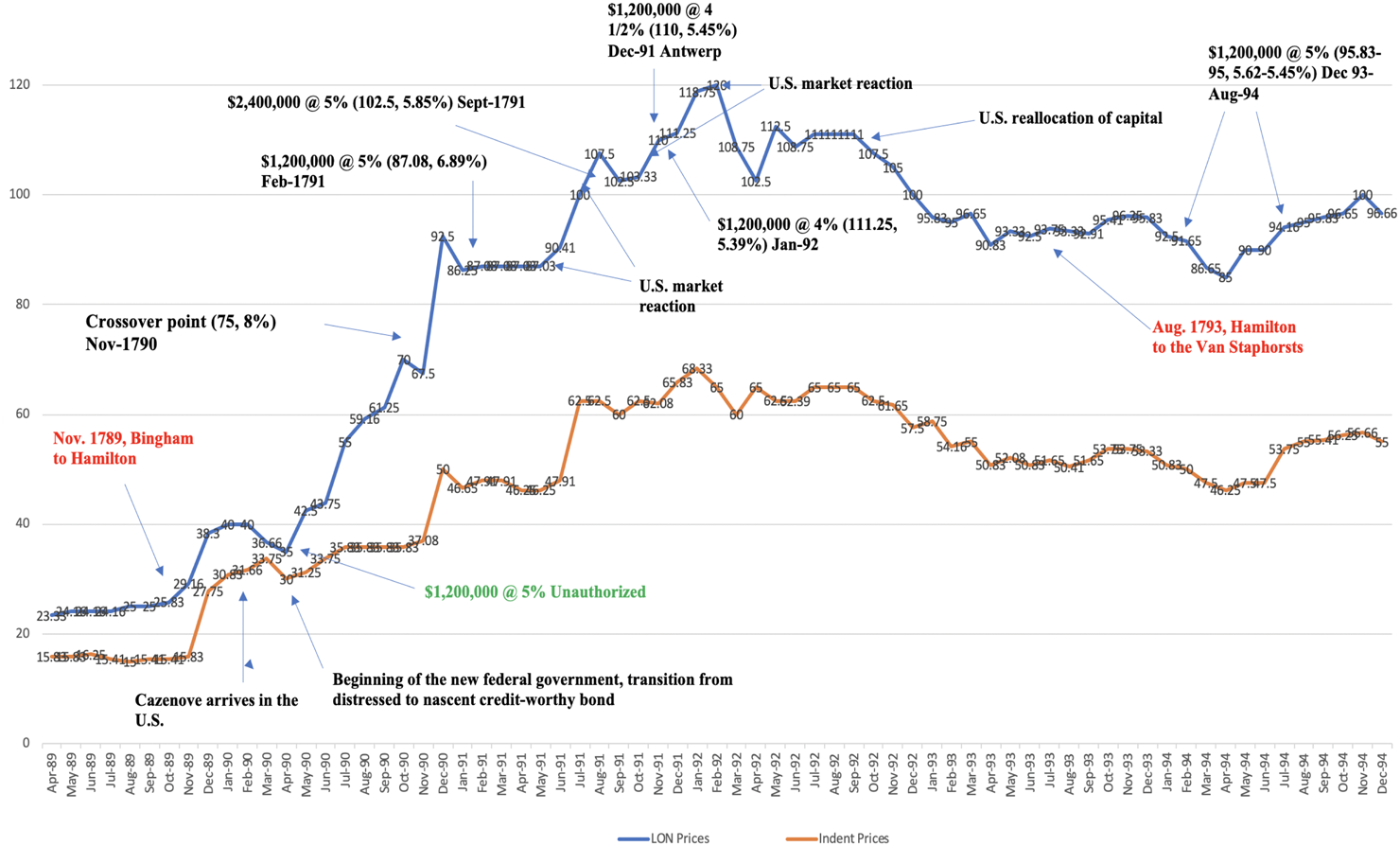
The Van Staphorsts, guided by Stadnitski's meticulous market research, had theorized that when the domestic debt of the United States rose higher than 75, the primary market for American bonds would be unencumbered by distractions. That point had been reached and, in their opinion, the great restructuring and refinancing of American debt that had previously been hampered by political inaction and a lack of specie could now commence. Before they could move ahead, however, they needed to demonstrate to the French that it was no longer necessary to sell their bonds at a discount. To do so, the Van Staphorst investment bank opened a loan for 3,000,000 guilders (1,200,000 specie dollars) on behalf of the United States – and the loan immediately filled. This proved beyond doubt that money was available to the American government and signaled to France that they could indeed get paid out at par for their bonds by money raised in Amsterdam.
Prices of 6 percent Loan Office notes and 3 percent indents, April 1789 – December 1794
Source: Early US securities markets, 1790–1860 data set, compiled by Richard Sylla, Jack Wilson and Robert Wright, available at https://eh.net/database/early-u-s-securities-prices

The Van Staphorsts did not publicize to the French, or indeed to anyone else, that they had completed the 3,000,000-guilder loan without first asking any American diplomat in Europe if the United States actually wanted the money, which was to say the least a highly irregular way to proceed. There were three reasons for this. The most important, of course, was that the loan had less to do with the United States than it did with France, for whom an immediate demonstration of the viability of American credit in Amsterdam was necessary. Second, had the Van Staphorsts asked William Short (the chargé who had lately replaced Jefferson as the US representative to France, and hence was acting head of finance for the United States in Europe) if the United States wanted 3,000,000 unsolicited guilders, they would have had to explain why they wished to open the loan, hence revealing their stratagem to stymie the competing American syndicates’ pursuit of the French bonds; and even assuming that Short would have agreed, they would have had to wait for months for him to consult with Philadelphia, and then for Congress to authorize the transaction. Third, most of all, the Van Staphorsts knew perfectly well that, once presented with the money, the cash-starved American government could not possibly refuse it (Morris Reference Morris and Cary1970 [1790], p. 298).
And, indeed, the American government did not. When the Van Staphorsts proffered the funds, they did so at an eminently affordable interest rate (6 percent); and immediately thereafter, as if on cue, the French Directorate of Finance asked the Americans for the money just raised, to cover the interest due on the bonds. The most astute financial agents in the United States, outwitted by their own investment bank, accepted the fait accompli. It was for their own good.
This did not stop the bidding process. A second group outside the Society of Friends of America emerged as a possible buyer of America's debt held by France. The French investment bank of Schweizer, Jeanerette and Company went back to the proposal of Morris–Parker, only this time they offered more than 36,000,000 livres in cash as collateral or as partial payment. Under this proposal, the group would pay in livres in their depreciated state, but the United States would be responsible for paying the group under the previous exchange rate. William Short disapproved of the deal for obvious reasons. The group sent an American, James Swan, to persuade Short, but the volatility of French currency was not a risk the United States was willing to take, even if it were to benefit the American government (Hamilton Reference Hamilton and Syrett1963b [Short 1790], pp. 348–57).
Swan was not to be deterred. He told Short that Genoese bankers who held large amounts of French debt were considering offering those French bonds back to the French government in exchange for American bonds. Swan was hoping to capitalize on Congressional fears that American bonds would find their way into the hands of a foreign power with which the United States had no diplomatic relationship. Again, Short told Swan that he could not support the deal without hearing from Philadelphia first, an effective stalling tactic (Jefferson Reference Jefferson and Boyd1965 [Short 1790], pp. 523–30). In September 1791, Hamilton told William Short that the Schweizer–Jeanerette–Swan proposal was dead, Washington himself making the final decision (Hamilton Reference Hamilton and Syrett1963b [1791], pp. 158–62).
In late February 1793, a third group, led by Colonel William Smith, the son-in-law of John Adams and a member of George Washington's staff at the close of the war, made yet another proposal: to convert American bonds held by France into domestic notes, then to purchase them in kind with commodities to alleviate the increasingly severe French food shortage. From Smith's point of view, there was more upside in Loan Office notes, and he could profit from the commodities transactions with the French. Hamilton and Washington, however, saw no need to add to the domestic debt when successful bond offerings were commencing in Amsterdam (Hamilton Reference Hamilton and Syrett1969 [1793], p. 184).
The Van Staphorsts succeeded in keeping the American bonds under French control through remarkably aggressive tactics, but they still owed the new Secretary of the Treasury, Alexander Hamilton, an explanation. They freely admitted that it was in their firm's interest to kill any trade that would have potentially released tens of millions of American bonds formerly owned by France into the secondary market. ‘As this transaction’, they explained – referring to the potential acquisition of the French bonds by an American syndicate – would have ‘tended to commit the credit and reputation of the United States to the management of persons unconnected with their Government and without any strong motives to induce them to uphold it, but who on the contrary would be spurred by the urging necessities to raise monies’, the Van Staphorsts had done the United States the incalculable favor of upholding ‘the rising credit of America’. In other words, putting large amounts of American bonds in the hands of those who might not be able to pay for them would have created immediate uncertainty, and perhaps havoc, in the secondary market for American bonds. Prudently, the Van Staphorsts also offered William Short a salve for their impertinent move: henceforth the US Treasury would be able to borrow at 5 percent and would have to pay 4.5 percent – just half the fee of the 9 percent they had charged for the 1788 loan. The United States, at least from a position of sovereign finance, had finally taken its place in the world community as an equal (Hamilton Reference Hamilton and Syrett1962b [Van Staphorst 1790], pp. 210–18).
Unlike the Morrises, both of whom had been seduced by the prospect of personal gain, Alexander Hamilton understood what was truly at stake in these maneuvers. He was well satisfied that the Van Staphorsts had successfully avoided a potentially dangerous blow to American credit. Hamilton's Report Relative to a Provision for the Support of Public Credit had laid out an ambitious plan to assume all the state debts under the federal government; but the new government of the United States could not take on a vast funded debt without first paying France what America owed it – unless the fragile new republic wanted to risk armed conflict with their first (and still indispensable) ally. Keeping these bonds under French control until an orderly refinancing could take place was a prudent move on behalf of American credit but above all an essential aspect of US foreign relations. Of course, Hamilton did not want it to appear as if he approved of America's investment bank opening unauthorized loans. He therefore informed the Van Staphorsts that while he appreciated the fact that they had always demonstrated ‘distinguished zeal for the interest of the United States’, their zeal had exceeded the bound of both fiscal propriety and American sovereign authority. They, therefore, in the future, would take care to avoid opening loans for the United States without first getting authorization from the Secretary of the Treasury (Hamilton Reference Hamilton and Syrett1965 [1790], pp. 409–10).
Other American reaction to the unauthorized loan was mixed. William Short, a man just one year out of the College of William and Mary when the Van Staphorsts made their first loan to the US through John Adams in 1782, told Jefferson that he was ‘astonished’ by the bold nature of the move. For his part, Jefferson believed that the Van Staphorsts had financial reasons for opening the unauthorized loan, but he was still delighted that these speculators were thwarted and referred to the Van Staphorsts as ‘our champions’. He recommended that while not authorized, the loan should be confirmed (Jefferson Reference Jefferson and Boyd1965 [1790], pp. 425–30). That his French friends would get repaid at par with interest was deeply gratifying to him. His only regret was that the repayment would not arrive in time to save France from upheaval (Jefferson Reference Jefferson and Boyd1965 [1790], pp. 315–17).
Gouverneur Morris was understandably agitated by the entire affair. America's Dutch bankers had quashed the deal he spent months negotiating and their explanations did nothing to assuage his anger. Morris saw only the profits the Van Staphorsts and their associates were earning. He failed to see the immense benefit the United States received in the capital markets through the rise in their credit (Morris Reference Morris and Cary1970 [1790], pp. 234–9). Morris was able to exact some revenge when he went to Antwerp to open and complete a loan with another bank (Hamilton Reference Hamilton and Syrett1965 [Short 1791], pp. 552–7).
III
The Van Staphorsts had spent most of the 1780s nurturing and protecting American credit, mostly from Americans. They had raised enough money to keep the Continental Congress from defaulting on the other Dutch loans while simultaneously buying up American domestic debt to bring those bonds to a level where they would not interfere with primary market activity. Once the domestic debt was deemed fully valued, the refinancing of the American debt owned by France could commence. To have those American bonds held by France come out for sale before the American capital structure was brought into order could have complicated matters greatly for the American government.
Other historians, starting in 1917 with Joseph Stancliffe Davis, believed that the multiple groups of American and French bidders were best interpreted as an effort to establish an international banking house, modeled upon those of the great Amsterdam firms. James Riley (Reference Riley1978) took up and expanded on this idea. Riley believed that the Van Staphorsts were nervous over rival bankers getting into the American business throughout the 1780s and the unauthorized loan was evidence of that trepidation. Neither argument is particularly convincing. First, of the groups bidding for the American bonds, none had the kind of expertise to operate an ‘international banking house’. Their French partners may have had the expertise, but France was careening into financial chaos, making attempts to lay off the American debt to private French buyers implausible. They would have had to go to the Amsterdam bourse to sell them in an investment trust as the House of Four were already doing by that time.
Concerning the Van Staphorsts’ fears of competition, there is no evidence that there was any risk of the Van Staphorsts losing their position as America's premier investment bank. Gouverneur Morris met with Hope and Company to see if they would be interested in getting involved in the purchase of America's debt to France but they passed. In truth, Hope had no experience selling American bonds nor did they have the appropriate customer base.Footnote 7 Throughout the 1780s, there was only one attempt to replace the Van Staphorsts as America's Dutch investment bank. When Jefferson figured out that the Dutch were only lending enough money to keep the American government current in its interest payments to Dutch investors in 1787, he wrote to Jay to see if the entire French debt could be refinanced. Jay sent Charles DumasFootnote 8 out into the Amsterdam capital markets to see what might be available, but nothing came of the endeavor, probably because the word had gotten out through Daniel Parker that the Loan Office notes were trading at depressed prices (Jefferson Reference Jefferson and Boyd1954a [1786], pp. 405–6). Only two loans were opened outside the Van Staphorsts' investment bank. One was a small loan opened in 1781 through an overeager investment banker named Jean de Neufville. The other loan was opened and completed at 4½ percent by De Wolfe and Company in Antwerp for 3,500,000 guilders in fall 1791, but Antwerp did not have the kind of investment capital the United States needed in the long run. The only city that did was Amsterdam.
In his Report Relative to a Provision for the Support of Public Credit, Hamilton explained the previous eight years of financial misadventure and laid out a plan by which the United States would avoid the same mistakes in the coming years. Hamilton proposed having the federal government assume all the state war debts, $25,000,000 face value. In return, the holders of these debts and the holders of the Loan Office notes would receive a combination of securities that included deferred interest debts designed to lower the interest cost of the federal government to 4⅝%. The resulting consolidation of the war-time debt turned the new bonds into an interest-bearing currency, the remedy the American economy needed from the beginning, and the measure that the Board of Treasury and Robert Morris failed to achieve during their tenures. The difference was that the new bonds had a dedicated stream of revenue to support them in the form of impost duties and excise taxes and a professionalized system of finance to manage it all. It was an ambitious plan designed to put the American economy on solid footing and properly spread out the capital structure of the new American republic.
None of what Hamilton wanted to do – and indeed succeeded in doing – would have been possible without the two Van Staphorst brothers, Pieter Stadnitski and those in their orbits. The small loans they made when American public opinion was not quite ready to support a strong centralized government; their acquisition of millions of dollars in American domestic debt; the thwarting of financial adventurers in their attempt to acquire America's debt from France; and the refinancing of the French debt combined with the reorganization of the American government: all these had made Hamilton's immense task of restructuring American public finance possible.
When Hamilton took office in 1789, he had the repayment of France on his mind but his ideas on the subject were not what the French were hoping for. Hamilton wanted a two-year moratorium on paying back the French loans. This meant that his plan of assumption was a priority, but he could not advance that plan without first securing a grace period from the French (Hamilton Reference Hamilton and Syrett1962a [1789], pp. 425–7). The French Treasury had to be satisfied that its US debts would be secured simultaneously with Hamilton's scheme for funding and assumption. With the passage of an impost bill, the new constitution and the inauguration of a whole new government, American speculators had all the investment rationale they needed to purchase American debt and yet the bonds did not move in price until the Dutch buying agent arrived. On his arrival in the US in February 1790, he began offering specie for Loan Office notes, which were trading at 38; nine months later, in November, Loan Office notes were trading at a price of 75, where they were no longer a hinderance to primary market activity. This was all that was necessary to effect a refinancing of the French debt. The only event that could have stopped this transformation was the sudden appearance on the market of millions in American bonds formerly held by France; hence its resolution could not have come at a better time. In January 1791, the first bond offering for the United States earmarked for the French was offered at 5 percent and took two and a half hours to sell out. In the first half of 1794, when the final bond offering earmarked for France was offered at the same rate, the issue took eight months to sell out. The reason was simple and revealing: the French Revolution was about to spill into the United Provinces and investors were getting extremely nervous.
The affair of the American bonds held by France was not simply a transaction thwarted but displayed the commitment Dutch investment banks had towards their clients. Once the credit of the United States was established, the Van Staphorsts defended and nurtured it as if it were their own, fending off (most of all) ill-informed American officials and financial adventurers. The lack of understanding and expertise that American officials had showed concerning finance, credit and capital markets in general was not quickly remedied, and American credit remained fragile until Alexander Hamilton, with a plan to put American credit on a solid, sustained footing, arrived on the scene as Secretary of the Treasury. The credit established and nurtured by the Van Staphorsts during the 1780s made that possible, allowing the republican experiment on the western Atlantic rim the chance to flourish in the 1790s and early 1800s, and enabling the United States to achieve the economic independence without which continued political sovereignty would have been impossible.