INTRODUCTION
Poor inhibitory control has been linked to the presence of aberrant cognitive experiences in schizophrenia, such as hallucinations, delusions, and thought disorder (Frith, Reference Frith1979; Guillem, Rinaldi, Pampoulova, & Strip, Reference Guillem, Rinaldi, Pampoulova and Strip2008). While neurological studies of schizophrenia have consistently documented dysfunction of the prefrontal lobes (e.g., Kaladjian, Jeanningros, Azorin, Grimault, Anton, & Mazzola-Pomietto, Reference Kaladjian, Jeanningros, Azorin, Grimault, Anton and Mazzola-Pomietto2007)—the neural regions largely responsible for most inhibitory-related processes (Koechlin, Ody, & Kouneiher, Reference Koechlin, Ody and Kouneiher2003)—cognitive studies of inhibition in schizophrenia have been less consistent in their findings (e.g., Donohoe et al., Reference Donohoe, Reilly, Clarke, Meredith, Green and Morris2006; Yucel et al., Reference Yucel, Volker, Collie, Maruff, Danckert and Velakoulis2002). Racsmany and colleagues (Reference Racsmany, Conway, Garab, Cimmer, Janka and Kurimay2008) recently found that schizophrenia participants were impaired on a directed forgetting task, but not on a retrieval practice task, said to measure intentional and unintentional executive control over memory, respectively. It is plausible that a similar intentional/unintentional distinction between impaired/intact processes in schizophrenia can be made for all inhibitory-related processes, explaining the inconsistency in findings on inhibition.
The term “inhibition” is often used as an umbrella term to cover a family of executive control processes which ultimately serve to prevent goal-irrelevant cognition, behavioral responses, and external stimuli from interrupting goal-directed thoughts and behaviors. One of the most cited and validated taxonomies of inhibitory-type processes was developed by Harnishfeger (Reference Harnishfeger, Dempster and Brainerd1995). According to Harnishfeger, inhibitory processes are categorized by three dimensions: (1) cognitive (controlling mental processes) or behavioral (controlling impulses or motor responses); (2) intentional (the conscious and deliberate suppression of irrelevant or unwanted stimuli or responses) or unintentional (the automatic suppression of stimuli or responses, which occurs without conscious awareness); and (3) inhibition (the active suppression or expulsion of goal-irrelevant information that has already entered working memory) or resistance to interference (the gating mechanism that allows goal-relevant, but prevents simultaneously presented goal-irrelevant, information from entering working memory). Harnishfeger’s (Reference Harnishfeger, Dempster and Brainerd1995) three dimensions have been successfully used in cognitive studies in the fields of aging (e.g., Andrés, Guerrini, Phillips, & Perfect, Reference Andrés, Guerrini, Phillips and Perfect2008; Earles, Connor, Frieske, Park, Smith, & Zwahr, Reference Earles, Connor, Frieske, Park, Smith and Zwahr1997; Salthouse, Atkinson, & Berish, Reference Salthouse, Atkinson and Berish2003), frontal lobe damage (e.g., Stuss, Toth, Franchi, Alexander, Tipper, & Craik, Reference Stuss, Toth, Franchi, Alexander, Tipper and Craik1999), Attention-Deficit Hyperactivity Disorder (ADHD; e.g., Nigg, Butler, Huang-Pollock, & Henderson, Reference Nigg, Butler, Huang-Pollock and Henderson2002), and Alzheimer disease (e.g., Amieva, Phillips, Della Sala, & Henry, Reference Amieva, Phillips, Della Sala and Henry2004) to show specific inhibition deficits/decline in these populations. Further support for Harnishfeger’s taxonomy comes from the developmental, experimental, and neurological literature. Of specific relevance to the current study is the inhibition versus resistance to interference distinction, and the intentional versus unintentional distinction. Evidence for the former of these distinctions comes from several sources: (1) neuro-imaging and cortical lesion studies have found some distinct neural regions involved in these two processes, namely activation of the left posterior region of the frontal lobe is specific to inhibition, while activation of the anterior cingulate is specific to interference control (e.g., McNab, Leroux, Strand, Thorell, Bergman, & Klingberg, Reference McNab, Leroux, Strand, Thorell, Bergman and Klingberg2008; Stuss et al., Reference Stuss, Toth, Franchi, Alexander, Tipper and Craik1999); (2) rodent studies have found that norepinephrine is integral to interference—but not inhibitory—control (e.g., Arnsten, Reference Arnsten1998); (3) studies have found differential involvement of working memory in the two forms of control (Kramer, Humphrey, Larish, Logan, & Strayer, Reference Kramer, Humphrey, Larish, Logan and Strayer1994); (4) the development of interference control (but not inhibition) has been found to covary with an increase in memory capacity (cf. Harnishfeger, Reference Harnishfeger, Dempster and Brainerd1995); and (5) inhibition and interference control tasks have been shown to load on separate factors (Friedman & Miyake, Reference Friedman and Miyake2004). The empirical support for the distinction between intentional and unintentional forms of cognitive control comes from the finding that unintentional forms of inhibition develop earlier (around age 5) than intentional forms of inhibition (around age 7; cf. Wilson & Kipp, Reference Wilson and Kipp1998), and that selective cognitive control impairments based on this distinction have been documented in particular clinical populations (Amieva et al., Reference Amieva, Phillips, Della Sala and Henry2004; Nigg et al., Reference Nigg, Butler, Huang-Pollock and Henderson2002).
This differentiation between inhibition-related processes may explain the discrepancy in empirical findings concerning “inhibition” in schizophrenia. By and large, evidence of reduced “inhibition” in schizophrenia has been reported in studies using tasks said to measure intentional cognitive inhibition (e.g., Racsmany et al., Reference Racsmany, Conway, Garab, Cimmer, Janka and Kurimay2008; Salame & Danion, Reference Salame and Danion2007; Waters, Badcock, Maybery, & Michie, Reference Waters, Badcock, Maybery and Michie2003) and intentional behavioral/response inhibition (e.g., Badcock, Michie, Johnson, & Combrinck, Reference Badcock, Michie, Johnson and Combrinck2002; Donohoe et al., Reference Donohoe, Reilly, Clarke, Meredith, Green and Morris2006; Henik & Salo, Reference Henik and Salo2004). However, schizophrenia studies have largely found inhibitory ability to be intact when using tasks said to measure unintentional cognitive inhibition (e.g., when using the Brown-Peterson [B-P] variant task; Fleming, Goldberg, Gold, & Weinberger, Reference Fleming, Goldberg, Gold and Weinberger1995; Randolph, Gold, Carpenter, Goldberg, & Weinberger, Reference Randolph, Gold, Carpenter, Goldberg and Weinberger1992) or unintentional resistance to distractor interference (e.g., Kopp & Rist, Reference Kopp and Rist1999; Yucel et al., Reference Yucel, Volker, Collie, Maruff, Danckert and Velakoulis2002).
It has long been contended that difficulties in intentionally resisting interference from distracting stimuli (“intentional resistance to interference,” according to Harnishfeger’s inhibition taxonomy) are common to schizophrenia (Frith, Reference Frith1979). However, validation of this proposal is limited because empirical support has largely come from studies using the Stroop paradigm, which has been argued to also measure behavioral response inhibition (because once the to-be-ignored color word enters working memory the participant must then suppress this response) and attention (Henik & Salo, Reference Henik and Salo2004)—two executive processes known to be impaired in schizophrenia (Gooding, Braun, & Studer, Reference Gooding, Braun and Studer2006; Wykes, Reeder, & Corner, Reference Wykes, Reeder and Corner2000). Thus, the overall pattern of “inhibition” findings reported above may reflect one of two possibilities: (1) individuals with schizophrenia have difficulties with all control processes that are intentional in nature (irrespective of whether they are cognitive or behavioral, and require inhibition or resistance to interference), but not with unintentional control processes; or (2) individuals with schizophrenia have specific intentional inhibition (cognitive and behavioral) impairments.
The aim of the current study was to investigate intentional resistance to interference (using the directed ignoring [DI] task) in schizophrenia to determine the specific nature of intentional cognitive control impairments in this disorder. The DI task requires participants to resist interference from a competing distractor (goal-irrelevant) story woven into a target (goal-relevant) story, thus requiring suppression, or “gating”, of external stimuli prior to them entering working memory. The DI task has been shown to have good construct and discriminant validity (e.g., Earles et al., Reference Earles, Connor, Frieske, Park, Smith and Zwahr1997; Lau, Christensen, Hawley, Gemar, & Segal, Reference Lau, Christensen, Hawley, Gemar and Segal2007; Paulik, Badcock, & Maybery, Reference Paulik, Badcock and Maybery2008;Footnote 1 Radvansky & Copeland, Reference Radvansky and Copeland2006; Salthouse et al., Reference Salthouse, Atkinson and Berish2003). A commonly used task said to place a high demand on unintentional cognitive inhibition, the B-P task (Kane & Engle, Reference Kane and Engle2000), was also administered to provide further support for the conjecture that unintentional control processes are intact in schizophrenia. The B-P task requires participants to automatically inhibit the intrusion of previously-relevant (currently-irrelevant) items to enable the correct recall of novel items belonging to the same category. The B-P task has also been shown to have good construct and discriminant validity (Friedman & Miyake, Reference Friedman and Miyake2004; Paulik et al., Reference Paulik, Badcock and Maybery2008). State anxiety was also measured and controlled for, because studies have linked anxiety to impaired performance on intentional cognitive control measures, including the DI task (e.g., Amir, Coles, & Foa, Reference Amir, Coles and Foa2002; Badcock, Waters, & Maybery, Reference Badcock, Waters and Maybery2007; Hopko, Ashcraft, Gute, Ruggiero, & Lewis, Reference Hopko, Ashcraft, Gute, Ruggiero and Lewis1998; Wood, Mathews, & Dalgleish, Reference Wood, Mathews and Dalgleish2001), and anxiety levels are typically elevated in schizophrenia samples (Seedat, Fritelli, Oosthuizen, Emsley, & Stein, Reference Seedat, Fritelli, Oosthuizen, Emsley and Stein2007).
METHOD
Participants
Sixty-nine individuals meeting International Classification of Diseases (World Health Organization, 1993) criteria for schizophrenia (n = 57) or schizoaffective disorder (n = 12) were recruited through the Centre for Clinical Research in Neuropsychiatry (CCRN), Graylands Hospital and related out-patient clinics and hostels in Perth, Western Australia. Two schizophrenia participants were excluded because their psychiatrist-provided diagnosis was not confirmed at interview. Control participants were 39 healthy individuals who had participated in previous research at CCRN, and were initially recruited via a random telephone recruitment procedure. General inclusion criteria included fluency in English and being aged 18–60 years. General exclusion criteria included hospital admission for drug/alcohol rehabilitation within the past year; poor visual acuity; neurological disorders; serious head injury; a current diagnosis of ADHD, obsessive-compulsive disorder (OCD), or posttraumatic-stress disorder (PTSD);Footnote 2 and premorbid IQ (estimated from the National Adult Reading Test—2nd edition [NART]; Nelson & Willison, Reference Nelson and Willison1991) below 75. Control participants were also excluded if they had a personal or family history of psychosis. Based on these criteria, six schizophrenia participants and five control participants were excluded. Remaining participants were 12 females and 49 males in the schizophrenia group, and six females and 28 males in the control group. Of the schizophrenia participants, 88.5% were taking antipsychotic medications (69% atypicals only, 8% typicals only, and 11.5% typicals and atypicals) and 84% were outpatients at the time of testing.
MEASURES
Directed Ignoring (DI) Task
The DI task (Connelly, Hasher, & Zacks, Reference Connelly, Hasher and Zacks1991) is a simple story-reading task in which participants are required to read aloud only target text printed in italicized font (20-point Arial). Two main conditions are presented: in the distractor condition, participants are required to ignore (resist interference from) an unrelated story printed in regular (nonitalicized) font interwoven into the target story passage; whereas in the control condition, no distracting text is present. In this control condition, blank spaces matching the average length of a distracting text section were inserted into the passages to control visual scanning requirements. Blank spaces were used instead of a string of Xs (which has also been used as a control in the DI literature), because spaces eliminate any possible involvement of interference control when performing the control condition (a participant may find Xs distracting). There were two practice and 12 test stories. Target and distractor stories were matched on length (125 words), and sections of target and distractor text were 3–9 words in length. Two multiple-choice questions (each with four alternative answers) followed each story. For the distractor condition, each question had part of the distractor story’s content as a plausible, but incorrect, response choice (a foil). Story order was counterbalanced across participants. There were two interference control indices: (1) the difference in reading time (RT) between control and distractor stories; and (2) for the distractor condition, the percentage of foils (of the total incorrect responses) chosen on the multiple-choice questions. Accuracy on the multiple-choice questions assessed text comprehension.
Brown-Peterson (B-P) Variant Task
This task assessed unintentional inhibition (Kane & Engle, Reference Kane and Engle2000). In each of the three blocks presented, participants read aloud and attempted to recall three lists of words, each list being composed of 10 words presented serially (one word every 2 s) on a computer screen (see Paulik et al., Reference Paulik, Badcock and Maybery2008, for details). All lists within a block were composed of words from the same semantic category (four-footed animals, occupations, or fruits), and lists were matched for word length and frequency (Battig & Montague, Reference Battig and Montague1969). After each list, a distractor task performed for 15 s required counting backward by twos from a number presented on the screen, at a pace set by auditory signals every 1500 ms. Participants were then asked to recall aloud as many words from the previous list as possible in any order in 20 s. To ensure that participants were not actively rehearsing items during the distractor task, participants with a counting accuracy rate of less than 70% were excluded. Four schizophrenia participants’ results were excluded accordingly. This task requires the automatic inhibition of memory intrusions of previously learnt—but no longer relevant—items when recalling new items belonging to the same category (Solso, Reference Solso1995). Hence, the cognitive overflow of (within block) previous list items—and thus the demand on inhibition—increases from list one (no overflow) to list three (maximum overflow). Inhibition was measured by the difference in recall accuracy (summated across blocks) between lists 1, 2, and 3—with poor unintentional inhibition indicated by a steep decline in recall across successive lists.
Clinical Interviews
Diagnosis for the schizophrenia group was confirmed using the Diagnostic Interview for Psychosis (DIP; Castle et al., Reference Castle, Jablensky, McGrath, Carr, Morgan and Watterreus2006). The short version of the Mini International Neuropsychiatric Interview (Sheehan et al., Reference Sheehan, Lecrubier, Sheehan, Janavs, Weiller and Keskiner1997) was administered to control participants to screen for psychological disorders, including schizophrenia.
Additional Measures
Premorbid full-scale IQ was estimated from the NART (Nelson & Willison, Reference Nelson and Willison1991). The Digit Span subtest of the Wechsler Adult Intelligence Scale—3rd edition (WAIS-III; Wechsler, Reference Wechsler1997) measured working memory. The 7-item anxiety subscale of the Hospital Anxiety and Depression Scale (HADS; Zigmond & Snaith, Reference Zigmond and Snaith1983) measured state anxiety (score range 0–21).
Procedure
Ethics approval was obtained from the Perth North Metropolitan Area Mental Health Service Ethics Committee and the research was completed in accordance with the Helsinki Declaration. Signed consent was obtained from all participants. Testing took approximately 1.5 hr for controls and 2.5 hr for schizophrenia participants. Control participants were offered $20 and schizophrenia participants $25 for reimbursement of time/expenses.
RESULTS
Descriptive Statistics
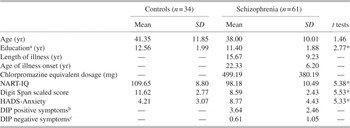
One univariate outlier (a score more than 3 SDs from the respective group mean) was identified from the variables presented in Table 1 and subsequently deleted. As seen in Table 1, there was no significant difference between the control and schizophrenia participants on age; however, the latter group had significantly lower education, premorbid IQ and working memory, and a higher level of state anxiety. Consequently, in the following group comparisons, where significant effects were found, these variables were entered into the analyses separately as covariates to examine any possible confounding effects.
Group means, SDs, and t tests for the demographic characteristics and additional measures

Note
NART-IQ = full-scale WAIS-III IQ estimated from the National Adult Reading Test; HADS = Hospital Anxiety and Depression Scale; DIP = Diagnostic Interview for Psychosis.
a Highest level of education completed (secondary and tertiary education only).
b Positive symptoms included hallucinations, delusions, positive formal thought disorder, and bizarre behavior (score range 0–17).
c Negative symptoms included restricted affect, blunted affect, rapport difficulties, thought blocking, poverty of speech, and restricted quantity of speech (score range, 0–6).
* p < .05.
A chlorpromazine equivalent dosage score was calculated for each schizophrenia participant and correlated with all measures (British National Formulary, 1995; Woods, Reference Woods2003). No significant correlations were found.
Schizophrenia and Control Group Comparisons
DI task performance
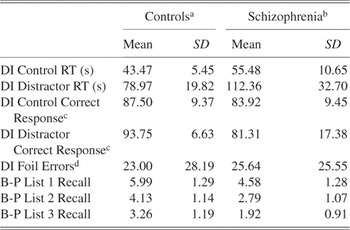
Seven schizophrenia participants did not complete the DI task. Three single data points (all from the control group) were identified as univariate outliers and subsequently deleted. Group means and SDs are presented in Table 2.
Group means and SDs for the performance indices of the cognitive control tasks

Note
DI = Directed Ignoring task; B-P = Brown-Peterson variant task.
a n = 34.
b n = 54 for the DI task and 57 for the B-P task.
c Percentage of correct responses on comprehension questions.
d Percentage of foil errors of total incorrect responses on comprehension questions.
Reading time (RT)
Repeated measures analysis of variance (ANOVA) was used to compare the groups on their RTs on control and distractor stories. As expected, there was a significant Story main effect (F(1,81) = 292.64; p < .05; Partial Eta2 = .78), with distractor story RTs longer than control story RTs. There was also a significant Group main effect (F(1,81) = 33.48; p < .05; Partial Eta2 = .29), with schizophrenia participants’ RTs longer than controls’ RTs. Importantly, the Group × Story interaction was also significant (F(1,81) = 15.68; p < .05; Partial Eta2 = .16). The amount of RT slowing to distractor stories compared with control stories was more pronounced for schizophrenia participants (see Table 2). The pattern of results remained the same when the additional measures were entered separately into the analysis as covariates.
Comprehension
A univariate ANOVA on the percentage of foil errors (of total errors) revealed there to be no significant group difference (see Table 2; F(1,84) = 0.20; p > .05; Partial Eta2 = .002). It should be noted, however, that a floor effect may have masked group differences, because both control (total foils: mean = 0.70; SD = 0.77) and schizophrenia (total foils: mean = 1.58; SD = 1.47) participants made very few foils. A repeated measures ANOVA comparing the two groups on the percentage of correct responses on the comprehension questions for the control and distractor conditions, revealed a significant Group main effect (F(1,81) = 15.76; p < .05; Partial Eta2 = .16), and a Story × Group interaction (F(1,81) = 5.36; p < .05; Partial Eta2 = .06). Post hoc t tests revealed a nonsignificant group difference for accuracy on control stories, whereas control participants had significantly higher accuracy than the schizophrenia participants on distractor stories. The group main effect remained significant, while the interaction did not, when the additional variables were entered into the analysis separately as covariates.
B-P task performance
As expected, when a repeated measures ANOVA was conducted on correct list recall (lists 1 to 3), there was a significant List main effect (F(2,178) = 291.50; p < .05; Partial Eta2 = .78), with post hoc tests showing that recall progressively decreased across lists. As reported in Table 2, the control participants had better recall overall than the schizophrenia participants (F(1,89) = 42.60; p < .05; Partial Eta2 = .32). However, critically, the List × Group interaction was not significant (F(2,178) = 0.054; p > .05; Partial Eta2 = .001). The pattern of results remained the same when the additional measures were entered into the analysis as covariates.
DISCUSSION
There is a large body of evidence linking schizophrenia to volitional executive deficits, whereas automatic processes appear to remain relatively intact (Merlotti, Piegari, & Galderisi, Reference Merlotti, Piegari and Galderisi2005; Racsmany et al., Reference Racsmany, Conway, Garab, Cimmer, Janka and Kurimay2008; Zec, Reference Zec1995). Inhibitory-related processes—theorized to contribute to the development and/or maintenance of psychotic symptoms (Frith, Reference Frith1979)—seem to be no exception to this rule, with previous schizophrenia studies reporting intact unintentional inhibition and unintentional resistance to interference (e.g., Fleming et al., Reference Fleming, Goldberg, Gold and Weinberger1995; Kopp & Rist, Reference Kopp and Rist1999; Randolph et al., Reference Randolph, Gold, Carpenter, Goldberg and Weinberger1992), but impaired intentional inhibition (e.g., Badcock et al., Reference Badcock, Michie, Johnson and Combrinck2002; Donohoe et al., Reference Donohoe, Reilly, Clarke, Meredith, Green and Morris2006; Racsmany et al., Reference Racsmany, Conway, Garab, Cimmer, Janka and Kurimay2008; Salame & Danion, Reference Salame and Danion2007; Waters et al., Reference Waters, Badcock, Maybery and Michie2003). However, up until now, whether these intentional control difficulties in schizophrenia were generalized (i.e., included both inhibition and resistance to interference) or specific (i.e., pertaining only to inhibition) remained unknown. This study aimed to clarify this issue.
Consistent with the premise that individuals with schizophrenia have generalized intentional control impairments, the schizophrenia group in the current study performed poorly on the task which places a high demand on intentional resistance to interference (the DI task): specifically, they took substantially longer to read passages that had embedded distractor text than did controls. Although the schizophrenia participants who completed the task did not appear to have difficulties understanding or following the task requirements (because they were able to slowly yet successfully perform the control condition), it cannot be ruled out that the schizophrenia participants had greater difficulty following the task requirements on the distractor condition, which is more cognitively taxing. However, it should be noted that the critical interaction on DI RTs could not be (statistically) explained by general cognitive decline or increased levels of anxiety, which one may expect if this alternative interpretation was correct. Contrary to the impaired intentional interference control hypothesis, schizophrenia participants did not make more foil errors than control participants. This suggests that, while schizophrenia patients have difficulties resisting interference from distractors, they may still be consciously aware that this information is not goal-relevant, and are able to decipher goal-relevant from goal-irrelevant information during recall. Consistent with this finding, previous research has found that clinical populations characterized by interference control deficits have not reliably been shown to produce higher foil errors than controls (e.g., Earles et al., Reference Earles, Connor, Frieske, Park, Smith and Zwahr1997), for the likely reason that the intrusion of distractor information into working memory due to failed interference control does not dictate the failure to later distinguish distractor from target information once held in working memory (required for a foil error to occur). Subsequently, most recent DI studies only report reading times as an index of interference control (Radvansky & Copeland, Reference Radvansky and Copeland2006; Salthouse et al., Reference Salthouse, Atkinson and Berish2003).
Text comprehension on the DI task was also examined. This analysis showed that the schizophrenia group made more comprehension errors on stories with included distractor words than stories without (relative to controls), but that this interaction effect was no longer significant once premorbid IQ, working memory, education, and anxiety were controlled for. This suggests that the schizophrenia participants had difficulties in synthesizing and/or remembering the content of the stories, and that this difficulty was more pronounced when the task carried a higher cognitive load due to reduced overall cognitive ability and higher levels of anxiety (which have been shown to exponentially impair cognitive ability with increased cognitive load; e.g., Wood et al., Reference Wood, Mathews and Dalgleish2001).
As expected, recall on the B-P task decreased across successive lists for both groups, reflecting increased demand on unintentional inhibition through the build-up of category-specific proactive interference. Although the schizophrenia group had poorer recall than the control group overall (consistent with memory difficulties documented in schizophrenia; Merlotti et al., Reference Merlotti, Piegari and Galderisi2005), the decline in recall across lists was not amplified in the schizophrenia group, signifying intact unintentional cognitive inhibition. This provides further support for the conjecture that individuals with schizophrenia have difficulties with intentional, but not unintentional, control processes. Since similar patterns of findings using the DI and B-P task have been found in predisposed (unmedicated) individuals (Paulik, Badcock, & Maybery, Reference Paulik, Badcock and Maybery2007; Paulik et al., Reference Paulik, Badcock and Maybery2008), and intentional control difficulties have been previously linked to the genetic predisposition to schizophrenia (e.g., Ross, Harris, Olincy, Radant, Adler, & Freedman, Reference Ross, Harris, Olincy, Radant, Adler and Freedman1998; Ross, Wagner, Heinlein, & Zerbe, Reference Ross, Wagner, Heinlein and Zerbe2008), it is unlikely that intentional control impairments in schizophrenia are due to medication, chronicity or hospitalization. In line with this, prospective studies have found that executive functions—and associated frontal–striatal activation—begin to decline before the onset of illness, with impairments increasing in severity further along the illness trajectory (e.g., Eastvold, Heaton, & Cadenhead, Reference Eastvold, Heaton and Cadenhead2007; Morey, Inan, Mitchell, Perkins, Lieberman, & Belger, Reference Morey, Inan, Mitchell, Perkins, Lieberman and Belger2005). This suggests that intentional cognitive control impairments may represent a vulnerability or trait marker for schizophrenia, which may help in the assessment of individuals at ultra-high risk of psychosis.
The current study differentially examined inhibitory processes in schizophrenia using cognitive tasks which have been specifically designed and validated to measure distinct inhibitory constructs. A limitation of using previously developed and validated cognitive tasks was that we could not find two tasks that were matched on all additional task requirements. The B-P and DI tasks were chosen because they both require the participant to read to-be-remembered text aloud; however, the DI task requires more saccadic eye movements during the reading phase than the B-P task, and the tests of memory use a recognition paradigm in the DI task and a free-recall paradigm in the BP task. Thus, we cannot rule out that these task differences (and the neurological substrates involved) contributed to the group differences reported on these tasks, although this seems unlikely given that the schizophrenia group showed intact and impaired performance on different indices for both tasks. A different approach that may help to overcome these methodological limitations—which we recommend future studies use to extend the findings reported here—is to study these inhibitory dimensions using psychophysiological measures (for an example of using this approach to dissociate intentional and unintentional processes, see Carter, Robertson, Chaderjian, O’Shora-Celaya, & Nordahl, Reference Carter, Robertson, Chaderjian, O’Shora-Celaya and Nordahl1994).
Intentional resistance to interference permits an individual to select goal-relevant stimuli from the environment while ignoring goal-irrelevant stimuli. The breakdown of this process may contribute to the development or maintenance of several different symptoms and features of schizophrenia, including those present during the prodromal period. For instance, it may contribute to the development or maintenance of a selective processing bias for external stimuli that is thematically related to an individual’s delusional beliefs (Frith, Reference Frith1979). Likewise, disruption to the processing of goal-relevant cognitions caused by the intrusion of goal-irrelevant stimuli may contribute to thought blocking, thought perseveration, disorganized speech, and poor concentration, and may also impede important processes—such as reality monitoring and testing—thought to be involved in positive symptom formation (Garety, Kuipers, Fowler, Freeman, & Bebbington, Reference Garety, Kuipers, Fowler, Freeman and Bebbington2001). Thus, it is possible that remediation of deficits in intentional resistance to interfere may reduce psychotic symptoms in schizophrenia: a speculation that warrants future clinical research.
ACKNOWLEDGMENTS
This work was supported by the Schizophrenia Research Institute, using funding from the Ron and Peggy Bell Foundation. We also thank Sarah Howell, Alan Bland, and Christina Read for assistance with participant recruitment, John Dean for the on-going DIP training, Matt Huitson for his help with task programming, and the Western Australia Family Schizophrenia Study for providing NART scores for participants.