Introduction
Low gestational weight gain (GWG) is a major risk factor for adverse birth outcomes. Reference Han, Lutsiv and Mulla1 Recent meta-analyses of observational studies reported that pregnant women with low GWG had a 1.6 times greater risk of delivering a low-birthweight infant, Reference Han, Lutsiv and Mulla1 a 1.5 times greater risk of delivering a small-for-gestational-age infant, Reference Goldstein, Abell and Ranasinha2 and a 2.0 times greater risk of delivering a preterm infant than women with normal GWG. Reference Han, Lutsiv and Mulla1
Studies on GWG tend to focus on the effects of excessive weight gain, especially among obese pregnant women. However, a non-negligible proportion of women experience inadequate weight gain during pregnancy. A recent multinational study reported that the proportion of women whose GWG was below the recommended range set by the US Institute of Medicine (IOM) 3 was 43%, 28%, 13%, and 19% among underweight, normal weight, overweight, and obese women, respectively. Reference Goldstein, Abell and Ranasinha4 That study also noted that East Asian women tend to have a lower pre-pregnancy body mass index (BMI) and GWG than women in the USA and Western Europe. Reference Goldstein, Abell and Ranasinha4 Furthermore, over 60% of pregnant women in Japan have a GWG below the IOM’s recommended range. Reference Enomoto, Aoki, Toma, Fujiwara, Sakamaki and Hirahara5,Reference Morisaki, Nagata and Jwa6 One of the possible reasons is the recommended range of guidelines provided by the Japanese Ministry of Health, Labour and Welfare 7 which shows the ranges of 9–12 kg and 7–12 kg weight gain for underweight and normal pre-pregnancy BMI, respectively. This is relatively low compared to the range of IOM guidelines. 3 In Japan, a mean birthweight has steadily decreased from 3200 to 3000 g over the past 40 years, and the proportion of low-birthweight infants has doubled from 5% to 10%. 8 Smaller birthweight has been influenced not only by the general trend of lower BMI in young women but also by lower GWG. Reference Ohmi, Hirooka, Hata and Mochizuki9,Reference Morisaki, Kawachi, Oken and Fujiwara10 Accordingly, many pregnant women in Japan and other countries are at risk of adverse birth outcomes associated with low GWG.
Recent analyses of the trimester-specific effects of GWG have employed successive weight measurements. Reference Sridhar, Xu and Hedderson11–Reference Karachaliou, Georgiou and Roumeliotaki17 In order to improve perinatal management and facilitate healthy fetal development, it is necessary to identify the critical periods that can influence birth outcomes and to quantify those effects. The analysis of successive GWG measurements can provide insight into this important topic. However, conventional statistical approaches, such as multivariable regression modeling, are unable to support causal interpretations Reference Cole, Platt and Schisterman18,Reference Whitcomb, Schisterman, Perkins and Platt19 as conditioning on subsequent measurements may introduce bias into the direct effects of earlier measurements. Causal mediation analysis in a counterfactual framework has been proposed to estimate the direct and indirect effects of an exposure variable under a mediator variable. Reference Bandoli, Palmsten, Flores and Chambers20,Reference Howe, Smith and Macdonald-Wallis21 This technique provides an alternative method for assessing period-specific effects using successive measurements. Previous studies Reference Sridhar, Xu and Hedderson11–Reference Margerison-Zilko, Shrimali, Eskenazi, Lahiff, Lindquist and Abrams13,Reference Hivert, Rifas-Shiman, Gillman and Oken16,Reference Karachaliou, Georgiou and Roumeliotaki17 on the effects of low GWG have mainly examined the GWG of the total gestation period or trimester-specific GWGs using conventional regression models. Therefore, the direct effects of trimester-specific low GWG on birth outcomes remain unclear. The purpose of our study was to investigate the trimester-specific direct effects of low GWG on birthweight using data from a Japanese longitudinal prospective cohort study.
Method
Data
Data were acquired from the babies’ and their parents’ longitudinal observation in Suzuki Memorial Hospital on intrauterine period (BOSHI) study. Reference Metoki, Ohkubo and Watanabe22,Reference Ishikuro, Obara and Metoki23 The BOSHI study was a prospective cohort study conducted between October 2006 and May 2010 in Suzuki Memorial Hospital, an obstetrics and gynecology hospital located in Sendai city, Japan. The study invited all pregnant women who met the inclusion criteria by a poster and a letter from the investigating staff. The inclusion criteria were pregnant women in the first 20 weeks of gestation and having no history of hypertension. The study protocols were approved by the institutional review boards of Suzuki Memorial Hospital (no number was provided), Tohoku University School of Medicine (2016-1-256), Tohoku Medical and Pharmaceutical University (2016-3), and the Ethics committee of the Faculty of Medicine, Toho university (A16126). All participants provided written informed consent prior to data collection.
For this study, we further restricted the sample to women with singleton pregnancies, at-term deliveries (>37 weeks), live births, and a BMI lower than 25 kg/m2. The women were weighed at each medical check-up by medical staffs using an identical digital scale equipped at Suzuki Memorial Hospital throughout their gestation. Information on the women, their partners, and their infants were collected from medical records and self-administered questionnaires. This information included the women’s age, height, parity, pre-pregnancy body weight (kg), gestational weight (kg), due date, smoking status, and alcohol consumption status. The due date was estimated by adding 280 days to the first day of the last menstrual period. In addition, we also collected information on each woman’s partner’s age, height, and smoking status, as well as each infant’s sex and anthropometric measurements.
The main exposure was trimester-specific low GWG, which was defined as the adherence to the Japanese guideline regarding control GWG during the pregnancy period. 7 The gestational age was calculated based on the due date as 40 weeks 0 day. We defined low if a cumulative GWG did not reach the target value (referred to as the cutoff value) by the end of each trimester. The gestation period was subdivided into the first trimester (0–15 weeks), second trimester (16–27 weeks), and third trimester (28–40 weeks). We calculated the cumulative GWG of the first trimester (GWG1), second trimester (GWG2), and third trimester (GWG3) by subtracting the measured pre-pregnancy weight from the weight at the last examinations of the trimester. The cutoff values for low GWG1, GWG2, and GWG3 were set at 0, 3.6, and 7 kg for GWG1, GWG2, and GWG3, respectively. The cutoff value for GWG3 was the lower limit of the Japanese guideline for normal pre-pregnancy BMI. 7 The cutoff value of 3.6 kg for GWG2 was also based on the Japanese guideline using the sum of a GWG rate of 0.3 kg/week for the 12-week period of the second trimester. 7
Based on previous studies, we identified the following factors reported to be associated with low GWG: pre-pregnancy BMI, Reference Deputy, Sharma, Kim and Hinkle24–Reference Fujiwara, Aoki, Kurasawa, Okuda, Takahashi and Hirahara27 maternal age, Reference Deputy, Sharma, Kim and Hinkle24,Reference Huang, Tan, Cai, Shi, Mi and Lei26 parity, Reference Huang, Tan, Cai, Shi, Mi and Lei26 height, Reference Pölzlberger, Hartmann, Hafner and Stümpflein28 and smoking during pregnancy. Reference Deputy, Sharma, Kim and Hinkle24,Reference Huang, Tan, Cai, Shi, Mi and Lei26 These factors have also shown a correlation with birthweight and being born small for gestational age. Reference Han, Lutsiv and Mulla1,Reference Goldstein, Abell and Ranasinha2,Reference Goldstein, Abell and Ranasinha4 Based on this information, these confounding factors were included in the directed acyclic graph (DAG).
The outcome measure was infant birthweight (g) which was immediately measured after delivery at the delivery room by an equipped digital weight scale.
Statistical analysis
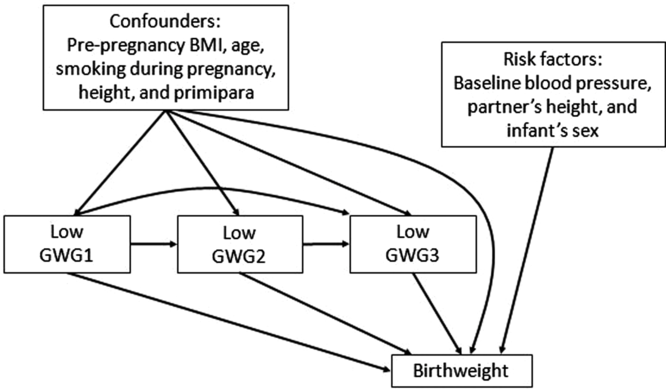
All statistical analyses were conducted using SAS software version 9.4 (SAS Institute Inc., Cary, NC, USA). The analysis was performed based on the DAG shown in Fig. 1. We investigated (i) the extent of the direct effect of low GWG in each trimester on birthweight and (ii) whether other factors have associations with birthweight. Pre-pregnancy BMI, age, height, smoking during pregnancy, and parity (primipara) were treated as potential confounders and included as covariates in the models. Partner’s height and infant’s sex were treated as independent risk factors. To estimate the direct effects of GWG, we used marginal structural models with inverse probability weighting. Reference Robins, Hernan and Brumback29,Reference VanderWeele30 The stabilized weights were calculated with logistic regression models as follows: variables X 1, X 2, and X 3 represent low GWG1, low GWG2, and low GWG3, respectively, where a value of 1 indicates that cumulative GWG did not reach the cutoff value by the end of each trimester and a value of 0 indicates that cumulative GWG reached the cutoff value by the end of each trimester. Variable A indicates the potential confounders of GWG and birthweight, and variable B indicates the independent risk factors.
 $$\hskip-39pt{{\rm{w}}_1}\left( {{{\rm{x}}_2}} \right) = {\rm{Pr}}\left( {{{\rm{X}}_2} = {{\rm{x}}_2}} \right)/{\rm{Pr}}\left( {{{\rm{X}}_2} = {{\rm{x}}_2}|{{\rm{X}}_1} = {{\rm{x}}_1},{\rm{\;A}} = {\rm{a}}} \right)$$
 $${{\rm{w}}_2}\left( {{{\rm{x}}_3}} \right) = {\rm{Pr}}\left( {{{\rm{X}}_3} = {{\rm{x}}_3}} \right)/{\rm{Pr}}\left( {{{\rm{X}}_3} = {{\rm{x}}_3}|{{\rm{X}}_1} = {{\rm{x}}_1},{{\rm{X}}_2} = {{\rm{x}}_2},{\rm{\;A}} = {\rm{a}}} \right).$$
Direct acyclic graph of the relationships among trimester-specific gestational weight gain, birthweight, confounders, and risk factors. The effect of interest was the direct effect of low GWG1, GWG2, and GWG3 on birthweight. BMI, body mass index; GWG1, gestational weight gain in trimester 1; GWG2, gestational weight gain in trimester 2; GWG3, gestational weight gain in trimester 3.

In order to quantify the effects of GWG on birthweight, we used a linear regression model with weight
 ${w_1}\left( {{x_2}} \right) \times {w_2}\left( {{x_3}} \right)$
.
 $${\rm{E}}\left( {{\rm{Y|}}{{\rm{X}}_1},{{\rm{X}}_2},{{\rm{X}}_3},{\rm{A}},\!{\rm{B}}} \right) = {{{\alpha }}_0} \!+\! {{{\alpha }}_1}{{\rm{X}}_1} \!+\! {{{\alpha }}_2}{{\rm{X}}_2} \!+\! {{{\alpha }}_3}{{\rm{X}}_3} \!+\! {{{\alpha }}_4}{\rm{A}} \!+\! {{{\alpha }}_5}{\rm{B}}$$
A pregnant woman whose GWG2 was lower than the stipulated cutoff was assigned a weight of
 ${w_1}\left( 1 \right)$
, whereas a woman with adequate GWG2 was assigned a weight of
 ${w_1}\left( 0 \right) = 1 - {w_1}\left( 1 \right)$
. A pregnant woman whose GWG3 was lower than the stipulated cutoff was assigned a weight of
 ${w_2}\left( 1 \right)$
, whereas a pregnant woman with adequate GWG3 was assigned a weight of
 ${w_2}\left( 0 \right)$
.
Sensitivity analysis
A sensitivity analysis was performed to examine the effects of different cutoff values for low GWG2 (3–6 kg) and GWG3 (7–11 kg) on the estimates. Other sensitivity analyses were performed to examine the effects of low GWG on birthweight among the normal weight women (18.5 kg/m2 < BMI) and among the non-hypertensive women.
Results
Baseline characteristics
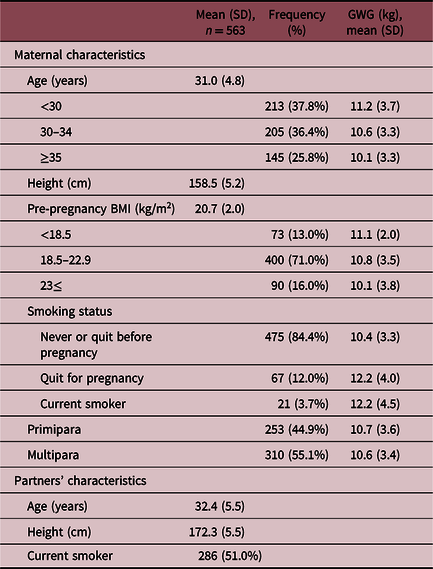
Of the 1473 women who received an explanation of the BOSHI study, 765 women consented to participate (response rate was 52%). Among these, we identified 563 women and their families who fulfilled the study’s inclusion and exclusion criteria and no missing data for any of the study variables. The baseline characteristics of the women and their partners are presented in Table 1. The mean age of the women and their partners was 31.0 and 32.4 years, respectively. The mean pre-pregnancy BMI of the women was 20.7 kg/m2, and 13% of the women were underweight before pregnancy. Approximately 3.7% of the women continued to smoke during pregnancy.
Baseline characteristics of the pregnant women and their partners

BMI, body mass index; GWG, gestational weight gain; SD, standard deviation.
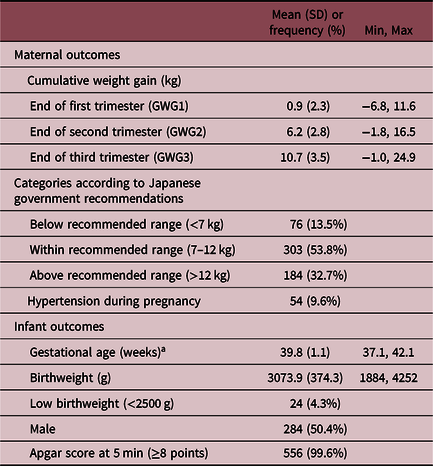
Table 2 summarizes the maternal and infant outcomes. The mean cumulative GWG1, GWG2, and GWG3 were 0.9, 6.2, and 10.7 kg, respectively. The GWG of 53.8% of the women was within the recommended range provided by the Japanese Ministry of Health, Labour and Welfare. 7 However, 62.0% of the women had a GWG below the recommended range stipulated in the US IOM guidelines. The mean birthweight was 3073.9 g (standard deviation: 374.3 g); approximately 4.3% of the infants had low birthweight.
Maternal and infant outcomes

GWG1, gestational weight gain in trimester 1; GWG2, gestational weight gain in trimester 2; GWG3, gestational weight gain in trimester 3; IOM, Institute of Medicine; SD, standard deviation.
a Preterm births (<37 weeks) were excluded from this study population.
Trimester-specific effects of GWG on birthweight
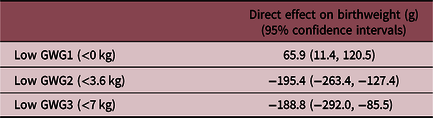
Table 3 shows the estimated direct effects of the trimester-specific GWG on birthweight. Low GWG in the second trimester and third trimester resulted in a reduction of 195.4 g (95% confidence interval [CI]: −263.4, −127.4 g) and −188.8 g (95% CI: −292.0, −85.5 g), respectively. Low GWG in the first trimester showed an effect in the opposite direction (an increase of 65.9 g). Smoking during pregnancy had a negative effect on birthweight (−197.2 g; 95% CI: −374.8, −19.6 g). Other factors (including mother’s height, partner’s height, and male infants) were positively correlated with birthweight. We also assessed the effects of the trimester-specific low GWG on birthweight by male infants and female infants separately and found that the weak between them.
Direct effects of trimester-specific gestational weight gain and confounders on birthweight

GWG1, gestational weight gain in trimester 1; GWG2, gestational weight gain in trimester 2; GWG3, gestational weight gain in trimester 3.
The analytical model included the mother’s pre-pregnancy body mass index, age, smoking during pregnancy, primipara, height, partner’s height, and infant’s sex.
Sensitivity analysis
We examined other cutoff values for the definition of low GWG during the second and third trimesters (Supplementary Table S1). The results depended on the cutoff values. However, the estimates of low GWG2 with cutoff value set at 3.6 kg were consistent (about −200 g) regardless of the cutoff values for low GWG3. The larger cutoff values for low GWG2 resulted in the negatively smaller effect of low GWG2 on birthweight while the cutoff values for GWG3 were fixed. The estimates of low GWG3 with the cutoff value fixed at 7 kg were varied from −169 to −237 g depending on the cutoff values for low GWG2. We examined the effects of low GWG on birthweight among the normal weight women. The coefficients were slightly changed, but the implication was similar to base case analysis (shown in Supplementary Table S2). We examined the association of GWG on birthweight among the non-hypertensive women. The result was similar to base case analysis.
Discussion
In this prospective cohort study, we examined the direct effects of inadequate GWG in each trimester on birthweight among women with either a low or normal pre-pregnancy BMI using the DAG and marginal structural models. The analysis found that women with low GWG during the second or third trimesters generally delivered infants that weighed almost 200 g less than the infants of women with higher weight gain. Low GWG during not only the third trimester but also the second trimester demonstrated the strong association with birthweight. We also examined the association among women with normal pre-pregnancy BMI and confirmed the association between the period-specific GWGs and birthweight was similar to one of the total study population.
The characteristics of our study sample were similar to those of previous studies from Japan in that most of the women had gained adequate weight in accordance with Japanese national guidelines, 7 but more than half of the women had a GWG below the recommendations provided in the IOM guidelines. Reference Enomoto, Aoki, Toma, Fujiwara, Sakamaki and Hirahara5,Reference Morisaki, Nagata and Jwa6 Our results that low GWG caused low birthweight corroborated the findings of previous studies. Reference Han, Lutsiv and Mulla1,Reference Goldstein, Abell and Ranasinha2,Reference Huang, Tan, Cai, Shi, Mi and Lei26,Reference Fujiwara, Aoki, Kurasawa, Okuda, Takahashi and Hirahara27,Reference Pugh, Albert and Kim31,Reference McDonald, Han and Mulla32 Several studies have examined the effects of trimester-specific weight gain, Reference Sridhar, Xu and Hedderson11,Reference Wander, Sitlani, Badon, Siscovick, Williams and Enquobahrie12,Reference Tsai, Chen, Seow and Chong33–Reference Ruchat, Allard and Doyon36 and most of these reported an association between weight gain during the second or third trimester and fetal growth. Reference Sridhar, Xu and Hedderson11,Reference Wander, Sitlani, Badon, Siscovick, Williams and Enquobahrie12,Reference Tsai, Chen, Seow and Chong33,Reference Sharma, Vesco and Bulkley35,Reference Ruchat, Allard and Doyon36 In contrast, Liang et al. conducted a cohort study of Chinese women and found that women with abnormal weight gain in the first and second trimesters were still able to deliver a normal birthweight infant if GWG was adequate in the third trimester. Reference Liang, Yin, Dong, Acharya and Li34 This discrepancy in results may have been influenced by different research hypotheses and methods; Liang et al. Reference Liang, Yin, Dong, Acharya and Li34 had examined their sample using a trajectory modeling approach for successive measurements of GWG, and their subjects generally had higher GWGs and delivered heavier infants than the women in our study sample. Our results contribute evidence on the effects of low GWG on birthweight among women who were underweight or normal weight before pregnancy. As previous studies Reference Sridhar, Xu and Hedderson11,Reference Wander, Sitlani, Badon, Siscovick, Williams and Enquobahrie12,Reference Tsai, Chen, Seow and Chong33,Reference Sharma, Vesco and Bulkley35,Reference Ruchat, Allard and Doyon36 and other life course studies have also shown an association between GWG in the earlier gestation period and infant anthropometrics, Reference Margerison-Zilko, Shrimali, Eskenazi, Lahiff, Lindquist and Abrams13–Reference Karachaliou, Georgiou and Roumeliotaki17 our findings emphasize that fetal development is especially susceptible to low GWG in the second trimester.
Our study used cumulative weight gain instead of incremental weight gain as the exposure of interest. This was because the former is widely used in research and clinical practice. However, cumulative measurements during the earlier period can affect subsequent measurements, which may introduce bias into analyses of direct effects. The causal analytical approach used in our study is able to avoid this bias and the estimates can be interpreted collectively. This causal approach is a suitable analytical approach for studies that use successive measurements of an exposure variable. Reference De Stavola, Nitsch and dos Santos Silva37–Reference Hutcheon and Bodnar39
Our analysis has several strengths. First, we utilized a causal inference approach to estimate the direct effects of low GWG. The DAG helped us to map the relationships between the outcome and variables. Inverse probability weighting method based on the DAG enabled us to interpret the estimates as the differences between the average birthweight if all women had adhered the recommendation and the average birthweight if all women had not adhered the recommendation, without conditioning other variables. Conventional regression models are unable to support such inferences as they are only able to estimate the conditional effects of each individual path. Next, our study was conducted using accurately measured data collected from medical examination records. Outcome misclassification was unlikely because we used raw measurements of birthweight. Furthermore, the BOSHI study used a relatively homogeneous sample with respect to patient demographic characteristics, socioeconomic status, and obstetric care. Accordingly, it is unlikely that variations in these factors would confound the results when compared with more diverse patients in larger studies. Our findings should be interpreted with consideration to several limitations. First, our study had a relatively small sample size, and we were unable to evaluate the risks of delivering low-birthweight (<2500 g) infants, preterm births, or maternal complications. Because the BOSHI study was performed at a single institution, the sample was not large and did not involve a high number of adverse events. We therefore could not determine if increases in GWG during the second trimester are clinically beneficial for both mother and child. Nevertheless, birthweight is an important indicator of infant health. A reduction in mean birthweight 200 g was comparable to the reduction due to smoking during pregnancy in our cohort and another study. Reference Brand, Gaillard and West40 The mean birthweight in our study was 3074 g and the proportion of low birthweight (smaller than 2500 g) was small; however, a reduction of 200 g in mean birthweight would lead increase the proportion of low birthweight in the population and it happened actually in Japan for the last several decades. 8 A recent systematic reviewReference Knop, Geng and Gorny41 showed that the birthweight was associated with risks of type 2 diabetes mellitus, cardiovascular disease, and hypertension in adult in a J-shaped manner which had the lowest risk categories at 3.5–4.0 and 4.0–4.5 kg birthweight. Though the relationship between birthweight and the risks in Japanese has yet unknown, a reduction in mean birthweight could be a big concern for underweight or normal pre-pregnancy women in population level. Adherence to an appropriate GWG guideline would lead to reducing the risk in adults. Second, the estimated effects of GWG were dependent on the stipulated cutoff values. We defined low GWG as the adherence to the guidelines regarding control GWG during the pregnancy period. So, we set cutoff values for GWG and used marginal structural models which generally require dichotomous exposure variables. In this study, our interpretation of the estimated effects was the averaged over effect of all the ways in which women did or did not adhere the guidelines. To examine the dependencies on the cutoff values, we performed the sensitivity analysis changing the cutoff values. The results depended on the cutoff values; however, the effects of GWG2 below the recommended range by Japanese guidelines were consistent at −200 g and the effects of GWG3 below the recommended range were at least 169 g smaller in mean birthweight. Third, we estimated direct effects assuming no interactions but could not exclude the possibility of interactions between the period-specific GWGs. Although estimating the natural direct effects of the period-specific GWGs which considers the interactions may provide more insight into these issues, it is more complicated to interpret and does not allow the simultaneous estimation of the three period-specific direct effects. Fourth, we did not explore the association between low GWG and birthweight among overweight women because the problem of overweight women lied outside the scope of this paper.
Although the majority of women in our study experienced normal weight gain under the Japanese guideline, 7 some women whose GWG did not reach the lower limits of the range had a higher possibility delivering the smaller infants than other women. Monitoring of gaining enough weight not only just before the delivery but also throughout the gestational period is important for normal or underweight Japanese women to ensure a greater chance of delivering infants with healthy birthweights.
Conclusions
This study quantified the trimester-specific direct effects of low GWG on birthweight. After adjusting for variations in pre-pregnancy BMI and other covariates, low GWG in the second trimester and third trimester was found to have a negative association with infant birthweight.
Supplementary material
To view supplementary material for this article, please visit https://doi.org/10.1017/S2040174420000240
Acknowledgements
The authors received the assistance of language editing from Coda Academic Editing. The authors are entirely responsible for the scientific content of the paper.
Financial support
This work was supported by JSPS KAKENHI (M.H., Grant Number 16H05243), (O.M., 17K15857).
Conflicts of interest
None.
Ethical standards
The authors assert that all procedures contributing to this work comply with the Japanese ethical standards (Ethical Guidelines for Medical and Health Research Involving Human Subjects of 2015, as revised in 2017) and with the Helsinki Declaration of 1975, as revised in 2008, and have been approved by the institutional committees Tohoku University School of Medicine (2016-1-256), Tohoku Medical and Pharmaceutical University (2016-3), the Ethics committee of the Faculty of Medicine, Toho University (A16126), and Suzuki Memorial Hospital.