Historian Oscar Handlin once reflected that in writing the history of immigrants in America, “I discovered that the immigrants were American history” (Handlin Reference Gulasekaram and Ramakrishnan2002). Immigrants are, indeed, American history. However, as immigration has become one of the defining issues in American politics, which has been made vivid by then-candidate Trump’s presidential campaign and now-President Trump’s immigration policies, it is clear that immigrants are also intricately tied to America’s present. Immigration strikes at the heart of political science, as the issue intersects foundational concepts such as nation and citizenship, renews questions about the inclusiveness of our political institutions, and creates new questions about political attitudes and behavior in the context of increased demographic change. As Wong writes, “Immigration can shape a nation. Consequently, immigration policy can maintain, replenish, and even reshape it. Immigration policy debates are thus seldom just about whom to let in and how many, as a nation’s immigration policies can define its identity” (Wong Reference White, Yeager, Menachemi and Scarinci2017a, 1).
The answer to what the immigration policies of our nation of immigrants should be has eluded Congress for decades. In fact, the last large-scale legalization of undocumented immigrants came over thirty years ago with the Immigration Reform and Control Act of 1986. As persistent and arguably deepening partisan divides in Congress continue to translate into dim prospects for comprehensive immigration reform, the undocumented population has grown and become more deeply rooted in American society. According to the U.S. Department of Homeland Security, there are an estimated twelve million undocumented immigrants living in the United States (US DHS Reference Theodore2018). The estimated median number of years that undocumented immigrants have lived in the United States is now 15.1 years and an estimated two-thirds of the undocumented population has lived in the United States for over a decade (Pew Research Center Reference Pantoja, Menjivar and Magana2019).
As political debates over comprehensive immigration reform and what to do with the legal status of undocumented immigrants remain unresolved, interior immigration enforcement policies have tightened, thus igniting debates over so-called sanctuary policies. Increased interior immigration enforcement has created a “new geography of deportability” (Valdivia Reference Theodore and Habans2019), as immigration enforcement efforts have expanded from workplaces and homes to schools, hospitals, courtrooms, and other public spaces. Fundamental to this new terrain of increased interior immigration enforcement is local law enforcement cooperation with federal immigration enforcement officials. Whereas the current administration and its supporters want to deepen such cooperation, many states and localities have resisted, opting instead to delimit when and under what conditions local law enforcement officials can do the work of federal immigration enforcement.
When local law enforcement officials do the work of federal immigration enforcement, undocumented immigrants are significantly less likely to report crimes to the police (for example, see Wong et al. Reference Wong2019; see also Menjivar et al. Reference Martínez-Schuldt and Martínez2018). Despite these empirical findings, the posited mechanism that explains this relationship, which is decreased trust in law enforcement, has not yet been systematically tested. Whereas some local law enforcement executives have welcomed closer cooperation with ICE on federal immigration enforcement, Footnote 1 others have argued against this, as doing so can potentially drive a wedge between local law enforcement officials and the communities they serve. For example, according to the Major Cities Chiefs Association (MCCA), “Immigration enforcement by local police would likely negatively effect and undermine the level of trust and cooperation between local police and immigrant communities . . . . Without assurances that contact with the police would not result in purely civil immigration action, the hard won trust, communication and cooperation from the immigrant community would disappear.” Footnote 2 Whether undocumented immigrants are less trusting of law enforcement when local law enforcement agencies work with ICE on federal immigration enforcement has not yet been systematically tested. Our study addresses this gap.
The question of whether interior immigration enforcement policies affect the trust that undocumented immigrants have in law enforcement has ignited contentious political debates. On the one hand, the Trump administration has changed the landscape of interior immigration enforcement in the United States, not only by attempting to defund so-called sanctuary localities (see Executive Order 13768, which was signed just a day after President Trump was inaugurated), but also by renewing efforts to partner with states and localities on federal immigration enforcement. Moreover, at a White House roundtable dubbed the “California Sanctuary State Roundtable,” President Trump stated that “I’m greatly honored to be here with the courageous mayors and sheriffs and local leaders from across the state of California. A great state. Each of you has bravely resisted California’s deadly and unconstitutional sanctuary state laws . . . . The state of California’s attempts to nullify federal law have sparked a rebellion by patriotic citizens who want their families protected.” Footnote 3 Here, President Trump describes sanctuary policies as deadly, leaving Californians in want of protection. The president has also stated more bluntly that sanctuary policies “breed crime.” Footnote 4 On the other hand, statements similar to those made by the Major Cities Chiefs Association described earlier appear in the texts of so-called sanctuary policies enacted by states and localities. For example, California’s SB 54, which prohibits the use of public resources for federal immigration enforcement purposes, among other provisions, states that
a relationship of trust between California’s immigrant community and state and local agencies is central to the public safety of the people of California. This trust is threatened when state and local agencies are entangled with federal immigration enforcement, with the result that immigrant community members fear approaching police when they are victims of, and witnesses to, crimes . . . . to the detriment of public safety and the well-being of all Californians.Footnote 5
Here, SB 54 connects sanctuary policies to trust in law enforcement and improved public safety. As so-called sanctuary policies represent arguably the most significant flashpoint in the contemporary debate over interior immigration enforcement in the United States, it has become imperative for researchers to inject empirical evidence into a debate that has heretofore been mostly an ideological one.
We embedded an experiment that varied the interior immigration enforcement context in a survey (n = 512) drawn from a probability-based sample of undocumented immigrants in order to determine whether undocumented immigrants are less trusting of police officers and sheriffs when local law enforcement officials work with ICE on federal immigration enforcement. In our experiment, we find that respondents are statistically significantly less likely to say that they trust that police officers and sheriffs will keep them, their families, and their communities safe, protect the rights of all people––including undocumented immigrants––equally, protect the confidentiality of witnesses to crimes even if they are undocumented, and protect undocumented immigrants from abuse or discrimination.
We begin by briefly reviewing the role of states and localities in federal immigration enforcement. We then examine what the existing literature says about how interior immigration enforcement can affect the trust that undocumented immigrants, and immigrants more generally, have in public institutions, focusing on law enforcement. We then derive a set of hypotheses about how the trust that undocumented immigrants have in police officers and sheriffs might be affected when local law enforcement officials do the work of federal immigration enforcement. After this, we describe the survey vehicle used to test our hypotheses and our survey experiment, wherein respondents were randomly assigned to conditions that vary the interior immigration enforcement context. We then discuss the findings of our survey experiment and the implications of our results.
The Role of States and Localities in Federal Immigration Enforcement
Prior to the passage of the first federal immigration laws toward the end of the nineteenth century, state governments played significant roles in matters related to immigration and to immigrants (for example, see Gulasekaram and Ramakrishnan Reference Gonzalez O’Brien, Collingwood and El-Khatib2015). Whereas the federal government has since gained supremacy over immigration-related matters, a new equilibrium has emerged in recent years wherein states and localities are increasingly passing immigration-related laws and ordinances, not to determine who we let into the country and how many, as this remains one of the plenary powers of the federal government, but to address issues related to interior immigration enforcement, as well as immigrant incorporation and other related issues. Although Congress sets the terms under which immigrants are admitted into the United States, immigrants most immediately impact the communities in which they live and work, which gives states and localities a major stake in their societal and economic incorporation (Boushey and Luedtke Reference Boushey and Luedtke2011), and has led some states to challenge federal supremacy in immigration matters (Newton Reference Newman, Johnston, Strickland and Jack2012). Concomitantly, the inability of Congress to pass comprehensive immigration reform has created space for states and localities to propose, adopt, and implement immigration-related laws and ordinances. The last large-scale legalization of undocumented immigrants (Immigration Reform and Control Act of 1986) and the last major changes to admissions policies (Immigration Act of 1990) occurred approximately three decades ago. Indeed, research on American federalism more generally suggests that states tend to move strategically on legislation in order to push Congress into action (for example, see Krane Reference Kirk, Papachristos, Fagan and Tyler2007; for immigration, see Filindra and Kovacs 2012).
Regarding the role of states and localities in federal immigration enforcement, some local law enforcement agencies argue that doing the work of federal immigration enforcement is necessary to ensuring public safety, as doing so will decrease crime. This argument, however, is not supported by the available empirical evidence. The scholarly literature to date has shown that crime rates are either lower in sanctuary jurisdictions compared to comparable non-sanctuary jurisdictions or that there is a null relationship between sanctuary jurisdictions and crime rates. For example, using administrative data from ICE, Wong (Reference Wong2017b) finds that violent and property crime rates are lower in sanctuary counties, defined in terms of responsiveness to administrative hold and detainer requests, compared to comparable non-sanctuary counties. In analyzing homicide and robbery incidents over three decades from 1990 to 2010, Martínez-Schuldt and Martínez (Reference Lewis, Provine, Varsanyi and Decker2017) find that city-level sanctuary policies are negatively and significantly related to fewer robberies, but have a null effect on homicides. Moreover, Gonzalez O’Brien, Collingwood, and El Khatib (2017) find no statistically significant differences in violent or property crime rates between sanctuary cities and comparable non-sanctuary cities.
Blurred Lines between Policing and Federal Immigration Enforcement
When local law enforcement officials do the work of federal immigration enforcement, this can exacerbate baseline levels of distrust in law enforcement and make undocumented immigrants who are already hesitant to contact the police even more hesitant to do so. Menjivar and Bejarano (Reference Menjivar and Abrego2004) identify three reasons for this: negative home country experiences with law enforcement, which create baseline levels of distrust; fears about immigration enforcement, which can exacerbate baseline levels of distrust; and social networks, which further shape perceptions of law enforcement. Concerns about immigration enforcement are of particular interest for our purposes here. Footnote 6 As the mechanism they highlight is fear of coming into contact with the machinery of immigration enforcement, it makes strong intuitive sense that when local law enforcement officials do the work of federal immigration enforcement, this can validate concerns among undocumented immigrants that interacting with police officers or sheriffs effectively means interacting with immigration officials.
The blurring of lines between local law enforcement officials and federal immigration enforcement has, indeed, been found to be a consequence of increased interior immigration enforcement. In studying the effects of local law enforcement cooperation with federal immigration enforcement officials, Varsanyi et al. found that “Latino residents do not necessarily distinguish between enforcement agencies . . . . The situation has led many in the Hispanic community to become fearful of all law enforcement agencies and government officials” (Varsanyi et al. Reference Valdivia2012, 21). Footnote 7 Provine et al. explain this blurring of lines as a function of the discretion that local law enforcement officials have when they do the work of federal immigration enforcement. They write that “partnering with local law enforcement cedes most control over enforcement [from the federal] to the local level and in a nontransparent way . . . . life changing decisions are occurring daily at the local level at the hands of local law-enforcement officers” (Provine et al. Reference Patler2016, 5). These “life changing decisions” include the arrest of undocumented immigrants, which can be a precursor for deportation. They further cite Motomura, who states succinctly that, as a matter of immigration enforcement, “the discretion to arrest has been the discretion that matters” (Motomura Reference Monogan2011, 1819). Indeed, for undocumented immigrants, to the extent that interactions with local law enforcement officials can potentially lead to deportation, police officers and sheriffs become indistinguishable from immigration enforcement officials.
There is also evidence that the blurring of lines between local law enforcement officials and federal immigration enforcement negatively affects attitudes toward policing. In studying the effects of 287(g) agreements, which authorize police officers and sheriffs to enforce federal immigration laws, including identifying, apprehending, and detaining undocumented immigrants, Armenta and Alvarez conclude that “as long as discretionary arrests [by local law enforcement] funnel removable immigrants into the deportation system, some immigrant communities will perceive policing as fundamentally unfair and discriminatory” (2017, e12453). Footnote 8 More generally, Becerra et al. (Reference Becerra, Wagaman, Androff, Messing and Castillo2017) recently found that Latinx survey respondents who reported greater fear of deportation were less likely to have confidence that police would not use excessive force and had less confidence that police would treat Latinx persons fairly.
These findings complement research that shows that increased interior immigration enforcement is related to the decreased use of and access to public health services (Asch, Leake, and Gelberg Reference Asch, Leake and Gelberg1994; Beniflah et al. Reference Beniflah, Little, Simon and Sturm.2013; Berk et al. Reference Berk, Schur, Chavez and Frankel.2000; Fenton, Catalano, and Hargreaves Reference Farris and Holman1996; Hardy et al. Reference Handlin2012; Wang and Kaushal Reference Voss and Bloemraad2018; White et al. Reference Walker and Leitner2014a; White et al. Reference Wang and Kaushal2014b); decreased school attendance (Capps et al. Reference Capps, Castaneda, Chaudry and Santos2007; Chaudry et al., Reference Chaudry, Capps, Pedroza, Castaeeda, Santos and Scott2010); diminished academic performance among undocumented students, as well as the U.S. citizen children of undocumented parents (Amuedo-Dorantes and Lopez Reference Amuedo-Dorantes and Lopez2015); can lock undocumented workers into exploitative workplace conditions (Gleeson Reference Filindra and Kovacs2010; Harrison and Lloyd Reference Hardy, Getrich, Quezada, Guay, Michalowski and Henley2011); and can even lead undocumented immigrants to avoid certain neighborhoods and grocery stores (Valdivia Reference Theodore and Habans2019).
The landscape of interior immigration enforcement in the United States also includes an increasing number of state laws and local ordinances, some of which are designed to tighten enforcement, while others are designed to delimit the extent to which local law enforcement officials do the work of federal immigration enforcement. When it comes to state-level legislation, research has shown a relationship between the passage of restrictive immigration-related legislation and economic anxiety (Bach Reference Bach1978; Ybarra, Sanchez, and Sanchez Reference Wong, Garcia and Valdivia2015; Newman et al. Reference Motomura2012), racial and ethnic anxieties related to demographic change (Newman et al. Reference Motomura2012; Ybarra, Sanchez, and Sanchez Reference Wong, Garcia and Valdivia2015; Boushey and Luedtke Reference Boushey and Luedtke2011; Avery, Fine, and Marquez Reference Avery, Fine and Marquez2017), and partisan politics (Monogan Reference Mirande2013). When it comes to immigration-related policies at the sub-state level, research has shown that the partisan composition of local electorates are strong predictors of whether cities adopt restrictive or welcoming policies towards immigrants (Ramakrishnan and Wong 2010; Steil and Vasi Reference Ramakrishnan, Wong and Varsanyi2014) and that demographic changes within communities significantly increase the likelihood that cities consider anti-immigrant proposals (Hopkins Reference Harrison and Lloyd2010; Walker and Leitner Reference Varsanyi, Lewis, Provine and Scott2011; Steil and Vasi Reference Ramakrishnan, Wong and Varsanyi2014). Cities with more highly educated populations (Walker and Leitner Reference Varsanyi, Lewis, Provine and Scott2011) and cities with more immigrant-serving organizations (Steil and Vasi Reference Ramakrishnan, Wong and Varsanyi2014) are also significantly more likely to adopt welcoming policies towards immigrants. Moreover, when it comes to explaining variation in local law enforcement cooperation with federal immigration enforcement officials, research shows that partisanship and demographic change explain the adoption of 287(g) agreements at the county level (Wong Reference White, Blackburn, Manzella, Welty and Menachemi2012), having a Latinx police chief decreases police entanglement on matters of federal immigration enforcement (Lewis et al. Reference Lewis and Ramakrishnan2012), and that the personal attitudes that sheriffs have towards immigrants is significantly related to policies such as checking the immigration status of people who are stopped for traffic violations or who are arrested for non-violent crimes (Farris and Holman 2017).
Research on policies that tighten enforcement provide more evidence that blurring the lines between local law enforcement officials and federal immigration enforcement negatively affects attitudes toward policing. For example, in examining the impact of SB 1070 in Arizona, which requires state and local police to check the immigration status of a person if a law enforcement officer has a reasonable suspicion that the person is undocumented, Footnote 9 among other provisions, Becerra (Reference Becerra2016) found that the law not only increased fears of deportation, but it also decreased the confidence that Latinx immigrants have that the police, as well as the courts, will treat them fairly. Footnote 10 Conversely, there is evidence that policies that delimit the extent to which local law enforcement officials do the work of federal immigration enforcement have positive implications for policing. For example, Menjivar et al. (Reference Menjivar and Bejarano2018) conclude in their analysis of survey data across four cities that “sanctuary city policies promote community policing,” as Latinx respondents in the two sanctuary cities they studied were more likely to report crimes to the police (even despite prior negative interactions with the police and knowing someone who has been deported) than the Latinx respondents in the two non-sanctuary cities they studied. Footnote 11
In sum, we argue that when local law enforcement officials do the work of federal immigration enforcement, this further blurs the already opaque lines between policing and federal immigration enforcement, which then significantly decreases the trust that undocumented immigrants have in police officers and sheriffs. Accordingly, we argue that when local law enforcement officials do the work of federal immigration enforcement, undocumented immigrants will be significantly less likely to trust that police officers and sheriffs will keep them and their families safe and will also be significantly less likely to trust that police officers and sheriffs will keep their communities safe. We further hypothesize that when local law enforcement officials do the work of federal immigration enforcement, undocumented immigrants will be significantly less likely to trust that police officers and sheriffs will protect the confidentiality of witnesses to crimes, even if they are undocumented.
Latinx Communities, Law Enforcement, and Trust
The research thus detailed builds on scholarship examining the relationship between Latinx communities and the police. Early studies sought to address shortcomings in research on how race and ethnicity––more specifically, how being Latinx––affected perceptions of the police and attitudes toward policing. For example, Mirande (Reference Michelson1980) fielded a survey in order to compare the attitudes of Latinx respondents to those of white and African American respondents across several indicators. Research along this vein, with some exceptions, generally found that Latinx respondents had more negative attitudes toward the police when compared to white respondents, but more positive attitudes when compared to African American respondents (for a review, see Brown and Benedict Reference Brown and Reed Benedict2002; Cao, Frank, and Cullen Reference Cao, Frank and Cullen1996). Footnote 12
As research in this area grew, more work analyzed the determinants of attitudes among Latinx persons. Footnote 13 Whereas characteristics such as age, gender, education, prior interactions with the police, and neighborhood contextual factors had been researched thoroughly to explain attitudes toward the police among whites and African Americans, missing from this research, as Correia writes, “was a more thorough understanding of the attitudes Latinos have of police . . . . The lack of research on Latinos was not limited to attitudes toward the police, but to the existing body of criminological research” (Correia Reference Correia2010, 100). In addressing this gap, research quickly pushed past basic demographic characteristics, for example, by distinguishing between those who primarily speak Spanish versus English. Footnote 14 Cheurprakobkit and Bartsch (Reference Cheurprakobkit and Bartsch1999) found that Spanish-speaking Latinx respondents in Texas were more likely than English-speaking Latinx respondents in the state to agree with statements such as, “a police force that is racially and ethnically similar to its citizens would be more effective,” among other findings. Moreover, Skogan (Reference Provine, Varsanyi, Lewis and Decker2005) found that Spanish-speaking Latinx respondents in Chicago were less likely than English-speaking Latinx respondents in the city to report that “police paid careful attention to what they had to say” during citizen-initiated encounters (i.e., when they needed the police). Footnote 15 Importantly, although public opinion polling on undocumented immigrants remains scarce, some research in this area has also examined attitudes toward the police by immigration status. For example, in a large survey of Latinx respondents, Theodore found that majorities of native born, foreign born, and undocumented respondents felt that “police officers stop Latinos and Hispanics on the streets in your city without good reason or cause” either somewhat often or very often, which contributed to many feeling “isolated from the law enforcement officers who are sworn to protect them” (Theodore Reference Skogan2013, 17). In a separate study, Theodore and Habans (Reference Steil and Vasi2016) found that “Both documented and undocumented immigration statuses were associated with negative attitudes towards police” (Theodore and Habans Reference Steil and Vasi2016, 983).
Altogether, empirical findings showing that Latinx persons are generally more mistrusting of law enforcement than are whites and African Americans, coupled with research showing that Spanish-speaking and undocumented Latinx persons are more likely to have experienced, or have concerns about, inequitable treatment by law enforcement, leads us to two additional hypotheses. We further hypothesize that when local law enforcement officials do the work of federal immigration enforcement, undocumented immigrants will be significantly less likely to trust that police officers and sheriffs will protect the rights of all people, including undocumented immigrants, equally and will also be significantly less likely to trust that police officers and sheriffs will protect undocumented immigrants from abuse or discrimination.
Data and Method
To test our hypotheses, we embedded an experiment in a probability-based sample of undocumented immigrants in San Diego County.
Through a partnership between the USIPC and the Mexican Consulate in San Diego (the Consulate), Wong created a sample frame of undocumented Mexican nationals in San Diego County. The sample frame is comprised of individuals who receive consular services unique to those living in the United States without authorization. Consulates provide a broad range of services to their nationals abroad. The sample frame, which includes approximately 73,000 people, accounts for nearly the entire universe of undocumented Mexican nationals who currently live in San Diego County. The Center for Migration Studies (CMS), for example, estimates that there are currently 82,406 undocumented immigrants who were born in Mexico who live in San Diego County (Center for Migration Studies 2016). Working with staff at the Consulate, we assigned random ID numbers to each record and then cut the sample frame into random draws of approximately 5,000 records for each survey module in the project. Call sheets with limited information about each respondent—the random ID number assigned to each record, first name, and phone number—are then printed out. Phone numbers are manually dialed by enumerators trained by the authors. Phone numbers are dialed once with no additional follow up. After each paper call sheet is completed, it is immediately reviewed and then destroyed. All surveys are conducted in Spanish, unless the respondent prefered to speak in English. In this study, 96.5% of surveys were conducted in Spanish. This study is IRB approved (UCSDIRB 180131).
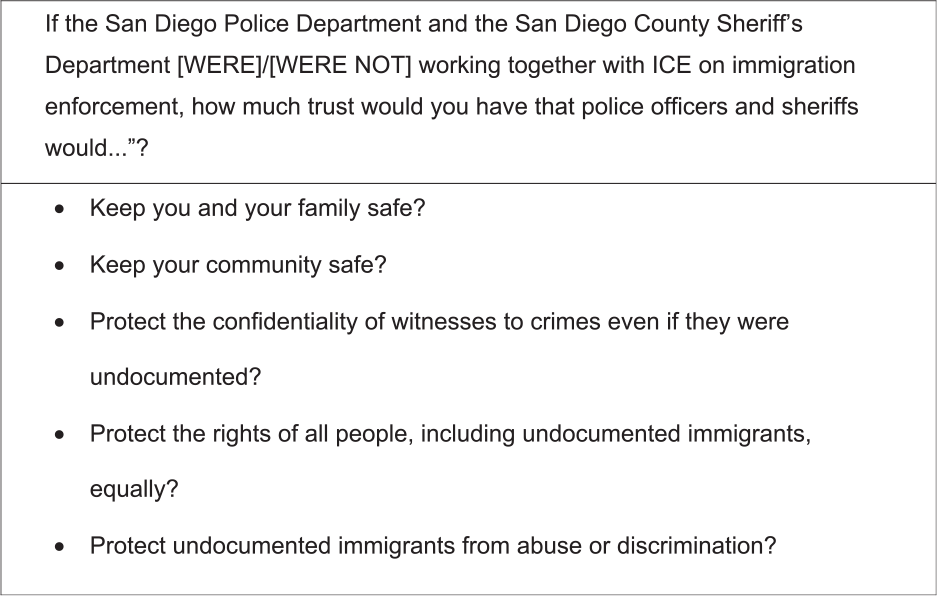
The survey was fielded between June and July 2018 and includes 512 respondents. In the survey, we embedded an experiment in order to better understand how interior immigration enforcement affects the trust that undocumented immigrants have in local law enforcement officials. In the experiment, respondents were randomly assigned to one of two groups. In one group (n = 267 respondents), questions were prefaced with, “If the [name of county] Police Department and the [name of county] County Sheriff’s Department WERE NOT working together with ICE on immigration enforcement, how much trust would you have that . . . ” In the second group (n = 245 respondents), questions were prefaced with, “If the [name of county] Police Department and the [name of county] County Sheriff’s Department WERE working together with ICE on immigration enforcement, how much trust would you have that . . . ” Respondents were then asked how much trust they had that police officers and sheriffs would: keep them and their families safe; keep their communities safe; protect the rights of all people, including undocumented immigrants, equally; protect the confidentiality of witnesses to crimes even if they are undocumented; and protect undocumented immigrants from abuse or discrimination.
Figure 1 provides the exact text. Regarding the survey experiment, there may be a temptation to assume that deportability is a constant for all undocumented immigrants, and thus undocumented immigrants experience their “illegality” similarly. However, research makes clear that heterogeneity exists among undocumented immigrants in how their legal status affects their day-to-day behaviors. The literature on the civic engagement of undocumented immigrants is instructive here. Some, indeed, are “in the shadows.” Others, however, have taken their activism to the streets, as demonstrated during the nationwide protests in 2006 when millions of people, including undocumented immigrants, marched in opposition to the passage of restrictive legislation in the U.S. House of Representatives (H.R. 4437) and in support of a path to citizenship, and some have even taken their activism to Capitol Hill, which has included being arrested for civil disobedience (for example, see Barreto et al. Reference Barreto, Manzano, Ramirez and Rim2009; Nicholls Reference Newton2013; Pantoja, Menjivar, and Magana 2008; Patler Reference Nicholls2017; Voss and Bloemraad Reference Varsanyi2011; Wong, Garcia, and Valdivia Reference Wong2018; Zepeda-Millan Reference Wong, Shklyan, Isorena and Peng2014). Perhaps more importantly, the last decade of interior immigration enforcement policy in the United States has oscillated between the greater or lesser use of prosecutorial discretion and enforcement priorities. For example, during the Obama administration, the Morton and Johnson memos, which provided field guidance for immigration enforcement officials, articulated factors to be considered when exercising prosecutorial discretion in the apprehension, detention, and removal of undocumented immigrants, which included: having no criminal history; length of time in the United States; having immediate family members in the United States; being a primary caregiver; and military service, among others (see Wong Reference White, Yeager, Menachemi and Scarinci2017a). More recently, the Department of Homeland Security under the Trump administration has made clear that “the Department no longer will exempt classes or categories of removable aliens from potential enforcement” and that previous enforcement priorities, including those articulated in the Morton and Johnson memos, “are hereby immediately rescinded.” Footnote 16 Given this rapidly shifting terrain, wherein policy changes quite literally make some undocumented immigrants more or less deportable by increasing or decreasing the exercise of prosecutorial discretion by federal immigration enforcement officials, it becomes increasingly important to better understand how interior immigration enforcement policies affect the trust that undocumented immigrants have in local law enforcement officials, particularly as localities are on the front lines of efforts to tighten interior immigration enforcement in the United States. As interior immigration enforcement policies change, on the ground, undocumented immigrants must confront uncertainties about whether interactions with local law enforcement officials can potentially lead to detention or deportation. There is a lacuna of empirical research on how undocumented immigrants confront these uncertainties, which our research attempts to help address.
Survey experiment text

An experiment such as this is superior to analyzing observational survey data (i.e., survey data that is not based on an experimental design) because asking respondents about one scenario is insufficient for determining how their behavior may or may not change based on the second scenario; asking respondents about one scenario and then the second scenario would likely produce biased results because responses related to the first scenario would likely influence responses to the second scenario (e.g., “I said I would be more trusting in the first scenario, so maybe I should say I would be less trusting in the second scenario”); random assignment to one of the two groups balances the two groups across the broad range of covariates (e.g., age, gender, etc.) that need to be controlled for in observational analyses; and random assignment to one of the two groups means that differences in responses can be causally attributed to the variation in the two scenarios (i.e., the treatment effect that results when local law enforcement officials do the work of federal immigration enforcement). Moreover, given the general lack of data on outcomes specific to undocumented immigrants—indeed, many studies of undocumented immigrants are, in fact, studies that use Latinx as a proxy for undocumented immigrants without addressing matters of imbalance across important covariates—an experiment such as this is an important step forward for causally identified work on undocumented immigrants. Footnote 17 We encourage researchers, however, to continue seeking out data and to think creatively about policy or other discontinuities so that we can better understand how policies causally affect outcomes for undocumented immigrants.
The response rate for the survey was 10.2%. Per our agreement with the Consulate, we have a one-call protocol for conducting the survey, meaning each number is dialed only once unless we contact a respondent and the respondent requests that we call back at a later time. If we are unable to contact the respondent, the number is not dialed again. We address potential imbalance in covariates between our respondents and those we were not able to contact in several ways. We used first name to estimate gender. An estimated 46.7% of our random draw was female compared to an estimated 48.2% of our respondents. We also compared the distribution of area codes for the numbers in our random draw to the distribution of area codes for the numbers of our respondents, acknowledging that area codes are imperfect proxies for where in San Diego County respondents live. In our random draw, 48.4% of numbers were in “Area Code 1,” 44.3% were in “Area Code 2,” 5.8% were in “Area Code 3,” and 1.5% were in “Other” area code. Among our respondents, 50.2% of numbers were in “Area Code 1,” 45.6% were in “Area Code 2,” 3.3% were in “Area Code 3,” and 0.9% were in “Other” area code. Moreover, among our respondents, we found no significant differences in response rates by hour except for decreases between noon and 1:00 p.m. and then again from 3:00 p.m. to 4:00 p.m., and an increase between 6:00 p.m. and 7:00 p.m. As demographic data on all individuals in the sample frame are unknown to us, it is not possible for us to test for potential imbalance differently. As research evolves on surveying undocumented immigrants, we look forward to innovation that builds on our best attempt here.
Results
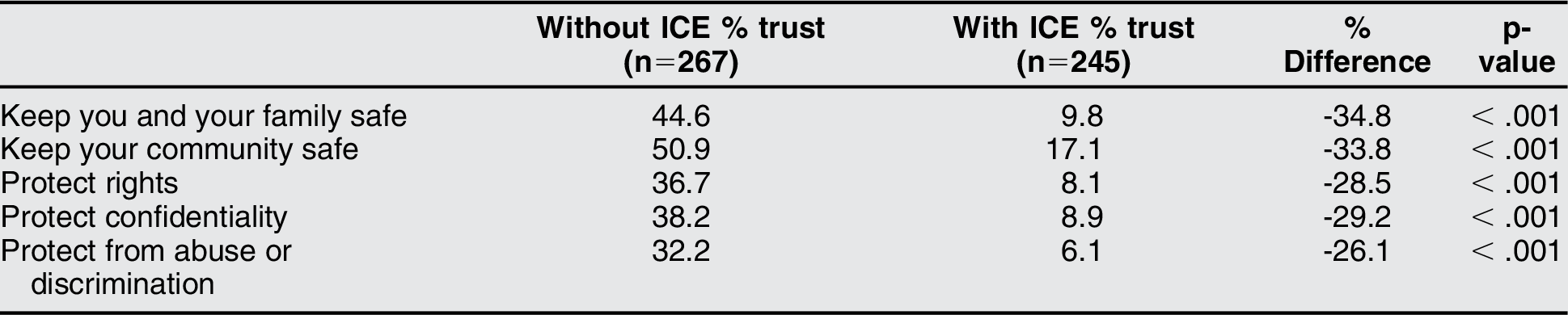
When local law enforcement officials work with ICE on federal immigration enforcement, respondents are statistically significantly less trusting that police officers and sheriffs would keep them, their families, and their communities safe. More specifically, when respondents are told that local law enforcement officials are not working with ICE on federal immigration enforcement, 44.6% trust “a great deal” or “a lot” that police officers and sheriffs would keep them and their families safe. When respondents are told that local law enforcement officials are working with ICE on federal immigration enforcement, just 9.8% trust “a great deal” or “a lot” that police officers and sheriffs would keep them and their families safe. In other words, 34.8% of respondents are less likely to say that they trust that police officers and sheriffs would keep them and their families safe when they are given the scenario where local law enforcement officials are working with ICE on federal immigration enforcement. This result is statistically significant (p < .001). Moreover, 33.8% are less likely to trust that police officers and sheriffs would keep their communities safe when they are given the scenario where local law enforcement officials are working with ICE on federal immigration enforcement. This result is also statistically significant (p < .001).
Respondents are also less likely to say that they trust that police officers and sheriffs would protect their rights, protect their confidentiality, and protect them from abuse or discrimination when they are given the scenario where local law enforcement officials are working with ICE on federal immigration enforcement. When respondents are told that local law enforcement officials are not working with ICE on federal immigration enforcement, 36.7% trust “a great deal” or “a lot” that police officers and sheriffs would protect the rights of all people, including undocumented immigrants, equally. When respondents are told that local law enforcement officials are working with ICE on federal immigration enforcement, just 8.1% trust “a great deal” or “a lot” that police officers and sheriffs would protect the rights of all people, including undocumented immigrants, equally. In other words, 28.5% of respondents are less likely to say that they trust that police officers and sheriffs would protect the rights of all people, including undocumented immigrants, equally when they are given the scenario where local law enforcement officials are working with ICE on federal immigration enforcement. This result is statistically significant (p < .001). Similarly, 29.2% are less likely to trust that police officers and sheriffs would protect the confidentiality of witnesses to crimes even if they are undocumented when they are given the scenario where local law enforcement officials are working with ICE on federal immigration enforcement. This result is also statistically significant (p < .001). Last, 26.1% are less likely to trust that police officers and sheriffs would protect undocumented immigrants from abuse or discrimination when they are given the scenario where local law enforcement officials are working with ICE on federal immigration enforcement. This result is highly statistically significant (p < .001).
Table 1 summarizes these results. Two sample t-tests are used to calculate average treatment effects (ATE) and 95% confidence intervals.
Effects of local cooperation with federal immigration enforcement on trust in law enforcement

Multivariate Results
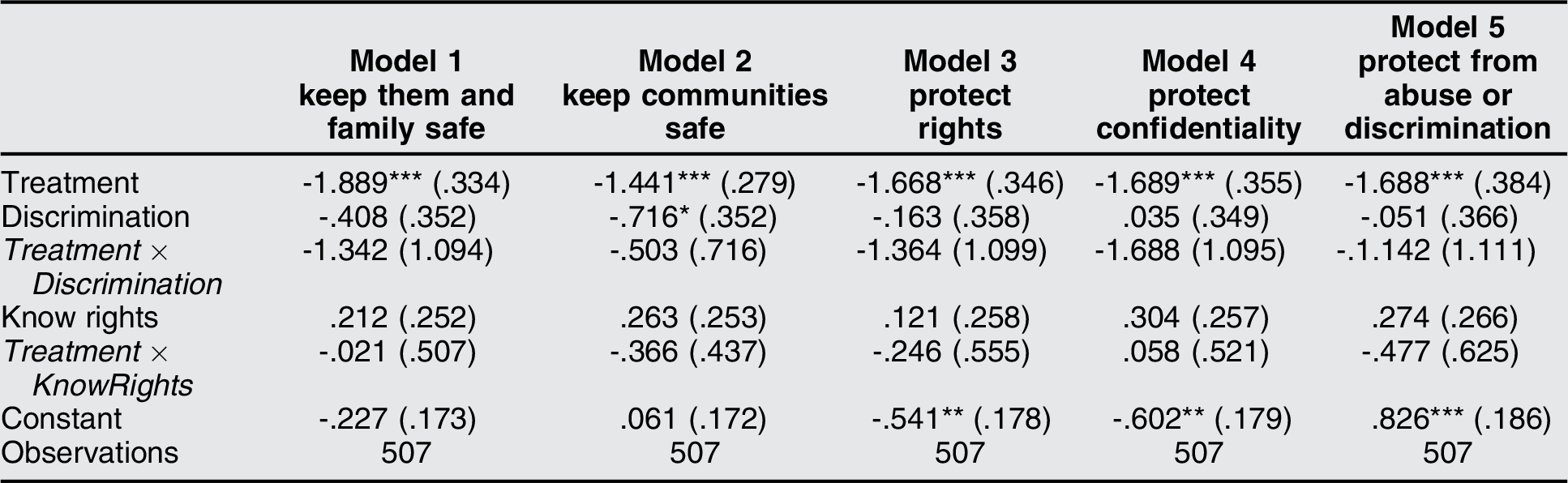
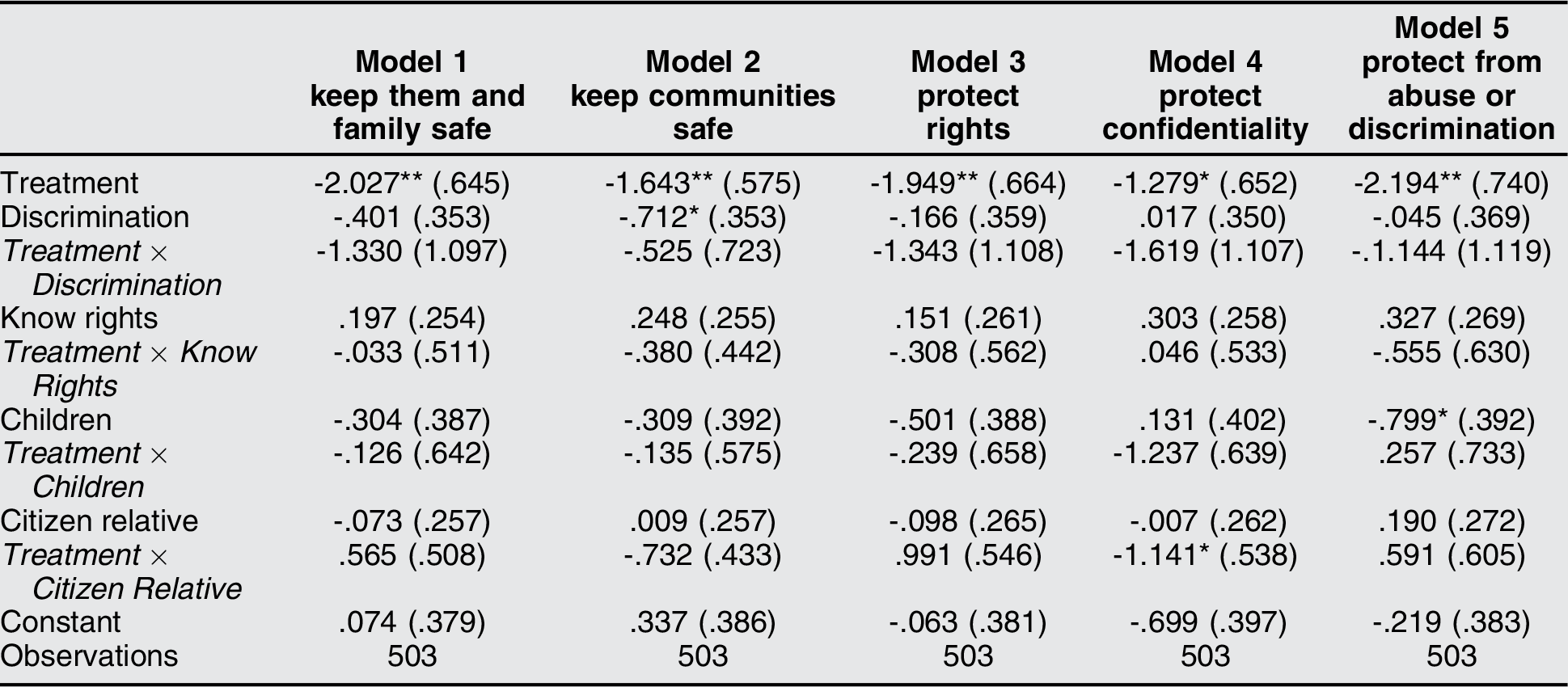
The differences-in-means make clear that trust declines significantly when local law enforcement officials work with ICE on federal immigration enforcement, but do the results hold when accounting for other factors? In particular, do the results hold when accounting for factors that might decrease the trust that undocumented immigrants have in police officers and sheriffs independent of whether local law enforcement officials work with ICE on federal immigration enforcement? Here, we estimate a series of logistic regression models that estimate the effect of the “working together with ICE” condition while also accounting for whether respondents have been discriminated against or treated differently in the past twelve months either because of their race/ethnicity, where they were born, the language they speak, or their immigration status. Discrimination is collapsed into a dichotomous variable equal to one if the respondent says “yes” to any one of the discrimination items (i.e., “yes” to discrimination because of the language they speak, but not because of the other characteristics we asked about) and zero otherwise. Moreover, we account for whether respondents know what their rights are if ICE shows up at their door, as not knowing one’s rights can potentially result in more generalized concerns about law enforcement. Know Rights is a dichotomous variable equal to one if respondents “strongly agree” or “agree” that they know what their rights are if ICE shows up at their door and zero otherwise. We note here that we are limited in the time that we have and are thus limited in the number of items we can include in each questionnaire. Footnote 18 We also estimate models that control for whether respondents have children and whether respondents have immediate family members who are U.S. citizens (these are demographic items that are asked across all of the surveys in the project). The effects of the treatment are substantively unchanged when controlling for whether respondents have children and immediate family members who are U.S. citizens.
Table 2 reports the results. Model 1 examines the likelihood that respondents trust that police officers and sheriffs would keep them and their families safe. Model 2 examines the likelihood that respondents trust that police officers and sheriffs would keep their communities safe. Model 3 examines the likelihood that respondents trust that police officers and sheriffs would protect the rights of all people, including undocumented immigrants, equally. Model 4 examines the likelihood that respondents trust that police officers and sheriffs would protect the confidentiality of witnesses to crimes even if they are undocumented. Model 5 examines the likelihood that respondents trust that police officers and sheriffs would protect undocumented immigrants from abuse or discrimination. As the table shows, the effects of the “working together with ICE” condition remain statistically significant across all of the trust items analyzed (refer to Models 1 to 5).
Multivariate logistic regressions

*** p < .001; ** p < .01; * p < .05.
Multivariate logistic regressions with added controls

*** p < .001; ** p < .01; * p < .05.
Discussion and Conclusion
In our study, we use a survey experiment to show that when local law enforcement officials work with ICE on federal immigration enforcement, undocumented immigrants are 34.8% less likely to trust “a great deal” or “a lot” that police officers and sheriffs would keep them and their families safe, 33.8% less likely to trust “a great deal” or “a lot” that police officers and sheriffs would keep their communities safe, 28.5% less likely to trust “a great deal” or “a lot” that police officers and sheriffs would protect the rights of all people, including undocumented immigrants, equally, 29.2% less likely to trust “a great deal” or “a lot” that police officers and sheriffs would protect the confidentiality of witnesses to crimes even if they are undocumented, and 26.1% less likely to trust “a great deal” or “a lot” that police officers and sheriffs would protect undocumented immigrants from abuse or discrimination. Our findings provide evidence to support the mechanism that connects local law enforcement cooperation with ICE to a broad range of “chilling effects,” particularly as they relate to the extent to which undocumented immigrants interact with police officers and sheriffs when local law enforcement officials work with ICE on federal immigration enforcement.
There is a growing literature on the adverse behavioral effects that result when local law enforcement officials do the work of federal immigration enforcement. Our results add to this literature by uncovering important attitudinal changes. These attitudinal changes are consequential because, as Kirk et al. write, “while strict immigration laws are often touted politically as ways to ensure public safety, the enactment and enforcement of harsh immigration laws may actually undercut public safety by creating a cynicism of the law in immigrant communities” (Kirk et al. Reference Kelly2012, 81). Footnote 19
Whereas our study focuses on trust in law enforcement, we look forward to more research that examines how interior immigration enforcement affects the trust that undocumented immigrants have in government, as well as in public institutions more generally (for example, see Michelson Reference Menjivar, Simmons, Alvord and Salerno Valdez2007; Cruz Nichols, LeBron, and Pedraza Reference Cruz Nichols, LeBron and Pedraza2018). For example, when local law enforcement officials do the work of federal immigration enforcement, is decreased trust in police officers and sheriffs collinear with decreased trust in state and local governments? Other public agencies? Bureaucrats and other public employees? Our study also focused on undocumented Mexican nationals in San Diego County. Undocumented Mexican nationals account for just under half of all undocumented immigrants in the U.S. (Pew Research Center Reference Pantoja, Menjivar and Magana2019). However, as the undocumented population is diverse with respect to national origins, we also look forward to future work that unpacks how experiences, attitudes, and behaviors may or may not vary between undocumented immigrants by country of origin and, relatedly, by race and ethnicity or language, among other factors. Similarly, as San Diego County is a border community, future work that incorporates a more geographically diverse sample may benefit from analyzing proximity to the U.S.–Mexico border as an explanatory variable.
Our findings, as well as future work in this area, have strong implications for states and localities that are already, or are considering, working with ICE on federal immigration enforcement. As the data show, to the extent that local law enforcement agencies decide to do the work of federal immigration enforcement, this puts at risk the hard-earned trust that police officers and sheriffs need to do the work of community policing. Not only does this include trust that local law enforcement officials can keep undocumented immigrants, their families, and their communities safe, but this also includes trust in fundamental notions of justice, such as whether police officers and sheriffs will protect the rights of all people equally and protect undocumented immigrants from abuse and discrimination. Whereas some local law enforcement agencies see working with ICE on federal immigration enforcement as a way to improve public safety, the scholarly literature—from research that shows that crime is lower in sanctuary jurisdictions compared to comparable non-sanctuary jurisdictions, to research that shows that undocumented immigrants are less likely to report crimes to the police when the lines between policing and immigration enforcement become blurred, and now to our research here—provides cause for local law enforcement agencies to consider more thoughtfully how doing the work of federal immigration enforcement can potentially undermine the very public safety they are entrusted to defend.