


The secondary sex ratio (SSR) in humans is a measure of boys born relative to girls and is considered to be at equilibrium at around 1.05 (i.e. that 105 males are born for every 100 females born). This is due to boys having higher mortality rates, thus an excess of males at birth is understood to lead to equity in adult sex ratios. Recently, however, many industrialized nations have reported a decline in SSR, meaning that fewer boys are being born relative to girls (Dickson & Parker, Reference Dickson and Parker1997; Dodds & Armson, Reference Dodds and Armson1997; James, Reference James1998; Grech et al., Reference Grech, Vassallo-Agius and Savona-Ventura2003; MacKenzie et al., Reference MacKenzie, Lockridge and Keith2005; Hamilton & Rasmussen, Reference Hamilton and Rasmussen2010).
There are a wide range of factors that may cause a decline in the number of males born, including: technological changes, such as the use of fertility drugs; biological changes, such as reductions in sperm motility arising from exposure to war and disaster (Fukuda et al., Reference Fukuda, Fukuda, Shimzu, Yomura and Shimzu1996, Reference Fukuda, Fukuda, Shimizu and Moller1998; James, Reference James2003; Bisioli, Reference Bisioli2004); differing hormone levels in parents at the point of conception (Bisioli, Reference Bisioli2004); environmental changes, particularly exposure to persistent environmental pollutants (James, Reference James1998; MacKenzie et al., Reference MacKenzie, Lockridge and Keith2005; Terrell et al., Reference Terrell, Hartnett and Marcus2011); and downward economic changes (Catalano, Reference Catalano2003). In addition, maternal condition is known to affect offspring sex. Women with high social status and good financial means have a greater number of sons (Grant & Yang, Reference Grant and Yang2003; Cameron & Dalerum, Reference Cameron and Dalerum2009), while older mothers (over 35 years of age) are more likely to bear girls, potentially suggesting a response to the increased metabolic demands of male children (Dickson & Parker, Reference Dickson and Parker1997).
Whatever the cause, this evidence seems to suggest that more daughters are born under poor conditions, indicating male offspring in utero may be more vulnerable to environmental stresses than daughters. This may be due to the Y-chromosome making males more fragile and therefore a poorer investment in suboptimal environments. Further, as sons place a greater metabolic demand on the mother they may be more energetically costly to carry in lean environments (Helle et al., Reference Helle, Helama and Lertola2009; Gray, Reference Gray2010).
The Longitudinal Study of Australian Children (LSAC) is conducted in partnership between the Australian Government Department of Social Services, the Australian Institute of Family Studies and the Australian Bureau of Statistics (www.growingupinaustralia.gov.au). The LSAC study comprises a stratified, randomized nationwide sample of 10,000 children across two cohorts with data collected every two years. The response rates over subsequent waves have remained very high, with 80% responding in the 2012 survey. Using data from the B cohort of the LSAC study, which includes an initial sample of 5107 Australian children born between 2003 and 2004, this study aimed to determine what maternal factors are associated with offspring sex in an Australian population. Maternal variables tested included: use of Assisted Reproductive Technology (ART), maternal education level, household income, maternal age, maternal smoking, maternal marital status and parental perceptions of wealth (Table 1). Ethical clearance for the project was obtained from the ANU Human Ethics Research Committee (protocol number 2014/609).
Results of chi-square tests of independence for maternal factors associated with offspring sex using the Longitudinal Study of Australian Children (LSAC) dataset
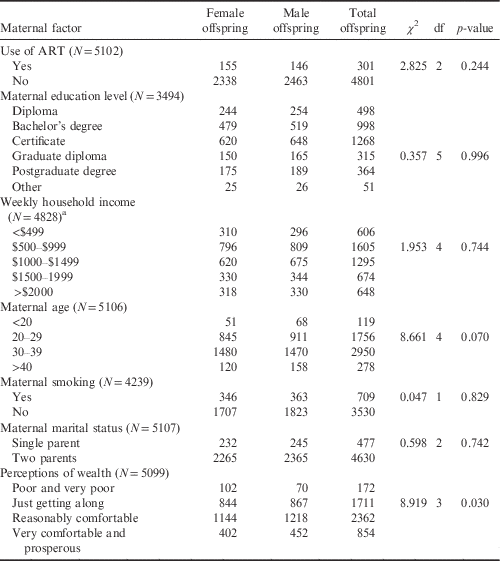
a Household income categories reflect those used on the LSAC survey given to participants.
Parental perceptions of wealth after birth were the only factor found to be significant (n=5099, due to missing data; χ 2=8.919; df=3; p=0.03). Where the principal carer indicated that they felt ‘Poor’ or ‘Very poor’ there was a decrease in the number of male children present in the LSAC sample. By contrast, where the principal carer reported that they felt ‘Very comfortable’ or ‘Prosperous’ there was an increase in the number of male children present in the LSAC sample.
Perceptions of wealth are likely to include factors such as education, employment stability, earning potential and support networks, and thus are more likely to account for both material assets and social context than a single measure of monetary income. Thus it seems that higher perceptions of wealth may relate to improved maternal condition and as such may exert a biological influence that promotes the conception and maintenance of male fetuses. This supports the reduction in male offspring seen following economic crises, where wealthy individuals have higher feelings of stress and angst (Jetton et al., Reference Jetton, Mols, Healy and Spears2017), and thus probably have lower perceived ideas regarding their wealth.
Interestingly, in Australia, there is frequently a higher number of boys born relative to girls in the Australian Capital Territory compared with other states (Australian Bureau of Statistics, 2015). As this is also the state where women earn the highest national average weekly salary, and have higher education levels (Australian Bureau of Statistics, 2013) they may perceive themselves to be wealthier and as a result have more sons.
The results from this study may thus reflect the fact that because male offspring are more sensitive to poor environmental conditions, they are likely to be produced at higher numbers in cohorts of women who perceive themselves to have higher available resources.
Acknowledgments
The authors would like to thank one anonymous reviewer and the Associate Editor for their helpful comments on previous versions of this manuscript. This paper uses unit record data from Growing Up in Australia, the Longitudinal Study of Australian Children. The study is conducted in partnership between the Department of Social Services (DSS), the Australian Institute of Family Studies (AIFS) and the Australian Bureau of Statistics (ABS). The findings and views reported in this paper are those of the authors and should not be attributed to DSS, AIFS or the ABS.



