Introduction
Partial laryngectomy has received growing acceptance as an alternative treatment for laryngeal cancer, particularly in the early stage.Reference Ambrosch, Kron and Steiner1, Reference Fink, Sibley, Kunduk, Schexnaildre, Sutton and Kakade-Pawar2 This treatment modality provides organ or function preservation, as with radiotherapy (RT) and chemoradiotherapy.Reference Chiesa Estomba, Betainces Reinoso, Lorenzo Lorenzo, Farina Conde, Araujo Nores and Santidiran Hidalgo3, Reference Canis, Ihler, Martin, Wolff, Matthias and Steiner4 Nowadays, partial laryngectomies frequently involve the use of endoscopic or microlaryngoscopic equipment. Transoral microlaryngoscopic laser surgery is preferred for early stage and selected advanced stage supraglottic cancers.Reference Canis, Ihler, Martin, Wolff, Matthias and Steiner4–Reference González-Márquez, Rodrigo, Llorente, Alvarez-Marcos, Díaz and Suárez6 There are numerous publications by experienced surgeons reporting high oncological success rates, highlighting the value of this surgery.
Recently, robotic surgery has been used to treat the head and neck field, particularly supraglottic cancer.Reference Olsen, Moore, Koch, Price, Kasperbauer and Olsen7, Reference Byrd and Ferris8 Supraglottic cancers are more aggressive than disease in other parts of larynx, and have a tendency for early lymph node metastasis.Reference Canis, Ihler, Martin, Wolff, Matthias and Steiner4, Reference Scola, Fernandez-Vega, Martinez, Fernandez-Vega and Ramirez9, Reference Canis, Ihler, Martin, Wolff, Matthias and Steiner10 While the results of transoral microlaryngoscopic laser surgery are well-established, publications regarding robotic surgery for the treatment of supraglottic cancers are scarce. Case series are small. Moreover, no studies have compared the outcome of patients with supraglottic cancer following transoral laser supraglottic surgery or transoral robotic supraglottic surgery. This article aimed to report the results of a meta-analysis of the published English-language literature in order to evaluate the success rates of transoral laser supraglottic surgery and transoral robotic supraglottic surgery, which may be of assistance when planning surgery.
Materials and methods
Literature research
A literature search was independently performed by one researcher (MBA) who searched the databases PubMed (January 1997 to August 2017), Sage (January 1997 to August 2017), Medline and the Cochrane Library. The search terms used were: ‘endoscopic/microlaryngoscopic laser surgery’ and ‘microlaryngoscopic robotic surgery’, or ‘transoral laser supraglottic surgery’ and ‘transoral supraglottic robotic surgery’ (Medical Subject Heading terms), and ‘randomized controlled trial’, ‘case report’ and ‘clinical retrospective trial’ (publication types). All data were evaluated by a second researcher (BS). Repetitions of the same experiment were excluded.
Inclusion criteria
All studies published in international journals in the English language that concerned randomised controlled trials, case reports or clinical retrospective trials examining transoral laser supraglottic surgery and/or transoral robotic supraglottic surgery were included. Only supraglottic cancer patients who had undergone either laser laryngectomy or robotic laryngectomy were included. Studies that provided information on the overall and disease-free survival rates of cancer patients were examined. If a research group had two different patient groups for the same condition, both studies were included.
Exclusion criteria
Repetitions of published literature from the same authors were excluded. Studies were also excluded if the patients had undergone surgery for other supraglottic diseases (e.g. benign lesions, obstructive sleep apnoea syndrome or laryngomalacia). Non-English language articles, articles with no description of overall or disease-free survival rates, and studies describing technical details or complications only were also excluded. Studies focusing on surgical procedures other than laser partial laryngectomy or robotic partial laryngectomy performed for supraglottic cancer, such as total laryngectomy or open partial laryngectomy, were not included. Genetic, radiological, histopathological and animal experiments were also excluded. If a study included patients with both supraglottic cancer and a supraglottic benign lesion, only patients with supraglottic cancer were included; the other patients were excluded. Thus, the n value for a given study included in this meta-analysis may be different to the examined study's original n value.
Data extraction
One reviewer (MBA) inspected the titles and abstracts of the studies, and screened the selected literature according to the abovementioned criteria. When no relevant word was found in the title or abstract, the full text of the study was reviewed to assess its relevance to this analysis. Where disagreement occurred, we attempted to resolve it through discussion.
The extracted data included: author name(s), publication year, sample size, surgery type, overall survival rates, disease-specific survival rates, follow-up duration, number of patients for each tumour (T) stage, mean patient age and number of patients with recurrence.
Main outcome measurements
The numbers of patients who had undergone transoral laser supraglottic surgery or transoral robotic supraglottic surgery, with overall survival and disease-free survival rates for two, three and/or five years following surgery, were calculated. The number of recurrences and follow-up duration data were also investigated. Other treatments (radiotherapy, chemoradiotherapy and neck dissection) were taken into account.
Mean ± standard deviation or median were calculated for the extracted data. The outcome variables were proportion (percentage) and 95 per cent confidence interval (CI) in the transoral laser supraglottic surgery or transoral robotic supraglottic surgery groups. Overall survival and disease-specific survival analysis would have been performed based on T-stage. However, statistical analysis could not be conducted as planned because of inadequate patient numbers in the transoral robotic supraglottic surgery group.
Statistical analysis
Meta-analysis was performed using MedCalc statistical software, version 12.7.2.0 (MedCalc Software, Ostend, Belgium). When the I2 statistical value was over 50 per cent and the p-value was less than 0.05, heterogeneity was considered statistically significant, and a random effects model was used to analyse the data. In order to evaluate the efficacy of the transoral laser supraglottic surgery and transoral robotic supraglottic surgery groups, 95 per cent CIs were calculated. Sensitivity analysis was performed to identify any studies that may have influenced the results.
Results
Studies
Studies were included in the meta-analysis based on the inclusion criteria and exclusion criteria described above. Twenty-four studies were included in this meta-analysis;Reference Ambrosch, Kron and Steiner1–Reference Olsen, Moore, Koch, Price, Kasperbauer and Olsen7, Reference Canis, Ihler, Martin, Wolff, Matthias and Steiner10–Reference Piazza, Barbieri, Del Bon, Grazioli, Perotti and Paderno26 1617 were excluded. Nineteen of the included studies related to transoral laser supraglottic surgeryReference Ambrosch, Kron and Steiner1–Reference González-Márquez, Rodrigo, Llorente, Alvarez-Marcos, Díaz and Suárez6, Reference Canis, Ihler, Martin, Wolff, Matthias and Steiner10, Reference Pantazis, Liapi, Kostarelos, Kyriazis, Pantazis and Riga11, Reference Hinni, Salassa, Grant, Pearson, Hayden and Martin13, Reference Wilkie, Lightbody, Lythgoe, Tandon, Lancaster and Jones15, Reference Rudert, Werner and Hoft18–Reference Piazza, Barbieri, Del Bon, Grazioli, Perotti and Paderno26 and five related to transoral robotic supraglottic surgery.Reference Olsen, Moore, Koch, Price, Kasperbauer and Olsen7, Reference Park, Kim, Byeon, Lee and Kim12, Reference Meulemans, Vanclooster, Vauterin, D'heygere, Nuyts and Clement14, Reference Park, Byeon, Chung, Choi and Kim16, Reference Mendelsohn, Remacle, Van Der Vorst, Bachy and Lawson17 The total number of supraglottic cancer patients was 927; 861 of these underwent transoral laser supraglottic surgery, while 66 underwent transoral robotic supraglottic surgery. A flow diagram is shown in Figure 1.
Flow diagram of the systematic literature search and study selection.

Descriptive statistics
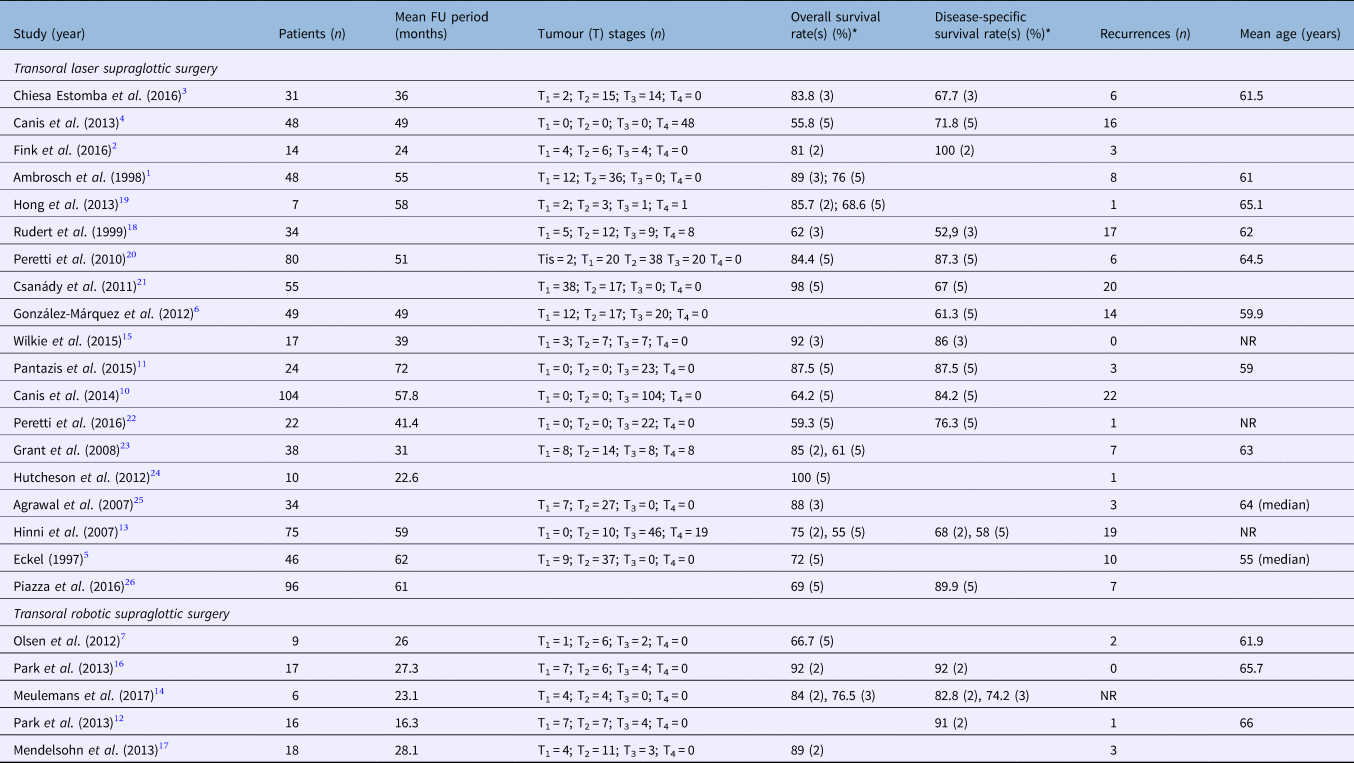
Mean follow-up duration, number of patients in the studies, the T stages of supraglottic cancers, mean age of the patients and the number of reported relapses were evaluated. Not all of the studies provided gender or mean age information. Mean follow-up duration was 47.9 months for transoral laser supraglottic surgery and 24.1 months for transoral robotic supraglottic surgery. The longest mean follow-up duration was 72 monthsReference Pantazis, Liapi, Kostarelos, Kyriazis, Pantazis and Riga11 and the shortest mean follow-up duration was 16.3 months.Reference Park, Kim, Byeon, Lee and Kim12 Mean age of the patients was 61.9 years in the transoral laser supraglottic surgery studies (16 studies) and 64.5 years in the transoral robotic supraglottic surgery studies (3 studies). Table 1 shows the descriptive statistics of the studies.Reference Ambrosch, Kron and Steiner1–Reference Olsen, Moore, Koch, Price, Kasperbauer and Olsen7, Reference Canis, Ihler, Martin, Wolff, Matthias and Steiner10–Reference Piazza, Barbieri, Del Bon, Grazioli, Perotti and Paderno26
Demographics and oncological data of transoral laser supraglottic surgery and transoral robotic supraglottic surgery studies

* Numbers in brackets indicate survival rate period. FU = follow-up; Tis = tumour in situ; NR = Not reported.
Overall survival
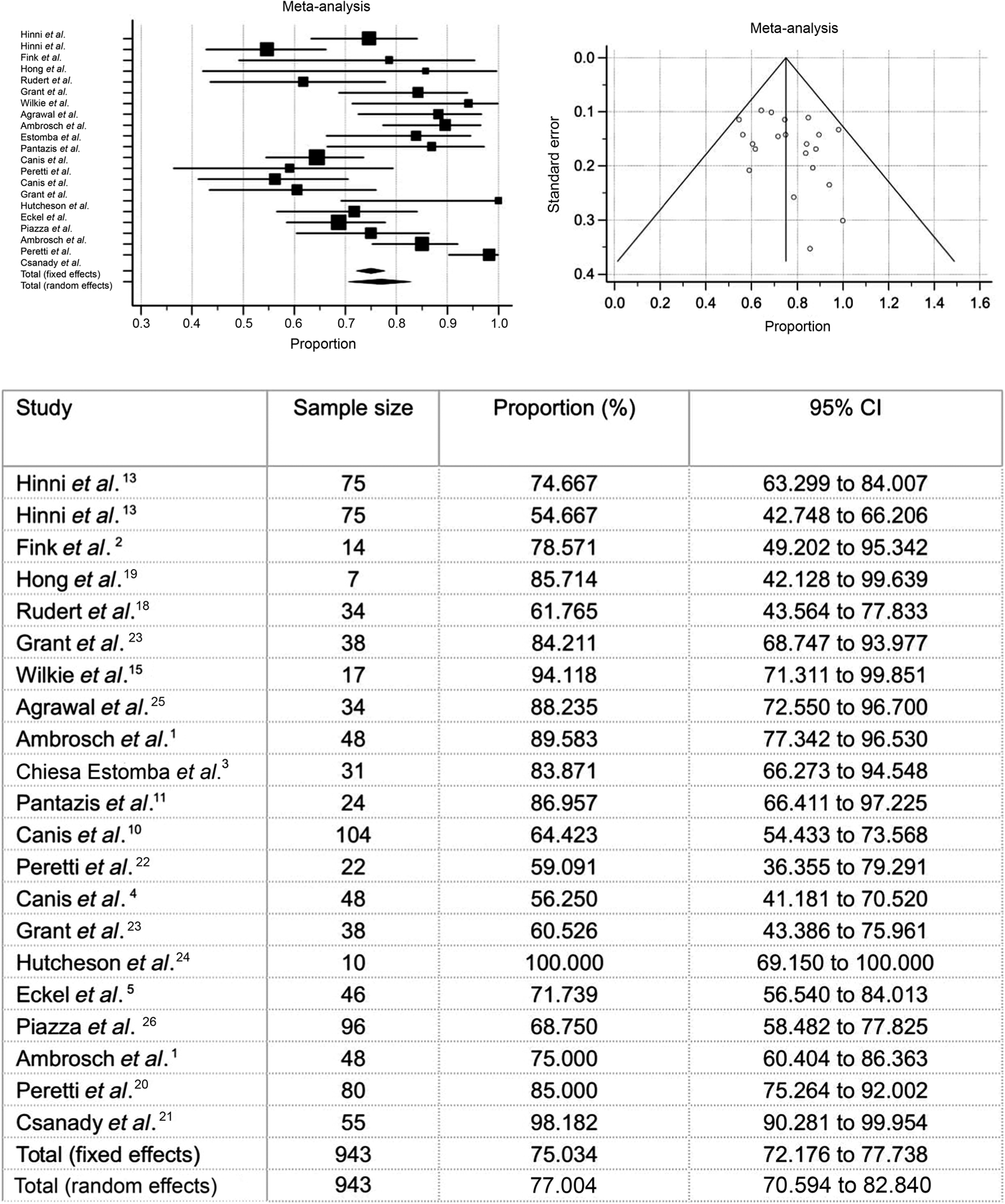
Heterogeneity in the transoral laser supraglottic surgery group was assessed by the random effects model because the p-value was less than 0.0001. The mean overall survival rate in the transoral laser supraglottic surgery group was 77.0 per cent (95 per cent CI = 70.6–82.8) (Figure 2).Reference Ambrosch, Kron and Steiner1–Reference Eckel5, Reference Canis, Ihler, Martin, Wolff, Matthias and Steiner10, Reference Pantazis, Liapi, Kostarelos, Kyriazis, Pantazis and Riga11, Reference Hinni, Salassa, Grant, Pearson, Hayden and Martin13, Reference Wilkie, Lightbody, Lythgoe, Tandon, Lancaster and Jones15, Reference Rudert, Werner and Hoft18–Reference Piazza, Barbieri, Del Bon, Grazioli, Perotti and Paderno26 As the transoral robotic supraglottic surgery studies were not heterogeneous and the significance level of this group was 0.3279, the fixed effect value was taken into account. The mean overall survival rate in the transoral robotic supraglottic surgery group was 82.5 per cent (95 per cent CI = 70.6–91.0) (Figure 3).Reference Olsen, Moore, Koch, Price, Kasperbauer and Olsen7, Reference Meulemans, Vanclooster, Vauterin, D'heygere, Nuyts and Clement14, Reference Park, Byeon, Chung, Choi and Kim16, Reference Mendelsohn, Remacle, Van Der Vorst, Bachy and Lawson17 There was no statistically significant difference in overall survival between the transoral laser supraglottic surgery group and the transoral robotic supraglottic surgery group.
Meta-analysis of overall survival in all transoral laser supraglottic surgery articles (repetitions of studies represent data for different survival rate periods). CI = confidence interval

Meta-analysis of overall survival in all transoral robotic supraglottic surgery articles (repetitions of studies represent data for different survival rate periods). CI = confidence interval

Regarding transoral laser supraglottic surgery, 5 studies, 4 studies and 10 studies evaluated overall survival for 2-year, 3-year and 5-year periods, respectively.Reference Ambrosch, Kron and Steiner1–Reference González-Márquez, Rodrigo, Llorente, Alvarez-Marcos, Díaz and Suárez6, Reference Canis, Ihler, Martin, Wolff, Matthias and Steiner10, Reference Pantazis, Liapi, Kostarelos, Kyriazis, Pantazis and Riga11, Reference Hinni, Salassa, Grant, Pearson, Hayden and Martin13, Reference Wilkie, Lightbody, Lythgoe, Tandon, Lancaster and Jones15, Reference Rudert, Werner and Hoft18–Reference Piazza, Barbieri, Del Bon, Grazioli, Perotti and Paderno26 One study evaluated overall survival for both two-year and five-year periods.Reference Hinni, Salassa, Grant, Pearson, Hayden and Martin13 Regarding transoral robotic supraglottic surgery, two studies investigated overall survival for a two-year period, one study investigated overall survival for a five-year period, and one study investigated overall survival for both two-year and three-year periods.Reference Olsen, Moore, Koch, Price, Kasperbauer and Olsen7, Reference Meulemans, Vanclooster, Vauterin, D'heygere, Nuyts and Clement14, Reference Park, Byeon, Chung, Choi and Kim16, Reference Mendelsohn, Remacle, Van Der Vorst, Bachy and Lawson17
Meta-analysis findings for the transoral laser supraglottic surgery and transoral robotic supraglottic surgery groups are shown in Figures 2 and 3, respectively.
Disease-specific survival
Heterogeneity in the transoral laser supraglottic surgery group was assessed by the random effects model because the p-value was less than 0.0001. The mean disease-specific survival rate in the transoral laser supraglottic surgery group was 75.9 per cent (95 per cent CI = 68.3–82.7) (Figure 4).Reference Fink, Sibley, Kunduk, Schexnaildre, Sutton and Kakade-Pawar2–Reference Canis, Ihler, Martin, Wolff, Matthias and Steiner4, Reference González-Márquez, Rodrigo, Llorente, Alvarez-Marcos, Díaz and Suárez6, Reference Canis, Ihler, Martin, Wolff, Matthias and Steiner10, Reference Pantazis, Liapi, Kostarelos, Kyriazis, Pantazis and Riga11, Reference Hinni, Salassa, Grant, Pearson, Hayden and Martin13, Reference Wilkie, Lightbody, Lythgoe, Tandon, Lancaster and Jones15, Reference Rudert, Werner and Hoft18, Reference Peretti, Piazza, Ansarin, De Benedetto, Cocco and Cattaneo20–Reference Peretti, Piazza, Penco, Santori, Del Bon and Garofolo22, Reference Piazza, Barbieri, Del Bon, Grazioli, Perotti and Paderno26 Heterogeneity in the transoral robotic supraglottic surgery group was evaluated and the significance level of this group was 0.3666. Therefore, the fixed effect value was used. The mean disease-specific survival rate in the transoral robotic supraglottic surgery group was 87.0 per cent (95 per cent CI = 74.3–94.9) (Figure 5).Reference Park, Kim, Byeon, Lee and Kim12, Reference Meulemans, Vanclooster, Vauterin, D'heygere, Nuyts and Clement14, Reference Park, Byeon, Chung, Choi and Kim16 There was no statistically significant difference in disease-specific survival between the transoral laser supraglottic surgery group and the transoral robotic supraglottic surgery group.
Meta-analysis of disease-specific survival in all transoral laser supraglottic surgery articles (repetitions of studies represent data for different survival rate periods). CI = confidence interval

Meta-analysis of disease-specific survival in all transoral robotic supraglottic surgery articles (repetitions of studies represent data for different survival rate periods). CI = confidence interval

Regarding transoral laser supraglottic surgery, two studies, three studies and eight studies evaluated disease-specific survival for two-year, three-year and five-year periods, respectively.Reference Fink, Sibley, Kunduk, Schexnaildre, Sutton and Kakade-Pawar2–Reference Canis, Ihler, Martin, Wolff, Matthias and Steiner4, Reference González-Márquez, Rodrigo, Llorente, Alvarez-Marcos, Díaz and Suárez6, Reference Canis, Ihler, Martin, Wolff, Matthias and Steiner10, Reference Pantazis, Liapi, Kostarelos, Kyriazis, Pantazis and Riga11, Reference Hinni, Salassa, Grant, Pearson, Hayden and Martin13, Reference Wilkie, Lightbody, Lythgoe, Tandon, Lancaster and Jones15, Reference Rudert, Werner and Hoft18, Reference Peretti, Piazza, Ansarin, De Benedetto, Cocco and Cattaneo20–Reference Peretti, Piazza, Penco, Santori, Del Bon and Garofolo22, Reference Piazza, Barbieri, Del Bon, Grazioli, Perotti and Paderno26 One study presented disease-specific survival rates for both two years and five years.Reference Hinni, Salassa, Grant, Pearson, Hayden and Martin13 Regarding transoral robotic supraglottic surgery, two studies gave disease-specific survival rates for a two-year period, and one study gave disease-specific survival rates for both two- and three-year periods.Reference Park, Kim, Byeon, Lee and Kim12, Reference Meulemans, Vanclooster, Vauterin, D'heygere, Nuyts and Clement14, Reference Park, Byeon, Chung, Choi and Kim16
The meta-analysis findings for the transoral laser supraglottic surgery and transoral robotic supraglottic surgery groups are shown in Figures 4 and 5.
Cancer recurrence
All of the studies gave recurrence data for transoral laser supraglottic surgery patients.Reference Ambrosch, Kron and Steiner1–Reference González-Márquez, Rodrigo, Llorente, Alvarez-Marcos, Díaz and Suárez6, Reference Canis, Ihler, Martin, Wolff, Matthias and Steiner10, Reference Pantazis, Liapi, Kostarelos, Kyriazis, Pantazis and Riga11, Reference Hinni, Salassa, Grant, Pearson, Hayden and Martin13, Reference Wilkie, Lightbody, Lythgoe, Tandon, Lancaster and Jones15, Reference Rudert, Werner and Hoft18–Reference Piazza, Barbieri, Del Bon, Grazioli, Perotti and Paderno26 The number of patients with recurrence was 164 out of 832 (19.7 per cent). One study reported that none of the patients had recurrence.Reference Wilkie, Lightbody, Lythgoe, Tandon, Lancaster and Jones15
In the transoral robotic supraglottic surgery group, only 6 out of 66 patients (9 per cent) had recurrence.Reference Olsen, Moore, Koch, Price, Kasperbauer and Olsen7, Reference Park, Kim, Byeon, Lee and Kim12, Reference Mendelsohn, Remacle, Van Der Vorst, Bachy and Lawson17 While one study reported no recurrence,Reference Park, Byeon, Chung, Choi and Kim16 another study did not present recurrence data.Reference Meulemans, Vanclooster, Vauterin, D'heygere, Nuyts and Clement14
Additional treatments
Sixteen studies mentioned additional treatments in the transoral laser supraglottic surgery group.Reference Ambrosch, Kron and Steiner1, Reference Chiesa Estomba, Betainces Reinoso, Lorenzo Lorenzo, Farina Conde, Araujo Nores and Santidiran Hidalgo3–Reference González-Márquez, Rodrigo, Llorente, Alvarez-Marcos, Díaz and Suárez6, Reference Pantazis, Liapi, Kostarelos, Kyriazis, Pantazis and Riga11, Reference Wilkie, Lightbody, Lythgoe, Tandon, Lancaster and Jones15, Reference Rudert, Werner and Hoft18–Reference Piazza, Barbieri, Del Bon, Grazioli, Perotti and Paderno26 A total of 194 patients (23.3 per cent) received radiotherapy and 31 patients (3.7 per cent) received chemoradiotherapy. In addition, unilateral or bilateral neck dissection was carried out in 250 patients (30 per cent). Three studies did not mention any additional treatments in this group.Reference Fink, Sibley, Kunduk, Schexnaildre, Sutton and Kakade-Pawar2, Reference Canis, Ihler, Martin, Wolff, Matthias and Steiner10, Reference Hinni, Salassa, Grant, Pearson, Hayden and Martin13
In the transoral robotic supraglottic surgery group, 7 patients (10.6 per cent) received radiotherapy and 16 patients (24.2 per cent) received chemoradiotherapy. Unilateral or bilateral neck dissection was conducted in 30 patients (45.4 per cent). Two studies did not mention other treatments in this group.Reference Meulemans, Vanclooster, Vauterin, D'heygere, Nuyts and Clement14, Reference Park, Byeon, Chung, Choi and Kim16
Discussion
For this meta-analysis, 1641 published studies were evaluated. Following the inclusion or elimination of studies based on the inclusion and exclusion criteria, 24 studies (19 on transoral laser supraglottic surgery and 5 on transoral robotic supraglottic surgery) remained. Interestingly, the number of the patients within each study varied considerably. The effects of sample size variation on total random effects (success rates) were recognised. Different random effects could have been calculated if the studies with a small sample size were excluded. However, we thought that the most effective review would be achieved by including each study that met the aforementioned criteria for the meta-analysis. To our knowledge, this is the first systematic review and meta-analysis to examine oncological outcomes (overall survival and disease-free survival) obtained through transoral laser or robotic surgery performed for late or early stage supraglottic cancer.
This meta-analysis failed to indicate any clear superiority of transoral laser supraglottic surgery or transoral robotic supraglottic surgery based on overall or disease-specific survival results. However, overall survival and disease-specific survival were slightly better in the transoral robotic supraglottic surgery group, although this finding was not significant. This might have resulted from unintentional or inevitable bias in patient selection for transoral robotic supraglottic surgery as a relatively new technique. The mean overall survival rate was 77.0 per cent (range, 70.5–82.8 per cent) (n = 943) for transoral laser supraglottic surgery, versus 82.4 per cent (range, 70.6–91.0 per cent) (n = 56) for transoral robotic supraglottic surgery. The mean disease-specific survival rate was 75.8 per cent (range, 68.3–82.7 per cent) (n = 723) for transoral laser supraglottic surgery, versus 87.0 per cent (range, 74.3–94.9 per cent) (n = 45) for transoral robotic supraglottic surgery.
The number of patients with recurrence was 152 (18.2 per cent; total n = 832) in the transoral laser supraglottic surgery group, versus only 6 patients (9 per cent; total n = 66) in the transoral robotic supraglottic surgery group. The meta-analysis showed recurrence data favouring transoral robotic supraglottic surgery (19.7 per cent vs 9 per cent). We think that there are several possible explanations for this result. These include: a shorter follow-up period in the transoral robotic supraglottic surgery group compared to the transoral laser supraglottic surgery group; the small sample size of the transoral robotic supraglottic surgery group, which might have biased the outcome analysis; a greater number of patients with advanced disease in the transoral laser supraglottic surgery group; and the potentially better margin control and superior visualisation associated with robotic surgery. The explanation will become clearer as the number of patients undergoing transoral robotic supraglottic surgery increases.
We evaluated the use of additional treatments (RT, chemoradiotherapy or neck dissection) performed in conjunction with transoral laser supraglottic surgery and transoral robotic supraglottic surgery. The patients who received these additional treatments probably had advanced stage supraglottic cancer. There was an obvious difference in the number of patients who underwent neck dissection between the transoral laser supraglottic surgery group (30 per cent) and transoral robotic supraglottic surgery group (45.4 per cent), with unknown significance. Likewise, there was a difference in the number of the patients who received RT between the transoral laser supraglottic surgery group (23.3 per cent) and the transoral robotic supraglottic surgery group (10.6 per cent), again with unknown significance. On the contrary, there was an obvious difference in the number of patients who received chemoradiotherapy between the transoral robotic supraglottic surgery group (24.2 per cent) and the transoral laser supraglottic surgery group (3.7 per cent). Unfortunately, we were unable to evaluate these comparisons statistically; this is because some studies did not mention additional treatment, and other studies did not provide overall survival, disease-specific survival or recurrence data specific to the additional treatment received. However, we acknowledge that these additional treatments affected overall survival, disease-specific survival and recurrence rates.
Use of endoscopic methods in the treatment of laryngeal cancer has increased over the past 30 years. Particularly in early stage laryngeal carcinomas, partial laryngectomies are performed endoscopically using ‘cold knife’ methods. As transoral laser microsurgery was introduced in 1972, its contribution in the management of primary laryngeal cancer has been well proven.Reference Remacle, Ricci-Maccarini, Matar, Lawson, Pieri and Bachy27, Reference Remacle, Hassan, Cohen, Lawson and Delos28 With the medical use of the carbon dioxide laser, partial endolaryngeal surgical procedures have continued to be successfully applied in supraglottic and glottic cancers.Reference Remacle, Hassan, Cohen, Lawson and Delos28 Upon the more recent introduction of robotic endolaryngeal surgery in the medical literature, an increasing number of surgeons prefer using robotic techniques, especially for supraglottic cancer.Reference Mendelsohn, Remacle, Van Der Vorst, Bachy and Lawson17, Reference Genden, O'Malley, Weinstein, Stucken, Selber and Rinaldo29 The development of endolaryngeal robotic and laser supraglottic surgical procedures has resulted in fewer complications and morbidities than open surgery. Comparisons between open surgery and endolaryngeal laser surgery in terms of oncological success and functional results did not indicate any significant differences.Reference Chiesa Estomba, Betainces Reinoso, Lorenzo Lorenzo, Farina Conde, Araujo Nores and Santidiran Hidalgo3, Reference Scola, Fernandez-Vega, Martinez, Fernandez-Vega and Ramirez9, Reference Rudert, Werner and Hoft18, Reference Cabanillas, Rodrigo, Llorente, Suárez, Ortega and Suárez30, Reference Valls-Mateus, Ortega, Blanch, Sabater, Bernal-Sprekelsen and Vilaseca31
In this meta-analysis, the proportion index for main outcomes was calculated based on the information extracted from 24 included studies. The results indicated a favourable efficacy of both transoral laser supraglottic surgery and transoral robotic supraglottic surgery in overall survival and disease-specific survival. Transoral laser supraglottic surgery and transoral robotic supraglottic surgery are commonly used for supraglottic cancers. According to this meta-analysis, both treatment modalities offer overall survival and disease-free survival rates of more than 70 per cent, regardless of the cancer stage. Even if we could not perform further analyses for each disease stage, we can probably predict that early stages of supraglottic cancers will have higher rates of oncological success. Although there was no statistically significant difference between the two groups, the oncological success rates of the transoral robotic supraglottic surgery group were higher than those of the transoral laser supraglottic surgery group. It is likely that this difference is because transoral laser supraglottic surgery is used in patients with an advanced stage of supraglottic cancer, and may also be a result of the difference in the number of patients between both groups.
Transoral robotic supraglottic surgery appears to be an appealing option for the resection of head and neck cancer. This technique was introduced in 2006, and the first supraglottic partial laryngectomy with transoral robotic supraglottic surgery was described in 2007 by Solares and Strome.Reference Solares and Strome32 Subsequently, Weinstein et al. (2007) treated the first three patients with supraglottic carcinoma using transoral robotic supraglottic surgery.Reference Weinstein, O'Malley, Snyder, Sherman and Quon33 As more transoral robotic supraglottic surgical procedures are performed, by more surgeons, the number of publications reporting oncological success rates will increase.
• Partial laryngectomies frequently involve use of endoscopic, microlaryngoscopic or robotic equipment
• No previous study has compared the outcomes of transoral laser or transoral robotic supraglottic surgical procedures in supraglottic cancer patients
• Oncological success rates of laser and robotic surgical procedures should be compared and well-defined statistically for supraglottic cancer patients
• Transoral laser and transoral robotic supraglottic surgical procedures have equal and acceptable oncological success rates
• For supraglottic cancer patients, families could be counselled prior to surgery regarding oncological success rates
It is important to consider that the cancer stage of each patient, defined according to the tumour–node–metastasis (TNM) classification, will influence the prognosis. Table 1 shows the patients’ T stages, but, unfortunately, detailed and specific information about N and M stages could not be found in any of the studies. This limits further commenting on the results of this meta-analysis. Hence, we compared the success of the surgical procedures, and nodal metastasis or distant organ metastasis was not investigated in the study. Thus, we think that TNM staging may have affected the homogeneity of oncological success rates for the patients who underwent these surgical procedures.
Conclusion
The pooled data extracted from the relevant literature, which met our inclusion and exclusion criteria, yielded overall survival rates of 77.0 per cent for transoral laser supraglottic surgery and 82.4 per cent for transoral robotic supraglottic surgery, and respective disease-free survival rates of 75.8 per cent and 87.0 per cent. For supraglottic cancer patients, families could be counselled prior to surgery regarding the oncological success rates. The surgical procedures have equal and acceptable oncological success rates.
Competing interests
None declared