INTRODUCTION
Chagas disease, caused by the intracellular parasite Trypanosoma cruzi, is a neglected illness affecting 12–14 million people in South and Central American countries (Clayton, 2010a; Coura and Viñas, Reference Coura and Viñas2010). This disease is characterized by 2 sequential clinical phases: the acute phase which begins soon after parasite infection and is usually asymptomatic, and the chronic phase that may, after several years or even decades lead to cardiomyopathy and/or digestive megasyndromes in 30–40% of the infected individuals (Rassi et al. Reference Rassi, Rassi and Marin-Neto2010; Laranja et al. Reference Laranja, Dias and Nobrega1951).
Nifurtimox (3-methyl-4-(5′-nitrofurfurylideneamine) tetrahydro-4H-1, 4-tiazine-1, 1-dioxide) and benznidazole (N-benzyl-2-nitroimidazole acetamide), were developed empirically more than 4 decades ago (Rodrigues Coura and de Castro, Reference Rodriques Coura and de Castro2002), and remain the current treatments for Chagas disease. These compounds remain in use despite the fact that they are considered far from ideal because they cause multiple side effects, present limited efficacy, especially in patients with the late chronic stage of the disease (Rocha et al. Reference Rocha, Teixeira and Ribeiro2007; Soeiro and de Castro, Reference Soeiro and de Castro2009; Bettiol et al. Reference Bettiol, Samanovic, Murkin, Raper, Buckner and Rodriguez2009; Machado et al. Reference Machado, Tanowitz and Teixeira2010), and have unfavourable pharmacokinetic properties (Caldas et al. Reference Caldas, Talvani, Caldas, Carneiro, de Lana, da Matta Guedes and Bahia2008). These limitations emphasize the urgent need for development of new trypanocidal compounds to replace the current chemotherapies (Soeiro and de Castro, Reference Soeiro and de Castro2009).
In the last decade our group has focused on the study of a class of synthetic aromatic compounds that has shown promising activity and selectivity in vitro against a variety of pathogens, including Giardia lamblia (Bell et al. Reference Bell, Cory, Fairley, Hall and Tidwell1991), Leishmania sp. (Werbovetz, Reference Werbovetz2006; Wang et al. Reference Wang, Zhu, Srivastava, Liu, Sweat, Pandharkar, Stephens, Riccio, Parman, Munde, Mandal, Madhubala, Tidwell, Wilson, Boykin, Hall, Kyle and Werbovetz2010), Plasmodium sp. (Bell et al. 1990; Hu et al. Reference Hu, Arafa, Ismail, Patel, Munde, Wilson, Wenzler, Brun and Boykin2009; Purfield et al. Reference Purfield, Tidwell and Meshnick2009), Pneumocystis carinii (Francesconi et al. Reference Francesconi, Wilson, Tanious, Hall, Bender, Tidwell, McCurdy and Boykin1999), Toxoplasma gondii (Lindsay et al. Reference Lindsay, Blagburn, Hall and Tidwell1991), and Trypanosoma sp. (Daliry et al. Reference Daliry, Da Silva, Da Silva, Batista, De Castro, Tidwell and Soeiro2009; Batista et al. Reference Batista, Batista, de Oliveira, do Amaral, Lannes-Vieira, Britto, Junqueira, Lima, Romanha, Sales Junior, Stephens, Boykin and Soeiro2010, De Souza et al. Reference De Souza, da Silva, Nefertiti, Ismail, Arafa, Tao, Nixon-Smith, Boykin and Soeiro2011). Aromatic amidines (AA) and their analogues have also demonstrated effectiveness in in vivo models against a variety of pathogens including the causative agents of Leishmaniasis (Wang et al. Reference Wang, Zhu, Srivastava, Liu, Sweat, Pandharkar, Stephens, Riccio, Parman, Munde, Mandal, Madhubala, Tidwell, Wilson, Boykin, Hall, Kyle and Werbovetz2010), Human African Trypanosomiasis (Mathis et al. Reference Mathis, Bridges, Ismail, Kumar, Francesconi, Anbazhagan, Hu, Tanious, Wenzler, Saulter, Wilson, Brun, Boykin, Tidwell and Hall2007; Wenzler et al. Reference Wenzler, Boykin, Ismail, Hall, Tidwell and Brun2009) and Chagas Disease (da Silva et al. Reference da Silva, Batista, Batista, de Souza, da Silva, de Oliveira, Meuser, Shareef, Boykin and Soeiro2008; Batista et al. Reference Batista, Batista, de Oliveira, do Amaral, Lannes-Vieira, Britto, Junqueira, Lima, Romanha, Sales Junior, Stephens, Boykin and Soeiro2010). In fact, pentamidine, a representative of the AA class has been widely used clinically against African trypanosomiasis (Apted, Reference Apted1980), antimony-resistant leishmaniasis (Bryceson et al. Reference Bryceson, Chulay, Mugambi, Were, Gachihi, Chunge, Muigai, Bhatt, Ho, Spencer, Meme and Anabwani1985), and P. carinii pneumonia (Kim et al. Reference Kim, Dabb, Glenn, Snyder, Chuk and Loeb2008). Congener aromatic molecules, like arylimidamides (AIAs; previously described as ‘reversed’ amidines), exhibit submicromolar and nanomolar efficacy against Leishmania donovani promastigotes and in L. donovani-infected macrophage assays (Stephens et al. Reference Stephens, Brun, Salem, Werbovetz, Tanious, Wilson and Boykin2003; Rosypal et al. Reference Rosypal, Tidwell and Lindsay2007, Reference Rosypal, Werbovetz, Salem, Stephens, Kumar, Hall and Tidwell2008). In addition, some AIAs demonstrated nanomolar IC50 values against Trypanosoma cruzi parasites in vitro (Stephens et al. Reference Stephens, Brun, Salem, Werbovetz, Tanious, Wilson and Boykin2003; Silva et al. Reference Silva, Batista, Mota, de Souza, Stephens, Som, Boykin and Soeiro2007a; Pacheco et al. Reference Pacheco, da Silva, de Souza, Batista, da Silva, Kumar, Stephens, Boykin and Soeiro2009; de Souza et al. Reference De Souza, Nefertiti, Bailly, Lansiaux and Soeiro2010; Batista et al. Reference Batista, Batista, de Oliveira, do Amaral, Lannes-Vieira, Britto, Junqueira, Lima, Romanha, Sales Junior, Stephens, Boykin and Soeiro2010). In mouse models, employing Y and Colombian strains, the AIA DB766 effectively reduced the parasite load in the blood and cardiac tissue and presented efficacy similar to that of benznidazole, improving the electrocardiographic alterations, and providing 90 to 100% protection against animal mortality (Batista et al. Reference Batista, Batista, de Oliveira, do Amaral, Lannes-Vieira, Britto, Junqueira, Lima, Romanha, Sales Junior, Stephens, Boykin and Soeiro2010).
The mechanisms of action of AAs and congeners are still poorly understood; however, biophysical studies (Bailly et al. Reference Bailly, Dassonneville, Carrasco, Lucas, Kumar, Boykin and Wilson1999; Wang et al. Reference Wang, Bailly, Kumar, Ding, Bajic, Boykin and Wilson2000; Mazur et al. Reference Mazur, Tanious, Ding, Kumar, Boykin, Simpson, Neidle and Wilson2000; Farahat et al. Reference Farahat, Paliakov, Kumar, Barghash, Goda, Eisa, Wenzler, Brun, Liu, Wilson and Boykin2011) demonstrated their ability to bind to the minor-groove of DNA at AT-rich sites, which could explain at least in part, their microbicidal activity. This association could impair important biological events associated with the cellular cycle and also prevent the association of protein/factors to the parasite DNA, arresting steps such as DNA replication and protein expression, ultimately leading to parasite death (Werbovetz, Reference Werbovetz2006; Soeiro et al. Reference Soeiro, Daliry, Silva, Batista, de Souza, Oliveira, Salomão, Menna-Barreto and de Castro2010; Wang et al. Reference Wang, Zhu, Srivastava, Liu, Sweat, Pandharkar, Stephens, Riccio, Parman, Munde, Mandal, Madhubala, Tidwell, Wilson, Boykin, Hall, Kyle and Werbovetz2010).
In a screening effort to further explore the anti-parasitic activity of these promising cationic compounds aiming to identify potential novel candidates for Chagas disease therapy, the biological efficacy of 7 AIAs was evaluated in vitro against bloodstream and intracellular forms of T. cruzi. Additionally, their toxicity was determined against primary cultures of cardiac host cells. Our data demonstrate the high trypanocidal effect of most of these aromatic compounds, such as DB1867, that displayed higher efficacy than the reference drug, being about 50 to 600 times more active against both bloodstream and intracellular forms, respectively. The high selectivity of these novel AIAs confirmed that they may represent novel therapeutic options for Chagas' disease treatment.
MATERIALS AND METHODS
Compounds
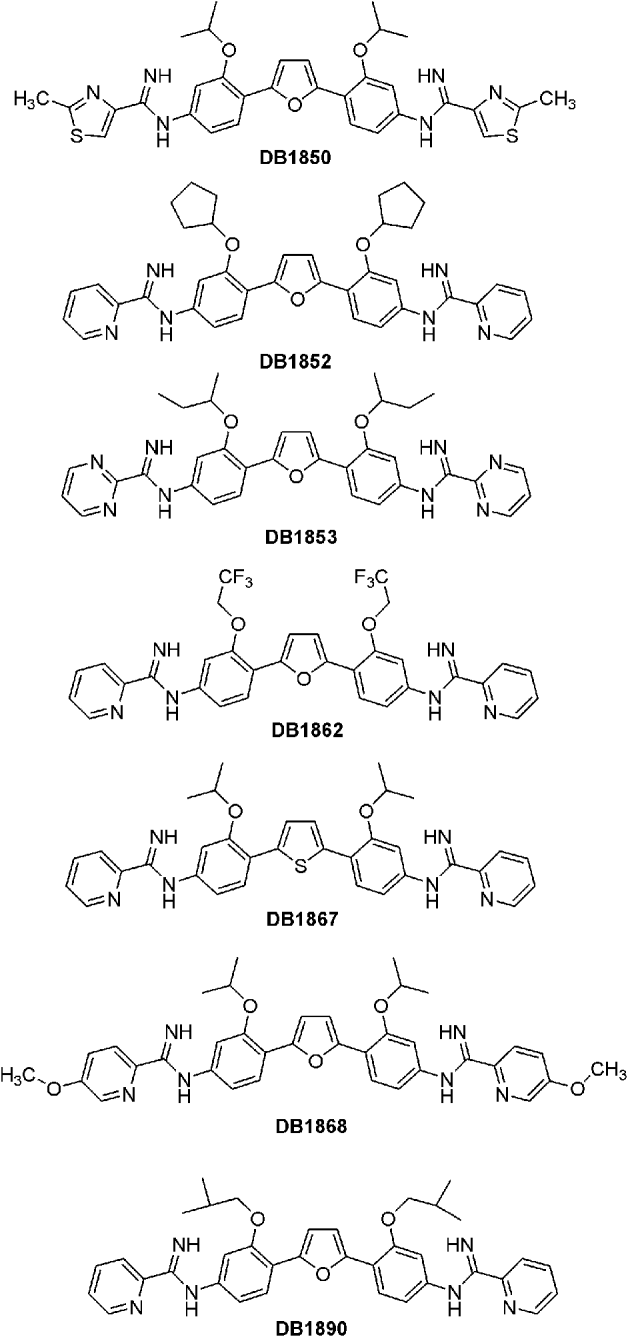
The synthesis of the 7 compounds (DB1850, DB1852, DB1853, DB1862, DB1867, DB1868, DB1890 – Fig. 1) was performed according to methods we have previously described (Stephens et al. Reference Stephens, Brun, Salem, Werbovetz, Tanious, Wilson and Boykin2003; Wang et al. Reference Wang, Zhu, Srivastava, Liu, Sweat, Pandharkar, Stephens, Riccio, Parman, Munde, Mandal, Madhubala, Tidwell, Wilson, Boykin, Hall, Kyle and Werbovetz2010) and will be published elsewhere. Benznidazole (Bz, Rochagan; Roche) was used as reference drug as reported (Batista et al. Reference Batista, Batista, de Oliveira, do Amaral, Lannes-Vieira, Britto, Junqueira, Lima, Romanha, Sales Junior, Stephens, Boykin and Soeiro2010). Stock solutions were prepared in dimethyl sulfoxide (DMSO), with the final concentration in the in vitro experiments never exceeding 0 6%, which did not exert any toxicity toward the parasite or mammalian host cells (data not shown).
Chemical structure of the compounds used in the study.

Parasites
The Y strain of T. cruzi was used in the present study. Bloodstream trypomastigote forms (BT) were obtained from T. cruzi-infected Swiss mice at the peak of parasitaemia (Meirelles et al. Reference Meirelles, Araujo-Jorge, Miranda, De Souza and Barbosa1986). For the analyses on intracellular forms, parasites lodged within cardiac cell cultures were employed, as previously reported (Silva et al. Reference Silva, Batista, Mota, de Souza, Stephens, Som, Boykin and Soeiro2007a).
Cardiac cell cultures and cytotoxicity assays
For the evaluation of toxicity and compound activity against intracellular parasites, primary cultures of embryonic cardiomyocytes (CM) were obtained from Swiss mice and purified following the method previously described (Meirelles et al. Reference Meirelles, Araujo-Jorge, Miranda, De Souza and Barbosa1986). In order to rule out toxic effects of the compounds on the host cells, uninfected CM cultures were incubated at 37°C with compounds for 24 h and 48 h (0 1–96 μ m). Untreated cultures were used as control samples. The cell death rates were measured by the MTT colorimetric assay allowing the determination of LC50 values (compound concentration that reduces 50% of cellular viability) (da Silva et al. 2010). All cell cultures were maintained at 37°C in an atmosphere of 5% CO2 and air, and the assays were run at least 3 times in duplicate. All procedures were carried out in accordance with the guidelines established and approved by the FIOCRUZ Committee of Ethics for the Use of Animals (0099/01).
Trypanocidal assays
The effect of the compounds against BT was evaluated through assaying 5×10⁶ parasites/ml for 24 h at 37°C in RPMI 1640 medium supplemented with 10% of fetal bovine serum, in the presence of serial dilutions of the AIAs (0 001–32 μ m). Untreated parasites were used as control samples. Alternatively, experiments were performed at 4°C for 24 h, with BT maintained in the presence of increasing concentrations of each compound (0 001–32 μ m) with or without mouse blood contents (96%). In these later assays, 4 μl of each compound (at 50% times the final dose) were added in 196 μl of blood from T. cruzi-infected mice. Parasite death rates were determined by light microscopy using a Neubauer chamber that allows the direct visualization and quantification of the number of motile and live parasites, and then IC50 (drug concentration that reduce 50% of the number of the treated parasites) calculated (Silva et al. Reference Silva, Batista, Mota, de Souza, Stephens, Som, Boykin and Soeiro2007a, Reference Silva, Meuser, De Souza, Meirelles, Stephens, Som, Boykin and Soeirob).
For the analysis of the effect against intracellular parasites, after 24 h of parasite-host cell interaction (ratio 10:1), the infected cardiac cultures were washed to remove the free parasites and then maintained, at 37°C in an atmosphere of 5% CO2 and air, in the presence of non-toxic concentrations of each AIA (from 0 004 up to 1 18 μ m), replacing the medium (with the respective compound) every 24 h. Infected cultures not treated were used as control. After 48 h, all cultures were fixed and stained with Giemsa solution. The endocytic index (EI) was used to compare the compound activity and was calculated by multiplying the percentage of infected cells by the mean number of parasites per infected cell (da Silva et al. Reference da Silva, Batista, Batista, de Souza, da Silva, de Oliveira, Meuser, Shareef, Boykin and Soeiro2008). Next, the IC50 was calculated based on the drug concentration that reduced 50% of the EI.
In all assays, the Selectivity Index (SI) was calculated as follows: SI=ratio LC50/IC50.
RESULTS
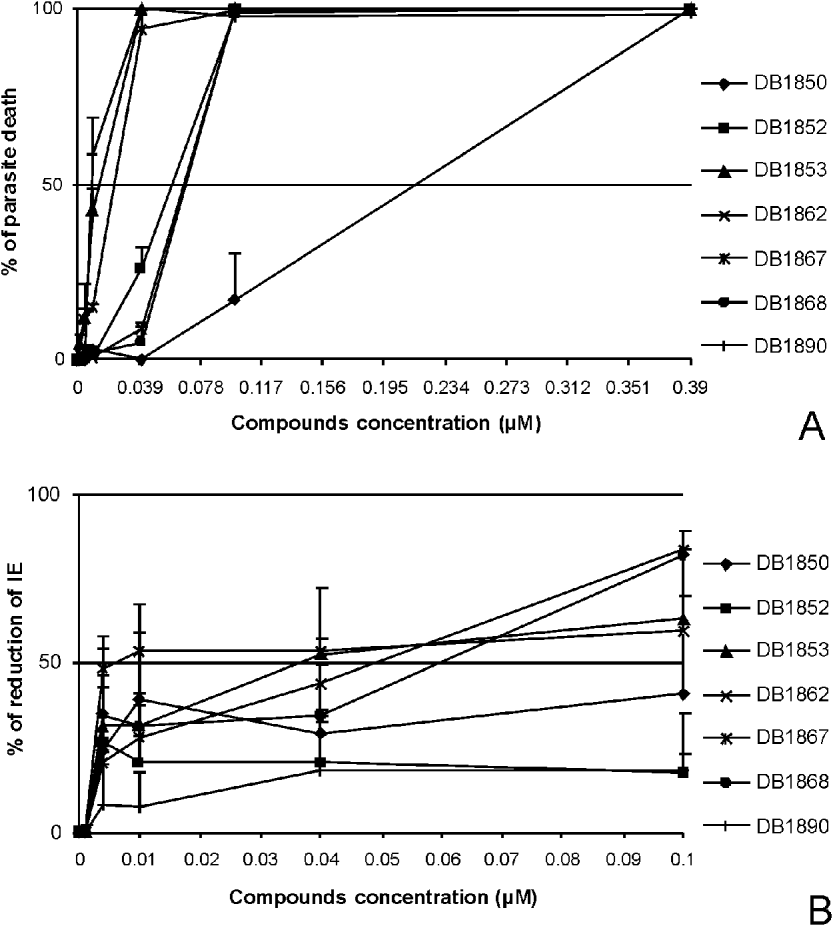
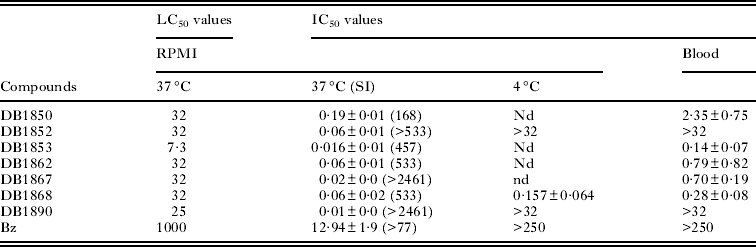
The biological activity of 7 novel arylimidamides (AIAs) was initially assayed against bloodstream trypomastigotes (BT) (Table 1, Fig. 2). When the compounds were diluted in the culture medium (RPMI) at 37°C, all showed a dose-dependent trypanocidal response (Fig. 2). In these experiments the compounds exhibited excellent in vitro activity achieving IC50 values in the low micromolar range (between 0 01 and 0 19 μ m) (Table 1, Fig. 2). The two most active compounds against BT at 37°C were DB1890 and DB1867, which presented IC50 values of 0 01 μ m and 0 02 μ m and SI values of 2461 and 1600, respectively, while DB1850 was the least active, with values of 0 19 μ m and 168 for IC50 and SI, respectively (Table 1). All the AIAs showed superior activity to BZ, presenting from 68 to 1200-fold higher efficacy than the reference drug (Table 1).
Activity in vitro of arylimidamides at 37°C against bloodstream trypomastigotes (A) and intracellular forms (B) of Trypanosoma cruzi (Y strain).

IC50 and LC50 (μ m) values of AIAs and benznidazole against BT forms of Trypanosoma cruzi and cardiac cells, respectively, with their respective SI values

BT=Bloodstream trypomastigotes.
SI*=selectivity index corresponds to the ratio LC50/IC50: SI was calculated on LC50 values of 24 h.
Bz=Benznidazole.
Nd=Not done.
The drug activity in the presence of blood at 4°C was evaluated with the goal to determine the applicability of these compounds for blood-bank prophylaxis. As it can be seen in Table 1, DB1850, DB1853, DB1862, DB1867 and DB1868 maintained considerable trypanocidal effect (at submicromolar range) at 4°C, presenting superior efficacy to that of Bz (Table 1). However, both DB1852 and DB1890 showed a pronounced decrease in activity (>32 μ m). Under these conditions, Bz did not show any activity at 4°C against trypomastigote forms (Table 1).
It is possible that the decreased activity may be related to the low temperature of the assay instead of only the presence of blood, therefore the effect of some compounds was investigated at 4°C but in the absence of blood, using only culture medium (RPMI). Compounds were selected based on their previous data: DB1868 that maintained its high trypanocidal activity compared to two other AIAs that displayed loss of activity (DB1852 and DB1890). For comparative analyses the reference drug Bz, was also included in the assay. Interestingly, lowering the temperature of incubation was sufficient to drop the activity of DB1852, DB1890 and Bz while DB1868, alone, was unaffected by the temperature (see IC50 values in Table 1).
To evaluate the toxicity of each AIA, uninfected cardiac cultures were incubated for 24 and 48 h with different doses of the compounds and the cellular viability evaluated by light microscopy and MTT colorimetric assays. Cellular viability was not significantly reduced by most of the AIAs after incubation for 24–48 h with doses up to 32 μ m (Tables 1 and 2).
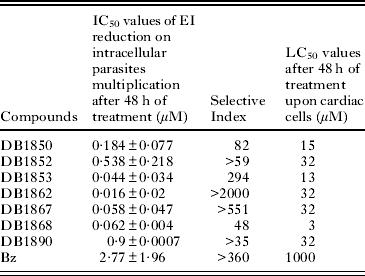
IC50 and LC50 values of AIAs and benznidazole against intracellular forms of Trypanosoma cruzi and cardiac cells, respectively, with their respective SI values

SI*, selectivity index corresponds to the ratio LC50/IC50 : SI was calculated on IC50 and LC50 values of 48 h.
Bz, benznidazole.
We further investigated the effect of the compounds on intracellular parasites by incubating T. cruzi-infected cardiac cells with selected non-toxic doses of each AIA. The direct quantification of the number of parasites in T. cruzi-infected cultures after 48 h of treatment showed a dose-dependent effect using all compounds (Figs 2 and 3). As found for BT forms, most AIAs exhibited excellent biological activity with IC50 values in the low micromolar range: between 0 016 and 0 9 μ m (Table 2). All AIAs were again more potent than Bz, with some of them showing considerably superior efficacy, as can be seen for DB1853 and DB1862, which were about 60 and 170-fold more potent than Bz, respectively (Table 2, Figs 2 and 3).
Light microscopy analysis of Trypanosoma cruzi-infected cardiac cells submitted (B) or not (A) to 0 13 μ m DB 1862 treatment.

The promising performance of this set of compounds was also observed by the evaluation of the selectivity index (SI). For the BT forms the SI values were between 168 and 2461 (Table 1), and for intracellular forms were >35 and >2000 (Table 2). Taken together the compound DB1862 displayed the best overall performance, with IC50 of 0 06 and 0 016 μ m and with SI values of ∼533 and >2000, for BT and amastigotes, respectively (Tables 1 and 2).
DISCUSSION
Aromatic amidines (AA), such as pentamidine, propamidine, and diminazene aceturate, are DNA minor groove binders that have long been used in infectious disease chemotherapy because they exhibit broad-spectrum anti-microbial effects (Soeiro et al. Reference Soeiro, Dantas, Daliry, Silva, Batista, de Souza, Oliveira, Salomão, Batista, Pacheco, Silva, Santa-Rita, Barreto, Boykin and Castro2009, Soeiro and de Castro, Reference Soeiro and de Castro2011). However, they display toxicity, require parenteral administration and present low bioavailability (Werbovetz, Reference Werbovetz2006), justifying the search for more effective analogues. Many AIAs have shown superior trypanocidal and leishmanicidal activity to that of the related aromatic amidines (De Souza et al. Reference De Souza, Lansiaux, Bailly, Wilson, Hu, Boykin, Batista, Araújo-Jorge and Soeiro2004, Reference De Souza, Oliveira, Boykin, Kumar, Hu and Soeiro2006, Reference De Souza, Nefertiti, Bailly, Lansiaux and Soeiro2010; Soeiro et al. Reference Soeiro, De Souza, Stephens and Boykin2005; Silva et al. Reference Silva, Batista, Mota, de Souza, Stephens, Som, Boykin and Soeiro2007a, Reference Silva, Meuser, De Souza, Meirelles, Stephens, Som, Boykin and Soeirob; Pacheco et al. Reference Pacheco, da Silva, de Souza, Batista, da Silva, Kumar, Stephens, Boykin and Soeiro2009; Batista et al. Reference Batista, Batista, de Oliveira, do Amaral, Lannes-Vieira, Britto, Junqueira, Lima, Romanha, Sales Junior, Stephens, Boykin and Soeiro2010; Wang et al. Reference Wang, Zhu, Srivastava, Liu, Sweat, Pandharkar, Stephens, Riccio, Parman, Munde, Mandal, Madhubala, Tidwell, Wilson, Boykin, Hall, Kyle and Werbovetz2010). In contrast to the original diamidines, in which the imino group is directly attached to an aryl ring, AIAs, previously named reversed amidines, present the imino group attached to an ‘anilino’ nitrogen (Soeiro and de Castro, Reference Soeiro and de Castro2011). Therefore our aim was to evaluate the activity and selectivity of additional novel AIAs against clinically relevant forms of Chagas disease.
When assayed against bloodstream trypomastigotes, these AIAs were able to induce a high level of parasite lyses in a dose-dependent manner, showing IC50 values in the submicromolar range. With the exception of DB1850, all the compounds had IC50 values lower than 0 07 μ m, confirming the excellent activity of the AIA class of compounds against T. cruzi as previously reported (Stephens et al. Reference Stephens, Brun, Salem, Werbovetz, Tanious, Wilson and Boykin2003; Silva et al. Reference Silva, Batista, Mota, de Souza, Stephens, Som, Boykin and Soeiro2007a, Reference Silva, Meuser, De Souza, Meirelles, Stephens, Som, Boykin and Soeirob; Pacheco et al. Reference Pacheco, da Silva, de Souza, Batista, da Silva, Kumar, Stephens, Boykin and Soeiro2009; de Souza et al. Reference De Souza, Nefertiti, Bailly, Lansiaux and Soeiro2010; Batista et al. Reference Batista, Batista, de Oliveira, do Amaral, Lannes-Vieira, Britto, Junqueira, Lima, Romanha, Sales Junior, Stephens, Boykin and Soeiro2010). The difference found in the activity of the most active compounds (DB1852, DB1853, DB1862, DB1867, DB1868, DB1890) compared to the less active compound (DB1850), could be due to binding to different targets, or even different modes of uptake and/or extrusion of the drugs. Pentamidine and other amidines such as DB75 are actively transported into African trypanosomes via the P2, HAPT1, and LAPT1 system of transporters (Lanteri et al. Reference Lanteri, Stewart, Brock, Alibu, Meshnick, Tidwell and Barrett2006) and accumulate at very high concentrations in the parasite mitochondria (Mathis et al. Reference Mathis, Holman, Sturk, Ismail, Boykin, Tidwell and Hall2006). However, until now, no report has appeared regarding the internalization of amidines by T. cruzi. The superior activity of AIA compared to AA compounds could be due to their lower pK values and greater lipophilic character which may contribute to their efficient entrance into cells (Mathis et al. Reference Mathis, Bridges, Ismail, Kumar, Francesconi, Anbazhagan, Hu, Tanious, Wenzler, Saulter, Wilson, Brun, Boykin, Tidwell and Hall2007). The IC50 values against BT forms are reasonably consistent except for that of DB1850. The lower activity of 1850 may be due the markedly different terminal groups (5-membered ring thiazoles for DB1850 and 6-membered ring pyridine or pyrimidine for the others). The 6 compounds with the higher activity against BT forms show that a range of variations in the O-alkyl groups (OCH2CF3 to O-c-pentyl) are tolerated. However, additional experimental data are needed to evaluate all of these hypotheses. Interestingly, all the compounds were significantly more active against BT forms than the current drug used for Chagas disease treatment, Bz.
The effectiveness of AIAs at 4°C in the presence of blood constituents was assessed in order to evaluate their potential use in prophylaxis for blood banking. This analysis may also identify the potential loss of compound activity due to plasma protein-compound interactions and may help to understand, in part, the pharmacokinetics and mechanism of action of these compounds. The incubation of BT under these experimental conditions showed that most AIAs maintained their activity (at submicromolar level) in the presence of blood (DB1850, DB1853, DB1862, DB1867 and DB1868), which confirms their potential as candidates for blood prophylaxis (Silva et al. Reference Silva, Batista, Mota, de Souza, Stephens, Som, Boykin and Soeiro2007a; Batista et al. Reference Batista, Batista, de Oliveira, do Amaral, Lannes-Vieira, Britto, Junqueira, Lima, Romanha, Sales Junior, Stephens, Boykin and Soeiro2010; da Silva et al. 2011).
In order to determine whether the reduction in activity observed for some AIAs (DB1852 and DB1890) was due to the low incubation temperature and not to compound instability and/or binding to blood elements, some of the AIAs were evaluated, along with BT, by substituting mouse blood for RPMI culture medium. The data demonstrated that these AIAs show decreased activity when incubated at 4°C with RPMI, suggesting that the drop in activity could be due to impaired compound uptake due to a transport-mediated uptake (de Koning, Reference de Koning2001) and/or due to decreased cellular target metabolism. Further studies are underway to clarify the effect observed in the present study.
These novel AIAs also exhibited considerable activity against intracellular parasites at doses that did not cause host cell damage, presenting superior activity when compared to Bz. In this case, a slightly different SAR (Structure-Activity Relationship) is seen in that DB1852 and DB1890 are less active against intracellular parasites as compared to BT. The cause of this difference is unclear but may be due to subtle differences in uptake, mechanisms of action and/or different targets. A viable drug candidate must be active against both clinical relevant forms, killing BT that are released from the cells as well as targeting the intracellular amastigotes. The present study shows that certain AIAs present this desirable characteristic. DB 1862 showed very high SI against both forms, and thus deserves to be considered for in vivo studies.
Taken together the set of compounds evaluated here showed excellent biological activity against clinically relevant forms of T. cruzi, showing high SI values and limited toxicity towards mammalian cells. The efficacy of these compounds against T. cruzi encourages in vivo evaluation as well as screening of new analogues in search of a useful alternative therapy for Chagas disease.
ACKNOWLEDGEMENTS
The present study was supported by Fiocruz and by Fundação Carlos Chagas Filho de Amparo a Pesquisa do Estado do Rio de Janeiro (FAPERJ – PP-SUS (2010), APQ1 (2011) and Pensa-Rio (16/2009-E-26/110-313/2010), Conselho Nacional Desenvolvimento científico e Tecnológico (CNPq), PDTIS/Fiocruz. The new AIA compounds were synthesized with support from the Bill and Melinda Gates Foundation.