IntroductionFootnote 1
This paper reflects on some of Andrew Battell’s most infamous descriptions of the allegedly cannibal Imbangala, called “Jaga” (spelled Giacchi or Iagges) in the texts, as printed by Samuel Purchas from 1613 to 1625 in Purchas, his pilgrimage and “The Strange Adventures of Andrew Battell” in Purchas, his Pilgrimes (hereafter Pilgrimage, “Strange Adventures,” and Pilgrimes, respectively).Footnote 2 As some of the only extant written accounts from Angola and Loango at the time Battell’s statement in Pilgrimage and “Strange Adventures” have been crucial for answering questions about history in early seventeenth-century Angola and Loango. However, as Jan Vansina noted in 2007, almost all scholars who relied on Battell’s statements read them as printed by E.G. Ravenstein in 1901 instead of the seventeenth-century originals.Footnote 3 He cautioned that the biggest risk of relying on Ravenstein, who printed Pilgrimage and “Strange Adventures” in reverse chronological order, was to “ignore explicit or inherent contradictions between the texts of 1613 and 1625 and to appreciate the chronological difference between them.”Footnote 4 This paper furthers methodological critiques of Battell’s materials by turning to the original texts with a particular focus on the chronological differences and on Samuel Purchas’s writing practices in Pilgrimage to understand editorial choices employed to produce “Strange Adventures.”Footnote 5 The resulting argument specifies how Purchas’s editorial project developed rapidly from 1613 to 1625 as he constantly sought to update his materials with the best and newest data possible derived from the most current eyewitness accounts that he could access. Assessment of the edits that Purchas made to Pilgrimage from 1613 to 1626 demonstrate that he considered and reconsidered what constituted authentic data and what sort of witnesses were most authoritative and reliable. As he negotiated the problems of data and authority in response to the scientific and religious context in England, Purchas amended text attributed to Battell in Pilgrimage and “Strange Adventures” even when such edits were based on no new information from Battell.
Purchas wrote Pilgrimage as an extended sermon on the history of Religion (his capitalization) in the world. The clergyman also crafted the discourse of Pilgrimage to take his reader on a historical and geographical journey through the world to observe and reflect on the diversity that God had placed in it. This project for Pilgrimage contrasted with Richard Hakluyt’s Principal Navigations that Purchas emulated or even his own later Pilgrimes, both of which (allegedly) reprinted traveler narratives in their own words. Emulating medieval morality tales, Pilgrimage turned stories of journeys into pious pilgrimages to help the reader contemplate religious truth through allegory.Footnote 6
For a source like Andrew Battell where no document outside of Purchas’s materials exists to verify his authenticity, it is nearly impossible to say for certain if Purchas faithfully recorded his informant’s words, amended those words to fit his agenda in Pilgrimage, or totally invented data and passed it off as belonging to the eyewitness. As with other overtly Christian texts such as missionary reports, Africanists have suggested Purchas’s religious agenda constrained him to repeating, or adding, only those aspects of African life that he deems sinful or evil.Footnote 7 While moral concerns were his focus at a meta-narrative level, patterns in the edits demonstrate that he also responded to mundane motivations when altering his Central African material. Even as an antiquarian Purchas developed his text in response to more careful definitions of scientifically verified knowledge of his day as well as religious and nationalist rivalries between Protestants and Catholics that heightened when the Scottish Catholic-friendly King James VI succeeded staunchly Protestant Queen Elizabeth as James I of England in 1603.
Revisiting Battell’s data by contextualizing it further within Purchas’s other texts and aided by analysis of his editorial project provides previously unappreciated insights into the production of “Strange Adventures.” Overall the data in the two Pilgrimage chapters on Loango and Angola (Volume 3, Book 7, Chapter 9 and 10) are derivative. Purchas relied on, indeed often copied almost word for word, passages in the Relation of the Kingdom of Kongo written and published in Italy by Filippo Pigafetta based on the eyewitness account of Duarte Lopes who stayed in Kongo from 1578 to 1583 (hereafter, the Relation).Footnote 8Pilgrimage contains some statements from Battell on Loango and Angola while most of his original material is found in “Strange Adventures.” Since Africanists read Ravenstein, who only reprinted the portions of Pilgrimage that related to Battell, Purchas’s voice as the author of Pilgrimage was decontextualized to the extent that Battell’s words seemed as if they could be taken at face value.
In 2007 when Vansina reconsidered Purchas’s editorial methods, Battell as an eyewitness, and especially the usefulness of Ravenstein’s text, he argued that Africanists had too casually assumed that “Strange Adventures” was Battell’s personal narrative. Beyond Joseph Miller’s argument that “Strange Adventures” contained “numerous additions from an editor in Europe,” Africanists barely mention Purchas when they cite Battell.Footnote 9 Critiquing the historiography Vansina wrote: “Nearly all modern readers act as if Battell wrote the ‘Strange Adventures’ all by himself, as if every statement in the text is in his very ipsissima verba, as if he had been an eyewitness to most of what he tells us, and as if the texts from 1613 [i.e. Pilgrimage] represent a faithful record by Purchas of his conversations with Battell. How much better can a source get?”Footnote 10 In the midst of this otherwise accurate critique of the historiography, Vansina claimed to quote the “1613 texts” of Pilgrimage, as he would throughout the article. By his own admission, he compared the 1626 text (fourth edition) with what Ravenstein printed from the 1617 text (third edition).Footnote 11 His belief that he was reading Battell’s statements as written is 1613 is an error that other scholars who relied on Ravenstein also made.Footnote 12
Purchas first published Pilgrimage in 1613; he rewrote, revised, and republished it in 1614, 1617, and 1626. A couple of Africanists have examined differences in the successive editions. Ravenstein carefully acknowledged reprinting only the 1617 Pilgrimage, but makes no indication whether or not he was aware of differences between the editions.Footnote 13 And, Paul Hair noticed Purchas’s additions of new accounts to the subsequent editions but did not indicate that text relating to Central Africa was revised or rewritten.Footnote 14
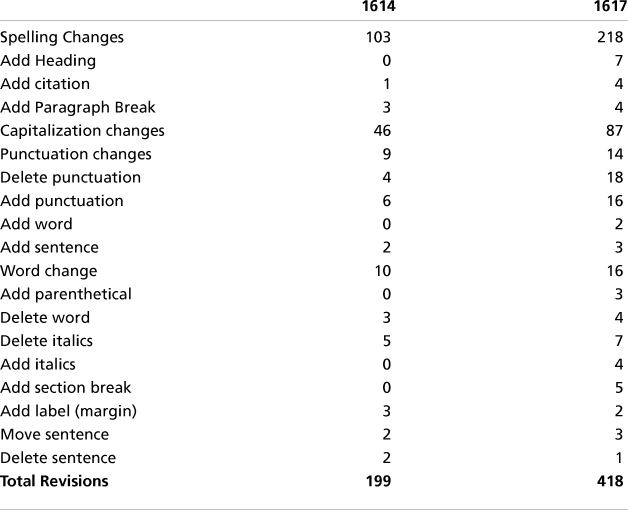
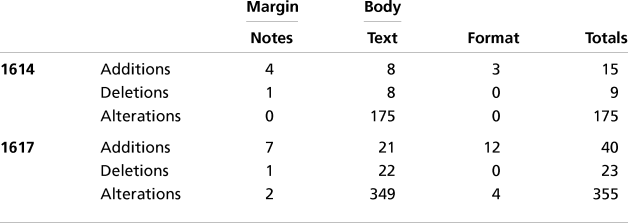
In fact, Purchas rewrote Pilgrimage extensively so that the 1613 text is quite different from later editions. The Central African chapters were heavily revised in 1614 and 1617, with very few edits in 1626. In all editions the two chapters comprise about twelve pages of body text with an edge margin for editorial comments. Additions, deletions, and alterations were made at all levels of the text: punctuation, spelling, words, sentence, paragraph, and chapter formatting. When compared side by side with the 1613 Pilgrimage text I counted 199 alterations in the 1614 edition; for the 1617 edition 418 alterations occurred from the 1613 text (for a difference of 219 changes from 1614 to 1617).Footnote 15 Most edits were what I termed insignificant (e.g. minor differences in spelling). Beyond the significant edits of new text or obvious textual formatting alterations, the most illuminating result of the study was noting that certain passages of text were densely edited and re-edited in 1614 and 1617. In perusing those passages most densely revised multiple times alterations that initially seemed insignificant like capitalization changes emerged as important indicators where Purchas subtly but clearly refined his Pilgrimage narrative. Patterns in the edits suggest he sought clarity of organization and description in the physical format of the text, updated economic and geographic numbers about topics such as slave trade exports as new data became available, rewrote to produce more efficacious homilies about God’s designs in the natural world, and countered data from Pigafetta/Lopes with more trustworthy data derived from British eyewitnesses. Not coincidentally, sensational activities alleged Jaga cannibalism or (to Purchas) curious religious rituals often correspond to portions of texts that Purchas was also motivated to revise heavily in Pilgrimage.Footnote 16 By far, the most extensively revised portion of text in the Pilgrimage editions is Battell’s Jaga narrative.
This diachronic analysis of statements about the Jaga homeland contributes to a long historiography that has tried to reconcile the differences between Lopes’s location of Jaga east of Kongo and Battell’s locating them in coastal Angola two decades later. The first modern scholars to investigate the issue of the Jaga homeland, such as David Birmingham, tried to understand the wide geographical range of the Jaga in the sources as migrations, essentially mirroring and updating Purchas’s assertions.Footnote 17 Miller argued in 1973 that a myth told amongst Portuguese sailors claimed all allegedly cannibal African groups were part of a single horde living in the as yet undiscovered heart of Africa.Footnote 18 He claimed the Jaga, glossed as cannibal invaders of Kongo in the Relation, were an expression of this myth and contended that the 1568 struggle in Kongo was an internal uprising of the oppressed.Footnote 19 Dismissing the barbaric glosses of cannibalism, he argued that Battell’s were the historical Jaga and predecessors to the Imbangala in Angola.Footnote 20 John Thornton and Anne Hilton contradicted Miller in support of the Relation; they argued people in Kongo had referred to some nearby outsiders as Jaga. These peoples were variously identified as living to the east and northeast of Kongo such as the Yaka (Thornton) or a combination of displaced Kongo and Tio (Hilton).Footnote 21 François Bontinck accepted Miller’s internal Kongo struggle, but equated it to a political struggle of Kongo nobility against the king rather than a popular uprising.Footnote 22 A key turn in the debate occurred when Paulo de Soares Pinto argued these previous scholars had focused too narrowly on identifying “Jaga” with known ethnic groups. Rather, he claimed jaga should be thought of as a generic term found in the sources.Footnote 23 Working from Pinto’s assertion, Mariana Candido argued the Portuguese in Angola named any Africans who resisted their presence jaga as one component of their strategy to assert authority through creation and application of names that indicated political privileges or consequences.Footnote 24 Thus, the debate over the Jaga homeland as being either near to Kongo or in Angola, has traversed through over four decades of Africanist analysis and been used to grapple with key questions like the identification of ethnic groups, the politics of colonialism, political instability in Kongo, and post-modern critiques of overly structural academic categories for ethnicity.Footnote 25 To these debates, this paper offers new insights on the production of “Strange Adventures” and analysis of Purchas’s changing assertions about the Jaga homeland.
Reflections on the Production of “Strange Adventures”
Africanists who read about Battell and his observations only through Ravenstein missed clues about Purchas’s broader project that likely shaped “Strange Adventures.” For example, though it cannot be proven unequivocally, Purchas left clues that his son, also named Samuel, transcribed “Strange Adventures.” Other more tentative observations from elsewhere in Purchas’s writings that bear on evaluation of Battell’s materials include a date of death for Battell and an earlier return to England than has been argued. Most importantly, if tentatively, I suggest that “Strange Adventures” should be considered a co-authored text of Andrew Battell, Samuel Purchas, and Samuel Purchas the younger that began with interview notes of Purchas/Battell before 1613 combined with Battell’s writing between 1615 and 1618/1619 and compiled and transcribed by 1622 when Purchas the younger entered Cambridge.Footnote 26
Purchas acknowledged in a long marginal note to “Strange Adventures” that he employed a transcriber for that text.Footnote 27 The note proves that Purchas allowed the transcriber’s voice to stand in the body text thus disproving the nearly ubiquitous assumption that “Strange Adventures” is Battell’s pure eyewitness account. Though Ravenstein and Hair had both noted the transcriber, Vansina was the first to write about the associated methodological problems with the transcriber whom he left unnamed. Claiming that Andrew Battell was likely an illiterate sailor he argued that “Strange Adventures” was probably penned by the transcriber based on oral interviews with Battell after 1613, similar to the pre-1613 interviews that Purchas conducted with Battell and included in Pilgrimage.Footnote 28 In the prefatory “To the Reader” to Pilgrimes, which Ravenstein did not print, Purchas noted that his son provided most translations and transcriptions for him.Footnote 29 Since the son quite fully replicated his father’s historical and religious worldview (like his father he attended St. John’s College at Cambridge, became an Anglican minister at Leigh, and wrote an historical-religious consideration of the natural world),Footnote 30 the methodological significance of identifying him as the transcriber indicates the near impossibility of determining whether passages in “Strange Adventures” that can be identified as events and data not witnessed by Battell (discussed below) were written by the editor (father) or transcriber (son).Footnote 31
Purchas also left clues about Andrew Battell like dates for his return to England and his death in works that africanists have not written about. The only specific date given in “Strange Adventures” was Battell’s departure from England in 1589. The title states he lived in Africa for “neere eighteen years,” indicating a return in 1607 or 1608.Footnote 32 Ravenstein reconstructed Battell’s movements and most Africanists seem to have implicitly accepted his assertion of a twenty-year absence with a return in 1610 or 1611.Footnote 33 However, in a 1619 Lent sermon Purchas stated Battell had a “sixteen years absence [from England].”Footnote 34 While not exactly consistent with the eighteen-year absence noted in “Strange Adventures,” this supports a return closer to 1607/1608 than 1610/1611. With an earlier return to England the possibility emerges that Purchas initially interviewed Battell closer to his African travels when his memory might be better, hinting that Battell’s statements in Pilgrimage might be more accurate than what was produced later. The same sermon also indicates Battell had earlier died from “a hurt in his thumb” clarifying that “Strange Adventures” was certainly composed prior to the Lenten season of 1619.Footnote 35 Since the preface to the printed sermon lamented the tragedies that Purchas experienced from Lent 1618 to Lent 1619, but the death of his friend Battell was not mentioned, it might be assumed that Battell died before Lent of 1618 but certainly not after Lent of 1619.Footnote 36 Earlier dates for Battell’s return to England and death would suggest that historians could assume greater certainty about Battell’s memory and the details in “Strange Adventures,” since they were likely recorded closer to his African adventures than has been thought.
If Andrew Battell was dead by 1619 and Purchas the younger wrote the transcription, then Vansina’s assertion that the transcriber wrote “Strange Adventures” needs amending. I propose, very tentatively, that Samuel Purchas quoted Battell relatively faithfully in Pilgrimage while archiving more extensive interview notes produced before 1613; Battell wrote parts of “Strange Adventures” on his own between 1615 and his death; and Purchas the younger transcribed, corrected, and expanded “Strange Adventures” from his father’s old notes for inclusion in Pilgrimes. That Samuel Purchas interviewed Andrew Battell and included portions, allegedly verbatim, from him in Pilgrimage in 1613 is known. These interviews were carried out in Leigh where Battell lived and nearby where Purchas ministered. In 1615 Purchas was appointed to London. There is no evidence to indicate if he ever returned to Leigh. Since Battell was dead by 1619 at the latest, and perhaps by 1618, if a transcriber interviewed Battell as Vansina argued, then those interviews must have occurred between 1615 and 1618/1619. Purchas the younger was born in 1601 and thus would have been interviewing Battell as an early to middle teenager making it unlikely (though not impossible) that he traveled from London for the interviews. Further, if Purchas the younger was the transcriber, one would assume that his father would have had access to transcriptions of his interviews with Battell to be included in the extensively revised 1617 version of Pilgrimage, but Purchas makes clear in “Strange Adventures” that “these papers came to my hand since [Battell’s] death.”Footnote 37 Thus, I propose Andrew Battell wrote text for “Strange Adventures” between 1615 when Purchas left for London, and 1618/1619 when he died.
My speculation is that before leaving for London in 1615 Purchas the elder posed a series of questions or prompts to Andrew Battell. This method of a publisher asking a traveler for an account was common. The accounts of travelers Hans Staden, Duarte Lopes, and an unnamed Portuguese pilot are linked to inquiries and questions from their respective publishers Johannes Dryander, Filippo Pigafetta, and Giovanni Ramusio (who was as much of an inspiration to Purchas as Richard Hakluyt) who directed narrative retellings. Though not as adept at inspiring travelers to write accounts as his predecessor Hakluyt, Purchas provided the impetus for some notable accounts of Africa. As Hair noted, Richard Jobson wrote his account of West Africa at Purchas’s behest.Footnote 38 Purchas also interviewed sailor Anthony Knyvett in order to expand portions of Knyvett’s journal relating to travels in Brazil and Africa that he found unsatisfactory.Footnote 39 Once he received Battell’s written account, Purchas the younger combined it with his father’s notes from the first interviews with Battell dating prior to 1613. As will be shown, he also likely updated portions of the account with other published sources.
Hearsay, Authority, and the Jaga Homeland
Though he maintained elements of the older antiquarian narrative style (e.g. the pilgrimage paradigm in an all-inclusive world history) Samuel Purchas simultaneously adopted practices to provide more accurate data based on new scientific methods. His careful attention to detail in his data (e.g. revisions to slave export numbers) and their presentation were following observational methods of empiricism more commonly associated with John Selden and especially Francis Bacon. Like the empiricists Purchas carefully maintained his notes and papers to preserve an archive for posterity (which he published as Pilgrimes) and used marginal comments to provide authority for the body text.Footnote 40 In relation to the Jaga material, and Battell’s materials more generally, Purchas’s attempts at printing the most verifiably accurate data resulted in a patriotically religious history that hinged on increasingly clear and combative contrasts between authoritative British Protestants (Andrew Battell) and gullible or deceitful Catholics (Lopes/Pigafetta) as he increasingly valued eyewitness assertions over data based on hearsay.
Purchas’s most significant edits to his Central Africa chapters through the four editions of Pilgrimage narrate Andrew Battell’s life with the Jaga. The alterations to this portion of the text are so radical that it is difficult to fully demonstrate their importance. Analyzing changes to the physical layout of the Jaga material proves that Purchas’s sense of authority derived from himself as author and clergyman in 1613 rapidly shifted to reliance on eyewitnesses as authoritative in the successive editions of Pilgrimage. Purchas, or his son as transcriber, continued to counter and revise Pigafetta and Lopes through carefully crafted text in “Strange Adventures” and Pilgrimes more broadly in 1625.
Though it seems unbelievable given how important Jaga cannibalism is in the historiography, in 1613 almost all personal data about Battell and his time living among the Jaga was placed in marginal note “m.”Footnote 41 The body text stated only that Battell lived with them for sixteen months.Footnote 42 The note explained how Portuguese trickery forced Battell to live and serve as a soldier among the Jaga before escaping. Relying on Battell’s memory of his time among them, the note also repudiates Duarte Lopes for reporting incorrect geographic and social data about the Jaga based on testimony of Christians in Kongo who had never met any Jaga in person. In 1614 Purchas relocated all of this marginal material into the body text thus highlighting its narrative strength.Footnote 43 He also created new paragraphs in 1614 for clarity and emphasis, including separating the Jaga from a discussion of the Anzichi (Anzicani in the Relation), another allegedly cannibal group from Loango. In 1617 Purchas further promoted the Jaga material by adding a new section break and title (“III. Of the Giacchi or Iagges”).Footnote 44 Thus, between 1613 and 1617 Purchas revised and emphasized Battell’s Jaga materials from an extended marginal note to one of the four sections that organized the narrative of Angolan geography and history.
Purchas’s increasingly strict posturing about the superiority of Protestant religion and British eyewitnesses are also evident in edits to the body text. In 1613, Purchas deferred to the widely accepted Relation about various Jaga customs but did not, in any way, counter it in the body text (only in the marginal note). In 1614, he prefaced the otherwise unaltered Pigafetta/Lopes Jaga information with a new attack on it as hearsay stating plainly: “Thus Lopes reporteth by Reports.” In the same year he removed all references to hearsay in any of his own assertions.Footnote 45 In 1617 he more clearly doubted Lopes’s Jaga material as hearsay by adding deceptively subtle qualifiers to some of Lopes’s data. For example Purchas questioned Lopes’s account of wars between the Jaga and unverifiable Amazons for the first time with “supposed Amazons.”Footnote 46
Ultimately, his rapidly changing standards for authentic data as requiring the verification of an eyewitness are clearest in edits to his statements about the Jaga homeland. Statements about the Jaga homeland in the successive editions of Pilgrimage demonstrate mostly plainly Purchas taking increasing liberties with his editorial and authorial assertions as he became more convinced of the superiority of eyewitness knowledge from 1613 to 1617. Consider these changing assertions alongside the 1625 statements of “Strange Adventures.” I add commentary inside of brackets for clarity, but otherwise copy the original texts. Recall that modern scholars compared only the 1617 and 1625 statements in Ravenstein.
[Battell] sayeth, they are called Iagges by the Portugall, by themselves Imbangolas, and came from Sierra Liona. This either is not the former Nation [reported by Lopes], but so called of like condition in manners, and invasion of Countries, or else these reports [Battell and Lopes] agree not. (Pilgrimage, 1613, page 589)
[Battell] sayeth; they are called Iagges by the Portugall, by themselves Imbangolas, and came from Sierra Liona. [Next sentence deleted] (Pilgrimage, 1614, page 702)
[Battell] sayeth; they are called Iagges by the Portugal, by themselves Imbangala (which term argues them to bee of the Imbij and Galz before mentioned) and came from Sierra Liona. (Pilgrimage, 1617, page 877)
We [Battell and his Portuguese companions] asked them, Who they were: then they told us, that they were the Gaga, or Gindes; that cames from Serra de Lion, and passed through the Citie of Congo; and so travelled to the East-ward of the great Citie of Angola, which is called Dongo. (“Strange Adventures,” 1625, page 974)
As noted above, Purchas seems to defer to Pigafetta/Lopes in 1613; he does not directly discredit their account as mere hearsay in the body text. And, he tepidly notes that Battell and Lopes differ on the location of the Jaga homeland as either being east-southeast (the Nile, Monomatapa) or northwest (Sierra Leone). Only in the long marginal note that provided context about Battell did Purchas state: “[N]either could Lopes (sayeth [Battell]) have true intelligence whence they came...” In 1614 Purchas had plainly stated earlier in the body text that Lopes only heard about the Jaga homeland from hearsay, which was verified by Battell’s statement that there was no possibility that Lopes had true knowledge of it. This strong assertion against Lopes was enough for Purchas in 1614 and he accepted Battell’s claim that the Jaga came from Sierra Leone to the northwest.Footnote 47 By 1617, Purchas had grown bold with his eyewitness information and his own ability and authority to marshal it into cogent arguments. He still doubted Pigafetta and Lopes, he maintained support for Battell’s claims, and he engaged in linguistic reconstruction. From “Imbangala” he determined that the Jaga were an aggregate of allegedly cannibal groups he described in other parts of Africa, the Imbij (Zimba) and Galz (Gala/Oromo).Footnote 48 So, by 1617 Purchas was both strongly denying the mythical claims of Lopes and asserting his own, allegedly, more accurate claim for the Jaga homeland based on better knowledge (the word “Imbangala” as their proper name) by the only true eyewitness, Andrew Battell. Sure of his facts, his marginal note about the Jaga homeland in “Strange Adventures” in 1625 declared plainly: “Lopes was deceived in their original.”Footnote 49
This diachronic comparison of Purchas’s evolving statements about the Jaga homeland casts doubt on Battell’s supposed eyewitness data in “Strange Adventures” as potentially based on Portuguese myths of the day. Many seventeenth-century Portuguese sources maintained that a single cannibal group traveled around the African continent on an equally mythical Nile/Niger/Congo/Zambezi River system that was linked in the as yet undiscovered heart of Africa. Miller provided a detailed introduction to the myth, given its fullest expression by the Jesuit Father Barreira.Footnote 50 Purchas obtained many materials about Africa from the publications of de Jarric in Latin, which included Barreira, only after 1615.Footnote 51 In 1617 Purchas wrote a completely new text written for his Guinea material based on Barreira that argued all allegedly cannibal African groups plaguing the entirety of the African continent descended from one “monstrous humane-inhumane devillish original” with different local names including Jaga (Kongo), Ginde (Angola), Galla (Ethiopia), Zimba or Imbij (Mozambique), Sumba and Mane (Sierra Leone) and that they all called themselves Imbangala.Footnote 52 Since Barreira had less to say about Central Africa his presence is much less noticeable in those chapters in 1617 than in the Guinea chapters.Footnote 53 But, Purchas clearly relied on Barreira to update Battell’s materials in 1617 as the linguistic construction Imbij + Galz = Imbangala.
If Purchas, rather furtively, used at least one other source to update Battell in Pilgrimage to counter the hearsay of Lopes, then the specifics about Battell’s conversation with the Jaga in “Strange Adventures” are suspect. Recall from the 1625 quote above that the Jaga told Battell that they were the “Jaga or Gindes” (no mention of Imbangala), that they came from “Serra de Lion” (not Sierra Leone as in Pilgrimage), and that they emigrated through Kongo and east of Dongo. Vansina ascribed most of these additions in “Strange Adventures” to the transcriber. He argued that the addition of Guindas to “Strange Adventures” was perhaps a further remembrance of Battell’s after 1613, but he claimed that removal of Imbangala and the supposed route of these Jaga through Kongo south to where Battell met was written by the transcriber.Footnote 54 He argued further, based on the comparison between the Jaga origin statements of the 1626 Pilgrimage and the 1625 “Strange Adventures,” that it makes no sense that the Jaga would claim to be from Sierra Leone, ascribed the Sierra Leone theory to the Portuguese in Battell’s trading party, and notes evidence that the link between the Jaga and the Guindas was also based on rumor in Luanda dating to nearly a decade prior.Footnote 55 Adding some specificity to Vansina’s assertions, since it is clear that in 1617 Purchas altered Battell’s Jaga materials based on Barreira’s assertions that included a mention of the Guindas in Angola nearby where Battell met these “Jaga,” perhaps Purchas the younger added details in 1625 to align Battell’s materials even more closely with Barreira’s.
Precedent for additions to Battell’s data exists elsewhere in “Strange Adventures.” Vansina demonstrated a story about a child being killed in Loango for seeing a king drink was added to “Strange Adventures” even though the incident was not witnessed personally by Battell.Footnote 56 Even in Pilgrimage Purchas took liberties ascribing data to his eyewitness Andrew Battell. Ravenstein noted where Purchas took the name of a mythical lake recorded by Duarte Lopes and ascribed authority for that data to Battell.Footnote 57 Since there are precedents for additions to Battell’s data, the additions to the Jaga homeland based on Barreira is reasonable and damning to assumptions that “Strange Adventures” is entirely based on Battell’s statements on the subject.
Purchas’s most drastic and increasingly combative textual changes in Pilgrimage were reserved for proving the veracity of his work against the Catholic myths and misconceptions of Pigafetta and Lopes. The Jaga homeland is mentioned in only one sentence in each of the various texts; they are quoted above. Conversely, when printing an English translation of the Pigafetta/Lopes Relation Purchas twice made marginal comments about flaws in Lopes’s account of the Jaga and referred the reader to Battell’s eyewitness material.Footnote 58 And he devoted an entire paragraph in Pilgrimage to clarifying that Lopes’s account was based on hearsay while Battell was the only white man to live among the Jaga.Footnote 59
Lopes reports by Reports. Andrew Battell lived (…) with the Jaga a longer time than any Christian (…) namely, sixteen months (…). Neither could Lopes have true intelligence (…) for Christians in those days had but uncertain conjectures (…) but [Battell] fled to them for his life, and escaped from them: the only European that ever lived in their camp.Footnote 60
Since Purchas devoted more effort to proving Lopes’s location for the Jaga homeland to be false than faithfully reproducing Battell’s words, all statements in both Pilgrimage and “Strange Adventures” must be evaluated in light of his rapidly changing sense of accurate data and authority, which were expressed in the text through a rivalry with Pigafetta and Lopes. Ironically, while using Andrew Battell to disprove the hearsay of the Catholic Lopes, Purchas undermined Battell’s credibility as an eyewitness by modifying “Strange Adventures” based on the allegedly eyewitness testimony of the Jesuit Barreira, which suggests that Purchas felt Catholics with a reputation for scientific training, like Jesuits, could be trusted more than Catholics or Protestants without scientific training. One wonders if Purchas or his son corrected details about the Jaga to provide the most accurate data possible from Battell, or if his hardening stance about a Catholic inability to provide true data in a context where Anglicans felt increasingly threatened at home by Catholic sympathizers led him to engage in seductively creative reconstructions based only on those parts of Battell’s account that contradicted Lopes and Pigafetta.
Conclusion: Rivalry and Reformation Politics in Purchas’s Central African Triptych
Battell’s narrative was subjected to one homogeneous editorial paradigm in every printing from 1613 to 1626 with Purchas elder as author and editor for Pilgrimage and Purchas elder and younger working as editor and transcriber (respectively) for “Strange Adventures.” For scholars devoted to late sixteenth and early seventeenth-century Angola, this suggests that “Strange Adventures” needs to be read cautiously as a response to the Protestant/Catholic rivalries of Reformation Europe. Further, “Strange Adventures” cannot be fully contextualized in isolation. At the very least, it must be read as a part of the elder Purchas’s triptych of Central Africa texts with Chapters 9 and 10 in Pilgrimage and the translation of the Pigafetta/Lopes Relation that he printed immediately following “Strange Adventures” in Pilgrimes. To this end, a new critical edition of “Strange Adventures,” ideally one that prints this triptych together, is warranted as Ravenstein’s editorial choices are unsuitable for specialized analysis for all the reasons Vansina demonstrated.
This analysis narrates one clear example of how the details of Angolan history could be altered by British editors based on other concerns like creating a text that was clear for readers, updating and defining accurate data, and highlighting contrasts between triumphant Protestants and gullible or deceitful Catholic rivals. When the corresponding texts from the various Pilgrimage editions and “Strange Adventures” regarding the Jaga homeland are compared together they exemplify that the editor altered data based on no new information from the eyewitness informant but rather on additions from other accounts. It is noteworthy that only four years after the first publication of Pilgrimage Purchas was willing to revise Battell’s information about the Jaga homeland based on the account of Barreira, who supported his assumption about a mythical, single horde of African cannibals and whose opinion as an intellectually trained Jesuit would have impressed the erudite Purchas. Samuel Purchas’s editorial paradigm and methods as evidenced in the Pilgrimage edits make “Strange Adventures” uniquely difficult to evaluate for eyewitness data amongst the already problematic travel accounts he printed in Pilgrimes because it is probable that he and his son both authored text to this allegedly eyewitness account unlike other narratives where he more often cut text as editor. Carefully examining trends in the edits to Pilgrimage can shed some light about the sorts of details in “Strange Adventures” that one of the Purchases were most likely to alter. Mostly these relate to sensational events and creatures, religious ceremonies involving witchcraft (or the “Devil”), or data that spoke to intellectual debates current at the time (e.g. the font of the Nile River). Still, even with very methodical reading of “Strange Adventures” as contextualized by Purchas’s evolving editorial paradigm and his other writings, in the absence of a handwritten manuscript that likely does not exist, it will be impossible to say for sure what portions of text are Battell’s ipsissima verba.
In tracing his editorial practices in Pilgrimage from 1613 to 1617 we can observe Samuel Purchas’s editorial methods for evaluating and reproducing scientifically authentic data that bear on any evaluations of the 1625 “Strange Adventures.” And, one questions the motivations for the edits. Purchas’s ascension in the Anglican Church seemed to coincide with publishing revised, allegedly more accurate versions of his history of Religion in the world that reserved its harshest critiques for Catholics even as it criticized all sorts of “others” – including alleged cannibals like the Imbangala (Jaga).Footnote 61 In the end, his edits to Battell’s material in the successive editions of Pilgrimage responded to historical changes and intellectual and religious considerations in England, not to new information from Battell. It is likely that Battell’s Angola and Loango recollections in “Strange Adventures” were similarly modified and, therefore, co-authored by Samuel Purchas or (more likely) his son in response to local and personal concerns in England.
Jared Staller is currently a lecturer at Rice University. His dissertation was a history of ideas about the history of São Tomé Island. His current research investigates the history of sixteenth century Kongo and Angola. E-mail: jared.staller@rice.edu
Appendix: Description of Work Method and Data Matrices
-Description of Method and Definitions
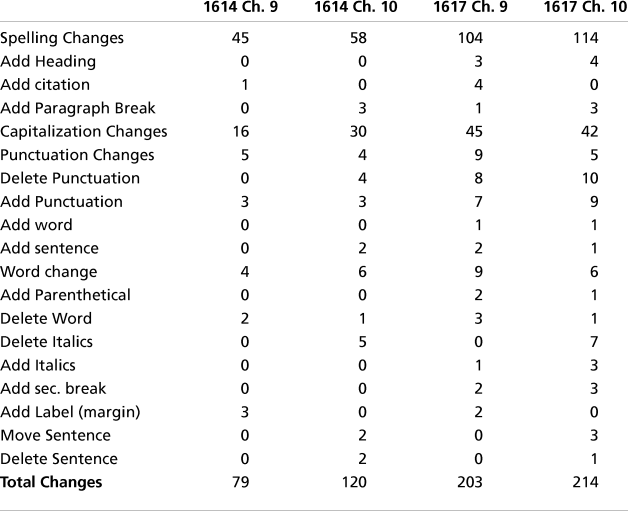
First I read Chapters 9 and 10 from Book Seven of the 1613 Pilgrimage. Then I compared Book Seven Chapters 9 and 10 the 1614 text to the 1617 text in order to see where Purchas had either re-edited text, or perhaps made new edits altogether.Footnote 62 In comparing the 1626 text to 1617 I found so few alterations, aside from the addition of a map that precedes the chapter, that there was no need to compare 1626 to 1613.Footnote 63 I compiled the statistics of the textual alterations from 1614 and 1617 (in relation to 1613) into two matrices. In one matrix I charted changes to each chapter of the text/format as only additions/deletions/alterations so as to gain a broad view of the basic trends in edits. In another matrix I charted specific types of changes like spelling changes, capitalization changes, or addition/deletion of words.
I examined my marked copies to see if any patterns emerged in the edited portions of text. Most paragraphs averaged three to eight edits. The majority of these edits I considered “insignificant” – minor spelling changes, punctuation changes, etc. On the contrary, when I observed “significant” edits like additions of text or formatting changes I noted that the density of edits was also much higher. So, for example, a sentence with a significant edit like the addition of a word might also include up to seven seemingly insignificant edits like spelling changes and capitalizations. I reexamined the most heavily revised portions of text in both 1614 and 1617 to uncover any development of Purchas’s religious and intellectual project. Overall the majority of textual changes demonstrate no development of any of Purchas’s central arguments.
My definition of an insignificant edit was any textual change that did not indicate any development of Purchas’s descriptions or ideas about true knowledge, religion, Africa, or Africans. Deletions from Pilgrimes are insignificant because they usually erase superfluous words.Footnote 64 Extraneous punctuation marks (e.g. a free-floating parenthesis) were also deleted. The vast majority of textual edits are spelling changes in both 1614 and 1617.Footnote 65 Spelling changes are not uniform throughout the successive editions or even within one printing. Fortunately all of the spelling changes are, for the current purposes, insignificant. Even when Purchas altered spelling of words from African languages Vansina assures us that we can decipher the original language.Footnote 66
Significant edits were those that indicated Purchas used writing or editing techniques to clarify and categorize religions, peoples, and the world. Significant revisions occurred where he replaced one word with another. Revisions, usually additions, in the marginal notes always profoundly emphasized Purchas’s authority as author/editor. Most punctuation changes are insignificant, but in a few cases the meaning of a sentence or word could potentially change. Alterations in capitalization, which originally seem haphazard and insignificant, are sometimes quite significant edits for ascribing more categorical and narrative value of nouns like “idol” or “religion” in 1613 to proper nouns “Idol” or “Religion” in 1614/1617.
-Notes about the Tables
Note that in both 1614 and 1617 Chapter 10 was revised more than Chapter 9. The heavily revised Battell/Jaga material occurs in Chapter 10, which accounts for the increased number of edits. Though many 1614 edits were maintained in 1617, it should not be assumed that all were.
Number and Types of Edits in 1614 and 1617 compared to the text printed in Book Seven, Chapters 9 and 10 of the 1613 Pilgrimage

Trends in the Edits of 1614 and 1617 compared to the text printed in Book Seven, Chapters 9 and 10 of the 1613 Pilgrimage
Specific Number and Types of Edits in 1614 and 1617 disaggregated by chapter compared to the text printed in Book Seven of the 1613 Pilgrimage