Introduction
In this report, a new species of myliobatiform ray, Hypolophites beckeri n. sp., is described from isolated pavement teeth recovered from the Lower Clayton Limestone Unit (LCLU) of the Midway Group near Malvern, Arkansas (AR), USA. This particular Hypolophites species is the fifth known globally and represents the westernmost occurrence and first report of the genus in the Mississippi Embayment and Gulf Coastal Plain (GCP) of the USA. Hypolophites species are biostratigraphically significant in regional and global stratigraphic analyses because they have only been reported from the Paleocene. The occurrence of an additional Hypolophites species in AR extends the known paleogeographic distribution of Hypolophites ~1,750 km westward and suggests that the genus is more diverse and widespread than originally recognized. Moreover, the distribution of Hypolophites during the Paleocene attests to the migratory abilities and diversification of myliobatiforms following the K/Pg mass extinction event.
Geologic setting
In southwestern Arkansas, Upper Cretaceous and Paleocene formations are infrequently exposed due to dense vegetation overgrowth (Haley et al., Reference Haley, Glick, Bush, Clardy, Stone, Woodward and Zachry1993, Reference Haley, Stone, Clardy and Hanson2009; McFarland, Reference McFarland1998, Reference McFarland2004). Near the town of Malvern, Arkansas, highway stabilization, commercial development, and erosion in the Ouachita River has discontinuously exposed the: (1) Maastrichtian Arkadelphia Formation that consists of dark, micaceous clays interbedded with fossiliferous sandy coquina lenses; (2) Arkadelphia Formation-Midway Group Contact (K/Pg boundary) that occurs as a coquina lag deposit that includes phosphate pebbles and distinctly Cretaceous macrofossils, including chondrichthyans, osteichthyans, plesiosaurs, turtles, and ammonites (see Becker et al., Reference Becker, Chamberlain and Wolf2006, Reference Becker, Mallery and Chamberlain2010, Reference Becker, Maisch and Chamberlain2013, Reference Becker, Maisch and Chamberlain2016; Maisch et al., Reference Maisch, Becker and Griffithsin press); (3) lower Midway Group (Paleocene) that is composed of gray clays and sandy limestones; and (4) upper Midway Group (Paleocene) that occurs mainly as orange/tan clays and limestones.
Currently, the Paleocene Midway Group in Arkansas has been informally subdivided into the Clayton Limestone (or Clayton Formation) and Porters Creek Clay (McFarland, Reference McFarland1998, Reference McFarland2004; Becker et al., Reference Becker, Smith and Chamberlain2011; Becker and Chamberlain, Reference Becker and Chamberlain2012). The Clayton Limestone can be further divided into the Lower and Upper Clayton Limestone Units (LCLU and UCLU), as observed in recent excavations along Interstate-30 (I-30) directly adjacent to the Ouachita River, ~4 km northwest of Malvern, Arkansas (Fig. 1; Maisch et al., Reference Maisch, Becker and Griffithsin press). The LCLU exposed in this outcrop is the source of the Hypolophites teeth featured in this study and consists of >20 m of massive, dark gray clays containing invertebrate casts and molds, thin interbedded sandy limestone units, and three locally phosphatic, sand and pebble lag deposits containing chondrichthyan and osteichthyan remains (Fig. 1; Maisch et al., Reference Maisch, Becker and Griffithsin press). Higher in this section, tan and yellow clays with thin limestone beds of the UCLU are exposed and appear identical to those occurring ~2.7 km to the northeast, as described by Becker et al. (Reference Becker, Smith and Chamberlain2011) and Becker and Chamberlain (Reference Becker and Chamberlain2012). Myliobatiforms occur in the UCLU; however, Hypolophites teeth have not been recovered (Becker et al., Reference Becker, Smith and Chamberlain2011; Maisch et al., Reference Maisch, Becker and Griffithsin press).
Location of the Lower Clayton Limestone Unit of the Paleocene Midway Group near Malvern, Arkansas, USA. (1) Reconstructed Late Cretaceous–Maastrichtian (a) and Paleocene–Danian (b) shorelines across the Atlantic and Gulf Coastal Plains and Western Interior Seaway indicated by arrows (modified from Scotese, Reference Scotese2014; Becker et al., Reference Becker, Maisch and Chamberlain2016). The location of Hypolophites beckeri n. sp. described in this study near Malvern, AR, is indicated by + and the location of Hypolophites hutchinsi Case, Reference Case1996, in NJ, is indicated by *. (2) Physiographic provinces in Arkansas, with Malvern indicated by X. (3) Outcrop exposure of the Lower Clayton Limestone Unit (LCLU) of the Midway Group adjacent to I-30 near Malvern, Arkansas.

Although the Midway Group in Arkansas has not been formally sub-divided into formations or correlated to specific Paleocene stage boundaries as recognized in the eastern Mississippi Embayment, preliminary data from dinoflagellates and otoliths indicate that the lower Midway Group in this section is Danian in age (Mancini et al., Reference Mancini, Tew and Smith1989; McFarland, Reference McFarland2004; Mancini and Puckett, Reference Mancini and Puckett2005; Dastas et al., Reference Dastas, Chamberlain and Becker2010; Stringer and Sloan, Reference Stringer and Sloan2018). Additionally, many chondrichthyans reported from the LCLU have also been found in contemporaneous Paleocene deposits in the Atlantic Coastal Plain (ACP) of the USA, western Europe, and northern Africa (e.g., Ward and Wiest, Reference Ward and Wiest1990; Case, Reference Case1996; Cappetta, Reference Cappetta and Schultze2012; Adolfssen and Ward, Reference Adolfssen and Ward2015).
Materials and methods
Over 500 kg of sediment was bulk sampled from the LCLU for laboratory analysis. Sediment was thoroughly rinsed through 5.0–0.5 mm sieves and dried under heat lamps. Fossils, including the holotype and paratypes featured in this report, were recovered from dried sediment using forceps and imaged using an Olympus SZ61 binocular microscope attached to an Infinity 2 Digital Camera. An Evex Mini SEM SX-3000 operating in the range of 20kv was also utilized to image several specimens with diagnostic morphological features.
Repositories and institutional abbreviations
For comparative purposes, the holotype and paratypes of Hypolophites hutchinsi Case, Reference Case1996, were examined at the American Museum of Natural History (AMNH), New York, USA (holotype: AMNH: FF14585; paratypes: AMNH: FF13875–13877; 14583, 14584). Specimens of Hypolophites beckeri n. sp. included in this study have been reposited in the Academy of Natural Science (ANSP) of Drexel University, Philadelphia, Pennsylvania, USA, under the catalog numbers ANSP: VP25128–25132; 25148–25152.
Systematic paleontology
Class Chondrichthyes Huxley, Reference Huxley1880
Subclass Elasmobranchii Bonaparte, Reference Bonaparte1838
Cohort Euselachii Hay, Reference Hay1902
Subcohort Neoselachii Compagno, Reference Compagno1977
Order Myliobatiformes Compagno, Reference Compagno1973
Superfamily Myliobatoidea Compagno, Reference Compagno1973
Family Myliobatoidea insertae familiae
Genus †Hypolophites Stromer, Reference Stromer1910
Type species
Hypolophites myliobatoides Stromer, Reference Stromer1910.
†Hypolophites beckeri new species
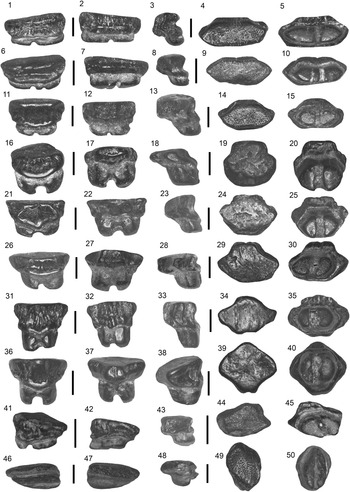
Figures 2, 3
Hypolophites beckeri n. sp. teeth from the Lower Clayton Limestone Unit of the Paleocene Midway Group near Malvern, Arkansas, USA. (1–5) Median tooth (ANSP: VP25128), (6–10) median tooth (ANSP: VP25148), (11–15) median tooth (ANSP: VP25129), (16–20) lateral tooth (ANSP: VP25149), (21–25) holotype: lateral tooth (ANSP: VP25131), (26–30) lateral tooth (ANSP: VP25150), (31–35) lateral tooth (ANSP: VP25130), (36–40) lateral tooth (ANSP: VP25132), (41–45) lateral-most tooth (ANSP: VP25151), (46–50) lateral-most tooth (ANSP: VP25152). Orientations:(1, 6, 11, 16, 21, 26, 31, 36, 41) = lingual; (2, 7, 12, 17, 22, 27, 32, 37, 42) = labial; (46, 47) = lateral; (3, 8, 13, 18, 23, 28, 33, 38, 43, 48) = profile; (4, 9, 14, 19, 24, 29, 34, 39, 44, 49) = occlusal; (5, 10, 15, 20, 25, 30, 35, 40, 45, 50) = basal. Note: Extensively wrinkled lingual and labial surfaces, occlusal surface ornamentation (4, 14, 44, 49), and wear facets (19, 24, 29), hexagonal to trilobed occlusal surfaces (14, 19, 24, 29), root with two nutritive grooves (10), and well-defined foramina (30, 45). All scale bars = 2 mm.

Comparison of lateral teeth from all presently known Hypolophites species showing diagnostic occlusal and basal tooth surfaces and scanning electron microscope images of unique features observed on Hypolophites beckeri n. sp. teeth from the Lower Clayton Limestone Unit of the Paleocene Midway Group near Malvern, Arkansas, USA. For line drawings, the shaded areas seen in basal view correspond to root lobes and the stippled pattern on the root of Hypolophites thaleri indicates that the root lobes are worn and obscured. (1) Pitted and vermiculate pattern on the occlusal surface of Hypolophites beckeri n. sp. lateralmost tooth (ANSP: VP25151) indicated by arrow; (2) basal surface view of Hypolophites beckeri n. sp. lateral tooth (ANSP: VP25131) with numerous foramina between and around the edges of the root lobes indicated by arrow; (3) labial view of Hypolophites beckeri n. sp. median tooth (ANSP: VP25129) with concave and wrinkled surface and distinct separation of the crown from the root as indicated by arrows; (4) lingual view of Hypolophites beckeri n. sp. median tooth (ANSP: VP25129) with flattened, slightly furrowed surface indicated by arrow. All scale bars = 2 mm.

Holotype
ANSP: VP25131; paratypes: ANSP: VP25128–25130; 25132; 25148–25152.
Diagnosis
A Hypolophites species with median and lateral pavement teeth that have hexagonal and rhombus-shaped, trilobate, and finely pitted occlusal surfaces, heavily wrinkled crown edges, a “U- or V-shaped” labial uvula, and small lingual shelf. Occlusal surface pitting forms a vermiculate pattern and is more frequently preserved on lateral teeth. The occlusal surfaces of median and lateral teeth have a mesial-distal width that may exceed 5.0 mm. In general, the length between the lingual and labial surfaces is half the mesial-distal occlusal surface width. As seen in profile view, crown and root thicknesses of median and lateral teeth are nearly equivalent and teeth may exceed 4.0 mm in total height. The lingual tooth surfaces are concave and extensively wrinkled, while the labial tooth surfaces are flat to slightly convex with dorso-ventrally oriented furrows. Roots of median and lateral teeth are generally bilobate, terminate with rounded bases, and may contain several foramina within the nutritive groove and on the edges of the root lobes. The roots of some median teeth may contain two nutritive grooves that asymmetrically divide the root.
Occurrence
Lower Clayton Limestone Unit of the Midway Group (Paleocene), adjacent to Highway 84, Interstate-30, and the Ouachita River ~4 km NW of Malvern, Arkansas, USA.
Description
Median and lateral teeth have crowns that overhang the labial root surface and hexagonal-like, vermiculated surface-pitting on the occlusal surfaces when unworn. Edges of the occlusal surface in median and lateral teeth may be: (1) rounded and form a trilobate shape on the labial crown edge; or (2) hexagonal with nearly straight, smooth edges. Median teeth are mesio-distally elongated, while lateral teeth are more equidimensional. Lateralmost teeth are labio-lingually elongated and increasingly compressed in dorsal-ventral and mesial-distal dimensions. Teeth in all jaw positions have lingual crown surfaces that are concave in profile view, labial tooth surfaces that are straight to slightly convex in profile view, and contain well-defined, vertical wrinkles or furrows that extend from the occlusal surface to the crown-root interface on all tooth edges. Median and lateral teeth have an enameloid crown that overhangs the root on the labial surface in profile view. The lingual surfaces of median and lateral teeth form a small but distinct “L”-shaped ledge and contain a “U- or V-shaped” uvula that is directed at the separation between the underlying root lobes. The roots of median and lateral teeth are generally bilobate, peg-like to pentagonal in shape, and have slightly convex, basal surfaces. Median teeth may contain roots with symmetric or asymmetric lobes. Lateral tooth roots become progressively more offset with increasing distance from the symphysis, such that the root lobes extend to different lengths beyond the lingual crown surface. A well-defined nutritive groove occurs between the root lobes in all teeth and frequently contains 1–3, centrally located foramina. Several small foramina may also be present on the edge of the root lobes. Although infrequent, median teeth may have a second, less-developed nutritive groove.
Etymology
Named in honor of Dr. Martin Becker for his pioneering and ongoing field endeavors focusing on the paleontology of Late Cretaceous–Paleocene marine vertebrates in the Malvern, Arkansas, region.
Remarks
Pavement teeth of Hypolophites beckeri n. sp. can be distinguished from similar teeth of Hypolophus sylvestris White, Reference White1931, Rhombodus binkhorsti Dames, Reference Dames1881, Myliobatis sp., and Rhinoptera sp. previously reported from the Malvern, Arkansas, region based on the presence of hexagonal to trilobate occlusal surfaces, well-developed, vertical wrinkles on all tooth edges in profile view, labial enameloid overhanging the root base, a lingual uvula, and a bilobate root generally separated by a single nutritive groove containing at least one central foramen (Becker et al., Reference Becker, Chamberlain and Wolf2006, Reference Becker, Smith and Chamberlain2011; Maisch et al., Reference Maisch, Becker and Griffithsin press). Hypolophites beckeri n. sp. teeth are also distinct from those of Hypsobatis weileri Cappetta, Reference Cappetta1992, Pseudohypolophus mcnultyi (Cappetta and Case, Reference Cappetta and Case1975), and Myledaphus specie because they do not have a two-tiered occlusal surface, a transverse ridge and faint labio-lingual folds on the occlusal and lateral surfaces, smooth crown surfaces in occlusal and profile view, well-developed foramina near the crown-root interface, or occur in the Late Cretaceous (e.g., Cappetta, Reference Cappetta and Schultze2012). Teeth of Apocopodon sericeus Cope, Reference Cope1886, appear similar to those of Hypolophites; however, they have thick crowns with anastomosing ridges on the occlusal surface, are polyaulachorhizous, and have only been reported from the Paleocene of Brazil and South Carolina (Ribiero de Santana et al., Reference Ribeiro de Santana, Cicimurri and Barbosa2011; Cappetta, Reference Cappetta and Schultze2012). Potobatis semperei Cappetta and Gayet, Reference Cappetta and Gayet2013, teeth also appear similar to those of Hypolophites; although, they have a smaller overall size, noticeable round-conical projections on the occlusal surface, thin roots that are nearly as wide as the crown, and are only known from the Paleocene of Bolivia.
Hypolophites beckeri n. sp. teeth have only been found as isolated specimens; however, they are distinct from those of previously reported taxa including: (1) Hypolophites myliobatoides Stromer, Reference Stromer1910; (2) Hypolophites mayombensis Leriche, Reference Leriche1913; (3) Hypolophites thaleri Cappetta, Reference Cappetta1972; (4) Hypolophites sp. Cappetta, Reference Cappetta1972; and (5) Hypolophites hutchinsi Case, Reference Case1996. Hypolophites beckeri n. sp. teeth are distinct due to the presence of mesio-distally elongated, labio-lingually compressed median teeth that may contain more than one nutritive groove, lateral teeth with hexagonal to tri-lobed occlusal surfaces, lateral-most teeth that are dorsoventrally flattened and ovular to rhombus-shaped. Additionally, all teeth lack crowns that are noticeably thicker than the roots are tall (Fig. 3).
The genus Hypolophites was erected for a fragmentary lower tooth plate of Hypolophites myliobatoides Stromer, Reference Stromer1910 from the Paleocene of Adabion, Togo, Africa. A second species, Hypolophites mayombensis Leriche, Reference Leriche1913, was also identified based on a fragmentary tooth plate from the Paleocene of the Enclave of Cabinda, Landana, Africa, and was interpreted to be a partial upper tooth plate due to the presence of median and lateral teeth with convex, hexagonal, vermiculated occlusal surfaces. An additional, larger, and more complete partial tooth plate and isolated teeth of Hypolophites myliobatoides were reported by White (Reference White1934) from Nigeria, Africa. White (Reference White1934) included line drawings of the occlusal and basal surfaces of the tooth plate and images of isolated teeth and a portion of the tooth plate's occlusal surface. This same specimen has been figured as line drawings in Cappetta (Reference Cappetta and Schultze1987, Reference Cappetta and Schultze2012) and photographed and figured by Claeson et al. (Reference Claeson, O'Leary, Roberts, Sissoko, Bouaré, Tapanila, Goodwin and Gottfried2010). As seen in these studies, the H. myliobatoides tooth plate contains: (1) median and lateral teeth that have a hexagonal occlusal surface with a rounded labial edge; (2) median and lateral teeth with wrinkled lateral edges; (3) lateral teeth with thinner crowns than median teeth; and (4) wide, bilobate roots with as many as five distinct edges and nearly flat basal surfaces in all teeth. White (Reference White1934) interpreted the upper tooth plate of H. mayombensis described by Leriche (Reference Leriche1913) to correspond with the lower teeth of H. myliobatoides and represent a composite dentition of a single species (i.e., H. myliobatoides). However, Cappetta (Reference Cappetta1972) indicated that the specimens identified by White (Reference White1934) as H. myliobatoides should in fact be identified as H. mayombensis because the tooth crowns lack a well-developed separation from the root on the labial surface.
A third species, Hypolophites thaleri Cappetta, Reference Cappetta1972, was identified based on a partial tooth plate from the Paleocene of Sessao, Niger, Africa. The teeth of H. thaleri can be distinguished from those of H. myliobatoides and H. mayombensis because they have a distinct separation between the crown and root on the labial surface, thick, hexagonal-shaped crowns, and nearly straight, wrinkled lateral edges. Isolated teeth of Hypolophites sp. were also identified in Niger (Cappetta, Reference Cappetta1972) and Mali, Africa (Cappetta, Reference Cappetta and Schultze1987). These teeth were distinguished from those of H. thaleri because the tooth crown rests directly above the root without any noticeable separation, the lateral tooth edges contain fewer wrinkles, and the lingual uvula is less developed. Currently, these isolated Hypolophites sp. teeth are thought to belong to H. myliobatoides or H. mayombensis (Cappetta, Reference Cappetta1972, Reference Cappetta and Schultze2012).
A fourth species, Hypolophites hutchinsi Case, Reference Case1996, was identified from the Paleocene of Monmouth County, New Jersey, USA, and was the first known outside of Africa. All median and lateral teeth of H. hutchinsi have smooth occlusal surfaces that may contain irregular grooves or notches along the edge, thinner crowns, shorter overall heights, thick, wedge-shaped lateral teeth, and labial and lingual indentations near the crown-root interface that readily distinguishes them from the teeth of H. myliobatoides, H. mayombensis, and H. thaleri. Among teeth from the known Hypolophites species described above, those of H. hutchinsi are the most similar to those of Hypolophites beckeri n. sp. from the LCLU near Malvern, Arkansas. However, Hypolophites beckeri n. sp. teeth can be distinguished from those of H. hutchinsi because they have: (1) vermiculated or pitted, hexagonal to trilobate occlusal surfaces with smooth edges; (2) thin, rhombus to ovular-shaped lateral teeth; (3) noticeably wrinkled lingual and labial tooth surfaces; and (4) roots that are generally shorter and more rounded, rather than pentagonal, in shape.
Despite having teeth with an intermediate evolutionary grade between the Dasyatidae and Myliobatidae, Cappetta (Reference Cappetta and Schultze1987, Reference Cappetta and Schultze2012) indicated that Hypolophites should not be considered a direct ancestor to Myliobatidae and placed the genus within the Dasyatidae. Conversely, the phylogenetic analysis of Myliobatidae completed by Claeson et al. (Reference Claeson, O'Leary, Roberts, Sissoko, Bouaré, Tapanila, Goodwin and Gottfried2010), indicated that Hypolophites is not closely related to other members of the Dasyatidae and is instead the immediate sister taxon to a monophyletic Myliobatidae with uncertain family-level placement.
Discussion
Paleoecology
All reported Hypolophites species have teeth that form pavement plates and are diagnostic of crushing/grinding dentitions ideal for feeding upon a variety of small invertebrates (Fig. 3; Cappetta, Reference Cappetta and Schultze2012). This interpretation is supported by the abundance of bivalves and crustaceans (e.g., oysters, nut clams, and crustacean elements) that co-occur with teeth belonging to Hypolophites beckeri n. sp. in the LCLU as well as wear facets on the occlusal surfaces of some teeth (Fig. 2.19, 2.24, 2.29). Additionally, many co-occurring chondrichthyan taxa in the LCLU are durophagous and represented by small teeth (~0.5–25 mm) that also form crushing/grinding dentitions ideal for feeding upon these same types of prey (Maisch et al., Reference Maisch, Becker and Griffithsin press). Furthermore, these chondrichthyans have benthic-epibenthic lifestyles, marginal to shallow marine affinities, and occur in Paleocene exposures in New Jersey, northern Africa, and Denmark (Arambourg, Reference Arambourg1952; Case, Reference Case1996; Noubhani and Cappetta, Reference Noubhani and Cappetta1997; Cappetta, Reference Cappetta and Schultze2012; Adolfssen and Ward, Reference Adolfssen and Ward2015).
In the LCLU, locally abundant, isolated chondrichthyan, osteichthyan, and crocodilian teeth co-occur with invertebrate remains and trace fossils, including Thalassinoides isp., Gastrochaenolites isp., and Entobia isp., within three sand-pebble, phosphatic lag deposits (Fig. 1; Maisch et al., Reference Maisch, Becker and Griffithsin press). These assemblages are known to be time-averaged and form in response to regressive-transgressive sea-level fluctuations across shallow marine shelves over thousands to millions of years (e.g., Becker et al., Reference Becker, Slattery and Chamberlain1998, Reference Becker, Seidemann, Chamberlain, Buhl and Slattery2008; Shimada et al., Reference Shimada, Schumacher, Parkin and Palermo2006). Prior studies indicate that a minimum of five, 3rd order, eustatic sea-level cycles have occurred during the early Paleocene, which suggests that sea-level cyclicity is responsible for the formation of fossiliferous lag deposits within the LCLU (Haq et al., Reference Haq, Hardenbol, Vail, Wilgus, Posamentier, Ross and Kendall1988; Briskin and Fluegeman, Reference Briskin and Fluegeman1990; Mancini and Puckett, Reference Mancini and Puckett2005; Haq, Reference Haq2014). These transgressive pulses contributed to variations in: (1) shallow marine habitat; (2) sea water temperature; and (3) the dispersal and diversification of marine vertebrates, including myliobatiforms (e.g., Brett, Reference Brett1998; Frisk, Reference Frisk, Heithaus and Carrier2010; Holland, Reference Holland2012). In this regard, extant myliobatiforms with tooth morphologies similar to Hypolophites are known to migrate large distances across shallow marine shelves for feeding and reproductive purposes (Frisk, Reference Frisk, Heithaus and Carrier2010; Last et al., Reference Last, Naylor, Séret, White, de Carvalho and Stehmann2016; Martins et al., Reference Martins, Heupel, Chin and Simpfendorfer2018; Rangel et al., Reference Rangel, Rodrigues and Moreira2018).
Biostratigraphic implications
All Hypolophites species have been reported from Paleocene stratigraphic sections containing associated vertebrate and invertebrate remains indicative of shallow marine environments within the Northern Atlantic Ocean Basin (Stromer, Reference Stromer1910; Leriche, Reference Leriche1913; White, Reference White1934; Cappetta, Reference Cappetta1972, Reference Cappetta and Schultze1987; Case, Reference Case1996; Maisch et al., Reference Maisch, Becker and Griffithsin press). However, the exact chronostratigraphic ages of some of these Paleocene sections remain uncertain or have been re-evaluated (Cappetta, Reference Cappetta and Schultze1987, Reference Cappetta and Schultze2012; Solé et al., Reference Solé, Noiret, Desmares, Adnet, Taverne, De Putter, Mees, Yans, Steeman, Louwye and Folie2018). In particular, Solé et al. (Reference Solé, Noiret, Desmares, Adnet, Taverne, De Putter, Mees, Yans, Steeman, Louwye and Folie2018) reassessed the age of Paleocene outcrops, including the Landana section where Leriche (Reference Leriche1913) identified H. mayombensis in the Congo Basin of west-central Africa. Their study demonstrated that although many of these outcrops were originally identified as early Paleocene (Danian): (1) Danian sediments are almost entirely absent, (2) the uppermost Danian is only represented in Landana, and (3) the majority of these exposures are Selandian–Thanetian in age. In this regard, H. mayombensis and H. myliobatoides are more likely late Danian/early Selandian–Thanetian in age while H. thaleri has been reported from the late Paleocene (Thanetian) of Niger (Cappetta, Reference Cappetta1972, Reference Cappetta and Schultze2012).
The H. hutchinsi specimens originally identified as early Paleocene, Montian (i.e., upper Danian), from NJ by Case (Reference Case1996), have also been reinterpreted as being late Paleocene (Thanetian) in age (Cappetta, Reference Cappetta and Schultze2012). However, H. hutchinsi was reported from the basal Hornerstown Formation, which has been identified as early Paleocene (upper Danian–Selandian) and occurs directly above a disconformable contact with the Late Cretaceous (Maastrichtian) New Egypt (Tinton) Formation (Sugarman et al., Reference Sugarman, Miller, Bukry and Feigenson1995; Case, Reference Case1996; Miller et al., Reference Miller, Sugarman, Browning, Kominz, Olsson, Feigenson and Hernández2004, Reference Miller, Sherrell, Browning, Field, Gallagher, Olsson, Sugarman, Tuorto and Wahyudi2010). The H. hutchinsi specimens, in addition to other chondrichthyan remains from the Hornerstown Formation reposited at AMNH by Case (Reference Case1996), lack evidence for extensive reworking (e.g., fragmentary, rounded crown and root elements, polishing, or phosphatization), and reinforce the upper Danian–Selandian age of H. hutchinsi and the basal Hornerstown Formation.
Preliminary studies on the Midway Group near Malvern, Arkansas, have identified Danian sediments in the lowermost LCLU (Dastas et al., Reference Dastas, Chamberlain and Becker2010; Stringer and Sloan, Reference Stringer and Sloan2018). However, temporal gaps are represented by the disconformity and lag deposit at the contact between the Arkadelphia Formation and Midway Group (i.e., K/Pg boundary) and the three additional lag deposits stratigraphically higher within the LCLU (e.g., Becker et al., Reference Becker, Mallery and Chamberlain2010, Reference Becker, Maisch and Chamberlain2013, Reference Becker, Maisch and Chamberlain2016; Maisch et al., Reference Maisch, Becker and Griffithsin press). Although, the precise age of the LCLU and Hypolophites beckeri n. sp. requires further investigation, the regional K/Pg stratigraphy and taphonomy of LCLU chondrichthyan remains support an upper Danian–Selandian age assignment (McFarland, Reference McFarland2004; Becker et al., Reference Becker, Smith and Chamberlain2011, Reference Becker, Maisch and Chamberlain2016; Maisch et al., Reference Maisch, Becker and Griffithsin press).
Diversification and paleobiogeographic distribution
Several global studies on chondrichthyan faunal turnover across the K/Pg boundary indicate batoids were disproportionately affected, where shallow-water, demersal taxa were more susceptible to extinction, in contrast to those with benthopelagic and deep-water affinities (Kriwet and Benton, Reference Kriwet and Benton2004; Guinot et al., Reference Guinot, Adnet and Cappetta2012; Aschliman et al., Reference Aschliman, Claeson, McEachran, Carrier, Musick and Heithaus2012). Despite relatively high rates of extinction among shallow-water taxa, ancestral myliobatiforms existed in the Late Cretaceous, survived the K/Pg mass extinction event, and radiated throughout the Paleocene (Kriwet and Benton, Reference Kriwet and Benton2004; Claeson et al., Reference Claeson, O'Leary, Roberts, Sissoko, Bouaré, Tapanila, Goodwin and Gottfried2010; Aschliman et al., Reference Aschliman, Claeson, McEachran, Carrier, Musick and Heithaus2012; Aschliman, Reference Aschliman2014; Bertozzi et al., Reference Bertozzi, Lee and Donnellan2016). Many extinct myliobatiforms have wide geographic distributions while others appear to be endemic to specific regions and habitats (refer to taxa mentioned in the systematic paleontology section above, as well as in Noubhani and Cappetta, Reference Noubhani and Cappetta1997; Cappetta, Reference Cappetta and Schultze2012, and references therein). Although the isolated occurrences of these extinct taxa may be the result of preservation and collecting biases, numerous extant myliobatiforms are also known to exhibit endemism (Frisk, Reference Frisk, Heithaus and Carrier2010; Last et al., Reference Last, Naylor, Séret, White, de Carvalho and Stehmann2016).
The first reported Hypolophites species in the USA, H. hutchinsi, extended the known paleobiogeographic range of the genus ~7,200 km westward from Mali, northern Africa to Monmouth County, New Jersey (Cappetta, Reference Cappetta and Schultze1987; Case, Reference Case1996). Hypolophites beckeri n. sp. described in this study, is the second North American species of Hypolophites identified and further extends the range of this genus ~1,750 km westward into the Mississippi Embayment and Gulf Coastal Plain (GCP) of the USA. Neither Hypolophites beckeri n. sp. nor H. hutchinsi has been reported in any other Paleocene–early Eocene chondrichthyan assemblages across the ACP and GCP of the USA (e.g., Ward and Wiest, Reference Ward and Wiest1990; Case, Reference Case1994; Purdy, Reference Purdy1998; Kent, Reference Kent, Weems and Grimsley1999; Becker et al., Reference Becker, Smith and Chamberlain2011; Phillips and Case, Reference Phillips and Case2019), suggesting both of these taxa are endemic and the result of myliobatiform diversification after the K/Pg mass extinction event.
Hypolophites beckeri n. sp. and H. hutchinsi are more similar to each other than any of the African species, which suggests they may have stemmed from a common ancestor. According to Claeson et al. (Reference Claeson, O'Leary, Roberts, Sissoko, Bouaré, Tapanila, Goodwin and Gottfried2010) and Bertozzi et al. (Reference Bertozzi, Lee and Donnellan2016), myliobatiforms originated in the Late Cretaceous and rapidly diversified across the K/Pg boundary. Many of these Late Cretaceous and early Paleocene myliobatiforms are known from only northern or central Africa, while others have dispersed globally (Noubhani and Cappetta, Reference Noubhani and Cappetta1997; Cappetta, Reference Cappetta and Schultze2012). As a result of the extensive myliobatiform diversification across the K/Pg boundary in Africa, it is likely that Hypolophites originated in Africa and dispersed through post-Tethyan connections to the Gulf and Atlantic coastal plains of the USA.
Acknowledgments
The author thanks M. Becker for introducing him to the Malvern field sites and for his mentorship over the last several years; R. Scimeca and C. Kline for their assistance with fieldwork; S. Foster, M. Gardiner, and T. Nixon for their assistance with laboratory analysis; J. Kriwet, D. Ehret, H. Sues, C. Kline, J. Kastigar, and S. Major for improving an earlier version of this manuscript; E. Gilmore and T. Daeschler for establishing a repository at ANSP; and A. Gishlick for providing access to comparative material in the fossil fish collection at AMNH.