

%20--%3e%3c!DOCTYPE%20svg%20PUBLIC%20'-//W3C//DTD%20SVG%201.0//EN'%20'http://www.w3.org/TR/2001/REC-SVG-20010904/DTD/svg10.dtd'%3e%3csvg%20version='1.0'%20id='Layer_1'%20xmlns='http://www.w3.org/2000/svg'%20xmlns:xlink='http://www.w3.org/1999/xlink'%20x='0px'%20y='0px'%20width='64px'%20height='64px'%20viewBox='5.5%20-3.5%2064%2064'%20enable-background='new%205.5%20-3.5%2064%2064'%20xml:space='preserve'%3e%3cg%3e%3ccircle%20fill='%23FFFFFF'%20fill-opacity='0'%20cx='37.785'%20cy='28.501'%20r='28.836'/%3e%3cpath%20fill='%23595959'%20d='M37.441-3.5c8.951,0,16.572,3.125,22.857,9.372c3.008,3.009,5.295,6.448,6.857,10.314%20c1.561,3.867,2.344,7.971,2.344,12.314c0,4.381-0.773,8.486-2.314,12.313c-1.543,3.828-3.82,7.21-6.828,10.143%20c-3.123,3.085-6.666,5.448-10.629,7.086c-3.961,1.638-8.057,2.457-12.285,2.457s-8.276-0.808-12.143-2.429%20c-3.866-1.618-7.333-3.961-10.4-7.027c-3.067-3.066-5.4-6.524-7-10.372S5.5,32.767,5.5,28.5c0-4.229,0.809-8.295,2.428-12.2%20c1.619-3.905,3.972-7.4,7.057-10.486C21.08-0.394,28.565-3.5,37.441-3.5z%20M37.557,2.272c-7.314,0-13.467,2.553-18.458,7.657%20c-2.515,2.553-4.448,5.419-5.8,8.6c-1.354,3.181-2.029,6.505-2.029,9.972c0,3.429,0.675,6.734,2.029,9.913%20c1.353,3.183,3.285,6.021,5.8,8.516c2.514,2.496,5.351,4.399,8.515,5.715c3.161,1.314,6.476,1.971,9.943,1.971%20c3.428,0,6.75-0.665,9.973-1.999c3.219-1.335,6.121-3.257,8.713-5.771c4.99-4.876,7.484-10.99,7.484-18.344%20c0-3.543-0.648-6.895-1.943-10.057c-1.293-3.162-3.18-5.98-5.654-8.458C50.984,4.844,44.795,2.272,37.557,2.272z%20M37.156,23.187%20l-4.287,2.229c-0.458-0.951-1.019-1.619-1.685-2c-0.667-0.38-1.286-0.571-1.858-0.571c-2.856,0-4.286,1.885-4.286,5.657%20c0,1.714,0.362,3.084,1.085,4.113c0.724,1.029,1.791,1.544,3.201,1.544c1.867,0,3.181-0.915,3.944-2.743l3.942,2%20c-0.838,1.563-2,2.791-3.486,3.686c-1.484,0.896-3.123,1.343-4.914,1.343c-2.857,0-5.163-0.875-6.915-2.629%20c-1.752-1.752-2.628-4.19-2.628-7.313c0-3.048,0.886-5.466,2.657-7.257c1.771-1.79,4.009-2.686,6.715-2.686%20C32.604,18.558,35.441,20.101,37.156,23.187z%20M55.613,23.187l-4.229,2.229c-0.457-0.951-1.02-1.619-1.686-2%20c-0.668-0.38-1.307-0.571-1.914-0.571c-2.857,0-4.287,1.885-4.287,5.657c0,1.714,0.363,3.084,1.086,4.113%20c0.723,1.029,1.789,1.544,3.201,1.544c1.865,0,3.18-0.915,3.941-2.743l4,2c-0.875,1.563-2.057,2.791-3.541,3.686%20c-1.486,0.896-3.105,1.343-4.857,1.343c-2.896,0-5.209-0.875-6.941-2.629c-1.736-1.752-2.602-4.19-2.602-7.313%20c0-3.048,0.885-5.466,2.658-7.257c1.77-1.79,4.008-2.686,6.713-2.686C51.117,18.558,53.938,20.101,55.613,23.187z'/%3e%3c/g%3e%3c/svg%3e)
%20--%3e%3c!DOCTYPE%20svg%20PUBLIC%20'-//W3C//DTD%20SVG%201.0//EN'%20'http://www.w3.org/TR/2001/REC-SVG-20010904/DTD/svg10.dtd'%3e%3csvg%20version='1.0'%20id='Layer_1'%20xmlns='http://www.w3.org/2000/svg'%20xmlns:xlink='http://www.w3.org/1999/xlink'%20x='0px'%20y='0px'%20width='64px'%20height='64px'%20viewBox='5.5%20-3.5%2064%2064'%20enable-background='new%205.5%20-3.5%2064%2064'%20xml:space='preserve'%3e%3cg%3e%3ccircle%20fill='%23FFFFFF'%20fill-opacity='0'%20cx='37.637'%20cy='28.806'%20r='28.276'/%3e%3cg%3e%3cpath%20fill='%23595959'%20d='M37.443-3.5c8.988,0,16.57,3.085,22.742,9.257C66.393,11.967,69.5,19.548,69.5,28.5c0,8.991-3.049,16.476-9.145,22.456%20C53.879,57.319,46.242,60.5,37.443,60.5c-8.649,0-16.153-3.144-22.514-9.43C8.644,44.784,5.5,37.262,5.5,28.5%20c0-8.761,3.144-16.342,9.429-22.742C21.101-0.415,28.604-3.5,37.443-3.5z%20M37.557,2.272c-7.276,0-13.428,2.553-18.457,7.657%20c-5.22,5.334-7.829,11.525-7.829,18.572c0,7.086,2.59,13.22,7.77,18.398c5.181,5.182,11.352,7.771,18.514,7.771%20c7.123,0,13.334-2.607,18.629-7.828c5.029-4.838,7.543-10.952,7.543-18.343c0-7.276-2.553-13.465-7.656-18.571%20C50.967,4.824,44.795,2.272,37.557,2.272z%20M46.129,20.557v13.085h-3.656v15.542h-9.944V33.643h-3.656V20.557%20c0-0.572,0.2-1.057,0.599-1.457c0.401-0.399,0.887-0.6,1.457-0.6h13.144c0.533,0,1.01,0.2,1.428,0.6%20C45.918,19.5,46.129,19.986,46.129,20.557z%20M33.042,12.329c0-3.008,1.485-4.514,4.458-4.514s4.457,1.504,4.457,4.514%20c0,2.971-1.486,4.457-4.457,4.457S33.042,15.3,33.042,12.329z'/%3e%3c/g%3e%3c/g%3e%3c/svg%3e)
Introduction
To ensure reliable clinical trials, clinical research professionals (CRPs) with specialized expertise are indispensable [Reference Sonstein, Silva, Jones and Bierer1,Reference Lee-Chavarria, Loucks, Paranal, Sampson and Feghali-Bostwick2]. Recently, the clinical trial environment has undergone significant changes, including revisions to the International Council for Harmonisation of Technical Requirements for Pharmaceuticals for Human Use Guidelines, advancements in medical technology, and increasing digitalization [3–Reference Zhang, Yang and Wang6]. In this rapidly changing context, it is essential to establish comprehensive CRP educational programs optimized to reflect international and domestic trends, encompassing both introductory and continuing training.
Monitors, as CRPs, play a central role in ensuring trial reliability by undertaking quality management activities such as source data verification (SDV) and source data review (SDR). In Japan, monitors affiliated with academic research organizations (AROs), research support organizations established within universities or medical institutions, support investigator-initiated trials (IITs). These trials are conducted under a multi-layered regulatory framework encompassing Japanese Good Clinical Practice, the Clinical Research Act, and the Ethical Guidelines for Medical and Biological Research Involving Human Subjects [Reference Maeda7]. Under this regulatory structure, investigators serve as sponsor-investigators; however, the organizational infrastructure and resources of AROs available to support these sponsor functions remain insufficient [Reference Tanoshima, Tanaka and Hara8].
Under these circumstances, the role of ARO monitors has been expanding beyond the conventional framework of site monitoring (such as SDV and SDR) into comprehensive quality management. Specifically, depending on the characteristics and resources of each study, monitors flexibly engage in various activities across the entire research lifecycle to ensure trial quality, such as supporting protocol development, implementing risk-based approaches (RBA), developing risk-based monitoring plans, or participating in clinical operations. Consequently, Japanese ARO monitors are required to possess not only a deep understanding of monitoring practices and regulations but also the diverse knowledge and skills necessary to maintain a holistic perspective of the entire trial and to establish and operate optimal quality management systems for each trial. However, systematic professional development programs adapted to these broad and multifaceted responsibilities have not been sufficiently established in Japan, remaining a significant challenge.
A key concept in designing effective professional development programs is competency, defined as the behavioral attributes required for successful job performance and widely applied in business and educational settings. In CRP education, although the value of competency-based approaches has been reported in prior studies by Sonstein et al [Reference Sonstein, Silva, Jones and Bierer1]. and Calvin-Naylor et al., [Reference Calvin-Naylor, Jones and Wartak9] research focusing on monitor training remain limited.
To bridge this gap, we developed a competency model tailored to both the Japanese clinical trial environment and the roles of ARO monitors [Reference Hamazaki, Matsushima and Inada10], based on the international core competency framework established by the Association of Clinical Research Professionals (ACRP) [11]. Since 2019, we have implemented a level-specific training program that incorporates this competency framework, offering the program free of charge.
This study aims to present our competency-based, level-specific training model for ARO monitors, along with its practical operations and continuous improvement processes, and to evaluate its effectiveness using feedback from participants between 2020 and 2024. The findings will contribute to training monitors who can facilitate Quality by Design and RBA, collaborate with multidisciplinary teams, and ensure research quality. Furthermore, as a highly reproducible and sustainable educational model for resource-constrained environments, this work offers adaptable insights for other institutions, both domestically and internationally, facing similar challenges.
Methods
Program design and educational structure
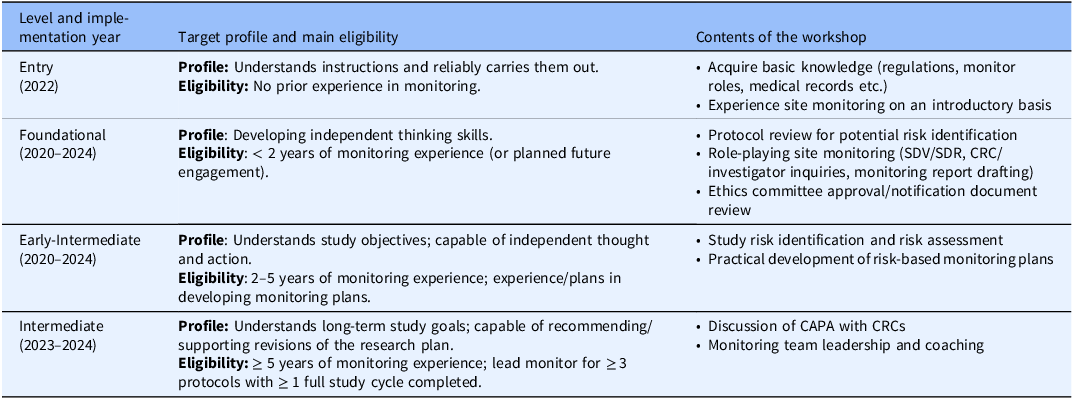
The overall structure of the training program is depicted in Figure 1. The level definitions, contents, primary participation criteria, and implementation years of the program are presented in Table 1. Further details are provided in Appendix 1. The levels were established with reference to the framework defined by ACRP [11]. Participants were permitted to attend the program multiple times (repeating the same level or advancing to different levels) to encourage progressive skill development.
The overall structure of the competency-based, level-specific training program.
Note: QMS = quality management system; RCA = root cause analysis; CAPA =corrective and preventive action; RBA = risk-based approach; SDV = source data verification; SDR = source data review.

Level-specific structure of the training program

Table 1. Long description
A table comparing training program levels, target profiles, eligibility, and workshop contents. The table has four rows and three columns. Column headers are Level and implementation year, Target profile and main eligibility, and Contents of the workshop. Row 1: Level and implementation year, Entry (2022); Target profile and main eligibility, Profile: Understands instructions and reliably carries them out. Eligibility: No prior experience in monitoring.; Contents of the workshop, Acquire basic knowledge (regulations, monitor roles, medical records etc.), Experience site monitoring on an introductory basis. Row 2: Level and implementation year, Foundational (2020-2024); Target profile and main eligibility, Profile: Developing independent thinking skills. Eligibility: <2 years of monitoring experience (or planned future engagement).; Contents of the workshop, Protocol review for potential risk identification, Role-playing site monitoring (SDV/SDR, CRC/ investigator inquiries, monitoring report drafting), Ethics committee approval/notification document review. Row 3: Level and implementation year, Early-Intermediate (2020-2024); Target profile and main eligibility, Profile: Understands study objectives; capable of independent thought and action. Eligibility: 2-5 years of monitoring experience; experience/plans in developing monitoring plans.; Contents of the workshop, Study risk identification and risk assessment, Practical development of risk-based monitoring plans. Row 4: Level and implementation year, Intermediate (2023-2024); Target profile and main eligibility, Profile: Understands long-term study goals; capable of recommending/supporting revisions of the research plan. Eligibility: ≥ 5 years of monitoring experience; lead monitor for ≥ 3 protocols with ≥ 1 full study cycle completed.; Contents of the workshop, Discussion of CAPA with CRCs, Monitoring team leadership and coaching.
Note: SDV = source data verification; SDR = source data review; CAPA = corrective and preventive action; CRC = clinical research coordinator.
Each level comprises a pre-assigned learning task, followed by a one- or two-day workshop. Pre-assigned learning tasks, tailored to each level, include activities such as watching webinars to acquire foundational knowledge and reviewing materials related to the upcoming workshops. This approach not only helps participants transition smoothly into the workshop but also enables them to gain knowledge that cannot be fully covered during the workshop alone, allowing for a more efficient use of the limited workshop time.
The workshops across all levels comprise a lecture followed by practical, interactive group work. In the program design, emphasis was placed on three key elements: “practice-oriented learning,” a “supportive learning environment provided by facilitators,” and “mutual interaction and learning among participants,” to ensure the effective acquisition of competencies. Practice-oriented learning is intended to translate knowledge into real-world application. A supportive learning environment aims to ensure psychological safety and encourage active participation. Mutual interaction and learning are designed to serve two purposes: fostering multifaceted perspectives through discussions among participants and facilitators with diverse backgrounds and experiences, and expanding professional networks among ARO monitors. For example, at the Foundational level, participants attend a lecture on site monitoring to strengthen their understanding, followed by a role-play exercise in which they simulate the monitoring process under facilitator guidance. Specifically, during group work, participants engage in the entire sequence of the monitoring process, including preparation before monitoring, reviewing source documents, querying investigators, and drafting a monitoring report. In designing the group work, participants were intentionally assigned to groups to ensure diversity in professional roles and institutional affiliations.
Operational framework of the program and continuous improvement
The program was managed by an operational team composed of ARO monitors, all of whom had at least two years of practical experience. Team members developed a detailed manual and also served as group work facilitators based on it.
After each program session, the team conducted a debrief using the KPT (Keep-Problem-Try) framework – a structured reflective methodology. Insights gained through this process were analyzed together with participant needs and feedback, in light of evolving domestic and international clinical trial environments. These comprehensive evaluations were reflected in annual adjustments to training levels, as well as revisions to the program content, training materials, and facilitation manual. This approach provided an operational framework for continuous improvement in educational quality.
Implementation of surveys
Two types of surveys were conducted among participants to evaluate the program. The first type, “post-workshop survey,” was administered to participants across all levels between 2020 and 2024, within a week after completion. The questionnaire included both closed- and open-ended questions assessing various aspects such as participant backgrounds (affiliation and primary professional role), satisfaction scores related to the workshop (pre-assigned learning tasks, lectures, and group work), and overall impressions. While the number of satisfaction questions was optimized each year according to the program’s content, a consistent 5-point Likert scale (1 = “very dissatisfied,” 5 = “very satisfied”) was employed.
The second type, “follow-up survey,” aimed to assess the mid-term outcomes that were difficult to evaluate immediately after program participation. This survey was conducted in 2022 and 2024, targeting individuals from all levels who participated in the program between 2020 and 2024, within two years following their participation. This survey included “post-program engagement in monitoring activity,” “post-program utilization of training materials,” “utility of learning from training program in daily practice,” and “post-program participant networking.” For both surveys, participants were contacted via email and asked to complete an online questionnaire (Google Form). To illustrate the specific structure of each survey, the latest 2024 versions of the questionnaires are provided as representative examples in Appendix 2.
Quantitative analysis of questionnaires
Descriptive statistics were used to evaluate the distribution of respondent backgrounds and assessment scores. In the post-workshop surveys, multiple responses were allowed for the question regarding primary role; therefore, the total number of responses exceeded the number of respondents. Median and range of satisfaction scores were calculated for each year. Although the number of satisfaction-related questions varied slightly by year, all available data were included in the analysis. Regarding pre-assigned learning tasks, although both mandatory and optional tasks were provided, only the former were included in the evaluation.
In the follow-up survey, the next key metrics were analyzed. (1) “Post-program engagement in monitoring activity” defined as having conducted at least one monitoring activity after participating in the program; (2) “Post-program utilization of training materials” calculated as the percentage of respondents who reported specific use (using materials for monitoring activities, institutional training, or self-study); (3) “Utility of learning from training program in daily practice” calculated as the percentage of respondents who selected 4 or 5 on a 5-point scale; and (4) “Post-program participant networking” calculated as the percentage of respondents who selected any of the items indicating increased interaction or networking with other participants or facilitators.
Qualitative analysis of questionnaire
To analyze the factors contributing to participants’ evaluations, the corresponding author applied an a priori framework based on the three key elements emphasized by the operational team during program design – practice-oriented learning, a supportive learning environment provided by facilitators, and peer interaction and mutual learning. Using this framework, a descriptive coding analysis was conducted via a deductive approach on the free-text responses from the post-workshop surveys (2020–2024). These comments were independently categorized by three coders (Y.K., S.I, and M.K.), with any discrepancies resolved through discussion to reach a consensus. Comments corresponding to multiple categories were assigned to each applicable category, and the proportion of comments within each category was calculated.
Ethical considerations
The ethical review was waived because the educational program was not subject to Japan’s Ethical Guidelines for Life Sciences and Medical Research Involving Human Subjects. All participants agreed to complete the self-assessment questionnaires used to examine their understanding of the program content. The survey forms included a statement explaining that responses in a de-identified format might be disclosed externally and that submission of the form implied consent to this condition.
Results
From 2020 to 2024, the program was implemented 13 times, five each for the Foundational and the Early-Intermediate levels, twice for the Intermediate level, and once for the Entry level (Table 1). The Entry level was subsequently merged into the Foundational level, with the experience gained from the Entry level and participant feedback incorporated into the revised curriculum.
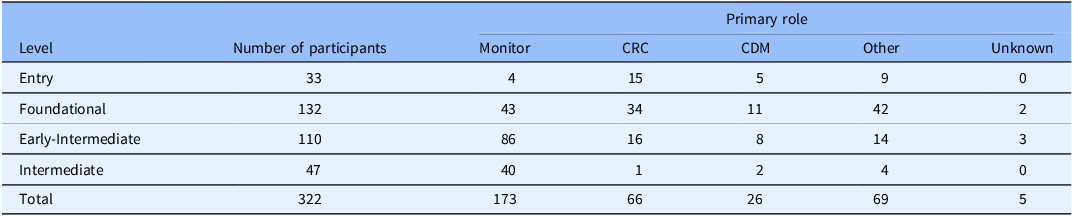
Of the total of 322 participants, more than half were monitors (53.7%), followed by clinical research coordinators (20.5%) and clinical data managers (8.1%). Others were CRPs– including study managers, auditors, and ethics committee administrative officers – and non-CRPs – including administrative staff and medical department secretaries (Table 2).
Demographic distribution of program participants by number and primary role across training levels

Table 2. Long description
The table has 6 rows and 6 columns. The columns are labeled Level, Number of participants, Monitor, CRC, CDM, Other, and Unknown. The rows are labeled Entry, Foundational, Early-Intermediate, Intermediate, and Total. Row 1: Entry, 33, 4, 15, 5, 9, 0. Row 2: Foundational, 132, 43, 34, 11, 42, 2. Row 3: Early-Intermediate, 110, 86, 16, 8, 14, 3. Row 4: Intermediate, 47, 40, 1, 2, 4, 0. Row 5: Total, 322, 173, 66, 26, 69, 5.
Note: Number of participants reflect cumulative enrollments (N = 322). In the 2024 Early-Intermediate level workshop, multiple selections for primary roles were permitted, resulting in 17 participants providing multiple responses. Consequently, the primary role response count for the Early-Intermediate level is n = 127 (among 110 participants), bringing the total number of role responses across all levels to N = 339. “Unknown” indicates respondents who did not answer; multiple responses were permitted in applicable years. CDM = clinical data manager.
Post-workshop survey results
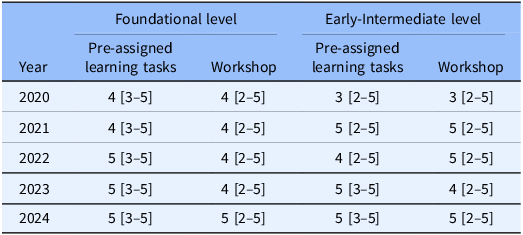
Valid responses were obtained from 317 of the 322 participants (response rate: 98.4%). As presented in Table 3, median satisfaction scores for both pre-assigned learning tasks and workshops remained steadily high over the 5-year study period, ranging from 4 to 5 for the Foundational level and from 3 to 5 for the Early-Intermediate level. Similar trends were also observed at the Entry and the Intermediate levels (Supplemental Table 1), indicating that our program has been consistently implemented across all levels with high participant satisfaction.
Satisfaction scores for pre-assigned learning tasks and workshops in the foundational and the early-intermediate levels from 2020 to 2024

Table 3. Long description
A table with five rows and four columns comparing satisfaction scores for pre-assigned learning tasks and workshops at the Foundational and Early-Intermediate levels from 2020 to 2024. The columns are labeled ‘Year’, ‘Foundational level Pre-assigned learning tasks’, ‘Foundational level Workshop’, ‘Early-Intermediate level Pre-assigned learning tasks’, and ‘Early-Intermediate level Workshop’. Each row lists the year and the corresponding satisfaction scores. Row 1: 2020, 4 [3-5], 4 [2-5], 3 [2-5], 3 [2-5]. Row 2: 2021, 4 [3-5], 4 [2-5], 5 [2-5], 5 [2-5]. Row 3: 2022, 5 [3-5], 4 [2-5], 4 [2-5], 5 [2-5]. Row 4: 2023, 5 [3-5], 4 [2-5], 5 [3-5], 4 [2-5]. Row 5: 2024, 5 [3-5], 5 [2-5], 5 [3-5], 5 [2-5].
Note: Scores are presented as median [range] based on a 5-point Likert scale (1 = “very dissatisfied,” 5 = “very satisfied”); only mandatory pre-assigned tasks were evaluated.
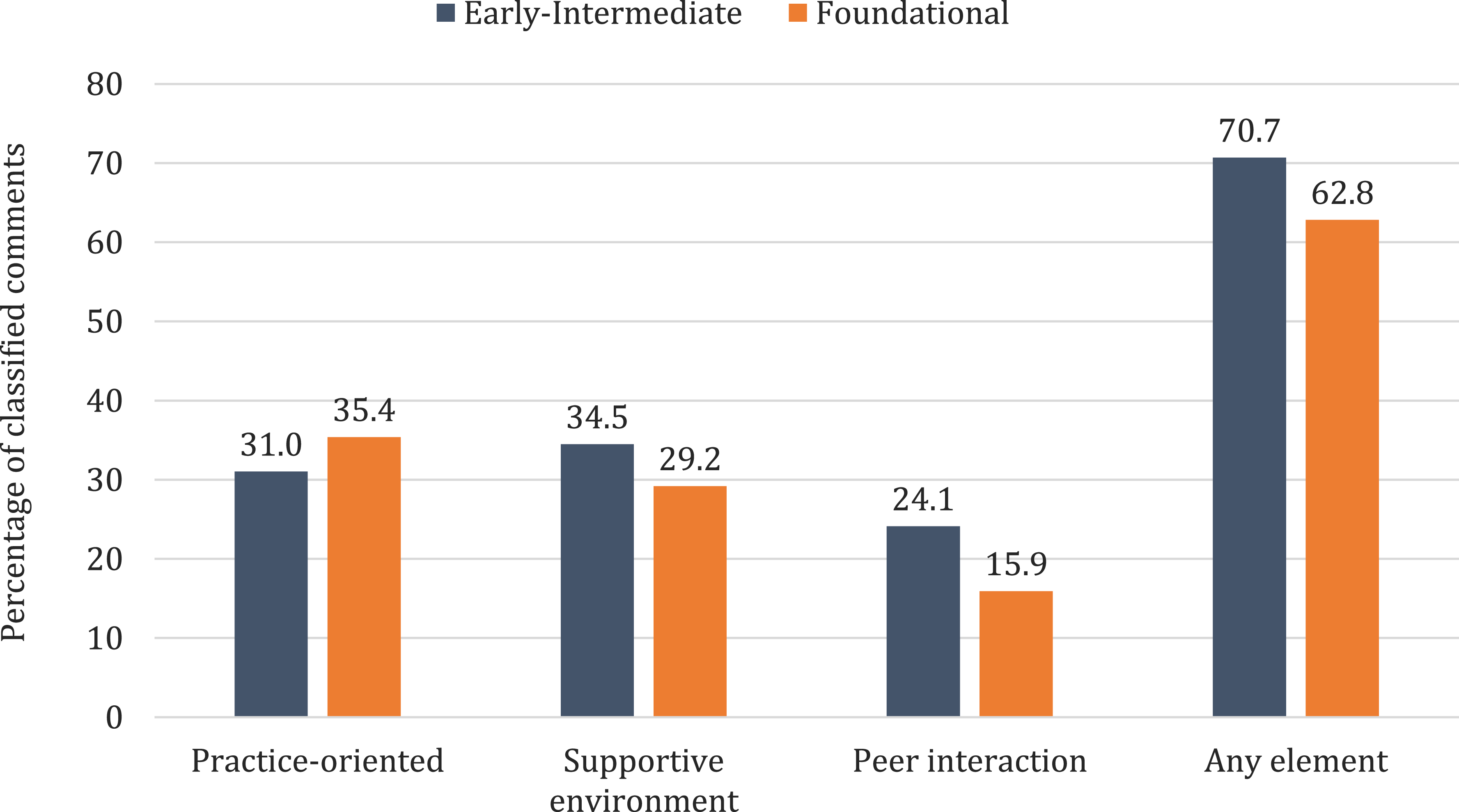
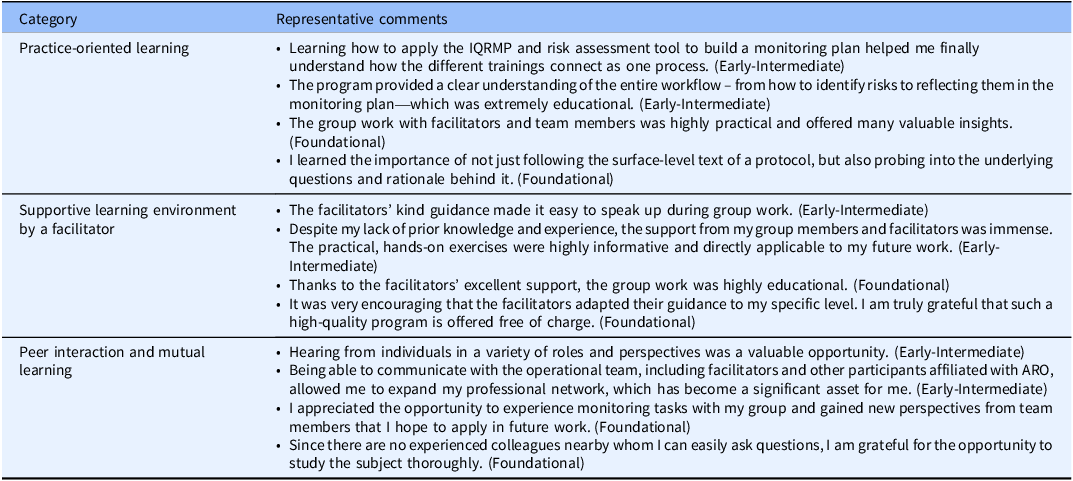
To explore whether the three key design elements (practice-oriented learning, a supportive learning environment, and mutual interaction and learning) contributed to this high satisfaction, we conducted a descriptive coding analysis. Of the 79 open-ended responses for the Early-Intermediate level, 58 were coded as providing favorable feedback on the training program. Of these, 70.7% (41/58) included favorable references to at least one of the three elements. Specifically, 31.0%, 34.5%, and 24.1% referenced practice-oriented learning, the supportive learning environment provided by facilitators, and peer interaction and mutual learning, respectively (Figure 2). Similarly, at the Foundational level, of the 164 open-ended responses, 113 were classified as favorable feedback, with 62.8% (71/113) referencing at least one of these elements. These results indicated that this design was widely valued across different learner levels (Figure 2). Representative comments corresponding to these three elements are summarized in Table 4.
Distribution of favorable comments classified into three elements in post workshop surveys. Bars depict the percentage of comments coded into three elements (practice-oriented learning, supportive learning environment by facilitator, and peer interaction and mutual learning). “Any element” indicates the percentage of comments that included at least one of these three elements.

Representative participant comments from post-workshop surveys

Table 4. Long description
A table with three columns and four rows. The columns are labeled Category, Representative comments. The rows are labeled Practice-oriented learning, Supportive learning environment by a facilitator, Peer interaction and mutual learning. The table lists representative comments from participants, categorized into three main themes: practice-oriented learning, supportive learning environment by a facilitator, and peer interaction and mutual learning. Each category contains specific comments highlighting the participants’ experiences and feedback.
Note: The comments were coded using descriptive qualitative analysis. IQRMP = Integrated Quality Risk Management Plan.
Most of the responses not classified as favorable comprised constructive operational feedback or self-reflections, which were excluded from the descriptive coding analysis. However, several pieces of feedback were utilized to improve subsequent program operations. For example, in response to frequently reported feedback that participants felt hesitant to ask questions, particularly during online group work, facilitators introduced procedures for proactive outreach and one-on-one support. Additionally, to address requests to exchange information with other participants and facilitators outside the training sessions, a dedicated time for casual chatting was newly established.
Follow-up survey results
Follow-up surveys were conducted twice, in 2022 and 2024. Owing to operational constraints, the questionnaire could not be distributed to participants at the Foundational and the Early-Intermediate levels in 2024 and were therefore excluded from the analysis. Of the 216 eligible participants, 197 received the questionnaire, and 160 responded (response rate: 81.2%, representing 226 cumulative participants).
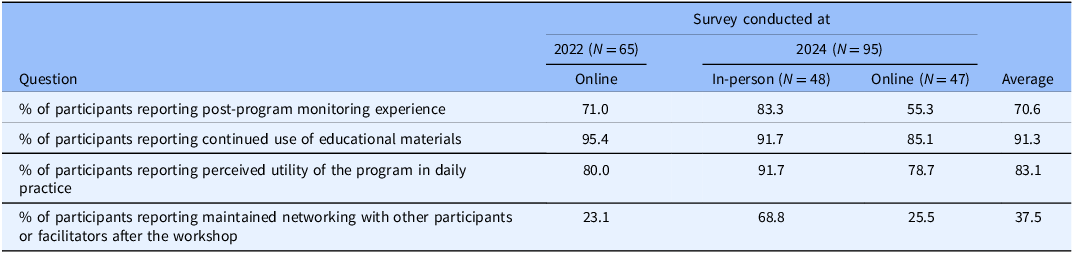
The results are depicted in Table 5. Of the respondents, 70% reported having engaged in monitoring activities after program participation. Those who reported no such experience cited organizational factors, such as departmental transfers or changes in job responsibilities. In addition, 91.3% continued to use educational materials – such as lecture slides – after program participation, and 83.1% reported that the program had been helpful in their daily practice. Most respondents who indicated that they had not used the materials or had not found the program helpful were individuals who had been unable to engage in monitoring activities owing to organizational constraints.
Follow-up survey results from 2020 to 2024 by participation format (In-person vs online)

Table 5. Long description
The table presents survey results from 2022 and 2024, comparing in-person and online participation formats. It has four rows and five columns. The columns are labeled ‘2022 (N = 65)’, ‘2024 (N = 95)’, and ‘Average’, with sub-columns for ‘Online’ and ‘In-person (N = 48)’ for 2022, and ‘Online (N = 47)’ and ‘In-person’ for 2024. The rows are labeled with questions about post-program monitoring experience, continued use of educational materials, perceived utility of the program in daily practice, and maintained networking. The values in the table show percentages of participants reporting various outcomes. Notable trends include higher percentages of participants reporting positive outcomes in 2022 compared to 2024, with in-person participation generally showing higher percentages than online.
Note: The 2024 follow-up survey excluded the Foundational and the Early-Intermediate levels due to operational constraints. Percentages reflect the proportion of respondents who selected each item.
Interestingly, 37.5% of participants reported increased interactions or networking with other participants or facilitators after completing the program. In the 2022 survey, this proportion was 23.1%, likely influenced by the fully online workshop format necessitated by the COVID-19 pandemic. However, in the 2024 survey, after hybrid formats, including in-person participation, resumed, this proportion rose to 47.4%. Notably, in-person participants were more likely to maintain interactions than were online participants (68.8% vs. 25.5%).
Discussion
Despite the growing importance of ARO monitors in Japan, systematic educational opportunities have remained scarce. By developing and implementing an educational program that reflects international standards while adapting to local needs, we established a systematic training framework optimized for the specific roles of ARO monitors. Given the current lack of similar systematic programs in Japan, our initiative can be expected to contribute to enhancing the reliability of IITs by fostering essential competencies.
Two primary factors underlie the sustained high participant satisfaction (Table 3) and practical utility of this program (Table 5). First, the core features of our educational structure align with andragogy, the theory of adult learning [Reference Knowles12]. For instance, “practice-oriented learning” using real-world scenarios aligns with adult learner’s orientation toward learning as “problem-centered,” while addressing their “readiness to learn” by providing solutions to immediate practical challenges. The “supportive learning environment provided by facilitators” supports the learner’s “self-concept” by respecting their autonomy, thereby encouraging self-directed engagement in the learning process. Furthermore, “mutual interaction and learning” leverages the diverse “experiences” of both participants and facilitators, stimulating “intrinsic motivation” through new insights gained from others’ perspectives. Additionally, the blended learning style using webinars supports the learners’ “self-concept” by allowing for self-paced study, while the stratification of learning levels effectively prepares their “readiness to learn.” These elements likely allowed participants to maintain their own learning pace while standardizing the baseline knowledge level across the group, thereby establishing a solid foundation for effective learning. While these principles were not intentionally integrated during the initial design phase, the results reinforce the program’s theoretical validity. Similar observations were reported by Roth et al., [Reference Roth, Lee-Chavarria and Kolb13] whose cross-institutional, peer-led, competency-based training model also closely aligns with andragogical principles. These findings suggest that incorporating the principles of andragogy is effective in CRP education.
The second factor is the standardization of operations and the continuous improvement process. Through standardization using a detailed facilitation manual and continuous improvement process incorporating participant feedback and KPT debriefs, we minimized operational variability across years and facilitators, providing consistently high-quality learning opportunities. These structural and operational frameworks ensure the reproducibility of education.
Particularly amid the globally recognized shortage of the CRP workforce [14], establishing a sustainable and stable educational system in resource-constrained environments is an urgent challenge. To address this, the key strength of our model lies in its versatile framework, which is built on international competency standards and aligned with andragogical principles. Furthermore, by integrating these structural and operational components, this study provides valuable insights into building a highly reproducible and sustainable educational foundation. Consequently, this model is considered broadly applicable to designing educational programs tailored to local needs in other countries facing similar challenges.
Furthermore, it is noteworthy that the program helped foster professional networking, particularly through face-to-face interaction. Following the enforcement of the Clinical Research Act in 2018 in Japan, monitoring became mandatory for clinical trials conducted under the Act, leading to an increase in monitoring demand. Meanwhile, specialized monitoring positions remain limited within Japanese academia; as a result, personnel are often assigned monitoring duties in addition to their primary professional responsibilities. This was indicated by the fact that approximately half of the participants held roles other than monitoring (Table 2) – a trend particularly pronounced at the lower levels (the Entry and Foundational levels). Under these circumstances, individuals often find themselves in an isolated working environment without nearby colleagues to consult regarding their monitoring duties – a situation reflected in the comments in Table 4. In such a context, the networks formed through this program have the potential to function as informal platforms for problem-solving. This is exemplified by participant feedback such as: “I am grateful for the facilitators’ prompt email responses. Since there is no one in my workplace to teach me about monitoring, I really appreciate having this support, where I can feel comfortable asking for advice (Foundational level, 2021).” These insights suggest that our program provides access to not only new knowledge and perspectives but also to communication channels that help participants address practical challenges that a single program alone cannot solve.
However, to maximize and maintain the impact of these functions under limited resources, multi-layered support that does not depend on individuals is essential. This includes support at both the institutional and national levels to link acquired skills and networks directly to practical application and career development, and to ensure the stable continuity of high-quality education. Although this remains a global challenge [14], such organizational backing is indispensable for the long-term success of clinical research in Japan.
Finally, several limitations of this research should be acknowledged. First, this study is a retrospective analysis based on participants’ subjective evaluations, consequently, the assessment of educational effectiveness may be influenced by factors such as self-report bias and selection bias, whereby individuals who are more engaged in the training are more likely to respond. Second, given that the number of questions was optimized across years, there are inherent limitations to strict longitudinal comparisons of satisfaction scores. Third, because the 2024 follow-up survey excluded participants from the Foundational and the Early-Intermediate levels, comparisons with the 2022 survey may be confounded by differences in participant levels or specialized roles. Fourth, follow-up survey respondents (n = 160) included higher proportions of monitors (64.6% vs. 48.1%) and Early-Intermediate level participants (39.8% vs. 24.1%) than non-respondents (n = 37). This likely reflects the tendency of ARO monitors to participate repeatedly, suggesting that the program aligns well with the needs of its target group. Nevertheless, it should be noted that the overall survey evaluations predominantly reflect the perspectives of this core target group. Lastly, since the findings are based on implementation in Japan, careful consideration is required when applying them to different cultural or institutional contexts.
Conclusion
This study presented a competency‑based educational program for ARO monitors in Japan along with its operational framework for continuous improvement. While subject to methodological limitations inherent to its single-arm, self-reported design, this andragogy-aligned program not only showed high participant satisfaction and practical utility but also helped foster professional networking that provided meaningful support for participants facing professional isolation. Our results suggest that the program functions as more than a one-time educational event; it is associated with strengthening the network foundation for ARO monitors in Japan and serves as a platform for ongoing mutual learning. This model represents a theoretically sound and versatile approach to developing CRPs that reflects international standards while adapting to local characteristics in resource-limited settings.
These findings contribute to the establishment of sustainable educational frameworks in other international clinical research contexts facing similar challenges. Moving forward, establishing organizational and public support systems is expected to maintain and further develop such platforms.
Supplementary material
The supplementary material for this article can be found at https://doi.org/10.1017/cts.2026.10863
Acknowledgments
The authors would like to thank Sawako Tomatsuri, Naomi Kondo, Minami Shimada, Daisuke Noso, and Mio Takahashi for their valuable contributions to the program design and workshop facilitation, and Miyuki Kanno, Akiko Watanabe, Yoko Okamoto, and Chiaki Shiba for their administrative support and assistance, including Miyuki Kanno’s contribution to the data analysis. The authors would also like to thank Editage (www.editage.jp) for English language editing.
Tohoku University’s Secure Google Gemini and Microsoft Copilot were used for the English translation and refinement of the manuscript prepared by the corresponding author. The manuscript then underwent professional review by Editage, followed by final check and approval by all authors.
Author contributions
Yosuke Kawabe: Conceptualization, Data curation, Formal analysis, Investigation, Methodology, Writing - original draft, Writing - review & editing; Akihiro Momoi: Conceptualization, Investigation, Methodology, Writing - review & editing; Miho Tarui: Conceptualization, Investigation, Methodology, Writing - review & editing; Tamiki Hikake: Conceptualization, Investigation, Methodology, Writing - review & editing; Suzuka Ikeda: Conceptualization, Data curation, Investigation, Methodology, Writing - review & editing; Yumi Tanaka: Conceptualization, Investigation, Methodology, Writing - review & editing; Nanako Hamazaki: Conceptualization, Investigation, Methodology, Writing - review & editing; Kenta Anjo: Conceptualization, Investigation, Methodology, Writing - review & editing; Kanae Hirase: Conceptualization, Investigation, Methodology, Writing - review & editing; Natsuko Tamura: Conceptualization, Investigation, Methodology, Writing - review & editing; Eri Imanishi: Conceptualization, Investigation, Methodology, Writing - review & editing; Yuto Hidaka: Conceptualization, Investigation, Methodology, Writing - review & editing; Eri Mekari: Conceptualization, Investigation, Methodology, Writing - review & editing; Sayuri Tsurumura: Conceptualization, Investigation, Methodology, Writing - review & editing; Yukiko Matsushima: Conceptualization, Investigation, Methodology, Writing - review & editing; Mieko Inada: Conceptualization, Investigation, Methodology, Writing - review & editing; Toshihide Miura: Methodology, Project administration, Writing - review & editing; Takuhiro Yamaguchi: Conceptualization, Methodology, Supervision, Writing - review & editing.
Funding statement
The educational programs and surveys in this study were conducted as part of the training program for clinical research professionals supported by the Ministry of Health, Labour and Welfare.
Competing interests
The authors declare none.



 Open access

