1. Introduction
A news headline that was widely publicized in Sri Lanka in 2013 was the case of a 13-year-old school girl being arrested and produced in a magistrates’ court for stealing eight coconuts from a neighbour’s garden. The girl claimed that she stole the coconuts because her family was unable to provide the Rs. 800 (approximately US$6) contribution demanded by her school towards painting the classrooms.Footnote 1 This case was discussed at various fora as to how a minor was arrested, produced in a magistrates’ court, and released on bail when the police should have followed proper legal procedure by referring the case to the local Mediation Board (MB). The legal blunder committed by the police and the local magistrate brought to light a socio-legal entity known as the MB that exists in contemporary Sri Lankan society as a mechanism to resolve local disputes. They were established by an Act of ParliamentFootnote 2 and at present there are more than 300 of these state-sponsored community mediation programmes that were conceptualized and modelled along the lines of Alternative Dispute Resolution (ADR) to function in parallel with the formal courts of law. The MBs were established as an alternative mechanism to the formal courts on the promise of being more effective and efficient by allowing the local community to settle their own disputes.Footnote 3 Yet the confusion highlighted in the coconut-stealing case suggests that MBs occupy an ambiguous space within the local dispute resolution system, raising questions that need to be examined from a sociocultural perspective such as: How do individuals engage with the MB? Where is the MB located conceptually within society? Is it within formal laws or popular justice? Can this be seen as a representation of the plural nature of legal ordering where law is defined broadly as a normative system? How do the different normative systems interact? The primary objective of this paper therefore is to inquire into the practice of community mediation through MBs and try to understand its position within the larger context of multiple systems of normative orders that coexist within the same socio-legal space.
Based on an exploratory study of the MB from a legal-anthropological perspective, this paper will look at the MB and its practice within the larger theoretical framework of legal pluralism. Since community mediation is defined as an ADR methodology and is considered as an alternative to the formal state legal system, the MB is conceptually framed within the legal pluralist perspective as one of the multiple normative ordering that exists in society. The paper will begin with a discussion on the theoretical background of community mediation followed by a case-study of an MB in a semi-urban town in Sri Lanka. The empirical analysis is based on data gathered using qualitative methods to elicit in-depth understanding of this socio-legal phenomenon. This paper thus provides an analysis of local dispute resolution through the MB as a window through which to examine how diverse systems of legal orderings converge at a particular site where the plural nature of law and its dynamic interactions are played out as a hybrid practice.
2. Legal Pluralism, Alternative Dispute Resolution, And Community Mediation
Within the discipline of anthropology, the idea of legal pluralism emerged with reference to the dichotomy between indigenous normative ordering and the colonial/European legal system especially in the non-Western cultures in Africa, Asia, and Oceania.Footnote 4 As such, the early studies on the legal systems of the non-Western societies focused on the maintenance of social order through the indigenous normative systems and how they were impacted and transformed thought encounters with the colonial legal system. This existence of the plurality of law came to be known as the concept of legal pluralism and can be defined broadly as a “situation where two or more legal systems coexist in the same social field.”Footnote 5 Legal pluralism, in other words, is a rejection of legal centralism which defines law only in terms of state law. Within this context, law is defined from a broader perspective, seeing it as a system of thought:
Law is not simply a set of rules exercising coercive power, but a system of thought by which certain forms of relations come to seem natural and taken for granted, modes of thought that are inscribed in institutions that exercise some coercion in support of their categories and theories of explanation.Footnote 6
In her analysis of legal pluralism, Merry further expands the concept to distinguish between “classic legal pluralism,” which focuses primarily on the intersection of the indigenous law and Western European law, and “new legal pluralism,” which emerged around the 1970s in the non-colonized societies encompassing multiple legal systems or normative orders such as the state legal system, customary laws, community tribunals, as well as non-legal institutions that function as adjudicatory bodies. The new legal pluralism looks at law and law-like processes from a broad perspective, moving beyond the earlier dichotomy of indigenous and colonial law to official legal system and other forms of normative ordering.Footnote 7 However, even though the distinction between the official and non-official or formal and informal within the plurality of law discussed above seems apparent from the characteristics of each practice,Footnote 8 as Merry correctly points out, they are all situated in the same social field:
The new legal pluralism moves away from questions about the effect of law on society or even the effect of society on law toward conceptualizing a more complex and interactive relationship between official and unofficial forms of ordering. Instead of mutual influences between two separate entities, this perspective sees plural forms of ordering as participating in the same social field.Footnote 9
It is within this new understanding of legal pluralism that ADR mechanisms can be located emerging from the need for an alternative to the formal legal system. In this context, the 1976 Pound Conference (National Conference on the Causes of Dissatisfaction with the Administration of Justice) is widely considered as the launching pad of ADR, emphasizing the goodness of community-based forms of dispute resolution and justice in contrast to the adversarial, coercive, and alienating nature of the state legal system and litigation practices. As the ADR movement is rooted in local communities with the involvement of non-legal professionals, it was envisaged to provide a more accessible and acceptable dispute resolution process outside the existing legal set-up.
In general, ADR refers to a set of techniques or methods of dispute resolution such as mediation, arbitration, and fact-finding that can be seen as a “toolbox” which is being used in various settings, giving it a rather broad and expansive domain.Footnote 10 As a community-based mechanism, theoretically, ADR methods are devoid of formal structure and facilitated mostly by volunteers. However, as Adler rightly points out, at the core of these techniques lie the practice of negotiation and the resultant compromise. The centrality of negotiation in ADR thus points to the “social legitimization of bargaining process” and has replaced imposed judgment with negotiated settlement as a more effective method of dispute resolution:
What has been discovered, or perhaps rediscovered, is that many disputes that traditionally are conceptualized and treated as collisions of rights or as win-lose adversarial contests are indeed negotiable. In this sense the rise of the mediation movement is a concurrent extension of negotiation’s newly acquired good name.Footnote 11
ADR techniques and methods therefore can be seen as operating within a metaphor of bargaining and compromise which is far removed from the rights-based justice system. Adler also argues that ADR offers new myths based on empowerment and voluntarism that replace the old myths about the limitations in legal advocacy and adversarial style of securing rights.
3. Community Mediation And Popular Justice
In the contemporary judicial landscape, community-based mediation programmes emerged as an ADR method to resolve minor disputes at the local level. Community mediation can be defined simply as dispute resolution conducted by members of the local community who do not have formal judicial or legal training and is carried out through a community-run forum. These community-based programmes offer disputants an opportunity to settle mostly minor disputes in an informal, non-adversarial, and participatory setting, mediated by volunteers. Community mediation thus is in stark contrast to the rights-based formal legal system and promotes interest-based conciliation and compromise using the values and norms of the community as its foundation. It is in this context that community mediation is sometimes seen as an attempt to restore the community ethos and to rejuvenate the self-reliant communities of the past within modern societies.Footnote 12
Although community mediation has been in existence for decades, the debates about its efficacy are still being argued from various perspectives. Among the early advocates were judges who saw it as easing the delays in the overburdened court system, scholars who believed that it will expand access to justice, businesses and corporate who saw it as reducing their litigation costs, and community leaders who promoted it for mobilizing talent in the local community.Footnote 13 Substantively, community mediation has been hailed as providing individuals with a choice in how they want to settle disputesFootnote 14 and also as an empowering mechanism against state control of individual lives.Footnote 15
On the other hand, the critics have argued that these mechanisms are an extension of state control under the guise of voluntarism and community empowerment.Footnote 16 Some have argued that it is conforming to the capitalist agenda of state hegemony for efficient management of the lower judicial bureaucracy.Footnote 17 Pavlich offers a more fundamental analysis focusing on the power of community mediation as a political development of extending the practice of governmentality to regulate disputants as well as a self-forming technique.Footnote 18 He argues that community mediation regulates disputants through confessional pressure to create non-disputing self-identities that conform to the ideas of peaceful communities.
As discussed above, community mediation techniques and methods are primarily based on the ideology of ADR which is generally defined in terms of its characteristics such as non-professional, community-based, participatory, non-coercive, collaborative, and non-confrontational. These ADR characteristics are situated within the realm of popular justice which is highlighted in contrast to the formal state law underlining the fundamental difference between the two. Where state law is governed by legal professionals within the adversarial institutionalized legal system, popular justice is administered by non-legal lay people who adhere to the non-confrontational, consensual community-based techniques of dispute resolution. However, as MerryFootnote 19 points out, popular justice often mimics state law in the way it operates (procedures, rituals, symbols, and language used) and is also subjected to the colonizing effect of state law. As a process, therefore, popular justice is linked to state law in fundamental ways and needs to be seen within that framework. On the other hand, popular justice is also linked conceptually to the local normative order, since it operates at the local level, reflecting local values and norms. Analytically, therefore, popular justice can be located “on the boundary between state law and local or community ordering, distinct from both but linked to each.”Footnote 20 It can also be seen as a semi-autonomous social fieldFootnote 21 at the intersection of the rules generated internally as well as those imposed from external legal systems. Popular justice therefore exists within the overlapping relationship between state law and local ordering.
Although, analytically, popular justice can be positioned as semi-autonomous and interdependent, its concept has been questioned from different perspectives. For instance, NaderFootnote 22 argues that popular justice is based on the ideology of harmony that sees conflicts and disputing as dysfunctional, and promoted as a way to minimize adversarial litigation practices. Nader also points to the power differentials within popular justice mechanisms and says that they are neither popular nor just: “... mediation works when parties are of equal bargaining strength and sophistication.”Footnote 23 In a similar argument, Fitzpatrick challenges the possibility of popular justice, claiming that it does not exist in opposition to formal state law; rather, there are similarities and compatibilities that make it a “mere mask or agent” of state power.Footnote 24 He argues that both formal and informal justice have at their core a “formed power” which exist on informal elements. He claims that the organization of power within these two supposedly opposing legal processes are distinct yet homologous and operate with the “mythic figures” of the individual and the community. Fitzpatrick’s analysis thus challenges the fundamental distinction between popular justice and state laws, on which the definition of popular justice rests.
However, to conceptualize community mediation on a continuum with formal and informal laws at the extremes is an oversimplification of the mediation process. The context-dependent nature of mediation should be seen as a hybrid socio-legal process, existing as a fluid practice traversing through multiple sociocultural contexts and legalities. Community mediation involves arguments, discussions, negotiations, and compromises within an established framework. Yet, since conflict and dispute resolution are essentially socially constructed practices, mediation is necessarily context-specific and contingent on sociocultural circumstances. This has been the broad approach taken by many anthropologists in analyzing community mediation.Footnote 25 Various studies have analyzed disputing and mediation processes from the local perspective emphasizing the cultural and contextual factors.Footnote 26 More specifically, they have argued that disputing and mediation need to be understood as a complex social process. As described by Moore,Footnote 27 law exists within social contexts and therefore can be analyzed as semi-autonomous social field which has:
... rule-making capacities, and the means to induce or coerce compliance; but it is simultaneously set in a larger social matrix which can, and does, affect and invade it, sometimes at the invitation of persons inside it, sometimes at its own instance.Footnote 28
Law and legal processes are therefore intrinsically social.
4. ADR And Informal Law In Practice
Theoretically, ADR mechanisms derive from the concept of popular justice and are seen as an alternative administration of justice in an informal way. There are numerous types and forms of these informal mechanisms that have sprung up in many societies across the world. The idea of informal law or justice system is increasingly being accepted as a better option to the often delayed, expensive, inefficient, and confrontational formal legal system. A survey of the pervasiveness of ADR methods in the US shows a variety of settings and engagements within and outside of state judicial administration. The San Francisco Community Boards, for instance, have been functioning from the early 1970s based on the principles of community mediation outside the formal legal system.Footnote 29 In China, there are more than a million People’s Mediation Courts (PMCs) at the village level that function as an alternative to the civil courts. These are established by the Constitution but are based on traditional local dispute resolution methods.Footnote 30 Similarly, the Barangay Justice System in the Philippines is also based on a traditional mediation mechanism but exists as a state-sponsored mediation programme.Footnote 31 In Bangladesh, there are three distinct models of informal courts or shalish that look into local disputes through a consent-based arbitration or mediation. These courts operate as traditional, government-administered and non-governmental organization (NGO)-facilitated shalish.Footnote 32 In Rwanda, there exist two separate mechanisms of informal justice in the form of Gacaca and Abunzi that deal with different types of disputes. The Gacaca has been established by the state to resolve issues arising from genocide-related disputes, while the Abunzi mediate in resolving family disputes, land issues, injury, robbery, etc. Another state-sponsored informal justice system is Sierra Leone’s Local Courts, which were established in 1963 to function along with their formal legal system and other traditional informal fora.Footnote 33 However, it has been pointed out the Gacaca has very little resemblance to its traditional roots and, moreover, the top-down approach of this type of traditional court by the state has become problematic.Footnote 34 Similarly, in Sierra Leone, there are issues because local courts are essentially a traditional system that has been adopted by the state.
Many of these informal systems have been fully incorporated or partially incorporated into the state or formal justice systems. However, there are many informal justice mechanisms that exist as customary dispute resolution methods used at the local level. For instance, in Afghanistan, there are dispute resolution councils known as shura or jigra that uses mediation methods by village elders in order to maintain peace and harmony in the community.Footnote 35 In Burundi, the Bashingantahe mediate between disputing parties presided by elders in the community, while, in Somalia, an informal mediation based on xeer principles takes place under the direction of traditional elders.Footnote 36 It is evident therefore that there are many different types of informal justice mechanisms that exist alongside the established formal legal system to provide a multitude of legal fora based on the concept of popular justice.
5. Mediation Boards In Sri Lanka
The concept of community mediation has a long history in Sri Lanka going back many decades, if not centuries. There are records of local-level dispute settlement through the Gamsabha (village tribunal/council) system that can be traced as far back as the fifth century bc, referring mostly to the pre-colonial Sinhala village organizations.Footnote 37 The Gamsabha was an adjudicatory body chaired by the village headman and its membership was drawn from the traditional rural leadership. After a period of decline beginning with the Dutch period,Footnote 38 the British tried to replicate a similar local dispute settlement mechanism through the Village Communities Ordinance of 1871. Although these Village Tribunals were seen by British officials as “resurrecting ancient village institutions,” as they maintained the status quo vis-à-vis the powers of the traditional elite, these were opposed by other upwardly mobile communities.Footnote 39 In the post-independence era, “obsession with the Gamsabhavas continued to haunt the post-independence legal reformists”Footnote 40 and another attempt was made in the form of the Conciliation Boards through the Conciliation Boards Act No. 10 of 1958. The Conciliation Boards can be seen as a precursor to the present MBs. In addition, as described by Tiruchelvam, the government’s foray into popular tribunals in the post-independence Sri Lanka was to create “social consciousness” that was consistent with the socialist development ideology of the governing elite.Footnote 41 By de-professionalizing the form and process of conflict resolution, the Conciliation Boards were expected to encourage the participation of the ordinary people in its work. However, they failed to achieve their objectives and instead have displayed a close resemblance to the Gamsabha that sought to settle disputes through the normative standards of the existing social order.Footnote 42 The Conciliation Boards, though not intended, comprised the village leadership and elites who used social pressure to mediate between disputants by applying the values and norms of the existing social structure. Due partly to the politicization of the mediation process and lack of competent mediators, the Conciliation Boards became less effective and were rejected by the local communities. As a result, the Conciliation Boards Act was repealed in 1978. However, in yet another attempt to formally revive the idea of community mediation, the current MBs were established ten years later with the objective of “facilitating the voluntary settlement of minor disputes using interest-based mediation.”Footnote 43 The trajectory of the concept of community mediation in Sri Lankan society thus shows its unique position within the judicial landscape.
Currently, MBs exist in almost all parts of the island and is believed to be the third largest mediation system in the world.Footnote 44 As at December 2013, there were 324 such MBs in operation,Footnote 45 with over 7,000 trained mediators actively engaged in the mediation process.Footnote 46
Officially, MBs function under the Ministry of Justice and are governed by the Mediation Boards Act No. 72 of 1988, amended by Act No. 15 of 1997, Act No. 21 of 2003, and Act No. 7 of 2011. The Act defines the duties of the MB as:
... by all lawful means to endeavour to bring the disputants to an amicable settlement and to remove, with their consent and wherever practicable, the real cause of grievance between them so as to prevent a recurrence of the dispute, or offence.Footnote 47
The primary objective of MBs was to offer an alternative mechanism of dispute resolution for local and minor conflicts outside the framework of the overburdened state legal system.Footnote 48 They were thus expected to ease the case-load placed on the courts and to improve people’s access to justice by offering a locally mediated settlement. The Act provides the legal framework for the MBs and distinguishes between mandatory mediation and non-mandatory/voluntary mediation. Under mandatory mediation, the Act specifies the disputes that are required to be referred for mediation prior to taking action in courts. These referrals are of three types: civil matters relating to movable or immovable property, debt, and damage up to the value of Rs. 250,000Footnote 49 (approximately US$2,000); criminal offences such as assault, trespass, defamation, etc.; and court referrals where disputes are legally required to go for mediation before seeking court intervention. Though a settlement is not required, these disputes need to have a “non-settlement certificate” in order to proceed to the courts. The intention of the mandatory mediation is to:
... divert such matters away from courts, for settlement if possible in an atmosphere which is free of the fetters and rigours of a court procedure and is also conducive to the amicable settlement of dispute the nature of which does not justify the applicability of technical legal concepts.Footnote 50
The disputes that are categorized as voluntary or non-mandatory are those brought to MBs voluntarily by the disputants. However, there is no compliance to appear before MBs even though one has been sent a letter asking to be present. This makes it somewhat difficult to enforce, hence the high amounts of absenteeism in these types of disputes.Footnote 51 The Act also provides for disputes that cannot be mediated, such as matrimonial disputes or divorce, those involving people of unsound mind, testamentary cases, and fundamental rights petitions,Footnote 52 to name a few.
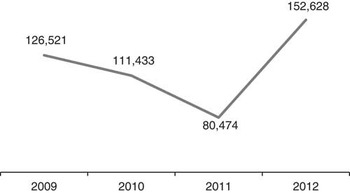
It is believed that more than two million disputes have been settled since the establishment of MBs in 1988.Footnote 53 According to available statistics, the number of disputes received by MBs nationally from 2009 to 2012 is shown in Figure 1.
Total number of disputes received Source: Ministry of Justice (2013).

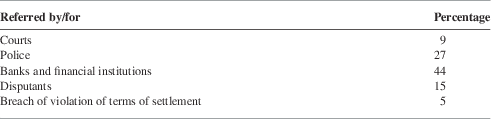
In 2011, there was an amendment to the Act which increased the maximum value for mandatory mediation in financial disputes by ten times. This could explain the increased number of disputes in 2012 when the trend earlier was on the decline. This corresponds with the data on the referral where, in 2012, the highest referral was from banks and financial institutions (see Table 1).
Percentage of disputes referred to Mediation Boards in 2012

Source: Ministry of Justice, 2013.
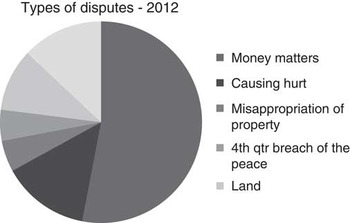
However, surveys and studies conducted prior to 2012 indicate that the majority of disputes were for non-mandatory or voluntary mediation.Footnote 54 According to the data above, potentially only 20% of the disputes in 2012 were non-voluntary or voluntary in nature. In addition, according to the types of disputes in 2012, the highest was “money matters” at 53% (Figure 2). Although statistics are not available for a comprehensive analysis of MBs at the national level, the above data indicate that, in 2012, the majority of disputes were on financial issues and brought to mediation by banks and other financial institutions.
Types of disputes in 2012 Source: Ministry of Justice (2013).

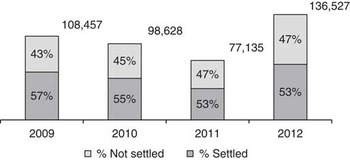
During the period 2009–12, the settlement ratio of the disputes remained at between 50% and 60%. This is based on the disputes that have been issued either settlement or non-settlement certificates and is presented in Figure 3.
Settlement ratio of disputes Source: Ministry of Justice (2013).

Each MB functions with voluntary mediators from the local community who have been selected and trained specifically by the Mediation Board Commission, which is a statutory body under the purview of the Ministry of Justice. Since the jurisdiction of the MB is defined by the local administrative area or the Divisional Secretary’s Division (DS division), the composition of the MB is necessarily local. These mediators are generally retired, “respected” members of the community who have been nominated by the Divisional Secretary, principals of schools in the area, religious leaders, or through non-political community organizations. Their selection is approved by the Mediation Board Commission, which is made up of three retired judges of the Supreme Court or Court of Appeal and two others appointed by the president of Sri Lanka. It is the responsibility of this Commission to select and train mediators. There is a great emphasis on the training of mediators, including providing refresher courses for trainers of mediators. It is believed that such training will facilitate the skills and techniques of the mediators which in turn will improve the efficiency of the mediation process.Footnote 55
In a typical mediation session, a dispute is heard by a panel of three mediators of whom two are selected by the disputing parties. If a dispute cannot be settled within three sessions, they are issued a non-settlement certificate. If a dispute is successfully resolved, then the disputants are issued settlement certificates which state each party’s obligations. However, since there is no mechanism to enforce these settlements, some disputes come back to the MB after some time. An evaluation conducted on MBs indicates a high level of confidence in them, with 90% of participants claiming to be satisfied with their work. Moreover, 82% of disputants and 63% of mediators state that mediation has a positive impact on the community.Footnote 56
6. Hybrid Practice Of Community Mediation
To discuss the practice of community mediation in the town of H,Footnote 57 this section will first present the methodology, the field site, and its sociocultural characteristics. Thereafter, the MB and its functioning will be analyzed as a social process that includes the setting and procedure as well as the act of mediation which together produce what is referred to as the hybrid practice of community mediation.
6.1 Methodology
H is a semi-urban town in the western province of Sri Lanka, with an urbanized town centre and rural outskirts. It is under the administrative unit of the DS division of H, which has 61 Grama Niladhari divisions or villages, with a total population of 112,441.Footnote 58 This DS division is predominantly Sinhala Buddhists.Footnote 59 There are three national schools and a branch campus of a national university located in H. According to statistics from the Divisional Secretariat, in 2012, the pre-school enrolment rate among children between ages three and five years remained high at 82% and a dropout rate of 8% during primary school. However, only 14% qualified for university education, indicating a high number of dropouts or failures during secondary school.Footnote 60 In terms of housing, there were 29,408 housing units, with 90% of houses defined as “single-storied” permanent houses.Footnote 61 There are several large manufacturing outfits located in H which provide employment to many in the area.
The MB of H has as its jurisdiction the administrative area of the H DS division. Although the Grama Niladhari divisions that come under the DS division are the smallest unit of administration, these average about 1,500 to 2,000 people per village. Therefore, it is different from the era of Gamsabha or the Village Tribunals of the pre-colonial period, when a village usually comprised small caste communities.Footnote 62 In this context, the MB, though comprising local mediators, deals with a heterogeneous community in terms of socioeconomic characteristics. The MB in H comprises 36 volunteer mediators representing the entire DS division and therefore disputants and mediators are not necessarily known to each other. There is a certain amount of social distance between the mediators and the disputants due to these reasons.
As discussed earlier in this paper, disputing and mediation are embedded in a complex social organization of any society or community. Hence an anthropological approach was adopted, taking into consideration the importance of situating the MB in the particular social context. Specifically, information was gathered using fieldwork methods of observation and in-depth interviews—methods widely used in anthropological research to collect qualitative data. The study thus involved observing mediation sessions, sitting along with the mediators and disputants and discussing the cases with the mediators afterwards. Since the primary objective of this study was to examine the mediation process, this research did not focus specifically on the disputants. As the researcher attended several days of multiple mediation sessionsFootnote 63 with an introduction given by the chairperson of the Board at the start of each session, the establishment of rapport with mediators was not a difficult task. In fact, the mediators were more than willing to share their stories. Moreover, the MB takes place in a public setting in an atmosphere of openness. Therefore, both mediators and disputants carry on regardless of who is listening or watching. Data collected were analyzed within a Geertzian interpretive framework that looks for meaning attached to symbols, behaviour, and practice.Footnote 64 Such an approach provides a nuanced understanding of community mediation within the context of a complex socio-legal landscape to enable the identification of common themes.
6.2 Mediation in PracticeFootnote 65
Mediation sessions are a social process traversing through cultural and normative ordering in the specific local context. Mediation is not carried out according to a fixed set of rules and regulations, but through a complex process of negotiation. This is similar to Merry’s description of the analytical framework for ADR which is not fixed and static; rather, it is fluid and shifts according to the context of the dispute.Footnote 66 The practice of community mediation, moreover, allows individuals to actively negotiate their space within the given structure. This was evident in the way mediators and disputants construct their own roles and functions within the process using techniques such as social pressure, reflecting the values and norms of the local community. Therefore, the hybrid nature of community mediation should be seen as a complex social process evident in the setting and the procedure on the one hand and the actual mediation process on the other. In the following section, mediation as practised in the MB of H is discussed under the two processes mentioned above by identifying the common themes that run through each of them.
6.2.1 Setting and Procedure
One of the defining features of community mediation is that it is in stark contrast to the impersonal and institutionalized formal/state law in terms of how the dispute resolution process is carried out. It is considered as an alternative to the formal/state law and hailed as providing a more community-oriented settlement of local-level disputes. In the MB in H, however, there were instances that can be interpreted as blurring the boundary between the formal and the informal. These can be seen in the setting of the MB as well as in the procedure followed during the mediation process.
There were 36 volunteer mediators at the time of this study and all of them were Sinhala Buddhists, which is a reflection of the general population of the H area. However, only four mediators were women and the age distribution is as shown in Table 2.
Age distribution of mediators

This shows that the majority of mediators are men over the age of 60 years. Many of them are retirees from both private and state sectors. The chairperson of the Board is a 71-year-old retired school teacher. The mediators are representative of those held in high esteem in the community, which is a stipulation in the Act. The profiles of the mediators fit the description of the traditional village elders who were from the upper strata of the local community in the gamsabha of the past. In principle, this goes against the spirit of the ADR movement, which promotes participatory and representative fora of non-legal persons. Even though there were no lawyers or anyone involved in legal administration in the MB, the composition can be seen as maintaining the existing social hierarchy.
The mediators are provided with a small brass badge to be worn for easy identification, provided by the Mediation Board Commission. According to mediators, since there is no other physical identification between them and disputants, the badge is seen as a necessary instrument. The symbolic meaning of such a marker, however, can be construed as an attempt to maintain social differentiation between mediators and disputants.
The Board meets once a week on Saturdays at the state-run primary school located in the centre of town. A large banner that says “H Mediation Board” is displayed at the entrance to the school hallFootnote 67 where the mediation sessions take place. This is a public space to which anyone has access. By conducting the sessions in an accessible location in a place that can be both formal and informal, the MB is physically located in an ambivalent site. It is formal for the reason that it is in an established institution and informal since the school is not in operation and hence the MB is there unofficially.
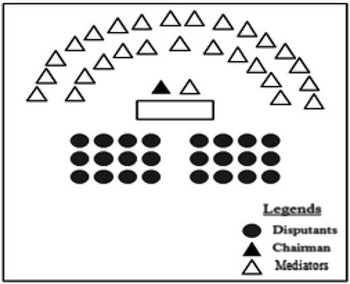
The mediators arrive early and arrange the chairs in rows facing a small table in the middle. There are two chairs kept at this table for the chairperson and another who acts as the secretary. Behind these, more chairs are placed in a semi-circle facing the row of chairs kept in front for the disputants. See Figure 4 for the layout of the MB. This too shows how mediators are differentiated from the disputants.
Layout

As the following proceedings show, the MB performs a number of structured formalities prior to the start of actual mediation. At 9 a.m., the meeting starts with a plenary session in which the chairperson delivers a welcome speech and asks everyone to observe a few minutes of religious prayer (agamiga wathawathawath) in whatever religion. According to the chairperson, this is done as a tradition (charithra) to invoke blessings on the proceedings that are about to begin, but also to calm the feelings/emotions (hitha thampath kireema) of the disputants. Thereafter, the chairperson addresses the gathering to explain the importance of mediation and the procedure to be followed. He emphasizes the difference between formal courts and mediation, and requests everyone to make a special effort to resolve their disputes. He then invites one of the mediators (a different mediator each time) to address the gathering. This speech usually includes the virtues of mediation and they make it a point to differentiate mediation from formal legal proceedings while reminding the disputants the value of harmony in the community. Thereafter, the chairperson again addresses the gathering, further emphasizing the need to resolve issues amicably through negotiation and mediation. He then informs about the process and some practical issues such as absenteeism and settlement/non-settlement certificates.
After the speeches are over, the chairperson calls on the disputants according to the dispute number (arawul anka). The disputants are referred to as parties (parshawaya), with the first party (palaweni parshawaya) being the complainant and the second party (deweni pashawaya) being the respondent. When the parties are identified, the chairperson asks each party whether they have a preference for a particular mediator. If no preference is given, he randomly appoints a panel with three mediators and names one as the chair of the panel. A record sheet is given to each panel with the respective dispute number written on it. If the dispute had been brought to the MB before then, the same record sheet is used with observations of previous panels recorded on it. The panel and the parties involved then move to another part of the hall or sometimes to nearby classrooms to start their session.Footnote 68 The chairperson continues to assign mediators to all the disputes that are listed for the day. Some panels are assigned multiple disputes, in which case the disputants have to wait for their turn. In one day, the Board receives about 30 to 40 disputes, of which about 20 disputes are mediated by panels.Footnote 69 Others are not considered due to the absence of one party. There is high absenteeism, since not all parties are legally bound to be present. However, according to the chairperson, the Board issues about 30 certificates of settlement/non-settlement per meeting.
Each panel finds itself a separate area with a table and some chairs to conduct mediation. The mediators sit on one side of the table and the disputing parties sit opposite them. The chairperson of the panel starts the proceedings by asking the first party to state their problem followed by the second party. If the dispute is a repeat appearance, then the panel reads the comments written by the earlier panels on the record sheet. After listening to both sides, the panel asks questions and suggests a remedy. If a settlement is reached, then the panel fills the record sheet and issues a certificate of settlement. If not, the reason why it was not resolved is recorded and a non-settlement certificate is issued if the parties agree. Sometimes, the panel asks for more evidence or time, and asks the disputants to come back on another day.
From the physical location of the MB to the actual mediation sessions by individual panels, there are many instances of structured formalities that mimic the formal legal system, as Merry has discussed in her analysis of ADR and popular justice.Footnote 70 This replication is evident in the ritualistic start to the MB as well as in the physical layout where clear boundaries are maintained between the mediators and disputants similar to a court of law. It also extends to the individual panels as well, where mediators and disputants sit on opposite sides with mediators directing the process. According to the mediators’ training manual,Footnote 71 the only mention about seating is that there should be adequate space between the disputants in order to prevent any tension, and also that mediators should maintain equal distance from the disputing parties. However, in the MB, there is clear maintenance and reinforcement of the social differentiation which can be translated as the power differentials that exist in the mediation process.
The physical layout and the operational aspects of the MB clearly illustrate the duality that exists in terms of formal and informal protocol while reinforcing the existing social differentiation and power relations of the community.
6.2.2 Mediation Process
As discussed, the MB is a statutory institution established under an Act of parliament. Through various amendments to the Act, it is now compulsory for certain disputes to be heard first in the MB. Mediators therefore are required to adjudicate though in a non-legal and less formal manner. Such a process, however, goes against the harmony ideology of community mediation which is extolled eloquently by mediators at the plenary session. The statutory requirement for mediation in the first instance is a practical and efficient method of unloading the workload from the formal courts of law. However, in the absence of codified rules of procedure, mediation involves the use of various conceptualizations and techniques reflecting the values and norms of the community. To examine the process of mediation as it takes place in the MB of H, this paper will now turn to examine the conceptual space within which mediation is carried out and the common techniques used by the mediators.
a) Constructed Space of Mediation
In the MB of H, the conceptual space within which mediators and disputants locate themselves is constructed and defined according to the context of the dispute. Even though mediators and disputants maintain their specific roles and social distance within the physical layout of the MB, their mediation practice indicates that they are fluid and negotiable. The status of the relationship between mediators and disputants is flexible and is constructed within and according to the perceived roles each plays in the mediation process. The conceptualization of the space within which mediation takes place thus varies according to the disputes being mediated. The constructed nature of the conceptual space can be seen in the following disputes.
The dispute arose over sisters Mala and Harshi’s need to have an access road through a land that belonged to brothers Jagath and Sisil. They are relatives and neighbours.
The brothers had offered to give a 10-foot road from their land (for the access road) in return for ten perches of land belonging to the sisters, as well as the use of the new access road. The sisters did not accept the offer, as they were not in favour of sharing the access road. The mediators suggested giving Jagath and Sisil land which is double the extent of the access road and the right to use the access road for both parties. However, the sisters have since got an offer from another party (Anura) for a different access road and are now not interested in compromising with Jagath and Sisil. This fourth mediation session was supposed to close the case with the participation of Anura, who was absent. The panel advised Mala and Harshi to consult Anura and get back with a fresh case, as this case was not getting solved. Both parties were issued non-settlement certificates. Throughout the negotiation, the mediators asked both parties to compromise in order to break the deadlock. The panel was of the opinion that Anura would not agree to anything binding or written, and that he had agreed to give a different access road to Mala and Harshi in order to spite Jagath and Sisil.
The mediators’ space within which they could operate in this particular case was limited to being “negotiators” or as third-party intervention, as there was no moral stand that they had to take. The dispute was not about an issue of values or norms, but a land dispute, which as mediators they tried to resolve. There was no reference to ideas such as harmonious co-existence or resource sharing, even though the parties were neighbours and relatives. The panel did not inquire about the personal backgrounds of the parties nor their interests. The mediation was clearly to resolve the issue of the disputed access road. Similarly, the disputants too approached the issue within a specific space where their relationship with each other was not a consideration. It was a purely practical matter without much concern for the impact of the dispute on their relationship. The context of the dispute therefore helped to define the relationship between the mediators and disputants and the role of the panel—in this case as neutral mediators. In other words, how the mediators define themselves and their role within the dispute is something that is constructed within the context of the dispute. This can also be seen in the next case.
The dispute involved a group of school boys in the age group of 15 to 17 years who had got into a fight after an event held in their school. There were five separate cases altogether but they were all taken up at the same time. The disputants included nine boys and seven parents.
In one case, Kamal had his right arm in a sling. He claimed he was injured in the fight and wanted compensation from Raja, who was alleged to have inflicted the injury. After listening to Kamal’s account of the fight and subsequent treatment of his injury, the panel asked Raja to respond. Raja did not deny that he was involved in the fight but said he did not mean to harm anyone. The parents of Raja were present and they accepted their son’s guilt and offered to pay towards Kamal’s medical treatment. It was decided that the amount will be worked out at the next MB after the parties have had time for consultation.
In other cases, the parents were keen to forgive and forget. The boys involved in the fights had very little to comment.
However, in one case, the second party was not present. It was revealed by the first party, Senaka, that he had not actually identified the other person, but had given the name of someone he thought was involved. As Senaka seemed helpless, one of the parents present offered to find this person and his name, and forward to the police to locate him.
All were asked to be present at the next sitting of the Board. The panel repeated several times that they are school boys and these issues should not go to courts. The panel also advised repeatedly that it is not good for the boys if they are taken to courts, as their reputation will be tarnished. The mediators also advised all disputants to avoid unnecessary involvement in fights.
This panel was primarily keen to advise the boys about staying out of trouble, especially from legal issues and formal courts, as they can be detrimental to their wellbeing. With the involvement of the parents, the context of the mediation seemed to transform the mediators to take on the role of advising the boys to stay out of trouble. This is somewhat similar to what Pavlich refers to as “pastoral power” of giving spiritual guidance during mediation.Footnote 72 The nature and the context of the dispute therefore helped to define the space within which mediators as well as disputants constructed their relationship as adviser-advisee. All disputants, whether they were first-party or second-party, were counselled especially by the mediator who was a retired school principal, about staying focused on studies and avoiding getting involved in fights. The constructed space in this mediation was contingent upon the nature of the dispute and therefore can be defined as space constructed on accepted values and norms of society.
In the next instance, the context of the dispute kept the mediators as mere observers, since their contribution was minimal in settling the cases.
The manager of a financial institution in H was one party in the dispute while the other parties were the clients of the institution who had defaulted on loan repayments. The mediators sat opposite from the manager and other disputants. They called out the names and offered few comments while the manager checked the files and worked out new payment schedules. The disputants one by one came forward and agreed to the new payment schemes without much negotiation.
The mediators therefore were observers in this case where the power differentials clearly indicated that there was no challenge or disputes between the parties. As observers, the mediators took a back seat and allowed the representative from the financial institution to conduct the mediation that was almost non-existent. The mediators’ role as observers in this case is another example of how the context of the dispute helps to define the space within which their roles are played out.
In the cases presented, it is evident that, even though mediation took place within the same setting, the actual process of mediation involved the subjective construction of specific space within which the roles and functions of disputants and mediators were defined. For the first dispute, clearly it was a case of mediation based on the ideology of third-party intervention and neutral intermediaries. There was no advising the parties involved on neighbourhood harmony or virtues of compromise. However, in the second dispute, the mediation was more advisory and pastoral than mere intervention. The mediators and parents of the boys were keen to advise the boys and make them understand the senselessness of getting into fights. In the final example, the mediators were observers, offering very little in terms of interventions or negotiation. It has been claimed that, in communities with demographic diversity with few common links, the model of mediation that works best is the neutrality-based model as opposed to trust-based.Footnote 73 Perhaps the mediators use a similar logic in deciding when to maintain a more neutral attitude and when to use a value-based approach. Thus, what transpires is the fluid nature of the conceptual space for mediation which can be seen as a social process.
b) Techniques of Mediation
When mediators are appointed by the Mediation Board Commission, they are given formal training in mediation. According to the training manual, mediation is seen as positive social work based on the principles of self-determination, co-operation, respect, justice, equity, respect, empowerment, and flexibility.Footnote 74 The mediators are expected to follow certain methods and techniques of dispute resolution in keeping with the principles mentioned above. However, in actual practice, the mediators use various techniques such as social pressure based on values and norms existing in society to conform disputants to compromise on a settlement. For example, the following dispute clearly shows the use of social pressure to conform to the values held by the mediators in trying to reach a compromise.
The dispute involved a marital issue between 27-year-old Kapila and his 18-year-old wife, Sonali, who has left him and now lives with her mother. The dispute was referred to the MB by the police on a harassment complaint made by Sonali’s mother, Pushpa, who claims that Kapila was harassing Sonali, demanding that she return to him with their child. Kapila on the other hand claims that Pushpa is turning Sonali against him.
The panel listened to both parties, including Pushpa, who was clearly angry with Kapila for “getting Sonali pregnant and ruining her future.” There was a lot of argument between Pushpa and Kapila and the mediators constantly asked the parties to stay calm and discuss the matter in a “civilized” manner. When Sonali was asked to give her views, she said she does not want to return to Kapila and wished to stay with her mother. The panel however tried to persuade her to return to Kapila, as there is a child involved. They also reminded Sonali repeatedly that society will not look at her favourably if she separates from her husband. The panel made it sound as if Sonali has no choice and that she should return to Kapila with their child. The panel also asked Pushpa to let Sonali and Kapila decide what they want to do. After a lengthy discussion, the mediators asked both parties to come back in two weeks for another session. In the meantime, the parties were asked to think about the situation seriously and try to come to some reconciliation.
This application of social pressure is perhaps reflective of the gender bias that exists in society. The rights of Sonali were not considered by the mediators, who approached the dispute from the normative standard of the local community. Sonali’s rights were almost non-existent in the discussions. The gender dimension of community mediation in Sri Lanka as discussed by Jayasundere and Valters shows that mediators’ desire to settle disputes sometimes discriminates against women, since they impose their interpretation of gender equality and status of women in society.Footnote 75 This could in turn discriminate against women who seek mediation under great social barriers. In the case discussed above, the mediators’ own gender bias is evident when they refused to acknowledge Sonali’s wish to separate from her husband. By referring to the adverse reactions by the community towards such situations, the mediators used social pressure as a means to reach a compromise in the dispute.
In another dispute, the mediators applied social pressure to get the parties to compromise, referring to the widely held criticism of self-serving lawyers. This view of lawyers in Sri Lanka is reinforced in society by the inefficient legal administrative system where cases sometimes take years to get resolved. Moreover, the MBs were established in part as a remedy to the chronic problems of legal delays. The mediators on their part use it to criticize the formal legal system and lawyers as a mediation technique.
The disputants in this case were a family including Nalini (mother), Ruwani (daughter), and Manoj (husband), while the other parties were Thusith and Suren, brothers and neighbours of the first party.
This is the second time this dispute has been called to the MB. The dispute was referred by the courts, since the second party has been charged by the police for assaulting the first party. The first time the dispute was brought to the MB, the first party was absent.
Nalini alleged that Thusith and Suren came into the house of her daughter Ruwani and her husband Manoj one night with a sword and a club and assaulted them. Nalini said she tried to intervene and got injured. When the panel asked Nalini what she wants done, she replied she wants Thusith and Suren punished.
Then Ruwani gave her account of the incident and said she was also injured by trying to intervene. Manoj then said he went to the hospital immediately, as he was injured in the arm with the sword that one of the brothers carried. He claimed he lost business opportunities (drives a three-wheel taxi known as a “tuk-tuk”) because of the injury. He wants compensation for the loss of income.
The panel then asked the second party to give their account. Thusith said that the story the first party gave is totally wrong. He said a friend of his brother called him to say that Suren was getting beaten by a person he was having a drink with. Thusith said he rushed to the scene and tried to intervene. Thusith claims he was not carrying any weapon. When the panel asked Suren to give his account of what happened, he said he was having a drink with Manoj after attending a wedding together. Suren claims they got into an argument which led to the fight. He says he did not start the fight, and that Nalini and Ruwani came to see what was happening. Suren claims that there are many court cases (kasippu cases Footnote 76 ) pending against Manoj and that this was the first time he and his brother had ever been arrested by the police and that was only because the other party made the police complaint first.
The mediators took great pains explaining to them that, if this case goes to courts, they will have to pay a lot of money to the lawyers who will keep postponing their case to make money for themselves.
Manoj said he is willing to settle the dispute if Thusith and Suren agree to pay him Rs. 100,000 (approximately US$770) as compensation. To this Thusith said the maximum they could give is only Rs. 5,000 (US$38). Manoj and Ruwani said they cannot accept such a small amount and therefore are willing to go to courts. As the parties could not come to a compromise, they were issued a non-settlement certificate. However, even up to the last minute, the panel tried to bring them to a settlement by telling them about the delays in the legal system and that they will only be helping lawyers to make money.
The panel clearly was trying to avoid sending the case to the courts by reiterating the fact that it is the lawyers who will benefit from their inability to compromise. The use of social pressure in this context includes the discourse on the law’s delays and its negative impact on litigants. This is one of the rationales for ADR in general and MBs in particular and is symbolically used by the panel to persuade the parties to compromise. The mediators’ distrust of lawyers can be understood as stemming from the adversarial relationship between lawyers and quasi-legal systems that have had an impact on the legal profession.Footnote 77
The rhetoric of anti-formal courts is used widely by mediators in persuading disputing parties to compromise. This is often presented as the dichotomy between formal and informal mechanisms of settling disputes. In the case below, mediators express their views on the efficiency and effectiveness of the mediation process in opposition to the formal courts of law.
The parties involved were a father and son (Ravi), and another young male (Namal). The parties are from adjoining villages. The dispute was referred to the MB from the police as it was a case of assault complained by the first party.
Ravi said he went to see a musical show in his village where Namal was present. During the show, a fight broke out and, as Ravi was injured, he went to the police to make a complaint against Namal who was involved in the fight. However, according to Namal, he was not directly involved and that there were about 50 others involved in the fight. Namal claims that he has been unfairly singled out.
The panel explained that, if this goes to courts, the parties will have to spend a lot of money and that it would be better to settle it amicably there. Both Ravi and Namal were willing to settle the case and were therefore issued certificates of settlement. The panel advised them to stay out of fights and that it would cost them a lot of money if these disputes are taken to courts.
In a dispute involving a husband and wife, the mediators yet again attempt to persuade the aggrieved party to compromise instead of proceeding with a divorce. The mediators in this instance intervened by advising against divorce, saying it will be a tedious legal process.
The first party in the dispute was a 34-year-old Kala who complained to the police about her husband Piyal who had assaulted her. Their pre-teenage son was also present, but the panel asked him to wait outside the room.
While giving her side of the story, Kala got hysterical, saying she has to endure physical assault by her husband every time he gets drunk. The panel tried to calm her down while Piyal admitted to his misbehaviour. The mediators told Piyal that the fault is entirely with him and that he needs to change his behaviour. However, Kala was adamant that she wants to initiate divorce proceedings and that she needs the non-settlement certificate for the assault case. The panel advised Kala that a divorce is a tedious process, going through courts and lawyers and that, since there is a child between them, she should try to reconcile with Piyal. However, even after repeated attempts by the panel to dissuade Kala from proceeding to courts, she was not willing to compromise. The panel told her that any case in the courts is cumbersome. They even called the son inside in an attempt to get Kala to compromise. Yet there was no compromise on her part.
The cases above are illustrative of how mediators use social pressure as well as the rhetoric of anti-formal law to induce the parties to compromise and settle their disputes within the MB. The use of these mechanisms as opposed to compromise based on the ideology of harmony and common good shows that mediation is subjective and context-specific. In the first dispute, the social pressure applied was based on the patriarchal values of the local community, disregarding the rights of the woman to choose her own course of action. In the other cases, examples of how social pressure is applied based on the critique of the formal legal system reflecting the general perceptions about the legal system and lawyers in the community. The use of social pressure to compromise resonates with the idea of coercive harmonyFootnote 78 which only helps to control conflict but does not really resolve them. The MB therefore uses social pressure and symbolism to induce compliance in order to settle disputes.
In the MB of H, therefore, the physical layout and the procedures followed in the plenary session as well as the smaller mediation sessions clearly set the boundaries for each individual within their defined roles as in a formal court of law. Yet, during the process of mediation, these roles and boundaries are redefined to accommodate cultural values as well as socially constructed ideas of dispute resolution. This conflation of formal and informal emerges as one of the key themes within the mediation process. Thus, the hybrid practice of mediation that mixes and blends the formal and informal is played out within the context of the MB.
7. Conclusion
Community mediation in Sri Lanka as a form of ADR exists as a hybrid practice that combines elements of formal procedures with informal social processes. Theoretically, it is based on the ideology of popular justice which is characterized by an informal, community-based, and non-adversarial approach to dispute resolution. Proponents of ADR claim that it creates harmony which allows peaceful co-existence among local communities. As discussed in this paper, community mediation constitutes the new legal pluralism that exists to provide a supposedly win-win solution to local disputes. In this context, community mediation and popular justice comprise two sides of the same coin which is supposed to challenge and offer an alternative to the formal legal system. However, in actual practice, community mediation methods do not always operate on these ideals. As described in the literature on mediation, community mediation methods imitate the procedures, rituals, symbols, and language of formal law.Footnote 79 The adoption of features of formal legal procedures in mediation clearly signifies there is a conflation of different normative orders that is applied in community mediation.
The objective of this paper is to offer a preliminary understanding of community mediation in Sri Lanka as a hybrid dispute resolution process. Specifically, the paper examined the MB in H as a case-study to explore the hybrid nature of the mediation process and community mediation as a site where different normative orders interact and intersect. The mediation setting involved the use of symbols, ideologies, and procedures resembling the formal legal system. There is replication or reproduction of the formal courtroom setting with clear demarcation drawn between the mediators and disputants. However, in keeping with the ideology of popular justice and non-adversarial dispute resolution, the members of the Board are individuals without any legal background whose only qualification to be a mediator is his/her social standing within the community. The setting therefore represents an amalgamation of different normative orders. In addition, the process of mediation also can be seen as a conflation of both systems. For instance, the conceptual space within which mediators and disputants operate is context-specific and based on how mediators define the situations.
Yet, the physical setting and the manner in which the mediators inquire and position themselves vis-à-vis the disputants show a tendency towards the formal legal procedures. This can also be seen as a marker of power incongruence within the mediation setting. Even though the relationship between mediators and disputants seem straightforward, it can be discerned from the disputes presented that this too is fluid and context-dependent, borrowing from different normative systems. Moreover, the mediation process as seen in the disputes uses social pressure to get the disputing parties to compromise, thereby giving legitimacy to the bargaining process.Footnote 80 The mediators’ desire to settle disputes by imposing a compromise theoretically contradicts the principles of community mediation as espoused by the ADR movement. Yet, by limiting the number of times disputants are permitted to seek mediation, the MB clearly sets their boundaries of operation. The MB in H therefore represents a duality in both its setting and procedure where the formal legal system and the local normative order are fused together to construct an alternative which can be seen as a hybrid practice.
Analysis of the disputes presented in this paper thus supports the idea that the MB in H functions as a social process embedded in the local social ordering on the one hand and imitating the formal legal system on the other hand. As discussed, this analysis is informed by legal pluralism that sees multiple legal systems coexisting within the same society. By extending this theoretical understanding of law to the analysis of community mediation, and borrowing the idea of the new legal pluralism from Merry,Footnote 81 this paper argues for a contemporary legal pluralism that focuses on interconnectedness of the different forms of normative ordering as they constitute the larger framework of the complex and plural qualities of law in modern society. As legal entities, these multiple systems and processes need to be conceptualized as operating within the same social field as fluid and hybrid constructs to extend the idea of active and dynamic interaction between the formal and the informal normative ordering that form the pluralistic nature of law in society. Finally, even though this study has a limited scope and applicability, it raises important questions about community mediation and related issues of interaction between law and society, such as legal consciousness in a context of hybrid practices and more importantly the role of the state in societies with multiple legalities.