Emergency management plans, strategies, and structures should be consistent with the local environment in which they are implemented.Reference Britton 1 Mitroff and colleagues indicated that developing and maintaining a proper emergency management system is an operational imperative for university leaders.Reference Mitroff, Diamond and Alpaslan 2 It should also be noted that emergency management of institutes of higher education (IHEs) is emerging as a distinct profession within the scope of the emergency management field. There is very little primary empirical research concerning the design of proper emergency management organization in IHEs, including related duties and structure. Nearly all the available work is in the field of emergency planning from a reactive point of view. More research and serious focused comparative studies are needed to assess the disaster management organization and task domains of university emergency managers in comparison with their urban counterparts. It is also necessary to find ways and means of structuring appropriate preparedness structures and programs for the disaster management of universities.Reference Farris and McCreight 3
Kapucu and Khosa show that all-hazards comprehensive emergency plans, continuity of operations plans, emergency information management, leadership support, community partnerships, and training and certification programs are among the most important key factors for creating disaster-resilient institutions.Reference Kapucu and Khosa 4 They investigated how different colleges and universities have developed and incorporated these key essentials to be prepared for effective disaster response.
“Building a Disaster-Resistant University” is a comprehensive manual of emergency management plans in universities provided by the Federal Emergency Management Agency (FEMA) of the United States. 5 A guide for preparing high-quality emergency operations plans for IHEs is also published by FEMA. 6 The guide focuses mostly on planning and provides a process, plan format, and content guidance that is flexible enough to be used by all IHE emergency planning teams. Customizing emergency operations plans (EOPs) to the individual institution based on assessment of the IHE’s unique physical, social, and environmental characteristics is among the key principles for developing a comprehensive higher education EOP. High-level support of planning by IHE senior leadership and consideration of items such as all threats and hazards, the access and functional needs of the whole IHE community, all settings and all times, and the individual preparedness of students, faculty, and staff are among the other key principles in planning for IHE EOPs. The plans must also meet the requirements of all applicable laws. 6
Jaradat and colleagues indicate that universities are not yet fully prepared for disasters and more efforts are needed in this field.Reference Jaradat, Mziu and Ibrahim 7 They also noted that universities should play a more central role in all phases of disaster management.Reference Jaradat, Mziu and Ibrahim 7 TobitaReference Tobita 8 recently investigated the natural disaster response of Nagoya University as a case study. Systems, organizations, and regulations were among the investigated perspectives.Reference Tobita 8 Tobita concluded that universities must construct proper logical frameworks for disaster management that correspond to their local characteristics, ie, their organizations, facilities, and risk situations.
The University of Tehran is the oldest university of Iran and a symbol of academic education. Factors including age and history; the presence of prominent professors and elite students; the high number of students, professors, and stuff; the validity of the university’s certificates, connections, and interactions with executive systems, industry, and official institutes and companies; rich and well-equipped laboratories and libraries; the notable number of majors and faculties; the considerable number of affiliated and other related institutes; being located in the capital and the center of Tehran; and the unique social and political position of this university indicate the necessity for designing a proper disaster management structure.
Thus, provision of an appropriate organizational plan for the university to mitigate earthquake-related collateral risks and reduce the probable damage upon the occurrence of an earthquake in Tehran is a must. The 2005 fire accident in the library of the faculty of law with the loss of several invaluable books and students’ theses clearly shows the necessity of such a plan.
The necessity for such a plan was indicated by the 2003 enactment of the Iran Cabinet National Comprehensive Rescue Plan and the 2004 Islamic City Council of Tehran’s enactment of Permission for Reinforcement and Operation of Disaster Management Plans of Tehran. According to these rules, the owners of every building that matches at least one of the following conditions must form a disaster management team for their building:
-
∙ Having at least 25 residents or staff.
-
∙ Having at least 25 visitors daily.
-
∙ Having at least 6 floors.
-
∙ In the case of a life-threatening danger when damage to the structure and its function endangers the life of the adjacent residents.
Given that over 40,000 students, 2100 faculty members, and approximately 4800 office staff study and work at the University of Tehran, it matches the first, second, and last criteria above. Consequently, there has to be an appropriate plan for quick response in time of emergencies.
The purpose of this article was to define the measures requisite for an earthquake risk reduction management plan for universities. Therefore, an appropriate disaster management organizational structure was compiled for the University of Tehran based on an analysis of corresponding organizational structures of some renowned universities worldwide. The phases these universities passed through to design earthquake risk management plans were investigated under the 3 categories of structural, nonstructural, and organizational sections. Here, the “structural” section relates to the lateral bearing system of structures, whereas in the “nonstructural” section, architectural elements, electrical and mechanical equipment, and contents of the structures are considered. The organizational structure is the prime focus of the organizational section.
To identify the different phases of forming an earthquake risk management plan in a university, as well as the sections that ought to be included, we first reviewed the risk reduction plans of different universities from around the world, and the documents and evidence concerning this issue, and compared them with the present condition of the University of Tehran. Although some of the selected universities may not be located in earthquake-prone zones, the possibility of occurrence of secondary incidents such as hazardous material release and fire following earthquake makes their selection relevant. Then, the proper organizational structure was selected based on an expert elicitation method considering related organizational design parameters and related contingency factors.Reference Mintzberg 9
Given that out of the different structural, nonstructural, and organizational sections of earthquake risk management plans, the University of Tehran has only a management structure for supervening incidents, this research mainly concentrates on the organizational section and the appropriate organizational structure for disaster management in the University of Tehran; the related task description is provided.
RISK MANAGEMENT PLANS AND ORGANIZATIONAL DIAGRAMS OF UNIVERSITIES
In this section, a literature review concerning risk management plans of some universities around the world, mostly based on the availability of their related information on the web, is presented and the main compartments of the related organizational diagrams are recognized. Then the organizational diagrams of these plans are compared, which will help to further design an appropriate diagram for the University of Tehran.
Review of Risk Management Plans of Universities
The risk management plans of the following universities were studied: University of California, Berkeley; University of Queensland; University of San Diego; Ohio State University; University of Guelph; Southern Methodist University; West Carolina University; Samford University; University of Wisconsin-Milwaukee; Mercer University; University of Utah; University of Florida; Roger Williams University; Francis Marion University; University of Washington; University of Winnipeg; Simon Fraser University; Seattle Pacific University; University of Oregon; Grand Valley State University; Boston University; University of San Francisco; California Polytechnic State University; University of South Florida; University of Cambridge; University of Alaska; and University of California, Santa Barbara County. 10 - 36
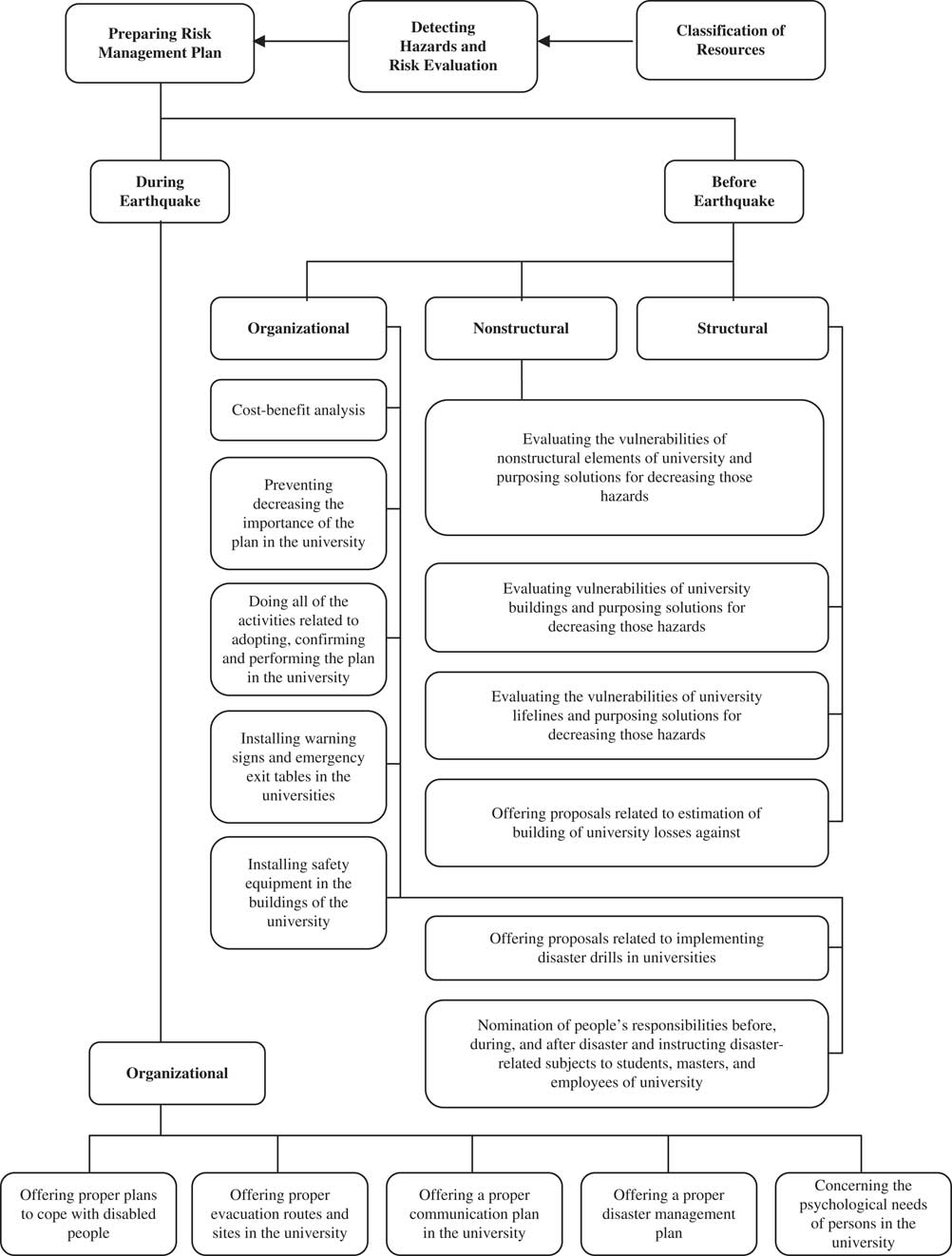
The universities’ plans concerning earthquake risk reduction and other collateral risks such as hazardous materials release and fire were investigated. The plans frequently concentrated on 2 periods of “before” and “during” earthquakes and 3 main sections: structural, nonstructural, and organizational (see Appendix 1 in the online data supplement). Having reviewed the risk management plans of the universities, the following steps can be considered as a reference for creating risk reduction management plans:
-
∙ Resource organization,
-
∙ Formation of a consulting committee,
-
∙ Selecting the project manager or administrator,
-
∙ Providing a timetable for the committee’s activities,
-
∙ Hazard detection and risk evaluation, and
-
∙ Executing the risk reduction plans in the university.
In the resource organization phase, all personnel and resources that may be of help to improve the risk management plan are identified. The identified personnel are then invited to a session where they are briefed about the necessity of the plan. If interested, they can cooperate in the formation of the risk management plan. A group of these people are then selected as the incident counseling committee of the university. The next step for this committee is detecting and identifying the natural and man-made dangers that pose a threat to the university.
Considering the level of vulnerability of the university, the committee will determine the priorities of the proposed risk reduction activities. Different subgroups will be formed to concentrate on different activities. After identifying the risks, they will take measures to reduce these risks.
The disaster management plans of the studied universities focused on identification and classification of resources, hazard detection, and risk evaluation. A summary of these plans is shown in Figure 1.
Summary of the Disaster Management Plans of the Universities Studied.

Comparison of Organizational Diagrams of the Studied Universities
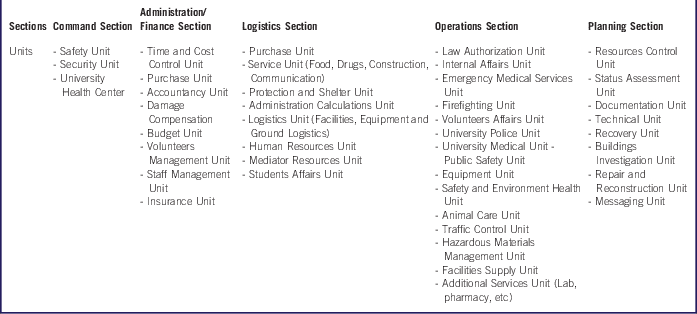
From studying the disaster management organizational structures of the studied universities, it is inferred that they often are composed of 2 separate parts. The first part is the command section, which consists of sections that are directly authorized by the disaster commander. The second part consists of 4 sections: administration and financial affairs, logistics, operations, and planning.
Table 1 shows the subsections of the Incident Command Systems (ICSs) of the reviewed universities. In addition to the universities investigated in Table 1, the emergency management system of the University of Cambridge and Purdue University are also investigated here.
Summary of Diagrams of Incident Command Systems in the Studied UniversitiesFootnote a

a Abbreviations: EH & S, Environment, Health & Security; EMA, Emergency Management Agency; EOC, emergency operations center; FEMA, Federal Emergency Management Agency; IT, information technology.
The University of Cambridge has provided an emergency management plan that is designed to be consistent with the emergency action plans held by the departments, buildings, and non-school institutions of the university. 34 This will enable it to complement and support the application of those plans in response to any emergency. A framework for managing the local multi-unit response to, and recovery from, emergency situations including strategic (GOLD), tactical (SILVER), and operational (BRONZE) levels of response is considered. The framework is also used to assist the university emergency response managers to communicate and understand the function and authority of the emergency services and other external agencies dealing with the event. The directors and heads of units of external affairs, communication, estate management, human resources, health and safety services, security, information technology, finance, legal services, registrar’s office, and academic division are involved in the emergency management plan along with the necessary administrative team. The title, deputy, membership, role purposes, and main responsibilities of the members of strategic, tactical, and operational management teams are described in the emergency management plan.
The Integrated Emergency Management Plan (IEMP) of Purdue University considers all phases of emergency management operations. 37 The National Incident Management System (NIMS) concepts, requirements, and policies are considered in the emergency management plan and the planned responses are consistent with the ICS in order to enhance the university’s ability to respond and recover from emergency situations. The IEMP is based on an organizational structure with 3 basic components, ie, an executive leadership policy group (ECPG) for policy-level decisions, campus safety and emergency preparedness committee (CSEP) as an advisory group for emergency preparedness issues, and emergency preparedness and planning office to implement vision, maintain plans, and standardize operating procedures. The ECPG is composed of the president, the executive vice president for academic affairs and provost, the chief financial officer/treasurer, the chief of staff, and the vice president for public affairs. The CSEP is made up of key staff members from units throughout the university. The emergency preparedness office includes partners from the university and representatives from relative organizations out of the university.
Purdue University has adopted NIMS to improve coordination and cooperation between public and private entities. NIMS includes the ICS. Thus, response management at Purdue University is based on the ICS structure. There are 3 functional areas in the ICS structure: incident command, command staff, and general staff. The Purdue University Incident Commander (PUIC) will normally be the chief of the police department or fire department of the university. The PUIC decides when the incident needs to be expanded to include a Public Information Officer, Liaison Officer, Safety Officer, Operations Section Chief, Planning Section Chief, Logistics Section Chief, and Finance & Administration Section Chief, as applicable. Purdue University Command Staff will be selected or requested by the PUIC based on the event or incident. Purdue University General Staff may comprise 4 sections: operations, planning, logistics, and finance and administration based on the emergency. PUIC will activate the section and select a Section Chief based on the emergency. The sections will be expanded to meet the resources and needs of the response.
The ICS is a disaster management organizational structure. It is a particular approach to assemble and control the highly reliable temporary organizations employed by many public safety professionals and to manage diverse resources in emergency situations.Reference Bigley and Roberts 38
In the next sections, the University of Tehran is introduced first as a case study, and then possible organizational structures are presented and a proposal is offered based on serious conditions of crisis in universities considering comments from professors and university staff having related knowledge and experience. The appropriate disaster management structure for the University of Tehran was deduced according to the different structure sections of the studied universities and related organizational design parameters.
CASE STUDY: THE UNIVERSITY OF TEHRAN
Located near the Enghelab Square, the University of Tehran is to the south of municipal district No. 6, in the middle of one of the most important and populated areas of Tehran. This campus was established in 1934 on 21 hectares of land.
Currently, the faculties of the University of Tehran consist of about 2100 professors, with approximately 4800 office staff. Students are accepted for BS and BA degrees in 111 majors and for MS and MA degrees in 177 majors through the national university entrance examinations. Applicants for PhD degrees in 156 different majors must take the domestic entrance exam of the university. The number of students is approximately 40,000. Moreover, about 280 foreign students currently study at the University of Tehran. The central library building and the university mosque have 11,200 and 1200 m2 of space, respectively, in addition to the educational buildings.
Three fire stations, 2 police stations, and 10 hospitals and health centers are located nearby the University of Tehran. The main potable water pipeline starts from the northern area of the campus, where the water repository is situated. Additionally, 2 high-pressure gas pipelines of 250 psi pass beneath the campus area. Fiber-optic cables pass through the northern and eastern areas of the campus. Six 20-kW electricity stations located inside the campus supply the electricity. The Enghelab Square station is the nearest subway station and one of the most accessible ways to this campus. 39
Concerning that Tehran is a highly earthquake-prone metropolitan area, earthquakes are a grave danger to the campus, considering the seismicity of its site, the age of the buildings, and the existence of hazardous materials in the university. Although the Mosha Fault is likely to cause the most powerful earthquake in Tehran, the Ray Fault would cause the deadliest one if activated, considering the old and condensed texture of southern Tehran, according to the investigations of the Japan International Cooperation Agency. 40 Considering the high risk of earthquake in Tehran and the vulnerability of the University of Tehran, providing an appropriate incident command structure is obviously essential.
METHODS
The methodology consisted of a gap analysis based on literature review and interviews, the Delphi method, and a developed questionnaire concerning proper disaster management organization based on related design parameters. A comprehensive literature review of the websites of different universities worldwide was performed considering disaster management structures. The universities with disaster management plans available on the web were studied. University websites were investigated in both scientific and nonscientific databases because of the nature of the research goals. The university websites were searched mainly through the Google (Google Inc, Mountain View, CA), Bing (Microsoft Corp, Redmond, WA), Yahoo (Yahoo, Sunnyvale, CA), and Ask (IAC Publishing Labs, Oakland, CA) search engines.
On the other hand, Google Scholar (Google Inc) was the main scientific database used for investigating scientific materials. Different combinations of a variety of key words including “university,” “institutes of higher education,” “campus,” “emergency plan,” “organization design,” “emergency response,” “emergency management,” “emergency operations plan,” “incident command system,” “disaster management structure,” and “emergency management organization” were used.
Interviews with university professors expert in the context or administration of the University of Tehran were also done to explore the key features of the organizational structure for the ICS. A gap analysis was performed between current units in the organizational structure for the ICS at the University of Tehran and the proper one derived from the review of the studied universities (Table 1).
The organizational design parameters considered in the study are explained here. Organizational structuring focuses on a number of design parameters. The most commonly used ones were considered in the questionnaire, as belowReference Mintzberg 9 :
-
∙ Job Specialization: This is for determining division of labor and concerns the number of tasks and their extent for each position (horizontal specialization and power sharing by nonmanagers) and the authority responsible for control of the incumbent over these tasks (vertical specialization and delegation to line managers).
-
∙ Formalization of Behavior: Organizations that use standardization for coordination of work processes or otherwise through rules, procedures, descriptions, and instructions are generally referred to as bureaucratic, whereas those that rely on direct supervision or mutual adjustment are called organic. Unskilled jobs are typically the most highly formalized ones.
-
∙ Training and Indoctrination: This is the key design parameter when the work is professional, ie, when the job is specialized horizontally but enlarged vertically.
-
∙ Grouping: Unit grouping deals with the reasons by which positions are clustered into units and comprehensive units, which may be considered on the basis of 2 basic variables, ie, function and market.
-
∙ Unit Size: Unit size describes the number of subunits that are grouped into one unit. The greater the standardization, the larger the unit. The more mutual adjustment for coordination is used and the more informal communication is allowed, the less the size of unit is necessary and thus the less direct supervision is needed.
-
∙ Planning and Control Systems: These design parameters reflect how job outputs are standardized. Planning and control systems may be divided into action planning for predetermination of outputs and performance control for measurement of outputs.
-
∙ Liaison Devices: This design parameter describes how mutual adjustments and informational connection are organized between different units.
-
∙ Decentralization: This is the key parameter that describes the decision-making system. Decentralization shows how and in what extent the power over decision-making is dispersed among the members of the organization in the chain of line authority. Vertical and horizontal decentralization in combination with selective and parallel decentralization results in 5 different kinds of decentralization.
As can be seen, 5 basic mechanisms of coordination are considered in the study of proper organization configuration. These include direct supervision, mutual adjustment, standardization of work processes, standardization of outputs, and standardization of skills.
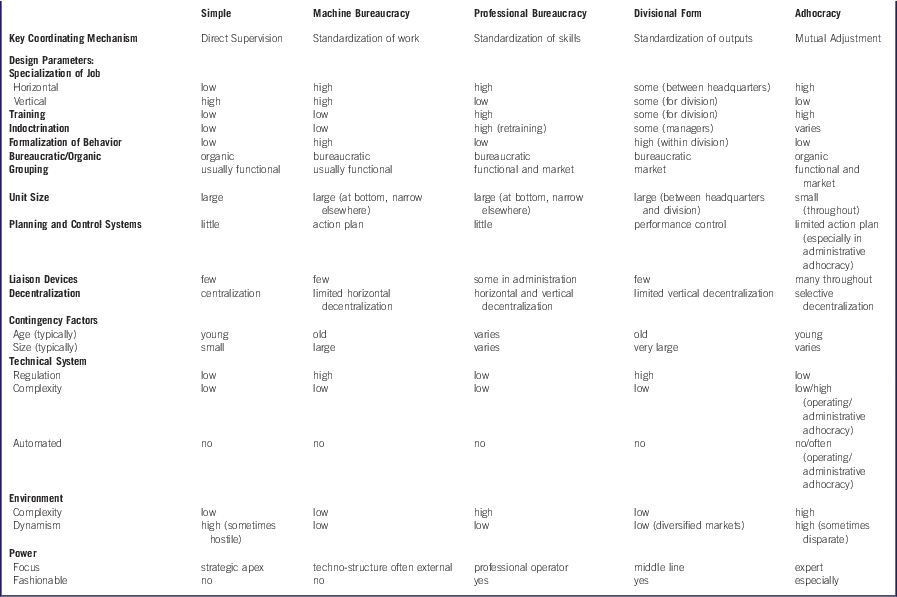
Age and size of the organization, technical system, environment, and power are the other factors considered here for the design of disaster management structure. These factors are called contingency factors. Based on the extended configuration hypothesis, a consistency among design parameters and contingency factors is necessary in organizational design.Reference Mintzberg 9 That means not only internal consistency among design parameters is necessary but also good congruence and fit between design parameters and contingency factors must be available. In other words, these 2 sets of factors interact with each other and the selection of one influences the choice of the other. Considering this hypothesis, it is concluded that the organizational structures can be classified into 5 basic categories as simple, machine bureaucracy, professional bureaucracy, divisional form, and adhocracy.Reference Mintzberg 41 , Reference Mintzberg 42 The organizations consist of 5 basic parts. These include the operating core, the strategic apex, the middle line, the techno-structure, and the support staff. Table 2 shows the specifications and features of the 5 basic organizational structures. The configuration is called a simple structure when direct supervision is the prime mechanism for decision-making and the strategic apex has the power for centralization. The organizational configuration has a machine bureaucracy structure when the tightest form of standardization of the work processes is the key parameter exerted by techno-structures and limited horizontal decentralization is available. The organization is said to have a professional bureaucracy configuration when standardization of skill is the key coordinating mechanism and the influence of the administrators is minimized and professionalism and outside training for enhancing skills is emphasized. The organization has a divisional form configuration when a limited vertical decentralization is available and the middle-line managers have autonomy for their own decisions in their Balkanized units. The standardization of outputs is the key coordinating feature in an organization with a divisional form. In an adhocracy configuration, the mutual adjustment is the key coordination mechanism; free coordination within or between work constellations is allowed. Collaboration of the support staff was considered in the decision-making process owing to their expertise in this configuration and the selective decentralization of power. Table 2 demonstrates the design parameters and the contingency factors of the 5 basic configurations.
Specifications of Different Organizational StructuresFootnote a

a Source: Mintzberg, 1980.Reference Mintzberg 9
To select the appropriate organization for the ICS of the University of Tehran, Table 2 was used to select the related configuration with consideration of the proper design parameters and contingency factors based on the viewpoints and opinions of the experts. An inquiry including the disaster profile and different organizational structure features was established, and 308 professors and university staff were asked about the characteristics of the proper disaster management system for the university. The questionnaire was formulated concerning the above-mentioned organizational design parameters and related contingency factors. The Delphi method was used to solicit expert opinions. The procedure consisted of formulating the questionnaire, obtaining individual answers, and iterating the questionnaires 2 times between 308 professors from different related departments (including management, natural disaster management, health, safety and environment, environmental hazards, reconstruction after disaster, and emergency management) and experienced university staff. The information feedback between rounds was controlled, analyzed, and finally aggregated.
The configuration with most similarities to the expert responses was selected as the appropriate structure for the investigated ICS. It can be inferred from the definition of an ICS that it is formed for incident conditions, such as an earthquake, that are quick, sudden, and unpredictable. In addition, owing to the quick and consecutive events of such incidents, the managers of different organizational levels do not have to contact their administrator; they have to make quick decisions. Hence, the people in charge of different sections of the organization should be allowed to make emergency decisions when the situation demands. Moreover, they ought to have the necessary proficiency and knowledge for making such decisions in disaster conditions.
RESULTS AND DISCUSSION
Organizational Structure for the Incident Command System for the University of Tehran
A brief description of the features of the ICS activity environment are as follows:
-
1. Complex and dynamic activity environment (unpredictable conditions, quick incidents, continuous change of conditions).
-
2. Splitting the decision-making process over the entire system (impossibility of contacting administrators in the case of earthquake disaster).
-
3. Lack of centralization (impossibility of communicating and adjustment with administrators).
-
4. Unofficial communication and coordination.
-
5. Shared coordination (owing to complexity of emergency conditions, work standardization cannot be employed, and owing to the wide activity field, direct monitoring is not applicable).
-
6. Presence of multiple communication systems (for different sections to communicate with each other).
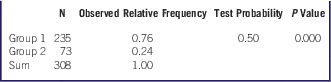
Table 3 shows the results of statistical analysis of the completed questionnaires. The results demonstrate that 76% of the professors and university staff confirmed that the adhocratic structure of the university’s disaster management (Group 1) is appropriate and the remaining 24% chose a configuration other than adhocracy (Group 2).
Result of the Binomial Hypothesis Test

The calculated P value was less than the considered level of significance (0.05); consequently, the null hypothesis, ie, the equality of relative frequency of Groups 1 and 2, is rejected and the test hypothesis is meaningful. Since the observed probability for Group 1 is 0.76, the alternative hypothesis
 $$H_{1} \,\colon\,p\,\gt\,0.5$$
for Group 1 is approved. Thus, from the point of view of the professors and university staff, the appropriate disaster management system is adhocracy in order to respond and react to an earthquake at the university. Low vertical hierarchy, working in a complex and dynamic environment, relying on mutual adjustment and informal communication, the need for using multidisciplinary teams, highly decentralized organization, and experts formally allocated to different divisions are among some important characteristics of adhocratic systems.Reference Konieczny
43
-
Reference Travica
46
By accepting the adhocracy system as the appropriate structure for the ICS of the university, the general features are as follow:
-
1. Shared coordination prevails in ICS (coordination forms through mutual adjustments and communications).
-
2. A need for different experts on the horizontal level of the ICS organizational system.
-
3. A lot of training (concerning behavior and quick reactions in incident conditions) is required for the personnel of the ICS structure to perform their duty properly.
-
4. It is not possible to standardize and formulate all the work of the members of the incident command structure given that the all the conditions under which the ICS works are not predictable and the environment may be dynamic and complicated.
-
5. The majority of the personnel who work in the incident command structure are experts. Therefore, limited action plans for administrative controls are required.
-
6. Multiple internal communication devices are required, as in emergency conditions, and different sections of the incident command structure need to communicate with each other.
-
7. As the conditions of an incident change quickly, and the staff and employees in charge of different sections in ICS are experts, there is no need to concentrate the responsibility of decision-making on one individual; the incident command structure has to be decentralized.
-
8. Unofficial connections are present through the entire structure; thus, there are many internal communications devices.
-
9. Incident command structure members have mutual adjustment with each other frequently.
-
10. The decision-making process takes place through the entire system and not in one specific unit.
-
11. The technical systems used for different applications are flexible in many units of the incident command structure.
-
12. The environment in which the ICS works—emergency conditions—is extremely complex and dynamic.
-
13. The experts in charge of each unit control the functions of the unit in the incident command structure.
It is concluded that the appropriate system for ICS in universities is the adhocracy system, with features such as decentralization, unofficial connections and coordination, and a variety of different communication devices. Although the adhocracy system is proposed here for the ICS at the university, this organizational configuration may face some challenges, especially in the recovery and reconstruction phase after the response phase when the emergency situation is controlled and stabilized. As noted earlier, adhocracy is used in environments that are both dynamic and complex. There is a tendency to standardize the works and skills when the complexity of the environment is reduced and it is transferred from a dynamic one to a stable situation as is the case when the response phase is transferred to the recovery and reconstruction phase. Age is another factor associated with adhocracies. Adhocracies tend to shift to bureaucratic configurations to escape uncertainties by using standards when they become older.Reference Mintzberg 9 , Reference Mintzberg 47 , Reference Mintzberg 48 An adhocracy may work well in the short term following a sudden event such as an earthquake, but it is not clear how it will work over the long term. This case should be studied in future research activities. The other field of research in this regard is to study and discuss how the proposed structure would be integrated with a larger response to an emergency in a city or on a regional scale.
Different Units of Incident Command Structure for the University of Tehran
By investigating the incident command structures of different universities, the current disaster management plan of the University of Tehran was analyzed (Figure 2), followed by a comparison with others. In the current ICS of the University of Tehran (Figure 2), the Administration and Financial Affairs, Logistics, Operations, and Planning sections are authorized by the incident command section, which consists of the Incident Commander, Internal Management Unit, Legal Unit, Liaison Unit, and Public Relations and External Coordination Unit.
The Current Incident Command Structure of the University of Tehran. Abbreviations: EOC, emergency operations center; IT, information technology. Source: University of Tehran, 2005. 39

It is inferred from comparing Figure 2 and Table 4 that there are several units in the structures of the studied universities that do not exist in the current structure of the University of Tehran, even though they are essential. Table 4 lists these sections. In some cases, a specific unit (indicated by an asterisk) is categorized in more than one section. For instance, the security unit is sometimes classified in the operations section and sometimes in the command section. Such units are listed here also, whether they can be fully operational according to their task descriptions or not are determined:
-
∙ Security unit (university police): This is classified in both the command and the operations sections; however, the former is the best section for this unit.
-
∙ Purchase unit: This is classified in both the logistics and the administration and financial affairs sections; however, the latter is the best section for this unit.
-
∙ Volunteers’ affairs management: This is classified in the operations, administration, and financial affairs sections; however, operations is the best section for this unit.
-
∙ Health service unit: This is classified in both the command and the operations sections; however, the latter is the best section for this unit.
-
∙ Safety unit: This is classified in both the command and the operations sections; however, the former is the best section for this unit.
Units and Sections Available in the Studied Universities That Need to be Added to the Incident Command Structure of the University of Tehran

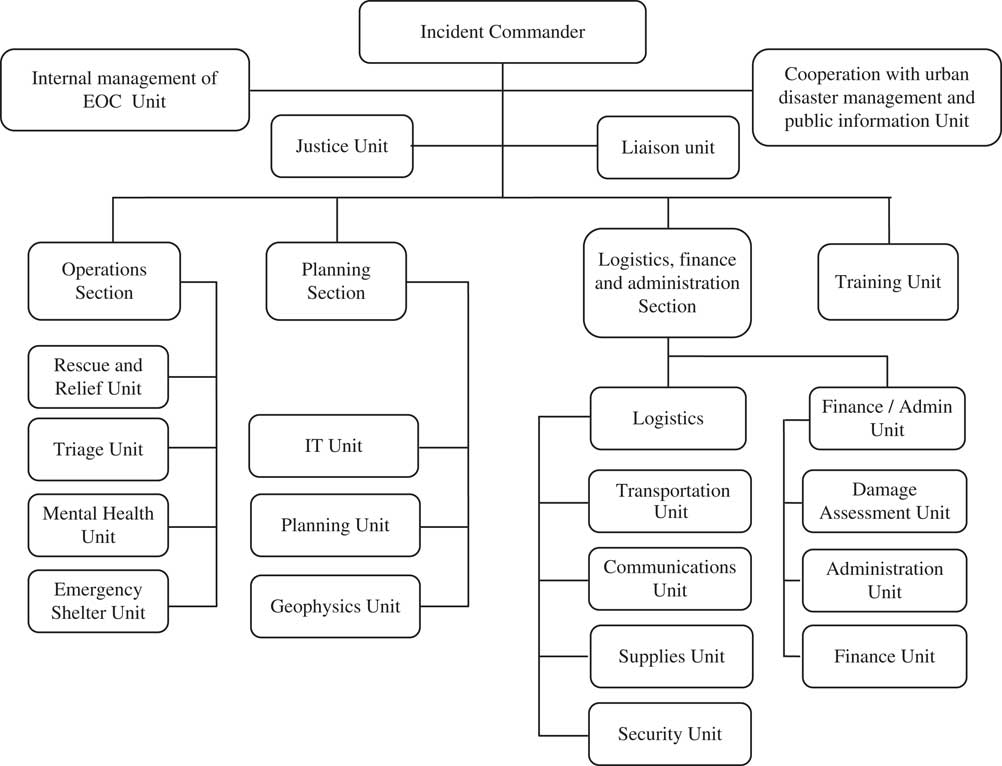
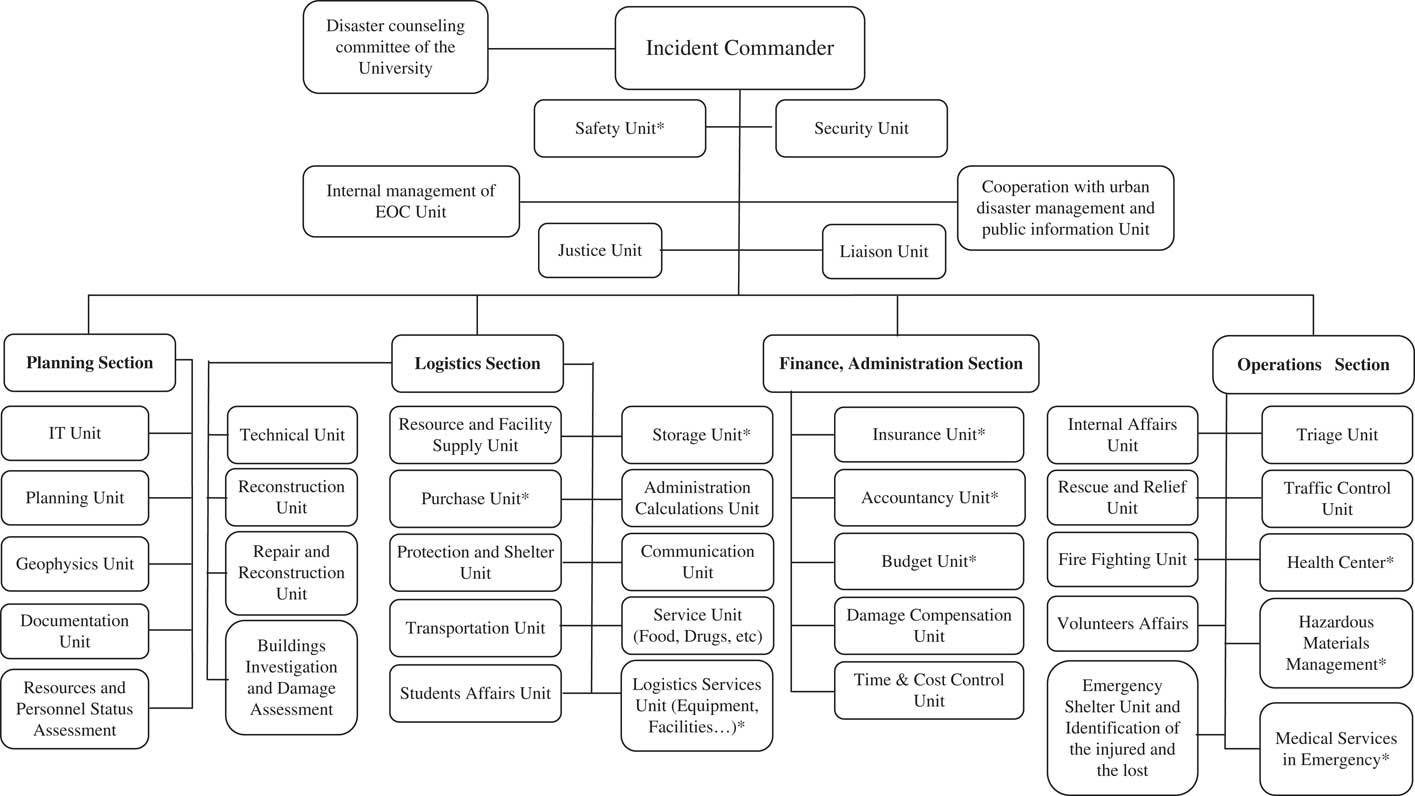
Therefore, as can be seen in Figure 3, the ICS of the University of Tehran should contain 5 sections: command, operations, administration and financial affairs, logistics, and planning. Description of responsibilities, relevant substitutes in charge for key persons, action plans and guidelines, control plans, and timetables of actions are provided in conjunction with the proposed structure, but only the structure is presented here owing to the article limitations. It is worth mentioning that the necessary units may be considered as a master plan. In a full-scale operation, the span of control is an important factor and no more than 5 subordinates per supervisor are organized in the detailed plan. On the other hand, Figure 3 is a summarized version of the full-scale plan for ease of graphic representation.
The Incident Command Structure Proposed for the University of Tehran. Abbreviations: EOC, emergency operations center; IT, information technology. Note: The units marked with asterisks (*) are not available in the current Incident Command Structure of the University of Tehran.

The command section consists of the cooperation with urban disaster management and the public information unit, security unit, internal management unit, safety unit, training unit, legal unit, and liaison unit. The operations section consists of the triage unit, internal affairs unit, rescue and relief unit, medical services in emergency, traffic control unit, firefighting unit, hazardous materials management, volunteers’ affairs, health center, emergency shelter unit, and the unit of identification of injured and lost people. The finance and administration section consists of the insurance unit, accountancy unit, budget unit, damage compensation unit, and time and cost control unit. The logistics section consists of the resource and facility supply unit, purchase unit, protection and shelter unit, transportation unit, students’ affairs unit, storage unit, service unit (food, drugs, etc), administration calculations unit, communication unit, and logistics services unit (equipment, facilities, etc). The planning section consists of the information technology unit, reconstruction unit, buildings investigation and damage assessment, repair and reconstruction unit, technical unit, planning unit, geophysics unit, resources and personnel status assessment, and documentation unit.
CONCLUSION
We introduced the processes implemented in 23 universities around the world regarding earthquake risk management, both before and during earthquakes, in 3 sections: structural, nonstructural, and organizational. We proposed a template for the structural, nonstructural, and organizational activities. With respect to the fact that most universities around the world have focused on the organizational section of their risk management plans, and that the University of Tehran had a structure for incident management at the time of the research, the different organizational structures were analyzed (Table 2) and the adhocratic structure was selected for the incident command management of the University of Tehran. One of the features of this structure is that it works in dynamic and complex environments and that the members are experts; they can make quick decisions at critical times without the need to be fully controlled by administrators. Therefore, this structure is selected as appropriate for emergency conditions. The ICSs of multiple universities were compared with the current incident command structure of the University of Tehran and an appropriate structure was proposed for disaster management at the University of Tehran (Figure 3). The structure provided in this study may be applicable to other universities as well.
SUPPLEMENTARY MATERIAL
To view supplementary material for this article, please visit https://doi.org/10.1017/dmp.2017.12.