Fire and police departments’ effectiveness is of particular importance to any community. As public safety providers (PSPs), the departments bear the legal responsibility to protect and serve the public (Boyce, Ciulla, Jones, Boone, Elliott, & Combs, Reference Boyce, Ciulla, Jones, Boone, Elliott and Combs2008) in risky job roles (Hällgren, Rouleau, & De Rond, Reference Hällgren, Rouleau and De Rond2018). Understanding what leads to fire and police departments’ service effectiveness may be more relevant than ever given the public scrutiny surrounding their actions (McGovern & Phillips, Reference McGovern, Phillips and Pontell2017). The quality of service provided by municipal fire and police departments has been scrutinized at local and national levels worldwide (e.g., public media and citizen groups) (Ellis & McGovern, Reference Ellis and McGovern2016; McGovern & Phillips, Reference McGovern, Phillips and Pontell2017), including in the USA, France, India, and Australia (Cheatham & Maizland, Reference Cheatham and Maizland2022). Other nations with histories of authoritarian rule (i.e., Latin American countries) grapple with issues related to constitutional safeguards and citizen safety with rising crime rates and hope that community-oriented policing will build community trust (Malone & Dammert, Reference Malone and Dammert2021).
From a community perspective, the ease of virtually sharing the PSPs’ (hereforth, we use PSP or first responders to represent firefighters and police officers) actions across social media outlets fosters heightened awareness within local communities and facilitates the cultivation of a reliable and authoritative presence. This, in turn, safeguards public accountability and promotes transparency (Fallik, Deuchar, Crichlow, & Hodges, Reference Fallik, Deuchar, Crichlow and Hodges2020). On the other hand, community trust perceptions are eroding at a record pace in countries like the United States (O’Connor, Reference O’Connor2017; Russell, Reference Russell2018), increasing the danger experienced by PSPs (Baka, Reference Baka2020; Ricciardelli et al., Reference Ricciardelli, Czarnuch, Carleton, Gacek and Shewmake2020), and leaving municipalities with challenges in hiring recruits (Mission Square Research Institude, 2023; Wilson & Grammich, Reference Wilson and Grammich2009). Public scrutiny may be appropriate as first responder performance begets important implications for citizen safety, municipality reputation, and overall trust in public agencies.
The importance of trust is not limited to citizens. PSPs’ trust perceptions of departmental administration also matter, given the routine uncertainty and danger in a first responder job. PSPs deal with high levels of job, physiological, and psychological stress, which is influenced by the organizational support (Brunetto, Farr-Wharton, Wankhade, Saccon, & Xerri, Reference Brunetto, Farr-Wharton, Wankhade, Saccon and Xerri2023) and psychological safety climate (Farr-Wharton, Brunetto, Hernandez-Grande, Brown, & Teo, Reference Farr-Wharton, Brunetto, Hernandez-Grande, Brown and Teo2022) they feel at work. PSPs depend upon their administration to assure appropriate equipment, sufficient staffing levels for assistance from other PSPs, and post hoc administrative support for their decision-making in crisis moments. The value of trust, a psychological ‘intention to accept vulnerability based upon positive expectations of the intentions or behavior of another’ (Rousseau, Sitkin, Burt, & Camerer, Reference Rousseau, Sitkin, Burt and Camerer1998, p. 385), can reduce uncertainty in highly uncertain contexts (Dirks & Ferrin, Reference Dirks and Ferrin2001, Reference Dirks and Ferrin2002). Earlier trust research in PSP contexts has identified the importance of perceived trust among coworkers, linked employee trust with competence among law enforcement officers (Lindberg & Rantatalo, Reference Lindberg and Rantatalo2015), and improved trust reports from firefighters stemming from their coworkers’ integrity and benevolence (Colquitt, LePine, Zapata, & Wild, Reference Colquitt, LePine, Zapata and Wild2011). Moving beyond coworker trust, we know when employees feel safe with organizational leaders, experience lower stress (Brunetto et al., Reference Brunetto, Farr-Wharton, Wankhade, Saccon and Xerri2023; Farr-Wharton et al., Reference Farr-Wharton, Brunetto, Hernandez-Grande, Brown and Teo2022), are more engaged (Brunetto et al., Reference Brunetto, Farr-Wharton, Wankhade, Saccon and Xerri2023), and are more likely to engage with others in extra-role behaviors (Mayer & Gavin, Reference Mayer and Gavin2005) that contribute to service performance gains (Colquitt et al., Reference Colquitt, LePine, Zapata and Wild2011; Dirks & Ferrin, Reference Dirks and Ferrin2002). Likewise, PSPs’ trust in administration (i.e., chiefs and lieutenants) is crucial since administrators provide first responders with the necessary resources (i.e., personnel, equipment, and training) to meet their needs in community crises, facilitating PSPs provision of quality service to their community. Thus, the purpose of this study is to understand what resources PSPs need to maintain trust in their administration and how these resources influence their service quality.
The discernment of what leads to PSPs’ improved trust in administration in the uncertain and dangerous first responder job role is critical. Administration plays a decisive, often final role in the decision-making of resource allocation, and extant research has found that organizational support, from PSPs’ perspectives, is often insufficient (Brunetto et al., Reference Brunetto, Farr-Wharton, Farr-Wharton, Shacklock, Azzopardi, Saccon and Shriberg2020; Brunetto, Xerri, & Farr-Wharton, Reference Brunetto, Xerri and Farr-Wharton2022; Hupe & Buffat, Reference Hupe and Buffat2014). First responders such as police and firefighters are often subject to the public sector gap, wherein the resources provided to these street-level bureaucrats are inadequate to meet the demand for public services (Hupe & Buffat, Reference Hupe and Buffat2014). Resources, as defined in the management literature, exist as either organizational or individual capacities, conditions, or characteristics that are valuable on their own or as part of the value-creation process to improve performance (Fagan & Ployhart, Reference Fagan and Ployhart2015; Hobfoll, Reference Hobfoll2001). At the organizational level, resources can include leadership support, organizational mission, or management practices (Fagan & Ployhart, Reference Fagan and Ployhart2015). Individual resources are the knowledge, skills, abilities, and other employee capacities that add value to an organization. Earlier findings report how the presence of sufficient organizational resources (e.g., training and staffing) has led to increased employee trust (e.g., De Jong & Dirks, Reference De Jong and Dirks2012; Dirks & Ferrin, Reference Dirks and Ferrin2002; Schaubroeck, Peng, & Hannah, Reference Schaubroeck, Peng and Hannah2013). Another body of literature has outlined the value of employees’ psychological resources as precursors to quality service delivery (e.g., Aryee, Walumbwa, Seidu, & Otaye, Reference Aryee, Walumbwa, Seidu and Otaye2016; Ehrhart, Witt, Schneider, & Perry, Reference Ehrhart, Witt, Schneider and Perry2011; Liao, Toya, Lepak, & Hong, Reference Liao, Toya, Lepak and Hong2009), commitment and reduced turnover intentions (Brunetto, Shacklock, Teo, & Farr-Wharton, Reference Brunetto, Shacklock, Teo and Farr-Wharton2014), and engagement (Brunetto et al., Reference Brunetto, Farr-Wharton, Farr-Wharton, Shacklock, Azzopardi, Saccon and Shriberg2020). However, limits remain in understanding the role of organizational and psychological resources, in combination, as antecedents to trust development and quality service provision in municipal police and fire departments.
We draw on the principle of reciprocity in social exchange theory (SET) (Ladd & Henry, Reference Ladd and Henry2000), wherein manager’s actions toward employees trigger a cascade of reciprocal attitudinal and behavioral responses and lead to the formation of a relationship (Cropanzano, Anthony, Daniels, & Hall, Reference Cropanzano, Anthony, Daniels and Hall2017). Manager–employee ‘relationships evolve into trusting, loyal, and mutual commitments’ that stem from the reciprocal exchanges existing between the two parties (Cropanzano & Mitchell, Reference Cropanzano and Mitchell2005, p. 875) such that benevolent treatment from administration begets employee reports of an increased positive orientation toward management and the organization (Cropanzano et al., Reference Cropanzano, Anthony, Daniels and Hall2017; Ehrhart et al., Reference Ehrhart, Witt, Schneider and Perry2011). Administrators’ positive initiating actions, such as allocating resources to employees (Riggle et al., Reference Riggle, Edmondson and Hansen2009), amplify employee trust perceptions. With resource gains, employees feel obligated to reciprocate to ‘do right’ in the relationship (Brower, Lester, Korsgaard, & Dineen, Reference Brower, Lester, Korsgaard and Dineen2009) by putting forth greater effort in terms of enhanced role performance (Brower et al., Reference Brower, Lester, Korsgaard and Dineen2009; Cropanzano et al., Reference Cropanzano, Anthony, Daniels and Hall2017; Cropanzano & Mitchell, Reference Cropanzano and Mitchell2005; Dirks & Ferrin, Reference Dirks and Ferrin2002). Based on the relational nature of trust in SET (Blau, Reference Blau1964), we consider the reciprocal relationship between administrators’ provision of organizational resources, employees’ psychological resources and trust in the administration, and PSP service performance.
This study seeks to make several contributions to the management literature. First, we assess whether trust in administration operates as an underexamined organizational resource to foster reciprocity and subsequently influence first responders’ service quality. By theorizing antecedents and outcomes of trust in the relationship between administration and employees (Reiche et al., Reference Reiche, Cardona, Lee, Canela, Akinnukawe, Briscoe and Wilkinson2014), we extend the SET literature by providing a more robust understanding of how the staffing and training decisions made by administrators may affect PSPs’ perceived trust in leadership and service quality. Second, we explore the contingent effect of employee prosocial motivation, a psychological resource that enables employees to focus on the welfare of others with no expectations of personal gains (Grant, Reference Grant2008), as an amplifying mechanism in the organizational resource–service quality relationship. Prosocial motivation might enable PSPs to engage in quality service levels above and beyond the influences of staffing or training on administrative trust, even within physically and emotionally demanding job contexts. Third, the study adds a new understanding of employee performance in the frontline, stressful, highly scrutinized, and risky service sector roles (Farr-Wharton et al., Reference Farr-Wharton, Brunetto, Hernandez-Grande, Brown and Teo2022; Grant & Sumanth, Reference Grant and Sumanth2009; Hällgren, Rouleau, & De Rond, Reference Hällgren, Rouleau and De Rond2018; Purba & Demou, Reference Purba and Demou2019; Van Gelderen, Konijn, & Bakker, Reference Van Gelderen, Konijn and Bakker2017) by discernment of distinct resources enabling PSPs to serve and protect citizens effectively.
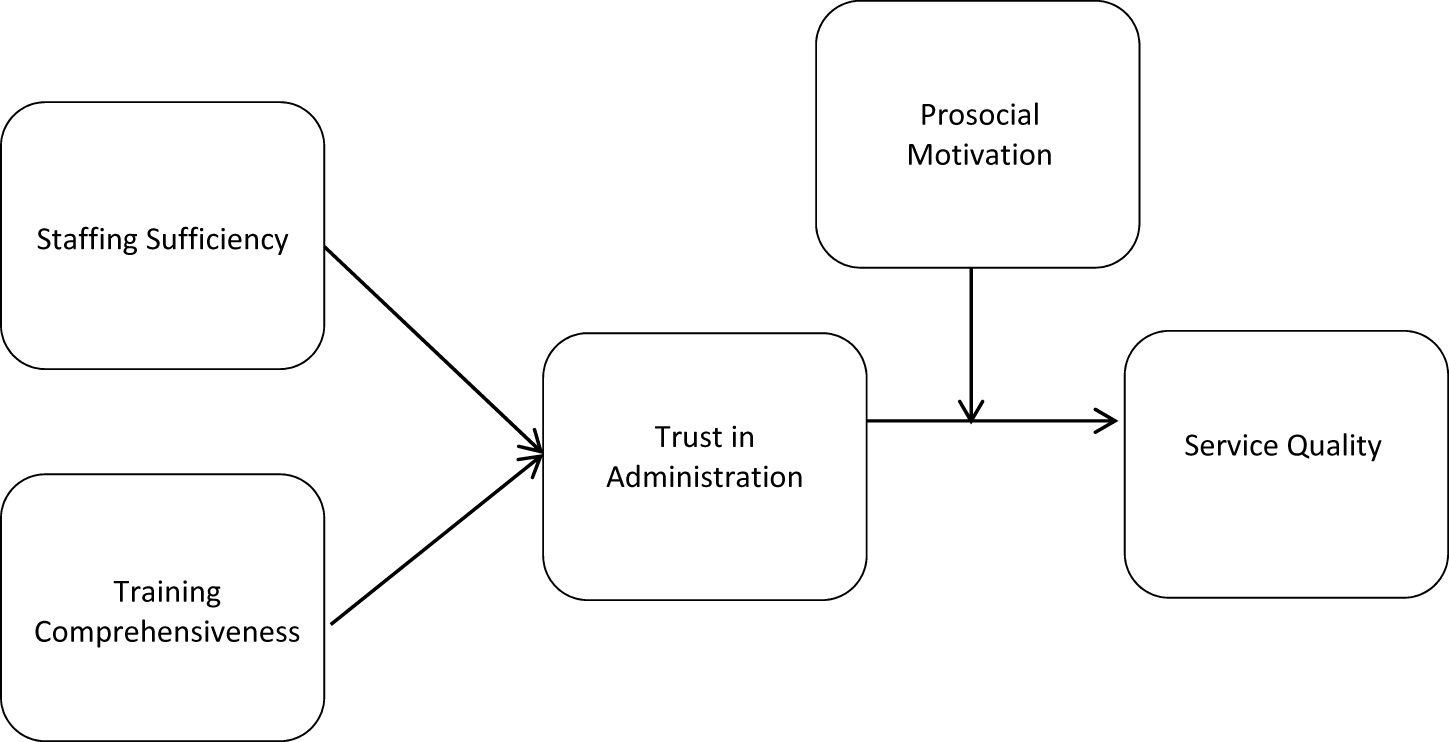
We examine the role of organizational and psychological resources on trust perceptions and service quality in a sample of firefighters and police officers from one municipality located in the Southwestern United States through two studies. By using the synchronic approach of studying two different coping agencies, we are able to compare responses, consider the role that context plays in our findings (Hupe & Buffat, Reference Hupe and Buffat2014), and answer the call to expand public administration research beyond just police departments to include a better understanding of fire departments as well (Henderson & Charbonneau, Reference Henderson and Charbonneau2016). In Study 1, we test the mediating role of trust in administration in the relationship between organizational resources (i.e., staffing sufficiency and training comprehensiveness) and quality service performance. In Study 2, we extend the aforementioned mediating relationship to test a moderated mediation model to examine whether staffing sufficiency and training comprehensiveness will increase employee service quality through trust in administration when accompanied by prosocial motivation. Our full hypothesized model is shown in Fig. 1.
Hypothesized second-stage moderated mediation model.

Importance of the context
Fire and police departments provide a unique setting for researchers to examine performance outcomes stemming from the context-specific resources they perceive are valuable in their risky job roles (Hällgren, Rouleau, & De Rond, Reference Hällgren, Rouleau and De Rond2018). There are similarities and differences between firefighters and police officers’ role responsibilities. Similarities exist in their immediate response to emergency calls. Both occupations are physically and emotionally demanding and involve periods of physical exertion in dangerous situations (Bacharach, Bamberger, & Doveh, Reference Bacharach, Bamberger and Doveh2008; McCarthy, Trougakos, & Cheng, Reference McCarthy, Trougakos and Cheng2016; Purba & Demou, Reference Purba and Demou2019; Scholarios, Hesselgreaves, & Pratt, Reference Scholarios, Hesselgreaves and Pratt2017). In their responder roles, firefighters are often first at the scene confronting dangerous elements and potential criminal activity (Boyce et al., Reference Boyce, Ciulla, Jones, Boone, Elliott and Combs2008) and increasingly respond to medical emergencies (Hällgren, Rouleau, & De Rond, Reference Hällgren, Rouleau and De Rond2018). Success in these risky roles requires police officers and firefighters to provide safe and reliable service (Colquitt et al., Reference Colquitt, LePine, Zapata and Wild2011) during unpredictable and adverse events (Bigley & Roberts, Reference Bigley and Roberts2001; Scholarios, Hesselgreaves, & Pratt, Reference Scholarios, Hesselgreaves and Pratt2017). In addition to responding to crisis events, first responders in both job roles provide routine community safety services (Colquitt et al., Reference Colquitt, LePine, Zapata and Wild2011), such as interacting with and educating the public, or preparing reports and writing field notes.
Despite these similarities, the requirements of community protection in these two departments also differ. Firefighters serve to protect people’s lives and properties in disasters, such as fires or car accidents (Junyoul, Taeil, & Jungmin, Reference Junyoul, Taeil and Jungmin2017), whereas police officers aim to protect the public from various criminal activities (Brunetto et al., Reference Brunetto, Farr-Wharton, Farr-Wharton, Shacklock, Azzopardi, Saccon and Shriberg2020; Noblet, Maharee-Lawler, & Rodwell, Reference Noblet, Maharee-Lawler and Rodwell2012). The characteristics of firefighting require firefighters to execute a variety of physically challenging tasks under extreme environmental conditions, making the job one of the most physically demanding and dangerous occupations (Bureau of Labor Statistics, 2019) and resulting in high levels of occupational stress, psychological distress, and emotional exhaustion (Purba & Demou, Reference Purba and Demou2019; Young, Partington, Wetherell, St Clair Gibson, & Partington, Reference Young, Partington, Wetherell, St Clair Gibson and Partington2014). Firefighters often require extensive levels of teamwork to sustain personal safety and support team success (Pratt, Lepisto, & Dane, Reference Pratt, Lepisto and Dane2019). The role of a police officer, while not without danger, can be more mentally challenging and isolating (Boyce et al., Reference Boyce, Ciulla, Jones, Boone, Elliott and Combs2008) than that of the firefighters. The routine physical demands in this job are less intensive than in firefighting, and police officers often respond to calls alone (Golembiewski & Kim, Reference Golembiewski and Kim1990), such as when police officers self-dispatch a traffic stop or approach a suspicious person while on a routine patrol. The solo nature of policing affords them with heightened levels of discretionary power in how they perform their roles (Farr-Wharton et al., Reference Farr-Wharton, Brunetto, Wankhade, Saccon and Xerri2021) though perceptions of discretionary power have been shown to differ across countries (Brunetto et al., Reference Brunetto, Farr-Wharton, Farr-Wharton, Shacklock, Azzopardi, Saccon and Shriberg2020). These differences in the job roles of police officers and firefighters, especially the difference in team (i.e., firefighter) versus solo (i.e., police officer) responders, might indicate the need for different organizational and psychological resources for effective job performance. To discern the potential differences, we examine our hypotheses in two separate departmental studies.
Theoretical framework and hypotheses
Organizational resources
For some time now, a body of scholarly work has examined the positive impact of staffing and training on organizational and employee performance gains (e.g., Ganster & Dwyer, Reference Ganster and Dwyer1995). More recent attention on employee performance in service roles has highlighted the positive effects of staffing sufficiency and training comprehensiveness on employee performance (Aguinis & Kraiger, Reference Aguinis and Kraiger2009; Greer, Carr, & Hipp, Reference Greer, Carr and Hipp2016; Sitzmann & Weinhardt, Reference Sitzmann and Weinhardt2018). However, more research is needed to shed light on how staffing sufficiency and training comprehensiveness may influence novel mechanisms in the service quality value chain (Greer, Carr, & Hipp, Reference Greer, Carr and Hipp2016; Liebermann & Hoffmann, Reference Liebermann and Hoffmann2008; Ployhart, Reference Ployhart2006), especially in the public sector. Prior staffing literature in the public safety domain concentrates on employee diversity and the types of selection tools used in hiring firefighters and police officers (Lievens, De Corte, & Westerveld, Reference Lievens, De Corte and Westerveld2015; McFarland, Ryan, Sacco, & Kriska, Reference McFarland, Ryan, Sacco and Kriska2004). The training literature in this context is limited primarily to training interventions for physical preparedness for role responsibilities (Baka, Reference Baka2020; Henderson, Berry, & Matic, Reference Henderson, Berry and Matic2007), failing to assess police and firefighters’ perceptions of training comprehensiveness. The roles of staffing sufficiency and training comprehensiveness are largely unexplored and limit what we know about service effectiveness in such physically and emotionally demanding, dangerous, and risky roles (Bacharach, Bamberger, & Doveh, Reference Bacharach, Bamberger and Doveh2008; Bigley & Roberts, Reference Bigley and Roberts2001; McCarthy, Trougakos, & Cheng, Reference McCarthy, Trougakos and Cheng2016).
Staffing sufficiency
Staffing sufficiency, also referred to as staffing adequacy, is the extent to which an organization has a sufficient number of employees to complete the expected job roles and responsibilities (Spence, Reference Spence1978; Vahey, Aiken, Sloane, Clarke, & Vargas, Reference Vahey, Aiken, Sloane, Clarke and Vargas2004). Spence (Reference Spence1978) originally conceptualized how sufficient staffing could signal an employer’s care, respect, and consideration for their employees. Early empirical work advanced this conceptualization by establishing relationships between staffing sufficiency and a variety of job-related attitudes and job enrichment (Vecchio & Sussmann, Reference Vecchio and Sussmann1981). Other research on staffing sufficiency, primarily limited to hospital contexts, shows how sufficient staffing can reduce employee burnout and turnover intentions and also improve patient satisfaction (Kane, Shamliyan, Mueller, Duval, & Wilt, Reference Kane, Shamliyan, Mueller, Duval and Wilt2007; Vahey et al., Reference Vahey, Aiken, Sloane, Clarke and Vargas2004). In the public safety context, McCabe and O’Connell (Reference McCabe and O’Connell2017) recently reported a positive relationship between the number of police officers and the level of crime but failed to discern the relationship between staffing levels and police performance. Brunetto et al. (Reference Brunetto, Shacklock, Teo and Farr-Wharton2014) found a link between organizational support and engagement, commitment, and turnover intentions for police officers and nurses but did not examine the role that staffing levels have on performance. This limited research assumes that appropriate staffing sufficiency levels can improve both service outcomes and employee perceptions. However, to test and extend these assumptions, scholars have called for more attention to the intervening mechanisms in the relationship between staffing levels and employee attitudes and behavior (e.g., Ployhart, Reference Ployhart2006). In this paper, we consider PSPs’ perceptions of staffing sufficiency through the principle of reciprocity rather than per capita, minimum-staffing, or authorized-level staffing approaches that may be used to make budgeting decisions (Brunetto & Beattie, Reference Brunetto and Beattie2020).
Administrators’ provision of appropriate staffing signals an awareness of employee workloads and highlights administration consideration for employee success and well-being (Baka, Reference Baka2020; Dirks & Ferrin, Reference Dirks and Ferrin2002; Rousseau et al., Reference Rousseau, Sitkin, Burt and Camerer1998). In this sense, PSPs perceive management’s commitment to maintaining adequate staffing levels as a form of positive behavior that signifies organizational support (Baka, Reference Baka2020). In turn, PSPs’ assessment of administrative support via adequate staffing levels elicits their positive reaction back to management (Cropanzano et al., Reference Cropanzano, Anthony, Daniels and Hall2017). In response to the felt staffing support, employees experience gratefulness toward the organization for providing them with a positive work experience (i.e., providing sufficient staff), which is known to inspire enhanced reciprocity and relation-based trust between employees and the organization (Balkin & Richebé, Reference Balkin and Richebé2007; Ng, Reference Ng2016). Thus, based on the extant research that found employee trust as a positive response to managerial decisions (Colquitt et al., Reference Colquitt, LePine, Zapata and Wild2011; Dirks & Ferrin, Reference Dirks and Ferrin2001; Schoorman et al., Reference Schoorman, Mayer and Davis2007), we surmise that PSPs who report sufficient staffing levels will also maintain a trusting orientation toward administration. Thus:
Hypothesis 1a: Staffing sufficiency will be positively associated with trust in the administration.
Training comprehensiveness
Following the same logic of the principle of reciprocity, we contend that PSPs’ perceptions of training comprehensiveness may also facilitate a similar increase in trust in administration, given that the allocation of training resources, such as the type and frequency of training, falls under management’s purview. However, to date, this relationship has received limited attention in the literature. Comprehensive training equips firefighters and police officers with the necessary skills and resources to address uncertain and dangerous situations (Aguinis & Kraiger, Reference Aguinis and Kraiger2009; Sitzmann & Weinhardt, Reference Sitzmann and Weinhardt2018). Before employees engage in behavioral changes following workplace training, they often first report a change in their psychological states, such as increased enthusiasm, commitment, or motivation (Paulsen & Kauffeld, Reference Paulsen and Kauffeld2017). Employees’ improved psychological state may stem from perceived management support, including management’s understanding of the workplace environment, expertise in allocating the necessary training resources, and investment in employees’ long-term growth and overall well-being (e.g., Lambooij, Flache, Sanders, & Siegers, Reference Lambooij, Flache, Sanders and Siegers2007). Employees perceive administrations’ competence and consideration in providing comprehensive training opportunities, which, in turn, triggers employees’ reciprocal feelings of goodwill and trust toward management (Mayer, Davis, & Schoorman, Reference Mayer, Davis and Schoorman1995; Rousseau et al., Reference Rousseau, Sitkin, Burt and Camerer1998). Thus, we posit that PSPs will view administration allocation of training resources, in this dangerous context, as a sign of care and benevolence from the administration (Aguinis & Kraiger, Reference Aguinis and Kraiger2009), a necessary prerequisite to trust perceptions (Mayer, Davis, & Schoorman, Reference Mayer, Davis and Schoorman1995). Thus, we hypothesize that:
Hypothesis 1b: Training comprehensiveness will be positively associated with trust in the administration.
Trust in administration and service quality
Based on existing findings from the extant literature, we surmise that increased levels of trust in administration may enhance PSPs’ overall service quality. Trust has been associated with several operational outcomes, including citizenship behaviors (Mayer & Gavin, Reference Mayer and Gavin2005) and job performance (Aryee et al., Reference Aryee, Budhwar and Chen2002; Colquitt et al., Reference Colquitt, LePine, Zapata and Wild2011). The relationship between trust in administration and heightened performance has been found to develop through several mechanisms. Trust in administration leads to higher levels of information exchange between subordinates and supervisors (e.g., Rich, Reference Rich1997), facilitates the sharing of resources among employees, and reduces employee engagement in nonproductive behaviors (Methot, Lepine, Podsakoff, & Christian, Reference Methot, Lepine, Podsakoff and Christian2016). Through heightened reciprocal exchanges, managers can provide rapid, corrective feedback to guide employees to improved performance (e.g., Schaubroeck, Peng, & Hannah, Reference Schaubroeck, Peng and Hannah2013). Such ongoing exchanges enhance a trusting relationship wherein employees are more likely to accept and apply this feedback to improve their performance (Dirks, Reference Dirks2000). When employees trust their manager, employees are more confident in providing creative solutions to challenging situations and sharing negative and problem-indicated information without fear of managerial retaliation (Baer et al., Reference Baer, Dhensa-Kahlon, Colquitt, Rodell, Outlaw and Long2015; Dirks & Ferrin, Reference Dirks and Ferrin2001). Critical to PSPs, employee trust in administration also influences employees’ perceptions of safety in the workplace, which should enhance performance outcomes. Perceptions of organizational support and relationships with supervisors have also been shown to influence employee engagement for police officers (Brunetto et al., Reference Brunetto, Farr-Wharton, Farr-Wharton, Shacklock, Azzopardi, Saccon and Shriberg2020, Reference Brunetto, Shacklock, Teo and Farr-Wharton2014), which should also enhance performance outcomes.
Extrapolating these findings to our study, we posit that trust in administration functions like other psychological attributes (e.g., job satisfaction, psychological safety climate, and perceived organizational support) to trigger positive psychological conditions (Brunetto et al., Reference Brunetto, Farr-Wharton, Farr-Wharton, Shacklock, Azzopardi, Saccon and Shriberg2020; Dirks & Ferrin, Reference Dirks and Ferrin2002, Reference Dirks and Ferrin2001; Farr-Wharton et al., Reference Farr-Wharton, Brunetto, Hernandez-Grande, Brown and Teo2022), such as confidence, a sense of safety, openness to new ideas, reduced stress, employee engagement, and collaboration that enhances service quality. In service settings, employees working in similar positive psychological conditions are often more sensitive and responsive to others’ feelings and thus show more care, respect, and consideration to customers in their service performance (Li & Tan, 2013). Thus, we expect similar quality service will result when firefighters and police officers report trust in their administration. We offer:
Hypothesis 2: Trust in administration will be positively associated with service quality.
The mediating role of trust
Our prior hypotheses have informally outlined the mediating role of trust in administration in the relationship between staffing sufficiency, training comprehensiveness, and service quality. By formally conceptualizing trust in administration as a mediator in this relationship, we contribute to the literature by explaining the role of employee perceptions toward administration in the relationship between staffing and training and employee service performance in a context beyond the technology sector (Chang & Chen, Reference Chang and Chen2002). Moreover, our focus on trust in administration examines a novel resource that may facilitate employee performance in the face of risky jobs and heightened stressors, such as dangerous contexts, fatigue, erratic shift hours, or physical demands (Henderson, Berry, & Matic, Reference Henderson, Berry and Matic2007; Purba & Demou, Reference Purba and Demou2019; Vila, Reference Vila2006; Vila, Morrison, & Kenney, Reference Vila, Morrison and Kenney2002; Young et al., Reference Young, Partington, Wetherell, St Clair Gibson and Partington2014).
The mediating role of trust in administration conceptualized in SET posits that individuals, in response to favorable initiating actions, will generally reciprocate by offering more positive behavioral responses or reducing negative responses (Cropanzano et al., Reference Cropanzano, Anthony, Daniels and Hall2017). Specific to our research, a series of reciprocal exchanges following the administrative provision of additional resources (i.e., staffing and training) evolve into development of trust toward the administration. When administrators help address the public sector gap, first responders should view administrators more positively. Specifically, PSPs who receive comprehensive training and sufficient staffing in their job would more readily perceive these resources as a positive initiating action that signals support from the administration (Balkin & Richebé, Reference Balkin and Richebé2007). In turn, PSPs will more readily develop affective organizational commitment (Meyer et al., Reference Meyer, Stanley, Herscovitch and Topolnytsky2002) and foster a greater sense of trust (Dirks & Ferrin, Reference Dirks and Ferrin2002; Konovsky & Pugh, Reference Konovsky and Pugh1994). In the presence of heightened administrative trust, employees are more likely to respond positively, using their new skills and capabilities gained from organizational resources (e.g., staffing and training) to improve their service quality. Therefore, we hypothesize that:
Hypothesis 3a: Trust in administration mediates the relationship between staffing sufficiency and service quality.
Hypothesis 3b: Trust in administration mediates the relationship between training comprehensiveness and service quality.
Prosocial motivation as an individual resource
Up to this point, we have identified staffing sufficiency and training comprehensiveness as organizational resources that influence PSP trust in the administration and improve employees’ service quality. Another resource that may be critical to PSPs, especially for police officers’ quality service provision, is their desire to help others or their prosocial motivation. Prosocial motivation, or ‘the desire to benefit other people’ (Grant, Reference Grant2008, p. 48), is a valuable psychological resource for employees working in mission-driven, community-oriented street-level organizations (e.g., Grant & Berry, Reference Grant and Berry2011; Grant & Sumanth, Reference Grant and Sumanth2009; Hu & Liden, Reference Hu and Liden2015; Zhu & Akhtar, Reference Zhu and Akhtar2014). Such organizations exist to help the community, and employees in these organizations work in roles that directly benefit the lives of others. In the case of police and fire departments, these coping agencies carry out public regulation tasks (Hupe & Buffat, Reference Hupe and Buffat2014) that can save lives. Benefiting others is a key characteristic of prosocial motivation, and prosocially motivated employees who work for mission-driven organizations value the opportunity to help or care for another’s well-being, providing these individuals with quality service (Grant & Sumanth, Reference Grant and Sumanth2009). Prosocially motivated employees often display altruistic acts and are more willing to put the organizational mission or the interests of those served by the organization above their own (Meglino & Korsgaard, Reference Meglino and Korsgaard2004) and provide higher levels of service in community-based work (Grant, Reference Grant2008).
For example, Witt and Broach (Reference Witt and Broach1993) found that procedural justice is related to satisfaction, but this relationship was stronger among individuals who held favorable beliefs regarding reciprocity. Extending earlier work on prosocial motivation, we consider the interactive effects of police officers’ prosocial motivation and their trust in administration on their service performance. Based on the socially appropriate principles of reciprocity (Cropanzano et al., Reference Cropanzano, Anthony, Daniels and Hall2017), we contend that when officers trust their administration and are motivated to do well for others, they are more likely to share information with colleagues, identify novel responses, and maintain positive attitudes about their job (Dirks & Ferrin, Reference Dirks and Ferrin2001; Schaubroeck, Peng, & Hannah, Reference Schaubroeck, Peng and Hannah2013). In this case, police officers who concurrently sense trust from their administrators and are prosocially motivated to help others amplify their ability to perform at higher service levels despite the uncertainty and perceived risk inherent in their jobs. On the other hand, we posit that police officers with low prosocial motivation lack the intrinsic drive to serve the community and are less inclined to embody social reciprocity norms to provide high service quality even when they trust their administration. Thus, contributing to the known value of prosocial motivation and trust found in research in more sedentary, low-risk job roles (Grant & Sumanth, Reference Grant and Sumanth2009), we examine this relationship with police officers’ service quality when working in jobs characterized by high levels of risk, uncertainty, and demands. Thus, we propose:
Hypothesis 4: Prosocial motivation moderates the relationship between trust in administration and service quality.
Overview of studies
A key strength of this paper is that our variables and data sources were operationalized to align with the reciprocal resource exchanges conceptualized in SET. Two of the coauthors consulted with the police and fire department chiefs in a local municipality for roughly 2 years as participants in the municipality’s Public Safety Committee. The coauthors worked with the chief and two deputy chiefs from the respective departments. The chiefs and deputy chiefs represent the department administration. The chiefs and deputy chiefs were males, each with over 20 years of service in the department. The police chief was Hispanic, and the other chiefs were Caucasian. As members of the Public Safety Committee, the coauthors conducted numerous needs assessments to outline departmental strategic goals that informed municipal funding decisions. No notable public safety incidents beyond the typical police and fire responses occurred during the timeframe of this research. Through forum discussions, individual qualitative interviews, and monthly committee meetings, the coauthors used an inductive approach to identify key constructs and develop trust and staffing measures appropriate for the setting. The researchers assured the anonymity of responses and that the chiefs would be provided with the finding summaries. The result was a comprehensive set of studies completed approximately 3 months apart. In Study 1, we examine our initial mediation model. In Study 2, we seek to replicate the findings of Study 1 in a new sample and examine the moderating role of prosocial motivation.
Study 1
Method
Participants and procedures
Study participants were non-civilian employees of the fire department in a medium-sized city in the southwest United States. The department chiefs and deputy chiefs supported employee participation in the study as an effort to inform the decisions made in the Public Safety Committee. Employees were given paid time during their regular shifts to complete the paper surveys. About 120 employees participated in the study. All department employees except for the chief and two deputy chiefs participated in the study. The majority of participants were male (97.4%). They ranged in age from 21 to 55 years (M = 35.74, SD = 7.55) and had been with the fire department for an average of 9.23 years (SD = 5.91, range: 0–23 years). Among them, 38.3% were identified as White, 38.3% as Hispanic or Latino/Latina, 9.2% as two or more races, 3.3% selected Other, 1.7% as Black or African-American, 1.7% as Native Hawaiian or Pacific Islander, 8% as American Indian or Alaskan Native, and 6.7% elected not to provide their race.
Measures
All items were measured using a 7-point Likert-type scale ranging from 1 (strongly disagree) to 7 (strongly agree).
Staffing sufficiency
Participants rated how sufficient they felt the staffing was on their shift using four items adapted from the Revised Nursing Work Index developed by Vahey et al. (Reference Vahey, Aiken, Sloane, Clarke and Vargas2004) and three related items created for this study (α = .85). An example of an adapted item is ‘There are enough firefighters on my shift to provide quality emergency services’. The three new items are ‘There are enough firefighters on my shift to address simultaneous crises’, ‘There are enough firefighters on my shift to provide necessary back up’, and ‘There are enough firefighters on my shift to provide quality community engagement’.
Perceived training comprehensiveness
We used four items adapted from Ehrhardt, Miller, Freeman, and Hom (Reference Ehrhardt, Miller, Freeman and Hom2011) to measure perceived training comprehensiveness (α = .71). An example scale item is ‘I receive many hours of training in my work role’.
Trust in administration
Participants rated their trust in administration using five items developed for this study through consultation requests and qualitative interviews with the department chiefs. These items were ‘My immediate supervisor keeps my interests in mind when making decisions’, ‘If my immediate supervisor asked why a problem occurred, I would speak freely even if I were partly to blame’, ‘I trust the chiefs (fire chief, deputy chiefs) to be fair in their treatment of me’, ‘I trust the chiefs (fire chief, deputy chiefs) to be fair in their support of me’, and ‘I trust the chiefs (fire chief, deputy chiefs) to have the needs and concerns of the employees as a priority’. The internal reliability for the scale is α = .88.
Service quality
Participants rated the service quality provided by their shift using nine items adapted from Parasuraman, Zeithaml, and Berry (Reference Parasuraman, Zeithaml and Berry1988) (α = .88). An example item includes, ‘On my shift, the firefighters are effective in listening to citizens’ needs’.
Analysis and results
Confirmatory factor analysis
To provide evidence for the discriminant validity of the study’s variables, we conducted confirmatory factor analyses (CFAs) and used chi-square difference tests to compare our hypothesized four-factor model to three alternative nested models. First, we test our hypothesized measurement model with the 25 items that make up our substantive variables loading on four factors. We found all of the factor loadings to be significant (p < .001), and 24 of the items had loadings of acceptable magnitude. For the sake of parsimony and to ensure a reasonable ratio of sample size to the number of estimated parameters, we created parcels for staffing sufficiency and service quality (Little, Cunningham, Shahar, & Widaman, Reference Little, Cunningham, Shahar and Widaman2002). We used factor analytic results to implement the balancing approach to parcel creation and created three parcels for each of the parceled measures (Little, Rhemtulla, Gibson, & Schoemann, Reference Little, Rhemtulla, Gibson and Schoemann2013). The hypothesized four-factor measurement model demonstrated a good fit to the data (χ2 = 161.83, df = 84, comparative fit index (CFI) = .93, Tucker-Lewis index (TLI) = .91, root mean square error of approximation (RMSEA) = .09, standardized root mean squared residual (SRMR) = .07).
Next, we compared our hypothesized four-factor model to three alternative models. In the first alternative model, we created a three-factor model that combined staffing sufficiency and training comprehensiveness into one factor. Compared to our hypothesized model, the three-factor alternative was a significantly worse fit for the data (CFI = .86, TLI = .83, RMSEA = .12, SRMR = .09, Δχ2 = 74.69, Δdf = 3, p < .001), providing support for the hypothesized model. In the second model, we created a two-factor alternative model to examine the discriminant validity of our trust in administration items by combining all of the predictor variables (staffing sufficiency, training comprehensiveness, and trust in administration) into one factor. This two-factor model was a significantly worse fit (CFI = .68, TLI = .63, RMSEA = .18, SRMR = .13, Δχ2 = 266.71, Δdf = 5, p < .001) for our data than our hypothesized model. In our third alternative model, we assessed the presence of common method variance (CMV). We compared our hypothesized model with a one-factor model in which all items were loaded onto a single latent factor. Compared to our hypothesized model, the one-factor model (χ2 = 610.68, df = 90, CFI = .51, TLI = .43, RMSEA = .22, SRMR = .16, Δχ2 = 448.85, Δdf = 6, p < .001) fit the data significantly worse. These findings provide evidence that CMV did not substantially bias our results.
Hypothesis testing
Table 1 reports the descriptive statistics for all Study 1 variables. The pairwise correlations are based on sample sizes ranging from 119 to 120 because one participant was missing responses on the four staffing sufficiency items. Missing data were handled using the FIML function in Mplus.
Means, standard deviation (SD), and correlations between Study 1 variables

Note: n ranges from 119 to 120. Cronbach’s αs appear on the diagonal.
* p < .05, two-tailed.
** p < .01, two-tailed.
We tested our mediation model using path analysis in Mplus 7. We also used bootstrapped estimates from 1,000 samples to construct bias-corrected confidence intervals (CIs) (Shrout & Bolger, Reference Shrout and Bolger2002). Using path analysis, we estimated two regression equations: one regressed the mediator on the independent variables, and the other regressed the outcome on the independent variables and the mediator. These estimates reflect (a) the direct effects of staffing sufficiency and training comprehensiveness on trust in administration (Hypotheses 1a and 1b, respectively), (b) the direct effects of trust in administration on service quality (Hypothesis 2), and (c) the indirect effects of staffing sufficiency and training comprehensiveness on service quality through trust in administration (Hypotheses 3a and 3b, respectively).
In support of Hypothesis 1a, staffing sufficiency was positively and significantly related to trust in administration (b = .53, p < .01, 95% CI [.29, .73]). Hypothesis 1b was not supported, as the path between training comprehensiveness and trust in the administration was positive but not significant (b = .17, n.s., 95% CI [−.12, .47]). We did find support for Hypothesis 2: trust in administration was positively and significantly related to service quality (b = .12, p < .05, 95% CI [.03, .21]). Hypotheses 3a and 3b predicted that trust in the administration would mediate the relationships on staffing sufficiency and training comprehensiveness, respectively, and service quality. We found partial support for these hypotheses. The indirect effect of staffing sufficiency on service quality through trust in the administration was significant (indirect effect = .06, 95% CI [.02, .12]), supporting Hypothesis 3a. However, the indirect effect of training comprehensiveness on service quality through trust in the administration was not significant (indirect effect = .02, 95% CI [−.01, .08]), so Hypothesis 3b was not supported.
Study 1 discussion
We found support for the direct and mediating relationships between staffing sufficiency, trust in the administration, and service quality. However, we failed to find significance with training comprehensiveness (Hypotheses 1b, 3b). These findings suggest that sufficient staffing levels are associated with heightened service quality and enhance firefighters’ perceived trust in the administration. The lack of significance with training comprehensiveness, while unexpected, may result from the team-oriented nature of firefighting. Firefighters spend the bulk of their shift together in the fire station, debriefing recent service calls as well as socializing and completing physical training while waiting for emergency calls. When responding to emergency calls, the firefighters again rely on their team to address emergency issues. It may be that in this team-oriented context, firefighters equate their training comprehensiveness more with their close peer interactions in the firehouse than from training resources provided by administrators.
Study 2
In Study 2, we seek to replicate the findings from Study 1 using a sample of police officers to provide further support for our model and improve the external validity of our results. To discern the distinction of police officers working alone as compared to the team-oriented nature of firefighting, we also include prosocial motivation as a potential moderator in trust in administration and service quality relationship (Hypothesis 4).
Method
Participants and procedures
Participants of this study were non-civilian employees of the police department in the same city as Study 1. Employees were again given paid time during their workday to complete the paper surveys. 119 employees participated in the study. To remove potential bias in the responses, two coauthors led the data collection and verified that no administrators ever viewed survey responses. The majority of participants were male (92.4 percent). They ranged in age from 22 to 56 years old (M = 34.30, SD = 7.48) and had been with the police department for an average of 8.01 years (SD = 5.64, range: 0 to 24 years). 52.6% identified as Hispanic or Latino/Latina, 32.7% as White, 5.2% as two or more races, 4.3% as Black or African-American, 2.6% selected other, 1.7% as Asian, and .9% as Native Hawaiian or Pacific Islander.
Measures
All items were measured using a 7-point Likert-type scale ranging from 1 (strongly disagree) to 7 (strongly agree). Variables used in the previous study (staffing sufficiency, perceived training comprehensiveness, trust of administration, and service quality) were measured using the same items as the previous study, just adapted for the police department instead of the fire department (e.g., ‘firefighters’ was changed to ‘officers’ and ‘emergency services’ was changed to ‘law enforcement’).
Participants’ perceptions of staffing sufficiency were rated using the same 7-item scale from Study 1 (α = .92). Participants also rated their perceptions of training comprehensiveness using the same 4-item scale used in Study 1 (α = .73). Participants then rated their trust in administration using the same five items used in Study 1 (α = .82). Finally, participants rated the service quality provided by their shift using the same 9-item scale used in Study 1 (α = .90).
Prosocial motivation
We adapted a five-item measure of prosocial motivation that was developed and validated by Grant and Sumanth (Reference Grant and Sumanth2009) (α = .93). Example items include ‘It is important to me to have the opportunity to use my abilities to benefit the community’ and ‘I get energized by working on tasks that have the potential to benefit the community’.
Analysis and results
Confirmatory factor analysis
Following the same parceling procedures as Study 1, in order to provide evidence for the discriminant validity of the variables in Study 2, we conducted CFAs and used chi-square difference tests to compare our hypothesized five-factor model to three alternative nested models. The hypothesized five-factor measurement model demonstrated a good fit to the data (χ2 = 247.60, df = 160, CFI = .95, TLI = .94, RMSEA = .07, SRMR = .09). Compared to our hypothesized model, the four-factor alternative with a single independent variable (combining staffing sufficiency and training comprehensiveness onto one factor) was a significantly worse fit for the data (CFI = .89, TLI = .87, RMSEA = .10, SRMR = .11, Δχ2 = 104.97, Δdf = 4, p < .001). Next, compared to our hypothesized model, a four-factor alternative with a single factor representing the mediator and moderator items was also a significantly worse fit for the data (CFI = .68, TLI = .63, RMSEA = .17, SRMR = .20, Δχ2 = 470.18, Δdf = 4, p < .001). Finally, compared to our hypothesized model, the one-factor model (χ2 = 1206.85, df = 170, CFI = .40, TLI = .32, RMSEA = .23, SRMR = .20, Δχ2 = 959.25, Δdf = 10, p < .001) fit the data significantly worse. These findings provide support for our hypothesized model and evidence that CMV did not substantially bias our results.
Hypothesis testing
Table 2 reports the descriptive statistics for all Study 2 variables. We used the path analytic procedures recommended by Edwards and Lambert (Reference Edwards and Lambert2007) to test our hypothesized second-stage moderated mediation model. This method has the advantage of combining moderated regression analysis and path analysis with bootstrapping mediation approaches to test the significance of indirect effects (Courtright, Colbert, & Choi, Reference Courtright, Colbert and Choi2014). To implement this procedure, we used Mplus 7 and Mplus code developed by Preacher, Rucker, and Hayes (Reference Preacher, Rucker and Hayes2007). We mean-centered our mediating and moderating variables in all models to avoid issues with multicollinearity. We also used bootstrapped estimates from 1,000 samples to construct bias-corrected CIs (Shrout & Bolger, Reference Shrout and Bolger2002) in all of our analyses. Following the two-step approach recommended by Edwards and Lambert (Reference Edwards and Lambert2007), we first used path analysis to estimate two regression equations (Model 1), one of which regressed the mediator on the independent variables and the other regressed the outcome on the independent variables and the mediator. These estimates reflect (a) the direct effects of staffing sufficiency and training comprehensiveness on trust in administration (Hypotheses 1a and 1b), (b) the direct effects of trust in administration on service quality (Hypothesis 2), and (c) the indirect effects of staffing sufficiency and training comprehensiveness on service quality through trust in administration (Hypotheses 3a and 3b). The results of our hypothesis testing are shown in Table 3.
Means, standard deviations (SD), and correlations between Study 2 variables

Note: n = 119. Cronbach’s αs appear on the diagonal.
* p < .05, two-tailed.
** p < .01, two-tailed.
Path analytic tests of hypothesized and alternative models

Note: Study 1: N = 120; Study 2: N = 119. Values represent unstandardized path estimates.
* p < .05.
** p < .01.
† 95% Confidence interval does not include zero.
‡ In computing the Q and W statistics, all models were compared with Model 4.
In support of Hypothesis 1a, staffing sufficiency was positively and significantly related to trust in administration (b = .29, p < .01, 95% CI [.15, .42]). Hypothesis 1b was also supported, as the path between training comprehensiveness and trust in the administration was positive and significant (b = .59, p < .01, 95% CI [.42, .74]). We also found support for Hypothesis 2: trust in administration was positively and significantly related to service quality (b = .17, p = .05, 95% CI [.02, .36]). Hypotheses 3a and 3b predicted that trust in the administration would mediate the relationships between staffing sufficiency and training comprehensiveness, respectively, with service quality. We found support for these hypotheses as well. The indirect effect of staffing sufficiency on service quality through trust in the administration was significant (indirect effect = .05, 95% CI [.01, .13]), supporting Hypothesis 3a. In addition, the indirect effect of training comprehensiveness on service quality through trust in the administration was significant (indirect effect = .10, 95% CI [.01, .21]), so Hypothesis 3b was supported in this study.
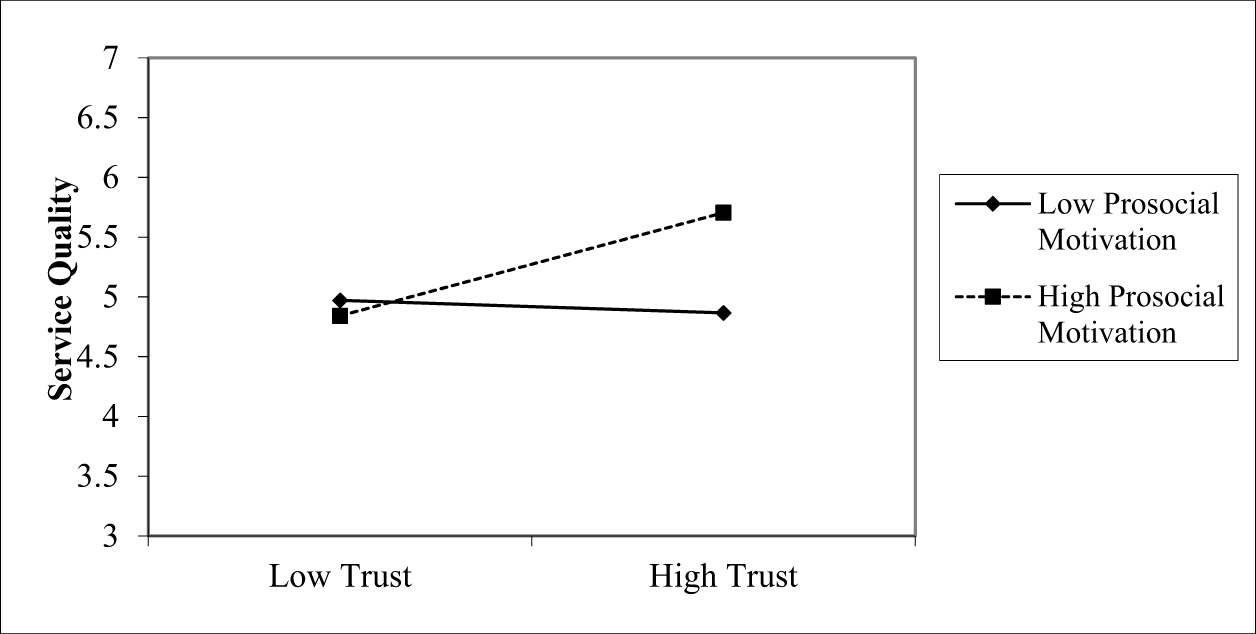
For the second step recommended by Edwards and Lambert (Reference Edwards and Lambert2007), we estimated the second-stage moderated mediation regression equations (Model 3). We then estimated indirect effects at high (+1 SD), moderate (mean), and low (−1 SD) standard deviation levels of prosocial motivation (i.e., moderator), and tested their significance using bias-corrected bootstrapped 95% CIs (Shrout & Bolger, Reference Shrout and Bolger2002). Hypothesis 4 predicted that prosocial motivation would moderate the relationship between trust in administration and service quality. As shown in Table 3, we found support for this hypothesis. The interaction between prosocial motivation and trust in administration on service quality was significant (b = .19, p < .05, 95% CI [.03, .34]). Further insight into the direction of this conditional effect can be found in Fig. 2. As shown in the figure, there is a positive relationship between trust in administration and service quality for employees with high prosocial motivation (simple slope = .31, p < .01), but that relationship is not significant for employees with low prosocial motivation (simple slope = − .04, p = .72). This result is consistent with the indirect effects reported in Table 3. Specifically, the conditional indirect effects of staffing sufficiency on service quality through trust in administration at different levels of prosocial motivation reflect that the indirect effects are significant at high levels of prosocial motivation (indirect effect = .09, 95% CI [.03, .19]) and moderate levels of prosocial motivation (indirect effect = .04, 95% CI [.002, .11]). The conditional indirect effects of training comprehensiveness on service quality through trust in administration at different levels of prosocial motivation reflect that the indirect effects are significant only at high levels of prosocial motivation (indirect effect = .17, 95% CI [.05, .32]). Therefore, Hypothesis 4 was supported.
Interaction between trust and prosocial motivation on service quality.

Finally, the Edwards and Lambert (Reference Edwards and Lambert2007) method allows researchers to compare the hypothesized model and alternative nested models to provide further support for our overall hypothesized second-stage moderated mediation model and rule out any potential that prosocial motivation is moderating the relationship between our independent variables and our mediator, in addition to moderating the relationship between trust in administration and service quality. The generalized R 2, Q, and W statistics were computed to allow us to compare several models to pinpoint where moderation is primarily taking place in the model (Models that contain more than one variable being predicted [i.e., mediation] in a path model can be compared by computing generalized R2, Q, and W statistics. A model with a higher generalized R 2 and a significant W statistic explains more variance than the model to which it is being compared, meaning that a statistically significant W statistic shows that the more restricted model is explaining significantly more variance [Tepper et al., Reference Tepper, Henle, Lambert, Giacalone and Duffy2008]) (Tepper, Henle, Lambert, Giacalone, & Duffy, Reference Tepper, Henle, Lambert, Giacalone and Duffy2008). Specifically, we compared our hypothesized second-stage moderation model (Model 3) and an alternative first-stage moderation model (Model 2) with a total effects model (Model 4).
As shown in Table 3, the total effects model, Model 4, (R 2Generalized = .66), explains significantly more variance than the simple mediation model, Model 1, (R 2Generalized = .58, W = 22.36, p < .001), and significantly more variance than the first-stage moderated mediation model, Model 2, (R 2Generalized = .61, W = 15.16, p < .001). This means that having both first- and second-stage moderation in the model creates a significantly better model than having no moderation or only first-stage moderation. However, the total effect model does not explain significantly more variance than our hypothesized second-stage moderated mediation model, Model 3, (R 2Generalized = .63, W = 9.59, n.s.), showing that adding first-stage moderation (to create a total effects model) does not significantly improve the second-stage moderation model, which provides further evidence for our hypothesized model. Finally, it is worth noting that in the first-stage moderation model, neither interaction was significant (staffing sufficiency × prosocial motivation: b = .10, p = .26; training × prosocial motivation: b = − .02, p = .89). Therefore, we can be confident that the moderation is taking place only in the second half of our model.
Study 2 discussion
In Study 2, we find full support for the mediating relationships, including the role of training comprehensiveness, which was not significant with firefighters. With police officers, we find that staffing sufficiency and training comprehensiveness are positively associated with trust in administration and service quality. It may be that in the uncertain and self-directed, sometimes isolating nature of policing, police officers require additional training and staffing support for heightened associations of trust and service quality. It is also possible that the team-based approach used in firefighting leads to more informal on-the-job training (OJT) than that which is available to police officers. We also find support for the value of high levels of prosocial motivation and high trust in administration such that the combination of both of these leads to heightened associations with police officer service quality. Our second study demonstrates the value of high prosocial motivation in police officers’ service quality in addition to the other resources. Police officers report a stronger positive association with quality of service if they have enough resources (staffing and training) provided to them. However, police report the highest service quality in the presence of trust in the administration and prosocial motivation. Thus, trust in the administration and prosocial motivation appear to amplify the value of organizational resources to police officer service quality.
General discussion
The overall study results provide meaningful implications for understanding what resources are necessary for PSPs provision of quality service for the communities they serve and how organizational resources impact service quality distinctly. First, when considering the organizational resources that are important in the study’s context, our findings suggest that staffing sufficiency is a critical need for both firefighters and police officers. Extending earlier research that reported the need for the administration to align sufficient staffing levels with the volume of emergency-related calls (McCabe & O’Connell, Reference McCabe and O’Connell2017), we find that sufficient staffing is associated with firefighters and police officers’ positive reports of service quality. The role of trust in the administration existed as a positive and novel link that heightened service quality for both departments. This finding extends earlier research showing the value of staffing sufficiency to employee performance in non-emergency job roles (Hudson & Shen, Reference Hudson and Shen2015, Reference Hudson and Shen2018) through heightened levels of trust in administrators by employees in risky job roles. As previously stated, by introducing trust in administration as a mediator, we contribute to the management literature and extend what we know about the reciprocity of resource exchange in SET to further explain the role of employee trust toward the administration in the relationship between organizational resources and service quality.
We posit our findings augment SET’s capacity to explain and provide more accurate insights about the dynamics of exchange relationships (Cropanzano et al., Reference Cropanzano, Anthony, Daniels and Hall2017) in several areas. First, we identified the value of multiple overlapping constructs for initiating behavioral action and targeting specific behavioral predictions. Namely, we found that administration’s provision of sufficient staffing and training comprehensiveness was associated with PSPs’ positive perceptions of trust in administration. Second, we reported how PSPs’ individual resources, particularly their prosocial motivation, served as an additional principle of reciprocity in their relationship between trust perceptions and improved service quality. Third, we find that police officers’ prosocial motivation is beneficial to their service quality effectiveness in a dangerous job context, expanding our understanding of exchange relationships across various settings and different resources (e.g., Brunetto et al., Reference Brunetto, Farr-Wharton, Farr-Wharton, Shacklock, Azzopardi, Saccon and Shriberg2020; De Jong & Dirks, Reference De Jong and Dirks2012; Dirks & Ferrin, Reference Dirks and Ferrin2002; Schaubroeck, Peng, & Hannah, Reference Schaubroeck, Peng and Hannah2013). In sum, our study investigated how administrations’ provision of sufficient staffing and training influences PSPs’ trust perceptions, in combination with employees’ prosocial motivation, to ultimately impact service effectiveness.
Through our findings, we extend SET to show the nuanced pathways of initiating actions of resource exchanges that enhance service quality in the public safety sector (Cropanzano et al., Reference Cropanzano, Anthony, Daniels and Hall2017). Our findings extend previous research that investigated how initiating actions evoked positive affect (i.e., trust) to influence individual citizenship behaviors (Aryee et al., 2002) and how perceptions of management support increased employee engagement in several contexts (Brunetto et al., Reference Brunetto, Farr-Wharton, Farr-Wharton, Shacklock, Azzopardi, Saccon and Shriberg2020). Our findings, specific to trust perceptions, suggested that when firefighters and police officers feel that they possess adequate support from their administrators, they respond with increased levels of trust in the administration, which ultimately results in higher levels of quality service provided to the community. Furthermore, our study identified two distinct resources, staffing sufficiency and training comprehensiveness, as positive predictors of PSPs’ trust in administration, which initiated enhanced service quality through trust. Notably, the requisite resources, however, appeared to be different for firefighters and police officers. The findings of Study 2 supported the importance of training comprehensiveness for police officers only. This result suggests that the police officers’ responsibilities of preventing, investigating, and stopping crime in a highly ambiguous and dangerous job role (e.g., Brandl & Stroshine, Reference Brandl and Stroshine2013; Yarwood, Reference Yarwood2015) may increase police officers’ perceived training needs, a need that may be driven by the solo nature of police officers’ job roles (Farr-Wharton et al., 2021). In contrast, the nonsignificant finding of training comprehensiveness for firefighters may suggest that they rely on their teams in crisis events or feel better prepared given their daily training in the firehouse (e.g., weight and cardiovascular, equipment checks).
The role of trust in administration emerged as a vital resource to employees’ positive service quality in both departments, and the mediating role of trust in administration between staffing sufficiency and positive service quality was fully supported in both samples. The reported association between trust in administration and positive service quality extends earlier work that depicts the importance of a leader’s trust for firefighters (e.g., Perry & Mankin, Reference Perry and Mankin2007; Sedlmeyer & Dwyer, Reference Sedlmeyer and Dwyer2018) to also include the value of administrative trust to police officers. The influence of perceived reciprocity between administrator trust and PSPs’ service quality found in this study moves beyond earlier research that links leadership style, namely transformational leadership or service leadership, with police officer commitment and turnover (Brunetto, Teo, Shacklock, Farr-Wharton, & Shriberg, Reference Brunetto, Teo, Shacklock, Farr-Wharton and Shriberg2017; Schaubroeck, Lam, & Peng, Reference Schaubroeck, Lam and Peng2011) to demonstrate a positive association with employee service quality. Moreover, this study responds to the call for understanding the reciprocity of trust between leaders and employees in different contexts (Reiche et al., Reference Reiche, Cardona, Lee, Canela, Akinnukawe, Briscoe and Wilkinson2014).
Beyond a focus on the value of organizational resources, our study is the first known to highlight the importance of police officers’ prosocial motivation to heightened service quality. We find that prosocial motivation appears to amplify police officers’ quality service provision. It may be that prosocial motivation is a critical resource in softening the current view in some countries of police officers’ public image as being impersonal, psychologically cruel, and even physically violent (e.g., Jobson & Schneck, Reference Jobson and Schneck1982; Van Craen, Reference Van Craen2013). Officers’ prosocial motivation may, instead, increase citizens’ perspectives of positive service quality. The value of high levels of prosocial motivation to police officers is perhaps even more valuable given that a considerable portion of a police officer’s job moves beyond crime prevention and thus requires officers to frequently help community members with social and emotional challenges (Hawdon, Reference Hawdon2008; Zhao, Lovrich, & Thurman, Reference Zhao, Lovrich and Thurman1999). Context should be considered when examining public sector organizations (Hupe & Buffat, Reference Hupe and Buffat2014). It is essential to acknowledge the differing demands on police officers and firefighters during crises. While police officers often find themselves working independently with heightened levels of discretion (Farr-Wharton et al., 2021), firefighters may rely on their teams for support in such situations. Indeed, the team-based nature of firefighting demands a significant amount of OJT in real-time scenarios. Future research should examine such distinctions.
Managerial implications
The findings of this study have several important managerial implications for PSPs and administrators in charge of resource allocation. While municipal resources to enhance public safety may be limited, chiefs need to be aware of the importance of sufficient staffing, as well as training comprehensiveness, and how this can impact service quality. Indeed, this study reinforces previous research emphasizing the need for aligning staffing levels with the volume of emergency-related calls (Gurvich et al., Reference Gurvich, Luedtke and Tezcan2010). It is important for administrators in other crisis-oriented service industries (e.g., healthcare) to recognize how staffing at appropriate levels heightens trust, which in turn improves service quality. To further enhance service quality, administrators should focus on fostering trust in the administration, as our findings suggest that trust serves as a fundamental driver in shaping positive service outcomes. This may be improved by providing adequate job resources, transparent communication, and fair treatment, as well as opportunities for employee participation and involvement in decision-making processes.
In addition, our study highlights the importance of comprehensive training programs for police officers. By investing in training that addresses the specific challenges and demands of dangerous and emotionally demanding job roles, administrators can empower employees with the necessary knowledge, skills, and abilities to perform their jobs more effectively. We find that training comprehensiveness is especially important in more solo, isolated job roles. Future research should distinguish between training types. For instance, an emerging research stream indicates that virtual reality training implemented in police academies offers a more effective approach to prepare officers, potentially decreasing instances of racialized police violence, and, concurrently, benefiting both law enforcement and the communities they serve (Alanis & Pyram, Reference Alanis and Pyram2022).
In consideration of the nonsignificant findings of training comprehensiveness for firefighters, it may be that the team-oriented nature and the reduced frequency of emergency calls (Fry, Magazine, & Rao, Reference Fry, Magazine and Rao2006) attenuate their reliance upon administration for formalized training resources. In this team-oriented job environment, earlier research suggests that firefighters need more training to prepare for the life-threatening conditions of a structural fire, complete routine training to meet physical fitness job requirements, and maintain equipment and vehicles (e.g., Boyce et al., Reference Boyce, Ciulla, Jones, Boone, Elliott and Combs2008; Junyoul, Taeil, & Jungmin, Reference Junyoul, Taeil and Jungmin2017). Our findings may suggest that other factors such as tenure, high-performing teams, or immediate supervisors may matter more than training comprehensiveness. Future research should delve deeper into understanding the underlying mechanisms and boundary conditions that reinforce or substitute for training programs in critical contexts.
Lastly, our findings suggest that administration should consider the role of prosocial motivation among police officers. We found that police officers’ prosocial motivation amplifies the relationship between trust in administration and service quality. We recommend that administrators should leverage and nurture this prosocial motivation by creating a supportive work environment that recognizes and values the altruistic drive of police officers. By promoting a culture of prosocial values and acknowledging the positive impact of prosocial motivation, administrators can harness its potential to enhance service quality. Moving beyond individual differences, investigating how team dynamics, such as cohesion, collaboration, and shared goals, contribute to or substitute for prosocial orientations would provide valuable insights.
Limitations and future research
As with all research, our work is not without limitations. First, due to the logistical challenges of collecting data from public protective service personnel in multiple regions, our findings were obtained from the fire department and police department in a single city. It is possible that different cities with dissimilar sizes, economic resources, and cultures may have police officers and firefighters who think and behave in a consistently different manner than the participants in our studies. Future research should test this model in other locations (e.g., very large cities, different regions of the country, or with other international municipalities). However, we can gain some reassurance of generalizability from the fact that our model was tested using two distinct public protective service occupations (firefighters and police officers), and we found consistent results for the majority of the relationships in our model.
In addition, our findings in Study 1 and 2 rely on self-report data from PSPs. As such, we cannot rule out the possibility of self-report bias in our results. Future research should seek to replicate the results of Study 1 and 2 by using objective performance measurements. Lastly, our variables of interest, inductively derived from the coauthors’ interactions with the department chiefs, identify the value of staffing and training on perceived administrative trust. Future research should consider other organizational resources that might positively influence public protective officers’ service quality. Similarly, our focus on prosocial motivation is limited to the examination of a psychological resource, namely prosocial motivation. Future research should examine the role of intentional hiring and training practices designed for identifying and developing prosocial motivation, respectively. Research should also examine the value of prosocial motivation in other public safety departments and other crisis-oriented service roles.
In addition, examining different cultural and organizational settings and job roles where prosocial behavior is crucial would shed light on the generalizability and applicability of these findings. Given that the majority of our sample were male employees, future research should specifically examine the impact of team environments on our proposed relationships for women. Understanding potential gender variations in our proposed relationships would contribute to a more comprehensive understanding of how team environments shape trust in administration and service quality across different populations. Future research should also account for other personal capabilities (e.g., personality and team support) that may also serve as a personal resource for success in such physically and emotionally demanding job roles. Finally, future research should compare our findings to other countries to account for the effects of context such as institutional design, relationships, and political cultures (Hupe & Buffat, Reference Hupe and Buffat2014).
Dr. Carol Flinchbaugh is a Professor of Management, and Robert O. Anderson Distinguished Professor at New Mexico State University. Dr. Flinchbaugh has several ongoing research projects focusing on the topics of employee responses to workplace demands, HR systems in the non-profit setting, and understanding generational differences in the workplace.
Dr. Jennifer Miles is an Assistant Professor of Management in the University of San Diego. Dr. Miles teaches courses in organizational behavior. Her research focuses on teams and group work, leadership, leader–member exchange, and ethical decision-making.
Dr. Bahareh Javadizadeh is an Assistant Professor of Management who specializes in Human Resource Management and Organizational Behavior. Her research explores the individual and organizational outcomes of perceived identity threat in the workplace, the creation of facades of conformity as a coping mechanism, and the buffering role of the climate of authenticity.
Dr. Yanni Liang received her PhD in Management from New Mexico State University. Her research is focused on strategy and sustainable firm performance.
Dr. William Smith is a retired Associate Professor at New Mexico State University. His research is focused on strategic management, strategic analysis, organizational theory, and business consulting.