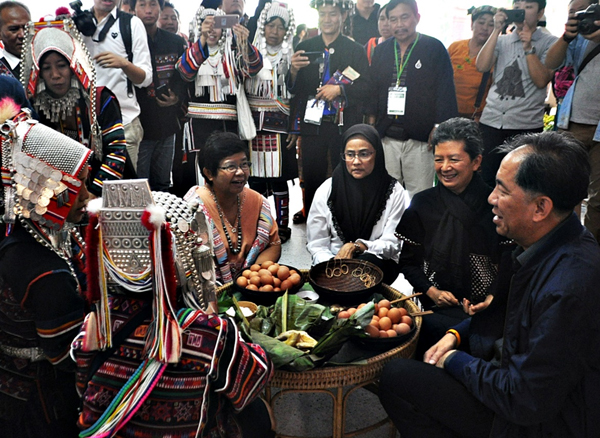
Between 8 to 9 August 2017 around three hundred Indigenous Peoples from all over Thailand gathered on the campus of Chiang Mai University in northern Thailand. One main reason for this Third National Assembly of the Council of Indigenous Peoples in Thailand (CIPT) was to celebrate World Indigenous Peoples’ Day — and ‘10 Years of United Nation's Declaration on Indigenous Peoples (UNDRIP): Lessons, Challenges, and the Future of Indigenous Peoples in Thailand’. The first morning was taken up with the National Assembly of Indigenous Peoples, followed by five sessions on various issues in the afternoon. The whole morning of the second day was taken up with ceremonial rituals, an opening ceremony, and speeches (see Figure 1). Krisada Boonrad, then permanent secretary of the Ministry of Interior, presided over the opening ceremony. A televised public forum was held in the afternoon. Based on information I received during this landmark event, and my long-term participation in and observation of related activities, I will emphasise two areas in this article: first, the influences of the global Indigenous Peoples’ movement on the Indigenous movement in Thailand; and second, how the latter represents a community of becoming both in terms of self-identification and negotiating for recognition by outsiders.
We now live in a globalised world of intensified interconnectedness.Footnote 1 Globalisation, on the one hand, increasingly works to align local and minority cultures with mainstream society, especially powerful Western structures, ideas and ideologies, such as capitalism, science, the media and information communications technology, and material culture, as well as world religions. Such powerful global forces have reshaped and are reshaping local and ethnic minority ways of life. On the other hand, globalisation arguably generates advantages for local and ethnic minorities because it entails the flow of capital, people, commodities, images and ideologies, as pointed out by Arjun Appadurai.Footnote 2 Though Appadurai posits five dimensions of global cultural flows, namely, ethnoscapes, mediascapes, technoscapes, financescapes, and ideoscapes, I will emphasise ethnoscapes and ideoscapes, both of which are salient to first, the formation of the Network of Indigenous Peoples (NIPT) and then the CIPT.
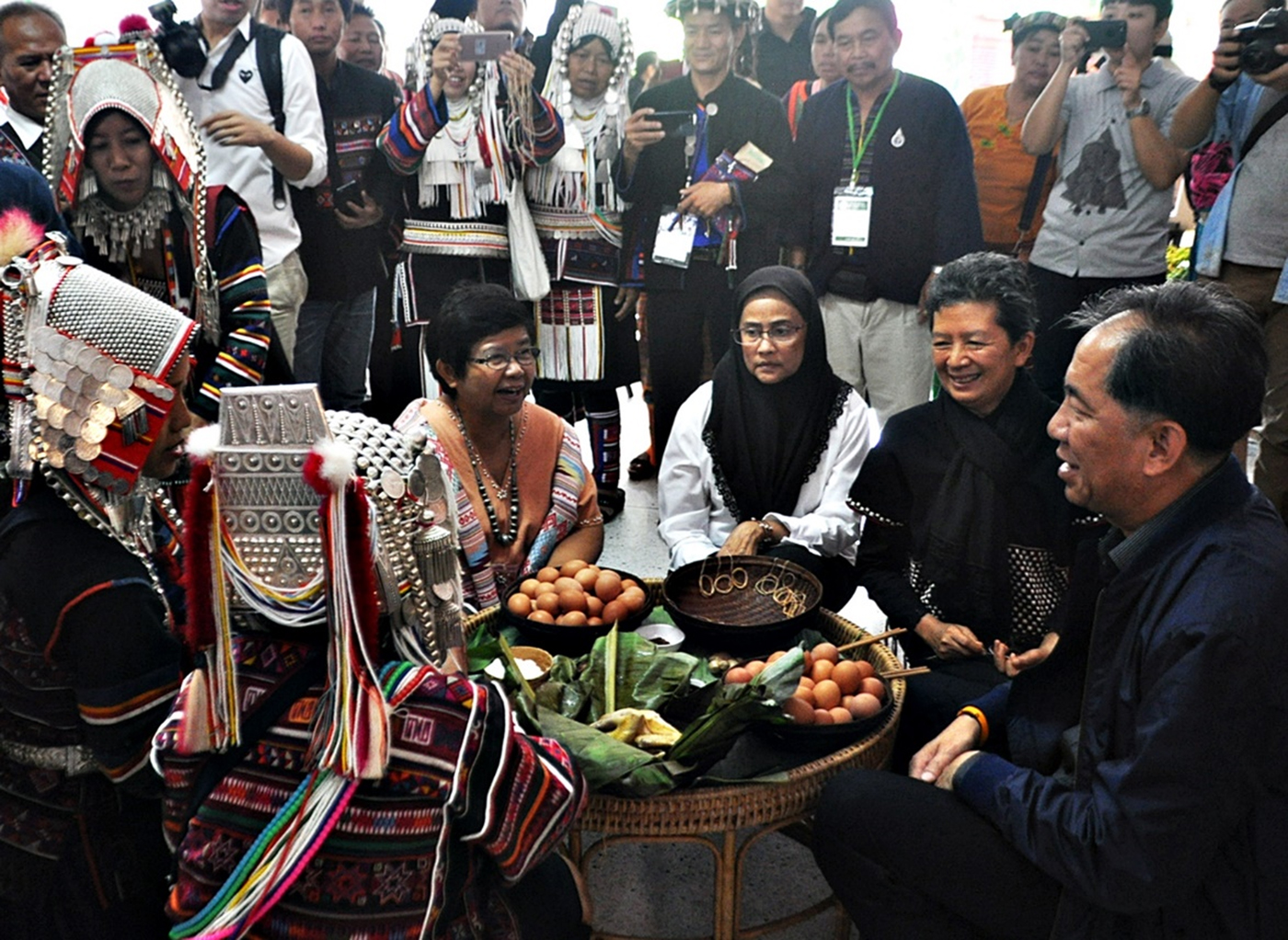
The permanent secretary of the Ministry of Interior, Krisada Boonrad (seated, right-hand corner) and three members of the National Human Rights Commission (NHRC) of Thailand — Sunee Chaiyaros, Angkhana Neelapaijit and Tuenjai Deetes (seated, left to right) at the Third National Assembly of the Council of Indigenous Peoples in Thailand, Chiang Mai, August 2017 (photograph by Prasit Leepreecha).
By an ‘ethnoscape’, Appadurai means the mobility of members of the same ethnic or cultural group in different parts of the world, including tourists, immigrants, refugees, exiles, guest workers and other moving groups and individuals.Footnote 3 He points out that central to ethnoscapes is the changing social, territorial, and cultural reproduction of group identity, ‘as groups migrate, regroup in new locations, reconstruct their histories, and reconfigure their ethnic projects’.Footnote 4 To me, this definition is more appropriate to ethnic groups whose members may be scattered all over the world, through migration and other factors. They are unlike Indigenous Peoples, who make up a larger global ethnoscape since they share common elements of identity and aims. Indigenous Peoples are native to the land, but disadvantaged in political, economic and sociocultural terms in the nation-states they live in, where they usually form a minority. Therefore, ideally, they aim to reclaim their basic sociopolitical rights.
An ‘ideoscape,’ explains Appadurai, ‘consists of a concatenation of ideas, terms and images, including freedom, welfare, rights, sovereignty, representation and the master-term “democracy”’.Footnote 5 Globalisation has entailed a great expansion of this rights ideology to encompass peoples who live across national boundaries, regions, and continents. Ideoscapes are counter-ideologies to the domination of state governments and mainstream culture. The globalised ideoscape of Indigeneity has directly resulted in the creation of the CIPT in Thailand. In the mid-2000s, after learning about the international Indigenous Peoples’ movement, the younger generation of highland groups in Thailand adopted the tenets of its ideoscape, identified themselves as Indigenous Peoples, and launched the movement.
In this article I adopt another framework for thinking about the creation of the CIPT and the Indigneous Peoples’ movement in Thailand — that of a ‘community of becoming’. A community of becoming creates desires, needs and imagination. Its features can be analytically divided into three levels. First, diverse and differentiated desires, needs, imagination and evaluation of individuals can coexist within the ‘community of becoming’. Such a community is, therefore, quite different from identification constituted through a sense of singular belonging and identity. Second, a ‘community of becoming’ intends to maintain its internal multiplicity and differences, but often faces critical situations of struggles with, resistance to, or negotiation with those with power, especially the nation-state and its agencies, which desire to govern by homogenising its constituent individuals. Lastly, if the ‘community of becoming’ can continue to exist within the context of such power relations, it needs to be articulated with other communities and networks which maintain their own multiplicities to form an assemblage, i.e. in a state of ‘continuous becoming’. In considering these new communities and their assemblages, I have come to realise that the people involved in these interactive or communal processes do not always intend to be incorporated or assimilated into organisations or entities such as the institutions of family, community, or the nation-state. On the contrary, they sometimes intend to remain as a ‘pack’ or ‘minoritarian’, keeping multiplicities with heterogeneous terms, rather than being incorporated into the majoritarian social order.
One of the most explicit ideas for addressing these issues is that of ‘becoming’ (devenir), which was developed by Gilles Deleuze and Félix Guattari in their seminal work A thousand plateaus.Footnote 6 ‘Becoming’ in their work derives, to a certain degree, from multiple ethnographic and fictional narratives: it relates to anomalous states of existence, contagious magic, minorities in borderlands, witchcraft, sorcery, spirit possession — all of which are related to rhizomatic multiplicities.Footnote 7 With these fragments, Deleuze and Guattari try to detect an intimate connection between power and desire that causes practices linked to ‘becoming others’. ‘Communities of becoming’ are ‘packs’ or ‘subject groups’ (groupe-sujet) that resist subjugation and produce their own desires; such communities are a kind of ‘collective assemblage’ (agencement collectif) that merge one's own internal multiplicity (as an individual) with external multiplicities (as a pack). ‘The origin of packs is entirely different from that of families and States; they continually work them from within and trouble them from without, with other forms of content, other forms of expression.’Footnote 8
To become-minoritarian is to embark upon a process of deterritorialisation from the social order and its norms or standards (including the family and nation-state). Deleuze and Guattari lay a greater emphasis on ‘becoming-woman’ and the special place accorded to it as a minority in the modern world. Minorities and majorities are not defined according to their size; a minority may be bigger than a majority. The majority is a model you have to conform to: for example, male business people, city dwellers, etc.Footnote 9 A minority has no model, it is a becoming, a process. When a minority creates models for itself, it is because it wants to become part of the majority to survive or prosper: for example, to have a state, be recognised, to establish its rights. As Deleuze and Guattari ask,
Why are there so many becomings of man, but no ‘becoming-man’? Because man is majoritarian par excellence, whereas becomings are minoritarian; all becoming is a ‘becoming-minoritarian’. […] One reterritorializes, or allows oneself to be reterritorialized, on a minority as a state; but in a becoming, one is deterritorialized. Even blacks, as the Black Panthers said, must become-black. Even women must become-woman. Even Jews must become-Jewish (it certainly takes more than a state).Footnote 10
In the spectrum of minoritarian becomings, declaration or coming-out is a significant moment, as widely observable in the cases of gays, the HIV-infected, ethnic minorities, etc.Footnote 11 The flux of images and the fully deterritorialised, rhizomatic notions developed by Deleuze and Guattari, I hope, inspire the next steps for dealing with a variety of relationships contained in new communities and assemblages, specifically within the Indigenous Peoples’ movement in Thailand:
It definitely makes sense to look at the various ways individuals and groups constitute themselves as subjects through processes of ‘subjectification’: what counts in such processes is the extent to which, as they take shape, they elude both established forms of knowledge and the dominant forms of power.Footnote 12
This article endeavours to demonstrate the ways in which the Indigenous Peoples’ movement in Thailand, created in the early 2000s, has struggled and continues to struggle to become ‘Indigenous Peoples’, rather than be integrated into Thai mainstream national and dominant forms.
Ethnic diversity and Indigenous Peoples in Thailand
Although there is ethnic and Indigenous diversity throughout the country, the Thai government has never had an official policy of surveying or classifying this diverse population. In this, it differs from neighbouring Laos, Vietnam, Myanmar, and the People's Republic of China.Footnote 13 However, there have been several attempts to integrate non-Thai peoples to become Thai. In particular, since the beginning of the Cold War, highland ethnic minority groups, or Hill tribes, as they are known in northern Thailand, have become widely known to the public, in the country and internationally, due to development projects adopted by the Thai government and international aid and development agencies and nongovernmental organisations (NGOs). Since the 2000s, the movement to become Indigenous Peoples has gradually caught the attention of other sectors of the population as well as government agencies. The main questions that have emerged are: how many groups of Indigenous Peoples are there in Thailand, and who are they?
Such uncertainty remains despite efforts by scholars and civil society leaders to show the history of regional population mobility, and to demonstrate how various ethnic groups have settled throughout the country. It is possible to identify four sets of information and classification methodologies that have been used in such endeavours. These include historical records, linguistic classification, anthropological classification, and the collection of information about the self-expression and identification of Thailand's many ethnic groups.
The first source of information includes historical accounts and records by travellers and historians regarding the ways of life and patterns of mobility of various ethnic groups. Besides minorities speaking Mon-Khmer and Tai-Lao languages who have long settled in different parts of Thailand and in neighbouring areas, there are also Malay-Muslims living near the country's southern border with Malaysia. The latter can be considered to be a group with a long history of settlement in Thailand as well. Some books describing the multiethnic groups of Thailand have been written by Joachim SchliesingerFootnote 14 and James Fitzroy McCarthy,Footnote 15 also known as Phra Wiphak Phuwadol.
McCarthy conducted surveys for twelve years, from 1881 to 1893, while delineating the borders of Siam. He recorded his travels from Bangkok to the south, and then from Bangkok to the north and across into Burma and Laos. He wrote in detail about the different ethnic groups that he met while travelling. Regarding the area of Lan Na (Lanna), in what is today northern Thailand, Hans Pent described the Indigenous Lua (or Lawa) of Chiang Mai, whose designated leader was Khunluang Wirangkha. Pent also wrote about the Mon, under Queen Chama Thewee, who were said to have moved from Lopburi to build the city of Lamphun in the tenth century CE. They were followed by Tai groups.Footnote 16 There is also a book by Boonchuai Srisawad,Footnote 17 who described over thirty ethnic groups living in Chiang Rai province. More recently, Kennon Breazeale attempted a historical investigation regarding population movements in northern and northeastern Siam from 1750 to 1900.Footnote 18 He identifies three groups of people who moved into Siam. The first were refugees fleeing warfare in their own countries; this group was largely made up of Vietnamese (10,000) and Mon (about 30,000). The second group were labourers. In 1896, according to French records, about 30,000 Khmu from the north of Laos came to work for logging concerns in northern cities.Footnote 19 The third group was forced into slavery as prisoners of war. When armies from Bangkok attacked Vientiane in 1828, they captured about 8,500 people from in and around Vientiane. Siamese armies also captured Mon, Burman, Shan, Lue, Cham, as well as Phuan in the fighting between Siam and surrounding kingdoms.Footnote 20 As for the Chinese, William Skinner showed that from 1882 to 1917 more than 815,700 entered Siam while only 635,500 left the country.Footnote 21 In addition, various ethnic groups inhabit the highlands: once referred to as ‘Hill tribes’, these groups now identify themselves as Indigenous Peoples.
Suthiwong Phongphaiboon has shown that southern Thailand was a corridor for maritime trade.Footnote 22 As such, people of different ethnic groups came to settle and developed relations in many sectors. In addition to native southern Thai or Thai Paktai and Malay, ethnic groups in southern Thailand include the Sakai (Munni), Chao Le or Sea Peoples (including the Moken, Mokren, and Urak Lawoi), Chinese, Indian, Sinhalese, Khmer, and Javanese. In the far south, encompassing the area of the historical Malay-Muslim kingdom of Patani, there were also Arabs and Caucasians, as well as Chinese who had assimilated into Malay life (Peranakan), and Siamese.Footnote 23 Throughout Thailand, with its majority Buddhist population, there are Muslims of different ethnicities, including Malays, Yunnanese, Bengalis, Arabs, Iranians, Cham, Minangkabau, Javanese, Pavian, Pathan (Pashtu), Punjabis, and Sam Sam (Thai-Malay).Footnote 24
A second source of information are classification systems established by linguists. Following an extensive survey by Mahidol University's Institute of Languages and Culture for Rural Development from 1993 to 2001, 62 linguistic groups were identified throughout the country: 24 Tai, 22 Austroasiatic, 11 Sino-Tibetan, 3 Austronesian (dialects), and 2 Mien-Hmong. Mahidol's researchers postulated that there could be more languages than this, depending on the definition of dialects and languages. For example, the survey team did not distinguish between the many Chinese dialects/languages.Footnote 25 In addition, there are other ethnicities in Thailand and in neighbouring countries, based on other linguistic criteria. James Matisoff has argued that every group with a language of its own has its own identity; in this sense, linguistic information shows the diversity of culture and ethnicity throughout Thailand.Footnote 26
The third source of information on ethnic groups comes from anthropologists who have studied ethnicity in Thai society. Using politics and culture as the determining factors for what constitutes an ethnic group, Charles Keyes identified five broad groups in Thailand.Footnote 27 The first is the ‘real Thai’, including those who speak Central Thai and live in central Thailand; this group constitutes about 36 percent of the 65 million people in the country. The second group includes the Thai from other regions such as Khon Muang (northern Thailand), Isan (northeastern Thailand), southern Thailand, as well as others who speak Thai dialects; this group accounts for another 46 percent of the population. The third group includes those who have at least largely assimilated into being Thai, such as the descendants of Chinese and Mon-Khmer who now speak Central Thai in everyday life. This group totals about 9 percent of the population. The fourth group are the people, who, in some contexts, have faced problems in being accepted as Thai. This includes the Chinese, Malay-Muslims, and Hill tribes; this group totals about 9 percent of the population. Those who have been classified as ‘Hill tribes’ (Chao khao in Thai) include at least ten ethnic groups. The final group is non-Thai, and includes refugees and undocumented people who have entered the country to work in recent decades. Agencies who have been working with these groups estimate that they may total between 2 and 4 million.
The last source of information derives from the preferences of people from the ethnic groups themselves. Even though they have joined many different networks in the past, the main activity for ethnic networks is the International Day of the World's Indigenous Peoples, which has been held annually on 9 August since it was initiated in 1997. In its first year, only 24 groups participated, and these were mostly groups that in the past had been identified by the government as ‘Hill tribes’ and ‘Sea gypsies’. Since then, this day has been observed every year with an increasing number of groups joining each time. Between 35 and 57 groups have gathered for the annual celebration of World Indigenous Peoples’ Day in Thailand in recent years, as described below. According to the CIPT, there are 42 Indigenous groups scattered throughout the country, with a total population of 4,284,702 people.Footnote 28
Historically, only a few Indigenous groups were publicly acknowledged due to nationalistic and security concerns. At the beginning of the nation-building period, in the early twentieth century or during King Vajiravudh's reign, the Chinese in Thailand were particularly targeted for control and assimilation. They were viewed and portrayed by King Vajiravudh as ‘Jews of the East’, because they were industrious and clever merchants whom, he feared, would take control of the economy eventually.Footnote 29 During the Cold War, they were, again, targeted because the government worried about their possible connections with the communists.Footnote 30 Besides the Chinese, the Vietnamese in the northeast and highland groups in the north were closely watched and often suppressed by the state. In addition to concerns regarding the spread of communism from Indochina into Thailand in the early 1960s, the Thai government and international experts also viewed opium cultivation and ‘slash-and-burn’ (swidden) agriculture widely practised among highland peoples as a threat to national security. Thus, from the 1960s to the 2000s, highland ethnic groups came to prominence, largely due to the publicising of various ‘Hill tribe problems’ that were of concern to the government and its allies, especially the United States.Footnote 31 The Thai public came to know the highland minorities as ‘Others’, as Thongchai Winichakul points out.Footnote 32 Various highland development projects, initiated by government agencies, international organisations, and NGOs, were initiated in mountain villages in the 1960s and continued into the 2000s. In the development context, the ‘Hill tribes’, comprising only 10 highland ethnic groups, were much better known to the public than any other ethnic groups in the country. However, since the mid-2000s, there has been a shift in the ethnoscape from ‘Hill tribes’ to ‘Indigenous Peoples’, led by young leaders with highland ethnic backgrounds.
International connections and influences
In addition to the establishment of the regional Asia Indigenous Peoples’ Pact (AIPP), whose first general assembly was held in Bangkok on 4 June 1992, as detailed by Micah Morton and Ian Baird in this volume,Footnote 33 I found that connections between NGO workers and young Indigenous leaders in Thailand and elsewhere influenced the founding of the NIPT. These international connections and influences can be divided into those from Asia and those from the rest of the world.
In Asia, a major international conference, the People's Plan for the 21st Century (PP21) was held at Chulalongkorn University and Thammasat University in Bangkok from 6 to 10 December 1992. It was the second effort to bring people together after the first such gathering in Minamata, Japan, in 1989, to make Asian voices heard and to break the monopoly over world affairs by the self-proclaimed custodians of the ‘New World Order’ — an order dictated by the superpowers. PP21 was an expression of an ‘alliance of hope’ between peoples of the Asia Pacific and elsewhere, aiming to create an alternative world and to overcome Northern domination. The conference covered 15 issues and target groups, including workers, women, youth, and indigenous/minority peoples.Footnote 34
About half a year prior to PP21, the Assembly of 13 Tribal Groups was set up, led by Somnuek Benjawitthayatham, who coordinated the Project for Cooperation and Support Network of NGOs on Tribal Development. Representatives of each tribal group were invited for meetings to brainstorm problems faced by their people. In late November 1992, the conferences of the assembly were organised on the campus of Chiang Mai University; the Assembly declared the desire for alternative development pathways. In early December, representatives of the 13 groups attended PP21. Some 500 people from 56 countries attended the event in Bangkok, where the Ratchadamnoen Declaration was adopted.Footnote 35 As a young ethnic Hmong researcher, I was part of both the Hmong and assembly activities in Chiang Rai and Chiang Mai, respectively, but I did not join the national event in Bangkok.
The AIPP's concept paper presented at the Asian Conference on the Rights and Aspirations of the Indigenous Peoples in May 1993 details the issues put forth by the Indigenous representatives at PP21:
Over the past few years, indigenous peoples of Asia have had the opportunity to meet and exchange situations and experiences. The most recent of these was in Bangkok last December when about 30 indigenous peoples met at the PP21 Forum under the auspices of the Asia Indigenous Peoples Pact (AIPP). Noting that 1993 was to be the International Year for the World's Indigenous People, and aware that the Draft Declaration on the Rights of the Indigenous Peoples is to be finalized this year, those meeting in Bangkok agreed that there was an urgent need for indigenous peoples of Asia to turn the attention on them this year into some action.
Two levels of action were suggested in December and are being implemented now. The first is for local-level consultations and programmes to encourage national-level sharing and consensus on issues facing indigenous peoples. The second is for a regional conference to gather and synthesize the demands and aspirations of the Peoples Declaration (which, in turn, will be our basis for comments on the Draft Universal Declaration).Footnote 36
At the time the concept of indigenous peoples was little known or understood in Thailand, but both local NGOs and ethnic leaders participated in these activities. AIPP's regional office was still based in Bangkok,Footnote 37 so only Prasert Trakarnsupakorn, a Karen and the Director of the Inter-Mountain Peoples’ Education and Culture in Thailand Association (IMPECT) in Chiang Mai, became an AIPP country member. He was sent by AIPP to represent the Indigenous Peoples in Thailand and to read a declaration at the Conference for the International Year of the World's Indigenous People, in New York, in 1993.Footnote 38 In addition to overseeing national-level cooperation, Prasert was assigned to coordinate the participation of ethnic minority groups in Thailand at the Asian Conference on the Rights and Aspirations of the Indigenous Peoples, in Chiang Mai, which was held on 17 to 23 May 1993. Sixty-five Indigenous participants from 16 countries, mainly from East Asia, Southeast Asia and South Asia, attended that conference.Footnote 39
Beyond Asia, according to Kittisak Rattanakrajangsri, an ethnic Mien NGO worker in Chiang Mai who was a key leader then and the present vice-chair of the CIPT, another significant event was the United Nations Conference on Environment and Development (the Rio Earth Summit) in 1992. A few leaders of highland tribal groups and NGO workers represented Thailand at the Rio conference, which marked the twentieth anniversary of the Stockholm Conference on the Human Environment.Footnote 40 Importantly, connections were established between these Indigenous representatives from Thailand and those from other continents as well as with relevant United Nations offices on natural resource-related issues; these connections would be influential in the formation of the NIPT.
Another important connection made a few months earlier was with the International Alliance of Indigenous Peoples and Tribal Peoples of the Tropical Forest (IAITPTF). The alliance was founded during the inaugural IAITPTF conference in Penang, Malaysia, on 15 February 1992. Since the adoption of its charter in 1992, this alliance of Indigenous Peoples from 59 countries has continued to fight for the rights of Indigenous and Tribal Peoples. It plays a crucial role in tracking national compliance with international conventions and movements pertaining to Indigenous Peoples, such as the Convention on Biological Diversity Article 8(j), the Action Plan of the World Summit on Sustainable Development, the World Conference against Racism, the UN Forum on Forests, the UN Framework Convention on Climate Change, and the UN Working Group on Indigenous Populations.Footnote 41 Importantly, Kittisak Rattanakrajangsri led the International Technical Secretariat when it was based in Chiang Mai. Later on, since the international office rotated to other continents, the office in Thailand was transformed into the Indigenous Peoples’ Foundation for Education and Environment (IPF).Footnote 42 I have been a national committee member of this Foundation since its establishment.
Meanwhile, the setting up of the United Nations Working Group on Indigenous Populations in 1982, mainly led by Indigenous leaders from North and Latin America, resulted in the United Nations declaring the First Decade of Indigenous Peoples in 1995.Footnote 43 The United Nations and other agencies began to provide more space and funds to support national Indigenous Peoples’ movements. In addition, the United Nations Permanent Forum on Indigenous Issues (UNPFII), an annual conference held in New York, began in 2002. A few Indigenous representatives from Thailand attend these meetings and events annually to present issues faced by Indigenous Peoples in the country.
Chiang Mai, in northern Thailand, is also the base for the regional office of the International Work Group for Indigenous Affairs (IWGIA), an organisation founded in Denmark in 1968. In Asia, particularly Southeast Asia, IWGIA has worked closely with the Tebtebba Foundation in the Philippines, and AIPP since the 1990s. In March 2006, the three organisations, together with national NGOs in Thailand, hosted a workshop on the ‘Concept of Indigenous Peoples’ and later published a book of its proceedings.Footnote 44 Besides supporting national and international campaigns on the rights of Indigenous Peoples, IWGIA also plays an important role in support for publishing on Indigenous topics.
Other conferences under the United Nations’ structure and conventions have helped to coalesce the Indigenous Peoples’ movement in Thailand. The UN conventions and declarations pertaining to Indigenous Peoples, such as the International Convention on the Elimination of All Forms of Racial Discrimination (ICERD, 1969), the Convention on the Elimination of All Forms of Discrimination against Women (CEDAW, 1981), and UNDRIP (2007), have all seen participation by Indigenous leaders in Thailand, both in the preparation of shadow reports and their presentation in New York.
Thus the international movement gradually influenced the involvement and perceptions of the Indigenous Peoples’ movement in Thailand, especially since the early 2000s. The UN conventions and declarations, pushed for by Indigenous Peoples in other continents and other vulnerable groups, have been conveyed through regional organisations, such as AIPP and IPF. There are now a variety of channels for NGO workers and Indigenous leaders in Thailand to reach and follow up directly with the United Nations and other international agencies, via email, Facebook, etc. The ethnoscape of Indigenous Peoples enables the sharing of common problems such as dealing with mainstream groups, nation-states, capitalism, and so on. Therefore, their common ideoscape involves uniting and claiming their basic right to be Indigenous Peoples, both at the international and national levels. However, the creation of the NIPT and becoming Indigenous Peoples in Thailand has not been easy, due to ethnic heterogeneity and the perceptions of state agencies.
Becoming Indigenous Peoples in Thailand
The shift in the ethnoscape from being referred to as ‘Hill tribes’ and ‘ethnic groups’ to becoming ‘Indigenous Peoples’ is linked to the deterritorialisation of Indigenous groups in Thailand. Instead of becoming Thai, according to national integration policies, Indigenous Peoples prefer to become minoritarian and remain as Indigenous Peoples, while claiming their basic rights as citizens. This section comprises two main parts: first, a discussion of the negotiations among various ethnic groups from different parts of the country; and second, cooperation and negotiation between Indigenous groups and other relevant local and national sectors.
Since Morton and Baird, in this volume, already describe the historical development of the indigenous movement in Thailand, I will only briefly outline the evolution of the NIPT and CIPT.Footnote 45 According to relevant archives and material, and my own experiences, the movement may be divided into four periods. The first period relates to the birth of the Hill Tribe Development Organization Network (1977–87). The second period was between 1988 and 1997, when the Centre for the Coordination of Non-governmental Tribal Development Organizations (CONTO) was established and played an important role. The third period was between 1997 and 2007, during which time the Assembly of Tribal Peoples of Thailand (AITT; Samatcha chon phao haeng prathet Thai) was the key coordinating organisation. Finally, there is the present period, beginning in 2007, when the NIPT and the CIPT have played crucial roles in the movement.Footnote 46 Since the current Indigenous Peoples’ movement comprises forty groups from around the country, with different backgrounds, problems and expectations, it involves continual negotiations and contestation, as I have found.
Negotiating terms for self-identification
Various official terms have been applied to describe the diverse ethnic groups of Thailand. In general, the term ‘minority groups’ (Chon kloom noi) is used to refer to all non-Thai peoples who are in the minority, in terms of the overall population. However, the term ‘Hill tribes’ (Chao khao) was officially used and widely known by the public from the early 1960s to the 2000s.Footnote 47 In the 1990s, Thai scholars began to use the term ‘ethnic group’ (Kloom chattiphan) instead, while both younger and senior highland leaders working in NGOs began to prefer the term ‘Tribal/Indigenous Peoples’ (Chon phao).Footnote 48 The term Indigenous Peoples (Chon phao phuen mueang) was adopted in 2007 by the younger generation of highland leaders. However, negotiations would continue over the term among the highland ethnic groups, lowland groups, and the Office of Ethnic Affairs, until 2015, when it was formally adopted by the CIPT.
As described by Katherine McKinnon,Footnote 49 in May 2007, just a few months before the first celebration of World Indigenous Peoples' Day in Thailand, I attended and observed a workshop on defining Indigenous Peoples in Thailand. Senior leaders, youth leaders and NGO workers from highland communities, together with some scholars who work closely with highland peoples, were called to attend a workshop to specifically discuss the common term in Thai for ‘indigenous peoples’. After listening to presentations on the history of Indigenous movements in the West and of tribal movements in Thailand, breakout groups were organised, so every participant would get a chance to talk. By the end of the day almost every group agreed on the term Chon phao phuen mueang (lit., Indigenous tribal people), for three main reasons. First, most participants were from highland ethnic groups labelled Hill tribes by outsiders, so they were reluctant to refer to themselves as Chon phuen mueang (Indigenous Peoples), which to them implied lowland groups who have lived in Thailand for generations.Footnote 50 Second, the term Chon phao (tribal people) had been used by the AITT for a decade and the term was well known to state authorities, which was important in terms of negotiating for rights recognition, particularly on citizenship and natural resource management issues. Finally, at the international level, especially in relation to the International Labor Organization's Convention No. 169, which uses the term ‘indigenous and tribal peoples’, it was felt that the term should be translated as Chon phao phuen mueang in Thai. Hence, this term was used for the first celebration of World Indigenous Peoples’ Day in August 2007.
Representatives and individuals from 24 ethnic groups joined the first annual Indigenous Peoples’ Day celebration in Chiang Mai, most of them from the highlands and southern seas, all of whom faced similar problems regarding natural resource conflicts and the lack of citizenship.Footnote 51 In that year, the NIPT was set up and was dominated by young leaders of highland ethnic groups who were NGO workers in northern Thailand. Yet, between 2008 and 2011, the Office of Ethnic Affairs of the Ministry of Social Development and Human Security sponsored the annual event. More ethnic groups from lowland areas participated, both in northern Thailand and other parts of the country. Government officials and representatives of lowland ethnic groups played an important role in negotiating to change the title of the annual event to the ‘Festival of Ethnic Groups and Indigenous Peoples’ Day’ (Mahakam wan kloom chattiphan lae chon phao phuen mueang).
To the lowland ethnic groups, the term Chon phao (tribal people) mainly refers to the Hill tribes and connotes a primitive society. The lowland groups regard the term Kloom chattiphan as more relevant and meaningful, since they feel that they have become ‘modern’ already. On the other hand, the Office of Ethnic Affairs wanted to promote the term ‘ethnic groups’ (Kloom chattiphan) to reflect its own name. Furthermore, there were policy-related questions regarding the use of the term Chon phao phuen mueang (Indigenous and Tribal peoples), concerning budget allocations and the privileging of Indigenous Peoples.
The politics of negotiation over Kloom chattiphan and Chon phao phuen mueang went on for many years between the Office of Ethnic Affairs, key leaders of the NIPT, and representatives of lowland ethnic groups. This also led to renewed discussions over the name which would be used in the draft of the proposed Indigenous Peoples’ Rights Act. In the beginning, the mixed term Sapha chon phao phuen mueang lae chattiphan haeng prathet Thai (Council of Indigenous and Ethnic Groups in Thailand, CIEPT) was used for the CIPT. This was questioned by the offices of the Law Reform Commission of Thailand and the National Legislative Assembly when the draft of the act was submitted to them. Finally, after an explanation and convincing key leaders from highland backgrounds, the meeting of the national committee, held at IMPECT on 13 October 2015, voted to adopt the term Chon phao phuen mueang for ‘Indigenous Peoples’, as an official name for submitting the draft of the proposed act to the National Legislative Assembly, in late November 2015.
It should be noted here that these terms were also perceived differently by grassroots indigenous peoples, depending on their locality. Although all ethnic minority villagers share a common goal with the Indigenous movement and have adopted the term Chon phao phuen mueang, they use and understand the term Chon phao in different ways. As mentioned, lowland ethnic groups often understand the term as referring to highlanders who are still primitive, while the highland groups often understand the term as meaning Indigenous Peoples. However, because the term Kloom chattiphan does not have any meaning for the highlanders, the lowland groups finally agreed to use the term Chon phao phuen mueang, given the dominance of the former in the movement. The term Chon phao phuen mueang is derived from the ILO Convention (No. 169) Concerning the Protection and Integration of Indigenous and Other Tribal and Semi-tribal Population in Independent Countries, which uses both ‘Indigenous Peoples’ and ‘tribal peoples’.Footnote 52
Thus the final proposal submitted by the CIPT to the National Legislative Assembly defines Indigenous Peoples in this way:
Indigenous communities, peoples, and nations are those which, having a historical and social continuity before the establishment of present nation-states, consider themselves distinct from the main society. They are not the dominating group in the nation-state and are determined to preserve, develop and transmit their ancestral territories, their ethnic identity, and their language to future generations. These are basic to their continued existence as peoples, in accordance with their own cultural patterns, social institutions, and legal system for living peacefully with other groups in the nation-state society.Footnote 53
This definition of Indigenous Peoples was adopted from that developed by the UN Special Rapporteur José R. Martinez Cobo, which had established the standard reference within the United Nations and elsewhere in the early 1980s.Footnote 54 According to Sakda Saemi, the CIPT's secretary, this definition is widely known and used by Indigenous Peoples worldwide, but the CIPT revised it slightly to suit the local context, since Thailand had never been colonised by Western countries. The members of the network and council have indeed accomplished the setting up of a ‘becoming community’. Yet, challenges remain, despite the CIPT's successful cooperation with relevant sectors.
Cooperation and negotiation between CIPT and relevant sectors
We return again to CIPT's national conference and the celebration of World Indigenous Peoples’ Day in August 2017 at Chiang Mai University, which was attended by 180 representatives of 36 Indigenous groups who are members of CIPT. Also present were nearly a hundred individual Indigenous participants as well as others, including senior bureaucrats and staff of independent agencies. Comparing the first decade anniversary celebration with the past ones, the NIPT and CIPT have been quite successful in terms of drawing connections with the four main sectors involved with the Indigenous Peoples’ movement in Thailand.
The first sector is comprised of the various Indigenous groups themselves, and their interrelationships and negotiations within the movement. Initially, highland leaders and NGO workers united and formed two organisations for Hill tribe networking, CONTO and AITT, during the late 1980s to mid-2000s. Representatives of Sea peoples from the south were also occasionally invited to these gatherings. Since the first annual celebration of World Indigenous Peoples’ Day in Thailand, representatives of lowland Indigenous groups from different parts of the country have also been invited, but some of them only observe the event, without fully participating. Other Indigenous groups have gradually joined the annual celebrations: in some years, over 57 groups participated. However, when the CIPT was launched in 2015, in Mae Sod, Tak province, only 36 Indigenous groups officially became members; five representatives of each group were nominated to be members of the council, each serving a four-year term. In addition to these 36 groups, an Indigenous group and one network applied for and was accepted by the national council to become new members in 2017. Based on my observations of this successful movement over a decade, key leaders of highland Indigenous groups and NGO workers, especially Sakda Saenmi and Kittisak Rattanakrajangsri, have played essential roles in leading and supporting the movement. Yet, though we see good relationships and cooperation within the movement, deep negotiations have sometimes occurred, such as during the election of the CIPT chair and in relation to adopting a common term for the network and national council, as described above.
The second sector comprises the media and scholars. Most of the annual events of the Indigenous movement in Thailand have been organised on campuses, in particular, those of Chiang Mai University, Chulalongkorn University, and Bodhivijjalaya College in Mae Sod. These universities offer convenient meeting rooms and performance spaces, but perhaps more importantly, there is also more social space for cooperation with scholars who have been working closely with Indigenous Peoples. Scholars such as Chayan Vaddhanaphuti, Chupinit Kesmanee, Ken Kampe, Samart Srijumnong, Narumon Hincheeranan have continuously supported the movement since its beginnings in the early 1990s. Other scholars, including myself, have also joined and/or supported the movement from time to time. All are motivated by the feeling that, like other minority groups, Indigenous Peoples have long been stereotyped and marginalised in Thailand, and that their/our problems and intentions need to be raised for greater public understanding and recognition. Furthermore, they/we feel that Indigenous Peoples need to be empowered. In addition to academia, some sections of the media have supported the movement in its ‘becoming’. Main national television channels such as Thai PBS annually broadcast forums and activities linked to the CIPT. Other television channels and newspapers, both local and national, have also reported on annual Indigenous Peoples events. Notably too, a younger generation of Indigenous Peoples and NGO workers have been trained to film and produce their own events and publicise Indigeneous Peoples’ issues for television, newspapers, and social media — one key group being the Indigenous Media Network (IMN). Overall, Indigenous events and voices are becoming much more widely known and recognised by the public in Thailand, due to the support of academics and the media. Hence, relationships between the Indigenous movement, academia and the media have been quite positive.
The third sector comprises state and independent agencies. As mentioned, between the late 1960s to the early 2000s Hill tribes were under government surveillance by the Office of the National Security Council, the Special Branch of the Bureau of Police (Tamruat santiban), the Third Army, the Department of Provincial Administration of the Ministry of Interior, and others. I noticed the attendance of plainclothes security officers at almost every meeting or event pertaining to Indigenous Peoples that was held on campuses. Later on, some officers of these agencies came to better understand the problems faced by Indigenous Peoples, and relationships became more positive. Indeed, the celebrations of World Indigenous Peoples' Day in the late 2000s were financed by the Office of Ethnic Affairs. However, after joining the annual celebration in early August 2012, which was held in Bangkok, and entirely designed and controlled by officials, with a THB6.3 million (about US$194,000) budget — on the theme of ‘Happiness among Diverse Ethnic Groups under Royal Patronage’ — key leaders of the Indigenous network have decided not to cooperate with this governmental agency.
In recent years there have even been simultaneous events with different themes and at different locations in Chiang Mai. In the meantime, the relationship between the Office of Ethnic Affairs and the NIPT has deteriorated, partly due to the retirement of some key officials who used to work with highland Indigenous Peoples; the most crucial source of tension is, however, that key officials took and revised the draft of strategies for Indigenous development initiated by the network. In addition, the independent National Human Rights Commission of Thailand (NHRC), which has some key committee members who have worked closely with Indigenous Peoples to understand their rights issues, have supported the annual event and other activities of the Indigenous network and national council since 2007. Supportive committee members of the NHRC include Sanae Chamarik, Amporn Meesuk, Sunee Chaiyaros, Niran Pitakwachara, Tuenjai Deetes and Angkana Neelapaichit. Importantly, the NHRC was the main funding agency for the event in Chiang Mai in 2017. The Sirinthorn Anthropological Centre, under the Ministry of Culture, also provided partial financial support for the 2018 annual event held in Chiang Rai. The Director, who attended the 2018 annual event, also promised to finance the 2019 annual World Indigenous Peoples’ Day celebration, which will be held together with the Fifth National Assembly of the CIPT. In summary, over the first few decades of the developing Indigenous movement in Thailand, some government agencies tried to strictly control it in the beginning, but later on allowed it more freedom, while some agencies have tried to shape the direction of relevant national ideologies and policies. Up to the time of writing, there has been no official recognition of the term ‘Indigenous Peoples’ in Thai by the relevant government agencies, but high-ranking officials from the Ministry of Interior and the Ministry of Culture were present during the past few annual events. Moreover, the movement has received support and cooperation from both national and international human rights organisations.
The last sector includes international organisations and networks. According to Kittisak Rattanakrajangsri (of AITT, NIPT and CIPT), the movement has concurrently developed and moved in tandem with regional and international Indigenous networks and movements, and in relation to the United Nations’ recognition of and support for Indigenous Peoples.Footnote 55 The emergence of AIPP in 1988, the IAITPTF in 1992, and the Indigenous Knowledge and Peoples (IKAP) Programme in 2000 directly influenced and supported the foundation and development of AITT, NIPT and CIPT. In addition, the movement also had good relationships with the ASEAN International Commission on Human Rights (AIRCH) when Sriprapha Petchmeesri was a representative of Thailand, from 2009 to 2012. At the United Nations level, the following working groups, events and declarations had a direct impact on the development of the Indigenous Peoples’ movement in Thailand: the Working Group on Indigenous Populations (WGIP) in 1982, the UNPFII in 2000, Expert Mechanisms on the Rights of Indigenous Peoples (EMRIP) in 2001, the appointment of a Special Rapporteur on the Rights of Indigenous Peoples in 2001, and UNDRIP in 2007. As mentioned earlier, Indigenous representatives from Thailand have also attended and presented shadow reports at United Nations meetings on Indigenous issues. Working with such international organisations, networks and forums has resulted in close relationships developing in support of each other. Furthermore, the ideologies and strategies related to the Indigenous Peoples’ movement in Thailand directly derive from such regional and international level interactions, as has been the case elsewhere in Southeast Asia.Footnote 56
In summary, instead of being ‘Hill tribes’ and ‘ethnic groups’, many activists from upland groups in northern Thailand prefer to become ‘Indigenous Peoples’, due to international influences, even if there is still much confusion and ambiguity at the grassroots level.Footnote 57 In any case, since 2007, the network has expanded to link with Indigenous groups throughout the country. The movement has also gained support from some scholars, media personalities, officials and others. At the international and regional level, the emergence of Indigenous networks and organisations, together with UN working groups, forums, declarations and conventions pertaining to Indigenous Peoples, have directly influenced the development and existence of the Network and Council of Indigenous Peoples in Thailand. Becoming Indigenous Peoples in Thailand, thus, is not only about deterritorialising the state and imposing academic discourses upon the Indigenous movement, but it is also about persisting with a minoritarian positionality through applying the idea of indigeneity, and with demanding that basic rights be recognised.
Conclusion
Thailand is an ethnically diverse nation, with several groups who have long been native to the land. Some migrated into the area both before and after the creation of the modern state in the late nineteenth century. There are also groups who have more recently crossed borders and settled down in Thailand. There are roughly sixty ethnic groups in the country. However, the prominent groups are the former so-called ‘Hill tribes’, comprising ten ethnic groups who previously inhabited mountain villages in northern Thailand. These highland groups have been known to the public since the 1960s because of government and international agencies dealing with so-called ‘Hill tribe problems’ related to Communism, opium poppy cultivation, deforestation, and poverty. The term ‘Hill tribes’ thus came to connote ‘Others’ who were primitive, recent immigrants who often posed a threat to national security. Although some of these misconceptions and issues have been resolved, others remain. In recent times, there has been growing public awareness of the ‘Hill tribes’ loss of identity and lack of access to basic rights as Thai citizens.
Since the late 1980s, NGO workers, including in particular, a younger generation of highland peoples, have built networks for dealing with state agencies and linking with international funding agencies. In the context of globalisation, these groups dominated by Indigenous NGO workers have gradually connected and absorbed knowledge of Indigenous rights movements elsewhere in Southeast Asia and around the world, and have also adopted ideas from the United Nations. The shifting of ethnoscapes from ‘Hill tribes’ and ‘ethnic groups’, as labelled by outsiders, to ‘Indigenous Peoples’, based on self-definition, emerged during the late 1990s to early 2000s. These groups set up the NIPT in 2007 and, formally, the CIPT in 2015. Annually, they meet and celebrate World Indigenous Peoples’ Day every 9 August. Becoming Indigenous Peoples in Thailand, thus, is a deterritorialisation of the labels and stereotypes previously imposed by outsiders including agencies of the state. Furthermore, the Indigeous Peoples’ movement in Thailand has grown and strengthened, as can be seen by its large membership and the support it receives from national and international institutions and organisations.
In summary, the Indigenous Peoples’ movement in Thailand has been quite successful to the extent that it has shifted the external identification of Indigenous groups toward self-identification and determination, as seen by the uniting of around 40 ethnic groups in the CIPT. Still, I have observed negotiations and deep contestations in the processes of becoming Indigenous Peoples. Internally, groups with different backgrounds have contested the adoption of the Thai term they are familiar with. At the time of writing, despite final agreement in 2015 on using the term Chon phao phuen mueang, I have observed that the terms Chao khao and Kloom chattiphan are still commonly used by some highland and lowland ethnic individuals, even during national Indigenous Peoples’ events. Though they have connected with international movements and organisations, and have developed good relationships with various relevant sectors and received support from academics and the media, the most challenging task is official recognition by the state, which continues to remain elusive.Footnote 58 Thus, the process of becoming Indigenous Peoples in Thailand is an ongoing one, and will continue to require hard work over the long term.