Title of show: PROJETO bRASIL (PROJECT bRAZIL)
Name of theatre company: Cia. Brasileira de Teatro
Director: Marcio Abreu
Playwright: Marcio Abreu, Rodrigo Bolzan, Nadja Naira, Giovana Soar
Actors: Rodrigo Bolzan, Nadja Naira, Giovana Soar
Set design: Fernando Marés
Lighting design: Nadja Naira and Beto Bruel
Costume design: Ticiana Passos
Sound design: Felipe Storino
Venue, city and date of performance run reviewed: Teatro Mezanino do Espaço SESC Copacabana, Rio de Janeiro, October 2015
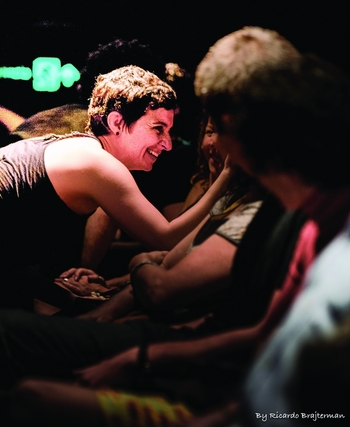
PROJETO bRASIL (PROJECT bRAZIL). Photographer: Ricardo Brajeterman.

PROJETO bRASIL (PROJECT bRAZIL) is the new theatre performance by Companhia Brasileira de Teatro. It should be seen mainly for its political agenda and its aesthetic merit, yet the manner in which the production presents the arc of its debate is even more relevant.
The first subject the performance considers can justify the title: the politics of gay or same-sex marriage. Within this primary subject is the plea from a segment of the population to win new definitions of family, along with the corresponding social benefits derived from this right in the Congress. At the same time, in all its aspects, the text of PROJETO bRASIL recalls the country's flag that should (in the words of the Brazilian national anthem) be open to all of its ‘children of this soil’ whose ‘gentle mother’ could be called the ‘beloved country of Brazil’, but which is not. In the play, gay people are not seeking equal rights, rather a reflection on what is needed to think of the country as a complex state within the scope of its amicable differences. In this first segment of the performance, the beautiful smile of actor Nadja Naira looms like an invitation to the opening of hearts and minds.
The play continues with the insertion of a speech at the UN in September 2013 by the former president of Uruguay, José Mujica, given and performed by Rodrigo Bolzan. In terms of this play, any barriers to a project in defence of Brazil are broken in favour of an idea of humankind. Between scenes we have the constant of one man looking at another, each with his own identity, but without ignoring differences.
In the third part of PROJETO bRASIL there is yet another scene full of energy and considerable potential to the sound of ‘Cantilena’, the aria from Bachianas Brasileiras No 5 by Villa-Lobos. In the meantime, one of the best moments of this section is the interpretation in Brazilian Sign Language of ‘Um Índio’ (A Brazilian Indian) by Caetano Veloso, sung by Giovana Soar. This is the moment when this play, which evolved out of a national political debate to develop into a reflection on humanism, returns to the seminal man: the indigenous figure of Caetano's song. Written by Soar, Naira, Bolzan and Marcio Abreu, the play skilfully transforms its sources into working material and final product. Here is an aesthetic tableau of great beauty that is quite simple and thus perhaps even more beautiful.
PROJETO bRASIL is a post-dramatic performance and, for this reason, it should be understood through signs that do not converge but rather diverge. For many scholars, theatre is a structure of signs because all of its elements carry intention. In this sense, discovering the meaning of PROJETO bRASIL in general is the first task of the audience. In other words, [the performance asks] spectators to become the subject of their own history, to take responsibility for the situation before them. These questions are not merely treated as themes, but rather as demands of PROJETO bRASIL.