Given that mortality following surgery for congenital and paediatric cardiac disease has fallen substantially, those providing medical and surgical treatment for patients with congenitally malformed hearts must move beyond mortality as an outcome to assess the quality of health care interventions. Medical and surgical interventions are done to prevent or mitigate the morbidity and mortality that would result from congenital cardiac disease if no therapeutic intervention is performed. Surgical care of congenital cardiac disease invariably involves anatomically and physiologically complex patients and equally complex diagnostic and therapeutic interventions. Given the complexity of the patients and interventions, it is not surprising that at times the clinical course is not what is desired by the health care team. Unwanted events may contribute to morbidity and thereby diminish the efficacy of these well-intentioned medical and surgical interventions.
In general, surgical interventions for patients with congenitally malformed hearts are undertaken to alter, in a beneficial way, the anticipated or expected course of the disease associated with the structural cardiac anomaly. This intent may encompass any or all of the following objectives:
• relief or reduction of symptoms,
• improvement of the individual patient’s functional capacity,
• enhancement or improvement of quality of life – either by preventing or postponing the occurrence or progression of a pathologic process, or by eliminating the indications or need for encumbrances such as medical therapy,
• contributing to the possibility of longer survival and greater freedom from disability than would be anticipated without the benefit of a successful surgical intervention.
During the last decade, an increasing amount of attention has been focused on “patient safety” and the prevention of medical error. Concurrently, a large effort has been put forth to develop the tools to evaluate, quantitate, and improve the quality of health care. Huge multi-institutional databases have been created to assess the outcomes of the surgical treatment of congenital cardiothoracic disease.
The most concrete and universal measure of outcome used in databases, whether the database is from a government, professional society, research project, or third-party payer, is operative mortality.Reference Jacobs and Mavroudis C Jacobs1 Nevertheless, as mortality after congenital cardiac surgery has decreased, the assessment of morbidity after congenital cardiac surgery has gained increasing importance.Reference Jacobs, Jacobs and Mavroudis2 In the modern era, death occurs in less than 4% of patients after congenital cardiac surgery.3–12 In order to assess better the quality of care provided to the remaining 96% of surviving patients, tools must be standardized to assess morbidity. Webster’s dictionary13 defines morbid as “of, having, or caused by disease; unhealthy; diseased”; morbidity is defined as a “state, quality or instance of being morbid”.13 Thus, mortality is death and morbidity is a state of illness or lack of health. In the specialty of congenital cardiac disease, mortality is death associated with congenital cardiac disease,Reference Jacobs and Mavroudis C Jacobs1 and morbidity is illness or lack of health associated with congenital cardiac disease. For our field to move beyond mortality and into the arena of “patient safety” and the assessment of quality of care, a universal nomenclature of safety and quality terms are needed as the basic tools to identify events that may adversely affect the outcomes of the treatment of our patients.
A large body of literature devoted to “patient safety” and error prevention exists and utilizes a nomenclature that can be applied specifically to the field of congenital cardiac disease and aid in the goals of increasing safety, decreasing medical error, minimizing mortality and morbidity, and evaluating quality of care. The purpose of this manuscript is to suggest and document a quality of health care taxonomy and the appropriate application of this nomenclature of “patient safety” to the specialty of congenital cardiac disease, with special emphasis on the following ten terms: morbidity, complication, medical error, adverse event, harm, near miss, iatrogenesis, iatrogenic complication, medical injury, and sentinel event. Although many of the examples cited in this manuscript are based on surgical therapy for congenital cardiac disease, the definitions and principles apply to all forms of therapy for congenital cardiac disease, including medical, surgical, inpatient and outpatient treatment.
Methods
The Multi-Societal Database Committee for Pediatric and Congenital Heart Disease includes paediatric and congenital cardiac surgeons, cardiologists, intensivists, anaesthesiologists, perfusionists, nurses, and governmental administrators representing numerous national and international societies. The literature related to “patient safety” was reviewed by a panel from this committee who also compose the Society of Thoracic Surgeons Congenital Database Taskforce Subcommittee on Patient Safety. A consensus building method was adopted by the panel, whereby each “patient safety” term was researched and the utility of the terms and their applicability to congenital cardiac disease was debated. A consensus definition was reached for each term. In addition to defining these terms, both severity and preventability also were considered. A taxonomy was constructed based on this review of existing literature related to patient safety and quality and its applicability to patients with congenital cardiac disease.
Definitions
Complication
“A complication is an event or occurrence that is associated with a disease or a healthcare intervention, is a departure from the desired course of events, and may cause, or be associated with, suboptimal outcome”.
This definition of complication recognizes that a complication can be secondary to multiple aetiologies including the following three:
• The patient’s underlying disease itself, independent of health care interventions
• Diagnostic, palliative, therapeutic, and preventative health care interventions
• Any combination of the two choices above.
This definition also recognizes that not all complications cause or are associated with suboptimal outcome.
An example of a complication caused by the patient’s underlying disease is a spontaneous pneumothorax developing in a patient with pulmonary blebs. An example of a complication secondary to a health care intervention is a pneumothorax caused by an inadvertent pleural puncture during a subclavian central line placement. An example of a complication that does not cause a suboptimal outcome is a situation where a perfusionist leaves a side port open on his cardiopulmonary bypass circuit and a large air bubble travels up towards the arterial cannula but is caught in time and de-aired by a vigilant perfusionist assistant.
Medical error
“A medical error is a health care intervention, that may be an act of commission or omission, where a planned action fails to be completed as intended or the use of a wrong plan is implemented to achieve an aim; this event is a departure from the desired course of events, is less than ideal, and may cause or be associated with suboptimal outcome.”
Therefore, medical errors will meet the following four criteria:
• A medical error is either the failure of a planned action to be completed as intended or the use of a wrong action to achieve an aim.
• A medical error is a departure from an accepted standard, rule, or expectation in patient care due to a lack of knowledge or a failure in execution.
• A medical error may cause or be associated with suboptimal outcome.
• A medical error may be an act of commission or omission.
A medical error is a subtype of complication. Not all complications are caused by medical error. Not all complications are the result of medical negligence or medical malpractice.
This definition of medical error offered by The MultiSocietal Database Committee for Pedatric and Congenital Heart Disease is completely consistent with terminology advocated by the Institute of Medicine (IOM). In their report titled “To Err Is Human: Building a Safer Health System”,Reference Kohn, Corrigan and Donaldson14 the Institute of Medicine makes the following four definitive statements:
1. “In this report, safety is defined as freedom from accidental injury. This definition recognizes that this is the primary safety goal from the patient’s perspective.”
2. “Error is defined as the failure of a planned action to be completed as intended or the use of a wrong plan to achieve an aim.”
3. “Errors can happen in all stages in the process of care, from diagnosis, to treatment, to preventive care.”
4. “Not all errors result in harm.”
In response to this Institute of Medicine Report, an interagency task force was established to ensure that all relevant federal agencies take a coordinated approach to improving quality of care.15 The goal of this “Quality Interagency Coordination Task Force(QuIC) is to ensure that all Federal agencies that purchase, provide, study, or regulate health care services are working in a coordinated way toward the common goal of improving the quality of care. The Quality Interagency Coordination Task Force seeks to provide information to help people make choices, to improve the care purchased and delivered by the Government, and to develop the infrastructure needed to improve the health care system.” 15 In an effort to consider thoroughly all of the relevant issues related to medical errors, the Quality Interagency Coordination Task Force defined medical error in a manner similar to the Institute of Medicine, but expanded of the definition of the Institute of Medicine.16 The definition of medical error provided by the Quality Interagency Coordination Task Force states: “An error is defined as the failure of a planned action to be completed as intended or the use of a wrong plan to achieve an aim. Errors can include problems in practice, products, procedures, and systems.”16 This definition of medical error provided by the Quality Interagency Coordination Task Force is consistent with the definitions provided by both the Institute of Medicine and The MultiSocietal Database Committee for Pedatric and Congenital Heart Disease.
Adverse event
“An adverse event is a complication that is associated with a healthcare intervention and is associated with suboptimal outcome.”
Not all medical error results in adverse events and not all adverse events are caused by medical error. An example of an adverse event without medical error is the acute thrombosis of modified Blalock-Taussig shunt despite perfect clinical execution. An example of an adverse event with medical error is third degree heart block that develops during repair of a ventricular septal defect secondary to incorrect suture placement. Some adverse events are preventable and some adverse events are not preventable.
An adverse event is a subtype of complication. Many subtypes of complications exist. In addition to medical error and adverse event, four additional subtypes of complications are defined below:
• A major complication is a complication that causes increased consumption of resources or permanent morbidity.
• A minor complication is a complication that does not cause increased consumption of resources or permanent morbidity.
• A permanent complication is a major complication that causes permanent morbidity.
• A transient complication is a complication that does not cause permanent morbidity; transient complications will include all minor complications and those major complications that do not cause permanent morbidity.
An adverse event can be a transient complication or permanent complication. A variety of alternative definitions of adverse event have been published in the literature.
In their 1999 report titled “To Err Is Human: Building a Safer Health System”,Reference Kohn, Corrigan and Donaldson14 the Institute of Medicine makes the following statement:
“Not all errors result in harm. Errors that do result in injury are sometimes called preventable adverse events. An adverse event is an injury resulting from a medical intervention, or in other words, it is not due to the underlying condition of the patient. While all adverse events result from medical management, not all are preventable (i.e., not all are attributable to errors). For example, if a patient has surgery and dies from pneumonia he or she got postoperatively, it is an adverse event. If analysis of the case reveals that the patient got pneumonia because of poor hand washing or instrument cleaning techniques by staff, the adverse event was preventable (attributable to an error of execution). But the analysis may conclude that no error occurred and the patient would be presumed to have had a difficult surgery and recovery (not a preventable adverse event).”
Thus, according to the Institute of Medicine, an adverse event “is an injury resulting from a medical intervention, or in other words, it is not due to the underlying condition of the patient. While all adverse events result from medical management, not all are preventable (i.e., not all are attributable to errors).” A preventable adverse event is an error that results in injury.Reference Kohn, Corrigan and Donaldson14
The 1991 Harvard Medical Practice StudyReference Brennan, Leape and Laird17, Reference Brennan, Leape, Laird, Hebert, Localio, Lawthers, Newhouse, Weiler and Hiatt18 stated, “We defined an adverse event as an injury that was caused by medical management (rather than the underlying disease) and that prolonged the hospitalization, produced a disability at the time of discharge, or both. We defined negligence as care that fell below the standard expected of physicians in their community.” In 1997, Andrews and colleaguesReference Andrews, Stocking, Krizek, Gottlieb, Krizek, Vargish and Siegler19 stated, “We defined adverse events as situations in which an inappropriate decision was made when, at the time, an appropriate alternative could have been chosen. The focus was on whether at the time the particular medical decision was made (knowing the facts as they were at that moment) the action was appropriate.” In 2002, LeapeReference Leape20 stated:
“Reporting systems collect information on adverse events, errors, or both. Adverse events have been defined as injuries related to medical management (in contrast to complications of disease). Preventable adverse events are those that result from errors or equipment failures. Error has been defined as ‘the failure of a planned action to be completed as intended (i.e., error of execution) or the use of a wrong plan to achieve an aim (i.e., error of planning).’ ”
Thus, Leape defines adverse events as injuries or harm related to medical management, in contrast to complications of disease.
In 2003, Murff and colleaguesReference Murff, Forster, Peterson, Fiskio, Heiman and Bates21, Reference Hiatt, Barnes and Brennan22 published data about electronically screening discharge summaries for adverse medical events (AE) and stated that “The primary outcome of the study was an AE, defined as an injury resulting from medical management rather than the patient’s underlying condition. We included both injuries that resulted in a disability at discharge and those that resulted in a prolonged hospitalization, the definition used for the Harvard Medical Practice Study (MPS), as well as injuries that resulted in transient disability or abnormal laboratory studies, which would not have met the MPS criteria. We applied the more inclusive definition to capture events that would be clinically significant yet might not have met the malpractice-oriented definition of injury used in the MPS. An example of such an event would be an elderly patient who required naloxone because of inappropriately dosed narcotics but who recovered quickly and did not require excess hospital days. These types of events are undesirable and important to detect for improving safety, even if they do not increase length of stay.” In reality, these additional events referred to by Murff and colleagues are actually medical errors that do not lead to suboptimal outcome and therefore represent medical errors that are not adverse events. This important point is discussed further in the next paragraph.
In 2005, Woods and colleagues offered the following definitions:Reference Woods, Thomas, Holl, Altman and Brennan23 “An adverse event is an injury that is caused by medical management, not the disease process, and has led to a prolonged hospital stay or disability at discharge. A preventable adverse event is an injury that is caused by medical intervention or management (rather than the disease process) and either prolonged hospital stay or caused disability at discharge, where there was enough information currently available to have avoided the event using currently accepted practices.” In other words, “Adverse events were defined as an injury caused by medical management rather than disease processes that resulted in either prolonged hospitalization or disability at discharge. A preventable adverse event was defined as an avoidable adverse event based on currently available knowledge and accepted practices.” Woods and colleagues also make the important statement that, “Errors do not always result in significant adverse events that result in increased hospital stay or disability because the error is identified in time, that is, before interaction with the patient, or the patient is resilient or just lucky.”Reference Weingart, Wilson, Gilbberd and Harrison24
Based on the above review of the literature, the best definition of an adverse event is a complication that is associated with a healthcare intervention and is associated with suboptimal outcome. We have already stated that a complication is an event or occurrence that is associated with a disease or a healthcare intervention, is a departure from the desired course of events, and may cause, or be associated with, suboptimal outcome. Therefore, an adverse event is an event or occurrence that is associated with a healthcare intervention, is a departure from the desired course of events, and causes or is associated with suboptimal outcome.
Harm
“Harm is defined as a suboptimal outcome. A complication associated with a suboptimal outcome is a complication that causes harm. An error associated with a suboptimal outcome is an error that causes harm. Not all complications cause harm. Not all errors cause harm.”
For example, prolonged bleeding from an intercostal artery following chest tube placement at the inferior border of a rib represents both a complication and an error causing harm. Inadvertent ligation of the left pulmonary artery during ligation of the patent arterial duct that is noticed right away and followed immediately by release of the ligature is an example of error most likely causing no harm. A nurse giving to a patient an extra pill in the morning, which is a standard multivitamin, is another example of error most likely causing no harm. Levels of harm can be categorized by severity (Appendix 1).Reference Shah, Kentala, Healy and Roberson25
Near miss
“A near miss is a complication that is either not associated with harm or suboptimal outcome, or is associated with minimized harm, because the unwanted consequence is minimized or prevented secondary to a recovery by identification and correction of the failure. This recovery could be caused by a planned or unplanned barrier or safeguard.”Reference Van der Schaaf, Lucas and Hale26–Reference Barach and Small30
An example of a near miss is the previously described situation where a perfusionist leaves a side port open on his cardiopulmonary bypass circuit and a large air bubble travels up towards the arterial cannula but is caught in time and de-aired by a vigilant perfusionist assistant.
Two categories of near miss events exist:
• “No harm events” where the unwanted consequence is prevented secondary to a recovery by identification and correction of the failure, and
• Near miss events where harm exists but is minimized because the unwanted consequence is diminished secondary to a recovery by identification and correction of the failure.
“No harm events”, are “events that have occurred but resulted in no actual harm although the potential for harm may have been present. Lack of harm may be due to the robust nature of human physiology or pure luck. An example of such a benign event would be the issuing of an ABO incompatible unit of blood for a patient, but the unit was not transfused and was returned to the blood bank.”15 An example of a near miss event associated with minimized harm is a baby who undergoes an arterial switch procedure that initially results in coronary ischaemia necessitating reinstitution of cardiopulmonary bypass, revision of the coronary implantation, postoperative extracorporeal membrane oxygenation, and eventual results in full recovery with discharge home of a healthy baby.
Iatrogenesis
“Iatrogenesis literally means ‘brought forth by a healer’. Iatrogenic events are events caused by the health care delivery team, not the underlying disease, and these events may result in positive or negative outcomes.”
“An iatrogenic complication is a complication that is associated with a healthcare intervention. In other words, an iatrogenic complication is an event or occurrence that is associated with a healthcare intervention, is a departure from the desired course of events, and may cause, or be associated with, suboptimal outcome.”
An iatrogenic complication is different from an adverse event because not all iatrogenic complications are associated with suboptimal outcome, while all adverse events are associated with suboptimal outcome. Both iatrogenic complications and adverse events may or may not be the consequence of medical error.
The literal meaning of the term iatrogenesis comes from the Greek “iatros” meaning healer, and “gener” meaning to create; thus, the alternative definitions include “induced in a patient by the health care delivery team’s activity, manner, or therapy,” or “brought forth by a healer.” When analyzing the impacts of medical care on patient well-being, the complexity of the health care delivery system is such that consideration of the actions and roles of physicians alone overlooks enormous aspects of the complete dynamic of the healthcare team and environment. As such, the broadest interpretation of healer, to encompass the multiple elements of a complex system, is most appropriate. An analogy can be made to the airline industry where the role of the meteorologist, navigator, and control tower in a successful airplane flight can be just as significant as the potential contribution of pilot error.
Furthermore, in the spirit of improving quality of care, it is important to view iatrogenesis in its entirety; that is, iatrogenesis can refer to good or bad effects that the actions or inactions of the healers have on the patient. Most of societal emphasis and scrutiny is currently focused on the harmful or negative effects. But this approach is myopic. The same antibiotic therapy that eradicates thousands of infections and saves countless lives, also contributes to the emergence of resistant strains of microorganisms. A balanced interpretation of the iatrogenesis of antibiotic treatment for documented, susceptible bacterial infection includes the positive effects for the patient of curing the infection and the negative effects for society of promoting resistant strains of microorganisms. Both the positive and negative impacts of any drug or treatment strategy are iatrogenesis; however, the iatrogenic events that are a departure from the desired course of events and may cause or be associated with suboptimal outcome are termed iatrogenic complications.
As discussed above, the term iatrogenic complication is not synonymous with adverse event; nevertheless, iatrogenic complications and adverse events both do not necessarily result from medical error. In fact, many iatrogenic complications are intrinsic effects of a medical treatment, and may be unavoidable accompaniments of appropriate efficacious treatment strategies, for example, alopecia, anemia and emesis that occur secondary to chemotherapy or radiation therapy for cancer.
Thus, iatrogenesis encompasses both the good and bad effects that follow from the interaction of the health care delivery team (system, organization, institution, entity) with the patient. Those iatrogenic events that are departures from the desired course of events and may cause or be associated with suboptimal outcome are iatrogenic complications.
Medical injury
“The term medical injuryReference Cole31–Reference Layde, Meurer, Guse, Henriksen, Battles, Marks and Lewin33 is synonymous with the term adverse event and is defined as a complication that is associated with a healthcare intervention and is associated with suboptimal outcome; however, the term medical injury has acquired so negative a connotation as to be misleading and inflammatory. The authors of this manuscript and othersReference Jacobs, Jacobs and Mavroudis2 suggest that this term has no utility and should be retired.”
The terms injury and harm are synonymous and are emotionally laden. When using these terms, one must understand what each term describes rather than what it implies. Colloquially, the term medical injury implies an error or negligence on the part of the health care team. It is essential to note that the definition above does not refer to the culpability, predictability or preventability of these events. Designation of an event as a “medical injury” does not signify that the event was preventable nor due to substandard care. In fact, most medical injuries are not the result of negligence.Reference Brennan, Leape and Laird17, Reference Layde, Cortes and Teret32 Medical injuries are outcomes that may occur in all stages in the process of care, including diagnosis, treatment and follow up,Reference Kohn, Corrigan and Donaldson14 and may or may not have resulted from a medical error. To restate, medical injuries can occur without an error in planning or execution of a treatment plan. The term adverse event is preferable to the term medical injury.
Relative to medical errors, adverse events are easier to identify because they are associated with suboptimal outcome. Although some medical errors are of interest because they represent a situation that might have led to a patient injury, no convincing evidence exists that the type of errors that do not lead to suboptimal outcome are similar to those that do. For these reasons and the seeming abundance of adverse events, some experts support an adverse event oriented, or “injury” oriented, approach to patient safety.Reference Layde, Cortes and Teret32
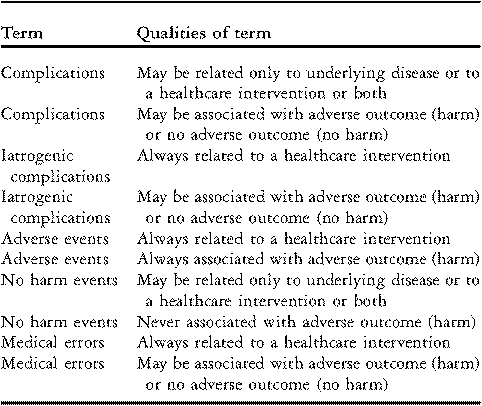
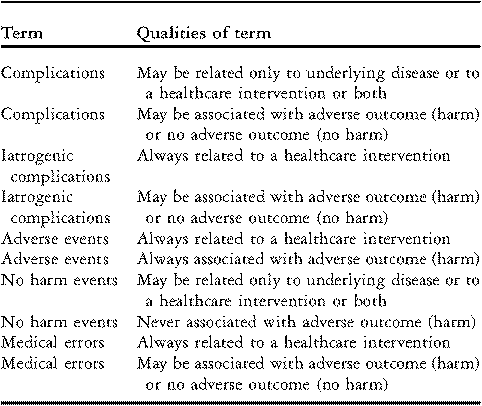
Tables 1 and 2 document the relationships and qualities of the following terms:
Relationship of the terms: Complications, Iatrogenic complications, Adverse events, No harm events, and Medical errors.

Qualities of the terms: Complications, Iatrogenic complications, Adverse events, No harm events, and Medical errors.
• Complications,
• Iatrogenic complications,
• Adverse events,
• No harm events, and
• Medical errors.
Comment
Improvement of health care, as measured by a reduction in mortality and/or morbidity, will inevitably result from the acknowledgement, analysis, and correction of the shortcomings in our present systems of delivering care. Introduction, validation, and application of better organizational systems and therapeutic strategies that are rational and eventually evidence-based will also help this endeavour, as will improved methods of assessing their quality. Health care interventions are a complex mixture of positive and negative effects, and some may be positive with respect to the individual patient and at the same time negative with respect to society as a whole, or vice versa.
While the connotations of most of the terms that we are analyzing may be considered negative, including terms such as complication, medical error, adverse event, iatrogenesis, and medical injury, it must be acknowledged that our ultimate goal is to improve the health-related quality of life of patients with congenital cardiac disease. This objective is most likely to occur because of the identification, validation and application of strategies to improve quality of care. Certainly these strategies have as a major focus the elimination or minimization of avoidable down-side issues or events, which are collectively what we will probably consider under the definition of morbidity, including but not limited to complications, disabilities, resource consumption, and even cost to society. Nevertheless, to dwell only on this side of the issue is to overlook the importance of improving care through application in a timely fashion of efficacious, successful treatment strategies in an optimally staffed and resourced environment. Quality improvement initiatives can involve both outcomes analysis and improvement of health care process. Failure or success in following a specified treatment plan may be a more sensitive marker of quality of care than many outcome measures.
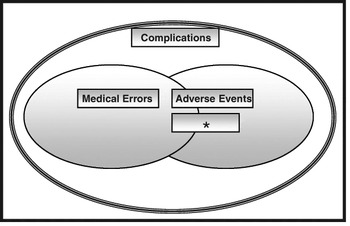
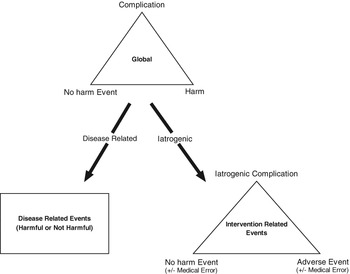
The purpose of this manuscript is to define the appropriate application to the specialty of congenital cardiac disease of the terms: morbidity, complication, medical error, adverse event, harm, near miss, iatrogenesis, iatrogenic complication, and medical injury. Our definitions of these terms are summarized in Appendix 2. Tables 1 and 2 and Figures 1 and 2 document the relationship of these terms to each other. Each of these terms is commonly utilized in the medical literature without universal agreement on their meaning and relationship.Reference Galvan, Bacha, Mohr and Paul34 It is our hope that the standardization of the definitions of these terms as they are applied to congenital heart disease outcomes analysis will facilitate improved methodologies to assess and improve quality of care in our profession.
Relationship between complications and subtypes of complications and the approaches to “Patient Safety”. In this Venn diagram, the large oval represents all types of complications. Complication is an overall encompassing term for any undesired event, under which there exist a variety of other patient safety events. Within the large oval of complications, two intersecting ovals represent the subtypes of complications named medical errors and adverse events. The union of the two ovals (representing events that are medical errors, adverse events, or both) is the subset of complications known as iatrogenic complications. The area within the large oval representing complications that is outside union of the two ovals representing medical errors and adverse events is the subset of complications associated with the patient’s underlying disease itself, independent of health care interventions. Medical errors and adverse events may be completely independent from each other. That is, medical error can occur without adverse events and adverse events can occur in absence of a medical error. At times, these two domains may intersect and a medical error may be associated with or result in an adverse event (modified fromReference Wright and van der Schaaf28). * = All adverse events are associated with harm; only some medical errors are associated with harm. All medical errors are associated with error; only some adverse events are associated with error.

Classification of complications and subtypes of complications. The term “complications” is a global term that may or may not be associated with harm. Complications may be secondary to the patient’s underlying disease itself (independent of health care interventions) or complications may be secondary to health care interventions (diagnostic, palliative, therapeutic, and preventative health care interventions). Those complications that are secondary to health care interventions and are associated with adverse outcome (harm) are termed “adverse events”.

Acknowledgements
We thank the Children’s Heart Foundation (http://www.childrensheartfoundation.org/) for financial support of this research. We acknowledge in particular the contributions of several investigators who contributed significantly:
• Karen Graham and Melanie Gevitz of Children’s Memorial Hospital, Northwestern University, Chicago, Illinois, United States
• Tina Merola, Tracey Cox, and Debbie McIntosh of The Congenital Heart Institute of Florida, Cardiac Surgical Associates, All Children’s Hospital, Children’s Hospital of Tampa, and the University of South Florida, Saint Petersburg and Tampa, Florida, United States of America
• Janet Kreutzer, of The Congenital Heart Institute of Florida, Cardiac Surgical Associates, Children’s Hospital of Tampa, and the University of South Florida, Saint Petersburg and Tampa, Florida, United States of America,
• Jean Wilhelm of The Congenital Heart Institute of Florida, Cardiac Surgical Associates, All Children’s Hospital, and the University of South Florida, Saint Petersburg and Tampa, Florida, United States of America.
This manuscript has been reviewed and approved as an official publication of The Society of Thoracic Surgeons Congenital Database Taskforce by the following Committees:
• The Society of Thoracic Surgeons Executive Committee,
• The Society of Thoracic Surgeons Council on Quality, Research & Patient Safety,
• The Society of Thoracic Surgeons Workforce on National Databases, and
• The Society of Thoracic Surgeons Congenital Database Taskforce.
Appendix 1: Harms Severity Table (Modified from25)
Category A: NO ERROR
Category B: ERROR, NO HARM
Category C: ERROR, HARM
Category D: ERROR, DEATH

Appendix 2: Definitions
1. Morbidity:Morbidity is a state of illness or lack of health, and includes physical, mental, or emotional disability.
2. Complication: A complication is an event or occurrence that is associated with a disease or a healthcare intervention, is a departure from the desired course of events, and may cause, or be associated with, suboptimal outcome.
3. Medical error: A medical error is a health care intervention, that may be an act of commission or omission, where a planned action fails to be completed as intended or the use of a wrong plan is implemented to achieve an aim; this event is a departure from the desired course of events, is less than ideal, and may cause or be associated with suboptimal outcome.
4. Adverse event: An adverse event is a complication that is associated with a healthcare intervention and is associated with suboptimal outcome.
5. Harm: Harm is defined as a suboptimal outcome. A complication associated with a suboptimal outcome is a complication that causes harm. An error associated with a suboptimal outcome is an error that causes harm. Not all complications cause harm. Not all errors cause harm.
6. Near miss: A near miss is a complication that is either not associated with harm or suboptimal outcome, or is associated with minimized harm, because the unwanted consequence is minimized or prevented secondary to a recovery by identification and correction of the failure. This recovery could be caused by a planned or unplanned barrier.Reference Van der Schaaf, Lucas and Hale26–Reference Wright and van der Schaaf28
7. Iatrogenic events are events caused by the health care delivery team and these events may result in positive or negative outcomes.
8. Iatrogenic complications are complications that are associated with a healthcare intervention. In other words, an iatrogenic complication is an event or occurrence that is associated with a healthcare intervention, is a departure from the desired course of events, and may cause, or be associated with, suboptimal outcome.
9. Medical injury: The term medical injury is synonymous with the term adverse event and is defined as a complication that is associated with a healthcare intervention and is associated with suboptimal outcome; however, the term medical injury has acquired so negative a connotation as to be misleading and inflammatory. The authors of this manuscript and othersReference Jacobs, Jacobs and Mavroudis2 suggest that this term has no utility and should be retired.
10. Sentinel event: The Joint Commission on Accreditation of Healthcare Organizations (JCAHO) of the United States of America states that “A sentinel event is an unexpected occurrence involving death or serious physical or psychological injury, or the risk thereof. Serious injury specifically includes loss of limb or function. The phrase, ‘or the risk thereof’ includes any process variation for which a recurrence would carry a significant chance of a serious adverse outcome. Such events are called ‘sentinel’ because they signal the need for immediate investigation and response.”35