Overgeneral autobiographical memory (OGM), or difficulties with autobiographical memory specificity (AMS), refers to the phenomenon of an individual not being able to retrieve a specific memory of a past event. This has commonly been tested by requiring an individual to retrieve a memory in response to a cue word (e.g., the Autobiographical Memory Test, AMT: Williams & Broadbent, Reference Williams and Broadbent1986). Overgeneral memory can be problematic. In adults with depression and posttraumatic stress disorders such as acute stress disorder (ASD) and posttraumatic stress disorder (PTSD), overgeneralised memory has been associated with poor interpersonal problem-solving skills, difficulties in imagining future events, and the persistence of depression and PTSD (see Moore & Zoellner, Reference Moore and Zoellner2007; Sumner, Griffith, & Mineka, Reference Sumner, Griffith and Mineka2010; Sumner, Reference Sumner2011; Williams, Reference Williams1996; Williams et al., Reference Williams, Barnhofer, Crane, Hermans, Raes, Watkins and Dalgleish2007, for reviews). There is now increasing evidence that children and adolescents with depression show autobiographical memory difficulties (Valentino, Reference Valentino2011), and the pattern of these relationships is often comparable to that seen in adults. As will be discussed further, difficulties with AMS in children exposed to trauma is less well understood. Although the dominant model used to explain autobiographical memory in psychopathology initially proposed negative or adverse life events were instrumental in the development of overgeneralised memory (Williams, Reference Williams1996), several key tenets of the model have not been systematically studied in children and youth following trauma and a rationale for the importance of studying these factors is now outlined.
Williams first proposed one possible pathway to the overgeneralised memory observed in adults was the result of a memory retrieval style developed in childhood. It was argued that following adverse or negative life experiences children learnt to avoid retrieving specific memories of past events as a way of managing distress associated with such specific recall (Williams, Reference Williams1996). Commonly referred to as the ‘affect regulation’ account, Williams and colleagues refined this model (Williams et al., Reference Williams, Barnhofer, Crane, Hermans, Raes, Watkins and Dalgleish2007) drawing on key components of Conway and Pleydell-Pearce's (Reference Conway and Pleydell-Pearce2000) normative model of autobiographical memory. Williams et al. labelled this refined model the CARFAX model (Capture And Rumination, Functional Avoidance and impaired eXecutive control). While the affect regulation component of the earlier model was retained (now labelled ‘functional avoidance’), cognitive mechanisms that interfered with strategic retrieval of specific memories, whether it was through distraction from the target search (capture and rumination mechanism) or difficulties with inhibition of irrelevant cues or memories (executive control), were also emphasised. Although historically the model was developed in an attempt to understand memory retrieval processes in individuals who had attempted suicide (Williams & Broadbent, Reference Williams and Broadbent1986), and then in depression, the model is now used as a transdiagnostic explanation of overgeneralised memory in both depression and PTSD. The importance of the affect regulation component of the model has been questioned in light of the observation that AMS difficulties are sometimes observed in those without significant history of trauma (Dalgleish et al., Reference Dalgleish, Williams, Golden, Perkins, Barrett, Barnard and Watkins2007). Researchers now suggest that it is possible some components of the model may have more explanatory power for explaining overgeneral memory in survivors of trauma (e.g., affect regulation explanation), while other components may explain OGM in depression (e.g., exectutive difficulties; Dalgleish et al., Reference Dalgleish, Williams, Golden, Perkins, Barrett, Barnard and Watkins2007; Dalgleish, Rolfe, Golden, Dunn, & Barnard, Reference Dalgleish, Rolfe, Golden, Dunn and Barnard2008; Sumner, Reference Sumner2011).
What is clear from the writings of both the model proponents themselves and recent reviews (Sumner, Reference Sumner2011; Valentino, Reference Valentino2011; Williams et al., Reference Williams, Barnhofer, Crane, Hermans, Raes, Watkins and Dalgleish2007) is that we do not definitively know whether OGM is a risk factor for psychopathology, whether it is also a maintaining factor, or simply just a consequence of developing depression or PTSD. Williams’ earlier version of the model appeared to argue a risk factor role, with children thought to become stuck in an overgeneral retrieval style while their presumably non-affected peers were thought to be more likely to use specific retrieval strategies as they grew older. At present, there is some support for the proposal that OGM maybe a risk factor for psychopathology. In the child area this is largely derived from the depression field. In adolescents OGM has recently been shown to predict the onset of new depressive episodes in the context of interpersonal stress (Sumner et al., Reference Sumner, Griffith, Mineka, Rekart, Zinbarg and Craske2011) and predicts depressive symptoms in non-clinical samples (Hipwell, Sapotichne, Klostermann, Battista, & Keenan, Reference Hipwell, Sapotichne, Klostermann, Battista and Keenan2011). The observation that OGM is seen in adults with remitted depression (Mackinger, Pachinger, Leibetseder, & Fartacek, Reference Mackinger, Pachinger, Leibetseder and Fartacek2000) also suggests this may be a trait characteristic. OGM also has been shown to predict PTSD and depression in adult trauma survivors (Bryant, Sutherland, & Guthrie, Reference Bryant, Sutherland and Guthrie2007; Kleim & Ehlers, Reference Kleim and Ehlers2008).
Studies have begun to examine the relationship between AMS difficulties and trauma in children. Five of six studies of children and adolescents exposed to varying levels of trauma (burns, child abuse, bombings) have found trauma exposure to be associated with difficulties retrieving specific autobiographical memories or greater likelihood of generating overgeneral memories (Brennen et al., Reference Brennen, Hasanovic, Zotovic, Blix, Solheim Skar, Prelic and Gavrilov-Jerkovic2010, Study 1; de Decker, Hermans, Raes, & Eelen; Reference de Decker, Hermans, Raes and Eelen2003; Meesters, Merckelbach, Muris, & Wessel, Reference Meesters, Merckelbach, Muris and Wessel2000; Stokes, Dritschel, & Bekerian, Reference Stokes, Dritschel and Bekerian2004; Valentino, Toth, & Cicchetti, Reference Valentino, Toth and Cicchetti2009). Kuyken, Howell, and Dalgleish (Reference Kuyken, Howell and Dalgleish2006), however, found that adolescents with depression and probable PTSD reported fewer overgeneralised memories than depressed non-PTSD adolescents. While these findings on the whole suggest that AMS difficulties are seen in children following trauma, several key questions remain.
First, the above child trauma research has studied children whose trauma has occurred months if not years previously. The exact timeline of when overgeneral memory occurs and becomes problematic is unclear. On the one hand, the child depression literature suggests OGM represents a vulnerability or risk factor for psychopathology. If this is also the case in relation to negative events or trauma, we would expect AMS difficulties in children to be associated with posttraumatic stress following recent trauma. To date no study of child autobiographical memory has tested this in a recently traumatised group and this formed the basis of Study 1. Models of OGM do pose what could initially be construed as a contradictory view in regard to the development of OGM following adverse events. Specifically, it is thought that OGM might initially be protective after a negative event as it reduces access to a distressing memory. It is only when this retrieval style becomes generalised that it is thought to become problematic (Sumner, Reference Sumner2011; Williams et al., Reference Williams, Barnhofer, Crane, Hermans, Raes, Watkins and Dalgleish2007). Indeed, there is some indirect support for the proposal that the functional avoidance mechanism outlined by the CARFAX model reduces short-term distress. In an experimental study with adults, Raes, Hermans, de Decker, Williams, and Eelen (Reference Raes, Hermans, de Decker, Eelen and Williams2003) observed individuals high in memory specificity ability experienced greater distress immediately following a negative stressor task relative to those less specific in their memory retrieval. To date, there has been only one study of AMS in an acute clinical trauma sample. However, rather than finding AMS was associated with good short-term adjustment, Harvey, Bryant, and Dang (Reference Harvey, Bryant and Dang1998) demonstrated that lower specificity was observed in adults with acute stress disorder compared with non-ASD adults. This occurred regardless of whether participants were instructed to retrieve a memory for any time up to their traumatic event (labelled an ‘unconstrained’ condition), or restricted to the period immediately following their trauma (‘constrained’ condition). While this supports autobiographical memory difficulties being a risk factor for acute stress, given this was an adult sample it cannot be ruled out that prior trauma (or PTSD) was actually responsible for these difficulties. Nor does it definitively refute the potential adaptive nature of reduced AMS shortly following trauma given it is possible in an adult clinical sample overgeneralised retrieval patterns were already developed prior to the recent acute event. Due to their age, children are likely to have experienced fewer traumatic events in their lifetime. Testing autobiographical memory performance in children soon after a negative event is an important first step to better delineate when memory specificity difficulties become associated with symptoms. In Study 1 we were also able to examine whether autobiographical memory performance predicted PTSD symptoms after a short follow-up (3 months posttrauma).
A second question that remains unaddressed is whether trauma exposure per se or the development of PTSD is associated with OGM in children. In adults, overgeneral memory is more strongly associated with PTSD rather than simply trauma exposure (Moore & Zoellner, Reference Moore and Zoellner2007) however overgeneral memory has never been examined in a sample of children formally diagnosed with PTSD. Thus Study 2 tested autobiographical memory in children who presented for treatment for PTSD. We predicted that compared with trauma-exposed non-PTSD controls, these children would retrieve fewer specific memories. Finally, given the suggestion that certain components of the CARFAX model may differentially explain OGM in trauma versus depression samples (Sumner, Reference Sumner2011) we measured one aspect of cognitive ability, working memory. If working memory and executive abilities better account for overgeneralised memory in depression rather than in trauma samples we would expect at best only a modest relationship between working memory and memory specificity difficulties.
Study 1: Acute Stress Children
Method
Participants
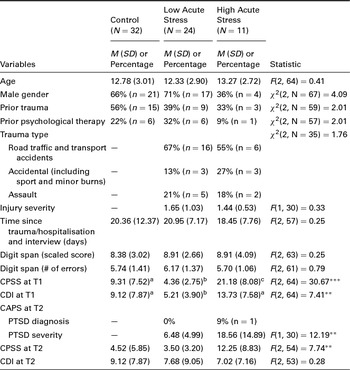
A total of 67 children and adolescents aged 8 to 17 took part in the study. Trauma-exposed participants (n = 35) were recruited from two metropolitan hospitals following a single-incident trauma (see Table 1 for participant and trauma characteristics). These children had been seen as outpatients or had required hospitalisation for injuries sustained during the trauma. Potential participants meeting broad inclusion and exclusion were identified from hospital admission lists. Eligibility criteria for this sample included: (1) age between 7 and 17, and (2) witnessing or experiencing a Criteria A stressor within the past 4 weeks. Exclusion criteria included: (1) sexual assault-type trauma, (2) traumatic brain injuries, (3) burns requiring ongoing active medical management, and (4) inability to complete questionnaires and interviews in English. Eighteen children considered for the study did not participate; four children could not be assessed within 4 weeks, and the remainder declined participation due to lack of time or ill health of the child. Children completed the Child PTSD Symptom Scale (CPSS; Foa, Johnson, Feeny, & Treadwell, Reference Foa, Johnson, Feeny and Treadwell2001), a self-report measure of posttraumatic stress reactions, to determine acute posttraumatic stress reactions (see Measures for further detail). Based on the CPSS, 11 children were categorised as displaying high acute stress symptoms, and 24 children were designated to the low acute stress symptom group. A comparison group of children (n = 32) who had been hospitalised for non-trauma related health concerns (e.g., respiratory illness, management of diabetes) were recruited as control participants for the present study. This group enabled the potentially stressful nature of being hospitalised and general distress to be taken into account when dissecting possible memory differences in children with high and low posttraumatic stress symptoms following trauma.
Demographic, Trauma, and Psychiatric Characteristics for Control; Low Acute Stress; and High Acute Stress Groups

Note: CPSS = Child PTSD Symptom Scale; CDI = Children's Depression Inventory; CAPS = Clinician-Administered PTSD Scale; a Values with different superscripts are significantly different from each other; **p < .01; ***p < .001.
In terms of effect sizes, previous research with child and adolescent samples trauma samples compared with controls has demonstrated a mean effect size (Cohen's d) of approximately 1.39 for differences in overgeneral memory (e.g., Brennen et al., Reference Brennen, Hasanovic, Zotovic, Blix, Solheim Skar, Prelic and Gavrilov-Jerkovic2010; Kuyken et al., Reference Kuyken, Howell and Dalgleish2006; Stokes et al., Reference Stokes, Dritschel and Bekerian2004). Not surprisingly autobiographical memory differences have thus been detected between groups with as few as 11 or 12 children, even in samples without significant symptoms (i.e., Brennen et al., Reference Brennen, Hasanovic, Zotovic, Blix, Solheim Skar, Prelic and Gavrilov-Jerkovic2010; Stokes et al., Reference Stokes, Dritschel and Bekerian2004). Taking into account the unequal group sizes, the present study was sufficiently powered (power = .80, using G*Power 3, Faul, Erdfelder, Lang, & Buchner, Reference Faul, Erdfelder, Lang and Buchner2007) to detect a directional effect of d = 0.95 for any two group comparison.
Measures
Acute and posttraumatic stress
To index acute and later posttraumatic stress reactions at 3-month follow-up, children completed the Child PTSD Symptom Scale (CPSS; Foa et al., Reference Foa, Johnson, Feeny and Treadwell2001) at both assessments. The CPSS is a self-report measure that indexes the frequency of the 17 PTSD symptoms. Foa et al. (Reference Foa, Johnson, Feeny and Treadwell2001) detail its acceptable psychometric properties (e.g., internal consistency of .89 for the total score), and test–retest reliability over a 1- to 2-week interval is acceptable (r ranging between .63–.85 for the total score and subscales). In terms of validity, the CPSS correlated highly with an established measure of child PTSD symptoms, the Child Post-Traumatic Stress Reaction Index (CPTSD-RI; Pynoos et al., Reference Pynoos, Frederick, Nader, Arroyo, Steinberg, Eth, Nunez and Fairbanks1987), r = .80 (Foa et al., Reference Foa, Johnson, Feeny and Treadwell2001). A score of ≥ 11 was found by Foa et al. (Reference Foa, Johnson, Feeny and Treadwell2001) to indicate probable PTSD caseness and resulted in 95% sensitivity and 96% specificity in their sample of children assessed for PTSD 2 years after exposure to an earthquake. Accordingly, this cut-off was adopted to create two groups at the initial assessment — those displaying low and high levels of acute posttraumatic stress, respectively. At the Time 2 assessment, the CPSS was re-administered, with the total of the 17 items used as a continuous measure of posttraumatic stress symptom severity. In the present study, Cronbach's alpha for this severity score was .88. At Time 2, the Clinician Administered PTSD Scale for Children (CAPS-CA; Nader et al., Reference Nader, Newman, Weathers, Kaloupek, Kriegler, Blake and Pynoos1998), a structured clinical interview, was also administered to index PTSD status according to DSM-IV criteria and provided an additional severity score. The total severity score consists of the addition of the frequency and intensity of symptoms. Concurrent validity has been demonstrated between the CAPS-CA and the PTSD Reaction Index, r = .51 (Carrion, Weems, Ray, & Reiss, Reference Carrion, Weems, Ray and Reiss2002), and in the present study the correlation between the CAPS-CA severity score and CPSS was high (r = .86). Children in the present study were also involved in a larger, unrelated study, in which interrater reliability for CAPS diagnostic status was assessed. Agreement based on 15% of those interviews was found to be 100% (see Nixon, Ellis, Nehmy, & Ball, Reference Nixon, Ellis, Nehmy and Ball2010).
Depression
Depressive symptoms were assessed at T1 and T2 using the Child Depression Inventory (CDI; Kovacs, Reference Kovacs1992), an established self-report rating scale. The CDI has been shown to have good internal consistency (coefficient alpha from .71 to .89), and test–retest reliability (coefficient correlation from .41 to .83; see Kovacs, Reference Kovacs1992, for review). In the present study, Cronbach's alpha was .88.
Trauma interview
A short interview was conducted with parents at T1 to collect demographic and other relevant information. This assessed child injury severity (where 0 = no injuries, 1 = minor injuries, such as bruises/abrasions, 2 = moderate injuries, such as broken bones, 3 = severe injuries, such as multiple fractures), prior exposure to trauma, and prior therapy for psychological difficulties, the latter variables being scored dichotomously.
Materials
Autobiographical Memory Task (AMT)
An adapted version of Williams and Broadbent's (Reference Williams and Broadbent1986) AMT procedures, instructions, and coding scheme was used at T1 with cue words derived from Harvey et al. (Reference Harvey, Bryant and Dang1998). Ten affect words were presented on flashcards with standardised instructions in two conditions. The five positive words (happy, brave, safe, strong, interested) and five negative words (lonely, doubt, hurt, strange, clumsy) were presented alternating by valence in both conditions. The two word groups were matched as closely as possible and did not differ significantly on imagability, familiarity, written frequency, syllables or number of letters (MRC Psycholinguistic Database; Wilson, Reference Wilson1988). In the unconstrained condition, participants were asked to recall a specific event from any time period of their life, prior to the recent trauma/hospital admission, in response to the cue words, and were given 60 seconds to generate a response. Two practice words (egg and beach) were given prior to the commencement of the AMT. In the constrained condition, participants were asked to recall a specific event from the time of trauma, up to 24 hours following the event in response to the cue words. Such separation of conditions was used to allow closer examination of non-trauma-related memories (unconstrained condition) and trauma-related memories (constrained condition). If the child did not retrieve a specific memory or if it was not explicitly clear it was a specific memory, they were prompted (i.e., ‘Can you tell me about one specific event or a particular time?’). As children can be susceptible to social desirability demands they were explicitly told not to make up a memory if they could not retrieve one, and that it was permissible to say they could not think of a memory. Previous research has shown children as young as 7 can satisfactorily complete the AMT (Drummond, Dritschel, Astell, O’Carroll, & Dalgleish, Reference Drummond, Dritschel, Astell, O’Carroll and Dalgleish2006; Valentino et al., Reference Valentino, Toth and Cicchetti2009).
Recalled memories were defined as ‘specific’ if the memory referred to a specific event that happened on a particular occasion and that lasted less than one day. Recalled memories were coded as ‘overgeneral’ (categoric or extended) if the memory was of a repeated event (categoric) or the event extended over one day (extended).Footnote 1 Failure to retrieve any memory was coded as ‘no memory’. Violation of instructions (e.g., repeating the same memory) or semantic associates were also recorded however these were extremely rare (<1% of responses). Total number of specific memories was the main variables of interest given that difficulties accessing specific memory is the theoretical construct of interest, although frequency of overgeneral memories are also reported. Reporting on the number of specific and overgeneral memories (and not collapsing categoric, extended and omissions into an ‘overgeneral’ category) removed the ambiguity of interpreting proportions of specific responses that may or may not include no memory/omissions (see Griffith et al., Reference Griffith, Sumner, Raes, Barnhofer, Debeer and Hermans2012, for discussion). Although we report descriptive data for words according to valence category, data was analysed for total scores as there is evidence in young adults at least that autobiographic specificity on the AMT is best described by a single-factor model rather than a two-factor model driven by valence (Griffith et al., Reference Griffith, Sumner, Debeer, Raes, Hermans, Mineka, Zinbarg and Craske2009). From a content point of view, children reported memories consistent with the valence of the cue word (which is not always the case in adult studies; e.g., Wisco & Nolen-Hoeksema, Reference Wisco and Nolen-Hoeksema2010), thus additional recoding was unnecessary.
Responses were audio-taped and coded for scoring purposes. The reliability and accuracy of the children's memories was determined by asking the parent (or primary caregiver) if they had knowledge of the particular event specified by the child. All memories were confirmed by a parent or caregiver. A randomised 30% of audiotapes were also examined by an independent rater to assess the reliability in scoring. The mean level of agreement of the specificity of memories between the scorer and rater over the 20 cue words (10 unconstrained, 10 constrained) was 90%, (kappa = .82). These interrater reliabilities are comparable to those obtained previous in child and adult samples (e.g., Harvey et al., Reference Harvey, Bryant and Dang1998; Kuyken et al., Reference Kuyken, Howell and Dalgleish2006; Williams & Broadbent, Reference Williams and Broadbent1986).
Working memory
An estimate of working memory ability was determined at T1 using the Digit Span (DS) subtest of the Wechsler Intelligence Scale for Children — 4th Edition (Wechsler, Reference Wechsler2003; WISC-IV). The DS subtest has been associated with working memory and has been found to be a fair measure of intellectual ability (26% of DS variance can be attributed to the general intelligence factor g; Sattler, Reference Sattler2001). Given Dalgleish et al. (Reference Dalgleish, Williams, Golden, Perkins, Barrett, Barnard and Watkins2007) found that errors made on executive control tasks were more likely than correct scores to be correlated with difficulty generating specific memories in an adult nonclinical sample, total error scores on DS were also examined.
Procedure
Following written informed parental consent (and child assent), participants were assessed in person within 4 weeks of the trauma using the above measures, either in the university research laboratory or, less frequently, at home. Children completed tasks in the following order: digit span, AMT, CPSS, and the CDI. The unconstrained condition of the AMT was conducted first, followed by the constrained condition (as per Harvey et al., Reference Harvey, Bryant and Dang1998, and Kangas, Henry, & Bryant, Reference Kangas, Henry and Bryant2005). A parent or primary caregiver was interviewed separately with the Trauma Interview and provided confirmation regarding their knowledge of any events recalled by the children during the AMT. At approximately 8-weeks post-assessment (approximately 3-months posttrauma), children were followed up in person or over the phone and administered the CAPS-CA, CPSS and CDI. Children were not paid for participating. No adverse events from any aspect of the research were reported.
Results
Descriptive statistics for relevant demographic, trauma and psychiatric characteristics are reported in Table 1. No significant differences were observed for age, gender, digit span (or digit span errors), prior trauma or psychological therapy across the three groups. The acute stress groups did not significantly differ in terms of type of trauma or injury severity. The Low Acute Stress group had significantly lower acute stress and depression scores relative to Controls (p = .009 and p = .04, respectively) whereas the High Acute Stress group reported significantly higher stress symptoms and a trend for higher depression symptoms than Controls (p < .001 and p = .054, respectively). At follow-up, the High Acute Stress group were rated on the interviewer administered CAPS as having significantly higher PTSD severity (p = .002) than the Low Acute Stress group, which was also seen in children's self-reported symptoms (p < .001). High Acute Stress children similarly demonstrated significantly higher self-reported PTSD symptoms at follow-up than the Low Acute Stress (p < .001) and Control children (p = .001); however, the groups were comparable in terms of depressive symptoms.
In terms of potential covariates of autobiographical memory performance, girls generated more specific memories overall (r = .29, p = .02) and digit span scores were positively correlated with number of specific memories retrieved, r = .27, p = .03. There was a nonsignificant trend for older children to recall more specific memories, r = .22, p = .08. As reported later, controlling for these variables did not substantially alter the pattern of findings.
Do High Acute Stress Children Show Autobiographical Memory Deficits?
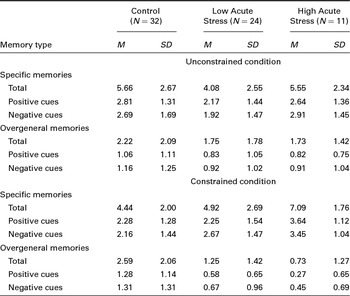
We conducted a 3 (Group: High Acute Stress, Low Acute Stress, Control) × 2 (Condition: unconstrained, constrained) mixed ANOVA with number of specific memories the dependent variables of interest (see Table 2 for descriptive data). For specific memories there was a significant Group × Condition interaction, F(1, 64) = 8.52, p = .001, and a trend for an effect of Group, F(2, 64) = 2.80, p = .07. There was no effect of Condition, F(1, 64) = 1.55, p = .22.
Number of Memories Recalled on the AMT (Means and Standard Deviations) for Control; Low Acute Stress; and High Acute Stress Groups by Unconstrained and Constrained Condition

Planned pairwise comparisons were conducted to dissect the effects of Group and the significant Group × Condition interaction to specifically examine whether High Acute Stress children demonstrated difficulties with specificity of recall. Children with High Acute Stress retrieved significantly more specific memories than Low Acute Stress children (p = .021, Cohen's d = 0.85). There was a trend for High Acute Stress children to retrieve more specific memories than Controls (p = .09, Cohen's d = 0.66); however, Low Acute Stress and Control children did not significantly differ (p = .34). The Group by Condition interaction appeared to be driven by the High Acute Stress group. When children were asked to retrieve memories from the period preceding their recent traumatic event (unconstrained condition), High Acute Stress children did not significantly differ from either the Low Acute Stress or Control children (ps = .12 and .90, respectively). However, when asked to retrieve memories in response to cue words during the 24-hour period following their trauma, High Acute Stress children reported significantly more specific memories than Low Acute Stress (p = .009, Cohen's d = 0.97) and Control children (p < .001, Cohen's d = 1.41). It is worth noting that in general, the same patterns of findings were observed when the proportion of specific memories retrieved (relative to total number of specific, overgeneral and no responses recalled) was examined.Footnote 2 This indicated the findings were not driven by differential rates of no responses across groups.
The same cue words were used for both the unconstrained and constrained conditions. As reported earlier there was no overall practice effect in the sense that overall children retrieved comparable numbers of specific memories in the constrained condition as they did in unconstrained condition. Given the significant Group × Condition interaction, it is worth noting that the Control group retrieved significantly fewer words in the constrained condition than the unconstrained condition (p = .004, Cohen's d = 0.52), whereas the High Acute Stress Group retrieved significantly more (p = .03, Cohen's d = 0.74). The Low Acute Stress Group only demonstrated a trend for an increased number of specific memories being retrieved in the second condition (p = .08).
The Influence of Potential Covariates and Depression
As reported earlier, gender and digit span were correlated with number of specific memories recalled (and age was a non-significant trend). Controlling for these variables simultaneously (ANCOVA) did not alter they key finding, with the Group × Condition interaction remaining significant, F(2, 60) = 10.51, p < .001, and pairwise comparisons indicating the High Acute Stress Group retrieved more specific memories than the other two groups (ps < .04). However, the main effect of Group, previously a non-significant trend, was now no longer significant, F(2, 60) = 1.38, p = .26.
Given the established finding in both children and adults that lower memory specificity is associated with depression, the relationship between depressive symptoms and specificity was of interest. While prior research has often covaried depression severity when examining the role of trauma symptoms on memory, given the groups significantly differed on depressive symptoms and were not allocated to groups randomly, this was not appropriate (see Miller & Chapman, Reference Miller and Chapman2001). In any event, depressive symptoms were not correlated with number of specific memories (r = -.05, p = .72).
Prediction of PTSD Severity at 3 Months
Multiple hierarchical regression was conducted to test whether acute memory specificity predicted later PTSD symptoms after controlling for initial PTSD symptoms. This order of entry represents a stringent test of whether memory specificity contributes to the maintenance of PTSD symptoms over and above initial symptom severity. Both self-reported PTSD symptoms (CPSS) and clinician-rated PTSD severity (CAPS-CA) were the outcomes of interest (collapsing the High and Low Acute Stress groups). Acute posttraumatic stress (PTS) and initial depression were entered in the first step, explaining 21% of the variance in self-reported PTSD (acute PTS β = .47, F[1, 28] = 7.60, p = .01). Total number of specific memories in the unconstrained and constrained conditions did not increase prediction significantly, (unconstrained β = -.22, constrained β = .10), ΔF(2, 26) = 0.43, p = .66, ΔR 2 = .03. Essentially the same pattern of results was observed when clinician-rated PTSD severity was the dependent variable of interest: Acute PTS, Step 1: acute PTS β = .41, F(1, 30) = 6.01, p = .02, R 2 = .17; unconstrained and constrained specificity, Step 2: unconstrained β = -.28, constrained β = .28, ΔF(2, 28) = 0.60, p = .55, ΔR 2 = .03. Age, gender and digit span did not change the above findings and were omitted from reported analyses due to the obvious issues regarding power. Reversing the order of entry (i.e., unconstrained and constrained specificity first) did not significantly alter any findings although there was a nonsignificant trend for constrained specificity to predict 3-month CAPS-CA severity (β = .49, p = .08).
In summary, the findings indicated that when restricted to giving responses to memories in the 24 hours after their trauma, children high in acute stress symptoms retrieved significantly more (not less) specific memories than low acute stress and control groups. Possible explanations for this will be discussed later. Some prior autobiographical memory research has been undertaken in children whose trauma has occurred months or years prior. However, as highlighted in the introduction, to date these samples have not included children formally diagnosed with PTSD. Given the unexpected findings of Study 1, we were most interested in whether our original expectation, that PTSD would be accompanied by the retrieval of fewer specific memories, would hold.
Study 2: Children with and without PTSD
Method
Participants
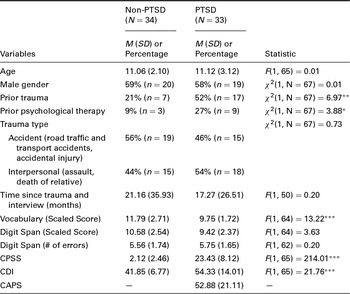
Sixty-seven children and adolescents aged 7 to 16 took part in the study. Children with PTSD (n = 33) were participating in a treatment study examining the effectiveness of cognitive-behaviour therapy for single-incident trauma and were assessed prior to receiving therapy. Trauma-exposed but non-PTSD (n = 34) children were recruited from the community (see Table 3 for participant and trauma characteristics). Inclusion and exclusion criteria were essentially the same as that of Study 1, with the exception that PTSD children had to meet criteria for full (n = 20) or subthreshold PTSD (n = 13). Children were defined as subthreshold PTSD when they failed to meet to full criteria for 1 of the 3 symptom clusters (i.e., typically they fell 1 symptom short on the avoidance cluster). With the obtained sample size, the study was sufficiently powered (power = .80) to detect an effect size (Cohen's d) of 0.61 or greater (one-tailed).
Demographic, Trauma, and Psychiatric Characteristics for Non-PTSD and PTSD Children

Note: CPSS = Child PTSD Symptom Scale; CDI = Children's Depression Inventory – T score; CAPS = Clinician-Administered PTSD Scale; a Values with different superscripts are significantly different from each other; *p < .05; **p < .01; ***p < .001.
Measures, Materials, and Procedure
Unless otherwise stated, the study was conducted as per Study 1. In relation to the Autobiographical Memory Test, the same cue words and procedure were used, with the exception that children were not restricted to a particular timeframe when generating a response as the focus of this study were children whose trauma had occurred well in the past. Thus they were presented with each cue word only once, which is in line with the typical AMT as previously used in trauma and depression research. Violation of acceptable AMT responses was again rare (<1%). Interrater reliability for the AMT remained good, with the mean level of agreement of the specificity of memories between the scorer and rater over the 10 cue words being 85% (kappa = 0.62). Parents confirmed memories to a high degree, with 81% of memories being confirmed as definitely true, and parents considering 16% as likely to have occurred even though the parent did not have direct knowledge of the event (e.g., child reporting a bullying incident in school that was not witnessed by the parent). In addition to the measures described in Study 1, children also completed the Vocabulary subtest from the WISC-IV (Wechsler, Reference Wechsler2003) in the event that children's verbal aptitude played a role in being able to articulate a specific response on the AMT.
Results
Descriptive statistics for relevant demographic, trauma and psychiatric characteristics are reported in Table 3. The PTSD group was significantly more likely to have experienced prior trauma, received prior therapy, and had lower Vocabulary scores than the non-PTSD group. Unsurprisingly, they had significantly higher PTSD and depression symptoms. In terms of potential covariates of autobiographical memory specificity, no variables were significantly correlated with total number of specific memories (rs ranging from -.02 to .24, ps between .054 to .86).
Do Children with PTSD Show Autobiographical Memory Deficits?
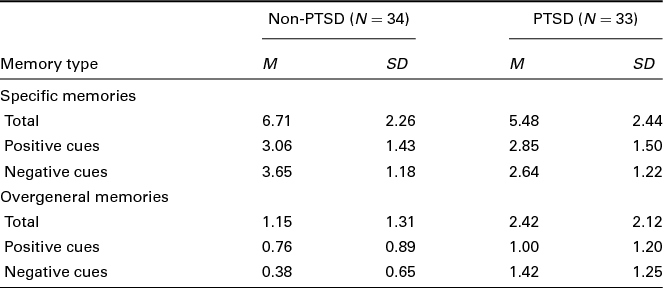
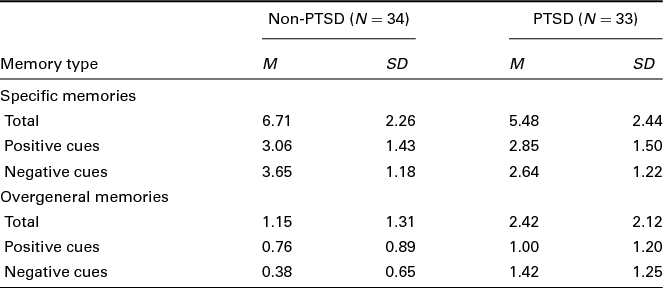
In contrast to children with acute stress (Study 1), but consistent with our hypothesis, children with PTSD retrieved significantly fewer specific memories (total) relative to their non-PTSD counterparts, F(1, 65) = 4.52, p = .037, Cohen's d = 0.52 (see Table 4 for descriptive data). Similar to Study 1, this finding was maintained if proportion of specific memories recalled was analysed, F(1, 65) = 4.07, p = .048, again indicating potential differential omission rates do not account for this difference. For the reasons outlined in Study 1, depression was not covaried but it is worth noting that depression symptoms were highly correlated with self-reported PTSD across the whole sample (r = .62, p < .001).
Number of Memories Recalled on the AMT (Means and Standard Deviations) for Non-PTSD and PTSD Children
Discussion
The current research represents the first occasion that autobiographical memory has been tested in acutely traumatised children (Study 1), allowing the relationship between recent trauma and memory specificity deficits to be examined. The proposition that memory specificity difficulties are a function of PTSD status rather than trauma exposure per se was investigated in Study 2. This was assessed in a sample of children and young people whose PTSD status was rigorously assessed (i.e., using the gold standard measurement of structured clinician interview). The implications of the two studies are discussed in turn.
In Study 1 we observed that children with higher levels of acute stress significantly differed from Low Acute Stress children and Controls in memory specificity. High Acute Stress children retrieved significantly more specific memories when they were directed to retrieve memories from the 24-hour period following their trauma. They did not differ for memories retrieved from the period before their trauma. While previous research has found that children are more likely to retrieve a greater number of memories from the past year than memories older than a year (Stokes et al., Reference Stokes, Dritschel and Bekerian2004), we did not observe a main effect of condition (i.e., unconstrained vs. constrained instructions). A recency effect therefore does not wholly account for this finding. The unconstrained condition used in the present study is close to the general instruction used in other AMT studies in which participants are told the age of the memory is not important; the current findings suggest then that children with acute stress symptoms following a discrete event do not demonstrate a retrieval deficit for memories that predate their acute event. It is possible that for High Acute Stress children, for reasons unmeasured, more events that lent themselves to being memorable occurred in the 24 hours after their trauma (in the constrained condition), or that they paid more attention to these. Control children may have had greater difficulty following the AMT instructions or indexing their responses to a 24-hour window in the constrained condition, especially if their hospital experience was not marked by noteworthy events or procedures. However, this does not account for why we observed a difference between High and Low Acute Stress children. Interestingly, the hospital control children reported higher posttraumatic stress and depression symptoms than the Low Acute Stress children. For a number of control participants, their hospitalisation was related to an ongoing condition (e.g., diabetes, asthma). These scores may reflect the seriousness of this illness relative to Low Acute Stress children. The latter were adjusting well to an event that, while upsetting and requiring hospital contact, was a discrete, time-limited event.
The only previous studies to date to examine varying windows of memory retrieval soon after trauma (Harvey et al., Reference Harvey, Bryant and Dang1998; Kangas et al., Reference Kangas, Henry and Bryant2005) ran analyses separately for unconstrained and constrained conditions. These found that adults with ASD had reduced specificity in each condition relative to non-ASD participants (Harvey et al., Reference Harvey, Bryant and Dang1998) or only in the unconstrained condition (Kangas et al., Reference Kangas, Henry and Bryant2005). Given the paucity of research with acutely traumatised children, accounting for these differences remains highly speculative. The affect regulation hypothesis (Williams, Reference Williams1996; Williams et al., Reference Williams, Barnhofer, Crane, Hermans, Raes, Watkins and Dalgleish2007) suggests that in the face of adversity children may learn to become more overgeneral in their retrieval style. It is possible that over time the retrieval patterns of these High Acute Stress children, if symptoms are maintained, will change, becoming more overgeneral with time. The finding that children with higher levels of acute stress are more specific in their retrieval is consistent with experimental findings in adults. In particular, the observation that adults predisposed to retrieve specific memories experienced more short-term distress than low specific individuals after an analogue stressor, although whether this held over time was not tested (Raes et al., Reference Raes, Hermans, de Decker, Eelen and Williams2003). Golden, Dalgleish, and Mackintosh (Reference Golden, Dalgleish and Mackintosh2007) found greater specificity in adults with complicated grief when tested for autobiographical memory associated with the deceased; however, this group showed the expected reduced specificity on a general AMT. The authors concluded that specific memory retrieval may be more likely when the memories are directly linked to the individual's distress. It is conceivable that when constrained to the 24 hours following their trauma, High Acute Stress children's memories remained closely associated with their recent event. The fact that minimal differences were observed between groups in the unconstrained condition does suggest that difficulty retrieving specific memories was not a risk factor for symptom development in the present sample. As highlighted by Raes et al. (Reference Raes, Hermans, de Decker, Eelen and Williams2003) and by our findings, there is clearly a need for longitudinal studies to examine whether retrieval patterns change over time. It is also possible that the nature of trauma under study (i.e., discrete, single-incident trauma), unlike chronic child abuse, is not sufficient to result in the expected difficulties with specific memory retrieval. However, this seems to be in contrast to adult studies that have included single-incident events. One might also expect non-significant findings rather than a finding that was clearly in the opposite direction to that of previous research. It is also worth noting that prior trauma exposure was not correlated with autobiographical memory performance.
Contrary to adult PTSD research (Harvey et al., Reference Harvey, Bryant and Dang1998; Kleim & Ehlers, Reference Kleim and Ehlers2008; although see Kangas et al., Reference Kangas, Henry and Bryant2005, for a null finding with cancer survivors) we found little evidence that autobiographical memory deficits predicted later PTSD severity. This could have been due to differences in the follow-up period, 3 months in the present study versus 6 months in adult studies. It may also be a result of the fact that the present sample, while exhibiting some posttraumatic stress, was by and large not a highly symptomatic group. Unfortunately, the variance in PTSD severity at follow-up in adults’ studies has not been routinely reported (with the exception of Sutherland & Bryant, Reference Sutherland and Bryant2007, which demonstrated some variability), thus examination of differences in this regard are not possible. It has been proposed that cognitive capacity limitations may play a role on retrieval difficulties (Kuyken & Brewin, Reference Kuyken and Brewin1995; Williams et al., Reference Williams, Barnhofer, Crane, Hermans, Raes, Watkins and Dalgleish2007). Consistent with this, we observed that higher scores on a task that indexes, in part, working memory (Digit Span) was associated with retrieval of more specific memories. Others have failed to observe such a relationship in child samples (e.g., de Decker et al., Reference de Decker, Hermans, Raes and Eelen2003). We did not find errors on this task to be significantly related to memory retrieval, whereas this has been observed in adult autobiographical memory studies utilising other executive-type tasks (e.g., Dalgleish et al., Reference Dalgleish, Williams, Golden, Perkins, Barrett, Barnard and Watkins2007). However, the observed correlation with working memory was relatively small in the current data and would only explain .07% of the variance in memory specificity. We did not employ a battery of executive functioning measures, nor measures of avoidant coping or similar in the present study. Thus we cannot make definitive comment on which mechanisms of the CARFAX model may be more influential in explaining memory specificity difficulties. However, the extremely modest relationship between working memory and memory retrieval does accord with the proposal that cognitive capacity deficits might be more associated with overgeneral memory in depressed rather than trauma samples (see Sumner, Reference Sumner2011).
The data of Study 2 revealed difficulties retrieving specific memories were observed in the PTSD group relative to non-PTSD children, consistent with prior adult findings (e.g., Harvey et al., Reference Harvey, Bryant and Dang1998; Kleim & Ehlers, Reference Kleim and Ehlers2008), and several child studies with trauma samples (de Decker et al., Reference de Decker, Hermans, Raes and Eelen2003; Meesters et al., Reference Meesters, Merckelbach, Muris and Wessel2000; Stokes et al., Reference Stokes, Dritschel and Bekerian2004; although see Kukyen et al., Reference Kuyken, Howell and Dalgleish2006). On the other hand AMT performance was unrelated to measures of working memory. It has been proposed in adults that problems in retrieving specific memories may reflect general difficulties integrating traumatic experiences into the normal autobiographical memory system and that this contributes to the persistence of PTSD (Harvey et al., Reference Harvey, Bryant and Dang1998). The findings of Study 2 indicate these difficulties may also be apparent in youth with PTSD, further emphasising the role of the autobiographical memory system in PTSD across the lifespan.
The findings of Study 2 seem to be in opposition to Kuyken et al. (Reference Kuyken, Howell and Dalgleish2006). Their study observed that adolescents with depression and probable PTSD retrieved fewer overgeneralised memories relative to adolescents with depression but low levels of PTSD symptoms. Key differences between the two samples preclude meaningful comparison. First, the current sample of PTSD children had experienced single-incident trauma versus sexual assault or childhood abuse as in Kuyken et al. (although for reasons discussed earlier, trauma-type is a less likely explanation of this discrepancy). Second, Kuyken et al.'s sample was of depressed adolescents with or without trauma whereas our sample had relatively lower levels of depression. Third, our sample comprised treatment seeking trauma survivors with clinically diagnosed PTSD.
Despite several elements of the present research requiring further study and replication, the current findings have several important implications. Both studies illustrate that difficulty retrieving specific memories following trauma is not wholly accounted for by age and cognitive abilities. Study 2 lends weight to the proposition that it is not trauma exposure per se that is associated with autobiographical memory difficulties, but that the presence of PTSD symptoms plays a role. The two studies also provide a greater knowledge about the timing of trauma and autobiographical memory problems. The majority of past child research in the field has included samples where trauma occurred a number of years previously or the interval was not reported. The present studies have measured autobiographical memory processes either very soon after trauma exposure (Study 1), or within on average 2 years of exposure (Study 2). Although utilising different samples, the findings do suggest an overgeneralised retrieval response is not automatic following trauma, as seen in Study 1; however, this seems to change when a larger interval between trauma and memory testing is present, evident in Study 2. The affect regulation component of AM models (e.g., Williams et al., Reference Williams, Barnhofer, Crane, Hermans, Raes, Watkins and Dalgleish2007) appears to argue that children are by and large overgeneral in their early years, and that significant adversity will maintain this style. Our acute stress findings hint at the possibility that early after trauma, children may have enhanced retrieval to memories. This remains consistent with Williams’ proposal that in the short-term, overgeneralised memory might be protective, buffering the individual from immediate distress. Further research needs to delineate the exact timeline of how this pattern of retrieval may change over time. To properly determine whether overgeneral memory is a risk factor or simply an epiphenomenon of PTSD, true prospective research (i.e., assessment of children before the onset of trauma or adversity), is required. As acknowledged in the field, such research is challenging to undertake.
The present research was accompanied by a number of strengths; in particular, it was reasonably powered, we undertook parental verification of children's memories, both acute and more chronic trauma samples were studied, clinical interviews were used to diagnose PTSD (Study 2), and the relationship between AMT performance and symptoms 3 months later was examined (Study 1). Nonetheless, the research had some limitations and qualifications. The severity of acute stress disorder symptoms in Study 1 was modest, thus the generalisability to a more severe sample is unknown. To avoid recall of recent hospital experiences contaminating pretrauma memory retrieval, the unconstrained and constrained conditions were not counterbalanced. It is worth noting this was not counterbalanced in prior adult ASD studies either (Harvey et al., Reference Harvey, Bryant and Dang1998) and the present data did not show a main effect of experimental condition. In Study 2, we did not include a non-trauma control group, although defining what indicates an absence of trauma can be difficult. We did not readminister the AMT at follow-up in either study, thus whether changes (if any) in AMT performance was associated with symptom change is unknown. Although not the primary aim of the studies, our measures of cognitive mechanisms could not delineate the varying types of complex processes that underpin what are broadly labelled ‘executive abilities’ that might influence autobiographical memory retrieval. These limitations notwithstanding, this research adds to a growing body of literature that indicates children with PTSD demonstrate difficulties with autobiographical memory. More importantly, in our opinion, it illustrates that more detailed study of acutely traumatised samples and prospective study of retrieval style is required for clarification and refinement of current models of autobiographical memory in child psychopathology. This is all the more important given the testing of novel paradigms (e.g., memory specificity and attention bias retraining) to address cognitive mechanisms thought to underpin anxiety and mood psychopathology in adults and children (e.g., Neshat-Doost et al., Reference Neshat-Doost, Dalgleish, Yule, Kalantari, Ahmadi, Dyregrov and Jobson2012).
Acknowledgments
This research was supported by grants from the Australian Rotary Health Research Fund and the Australian Research Council awarded to the first author. We are grateful to all the families for their involvement, Emily Bashah for assisting with data collection, and the staff of the Flinders Medical Centre and the Women's and Children's Hospital, Adelaide.