Introduction
Hazardous materials (HazMat) incidents pose an increasing global threat to public health, safety, and environmental sustainability. These events may involve chemical, biological, radiological, or nuclear substances that, when unintentionally released, can cause acute toxicity, environmental contamination, injuries, and fatalities.Reference Jaramillo and King 1 Rapid industrialization and urbanization—particularly in high-growth regions—have increased the frequency, scale, and complexity of such incidents. The Middle East and North Africa (MENA) region, characterized by extensive industrial expansion and evolving geopolitical conditions, faces distinct challenges in HazMat management. The potential use of hazardous agents in terrorism, as demonstrated by prior regional events, further emphasizes the need for preparedness and coordinated emergency response.Reference Mani, Plummer and Kuhn 2
Despite its economic and industrial importance, HazMat-related research from the Middle East remains limited. Available studies from the Gulf Cooperation Council (GCC), Lebanon, and Iran indicate that the transport, storage, and handling of hazardous substances are major sources of risk.Reference Al-Hajj, Dhaini and Mondello 3 , Reference Hajizadeh, Koohpaei and Khodaparast 4 Contributing factors include human error, inadequate safety infrastructure, improper storage practices, and weak regulatory enforcement.Reference Al-Hajj, Dhaini and Mondello 3 –Reference Wijnands, Koppen and de Vries 6 The 2020 Beirut ammonium nitrate explosion remains one of the most devastating HazMat disasters globally.Reference Al-Hajj, Dhaini and Mondello 3 The detonation of 2750 tons of ammonium nitrate killed 220 people, injured over 6500, and caused widespread environmental and health impacts, exposing critical failures in safety governance and regulatory oversight.Reference Al-Hajj, Dhaini and Mondello 3 In Iran, multiple studies report increasing HazMat transportation accidents, with human error, vehicle malfunction, and poor packaging identified as key contributors.Reference Hajizadeh, Koohpaei and Khodaparast 4 The absence of specialized HazMat transport systems further magnifies these risks.
Across the GCC, occupational chemical exposure remains a persistent public health concern. Workers in petrochemical, pesticide, cement, and heavy metal industries face elevated risks of acute and chronic toxicity.Reference Zaidan, Al-Saidi and Hammad 7 , Reference Masood, Khaled and Bin-Ismail 8 Documented incidents include pesticide poisoning among greenhouse workers in Oman and Qatar, petrochemical exposure among fuel station employees in Kuwait, and elevated blood lead levels among industrial workers in the United Arab Emirates.Reference Hajizadeh, Koohpaei and Khodaparast 4 , Reference Zaidan, Al-Saidi and Hammad 7 , Reference Masood, Khaled and Bin-Ismail 8 Indoor air pollution—characterized by high concentrations of particulate matter, volatile organic compounds, and heavy metals—has also been reported in residential and industrial settings, often linked to inadequate ventilation, proximity to industrial zones, and traditional practices such as incense burning.Reference Amoatey, Omidvarborna and Baawain 9 Despite extensive industrial activity, the Middle East remains underrepresented in global HazMat literature. Limited data from Saudi Arabia and Iran suggest that HazMat transportation contributes disproportionately to incident burden due to human error, poor packaging, and adverse environmental conditions.Reference Hajizadeh, Koohpaei and Khodaparast 4 , Reference Zaidan, Al-Saidi and Hammad 7 Rapid infrastructure expansion and regional geopolitical dynamics further complicate preparedness and response. Emerging technologies, including artificial intelligence and data-driven surveillance systems, offer opportunities to strengthen national preparedness and hazard risk assessment.Reference Farhat, Alinier and Bajow 10 Structured approaches to HazMat waste management—incorporating monitoring, segregation, and regulated disposal—have demonstrated improved compliance and reduced occupational exposure in regional studies.Reference Zaidan, Al-Saidi and Hammad 7 , Reference Masood, Khaled and Bin-Ismail 8 , Reference Kavil, Alshemmari and Alkasbi 11 Oman’s strategic geographic location, substantial hydrocarbon resources, expanding industrial base, and growing transport networks place the country at a heightened risk of HazMat incidents. While environmental protection, workforce health, and operational safety are well established in the oil and gas sector, systematic national data describing the occurrence, distribution, and characteristics of HazMat incidents across sectors remain limited.Reference Al Kalbani, Gultekin and Al Hinai 12 , Reference Al Khusaibi 13 Without such data, it is difficult to identify national risk patterns, prioritize preventive measures, or strengthen emergency preparedness systems.
To address this evidence gap, the present study analyzes data from the national HazMat incident registry maintained by the Civil Defence and Ambulance Authority (CDAA). To our knowledge, this represents the first registry-based national analysis of HazMat incidents in Oman. The objective of this study was to characterize the temporal trends, geographic distribution, incident types, and operational contexts of HazMat events reported between June 2019 and November 2024. By providing baseline national evidence, this study aims to support risk assessment, inform regulatory and emergency response planning, and contribute regional data to the broader international literature on HazMat management.
Methods
Study Design and Aim: This study was a retrospective-descriptive review of HazMat incidents reported in Oman between June 1, 2019, and November 30, 2024, representing a 5.5-year observation period. This timeframe was determined by data availability, as a formal national HazMat registry was not maintained before June 2019. The primary aim was to identify patterns related to incident type, location, HazMat involved, and the circumstances under which these events occurred. The study also sought to characterize the geographic distribution and operational contexts of incidents in order to support national risk assessment and emergency preparedness planning.
Data Source: Incident data were extracted from the centralized registry maintained by the HazMat team of the Civil Defence and Ambulance Authority (CDAA), which serves as the primary operational reporting system for HazMat incidents attended by national emergency response units in Oman. The registry captures a wide range of variables, including the nature of the hazardous substance, location of the incident, type of release, and the initial response measures taken. Incident reports are typically completed by HazMat response officers or incident commanders following field operations using a standardized reporting template. The reporting form records the date and location of the incident, incident classification, hazardous substance involved (when identified), operational setting, response actions undertaken, and immediate outcomes such as evacuations or fatalities when available. Submitted reports are reviewed internally by the CDAA HazMat coordination unit prior to entry into the central registry in order to improve data consistency and completeness. The registry also documents whether the incident occurred at a fixed site—such as an industrial facility, school, or airport—or during the transportation of HazMat by road or other means. Because the CDAA is the national authority responsible for HazMat emergency response, the registry captures the majority of significant HazMat incidents requiring specialized intervention across Oman. However, smaller incidents managed internally by industrial facilities without CDAA deployment may not always be captured in this database.
Inclusion and Exclusion Criteria: All incidents reported during the study period were eligible for inclusion if they involved a chemical, radiological, or biological substance classified as hazardous under international or national safety standards. Events were included whether they occurred in industrial facilities, during transportation, or in public or institutional settings. Incidents were excluded if they occurred outside Omani territory, if the substance was determined to be nonhazardous, or if the report lacked sufficient information to allow classification of incident type or location.
Definition of Hazardous Materials Incident: For the purposes of this study, a HazMat incident was defined as any event involving the accidental release, leakage, spill, fire, explosion, or potential exposure related to chemical, biological, or radiological substances that required operational response by the CDAA HazMat team.
Incident categories were operationally defined as follows:
Gas leak: Unintended release of compressed or liquefied gases from cylinders, pipelines, storage tanks, or transportation vehicles.
Chemical spill: Release of liquid or solid hazardous chemicals into the environment without ignition.
Fire or explosion: Combustion or explosive event involving hazardous materials or triggered by the ignition of previously released flammable substances.
Transport-related incident: Release of HazMat during road transportation, including tanker overturning, collision, or container rupture.
Radioactive event: Incidents involving materials emitting ionizing radiation that required specialized containment or monitoring procedures.
In some cases, individual incidents involved overlapping mechanisms, such as a gas leak followed by fire. Because the registry data were derived from operational records and no unified incident categorization system was in place at the time of reporting, incidents were classified based on the descriptive information available in the original records. Accordingly, some overlap between categories may have occurred.
Data Classification and Variables: Each reported incident was reviewed and categorized according to multiple dimensions. Incident type was classified as gas leak, fire or explosion, chemical spill, transport-related spill/leak, or radioactive event. Location type was classified as industrial area, transportation corridor, airport, educational institution, residential neighborhood, or other public area. Geographical distribution was mapped at the governorate level, with detailed attention to regions known for industrial density, including Al Rusail, Al Qurum, and in the Muscat Governorate. Where available, the specific hazardous substance involved in the incident was recorded. Consequences of the incident, including the number of fatalities, injuries, environmental contamination, and evacuations, were documented when reported. It was noted that in some cases, multiple categories overlapped, such as a gas leak leading to a subsequent fire. To contextualize Oman’s findings, a search was undertaken to identify major hazardous materials incidents reported in the MENA and GCC regions between 2000 and 2025. Publicly available sources included government releases, established news outlets, and disaster/event reporting platforms. Incidents were included if they involved hazardous material release or exposure associated with substantial human, environmental, or infrastructural impact. Details were cross-verified against at least two independent sources whenever possible. Table 1 was compiled for contextual comparison and was not included in the primary registry-based analysis.
Selected case studies of major Hazardous Materials (HazMat) and industrial incidents in the Middle East and North Africa (MENA) region (2000–2025)

Events listed were identified from publicly available reports describing major hazardous materials incidents in the Middle East and North Africa (MENA) region (2000–2025). Sources were cross-checked where possible and are presented for contextual comparison only; these events were not included in the primary CDAA registry analysis.
Data Analysis: Descriptive statistics were used to analyze and summarize the data. Frequencies and proportions were calculated for incident types, geographic regions, hazardous substances, and operational settings. Temporal trends were evaluated using annual incident counts across the study period. Spatial mapping and visualization were performed using Google Maps to illustrate the geographic distribution of incidents across Oman, while Microsoft Excel was used for data tabulation, cleaning, and plotting summary graphs.
Ethical Considerations: This study involved the analysis of retrospective data collected for public safety purposes, and no personally identifiable information was accessed. All data were de-identified prior to analysis. Formal permission to access the CDAA registry was granted by relevant authorities, and all research activities adhered to national and institutional standards for research ethics and data protection.
Results
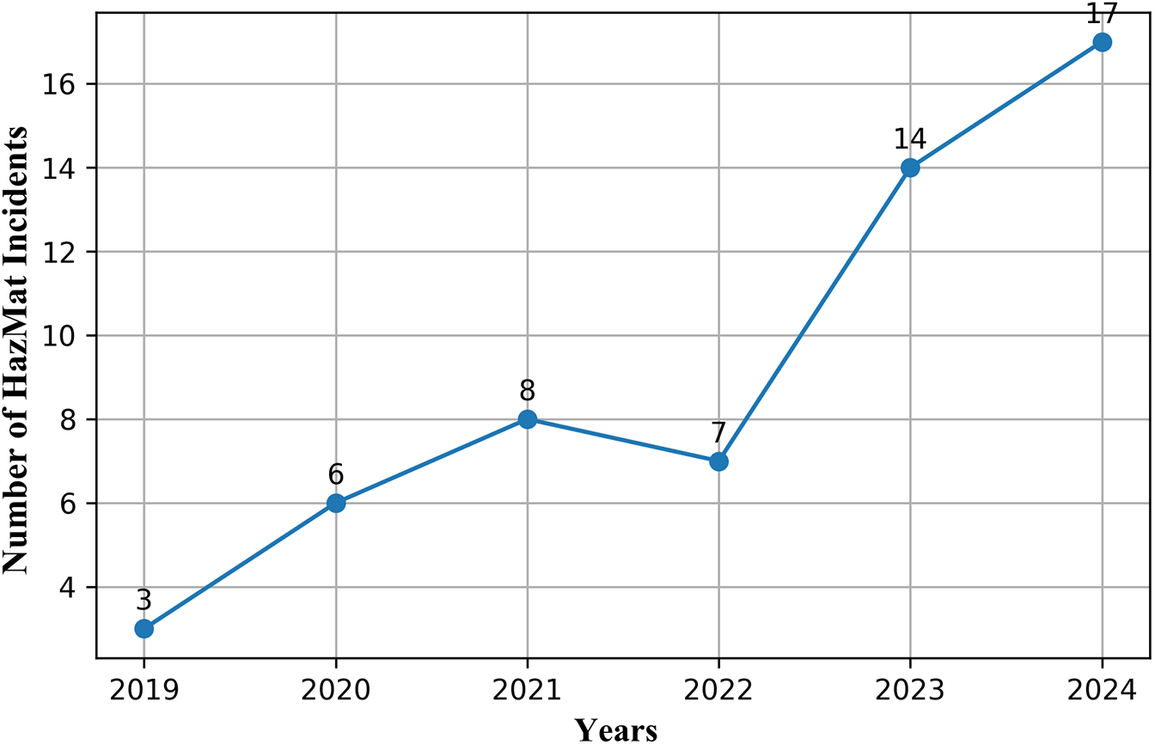
A total of 55 HazMat incidents were recorded in Oman between June 2019 and November 2024. The annual distribution of incidents demonstrated a gradual increase over the study period (Figure 1). Reported incidents increased from 3 incidents in 2019 to 17 incidents in 2024, with intermediate counts of 6 incidents in 2020, 8 incidents in 2021, and 7 incidents in 2022. A marked increase was observed during the final two years of the study, with 14 incidents reported in 2023 and 17 incidents in 2024. Overall, the 55 incidents recorded during the study period correspond to an average of approximately 10 incidents per year.
Annual Number of Hazardous Materials (HazMat) Incidents in Oman.

Geographically, incidents were concentrated in Muscat Governorate, which accounted for 39 of the 55 incidents (approximately 71%) reported during the study period (Figure 2). The remaining 16 incidents occurred across several other governorates, including Al Dakhiliyah, Al Batinah, and Dhofar. Within Muscat, multiple incidents occurred in areas characterized by dense urban development and industrial activity, including Al Rusail, Al Qurum, and surrounding transportation routes.
Geographic distribution of hazardous materials (HazMat) incidents reported in Oman, June 2019–November 2024.

Analysis of incident locations demonstrated that residential neighborhoods represented the most common operational setting, accounting for 26 incidents (47%) (Figure 3). Other public areas accounted for 9 incidents (16%), while airports, educational institutions, industrial areas, and transportation corridors each accounted for 5 incidents (approximately 9%). With respect to incident characteristics, gas leaks were the most frequently reported event type, involved in 28 incidents (approximately 51% of all incidents) (Figure 4). Transport-related chemical spills or leaks were documented in 14 incidents, while chemical spills were reported in 13 incidents. Fires associated with HazMat were recorded in 10 incidents, and three incidents involved radioactive material exposure. Because incident records were derived from operational response reports rather than a standardized national incident classification framework, some incidents involved overlapping mechanisms. For example, a transport accident could result in both a chemical spill and a subsequent fire, or a gas leak could lead to ignition and explosion. Accordingly, the categories presented in Figure 4 are not mutually exclusive, and a single incident may contribute to more than one category. Several severe incidents were associated with the transportation of HazMat. On October 22, 2024, an overturned tanker transporting triethylene glycol in Adam (Al Dakhiliyah Governorate) resulted in the deaths of two civilians. 14 , 15 Similarly, on May 30, 2023, the overturning of a carbon dioxide tanker in Quriyat led to the fatality of the driver. 16 Overall, transport-related incidents accounted for a substantial proportion of fatalities, highlighting the risks associated with HazMat transport on national road networks (Figures 3 and 4). Among all recorded events, three incidents involved radioactive materials, representing a rare but high-risk subset of HazMat incidents. Several incidents also involved toxic gas exposure, including chlorine and hydrogen sulfide (H₂S), occurring in both industrial and educational environments. In multiple cases, these incidents required evacuation, containment measures, and emergency medical evaluation.
Distribution of hazardous materials (HazMat) incidents by operational setting in Oman, 2019–2024.

Classification of Hazardous Materials (HazMat) Incidents in Oman by Incident Type. Categories are not mutually exclusive because some incidents involved overlapping mechanisms, such as gas leaks followed by fire; therefore, totals exceed the number of individual incidents.

Table 1 summarizes major HazMat incidents reported in the Middle East and North Africa (MENA) and Gulf Cooperation Council (GCC) regions, providing regional context for HazMat risks and emergency preparedness challenges.
Limitations
This study has several limitations. The analysis was based on operational CDAA records rather than a dedicated epidemiological surveillance system, and some incident details were incomplete. The registry also primarily captures incidents requiring CDAA response, so smaller events managed internally may have been missed. In addition, incident classification was derived from descriptive reports without a standardized national categorization framework, and some incidents involved overlapping mechanisms, such as gas leaks followed by fire or transport incidents associated with chemical release. In some cases, the specific HazMat could not be conclusively identified because of limitations in on-site sampling or incomplete reporting. Detailed clinical outcome data, including injuries, hospitalizations, and long-term health outcomes, were not consistently available, limiting assessment of the full health burden. Finally, the retrospective descriptive design precludes causal inference. Nonetheless, the study provides important baseline national evidence on HazMat incidents in Oman.
Discussion
This study provides the first registry-based national characterization of HazMat incidents in Oman based on operational response records from the Civil Defence and Ambulance Authority. Several key patterns emerged. HazMat incidents increased over time, were strongly concentrated in Muscat Governorate, and most frequently involved gas leaks. Incidents occurred across diverse operational environments, including residential areas, public facilities, industrial sites, and transportation corridors, highlighting the broad societal interface of HazMat in modern urban and industrial systems. The increase in reported incidents observed during the later years of the study likely reflects a combination of factors. Rapid urban expansion, industrial development, and growth in HazMat transport networks have increased the presence and movement of hazardous substances in populated areas. At the same time, improvements in incident documentation and reporting practices may have contributed to greater detection and recording of events. Similar increases in HazMat incidents have been documented internationally, particularly in rapidly developing industrial regions where expanding infrastructure and chemical transport activities elevate exposure risks.Reference Yacob, Ismail and Prasetya 17 –Reference Wang, Fu and Yan 20
Geographically, the strong concentration of incidents in Muscat Governorate reflects the distribution of population density, industrial facilities, and transportation infrastructure within Oman. Industrial hubs such as Al Rusail and Al Qurum host a wide range of petrochemical, manufacturing, and logistics activities that involve the storage and movement of hazardous substances. Previous studies have shown that regions characterized by dense industrial activity and high transportation throughput experience disproportionately higher rates of HazMat incidents.Reference Cutter and Ji 5 , Reference Zaidan, Al-Saidi and Hammad 7 , Reference Hwang, Won and Jeong 21 , Reference Nam, Ku and Park 22 Comparable spatial clustering patterns have also been reported in other countries where industrial zones intersect with urban environments and major transport corridors.Reference Wang, Fu and Yan 20 –Reference Zhu, Zhang and Lang 23
Gas leaks represented the most frequently reported incident type in the present study. This observation aligns with international literature indicating that gaseous releases are among the most common HazMat emergencies encountered by response agencies.Reference Amoatey, Omidvarborna and Baawain 9 Such incidents are often associated with pipeline failures, pressurized storage systems, equipment malfunction, or human error during industrial handling. In several incidents within the present dataset, gas releases also triggered secondary events such as fires, highlighting the multi-mechanism nature of HazMat incidents and the operational complexity faced by emergency responders.
Transportation-related incidents also represented a notable component of the dataset and were associated with several of the most severe outcomes observed. The fatal tanker incidents in Adam and Quriyat illustrate the risks associated with the movement of HazMat along national road networks. Globally, transportation accidents involving HazMat have been identified as a major source of chemical emergencies affecting public safety and environmental health.Reference Hajizadeh, Koohpaei and Khodaparast 4 , Reference Cutter and Ji 5 , Reference Yacob, Ismail and Prasetya 17 , Reference Zhu, Zhang and Lang 23 , Reference Aljumaan and Alsulaibikh 24 Factors such as vehicle malfunction, driver error, and inadequate containment systems have been widely identified as contributing causes.Reference Hajizadeh, Koohpaei and Khodaparast 4 , Reference Zhu, Zhang and Lang 23 , Reference Aljumaan and Alsulaibikh 24 These findings underscore the importance of strengthening HazMat transport safety through improved driver training, route risk assessment, vehicle safety standards, and regulatory oversight. An important observation from this study is the distribution of incidents across multiple operational environments. Although industrial facilities remain key sources of risk, HazMat incidents were also recorded in residential neighborhoods, public facilities, transportation corridors, and educational institutions. The presence of hazardous substances in such diverse environments reflects the broad societal interface of modern chemical use, including laboratory activities, infrastructure maintenance, logistics operations, and fuel distribution systems.Reference El-Toony, Eid and Algarni 25 , Reference Sundarakani, Pawar, Potter and Lisec 26 Similar patterns have been reported in studies of chemical incidents occurring in schools and public facilities, where improper storage or handling of chemicals may result in exposure events requiring emergency response.Reference El-Toony, Eid and Algarni 25 – 28 These findings highlight the need for strengthened chemical safety awareness and preparedness beyond traditional industrial sectors. The identification of incidents involving radioactive materials, although infrequent, highlights an additional dimension of HazMat management. Even a small number of radiological incidents may require highly specialized response capabilities and technical expertise. International guidance emphasizes the importance of maintaining preparedness for such low-frequency but high-consequence events through training programs, monitoring systems, and coordinated multi-agency response frameworks.Reference Farhat, Alinier and Bajow 10 , 19
Taken together, the findings of this study highlight several implications for HazMat risk management in Oman. First, the geographic clustering of incidents suggests that targeted prevention strategies may be particularly valuable in industrial and urban hubs where HazMat storage and transport activities are concentrated. Second, the contribution of transportation-related incidents underscores the need for strengthened safety protocols and monitoring systems along major transport corridors. Third, the occurrence of incidents in residential and public environments highlights the importance of broader community awareness, institutional safety practices, and coordinated emergency preparedness. More broadly, this study contributes important baseline national evidence to the limited body of HazMat research from the Middle East and Gulf region. Previous studies have highlighted gaps in regional surveillance systems and incident reporting frameworks. By analyzing national operational response records, the present study provides an initial characterization of incident patterns and operational contexts in Oman. These findings may support the development of standardized surveillance systems, improved risk assessment strategies, and evidence-based emergency preparedness planning.
Conclusion
This study provides the first registry-based national characterization of HazMat incidents in Oman, offering new insights into their temporal trends, geographic distribution, and operational contexts. Over the 5.5-year study period, incidents increased over time and were strongly concentrated in Muscat Governorate, reflecting the country’s urban density, industrial activity, and transportation networks. Gas leaks represented the most frequently reported incident type, and incidents occurred across diverse operational environments, including residential areas, public facilities, industrial sites, and transportation corridors. Transportation-related incidents were associated with several of the most severe outcomes observed, highlighting the importance of strengthening hazardous materials transport safety through improved regulatory oversight, route-specific risk assessment, and enhanced emergency response preparedness. The occurrence of incidents in residential and institutional environments further underscores the need to expand chemical safety awareness and preparedness beyond traditional industrial sectors. More broadly, this study provides baseline national evidence on hazardous materials incidents in Oman and contributes to the limited body of HazMat research from the Middle East and Gulf region. These findings may support the development of standardized surveillance systems, strengthened regulatory frameworks, and targeted risk-reduction strategies aimed at improving hazardous materials governance and emergency response capacity.
Presentation(s) or awards at a meeting
MENATOX 2025, Muscat, Sultanate of Oman.
Acknowledgments
None.
Author contribution
SA: Conceptualization (lead); Supervision (lead); Project administration (lead); Writing—review and editing (equal). DH: Investigation (lead); Data curation (lead); Formal analysis (lead); Writing—original draft (lead); Writing—review and editing (equal). SR: Methodology (supporting); Writing—review and editing (equal). MA: Investigation (supporting); Data curation (supporting); Writing—review and editing (equal).
Funding statement
None
Competing interests
None
Ethical approval
Formal institutional ethical approval was not required for this retrospective study. Written permission to access and analyze the anonymized data was obtained from the Civil Defence and Ambulance Authority (CDAA) (dated 26.10.2025).
Consent to participate
None required.
Artificial intelligence disclosure
No generative or artificial intelligence tools were used in the preparation, analysis, or creation of the manuscript, tables, or figures.