

INTRODUCTION
The ‘nonnative’ English speaker as instructor: Language, race, and ideology
Nonnative English speakers (NNESs) serving as instructors at institutions of higher education in the United States (US) have long found themselves in the midst of controversy. From the perspective of many undergraduate students, many NNESs lack the linguistic competence to serve as instructors, and their ‘inadequate’ language strains classroom communication. Complaints have often targeted NNESs serving as international teaching assistants (ITAs) and have been reported by a number of surveys of undergraduate students (Berdie, Anderson, Wenberg, & Price Reference Berdie, Anderson, Wenberg and Price1976; Fox & Gay Reference Fox and Gay1994; Halleck & Moder Reference Halleck and Moder1995; Plakans Reference Plakans1997; Fitch & Morgan Reference Fitch and Morgan2003). In addition, Villarreal (Reference Villarreal2013) found that undergraduate students had similar complaints about the language of NNESs serving as faculty (e.g. professors rather than ITAs). In particular, Villarreal reports that the students he interviewed frequently discussed their instructors' accents. For example, one participant claimed that “everywhere you go, everyone's always talking about how, in the Math Department, there's so many foreign teachers, it's so hard to understand them” (2013:19). Furthermore, the students reported that these ostensibly linguistic difficulties led them either to drop NNESs' courses or to avoid registering for them.
Research into language ideology offers an enlightening perspective on the controversies surrounding NNESs. Subtirelu (Reference Subtirelu2014:121), citing Woolard & Schieffelin (Reference Woolard and Schieffelin1994), defines language ideology as:
the networks of beliefs that language users hold, either tacitly or overtly, about language and its assumed relation to other aspects in their environments, especially other individuals and social groups, which stem either from explicit teaching or implicit socialization. Owing to their connections between language and language users or social groups, language ideologies are intimately connected to macro-structures of power and privilege. In particular, language ideologies are often used as an interpretive lens to explain the ways in which language varies across social groups in a society and to draw connections between specific aspects of language and the identities, moral goodness, or worth of those using particular features of language.
Thus, the study of language ideology offers a way of viewing complaints about accents, ostensibly an issue of language, as connected to broader issues of political power and social exclusion through their intersection with other oppressive ideologies, such as racism.
In particular, Lippi-Green (Reference Lippi-Green1994) suggests that the term accent commonly makes reference to the way the Other speaks. She also points to an accompanying ideological phenomenon, the assertion or assumption that one's own speech is without accent. Lippi-Green argues that claims of being ‘accentless’ are a convenient way for speakers to absolve themselves of responsibility for ensuring successful communication with the Other, in other words, for rejecting their share of the communicative burden. Thus, when undergraduate students complain about their instructors' accents, they may be rejecting the responsibility to communicate with their instructors. Lippi-Green argues, however, that the motivation for this is more insidious than mere avoidance of effort. She states that ‘when people reject an accent, they also reject the identity of the person speaking: his or her race, ethnic heritage, national origin, regional affiliation, or economic class’ (1994:165). In Lippi-Green's view, then, undergraduate students' complaints can be viewed as an act of social exclusion, as a means of denying meaning to the communicative attempts of the NNES instructor as Other.
How this social exclusion operates in the context of the United States is clarified by Shuck (Reference Shuck2006), who describes how the ideological connections between language, race, and nationality are cemented through a language ideology—the ideology of nativeness—in which identifiable, uncontested groups of native and nonnative English speakers are presupposed. According to Shuck, speakers racialize NNESs by creating iconic associations between language, nationality, and race such that each category can effectively stand in for the others (2006:267–68). Hence, comments about NNESs' accents go beyond commenting on language by marking the NNES as national and racial outsider. Furthermore, members of these two groups are ideologically ascribed particular stereotypical characteristics. NNESs are assumed to have accents, to be incomprehensible, and to be fully culpable for any failure in communication with ‘native’ speakers. In contrast, native English speakers (NESs) are assumed to have no accents, to be perfectly comprehensible, and to bear no responsibility for the success or failure of communication with NNESs.
Elsewhere, Shuck (Reference Shuck2004) has described the performative process by which the ideology of nativeness can be reproduced, transmitted, and expanded upon. In particular, some of the presuppositions of the ideology of nativeness are often drawn upon within a performance frame that frees the speaker of the need to adhere to constraints on the social acceptability of their behavior, such as the expectation, which operates in other frames, that speakers will not say what they believe to be false or say things they do not have evidence for. As a result, Shuck argues that this performance frame permits speakers to take the presuppositions of the ideology of nativeness to their extremes, reinforcing and expanding on stereotypical attributes such as the idea that NNESs are inherently incomprehensible. For example, Shuck observed that, in recounting a narrative about an interaction with a Saudi man whom the main storyteller encountered on an airplane, two young women collaborated in constructing the Saudi man as nonnative Other and further as incomprehensible and even frightening. The main storyteller exaggerates the man's apparent linguistic difficulties to the point that her story becomes self- contradictory in that she both claims to have understood what the man was requesting of her, a drink (2004:215, lines 33–34), while later claiming not to have understood anything he said (2004:215, lines 46–47). Eventually with the support of the other speaker, the main storyteller ascribes the man other characteristics such as being frightening and possibly even a murderer. This suggests that these NESs have tacitly agreed not to orient to the accuracy or truthfulness of the representation of the Other within the performance frame. If these speakers were attending to the accuracy of the representation, one might have noted the clearly hyperbolic even self- contradictory representation of the Saudi man being constructed. Instead, they attend to the exaggerated description of this man as simply an element in an entertaining narrative.
One further characteristic of such performances that Shuck (Reference Shuck2004) identifies is their formulaicity. She states that ideological performances are often accompanied by a limited set of relatively formulaic discourse patterns. One pattern, in particular, that she observed was ‘[I/You] couldn't understand a word [he/she/they] said’ (2004:196). Drawing on the ideology of nativeness, this formula presents the NNES's linguistic competence hyperbolically, erasing all of his or her capacity to communicate in English. In addition, it provides speakers with a convenient, preformulated and recognizable verbal routine for performing the ideology of nativeness.
Shuck's work, in conjunction with Lippi-Green's, provides an enlightening frame within which to view undergraduate students' complaints about their NNES instructors' language and accents. Despite being ostensibly about matters of language and the need for effective communication in the classroom, these complaints have the potential to be a form of racialized exclusion, in which NES students construct their instructors as incomprehensible Others with whom they bear no responsibility for ensuring successful communication.
While such an application of past language ideology research to undergraduates' complaints about NNES instructors is quite tempting and, in fact, seems supported by past experimental research (e.g. Rubin Reference Rubin1992; Kang & Rubin Reference Kang and Rubin2009), very little research exists on how US undergraduate students actually represent their NNES instructors in their complaints. Furthermore, the available research (e.g. Fitch & Morgan Reference Fitch and Morgan2003) has focused on small samples drawn from single university campuses.
In addition, Shuck's (Reference Shuck2004) finding that performance is an important aspect of the transmission of this ideology suggests that the type of discourse observed in these studies is often a function of their context, namely focus groups composed of undergraduate students who are encouraged to converse freely about NNESs. While understanding the processes of ideological transmission and reproduction that take place in conversation is undoubtedly important, other discourse contexts may have more immediate and direct impacts on NNES instructors and their professional lives but may be less conducive to, or accepting of, ideological performance.
In particular, students' evaluations of their instructors in more public or official arenas can have direct professional and personal impacts on NNES instructors. The need to present oneself as a credible evaluator of an instructor, however, may present certain constraints on the performance of discriminatory ideologies, as even members of the dominant social group in the US have been observed to make efforts to avoid charges of racism (e.g. Hill Reference Hill2008). It is thus important to consider to what extent and in what ways the ideology of nativeness permeates these evaluations. One major source of this evaluative discourse is the website RateMyProfessors.com (RMP), which allows students to numerically rate and comment on their instructors at institutions of higher education. In the next section, I review research on RMP that indicates how the website can offer relevant and important insight on language ideologies as they pertain to NNES instructors in the US.
RateMyProfessors.com: Contexts and functions
RateMyProfessors.com is a commercial website designed to allow students in the US to provide anonymous feedback about instructors with the intention of allowing students ‘to figure out who's a great professor and who's one [they] might want to avoid’.Footnote 1 The site allows users to rate instructors and courses from one to five on several criteria, including the instructor's Clarity and Helpfulness as well as the course or instructor's Easiness and the rater's own Interest in the course topic. Users can also leave brief comments (350 characters or less).
Due in part to its popularity, RMP has attracted the attention of numerous researchers interested in what the website might reveal about students' evaluations of instructors and their course selection behaviors. In particular, research suggests (i) that RMP evaluations are reasonably representative of students' perspectives on particular instructors, (ii) that RMP is perceived as largely credible and is utilized by students in course selection, and (iii) that RMP's influence reaches beyond students.
Numerous studies have found strong correlations between institutional teaching evaluations and RMP quality scores (Coladarci & Kornfield Reference Coladarci and Kornfield2007; Timmerman Reference Timmerman2008; Brown, Baillie, & Fraser Reference Brown, Baillie; and Fraser2009; Sonntag, Bassett, & Snyder Reference Sonntag, Bassett and Snyder2009; Bergin, Sharp, Gatlin, Villalta-Cerdas, Gower, & Sandi-Urena Reference Bergin, Sharp, Gatlin, Villalta-Cerdas, Gower and Sandi-Urena2013). When studies have attended to the reliability of RMP ratings by only including instructors who had received a relatively high number of ratings (e.g. fifteen), they have found even stronger correlations (Albrecht & Hoopes Reference Albrecht and Hoopes2009; Sanders, Walia, Potter, & Linna Reference Sanders, Walia, Potter and Linna2011). For example, Sanders and colleagues (Reference Sanders, Walia, Potter and Linna2011) found that, for forty-four instructors at the University of Auburn-Montgomery who had received fourteen or more RMP ratings, the correlation between institutional evaluation scores and RMP overall quality scores was r = 0.87. Thus, RMP ratings are strongly correlated with institutional ratings especially when an instructor has received numerous ratings on RMP, suggesting that RMP ratings can serve as an indicator of how an instructor is evaluated institutionally.
Researchers have also issued surveys to students in order to get a sense of the number who report using the website and how they report using it. These surveys provide evidence of widespread awareness and use of the website. The percentage of students visiting RMP has consistently been estimated at over eighty percent, and the percentage of students posting comments at approximately thirty percent (Brown et al. Reference Brown, Baillie; and Fraser2009; Davison & Price Reference Davison and Price2009; Steffes & Burgee Reference Steffes and Burgee2009; Bleske-Rechek & Michels Reference Bleske-Rechek and Michels2010). Clearly, the vast majority of US students then have read RMP evaluations, but a smaller percentage actually produce them.
The tendency for a relatively small percentage of students to produce evaluations raises concerns that these students differ from the overall population. Past research, however, has found minimal support for this suggestion (Hossain Reference Hossain2009; Bleske-Rechek & Michels Reference Bleske-Rechek and Michels2010) and, in some cases, no support (Bergin et al. Reference Bergin, Sharp, Gatlin, Villalta-Cerdas, Gower and Sandi-Urena2013). For example, Bleske-Rechek & Michels compared characteristics of RMP posters and nonposters and found very few differences. The differences they note included that male students were slightly more likely to post than female students and that arts and humanities students were less likely to post than other students. One additional finding of their study is further suggestive of a potential bias in RMP. Namely, the top two motivations for posting to RMP that Bleske-Rechek & Michels report—(i) “I felt it was my duty to warn others about the professor”, and (ii) “I thought the instructor was an excellent teacher”— suggest that RMP evaluations are more likely to come from those students who evaluate the instructor negatively or positively (rather than neutrally).
Research has also examined how students perceive and use the information they find on RMP. Several studies have reported that large majorities of respondents report using RMP in their course selection process (Brown et al. Reference Brown, Baillie; and Fraser2009; Davison & Price Reference Davison and Price2009; Steffes & Burgee Reference Steffes and Burgee2009; Bergin et al. Reference Bergin, Sharp, Gatlin, Villalta-Cerdas, Gower and Sandi-Urena2013). For example, 94% of respondents in Steffes & Burgee's study reported using RMP when selecting courses. Furthermore, research has found that students tend to view the information on RMP as highly credible (Brown et al. Reference Brown, Baillie; and Fraser2009; Davison & Price Reference Davison and Price2009; Steffes & Burgee Reference Steffes and Burgee2009). Students' trust of RMP and use of it in course selection has been a cause for concern for some researchers who provide evidence of a self-fulfilling prophecy, in which participants read RMP comments and are then more likely to experience instructors in the way that they were previously described to them (C. Edwards, Edwards, Qing, & Wahl Reference Edwards, Edwards, Qing and Wahl2007; A. Edwards, Edwards, Shaver, & Oaks Reference Edwards, Edwards, Shaver and Oaks2009; Kowai-Bell, Guadagno, Little, Preiss, & Hensley Reference Kowai-Bell, Guadagno, Little, Preiss and Hensley2011; Lewandowski, Higgins, & Nardone Reference Lewandowski, Higgins and Nardone2011; A. Edwards & Edwards Reference Edwards and Edwards2013).
Finally, RMP has caught the attention of audiences beyond undergraduate students, being attended to by a variety of different stakeholders in higher education. A number of authors have suggested that university administrators (Timmerman Reference Timmerman2008; Bergin et al. Reference Bergin, Sharp, Gatlin, Villalta-Cerdas, Gower and Sandi-Urena2013) or faculty themselves (Otto, Sanford, & Ross Reference Otto, Sanford and Ross2008) should use RMP as a supplementary means of evaluating teaching performance. Furthermore, the magazine Forbes uses RMP ratings as a major factor in its ranking of US colleges and universities (Center for College Affordability and Productivity 2012).
Despite a great deal of attention directed at RMP, there are a number of areas where further research is warranted. First, most studies have exclusively examined the numeric ratings paying no attention to users' comments. Some researchers have suggested, however, that the comments play a greater role in influencing RMP readers (Kindred & Mohammed Reference Kindred and Mohammed2005; Scherr, Müller, & Fast Reference Scherr, Müller and Fast2013). Furthermore, no studies have thoroughly examined the role of the instructor's language background in RMP users' evaluations, but some studies have hinted at the possibility that language (in concert with race) affects RMP ratings. For example, Reid (Reference Reid2010) found that Asian instructors received lower numeric ratings than White instructors with language likely playing a role. In addition, two studies examining RMP users' comments noted the presence of complaints about NNESs' accents (Helterbran Reference Helterbran2008; Davison & Price Reference Davison and Price2009). It appears, however, that direct examination of how RMP users evaluate their instructors' language is warranted.
This study attempts to provide insight into this issue by examining the evaluations of ‘Asian’ instructors, who represent the most prominent group of NNES instructors at US universities. In particular, the study focuses on instructors with last names that are indexical of ‘Asian’ ethnicity (see the next section for more information about ‘Asian’ instructors in the US and a description of this study's operationalization of ‘Asian’). Specifically, the study addresses the following research questions:
(i) Are instructors with last names common to citizens of China and South Korea evaluated differently than those with last names common to US citizens?
(ii) If so, to what extent and in what ways might the ideology of nativeness account for these differences?
METHOD
Data collection and sampling procedures
Data was collected from the website RateMyProfessors.com during the month of January 2014. A computer program cycled through all instructor profile pages and downloaded information including ratings, comments, and biodata. I limited the program's collection to US institutions and comments that had been posted between 2010 and 2014 to simulate a time span similar to the amount of time often required for an undergraduate degree, approximately four years.
Automatically separating instructors into racial or linguistic categories was, unsurprisingly, a difficult matter given: (a) the paucity of information available about the instructor on the website, (b) the fact that any available information is usually not provided by the instructors themselves and thus would not reflect how they personally identify, and (c) the many ways in which members of contemporary society routinely blur the boundaries of the neatly divided social groups imagined by the ideology of nativeness (Brutt-Griffler & Samimy Reference Brutt-Griffler and Samimy2001). In most cases, however, the most prominent piece of information that allows readers to place instructors into racial or linguistic categories would be the instructor's name (although in rare cases a picture of the instructor has been uploaded onto their profile). Hence, the program collected data only from instructors with last names that placed them in one of two groups.
The first group included those with last names from among the forty most frequent in the United States,Footnote 2 excluding names indicative of Hispanic or Latino/a ethnicity (e.g. Gonzalez) due to the ideology of nativeness's problematic positioning of that population. In other words, although many Latino/as are in fact NESs (or bilingual English speakers), dominant discourses in the US often position them as NNESs or non-English speakers on the basis of race and (often inaccurately assumed) nationality (Dick Reference Dick2011; Subtirelu Reference Subtirelu2013).
The second group included those with last names from among the twenty most frequent in South KoreaFootnote 3 and the People's Republic of China,Footnote 4 excluding Lee which is also a common name for individuals of European descent in the US (which was also excluded from the US group). I used Korean and Chinese names for a few reasons. First, large percentages of both countries' populations can be accounted for using a small number of last names, allowing for efficient generation of many search results from few names. Second and most importantly, as of 2003, instructors from China represented the largest group of faculty born and educated outside of the US (Kim, Twombly, & Wolf-Wendel Reference Kim, Twombly and Wolf-Wendel2012). Furthermore, as of 2013, graduate students (who often serve instructional roles at US institutions of higher education) from China and South Korea were the first and third largest groups of non-US-born graduate students respectively (Institute of International Education 2013) with those from India being the second largest. Finally, in the US, the racial category ‘Asian’ is often applied specifically to those of apparent East Asian descent rather than being applied to all those originating from the continent of Asia. For example, commenting on the construction of ‘Asianness’ in San Francisco, Hall-Lew (Reference Hall-Lew2010:464–65) writes that:
San Franciscans often discursively conflate the terms ‘Asian’ and ‘Chinese,’ and residents of non-Chinese, East Asian ethnicities are frequently framed as Chinese. The vast diversity internal to the category ‘Chinese’ is further erased, as is the ‘Asianness’ of people of South Asian ethnicities.
Although Hall-Lew specifically discusses San Francisco, the tendency to use the term ‘Asian’ to refer to those with heritage stemming from a number of different East Asian countries (but not South Asian countries such as India) is common in other parts of the US as well. For these reasons, last names common in China and Korea were expected to provide the most relevant data to the context this study examines.
The classification procedure I used has obvious potential shortcomings. Names, while indexical of ethnicity or speaker status, are not in and of themselves constitutive of linguistic or racial identity, nor do they necessarily determine how a person would be perceived in a face-to- face encounter such as that which occurs in a classroom. It is worth pointing out that how to determine what would be an ‘accurate’ classification in this case is itself an ontologically complex question. The way in which I am attempting to divide up groups of people is not on the basis of differences that have essential being but rather on the basis of socially constructed categorizations that stem from perceptual and discursive processes and have relevance within a particular social and historical context, specifically with reference to the category of ‘Asian’ in the US. In other words, I would consider a classification ‘accurate’ if it follows the processes of social classification of instructors that students and RMP users are likely to draw on, perceptually and discursively.
Nonetheless, a number of potential factors might lead instructors to be classified by my program in a manner that oversimplifies the racial or linguistic categories that RMP users draw on. Most obviously, Asian Americans with Chinese or Korean last names who are US citizens and NESs may be placed in the same group as Chinese or Korean nationals who use English as a second language for professional purposes. This presents a problem in that RMP users, especially those who are posting comments and have actually taken classes with the instructors, may make relevant distinctions between or among these individuals, potentially viewing Asian Americans differently than Chinese or Korean nationals (or drawing other distinctions). This classification method is a limitation of this study to the extent that its reliance on last names results in individual instructors being categorized in a manner that is not faithful to the way RMP users construct the linguistic and racial identities of their instructors. Demographic studies of last names, however, have shown them to be reliable proxies for predicting how people identify themselves in terms of ethnicity and nationality (for a review, see Mateos Reference Mateos2007).
Unfortunately, this practical but flawed classification procedure places me in the awkward position of attempting to provide labels for the groups of people I have assembled using it, both of which are internally heterogeneous. I have divided my data set in two parts and I rely on the following abbreviated names for the two halves of that data: RMP-US and RMP- C&K. This is necessary simply to provide a way of labeling data in a spatially efficient manner (e.g. for the tables below). When specifically discussing the instructors in each group as a whole, I refer to them with reference to the apparent origin of their last names (e.g. ‘instructors with Chinese or Korean last names’) acknowledging the classification procedure that produced the division. When referring to the racialized category apparently assigned to some instructors, I use the category of ‘Asian’ in scare quotes to reflect the fact that I am referencing a system of racial categorization common in the US (e.g. Hall-Lew Reference Hall-Lew2010), which RMP users likely rely on to describe and evaluate instructors, a system that may or may not align with how the instructor personally identifies and is arguably problematic in other ways as well (e.g. ‘Asian’ refers to a continent inhabited by millions of people who, when the term is used in this way, are routinely excluded from the category).
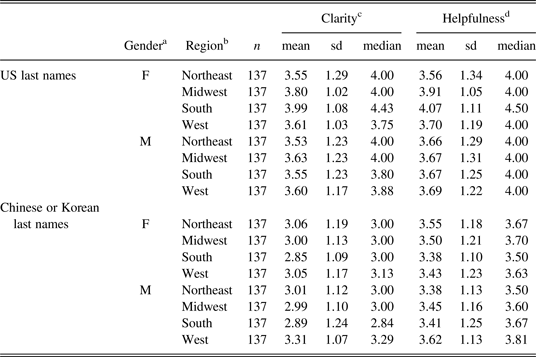
Initial data collection resulted in a considerable number of data points: over 300,000 comments for over 60,000 instructors. Preliminary statistical analyses revealed several imbalances. First, instructors with US last names far outnumbered the instructors with Korean or Chinese last names. In addition, reflecting demographic tendencies of faculty in the United States (see Kim et al. Reference Kim, Twombly and Wolf-Wendel2012), instructors with Korean or Chinese last names were not represented evenly throughout the dataset. Specifically, these instructors were highly concentrated in mathematics, computer science, and engineering. There were also imbalances related to geographic region and gender. As a result, I created a balanced, stratified sample by randomly sampling from within the original dataset and limiting the data to only instructors teaching in mathematics and statistics departments. The final stratified sample of mathematics instructors is presented in Table 1.
Sample of instructors (N = 2192) with descriptive statistics for dependent variables.

aGender was assigned using automatic classification based on relative frequency of gendered pronouns. I verified the accuracy of this classification by manually coding a random sample of 100 instructors. Agreement between my manual coding and the automatic classification was 100%.
bUS Census region (U.S. Census Bureau n.d.) of the institution where the instructor teaches.
cDescriptive statistics computed on aggregated user-assigned ratings of instructors' Clarity on a scale of 1 to 5 from ratings issued between 2010 and 2014.
dDescriptive statistics computed on aggregated user-assigned ratings of instructors' Helpfulness on a scale of 1 to 5 from ratings issued between 2010 and 2014.
Numeric ratings
RMP users rate instructors on five-point Likert scales. In this study, I examine the Clarity and Helpfulness ratings as these pertain most clearly to the instructor as opposed to the rater or the course content; these are also the two measures that RMP uses to compute its Overall Quality rating for each instructor. I used aggregate Clarity and Helpfulness scores as dependent variables in statistical analyses of the numeric ratings (see Table 1). For these aggregate scores, I computed the mean of all Clarity and Helpfulness ratings each of the instructors received between the years 2010 and 2014 (limited to a maximum of the twenty most recent ratings for each instructor). The distribution of the number of comments instructors received was positively skewed (i.e. most instructors received very few comments; the mode was one) with the median number of ratings being four and the interquartile range being six. Using R (v. 3.0.1, R Core Team 2013), I compared the aggregated Clarity and Helpfulness scores of instructors with US last names and those with Chinese or Korean last names through Wilcoxon rank sum tests.
The RMP corpora
I also compiled a corpus of the most recent comments from January 2010 to January 2014 for each of the instructors included in the numeric ratings analysis (see Table 1 above) with a maximum limit of twenty comments for each instructor. I placed the comments in two corpora based on group—instructors with Chinese or Korean last names or instructors with US last names (1,096 instructors in each group): the RMP-US corpus (6,602 comments, totaling 294,839 words) and the RMP-C&K corpus (6,323 comments, totaling 281,894 words). The stratified sample used in the numeric ratings analysis provided a sampling frame ensuring the corpora have nearly equal representations of instructors according to Gender and Region.
Quantitative corpus analysis
This study employs a mixed methods approach to discourse analysis, combining corpus linguistic techniques with critical discourse analysis (CDA), a combined approach that Baker, Gabrielatos, KhosraviNik, Krzyżanowski, McEnery, & Wodak (Reference Baker, Gabrielatos, KhosraviNik, Krzyżanowski, McEnery and Wodak2008) argue is able to compensate for some of the shortcomings of either approach when used in isolation. In particular, corpus linguistic approaches to texts are constrained in terms of their ability to draw on the broader contexts in which discourse is produced. CDA, in contrast, is highly attentive to such context. However, CDA has often been accused of relying on nonrepresentative text samples selected merely to confirm the presuppositions of the analyst while ignoring potentially relevant counter examples. Corpus linguistics, in contrast, strives for the collection of representative data from which reasonable generalizations about discourse can be made. As such, the two approaches can be, and often are, combined effectively.
The use of quantitative corpus linguistic techniques is also undertaken in light of claims by Sealey (Reference Sealey2007) that while more ethnographic analyses of micro-interaction are well-suited to locate and describe the ways in which individuals exercise their own agency in discourse, such approaches are less successful at describing social structures that are beyond the individual's control and yet which constrain their discourse. Sealey argues that corpus linguistics offers appropriate tools for examining how the preponderance of what is frequently said can act as a constraint on what can be or must be said in particular contexts.
In light of this, I used two corpus linguistic techniques to uncover patterns in the corpora for subsequent qualitative analysis. First, using R (R Core Team 2013), I extracted keywords for both corpora. Keywords are words that occur at a significantly higher rate in one corpus than in another comparison corpus. According to Baker (Reference Baker2004), they provide an indication of the types of rhetorical strategies that text producers frequently use in that corpus. See Tables 3 and 4 for further information regarding methodological choices for generating keywords in this study.
Second, using kfNgram (v 1.3.1, a piece of software that provides flexible phraseological analysis, see Fletcher Reference Fletcher2007), I extracted six-word phrase frames (flexible n-gram units containing one variable slot, e.g., he has a * accent but). Phrase frames provide an extension to the single lexical item offered by the keywords analysis helping to uncover highly frequent sequences of words in the discourse. The software allows the analyst to extract phrase frames of varying length. I chose to select the longest phrase frames that still provided numerous examples in both corpora. I also examined the shorter phrase frames that were extracted to ensure that potentially informative, but shorter, formulaic sequences were not ignored by my approach. I found that the most frequent shorter phrase frames tended to be subsumed within the longer phrase frames. For example, the most frequent four-word phrase frame in the RMP-C&K corpus was * hard to understand, which was subsumed in a variety of highly frequent six-word phrase frames, such as a little hard to understand *. This being the case, I judged it appropriate to use the longer phrase frames in my analysis. The resulting combination of keywords and phrase frames provided me with a sense of the distinctiveness and frequency of certain words as well as the formulaicity of phrases that I utilized in my closer examination of the discourse using CDA.
Critical discourse analysis
After identifying quantitative patterns in the corpora, I analyzed these more closely relying on critical discourse analysis. CDA makes theoretical assumptions important to the present study. In particular, CDA researchers assume that discourse and ideology are related in that discourse is constrained by and reflects underlying ideology (Fairclough Reference Fairclough2001), in this case, language ideology. As such, features of discourse often work to reproduce language ideologies. Discourse, however, is also capable of shaping or resisting ideology. Furthermore, an important acknowledgement that CDA makes is that ideology is often tacit even when reproduced in discourse (Gee Reference Gee2012) and thus is not necessarily observable by attending solely to individuals' overtly stated beliefs. Consequently, language ideology is more clearly described through patterns in discourse observed by the careful analyst than by accepting at face-value the statements of individual actors.
Corpus linguists and discourse analysts have been interested in patterned or repetitive linguistic units containing predictable sequences of words, which often reproduce hegemonic ideas. I have already mentioned a relevant example from Shuck (Reference Shuck2004:196): ‘[I/You] couldn't understand a word [he/she/they] said’. The formulaic nature of this complaint works to construct NNESs as incomprehensible, reproducing an ideology of nativeness that privileges the NESs' language. In this study, I describe frequently occurring, formulaic strategies by analyzing keywords and flexible phraseological units extracted during quantitative corpus analysis and attempting to interpret their ideological functions through CDA. It is important to note that while the quantitative information I obtained and utilized allowed me to make principled decisions about what to attend to, CDA remains an interpretive analytic process, the findings from which cannot be reduced to the frequency information obtained from the corpus.
RESULTS
Statistical analysis of numeric ratings
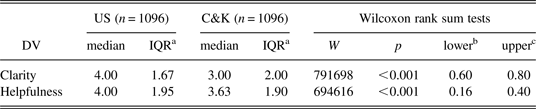
I first tested whether RMP users rate instructors with US last names and those with Chinese or Korean last names differently. As mentioned earlier, I used nonparametric Wilcoxon rank sum tests; this was due to the nonnormal distribution of the dependent variables as demonstrated by significant Shapiro-Wilk tests (for Clarity: W = 0.95, p < 0.01; for Helpfulness: W = 0.91, p < 0.01). Table 2 reports the results of these tests as well as group medians and confidence intervals. The confidence intervals provide a practical means of understanding the relationship between the instructor's language background or race and RMP users' ratings. Instructors with US last names are estimated to have a median Clarity score that is 0.60 to 0.80 points (on a five-point scale) higher than instructors with Chinese or Korean last names and a median Helpfulness score that is 0.16 to 0.40 points higher. Therefore, the results presented in Table 2 suggest a sizable advantage for instructors with US last names over their colleagues with Chinese or Korean last names in terms of how they are evaluated, particularly in terms of ratings of Clarity.
Tests of differences in group medians between instructors with US last names and those with Chinese and Korean last names.
aInterquartile range (range between twenty-fifth and seventy-fifth percentiles).
bLower 95% confidence interval of the difference in group medians.
cUpper 95% confidence interval of the difference in group medians.
Quantitative corpus analysis
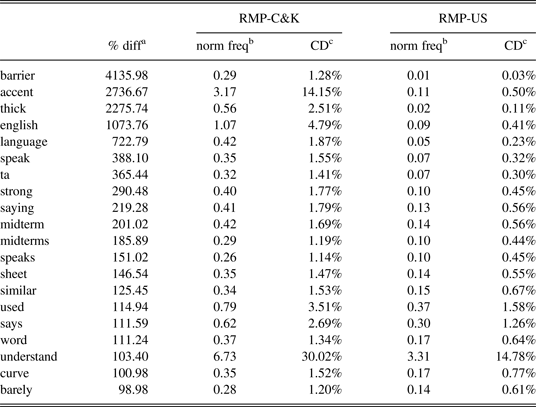
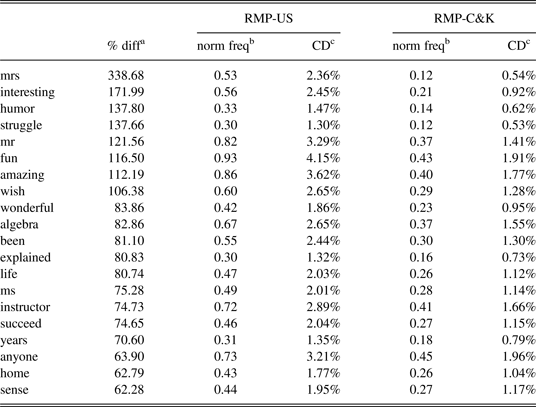
After observing sizable differences in numeric ratings assigned to these instructors by RMP users, I began to analyze their comments by extracting keywords from both corpora. Keywords are presented in Tables 3 (RMP-C&K) and 4 (RMP-US).
Top twenty keywords from the RMP-C&K corpus (total word count: 281,894).
aPercentage difference between normed frequencies in the RMP-C&K corpus and RMP-US corpus. A minimum normed frequency threshold of 0.25 occurrences per thousand words in the RMP-C&K corpus was used to ensure low frequency words were not classified as keywords. All keywords occur at a statistically significant higher rate in the RMP-C&K corpus than in the RMP-US corpus according to log-likelihood comparisons (G 2 >10.83, p < 0.001).
bNormalized frequency (frequency per 1,000 words).
cContextual diversity (% of texts or comments containing the keyword).
Top twenty keywords from the RMP-US corpus (total word count: 294,839).
aPercentage difference between normed frequencies in the RMP-US corpus and RMP-C&K corpus. A minimum normed frequency threshold of 0.25 occurrences per thousand words in the RMP-US corpus was used to ensure low frequency words were not classified as keywords. All keywords occur at a statistically significant higher rate in the RMP-US corpus than in the RMP-C&K corpus according to log-likelihood comparisons (G Footnote 2 >10.83, p < 0.001).
bNormalized frequency (frequency per 1,000 words).
cContextual diversity (% of texts or comments containing the keyword).
Tables 3 and 4 provide an indication of the topics in each corpus. Of particular note in the RMP-C&K corpus is the presence of keywords indicating discussion of language such as accent, english, language, speak, and word. Of particular note in the RMP-US corpus are keywords denoting positive attributes such as interesting, (sense of) humor, fun, amazing, and wonderful.
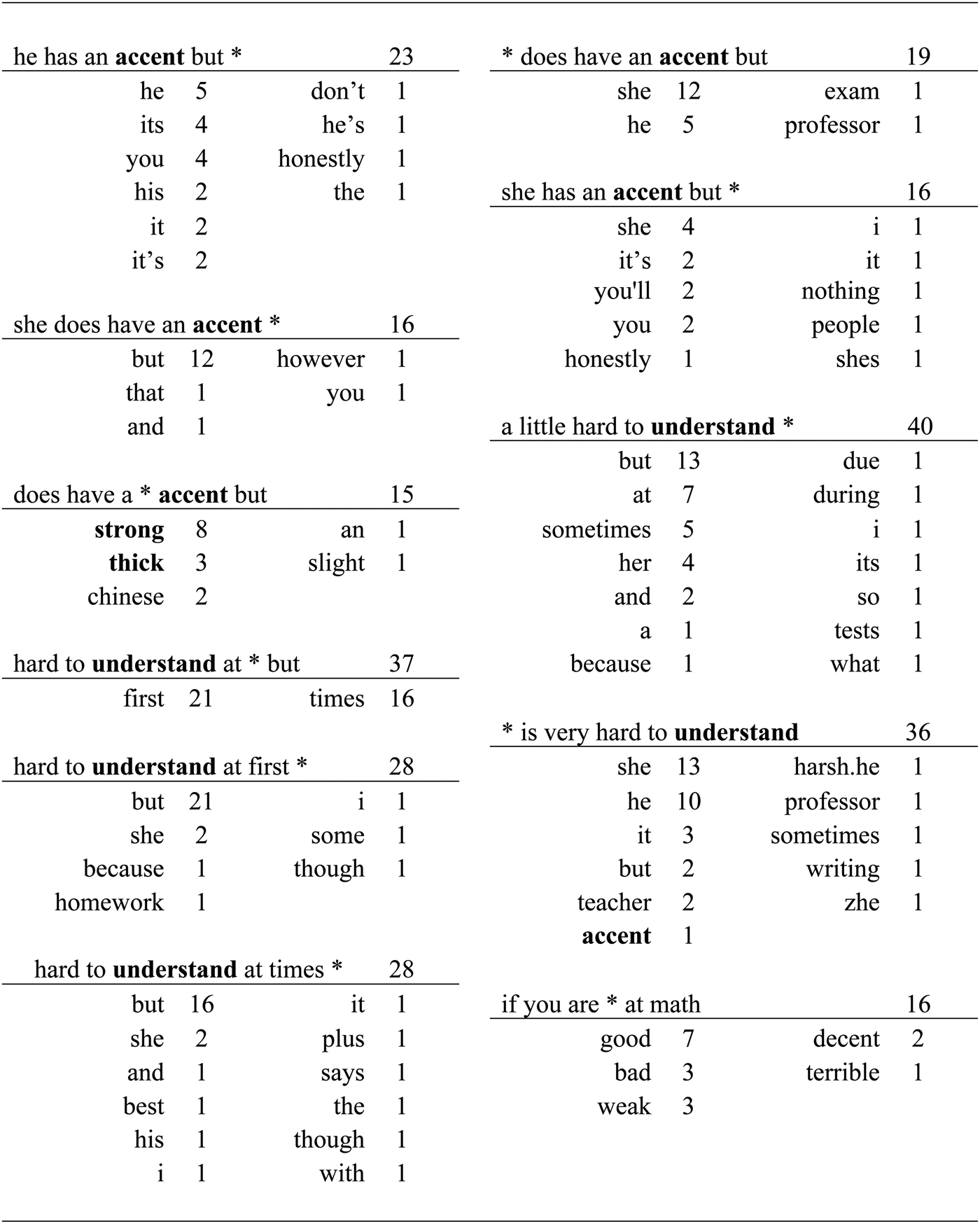
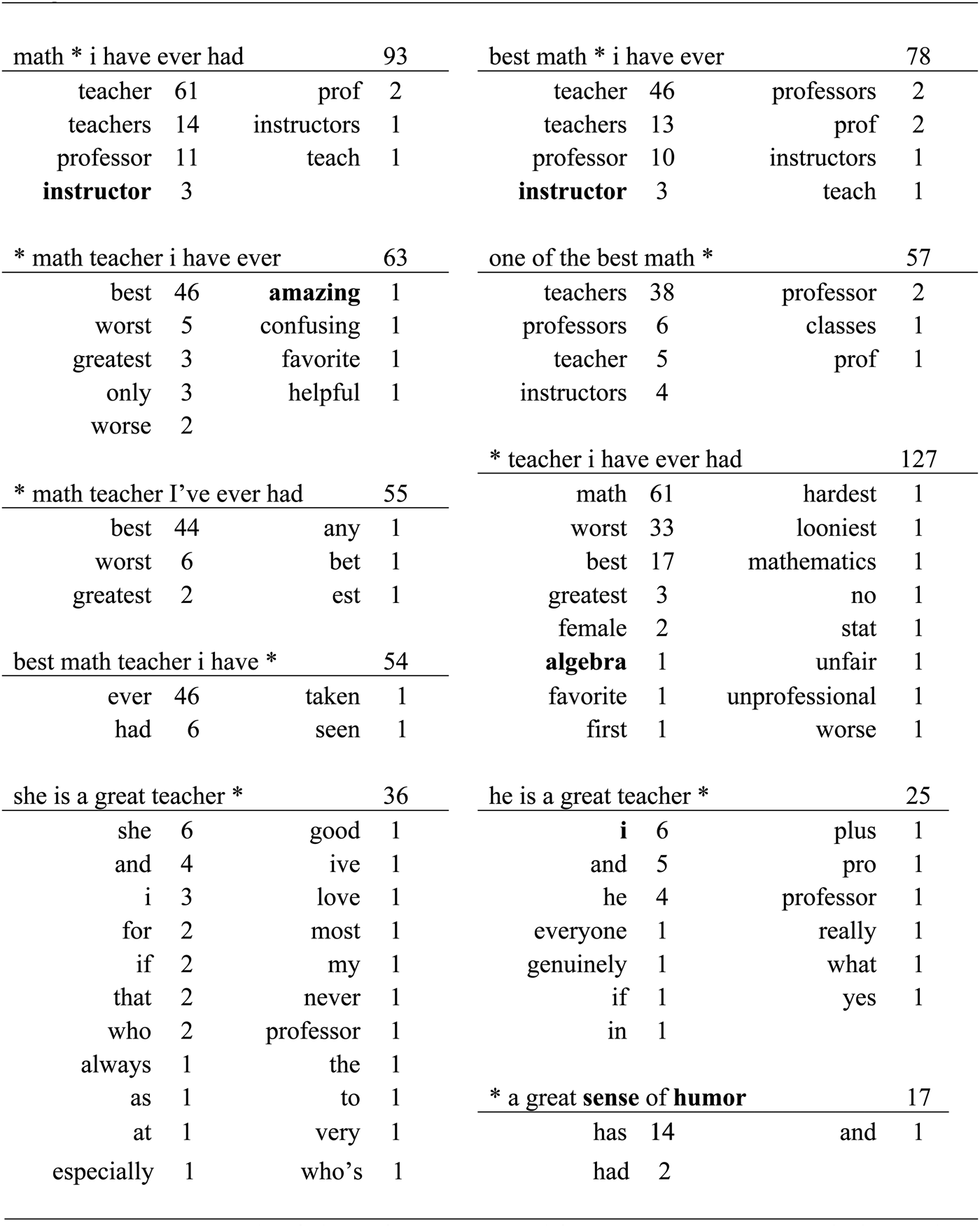
To further understand the contextualized usage of these keywords as well as other highly frequent terms and how they interact with each other, I extracted phrase frames for each corpus. A sample of highly frequent phrase frames from the RMP-C&K corpus is presented in Figure 1, and, from the RMP-US corpus, in Figure 2.
Sample of phrase frames extracted from RMP-C&K corpus. Each six-word phrase frame (five words and a variable slot represented by *) appears above the line with its overall frequency to the right. Below the line are variants observed to occur in the slot with their frequencies to the right. Keywords appear in bold (see Table 3).
Sample of phrase frames extracted from RMP-US corpus. Each six-word phrase frame (five words and a variable slot represented by *) appears above the line with its overall frequency to the right. Below the line are variants observed to occur in the slot with their frequencies to the right. Keywords appear in bold (see Table 4).
Figure 1 makes it clear that, although the instructors' language is a frequent topic in the RMP-C&K corpus, the evaluations of that language are not overwhelmingly negative nor do they appear to construct instructors according to the stereotypical characteristics ascribed to NNESs by the ideology of nativeness. Mention of an instructor's accent is frequently followed by but suggesting that this initial ‘problem’ contrasts with what follows. In addition, although instructors with Chinese or Korean last names are repeatedly represented as hard to understand, this phrase is frequently mitigated by premodifiers such as a little and postmodifiers such as at first, at times, and sometimes. This suggests a sharp difference from the performance aspects reported by Shuck (Reference Shuck2004), where hyperbolic descriptions of the incomprehensibility of NNESs were prevalent.
Looking over the phrase frames from the RMP-US corpus (Figure 2), there appears to be a great deal of extreme evaluation, mostly positive, of RMP-US instructors, particularly relying on the phrase math teacher I have ever preceded by modifiers like best. In the next section, I take a closer look at these quantitative patterns in context using CDA.
Critical discourse analysis
Having described a set of patterns appearing in the two RMP corpora through quantitative approaches, I now turn my attention to the findings of the qualitative aspect of this study, which used critical discourse analysis to more closely examine RMP users' discursive evaluations of mathematics instructors informed by these patterns. I organize this section around formulaic strategies (or ‘formulas’) I observed RMP users using when evaluating instructors. For each strategy, I describe the sequence of discursive elements that help to achieve a particular ideological or discursive function and that are frequent, formulaic, or particularly characteristic of one corpus but not the other, as evidenced by the presence of keywords (in bold, see Tables 3 and 4) or frequent phrase frames (underlined, see Figures 1 and 2).
Although CDA's careful attention to naturally occurring discourse usually compels researchers to present excerpts of authentic discourse for reader perusal as a means of increasing the transparency of their analyses, for ethical reasons, I have chosen to present altered excerpts from the data. McEnery & Hardie (Reference McEnery and Hardie2012) note that corpus linguists should take greater care in protecting the people who are discussed in their corpora. With modern search engine technology, excerpts could easily be used to learn the identities of the instructors discussed in my corpora. Although RMP is a publically available website, I do not wish to draw undue attention to specific instructors, especially those who have been the subject of unfair or discriminatory complaints. My findings are based on the unaltered discourse I collected from RMP, and I have attempted to be faithful to that discourse while shielding individual instructors from undue attention by altering excerpts in a minimal way that reflects variations in phrases, attested elsewhere in the corpus. Other aspects of the discourse, including capitalization and punctuation choices that flout conventions of published writing, are presented as they appear on the website.
‘She can't speak English’: The erasure of ‘Asian’ instructors' linguistic competence
Shuck (Reference Shuck2004) notes that the US university students she interviewed frequently drew on the ideology of nativeness often in exaggerated performances to construct NNESs as incomprehensible. The erasure of NNESs' English competence was attested in the RMP-C&K corpus drawing on several different formulaic strategies. One strategy was direct denial of the instructor's English proficiency in variations of: X cannot speak English, such as in excerpts (1) and (2).
(1) AWFUL! AWFUL! DO NOT TAKE THIS PROF!! HE BARELY SPEAKS ENGLISH AND IS RUDE TO STUDENTS!
(2) Her english is terrible (not only her accent, she cannot speak english)
Such proclamations place RMP users, presumably as NESs, in the position to evaluate the English abilities of their instructors and to deny that competency entirely as in (2) or nearly entirely, as in (1).
A second formulaic strategy was also identified by Shuck (Reference Shuck2004) and involves variations of X can't understand a word Y says, as in excerpts (3) and (4).
(3) Did not understand a single word he said all quarter.
(4) He has a really strong accent so you can't understand a word of what he says
As Shuck notes, this complaint appears to be hyperbolic. For example, it seems unlikely that the RMP user in (3) attended a course over an entire term and never understood a single word the instructor produced (even if that attendance was irregular). Thus, this formulaic strategy uses the social acceptability of hyperbole in complaints or narratives to erase NNES instructors' English competency.
A third formula RMP users employed to erase ‘Asian’ instructors' English competency involves variations of Don't X unless you speak Y, where X is some course-related action like registering for the course or asking questions and Y is the instructor's (assumed) first language as in excerpts (5) and (6).
(5) Don't take him unless you know Chinese. Because he obviously can't speak English.
(6) Professor Kim has a THICK accent so don't bother asking questions unless you speak Korean.
This formula allows RMP users both to erase the English competency of their instructors and to highlight the NNESs' racial Otherness. Of particular note is the suggestion in (6), in which, drawing on the ideology of nativeness (see Shuck Reference Shuck2006), the RMP user attempts to absolve students of the responsibility to cooperate and ask questions when they do not understand.
‘She does have an accent but…’: Objecting to the dominant language ideology
Although I found ample evidence to suggest that the ideology of nativeness infiltrates RMP evaluations, an unexpected finding of the study was that objection or opposition to this language ideology, however weak, was more frequent. Many RMP users tried to circumvent the dominant language ideology by first acknowledging its presence and then seeking exception to the assumptions it makes. One formulaic strategy RMP users employ to resist the dominant language ideology involved variations of X is hard to understand at first but you get used to Y, where X is the instructor and Y is some aspect of the instructor's language (e.g. accent) as in (7) and (8).
(7) She does have an accent which you might find hard to understand at first, but you'll get used to it quickly.
(8) He is hard to understand at first but you get used to him and then it's easy.
Thus, this formula represents the communication difficulties that students face when communicating with instructors who have Chinese or Korean last names as temporary as opposed to the immutable incomprehensibility ascribed to these instructors by the ideology of nativeness.
Another formula RMP users used to challenge the ideology of nativeness involved suggesting that the instructor has communicative competence so long as the students are willing to engage in cooperative communication. This formula included variations of X is somewhat difficult to understand, but if you Y, then Z, where X is the instructor or the instructor's language, Y is an action the student can take (e.g. asking questions), and Z is the positive outcome of understanding that will occur. Excerpts (9) and (10) illustrate this formula.
(9) her accent is a little hard to understand sometimes, but if you just ask, she'll repeat.
(10) sort of difficult to understand, but is really helpful if you ask and go see him during office hours.
Importantly, this formulaic strategy represents students, including NES students, as having responsibility for ensuring the success of communication with their instructors. This challenges the representation of ‘Asian’ instructors in the dominant ideology as well as the attempts that that ideology makes to absolve NESs of responsibility in communication with NNEs.
Despite the fact that these formulas were more frequent than those echoing the ideology of nativeness, I posit that that ideology is nonetheless dominant in this context. My argument rests specifically on the notion of naturalized ideology (Fairclough Reference Fairclough2001), which refers to the idea that powerful ideologies are ubiquitous and accepted merely as ‘common sense’ and thus often need not be explicitly stated but can instead be suggested merely through the presence of indexical features, such as a Chinese or Korean last name.
I argue that RMP users perceive the ideology of nativeness as ubiquitous and naturalized and that they demonstrate this in their discourse. In particular, RMP users appear to feel compelled to comment on ‘Asian’ instructors' language even when they have nothing noteworthy to say about it. In contrast to the assumption for instructors in the RMP-US corpus, who have last names like Smith and Williams, many RMP users approach the evaluation of instructors in the RMP-C&K corpus, who have last names like Kim and Chen, with apparent recognition of negative assumptions about instructors' language, stemming from the dominance of the ideology of nativeness. One particularly common way in which RMP users reveal this tendency is in formulas such as X does have an accent but Y, as in excerpts (11), (12), and (13), where X is the instructor and Y is a mitigating factor that attempts to undermine the ideological presuppositions indexed by the instructor's last name and his or her accent.
(11) He does have an accent but it's nothard to understand him
(12) Yes she does have an accent but so does everyone else in los angeles.
(13) she does have an accent but her english is intelligible and she explains math well
The use of the emphatic does in (11), (12), and (13) acknowledges the anticipated concerns of other RMP users (note also the yes in (12)) prior to the text producers' subversion of those concerns. Interestingly, in many cases, acknowledgments of these concerns appear without any prior mention of the instructor's accent by other RMP commenters.
Thus, RMP users raise the issue of ‘Asian’ instructor's language and respond to what they seem to perceive as the dominant ideology about such instructors. However, even though these comments may appear neutral or, in rare cases, even complimentary as in (14), such comments do not appear in the RMP-US corpus.
(14) Her english is perfect, and she gives really good examples in class.
As a result, many RMP users appear to approach evaluation of instructors who have Chinese or Korean last names with the assumption that their instructors' language must be commented on even when this would not be necessary for those whose names index NES identity. I suggest that the motivation of this is the dominance of the ideology of nativeness, which the RMP users ostensibly object to, and yet are compelled to acknowledge, nonetheless.
‘The best professor I've ever had’: Extreme positive evaluations of US instructors
Having examined some of the major strategies used in the RMP-C&K corpus, I now do the same for the RMP-US corpus. I have identified one noteworthy strategy, which involves extreme positive evaluation and is characterized particularly by variations of this formula: X was the best math teacher I've ever had, as illustrated in excerpts (15) and (16).
(15) She was the best math teacher I have ever had
(16) Mrs. Johnson is the best teacher I ever had.
Although this formula is also attested in the RMP-C&K corpus, it is far more common in the RMP-US corpus. This is evidenced in part by the fact that, although not among the top twenty keywords ranked according to percentage difference, words such as best and teacher occur significantly more frequently in the RMP-US corpus than in the RMP-C&K corpus (G 2 > 10.83, p < 0.001). Figure 2 reveals that, at times, the phrase frames that are part of this formula also include worst. However, best is more frequent. In addition, in the RMP-US corpus, the most frequent string with best, best math teacher I have ever, appears forty-six times. The most frequent string with worst, worst teacher I have ever had, occurs thirty-three times. The relative frequency is reversed in the RMP-C&K corpus, where worst teacher I have ever had occurs twenty-five times, and best math teacher I have ever occurs only fifteen times (a statistically significant difference, χ 2 = 4.57, p = 0.03). Thus, RMP users frequently draw on formulas such as this as a form of extreme positive evaluation granted to instructors with US last names with greater frequency than those with Chinese or Korean last names.
DISCUSSION
I return now to my original research questions, attempting to provide answers to them based on the findings of this study. My first research question dealt specifically with whether mathematics instructors with Korean and Chinese last names at institutions of higher education in the United States were evaluated differently on RateMyProfessors.com than their colleagues with US last names. I found that instructors with Chinese or Korean last names were rated significantly lower in Clarity and Helpfulness. In particular, I found that the median rating of Clarity for these instructors was approximately 0.60 to 0.80 points (on a five-point scale) lower than that for instructors with US last names, suggesting a substantial disadvantage for instructors with Chinese or Korean last names. In addition, quantitative analysis of the comments in the two corpora revealed that RMP users commented on the language of their ‘Asian’ instructors frequently but were nearly entirely silent about the language of instructors with common US last names. Finally, RMP users tended to withhold extreme positive evaluation from instructors who have Chinese or Korean last names, although this was frequently lavished on instructors with US last names. This suggests that students' evaluations of ‘Asian’ instructors teaching in the US pay greater attention to instructors' language, a tendency that lessens the likelihood that they will offer the same extreme positive evaluations that they frequently bestow on many of their other instructors.
The tendency for ‘Asian’ instructors to be evaluated more negatively than their colleagues with common US last names raises one particularly difficult question: are these evaluations ‘justified’, ‘fair’, ‘deserved’, or ‘legitimate’, or are they not? In other words, are students ‘biased’, or do their instructors have ‘legitimate’ language problems? While it might be on some level informative to examine instructors' spoken language and students' responses to it, as some studies have done (e.g. Rubin Reference Rubin1992; Kang & Rubin Reference Kang and Rubin2009) and future research should continue to do, ultimately the issue cannot be divorced from questions of ideology. Even when there is apparent agreement among different people about the perceived quality or intelligibility of an individual's language, that consensus cannot be removed from the political and social circumstances that have produced it (Park & Wee Reference Park and Wee2009). In other words, even if we were able to come to a consensus about whether an instructor has ‘legitimate’ problems with his or her speech (perhaps even with that instructor joining in the consensus and accepting this characterization of his or her language), that consensus would have to draw on some ideological framework of expectations for what or whose language will be legitimized. Such a framework would almost certainly serve the interests of some by constructing their language as ‘without problems’ or ‘normal’ (likely NESs) while marginalizing others by constructing their language as ‘containing problems’ or ‘being abnormal’ (likely many NNESs).
In light of the understanding that ideology is central to widespread complaints about NNES instructors' language, I have examined the different evaluations I observed from a language ideological perspective attempting to examine how they work in the interests of certain instructors but not in others. Hence, my second research question concerned how differences in evaluations of these instructors might be explained as a function of the ideology of nativeness as described by Shuck (Reference Shuck2004, Reference Shuck2006). Shuck's work on the ideology of nativeness suggests that in some contexts NESs freely construct NNESs using exaggerated stereotypical characteristics including the outright denial of the NNES's English competence. Discourse drawing on the ideology of nativeness in this manner was attested in some RMP users' evaluations of their ‘Asian’ instructors. In addition, in some cases, RMP users attempted to absolve themselves and other students of responsibility for ensuring successful communication with their instructors (for example, by advising others not to ask questions in class). For these users then, Shuck's description of the performance and dissemination of the ideology of nativeness is quite apt.
I observed, however, that attempts to draw on the ideology of nativeness and construct ‘Asian’ instructors as incomprehensible were actually far less common than objections to the presuppositions of the ideology of nativeness. Specifically, one formula X does have an accent but (and variations thereof) was among the most common sequences in the RMP-C&K corpus. Users drawing on this formulaic strategy acknowledge the presence of a language feature that is highly stigmatized but proceed to counter the assumptions of the ideology of nativeness in some other way, for example, by pointing to the instructors' ability to compensate for communication difficulties or suggesting that any communication difficulties are only temporary.
Despite the frequency of objection to the presuppositions of the ideology of nativeness, I argue that it is still the dominant language ideology in the context of RMP. The structure of the previously mentioned formula is particularly suggestive of the ideology's naturalized status. RMP users commenting on instructors who have Chinese or Korean last names appear to anticipate that their eventual readers will orient to the ‘Asianness’ of the instructors' last names and iconically arrive at the conclusion that the instructor is NNES and, worse, that he or she is incomprehensible. This anticipation and the resulting acknowledgement (i.e. X does have an accent) reflect the constraints that hegemonic discourses, like those that reproduce and transmit the ideology of nativeness, act as constraints on what can or must be said (Sealey Reference Sealey2007). In this case, the ideology of nativeness seems to demand an explanation for the ‘Asianness’ that some instructors' last names present. Having decided that the instructor in question does not in some way conform to stereotypical presuppositions, many RMP users attempt to challenge the iconic associations between race, language, and incomprehensibility at least for the individual instructor. In spite of the objections these users leveled at the dominant language ideology, the ostensibly neutral or even positive comments about NNESs' language that many posters felt compelled to make are themselves problematic (even if well-intended) in that they draw attention to an area where NNESs face continual disadvantage relative to NESs, largely as a result of the ideology of nativeness. In particular, even apparently positive comments about NNES instructors' language must be interpreted against the silence about and assumed ‘perfection’ of NESs' language that the dominant and ubiquitous language ideology, the ideology of nativeness, presupposes. Although the present study did not examine the way comments were interpreted by other RMP users, future research could examine how such positive or neutral statements about language are interpreted and specifically whether they lead to more positive or negative expectations about the instructor than comments that are silent on this topic. Such research might help to clarify the degree to which the apparent obligation for RMP users to comment on ‘Asian’ instructors' language serves as a disadvantage for them.
It is interesting to consider possible explanations for why the discourse I observed on RMP only partially reflects the hyperbolic complaints and highly stereotypic representation of NNESs that have been observed in past language ideology studies, for example, by Shuck (Reference Shuck2004). One important difference is the function that RMP discourse serves, mainly as a form of evaluating instructors for other RMP users. In this sense then, RMP might be expected to display some of the same features of related genres like online product reviews, in which users work to construct credible identities as expert reviewers (Mackiewicz Reference Mackiewicz2010). I would argue that hyperbolic complaints and stereotypes are likely to undercut the credibility and objectivity of RMP posters in the eyes of many RMP readers. As a result, RMP users may be less likely to engage in performances that draw explicitly on the ideology of nativeness in this context than they would be in other contexts like casual conversation or in Shuck's group interviews. Another possibility is that the dependence on frequency information in this study has allowed me to identify features of RMP discourse that may be present in other contexts but often go unnoticed in studies adopting a more strictly interpretive or qualitative approach to analysis, due to their lack of saliency relative to more performative features of the discourse. One other possible explanation is that the passage of over a decade since Shuck collected her data and the increasing ethnic and linguistic diversity of the US has made people, including RMP users, more sensitive to language discrimination and thus less likely to engage in behaviors that overtly reproduce the ideology of nativeness.
Although the disadvantages that ‘Asian’ instructors bear at the hands of the ideology of nativeness are frequently subtly enacted in this context, its subtlety should not be mistaken for harmlessness. RMP ratings have been shown to approximate institutional evaluations quite strongly (e.g. Sanders et al. Reference Sanders, Walia, Potter and Linna2011; see discussion of correlations between RMP ratings and institutional evaluations above), and this suggests that ‘Asian’ instructors likely face similar disadvantages in terms of numeric ratings on their institutional evaluations, which play a major role in their professional lives. Furthermore, US students have been shown to place a great deal of faith in RMP as a reliable tool for course selection (e.g. Steffes & Burgee Reference Steffes and Burgee2009; see discussion of student perceptions and use of RMP above), suggesting they may avoid instructors with last names that index ‘Asianness’. Such instructors may be unable to generate sufficient enrollment to warrant them teaching advanced courses in their areas of specialization, or they may be granted fewer teaching assignments. In addition, reading evaluations of ‘Asian’ instructors that frequently reference their language may predispose students to experience these instructors as problematic communicators (e.g. A. Edwards et al. Reference Edwards, Edwards, Shaver and Oaks2009; see the discussion of how RMP ratings may create self-fulfilling prophecies above). Furthermore, the use of RMP ratings in the ranking of universities, as practiced by Forbes (Center for College Affordability and Productivity 2012), provides institutions of higher education with a further incentive not to employ social groups who are routinely assigned relatively low ratings, such as ‘Asian’ instructors.
The subtlety with which these disadvantages arise is, nonetheless, striking, when one compares it to the findings of seminal work on language ideology related to NNESs in the US, such as that by Lippi-Green (Reference Lippi-Green1994:171), which argues that discrimination focused on the language of an individual or social group ‘can be found everywhere in our daily lives. In fact, such behavior is so commonly accepted, so widely perceived as appropriate that it must be seen as the last widely open backdoor to discrimination’. The findings of this study, however, suggest that, within the context of RMP, the pervasive structural disadvantages that ‘Asian’ instructors face at the hands of the dominant language ideology are subtle enough to avoid raising suspicions of discrimination and prejudice even if the ‘widely open backdoor’ were closed.