Introduction
Adolescence is a time of increased risk for many mental health (MH) disorders, and the importance of an effective and well-managed transition between Child and Adolescent Mental Health Services (CAMHS) and Adult Mental Health Services (AMHS) has been increasingly recognised (Singh et al. Reference Singh, Paul, Ford, Kramer, Weaver, McLaren, Hovish, Islam, Belling and White2010; McNamara et al. Reference McNamara, McNicholas, Ford, Paul, Gavin, Coyne, Cullen, O’Connor, Ramperti, Dooley, Barry and Singh2013; Paul et al. Reference Paul, Ford, Kramer, Islam, Harley and Singh2013). For many adolescents, the presentation of MH difficulties continue and persist into adulthood (Patton et al. Reference Patton, Coffey, Cappa, Currie, Riley, Gore, Degenhardt, Richardson, Astone, Sangowawa, Mokdad and Ferguson2012), and as such they will frequently require long-term engagement with health services and require transfer of care from the CAMHS to AMHS. Continuity of care in MH services is, therefore, a key aspect of service provision. Problems in transition typically disrupt continuity of care and may have a serious impact on service users, on their care givers and on the effectiveness of MH services in providing quality care (Singh et al. Reference Singh, Paul, Ford, Kramer, Weaver, McLaren, Hovish, Islam, Belling and White2010).
Shortcomings in transition have been highlighted in a UK report by the Health Select Committee (House of Commons, 2000) and by Singh et al. (Reference Singh, Paul, Ford, Kramer, Weaver, McLaren, Hovish, Islam, Belling and White2010). These include arbitrarily drawn service boundaries, poor communication between agencies, shortage of in-patient units for adolescents and the need for early intervention services. The findings of the CAMHS report (Health Service Executive (HSE), 2013), which audited all 60 CAMHS in Ireland, reflect the lack of a standardised practice nationwide regarding service provision for 16- and 17-year-olds. The report indicated that only 19 teams nationwide accepted all new cases up to and including 17-year-olds. Thus, although a Vision for Change recommends that the upper age limit for CAMHS as 18, it is clear that the transition boundary (i.e. the age boundary between CAMHS and AMHS) in reality varies between 16 and 18 years. As a result, some young people face difficulties accessing appropriate services. At present, there is limited information about the process of transition in Ireland (McNamara et al. Reference McNamara, McNicholas, Ford, Paul, Gavin, Coyne, Cullen, O’Connor, Ramperti, Dooley, Barry and Singh2013).
Although MH policy in Ireland, A Vision for Change: The Report of the Expert Group on Mental Health Policy (Department of Health & Children, 2006), has emphasised the importance of improving both the quality and continuity of treatment within MH services, information on this area has so far been lacking. This Irish study of transition policy and practice, ITRACK, is the first to explore the specific arrangements for transition between CAMHS and AMHS. The critical gaps between operational practice and best practice guidelines have previously been published (McNamara et al. Reference McNamara, McNicholas, Ford, Paul, Gavin, Coyne, Cullen, O’Connor, Ramperti, Dooley, Barry and Singh2013). In this paper, we describe the cohort of young people reaching the transition boundary and their outcomes.
Methods
A comprehensive list of all consultant psychiatrists from child and adult MH services in urban and rural areas throughout Ireland was generated from the HSE website and by making telephone contact with each clinic. Ethical approval was received from the research ethics committee of each participating clinical service. Clinicians were advised about the study and were invited to participate. Consenting child psychiatrists were asked to retrospectively identify all cases who had reached the transition (age) boundary during January and December 2010. Specifically, clinicians were asked to draw up a list of all young people whose cases were open when they reached age X between 1 January and 31 December 2010 (where X is the last chronological year of age for which they should be seen by the CAMHS as defined by that service/team).
Following the identification of potential cases by the clinician, clinical team members retrieved the relevant data from the case notes using the data extraction tool used in the UK transition study, TRACK, with minor modifications for the Irish setting (i.e. removing references to the NHS Trust and NHS Patient ID number; Singh et al. Reference Singh, Paul, Ford, Kramer, Weaver, McLaren, Hovish, Islam, Belling and White2010). Fully anonymised data were provided by the clinicians to the research team for analysis. In some instances, the consent of the young person was given for the research team to access the case notes directly in order to extract data. Information collected included the following: suitability for referral to the AMHS; young person’s clinical and socio-demographic details; parental engagement; outcome of referral; time from referral to assessment (if referred); time from referral to acceptance by the AMHS; documented evidence of hand-over planning; quality of information transfer; nature and frequency of joint working during transition (between CAMHS and AMHS); problems documented during transition; contact frequency, types of contact and contact details; and admissions, discharges, referrals to other services and evidence of documentation of other transitions within the previous year. For potential referrals (those who crossed the transition boundary but were not referred), information was collected as mentioned above, but also included the following: current status; current management plan; and factors accounting for the decision not to refer to the AMHS. The diagnosis given by CAMHS was recorded on two occasions, at the time of initial presentation to the CAMHS (D1) and at the time of reaching the transition boundary (D2). Data were entered into SPSS, where cases were categorised as being either referred to the AMHS, refused referral by the young person and/or parent or not referred. Descriptive statistics were initially derived for all variables, and Pearson χ 2-tests (Fisher’s exact tests where appropriate and ɸ or Craemer’s V noted for strength of association) were used in order to determine significant associations (p<0.05). Using Bonferroni principles, correlations with a significance value of p<0.01 were considered significant.
Results
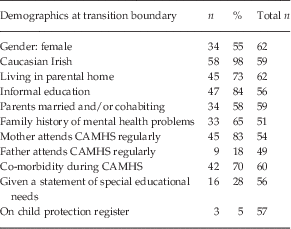
From the 60 CAMHS teams contacted, nine responded from the four HSE service areas, covering a population of 4.6 million; one CAMHS was ineligible as their cut-off age was 12/13, transferring care to another CAMHS. From these clinics, 62 service users were identified by the child psychiatrist as having crossed the transition boundary, with the majority of cases from HSE Dublin Mid-Leinster (n=40, 66%), HSE South (n=18, 30%), HSE West (n=2, 3%) and HSE Dublin North (n=1, 2%). Clinical and socio-economic details are listed in Table 1. The mean age at initial referral to a CAMHS service was 13.3 (s.d. 3.68, range 4–17.5), and mean age of transition was 17.7 years (s.d. 0.75, range 16–19). Attendance by either parent was very common, with most mothers attending regularly (n=45, 73%) and both parents in nine cases (20%). In cases where the information was documented (n=51), there was a very high rate of MH problems present in either parents (n=22, 43%), sibling (n=12, 19%) or second-degree relatives (n=19, 37%). A χ 2-test for independence (with Yates Continuity Correction) indicated a significant association between mothers with an MH history and regular attendance [χ 2 (1, 43)=7.87, p=0.012, ɸ=0.43]. Young people who had a family history of MH problems had mothers who were less likely to attend.
Demographic details (total sample, n=62)
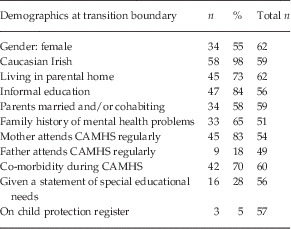
CAMHS, Child and Adolescent Mental Health Services.
As might be expected, diagnoses changed over time, highlighting the temporal instability of MH diagnoses. The most common diagnoses at the time of initial presentation (D1) to the CAMHS were mood disorders such as anxiety or depression (n=23, 37%) and attention deficit hyperactivity disorder (ADHD; n=19, 31%). Less common were eating disorders (7, 11%) and psychosis (5, 8%). Over time (D2), mood disorder frequency decreased (16, 26%), ADHD increased (19, 31%) and psychosis (n=6, 10%) and obsessive–compulsive disorder (OCD; n=4, 7%) featured more frequently, although still in a limited number of cases. Five young people had eating disorders (8%) and three (5%) had pervasive developmental disorder (PDD). Co-morbidity was common among many of the service users, with 42 (70%) of them experiencing multiple MH difficulties at some point during their engagement with the CAMHS.
In addition to general support and psycho-education, specific interventions following initial consultation included medication (39, 64%), individual therapy (25, 41%) and parenting support (12, 20%). At the time of transition, most young people were receiving general psychological support (n=47, 77%) and medication (34, 56%), with fewer individuals receiving individual therapy as the primary intervention (n=12, 20%). In the majority of cases, the identified lead clinician was a Psychiatrist (n=19, 58%) followed by a Nurse (n=10, 30%) and Psychologist or a Social Worker (n=2, 6%, respectively).
Transition pathways
Transition pathways were determined for each case in the sample who made the transition. Out of the total sample of 62 cases, 47 (76%) were perceived by the CAMHS clinician to have ‘on-going MH service needs’ (referred to subsequently as ‘MH need’) at the time of transition, whereas 15 (24%) did not (no MH need) (Fig. 1). Of those with ‘MH need’, the majority were not referred: 15 (32%) were referred; 21 (45%) were not referred; and in 11 (23%) cases, referral was refused by the young person. Conducting the χ 2-test revealed few associations between those considered to have an MH need and those who did not. Specifically, diagnostic group or a family history of mental illness were not significantly associated with the MH need. Being on medication [χ 2 (1, 61)=6.81, p=0.015, ɸ=0.334] or having a mother who attended CAMHS regularly [χ 2 (2, 45)=5.26, p=0.044, ɸ=0.312] showed a trend towards significance; however, using Bonferroni corrections, they were not significantly associated.
Young people with on-going MH needs
Forty-seven young people were considered to have MH needs at the time of crossing the transition boundary, with a range of diagnosis (16 ADHD, 10 mood disorders, six psychosis, four ED, four OCD and one autistic spectrum disorder). Of these, a third were referred (15, 32%; one ADHD, five mood disorders, five psychosis, two OCD and two no axis 1/2 diagnosis given). Most were deemed to be urgent referrals (n=10, 71%), with the mean waiting time to AMHS decision of 7.9 weeks (s.d. 5.49, range 0–15). One referral was not accepted, where the AMHS perceived the person to have a primary substance-abuse problem co-morbid with depression. Nine clinicians gave specific reasons for referrals, these included being on psychotropic medication (six reports) and referral for specific interventions: dialectical behavioural therapy (one), cognitive-behavioral therapy (one) and bereavement counselling (one).
Almost half (21, 45%) of those with MH needs were not referred; 12 (57%) of them continued with the CAMHS beyond the transition boundary for a mean number of 59 weeks (s.d. 30.62, range 2–111), attending on average six times (mean 6.4 sessions, s.d. 7.49, range 0–24). Nine young people (43%) were discharged back to their GP. A smaller number of clinicians gave reasons for non-referral, despite MH needs. Six clinicians stated that the person would not meet the AMHS referral criteria (two ADHD, two PDD, one learning difficulty and one mood disorder), and seven perceived that the AMHS did not have the appropriate or necessary services that the young person in question needed. Of these, four young people were on medication; two were receiving individual therapy in addition to general support. The disorders ranged from ADHD (three), mood disorder (two), eating disorder (one) to child protection issues (one). One young person was referred to a private psychology service to better meet his/her needs.
Finally, for the remaining 11 (23%) cases with MH needs, the clinician considered them suitable for referral and the evidence from the case notes indicated that they wanted to make the referral, but the young person, and in three cases the parents as well, refused the referral to adult MH services. Six (55%) of these cases continued with the CAMHS beyond the transition boundary for 49 weeks (s.d. 2.51, range=0–7), before the young person either disengaged (n=5, 83%) or was discharged to their GP (n=1, 17%). Three (27%) young people were discharged directly to their GP at transition and a further two (18%) after a period of non-attendance at the CAMHS. The disorders ranged from ADHD (seven), mood disorder (two), OCD (one) to substance use disorder (one).
Comparisons between referred, not referred and refused
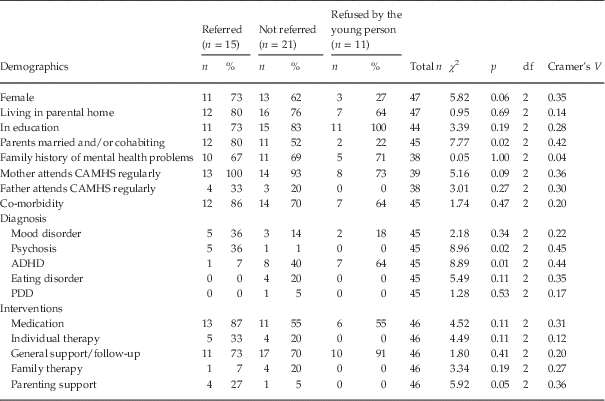
A comparison between the clinical features of those referred and not referred, along with those who refused are given in Table 2. The main differentiating features are that those with a diagnosis of psychosis were more likely to be referred [χ 2 (2, 45)=8.96, p=0.02, V=0.45] and those with ADHD were more likely to refuse transfer [χ 2 (2, 45)=6.81, p=0.01, V=0.44], only the latter reaching statistical significance at p=0.01.
Demographic and clinical details (young people with MH need, n=47)
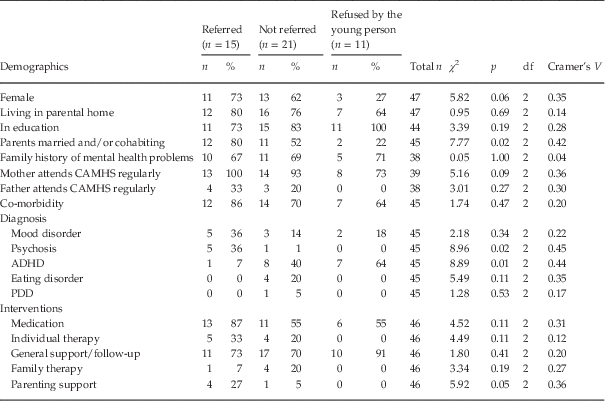
MH, mental health; CAMHS, Child and Adolescent Mental Health Services; ADHD, attention deficit hyperactivity disorder; PDD, pervasive developmental disorder.
Interestingly, being prescribed medication was not associated with the patient’s outcome with respect to referral status [χ 2 (2, 46)=4.515, p=0.11]. This may be explained by the high proportion of patients with ADHD who were either not referred or refused the referral, who would be expected to be on medication. Individual therapy and parenting support were also more frequent among the referred group, but this did not reach statistical significance [χ 2 (2, 46)=4.485, p=0.12 and χ 2 (2, 46)=5.916, p=0.08, respectively].
Case management around transition
With respect to the 15 young people who were referred, there was documented evidence from the case notes that the young person consented to the transition (n=6, 40%) and was prepared for the process (n=8, 53%). There was written communication between CAMHS and AMHS with respect to transition in all cases, with a referral letter being consistently sent (n=14, 93%). However, less evident from the notes were the occurrence of planning (n=2, 13%), joint appointments (n=1, 6%) or telephone conversations (n=1, 6%) between corresponding clinicians.
Discussion
At initial assessment, many of the children attending CAMHS had co-morbid MH diagnosis and had family members with difficulties. Over time and with treatment, their needs may change. MH difficulties may resolve to the point where they no longer require specific MH interventions and they can be discharged back to their GP, as occurred in 15 cases in this study, or they may be referred to other community psychological services to provide on-going support, as in the case of one young person. For others who have severe and enduring mental illness, they will require continued care from specialised MH services. The age at which that decision arises is dictated by service configurations and idiosyncratic practice. This 1-year cross-sectional review of CAMHS attendees revealed that, upon reaching this transition boundary, the fate and care pathway for young people with perceived MH needs, especially neurodevelopmental disorders (ADHD) and eating disorders, are far from clear. It has been previously reported that the lack of a standardised practice nationwide regarding service transition boundary, coupled with an absence of written policies and minimal formal interaction between child and adult services, contribute to the on-going ambiguity in service provision (McNamara et al. Reference McNamara, McNicholas, Ford, Paul, Gavin, Coyne, Cullen, O’Connor, Ramperti, Dooley, Barry and Singh2013).
In this study, less than a third of those with perceived MH needs were in fact being referred, despite the fact that all but one of the referrals made were accepted readily and within a short time-frame by the AMHS. This rate of referral is significantly less than the 58% found in the UK transition study (Singh et al. Reference Singh, Paul, Ford, Kramer, Weaver, McLaren, Hovish, Islam, Belling and White2010). Referrals that were made were generally urgent, co-morbid and had typical diagnosis expected to be managed within an AMHS setting. Similar to the UK study, those with psychosis or a mood disorder were somewhat more likely to be referred to the AMHS compared with ADHD or eating disorders (Singh et al. Reference Singh, Paul, Ford, Kramer, Weaver, McLaren, Hovish, Islam, Belling and White2010).
Equally concerning was the finding that 11 (23%) young people refused referral. The reasons elicited from the case notes suggest that there were both clinician and youth factors accounting for this.
It seems from the data that CAMHS clinicians were not necessarily considering diagnoses such as ADHD or eating disorders to have ‘on-going MH need’; neither did they believe they would be accepted or appropriately managed by the AMHS. None of the young people with an ED were referred, despite four remaining in CAMHS services beyond the transition boundary. It is recognised that the treatment of choice for an eating disorder in adolescents is family-based treatment (Lock et al. Reference Locke, Le Grange, Agras, Moye, Bryson and Jo2010), and that transfer of care midway, especially to a different treatment style, may have poorer outcomes, both of which may have discouraged onward referral. In fact, the dearth of services acknowledged nationally for ED across all age groups compounds that perception (Maher & Nwachukwu, Reference Maher and Nwachukwu2012). Given that almost half (43%) of the cases with an ED present between ages 16 and 20, and that for many the disorder was protracted, it is very likely that the management of ED will require on-going care through the period of adolescence into early adulthood, requiring close collaboration between adult and child services (Birmingham & Treasure, Reference Birmingham and Treasure2010). The proposed national clinical-care programme for eating disorders shares this vision of shared therapeutic style and responsibility (Department of Health & Children, 2011).
Only one person with ADHD was referred, seven young people with ADHD refused referral and, in another nine cases, the clinicians chose not to refer. These findings are similar to those of Singh et al. (Reference Singh, Paul, Ford, Kramer, Weaver, McLaren, Hovish, Islam, Belling and White2010), who found that neurodevelopmental disorders were less often referred. Given that up to 60% of children with ADHD continue to meet the diagnostic criteria in adulthood (Faraone & Biederman, Reference Faraone and Biederman2005), there is an urgent need to develop adult ADHD services. One Irish study screened attendees at AMHS and found 24% met the criteria for ADHD, but none of them had been recognised by their treating clinician (Kooij et al. Reference Kooij, Bejerot, Blackwell, Caci, Casas-Brugué and Carpentier2010; Syed et al. Reference Syed, Masaud, Nkire, Iro and Garland2010). Lack of belief in the validity of ADHD or expertise in its management have been linked with paucity of services or lack of recognition (Fitzgerald, Reference Fitzgerald2001; Asherson et al. Reference Asherson, Adamou, Bolea, Muller, Dunn Morua, Pitts, Thome and Young2010; Moncrieff & Timimi, Reference Moncrieff and Timimi2010; Young et al. Reference Young, Murphy and Coghill2011; Hall et al. Reference Hall, Newell, Taylor, Sayal, Swift and Hollis2013; Swift et al. Reference Swift, Hall, Marimuttu, Redstone, Sayal and Hollis2013). With increasing awareness of the persistence of ADHD into adulthood, the associated impairment and the continued efficacy of treatment, perceptions seem to be changing. Although there are some country-specific differences, most European and Irish clinicians now accept the biological nature of the disorder and show willingness to treat (Beirne et al. Reference Beirne, McNamara, O’Keeffe and McNicholas2013; Fitzgerald & McNicholas, Reference Fitzgerald and McNicholas2014). This suggests that CAMHS clinicians’ views of the AMHS not accepting ADHD referrals need to be reconsidered. Better communication between AMHS and CAMHS would improve knowledge of what services are available in AMHS, and more joint working between teams might address the knowledge gap present, both of which may be responsible for the low rate of referrals and the poor uptake of services. Whether this belief that the AMHS will not accept or adequately manage the cases is responsible for the refusal of many young people to be referred needs further exploration.
Many cases (45%) with perceived MH needs were eventually transferred back to their GP. The expectation that GPs are willing and are able to provide the necessary MH support needs to be considered. Although many GPs do indeed provide such support confidently either alone (Lamont et al. Reference Lamont, Harland, Atkinson and White2009) or with the support from a specialist MH nurse (Taylor et al. Reference Taylor, Fauset and Harpin2010), other studies highlight GPs reluctance to do so, particularly around ADHD and eating disorders, both found in this study to remain either in CAMHS or to be discharged to their GP. Studies have identified barriers such as inadequate training, poor screening tools and insufficient time and resources (Boule & McSherry, Reference Boule and McSherry2002; Hagelstamp et al. Reference Hagelskamp, Lucas and Scammell2005; Currin et al. Reference Currin, Waller and Schmidt2009; Ghanizadeh & Zarei, Reference Ghanizadeh and Zarei2010; Young et al. Reference Young, Murphy and Coghill2011). Prescribing rates amongst GPs in ADHD are known to precipitously drop after age 16, despite on-going impairment, even allowing for remission with developmental maturation; this suggests that many are not receiving appropriate care (McCarthy et al. Reference McCarthy, Wilton, Murray, Hodgkins, Asherson and Wong2013). A qualitative follow-up by the same authors found that adults with ADHD experienced the pursuit of treatment and adult care as an ‘uphill struggle’, influenced by the ‘sceptical and negative attitudes towards ADHD by healthcare professionals’ (Matheson et al. Reference Matheson, Asherson, Wong, Hodgkins, Setyawan, Sasane and Clifford2013).
Tantam (Reference Tantam2005) points at the importance of the clinician engaging with the young person with respect to referral to the AMHS, and it is reassuring that many young people in this study were consulted about the transition process, involved in the decision-making and referral plans. This is in line with what is considered to be a good standard for transition (Lamb et al. Reference Lamb, Hall, Kelvin and Van Beinum2008). It is important to go further than enquiring about wishes, but to tease out any possible misconceptions that would otherwise limit transfer options. Young people (16–24) attending AMHS reported finding this stigmatising, believed that the service catered to a much older cohort of patients and excluded family and parents (Davis & Butler, Reference Davis and Butler2002; Jivangee et al. Reference Jivangee, Kruzich and Gordon2009; Jivangee & Kruzich, Reference Jivanjee and Kruzich2011). The Health and Social Care Scrutiny Commission (2013) suggests that, along with the fear of stigmatisation around mental illness, young people lacked information of MH services and treatment, which led to misconceptions and misinformation, resulting in mistrust and anxiety. In our study, although not explored, these attitudes may well have explained the large numbers not consenting to the referral.
These concerns and barriers are not unique to psychiatry services, and similar themes emerge when transitioning between paediatric and adult medical settings. Young people express anxiety and negative opinions regarding adult medical services, including concerns over lack of familiarity with the new service and the necessity to start over with a new team, in addition to beliefs that they will be more formal, less friendly and have a broad age range of other patients (Viner, Reference Viner1999; Soanes & Timmons, Reference Soanes and Timmons2004; Tuchman et al. Reference Tuchman, Slap and Britto2008). For both MH services and medical services, these negative perceptions and worries may be diminished by providing adequate information about the service, staff and treatment approach beforehand, ensuring that family members are included in the treatment settings, and clustering same age patients together.
The possibility also exists and must be considered that automatic transfer to AMHS even in the presence of enduring MH may not be in the young persons’ best interest, and other models of care may be more appropriate. For milder cases, pro-active creative strategies such as youth MH cafes and community drop-in psychological services may provide a safe, accessible and non-stigmatising space for young adults (Illback et al. Reference Illback, Bates, Hodges, Galligan, Smith, Sanders and Dooley2010; Illback & Bates, Reference Illback and Bates2011). For more severe cases, increasingly there are calls for MH services that span the age group of 16–24, covering typically occurring disorders such as psychosis, mood disorders, ADHD and eating disorders (Smith & Leon, Reference Smith and Leon2001; Young Minds, 2006).
Relative to total numbers of cases discharged form CAMHS, both this study and the HSE annual reports concur that transition numbers are generally not high, and not the source of large volume of work for the AMHS (HSE, 2011). Between October 2012 and September 2013, 189 cases were transferred to the AMHS nationally, representing only 2% of all closed cases (HSE, 2013). This may be appropriate in that the young person may have recovered sufficiently not to require on-going services. It may also suggest that CAMHS are only referring severe cases to the AMHS. There were 1450 open cases in CAMHS aged over 16, and 137 remained in CAMHS even after 18 years of age (HSE, 2013). However, given that the recognised barriers are identified, further research needs to be carried out to establish the validity of discharge to GPs or remaining within the CAMHS beyond the transition boundary. Given that the cases referred by the CAMHS to AMHS are indeed readily accepted and engaged well, on-going work between services around expected needs should help ensure that those in most need are in fact receiving appropriate services. It may also be necessary in the current economic climate that CAMHS clinicians hitherto practicing autonomously, idiosyncratically and flexibly, with the liberty to extend youth attendance and continue care well beyond the transition boundary when deemed fit, may no longer be able to do so, being curtailed by austerity measures.
Limitations
This study faced significant methodological challenges. The lack of centralised patient databases almost certainly had adverse effects on clinician recruitment and case ascertainment. Although some teams had such databases, most teams did not, and it is likely that this contributed to a relatively low response rate to requests for participation in the research. Suitable cases for inclusion in this study may have been ultimately identified by clinician recall, thus lending itself prone to recall bias, despite efforts to minimise this by manual review of all records. This might suggest that cases that were particularly difficult, complex or had adult psychopathology were more likely to be included. Furthermore, in compliance with data protection and the need to use only anonymised data, unless explicit patient consent was given, clinicians acted as gate keepers and were constrained by time pressures. This limited the numbers enrolled into the study and may have introduced some bias in data retrieval in cases where the independent researchers were unable to personally and independently retrieve the information. Future qualitative research is warranted to understand, in spite of perceived MH service needs, the significant non-referral by CAMHS and refusal by the young person. The authors are currently conducting qualitative interviews with clinicians and service users in this regard. This study includes interviews with young people who have made the transition from CAMHS to AMHS, and will provide greater insight into the facilitators of and barriers to a successful transition.
Transition and discharge outcomes for Mental health service users

Acknowledgements
This research is funded by a Health Research Award from the Irish Health Research Board Grant No. HRA_HSR/2010/27. We wish to express our gratitude to the clinicians and researchers who supported this study.