Introduction
Since Bleuler coined the term schizophrenia in the early 1900s negative symptoms have been recognized as a core feature of the disorder (Bleuler, Reference Bleuler1950). The symptoms include alogia, asociality, blunted affect, anhedonia and amotivation (Blanchard et al. Reference Blanchard, Kring, Horan and Gur2011), and have been found to severely impact both quality of life and social functioning (Norman et al. Reference Norman, Malla, Mclean, Voruganti, Cortese, Mcintosh, Cheng and Rickwood2000).
Historically, negative symptoms were believed to increase over time as patients experience a progressive deterioration in functioning (Kraepelin, Reference Kraepelin, Barclay and Robertson1971). However, in observational studies which evaluated the progressive course of these symptoms the evidence initially suggested that these are largely stable over time (Pogue-Geile & Harrow, Reference Pogue-Geile and Harrow1985; Fenton & McGlashan, Reference Fenton and McGlashan1991; Dollfus & Petit, Reference Dollfus and Petit1995; Eaton et al. Reference Eaton, Thara, Federman, Melton and Liang1995). Later work recognized that the course was highly heterogenous, with some negative symptoms improving, often in tandem with improvement in positive symptoms (Addington & Addington, Reference Addington and Addington1991). In an attempt to explain this heterogeneity Carpenter and colleagues proposed a distinction between those attributable to factors such as hospitalization, medication side-effects, depression, and elevated positive symptoms (known as secondary negative symptoms), from primary symptoms which were regarded as a core feature of the disorder itself (Carpenter et al. Reference Carpenter, Heinrichs and Alphs1985). While secondary symptoms tend to improve relatively quickly once the causes are addressed, primary negative symptoms are thought to be largely persistent (Möller, Reference Möller2007).
Broadly defined, primary negative symptoms refer to negative symptoms which are present both within and during periods of positive symptom exacerbation. However, distinguishing between primary and secondary negative symptoms can be a complex undertaking given the challenges in obtaining sufficient historical information and the level of clinical expertise required by the assessors. In light of this, Buchanan (Reference Buchanan2007) suggested the alternative, broader distinction of ‘persistent negative symptoms’, which include negative symptoms which remain present after usual treatments for secondary negative symptoms have failed. In the consensus statement for negative symptoms, it was proposed that distinguishing between primary and secondary negative symptoms was not essential for the purposes of testing therapeutics, as long as studies select participants with persistent symptoms and control for secondary sources of negative symptoms (Kirkpatrick et al. Reference Kirkpatrick, Fenton, Carpenter and Marder2006).
To date, any advances in the treatment of schizophrenia have been found to provide only limited benefit to negative symptoms. In a meta-analysis which examined the efficacy of different second-generation antipsychotics, most were found not to provide a significant benefit over and above first-generation drugs, and in those that did the effect sizes were small (Leucht et al. Reference Leucht, Arbter, Engel, Kissling and Davis2009). Meta-analyses into the efficacy of adjunctive medications such as α 2 receptor antagonists (Hecht & Landy, Reference Hecht and Landy2012) and glutamatergic compounds (Tuominen et al. Reference Tuominen, Tiihonen and Wahlbeck2005) show some promise, while there is some evidence to suggest that adjunctive antidepressant medication may have some limited benefit (Singh et al. Reference Singh, Singh, Kar and Chan2010). In a broader review evaluating the different pharmacological approaches in treating negative symptoms (Arango et al. Reference Arango, Garibaldi and Marder2013), new drugs that act on the NMDA and α 7 nicotinic receptors are highlighted as promising, but again more research is needed. In a series of meta-analyses on psychotherapeutic interventions, CBT was reported to have a small effect (Jauhar et al. Reference Jauhar, Mckenna, Radua, Fung, Salvador and Laws2014), social skills training a moderate effect (Kurtz & Mueser, Reference Kurtz and Mueser2008), while no effect was found for social cognitive training (Kurtz & Richardson, Reference Kurtz and Richardson2012). In a meta-analysis of cognitive remediation therapy which evaluated symptoms overall, a small effect was detected (Wykes et al. Reference Wykes, Huddy, Cellard, Mcgurk and Czobor2011). In the UK, NICE have previously recommended Arts therapies (NCCMH, 2010); however, this has since been challenged by the non-significant result of the MATISSE trial (Crawford et al. Reference Crawford, Killaspy, Barnes, Barrett, Byford, Clayton, Dinsmore, Floyd, Hoadley, Johnson, Kalaitzaki, King, Leurent, Maratos, O'neill, Osborn, Patterson, Soteriou, Tyrer and Waller2012). Overall, a lack of treatment efficacy has led to negative symptoms to be recognized as an unmet therapeutic need, and an important target for new interventions (Kirkpatrick et al. Reference Kirkpatrick, Fenton, Carpenter and Marder2006).
Given the current focus on developing new interventions for negative symptoms, understanding their longitudinal course is important for future study design. Many of the earlier observational studies included inpatients, which is problematic given this population would typically receive far higher doses of antipsychotic medication and experience higher positive symptoms (Kasckow et al. Reference Kasckow, Twamley, Mulchahey, Carroll, Sabai, Strakowski, Patterson and Jeste2001), and may reside in an under-stimulating environment (Oshima et al. Reference Oshima, Yoshio and Yoshimasa2003), which may induce negative symptoms secondary to the disorder itself. In addition, a number of the earlier studies included other illnesses such as schizoaffective disorder, which follows a different longitudinal course and can have poorer diagnostic stability, which again may influence symptom change over time (Malhi et al. Reference Malhi, Green, Fagiolini, Peselow and Kumari2008).
The objective of this study was to examine how negative symptoms change over time in schizophrenia outpatients, while exploring the impact of factors known to induce secondary negative symptoms. By pooling a wide variety of studies by way of meta-analysis, the aim was uncover broader trends in how these symptoms may change, as opposed to attempting to identify an estimate of effect size for a particular type of treatment. Following a systematic search, we conducted a meta-analysis of the within-group mean changes in negative symptoms. Only samples comprising exclusively of schizophrenia patients from the first assessment point were considered. Due to the expected heterogeneity between different interventions, separate effect size estimates were calculated for each treatment type. Finally, a series of planned meta-regressions were conducted to explore any impact of factors which may lead to secondary negative symptoms (Carpenter et al. Reference Carpenter, Heinrichs and Alphs1985), and possible sources of methodological bias.
Method
Research in context
The systematic review was conducted following PRISMA statement guidelines (Liberati et al. Reference Liberati, Altman, Tetzlaff, Mulrow, Gotzsche, Ioannidis, Clarke, Devereaux, Kleijnen and Moher2009). An electronic search using the Medline, PsycINFO, EMBASE and CENTRAL databases was conducted dating back to 1962, which was when the Brief Psychiatric Rating Scale (BPRS) was first published (Overall & Gorham, Reference Overall and Gorham1962). The search was conducted on 26 April 2014 and contained three parameters. The first related to diagnosis, the second to negative symptoms, and the third an indicator that the study took place over at least two time points.
A hand-search of the American Journal of Psychiatry, Acta Scandinavica Psychiatrica, British Journal of Psychiatry, Schizophrenia Bulletin, JAMA Psychiatry, The Lancet, and Schizophrenia Research was conducted, either from 1962 or the date of first issue, and reference lists from all selected papers were hand-searched. During extraction, all assessments of negative symptoms, study inclusion/exclusion criteria, demographic details, industry sponsorship, and study methodology details were recorded. When necessary, corresponding authors were contacted for further information. In the case of missing standard deviations, a mean from the existing sample was imputed when possible. M.S. conducted the abstract screening, 20% of which was duplicated by C.B. with minimal discrepancies in selection detected. In the full paper screening phase M.S. conducted 100% of the screening, duplicated by H.K. and C.B. screening 50% of the sample each. All discrepancies were resolved without the need for S.P. to adjudicate as planned. At the full screening phase, all data were independently extracted onto a piloted extraction sheet.
Eligibility criteria
During the screening phase studies were excluded if they were clearly not relevant, did not have repeated assessments of negative symptoms at set time points, included no usable data on an exclusively schizophrenic sample, children or older adults, or were either under 10 weeks in length or over 3 years in length from the first follow-up assessment. Studies which included inpatients were considered, as long as the study included one time-point where the sample was exclusively outpatients, and then followed up from a standardized time-point from this assessment. Symptoms were required to be measured on a validated scale. Qualitative studies, case reports, letters to the editor, conference abstracts and book chapters were excluded. All articles were required to be published in a language which used Latin-based characters. Due to the analytical strategy adopted and the risk of small samples leading to biased estimates (Morris, Reference Morris2000), studies with fewer than 50 participants were excluded.
Analysis plan
In the pooled analysis, the measure of effect size for each study was calculated using the standardized mean change (SMC) (Becker, Reference Becker1988; Morris, Reference Morris2000). The estimation of the variance was calculated using the large-sample approximation method recommended by Becker (Reference Becker1988), which can provide accurate estimates provided the sample sizes are adequately sized (Morris, Reference Morris2000). The estimate of the correlation between the baseline and end of study scores was set at 0.633, based upon datasets held at our research group (Priebe et al. Reference Priebe, Mccabe, Bullenkamp, Hansson, Lauber, Martinez-Leal, Rossler, Salize, Svensson, Torres-Gonzales, Van Den Brink, Wiersma and Wright2007) and a subsequent sensitivity analysis.
In deciding the appropriate effects model to adopt, the decision was complicated by the likelihood that multiple arms of the same study would be separately eligible for inclusion. One method of addressing this which was recognized in the Cochrane Handbook (Higgins & Green, 2011), is to conduct a two-level, fixed-effects meta-analysis across arms within studies, followed by a random-effects meta-analysis across studies, as a way to account for the mix in fixed and random effects that are likely to be present. However, this model adds considerable complexity to the analysis, while the handbook itself acknowledges that ‘in practice the difference between different analyses is likely to be trivial’ (section 16.5.5). This being the case, the method was not used, and the DerSimonion and Laird random-effects model was adopted (DerSimonian & Laird, Reference Dersimonian and Laird1986). All analysis was completed using Stata version 11 (StataCorp, Reference Statacorp2009).
In cases where multiple scales were used to measure negative symptoms, the primary outcome measure was selected. When negative symptoms were measured over more than two time points, only the baseline and the study endpoint data were selected.
In the first stage of the analysis samples were grouped according to whether the intervention involved testing second-generation antipsychotics, first-generation antipsychotics, adjunctive medications, non-drug interventions, or placebo/treatment as usual (TAU) arms. In the next stage a series of planned univariate meta-regressions were conducted, with those found to approach significance (p < 0.10) entered into a multivariate model. First, we examined the impact of length of treatment in order to assess whether there was any trend over time. Next, we tested whether there was any difference between studies which incorporated a maximum threshold for positive and depressive symptoms, compared to those that did not, in order to assess whether the degree of change in negative symptoms varied dependent upon how studies dealt with factors which can cause secondary negative symptoms. We also tested the impact of blinding the assessors, a minimum negative symptom inclusion criterion, and whether the study received industry sponsorship.
In any examination of the change in a continuous variable over time which only includes two time points the issue of regression to the mean should be considered (Chiolero et al. Reference Chiolero, Paradis, Rich and Hanley2013). This being the case, the mean negative symptoms at baseline were added to the final multivariate model to determine the degree of additional variance that may be explained by a greater reduction in negative symptoms being caused by a higher baseline symptom levels.
Results
A flow diagram depicting the search strategy for studies is included in Fig. 1. Of the 9480 articles screened, 49 articles were found and 41 were included in the final analysis (see Table 1). From these, a total of 89 separate samples were obtained. Of the 41 studies, five came from the USA; four each from Canada, Germany and the UK; three each from India, Spain and Turkey; two each from China, France and Italy; and one each from Brazil, Finland, Israel, Nepal, Poland and Serbia. Four studies were conducted in multiple countries, with sites in Northern America, Europe and Asia. Based on 51 samples, the median of study mean illness duration was 12.4 years (range 0.6–27.5 years). Twenty-three studies measured negative symptoms using the Positive and Negative Syndrome Scale (PANSS; Kay et al. Reference Kay, Flszbein and Opfer1987), 14 used the Scale to Assess Negative Symptoms (SANS; Andreasen, Reference Andreasen1983), and four used the BPRS (Overall & Gorham, Reference Overall and Gorham1962). While studies which used alternative scales were screened, none met eligibility criteria. After pooling all 89 samples, a final total of 5944 participants were included in the meta-analysis.
Flow diagram outlining study selection procedure.

Characteristics of eligible studies

a PANSS, Positive and Negative Syndrome Scale; BPRS, Brief Psychiatric Rating Scale; SANS, Scale to Assess Negative Symptoms; NSA-16, Negative Symptom Assessment-16.
b TAU, treatment as usual; SGA, second-generation antipsychotic; Adjunctive, adjunctive medication in addition to antipsychotic medication received; FGA, First-generation antipsychotic; CBT, cognitive behaviour therapy; CRT, cognitive remediation therapy.
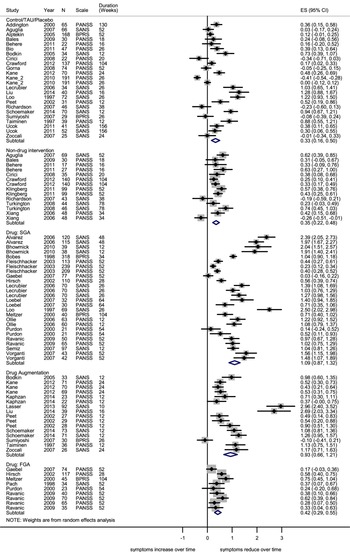
As indicated in the forest plot (see Fig. 2), in all five intervention types a significant reduction in negative symptoms was found between the baseline and the follow-up assessment stage. Large effect sizes (ES) were detected in second-generation antipsychotics [ES = 1.09, 95% confidence interval (CI) 0.86–1.32, I 2 = 95.5%] and the adjunctive medication (ES = 0.97, 95% CI 0.68–1.26, I 2 = 91.7%) arms, while a small effect size was noted in the placebo/TAU group (ES = 0.33, 95% CI 0.17–0.49, I 2 = 91.8%).
Forest plot of the change in negative symptoms, by intervention type.

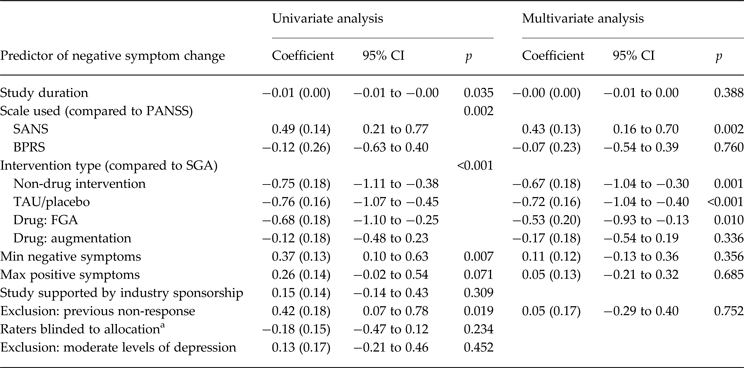
Next, a series of meta-regressions were conducted. In the univariate analyses the scale used, intervention type, study duration, and a minimum negative symptoms inclusion criterion were all associated with negative symptom change heterogeneity (see Table 2). A maximum level of positive symptoms and previous non-response to treatment as exclusion criteria were found to approach significance (p < 0.10), while other variables were non-significant. In the multivariate model, only the type of scale used and the type of intervention received remained significant. Studies which used the SANS found a significantly greater reduction in negative symptoms relative to those that used the PANSS (SANS: ES = 1.02, 95% CI 0.77–1.28; PANSS: ES = 0.66, 95% CI 0.56–0.77). Collectively, the scale used and the intervention type accounted for 43.65% of the variance. In a sensitivity analysis, the sample-level baseline negative symptoms were added to the model which was found to be a significant predictor (B = 0.01, s.e. = 0.00, 95% CI 0.00–0.02). However, the additional variance explained was relatively small (4.10%).
Univariate and multivariate meta-regressions examining the heterogeneity of negative symptom change

CI, Confidence interval; PANSS, Positive and Negative Syndrome Scale; SANS, Scale to Assess Negative Symptoms; BPRS, Brief Psychiatric Rating Scale; SGA, second-generation antipsychotic; TAU, treatment as usual; FGA, first-generation antipsychotic.
Values within parentheses are standard errors.
a One study not included due to lack of data.
Although many of the studies evaluated extra-pyramidal symptoms (EPS) as part of their analysis (53.7%), only three studies specified an EPS maximum threshold as an exclusion criterion (Klingberg et al. Reference Klingberg, Wolwer, Engel, Wittorf, Herrlich, Meisner, Buchkremer and Wiedemann2011; Lasser et al. Reference Lasser, Dirks, Nasrallah, Kirsch, Gao, Pucci, Knesevich and Lindenmayer2013; Schoemaker et al. Reference Schoemaker, Jansen, Schipper and Szegedi2014). Given the lack of data, this was not included in the meta-regression analysis. Of those studies that did report EPS, they were generally considered to be in the low range at study intake, suggesting that the impact of EPS on negative symptoms was likely to be minimal.
Given the finding that second-generation antipsychotics and adjunctive medication arms resulted in much larger effect sizes than other treatment types, contrary to our expectations based on the existing literature (i.e. Leucht et al. Reference Leucht, Arbter, Engel, Kissling and Davis2009; Arango et al. Reference Arango, Garibaldi and Marder2013), the TAU and placebo control arms that they were compared to were explored in more depth. A substantially larger effect size was detected in TAU/placebo control arms which were part of the drugs trials, in comparison to those that were not (ES = 0.67, 95% CI 0.41–0.93, in comparison to ES = 0.15, 95% CI 0.04–0.25). In a subsequent meta-regression this difference was found not to be attributable to either higher negative symptoms at baseline, or the type of assessment tool used, which were significant predictors in the full model.
Examination of individual negative symptoms
In 18 samples over nine studies the change in individual negative symptoms were also reported (see Table 1). Seven studies used the SANS as the rating tool, while two used the PANSS. Scores from different scales were combined using the method proposed by Lyne and colleagues (Reference Lyne, Kinsella and O'Donoghue2012). A significant reduction was found in all four of the symptoms measured (affective blunting, alogia, avolition-apathy, anhedonia-asociality). Of the four, alogia appeared to reduce the least (ES = 0.64, 95% CI 0.45–0.83) and avolition-apathy the most (ES = 0.77, 95% CI 0.53–1.01); however, the difference between the items appeared minimal.
Eligible studies not pooled into the main analysis
Eight studies were found to be eligible, but could not be included in the main analysis (see Table 1). In line with the main results, 11 samples found some form of reduction in negative symptoms from baseline to end of study, five saw no change, and in two the change was not specified.
Discussion
Main results
The meta-analysis provided a clear result; negative symptoms of schizophrenia tend to improve significantly in an outpatient setting. A reduction in negative symptoms found across all intervention types, with the effect sizes ranging from small to large. A significant reduction was found in all four of the separate negative symptoms examined, covering both experiential and expressive features of the disorder. While substantial heterogeneity was present in the sample, a series of planned meta-regressions indicated that there was no difference in the reduction between studies which did and did not exclude participants with higher levels of positive or depressive symptoms. In addition, study-level methodological differences such as whether assessors were blinded, the symptom eligibility criteria, or whether the study received industry sponsorship did also not appear to influence the result.
Strengths and limitations
One of the main strengths of the study is that, despite the broad range of study interventions considered, the findings are consistent. Of the 89 study arms included, only one found a clear significant increase in symptoms. In this case, the sample was part of a continuation study where patients who had previously responded well to their SGA medication were then switched to a placebo (Kane et al. Reference Kane, Mackle, Snow-Adami, Zhao, Szegedi and Panagides2011). In addition, when testing for the effect of regression to the mean, adding baseline negative symptoms to the multivariate model appeared to add relatively little additional explanatory power of the variance (4.1%), suggesting the findings are relatively robust. A further strength of this study is that despite the broad study inclusion criteria, removing samples which included inpatients at baseline, and other psychotic diagnoses, meant the participant inclusion criteria were relatively stringent in comparison to other observational studies that have looked at how negative symptoms change over time (i.e. Pogue-Geile & Harrow, Reference Pogue-Geile and Harrow1985; Fenton & McGlashan, Reference Fenton and McGlashan1991; Dollfus & Petit, Reference Dollfus and Petit1995; Eaton et al. Reference Eaton, Thara, Federman, Melton and Liang1995). When testing for heterogeneity, no difference in the effect size was detected between studies which excluded participants with elevated positive and depressive symptoms, which suggests the change unlikely to be attributable to a reduction in these factors which can induce secondary negative symptoms.
One limitation of the study is that because of the variance estimation method adopted a number of studies were excluded due being too small. However, given there is evidence to suggest that smaller studies can often present larger effect sizes (i.e. Zhang et al. Reference Zhang, Xu and Ni2013), our findings may have led to a more conservative estimate of the effect size. Another limitation is that, despite the number of studies included in the analysis (n = 41), the final sample of 5944 patients was smaller than what was anticipated. This was due to a number of the larger studies either containing inpatients (Lieberman et al. Reference Lieberman, Stroup, McEvoy, Swartz, Rosenheck, Perkins, Keefe, Davis, Davis, Lebowitz, Severe and Hsiao2005), not using a validated negative symptoms scale (Dossenbach et al. Reference Dossenbach, Erol, Kessaci, Shaheen, Sunbol, Boland, Hodge, O'Halloran and Bitter2004), or including patients with other psychotic disorders.
Another important issue to consider is that it is difficult to assess to what extent the reduction in severity is attributable to improvements in primary or secondary negative symptoms. However, difficulties making this distinction in research trials is not new (Buchanan, Reference Buchanan2007), and the consensus statement suggests that such a distinction is not essential in trials as long as the symptoms are persistent and causes of secondary negative symptoms are adequately controlled for (Kirkpatrick et al. Reference Kirkpatrick, Fenton, Carpenter and Marder2006). In this analysis, the eligible studies typically reported participants as being highly chronic in nature, reflected in the large median duration of illness (12.4 years), and many defined their sample as treatment-resistant, stable, non-acute, or in a maintenance period. Regarding whether secondary negative symptoms can be adequately controlled for using study-level inclusion/exclusion criteria in a meta-regression of the heterogeneity present in a meta-analysis, this is also up for debate. However, despite these issues the high consistency of the directional change in negative symptoms in an outpatient sample, and the fact that there was no difference in this change between studies which did and did not control for factors which induce secondary negative symptoms does suggest that the improvement appears to occur to a greater extent to what was previously assumed. Further work examining the longitudinal course of negative symptoms in a study with clearly defined inclusion criteria relating to the persistence of negative symptoms, with appropriate controls for secondary negative symptoms, would provide stronger evidence for whether primary negative symptoms of the disorder are less stable than previously assumed.
Another limitation is that due to the substantial heterogeneity of the study designs, the fact that multiple arms of single studies were included which would naturally cluster together, and possible issues relating to the regression of the mean complicating the interpretation further, it was recognized that conducting an examination of publication bias important in typical meta-analytical studies (Higgins & Green, 2011) would have limited utility in this context. This being the case, such analysis was omitted so we cannot be certain as to whether publication bias influenced the results significantly. However, given a number of the studies were non-inferiority trials, dose–response studies, observational studies, and that control arms were used in this study as equivalent to experimental conditions, it would be unlikely that any publication bias would systematically inflate the overall effect sizes in the same manner as would typically be expected in a normal meta-analysis.
Finally, due to the lack of data, no-medication as a therapeutic option could not be evaluated, meaning it is not clear whether a reduction in negative symptoms would also occur in non-medicated patients. It is possible, however, that such an improvement could occur given there is some evidence to suggest that patients who do not immediately relapse upon termination of their antipsychotic regimen may experience improved global functioning over time (Harrow & Jobe, Reference Harrow and Jobe2007).
Interpretation
These findings are contrary both to the earliest conceptions of schizophrenia, which suggested that negative symptoms follow a path of progressive deterioration (Bleuler, 1951; Kraepelin, Reference Kraepelin, Barclay and Robertson1971), and our current understanding of negative symptoms which suggest that they are highly stable in the non-acute phase (Möller, Reference Möller2007). While acknowledging that the improvement in negative symptoms were relatively small in the TAU, non-drug intervention arms and typical antipsychotic study arms, the improvement of negative symptoms over time appear to lend support to the recovery model of schizophrenia, particularly given the relationship of these symptoms to psychosocial functioning (Norman et al. Reference Norman, Malla, Mclean, Voruganti, Cortese, Mcintosh, Cheng and Rickwood2000; Warner, 2009).
Given the limitations of the within-group design, the effect sizes presented cannot be used as an assessment on the effectiveness of any one treatment. As highlighted earlier, a series of meta-analyses have been conducted to evaluate treatments for schizophrenia using more appropriate designs (i.e. Kurtz & Mueser, Reference Kurtz and Mueser2008; Leucht et al. Reference Leucht, Arbter, Engel, Kissling and Davis2009; Jauhar et al. Reference Jauhar, Mckenna, Radua, Fung, Salvador and Laws2014). Overall, these reviews have detected relatively limited treatment benefits for negative symptoms, contrasting with the large within-group effect sizes noted here in the example of second-generation antipsychotic and adjunctive drug medication trials. Further investigation into the TAU and placebo study arms indicate that the effect sizes of drug study control arms are substantially larger than non-drug study controls , which suggest there is something inherent in the methodologies employed which makes these drug studies more likely to detect and report symptoms improvements. Many drug studies used placebo, as opposed to TAU, so a placebo effect may account for at least part of this difference. However, while it has been noted that the placebo effect is an increasing issue in schizophrenia drug trials (Kinon et al. Reference Kinon, Potts and Watson2011), given the effect size differences between drug and non-drug studies are so large (ES = 0.67, in comparison to ES = 0.15) it suggests that other factors inherent to the design and assessment may also be important. Regardless, the highly varied nature and outcomes study arms which fall under the heading of TAU and placebos merits further investigation.
Disentangling how regression to the mean issue relates to negative symptoms in an exclusively outpatient sample is complex issue worthy of further consideration. Higher mean levels of negative symptoms at baseline did predict a greater reduction. However, the additional proportion of the variance explained over and above the intervention type and assessment scale used was fairly small (4.1%), suggesting that the regression to the mean may not be as large as one might typically expect. This could be due to a number of factors. First, primary negative symptoms are thought to be highly stable (Möller et al. Reference Möller2007) so it is perhaps unlikely that a substantial fluctuation around the mean level of symptoms over time would be expected, presuming secondary factors are appropriately considered. Second, by omitting samples which contained inpatients at baseline (but not necessarily at study end), the patients were a lot less likely to have been recruited during their most severe phase of their disorder, further minimizing the regression to the mean effect (Morton & Torgerson, Reference Morton and Torgerson2003).
When testing for sources of heterogeneity in the course of negative symptoms, only the impact of assessment scale type remained significant, after controlling for intervention type. In comparison to studies which used the PANSS or the BPRS, a significantly greater change in negative symptoms was detected in studies that used the SANS. The finding that the SANS is a more sensitive instrument to detect change is in line with recommendations outlined in the MATRICS consensus statement (Kirkpatrick et al. Reference Kirkpatrick, Fenton, Carpenter and Marder2006) and is perhaps unsurprising given the scales focus on negative symptoms, despite the conceptual and methodological issues that the scale is recognized to have (Blanchard et al. Reference Blanchard, Kring, Horan and Gur2011). No eligible studies used either the Clinical Assessment Interview for Negative Symptoms (Horan et al. Reference Horan, Kring, Gur, Reise and Blanchard2011) or the Brief Negative Symptom Scale (Strauss et al. Reference Strauss, Keller, Buchanan, Gold, Fischer, Mcmahon, Catalano, Culbreth, Carpenter and Kirkpatrick2012), therefore it is unknown how these new scales compare.
Understanding how negative symptoms change over time requires further attention given the duration between time points was not found to be a significant predictor. However, with the considerable variability in treatment duration, post-treatment follow-up duration, and post-treatment provision between studies, this is perhaps not surprising. In longitudinal studies assessing negative symptoms over very long periods of time, there has been little evidence of a linear improvement towards symptom remission (Strauss et al. Reference Strauss, Harrow, Grossman and Rosen2010), while the rate of recovery in schizophrenia remains low (Jääskeläinen et al. Reference Jääskeläinen, Juola, Hirvonen, McGrath, Saha, Isohanni, Veijola and Miettunen2013). Overall, this suggests that the trajectory of this improvement may be complex. One possible explanation of the improvement uncovered could be the non-specific effects of increased attention derived from being involved in research. Patients with prominent negative symptoms are typically very socially isolated, so increased contact time with researchers in itself may provide some therapeutic benefit.
Conclusions
Based on the available data of almost 6000 outpatients, negative symptoms of schizophrenia do not tend to be stable or deteriorate, but are instead likely to improve over time. This finding offers a further critique of the historical argument which suggests schizophrenia is a disorder of continual decline (Bleuler, Reference Bleuler1950; Kraepelin, Reference Kraepelin, Barclay and Robertson1971) and instead provides further support to the recovery model of schizophrenia (Warner, 2009). Overall, these findings suggest that negative symptoms may not be as resistant to change as what has previously been assumed, and perhaps offer new hope to those who may experience such symptoms.
Acknowledgements
The authors thank Dr Stephen Bremer for statistical advice. This research received no specific grant from any funding agency, commercial or not-for-profit sectors.
Declaration of Interest
None.