Introduction
Malta attained independence from Britain on 21 September 1964.Footnote 1 The post-independence years were characterised by a boom in the building industry, mainly through the building of more hotels to cater for a flourishing tourism industry, new primary and secondary schools in towns and villages and industrial estates for a growing manufacturing industry, as well as the building of a new university campus (Thake Reference Thake2014, pp. 89–90). All of this occurred in parallel with the setting up in 1967 of the Moviment Qawmien Letterarju (‘Literary Revival Movement’). The movement traced its inception to a group of university students, budding poets, journalists and writers who met at cafes in Valletta, Malta's capital, to socialise as well as to discuss their aspirations for an independent Malta and share their literary works. Eventually, the movement started organising literary and musical Beat & Literature evenings in village squares and town halls, as well as on beaches, bastions, hotels and even in catacombs (Fenech Reference Fenech2005, p. 33). As such, the movement offered a platform for young Maltese writers to make their writing known. Such literature contrasted sharply with the widely diffused poems of local traditional poets whose verses were imbued with imitations and the rigid formalism of 19th century Italian traditional romanticism (Friggieri Reference Friggieri1986, p. 210).
In most romantic Maltese poetry, Malta assumes the role of the nation-mother who protects her children (or citizens) against all odds and whose children in turn have to be loyal and defend her with all their might, as was done before by the nation's ancestors and national heroes. These had shed their blood against powerful aggressors who over the years attacked this small Mediterranean island and its nation. Nation is mostly understood here as an ‘imagined community’ (Anderson Reference Anderson2016) embracing broadly shared views of its own history, culture and worldviews as well as habits of thought and practice. This becomes possible through ‘government-directed mass public education and laws, as well as attitudes encouraged by governments through the mass media’ (Turino Reference Turino2008, p. 117). In the context of this rather tight definition, the patriotic verses of the romantic Maltese poets remained prominent and uncontested in the Maltese curriculum. At the same time, members of the Moviment Qawmien Letterarju challenged local romantic views of the nation and its history, opposed conformity and aspired to a re-evaluation of various aspects of Maltese life, as well as questioning human existence and, in some cases, even doubting the value of Malta's independence when the island was still serving as a military base. Most of this was inspired by the contemporary international literature of that time as well as by the upheavals brought about by the counterculture and civil rights protests of the 1960s, the Vietnam War and anti-war protests, political assassinations and the emerging ‘generation gap’.
At the same time, a beat group of young Maltese musicians, composed of a drummer and bass, rhythm and lead guitars led by their lead singer and guitarist Freddie Portelli, was set up in 1963 in the fishing village of St Paul's Bay. Initially, the band was called The Bums but later it became known as The Malta Bums. The band was another addition to the many bands with the same line-up which were flourishing in Malta at that time. This was occurring within a local popular music activity which was still taken up by jazz bands playing in the entertainment venues of Strait Street, Valletta's red light district, at Pjazza Reġina (Queen's Square), another open-air entertaining venue in the capital, and on local TV and Rediffusion (as the local cable radio was known). Nevertheless, it did not take long for Portelli's band to start performing in public and gain considerable fame both locally and abroad. The release of their 1967 record ‘Viva Malta’ gained an unprecedented following and brought them huge fame.Footnote 2 This occurred at a time when most Maltese were still toying with the acquisition of independence and the realisation of Malta as an independent nation. The band were invited several times by the Moviment Qawmien Letterarju to perform at events organised by the movement in an attempt to attract more youths (Bonello et al. Reference Bonello, Vella and Parsons2018, pp. 50–51).
The 7-inch vinyl record (that included on its side B a song called ‘That's All I Know’, which never gained popularity) was sold in thousands both locally and internationally, mostly among Maltese immigrant communities in Canada, Australia, the USA and Britain. Indeed, many Maltese have come to regard this classic song as their own ‘unofficial’ national anthem (The Sunday Times of Malta 2018, p. 42). The song is regularly aired on local radio and TV and played at political mass meetings and at international events where Malta is represented, as well as at wedding receptions. Over the years, it has been arranged in different versions, including one in which local singers and personalities came together virtually to express national solidarity and unity in the face of the social and economic challenges brought about by the Covid-19 pandemic.Footnote 3
This article analyses this song in its historical, cultural and social context. It discusses how and why it became so popular at that time and is still popular nowadays. For that purpose, it scrutinises its music and lyrics, as well as its production process and how each one of these built on the familiar to convey sentiments of national unity which transpire as central to the national loyalty the lyrics call for. Here, the familiar in the different forms it takes participates in conveying sentiments of national unity and belonging as well as further connecting the local with the global. Although this is a case study concerning one particular song in a particular locality, the discussion that unfolds here should serve both to provide another exemplar of a postcolonial song which over time has generated unremitting national fervour and transpired as resilient to time and to amplify the value of the familiar in its diverse forms to aid in conveying unity and belonging in a patriotic postcolonial track such as ‘Viva Malta’. This article also aims to contribute to the study of music and national identity in the context of postcolonial music studies more broadly. Moreover, it aims to build further on the few existing studies on modern popular music in Malta that include works such as those by D'Anastas (Reference D'Anastas2011) and Ciantar (Reference Ciantar2021) as well as contributions in the local press (see, for instance, Montfort Reference Montfort1995).
For this purpose, the present paper is divided into four sections. The first section will focus on Malta in the post-independence years up until the 1971 General Election when the Nationalist Party, who had negotiated independence with Britain, was bowled out of power by the Malta Labour Party. This overview will then dovetail to the cultural life in Malta of that time with special attention to social and cultural changes and how these paralleled developments in local popular music more specifically. The discussion here aims to provide an adequate frame of reference for the analysis and discussion which will unfold in the third and fourth sections. The second section will focus on The Malta Bums as well as on the inception and diffusion of ‘Viva Malta’ both locally and abroad. The third section will then scrutinise the three components of the song, namely, the lyrics and the music, as well as its production. The production aspect is essential here and should also be kept in view, as rightly observed by Peter Wicke (Reference Wicke and Scott2009, p. 150), who argued that in ‘popular music, the audio-technical and the musical became so dependent on each other through the mass production of records that it is no longer possible to have an understanding of musical development without keeping both sides simultaneously in view’. The analysis of the third section will then be extended in the fourth section through a focus on the potential of the familiar in the various shapes it takes to enhance sentiments of national unity and bonding. Apart from relying on relevant literature and the analysis of the 1967 track version the present analysis was made further possible through an interview with Freddie Portelli as the then leader and lead singer of The Malta Bums and personal communication which followed.Footnote 4 Until indicated otherwise, all data regarding The Malta Bums and the track in question relies on the interview and personal communication with Portelli.
Malta (1964–1971): socio-political life and popular music
Malta was part of the British Empire for over 150 years before it became independent in 1964. During this time, the Maltese fought the Second World War alongside the British military and its allies based in Malta.Footnote 5 As already noted previously, after its independence Malta experienced considerable changes in various aspects of its economic, socio-political and cultural life. Owing to the challenges brought about by independence that had seen Malta shift from colonialism to statehood, the years 1964–1971 marked a crucial period for an independent government which had to assume further governmental and economic responsibilities which previously were within the remit of the British Crown (Jones Reference Jones1989, p. 262). The changes were considerable even though these paralleled some continuities.
The first fundamental change that Malta experienced following independence was the shift from a fortress colony to an independent sovereign state.Footnote 6 This meant that the island had to start assuming control not only over its economy and governance but also over its defence and foreign policy. Such responsibilities started being taken up at the same time that British defence facilities and personnel were still on the island occupying exclusive zones inaccessible to the Maltese. Indeed, this British military presence was a condition included in the defence treaty negotiated as part of the island's independence, which agreement was renegotiated in 1972 and extended to March 1979, when the Royal Navy left Malta permanently. Following its independence, Malta, like Canada, Australia and other countries in the Commonwealth, continued to have a British Governor-General representing the Queen as the Head of State up until 1974, when the island became a Republic with its own President.
From an economic point of view, the early post-independence years meant the urgent need for the diversification of the island's economy which up until that time was largely dependent on the activity and the large-scale spending of the British military and the hiring of Malta as a naval base (Alshinawi Reference Alshinawi2014, p. 19). This economic diversification commenced in earnest and included work to establish tourism, agriculture and manufacturing industry as the economic pillars. This was complemented by extensive infrastructural and administrative projects that could assist Malta to function independently as a state. These included, for instance, the setting up of a Central Bank, a development corporation and a polytechnic, and the upgrading in 1965 of a power station to meet the increasing demand for electricity generated by this development. This also meant an effort on part of the post-independence government to change the island's image from ‘a mere fortress and naval yard to a country famous for its rich historical past and its ideal advantages, such as its Mediterranean climate and crystal clear waters to attract tourists’ (Jones Reference Jones1989, p. 262). Tourism, along with developments in local broadcasting, exposed the country more to the outside world.
In the 1960s, various local branches of British companies such as Redifussion were allowed to continue with their local operations in Malta more or less freely, although in consultation with the government and subject to institutional safeguards such as the Malta Broadcasting Authority, which was entrenched in the Maltese Independence constitution. It was during this time that new Maltese-language programmes on the Rediffusion B Network increased considerably (Sant Reference Sant2016, p. 12). Whilst the programme schedule of the A Network contained programmes from Britain, the USA, Switzerland, Germany and other countries the B Network was purely national (The Sunday Times of Malta 1968, p. 24). Such programmes sought both to promote Malta's culture and to elevate the status of the Maltese language in both its spoken and literary forms. Although Maltese was entrenched in the 1964 Independence constitution as Malta's national and official language, along with English as the other official language, its value as a useful language for professional and technical purposes remained belittled, especially among Maltese from the learned classes. Broadcasts on the national radio of readings of traditional romantic Maltese literary works were aired in parallel with live broadcasts of poetry and music events held by the Moviment Qawmien Letterarju (Sant Reference Sant2016, p. 148). Efforts such as these mainly aimed to uplift the status of the Maltese language, central to the shaping of Maltese national community, while, at the same time, make local broadcasting sound more national. Moreover, the use of Maltese aimed at contributing to the breakdown of the cultural and linguistic colonial hegemony of English.
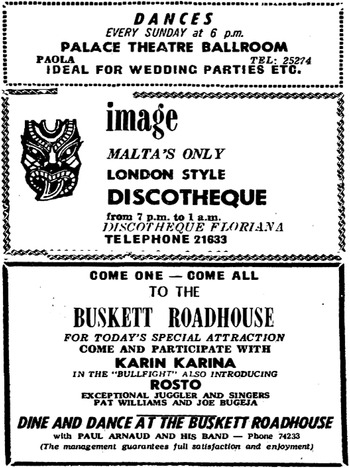
In these same years, the participation of Maltese musicians performing live on Redifussion increased considerably (Sant Reference Sant2016, p. 100).Footnote 7 The musicians taking part in these live programmes were well-known local musicians who at that time were also active with their big bands in entertainment venues such as those in Valletta's Strait Street and Pjazza Reġina, referred to previously. Other performing opportunities for these bands were further extended through their appearance in shows produced on local TV when this was eventually introduced in Malta in 1962.Footnote 8 The airing of local and international popular music on Redifussion and Television Malta was further complemented by the involvement of more local DJs in daily radio programmes and breakfast shows. International popular music aired during these programmes mostly came from the music market, which was dominated by Anglo-American artists such as Elvis and Motown music and, from the other side of the ocean, by The Beatles. To these, one may also add songs from neighbouring Italy, especially those from the Sanremo festival which reached local viewership through RAI, which at that time was the only available international television channel in Malta. The influence of Sanremo on Maltese popular music was considerable in terms of both song writing and arranging. Sanremo also served as a model for the organisation of local song festivals, so much so that the very use of the term ‘festival’ in local song contests can be attributed to the use of the term by the Italian media in its reference to the Sanremo Festival (Mamo Reference Mamo2017, p. 16). Moreover, in the 1960s, one notes in Malta a sharp increase in new nightspots opening up, such as dance halls, restaurants, nightclubs and discotheques (see, for instance, Figure 1). This was intended to meet the increasing demands of a growing tourism sector and entertainment industry. Simultaneously, nightspots such as these brought more Maltese youths from diverse educational and social backgrounds into contact in the context of a fast-changing Malta.
Three adverts of entertainment spots featuring on the same page in The Sunday Times of Malta of 13 April 1969 (p.20), used with permission of the Times of Malta.

The Malta Bums and ‘Viva Malta’
In 1963, the same year that Martin Luther King Jr delivered his famous ‘I Have a Dream’ speech and US President John F. Kennedy was assassinated, the 22-year-old Freddie Portelli was setting up a beat group in St Paul's Bay, his hometown. After some initial difficulties that, for instance, saw a band member emigrating to Australia and another dropping out owing to work commitments, the band settled down with Portelli himself as lead singer and guitarist Tony Muscat (‘il-Maduwi’) on rhythm guitar, Tony Camilleri (‘il-Bayzo’) on bass guitar and Tony Bartolo (‘il-Gigu’) on drums. The band was modelled on the Beat group bands at that time such as The Shadows, The Beatles and The Yardbirds, with all members sharing the backing vocals. Other Maltese groups from that time which adopted the same line-up were The Followers, The Echoes and The Northbeats. The Malta Bums was very keen to establish good teamwork. This was manifested, for instance, in the way individual members of the group shared in the harmonised backing vocals most typical at that time in the music of 1960s Motown groups such as Martha and the Vandellas and The Temptations. Indeed, good harmonised backing vocals were central to the band as attested by Portelli himself in a 1995 interview: ‘We may not have been the first pop band but we did put an accent on harmony in our styles’ (Montfort Reference Montfort1995, p. 23).
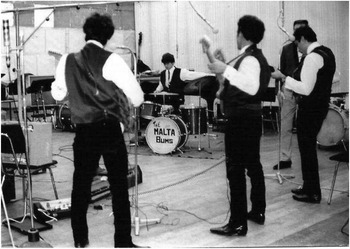
Initially, their rehearsal sessions at a garage in St Paul's Bay were packed with youths. Once, a German tourist by the name of Herr Otto Alf, who happened to be passing by, stopped to listen to the band rehearsing and, eventually, continued to go there repeatedly. He envisaged so much potential in the band that he assumed the role of manager for the band and before he left Malta he invited them to make an all-expenses paid 20 day visit to Germany, which the band accepted. Indeed, it was during this visit in Germany that Otto Alf named the band The Malta Bums, which in German meant ‘The Malta Bang’. When in Germany, that is in 1966, the band was invited to perform at Radio Köln (see Figure 2) and, eventually, on TV Köln on condition of singing a song in Maltese. The band relied on Portelli to compose the song but until a day before filming the song was still not composed as he forgot to do it! In order to make up for his negligence, and in light of the urgency and the importance of the song for their filming the following day, Portelli picked up a cigarette packet lying under a table and started scribbling the lyrics of ‘Viva Malta’ in pencil. The lyrics, as he asserted, were inspired by his sentiments of that moment being away from his own country. Actually, this was the first time that Portelli had written a song in Maltese as the songs which he had previously written were in English. According to him, this was in part an effort to meet the request by TV Köln to sing in Maltese and partly an expression of his wistful longing for home. Indeed, the music of ‘Viva Malta’ was based on motifs and harmonic progressions that originally he had planned for a song in English but which, he thought, could fit this one well. A few minutes later the lyrics were completed and Portelli picked up the guitar and matched the music he had in mind to his Maltese lyrics. According to Portelli, this initial draft was so well received by the other members that they started rehearsing it at once.
The Malta Bums at Radio Köln in 1966, used with permission of Freddie Portelli.

The following day a crew from TV Köln turned up to their place for the filming; however, since the song was new and they had not enough time to rehearse it, they made a lot of mistakes, so much so that at one point the producer lost his patience and ordered the crew to leave. Then he turned to Freddie and told him, ‘Mr Portelli, here's not Malta. Here every minute costs money!’ This led Portelli and his band to realise the seriousness of this production and they apologised to the producer while redoubling their efforts to get it right.
Eventually, the song was very well received by the TV audiences, to the extent that when they were still in Germany Portelli received a phone call from Otto Alf informing him that TV Köln had told him that owing to the strong response they had got from their TV viewers the station had decided to broadcast the song more often than originally scheduled. The success of ‘Viva Malta’ on TV Köln brought The Malta Bums more opportunities to perform live in Germany. Indeed, their stay there was eventually extended from a mere 20 days to 6 months.
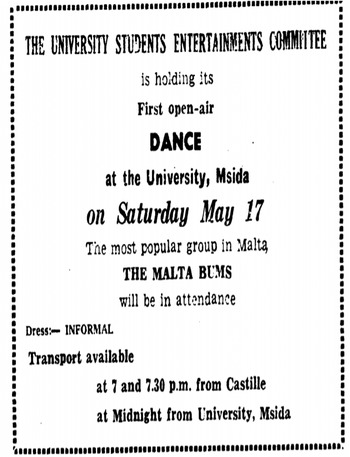
Back in Malta in 1967, ‘Viva Malta’ was recorded in a local recording studio and released on a 45 rpm vinyl record which sold widely both locally and internationally.Footnote 9 It also received regular airing on the local radio that further increased its popularity and, consequently, that of The Malta Bums. The local success of the song made the band one of the top bands in Malta at that time with increased public live shows (see, for instance, Figure 3) and events such as those organised by the Moviment Qawmien Letterarju, as explained earlier. As Charles Flores, a cofounder of the movement told us: ‘I am pretty sure we had many people coming over to listen to some of the new poetry only because they wanted to watch The Malta Bums rampaging out a live version of ‘Viva Malta’ (personal communication, 28 June 2021).
An Advert in the Times of Malta of 15 May 1969 (p. 20) attesting to the local popularity of The Malta Bums, used with permission of the Times of Malta.

‘Viva Malta’: lyrics, music and production
Internationally, the 1960s represent an age marked by the development of countless popular musical styles and genres which have all paved the way for the musical diversity enjoyed today. Anglo-American music led to the foundations of rock music, the so-called British invasion. The decade was also characterised by the development of a number of musical forms such as Motown, R&B, soul, funk and pop-rock. All this led musicians from all over the world to develop their own styles which they felt most appropriate for their own cultures (Wallis and Malm Reference Wallis, Malm, Frith and Goodwin2006, p. 149). During almost 10 years of mimicking the great artists such as The Beatles and Elvis Presley, musicians in small countries had attempted to create their own national versions of popular music (Wallis and Malm Reference Wallis, Malm, Frith and Goodwin2006). In this regard, for instance, Motti Regev (Reference Regev2013) notes how pop-rock emerged in the USA and Britain in the 1950s and subsequently spread globally. In the process, it absorbed local inflections from whichever location it found itself in. This led to pop-rock being invested with expressions of revalued/rediscovered national identity particular to each of these locations yet becoming cosmopolitan and world-embracing at the same time. The local adaptation of international musical styles could not have been bettered except through more reliance on songs in the native language. Hence, a major development in the 1960s was singing in one's own language as it added a new and stronger communicative aspect to the channel between performers and listeners (Wallis and Malm Reference Wallis, Malm, Frith and Goodwin2006, p. 149). This was precisely what happened in Malta through songs in Maltese produced by The Malta Bums and others who modelled their compositions on the widely diffused styles of that time. Framing the use of the mother tongue in such songs within Jürgen Habermas's theory of communicative action, the potential for social cohesion embodied in language use in the context of a shared culture gains a central position here. Habermas notes how questions of identity are connected to action aimed at reaching understanding because ‘in coming to an understanding about something in the world, actors are at the same time taking part in interactions through which they develop, confirm and renew their membership in social groups and their own identities’ (Habermas Reference Habermas1987, p. 139). Through the use of the Maltese language, ‘Viva Malta’ invites citizens not only to value the beauty and history of their island, but also to express loyalty to their country and, most importantly, to attain the much-needed unity (see lyrics below).Footnote 10 That was needed both to heal divisions of the past as well as to face the challenging years ahead as an independent nation. In principle, the imagined community could not progress without being united. The song highlights the centrality of national unity in a nation mired in significant fissures some of which still current.Footnote 11 The politico-religious conflict of the early 1960s between the Maltese Catholic Church and the Malta Labour Party, for instance, triggered a lot of rifts and pain that continued to be felt even after the 1969 reconciliation between the two sides.Footnote 12 Other divisions pertained to social class and the interest of the elites in safeguarding their status quo and distinguishing themselves from the populace. Social divisions were, and to some extent still are, manifested linguistically with, for instance, sectors of the upper class adopting first Italian and then English as their main language. This resulted in the downgrading of Maltese, being labelled by the privileged class as ‘the kitchen language’. Fissures that continue until today include those of partisan politics and the allegiance of most Maltese to one of the main political parties. To these one may also add parochial divisions generated by the rivalry between band clubs within the same town or village. In this complex social and political scenario, ‘Viva Malta’ calls the Maltese to come together and commit themselves faithfully to their island. In this regard, Portelli pointed out to us that the lyrics of ‘Viva Malta’ make no reference to partisan politics or denominations: ‘“Viva Malta” rises above all this. It urges the Maltese to forget all about what divides them and instead focus more on what unites them’ (personal communication, 24 June 2021).
The first verse of the verse–chorus form in ‘Viva Malta’ depicts the island's natural beauty, highlights the bravery of its inhabitants and evokes its uniqueness that makes it stand out in the world. Expanding further on the bravery of the Maltese, the second verse recalls the battles and wars that the nation had fought courageously in its own defence and exalts the strong and impenetrable bastions that served to shield the nation from the fierceness of foreign enemies. Here, the transformation of ordinary language into an intense and vital language is supported by ‘a judicious reference to local history and geography’ (Moore Reference Moore2012, p. 110). Indeed, such referencing is augmented by the call to loyalty that becomes central to a chorus which diverts listeners for a while from the environmental and historical descriptions of the two verses. Nevertheless, both verses build on a common semantic frame understood here as the ‘necessary context for understanding any word, whose meaning cannot exhaustively be given in dictionary fashion’ (Moore Reference Moore2012, p. 111). Such a semantic frame is only hinted at, as if listeners, as members of this imagined community, are somehow ‘in the know’ (Moore Reference Moore2012, p. 111). The cognizant listener of ‘Viva Malta’ is craftily urged to refer to this common knowledge in order to make sense of the lyrics and enrich them with feelings. The process becomes intriguing as it gives the listener the opportunity to shape his/her own feelings which are personal as much as communal and, hence, broader. In relation to this, Verse 1 refers to the land of the brave without specifying who these brave people are. They could be the Maltese as a nation or perhaps prominent historical heroes that all students in Malta encounter in their history books or even whether the listener or any of his/her ancestors. Moreover, the reference to ‘din l-art ħelwa’ (‘this fair land’) in Verse 1 is a direct allusion to the Maltese national anthem, whose first line includes these same words.Footnote 13
The same lack of specificity experienced in Verse 1 reappears in the second verse when the song refers to battles and wars. We are left rather perplexed here as to which of these battles and wars the lyrics allude to, whether it is the 1565 Great Siege of Malta when the nation, along with the Knights of St John, battled for months against the Ottoman Empire, or whether it is the Second World War that the country was strongly involved in, or even, in a more current reading, the struggle of the nation against the Covid-19 pandemic, repeatedly referred to both locally and internationally as a global battle. Here, the native listener is given ample space to interpret and reinterpret all this on the basis of his/her own knowledge, life experience, changing world views and current situations. This ‘hinted at’ approach invites listeners to engage more actively in the moulding of meanings as well as to perceive a way of reconciling the personal with the communal, the past with the present and nostalgia with actual action. In a rather more direct tone, the chorus urges citizens to do everything possible for their homeland and to do it from their heart because this is their country. The question one may feel being inferred in the chorus though may propose something like: ‘Why should the nation say “Viva Malta” and, more importantly, why should this nation do everything for it wholeheartedly?’

When understood as such, the question implied by the chorus is answered gradually and craftily in the verses. Each line in both verses provides added information to the previous one. Both verses capture the listeners’ imagination and curiosity as to where the song is heading. All of this is complemented and supported by a series of contrasts employed throughout to make the song sound more interesting, engaging and persuasive. For instance, the present tense of the first verse shifts to the past tense in the second as if the overall answer to the implied question of the chorus may be found in the present as much as in the island's past. The past tense as employed here, apart from justifying the loyalty called for in the chorus, celebrates national achievements. Other contrasts in the text include the sunshine depicted in Verse 1, which contrasts nicely with the wars and battles referred to in Verse 2. Further poetic devices employed aimed at adding more effectiveness to the lyrics include the use of the octosyllabic metre, rhyming, assonance and anadiplosis (that is, the reappearance of the last word in a line as the first word in the subsequent one). The use of anadiplosis with words such as ‘Malta’, ‘kollox’ and ‘art’ is fourfold: (a) it stretches nicely the logical progression of ideas across the lines; (b) it generates a pleasant rhythm aimed at easing the memorisation of the text; (c) it creates a sense of urgency, in this case, for loyalty and action; and (d) it adds an increased dose of persuasion to the text. It is also worth noting here that the octosyllabic metre is a commonly used metre in Maltese folk singing and, hence, it might have sounded familiar to local listeners and, consequently, made this song sound, somehow, more ‘Maltese’. The octosyllabic metre in both verses contrasts well with its lesser appearance in the chorus. It also matches well the a–a–b–b rhyme scheme employed in both verses as well as other devices such as the use of assonance to accelerate the musical effect of the lyrics with words such as ‘xemx’ and ‘m'hemmx’ and the frequent reiteration of the song title for both emphasis and coherency.
As explained earlier, the overall tone of the lyrics in ‘Viva Malta’ is fundamentally romantic, akin to the romanticism adopted in nationalistic poems of Maltese poets such as Gan Anton Vassallo (1817–1868), the national poet Dun Karm Psaila (1871–1961) and Rużar Briffa (1906–1963). For these and other Maltese romantic poets, ‘l-art’ (‘the land’), which is feminine in Maltese, takes the attributes of a mother who is gentle, kind, protective and willing to sacrifice herself in defence of her children. In contrast to the feminine land, the lyrics refer to the masculine figure of the hero who calls the Maltese to wake up and do something for their patria.
In ‘Viva Malta’, the motherland is depicted as charming, albeit resilient and protective. In turn, it is now up to its people to offer their heartfelt and faithful commitment and loyalty to her. Through a series of calls and responses in the chorus, the masculine and courageous hero distinguishes himself from the rest of the crowd.Footnote 14 He both calls the Maltese to render homage to their homeland by saying ‘Viva Malta’ as well as sounding their loyalty. In Verse 2, the personification of the motherland is intensified and attributed with the human qualities of seeing and resilience. The track becomes really intriguing the more the listener is engaged to explore the friction between this familiar romantic tone of the lyrics and the pop-rock style of the track which injects vitality and activity as much as ‘modernity’. By friction is meant here ‘the expectations listeners may bring to a track, on the basis of normative assumptions, and a track's frequent refusal to conform to those assumptions’ (Moore Reference Moore2012, p. 163).
In 1960s Malta, the notion of matching popular musical styles of that time like rock with romantic and patriotic lyrics might have sounded simultaneously innovative and incompatible, albeit fitting enough in events such as those of the Moviment Qawmien Letterarju. Such events aimed to serve as a platform for debating areas of tension (and links) between, on the one hand, ‘modernity’ as proposed by the present and its foresight and, on the other hand, the ‘traditional’ past with the nostalgia it conjures and makes one value. In ‘Viva Malta’ the past, its glories and the nostalgia that these evoke coexist in tension and relation with the ‘modernity’ proposed by the music and the technology it relies on for its transmission. Examples of tensions in popular music that in one way or another relate to national identity and its ambivalence are various. Cowie and Boehm (Reference Cowie and Boehm2006), for instance, note how the ‘patriotic’ chorus in Bruce Springsteen's song ‘Born in the USA’ released in 1984 contrasts with the desperate narrative of the verses and their description of a ‘working-class man’ left isolated from his own society, family and government and also ‘dwarfed by a sonic wall of nationalism’ (Cowie and Boehm Reference Cowie and Boehm2006, p. 376). Other examples include Nick Baxter-Moore's analysis of works by the Kinks and how the band represented English identity in the late 1960s and 1970s (Baxter-Moore Reference Baxter-Moore2006). Here, Baxter-Moore notes tensions between ‘English’ and ‘British’ identities, the identification with region and with nation, tradition and modernity as well as ‘realism’ and ‘nostalgia’ as represented in social class and class politics. On basis of the analysis of each, Baxter-Moore notes that, rather than preserving the past, the Kinks ‘reconstruct it for present use; they create alternative idealised versions of England – past and present, urban and rural, working class and aristocratic – which listeners may draw on in developing their own sense of identity’ (Baxter-Moore Reference Baxter-Moore2006, p. 162), in particular, when this is understood in terms of an imagined community. As with the expression of Englishness in songs by the Kinks in the 1960s, the Smiths in the 1980s and ‘Britpop’ bands in the 1990s, Malta's past and its previous glories as expressed in ‘Viva Malta’ transpire as ‘a treasure trove’ (Taylor, cited in Cloonan Reference Cloonan1997, p. 62). Conversely, as Martin Cloonan (Reference Cloonan1997, p. 63) rightly notes with reference to the dominant mode of nostalgia in pop Englishness: ‘harking back to a previous era excludes not only those who cannot remember it, but also those who have arrived in the country since then’. As already stated, the historical events referred to in ‘Viva Malta’ are backed up by the centrality of these in the transmission of the island's history in local education as well as in the teaching of Maltese language and literature which are both very historically oriented. Indeed, in the case of Malta this might have served to mitigate exclusion in the process of referring back in history.
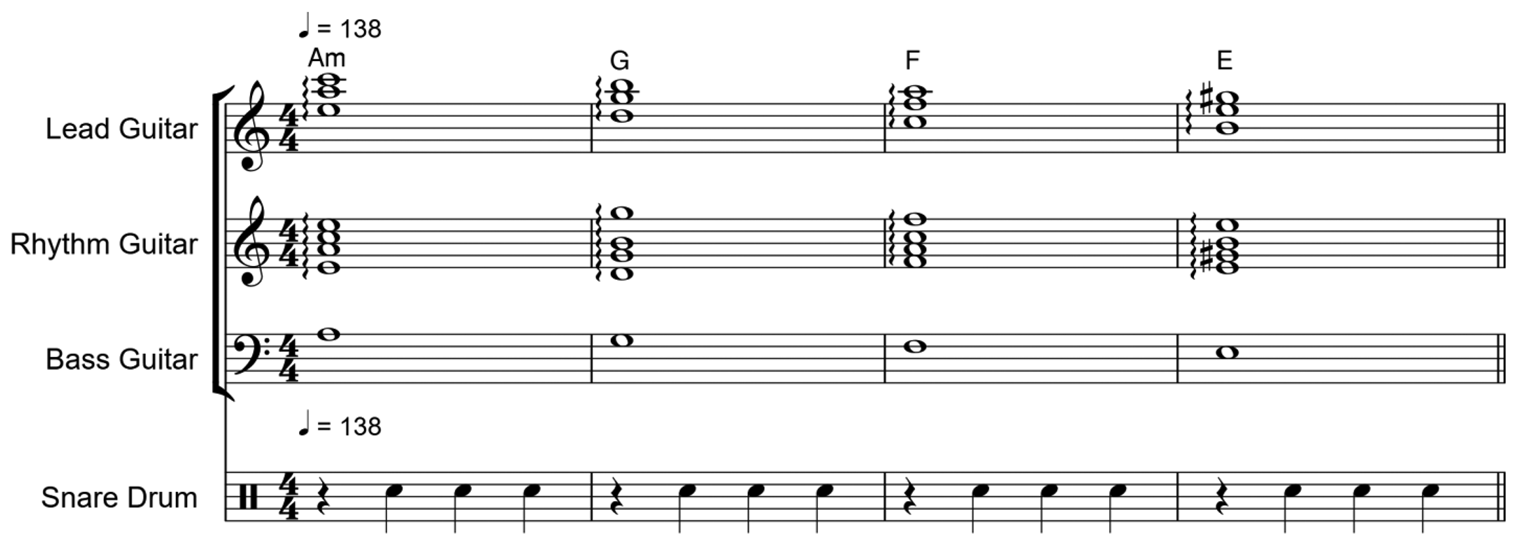
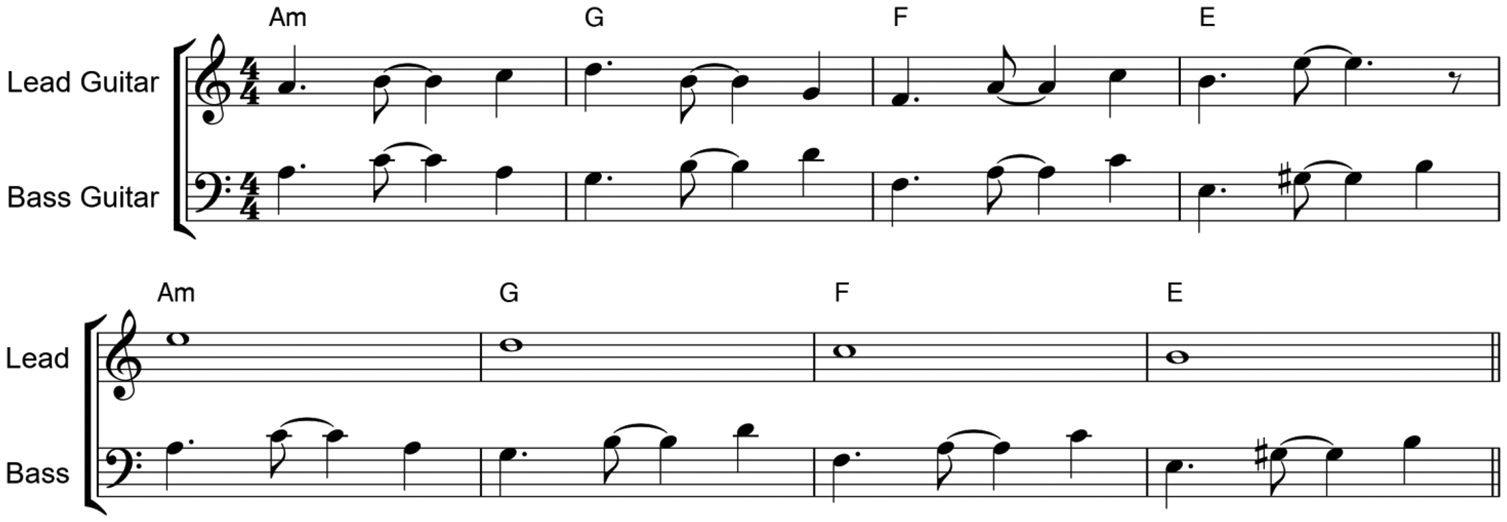
The 1967 version of ‘Viva Malta’ considered here adopts the vocals–guitar–bass–drums functional layers. Except for the introduction (see Example 1), the bass and lead guitars along with the voice are prioritised throughout while the rhythm guitar and drum kit fill in the rest of the sound box together with the drum kit in the background holding the entire ensemble together. As with the music of most British beat groups and the majority of rhythm ’n’ blues-based bands, ‘Viva Malta’ fuses the energy and the variety of vocal textures adopted by the upbeat rhythm ’n’ blues with the emphasis on the electric guitar brought about by rock ’n’ roll. This is complemented by the vocal timbre adopted by the lead singer reminiscent of Elvis Presley's soulful vocal quality.
The intro to ‘Viva Malta’.

In the four-bar intro to this song (see Example 1), the lead, rhythm and bass guitars play a block chord in every bar, each time supported by a three-stroke backbeat on the snare drum commencing on the second beat.Footnote 15 The chord progression used here, the so-called ‘flamenco progression’, descends stepwise i–VII–VI–V on a bass guitar holding on to the root of each chord. The progression itself, but equally important the parallel descending compound thirds forming on the outer parts, are a strong hallmark of this song that make it immediately identifiable by attuned listeners. This was corroborated by Portelli himself during our interview with him. Eventually, the progression becomes a loop for both the guitar solo sections and the verses and, hence, while it establishes itself as central through reiteration, it makes the overall harmony of the track very much beginning-oriented. Furthermore, the repeated recurrence of this progression as well as its regularity in terms of harmonic movement are a common norm most associated with the way such a progression is employed, for example, in songs by The Ventures in ‘Walk Don't Run’ (1960), Ray Charles’ ‘Hit the Road, Jack’ (1961) and The Animals’ version of Nina Simone's ‘Don't let me be Misunderstood’ (1964).
Following the intro, a solo guitar (see Example 2) makes its way as an instrumental section that may be heard both as an extension of the intro and as a freestanding solo when it reappears after the chorus. Moreover, the sounding of this solo prior to the first entry of the lyrics gets the song into gear and, as a hook, it is re-employed to reclaim that ‘gearing-up’. It also brings for the listeners’ attention the active bass line with its arpeggio-like style conveying the ‘doing’. Although the four-bar bass line in the first part of this solo is reiterated in the second part, the nuances it is endowed with emerge from the harmonic relation it grows within when seen in relation to the lead guitar part as well as the prominence that this same bass gains against the falling four whole tones (or semibreves) in the second part. Eventually, in the dropout, this guitar solo is attributed with ‘lifeness’ when vocalised instead of instrumentally reproduced. This somehow complements the lifeness brought about by the personification attributed to the motherland in the lyrics.
The guitar solo.

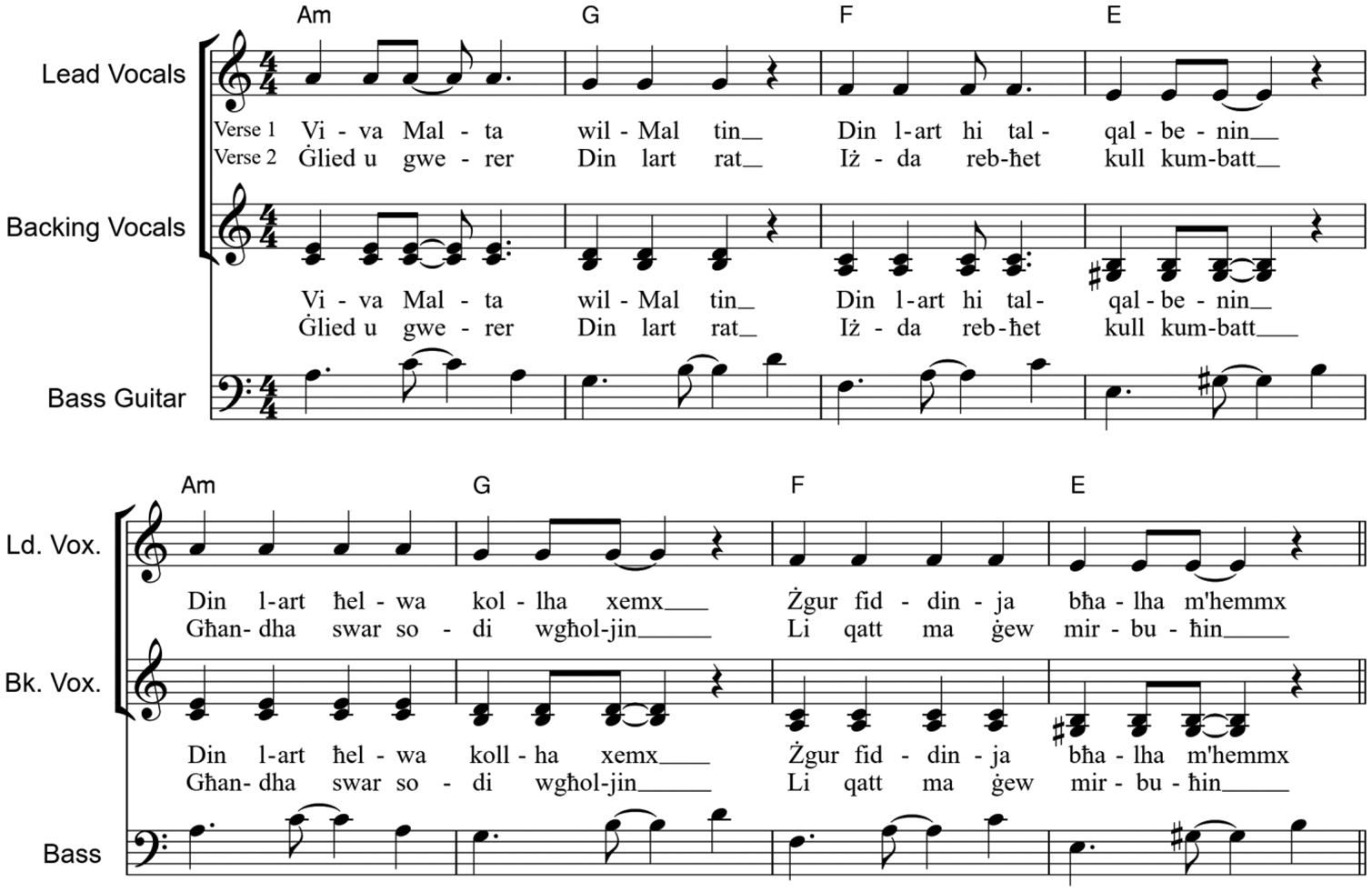
The collective is consistently present throughout the track. Both verses, for instance, are pronounced by the lead singer supported by the backing vocals of the band members (Example 3). From the interview with Portelli, it became quite clear that the harmonised backing vocals, as created and assigned by him to the other members of the band in this and other songs, were meant both to demonstrate the band's musicality and to reflect in sound the strong bond that existed among its members. In relation to the latter, Susan Fast (Reference Fast and Scott2009, p. 175) notes that in rock bands ‘the group is conceived of as a self-contained fraternity. Backing vocals by members of the band serve to strengthen the fraternal bond, not only lending the lead singer support but also demonstrating the unity of purpose among band members’. Similarly, the backing vocals in ‘Viva Malta’ serve both to sound the fraternal bond referred to by Fast and to dramatise the collective voice of a nation. In itself, the linear and sequential melodic line of each verse together with the backing vocals invite listeners with access to the common semantic frame described above to reflect about their motherland. This sense of reflection contrasts nicely with an active bass line that, as stated earlier, is more concerned with the ‘doing’ and, by extension, in translating reflection into action.
The verses.

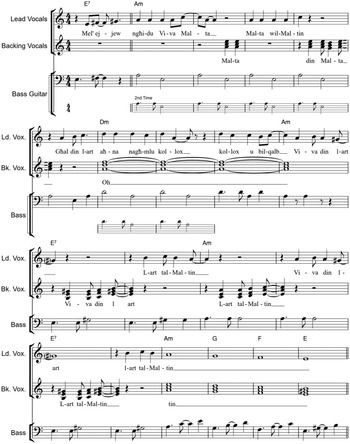
Momentarily, the reiterated harmonic loop of both the verses and the instrumental guitar solo gives way to another, though related, progression in the chorus: i–iv–i–V7–i–V7–i. Here, the rate of harmonic change is somewhat slower when compared with the one experienced previously. Nevertheless, intra-band interaction in terms of both ‘self-contained fraternity’ and how this extends itself to mean a broader representation becomes intriguing. In the chorus (see Example 4), the backing vocals are engaged in a call and response with the lead singer proposing and the backing vocals confirming. Here, the backing vocals are elevated from a reflective to a decisive crowd convinced to confirm its loyalty to the country both by emphasising ‘Malta’ and by sustaining lines such as when the lead singer sings ‘…aħna nagħmlu kollox/Kollox u bil-qalb’ (‘we'll do all we can/And most willingly’). The sound of decisive loyalty here is engendered through reiteration and the sounding of a vocal drone that contrasts well with the previously experienced parallel vocal harmony of the verses. Moreover, the backing voices both promote the lead singer by responding to him as well as sounding the collective ‘we’. The drama activated in the verses is here intensified both through the dialogue between the ‘hero’ and the ‘nation’ and through sounding the newly introduced subdominant D minor chord at the word ‘aħna’ (‘we’). In this sense, the subdominant chord becomes pivotal as it simultaneously participates in the most effective way both in the intensification of the song's drama and in fulfilling the expectation fostered earlier through the established harmonic loop. The interest ignited by the chorus is reached and maintained through multiple techniques that when understood in relation to one another demonstrate an increased activity akin to the one needed by a nation to really free itself from years of colonialism, heal social and cultural divisions both of the past and the present, and eventually, start to believing in itself and unite.
The chorus.

From the production point of view, one notes that back in the 1960s despite the limited access to technology, producers together with recording engineers and band members aimed for more innovation and creativity using the recording studio as a musical palette (Zagorski-Thomas Reference Zagorski-Thomas2014, p. 108). Portelli explained to us how ‘Viva Malta’ was produced using the two-track recording technique where one track included the backing and the other the solo voice and backing vocals. This practice was already widely used in the early 1960s and was later extended to four-track with Ampex as one of the first firms to introduce this multi-track technology, even though Les Paul is known to have made records using eight-track systems back in 1957 (Burgess Reference Burgess2014, p. 53).
The backing track of ‘Viva Malta’ was one of the four songs recorded while The Malta Bums were active at Radio Köln. The process consisted of getting a good recording in one take on a quarter-inch tape. Portelli explained how the four band members were set up in one recording room repeating their music over and over again until they got it ‘right’, admitting that this was a very lengthy and laborious recording process. Despite the fact that in the mid-1960s the 4-track recording facility was already in use internationally and offered a range of options for bands and artists to experiment with, the overdub technique in Portelli's productions was not employed. Portelli explained to us how if one of the band members made a mistake, they had to redo the recording from the beginning. This also meant that the sound balance, i.e the mix, was done during the recording phase. Such a production technique employed momentous capturing of the sound using the best microphone positioning and the ability to play with available basic processing tools of that time such as the addition of plate reverbs, loop echoes, compressors and limiters. This production practice also lacked razor tape editing, a process already in use in the mid-1960s, which could have helped to enhance the recording by selecting the best snapshots, in turn adding further shades to the meaning of a performance. Together with other innovative recording methods, the recording studio in the mid-1960s started to offer producers such as Phil Spector and Joe Meek, and musicians and artists such as The Beatles, The Beach Boys and The Rolling Stones, different shades of colours on the palette in order to be more creative rather than just mirroring a live performance. When referring to The Beatles’ Revolver, released in 1966, Carr and Moore (Reference Carr, Moore, Moore and Carr2020, p. 4) list ‘original’ techniques that were used on this album that included ‘backwards guitars’ in ‘I'm Only Sleeping’, ‘over compressed’ sounds and ‘sound samples’ in ‘Yellow Submarine’ as well as automatic double tracking and flanging. Apart from The Beatles, one can list other bands who further pushed the envelope of recording technology in tracks such as The Rolling Stones’ ‘I Can't Get No Satisfaction’ (1965) featuring ‘fuzz’ guitar, The Who's ‘My Generation’ (1965), introducing fatter bass sounds, and The Spencer Davis Group's ‘Gimme Some Lovin’ (1966), which included ‘overdriven’ Hammond organ sounds (Carr and Moore Reference Carr, Moore, Moore and Carr2020).
According to Portelli, the drum kit in the recording of ‘Viva Malta’ was fully miked up with microphones. This contrasts with the popular drum recording technique employed by the mid-1960s which normally utilised the two-microphone method that consisted of a microphone placed in front of the bass drum and another one overhead in the middle of the kit. Late 1960s recordings employed the Glyn Jones method of using matched pair microphones, equidistant from the snare, as the overheads. In contrast, Portelli recalled how the electric and bass guitars were tracked using a single microphone placed about a foot away from the speaker cone of the valve amplifier, a technique that is still in use in modern recording productions.
When referring to the recording of the vocal parts in ‘Viva Malta’, Portelli revealed to us how these were recorded in Malta in 1967 and then mixed to the instrumental backing tracks that the band had brought with it from Radio Köln. According to Portelli, both as the leader and as the eldest member of the band, he used to assign the voicing to each band member. He explained that this was imitative of music styles found in the international music market of the mid-1950s and early 1960s with bands performing rhythm and blues/gospel-influenced harmonic voicing. Groups like The Hollies, The Byrds, The Beach Boys and The Mamas and The Papas were known for their outstanding ensemble vocal work. Portelli's fascination with these models and insistence on a distinct vocal harmony in his songs might be one reason for having the vocal harmony placed upfront in the mix of ‘Viva Malta’. On a close listening of the 1967 vinyl version of this track, one notes that the higher backing voice stands out from the other voices, a balance setting that in many parts of the track masks the other backing vocals. Moreover, the same backing voices, together with the main voice, the rhythm guitar and bass, constantly obscure the drums from the first verse onwards, making it hard to define the drummer's role. Nevertheless, the mix works well for the lyrics as it makes them clear and, hence, easy to follow and apprehend. Such a sound product contrasts strongly with what was being produced locally at that time. For instance, although the drums in The Followers’ 1968 rock ’n’ roll-style song ‘In-Nanna Beat’ sound positioned better than in ‘Viva Malta’ within the mono mix sound quality, the leading voice is somewhat drowned and overshadowed by the other instruments, making the lyrics inconsistently discernible.
The familiar that binds us more
It has already been noted how the friction generated between the essentially romantic lyrics of the track and the musical style adopted has added more interest to the song. This is important to note especially when considering ‘that for music making to be engaging and socially meaningful, the unfamiliar must be adequately framed within, or balanced by, the familiar’ (Stobart Reference Stobart2016, p. 131). The familiar here transpires as having a dual role, that is, it counterbalances the friction described earlier as well as serving as an agent through which the sense of national unity and the implied loyalty could be impelled further.
The romantic nationalistic theme and tone of ‘Viva Malta’ as well as the metric employed emerge intertextually, so to say, with other patriotic verses central to Maltese literature at that time and earlier and which today still hold a prominent status in the teaching of Maltese literature. This echoes Harold Bloom's popular aphorism that ‘the meaning of a poem can only be another poem’ (Bloom Reference Bloom1973, p. 94). Indeed, the repertoire of local nationalistic poetry supported by corresponding common knowledge of local history and environmental awareness as transmitted through education made the lyrics of this song sound somehow familiar and, hence, more engaging and socially cohesive. Seen from a rather different viewpoint, the lyrics of ‘Viva Malta’ evoke both the local and acclaimed nationalistic literary repertoire, as well as the related widespread and familiar knowledge that is vital for its communal understanding. Through all this, listeners could feel part of a bigger and cohesive community that was able to face the challenges brought about by independence and rise above all divisions. Moreover, the lyrics of the song in question gained more meaning through their intertextuality with ongoing political discourse of that time about nationhood, economic progress, the real meaning of independence and the role of each citizen in fostering a climate of progress for the good of the entire Maltese society.Footnote 16
From the technical aspect, it has already been explained how the 1967 Malta production of this track was a composite of the backing track which was brought from Germany and the superposition of the main voice and backing vocals on that in a separate session in Malta. An analysis of the track has also revealed a different ambience result for each recording. This could have been the result of either the different recording chambers used for the recordings or the settings to the mechanical reverb systems used in the mid-1960s, or a combination of both. Mapping the sound sources of this track within what Moylan (Reference Moylan2012) refers to as the ‘sound stage’ is practically impossible since in this case one cannot include two spaces at once in a sound stage diagram.Footnote 17 Moreover, the analysis of the track revealed challenges in locating the position of the sound sources since all the sounds are densely centralised.
The prominent position of the main voice and backing harmony is no coincidence or a slip in the final mix down that was crafted in Malta. It seems that the finished production was not about the arrangement, instrument placement or careful balance between elements but projecting the lyrics as clearly and with as little interruption as possible to the listener. Indeed, Portelli reiterated the clear comprehension of the lyrics several times during the same interview. This kind of mix might have been an added reason for the popularity of this song locally, in which production prioritised the focus of the ear on the delivery and understanding of the lyrics over the backing instrumentation. Hence, the final version conveyed a mix accentuating the comprehension of the lyrics which in turn facilitated further the engagement of the listeners with the familiar and ‘romanticised’ patriotic. The well-defined main voice and backing harmony allowed radio listeners and live audiences alike to understand, connect and sing along more smoothly.
The sense that the familiar may bind us all and, hence, make us collectively bolder to face the challenges ahead was further enhanced by the musical form adopted. It has already been noted how ‘Viva Malta’ followed a verse–chorus form that along with strophic singing implied repeatability. As suggested by Elizabeth Hellmuth Margulis (Reference Margulis2014, p. 16), repeatability may assist groups of listeners to appropriate a song and make it part of their tradition irrespective of time: ‘repeatability is how songs become the property of a group or a community instead of an individual, how they come to belong to a tradition rather than to a moment’. An aspect that dovetails with this is the role of the call and response in this song which apart from expressing the collective, reminds listeners that the form through which they are being engaged collectively, after all, is familiar to them both when understood as mimicking international practices in popular music as well as when thought of as adopting practices in local popular music-making. Examples of international songs from that age with calls and responses familiar to local audiences of that time include, for example, Martha Reeves & The Vandellas’ ‘Heat Wave’ (1963) and ‘Dancing in the Streets’ (1965), The Mamas & the Papas's ‘California Dreamin’’ (1965), and The Beatles’ ‘With a Little Help from my Friends’ (1967). In parallel to the local exposure to international popular music-making, one may add examples of recorded local folk music which were also aired on cable radio. The earliest recordings of Maltese folk music available for the local consumption on 78 rpm records were produced in the early 1930s in Milan and Tunis for international recording labels such as Pathé, Odeon and His Master's Voice (Alamango Reference Alamango2011).Footnote 18 These recordings included Maltese humorous songs known as makjetti structured on calls and responses between solo singers and a choir.Footnote 19
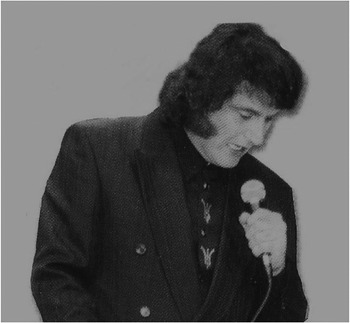
One other aspect of the familiar in ‘Viva Malta’ emerges from the performing persona of Freddie Portelli as the lead singer in this track. Locally, Portelli's appearance and performing style is widely perceived as mimicking those of Elvis Presley and, hence, build on associative conventions of movement, gestures, vocal timbre and, in many instances, interpretation (see Figure 4). Indeed, Portelli was described in the local media as ‘our own homegrown Elvis’ (Cassar Reference Cassar2019) even if for segments of Maltese society his popularity rests on his kitsch appeal more than anything else. Nevertheless, Portelli's soulful baritone voice, reminiscent of Elvis, rests on the typical close miking technique as well as the audible sighs and intakes of breaths that made it more possible for Elvis (and, by extension, for Portelli) both to make his singing sound ‘authentic’ and to relate more intimately and instantly with audiences. Portelli's imitative vocal timbre and public persona added more to the familiar palimpsest of ‘Viva Malta’. This served both to broaden listenership through familiarity with Elvis's voice and to build on this kind of aural illusion aimed at augmenting and transforming local expressions into transnational ones even if in an illusory fashion. As such, local national sentiments and aspirations could have been made to sound as if they were of transnational concern and, hence, broader than the local. The track spins this illusion as if to make the call for national loyalty emerging and pronounced via the vocality of an international idol (Elvis in this case) and, hence, elevated in importance as when a theme is picked up and sung about by world-known pop stars.
Freddie Portelli, used with his permission.

Conclusion
‘Viva Malta’ emerged at a time when the country was finding its feet as an independent nation, recuperating from deep social fissures brought about by the politico-religious conflict of the early 1960s and, equally importantly, engaging in national soul-searching. The patriotism expressed in the song of our concern blended well with the aspirations of the Maltese in seeing their country prospering socially, culturally, politically and economically. The national reappraisal implied in ‘Viva Malta’ mirrored parallel expressions in other domains of local arts such as theatre, poetry and art. The local landscape and seascape, for instance, were seen by local artists of the post-independence era, some of whom having an international repute, as a source of artistic inspiration. These artists have transformed into abstract art picturesque views of Maltese villages and maritime life and brought them in line with contemporary art for the attention of local and international viewers who both liked the transformation of the local and valued its connections with transnational artistic practices of that time. At the same time, members of the Moviment Qawmien Letterarju used language to challenge the stability of tradition and conformity. All of this was inspired by paradigms of literary practices from abroad which were applied locally to help these writers foster a new literature on a par with international contemporary literary practices as much as with newly proposed modes of presentation and diffusion. In this context, ‘Viva Malta’ managed to strike the right balance between the ‘romantic’ past and its conventions with the challenges of social change and the ambitious aspirations of a newly independent state which envisaged several benefits in connecting more effectively with the outside world. In the process of creation, production and transmission, ‘Viva Malta’ merges the local and the transnational. All of this was supported by a strong level of interest which was sustained throughout the track, mainly through the drama that the track generated, the friction it built on and the familiar it capitalised on.
National unity as conveyed in this song was expressed in the lyrics and backed up by the music as well as, to some extent, by the aesthetics implied in the local 1967 recording process. All of these dovetailed well with the familiar that each of these aspects banked on to construe the ‘we’ and, hence, belonging and unity against all divisions. The much needed sense of national unity grows throughout the track and, eventually, becomes fundamental to the call for loyalty. Here, the familiar in all its forms and shades becomes central for the social engagement the track calls for. Indeed, the different nuances of the familiar come together to epitomise national unity, at the same time establishing a discreet counterbalance to the friction that the track unfolds in to maintain interest and, hence, pleasure and engagement. The familiar that emerges here, and the sense of national unity it proposes, were and are still relevant to current times.Footnote 20 In part, the song survived and resisted time owing to its potential to remain relevant to contemporary life in Malta amidst rifts the nation lives by. The national sentiments as expressed in ‘Viva Malta’ gain a refreshed meaning whenever the song is sung depending on current life situations, emerging rifts, new challenges and visions for the future.