Introduction
The world has experienced a tremendous rise in the burden of non-communicable diseases (NCDs) in recent years. Recent estimates suggest that NCDs are responsible for 71% of all deaths globally (World Health Organization (WHO), 2018a). It is also projected that the total number of global deaths due to NCDs will increase from 38 million in 2012 to 52 million by 2030 (WHO, 2014b). While the NCD burden was first documented in developed countries, these diseases had penetrated the entire world, including developing countries, by the third millennium (Boutayeb & Boutayeb, Reference Boutayeb and Boutayeb2005). The risk of dying from NCDs is now highest in low- and middle-income countries (LMICs) (Bennett et al., Reference Bennett, Stevens, Mathers, Bonita, Rehm and Kruk2018). Importantly, approximately 37% of annual NCD deaths occur prematurely (below the age of 70), and 85% of these premature deaths occur in LMICs (WHO, 2018a). Globally, about 150 million people each year suffer a financial catastrophe, and around 100 million are pushed under the poverty line because of having to pay for health care, mostly for the treatment of NCDs (WHO, 2010). The Global Economic Burden of Non-Communicable Diseases Study predicted that NCDs are likely to cause around US$47 trillion in output loss between 2010 and 2030 (Bloom et al., Reference Bloom, Cafiero, Jané-Llopis, Abrahams-Gessel, Bloom and Fathima2011). These economic impacts of NCDs invariably affect LMICs and households more severely because they have the least financial cushion to withstand the economic consequences of NCDs (WHO, 2014b).
Bangladesh has also experienced a rapid shift in the disease burden from acute, infectious and parasitic diseases towards NCDs (WHO, 2011; Mascie-Taylor, Reference Mascie-Taylor2012). For instance, in 1986, around 8% of deaths were attributed to NCDs, against 52% due to communicable diseases (WHO, 2011). In comparison, recent estimates suggest that NCDs have caused around 886,000 (59%) deaths annually (WHO, 2014b). The most common NCDs in Bangladesh are cardiovascular diseases (CVDs), diabetes mellitus, cancer, and chronic respiratory diseases (CRDs) (Biswas et al., Reference Biswas, Pervin, Tanim, Niessen and Islam2017). A recent systematic review and meta-analysis of 755 papers reporting CVD prevalence in Bangladeshi adults found that the weighted pooled prevalence of CVD was 5.0%, regardless of the type of CVD, sex, and geographical location of the study participants (Chowdhury et al., Reference Chowdhury, Haque, Farhana, Anik, Chowdhury and Haque2018). According to the most recent nationally representative Bangladesh Demographic and Health Survey conducted in 2017–18, 1 in 10 adults in Bangladesh (aged 18 and older) have raised blood glucose, the prevalence of which increases steeply with age (National Institute of Population Research and Training (NIPORT & ICF, 2020). A vast number ofpeople in Bangladesh are suffering from CRDs, and the prevalence of asthma is 5.2% (Barua et al., Reference Barua, Saha, Ghosh and Ruble2013) and that of COPD is 12.5% (Sutradhar et al., Reference Sutradhar, Gupta, Hasan, Wazib and Sarker2019). Cancer accounts for about 10% of total annual deaths in Bangladesh (WHO, 2014a). An estimated 200,000 patients are newly diagnosed with cancer in Bangladesh every year (Noronha et al., Reference Noronha, Tsomo, Jamshed, Hai, Wattegama and Baral2012). The five most frequent cancers occurring in Bangladesh are breast (12.10%), oesophagus (11.30%), cervix uteri (9.70%), lung (8.80%), and lip and oral cavity (8.70%) (Directorate General of Health Services, 2018).
With one-third of the total population being over 60 years of age by 2050, Bangladesh is facing a difficult task in successfully addressing the growing burden of NCDs with its limited resources and health system bottlenecks. These bottlenecks include weak governance, insufficient health financing, weak public health systems, a highly unregulated private health sector, and a limited capacity to address local health needs (Islam et al., Reference Islam, Akhter and Islam2018). Although there is no accurate financial estimate of the economic impacts of NCDs in Bangladesh, several earlier studies have linked NCDs with poverty and inequality (Biswas et al., Reference Biswas, Islam, Linton and Rawal2016; Mirelman et al., Reference Mirelman, Rose, Khan, Ahmed, Peters, Niessen and Trujillo2016). Another study estimated that larger out-of-pocket expenditure due to NCDs could push an additional 4.6% of Bangladeshi households into poverty annually (Hamid et al., Reference Hamid, Ahsan and Begum2014). Therefore, it is important that NCDs are prevented at a large scale by controlling the avoidable risk factors for developing such diseases before they reach the severe stage (Zaman et al., Reference Zaman, Ullah, Bhuiyan, Karim and Rahman2016).
According to the World Health Organization (WHO), there are four main risk factors for NCDs: tobacco use, unhealthy diet, physical inactivity, and harmful use of alcohol, all of which are modifiable. Although there are also non-modifiable factors (mainly age, sex, family history, and ethnicity) and metabolic risk factors (overweight and obesity, raised blood pressure, dyslipidaemia, and disturbed metabolism of glucose or insulin) that contribute to the development of NCDs (Alberti et al., Reference Alberti, Zimmet and Shaw2005; WHO, 2018b), previous research has identified that these can essentially be prevented through modification of lifestyle factors such as tobacco use, diet, consumption of fruit and vegetables, alcohol and drug use and physical activity (Murray & Lopez, Reference Murray and Lopez1997; WHO, 2005). According to a recent study, the prevalence of physical inactivity among Bangladeshi adults is 34.5% (Moniruzzaman et al., Reference Moniruzzaman, Zaman, Islalm, Ahasan, Kabir and Yasmin2016), which poses an increased risk of developing NCDs among this population. According to the most recent Global Adult Tobacco Survey, 35.3% of adults consumed tobacco products in Bangladesh in 2017, where the prevalence of smoking was 18.0% (WHO, 2017). The average per capita daily intake of fruit and vegetables in Bangladesh is only 126 g (Nahar et al., Reference Nahar, Choudhury, Sultana and Siddiquee2013; Food and Agriculture Organization (FAO, 2021), which is much lower than the joint WHO and FAO recommendation of 400 g per day. The prevalence of alcohol drinking across age groups is less than 1% (0.8%; men 1.5% and women 0.1%), while more than 7 million people reportedly suffer from drug addiction in Bangladesh (Government of People’s Republic of Bangladesh, 2018a).
Although many developed countries have adopted several preventative measures to tackle NCDs, such efforts are meager in developing countries, including Bangladesh (Narayan & Rhodes, Reference Narayan and Rhodes2016). The Government of Bangladesh (GoB) has implemented several pilot initiatives to control NCDs (e.g. Health Promotion Model Villages in a few areas and the Model School Initiatives in 91 schools in rural areas). However, these initiatives have not been subjected to rigorous evaluation (Biswas et al., Reference Biswas, Pervin, Tanim, Niessen and Islam2017). Hence, policymakers were not entirely convinced about scaling up these initiatives, and most planned activities are stalled or only partially implemented (Government of People’s Republic of Bangladesh, 2018b). Recently, the government has adopted a global strategic plan for the surveillance and prevention of NCDs in Bangladesh. The Multisectoral Action Plan for Prevention and Control of Non-communicable Disease 2018–2025 is a 3-year operational plan that has been adopted to tackle the growing burden of NCDs. As part of the primary prevention strategy, this action plan aims to promote population-wide interventions to reduce exposure to key risk factors. Actions include fully implementing tobacco control laws; placing restrictions on the availability of illicit alcohol; developing collaborative efforts to reduce trans-fats, saturated fats, and salt intake; encouraging the consumption of adequate servings of fruit and vegetables; encouraging physical activity; and establishing healthy settings in cities, schools and workplaces (Government of People’s Republic of Bangladesh, 2018b). However, there is a growing concern over the materialization of these actions, as most preventative actions to combat NCDs in the past have remained unimplemented or only partially implemented (Government of People’s Republic of Bangladesh, 2018b). One of the key initiatives the government has taken since 2012 is to establish ‘NCD corners’ in Upazila Health Complexes (UHCs), which provide NCD-related services in parallel to existing UHC services (Alam et al., Reference Alam, Robinson, Kanungo, Hossain and Hassan2013). However, there are no such facilities at the union level (the lowest administrative unit in Bangladesh). In recent years, the Community Health Workers (CHWs) in some areas have started providing NCD services, in particular random blood glucose tests for those at risk of developing diabetes, and also health education and counseling services (Rawal et al., Reference Rawal, Jubayer, Choudhury, Islam and Abdullah2021). Nevertheless, there is no structured referral or follow-up mechanism in place from one health facility to another. Although there are signs of improvement in secondary prevention strategies, a lot more has to be done for the primary prevention of NCDs.
To avoid the huge expenses of curative care for people with NCDs, the GoB has recently focused on investing more in preventative care through promoting healthy lifestyles such as eating a healthy diet, increasing physical activity, and reducing the consumption of tobacco and alcohol (Government of People’s Republic of Bangladesh, 2018b). However, there is a scarcity of information on the current status of these lifestyle characteristics among the adult population in Bangladesh. Therefore, the present study aimed to explore the current status of the lifestyle characteristics that have been proven to be linked to NCDs among the Bangladeshi adult population, and the socio-demographic determinants of these characteristics. The findings of the study will inform the formulation and implementation of primary prevention strategies to combat the overwhelming NCD burden in Bangladesh.
Methods
Study design and participants
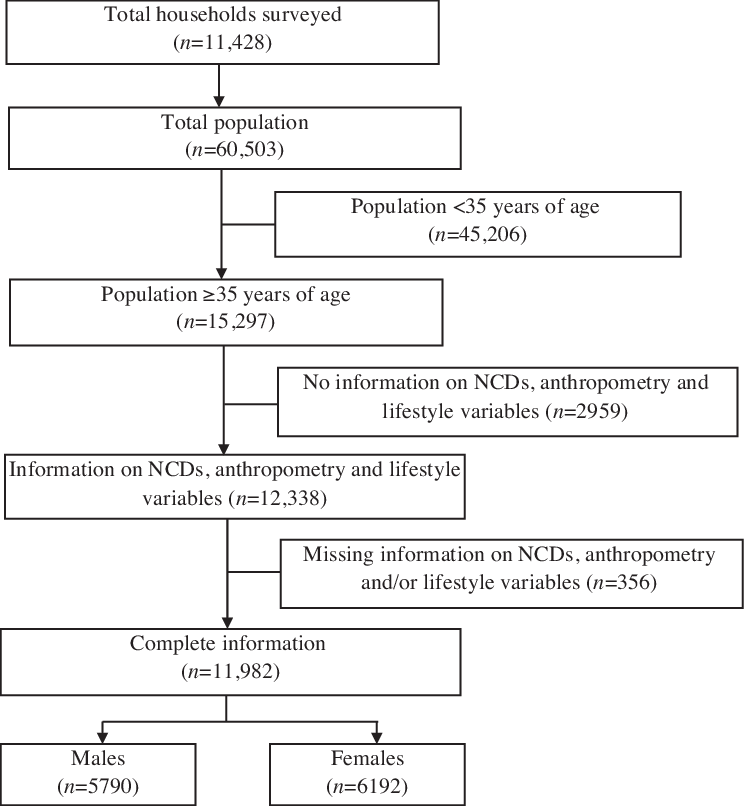
The data for the study were collected as part of a large-scale cross-sectional survey conducted between October 2015 and January 2016. The base survey was conducted by Building Resources Across Communities (BRAC) and explored the overall health status of under-five children, adolescent girls, women of reproductive age, and adults aged 35 years old and above in Bangladesh. A two-stage cluster random sampling technique of households was applied to collect the data. At the first stage of sampling, 210 clusters were selected with a probability proportional to cluster size, with 180 clusters selected from rural areas and 30 clusters from urban areas. A cluster is typically a union (rural case) or a ward (urban case) and is the lowest administrative unit in Bangladesh. At the second stage of sampling, starting from the north-western corner of a cluster with a systematic random sample of five households, an average of 54 households were selected per cluster to provide statistically reliable estimates. As a result, 11,428 households were selected, covering all administrative divisions of Bangladesh. The present analysis considered 12,338 men and women aged 35 years or above from 11,428 households. A total of 356 participants were excluded due to missing or inconsistent information, and the final analysis considered 11,982 participants (Figure 1).
Study profile and participant enrolment.

Data collection
Socio-demographic information was collected through a face-to-face interview of the participants using a structured questionnaire. The questionnaire was piloted in Gazipur, a suburb of Dhaka, and the feedback from the pilot was incorporated into the final version of the questionnaire. Interviewers (field researchers) with experience in conducting health surveys were recruited and trained for the data collection. The data were collected electronically in Android tablets using ODK (Open Data Kit; the Android-based mobile platform software). Details of the data collection tools and techniques can be found elsewhere (Mitra et al., Reference Mitra, Mistry, Afsana and Rahman2018).
Operational definition of study variables
Anthropometry
Height was measured to the nearest 0.1 cm using a board with an upright wooden base and a movable headpiece, on a flat surface. Weight was measured with an electronic scale at 0.1 kg precision. Body mass index (BMI) was calculated as weight in kg/(height in metres)2 and grouped into four categories using the Asian cut-offs (underweight <18.5, normal 18.5–22.9, overweight 23.0–24.9 and obese ≥25.0) (WHO Expert Consultation, 2004).
Socio-demographic factors
The socio-demographic factors included in the analysis were: age, sex (male/female), education (no education, primary incomplete, primary or secondary incomplete, secondary or higher), occupation (employed/unemployed), BMI (see above), division, place of residence (rural/urban) and household wealth status (poor, middle and rich).
Wealth index was constructed using factor analysis (Rutstein, Reference Rutstein2015) of household-level key socioeconomic variables: type of wall, floor, and roof of the house; ownership of a radio, television, computer, bicycle, mobile phone/telephone, refrigerator, wardrobe, table, chair, watch, bed, sewing machine, bicycle, motor vehicle, and livestock; and access to solar power and electricity. A single composite wealth index was created, categorized into ‘poor’, ‘middle’, and ‘high’ based on the wealth score’s tertile cut-point.
Lifestyle characteristics
Lifestyle characteristics included diet (fruit and vegetable consumption, extra salt intake), sleeping pattern, smoking, smokeless tobacco use, and physical activity.
Consumption of fruit and vegetables was categorized based on the WHO recommendation of ‘consume daily’ and ‘not consumed daily’ (WHO 2019b). Extra salt intake was measured by asking whether or not the respondent took extra salt during the meal, and categorized as ‘never’, ‘sometimes’ or ‘always’. Sleeping time was categorized based on the recommendation of the National Sleep Foundation as <7 hours/day, 7–9 hours/day, and >9 hours/day (National Sleep Foundation, 2019). Smoking and using smokeless tobacco were categorized as ‘current user’ (used in last 30 days) and ‘non-user’. Physical activity was defined as ‘low’ or ‘moderate to high’ using moderate- and vigorous-intensity activity (WHO, 2019a).
Statistical analysis
The chi-squared test was used to compare lifestyle characteristics by sex. All lifestyle variables were categorized as binary (yes/no) to explore the association with socio-demographic characteristics. The percentage of ‘yes’ answers was only reported if the response was either ‘yes’ or ‘no’ to avoid any redundancy of information. The chi-squared test was also performed to assess the association of lifestyle characteristics with socio-demographic factors. To ensure the accurate representation of data, sampling weight was used. Binary logistic regression with a generalized estimating equation to adjust the clustering effect was applied to assess the adjusted relationship between lifestyle characteristics and socio-demographic factors. Variables with p < 0.25 in the bivariate analyses were included in the final multiple logistic regression model (Agresti, Reference Agresti and Agresti2003). The adjusted odds ratio (aOR) and corresponding confidence interval (CI) were calculated at the 5% level of significance. All analyses were performed using the statistical software package STATA (version 13.0).
Results
Prevalence of lifestyle characteristics
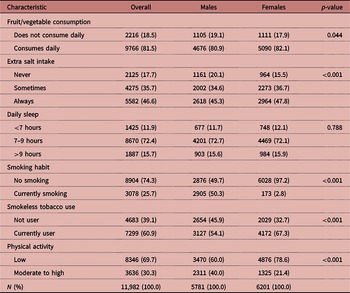
Table 1 shows the prevalence of lifestyle characteristics among the adult population in Bangladesh. Approximately one-fifth of the respondents (18.5%) reported non-daily consumption of fruit/vegetables, almost half (46.6%) always used extra salt with their meals, 11.8% reported an average of fewer than 7 hours sleep per day, a quarter (25.7%) admitted to smoking tobacco, 60.9% used smokeless tobacco and 69.7% had low physical activity.
Prevalence of lifestyle characteristics among Bangladeshi adults aged 35 years or more a

a All values n (%).
The prevalence of lifestyle characteristics varied by sex (Table 1). The prevalences of not consuming fruit or vegetables daily (19.1% vs 17.9%) and smoking (50.3% vs 2.8%) were higher among males than females. On the other hand, the prevalences of always taking extra salt with meals (47.8% vs 45.3%), consumption of smokeless tobacco (67.3% vs 54.1%), and low physical activity (78.6% vs 60.0%) were higher among females than males.
Association between lifestyle characteristics and socio-demographic factors
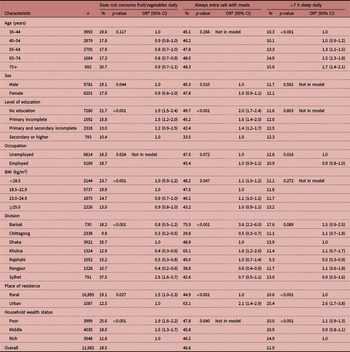
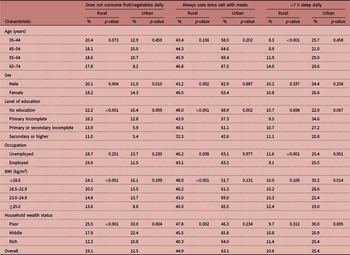
Table 2 shows the association of not consuming fruit or vegetables daily, always taking extra salt with meals, and sleeping <7 hours daily with respondents’ socio-demographic characteristics. Not consuming fruit and/or vegetables daily was significantly higher among males (19.1%), the uneducated (21.7%), the underweight (23.7%), those from the Sylhet division (37.5%), rural residents (19.1%) and members of poor households (25.6%). Apart from age, sex and BMI, these factors remained significant in the adjusted analysis. When the data were stratified by place of residence, they remained significant for rural areas, but in some cases were not significant in urban areas (Table 4). The prevalence of taking extra salt with meals was higher among older adults (20.7%), females (47.8%), the uneducated (49.7%), the underweight (48.2%), residents of the Barisal division (75.9%), and residents of urban areas (63.1%), and these factors remained significant in the adjusted analysis. On the other hand, sleeping <7 hours daily was higher among older people (15.6%), the unemployed (12.6%), obese people (13.2%), residents of the Barisal division (17.6%), residents of urban areas (25.4%) and members of rich households (14.9%). The adjusted regression analysis also confirmed that the odds of sleeping <7 hours daily was higher among older people and residents of urban areas.
Dietary and sleeping patterns by socio-demographic characteristics

OR: odds ratio, CI: confidence interval.
a OR adjusted with variables in the list and the clustering effect.
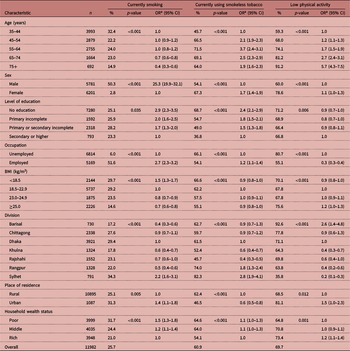
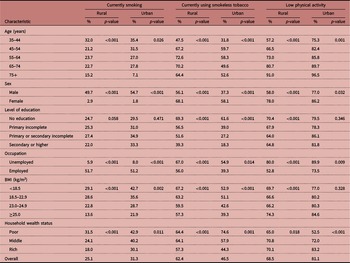
Table 3 shows the association of currently smoking, current smokeless tobacco consumption, and physical inactivity with the socio-demographic characteristics of the respondents. Smoking was significantly higher amongst adults aged 35–44 years (32.4%), males (50.3%), the employed (51.6%), the underweight (29.7%), residents of Sylhet division (34.3%), residents of urban areas (31.3%) and members of poor households (31.7%). The adjusted analysis also revealed that the odds of smoking was significantly higher amongst males, the uneducated, the employed, the underweight, residents of the Sylhet division, residents of urban areas, and members of poor households. Smokeless tobacco consumption was significantly higher amongst adults aged 55–64 years (71.5%), females (67.3%), the uneducated (68.7%), the unemployed (66.1%), the underweight (66.6%), residents of the Sylhet division (82.3%), residents of rural areas (62.4%) and members of poor households (64.6%). Apart from BMI, these factors remained significant in the adjusted analysis. Low physical activity was significantly higher amongst older people (91.2%), females (78.6%), the uneducated (71.2%), the unemployed (80.7%), the obese (75.6%), residents of the Barisal division (92.6%), residents of urban areas (81.1%) and members of rich households (73.4%). Similar results were observed in the adjusted regression analysis and stratified analysis by place of residence, though the effect of some covariates was less obvious in urban than in rural areas (Table 5).
Tobacco consumption and physical activity pattern by socio-demographic characteristics

OR: odds ratio, CI: confidence interval.
a OR adjusted with variables in the list and the clustering effect.
Dietary and sleeping pattern by socio-demographic characteristics stratified by place of residence

Tobacco consumption and physical activity pattern by socio-demographic characteristics stratified by place of residence

Discussion
This study found that the prevalences of certain NCD-linked lifestyle characteristics, i.e. consuming fruit and vegetables daily, taking extra salt with meals, sleeping <7 hours daily, smoking, smokeless tobacco consumption and low physical activity, were quite high among the adult population in Bangladesh in 2015–16. It was found that an inadequate diet, poor sleeping pattern, tobacco consumption and low physical activity were significantly higher in older adults, women, the uneducated, the unemployed, residents of urban areas and residents of rich households.
The adequate daily consumption of fruit and vegetables can reduce the risk of NCDs such as cancer, ischaemic heart disease and stroke (Hartley et al., Reference Hartley, Igbinedion, Holmes, Flowers, Thorogood and Clarke2013; WHO, 2019b), and can help lower the risk of obesity (Bermejo et al., Reference Bermejo, Aparicio, Andrés, López-Sobaler and Ortega2007). The WHO and FAO joint recommendation highlights the importance of consuming a minimum of 400 g of fruit and vegetables per day to tackle the overwhelming NCD burden, and the Government of Bangladesh has adopted this for the Bangladeshi people (Nahar et al., Reference Nahar, Choudhury, Sultana and Siddiquee2013). Although the present study found that four out of five adults in Bangladesh consume fruit and vegetables daily, a recent study reported that the average intake of fruit and vegetables was only 126 g (Nahar et al., Reference Nahar, Choudhury, Sultana and Siddiquee2013; Food and Agriculture Organization, 2021). Multiple factors, such as region-specific differences, socioeconomic factors, growing and storage conditions, processing methods and seasonal availability, are associated with inadequate fruit and vegetable consumption in Bangladesh (Hall et al., Reference Hall, Moore, Harper and Lynch2009; Zaman et al., Reference Zaman, Choudhury, Ahmed, Khandaker, Rouf and Malik2017). Therefore, collective multi-sectoral initiatives, such as increasing production and storage capacity for fruit and vegetables, creating a balance between prices and consumption, dietary diversification and an awareness campaign to encourage people to follow the WHO–FAO recommended eating habits, are needed to increase overall fruit and vegetable consumption in Bangladesh. It is also imperative that all people, irrespective of their place residence, sex and economic status, have access to adequate safe and healthy food. This is particularly true in the urban context as urban people in Bangladesh often do not have sufficient access to vegetables and fruit due to unavailability and high prices compared with rural areas.
The WHO have recommended a decreased sodium intake to reduce blood pressure and the risk of NCDs such as stroke and coronary heart disease (WHO, 2012). As salt is the main source of sodium, the WHO and FAO have recommended an individual consumption of less than 5 g of salt daily (WHO, 2012, 2019c). However, average salt intake has been reported to be only 15–21 g per day among Bangladeshi adults (Penney, Reference Penney2009). The present study found that nearly half of adults took extra salt with their meals. To reduce this high level of salt consumption, the habit of adding table salt to food should be stopped. Health policy should be reformed to reduce the salt content in processed food, and advocacy for eating less salty food should be implemented in restaurants and by other food providers. Bangladeshi people often follow medical advice (Islam & Jhora, Reference Islam and Jhora2012), so health professionals, including doctors and nurses, need to encourage their patients to reduce their salt intake from foods such as salted pickles and seasonal salty fruits, which are popular in Bangladesh.
Inadequate sleep exacerbates other NCD risk factors such as increased blood pressure, smoking and physical inactivity (Basnet et al., Reference Basnet, Merikanto, Lahti, Männistö, Laatikainen, Vartiainen and Partonen2016). The National Sleep Foundation recommends that adults of 35 years and above should sleep for 7–9 hours daily. Yet, sleeping patterns have not been taken into consideration in the GoB’s recent action plan to prevent and control NCDs (Government of People’s Republic of Bangladesh, 2018b). This study found that many adults sleep for less than 7 hours a day in Bangladesh. Therefore, the GoB should adopt the National Sleep Foundation guidelines and encourage people to maintain a balanced sleeping pattern. Additionally, public health campaigns should highlight the importance of having an appropriate amount of sleep, maintaining an appropriate sleeping environment (i.e. in the dark, a relaxing environment and neither too hot nor too cold) and having regular bedtimes. Moreover, the promotion of regular physical activity, maintaining a healthy diet and limiting the use of electronic devices before bedtime should be prioritized because lack of physical activity, having an unhealthy diet, watching too much TV and using smartphones can significantly reduce an individual’s sleep hours (Lemola et al., Reference Lemola, Perkinson-Gloor, Brand, Dewald-Kaufmann and Grob2015).
Tobacco smoking is an important risk factor for many NCDs, including cardiovascular diseases, chronic respiratory diseases, cancer and diabetes (Glantz & Gonzalez, Reference Glantz and Gonzalez2012). The GoB has taken steps to decrease smoking, for instance by establishing the National Tobacco Control Cell to coordinate tobacco control initiatives. Despite this, smoking prevalence is still very high in Bangladesh (Government of People’s Republic of Bangladesh, 2018b). This study found that smoking was more prevalent among males than females, and that the level of smokeless tobacco consumption was the same in both sexes. Awareness-raising campaigns, enforcement activities through mobile courts and high government taxation have proved to be inadequate in reducing Bangladesh’s high tobacco consumption (Government of People’s Republic of Bangladesh, 2018b). Therefore, effective strategies such as holistic education on tobacco use, appropriate school interventions, community-based counselling, strict maintenance of public smoking restrictions and smuggling controls might be useful to promote smoking cessation (Lancaster et al., Reference Lancaster, Stead, Silagy and Sowden2000). In addition, more-effective regulations are needed to reduce smoking amongst adolescents and to protect non-smokers from second-hand smoke inhalation (passive smoking) as these are leading causes of increased tobacco consumption in LMICs (Thomas & Hefler, Reference Thomas and Hefler2016).
At least 75 minutes per week of vigorous intensity physical activity, 150 minutes of moderate intensity physical activity, or an equivalent combination of vigorous and moderate activity, can reduce the risk of NCDs (WHO, 2019a). However, the level of physical activity is quite low among Bangladeshi adults (Moniruzzaman et al., Reference Moniruzzaman, Zaman, Islalm, Ahasan, Kabir and Yasmin2016). The present study found that approximately 70% of adults did not follow WHO recommendations for physical activity. To the best of the authors’ knowledge, currently there are no national recommendations on physical activity available in Bangladesh. There is therefore a need to develop national physical activity guidelines without further delay. In the 2018–2025 action plan, the government introduced a few health-related initiatives, including pedestrian-friendly footpaths, separate cycle lanes and open spaces (e.g. parks, lakes and ponds) to promote and inspire people to walk and avoid traffic (Government of People’s Republic of Bangladesh, 2018b). These initiatives require support and commitment from the government, community and individuals. Additionally, school-based and family-based interventions could be possible solutions, as these have been proven to be effective elsewhere (Strong et al. Reference Strong, Malina, Blimkie, Daniels, Dishman and Gutin2005; Okely et al., Reference Okely, Cotton, Lubans, Morgan, Puglisi and Miller2011). However, establishing these facilities will not immediately solve the problem; it is also essential to ensure that people have equitable access to these services, so they must be available, accessible, affordable and acceptable to all people.
This large-scale cross-sectional study highlights future demands and approaches for establishing and developing national guidelines on desirable lifestyle characteristics to prevent NCDs in Bangladesh. Although the GoB has adopted the global strategic plan for surveillance and prevention of NCDs, the majority of the recommended actions remain unimplemented or only partially implemented (Government of People’s Republic of Bangladesh, 2018b). The findings of this study suggest that community education interventions need to be focused on public awareness of NCDs and their associated risk factors through the appropriate use of social marketing and mass media. A multi-modality approach could be useful for preventing and treating NCDs (Lavie et al., Reference Lavie, Laddu, Arena, Ortega, Alpert and Kushner2018). Bangladesh has a structured health care system with three tiers: primary care, backed by district hospitals providing secondary and tertiary levels of care (Islam & Biswas, Reference Islam and Biswas2014). Despite having a relatively good health system infrastructure in multiple tiers, health care services for the prevention and control of NCDs are still largely non-functional (Biswas et al., Reference Biswas, Pervin, Tanim, Niessen and Islam2017). There is one community clinic for every 6000 people at the grassroots level providing primary health care services to the local community (Ahmed et al., Reference Ahmed, Alam, Anwar, Begum, Haque and Khan2015). However, preventive services are still mostly restricted to maternal health, child health and immunization at these clinics (Normand et al., Reference Normand, Iftekar, Rahman, Normand and Rahman2002). They could be effectively used for the primary prevention of NCDs and would be particularly important for smoking cessation, as well as blood pressure and diabetes control (Eldridge et al., Reference Eldridge, McFarlin, McFarland and Williams2017). Moreover, involving trained CHWs in promoting desirable lifestyle characteristics through these community clinics could be a useful way to sustain NCD prevention interventions, which have already proved effective in other health care settings (Bittencourt & Scarinci, Reference Bittencourt and Scarinci2014; Wewers et al., Reference Wewers, Shoben, Conroy, Curry, Ferketich and Murray2016). In addition, community engagement is necessary to make the different initiatives (e.g. smoking cessation and enhance physical activity) effective. Systematic monitoring of interventions should be highlighted in policy guidelines, which is a key concern in developing countries such as Bangladesh.
It is also essential to note that health behaviours are not only influenced by individual- and household-level factors, but social, economic and environmental characteristics also modulate healthy lifestyle behaviours (Amarasinghe & D’Souza, Reference Amarasinghe and D’Souza2012). The Government of Bangladesh has adopted several policies to address these, including banning advertisements and using plain packaging for tobacco products, and adopting the National Safe Food Act of 2013 (Biswas et al., Reference Biswas, Pervin, Tanim, Niessen and Islam2017) and the National Policies of Safe Water (Hadi, Reference Hadi2019). However, the present research highlights the importance of revising current policies and implementing them properly to promote healthy lifestyle behaviours. Notably, national agricultural policy should focus on producing diversified crops, including fruit and vegetables, and making them more available, especially to city dwellers. Emphasis also needs to be given to rectifying policies on making open spaces available for physical activity, while the existing policy of encouraging walking and cycling for commuting should be implemented appropriately (Hadi, Reference Hadi2019).
Region-specific strategies can also be of value as wide disparities in health indicators are noticeable in different regions of Bangladesh. For example, some parts of Sylhet division are inundated with water for nearly 6 months of the year, with acute food shortages during this period (Food Planning and Monitoring Unit, 2016). Therefore, policymakers should consider this area as vulnerable and support adequate food supply during this inundation period. Moreover, the coastal region has a salinity problem associated with an increased prevalence of hypertension (Khan et al., Reference Khan, Awan, Archie, Sultana and Muurlink2020). Therefore, policymakers should also focus on ensuring an adequate and safe water supply for people residing in coastal areas. Furthermore, they should also emphasize access of all people to services that encourage the lifestyle changes identified in the present study (healthy diet, physical exercise), as merely establishing these services will not ensure access. Issues such as availability, accessibility, affordability and acceptability all need to be considered.
Despite its strengths, the study has some limitations. First, it followed a cross-sectional study design, and thus causal inference could not be made. Second, data on lifestyle factors were self-reported so there was a possibility of measurement error. Third, adherence to appropriate guidelines for lifestyle characteristics can be guided by the level of knowledge of participants, which was not explored in the study. Fourth, information was not collected on some important lifestyle factors, such as the over-consumption of meat and alcohol, which are considered important risk factors for developing NCDs.
In conclusion, this paper, based on data collected in a large-scale study of lifestyle characteristics among the population of Bangladesh, highlights that NCD-related lifestyle characteristics are poorly compliant with standard guidelines among adults in the country. The findings will help policymakers formulate and activate effective public health policies on lifestyle modification to prevent the overwhelming NCD burden of the country. Future longitudinal studies are required to understand causal pathway and to develop effective prevention policies to tackle the growing NCD burden in Bangladesh.
Acknowledgments
The authors thank the staff of the Health Nutrition and Population Programme of BRAC for their assistance in conducting this study.
Funding
This research was funded by the Strategic Partnership Arrangement (SPA) between BRAC, the UK Department for International Development (DFID) and the Australian Department of Foreign Affairs and Trade (DFAT).
Conflicts of Interest
The authors have no conflicts of interest to declare.
Ethical Approval
Ethical approval was obtained from the Bangladesh Medical Research Council (Ref: BMRC/NREC/2013-2016/802) before conducting the study. Verbal and written informed consent was sought from the participants prior to interview, and they were ensured of the confidentiality of the information they provided.