INTRODUCTION
Toxoplasma gondii is a parasitic protozoan that can infect a wide range of warm-blooded animals. It is a major cause of congenital disease, abortion and stillbirth both in humans and in livestock (Dubey and Beattie, Reference Dubey and Beattie1988). Sheep are particularly susceptible to infection. Seroprevalence studies suggest that levels of T. gondii infection in sheep flocks are relatively high at around 30% of animals infected (Tenter et al. Reference Tenter, Heckeroth and Weiss2000). Abortion and stillbirth occur following the development of macroscopic lesions in the placenta caused by a focal inflammation and necrosis of the cotyledon (Beverley et al. Reference Beverley, Watson and Payne1971). On many occasions, however, healthy T. gondii-positive lambs are born and survive (Duncanson et al. Reference Duncanson, Terry, Smith and Hide2001; Williams et al. Reference Williams, Morley, Hughes, Duncanson, Terry, Smith and Hide2005). T. gondii-related abortion can lead to a significant loss of lambs and is suggested to account for one third of all diagnosed ovine abortions (e.g. VIDA, 2003; VLA, 2006).
In humans it has been shown that previous infection with T. gondii generates strong immunity, that it constrains future congenital transmission during subsequent pregnancy and that any subsequent children are not infected (Frenkel, Reference Frenkel1990). A similar pattern has been proposed for sheep. For example, in experimental studies vaccination using S48 incomplete strain of T. gondii was found to be successful in limiting the severity of congenital disease when ewes were challenged with oocysts (Buxton and Innes, Reference Buxton and Innes1995). Also, it has been shown that an oral dose of infective oocysts given before pregnancy was enough to produce an immune response and consequently neutralize parasitic challenge (McColgan et al. Reference McColgan, Buxton and Blewett1988). However, despite the success of vaccination in limiting congenital disease and abortion it does not necessarily block disease transmission (Buxton and Innes, Reference Buxton and Innes1995). The hypothesis that infection protects against subsequent disease is the basis for many farmers retaining and breeding from ewes with a history of abortion. This hypothesis also provides justification for vaccination against ovine toxoplasmosis using living tachyzoites.
The recent findings of high rates of congenital transmission in sheep (Duncanson et al. Reference Duncanson, Terry, Smith and Hide2001; Williams et al. Reference Williams, Morley, Hughes, Duncanson, Terry, Smith and Hide2005) and evidence for different frequencies of abortion and Toxoplasma infection in different families of sheep (Morley et al. Reference Morley, Williams, Hughes, Terry, Duncanson, Smith and Hide2005) prompted us to revisit the question of sequential infection by T. gondii in natural populations of sheep.
We have carried out a study to investigate whether ewes might give birth to T. gondii-positive lambs and experience abortion in successive pregnancies. Using breeding records collected from a pedigree Charollais flock over a 10-year period (1992–2003) and PCR detection of T. gondii in the same flock (2000–2003), we show that both T. gondii infection and abortion can occur in subsequent lambings.
MATERIALS AND METHODS
The Charollais pedigree flock used in this study has been maintained on a working farm in Worcestershire (UK) between 1992 and 2003. Detailed breeding and lambing records have been kept during this time-period, which have been made available for data analysis. During our T. gondii study period (2000–2003), foetally-derived umbilical cord tissue was taken from healthy lambs. In addition, aborted and stillborn lambs were dissected and samples of brain, heart and tongue were taken. Samples were collected with sterile instruments and then frozen prior to DNA extraction. Extensive precautions were taken to avoid contamination, which might give false PCR results, as described previously in detail (Williams et al. Reference Williams, Morley, Hughes, Duncanson, Terry, Smith and Hide2005; Morley et al. Reference Morley, Williams, Hughes, Terry, Duncanson, Smith and Hide2005; Hughes et al. Reference Hughes, Williams, Morley, Cook, Terry, Murphy, Smith and Hide2006).
Isolation of sheep DNA and detection of the parasite using SAG 1 nested PCR was carried out as previously described (Duncanson et al. Reference Duncanson, Terry, Smith and Hide2001; Terry et al. Reference Terry, Smith, Duncanson and Hide2001; Marshall et al. Reference Marshall, Hughes, Williams, Smith, Murphy and Hide2004; Williams et al. Reference Williams, Morley, Hughes, Duncanson, Terry, Smith and Hide2005; Morley et al. Reference Morley, Williams, Hughes, Terry, Duncanson, Smith and Hide2005).
Using the pedigree Charollais stock records from the study farm for 2000–2003, ewes that had had lambs in at least 2 successive lambing years were selected. Twenty-nine ewes fell into this category (from a total of 72 ewes) and all progeny from these individuals were tested for T. gondii infection using SAG1 nested PCR. This represented over 40% of the total Charollais flock available during this 3-year study period. Abortion data and family information results were obtained by examination of pedigree stock records as described previously (Morley et al. Reference Morley, Williams, Hughes, Terry, Duncanson, Smith and Hide2005).
RESULTS
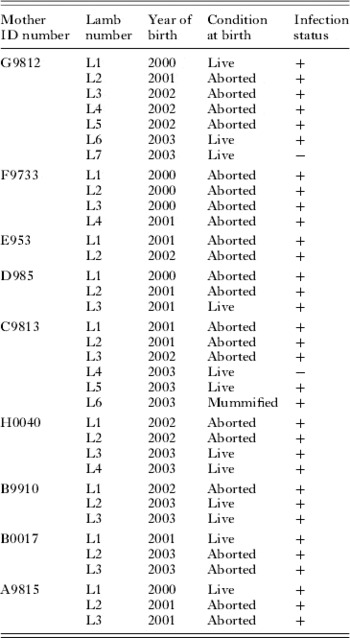
To investigate the question of successive infection with Toxoplasma, ewes were selected based solely on the criterion that they had 2 or more lambings during the 2000–2003 sampling period. Twenty-nine ewes were found to fit this criterion. The remaining ewes had only a single lambing or less during this period and therefore could not be investigated for multiple lambings. Following PCR analysis of tissue samples collected from these 29 ewes, 9 of the ewes were found to have produced T. gondii-positive lambs over successive lambings. The remaining ewes produced either all negative lambs (n=12) or a positive followed by a negative lamb (n=4) or vice-versa (n=4). Details of the ewes with Toxoplasma-positive successive lambs are shown in Table 1. This demonstrates that lambs can be congenitally infected with T. gondii in successive lambings. Furthermore, the results show that sequential abortion has also occurred in lambs born from ewes G9812, F9733, E953, D985, C9813 and A9815. In all the examples studied, the aborted lambs were found to be congenitally infected with T. gondii. For example, ewe G9812 gave birth to 7 lambs over 4 successive lambing seasons and all but 1 were infected.
Details of ewes and their lambs born over successive lambings, where 33/35 lambs were Toxoplasma gondii positive
(The term ‘live’ refers to lambs born healthy and surviving, while the term ‘aborted’ refers to lambs that were aborted pre-term, stillborn or died within a few days of birth. The term ‘mummified’ refers to the delivery of a mummified or malformed foetus. Infection status indicates that T. gondii DNA was detected in a tissue sample from that lamb by PCR.)

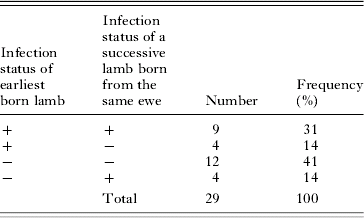
Table 2 shows the relative risk of repeated transmission in successive pregnancies of the 29 ewes in our study group. The results show that transmission of infection in successive pregnancies is not a rare event and was found to occur in 31% of ewes. The likelihood of a ewe giving birth to a congenitally infected lamb followed by an uninfected lamb at the next pregnancy was found to be much lower, at 14%. The risk of repeated transmission is high: breeding from a ewe that had previously produced an infected lamb resulted in a 69% risk of a subsequent lamb being infected.
Infection status of first and second lambs born in successive lambings showing the frequency at which each combination was found to occur
(In the case of successive lambings where multiple lambs were born, they were scored positive if at least 1 lamb was infected.)
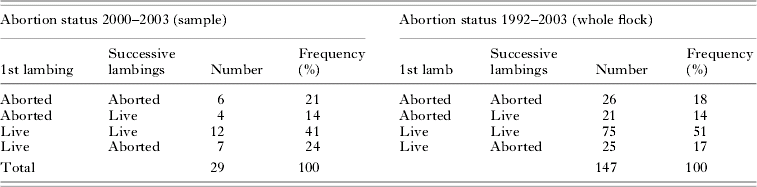
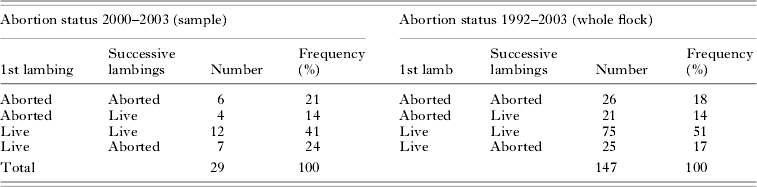
To determine the relationship between infection and abortion, and to establish whether data for abortion frequency follows a similar pattern, the frequency of repeated abortion in successive pregnancies was determined from our study sample of 29 ewes. In addition, we also compared this to retrospective data taken from stock records from the whole flock over the period of 1992–2003. These results are shown in Table 3. Columns 1–4 of Table 3 show abortion data for the study sample of 29 ewes during the T. gondii study period (2000–2003). Columns 5–8 show data for all ewes (n=147) in the lambing period from 1992–2003 where we could establish that the ewe had had pregnancies in successive years or lambings. From the data shown in Table 3 it can be seen that the frequency of 21% for successive T. gondii-positive abortions is of a similar order to the 18% value for successive abortions in the whole flock since 1992. Furthermore, there is no significant difference between the rates of successive abortions in the 2000–2003 sample compared with the rates of successive abortions in the 1992–2003 sample (P>0·05, Chi-squared test) (compare Table 3, columns 4 and 8) suggesting that the 2000–2003 sample tested for T. gondii infection is representative of the 1992–2003 sample. Using the full flock data set (i.e. from 1992–2003), the risk of loss of a lamb was high (55%) if a previous lamb was stillborn. Conversely, if a given lamb is born alive, the risk of losing a subsequent lamb was only 25%. Taken together, these data show that successive infection or abortion rates are high in this flock.
Comparison of abortion status of lambs born to ewes in first and successive lambings
(The first columns show the abortion status of first and subsequent lambs in the sample of 29 taken from 2000–2003 for the Toxoplasma gondii DNA test. The second set of columns shows the abortion status of 147 lambs taken from pedigree history for the entire flock. First lambing refers to the first time we encountered a lambing within the sampling period, not necessarily the first lamb born to that ewe. In the case of successive lambings where multiple lambs were born, they were scored positive if at least 1 lamb was infected or aborted.)
DISCUSSION
Evidence from studies of humans and sheep suggests that infection with T. gondii protects the host from future parasitic challenge (Frenkel, Reference Frenkel1990; McColgan et al. Reference McColgan, Buxton and Blewett1988). In this study we set out to investigate this phenomenon in a population of sheep. We found that 1/3 of ewes gave birth, in successive lambing years, to T. gondii-infected lambs. The risk of such successive infection was high (69%). Furthermore, in our study sample, 1 in 5 ewes were found to abort in successive lambings. Therefore, subsequent foetal infection and abortion appears to occur following an initial infection.
The frequency of aborted T. gondii-positive first lambs during the study period 2000–2003 (35%) was mirrored by the frequency of first lamb abortions throughout the history of this flock, 1992–2003 (32%). Thus, there was not an unusually high rate of abortion in our study period of 2000–2003. This implies that parasite transmission may be a major factor in repeat abortions.
In previous studies, histological evidence from foetal brains and serological methods were used to determine whether lambs were infected with T. gondii (McColgan et al. Reference McColgan, Buxton and Blewett1988). One reason for the discrepancy between our results and these might be that the technique of PCR used in our study is a more sensitive tool for detecting T. gondii infection. In addition, the absence of histological evidence in foetal brains does not necessarily mean the absence of parasitic challenge. In humans, serological analysis using IgM antibody has often shown a negative response in newborns, even in the presence of congenital infection (Desmonts et al. Reference Desmonts, Naot and Remington1981). Also, production of IgG against the parasite can be suppressed for several months in cases of congenital toxoplasmosis (Remington and Desmonts, Reference Remington, Desmonts, Remington and Klein1990). Another factor that could contribute to variation in estimates of congenital transmission might be that we have investigated infections that had occurred and been sustained in a natural population, rather than in experimental systems where parasite challenge doses and routes may be different. A further explanation which could account for this discrepancy is that our studies were conducted solely on Charollais sheep and it is possible that there are differences between breeds of sheep (Buxton et al. Reference Buxton, Maley, Wright, Rodger, Bartley and Innes2007). Studies have shown that different strains of mice have different susceptibilities to Toxoplasma but it is not clear how this might be related to the question of successive abortion. Further studies are required in different breeds of sheep to investigate this issue. Furthermore, different strains of Toxoplasma could influence the outcome of the parasite on mode of transmission, abortion and successive abortion (Boothroyd and Grigg, Reference Boothroyd and Grigg2002). This would indeed be a very interesting question which would need to be resolved by a wide-ranging study involving molecular typing of strains.
The fact that successive congenital infection occurs suggests that complete protective immunity has not been acquired following a previous infection. There are two possible mechanisms of congenital transmission that could be occurring. Either the parasite is transmitted to the foetus from an infected mother during each successive pregnancy (endogenous transplacental transmission), or new T. gondii infections are acquired repeatedly between or during pregnancies (exogenous transplacental transmission) (Trees and Williams, Reference Trees and Williams2005). For both mechanisms, our data are consistent with a reduced immune response by the ewe during pregnancy. In humans, the immune system is modified during pregnancy, for example there is a decrease in CD4 lymphocytes, an increase in CD8 lymphocytes and depletion in the function of NK cells (Zuber and Jacquier, Reference Zuber and Jaquier1995; Boyer et al. Reference Boyer, Remington and MacLeod1998). The pathways that are altered are the very mechanisms that would protect the mother against T. gondii infection during her pregnancy. Also, during pregnancy, sudden hormonal imbalances can lead to a reduction in the ability of the body to fight infection and render the body susceptible to challenge by T. gondii (Avelino and Compos, Reference Avelino and Campos2002). It is well known that an infection by many intracellular parasites, including T. gondii, stimulates an immune response that has the dual effect of compromising the pregnancy and limiting the parasite infection (Quinn et al. Reference Quinn, Ellis and Smith2002). Thus a fine balance exists between the host maintaining a successful pregnancy whilst attempting to combat infection.
Our studies taken together (Duncanson et al. Reference Duncanson, Terry, Smith and Hide2001; Marshall et al. Reference Marshall, Hughes, Williams, Smith, Murphy and Hide2004; Williams et al. Reference Williams, Morley, Hughes, Duncanson, Terry, Smith and Hide2005; Morley et al. Reference Morley, Williams, Hughes, Terry, Duncanson, Smith and Hide2005; this study) suggest that vertical transmission may play an important role in toxoplasmosis of sheep. However, this is by no means generally accepted as other studies have been unable to find evidence to support vertical transmission in sheep (Buxton et al. Reference Buxton, Rodger, Maley and Wright2006) and our data are therefore contradictory and need reconciliation.
However, an important observation from our studies is the high risk (55%) of having a successive aborted lamb following an initial abortion and the possible link with Toxoplasma. If generally applicable these results have potentially important implications for sheep husbandry – although we recognize that further studies are required before we can safely suggest changes to long-established practices. Our work raises some further questions about the transmission of and immunity to T. gondii and suggests the need for further study into the sufficiency of an initial infection to provide life-long immunity to ewe and offspring.
We would like to acknowledge The Perry Foundation, The Wellcome Trust, The University of Salford and the Yorkshire Agricultural Society for providing funding towards these studies. We are also grateful for assistance given by Allan Maiden and family and Miss Sarah Lowe.