




No CrossRef data available.
Article contents
- Abstract
- Definitions
- Models of Ethnic Outbidding
- Reverse Centrist Spiral among Ethnic Parties in India
- Institutional Encouragement of Ethnic Politics
- Institutionalized Multidimensionality and Centrist Ethnic Party Behavior
- Ethnification of the Party System in Uttar Pradesh
- Summary and Comparative Implications
- Implications for Empirical Democratic Theory
- References
Ethnic Parties and Democratic Stability
Published online by Cambridge University Press: 16 June 2005
Article contents
- Abstract
- Definitions
- Models of Ethnic Outbidding
- Reverse Centrist Spiral among Ethnic Parties in India
- Institutional Encouragement of Ethnic Politics
- Institutionalized Multidimensionality and Centrist Ethnic Party Behavior
- Ethnification of the Party System in Uttar Pradesh
- Summary and Comparative Implications
- Implications for Empirical Democratic Theory
- References
Abstract
Ethnic divisions, according to empirical democratic theory, and commonsense understandings of politics, threaten the survival of democratic institutions. One of the principal mechanisms linking the politicization of ethnic divisions with the destabilization of democracy is the so-called outbidding effect. According to theories of ethnic outbidding, the politicization of ethnic divisions inevitably gives rise to one or more ethnic parties. The emergence of even a single ethnic party, in turn, “infects” the political system, leading to a spiral of extreme bids that destroys competitive politics altogether. In contrast, I make the (counterintuitive) claim that ethnic parties can sustain a democratic system if they are institutionally encouraged: outbidding can be reversed by replacing the unidimensional ethnic identities assumed by the outbidding models with multidimensional ones. My argument is based on the anomalous case of ethnic party behavior in India. It implies that the threat to democratic stability, where it exists, comes not from the intrinsic nature of ethnic divisions, but from the institutional context within which ethnic politics takes place. Institutions that artificially restrict ethnic politics to a single dimension destabilize democracy, whereas institutions that foster multiple dimensions of ethnic identity can sustain it.Kanchan Chandra is associate professor of political science at MIT (kchandra@mit.edu) and author of Why Ethnic Parties Succeed (2004). For useful discussions and written comments, the author thanks the anonymous reviewers and the editorial board of Perspectives on Politics, Steve Ansolabehere, Paul Brass, Eric Dickson, Cynthia Enloe, James Fearon, Rachel Gisselquist, J. P. Gownder, Henry Hale, Jennifer Hochschild, Mala Htun, Samuel Huntington, Stathis Kalyvas, Nelson Kasfir, Herbert Kitschelt, David Laitin, Gerard Padro-i-Miquel, Lloyd Rudolph, Susanne Rudolph, Jody Shapiro, Kenneth Shepsle, James Snyder, Ashutosh Varshney, Santhanagopalan Vasudev, Barry Weingast, Myron Weiner, Chris Wendt, Steven Wilkinson, Adam Ziegfeld, and participants of the fall 2003 meeting of the Laboratory in Comparative Ethnic Processes (LICEP) at UCLA.
Information
- Type
- Research Article
- Information
- Copyright
- © 2005 American Political Science Association
Ethnic divisions, according to empirical democratic theory and commonsense understandings of politics threaten democratic institutions.1
Mill 1991; Rustow 1970; Dahl 1971; Geertz 1973; Rabushka and Shepsle 1972; Lijphart 1977; Horowitz 1985; Horowitz 1994; Ake 1993; Sisk 1995; Reilly 2001.
On the mitigation of the threat by certain cleavage structures, see, for instance, Coser 1956; Dahrendorf 1959; Dahl 1956; Dahl 1971; Horowitz 1971; Lipset 1960; Simmel 1955; Rae and Taylor 1970. On the mitigation of the threat by institutional engineering, see, for instance, Horowitz 1985; Horowitz 1994; Nordlinger 1972; Lijphart 1977; Sisk 1995; Sisk 1996; Reilly 2001.
Horowitz 1994, 37.
Lijphart 1977, 236–37 (emphasis added).
One of the principal mechanisms linking the politicization of ethnic divisions with the destabilization of democracy is the so-called outbidding effect. According to theories of ethnic outbidding, the politicization of ethnic divisions inevitably gives rise to one or more ethnic parties.5
Rabushka and Shepsle 1972; Horowitz 1985. I criticize this proposition in Chandra 2004, arguing that successful ethnic parties are not inevitable in ethnically divided societies, but depend on the fulfillment of stringent institutional and demographic conditions. Here I put aside questions of the origins of ethnic parties, addressing only the issue of how they behave once they have emerged.
Such pessimism is unwarranted. Indeed, ethnic parties can, I argue, sustain a democracy, depending on the institutional context within which ethnic divisions are politicized. Institutions that artificially restrict ethnic politics to a single dimension are likely to destabilize democracy, whereas institutions that foster the politicization of multiple dimensions of ethnic identity are likely to sustain it.
This claim rests on a revision of the outbidding models' assumptions about ethnic identity. These models are based on the now discredited “primordialist” assumptions that ethnic identities are fixed, unidimensional, and exogenous to politics. I discard these assumptions in favor of the “constructivist” position that ethnic identities can be fluid, multidimensional, and endogenous to competitive politics. These new assumptions reveal an unexpected and positive relationship between the institutionalization of ethnic divisions and democratic stability.
My argument is based on the anomalous case of ethnic party behavior in India. Divided at least on the basis of language, tribe, caste, region, and religion, India meets the classic definition of an ethnically divided society. Parties based on these divisions have often emerged in Indian politics. While they have often engaged in an initial spiral of outbidding, however, this has typically given way, over a longer stretch of time, to centrist behavior. The roots of this pattern lie, paradoxically, in the institutional encouragement of ethnic politics by the Indian state. Acting on the inherent multidimensionality of ethnic identities, such encouragement forces initially extremist parties toward the center. This article identifies the mechanism by which institutionalization produces centrism in ethnic party behavior, and illustrates it using the case of ethnic party behavior in the north Indian state of Uttar Pradesh.
My argument provides an alternative basis for designing institutional prescriptions for multiethnic democracies. Most institutional prescriptions either depoliticize the issues that ethnic groups are most likely to fight over, or constrain the power of ethnic majorities to make unilateral decisions on issues that concern ethnic minorities. In contrast, I suggest that institutions for multiethnic democracies should encourage the politicization of ethnic divisions and induce proliferation of multiple ethnic majorities. A multitude of freely forming ethnic majorities may be a more effective safeguard against the destabilization of democracy than the imposition of constraints on any single one.
After defining key terms and outlining predictions of theories of ethnic outbidding, I show how ethnic parties in India diverge from those predictions. I next describe the institutional encouragement of ethnic politics by the Indian state and model the mechanism by which it leads to centripetal ethnic parties. I illustrate the model with the case of Uttar Pradesh. I conclude with suggestions for theoretical development, empirical research, and institutional designs for multiethnic democracies.
Definitions
Ethnic identity refers to nominal membership in an ascriptive category, including race, language, caste, or religion. This is consistent with the broad definition now taken as standard in the field of ethnic mobilization: “Ethnicity easily embraces groups differentiated by color, language, and religion; it covers ‘tribes,’ ‘races,’ ‘nationalities,’ and ‘castes.’”6
Horowitz 1985, 53; see also Varshney 2002, 5.
Membership in an ethnic category is inherited: I might, for example, be born a Sikh from the Mazhabi caste in Punjab, a Yoruba Christian from southern Nigeria, or an African American Muslim from Chicago. However, as these examples illustrate, we are usually born as members of several ethnic categories, with a choice about which one to identify with.
An ethnic party appeals to voters as the champion of the interests of one ethnic category or set of categories to the exclusion of others, and makes such an appeal central to its mobilizing strategy. The key aspect of this definition is exclusion. An ethnic party may champion the interests of more than one ethnic category, but only by identifying the common ethnic enemy to be excluded.7
For a similar definition see Horowitz 1985, 299. Horowitz too argues that an ethnic party can champion the cause of more than one ethnic group. He maintains that a party should be termed multiethnic “only if it spans the major groups in conflict” (p. 299). The problem with this definition is that conflict between ethnic groups is often created in the process of political mobilization.
The terms outbidding and centrism refer to the location of party positions on a given dimension. Outbidding occurs when parties assume positions toward the endpoints on this dimension. Centrism describes the assumption of positions closer to the middle.
Institutionalization of a given cleavage is the attachment of routinized, within-system payoffs to political mobilization based on that cleavage.
I use the term democracy in a minimalist sense to mean a system in which the political leadership is chosen through competitive elections.8
Huntington 1991, 7.
Models of Ethnic Outbidding
The first model of ethnic outbidding (model 1), based on the axioms of rational choice theory, was proposed by Alvin Rabushka and Kenneth Shepsle in 1972.9
Rabushka and Shepsle 1972, 66–88.
Horowitz 1985, 349–64.
Model 1 assumes the following:11
My discussion of the model relies on Rabushka and Shepsle 1972, 67–73.
- There are two ethnic groups, A and B, separately organized in all respects.
- There is a single issue axis, represented by a line segment with endpoints A and B.
- All individuals within an ethnic group have identical preferences with regard to alternatives on this issue axis.
- All individuals in different ethnic groups have diametrically opposed preferences with regard to alternatives on this issue axis: all As prefer endpoint A most and endpoint B least; all Bs prefer endpoint B most and endpoint A least.
- Individual preferences, and therefore group preferences, on ethnic issues are intense, meaning that individuals are “risk-acceptant.”
- The outcome is decided by majority rule.
The assumptions driving model 2 are less explicit. The following list identifies its implicit assumptions and shows that they are consistent with those of model 1.12
By not making these assumptions explicit, Horowitz risks contradicting himself. But without these assumptions, the predictions of his outbidding model do not follow. For example, he argues that subethnic divisions within a group create incentives for the proliferation of parties claiming to represent that group and are therefore likely to fuel intense outbidding conflict. By subethnic divisions, Horowitz means ascriptive divisions based on differences of caste, clan, language, religion, or region that are “at a level below the principal lines of politically relevant group boundaries” (Horowitz 1985, 350). But acknowledgment of differences in preferences within ethnic groups is difficult to reconcile with conclusions based on the model. If the preferences of subgroups within the ethnic “majority” differ from one another and cluster at different points on the issue axis, then the logic of the outbidding model is arrested. If, for instance, preferences of subgroups in groups A and B cluster near the center of the issue axis, a party might be able to win an election by making a cross-ethnic appeal to clusters from both ethnic groups at the center, rather than through an ethnic bid for the support of individual groups at the extremes.
- There are two groups, A and B, each with a “segmented
organizational structure,”13echoing model 1's assumption that they are separately organized in all respects.
Horowitz 1985, 8–9, 342.
- Ethnic issues preempt all other issues in ethnically divided
societies, echoing model 1's assumption of a single issue axis.14
Horowitz 1985, 19.
- Individuals belonging to an ethnic group share a desire for
self-esteem and a sense of belonging.15But there is no acknowledgment that these individuals might desire other things more, or differ in the degree to which they desire these two forms of gratification, or change their desires over time. Instead, ethnic groups are treated throughout as monolithic groups with common desires that are constant over time. Model 2 therefore treats ethnic group preferences as fixed and homogeneous.
This assumption is developed in Horowitz 1985, 141–228, and summarized in 226–28.
- Conflict between ethnic groups is a zero-sum game, where one
group's interests are in direct opposition to the other's.16Ethnic parties representing distinct ethnic groups present voters with an either-or choice.17
Horowitz 1985, 141–228.
This indicates that model 2 also takes preferences across groups in conflict to be perfectly incompatible.Horowitz 1985, 345.
- Horowitz's frequent descriptions of the emotional attachment to
ethnic identity as “intense” and “out of
proportion” indicates agreement with Rabushka and Shepsle's
similar assumption about ethnic group preferences.18
Horowitz 1985, 131.
- Finally, the electoral outcome is decided through simple majority vote.
The predictions of the two models are summarized in the figures below, adapted from Horowitz.19
Horowitz 1985, 359.

Step 1: Centrist position of the multiethnic coalition
In order to defeat or weaken the multiethnic coalition, a challenger party must take a position closer to either endpoint A or B. Sooner or later, therefore, according to both models, a multiethnic coalition is undercut by ethnic challengers on either or both flanks that “outbid” it for the support of As and/or Bs (fig. 2).

Step 2: Undermining of the multiethnic coalition by challengers with more extreme positions
Once the first ethnic bid is in place, it can only be defeated by more extreme bids. The polarized preference distribution inexorably pulls all parties, old and new, toward the extreme ends of the issue axis (fig. 3).

Step 3: Old and new parties attempt to outbid each other
When there is even a slight difference in the numerical strength of groups A and B, the result should be either or both of two equally destabilizing outcomes: the party bidding for the support of majority group A should win the election and subvert the democratic process by stripping minority group B of all rights, or the minority group B should engage in destabilizing violence to preempt such exclusion.
The assumptions that ethnic groups are fixed, internally homogeneous, unidimensional, and exogenous to institutions and political competition, are now commonly associated with “primordialist” approaches to ethnic identity.20
For a summary of the debate between primordialism and constructivism, see Chandra 2001b.
Constructivist scholarship that make these claims include, see Barth 1969; Brass 1974; Kasfir 1979; Laitin 1986; Pandey 1990; Posner 2005; Waters 1990.
Rabushka and Shepsle brush aside criticisms of their assumptions, arguing that the model should be judged based on the accuracy of its predictions rather than its assumptions.22
Similarly, Horowitz justifies his description of ethnic groups as a “conceptual convenience” that, though not always accurate, captures the essential elements of politics in ethnically divided societies.23Horowitz 1985, 74.
Reverse Centrist Spiral among Ethnic Parties in India
Figure 4 describes the typical pattern of ethnic party behavior across space and time in India. In what is widely accepted as the “centrist equilibrium of Indian politics,”24
aspiring ethnic parties in postcolonial India typically open with an extreme bid and then adopt progressively more moderate positions, eventually finding their way to the center.
Reverse centrist spiral among ethnic parties in India
In the first election in independent India in 1951, for example, the umbrella Congress party was challenged at the national level by four ethnic parties: the Ram Rajya Parishad, the Hindu Mahasabha, and the Bharatiya Jana Sangh—all vying for the support of the Hindu “majority”—and the All India Scheduled Caste Federation, bidding for the support of the ex-untouchable castes. Three of the four ethnic parties gradually disappeared after being unable to obtain more than a negligible share of the vote. The fourth, the Bharatiya Jana Sangh, attempted to remodel itself into a centrist party in the image of Congress.25
In the late 1980s, as Congress began to decline, ethnic parties appeared once more: the Bharatiya Janata Party (BJP), descended from the Bharatiya Jana Sangh, veered back toward an extreme position by attempting to pit Hindus against Muslims; and the Bahujan Samaj Party (BSP) and the Janata Dal (JD) tried to mobilize the Scheduled Castes, “backward” castes, and Muslims against the Hindu upper castes.26 However, each party subsequently moderated its platform. Most notable was the moderation of the BJP, which, when it assumed power for the first time in 1998, did not include any overtly pro-Hindu issues in its governing agenda.A similar pattern characterizes party politics at the state level. In the late 1950s, for example, the main opposition to Congress in Tamil Nadu came from the Dravida Munnetra Kazhagam (DMK), an ethnic party that fought its first election on the secessionist demand for the separate state of Dravida Nadu. By the next election in 1962, the DMK had dropped the demand for secession.27
Since then, the DMK and its offshoot, the All India Anna Dravida Munnetra Kazhagam (AIADMK), have become part of a stable, centrist party system in Tamil Nadu. Similar attempts at outbidding by ethnic parties in other states have been reversed or arrested. In Punjab in the 1980s, the Akali Dal intensified its demands for regional autonomy for Sikhs, with some factions claiming solidarity with Jarnail Singh Bhindranwale, a Sikh revivalist leader who called for an independent Sikh state. However, by the late 1990s, the Akali Dal had deemphasized the demand for autonomy and sought to reinvent itself as a party of all Punjabis, not only of Sikhs.28Based on fieldwork in the 1997 assembly elections in Punjab.
What explains the changing behavior of ethnic parties? According to one argument, the answer lies in the existence of a dispersed or multipolar cleavage structure, that is, one in which there are several small groups, none of which constitute a majority.30
Horowitz 1971. See also Horowitz, 1985, 37.
Dahl 1971, 117; Horowitz 1971, 238–39.
Horowitz 1971, 237.
Dahl 1971, 117.
But to characterize India's cleavage structure as dispersed or multipolar is incorrect, for doing so privileges particular dimensions of ethnic identity and ways of categorizing groups on those dimensions while ignoring other dimensions and categorizations. If we focus on the dimension of language, and count separately each regional language in India, we might categorize India's cleavage structure as dispersed. Similarly, if we focus on the dimension of caste, and count separately each localized caste group, we might do the same. But such a conclusion overlooks other ways of categorizing the Indian population that can and have sliced the population into bipolar configurations (Upper Caste versus Backward Caste; Hindi-speakers versus non-Hindi speakers; Hindus versus Muslims; north versus south). Therefore we cannot attribute the reverse centrist spiral of ethnic party behavior in India to a dispersed cleavage structure. Rather, we need to identify the conditions under which multipolar or bipolar categorization are likely to be activated.
A second explanation highlights the moderating influence of “crosscutting” cleavage structures. Crosscutting cleavages, the classic argument runs, prevent the emergence of permanent majorities, since the mobilization of voters on any one dimension of cleavage is likely to be canceled by the mobilization of voters on another.34
India is also commonly described as a society with crosscutting cleavages. Therefore, ethnic parties should be less likely to engage in outbidding.India's cleavage structure is indeed more crosscutting than dispersed, but a comparison between colonial and postcolonial India shows that we cannot attribute the move toward the center of ethnic parties in postcolonial India simply to that fact. In colonial India, competition between the Muslim League, which represented Muslims, and the Indian National Congress, dominated mainly by Hindus, was consistent with the expectations of the outbidding model. The Muslim League, initially close to the center, took up progressively more extreme positions over the issue of territorial autonomy for Muslims that resulted in the violent partition of British India into India and Pakistan in 1947. Postcolonial politics, however, has been marked by intermittent outbidding by marginal parties followed by centrist behavior. India's cleavage structure was crosscutting in both periods. Why then do we see outbidding in one period but centrism in another?
To the extent that India's crosscutting cleavage structure is a constant, it cannot explain the variation in outcomes over time. My argument builds on the insight that crosscutting cleavages are likely to moderate ethnic outbidding. Indeed, it assumes it. But it is the institutionalization of such cleavages, rather than the mere fact of their existence, that explains the variation in democratic outcomes in India and elsewhere. The cleavages that were institutionally recognized in colonial and postcolonial India differ. The colonial state privileged religious identity over other types of identities at the national level, particularly by providing separate communal electorates to Hindus and Muslims since 1909. The postcolonial constitution, in contrast, institutionalized multiple and crosscutting cleavages. This difference accounts for the striking difference in ethnic party behavior.
Institutional Encouragement of Ethnic Politics
The state controls the bulk of resources in Indian society, including 69 percent of the jobs in the organized economy.35
Government of India 2001; Weiner 1967; Bardhan 1988; Kohli 1991; Rudolph and Rudolph, 1987.
While the absolute share of the public and private sector in employment has remained relatively stable, the relative rates of growth of the two have changed following the economic reforms. The greater opportunities and incentives now provided by the government in the private sector combined with restriction on the expansion of the public sector mean that the private sector is now growing at a faster rate (Government of India 2001). In the longer run, if government policy continues to encourage expansion of economic activity in the private sector, we should expect its relative share in employment to increase even in the absence of privatization efforts. In the present and the near future, however, the state continues to dominate employment opportunities in the organized economy in India.
Three policies affect an individual's chances for obtaining control of, or access to, the state: affirmative action policies; language policies; and policies on the creation of new federal units within the Indian Union. These policies are outlined in India's constitution, written by a constituent assembly between 1948 and 1950 and adopted the following year.37
All three, by accident rather than design, privilege the politicization of ethnic identities over nonethnic identities.Affirmative action policies
Affirmative action policies provide the greatest institutional encouragement to the politicization of ethnic identity in India. The constitution promises preferential treatment to three separate categories of citizens: “Scheduled Castes” (SCs), “Scheduled Tribes” (STs), and “Other Backward Classes” (OBCs). The term “backward classes” was intended as, and has come to be accepted as, a euphemism for backward castes. As B. R. Ambedkar, chairman of the drafting committee of the constitution, observed: “What are called backward classes are … nothing else but a collection of certain castes.”38
Galanter 1978, 1816.
Members of SCs and STs receive proportional representation in national, state, and local legislatures, proportional employment in government services, including the civil services and the police force, and “reserved” seats in government-funded educational institutions. The constitution also empowers state and central governments to provide unspecified benefits to the OBCs.39
Galanter 1978, 1812.
Constitution of India Article 341, 342.
The ambiguity over which groups are beneficiaries, and the ease with which the lists may be revised means that individuals have an incentive to mobilize on the basis of caste or tribal identity and to demand that their group be included in one of the three lists. Politicians also have an incentive to mobilize individuals on the basis of caste or tribe. Not surprisingly, therefore, these constitutional provisions have resulted in a wave of caste mobilizations at both the state and the central level, as large numbers of caste groups, often exceeding a majority of the population, demand to be classified as SC, ST, or, most frequently, OBC.
Language policy
The official language of the state determines access to state employment and, indirectly, to opportunities in the private sector. Since language repertoires are not easily changed in a single generation, designating one language as the official one immediately identifies winners in the race for control of the state (those who are fluent in the official language) and losers (those who are not).41
There is a hierarchy of official languages in India.42
At the top are the official languages of the Union. Knowledge of these languages offers the best career prospects for jobs in the All India Civil Services. Next are the official languages of the federal units, the Indian states. Knowledge of these languages offers access to the All India Civil Services as well as the vast pool of jobs controlled by the states. At the third level are “mother tongues.” Although state-run schools are often required to provide instruction in “mother tongues,” knowledge of mother tongues does not offer any access to state jobs.The relative positions of individual languages in the language hierarchy are open to renegotiation. At the top, while Hindi is designated by the constitution as the official language of the Union, English enjoys supposedly temporary status as an “additional associate official language,” to be withdrawn once non-Hindi speakers, who constitute a majority of the Indian population, acquire proficiency in Hindi.43
Constitution of India, Article 343. See Brass 1994, 164–65, 177.
Constitution of India, Article 345.
Had the official languages of the state been specified once and for all, individuals who did not speak these languages would have had incentives to learn them. But since official languages are treated as an open and easily revised policy issue in India, individuals who lose out have incentives to mobilize as linguistic groups and demand that their own language be upgraded to the status of official language, or that the language spoken by another group be downgraded to the status of mother tongue. Linguistic mobilization has been a recurrent issue at the state level in postcolonial Indian politics.45
Brass 1994, 157–91; Dasgupta 1988, 144–68.
Recognition of statehood
India is a federation in which powers are shared between the Union and the state governments. The governmental machinery in each state has considerable power in determining the life-chances of its population. It formulates policies on education, land ownership, and taxation on land and agricultural income, distributes jobs and other forms of patronage, and allocates the funds obtained as grants from the central government. Subunits within states have fewer resources at their disposal. Where the designation of a subunit as a state carries with it substantial material benefits, and where the redrawing of state boundaries is relatively easy, subunits within state boundaries have strong incentives to demand to be recognized as states in their own right.
The states are not treated as sovereign entities by the Indian constitution, which empowers the Union government to carve out new states from old ones simply by passing a law, without even obtaining the assent of the state concerned.46
Constitution of India, Article 3.
Brass 1994, 172–74.
The decision to adopt these three policies was made in top-down fashion by political elites influenced by a liberal nationalist ideology. The deliberations over the constitution took place largely behind closed doors, in the Constituent Assembly, and the still smaller meeting rooms of committees. The members of the Constituent Assembly sought to tap popular opinion by consulting with citizens' groups and associations.48
For an account of the process by which the constitution was formulated, see Austin 1966.
Once these institutional choices were made, however, their unintended consequence was to encourage, over time, large-scale mass mobilizations along multiple ethnic dimensions. A wave of mobilizations by linguistic and regional groups demanding states of their own broke out in the late 1950s. An explosive struggle over the “official” language emerged at the national level in the 1960s, followed by similar struggles in individual states. And demands for caste-based affirmative action percolated upwards from the local to the state level in state after state immediately after adoption of the constitution, culminating in nationwide agitations by the late 1980s.
During the same period mobilization on nonethnic dimensions such as class, sector, or income, became less visible, less sustained, and narrower in scope. Nonethnic groups have had some success in lobbying for particular policy concessions. For example, farmers' movements have extracted agricultural subsidies from the government.49
However, nonethnic politics is at a disadvantage in the struggle for control of the state, where most of the opportunities for advancement lie.Institutionalized Multidimensionality and Centrist Ethnic Party Behavior
Here, I model the process by which the institutionalization of multiple and crosscutting dimensions of identity leads to an initial spiral of extreme bids followed by a stable centrist equilibrium. Politicians who encourage institutionalized cleavages can credibly promise voters concrete rewards within the existing rules of the game. However, politicians who seek to activate cleavages that exist at the social level but are not institutionally recognized must first promise to transform the existing rules of the game before they can credibly promise rewards. Consequently, institutionally recognized cleavages are advantaged as mobilization strategies, while cleavages that are not so recognized are disadvantaged.50
For a different argument about the importance of institutionalization, see Laitin 1986 and Posner 2005, which argue that institutionalization not only gives voters greater incentive to mobilize along cleavages that are institutionally recognized, but also creates a “commonsensical world” in which those cleavages not given institutional recognition become progressively less “real” in the political imagination of voters. I do not make this more stringent assumption about the psychological impact of institutionalization here; however, the assumption that institutionalization creates a commonsensical world around institutionalized cleavages would produce an equivalent prediction, leading to the privileging of institutionalized over noninstitutionalized cleavages in politics.
The assumptions of my model are consistent with those of the outbidding model on a single dimension. The key innovation is that this model allows for the possibility of choice between group memberships on more than one dimension of identity. Introducing this possibility produces the radically different outcome of centripetal rather than outbidding behavior.
Imagine a political system that offers institutional incentives for activating two crosscutting dimensions, represented in figure 5.

Two institutionalized dimensions of identity
Dimension 1 divides the population into majority group A and minority group B. Dimension 2 divides the population into majority group D and minority group E along a different axis. On any dimension, the groups are mutually exclusive, and each cleavage encompasses all of the population. A single individual in this society possesses one of the following four combinations of institutionalized identities:
- (A ∩ D): (that is, belongs to the majority group on both dimensions).
- (A ∩ E): (that is, belongs to the majority group on dimension 1 but the minority group on dimension 2).
- (B ∩ D): (that is, belongs to the minority group on dimension 1 but the majority group on Dimension 2).
- (B ∩ E): (that is, belongs to the minority group on both dimensions).
Assumptions
The model makes the following assumptions:
- There is a first-past-the-post (FPTP) electoral system with only two political parties. In such a system, either party must obtain more than 50 percent of the votes to win. This assumption restates the majority rule principle driving the outbidding models in an explicit institutional form.
- Both parties seek to win elections.
- Parties can only take a position on one dimension at a time. On any dimension, they can bid for the exclusive support of the majority or the minority, or they can take a position equidistant from both. This assumption corresponds to the “outbidding” strategy or the centrist political strategy, respectively, assumed by the earlier models.
- An outbidding strategy imposes the cost of intergroup conflict on society at large. Equidistance has no social cost.
- Individuals care only about being members of the group that is promised rewards by the winning party. Faced with a choice of party positions on different identity dimensions, voters will favor the dimension of their identities that places them in the majority group. Thus if they are in a majority or a minority on both dimensions, they will be indifferent between the two. But if they are in the majority on one dimension and the minority in other, they will favor their majority identity.
- Positions taken early are more credible than positions taken later. If two parties bid for the support of the same majority group on the same dimension of identity, therefore, the first mover is credible, while the second is not.
At some initial point, imagine that only one dimension of identity is salient (AB), Suppose that one party declares itself the champion of majority group A and excludes minority group B. This corresponds to an “outbidding” strategy on a single dimension of identity. This should lead to the clustering of all A voters behind this first mover. The second party cannot also credibly bid for the support of the majority group A. In a political system in which no other dimension of identity can be activated, the results of a political competition are decided in this first round. The first mover always wins, the second mover always loses, and the democratic system is destabilized by permanent exclusion of the Bs. This first scenario corresponds exactly to the first stage of the outbidding model.
But where institutions attach payoffs to more than one dimension of identity, a party that stands to lose on the first dimension can turn the verdict to its advantage by activating the second dimension (DE) and bidding for the support of the majority group D on the second dimension. More generally, the institutionalization of multiple cleavages means that any party mobilizing voters on the basis of one cleavage can provoke a countermobilization by a competing party on another dimension that cuts across the first.
Centrism is a special case of the redefinition of majorities produced through this mechanism. Centrism arises when the two institutionalized cleavage configurations are “symmetric.” In other words, if (x) is the proportion of the majority group A and (1 − x) the proportion of the minority group B in the population, then symmetry requires that (x) is also the proportion of the majority group D and (1 − x) is also the proportion of minority group E in the population. In this configuration, even as the proportions of majority (x) and minority (1 − x) on each dimension remain constant, the proportions in which members of any one group on the first dimension are “remixed” into a new group on another dimension may vary.
Consider, for example, a case in which (x) = 60 percent and (1 − x) = 40 percent on both dimensions. Any of the combinations of identities across dimensions listed in table 1 would be compatible with these proportions: When the two cleavage structures are symmetric, the result of both parties bidding for the support of the majority group on the two different dimensions will be a draw. The reasoning is as follows:
Examples of “symmetric” cleavage structures

From assumption 5, we know that:


When cleavages are symmetric:


It follows that ((A ∩ D)/2) + (A ∩ E) = ((A ∩ D)/2) + (B ∩ D)
Support for party 1 in other words, equals support for party 2. This holds true for any symmetric pair of cleavages, regardless of the relative sizes of the majority and minority groups, and regardless of the way in which members of a group on one dimension are remixed into new groups on another dimension.
Given the institutionalization of symmetric cleavages, then, it is always profitable for initially marginal parties to bid for the support of ethnic majority A or D. The reasons for initial imbalance may be various. Different historical trajectories or organizational resources may, for instance, give one party an initial advantage over the other. Even anticipating that its competitor will respond by bidding on the crosscutting dimension, an outbidding strategy still allows a marginal party to orchestrate a draw and thus improve its position. The best response of the dominant party is to outbid on a second dimension to prevent further attrition of its voter base. Wherever we see marginal parties, therefore, we should see an initial spiral of outbidding, ending with an electoral verdict in which both parties are deadlocked.
Once the two counterbalancing bids have produced a draw, neither party can improve its position. If both parties continue to outbid, they would inflict the costs of high levels of intergroup tension and possibly violence on society without any expected increase in votes. But if both parties coordinate on a centrist strategy, then both can maintain their positions without inflicting costs on society. Further, once both parties are situated at the center, they open up the possibility of obtaining the elusive winning margin by making a localized and selective pitch to some section of the formerly excluded minority groups. In subsequent elections, therefore, we should find parties that began with an initial spiral of outbidding to be locked into a centrist equilibrium by the institutional incentives that allow for the activation of new identity dimensions.
The centrist equilibrium insulates the democracy from destabilization by preventing the permanent exclusion of minorities in two ways. First, since no party seeking to mobilize an ethnic majority at the expense of the minority wins, no party is strong enough to exclude a minority. Second, because no party has a winning majority, all parties have to seek the support of some section of the minority in order to win.
Over time, this equilibrium might be destabilized. The key actor driving the initial spiral of outbidding is a marginal party for which a draw is beneficial. A dominant party has no incentive to engage in outbidding, since the draw that inevitably results weakens rather than strengthens its position. The entry of a new political party or an organizational split in one of the old parties, therefore, might provoke a new spiral of outbidding initiated by these new parties. An environment of uncertainty, in which parties underestimate their actual support base, might produce the same result. Alternatively, links to other political games at other levels may upset the centrist equilibrium by driving one party toward an extreme bid. A regional party organization for instance, may be forced by a national-level party organization to play an outbidding strategy even against local incentives. By the logic that led to initial centrist equilibrium, however, any fresh attempt at ethnic outbidding is likely to generate a countermobilization on a new dimension that guides each party back to the center.
Note that the emergence of the centrist behavior depends on the institutionalization of a symmetric cleavage structure. Institutionalization of asymmetric cleavages with two-party competition should, in contrast, produce a politics of competitive polarization. An asymmetric cleavage structure should, under majority rule, produce a victory for one party even on two dimensions. But as long as institutions attach rewards to the mobilization of voters on more than one dimension, the majority obtained under these conditions will not be stable. Instead, it will be vulnerable to destabilization by new majorities manufactured on different dimensions by those who stand to lose under the current system, whether or not these dimensions are symmetric. The inherently transient nature of majorities and minorities in this multidimensional environment renders the politics of ethnicity indistinguishable from “normal” democratic politics. Thus while institutionalized asymmetric cleavages should not produce the centrist behavior that is the main concern of this article, it should nevertheless produce the fluidity that can independently insulate a democratic system from breakdown.
While this model assumes the existence of crosscutting cleavages, it builds on the insight that such cleavages can safeguard democratic stability in three ways. First, it is the institutionalization of these cleavages, not merely their simple existence in society, that makes them viable candidates for politicization. When cleavages are not institutionalized, it is difficult (although not impossible) to activate them in politics. Second, this model identifies conditions under which political entrepreneurs should activate these cleavages; it attaches the missing argument about agency to a structural argument about cleavages. Third, it specifies the particular pattern of cross-cutting cleavages that is likely to produce centrism. With two-party competition and an FPTP electoral system, a crosscutting cleavage structure must be symmetric in order to produce centripetal party behavior. Other electoral rules and party systems may require other patterns of cross-cutting cleavages, as yet unidentified, to produce equivalent outcomes. In the next section I illustrate the model using the case of ethnic party politics in the Indian state of Uttar Pradesh.
Ethnification of the Party System in Uttar Pradesh
With 139 million inhabitants in 1991—nearly equaling the Russian Federation—the northern state of Uttar Pradesh is India's most populous.51
World Bank 1998. The new state of Uttaranchal was carved out of Uttar Pradesh in 2000, with a population of approximately 8 million, according to the 2001 census. Data used in this section, unless otherwise stated, are from the 1991 census.
Between 1947 and 1985, the multiethnic Congress party dominated Uttar Pradesh politics, consistently winning the majority of the state's parliamentary seats, except in 1977. The party also controlled the legislative assembly in the state of Uttar Pradesh for most of this period, with four brief intervals of opposition rule that added up to only four years.52
Congress appealed to the disparate groups in its electoral base using the ambiguous strategy that Rabushka and Shepsle attribute to a multiethnic coalition.53Step 1: First ethnic bid
After 1985 the multiethnic Congress began to unravel.54
Why the Congress strategy of ambiguity remained a winner for almost four decades is one question raised by the outbidding model, which argues that such a strategy is “inherently unstable” (Rabushka and Shepsle 1972, 82); however, it is not the puzzle to which I wish to draw attention here.
1991 census figures, reported in Butler, Lahiri, and Roy 1995.
The BJP traces its lineage to the Bharatiya Jana Sangh, a Hindu nationalist political party that slowly moderated its position until 1977, when it merged with a collection of opposition parties to form the umbrella Janata Party. The BJP was reborn from Janata in 1980. In its initial years the BJP continued to define itself as an aggregative party, meant for both Hindus and Muslims. In the early part of the 1980s, the BJP was, surprisingly, more centrist than the Congress. Its aggressive championing of Hindu interests can be traced specifically to 1986. For details, see Chandra 1994.
Religion is not among those cleavages promised institutional rewards in the postcolonial constitution. Consequently, mobilizing voters on the basis of religion has proved extraordinarily difficult, and did not yield political dividends in the several national elections before the 1980s.58
For election data on the failure of Hindu nationalist parties, see Butler, Lahiri, and Roy 1995.
Once the BJP had overtly assumed a Hindu majoritarian position, the logic of the outbidding model should have resulted in one or more of the following scenarios: (1) an attempt by Congress to remake itself from an umbrella to a pro-Hindu party and therefore “outbid” the BJP; (2) the emergence of a third party even more committed to the championing of Hindu interests than Congress or the BJP; or (3) the BJP's assumption of an even more extreme position to preempt the emergence of an ethnic challenger. And, we should have witnessed a similar outbidding effect by parties representing the Muslim minority.
Step 2: Introduction of a new issue axis
At this point, however, the predictions of the outbidding model go awry. A third party, the Janata Dal (JD) did in fact bid for Muslim support by committing itself to protecting the mosque. However, the JD's major initiative was to activate the dimension of caste. In 1990 the Indian prime minister, who belonged to the JD, announced his government's decision to reserve 27 percent of the jobs in the central government services for OBCs, explicitly defined as a collection of caste categories. By introducing the issue of affirmative action for the OBCs, the JD sought to draw a sharp line between Hindu upper castes and other subordinate groups, thus fragmenting the religious majority that the BJP was attempting to forge.
Step 3: Initial surge of “outbidding” followed by reverse spiral of moderation
Since 1990, party politics in Uttar Pradesh has revolved around these two issue axes: the rights of the Hindu majority versus the Muslim minority; and the relative representation of the Hindu upper castes versus others in state jobs. The cleavages of religion and caste in Uttar Pradesh are approximately symmetric. Hindu constitute 82 percent of the population, and Muslims 17 percent. Precise figures for categories on the dimension of caste do not exist, since India has not taken a comprehensive caste census since 1931. Nevertheless, estimates from that census put Hindu upper castes at roughly 20 percent of the population of Uttar Pradesh. The remaining 80 percent is composed of Scheduled Castes (21 percent), Muslims (17 percent), and the Other Backward Castes (roughly 42 percent).60
Hasan 1989, 154; Hasan 1998, 123.
The activation of the two roughly symmetric dimensions arrested the parties' initial outbidding. Consider, first, party positions on religion.61
The description of the moderation of all parties in Uttar Pradesh, in addition to the secondary sources cited in the text, is based on my own fieldwork in Uttar Pradesh during the 1991, 1996, and 1998 election campaigns. Where the source is not explicitly cited all figures for the ethnic profile of party candidate lists and governments are based on data gathered during fieldwork.
Party positions on caste representation exhibit a similar centrism. By 1993, following a series of splinters, the JD was succeeded by the Samajwadi Party (SP) in Uttar Pradesh. In 1993 the BSP and the SP allied against the BJP in the state assembly elections. Both the BSP and the SP made displacement of upper castes from their position of dominance a central election issue, although the former was more extreme in this position than the latter. In elections since 1993, however, both the SP and the BSP began to induct upper castes into their party organizations and candidate lists, to redefine the issue as power-sharing between upper castes and others, rather than displacing upper castes from power, and to seek alliances with parties that they had earlier denounced as instruments of the upper castes.64
In contemporary politics in Uttar Pradesh, the political system does not permanently exclude any ethnic category. Hindu upper castes are courted by the BJP, the BSP, and the SP. The OBCs also are courted by all three parties. Scheduled Castes are courted by the BSP, and to a lesser extent, the BJP and SP. Muslims are courted by the SP and BSP. The BJP has not yet made any significant effort to incorporate Muslims into its organization and candidate lists, but it no longer markets itself on an electoral platform threatening exclusion of Muslims from the national community.
Up to now, competing mobilizations have checked each other and forced extremist parties to the center. However, the reverse spiral toward moderation in Uttar Pradesh may certainly be challenged in the future. Given the rewards of winning control of the state, marginal political parties will continue to experiment with outbidding strategies in order to forge ethnic majorities.65
The BJP government's veiled support of communal violence in Gujarat in February 2002 appears to have been a reversion to outbidding in order to improve adverse electoral prospects. On the use of communal violence to electoral advantage, see Wilkinson 2004; Brass 1997; Brass 2003.
On the electoral roots of the violence in Gujarat, see esp. Wilkinson 2002; CSDS Team 1999.
Continuing with the example of Uttar Pradesh, the ambiguity of the state's affirmative action clauses is already being used to manufacture new political coalitions that might fragment the most recent effort to weld a majority based on subordinate groups (SCs, OBCs, and Muslims). The BSP, for instance, has begun to divide the OBCs into two categories: the “Forward among Backward,” comprising the better off castes in this category, and the “Most Backward,” comprising those who are worse off. The SP, meanwhile, is seeking to identify the “Backwards among Forwards,” i.e., sections of the upper castes who also deserve to be identified as a “Backward Class.” The relative openness toward renegotiation of state boundaries resulted in a successful agitation for the new state of Uttaranchal, carved out of northern Uttar Pradesh. Uttaranchal's borders cut across religion, and to a lesser extent, caste. Language politics in Uttar Pradesh has so far coincided with religious politics: 90 percent of the population, mainly Hindu, reportedly speaks Hindi, while the rest, mainly Muslim, speaks Urdu.67
However, the potential exists for fragmenting both religious and caste identities through activation of other language cleavages. Paul Brass points, for example, to the existence of Bhojpuri as a “minority mother tongue” in Uttar Pradesh. So far, Bhojpuri has been treated as a dialect of Hindi, and educated Bhojpuri speakers have not sought a separate official status for their language.68Brass 1994, 184.
Summary and Comparative Implications
Theories of ethnic outbidding assume that ethnic identities are intrinsically fixed. Such fixity, their proponents claim, generally leads to destabilizing party behavior. Although I do not challenge the conclusion that fixed identities increase the risk of destabilizing party behavior, I suggest that fixity is not an intrinsic quality of ethnic identities but a product of the institutional context in which ethnic groups are politicized. Some institutional contexts impose an artificial fixity on ethnic identities, while others allow their inherent fluidity to flourish. Consequently, some institutional contexts produce benign forms of ethnic politics, while others produce malign forms.
Although the institutionalization of multiple dimensions of ethnic identity is sufficient to produce a centrist equilibrium even in the maximally polarized societies of the type assumed by the outbidding models, and therefore to safeguard democratic stability, it is not necessary. Democratic stability may also be induced by a different distribution of preferences between majority and minority groups, a multiparty system that fragments the votes of an ethnic majority, a multipolar configuration of ethnic groups, or institutions and rules that force alliances between extremist parties.69
For two arguments questioning the presumed negative correlation between ethnic mobilization and democratic destabilization, although for different reasons, see Giuliano 2000 and Birnir 2004.
My argument must be further developed to take into account conditions of more than two dimensions of cleavage, more than two groups on each dimension, and more than two political parties. It must also be tested with data on cases other than India. One test is suggested by a controlled comparison between India and Sri Lanka between 1948 and 1972. Both nations share a historical legacy of British colonial rule. They also shared a similar electoral and governmental system for this time period: FPTP with single-member districts and a parliamentary government. Most important, though often overlooked, Sri Lanka replicates India's crosscutting cleavage structure at the social level, albeit on a smaller scale: it is also divided by caste, region, religion, and language.70
Tambiah 1986; Ryan 1993; Roberts 1995. See also Darini Rajasingham-Senanayake, “Democracy and the Problem of Representation,” in Pfaff-Czarnecka et al. 1999, 99–134.
Why these differences? If my argument is right, then the cause of democratic breakdown in Sri Lanka lies in the absence of institutional recognition of the multiple dimensions of social identity. This appears plausible. Unlike the postcolonial Indian constitution, the Sri Lankan constitution from 1948 to 1972 did not reward mobilization of identities based on caste and region that cut within and across the boundaries of the Sinhala and Tamil groups. We need more research on the design and implementation of Sri Lanka's constitution, however, to evaluate these hypotheses.
Finally, my model also generates a new hypothesis for the breakdown of democracy in multiethnic countries such as the former Yugoslavia. The violence that accompanied democratization in Yugoslavia is usually explained as a consequence of long-standing historical enmities,71
a “security dilemma,”72 or, most recently, the weak institutional environment in which democratization took place.73 An explanation may lie instead in the institutionalization of a single ethnic identity in Communist Yugoslavia. Yugoslavia's 1974 constitution comprehensively privileged “nations” (Serb, Croat, Slovene, Macedonian, Montenegrin, and, eventually, Muslim) and “nationalities” (Albanians, Hungarians, and, initially, Muslims) at the expense of other potentially crosscutting identities, according them territorial and administrative autonomy and proportional representation in representative and executive bodies in both the Communist Party and the state.74 Although this was intended to preempt ethnic discontent by recognizing it, it may have accelerated the breakdown of democracy by preventing the fluidity in ethnic self-definitions that sustains competitive politics.Implications for Empirical Democratic Theory
My argument has four implications for empirical democratic theory. First, it provides a basis for imagining more broadly the relationship between ethnic mobilization and democratic stability. “Outbidding” is only one path by which ethnic divisions are believed to threaten democracy. There are at least four additional propositions linking ethnic divisions to democratic destabilization: (1) ethnically politicized societies are believed to be less likely to possess the minimal sense of political community necessary for democracy to function;75
(2) the politicization of ethnic divisions is believed to be more likely to produce a politics of permanent exclusion (independently of outbidding) than other types of divisions;76 (3) demands made by ethnic groups are believed to be more intractable than demands made by nonethnic groups;77For a review of works that make this claim, see Chandra 2001a.
See esp. Geertz 1973.
Second, it suggests that institutionalist approaches to cleavage structures should be integrated into a theory of democratic stability. By institutionalist approaches I mean two bodies of literature: (1) work in the subfield of party and electoral politics, spawned by Seymour Martin Lipset and Stein Rokkan's argument that institutions are in part responsible for translating social cleavages in general into political cleavages;80
and (2) work in the subfield of ethnic politics, which identifies a range of mechanisms by which institutions structure ethnic cleavages in particular.81 Although not always described as such, institutionalist approaches may be considered as a variant of constructivism.82If institutions structure cleavages, then ethnic cleavages are in themselves just a proximate variable to explain the stability of democratic regimes. To understand destabilization, we must look beyond the supposedly prepolitical character of ethnic majorities and minorities and explore the institutional conditions that induce permanent ethnic majorities or more benign outcomes. We also must explore the institutional conditions that induce permanent majorities on dimensions other than ethnicity. Might class cleavages, for instance, also destabilize democracies if they are made permanent by an underlying institutional structure? Similarly, how might the institutional privileging of occupational or ideological cleavages affect democratic stability?
Third, my argument implies that explaining the foundations of democratic stability requires a theory of institutional choice. This point is a variant of the second but warrants an independent statement. I have proposed that institutions affect which and how many cleavages are politically activated. But I have not addressed the question of how these institutions come to be formed, save to make the negative statement that these institutional choices are not endogenous to a pre-existing cleavage structure. In India, the cleavage structure is a constant, but colonial and postcolonial institutions vary. Similarly, India and Sri Lanka have similarly crosscutting cleavage structures, yet the institutions in both countries are different. This negative case is sufficient for the purpose of this article, which is to re-examine the partial effect of one particular mechanism believed to lead to democratic destabilization. But a general account of the roots of democratic stability requires a theory of institutional origins and change.83
For work on this question, see Przeworski 2003; Greif (forthcoming).
Fourth, and most importantly, my argument implies a critique of standard prescriptions for institutional designs for multiethnic democracies and suggests alternative prescriptions. Standard prescriptions can be divided into three categories. In the first category are general blueprints for institutional design, principal among which is Arend Lijphart's theory of “consociationalism.” The handful of other blueprints at a comparable level of generality, such as Eric Nordlinger's principles for conflict resolution, and William Kymlicka's proposals for “multicultural citizenship,” are largely consistent with consociationalism.84
The second category includes specific proposals that isolate some subset of institutions encompassed within consociationalism as self-standing solutions to particular problems. Proposals for federalism, electoral systems based on proportional representation, parliamentary governments, and cultural autonomy fall into this category. The final category includes proposals that advocate institutions that are alternatives to consociationalism. These proposals center mainly on electoral systems based on majority rule rather than proportional representation. All three sets of proposals attempt to mitigate the supposed threat posed by ethnic politics by reducing the incentives to politicize ethnicity or constraining the power of ethnic majorities when they emerge.But a hitherto unnoticed solution to the problem of institutional design for multiethnic democracies might lie, not in depoliticizing the issues that ethnic groups fight over or in constraining ethnic majoritarianism, but in encouraging politicization of ethnic majorities on multiple dimensions. Such an outcome might be induced by adopting institutions that institutionalize the principle of group representation but include mechanisms for redefining the groups to be represented, and that are highly differentiated in the recognized ethnic categories. Below are some speculative guidelines for the design of such institutions:
- Enshrine the principle of group representation, but, as in the case of the Indian constitution, also introduce rules that allow for easy redefinition of the groups to be given representation through open-ended affirmative action programs, language laws, and federal systems. Such an institutional guideline not only permits ethnic groups to define themselves, but also provides a means for their continued redefinition.
- Ensure variation in the categories of ethnic identification across
public policy contexts such as education, employment, and health.85A system in which the categories that individuals use to identify themselves vary across policy contexts is more likely to produce fluidity in political self-identifications overall than a system in which the categories are uniform across policy contexts.
I owe this point to a discussion with Andy Sabl.
- Ensure variation in the categories of ethnic identification across levels of government. A system in which individuals use different categories to classify themselves at local, regional, and national levels of government is more likely to produce fluidity in political self-identifications than a system in which the categories are uniform across levels.
- Adopt electoral rules that permit fluidity in ethnic self-definitions, or at a minimum, do not impose fixity. Both alternative vote (AV) and FPTP electoral systems have this desirable quality. Proportional representation electoral systems also may be designed to serve the same purpose. These electoral systems have so far been evaluated against each other on criteria such as their ability to promote interethnic compromise, or provide representation or accountability. But, I suggest here, an important yardstick on which to rate them is their capacity to permit fluidity in ethnic identification.
- Design state statistical procedures that collect and disseminate information on multiple forms of self-identification. The census is especially important here, but so are the media, since both present individuals with the range of categories of self-identification that they believe are “real.” Political systems in which the census and/or the media ask individuals to profess multiple ethnic identifications, and publicize these several answers, therefore, are more likely to produce fluidity in political identifications than systems that collect and report information on single categories. The new multiracial category in the U.S. census, which enables individuals to define themselves as a mix of ethnic identities, may be especially worth considering.
These proposals are designed to recognize ethnic identities as a legitimate basis for political mobilization without reifying them. Their differentiated nature is likely to be a bureaucrat's nightmare, introducing difficulties in implementation, record keeping, and consistency across areas of government and over time. But they may also be a democrat's joy—creating a self-sustaining multiethnic democracy by letting multiple majorities check and balance one another.
The institutionalized encouragement of multiple dimensions of cleavage, however, can ensure only the survival of democracy, minimally defined as a competitive system. What consequences these institutions have for democratic governance remains an open question. On the one hand, institutions that encourage the continuous mobilization of new ethnic majorities might create high levels of conflict and obstruct effective policy making and implementation. On the other hand, they may produce responsive governments through ethnic inclusion, as well as a more humane government attuned to human diversity.86
On the use of uniform schemes of categorization and its consequences for governance, see Scott 1998.
References
Ake, Claude.
1993.
Rethinking African democracy. In
The global resurgence of democracy, ed.
Larry Diamond and
Marc F. Plattner,
70–82.
Baltimore:
Johns Hopkins Press.
Andersen, Walter, and
Shridhar Damle.
1987.
The brotherhood in saffron.
New Delhi:
Vistaar Publications.
Austin, Granville.
1966.
The Indian constitution: Cornerstone of a nation.
Oxford:
Clarendon Press.
Bardhan, Pranab.
1988.
Dominant proprietary classes and India's democracy. In
India's democracy, ed.
Atul Kohli,
214–24.
Princeton:
Princeton University Press.
Barnett, Marguerite Ross.
1976.
The politics of cultural nationalism in South India.
Princeton:
Princeton University Press.
Barth, Frederik, ed.
1969.
Ethnic groups and boundaries: The social organization of cultural
difference, ed.
Frederik Barth.
Boston:
Little, Brown,
9–38.
Basu, Durga Das.
1996.
Shorter Constitution of India.
12th ed.
New Delhi:
Prentice Hall.
Baxter, Craig.
1971.
The Jana Sangh: A biography of an Indian political party.
Dehli:
Oxford University Press.
Bharatiya Janata Party.
1989.
Resolution adopted at National Executive Meeting, June 9–11,
Palampur Himachal Pradesh.
Delhi:
Bharatiya Janata Party.
Birnir, Johanna.
2004.
The ethnic effect.
Unpublished book manuscript.
Brass, Paul R.
1974.
Language, religion, and politics in north India.
Cambridge:
Cambridge University Press.
Brass, Paul R.
1994.
The politics of India since independence.
2nd ed.
Cambridge:
Cambridge University Press.
Brass, Paul R.
1997.
Theft of an idol: Text and context in the representation of
collective violence.
Princeton:
Princeton University Press.
Brass, Paul R.
2003.
The production of Hindu-Muslim violence in contemporary
India.
Seattle:
University of Washington Press.
Bringa, Tone.
1995.
Being Muslim the Bosnian way: Identity and community in a central
Bosnian village.
Princeton:
Princeton University Press.
Butler, David,
Ashok Lahiri, and
Prannoy Roy.
1995.
India decides: Elections 1952–1995.
New Delhi:
Living Media.
Chandra, Kanchan.
1994.
Inside the BJP: Political actors and ideological choices.
Paper presented at the annual meeting of the Association of
Asian Studies, Boston.
Chandra, Kanchan.
1999.
Post-congress politics in Uttar Pradesh: The ethnification of the
party system and its consequences. In
Indian politics and the 1998 election: Regionalism, Hindutva, and
state politics, ed.
Paul Wallace and
Ramashray Roy,
55–104.
New Delhi:
Sage Publications.
Chandra, Kanchan.
2001a.
Ethnic bargains and group instability.
Politics and Society
29 (3):
337–62.Google Scholar
Chandra, Kanchan.
2004.
Why ethnic parties succeed: Patronage and ethnic headcounts in
India.
Cambridge University Press.
Chandra, Kanchan, ed.
2001b.
Cumulative findings in the study of ethnic politics.
APSA-CP Newsletter
12 (1):
7–25.Google Scholar
Chandra, Kanchan, and
Chandrika Parmar.
1997.
Party strategies in the Uttar Pradesh Assembly elections
1996.
Economic and Political Weekly
37 (5):
214–22.Google Scholar
Chandra, Kanchan, and
Macartan Humphreys.
2002.
Incorporating constructivist propositions into theories of
democracy.
Paper presented at conference Modeling Constructivist Approaches
to Ethnic Groups, MIT, Cambridge, MA, December 2002.
Cohen, Leonard J.
1989.
The socialist pyramid: Elites and power in Yugoslavia.
London:
Tri-Service Press.
Commissioner for Linguistic Minorities.
1992.
Twenty-ninth report of the commissioner for linguistic minorities in
India.
New Delhi:
Government of India Press.
Coser, Lewis.
1956.
The functions of social conflict.
Glencoe, IL:
Free Press.
CSDS Team.
1999.
Clear lines of cleavage in Gujarat.
Frontline
16 (25),
November 27–December 10.
http://www.flonnet.com/fl1625/16250400.htm.Google Scholar
Dahl, Robert.
1956.
A preface to democratic theory.
Chicago:
University of Chicago Press.
Dahl, Robert.
1971.
Polyarchy: Participation and opposition.
New Haven:
Yale University Press.
Dahrendorf, Ralf.
1959.
Class and class conflict in industrial society.
Stanford:
Stanford University Press.
Dasgupta, Jyotindra.
1988.
Ethnicity, democracy, and development in India: Assam in a general
perspective. In
India's democracy, ed.
Atul Kohli,
144–68.
Princeton:
Princeton University Press.
Diamond, Larry, and
Marc. F. Plattner, eds.
1993.
The global resurgence of democracy.
Baltimore:
Johns Hopkins University Press.
Elster, Jon.
1989.
Nuts and bolts for the social sciences.
Cambridge:
Cambridge University Press.
Galanter, Marc.
1978.
Who are the other backward classes?
Economic and Political Weekly, October 28.
Geertz, Clifford.
1973.
The integrative revolution: Primordial sentiments and civil
politics in the new states. In
The interpretation of cultures,
255–311.
New York:
Basic Books.
Giuliano, Elise.
2000.
Who determines the self in the politics of
self-determination?
Comparative Politics
32 (3):
295–316.Google Scholar
Government of India, Ministry of Finance.
2001.
Economic Survey of India 2000–2001.
http://indiabudget.nic.in/es2000-01/welcome.html.
Graham, Bruce Desmond.
1990.
Hindu nationalism and Indian politics.
Cambridge:
Cambridge University Press.
Greif, Avner.
Forthcoming.
Institutions and trade during the late medieval commercial
revolution.
Cambridge:
Cambridge University Press.
Hansen, Thomas Blom.
2001.
Wages of violence: Naming and identity in postcolonial
Bombay.
Princeton:
Princeton University Press.
Hasan, Zoya.
1998.
Quest for power: Oppositional movements and post-congress politics
in Uttar Pradesh.
Delhi:
Oxford University Press.
Hasan, Zoya.
1989.
Power and mobilization: Patterns of resilience and change in Uttar
Pradesh politics. In
Dominance and state power in modern India, vol. 1, ed.
Francine Frankel and
M. S. A. Rao,
133–203.
Delhi:
Oxford University Press.
Horowitz, Donald.
1971.
Three dimensions of ethnic politics.
World Politics
23 (2):
232–44.Google Scholar
Horowitz, Donald.
1985.
Ethnic groups in conflict.
Berkeley:
University of California Press.
Horowitz, Donald.
1991.
A democratic South Africa? Constitutional engineering in a divided
society.
Berkeley:
University of California Press.
Horowitz, Donald.
1994.
Democracy in divided societies. In
Nationalism, ethnic conflict and democracy, ed.
Larry Diamond and
Marc F. Plattner,
35–55.
Baltimore:
Johns Hopkins Press.
Huntington, Samuel.
1991.
The third wave: Democratization in the late twentieth
century.
Norman:
University of Oklahoma Press.
Jaffrelot, Christophe.
1996.
The Hindu nationalist movement in India.
New York:
Columbia University Press.
Kaplan, Robert D.
1994.
Balkan ghosts: A journey through history.
New York:
Vintage Books.
Kasfir, Nelson.
1979.
Explaining ethnic political participation.
World Politics
31 (3):
365–484.Google Scholar
Kohli, Atul.
1991.
Democracy and discontent: India's growing crisis of
governability.
Cambridge:
Cambridge University Press.
Kymlicka, Will.
1995.
Multicultural citizenship.
Oxford:
Clarendon Press.
Laitin, David.
1986.
Hegemony and culture: Politics and religious change among the
Yoruba.
Chicago:
University of Chicago Press.
Laitin, David.
1989.
Language policy and political strategy in India.
Policy Sciences
22 (4):
415–36.Google Scholar
Laitin, David.
1998.
Identity in formation: The Russian-speaking populations in the near
abroad.
Ithaca:
Cornell University Press.
Lardeyret, Guy.
1996.
The problem with PR. In
The global resurgence of democracy, ed.
Larry Diamond and
Marc F. Plattner,
175–80.
Baltimore:
Johns Hopkins Press.
Lele, Jayant.
1995.
Hindutva, the emergence of the right.
Madras:
Earthworm Books.
Lipset, Seymour.
1960.
Political man.
Garden City, NY:
Doubleday.
Lipset, Seymour Martin, and
Stein Rokkan.
1967.
Cleavage structures, party systems and voter alignments: An
introduction. In
Party systems and voter alignments, ed.
Seymour Martin Lipset and
Stein Rokkan,
1–64.
New York:
Free Press.
Lijphart, Arend.
1977.
Democracy in plural societies.
New Haven:
Yale University Press.
Lijphart, Arend.
1995.
Self-determination versus pre-determination of ethnic minorities in
power-sharing systems. In
The rights of minority cultures, ed.
Will Kymlicka,
275–87.
Oxford:
Oxford University Press.
Lijphart, Arend.
2001.
Constructivism and consociational theory.
APSA-CP Newsletter
12 (1):
11–13.Google Scholar
Mandal Commission
report of the Backward Classes Commission, 1980.
N.d.
New Delhi:
Akalank Publications.
Manor, James.
1988.
Parties and the party system. In
India's democracy, ed.
Atul Kohli,
62–98.
Princeton:
Princeton University Press.
Mill, John Stuart.
1991.
Considerations on representative government.
New York:
Prometheus Books.
Nordlinger, Eric.
1972.
Conflict regulation in divided societies.
Cambridge:
Center for International Affairs, Harvard University.
Pandey, Gyanendra.
1990.
The construction of communalism in colonial North India.
Delhi:
Oxford University Press.
Pfaff-Czarnecka, Joanna,
Darini Rajasingham-Senanayake,
Ashis Nandy, and
Edmund Terence Gomez.
1999.
Ethnic futures: The state and identity politics in Asia.
New Delhi:
Sage Publications.
Posner, Daniel.
2005.
The institutional origins of ethnic politics in Africa.
Cambridge:
Cambridge University Press.
Przeworski, Adam.
2003.
Institutions matter?
Paper presented at the conference Institutions, Behavior, and
Outcomes, CEBRAP. São Paulo, Brazil. March 12–14.
Przeworski, Adam,
Michael Alvarez,
Jose Antonio Cheibub, and
Fernando Limongi.
2000.
Democracy and development.
Cambridge:
Cambridge University Press.
Rabushka, Alvin, and
Kenneth Shepsle.
1972.
Politics in plural societies: A theory in democratic
instability.
Columbus, OH:
Charles E. Merrill.
Rae, Douglas, and
Michael Taylor.
1970.
The analysis of political cleavages.
New Haven:
Yale University Press.
Ramet, Sabrina P.
1992.
Nationalism and federalism in Yugoslavia 1962–1991,
2nd ed.
Bloomington:
Indiana University Press.
Reilly, Benjamin.
2001.
Democracy in divided societies: Electoral engineering for conflict
management.
Cambridge:
Cambridge University Press.
Rudolph, Lloyd I., and
Susanne H. Rudolph.
1987.
In pursuit of Lakshmi: The political economy of the Indian
state.
Chicago:
University of Chicago Press.
Rustow, Dankwart.
1970.
Transitions to democracy: Towards a dynamic model.
Comparative Politics
3 (2):
337–64.Google Scholar
Ryan, Bruce.
1993.
Caste in modern Ceylon.
New Delhi:
Navrang.
Roberts, Michael.
1995.
Caste conflict and elite formation.
New Delhi:
Navrang.
Scott, James.
1998.
Seeing like a state: How certain schemes to improve the human
condition have failed.
New Haven:
Yale University Press.
Simmel, Georg.
1955.
Conflict and the web of group affiliations.
Glencoe, IL:
Free Press.
Sisk, Timothy.
1995.
Democratization in South Africa: The elusive social contract.
Princeton:
Princeton University Press.
Sisk, Timothy.
1996.
Power sharing and international mediation in ethnic
conflicts.
Washington, DC:
United States Institute of Peace.
Snyder, Jack.
2000.
From voting to violence: Democratization and nationalist
conflict.
New York:
W. W. Norton.
Subramanian, Narendra.
1999.
Ethnicity and populist mobilization: Political parties, citizens and
democracy in South India.
Delhi:
Oxford University Press.
Tambiah, Stanley.
1986.
Sri Lanka: Ethnic fratricide and the dismantling of
democracy.
Chicago:
University of Chicago Press.
Upadhyaya, Prakash Chandra.
1992.
The politics of Indian secularism.
Modern Asian Studies
26 (4):
815–53.Google Scholar
Varshney, Ashutosh.
1995.
Democracy, development, and the countryside: Urban-rural struggles
in India.
Cambridge:
Cambridge University Press.
Varshney, Ashutosh.
2002.
Ethnic conflict and civic life: Hindus and Muslims in India.
New Haven:
Yale University Press.
Waters, Mary.
1990.
Ethnic options: Choosing identities in America.
Berkeley:
University of California Press.
Weiner, Myron.
1967.
Party building in a new nation.
Chicago:
University of Chicago Press.
Wilkinson, Steven.
2004.
Votes and violence: Electoral competition and ethnic riots in
India.
Cambridge:
Cambridge University Press.
Wilkinson, Steven.
2002.
Putting Gujarat in perspective.
Economic and Political Weekly, April 27.
World Bank.
1998.
World development indicators.
Washington, DC:
World Bank.

Step 1: Centrist position of the multiethnic coalition
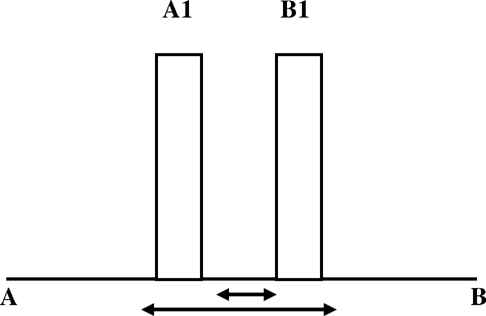
Step 2: Undermining of the multiethnic coalition by challengers with more extreme positions
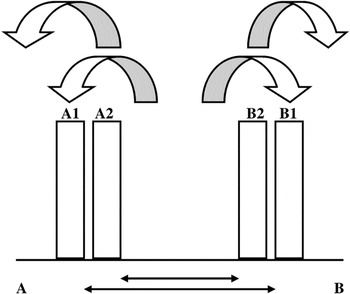
Step 3: Old and new parties attempt to outbid each other
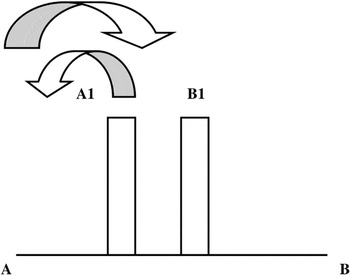
Reverse centrist spiral among ethnic parties in India
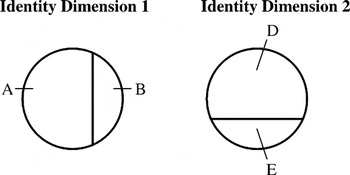
Two institutionalized dimensions of identity
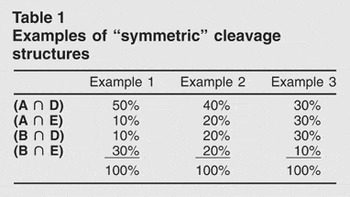
Examples of “symmetric” cleavage structures
 You have
Access
- 206
- Cited by