





Introduction
This article is devoted to the construction of equivariant compactifications of Bruhat-Tits buildings of quasi-reductive groups. Pseudo-reductive and quasi-reductive groups were introduced with the aim of studying the combinatorics of rational points of arbitrary connected linear algebraic groups over arbitrary fields. They form a class of groups that generalises that of reductive groups, defined by Borel and Tits in [Reference Borel and TitsBoT78] and [Reference TitsTit13], then studied extensively by Conrad, Gabber and Prasad in [Reference Conrad, Gabber and PrasadCGP15] and [Reference Conrad and PrasadCP16].
Recall that a smooth connected affine group G over a field k is said to be reductive if
$G_{\overline k}$
 contains no nontrivial smooth connected unipotent normal subgroups. More generally, the group G is said to be pseudo-reductive (resp. quasi-reductive) if it contains no nontrivial smooth connected unipotent normal (resp. k-split unipotent) k-subgroups.
When k is a perfect field, the unipotent radical
$\mathcal R_u(G_{\overline k})$
 of
$G_{\overline k}$
 , that is the maximal smooth connected unipotent normal subgroup of
$G_{\overline k}$
 , is defined over k and k-split, hence the notions of reductivity, pseudo-reductivity and quasi-reductivity coincide in that case. Over imperfect fields, however, the classes are distinct [Reference Conrad, Gabber and PrasadCGP15, Example 1.1.3] and the role of pseudo-reductive groups in the study of linear algebraic groups is analogous to that of reductive groups in the case of perfect fields, in the sense that any smooth connected affine group over a field is an extension of a pseudo-reductive group by a unipotent group. Moreover, the structure theory of [Reference Conrad, Gabber and PrasadCGP15] provides a good enough understanding of pseudo-reductive groups to allow one to extend results about smooth connected affine groups previously known over perfect fields to imperfect fields. For example, it allowed Conrad in [Reference ConradCon12] to extend previous results of Oesterlé’s [Reference OesterléOes84, IV, 5.6] and Borel’s [Reference BorelBor63, 5.8] on the finiteness of Tamagawa numbers to connected groups over imperfect fields.
One upshot of the structure theory of pseudo-reductive groups developed in [Reference Conrad, Gabber and PrasadCGP15], notably the fact that many are generalised standard [Reference Conrad, Gabber and PrasadCGP15, Theorem 5.1.1], is that the rational points of quasi-reductive groups over a field k are close to being direct products of groups of rational points of reductive groups (over extensions of k). This observation makes it plausible that, when k is valued, the study of rational points of quasi-reductive groups over k should be covered by some generalised version of Bruhat-Tits theory.
Recall that, in the papers [Reference Bruhat and TitsBT72] and [Reference Bruhat and TitsBT84], Bruhat and Tits associated to each reductive group G over a valued field k an affine building
$\mathcal B(G, k)$
 endowed with an action of
$G(k)$
 , commonly called its Bruhat-Tits building. An affine building is a polysimplicial complex covered by subcomplexes called apartments, each of which is isomorphic to a given Euclidean tiling, the apartment system being subject to rigid incidence relations [Reference BrownBro89, IV.1]. Bruhat-Tits buildings provide rich geometries that encode a lot of the structure of reductive groups over non-archimedean valued fields, analogously to symmetric spaces for real non-compact Lie groups. They are endowed with a natural non-positively curved metric and their vertices parameterise maximal compact subgroups.
In [Reference SolleveldSol18], Solleveld associates with any quasi-reductive group G over a local field k a Euclidean building endowed with an action of
$G(k)$
 that reduces to the Bruhat-Tits building when G is reductive. The main observation is, as previously mentioned, the fact that the group
$G(k)$
 is, up to extension by a compact group and modification of Cartan subgroups, a finite direct product of groups of rational points of reductive groups
$\prod _{i\in I} G^{\prime }_i(k^{\prime }_i)$
 over finite extensions
$k^{\prime }_i$
 of k. The building of G over k is then defined as the product
$\prod _{i \in I} \mathcal B(G^{\prime }_i, k^{\prime }_i)$
 . In [Reference LourençoLou21], Lourenço extends Solleveld’s construction to quasi-reductive groups over discretely valued fields with perfect residue fields. The article closely follows the layout of [Reference Bruhat and TitsBT84] and one of its key new features is its extension of the arithmetic theory of Bruhat-Tits integral models to the quasi-reductive setting: to each bounded subset
$\Omega \subset \mathcal B(G, k)$
 , we can associate integral models of G whose integral points are stabilisers of
$\Omega $
 in
$G(k)$
 (pointwise, global and other variants [Reference LourençoLou21, §§3.2, 4.2]).
This brings us to the subject matter of our article, namely compactifications of Bruhat-Tits buildings of quasi-reductive groups over local fields. A motivating factor for compactifying Bruhat-Tits buildings is the analogy between affine buildings and symmetric spaces, whose compactifications have found applications in group theory – see, for example, [Reference Borel and SerreBoS76] for applications to finiteness properties of S-arithmetic groups, or Mostow’s proof of his strong rigidity theorem [Reference MostowMos73] – and arithmetic geometry – where arithmetic quotients of symmetric spaces can sometimes be interpreted as moduli spaces of algebraic varieties. An example of this analogy coming to fruition is provided by [Reference PrasadPra79], in which the author proves a rigidity result for lattices in semisimple p-adic groups by letting geodesic compactifications [Reference Bridson and HaefligerBH99] of Bruhat-Tits buildings play the role that geodesic compactifications of symmetric spaces played in [Reference MostowMos73].
In the following, we shall specifically concern ourselves with polyhedral compactifications of Bruhat-Tits buildings, studied under various guises in, among others, [Reference LandvogtLan96], [Reference WernerWer07] and [Reference Rémy, Thuillier and WernerRTW10]. These compactifications fit in an ordered family (for the domination order) indexed by conjugacy classes of pseudo-parabolic subgroups. Each space admits a polysimplicial structure and its boundary naturally decomposes as a union of Bruhat-Tits buildings of smaller rank, much like in Satake’s construction of compactifications of symmetric spaces [Reference SatakeSat60]. The analogy between both constructions is given a thorough treatment in [Reference WernerWer07] and [Reference Rémy, Thuillier and WernerRTW12]. In [Reference Guivarc’h and RémyGR06], the authors establish that the vertices of the maximal compactification of
$\mathcal B(G, k)$
 parameterise closed amenable subgroups of
$G(k)$
 with Zariski-connected closure that are maximal for these properties. This suggests that a similar result should hold for an arbitrary quasi-reductive group G over a local field.
In this article, we take the analytic-geometric point of view on compactifications of Bruhat-Tits buildings of quasi-reductive groups over local fields, as adopted in [Reference WernerWer04] and [Reference Rémy, Thuillier and WernerRTW10].
Our main goal is to establish the following theorem, which synthesises most of the results of Sections 2–4.
Theorem A. Let G be a quasi-reductive group over a local field k. Denote by
$\mathcal B(G, k)$
 the Bruhat-Tits building of G over k. Let P be a pseudo-parabolic subgroup of G.
-
1. There exists a continuous $G(k)$
 -equivariant map $$ \begin{align*}\vartheta_P: \mathcal B(G, k) \to (G/P)^{\operatorname{\mathrm{an}}},\end{align*} $$
where $\operatorname {\mathrm {an}}$
is the Berkovich analytic space associated to
$G/P$
. -
2. The map $\vartheta _P$
has relatively compact image and is an embedding if and only if P is of non-degenerate type as defined in Section 3.3. The homeomorphism type of the closure of the image depends only on the conjugacy class of P. -
3. Whenever P is of non-degenerate type, the closure of the image of $\vartheta _P$
admits a stratification by affine buildings. Precisely, the compactification
$\overline {\vartheta _P(\mathcal B(G, k))}$
is
$G(k)$
-equivariantly homeomorphic to a disjoint union $$ \begin{align*}\overline{\vartheta_P(\mathcal B(G, k))} = \bigsqcup_{\substack{Q \subset G}} \mathcal B(Q/\mathcal R_{us,k}(Q), k),\end{align*} $$
where Q ranges among the J-relevant pseudo-parabolic subgroups of G (see Definition 61 below). of G. For each J-relevant pseudo-parabolic subgroup Q of G, the group $Q(k)$
is the stabiliser of the stratum
$\mathcal B(Q/\mathcal R_{us,k}(Q), k)$
.


The proof loosely follows the structure of [Reference Rémy, Thuillier and WernerRTW10], but substantial new difficulties must be overcome. The first difficulty is the construction of the map
$\vartheta _P$
 , which relies on the existence of a canonical continuous
$G(k)$
 -equivariant map

The idea in [Reference BerkovichBer90] and [Reference Rémy, Thuillier and WernerRTW10] was to associate to each point
$x \in \mathcal B(G, k)$
 an affinoid subgroup
$G_x$
 of
$G^{\operatorname {\mathrm {an}}}$
 , which contains the information about the stabilisers
$G(K)_{x_K}$
 of
$x_K \in \mathcal B(G, K)$
 for each non-archimedean extension
$K/k$
 . This makes extensive use of Rousseau’s theory of the functoriality of Bruhat-Tits buildings with respect to field extensions, developed in [Reference RousseauRou77]. The Shilov boundary of
$G_x$
 turns out to be a single point, which we denote by
$\vartheta (x)$
 . In other words, each function
$f\in \mathcal O(G_x)$
 achieves its maximum at
$\vartheta (x)$
 . This mapping is reminiscent of the compactification in [Reference Guivarc’h and RémyGR06], which associated to each special point its stabiliser in
$G(k)$
 , viewed as a point in the Chabauty space of closed subgroups of G. By associating to a point the data of all stabilisers
$G(K)_{x_K}$
 , for all non-archimedean extensions, the analytic construction can separate not just all special points, but in fact all points in the buildings.
In our situation, due to technical limitations, we can only carry out this construction for points that become special after a finite extension of k, which we dub virtually special. Indeed, the theory of Bruhat-Tits buildings for quasi-reductive groups over non-archimedean fields only associates buildings to groups over local fields for [Reference SolleveldSol18] and discretely valued fields with perfect residue fields for [Reference LourençoLou21], which prevents the use of arbitrarily ramified extensions as in [Reference BerkovichBer90]. These virtually special points are then shown to be dense, which allows one to extend the map
$\vartheta $
 from the set of virtually special points to the whole building. This spans the entirety of the second section.
The second difficulty is to establish that
$\vartheta _P$
 is open with relatively compact image and injective for suitable P. The proofs of these various assertions form the bulk of Section 3. The main observation is the fact that the restriction of
$\vartheta _P$
 to an apartment lies in the analytification of an affine scheme, which admits an interpretation in terms of seminorms over the algebra of regular functions. An explicit description of the restriction of the map
$\vartheta _P$
 to an apartment in terms of seminorms, proved in Proposition 35, plays a central role in most arguments. Note that the relative compactness is somewhat surprising in this case as, in contrast with the reductive case, the target space
$(G/P)^{\operatorname {\mathrm {an}}}$
 of
$\vartheta _P$
 is in general not compact. Indeed, by [Reference BerkovichBer90, Theorem 3.4.8 (ii)], the analytification
$(G/P)^{\operatorname {\mathrm {an}}}$
 is compact if and only if
$G/P$
 is proper, that is if and only if P is a parabolic subgroup. However, quasi-reductive groups do not admit proper parabolic subgroups unless they are reductive [Reference Conrad, Gabber and PrasadCGP15, Proposition 3.4.9].
The last point is the description of the boundary of
$\vartheta _P(\mathcal B(G, k))$
 . Here, we rely on previous work by Charignon on stratified compactifications of affine buildings. In [Reference CharignonCha10], the author associates to each affine building
$\mathcal I$
 , modelled on an affine Coxeter complex
$\Sigma $
 , and each fan
$\mathcal F$
 in the direction
$\vec \Sigma $
 of
$\Sigma $
 subject to some compatibility relations [Reference CharignonCha10, 2.3] a canonical compactification
$\overline I^{\mathcal F}$
 of
$\mathcal I$
 , which we call a polyhedral compactification. We establish in Proposition 53 that the compactification
$\overline {\vartheta _P(\mathcal B(G, k))}$
 is a polyhedral compactification in that sense, with respect to a fan that can be described explicitly in terms of the type of P. The remainder of Section 4 is devoted to giving a group-theoretic description of the strata, which are constructed in terms of pure building geometry in [Reference CharignonCha10]. This culminates in Theorem 63.
To conclude, we give a brief description of Section 1 and its relation to the rest of the article. It is devoted to the proof of the following theorem:
Theorem B. The construction of the Bruhat-Tits building
$\mathcal B(G, k)$
 is functorial in the discretely valued henselian field k with perfect residue field and excellent valuation ring.
This theorem plays a central role in the article as it allows one to make sense of the notion of virtually special points, which lies at the heart of the entire construction.
The precise statement can be found in Theorem 11 and generalises, in the setting of discretely valued fields with perfect residue fields, previous results of Rousseau’s on the functoriality of Bruhat-Tits buildings of reductive groups with respect to field extensions [Reference RousseauRou77]. The proof relies heavily on the combinatorial theory of buildings associated to valuated root group data developed in [Reference Bruhat and TitsBT72].
Structure of the article
The present article splits into four sections. Section 1, dealing with the functoriality of Bruhat-Tits buildings with respect to field extensions, may be taken as a black box for the remainder of the text. Section 2 constructs a continuous map

Section 3 establishes that, for suitable pseudo-parabolic subgroups P, the composition

is a compactification map. Section 4 studies the geometry at infinity of the compactification and its strata. Finally, the Appendix studies the relation between the buildings associated to centralisers of tori in G and the Bruhat-Tits building of G.
Notations and preliminaries
Unless otherwise specified, an algebraic group over k will mean a smooth affine group scheme of finite type over k. We will usually adhere to the following notations.
Algebraic groups
In the following, we denote by k a field and G a connected algebraic k-group.
-
• We denote by $\mathcal R_{u,k}(G)$
the k-unipotent radical of G, that is its maximal smooth connected k-unipotent normal subgroup. -
• Recall that a unipotent k-group is said to be split if it admits a composition series whose successive factors are isomorphic to $\mathbb G_{a,k}$
. Denote by
$\mathcal R_{us, k}(G)$
the k-split unipotent radical of G, that is its maximal smooth connected k-split unipotent normal subgroup. -
• We say that a connected algebraic k-group is pseudo-reductive if $\mathcal R_{u, k}(G) = 1$
and quasi-reductive if
$\mathcal R_{us, k}(G) = 1$
. -
• If G is endowed with an action of a split torus S, then we denote by $\Phi (G, S)$
the set of nonzero weights of the adjoint action of S on the Lie algebra of G.




In the following definitions, we assume that G is quasi-reductive and that S is a maximal split torus in G.
-
• $\Phi = \Phi (G, S)$
is a root system called the (relative or k-) root system of G. -
• $W(G, S) = N_G(S)/Z_G(S)$
is the Weyl group of
$\Phi $
, a finite constant group scheme over k. -
• $X^*(S) = \operatorname {\mathrm {Hom}}_{\operatorname {\mathrm {Grp}}}(S, \mathbb G_m)$
is the group of characters of S. -
• $X_*(S) = \operatorname {\mathrm {Hom}}_{\operatorname {\mathrm {Grp}}}(\mathbb G_m, S)$
is the group of cocharacters of S. -
• $\langle \cdot , \cdot \rangle : X^*(S) \times X_*(S) \to \mathbb Z$
is the canonical pairing: for
$\alpha \in X^*(S), \lambda \in X_*(S)$
, we have
$\alpha \circ \lambda : t \mapsto t^{\langle \alpha , \lambda \rangle }$
. -
• We set
$$ \begin{align*}V(G, S) = \frac{X_*(S)\otimes_{\mathbb Z}\mathbb R}{\operatorname{\mathrm{Span}}_{\mathbb R}(\Phi(G, S))^{\perp}} \simeq \frac{X_*(S)\otimes_{\mathbb Z}\mathbb R}{X_*(Z(G))\otimes_{\mathbb Z}\mathbb R}\simeq X_*(S') \otimes_{\mathbb Z}\mathbb R,\end{align*} $$
where $S' = (S\cap \mathcal D(G))^0_{\operatorname {\mathrm {red}}}$
. -
• We set
$$ \begin{align*}V^*(G,S) = \operatorname{\mathrm{Span}}_{\mathbb R}(\Phi(G, S))\subset X^*(S)\otimes_{\mathbb Z}\mathbb R .\end{align*} $$
-
• The canonical pairing $\langle \cdot , \cdot \rangle $
induces a perfect pairing, which we still denote by
$\langle \cdot , \cdot \rangle : V^*(G, S) \times V(G, S) \to \mathbb R.$
-
• Given a cocharacter $\lambda $
of G, we let
$P_G(\lambda )$
,
$U_G(\lambda )$
and
$Z_G(\lambda )$
be the subgroups associated with
$\lambda $
[Reference MilneMil17, 13.d], characterised functorially by the condition that, for each k-algebra A, we have $$ \begin{align*}\begin{array}{ccl}P_G(\lambda)(A) & = & \{g \in G(A), \lambda(t)g\lambda(t)^{-1} \text{ has a limit as } t\to 0\} \\ U_G(\lambda)(A) & = & \{g \in G(A), \lambda(t)g\lambda(t)^{-1} \underset{t \to 0}{\longrightarrow} 1 \} \\ Z_G(\lambda)(A) & = & \{g \in G(A), \forall t \in A^{\times}, \lambda(t)g\lambda(t)^{-1} = g \}\end{array}.\end{align*} $$
-
• A pseudo-parabolic subgroup of G is a closed subgroup P of the form $P = P_G(\lambda )\mathcal R_{u,k}(G)$
. If G is quasi-reductive, then we have
$P = P_G(\lambda )$
and
$\mathcal R_{us, k}(P) = U_G(\lambda )$
. -
• G is said to be quasi-split if there exists a minimal pseudo-parabolic subgroup of $G_{k^s}$
that is defined over k. -
• G is said to be pseudo-split if there exists a maximal torus of $G_{k^s}$
that is defined over k.


Affine spaces
We denote by A a real affine space with direction V.
-
• If F is an affine subspace of A, we denote by $\vec F$
its direction. -
• If X is a subset of V, we denote by $X^{\vee } = \{\alpha \in V^*, \forall x \in X, \langle \alpha , x \rangle \ge 0\}$
its dual cone. -
• If X is a subset of V, we denote by $X^0 = \{\alpha \in V^*, \forall x \in X, \langle \alpha , x \rangle = 0\}$
its annihilator.


Buildings and Bruhat-Tits theory
-
• We call a non-archimedean field any field that is complete with respect to a non-trivial non-archimedean absolute value.
-
• We call a local field any non-archimedean field that is locally compact.
-
• If G is quasi-reductive over a henselian discretely valued field k with a perfect residue field and excellent valuation ring, then we denote by $\mathcal B(G, k)$
its (reduced) Bruhat-Tits building. If K is a finitely ramified extension of k, then we will also write
$\mathcal B(G, K)$
for
$\mathcal B(G_K, K)$
. -
• If S is a maximal split torus in G, we denote by $A(G, S)$
the apartment of
$\mathcal B(G, k)$
corresponding to S. It is an affine space under
$V(G, S)$
. -
• If $\Omega \subset A(G, S)$
is a subset of an apartment, we denote by $$ \begin{align*}\hat P_{\Omega} = \{g \in G(k), \forall x \in \Omega, gx = x \}\end{align*} $$
its pointwise stabiliser.
-
• Recall that, given an affine building X modelled on an affine Coxeter complex $\Sigma $
with direction
$\vec {\Sigma }$
and vectorial Weyl group W, any W-invariant inner product on
$\vec \Sigma $
extends to a unique metric on X [Reference BrownBro89, §3A]. If
$X= \mathcal B(G, k)$
is the Bruhat-Tits building of a group G, then the action of
$G(k)$
on X is isometric. The topology determined by this metric does not depend on the specific inner product on
$\vec \Sigma $
. All affine buildings in the text will be endowed with this topology and all metrics on buildings will be assumed to be of the type described above.


1 Functoriality for Bruhat-Tits buildings
In this section, we give an account of functoriality of Bruhat-Tits buildings of quasi-reductive groups with respect to field extensions, following the general outline of [Reference RousseauRou77].
Specifically, our goal is to establish the following two results, which will be sufficient for our purposes:
-
1. Given a quasi-reductive group G over a henselian discretely valued field $(k, \omega )$
with perfect residue field and excellent valuation ring and given a discretely valued Galois extension with excellent valuation ring
$K/k$
, there exists an action of
$\operatorname {\mathrm {Gal}}(K/k)$
on
$\mathcal B(G, K)$
via simplicial automorphisms. -
2. There exists a system of equivariant maps
$$ \begin{align*}p_{L/K}: \mathcal B(G, K) \to \mathcal B(G, L)\end{align*} $$
indexed by towers of separable discretely valued extensions with excellent valuation ringsFootnote 1 $k \subset K \subset L$
such that:-
(i) The restriction of $p_{L/K}$
to any apartment
$A(G_K, S) \subset \mathcal B(G, K)$
is an affine isomorphism onto an affine subspace of an apartment
$A(G_L, T)$
for some maximal split torus
$T \subset G_L$
containing
$S_L$
. -
(ii) For any $k \subset K \subset L \subset M$
, we have $$ \begin{align*}p_{M/K} = p_{M/L} \circ p_{L/K}.\end{align*} $$
-
(iii) Whenever $L/K$
is Galois, there is an inclusion $$ \begin{align*}p_{L/K}(\mathcal B(G, K)) \subset (\mathcal B(G, L))^{\operatorname{\mathrm{Gal}}(L/K)}.\end{align*} $$
-


In order to prove the general theorem, we shall first need to prove some special cases and variants of it. The proofs will vary in length and complexity, but will always follow the same template.
-
1. Observe that, under the assumption that $p_{L/K}$
is equivariant and satisfies (i), the linear part of the restriction of
$p_{L/K}$
to an apartment
$A(G_K, S)$
will be the map induced by base change on cocharacters. -
2. The assumptions of equivariance and affineness then reduce the proof of uniqueness to checking that a given special point x can only have one image.
-
3. Use characteristics of the special case at hand to exhibit the image y of x. Usually, this will involve studying the action of $G(K)_x$
on
$\mathcal B(G, L)$
and its fixed points. -
4. Prove that the affine map $A(G_K, S) \to A(G_L, T)$
mapping x to y with the linear part exhibited above extends to a
$G(K)$
-equivariant map. This will sometimes be proved explicitly, and sometimes be dealt with using Bruhat and Tits’ theory of descent for valuated root data [Reference Bruhat and TitsBT72, §9], which aims specifically at producing such statements.


We fix a quasi-reductive group G over a henselian discretely valued field
$(k, \omega )$
 with perfect residue field and excellent valuation ring, normalised so that
$\omega (k^{\times }) = \mathbb Z$
 . We fix, once and for all, an algebraic closure
$\overline k$
 of k which will contain all the extensions to be discussed below. Each algebraic extension
$K/k$
 will be endowed with the unique valuation that extends that of k.
1.1 Galois action on the building
We start off by proving that, for any Galois extension
$K/k$
 of henselian discretely valued fields with perfect residue fields and excellent valuation rings, the Galois group
$\operatorname {\mathrm {Gal}}(K/k)$
 acts on the building
$\mathcal B(G, K)$
 .
Theorem 1. Let K and L be two separable henselian discretely valued extensions of k with perfect residue fields and excellent valuation rings and let
$\sigma : K \to L$
 be a morphism of k-algebras. Assume that
$G_K$
 and
$G_L$
 have the same relative rank. Then, there exists a unique map

such that:
-
1. For each maximal K-split torus $S \subset G_K$
, the map
$p_{\sigma }$
restricts to an affine isomorphism of
$A(G_K, S)$
onto
$A(G_L, S^{\sigma })$
. -
2. For each $x \in \mathcal B(G, K)$
and
$g \in G(K)$
, we have
$p_{\sigma }(gx) = \sigma (g)p_{\sigma }(x)$
.


Moreover, the following hold:
-
(i) For any K-split torus $S \subset G_K$
, affine roots in
$A(G_K, S)$
are mapped to affine roots in
$A(G_L, S^{\sigma })$
. -
(ii) For any K-split torus $S \subset G_K$
, the linear part of the affine isomorphism
$p_{\sigma }: A(G, S) \to A(G, S^{\sigma })$
is the map
$V(G, S) \to V(G, S^{\sigma })$
induced by pullback on cocharacters. -
(iii) If K, L and M are three extensions of k as above and $\sigma : K \to L$
and
$\tau : L \to M$
are two k-morphisms, then we have
$p_{\tau \circ \sigma } = p_{\tau } \circ p_{\sigma }$
.


Proof. We begin with the proof of uniqueness. The key point is the observation that the compatibility condition on
$p_{\sigma }$
 with respect to the
$G(K)$
 -action together with the condition that
$p_{\sigma }$
 be affine on apartments implies that
$p_{\sigma }$
 is determined by the image of a single special vertex in
$\mathcal B(G, K)$
 . The uniqueness of the image of the latter then follows from condition 2.
(Uniqueness) Let a map
$p_{\sigma }$
 be given satisfying conditions 1 and 2. Fix a maximal K-split torus
$S \subset G_K$
 . Let x be a special vertex in
$A(G_K, S)$
 . Because the Weyl group
$W(G_K, S)(K)$
 acts without nonzero fixed vectors on the direction
$V(G_K, S)$
 , the point x is the unique fixed point for the action of the stabiliser
$N_{G_K}(S)(K)_x$
 on
$A(G_K, S)$
 . Moreover, because
$N_{G_K}(S)(K)_x$
 acts on
$A(G_K, S)$
 via its bounded quotient
$N_{G_K}(S)(K)_x/Z(G)(K)$
 , condition 2 implies that its image
$\sigma (N_{G_K}(S)(K)_x)$
 acts on
$A(G_L, S^{\sigma })$
 via its bounded quotient
$\sigma (N_{G_K}(S)(K)_x)/Z(G)(L)$
 . Therefore, there exists
$x'\in A(G_L, S^{\sigma })$
 that is fixed under
$\sigma (N_{G_K}(S)(K)_x)$
 . Lastly, because the image of the subgroup
$N_{G_K}(S)(K)_x$
 in the linear group of
$V(G_K, S)$
 is the full Weyl group
$W(G_K, S)$
 , condition 2 implies that the image of
$\sigma (N_{G_K}(S)(K)_{x})$
 in
$GL(V(G_L, S^{\sigma }))$
 is the full Weyl group
$W(G_L, S^{\sigma })(L)$
 and therefore acts on
$V(G_L, S^{\sigma })$
 without fixing nonzero vectors. The point
$x'$
 is thus a special vertex and the unique fixed point of the apartment
$A(G_L, S^{\sigma })$
 under the action of
$\sigma (N_{G_K}(S)(K)_x)$
 .
We now characterise the linear part of the restriction of
$p_{\sigma }$
 to the apartment
$A(G_K, S)$
 . Let
$\varpi $
 be a uniformiser of the valuation ring
$k^{\circ }$
 . For each cocharacter
$\lambda \in \Phi (G_K, S)^\vee $
 , the element
$s = \lambda (\varpi ^{-1}) \in S(K)$
 acts on
$A(G_K, S)$
 by translation by the vector
$\nu (s) \in V(G_K, S)$
 satisfying

In other words, the vector
$\nu (s)$
 is the image of
$\lambda $
 in
$V(G_K, S)$
 . By assumption, we have

denoting by
$\sigma : X_*(S) \overset {\sim }{\to } X_*(S^{\sigma })$
 the isomorphism given by pulling back cocharacters along the map
$\sigma ^*: \operatorname {\mathrm {Spec}} L \to \operatorname {\mathrm {Spec}} K.$
 This map extends
$\mathbb R$
 -linearly and passes to the quotient to a linear isomorphism

The same argument as before then implies that
$\sigma (s)$
 acts on
$A(G_L, S^{\sigma })$
 by translation by
$\sigma (\lambda )$
 . In other words, for each cocharacter
$\lambda \in X_*(S)$
 , we have

We deduce from condition 1 and the fact that the images of the cocharacters span
$V(G_K, S)$
 that, for each
$v \in V(G_K, S)$
 , we have

The linear part of
$p_{\sigma }$
 is therefore the isomorphism
$\sigma : V(G_K, S) \to V(G_L, S^{\sigma })$
 induced by pulling back cocharacters.
We deduce from the above considerations the uniqueness of the map
$p_{\sigma }$
 . Indeed, if
$p_{\sigma }$
 and
$p^{\prime }_{\sigma }$
 satisfy conditions 1 and 2, then they coincide over
$A(G_K, S)$
 . Because
$\mathcal B(G, K) = G(K) \cdot A(G_K, S)$
 , condition 2 implies that
$p_{\sigma }$
 and
$p^{\prime }_{\sigma }$
 coincide everywhere.
(Existence) We now prove that the conditions brought forth above do define a map from
$\mathcal B(G, K)$
 to
$\mathcal B(G, L)$
 . The idea is to check that the map

passes to the quotient, which amounts to proving that, for each
$z \in A(G_K, S)$
 , the stabiliser
$\hat P_z$
 is mapped to
$\hat P_{p_{\sigma }(z)}$
 by
$\sigma $
 . Fix an apartment
$A(G_K, S)$
 as before and a special vertex
$x \in A(G_K, S)$
 . Denote by
$x'$
 the unique fixed point of
$A(G_L, S^{\sigma })$
 under the subgroup
$\sigma (N_{G_K}(S)(K)_x)$
 . We define
$p_{\sigma }$
 on
$A(G_K, S)$
 as the affine isomorphism

Then, for each
$n \in N_{G_K}(S)(K)$
 and each
$z = x + v \in A(G_K, S)$
 , we have

Indeed, by construction, if
$n \in N_{G_K}(S)(K)_x$
 , we have

Moreover, if
$n \in Z_{G_K}(S)(K)$
 , then
$nz = x + v + \nu (n)$
 , where
$\nu (n) \in V(G_K, S)$
 satisfies
$\langle a, \nu (n) \rangle = - \omega (a(n))$
 for each
$a \in \Phi $
 . Then, we have

Now, by a previous observation, we have

for each
$a \in \Phi $
 , hence
$\sigma (\nu (n)) = \nu (\sigma (n))$
 and finally

Because
$N_{G_K}(S)(K)$
 is spanned by
$N_{G_K}(S)(K)_x$
 and
$Z_{G_K}(S)(K)$
 , we get the result we claimed.
To conclude, we now only have to prove that, denoting by

the valuation of the root data

associated to x (resp.
$x'$
 ) we have for each
$a \in \Phi $
 and
$u \in U_a(K) \setminus \{1\}$


Let
$a \in \Phi $
 and
$u \in U_a(K) \setminus \{1\}$
 . Recall from [Reference Bruhat and TitsBT72, 6.2.12 b)] that, if
$(u', u") \in U_{-a}(K)^2$
 is the unique pair [Reference Bruhat and TitsBT72, 6.1.2 (2)] such that
$m(u) = u'uu" \in N_{G_K}(S)(K)$
 , then
$\varphi _a^x(u)$
 is the only
$k \in \mathbb R$
 such that the fixed locus of
$m(u)$
 in
$A(G_K, S)$
 is the hyperplane

Now observe that

Because
$\sigma (u)$
 lies in
$U_{\sigma (a)}(L) \setminus \{1\}$
 whereas
$\sigma (u')$
 and
$\sigma (u")$
 lie in
$U_{-\sigma (a)}(L)$
 , the aforementioned uniqueness property implies

Finally, recall that the equivariance property (1) implies that the fixed locus of
$m(\sigma (u))$
 is the image under
$p_{\sigma }$
 of the fixed locus of
$m(u)$
 , that is the hyperplane

In other words, we have

Note that this proves that
$p_{\sigma }$
 maps the affine roots of
$A(G_K, S)$
 to those of
$A(G_L, S^{\sigma })$
 .
We deduce that, for any bounded subset
$\Omega \subset A(G_K, S)$
 , we have

Moreover, by (1), we have

where
$\hat N_{\Omega } = \{n \in N_{G_K}(S)(K), \forall x \in \Omega , n\cdot x = x\}$
 is the pointwise stabiliser of
$\Omega $
 . Because
$\hat P_{\Omega } = \hat N_{\Omega } U_{\Omega }$
 , by [Reference Bruhat and TitsBT72, 7.1.8, 7.4.4], we conclude that

Consequently, for all pairs
$(g,x), (h,y) \in G(K) \times A(G_K, S)$
 , there exists
$n \in N_{G_K}(S)(K)$
 such that
$nx = y$
 and
$n^{-1}h^{-1}g \in \hat P_x$
 if and only if there exists
$n^\sigma \in N_{G_L}(S^{\sigma })(L)$
 such that
$n^\sigma p_{\sigma }(x) = p_{\sigma }(y)$
 and
$(n^\sigma )^{-1}\sigma (h^{-1})\sigma (g) \in \hat P_{p_\sigma (x)}$
 . In other words, the injection

descends to an injection from
$\mathcal B(G, K)$
 to
$\mathcal B(G, L)$
 , which we still denote by
$p_{\sigma }$
 , such that, for each
$g \in G(K)$
 and
$x \in \mathcal B(G, K)$
 , we have

Note that the proof of Theorem 1 yields the following relation between valuated root data.
Proposition 2. Let K and L be two henselian discretely valued extensions of k with perfect residue fields and excellent valuation rings and
$\sigma : K \to L$
 be a morphism of k-algebras such that
$G_K$
 and
$G_L$
 have the same relative rank. Let
$S \subset G_K$
 be a maximal K-split torus and x be a point in the apartment
$A(G_K, S)$
 . Then, for each
$a \in \Phi (G_K, S)$
 , we have

We also deduce the following property relating the polysimplicial structures of
$\mathcal B(G, K)$
 and
$\mathcal B(G, L)$
 under the assumptions of Theorem 1.
Proposition 3. Let K and L be separable henselian discretely valued extensions of k with perfect residue fields and excellent valuation rings and
$\sigma : K \to L$
 be a morphism of k-algebras such that
$G_K$
 and
$G_L$
 have the same relative rank (e.g.
$G_K$
 is pseudo-split). Let
$S \subset G_K$
 be a maximal K-split torus. Then, the embedding
$p_{\sigma }$
 maps vertices (resp. special vertices) in
$\mathcal B(G, K)$
 to vertices (resp. special vertices) in
$\mathcal B(G, L)$
 .
Proof. This statement follows directly from the fact that
$p_{\sigma }$
 maps affine roots in
$A(G_K, S)$
 to affine roots in
$A(G_L, S^{\sigma })$
 and the equality between the relative ranks of
$G_K$
 and
$G_L$
 .
Remark 4. Note that, in general, the image of a higher-dimensional facet in
$A(G_K, S)$
 will not be a facet in
$A(G_L, S^{\sigma })$
 .
Finally, Theorem 1 also immediately yields the existence of a Galois action on the Bruhat-Tits building.
Theorem 5. Let K be a discretely valued Galois extension of k with excellent valuation ring and
$\sigma \in \operatorname {\mathrm {Gal}}(K/k)$
 . Then, there exists a unique map

such that:
-
1. For each maximal K-split torus $S \subset G_K$
, the map
$p_{\sigma }$
restricts to an affine isomorphism of
$A(G_K, T)$
onto
$A(G_K, S^{\sigma })$
in such a way that affine roots in
$A(G_K, S)$
are mapped to affine roots in
$A(G_K, S^{\sigma })$
. In particular, the map
$p_{\sigma }$
is simplicial. -
2. For each $x \in \mathcal B(G, K)$
and
$g \in G(K)$
, we have
$p_{\sigma }(gx) = \sigma (g)p_{\sigma }(x)$
.


Moreover, for each
$\sigma , \tau \in \operatorname {\mathrm {Gal}}(K/k)$
 , we have
$p_{\sigma \tau } = p_{\sigma } \circ p_{\tau }$
 .
1.2 Functorial system of embeddings
Our second, more substantial, task is to establish the existence of a canonical system of embeddings indexed by separable henselian discretely valued extensions of k with excellent valuation rings.
We first prove the existence of canonical embeddings
$p_{L/K}$
 for two classes of extensions, mirroring the two steps of the general construction of the Bruhat-Tits building. First, we treat the case where L is the strict henselisation of K, then we treat the case where
$L/K$
 is finite Galois and such that
$G_K$
 is quasi-split and
$G_L$
 is pseudo-split.
Both proofs rely on descent theory for valuations of root data, as exposed in [Reference Bruhat and TitsBT72, §9], which provides a general framework for constructing equivariant embeddings of buildings.
The case of the strict henselisation
The first case that we treat is that of a strict henselisation
$K^{\operatorname {\mathrm {nr}}}/K$
 . Note that K
nr has an excellent valuation ringif K does, by [Reference GrecoGre76, Corollary 5.6]. The situation is as nice as it could be, in the sense that the canonical embedding
$\mathcal B(G, K) \to \mathcal B(G, K^{\operatorname {\mathrm {nr}}})$
 is a simplicial map and identifies
$\mathcal B(G, K)$
 with the fixed locus of
$\mathcal B(G, K^{\operatorname {\mathrm {nr}}})$
 under the action of
$\operatorname {\mathrm {Gal}}(K^{\operatorname {\mathrm {nr}}}/K)$
 .
The proof is a direct consequence of the construction of Bruhat-Tits buildings which relies on unramified descent in the general case [Reference Bruhat and TitsBT84, §5], [Reference LourençoLou21, Section 4.4].
Proposition 6. Let K be a separable henselian discretely valued extension of k with perfect residue field and excellent valuation ring and
$K^{\operatorname {\mathrm {nr}}}$
 be its strict henselisation. There exists a unique map

such that
-
1. For each maximal K-split torus $S \subset G_K$
, there exists a maximal
$K^{\operatorname {\mathrm {nr}}}$
-split torus
$S^{\operatorname {\mathrm {nr}}} \subset G_{K^{\operatorname {\mathrm {nr}}}}$
such that
$S_{K^{\operatorname {\mathrm {nr}}}} \subset S^{\operatorname {\mathrm {nr}}}$
and such that the map
$p_{K^{\operatorname {\mathrm {nr}}}/K}$
restricts to an affine isomorphism of
$A(G_K, S)$
onto an affine subspace of
$A(G_{K^{\operatorname {\mathrm {nr}}}}, S^{\operatorname {\mathrm {nr}}})$
. -
2. The map $p_{K^{\operatorname {\mathrm {nr}}}/K}$
is
$G(K)$
-equivariant. -
3. We have the inclusion $p_{K^{\operatorname {\mathrm {nr}}}/K}(\mathcal B(G, K)) \subset \mathcal B(G, K^{\operatorname {\mathrm {nr}}})^{\operatorname {\mathrm {Gal}}(K^{\operatorname {\mathrm {nr}}}/K)}$
.


Moreover, for each maximal K-split torus
$S \subset G_K$
 and each maximal
$K^{\operatorname {\mathrm {nr}}}$
 -split torus
$S^{\operatorname {\mathrm {nr}}} \subset G_{K^{\operatorname {\mathrm {nr}}}}$
 such that
$S_{K^{\operatorname {\mathrm {nr}}}} \subset S^{\operatorname {\mathrm {nr}}}$
 , the affine roots in
$A(G_K, S)$
 correspond to the restrictions of the affine roots in
$A(G_{K^{\operatorname {\mathrm {nr}}}}, S^{\operatorname {\mathrm {nr}}})$
 , and we have the equality
$p_{{K^{\operatorname {\mathrm {nr}}}}/K}(\mathcal B(G, K)) = \mathcal B(G, {K^{\operatorname {\mathrm {nr}}}})^{\operatorname {\mathrm {Gal}}({K^{\operatorname {\mathrm {nr}}}}/K)}$
 .
Proof. Let S be a maximal K-split torus in
$G_K$
 . Let
$\Gamma $
 be the Galois group
$\operatorname {\mathrm {Gal}}(K^{\operatorname {\mathrm {nr}}}/K)$
 . By [Reference LourençoLou21, Lemme 4.8], there exists a maximal
$K^{\operatorname {\mathrm {nr}}}$
 -split torus
$S^{\operatorname {\mathrm {nr}}}$
 in
$G_{K^{\operatorname {\mathrm {nr}}}}$
 that contains
$S_{K^{\operatorname {\mathrm {nr}}}}$
 and is defined over K. Denote by
$\Phi = \Phi (G_K, S)$
 and
$\Phi ^{\operatorname {\mathrm {nr}}} = \Phi (G_{K^{\operatorname {\mathrm {nr}}}}, S^{\operatorname {\mathrm {nr}}})$
 the corresponding root systems. The apartment
$A(G_{K^{\operatorname {\mathrm {nr}}}}, S^{\operatorname {\mathrm {nr}}})$
 is then stable under the action of
$\Gamma $
 and admits a fixed point y corresponding to a
$\Gamma $
 -invariant valuation
$\varphi ^{\operatorname {\mathrm {nr}}}$
 of the root group datum
$(Z_{G_{K^{\operatorname {\mathrm {nr}}}}}(S^{\operatorname {\mathrm {nr}}})(K^{\operatorname {\mathrm {nr}}}), (U_{a^{\operatorname {\mathrm {nr}}}}(K^{\operatorname {\mathrm {nr}}}))_{a^{\operatorname {\mathrm {nr}}} \in \Phi ^{\operatorname {\mathrm {nr}}}})$
 . It then follows from [Reference LourençoLou21, Théorème 4.9] that the valuation
$\varphi ^{\operatorname {\mathrm {nr}}}$
 descends to a valuation
$\varphi $
 of the root group datum
$(Z_{G_K}(S)(K), (U_a(K))_{a\in \Phi })$
 , corresponding to a point
$x \in A(G_K, S)$
 . By [Reference Bruhat and TitsBT72, 9.1.17], there is then a
$G(K)$
 -equivariant isometry

such that
$p_{K^{\operatorname {\mathrm {nr}}}/K}(x) = y$
 . We then have
$p_{K^{\operatorname {\mathrm {nr}}}/K}(A(G_K, S)) = A(G_{K^{\operatorname {\mathrm {nr}}}}, S^{\operatorname {\mathrm {nr}}})^{\Gamma }$
 and, by
$G(K)$
 -equivariance, the inclusion
$p_{K^{\operatorname {\mathrm {nr}}}/K}(\mathcal B(G, K)) \subset \mathcal B(G, K^{\operatorname {\mathrm {nr}}})^{\Gamma }$
 , which completes the proof of the existence statement. By [Reference Bruhat and TitsBT72, 9.2.14 and 9.2.15], the map
$p_{K^{\operatorname {\mathrm {nr}}}/K}$
 is in fact the unique
$G(K)$
 -equivariant isometry from
$\mathcal B(G, K)$
 to
$\mathcal B(G, K^{\operatorname {\mathrm {nr}}})$
 that maps into
$\mathcal B(G, K^{\operatorname {\mathrm {nr}}})^{\Gamma }$
 , which establishes the uniqueness statement.
The additional statements follow directly from [Reference LourençoLou21, Théorème 4.9].
For technical reasons to be detailed below, we also establish a similar result for embedded buildings – or inner façades in the terminology of [Reference RousseauRou23] – associated to centralisers of tori.
Recall that, if S is a K-split torus in
$G_K$
 , then the union
$\mathcal B(Z_{G_K}(S), G_K, K)$
 of the apartments
$A(G_K, T)$
 , where T ranges among the maximal K-split tori of
$G_K$
 that contain S, is closely related to the Bruhat-Tits building
$\mathcal B(Z_{G_K}(S), K)$
 (see the Appendix for precise statements). In particular, Proposition 6 implies the following result.
Proposition 7. Let K be a separable henselian discretely valued extension of k with perfect residue field and excellent valuation ring and S be a K-split torus in
$G_K$
 . Then, the action of
$\operatorname {\mathrm {Gal}}(K^{\operatorname {\mathrm {nr}}}/K)$
 on
$\mathcal B(G, K^{\operatorname {\mathrm {nr}}})$
 stabilises the subspace
$\mathcal B(Z_{G_K}(S), G, K^{\operatorname {\mathrm {nr}}})$
 and we have

Proof. First of all, note that Conditions 1 and 3 of Proposition 6 imply that

For the reverse inclusion, we apply Proposition 6 to the group
$Z_{G_K}(S)$
 and use the fact that the building
$\mathcal B(Z_{G_K}(S), K^{\operatorname {\mathrm {nr}}})$
 is a quotient of the façade
$\mathcal B(Z_{G_K}(S), G, K^{\operatorname {\mathrm {nr}}})$
 . Let T be a maximal K-split torus of
$G_K$
 containing S. By [Reference LourençoLou21, Lemme 4.8], we have at our disposal a maximal
$K^{\operatorname {\mathrm {nr}}}$
 -split torus
$T^{\operatorname {\mathrm {nr}}}$
 of
$G_{K^{\operatorname {\mathrm {nr}}}}$
 containing
$T_{K^{\operatorname {\mathrm {nr}}}}$
 that is defined over K, and we have

Consider the vector spaces

The map
$X_*(T) \to X_*(T^{\operatorname {\mathrm {nr}}})$
 given by extension of scalars induces a linear injection
$\begin {array}{ccc}V & \hookrightarrow & V^{\operatorname {\mathrm {nr}}}\\v & \mapsto & v_{K^{\operatorname {\mathrm {nr}}}}\end {array}$
 that identifies V with the set of
$\operatorname {\mathrm {Gal}}(K^{\operatorname {\mathrm {nr}}}/K)$
 -fixed points of
$V^{\operatorname {\mathrm {nr}}}$
 . Indeed, by Theorem 1 (ii), the action of
$\operatorname {\mathrm {Gal}}(K^{\operatorname {\mathrm {nr}}}/K)$
 on
$V(G_{K^{\operatorname {\mathrm {nr}}}}, T^{\operatorname {\mathrm {nr}}})$
 is induced by the pullback action on cocharacters.
Then, we claim that the restriction of
$p_{K^{\operatorname {\mathrm {nr}}}/K}$
 to
$\mathcal B(Z_{G_K}(S), G, K)$
 is V-equivariant, i.e. that for each
$x \in \mathcal B(Z_{G_K}(S), G, K)$
 and each
$v \in V$
 , we have

Because the action of V commutes with that of
$Z_{G_K}(S)(K)$
 (Property 2 of the Appendix), it is sufficient to prove the above for
$x \in A(G_K, T)$
 .
Recall that the centraliser
$Z_{G_K}(T)(K)$
 acts on
$A(G_K, T)$
 by translation via the map

such that, for each
$z \in Z_{G_K}(T)(K)$
 and
$\alpha \in \Phi (G_K, T)$
 , we have

Likewise, we have an analogously defined map

In particular, the centre
$Z(Z_{G_K}(S))(K)$
 acts on
$A(G_K, T)$
 by translations by elements of V and on
$A(G_{K^{\operatorname {\mathrm {nr}}}}, T^{\operatorname {\mathrm {nr}}})$
 by elements of
$V^{\operatorname {\mathrm {nr}}}$
 and we have, for each
$z \in Z(Z_{G_K}(S))(K)$


Because
$p_{K^{\operatorname {\mathrm {nr}}}/K}$
 is
$G(K)$
 -equivariant, we have

for each
$x \in A(G_K, T)$
 and
$z \in Z(Z_{G_K}(S))(K)$
 . Because both sides of the equation are affine and because the convex hull of
$\{\nu (z), z \in Z(Z_{G_K}(S))(K)\}$
 is V, we get the result.
Now let

be the essentialisation map described in the Appendix. Because it is invariant under the action of
$V^{\operatorname {\mathrm {nr}}}$
 , the map
$\widetilde \pi ^{\operatorname {\mathrm {nr}}} \circ p_{K^{\operatorname {\mathrm {nr}}}/K}$
 is invariant under the action of V. Therefore, there exists a unique map j that makes the following diagram commute

Moreover:
-
1. The restriction of j to $A(Z_{G_K}(S), T)$
fits into the following commutative diagram In particular, the restriction of j to $A(Z_{G_K}(S), T)$
is an affine injection. -
2. The map j is $G(K)$
-equivariant. In particular, the restriction of j to each apartment
$A(G_K, T')$
is an affine injection into an apartment
$A(G_{K^{\operatorname {\mathrm {nr}}}}, (T')^{\operatorname {\mathrm {nr}}})$
for some maximal
$K^{\operatorname {\mathrm {nr}}}$
-split torus
$(T')^{\operatorname {\mathrm {nr}}}$
containing
$(T')_{K^{\operatorname {\mathrm {nr}}}}$
. -
3. Because $\widetilde \pi ^{\operatorname {\mathrm {nr}}}$
is
$\operatorname {\mathrm {Gal}}(K^{\operatorname {\mathrm {nr}}}/K)$
-equivariant (Proposition A.2), we have $$ \begin{align*}\widetilde \pi^{\operatorname{\mathrm{nr}}}(p_{K^{\operatorname{\mathrm{nr}}}/K}(\mathcal B(Z_{G_K}(S), G, K))) \subset \mathcal B(Z_{G_K}(S), K^{\operatorname{\mathrm{nr}}})^{\operatorname{\mathrm{Gal}}(K^{\operatorname{\mathrm{nr}}}/K)}\end{align*} $$
and therefore
$$ \begin{align*}j(\mathcal B(Z_{G_K}(S), K)) \subset \mathcal B(Z_{G_K}(S), K^{\operatorname{\mathrm{nr}}})^{\operatorname{\mathrm{Gal}}(K^{\operatorname{\mathrm{nr}}}/K)}.\end{align*} $$


In other words, the map j is none other than the map

given by Proposition 6.
Now, let
$y^{\operatorname {\mathrm {nr}}} \in \mathcal B(Z_{G_K}(S), G, K^{\operatorname {\mathrm {nr}}})^{\operatorname {\mathrm {Gal}}(K^{\operatorname {\mathrm {nr}}}/K)}$
 . Because
$\widetilde \pi ^{\operatorname {\mathrm {nr}}}$
 is
$\operatorname {\mathrm {Gal}}(K^{\operatorname {\mathrm {nr}}}/K)$
 -equivariant, we have

By Proposition 6, there exists
$x \in \mathcal B(Z_{G_K}(S), K)$
 such that

Because
$\widetilde \pi $
 is onto, there exists
$z\in \mathcal B(Z_{G_K}(S), G, K)$
 such that
$\widetilde \pi (z) = x$
 . Then, we have

Therefore, there exists
$v^{\operatorname {\mathrm {nr}}} \in V^{\operatorname {\mathrm {nr}}}$
 such that
$y^{\operatorname {\mathrm {nr}}} = p_{K^{\operatorname {\mathrm {nr}}}/K}(z) + v^{\operatorname {\mathrm {nr}}}$
 . Because both
$y^{\operatorname {\mathrm {nr}}}$
 and
$p^1_{K^{\operatorname {\mathrm {nr}}}/K}(z)$
 are fixed under the action of the Galois group, so must
$v^{\operatorname {\mathrm {nr}}}$
 be (Proposition A.2, 3). Consequently,
$v^{\operatorname {\mathrm {nr}}}$
 can be written
$v^{\operatorname {\mathrm {nr}}} = v_{K^{\operatorname {\mathrm {nr}}}}$
 for some
$v \in V$
 and we thus have

which completes the proof.
The quasi-split to pseudo-split case
The second special case is that of a finite Galois extension
$L/K$
 such that
$G_K$
 is quasi-split and
$G_L$
 is pseudo-split. The main difficulty here is to exhibit the image of a given special point. Because this image will be constructed as a valuation of a root group datum, which will involve concrete manipulations of parameterisations of root groups, this proof will be noticeably longer than the other ones.
Proposition 8. Let K be a separable henselian discretely valued extension of k with perfect residue field and excellent valuation ring such that
$G_K$
 is quasi-split. Let L be a finite Galois extension of K such that
$G_L$
 is pseudo-split. Then, there exists a unique map

such that
-
1. For each maximal K-split torus $S \subset G_K$
, there exists a maximal L-split torus
$T \subset G_L$
such that
$S_L \subset T$
and such that the map
$p_{L/K}$
restricts to an affine isomorphism of
$A(G, S)$
onto an affine subspace of
$A(G_L, T)$
. -
2. The map $p_{L/K}$
is
$G(K)$
-equivariant. -
3. We have the inclusion $p_{L/K}(\mathcal B(G, K)) \subset \mathcal B(G, L)^{\operatorname {\mathrm {Gal}}(L/K)}$
.


Lemma 9. With the notations of Proposition 8, if
$S \subset G_K$
 is a maximal K-split torus, then there exists a unique maximal torus
$T \subset G_K$
 that contains S. The torus T splits over L and the set of fixed points of the apartment
$A(G_L, T_L)$
 under the induced action of
$\operatorname {\mathrm {Gal}}(L/K)$
 is an affine subspace with direction
$X_*(S_L)_{\mathbb R}/X_*(Z(G_L))_{\mathbb R}$
 . Moreover, we have
$Z_{G_K}(S) = Z_{G_K}(T)$
 as well as
$N_{G_K}(S) \subset N_{G_K}(T)$
 .
Proof. Because
$G_K$
 is quasi-split, the centraliser
$Z_{G_K}(S)$
 is nilpotent and therefore contains a unique maximal torus T that lies in the centre
$Z(Z_{G_K}(S))$
 [Reference MilneMil17, Theorem 16.47]. It immediately follows that
$Z_{G_K}(S) = Z_{G_K}(T)$
 . Moreover, for each K-algebra R, if
$n \in N_{G_K}(S)(R)$
 , then n normalises the subgroup
$Z_{G_R}(S_R)$
 and, because
$T_R$
 is characteristic in
$Z_{G_R}(S_R)$
 , n must also normalise
$T_R$
 . Hence
$N_{G_K}(S) \subset N_{G_K}(T)$
 .
Applying the same theorem to
$Z_{G_L}(S_L) = (Z_{G_K}(S))_L$
 , we note that
$T_L$
 is the only maximal torus of
$G_L$
 that contains
$S_L$
 . But
$S_L$
 is split and therefore contained in a maximal L-split torus of
$G_L$
 which, because
$G_L$
 is pseudo-split, must be a maximal torus and can thus only be
$T_L$
 . Hence, the torus
$T_L$
 must be split.
Because
$T_L$
 is defined over K, the action of
$\operatorname {\mathrm {Gal}}(L/K)$
 on
$\mathcal B(G, L)$
 stabilises its associated apartment
$A(G_L, T_L)$
 and induces an action by affine automorphisms. In particular, because
$\operatorname {\mathrm {Gal}}(L/K)$
 is compact, the action of
$\operatorname {\mathrm {Gal}}(L/K)$
 admits a fixed point. Setting this point as origin defines an isomorphism of affine spaces between
$A(G_L, T_L)$
 and
$V(G_L, T_L)$
 that identifies the action of
$\operatorname {\mathrm {Gal}}(L/K)$
 on
$A(G_L, T_L)$
 with the action on
$V(G_L, T_L)$
 induced by the pullback action on cocharacters of
$T_L$
 . Because the fixed locus of the
$\operatorname {\mathrm {Gal}}(L/K)$
 -action on
$V(G_L, T_L) = X_*(T_L)_{\mathbb R}/X_*(Z(G_L))_{\mathbb R}$
 is precisely
$X_*(S_L)_{\mathbb R}/X_*(Z(G_L))_{\mathbb R}$
 , we get the expected result.
Proof of Proposition 8
The spirit of the proof is very similar to that of Proposition 6. As in the previous case, we prove that, letting
$\Phi = \Phi (G, S)$
 be the relative root system of G and
$\widetilde \Phi = \Phi (G_L, T_L)$
 be its absolute root system, the valuation
$(\varphi _{a}^y)_{a\in \widetilde \Phi }$
 associated to y descends to the valuation
$(\varphi _a^x)_{a\in \Phi }$
 associated to x in the sense of [Reference Bruhat and TitsBT72, 9.1.11]. The strategy goes as follows: Letting x be a special vertex in
$A(G, S)$
 , we give an explicit construction of a valuation of the root data
$(Z(L), (U_a(L))_{a\in \widetilde \Phi })$
 that descends to
$(\varphi _a^x)_{a\in \Phi }$
 and prove that it is fixed under the Galois action. Proposition [Reference Bruhat and TitsBT72, 9.1.17] then directly yields a map satisfying 1–3 and Propositions [Reference Bruhat and TitsBT72, 9.2.14 and 9.2.15] then ensure the uniqueness.
Let x be a special vertex in
$A(G, S)$
 . We may assume without loss of generality that there exists a Chevalley quasi-system in
$G^{\operatorname {\mathrm {pred}}}$
 along S [Reference LourençoLou21, Définition 2.4], i.e. a family of isomorphisms
$(\zeta _a)_{a\in \Phi }$
 of Weil restrictions of groups of the form
$\operatorname {\mathrm {SL}}_2, \operatorname {\mathrm {SU}}_3$
 or
$\operatorname {\mathrm {BC}}_1$
 onto the universal covers
$\widetilde G_a$
 of the groups of K-rank 1
$G_a = \langle U_{a}, U_{-a}\rangle $
 associated to each non-divisible root
$a \in \Phi _{\operatorname {\mathrm {nd}}}$
 , such that the valuation
$(\varphi _a^x)_{a\in \Phi }$
 associated to x is given by the formulas in [Reference LourençoLou21, Définition 3.1].
We construct an associated Chevalley quasi-system in
$G_L$
 along
$T_L$
 . Note that, under the assumption that
$G_L$
 is pseudo-split, each
$(G_a)_L$
 is pseudo-split with
$(T \cap G_a)_L$
 as a split maximal torus [Reference Conrad, Gabber and PrasadCGP15, Corollary A.2.7]. Because G is pseudo-split over K, there exists a pseudo-parabolic subgroup
$B \subset G$
 such that
$B_L$
 is a minimal pseudo-parabolic L-subgroup of
$G_L$
 . Denote by
$\Delta \subset \Phi (G, S)$
 the system of relative simple roots associated to B and by
$\widetilde \Delta \subset \Phi (G_L, T_L)$
 the system of absolute simple roots associated to
$B_L$
 . Recall [Reference Conrad, Gabber and PrasadCGP15, Proof of Theorem C.2.15, Step 5] that the restriction map
$\alpha \mapsto \alpha _{|S}$
 establishes a bijection between the set of
$\operatorname {\mathrm {Gal}}(L/K)$
 -orbits in
$\widetilde \Delta $
 and the set
$\Delta $
 . Let
$a \in \Delta $
 be a relative simple root, let
$S_a = (S \cap G_a)^0_{\operatorname {\mathrm {red}}}$
 and let
$\widetilde S_a$
 be the unique maximal L-split torus of
$\widetilde G_a$
 that maps onto
$S_a$
 .
-
1. Assume that the isomorphism $\zeta _a$
has as domain a Weil restriction
$R_{K'/K}(\operatorname {\mathrm {SL}}_{2, K'})$
. The base change
$R_{K'/K}(\operatorname {\mathrm {SL}}_{2, K'})_L$
decomposes into a direct product $$ \begin{align*}R_{K'/K}(\operatorname{\mathrm{SL}}_{2, K'})_L = R_{K'\otimes_KL/L}(\operatorname{\mathrm{SL}}_{2,K'\otimes L}) \simeq \prod_{i=1}^r R_{L^{\prime}_i/L}(\operatorname{\mathrm{SL}}_{2,L^{\prime}_i}),\end{align*} $$
where $K' \otimes _K L = \prod _{i=1}^r L^{\prime }_i$
is the canonical decomposition of the finite reduced L-algebra
$K'\otimes _KL$
into a product of extensions of L and we have a commutative diagram Here, the notation $\operatorname {\mathrm {diag}}\left (\begin {pmatrix}* & \\ & *\end {pmatrix}_L\right )$
refers to the diagonal embedding of the torus
$\begin {pmatrix}* & \\ & *\end {pmatrix}_L$
of
$\operatorname {\mathrm {SL}}_{2,L}$
in the product
$\prod _i R_{L^{\prime }_i/L}(\operatorname {\mathrm {SL}}_{2,L^{\prime }_i})$
. Because
$(G_a)_L$
is pseudo-split, so is
$\prod _i R_{L^{\prime }_i/L}(\operatorname {\mathrm {SL}}_{2,L^{\prime }_i})$
, which implies that each
$R_{L^{\prime }_i/L}(\operatorname {\mathrm {SL}}_{2,L^{\prime }_i})$
is pseudo-split and therefore [Reference Conrad, Gabber and PrasadCGP15, Proposition A.5.15 (2)] that each extension
$L^{\prime }_i/L$
is purely inseparable. It follows that the torus
$\prod _i \begin {pmatrix}* & \\ & *\end {pmatrix}_{L}$
is the unique maximal torus of
$\prod _i R_{L^{\prime }_i/L}(\operatorname {\mathrm {SL}}_{2,L^{\prime }_i})$
containing the split torus
$\operatorname {\mathrm {diag}}\left (\begin {pmatrix}* & \\ & *\end {pmatrix}_L\right )$
. The assumption that
$\zeta _a$
maps the subgroup
$R_{K' \otimes _K L/L}\begin {pmatrix}1 & \mathbb G_{a,K'\otimes _K L} \\ & 1 \end {pmatrix}$
to
$U_a$
implies that a pulls back along
$\zeta _a$
to the character
$\begin {array}{ccc} \mathbb G_{m,L} & \to & \mathbb G_{m,L} \\ t & \mapsto & t^2 \end {array}$
. Consequently, pulling back along
$(\zeta _a)_L$
establishes a Galois-equivariant one-to-one correspondence between the roots
$\alpha \in \widetilde \Delta $
such that
$\alpha _{|S_L} = a_L$
and the roots of
$\prod _{i=1}^r R_{L^{\prime }_i/L} (\operatorname {\mathrm {SL}}_{2, L^{\prime }_i})$
whose restriction to
$\operatorname {\mathrm {diag}} \begin {pmatrix}* & \\ & * \end {pmatrix}_L$
is the character
$\begin {pmatrix} t & \\ & t^{-1} \end {pmatrix} \mapsto t^2$
, namely the maps
$\begin {array}{ccc} \mathbb G_{m,L}^r & \to & \mathbb G_{m,L}\\(t_1, \dots , t_r)& \mapsto & t_i^2\end {array}$
for
$i \in [\![1, r]\!]$
. We relabel the factor fields of
$K' \otimes _KL$
accordingly:
$K' \otimes _K L = \prod _{\substack {\alpha \in \widetilde \Delta \\\alpha _{|S_L} = a_L}} L^{\prime }_{\alpha }$
.It follows that the factors $R_{L^{\prime }_\alpha /L}(\operatorname {\mathrm {SL}}_{2,L^{\prime }_\alpha })$
are the subgroups of L-rank 1 of
$R_{K'\otimes _K L/L} (\operatorname {\mathrm {SL}}_{2,K' \otimes _K L})$
associated to the roots relative to
$\prod _i \begin {pmatrix}* & \\ & * \end {pmatrix}_L$
whose restriction to
$\operatorname {\mathrm {diag}} \begin {pmatrix}* & \\ & * \end {pmatrix}_L$
is the character
$\begin {pmatrix} t & \\ & t^{-1} \end {pmatrix} \mapsto t^2$
. Accordingly, we have a direct product decomposition $$ \begin{align*}(\widetilde {G_a})_L = \prod_{\substack{\alpha \in \widetilde \Delta\\\alpha_{|S_L} = a_L}} \widetilde{(G_L)_{\alpha}}\end{align*} $$
and the map $(\zeta _a)_L$
decomposes into a product $$ \begin{align*}(\zeta_a)_L = \prod_{\alpha_{|S_L} = a_L} \zeta_{\alpha},\end{align*} $$
where each $\zeta _{\alpha }: R_{L^{\prime }_\alpha /L}(\operatorname {\mathrm {SL}}_{2, L^{\prime }_\alpha }) \to \widetilde {(G_L)_{\alpha }}$
is an isomorphism that maps the upper triangular matrices to the root group
$U_{\alpha }$
and whose restriction to the torus
$\begin {pmatrix} * & \\ & * \end {pmatrix}$
is the coroot
$\alpha ^{\vee }$
.Observe also that, for each $\sigma \in \operatorname {\mathrm {Gal}}(L/K)$
, the automorphism induced by
$\sigma $
on
$K' \otimes _K L$
restricts to an isomorphism of valued fields
$L^{\prime }_{\alpha } \overset {\sim }{\to } L^{\prime }_{\sigma (\alpha )}$
for each
$\alpha \in \widetilde \Delta $
such that
$\alpha _{|S_L} = a_L$
. Because
$(\zeta _a)_L$
is defined over K, we have $$ \begin{align*}\sigma \circ \zeta_{\alpha} \circ \sigma^{-1} = \zeta_{\sigma( \alpha)}\end{align*} $$
for each $\alpha \in \widetilde \Delta $
such that
$\alpha _{|S_L} = a_L$
.Consequently, if for each $\alpha \in \widetilde \Delta $
such that
$\alpha _{|S_L} = a_L$
we define a function
$\varphi _{\alpha }: U_{\alpha }(L) \to \mathbb R$
by setting, for each
$x \in L^{\prime }_{\alpha }$
, $$ \begin{align*}\varphi_{\alpha}\left(\zeta_{\alpha}\begin{pmatrix}1 & x \\ & 1\end{pmatrix}\right) = \omega(x),\end{align*} $$
then we have
$$ \begin{align*}\varphi_{\alpha} \circ \sigma^{-1} = \varphi_{\sigma(\alpha)}\end{align*} $$
for each $\sigma \in \operatorname {\mathrm {Gal}}(L/K)$
.Moreover, under the identification $\zeta _a$
, the inclusion
$U_a(K)\hspace{-1pt} \subset\hspace{-1pt} U_a(L)\hspace{-1pt} =\hspace{-1pt} \prod _{\substack {\alpha \in \widetilde \Delta \\\alpha _{|S_L} = a_L}}\hspace{-1pt} U_{\alpha }(L)$
pulls back to the diagonal map
$K' \to K' \otimes _K L = \prod _{\substack {\alpha \in \widetilde \Delta \\\alpha _{|S_L} = a_L}} L^{\prime }_{\alpha }$
. Therefore, in the decomposition of an element
$u \in U_{a}(K)\setminus \{1\}$
as
$u = \prod _{\substack {\alpha \in \widetilde \Delta \\\alpha _{|S_L} = a_L}} u_{\alpha }$
, with
$u_{\alpha } \in U_{\alpha }(L)$
, we have
$\varphi ^x_a(u) = \varphi _{\alpha }(u_{\alpha })$
for each
$\alpha \in \widetilde \Delta $
such that
$\alpha _{|S_L} = a_L$
. -
2. Next, assume that the isomorphism $\zeta _a$
has as domain a Weil restriction
$R_{K'/K}(\operatorname {\mathrm {BC}}_{1, K'})$
. The exact same reductions as in step 1 apply and we may write
$K' \otimes _K L = \prod _{\substack {\alpha \in \widetilde \Delta \\\alpha _{|S_L} = a_L}} L^{\prime }_{\alpha }$
and $$ \begin{align*}R_{K' \otimes_K L/L} (\operatorname{\mathrm{BC}}_{1, K' \otimes_K L}) = \prod_{\substack{\alpha \in \widetilde \Delta\\\alpha_{|S_L} = a_L}} R_{L^{\prime}_{\alpha}/L}(\operatorname{\mathrm{BC}}_{1, L^{\prime}_{\alpha}}).\end{align*} $$
Likewise, we have a direct product decomposition
$$ \begin{align*}(\widetilde {G_a})_L = \prod_{\substack{\alpha \in \widetilde \Delta\\\alpha_{|S_L} = a_L}} \widetilde{(G_L)_{\alpha}}\end{align*} $$
and the map $(\zeta _a)_L$
decomposes into a product $$ \begin{align*}(\zeta_a)_L = \prod_{\alpha_{|S_L} = a_L} \zeta_{\alpha},\end{align*} $$
where each $\zeta _{\alpha }: R_{L^{\prime }_\alpha /L}(\operatorname {\mathrm {BC}}_{1, L^{\prime }_\alpha }) \to \widetilde {(G_L)_{\alpha }}$
is an isomorphism that maps the ‘upper triangular unipotent matrices’ to the root group
$U_{\alpha }$
and whose restriction to the torus
$\begin {pmatrix} * & \\ & * \end {pmatrix}_L$
is the coroot
$\alpha ^{\vee }$
. In this context, we callupper triangular unipotent matrices the elements of the root groupof
$R_{L^{\prime }_{\alpha }/L}(\operatorname {\mathrm {BC}}_{1, L^{\prime }_{\alpha }})$
that lifts the group of upper triangular unipotentmatrices in
$R_{(L^{\prime }_{\alpha })^{1/2}/L}(\operatorname {\mathrm {Sp}}_{2, (L^{\prime }_{\alpha })^{1/2}})$
. Like before, the fact that
$(\zeta _a)_L$
is defined over K implies that $$ \begin{align*}\sigma \circ \zeta_{\alpha} \circ \sigma^{-1} = \zeta_{\sigma(\alpha)}\end{align*} $$
for each $\sigma \in \operatorname {\mathrm {Gal}}(L/K)$
and
$\alpha \in \widetilde \Delta $
such that
$\alpha _{|S_L} = a_L$
.Let $\eta \in K^{\prime 1/2} \setminus K'$
such that the function
$\varphi _a^x: U_a(K) \to \mathbb R$
is given by $$ \begin{align*}\varphi_a^x(x_a(u, v)) = \frac{1}{2} \omega(\eta u^2 + v),\end{align*} $$
where $x_a: R_{K^{\prime 1/2}/K}(\mathbb G_{a,K^{\prime 1/2}}) \times R_{K'/K}(\mathbb G_{a, K'}) \to U_a$
is the restriction of
$\zeta _a$
to the subgroup of unipotent upper triangular matrices in
$R_{K'/K}(\operatorname {\mathrm {BC}}_{1, K'})$
. Then, if for each
$\alpha \in \widetilde \Delta $
such that
$\alpha _{|S_L} = a_L$
we define a function
$\varphi _{\alpha }: U_{\alpha }(L) \to \mathbb R$
by setting for each
$(u, v) \in (L^{\prime }_{\alpha })^{1/2}\times L^{\prime }_{\alpha }$
$$ \begin{align*}\varphi_{\alpha}(x_{\alpha}(u, v)) = \frac{1}{2}\omega(\eta u^2 + v),\end{align*} $$
we have for each such $\alpha $
and each
$\sigma \in \operatorname {\mathrm {Gal}}(L/K)$
$$ \begin{align*}\varphi_{\alpha} \circ \sigma^{-1} = \varphi_{\sigma(\alpha)}.\end{align*} $$
Moreover, under the identification $\zeta _a$
, the inclusion
$U_a(K) \subset U_a(L) = \prod _{\substack {\alpha \in \widetilde \Delta \\\alpha _{|S_L} = a_L}} U_{\alpha }(L)$
pulls back to the diagonal map
$(K')^{1/2} \times K' \to \prod _{\substack {\alpha \in \widetilde \Delta \\\alpha _{|S_L} = a_L}} (L^{\prime }_{\alpha })^{1/2} \times L^{\prime }_{\alpha }$
. Therefore, in the decomposition of an element
$u \in U_{a}(K)\setminus \{1\}$
as
$u = \prod _{\substack {\alpha \in \widetilde \Delta \\\alpha _{|S_L} = a_L}} u_{\alpha }$
, with
$u_{\alpha } \in U_{\alpha }(L)$
, we have
$\varphi ^x_a(u) = \varphi _{\alpha }(u_{\alpha })$
for each
$\alpha \in \widetilde \Delta $
such that
$\alpha _{|S_L} = a_L$
. -
3. Finally, assume that the isomorphism $\zeta _a$
has as domain a Weil restriction
$R_{K^{\prime }_2/K}(\operatorname {\mathrm {SU}}_{3, K'/K^{\prime }_2})$
. Again, we decompose
$K^{\prime }_2 \otimes _KL = \prod _{i\in I_a} L^{\prime }_i$
, where the
$L^{\prime }_i$
are fields and because
$R_{K^{\prime }_2/K}(\operatorname {\mathrm {SU}}_{3, K'/K^{\prime }_2})_L$
is pseudo-split, we have
$K' \subset L^{\prime }_i$
for each i, each
$L^{\prime }_i/L$
is purely inseparable, and $$ \begin{align*}R_{K^{\prime}_2/K}(\operatorname{\mathrm{SU}}_{3, K'/K^{\prime}_2})_L = \prod_{i\in I_a} R_{L^{\prime}_i/L}(\operatorname{\mathrm{SL}}_{3, L^{\prime}_i}).\end{align*} $$
Likewise, we have a commutative diagram
The torus $\prod _{i \in I_a} \begin {pmatrix}* & & \\ & * & \\& & *\end {pmatrix}_L$
is then the unique maximal torus of
$\prod _{i\in I_a} R_{L^{\prime }_i/L}(\operatorname {\mathrm {SL}}_{3,L^{\prime }_i})$
containing the split torus
$\operatorname {\mathrm {diag}}\left (\begin {pmatrix}* & & \\ & 1 & \\& & *\end {pmatrix}_L\right )$
.For each $i \in I_a$
, denote by
$\alpha _i$
(resp.
$\beta _i$
) the character of
$T_L$
that pulls back to $$ \begin{align*}\left(\begin{pmatrix}s_j & & \\ & s_j^{-1}t_j & \\& & t_j^{-1}\end{pmatrix}\right)_{j \in I_a} \mapsto s_i^2 t_i^{-1} \left( \text{resp.} \left(\begin{pmatrix}s_j & & \\ & s_j^{-1}t_j & \\& & t_j^{-1}\end{pmatrix}\right)_{j \in I_a} \mapsto t_i^2 s_i^{-1} \right)\end{align*} $$
along $(\zeta _a)_L$
. The latter characters are the only roots of
$\prod _{i \in I_a} R_{L^{\prime }_i/L}(SL_{3, L^{\prime }_i})$
that restrict to the character
$\begin {pmatrix}t & & \\ & 1 & \\ & & t^{-1}\end {pmatrix}\mapsto t$
on
$\operatorname {\mathrm {diag}} \left (\begin {pmatrix}* & &\\ & 1 & \\ & & *\end {pmatrix}_L\right )$
. Therefore, we have $$ \begin{align*}\{\alpha \in \widetilde \Delta, \alpha_{|S_L} = a_L\} = \bigcup_{i \in I_a}\{\alpha_i, \beta_i\} \text{ and } \{\alpha \in \widetilde \Phi, \alpha_{|S_L} = 2a_L\} = \{\alpha_i+\beta_i, i \in I_a\}\end{align*} $$
For each $i \in I_a$
, set $$ \begin{align*}\zeta_{\alpha_i}: \begin{array}{ccc} R_{L^{\prime}_i/L}(SL_{2, L^{\prime}_i}) & \longrightarrow & G_{\alpha_i} \\ \begin{pmatrix} a & b\\ c & d \end{pmatrix} & \longmapsto & \zeta_a\left(\begin{pmatrix} a & b & \\ c & d & \\ & & 1\end{pmatrix}\right)\end{array}\!\!,\end{align*} $$
$$ \begin{align*}\zeta_{\beta_i}: \begin{array}{ccc} R_{L^{\prime}_i/L}(SL_{2, L^{\prime}_i}) & \longrightarrow & G_{\beta_i} \\ \begin{pmatrix} a & b\\ c & d \end{pmatrix} & \longmapsto & \zeta_a\left(\begin{pmatrix} 1 & & \\ & a & b \\ & c & d \end{pmatrix}\right)\end{array}\!\!,\end{align*} $$
and
$$ \begin{align*}\zeta_{\alpha_i+\beta_i}: \begin{array}{ccc} R_{L^{\prime}_i/L}(SL_{2, L^{\prime}_i}) & \longrightarrow & G_{\alpha_i +\beta_i} \\ \begin{pmatrix} a & b\\ c & d \end{pmatrix} & \longmapsto & \zeta_a\left(\begin{pmatrix} a & & b \\ & 1 & \\ c & & d \end{pmatrix}\right)\end{array}\!\!.\end{align*} $$
Here, we think of $R_{L^{\prime }_i/L}(SL_{3, L^{\prime }_i})$
as a direct factor of
$R_{K^{\prime }_2 \otimes _K L}(SL_{3, K^{\prime }_2\otimes _KL})$
.Then, for each $i \in I_a$
and
$\sigma \in \operatorname {\mathrm {Gal}}(L/K)$
, we have $$ \begin{align*}\sigma \circ \zeta_{\alpha_i} \circ \sigma^{-1} = \zeta_{\alpha_{\sigma(i)}} = \zeta_{\sigma(\alpha_i)},\end{align*} $$
$$ \begin{align*}\sigma \circ \zeta_{\beta_i} \circ \sigma^{-1} = \zeta_{\beta_{\sigma(i)}} = \zeta_{\sigma(\beta_i)},\end{align*} $$
and
$$ \begin{align*}\sigma \circ \zeta_{\alpha_i+\beta_i} \circ \sigma^{-1} = \zeta_{\sigma(\alpha_i+\beta_i)}.\end{align*} $$
Once again, if, for each $\alpha \in \widetilde \Delta $
such that
$\alpha _{|S_L} \in \{a_L, 2a_L\}$
, we define
$\varphi _{\alpha }: U_{\alpha } \to \mathbb R$
by $$ \begin{align*}\varphi_{\alpha}\left(\zeta_{\alpha}\begin{pmatrix}1 & x\\ & 1\end{pmatrix} \right) = \omega(x),\end{align*} $$
then for each $\sigma \in \operatorname {\mathrm {Gal}}(L/K)$
and each such
$\alpha $
, we have $$ \begin{align*}\varphi_{\alpha} \circ \sigma^{-1} = \varphi_{\sigma(\alpha)}.\end{align*} $$
Recall also that, denoting by $H_0(K', K_2')$
the
$K^{\prime }_2$
-variety $$ \begin{align*}H_0(K', K_2') = \{(x, y) \in R_{K'/K^{\prime}_2}(\mathbb A_{K'}^2), y+\tau(y) = x\tau(x)\},\end{align*} $$
where $\tau $
is the nontrivial element of
$\operatorname {\mathrm {Gal}}(K'/K^{\prime }_2)$
, the group of upper-triangular unipotent matrices in
$R_{K_2'/K }SU_{3, K'/K^{\prime }_2}$
is identified with
$R_{K^{\prime }_2/K}(H_0(K', K^{\prime }_2))$
via the map $$ \begin{align*}\mu: (x, y) \mapsto \begin{pmatrix} 1 & -\tau(x) & -y \\ & 1 & x \\ & & 1\end{pmatrix}\!.\end{align*} $$
Then, the inclusion $U_a(K) \subset U_a(L) = \prod _{i \in I_a} U_{\alpha _i}(L) U_{\alpha _i+\beta _i}(L) U_{\beta _i}(L)$
spells out explicitly as the map $$ \begin{align*}\zeta_a(\mu(x,y)) \mapsto \prod_{i \in I_a} \zeta_{\alpha_i}(-\tau(x))\zeta_{\alpha_i+\beta_i}(\tau(y))\zeta_{\beta_i}(x).\end{align*} $$
Then, if $u = \zeta _a(\mu (x,y)) \in U_a(K) \setminus \{1\}$
decomposes as
$u = \prod _{i \in I_a} u_{\alpha _i} u_{\alpha _i+\beta _i}u_{\beta _i}$
, we have for each
$i \in I_a$
: $$ \begin{align*}\varphi_{\alpha_i}(u_{\alpha_i}) = \varphi_{\beta_i}(u_{\beta_i}) = \omega(x) \ge \varphi_a^x(u)\end{align*} $$
and
$$ \begin{align*}\varphi_{\alpha_i+\beta_i}(u_{\alpha_i+\beta_i}) = \omega(y) = 2\varphi_a^x(u).\end{align*} $$


We have thus constructed a quasi-épinglage
$(\zeta _{\alpha })_{\alpha \in \widetilde \Delta }$
 [Reference LourençoLou21, Définition 2.4] in
$G_L$
 along
$T_L$
 . By [Reference LourençoLou21, Proof of Proposition 2.5], this quasi-épinglage extends to a Chevalley quasi-system
$(\zeta _{\alpha })_{\alpha \in \widetilde \Phi }$
 in
$G^{\operatorname {\mathrm {pred}}}_L$
 along
$T_L$
 . Let us now extend our family
$(\varphi _{\alpha })_{\alpha \in \widetilde \Delta }$
 to a valuation
$(\varphi _{\alpha })_{\alpha \in \widetilde \Phi _{\operatorname {\mathrm {nd}}}}$
 of the root data
$(Z_G(T)(L), (U_{\alpha }(L))_{\alpha \in \widetilde \Phi })$
 . Our main tool is the fact that, for all non-divisible roots
$\alpha $
 and
$\beta $
 in
$\widetilde \Phi _{\operatorname {\mathrm {nd}}}$
 , the parametrisation
$\operatorname {\mathrm {int}}(m_{\alpha }) \circ \zeta _{\beta }$
 is similar to
$\zeta _{s_{\alpha }(\beta )}$
 , in the sense that it differs from
$\zeta _{s_{\alpha }(\beta )}$
 by precomposition with a field L-automorphism of
$\bar L$
 that maps the domain of
$\zeta _{\beta }$
 onto that of
$\zeta _{s_{\alpha }(\beta )}$
 , and by a possible sign change.
Recall from [Reference LourençoLou21, Définition 2.4] that, if
$(\zeta _a)_{a\in \Phi }$
 is a Chevalley quasi-system, we let

The computations we made above allow us to relate the
$(m_a)_{a\in \Phi _{\operatorname {\mathrm {nd}}}}$
 and the
$(m_{\alpha })_{\alpha \in \widetilde \Phi _{\operatorname {\mathrm {nd}}}}$
 as follows:
-
1. If $a \in \Delta $
is such that
$\zeta _a$
has as domain a Weil restriction
$R_{K'/K}(SL_{2, K'})$
or
$R_{K'/K}(BC_{1, K'})$
, then we have
$m_a = \prod _{\substack {\alpha \in \widetilde \Phi \\ \alpha _{|S} = a}} m_{\alpha }.$
-
2. If $a \in \Delta $
is such that
$\zeta _a$
has as domain a Weil restriction
$R_{K^{\prime }_2/K}(SU_{3, K'/K^{\prime }_2})$
, then for some order on the roots, we have
$m_a = \lambda (-1) \left (\prod _{\substack {\alpha \in \widetilde \Phi \\ \alpha _{|S} \in \{a, 2a\}}}m_{\alpha }\right )$
, for some cocharacter
$\lambda \in X_*(T)$
.


This allows one to define valuation functions by precomposing those already constructed by products of
$\operatorname {\mathrm {int}}(m_{\alpha })$
 , and to transfer properties to the general case that were proved above for the
$\varphi _{\alpha }$
 , where
$\widetilde \alpha \in \widetilde \Phi $
 with
$\alpha _{|S} \in \Delta \cup (2\Delta \cap \Phi )$
 . The reason we expect this transfer to work is that, for valuations of root data, we do have such a compatibility with conjugacy by specific elements of
$N_G(T)(L)$
 , see [Reference Bruhat and TitsBT72, Proposition 6.2.7] – with the notations of this proposition, we have
$m_{\alpha } \in M_{\alpha , 0}$
 for each
$\alpha $
 .
Observe [Reference BourbakiBou81, Ch. VI, §1, Proposition 15] that each non-divisible root
$a \in \Phi _{\operatorname {\mathrm {nd}}}$
 can be mapped to
$\Delta $
 by some element
$w\in W(G, S)(K)$
 . For each
$a\in \Phi _{\operatorname {\mathrm {nd}}} \setminus \Delta $
 , fix once and for all a simple root
$b_a \in \Delta $
 and an element
$w_a \in W(G, S)(K)$
 such that
$w_a(a) = b_a$
 .
Finally, recall that, as observed in the proof of Lemma 9, we have an inclusion

This inclusion has the property that, for any character
$\chi $
 and any
$w \in W(G, S)(K)$
 , we have
$w(\chi )_{|S} = w(\chi _{|S})$
 .
Now, let
$\alpha \in \widetilde \Phi _{\operatorname {\mathrm {nd}}} \setminus \widetilde \Delta $
 whose restriction to S is a root
$ja$
 , with
$j \in \{1,2\}$
 and
$a \in \Phi _{\operatorname {\mathrm {nd}}} \setminus \Delta $
 . Set

where
$\alpha _1, \dots , \alpha _r, \beta _{\alpha } \in \widetilde \Delta $
 , with
$\beta _{\alpha } = w_a(\alpha )$
 and
$w_a = s_{\alpha _1}\dots s_{\alpha _r}$
 . This function does not depend on the decomposition of
$w_a$
 as a product of simple reflections. Indeed, if
$\zeta _{\alpha }$
 has as domain a Weil restriction
$R_{L'/L}(SL_{2, L'})$
 , then because
$(\zeta _{\alpha })_{\alpha \in \widetilde \Phi _{\operatorname {\mathrm {nd}}}}$
 is a Chevalley quasi-system, there exists a
$\tau \in \operatorname {\mathrm {Aut}}_L(\overline L)$
 such that, for each
$x \in L'$
 , we have

and therefore

On the other hand, if
$\zeta _{\alpha }$
 has as domain a Weil restriction
$R_{L'/L}(BC_{1, L'})$
 , then likewise, there exists
$\tau \in \operatorname {\mathrm {Aut}}_L(\overline L)$
 such that, for each
$(u, v) \in L^{\prime 1/2}\times L'$
 , we have

Therefore, there exists
$\eta \in L^{\prime 1/2} \setminus L'$
 such that

for all
$(u, v) \in L^{\prime 1/2} \times L'$
 .
It now follows from [Reference LourençoLou21, Proposition 3.2] that the collection
$(\varphi _{\alpha })_{\alpha \in \widetilde \Phi _{\operatorname {\mathrm {nd}}}}$
 defined above constitutes a valuation of the root data
$(Z_G(T)(L), (U_{\alpha }(L))_{\alpha \in \widetilde \Phi })$
 corresponding to a point
$z \in A(G_L, T)$
 . Furthermore, we claim that, if
$a \in \Phi _{\operatorname {\mathrm {nd}}}$
 is a non-divisible root and
$u \in U_a(K)\setminus \{1\}$
 , we have the equivalence

that is

This follows from earlier computations in the case where
$a \in \Delta $
 . The general case will be reduced to that of simple roots. Let
$a \in \Phi _{\operatorname {\mathrm {nd}}}\setminus \Delta $
 . Let
$a_1, \dots , a_p \in \Delta $
 be such that
$w_a$
 admits the following decomposition as a product of simple reflections

Let
$u \in U_a(K) \setminus \{1\}$
 . On the one hand, by [Reference Bruhat and TitsBT72, Proposition 6.2.7], we have

On the other hand, if
$\alpha \in \widetilde \Phi $
 is such that
$\alpha _{|S} \in \{ a, 2a\}$
 , then because

is a decomposition of
$w_a$
 as a product of reflections in
$W(G, T)(L)$
 , the component
$u_{\alpha }$
 of u in
$U_{\alpha }(L)$
 satisfies

for some
$\lambda \in X_*(T)$
 . We can then check explicitly using our formulas for the épinglage
$(\varphi _{\alpha })_{\alpha \in \widetilde \Delta }$
 that
$\varphi _{\beta _{\alpha }}\circ \operatorname {\mathrm {int}}(\lambda (-1)) = \varphi _{\beta _{\alpha }}$
 . Now, because
$\beta _{\alpha } = w_a(\alpha )$
 lifts
$b_a = w_a(a)$
 , and because
$\operatorname {\mathrm {int}}(m_{a_1})\circ \cdots \operatorname {\mathrm {int}}(m_{a_p})(u_{\alpha })$
 is the component of
$\operatorname {\mathrm {int}}(m_{a_1})\circ \cdots \operatorname {\mathrm {int}}(m_{a_p})(u)$
 in
$U_{\beta _{\alpha }}(L)$
 , we deduce from previous computations that

This completes the proof of the fact that the valuation
$(\varphi _a^x)_{a \in \Phi }$
 is induced by the valuation
$(\varphi _{\alpha })_{\alpha \in \widetilde \Phi }$
 in the sense of [Reference Bruhat and TitsBT72, Définition 9.1.11]. By [Reference Bruhat and TitsBT72, Proposition 9.1.17], there exists a
$G(K)$
 -equivariant map

that maps x to z and is an isometric embedding if the metric on
$V(G_K, S)$
 is chosen to be induced by a choice of inner product on
$V(G_L, T)$
 . In particular, it is affine on apartments, which establishes condition 1.
Our last task is to check that
$z \in \mathcal B(G, L)^{\operatorname {\mathrm {Gal}}(L/K)}$
 , which amounts to proving that the valuation
$(\varphi _{\alpha })_{\alpha \in \widetilde \Phi _{\operatorname {\mathrm {nd}}}}$
 is
$\operatorname {\mathrm {Gal}}(L/K)$
 -invariant. We proved that, for all
$\alpha \in \widetilde \Phi $
 and
$\sigma \in \operatorname {\mathrm {Gal}}(L/K)$
 , we have

Now, if
$\alpha \in \widetilde \Phi _{\operatorname {\mathrm {nd}}}$
 satisfies
$\alpha _{|S} \in \{a, 2a\}$
 with
$a \in \Phi _{\operatorname {\mathrm {nd}}} \setminus \Delta $
 , then writing
$w_a = s_{\alpha _1} \circ \cdots s_{\alpha _r}$
 as a product of simple reflections in the absolute Weyl group
$W(G,T)(L)$
 , we have for each
$\sigma \in \operatorname {\mathrm {Gal}}(L/K)$
 :

Because
$w_a \in W(G, S)(K)$
 is
$\operatorname {\mathrm {Gal}}(L/K)$
 -invariant, we have

Moreover, given the compatibility between the parameterisations
$\zeta _{\alpha }$
 for
$\alpha \in \widetilde \Delta $
 and the action of
$\operatorname {\mathrm {Gal}}(L/K)$
 , we have
$\sigma (m_{\alpha _i}) = m_{\sigma (\alpha _i)}$
 for each
$i \in [\![1,r]\!]$
 . We deduce that

as
$w_a = \sigma (w_a) = s_{\sigma (\alpha _1)} \cdots s_{\sigma (\alpha _r)}$
 . This completes the proof of the
$\operatorname {\mathrm {Gal}}(L/K)$
 -invariance of
$(\varphi _{\alpha })_{\alpha \in \widetilde \Phi _{\operatorname {\mathrm {nd}}}}$
 , and therefore z is fixed under the action of
$\operatorname {\mathrm {Gal}}(L/K)$
 on
$\mathcal B(G, L)$
 .
By
$G(K)$
 -equivariance of j, we deduce that
$j(G(K) \cdot x) \subset \mathcal B(G, L)^{\operatorname {\mathrm {Gal}}(L/K)}$
 . Finally, because
$\mathcal B(G, K)$
 is the convex hull of
$G(K) \cdot x$
 , we get
$j(\mathcal B(G, K)) \subset \mathcal B(G, L)^{\operatorname {\mathrm {Gal}}(L/K)}$
 .
The above map j is therefore a map from
$\mathcal B(G, K)$
 to
$\mathcal B(G, L)$
 that satisfies conditions 1–3, which completes the proof of Proposition 8.
The general case
We are now in position to prove the general functoriality theorem. Let us begin with the following technical corollary of Theorem 1 as well as Propositions 6 and 8, which will prove very useful below.
Proposition 10. Let K and L be separable henselian discretely valued extensions of k with perfect residue fields and excellent valuation rings.
-
1. Assume that $G_K$
and
$G_L$
have the same relative rank. Let
$K_0$
and
$L_0$
be extensions of k such that the following inclusions hold $$ \begin{align*}\begin{matrix} K & \subset & L \\ \cup & & \cup \\ K_0 & \subset & L_0 \end{matrix}\!\!.\end{align*} $$
Assume that K is Galois over $K_0$
and that L is Galois over
$L_0$
. Then, the map
$p_{L/K}$
is
$\operatorname {\mathrm {Gal}}(L/L_0)$
-equivariant if we let
$\operatorname {\mathrm {Gal}}(L/L_0)$
act on
$\mathcal B(G, K)$
via the restriction map
$\operatorname {\mathrm {res}}_{L/K}: \operatorname {\mathrm {Gal}}(L/L_0) \to \operatorname {\mathrm {Gal}}(K/K_0)$
. -
2. Assume that K and L satisfy the conditions of Proposition 6 or 8. Let $K_0 \subset K$
be a subextension of k such that K and L are Galois over
$K_0$
. Then, the map
$p_{L/K}$
is
$\operatorname {\mathrm {Gal}}(L/K_0)$
-equivariant if we let
$\operatorname {\mathrm {Gal}}(L/K_0)$
act on
$\mathcal B(G, K)$
via the restriction map
$\operatorname {\mathrm {res}}_{L/K}: \operatorname {\mathrm {Gal}}(L/K_0) \to \operatorname {\mathrm {Gal}}(K/K_0)$
.


Proof.
-
1. Let $\gamma \in \operatorname {\mathrm {Gal}}(L/L_0)$
and
$\gamma _K = \operatorname {\mathrm {res}}_{L/K}(\gamma )$
. Then, by Theorems 1 and 5, the map $$ \begin{align*}p_{\gamma} \circ p_{L/K} \circ p_{\gamma_K^{-1}} : \mathcal B(G, K) \to \mathcal B(G, L)\end{align*} $$
satisfies conditions 1 and 2 of Theorem 1 with $\sigma :K \to L$
being the inclusion, hence we must have
$p_{\gamma} \circ p_{L/K} \circ p_{\gamma_K^{-1}} = p_{L/K}$
. -
2. Let $\gamma \in \operatorname {\mathrm {Gal}}(L/K_0)$
and
$\gamma _K = \operatorname {\mathrm {res}}_{L/K}(\gamma )$
. To prove that
$p_{\gamma} \circ p_{L/K} \circ p_{\gamma_K^{-1}} = p_{L/K}$
, it will be sufficient, because of the uniqueness properties of Propositions 6 and 8, to prove that the map
$p_{\gamma} \circ p_{L/K} \circ p_{\gamma_K^{-1}}$
satisfies conditions 1–3. As previously observed, conditions 1 and 2 follow directly from Theorem 5. Lastly, we need to check that $$ \begin{align*}p_{\gamma} \circ p_{L/K} \circ p_{\gamma_K^{-1}}(\mathcal B(G, K)) \subset \mathcal B(G, L)^{\operatorname{\mathrm{Gal}}(L/K)},\end{align*} $$
that is
$$ \begin{align*}p_{\gamma} \circ p_{L/K}(\mathcal B(G, K)) \subset \mathcal B(G, L)^{\operatorname{\mathrm{Gal}}(L/K)}.\end{align*} $$
It is sufficient to check that $p_{\gamma }$
maps the
$\operatorname {\mathrm {Gal}}(L/K)$
-fixed locus of
$\mathcal B(G, L)$
to itself, which is immediate because
$\operatorname {\mathrm {Gal}}(L/K)$
is normal in
$\operatorname {\mathrm {Gal}}(L/K_0)$
.


We now state and prove the main theorem.
Theorem 11. There exists a unique family
$(p_{L/K}: \mathcal B(G, K) \to \mathcal B(G, L))$
 , indexed by pairs
$(K, L)$
 of separable henselian discretely valued extensions of k with perfect residue fields and excellent valuation rings such that
$K \subset L$
 , and satisfying the following properties:
-
1. For each $K \subset L$
, each
$S \subset G_K$
, there exists
$T \subset G_L$
such that
$S_L \subset T$
and such that the map
$p_{L/K}$
restricts to an affine isomorphism of
$A(G_K, S)$
onto an affine subspace of
$A(G_L, T)$
. -
2. For each $K \subset L$
, the map
$p_{L/K}$
is
$G(K)$
-equivariant. -
3. Whenever $L/K$
is Galois, we have
$p_{L/K}(\mathcal B(G, K)) \subset (\mathcal B(G, L))^{\operatorname {\mathrm {Gal}}(L/K)}$
. -
4. For all extensions $K, L, M$
of k such that
$K \subset L \subset M$
, we have $$ \begin{align*}p_{M/K} = p_{M/L} \circ p_{L/K}.\end{align*} $$


Proof. We follow the proof of [Reference RousseauRou77, Théorème 5.2], with minimal adjustments. We first establish the uniqueness assertion.
(Uniqueness) Let
$(p_{L/K})_{k \subset K \subset L}$
 be a system of maps satisfying conditions 1–4. Observe that, if
$K \subset L$
 , with
$L = K^{\operatorname {\mathrm {nr}}}$
 , then
$p_{L/K}$
 must be the map constructed in Proposition 6. Likewise, if
$K \subset L$
 , with
$G_K$
 quasi-split and
$G_L$
 pseudo-split, then
$p_{L/K}$
 must be the map constructed in Proposition 8. Now, let K and L be arbitrary finite separable extensions of k with
$K \subset L$
 .
Consider the strict henselisation
$K^{\operatorname {\mathrm {nr}}}$
 (resp.
$L^{\operatorname {\mathrm {nr}}}$
 ) of K (resp. L). Then, the groups
$G_{K^{\operatorname {\mathrm {nr}}}}$
 and
$G_{L^{\operatorname {\mathrm {nr}}}}$
 are quasi-split by [Reference LourençoLou21, Corollaire 2.3]. There is thus a unique minimal finite Galois extension
$\widetilde {K^{\operatorname {\mathrm {nr}}}}/K^{\operatorname {\mathrm {nr}}}$
 (resp.
$\widetilde {L^{\operatorname {\mathrm {nr}}}}/L^{\operatorname {\mathrm {nr}}}$
 ) such that
$G_{\widetilde {K^{\operatorname {\mathrm {nr}}}}}$
 (resp.
$G_{\widetilde {L^{\operatorname {\mathrm {nr}}}}}$
 ) is pseudo-split. Then, the extensions
$K^{\operatorname {\mathrm {nr}}}$
 and
$\widetilde {K^{\operatorname {\mathrm {nr}}}}$
 (resp.
$L^{\operatorname {\mathrm {nr}}}$
 and
$\widetilde {L^{\operatorname {\mathrm {nr}}}}$
 ) are Galois over K (resp. L), the group
$G_{K^{\operatorname {\mathrm {nr}}}}$
 (resp.
$G_{L^{\operatorname {\mathrm {nr}}}}$
 ) is quasi-split and the group
$G_{\widetilde {K^{\operatorname {\mathrm {nr}}}}}$
 (resp.
$G_{\widetilde {L^{\operatorname {\mathrm {nr}}}}}$
 ) is pseudo-split.
It then follows from condition 4 and Propositions 6 and 8 that the following diagram commutes

Because all maps in the diagram are injective, the map
$p_{L/K}$
 is uniquely determined in terms of the maps
$p_{K^{\operatorname {\mathrm {nr}}}/K}, p_{\widetilde {K^{\operatorname {\mathrm {nr}}}}/K^{\operatorname {\mathrm {nr}}}}, p_{\widetilde {L^{\operatorname {\mathrm {nr}}}}/\widetilde {K^{\operatorname {\mathrm {nr}}}}}, p_{\widetilde {L^{\operatorname {\mathrm {nr}}}}/L^{\operatorname {\mathrm {nr}}}}$
 and
$p_{L^{\operatorname {\mathrm {nr}}}/L}$
 , each of which is uniquely determined in terms of G, K and L as a consequence of either Proposition 6 or Proposition 8.
(Existence) Let K and L be arbitrary henselian discretely valued extensions of k with perfect residue fields and excellent valuation rings with
$K \subset L$
 . We consider the extensions – with the same notations as above

Consider

Restriction maps fit in a commutative diagram

By Theorem 5 and Propositions 6 and 8, we may then form the following diagram.

Because all maps in the diagram are injective, it is sufficient, in order to construct a map
$\mathcal B(G, K) \to \mathcal B(G, L)$
 that makes the rectangle (2) commute, to prove that

We proceed in two steps in order to exploit the features of the two special cases: first, we construct a map
$p_{L_1/K_1}: \mathcal B(G, K_1) \to \mathcal B(G, L_1)$
 making the right-hand square commute. Then, we exploit the uniqueness of this map to construct the map
$p_{L/K}$
 .
Step 1: By the same argument as before, it is sufficient to prove that

Furthermore, by
$G(K_1)$
 -equivariance, it is sufficient to check that

for some maximal
$K_1$
 -split torus
$S_1 \subset G_{K_1}$
 . Let
$S_1$
 be such a maximal
$K_1$
 -split torus in
$G_{K_1}$
 . By Proposition 8 and Lemma 9, the image
$p_{K_2/K_1}(A(G_{K_1}, S_1))$
 lies in the apartment
$A(G_{K_2}, S_2)$
 associated to the unique maximal
$K_2$
 -split torus
$S_2 \subset G_{K_2}$
 that contains
$(S_1)_{K_2}$
 . Now, by Theorem 1, the image
$p_{L_2/K_2}(A(G_{K_2}, S_2))$
 is precisely
$A(G_{L_2}, T_2)$
 , with
$T_2 = (S_2)_{L_2}$
 . As
$T_2$
 is defined over
$K_1$
 (Lemma 9), it is in particular defined over
$L_1$
 . Hence, the action of
$\Gamma ^{\prime }_2$
 on
$B(G, L_2)$
 leaves
$A(G_{L_2}, T_2)$
 invariant. Because
$p_{L_2/K_2}$
 is
$\Gamma ^{\prime }_2$
 -equivariant, by Proposition 10, we have the inclusion

To conclude, let
$T_1$
 be a maximal
$L_1$
 -split torus in
$G_{L_1}$
 containing
$(S_1)_{L_1}$
 . By the same reasoning as above, the image
$p_{L_2/L_1}(A(G_{L_1}, T_1))$
 lies in the apartment
$A(G_{L_2}, T^{\prime }_2)$
 associated to the unique maximal
$L_2$
 -split torus of
$G_{L_2}$
 containing
$(T_1)_{L_2}$
 . Furthermore, by construction of
$p_{L_2/L_1}$
 , we must then have

Observe that the torus
$T^{\prime }_2$
 must then contain
$(S_1)_{L_2}$
 . By uniqueness of the maximal torus in
$(Z_{G_{K_1}}(S_1))_{L_2}$
 , we must then have
$T^{\prime }_2 = T_2$
 . Hence, we have the inclusion

which completes the proof.
We have thus proved the existence of a map
$p_{L_1/K_1}: \mathcal B(G, K_1) \to \mathcal B(G, L_1)$
 such that the square

commutes. By
$G(K_1)$
 -equivariance and injectivity of
$p_{L_2/K_2} \circ p_{K_2/K_1}$
 and
$p_{L_2/L_1}$
 , the map
$p_{L_1/K_1}$
 must be
$G(K_1)$
 -equivariant. Moreover, it follows from the construction that it maps each apartment
$A(G_{K_1}, S_1)$
 to the apartment
$A(G_{L_1}, T_1)$
 associated to the unique maximal
$L_1$
 -split torus such that
$(S_1)_{L_1} \subset T_1$
 . The restriction map

is then affine because, letting
$S_2$
 be the unique maximal
$K_2$
 -split torus of
$G_{K_2}$
 containing
$S_1$
 and
$T_2 = (S_2)_{L_2}$
 , we have the commutative diagram

where
$p_{L_2/K_2} \circ p_{K_2/K_1}$
 and
$p_{L_2/L_1}$
 are affine and injective.
We also prove that
$p_{L_1/K_1}$
 is
$\Gamma ^{\prime }_1$
 -equivariant, which will also follow formally from Galois-equivariance properties of the other maps in the square (3). Let
$\gamma ^{\prime }_1 \in \Gamma ^{\prime }_1$
 , a lift
$\gamma '$
 of
$\gamma ^{\prime }_1$
 to
$L_2$
 , the restriction
$\gamma = \operatorname {\mathrm {res}}_{L_2/K_2}(\gamma ')$
 , and the restriction
$\gamma _1 = \operatorname {\mathrm {res}}_{K_2/K_1}(\gamma )$
 . Then, Proposition 10 implies that

and therefore

Step 2: Our second and final step is to deduce that, given an apartment
$A(G_K, S)$
 in
$\mathcal B(G, K)$
 , we have

for some maximal L-split torus T of
$G_L$
 such that
$S_L \subset T$
 . First of all, it follows from Proposition 6 and the construction of
$p_{L_1/K_1}$
 that the image
$p_{L_1/K_1} \circ p_{K_1/K}(A(G_K, S))$
 lies in the apartment
$A(G_{L_1}, T_1)$
 associated with a certain maximal
$L_1$
 -split torus
$T_1$
 containing S and is
$\Gamma ^{\prime }_1$
 -equivariant. Consequently, we have the inclusion

with the notations of the Appendix. By Proposition 7, we deduce

Let
$x \in A(G_K, S)$
 . The above inclusion implies that there exists a maximal L-split torus T of
$G_L$
 containing
$S_L$
 such that

Because the right-hand side is stable under the action of
$S(K) \subset T(L)$
 , we get that

and, passing to the convex hull,

We then deduce by the same arguments as before that there must exist a
$G(K)$
 -equivariant map

such that
$p_{L_1/K_1}\circ p_{K_1/K} = p_{L_1/L} \circ p_{L/K}$
 . Moreover, we have
$p_{L/K}(A(G_K, S)) \subset A(G_L, T)$
 and, by
$G(K)$
 -equivariance, we find that for each S, there must exist a maximal L-split torus T containing
$S_L$
 such that
$p_{L/K}(A(G_K, S)) \subset A(G_L, T)$
 . The same argument as before then proves that the restriction of
$p_{L/K}$
 to
$A(G_K, S)$
 is affine, which establishes that
$p_{L/K}$
 satisfies condition 1. To complete the proof of Theorem 11, we now need to establish conditions 3 and 4.
Condition 4 is an easy consequence of the uniqueness conditions. Indeed, if
$K \subset L \subset M$
 is a tower of henselian discretely valued extensions of k with perfect residue fields and excellent valuation rings, then we have a commutative diagram

Furthermore, because
$G_{K_2}$
 is pseudo-split, we know by Theorem 1 that
$p_{M_2/L_2} \circ p_{L_2/K_2} = p_{M_2/K_2}$
 . Therefore, we have the commutative diagram

Because
$p_{M/K}$
 is, by construction, the only map
$\mathcal B(G, K) \to \mathcal B(G, M)$
 that makes the above rectangle commute, we must have

Lastly, establishing condition 3 merely requires adapting the Galois-equivariance arguments we previously brought forth. Indeed, if
$L/K$
 is Galois, then
$L_1$
 and
$L_2$
 are Galois over K. Furthermore, setting

we have a diagram

Recall that, by Theorem 5, we have the following actions:

Then, repeated applications of Proposition 10 yield

By commutativity of the diagram, we get

More precisely, we may write

Then, using Proposition 10 and the injectivity of
$p_{L_2/L_1} \circ p_{L_1/L}$
 , we get

and finally by injectivity

which completes the proof.
Remark 12. We used Proposition 7 in Step 2 of the existence proof of Theorem 11 to ensure that
$p_{L/K}$
 maps the apartment into an apartment
$A(G_L, T)$
 for a torus
$T \subset G_L$
 that contains
$S_L$
 . At that stage of the proof, we could have argued directly from Proposition 6 that
$p_{L_1/K_1} \circ p_{K_1/K}(A(G_K, S))$
 lies in
$\mathcal B(G, L_1)^{\Gamma ^{\prime }_1} = p_{L_1/L}(\mathcal B(G, L))$
 , and thus that, by convexity, the image lies in the image of some apartment
$p_{L_1/L}(A(G_L, T))$
 . However, the torus T need not contain
$S_L$
 .
We conclude this section by generalising two results that held in the two special cases of Theorem 11 we studied earlier.
First of all, we prove that, given an apartment A in a building
$\mathcal B(G, K)$
 , there exists a Galois extension
$L/K$
 such that
$G_L$
 is pseudo-split and such that A is the set of fixed points of an apartment
$A_L \subset \mathcal B(G, L)$
 that is stable under the action of
$\operatorname {\mathrm {Gal}}(L/K)$
 .
Proposition 13. Let K be a separable henselian discretely valued extension of k with perfect residue field and excellent valuation ring, and let
$A(G, S)$
 be an apartment in
$\mathcal B(G, K)$
 . There exists a maximal torus T of G containing S and a finite Galois extension
$L/K$
 satisfying the following:
-
1. The torus $T_L$
is split. -
2. The injection $p_{L/K}: \mathcal B(G, K) \to \mathcal B(G, L)$
maps
$A(G, S)$
isomorphically onto the set of
$\operatorname {\mathrm {Gal}}(L/K)$
-fixed points of
$A(G_L, T_L)$
.


Proof. Let
$K^{\operatorname {\mathrm {nr}}}$
 be the strict henselisation of K and
$\widetilde K^{\operatorname {\mathrm {nr}}}$
 be the minimal Galois extension that splits
$G_{K^{\operatorname {\mathrm {nr}}}}$
 . By [Reference LourençoLou21, Lemme 4.8], there exists a maximal
$K^{\operatorname {\mathrm {nr}}}$
 -split torus
$S^{\operatorname {\mathrm {nr}}}$
 that contains
$S_{K^{\operatorname {\mathrm {nr}}}}$
 and is defined over K. Because
$G_{K^{\operatorname {\mathrm {nr}}}}$
 is quasi-split, there exists a unique maximal torus T of
$G_{K^{\operatorname {\mathrm {nr}}}}$
 that contains
$S^{\operatorname {\mathrm {nr}}}$
 . The torus T is defined over K, because
$S^{\operatorname {\mathrm {nr}}}$
 is, and splits over
$\widetilde K^{\operatorname {\mathrm {nr}}}$
 . Moreover, Proposition 6 yields

and Proposition 8 yields

In particular,

Now, let
$L \subset \widetilde K^{\operatorname {\mathrm {nr}}}$
 be a finite Galois extension of K such that
$T_L$
 is split. By Theorem 1, we have

In other words,

and, by injectivity, we have

Because T is defined over K, the apartment
$A(G_L, T_L)$
 is stable under the action of
$\operatorname {\mathrm {Gal}}(L/K)$
 and the set of
$\operatorname {\mathrm {Gal}}(L/K)$
 -fixed points is a non-empty affine space under
$V(G_L, T_L)^{\operatorname {\mathrm {Gal}}(L/K)} = V(G, S)$
 . By considering dimensions, we thus see that

Secondly, we prove a general version of Proposition 10.
Theorem 14. Let
$K, L, M$
 be separable henselian discretely valued extensions of k with perfect fields and excellent valuation rings such that
$K \subset L \subset M$
 . Assume that L and M are Galois over K. Then, the map
$p_{M/L}$
 is
$\operatorname {\mathrm {Gal}}(M/K)$
 -equivariant if we let
$\operatorname {\mathrm {Gal}}(M/K)$
 act on
$\mathcal B(G, L)$
 through the restriction map
$\operatorname {\mathrm {res}}_{M/L}: \operatorname {\mathrm {Gal}}(M/K) \to \operatorname {\mathrm {Gal}}(L/K)$
 .
Proof. The argument is a combination of Proposition 10 and some ideas of the proof of Theorem 11. Recall that, by construction, the map
$p_{M/L}$
 is the only map that makes the following diagram commute

where, as in the proof of Theorem 11, we let

Note that all extensions in question are Galois over K under the assumption that L and M are Galois over K. Then, letting
$\gamma ' \in \operatorname {\mathrm {Gal}}(M/K)$
 and denoting by
$\gamma ^{\prime }_1 \in \operatorname {\mathrm {Gal}}(M_1/K)$
 a lift of
$\gamma '$
 , and by
$\gamma ^{\prime }_2 \in \operatorname {\mathrm {Gal}}(M_2/K)$
 a lift of
$\gamma ^{\prime }_1$
 , and letting
$\gamma _2 = \operatorname {\mathrm {res}}^{M_2}_{L_2} (\gamma ^{\prime }_2) \in \operatorname {\mathrm {Gal}}(L_2/K)$
 , as well as
$\gamma _1 = \operatorname {\mathrm {res}}^{L_2}_{L_1}(\gamma _2) \in \operatorname {\mathrm {Gal}}(L_1/K)$
 , and finally
$\gamma = \operatorname {\mathrm {res}}^{L^{\operatorname {\mathrm {nr}}}}_L(\gamma ) \in \operatorname {\mathrm {Gal}}(L/K)$
 , repeated applications of Proposition 10 yield:

It follows that
$p_{\gamma '} \circ p_{M/L} \circ p_{\gamma }^{-1}$
 makes the above rectangle commute, hence we must have

Remark 15. The assumptions of separability made on the fields involved ensure that extension of scalars preserves pseudo-reductivity.
Note that any complete discretely valued field is henselian and has an excellent valuation ring [Reference GrothendieckEGA IV2
, Scholie 7.8.3 (iii)]. In particular, the entire discussion above holds for any complete discretely valued field with a perfect residue field. The weaker assumption that a field k be henselian and discretely valued with a perfect residue field and an excellent valuation ring is sufficient to ensure that
$[k:k^p] \le p$
 whenever
$p = \mathrm {char}(k)> 0$
 , which is critical in the construction of the Bruhat-Tits building. Specifically, the property that
$[k:k^p] \le p$
 ensures that any pseudo-reductive k-group G is generalised standard [Reference Conrad, Gabber and PrasadCGP15, Definition 10.1.9], which is an important ingredient of the explicit construction of quasi-Chevalley systems in quasi-split pseudo-reductive groups and then valuations of root group data for quasi-split quasi-reductive groups in
$G(k)$
 [Reference LourençoLou21, Proposition 2.5].
Note also that, for valued fields, the properties of being henselian, discretely valued, having a perfect residue field and an excellent valuation ring are preserved under finite extensions [Reference GrothendieckEGA IV2
, Scholie 7.8.3 (ii), (vi)]. In particular, given a henselian discretely valued field with perfect residue field k and excellent valuation ring, Theorem 11 yields full functoriality of the Bruhat-Tits building
$\mathcal B(G, k)$
 with respect to finite separable field extensions of k.
Notation 16. For ease of notation, whenever K is a separable henselian discretely valued extension of k with perfect residue field and excellent valuation ring, and for each
$x\in \mathcal B(G, k)$
 , we will write
$x_K$
 instead of
$p_{K/k}(x)$
 in all of the following.
2 Mapping the building into
$G^{\operatorname {\mathrm {an}}}$

Let G be a quasi-reductive group over a local field k. We denote its valuation by
$\omega $
 and by
$|\cdot |$
 the absolute value
$| \cdot | : x \mapsto e^{-\omega (x)}$
 . In this section, we construct an injection

following the general philosophy of [Reference Rémy, Thuillier and WernerRTW10]. Recall that the idea is to associate to each special vertex x the unique point
$\vartheta (x)$
 in the Shilov boundary of
$(\mathcal G_x^{\circ })^{\operatorname {\mathrm {an}}}$
 , where
$\mathcal G_x^{\circ }$
 is the parahoric subgroup associated to x in [Reference LourençoLou21, Théorème 4.5]. In the case where the point x is not a special vertex, its image is
$\operatorname {\mathrm {pr}}_{K/k}(\vartheta _K(x_K))$
 , where K is a suitably chosen non-archimedean extension of k such that
$G_K$
 is split and such that
$x_K$
 is a special vertex in
$\mathcal B(G, K)$
 .
In our case, because we are reliant on Bruhat-Tits theory for quasi-reductive groups as exposed in [Reference LourençoLou21], which requires discretely valued base fields with perfect residue fields, we cannot make sense of the above definition unless the point x becomes a special vertex in
$\mathcal B(G, K)$
 for a finitely ramified Galois extension
$K/k$
 that splits G (for the simple reason that we do not have a working definition of
$\mathcal B(G, K)$
 for a non-discretely valued non-archimedean extension
$K/k$
 ). It turns out to be equivalent to require that x become a special vertex in
$\mathcal B(G, K)$
 for
$K/k$
 a finite Galois extension that splits G.
The main observation we make here is that there is a large enough amount of such points that embedding them determines a unique embedding of the whole building by a density argument.
2.1 Virtually special points in the building
We first introduce the notion of a virtually special point of the building, which formalises the aforementioned condition, and collect some basic facts. We conclude by proving that virtually special points are dense in the building.
Definition 17. Let
$x \in \mathcal B(G, k)$
 . We say that x is virtually special if there exists a finite Galois extension
$K/k$
 such that
$G_K$
 is pseudo-split and the canonical injection

defined in Theorem 11 maps x to a special vertex. We denote by
$\mathcal B_{\mathbb Q}(G, k)$
 the set of virtually special points in
$\mathcal B(G, k)$
 . If
$S \subset G$
 is a maximal split torus, we denote by
$A_{\mathbb Q}(G, S)$
 the set of virtually special points in the apartment
$A(G, S)$
 .
Remark 18. The notations
$\mathcal B_{\mathbb Q}(G, k)$
 and
$A_{\mathbb Q}(G, S)$
 will be justified by the proof of Proposition 22. Indeed, it will appear that, for a certain choice of coordinates in
$A(G, S)$
 , the elements of
$A_{\mathbb Q}(G, S)$
 are precisely the points of
$A(G, S)$
 with rational coordinates.
The following proposition is a direct consequence of the definition.
Proposition 19. If
$k'/k$
 is a finite Galois extension, then we have

We also check that the set of virtually special points is preserved under the action of
$G(k)$
 .
Proposition 20. The action of
$G(k)$
 on
$\mathcal B(G, k)$
 stabilises
$\mathcal B_{\mathbb Q}(G,k)$
 .
Proof. Let
$x \in \mathcal B_{\mathbb Q}(G,k)$
 and
$g \in G(k)$
 . Let
$K/k$
 be a finite Galois extension such that
$x_K$
 is a special vertex. Because
$G(K)$
 acts on
$\mathcal B(G, K)$
 by simplicial automorphisms, the point
$gx_K$
 is a special vertex. Moreover, the map
$p_{K/k}$
 is
$G(k)$
 -equivariant, hence
$gx_K = p_{K/k}(gx)$
 , which concludes the proof.
To conclude these introductory observations, we check that the set of virtually special points is preserved under the action of a Galois group.
Proposition 21. If
$k'/k$
 is a finite Galois extension, then the action of
$\operatorname {\mathrm {Gal}}(k'/k)$
 stabilises
$\mathcal B_{\mathbb Q}(G, k')$
 .
Proof. Let
$x \in \mathcal B_{\mathbb Q}(G, k')$
 and
$\sigma \in \operatorname {\mathrm {Gal}}(k'/k)$
 . Let K be a finite Galois extension of k containing
$k'$
 such that
$G_K$
 is pseudo-split and
$x_K$
 is a special vertex. Let
$\widetilde \sigma \in \operatorname {\mathrm {Gal}}(K/k)$
 be an automorphism of K that extends
$\sigma $
 . Then, because the action of
$\operatorname {\mathrm {Gal}}(K/k)$
 on
$\mathcal B(G,K)$
 preserves the simplicial structure, the point
$\widetilde \sigma (x_K)$
 is special. Moreover, by Theorem 14, we have
$\widetilde \sigma (x_K) = \sigma (x)_K$
 . Hence, the point
$\sigma (x)$
 is virtually special.
Our goal is now to prove the following proposition.
Proposition 22. The subset
$\mathcal B_{\mathbb Q}(G, k)$
 is dense in
$\mathcal B(G, k)$
 . More precisely, for any facet
$\mathbf f \subset \mathcal B(G, k)$
 , the subset
$\mathbf f \cap \mathcal B_{\mathbb Q}(G, k)$
 is dense in
$\mathbf f$
 .
This key result will be established in two steps. We first treat the case where G is pseudo-split over k. This relies on proving that, for an appropriate choice of coordinate system, the set of virtually special points in an apartment
$A(G, T)$
 is precisely the set of points with rational coordinates. Then, we treat the general case by exploiting the pseudo-split case. Letting
$K/k$
 be a suitable finite Galois extension such that
$G_K$
 is pseudo-split, we prove that, if x is a vertex in
$\mathcal B(G, k)$
 , then
$x_K$
 is the centroid of the facet
$\mathbf f$
 of
$\mathcal B(G, K)$
 that contains it. In particular, the point
$x_K$
 is a convex combination of vertices of
$\mathcal B(G, K)$
 with rational coefficients, hence virtually special.
Step 1: The pseudo-split case. Assume that G is pseudo-split over k. Let
$A = A(G, T)$
 be an apartment in
$\mathcal B(G, k)$
 and o be a special vertex in A. Denote by
$\Phi $
 the root system
$\Phi (G,T)$
 associated to T. Recall from Proposition 3 that, if
$K/k$
 is a finite Galois extension, then the canonical injection
$p_{K/k}: \mathcal B(G, k) \to \mathcal B(G, K)$
 identifies A with the apartment
$A_K = A(G_K,T_K)$
 in such a way that special vertices in A are mapped to special vertices in
$A_K$
 . In particular, the point
$o_K$
 is a special vertex of
$A_K$
 and the affine roots in
$A_K$
 are the

for
$a \in \Phi $
 and
$\gamma \in \Gamma ^{\prime }_{a_K}$
 . It then follows from [Reference Bruhat and TitsBT72, 1.3.7] that a special vertex of
$A_K$
 is a point x such that, for each root
$a \in \Phi $
 , there exists either
$\gamma \in \Gamma ^{\prime }_{a_K}$
 such that
$x \in \partial \alpha ^{o_K}_{a_K,\gamma }$
 or a
$\gamma \in \Gamma ^{\prime }_{2a_K}$
 such that
$x \in \alpha ^{o_K}_{2a_K, \gamma }$
 .
Note also that, because G is pseudo-split over k, for each root
$a \in \Phi $
 , we have

where
$k_a/k$
 (resp.
$k_{2a}/k$
 ) is purely inseparable. Then, by the proof of [Reference LourençoLou21, Lemme 4.4], for each
$a \in \Phi $
 , we have

Note in particular that, letting
$e(K/k)$
 be the ramification index of the extension
$K/k$
 ,

and that, if a is not multipliable, then

where
$p = \mathrm {char}(k)$
 and
$m_a$
 is the least positive integer m such that
$ x^{p^m} \in k$
 for each
$x \in k_a$
 .
We are now in position to prove that virtually special points are exactly those points
$x \in A$
 such that
$\langle a, x-o \rangle \in \mathbb Q$
 for each
$a \in \Phi $
 . First, by inspection, we see that for each finite Galois extension
$K/k$
 and each root
$a \in \Phi $
 , we have
$\Gamma ^{\prime }_{a_K} \cup \Gamma ^{\prime }_{2a_K} \subset \mathbb Q$
 . In particular, if
$x \in A$
 is mapped by
$p_{K/k}$
 to a special vertex in
$A_K$
 for some finite Galois extension
$K/k$
 , then we have

for each root
$a \in \Phi $
 . Conversely, if
$\langle a, x-o \rangle \in \mathbb Q$
 for each
$a \in \Phi $
 , then there exists N such that, for each non-multipliable a,
$\langle a, x-o \rangle \in \frac {1}{N} \Gamma ^{\prime }_a$
 (the key point being that, when a is non-multipliable, the subset
$\Gamma ^{\prime }_a$
 is a nontrivial subgroup of
$\mathbb Q$
 ). Then, letting
$K/k$
 be a totally ramified Galois extension of degree N, we immediately check that
$x_K$
 is a special vertex in
$A_K$
 .
Letting
$\Delta $
 be a basis for
$\Phi $
 , it follows that the virtually special points in A are exactly the points x with rational coordinates in A, setting o as an origin and within the coordinate system given by the dual basis of
$\Delta $
 . It is clear from this characterisation that the set of virtually special points in A is dense in A and closed under convex combinations with rational weights.
We conclude this discussion by proving that furthermore the virtually special points in any facet are dense in that facet. First of all, any vertex x is a virtually special point. Indeed, it must satisfy
$\langle a, x-o \rangle \in \Gamma ^{\prime }_a$
 for a ranging in a subset of
$\Phi $
 that forms a basis for
$\operatorname {\mathrm {Span}}_{\mathbb Q}(\Phi )$
 , and therefore we must have
$\langle a, x - o\rangle \in \mathbb Q$
 for all
$a \in \Delta $
 . Next, if
$\mathbf f$
 is an arbitrary facet of A, the extremal points
$\{x_1, \dots , x_r\}$
 of
$\overline {\mathbf f}$
 are vertices of A, and thus virtually special points. Then, the convex combinations of the
$x_i$
 with positive rational coefficients form a dense subset of
$\mathbf f$
 comprising virtually special points.
Step 2: The general case.
We now let G be arbitrary. As in the first step, we prove that vertices are virtually special. Fix a vertex x in an apartment
$A(G, S)$
 of
$\mathcal B(G, k)$
 . Recall from Proposition 13 that there exists a Galois extension
$K/k$
 and a maximal torus T of G containing S such that

Denote by
$\mathbf f \subset A(G_K, T_K)$
 the facet of
$\mathcal B(G, K)$
 that contains
$x_K$
 . Because the action of the group
$G(K)$
 preserves the polysimplicial structure and because
$p_{K/k}$
 is
$G(k)$
 -equivariant, the stabiliser
$G(k)_x$
 stabilises the facet
$\mathbf f$
 . Further, the group
$G(k)_x$
 stabilises the set
$\{z_1, \dots , z_r\}$
 of vertices of
$\mathbf f$
 . In particular, the centroid
$\gamma = \frac {1}{r}\sum _{i=1}^r z_i$
 is fixed by
$G(k)_x$
 . Indeed, the group
$G(k)_x$
 acts isometrically on
$\mathcal B(G, K)$
 ; hence, for any
$g \in G(k)_x$
 , the map

induced by g is an isometry and thus affine, hence preserves convex combinations.
On the other hand, observe that the Galois group
$\Gamma = \operatorname {\mathrm {Gal}}(K/k)$
 acts on
$A(G_K, T_K)$
 by affine automorphisms that preserve the polysimplicial structure, and fixes
$x_K$
 . Consequently, the group
$\Gamma $
 preserves the facet
$\mathbf f$
 and, by similar arguments, also fixes the centroid
$\gamma $
 . Hence, there exists
$y \in A(G, S)$
 such that
$\gamma = y_K$
 . By
$G(k)$
 -equivariance and injectivity of
$p_{K/k}$
 , the group
$G(k)_x$
 must then fix the point y. Because x is a vertex, it is the only point of
$\mathcal B(G, k)$
 fixed by
$G(k)_x$
 [Reference SolleveldSol18, Proposition 3.10 (a)], hence
$x = y$
 and we have

By Step 1, each of the
$z_i$
 is virtually special, hence, as a convex combination of the
$z_i$
 with rational weights, so is
$x_K$
 . By Proposition 19, we deduce that x is virtually special. We then deduce that all convex combinations of vertices with rational coefficients are virtually special points, which proves that virtually special points are dense in every facet (and in particular in
$A(G, S)$
 ).
We conclude with this transitivity property:
Proposition 23. Let
$x, y \in \mathcal B_{\mathbb Q}(G, k)$
 . Then, there exists a finite Galois extension
$K/k$
 , a split maximal torus T in
$G_K$
 and
$t \in T(K)$
 such that
$y_K = tx_K$
 .
Proof. We may and do assume that G is pseudo-split over k.
Let
$A(G, T)$
 be an apartment of
$\mathcal B(G, k)$
 that contains x and y. Let
$\Delta $
 be a basis for
$\Phi (G, T)$
 . Then, it follows from the proof of Proposition 22 that we have
$\langle a, y-x \rangle \in \mathbb Q$
 for each
$a \in \Delta $
 . Let
$N \in \mathbb N$
 such that

Then, if
$K/k$
 is a totally ramified Galois extension of degree
$ND$
 , where D is the determinant of the Cartan matrix
$(\langle a, (a')^{\vee }\rangle )_{a, a' \in \Delta }$
 of
$\Phi (G,T)$
 , there exists a
$t \in T(K)$
 such that

and therefore
$y_K = tx_K$
 . Indeed, letting
$a^{\vee } \in X_*(T)$
 denote the coroot associated to a for each
$a \in \Delta $
 , we may look for t of the form
$\prod _{a \in \Delta } a^{\vee }(\varpi _{K})^{n_a} $
 for
$n_a \in \mathbb Z$
 . Then, the condition
$y_K = tx_K$
 is equivalent to the condition

This system has a unique solution
$(n_a)_{a \in \Delta } \in \mathbb Z^{\Delta }$
 , which completes the proof.
Note that, in the case when G is pseudo-split over k, the proof yields a better result.
Corollary 24. Assume that G is pseudo-split over k. Let x and y be in
$\mathcal B_{\mathbb Q}(G, k)$
 . Then, for any split maximal torus T such that the apartment
$A(G, T)$
 contains x and y, there exists a finite Galois extension
$K/k$
 and an element
$t \in T(K)$
 such that
$y_K = tx_K$
 .
2.2 Mapping the virtually special points
We now construct a canonical
$G(k)$
 -equivariant map

The idea is to associate to each point its ‘analytic stabiliser’, defined as follows: let
$K/k$
 be a finite Galois extension such that
$G_K$
 is pseudo-split and such that
$x_K$
 is special. Denote by
$\mathcal G_{x_K}^{\circ }$
 the parahoric
$K^{\circ }$
 -model of
$G_K$
 associated to the facet
$\{x_K\}$
 , as defined in [Reference LourençoLou21, 4.2]. Then, the Berkovich analytification
$(\mathcal G_{x_K}^{\circ })^{\operatorname {\mathrm {an}}}$
 constructed in [Reference Rémy, Thuillier and WernerRTW10, 1.2.4] is a strictly K-affinoid subgroup of
$G^{\operatorname {\mathrm {an}}}$
 and, by [Reference Rémy, Thuillier and WernerRTW10, Proposition 1.3], the projection
$G_x := \operatorname {\mathrm {pr}}_{K/k}((\mathcal G_{x_K}^{\circ })^{\operatorname {\mathrm {an}}})$
 is a k-affinoid subgroup of G. This subgroup does not depend on the choice of the extension K. Indeed, if K and
$K'$
 are two such extensions and L is a common finite Galois extension, then it follows from [Reference LourençoLou21, Théorème 4.5] that

and therefore

and finally

and, by the same argument

Then, we have the following proposition:
Proposition 25. Let x be a point in
$\mathcal B_{\mathbb Q}(G, k)$
 . The k-affinoid subgroup
$G_x$
 has a unique Shilov boundary point, which we denote by
$\vartheta (x)$
 .
Proof. Consider a finite Galois extension such that
$G_K$
 is pseudo-split and
$x_K$
 is a special vertex.
By construction, the K-analytic subgroup
$G_x \hat \otimes _k K$
 is the analytification of the
$K^{\circ }$
 -group scheme
$\mathcal G = \mathcal G_{x_K}^{\circ }$
 and, as such, is strictly K-affinoid. Because
$\mathcal G$
 is smooth, it follows from [Reference Rémy, Thuillier and WernerRTW10, 1.2.4] and [Reference BerkovichBer90, 2.4.4] that the reduction map

establishes a one-to-one correspondence between the Shilov boundary of
$G_x \hat \otimes _k K$
 and the generic points of the irreducible components of the reduction
$\mathcal G_{\widetilde K}$
 .
As
$\mathcal G_{\widetilde K}$
 is connected, the strictly K-affinoid domain
$G_x \hat \otimes _k K$
 has only one Shilov boundary point and the same goes for
$G_x$
 as the projection
$\operatorname {\mathrm {pr}}_{K/k}$
 maps the Shilov boundary of
$G_x\hat \otimes _k K$
 onto that of
$G_x$
 [Reference BerkovichBer90, Proof of Proposition 2.4.5].
Proposition 26. For any
$x \in \mathcal B_{\mathbb Q}(G, k)$
 and
$g \in G(k)$
 , we have

Proof. Let
$K/k$
 be a finite Galois extension such that
$G_K$
 is pseudo-split and
$x_K$
 is a special vertex of
$\mathcal B(G,k)$
 . Denote by
$\mathcal G_{x_K}$
 the parahoric
$K^{\circ }$
 -model of G associated to
$x_K$
 . Then, the automorphism
$\operatorname {\mathrm {int}}(g)$
 of G induces an isomorphism from
$\mathcal G_{x_K}$
 to a
$K^{\circ }$
 -model
$\mathcal H$
 of G. We prove that
$\mathcal H = \mathcal G_{g x_K}$
 , which will establish that the analytic automorphism
$\operatorname {\mathrm {int}}(g)^{\operatorname {\mathrm {an}}}$
 of
$G^{\operatorname {\mathrm {an}}}$
 maps
$G_x$
 to
$G_{gx}$
 .
The group
$\mathcal H$
 is smooth, connected, affine and, for each finite unramified Galois extension
$K'/K$
 , we have

By [Reference LourençoLou21, Théorème 4.5], it is sufficient to prove that
$gP_{x_{K'}}^{\circ }g^{-1} = P_{gx_{K'}}^{\circ }$
 for each unramified Galois extension
$K'/K$
 to conclude. Let T be a split maximal K-torus such that the apartment
$A(G_K, T)$
 contains
$x_K$
 and
$gx_K$
 . The Bruhat decomposition [Reference SolleveldSol18, Theorem 3.14 (a)] rewrites as

By construction, we have

and therefore we also have
$G(K) = P_{gx_K}^{\circ }N_G(T)(K) P_{x_K}^{\circ }$
 . Further, because
$x_K$
 is special, we may write
$G(K) = P_{gx_K}^{\circ }Z_G(T)(K) P_{x_K}^{\circ }$
 . Write
$g = pzp'$
 , with
$p \in P_{gx_K}^{\circ }$
 ,
$p'\in P_{x_K}^{\circ }$
 ,
$z\in Z_G(T)(K)$
 . We then have
$gx = zx$
 and it is sufficient to check that
$zP_{x_K}^{\circ }z^{-1} = P^{\circ }_{zx_K}$
 .
First of all, for any
$a \in \Phi (G_K,T)$
 and
$r \in \mathbb R$
 , we have
$zU_{a,r}z^{-1} = U_{a, r - \omega (a(z))}$
 , and thus

In the above, the expression ω(a(z)) implicitly relies on the identification
$X^*(T) \otimes _{\mathbb Z} \mathbb {Q} \simeq X^* (Z_G(T)) \otimes _{\mathbb Z} \mathbb {Q}$
 [Reference LourençoLou22, Proof of Proposition 3.2], allowing one to think of a character of T as a rational characterof ZG
(T). Consequently,

Because
$P_{x_K}^{\circ }$
 (resp.
$P_{z\cdot x_K}^{\circ }$
 ) is spanned by the
$ U_{a,x_K}$
 (resp.
$U_{a, z\cdot x_K}$
 ) and
$\mathcal Z^{\circ }(K^{\circ })(N_G(T)(K) \cap U_{x_K})$
 (resp.
$\mathcal Z^{\circ }(K^{\circ })(N_G(T)(K) \cap U_{z\cdot x_K})$
 ), we do have
$zP_{x_K}^{\circ }z^{-1} = P^{\circ }_{z\cdot x_K}$
 .
Because the same reasoning applies if we substitute any finite unramified Galois extension
$K'$
 of K for K in the above proof, we find
$\mathcal H = \mathcal G_{g \cdot x_K}^{\circ }$
 . Passing to Berkovich analytifications, the automorphism
$\operatorname {\mathrm {int}}(g)^{\operatorname {\mathrm {an}}}$
 maps
$G_x$
 onto
$G_{gx}$
 . As it is an analytic isomorphism, it also maps the unique Shilov boundary point of
$G_x$
 to that of
$G_{gx}$
 , whence

Lemma 27. Let
$K/k$
 be a finite Galois extension. We have the commutative diagram

Proof. Let
$x \in \mathcal B_{\mathbb Q}(G, k)$
 and
$L/K$
 be a finite Galois extension such that
$G_L$
 is pseudo-split and
$x_L$
 is a special point. Then, we have

as well as

Because the projection
$\operatorname {\mathrm {pr}}_{K/k}$
 maps Shilov boundaries to Shilov boundaries, we have
$\vartheta (x) = \operatorname {\mathrm {pr}}_{K/k}(\vartheta (x_K))$
 .
2.3 Extending to the building
Our goal is now to extend the map
$\vartheta $
 to the whole of
$\mathcal B(G, k)$
 . Given that we have the commutative diagram established in Lemma 27

for each finite Galois extension
$K/k$
 , it is sufficient to work in the case where G is pseudo-split, which we henceforth assume.
We begin by establishing a formula for the norm
$\vartheta (x)$
 associated to a point of the building.
Let T be a split maximal torus and let
$\Phi = \Phi (G, T)$
 be the root system corresponding to T. Consider a minimal pseudo-parabolic subgroup P containing T and let
$\Phi ^+ = \Phi (P, T)$
 be the set of positive roots corresponding to P. Denote by
$\Phi _{\operatorname {\mathrm {nd}}}$
 the set of non-divisible roots in
$\Phi $
 and by
$\Phi ^+_{\operatorname {\mathrm {nd}}} = \Phi ^+ \cap \Phi _{\operatorname {\mathrm {nd}}}$
 . Then, the multiplication map yields an open immersion

whose image is independent of the order on
$\Phi ^+_{\operatorname {\mathrm {nd}}}$
 . We denote this image by
$\Omega (T, P)$
 and call it the open Bruhat cell corresponding to the pair
$(T, P)$
 .
If o is a special point in
$A(G, T)$
 , then o determines integral models
$\mathcal U_{a, o}$
 for each
$U_{a}$
 and an integral model
$\mathcal G$
 for G defined in [Reference LourençoLou21, 4.2]. Letting
$\mathcal Z^{\circ }$
 be the open subgroup of the Néron model of
$Z = Z_G(T)$
 containing its generic fibre and the neutral component of its special fibre, it follows from [Reference LourençoLou21, Théorème 4.5] that the above open immersion descends to an open immersion of
$k^{\circ }$
 -schemes

We denote by
$\Omega (\mathcal T, \mathcal P)$
 the image of this immersion.
For each non-divisible root
$\alpha \in \, \Phi _{\operatorname {\mathrm {nd}}}$
 , we have an
$\mathcal T$
 -equivariant isomorphism of
$k^{\circ }$
 -schemes:

where
$\mathcal T = \operatorname {\mathrm {Spec}}(k^{\circ }[X^*(T)]) \subset \mathcal Z^{\circ }$
 [Reference JantzenJan87, 2.11 (3)]. Moreover, each
$\mathcal U_{2{\alpha }}$
 (resp.
$\mathcal U_{\alpha }/\mathcal U_{2{\alpha }}$
 ) is an affine space over
$k^{\circ }$
 on which
$\mathcal T$
 acts linearly via the character
$2{\alpha }$
 (resp.
${\alpha }$
 ). Fix
$\mathcal T$
 -equivariant isomorphisms

for each non-divisible root
${\alpha }$
 . These yield a
$\mathcal T$
 -equivariant open immersion of
$k^{\circ }$
 -schemes

Lastly, we denote by
$\vartheta _Z(\ast )$
 the only point in the Shilov boundary of
$\mathcal Z^{\operatorname {\mathrm {an}}}$
 , a multiplicative norm on
$k[Z]$
 . The uniqueness of that point follows from Proposition 25 applied to Z. Note that the Bruhat-Tits building of the quasi-reductive group Z [Reference Conrad, Gabber and PrasadCGP15, Remark C.2.12 (1)] reduces to a point, which makes this notation consistent with the above.
Proposition 28. Assume that G is pseudo-split. We keep the above notation. Let

-
1. The point $\vartheta (o)$
lies in
$\Omega (T, P)^{\operatorname {\mathrm {an}}}$
and satisfies for each
$f = \sum _{\nu \in \mathbb N^{\mathbf \Phi }} f_{\nu }\xi ^{\nu } \in k[\Omega (T,P)] = k[Z][(\xi _{\alpha , i})_{(\alpha , i) \in {\mathbf \Phi }}]$
, $$ \begin{align*}|f|(\vartheta(o)) = \max_{\nu \in \mathbb N^{\mathbf \Phi}} |f_{\nu}|(\vartheta_Z(\ast)).\end{align*} $$
-
2. Given the identification between $A(G, T)$
and
$V(G, T)$
given by o, we have for each
$x \in A_{\mathbb Q}(G, T)$
and
$f \in k[\Omega (T,P)]$
: (4) $$ \begin{align} |f|(\vartheta(x)) = \max_{\nu \in \mathbb N^{\mathbf \Phi}}|f_{\nu}|(\vartheta_Z(\ast)) \prod_{\substack{\alpha \in \Phi\\1 \le i \le N_{\alpha}}} e^{\nu(\alpha, i)\langle \alpha, x\rangle}. \end{align} $$


Proof.
-
1. The proof is analogous to that of [Reference Rémy, Thuillier and WernerRTW10, Proposition 2.6].
Recall that $\vartheta (o)$
is the only point of the Shilov boundary of the affinoid subgroup
$\mathcal G^{\operatorname {\mathrm {an}}}$
of
$G^{\operatorname {\mathrm {an}}}$
, that is, by [Reference Rémy, Thuillier and WernerRTW10, 1.2.4], the only point in
$\mathcal G^{\operatorname {\mathrm {an}}}$
that is mapped to the generic point of
$\mathcal G_{\widetilde k}$
by the reduction map $$ \begin{align*}\rho: \mathcal G^{\operatorname{\mathrm{an}}} \to \mathcal G_{\widetilde k}.\end{align*} $$
Because $\Omega (\mathcal T, \mathcal P)$
is an open subset of
$\mathcal G$
that meets the special fibre, its special fibre
$\Omega (\mathcal T, \mathcal P)_{\widetilde k}$
contains the generic point of
$\mathcal G$
. As a consequence of the commutativity of the following diagram the open subset $\Omega (\mathcal T, \mathcal P)^{\operatorname {\mathrm {an}}}$
of
$\mathcal G^{\operatorname {\mathrm {an}}}$
must contain
$\vartheta (o)$
. Moreover, the condition that
$\vartheta (o)$
reduces to the generic point of
$\Omega (\mathcal T, \mathcal P)_{\widetilde k}$
may be rewritten as the claim that, for any function
$f \in k[\Omega (T, P)] = k[Z][(\xi _{a, i})_{a\in \, _k\Phi , 1 \le i \le N_a}]$
, we have the equivalences: $$ \begin{align*}|f|(\vartheta(o)) \le 1 \Longleftrightarrow f \in k^{\circ}[\mathcal Z][(\xi_{a,i})_{(\alpha, i) \in {\mathbf \Phi}}]\end{align*} $$
and
$$ \begin{align*}|f|(\vartheta(o)) < 1 \Longleftrightarrow f \text{ maps to zero in } (\widetilde k\otimes_{k^{\circ}} k^{\circ}[\mathcal Z])[(\xi_{\alpha, i})_{(\alpha, i)\in {\mathbf \Phi}}].\end{align*} $$
It follows that the restriction of $\vartheta (o)$
to
$k[Z]$
is the Shilov boundary of the affinoid subgroup
$\mathcal Z^{\operatorname {\mathrm {an}}} \subset Z^{\operatorname {\mathrm {an}}}$
. -
2. By Proposition 23, there exist a finite Galois extension K and $t \in T(K)$
such that
$x_K = t\cdot o_K$
. By Proposition 26, we have
$\vartheta (x_K) = t\vartheta (o_K)t^{-1}$
. In particular, because
$\operatorname {\mathrm {int}}(t)$
preserves
$\Omega (T, P)$
, we must have
$\vartheta (x_K) \in \Omega (T, P)^{\operatorname {\mathrm {an}}}$
. Moreover, we have $$ \begin{align*}|f|(\vartheta(x)) = |f|(\vartheta(x_K)) = |\tau^*(f)|(\vartheta(o_K)),\end{align*} $$
where $\tau $
is the only map that makes the following diagram commute Now, because $T_K$
normalises
$U_{\alpha , K}$
for each
$\alpha \in \Phi _{\operatorname {\mathrm {nd}}}$
and, further, preserves the weight space decomposition
$U_{\alpha , K} \simeq U_{\alpha , K}/U_{2\alpha , K} \times U_{2\alpha , K}$
, it follows that
$\tau $
acts on each
$\mathbb A_K^{N_{\alpha }}$
by multiplication by the character
$\alpha $
. In other words, $$ \begin{align*}\tau^*: K[Z][(\xi_{\alpha, i})_{(\alpha,i)\in {\mathbf \Phi}}] \to K[Z][(\xi_{\alpha, i})_{(\alpha,i)\in {\mathbf \Phi}}]\end{align*} $$
is the only morphism of $K[Z]$
-algebras that maps
$\xi _{\alpha , i}$
to
$\alpha (t) \xi _{\alpha , i}$
for each
$\alpha \in \Phi $
and
$i \in [\![1, N_{\alpha }]\!]$
. Consequently, if
$f = \sum _{\nu \in \mathbb N^{\mathbf \Phi }} f_{\nu }\xi ^{\nu } $
, then $$ \begin{align*}\tau^*(f) = \sum_{\nu \in \mathbb N^{\mathbf \Phi}} f_{\nu}\prod_{(\alpha, i) \in {\mathbf \Phi}} \alpha(t)^{\nu(a,i)} \xi^{\nu}\end{align*} $$
and therefore
$$ \begin{align*}|f|(\vartheta(x)) = \max_{\nu \in \mathbb N^{\mathbf \Phi}} |f_{\nu}|(\vartheta_Z(\ast)) \prod_{(\alpha, i) \in {\mathbf \Phi}} |\alpha(t)|^{\nu(a,i)}.\end{align*} $$
Now, given that $o_K$
is taken as origin of
$A(G_K, T_K)$
and that, by definition of the apartment [Reference LourençoLou21, Définition 3.3], t acts on
$A(G_K, T_K)$
by translation by the vector
$\nu (t) \in V(G_K, T_K)$
such that
$\langle \alpha , \nu (t) \rangle = -\omega (\alpha (t))$
, we have $$ \begin{align*}|f|(\vartheta(x)) = \max_{\nu \in \mathbb N^{\mathbf \Phi}} |f_{\nu}|(\vartheta_Z(\ast))\prod_{(\alpha,i)\in {\mathbf \Phi}}e^{\nu(\alpha,i)\langle \alpha, x \rangle}.\\[-34pt]\end{align*} $$


Theorem 29. The map
$\vartheta $
 extends uniquely to a continuous
$G(k)$
 -equivariant map

Proof. Note that, because
$\vartheta $
 is already
$G(k)$
 -equivariant, the continuity of the
$G(k)$
 -action on
$\mathcal B(G,k)$
 and
$G^{\operatorname {\mathrm {an}}}$
 will immediately imply that the extension is equivariant. Consequently, all we need to do is prove that, for any point
$x \in \mathcal B(G, k)$
 and any sequence
$(x_n) \in \mathcal B_{\mathbb Q}(G, k)^{\mathbb N}$
 converging to x, the sequence
$\vartheta (x_n)$
 converges in
$G^{\operatorname {\mathrm {an}}}$
 and that the limit depends only on x.
The proof comprises two steps, one mainly using Berkovich and one using Bruhat-Tits theory. First of all, we treat the case of a sequence of virtually special points in an apartment converging to a point in that apartment, which follows easily from Proposition 28. Next, we reduce the general case to the first step using the geometry of the building. The main observation is the fact that, from any sequence of points in the building converging to a point x, we may extract a subsequence lying in a single apartment containing x, a consequence of the local finiteness of the building.
Step 1:Assume that
$x \in A(G, T)$
 . Then, it follows from Proposition 28 that, for any sequence
$(x_n) \in A_{\mathbb Q}(G, T)^{\mathbb N}$
 converging to x, the sequence
$\vartheta (x_n)$
 converges in
$\Omega (T, P)^{\operatorname {\mathrm {an}}} \subset G^{\operatorname {\mathrm {an}}}$
 and that the limit depends only on x. Namely, for any
$f \in k[\Omega (T, P)]$
 , we have

Step 2: Now, consider an arbitrary sequence
$(y_n) \in \mathcal B_{\mathbb Q}(G, k)^{\mathbb N}$
 converging to x. Consider
$\mathbf {f} \subset \mathcal B(G, k)$
 the facet of
$\mathcal B(G, k)$
 containing x, that is the only relatively open polysimplex of
$\mathcal B(G, k)$
 containing x. We may associate to it the parahoric
$k^{\circ }$
 -group scheme
$\mathcal G^{0}_{\mathbf f}$
 . By [Reference LourençoLou21, Théorème 4.7], the star of
$\mathbf f$
 , that is the set of facets of
$\mathcal B(G, k)$
 whose closure contains
$\mathbf f$
 , is in one-to-one correspondence with the set of parabolic subgroups of
$\mathcal G^0_{\mathbf f, \widetilde k}$
 . In particular, because k is local, the residue field
$\widetilde k$
 is finite and the set of parabolic
$\widetilde k$
 -subgroups of
$\mathcal G^0_{\mathbf f, \widetilde k}$
 is finite and the star of
$\mathbf f$
 is therefore finite.
Because the union of the facets in the star of
$\mathbf f$
 is a neighbourhood of x [Reference BrownBro89, Lemma VI.3A], it follows that it contains the
$y_n$
 for all sufficiently large n. Because the star of
$\mathbf f$
 is a finite collection, there must exist a facet
$\mathbf f'$
 such that
$\mathbf f \subset \overline {\mathbf f'}$
 and a subsequence
$(y_{n_j})$
 such that
$y_{n_j} \in \mathbf f'$
 for all
$j \in \mathbb N$
 . Moreover, by [Reference Bruhat and TitsBT72, 7.4.9], the group
$\mathcal G^0_{\mathbf f}(k^{\circ })$
 acts transitively on the apartments containing
$\mathbf f$
 . Therefore, there exists
$g \in \mathcal G^0_{\mathbf f}(k^{\circ })$
 such that
$ \mathbf f' \subset g\cdot A(G, T)$
 . Consequently, we may write
$y_{n_j} = gx_{n_j},$
 with
$x_{n_j} \in A_{\mathbb Q}(G, T)$
 for all
$j \in \mathbb N$
 . Note that the sequence
$(x_{n_j})$
 also converges to x. It will suffice to prove that
$\lim _{j \to \infty } \vartheta (y_{n_j}) = \lim _{j \to \infty } \vartheta (x_{n_j})$
 .
Because
$\vartheta $
 is
$G(k)$
 -equivariant, we have
$\vartheta (y_{n_j}) = g\vartheta (x_{n_j})g^{-1}$
 for all
$j \in \mathbb N$
 . By continuity of the action, we have

By the first step, we know that the limit
$\lim _{j \to \infty } \vartheta (x_{n_j})$
 is independent of the choice of the sequence of points in
$A_{\mathbb Q}(G, T)$
 converging to x. Moreover, by Proposition 22, we know that there exists a sequence
$(u_n)$
 of virtually special points in
$\mathbf f \cap \mathcal B_{\mathbb Q}(G, k)$
 that converges to x. Therefore, we have

The exact same argument applies to any subsequence of
$(y_n)$
 , which establishes the fact that from any subsequence of
$(\vartheta (y_n))$
 , we may extract a subsequence that converges to the common limit of the sequences
$(\vartheta (x_n))$
 , for
$(x_n)$
 an arbitrary sequence of points in
$A_{\mathbb Q}(G, T)$
 that converges to x. Hence,
$(\vartheta (y_n))$
 converges to that same limit.
This proves that, for any sequence of points
$(x_n)$
 in
$\mathcal B_{\mathbb Q}(G, k)$
 converging to a point x in
$A(G, T)$
 , the limit
$\lim _{n \to \infty } \vartheta (x_n)$
 exists and depends only on x. The general case easily follows. Indeed, if
$y \in \mathcal B(G, k)$
 , then there exists
$g \in G(k)$
 such that
$gy \in A(G, T)$
 and, for any sequence of virtually special points
$(y_n)$
 converging to y, the sequence
$(\vartheta (y_n))$
 converges to a limit depending only on y if and only if the same holds for the sequence
$(\vartheta (gy_n)) = (g\vartheta (y_n)g^{-1})$
 .
Note that the density of virtually special points and the continuity of
$\vartheta $
 yield the following as a direct corollary of Lemma 27.
Proposition 30. Let
$K/k$
 be a finite Galois extension. We have the commutative diagram

3 Embedding in pseudo-flag varieties
In this section, our goal is to prove that we can recover the family of polyhedral compactifications of
$\mathcal B(G, k)$
 constructed in [Reference CharignonCha10, Chap. 1] – the abstract building-theoretic analogue of Satake’s compactifications of symmetric spaces – by mapping
$\mathcal B(G, k)$
 into
$(G/P_G(\mu ))^{\operatorname {\mathrm {an}}}$
 for various
$\mu \in X_*(G)$
 .
3.1 Dependence on the pseudo-parabolic subgroup
Let P be a pseudo-parabolic subgroup. We check that the composition

depends only on the conjugacy class of P, in the following sense.
Proposition 31. Let Q be a pseudo-parabolic subgroup of G conjugate to P and
$h \in G(k)$
 such that
$Q = hPh^{-1}$
 . Then, setting the isomorphism

induced by the orbit map
$g \mapsto gh^{-1}Q$
 , we have
$\vartheta _Q = \iota _{Q,P}^{\operatorname {\mathrm {an}}}\circ \vartheta _P$
 .
Proof. Because both sides of the equation are continuous maps on
$\mathcal B(G, k)$
 , it is sufficient to prove that they agree on the dense subset of virtually special points. Moreover, Proposition 30 allows us to reduce to proving the equality for special vertices in the case when G is pseudo-split over k.
Now, assume that G is pseudo-split and consider a special vertex
$x \in \mathcal B(G, k)$
 . Denote by
$\mathcal G$
 the parahoric
$k^{\circ }$
 -group scheme
$\mathcal G_x^{\circ }$
 associated to x. Let
$\mu $
 be a cocharacter of G such that
$P = P_G(\mu )$
 . Then, there exists a maximal split torus
$T \subset G$
 such that
$\mu $
 factors through T. Now, by construction,
$\mathcal G$
 contains the split
$k^{\circ }$
 -torus
$\mathcal T = \operatorname {\mathrm {Spec}}(k^{\circ }[X^*(T)])$
 and
$\mu $
 descends to a cocharacter
$\mu ^{\circ }$
 of
$\mathcal T$
 . Let
$\mathcal P$
 be the subgroup of
$\mathcal G$
 defined by
$\mathcal P = P_{\mathcal G}(\mu ^{\circ })$
 . Then, the image
$\vartheta _P(x) \in (G/P)^{\operatorname {\mathrm {an}}}$
 is the unique preimage of the generic point of
$(\mathcal G/\mathcal P)_{\widetilde k}$
 under the reduction map

Indeed, the commutative diagram

and the surjectivity of the map
$(\lambda _{\mathcal P})_{\widetilde k}: \mathcal G_{\widetilde k} \to (\mathcal G/\mathcal P)_{\widetilde k}$
 imply that
$\vartheta (x)$
 , which by construction is the unique preimage of the generic point of
$\mathcal G_{\widetilde k}$
 under the reduction map
$\rho $
 , maps to a preimage of the generic point of
$(\mathcal G/\mathcal P)_{\widetilde k}$
 in
$(\mathcal G/\mathcal P)^{\operatorname {\mathrm {an}}}$
 . To establish the uniqueness of the preimage, recall that, for any non-empty affine open subset
$\mathcal U$
 of
$\mathcal G/\mathcal P$
 , the space
$\mathcal U^{\operatorname {\mathrm {an}}}$
 contains a unique preimage of the generic point of
$(\mathcal G/\mathcal P)_{\widetilde k}$
 by [Reference BerkovichBer90, Proposition 2.4.4]. The fact that, by construction,
$(\mathcal G/\mathcal P)^{\operatorname {\mathrm {an}}}$
 is covered by subsets of the form
$\mathcal U^{\operatorname {\mathrm {an}}}$
 and that any two of these meet along a subset of the same type allows one to conclude.
Next, observe that due to the Iwasawa decomposition [Reference SolleveldSol18, Theorem 3.12], we may write
$h = kp$
 , with
$k \in \mathcal G(k^{\circ })$
 and
$p \in P(k)$
 . Hence, we have
$Q = kPk^{-1} = P_G(k \cdot \mu )$
 . Set
$\mathcal Q = P_{\mathcal G}(k \cdot \mu ^{\circ })$
 . Then, we have
$\mathcal Q = k\mathcal P k^{-1}$
 and the map
$\iota _{Q, P}$
 descends to a map

Therefore, the diagram

commutes. Because
$(\iota _{\mathcal Q, \mathcal P})_{\widetilde k}$
 maps generic points to generic points, the map
$\iota _{Q, P}^{\operatorname {\mathrm {an}}}$
 maps the unique preimage in
$(\mathcal G/\mathcal P)^{\operatorname {\mathrm {an}}}$
 of the generic point of
$(\mathcal G/\mathcal P)_{\widetilde k}$
 to the unique preimage in
$(\mathcal G/\mathcal Q)^{\operatorname {\mathrm {an}}}$
 of the generic point of
$(\mathcal G/\mathcal Q)_{\widetilde k}$
 . In other words,

Remark 32. The map
$\iota _{Q, P}$
 does not depend on the choice of h. Indeed, if
$h' \in G(k)$
 also satisfies
$Q = h'Ph^{\prime -1}$
 , then, by [Reference Conrad, Gabber and PrasadCGP15, Proposition 3.5.7], we have
$h' h^{-1} \in N_G(Q)(k) = Q(k)$
 , and thus
$h^{-1}Q = h^{\prime -1}Q$
 .
Corollary 33. The map
$\vartheta _P$
 is
$G(k)$
 -equivariant.
Proof. Let
$g \in G(k)$
 . We have the following commutative diagram

in which all maps are
$G(k)$
 -equivariant for the action by left-translation. Now, recall from Proposition 26 that, for each
$x \in \mathcal B(G, k)$
 , we have

Consequently, we have

By the above diagram, we have

Finally, we find

which completes the proof.
3.2 Restricting to an apartment: an explicit formula
The following sections will establish that, if P is a suitable pseudo-parabolic subgroup of G, then
$\vartheta _P$
 is an embedding with relatively compact image. The argument hinges on an explicit formula for the restriction of
$\vartheta _P$
 to an apartment
$A(G, T)$
 of the building such that
$T \subset P$
 in the case where G is pseudo-split. The argument is essentially identical – yet not reducible – to that of Proposition 28.
Assume that G is pseudo-split over k and let A be an apartment in
$\mathcal B(G, k)$
 associated to a maximal split torus T. We denote by
$\Phi = \Phi (G, T)$
 the root system of G corresponding to T. Let o be a special vertex in A and denote by
$\mathcal G$
 the parahoric
$k^{\circ }$
 -model of G associated to o. For each
$\alpha \in \Phi _{\operatorname {\mathrm {nd}}}$
 , we denote by
$\mathcal U_{\alpha } \subset \mathcal G$
 the
$k^{\circ }$
 -model of the root group
$U_{\alpha }$
 associated to o.
Let
$P = P_G(\mu )$
 be a pseudo-parabolic subgroup containing T and
$U^- = U_G(-\mu )$
 . Arguing as in the proof of Proposition 31, we may find a
$k^{\circ }$
 -cocharacter
$\mu ^{\circ }: \mathbb G_{m, k^{\circ }} \to \mathcal G$
 such that
$\mu ^{\circ } \otimes _{k^{\circ }} k = \mu $
 . Then, let
$\mathcal P = P_{\mathcal G}(\mu ^{\circ })$
 and
$\mathcal U^- = U_{\mathcal G}(-\mu ^{\circ })$
 . Let

Then, we claim that the multiplication map

is a
$\mathcal T$
 -equivariant isomorphism of
$k^{\circ }$
 -schemes.
For each non-divisible root
$\alpha \in \, \Psi _{\operatorname {\mathrm {nd}}}$
 , we have a
$\mathcal T$
 -equivariant isomorphism of
$k^{\circ }$
 -schemes:

Moreover, each
$\mathcal U_{2{\alpha }}$
 (resp.
$\mathcal U_{\alpha }/\mathcal U_{2{\alpha }}$
 ) is an affine space over
$k^{\circ }$
 on which
$\mathcal T$
 acts linearly via the character
$2{\alpha }$
 (resp.
${\alpha }$
 ). For each
$\alpha \in \Phi $
 , set
$N_{\alpha } = \dim _k(U_{\alpha }/U_{2\alpha })$
 and fix
$\mathcal T$
 -equivariant isomorphisms

for each non-divisible root
${\alpha }$
 . These yield a
$\mathcal T$
 -equivariant isomorphism of
$k^{\circ }$
 -schemes

In the following, we identify
$k[U^-]$
 with the polynomial algebra
$k[(\xi _{\alpha , i})_{(\alpha , i) \in \, \Psi \times \mathbb N, 1 \le i \le N_{\alpha }}]$
 using this isomorphism.
Remark 34. We call a system of coordinates
$(\xi _{\alpha , i})_{(\alpha , i) \in \mathbf \Psi }$
 on
$U^-$
 so constructed adapted to the point o.
Denote by
$\Omega (\mathcal T, \mathcal P)$
 the image of the open immersion defined by the multiplication map [Reference Conrad, Gabber and PrasadCGP15, Proposition 2.1.8 (3)]

Let
$\Omega (T, P) = \Omega (\mathcal T, \mathcal P) \otimes _{k^{\circ }} k$
 .
Proposition 35. We keep all the above notation. Let x be a point in A. We let
$\Psi = \Phi (U_G(-\mu ), T)$
 and

-
1. The image $\vartheta _P(x)$
lies in
$(U^-)^{\operatorname {\mathrm {an}}} \simeq (\Omega (T, P)/P)^{\operatorname {\mathrm {an}}} \subset (G/P)^{\operatorname {\mathrm {an}}}$
. -
2. For each $f =\sum _{\nu \in \mathbb N^{\mathbf \Psi }} f_{\nu }\xi ^{\nu } \in k[U_G(-\mu )] = k\left [(\xi _{\alpha , i})_{(\alpha , i)\in {\mathbf \Psi }}\right ]$
, we have $$ \begin{align*}|f(\vartheta_P(x))| = \max_{\nu \in \mathbb N^{\mathbf \Psi}} |f_{\nu}| \prod_{(\alpha, i)\in {\mathbf \Psi}}e^{\nu(\alpha, i) \langle \alpha, x\rangle}.\end{align*} $$


Proof. The arguments are essentially the same as those of Proposition 28.
The statement will follow from the fact that
$\vartheta (x)$
 lies in
$\Omega (T, P)^{\operatorname {\mathrm {an}}}$
 for all
$x \in A$
 . To establish this, we proceed in three steps, first proving it for the origin o, then extending to any virtually special point and finally concluding by density.
-
1. First of all, because $\Omega (\mathcal T, \mathcal P)$
is an open subset of
$\mathcal G$
that meets the special fibre of
$\mathcal G$
, the special fibre
$\Omega (\mathcal T, \mathcal P)_{\widetilde k}$
contains the generic point of
$\mathcal G_{\widetilde k}$
. Therefore, the analytification
$\Omega (\mathcal T, \mathcal P)^{\operatorname {\mathrm {an}}}$
contains
$\vartheta (o)$
. Now, because the diagram commutes and the bottom arrow is surjective (and therefore dominant), the image $\vartheta _P(o)$
is the unique Shilov boundary of
$(\mathcal G/\mathcal P)^{\operatorname {\mathrm {an}}}$
. Identifying
$(\Omega (\mathcal T, \mathcal P)/\mathcal P)^{\operatorname {\mathrm {an}}}$
with
$(\mathcal U^-)^{\operatorname {\mathrm {an}}}$
via
$\lambda _{\mathcal P}^{\operatorname {\mathrm {an}}}$
, the point
$\vartheta _P(o)$
may be understood as the only seminorm such that, for each
$f \in k[U^-] = k[(\xi _{\alpha , i})_{(\alpha , i) \in {\mathbf \Psi }}]$
, we have $$ \begin{align*}|f(\vartheta_P(o))| \le 1 \iff f \in k^{\circ}[(\xi_{\alpha, i})_{(\alpha, i) \in {\mathbf \Psi}}]\end{align*} $$
and
$$ \begin{align*}|f(\vartheta_P(o))| < 1 \iff f \text{ maps to zero in } \widetilde k[(\xi_{\alpha, i})_{(\alpha, i)\in \mathbf \Psi}].\end{align*} $$
In other words, if $f = \sum _{\nu \in \mathbb N^{\mathbf \Psi }} f_{\nu } \xi ^{\nu } \in k[(\xi _{\alpha , i})]$
, we have $$ \begin{align*}|f(\vartheta_P(o))| = \max_{\nu \in \mathbb N^{\mathbf \Psi}} |f_{\nu}|.\end{align*} $$
-
2. Next, consider a virtually special point $x \in A_{\mathbb Q}(T, k)$
. By Corollary 24, we have at our disposal a finite extension
$K/k$
and a
$t \in T(K)$
such that
$x_K = t o_K$
. Then, we have
$\vartheta (x_K) = t\vartheta (o_K)t^{-1}$
and, because
$\Omega (T, P)$
is normalised by T, we have
$\vartheta (x_K) \in \Omega (T, P)_K^{\operatorname {\mathrm {an}}}$
and, consequently,
$\vartheta (x) = \operatorname {\mathrm {pr}}_{K/k}^{\operatorname {\mathrm {an}}}(\vartheta (x_K)) \in \Omega (T, P)^{\operatorname {\mathrm {an}}}$
and finally
$\vartheta _P(x) \in (\Omega (T, P)/P)^{\operatorname {\mathrm {an}}}$
. Moreover, for
$f \in k[U^-]$
, we have $$ \begin{align*}|f|(\vartheta_P(x)) = |f|(\vartheta_P(x_K)) = |\tau^*(f)|(\vartheta_P(o_K)),\end{align*} $$
where $\tau $
is the only map that makes the following diagram commute In other words, $\tau ^*$
is the only k-automorphism of
$k[(\xi _{\alpha ,i})_{(\alpha , i)\in {\mathbf \Psi }}]$
that maps
$\xi _{\alpha , i}$
to
$\alpha (t) \xi _{\alpha , i}$
for each
$\alpha \in \Psi $
and
$i \in [\![1, N_{\alpha }]\!]$
. We deduce that if
$f = \sum _{\nu \in \mathbb N^{\mathbf \Psi }} f_{\nu } \xi ^{\nu } \in k[(\xi _{\alpha ,i})_{(\alpha , i)\in {\mathbf \Psi }}]$
, we have $$ \begin{align*}\tau^*(f) = \sum_{\nu \in \mathbb N^{\mathbf \Psi}} \left(f_{\nu} \prod_{(\alpha, i)\in {\mathbf \Psi}} \alpha(t)^{\nu(\alpha, i)}\right) \xi^{\nu}\end{align*} $$
and thus
$$ \begin{align*}|f|(\vartheta_P(x_K)) = \max_{\nu \in \mathbb N^{\mathbf \Psi}} |f_{\nu}| \prod_{(\alpha, i)\in {\mathbf \Psi}} |\alpha(t)|^{\nu(\alpha, i)} = \max_{\nu \in \mathbb N^{\mathbf \Psi}} |f_{\nu}| \prod_{(\alpha, i)\in {\mathbf \Psi}} e^{\nu(\alpha, i)\langle \alpha, x\rangle }\end{align*} $$
using point 1.
-
3. If x is an arbitrary point in A, then there exists a sequence $(x_n)$
of points in
$A_{\mathbb Q}(T, k)$
that converges to x. Then, it is clear from the continuity in x of the formula in point 2 that the sequence
$(\vartheta _P(x_n))$
converges to a seminorm on
$k[U^-]$
, that is that
$\vartheta _P(x) \in \Omega (T, P)^{\operatorname {\mathrm {an}}}$
and that the formula for
$\vartheta _P(x)$
is as announced.


3.3 Injectivity of the map
This section establishes the injectivity of the map
$\vartheta _P$
 under the condition that P is of non-degenerate type, a property we define below.
Definition 36. Let G be a quasi-reductive group over a field k and P be a pseudo-parabolic subgroup of G. We say that P is of non-degenerate type if it does not contain any minimal nontrivial k-isotropic perfect smooth connected normal subgroup of G.
The property of being of non-degenerate type admits the following Lie-theoretic characterisations.
Proposition 37. Let G be a quasi-reductive group over a field k and P be a pseudo-parabolic subgroup of G. Fix a k-split maximal torus
$S \subset P$
 and
$P_0$
 a minimal pseudo-parabolic subgroup such that
$S \subset P_0 \subset P$
 . Denote by
$P = L_P \ltimes U$
 the Levi decomposition of P corresponding to S. Let
$\Phi = \Phi (G, S)$
 be the root system associated to S and
$\Delta \subset \Phi $
 be the system of simple roots corresponding to
$P_0$
 . The following are equivalent.
-
1. P is of non-degenerate type.
-
2. The type $I = \Phi (L_P, S) \cap \Delta $
of P contains no connected components of the Dynkin diagram
$\Delta $
. -
3. The subset $-\Psi = \Phi (U, S)$
spans
$V^*(G, S) = \operatorname {\mathrm {Span}}_{\mathbb R}(\Phi )$
as a vector space.


Proof. It follows from [Reference Conrad, Gabber and PrasadCGP15, Proposition C.2.32] that the minimal nontrivial k-isotropic perfect smooth connected normal subgroups of G are the
$N_{\Phi _i} = \langle U_{\alpha }, \alpha \in \Phi _i \rangle $
 for
$\Phi _i$
 ranging in the set of irreducible components of the root system
$\Phi $
 . Because P contains the root group
$U_{\alpha }$
 if and only if
$\alpha \in \Phi (P, S)$
 , we have the equivalences

The equivalence
$1 \iff 2$
 immediately follows as the connected components of the Dynkin diagram
$\Delta $
 are precisely the
$\Delta \cap \Phi _i$
 for
$\Phi _i$
 ranging among the irreducible components of
$\Phi $
 .
We now prove the equivalence
$2 \iff 3$
 . Assume that I contains a connected component
$\Delta _i = \Delta \cap \Phi _i$
 of the Dynkin diagram
$\Delta $
 . Then, we have
$\Phi _i \subset \Phi (L_P, S)$
 and therefore
$\Phi (U, S) = \Phi (P, S)\setminus \Phi (L_P, S) \subset \bigsqcup _{j \ne i} \Phi _j$
 and therefore
$\operatorname {\mathrm {Span}}_{\mathbb R}(\Phi (U, S))$
 is contained in
$\operatorname {\mathrm {Span}}_{\mathbb R}\left (\bigsqcup _{j \ne i} \Phi _j\right )$
 , which is a proper subspace of
$\operatorname {\mathrm {Span}}_{\mathbb R}(\Phi )$
 because the
$\Phi _i$
 are pairwise orthogonal. Conversely, if I contains no connected component of
$\Delta $
 , let
$\Phi _i$
 be an irreducible component of
$\Phi $
 . By assumption, there exists an
$\alpha \in \Phi _i$
 such that
$\alpha \in \Delta \setminus I$
 . Because
$P_0 \subset P$
 , that is
$\Delta \subset \Phi (P,S)$
 , we must have
$\alpha \in \Phi (U, S)$
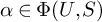 . Then, for each
$\beta \in I \cap \Phi _i$
 , the root
$s_{\alpha }(\beta ) = \beta - \underbrace {\langle \alpha , \beta \rangle }_{< 0} \alpha $
 is a sum of elements of
$\Delta $
 and is not contained in the span of I, hence it lies in
$\Phi (U, S)$
 . Therefore, the subspace
$\operatorname {\mathrm {Span}}_{\mathbb R}(\Phi (U, S))$
 contains
$I \cap \Phi _i$
 . Because it contains
$(\Delta \setminus I) \cap \Phi _i$
 , it actually contains
$\Delta \cap \Phi _i$
 and therefore contains
$\Phi _i$
 .
Proposition 38. The map
$\vartheta _P$
 is injective if and only if P is of non-degenerate type.
Proof. Observe that, because
$\vartheta _P$
 is
$G(k)$
 -equivariant and because any two points lie in an apartment, the map
$\vartheta _P$
 is injective if and only if there exists an apartment A such that
$\vartheta _{P|A}$
 is injective.
Let S be a maximal k-split torus contained in P. Let o be a special point of
$A(G, k)$
 and K be a finite extension such that
$G_K$
 is pseudo-split and
$o_K$
 is special. Let T be a maximal K-split torus that contains
$S_K$
 such that
$p_{K/k}(A(G, S)) \subset A(G_K, T)$
 . By Propositions 30 and 35, we have the commutative diagram

where
$U^-$
 is the k-split unipotent radical of the opposite pseudo-parabolic subgroup to P with respect to S. With the notations of Section 3.2 associated to the point
$o_K$
 , we have, for each
$f = \sum _{\nu \in \mathbb N^{\mathbf \Psi }} f_{\nu }\xi ^{\nu } \in K[U^-] = K[(\xi _{\alpha , i})_{(\alpha , i)\in {\mathbf \Psi }}]$
 and
$x \in A(G_K, T)$
 :

Note also that, for each character
$\chi \in X^*(T)$
 and each cocharacter
$\lambda \in X_*(S)$
 , we have the following compatibility property between duality pairings

Now, let
$a \in \Phi (U^-, S)$
 be a relative weight of the Lie algebra of
$U^-$
 and
$\phi \in \operatorname {\mathrm {Lie}}(U^-)^* \subset k[U^-]$
 be a nonzero weight vector of weight
$-a$
 . Then, we may write

with
$\phi _{\alpha , i}\in K$
 and not all
$\phi _{\alpha , i}$
 equal to zero. Hence, we have, for all
$x \in A(G, S)$
 :

Therefore, if
$x, y \in A(G, S)$
 satisfy
$\vartheta _P(x) = \vartheta _P(y)$
 , then
$\langle a, x-o \rangle = \langle a, y-o \rangle $
 for each
$a \in \Phi (U^-, S)$
 . Conversely, if x and y in
$A(G,S)$
 satisfy
$\langle a, x-y \rangle = 0$
 for each
$a \in \Phi (U^-, S)$
 , then the observation following Equation (5) shows that
$\vartheta _{P_K}(x) = \vartheta _{P_K}(y)$
 , and therefore
$\vartheta _P(x) = \vartheta _P(y)$
 . In other words, for x and y in
$A(G,S)$
 , we have
$\vartheta _P(x) = \vartheta _P(y)$
 if and only if
$x-y$
 lies in the annihilator

Hence, the map
$\vartheta _P$
 is injective if and only if the subset
$\Phi (U^-, S)$
 spans the dual space
$V^*(G, S)$
 , that is if and only if P is of non-degenerate type by Proposition 37.
3.4 Relative compactness
In this section, we establish that, if P is a pseudo-parabolic subgroup of G, then the image of the map
$\vartheta _P$
 is relatively compact. As usual, it will suffice to consider the case when G is pseudo-split. The main insight is that the Cartan decomposition [Reference SolleveldSol18, Theorem 3.13 (d)] allows one to restrict to proving that sequences taking values in a suitably chosen cone admit a convergent subsequence, which will follow from the previous section.
Proposition 39. The map
$\vartheta _P$
 has relatively compact image. In particular, if P is of non-degenerate type, then
$\vartheta _P$
 factors through a
$G(k)$
 -equivariant compactification of
$\mathcal B(G, k)$
 .
Proof. First of all, thanks to Proposition 30, we have the following commutative diagram of continuous maps

for any finite extension
$K/k$
 . It follows that, if
$\vartheta _{P_K}$
 has relatively compact image, then so does
$\vartheta _P$
 .
It is therefore sufficient to prove our claim in the case where G is pseudo-split over k, which we will assume in what follows. Let T be a maximal split torus contained in P and
$\mu \in X_*(T)$
 be a cocharacter such that
$P = P_G(\mu )$
 . Set
$U^- = U_G(-\mu )$
 . Fix a special vertex o in
$A(G, T)$
 , set
$\Psi = \Phi (U^-, T)$
 and consider the cone

Observe that we have

where the action of
$W(G, T)(k) = \dfrac {N_G(T)(k)}{Z_G(T)(k)}$
 on
$A(G, T)$
 is given by the identification of
$A(G, T)$
 with
$V(G, T)$
 by setting o as origin. Moreover, because o is special, the projection

is onto, hence we have

Moreover, by [Reference SolleveldSol18, Theorem 3.11], we have

and therefore

Because
$\vartheta _P$
 is
$G(k)$
 -equivariant and continuous and because
$G(k)_o$
 acts through its compact quotient
$G(k)_o/Z(G)(k)$
 , proving that
$\vartheta _P$
 has relatively compact image reduces to proving that its restriction to
$C(P)$
 has relatively compact image. Now, let
$(x_n)$
 be a sequence in
$C(P)$
 . Identify
$A(G, T)$
 with
$V(G, T)$
 using o as origin and assume the notations of Section 3.2. Then, by Proposition 35, we have
$\vartheta _P(x_n) \in (U^-)^{\operatorname {\mathrm {an}}}$
 for each
$n \in \mathbb N$
 and, for each
$f = \sum _{\nu \in \mathbb N^{\mathbf \Psi }} f_{\nu }\xi ^{\nu }\in k[U^-] = k[(\xi _{\alpha , i})_{(\alpha , i) \in {\mathbf \Psi }}]$
 , we have

For each
$\alpha \in \Psi $
 , the sequence
$(e^{\langle \alpha , x_n\rangle })$
 is bounded. Consequently, there exists a subsequence
$(x_{n_j})$
 such that
$(e^{\langle \alpha , x_{n_j}\rangle })$
 converges for each
$\alpha \in \Psi $
 . Then, for each
$f \in k[U^-]$
 , the sequence
$(|f|(\vartheta _P(x_{n_j})))$
 converges and thus the subsequence
$(\vartheta _P(x_{n_j}))$
 converges in
$(U^-)^{\operatorname {\mathrm {an}}}$
 .
The proof actually yields the following more precise statement.
Proposition 40. Let S be a maximal split torus in P and o a special vertex in
$A(G, S)$
 . Consider the cone

Then, the image
$\vartheta _P(C(P))$
 is relatively compact in the open subspace
$(\Omega (S, P)/P)^{\operatorname {\mathrm {an}}} \subset (G/P)^{\operatorname {\mathrm {an}}}$
 .
3.5 Openness of the corestriction
In this section, we check that the corestriction

is an open map. In particular, if P is of non-degenerate type, we prove that
$\vartheta _P$
 is an embedding.
Proposition 41. The corestricted map
$\vartheta _P: \mathcal B(G, k) \to \overline {\vartheta _P(\mathcal B(G, k))}$
 is open. In particular, whenever P is of non-degenerate type, the map
$\vartheta _P$
 is an embedding.
The proof goes in three steps. First of all, we prove that the restriction of
$\vartheta _P$
 to an apartment
$A(G, S)$
 (and thus to any apartment) induces an open map to the closure of its image. Secondly, we prove that the action map

is a topological quotient map. Lastly, we deduce that the map
$\vartheta _P: \mathcal B(G, k) \to \overline {\vartheta _P(\mathcal B(G, k))}$
 is open.
Lemma 42. Let S be a maximal split torus of G. The image
$\vartheta _P(A(G, S))$
 is open in its closure
$\overline {\vartheta _P(A(G, S))}$
 .
Proof. Without loss of generality, we may assume S to be contained in P.
Let o be a special vertex in
$A(G, S)$
 . Let T be a maximal torus of G and
$K/k$
 a finite extension such that
-
1. The torus $T_K$
is split. -
2. The apartment $A(G_K, T_K)$
contains
$p_{K/k}(A(G, S))$
. -
3. The point $o_K \in A(G_K, T_K)$
is a special vertex.


Then, as in the proof of Proposition 37, we have the diagram

where
$U^-$
 is the k-split unipotent radical of the pseudo-parabolic subgroup of G opposite to P with respect to S. We may rewrite the explicit formula in Proposition 35 as the statement that, for each
$x \in \vartheta _P(A(G, S))$
 and
$f \in K[U^-] = K[(\xi _{\alpha , i})_{(\alpha , i) \in {\mathbf \Psi }}]$
 , we have

where, for each
$\alpha \in \Phi (U^-, S)$
 , the family
$(\xi _{\alpha , i})$
 is a choice of coordinates on
$U_{\alpha }$
 given by
$o_K$
 through the procedure described in the introduction to Section 3.2. It follows from the proof of Proposition 39 that this formula extends to all points
$x \in \overline {\vartheta _P(A(G, S))} \cap (U^-)^{\operatorname {\mathrm {an}}}$
 and that a point
$x \in \overline {\vartheta _P(A(G, S))} \cap (U^-)^{\operatorname {\mathrm {an}}}$
 lies in
$\vartheta _P(A(G, S))$
 if and only if
$|\xi _{\alpha , i}(x)|> 0$
 for all
$(\alpha , i) \in {\mathbf \Psi }$
 .
It follows that the image
$\vartheta _P(A(G, S))$
 is open in
$\overline {\vartheta _P(A(G, S))} \cap (\Omega (S, P)/P)^{\operatorname {\mathrm {an}}}$
 . Note that the Bruhat decomposition [Reference Conrad, Gabber and PrasadCGP15, Theorem C.2.8] implies that
$G/P = \bigcup _{w \in W} \dot w\Omega (S, P)/P$
 , where, for each
$w \in W$
 , we choose an arbitrary lift
$\dot w$
 of w in
$N_G(S)(k)$
 ; see [Reference JantzenJan87, II.1.9.7]. By
$N_G(S)(k)$
 -equivariance of
$\vartheta _P$
 , we deduce that
$\vartheta _P(A(G, S))$
 is open in
$\overline {\vartheta _P(A(G, S))}\cap (\dot w\Omega (S, P)/P)^{\operatorname {\mathrm {an}}}$
 for each
$w \in W$
 , and therefore open in
$\overline {\vartheta _P(A(G, S))}$
 .
We now conclude our first step.
Lemma 43. Let S be a maximal split torus of G. The map

is open.
Proof. As in the previous lemma, we may assume that S is contained in P. Let
$U^-$
 be the k-split unipotent radical of the pseudo-parabolic subgroup opposite to P with respect to S. Let o be a special vertex in
$A(G, S)$
 . Recall from Proposition 38 that
$\vartheta _P$
 factors through the quotient map

a surjective affine map, hence open. We may therefore assume that P is of non-degenerate type, i.e. that we have the implication

for each
$x \in V(G, S)$
 . Under this assumption, the open half-spaces

for
$a \in \Phi (U^-, S) $
 form a subbase of open sets for the topology of
$A(G, S)$
 . Because
$\vartheta _P$
 is injective, we need only check that these half-spaces have an open image. Consider a system of coordinates
$(\xi _{\alpha , i})_{(\alpha , i)\in \mathbf \Psi }$
 on
$U^-_K$
 as in Section 3.2. Let
$\phi = \sum _{\substack {(\alpha , i) \in {\mathbf \Psi }\\ \alpha _{|S} = a}}\phi _{\alpha , i} \xi _{\alpha , i} \in k[U^-]$
 be a nonzero weight vector of weight
$-a$
 in
$\operatorname {\mathrm {Lie}}(U^-)^*$
 . Then, it follows from Proposition 35 that, for each
$r \in \mathbb R$
 , we have

and

where
$C = \max _{\substack {(\alpha , i) \in {\mathbf \Psi }\\ \alpha _{|S} = a}} |\phi _{\alpha , i}|$
 . Consequently, for each
$r \in \mathbb R$
 , the images
$\vartheta _P(H_{a, r}^+)$
 and
$\vartheta _P(H_{a, r}^-)$
 are open in
$\vartheta _P(A(G, S))$
 , and thus open in
$\overline {\vartheta _P(A(G, S))}$
 by Lemma 42.
Now, let o be a special vertex in
$A(G, S)$
 . By [Reference SolleveldSol18, Theorem 3.12], we have a coarse Cartan decomposition

and therefore

Because
$G(k)_o \times \overline {\vartheta _P(A(G, S))}$
 and
$\overline {\vartheta _P(\mathcal B(G, k))}$
 are compact Hausdorff by Proposition 39, the surjective action map

is in fact a quotient map.
In order to conclude that
$\vartheta _P$
 is an open map, we need to make one last observation.
Lemma 44. Let S be a maximal split torus of G and
$x \in \overline {\vartheta _P(A(G, S))}$
 . If, for some
$g \in G(k)$
 , we have
$gx \in \vartheta _P(\mathcal B(G, k))$
 , then
$x \in \vartheta _P(A(G, S))$
 .
Proof. The proof is completely analogous to that of [Reference Rémy, Thuillier and WernerRTW10, Lemma 3.33]. The key point is the fact that, using Proposition 35, we may characterise the points of
$\vartheta _P(A(G, S))$
 as the points x of
$\overline {\vartheta _P(A(G, S))}$
 that induce norms on their local ring
$\mathcal O_{(G/P)^{\operatorname {\mathrm {an}}}, x}$
 , a property that is clearly preserved by the action of
$G(k)$
 .
First of all, reasoning as in the proof of Lemma 42, we observe that there exists a
$\dot w \in N_G(S)(k)$
 such that
$\dot wx \in (\Omega (S, P)/P)^{\operatorname {\mathrm {an}}}$
 . Moreover, the lemma holds for x if and only if it does for
$\dot wx$
 . We may therefore assume that x lies in
$\overline {\vartheta _P(A(G, S))} \cap (\Omega (S, P)/P)^{\operatorname {\mathrm {an}}}$
 . Let o be a special vertex in
$A(G, S)$
 . Let T be a maximal torus of G and
$K/k$
 a finite extension such that
-
1. The torus $T_K$
is split. -
2. The apartment $A(G_K, T_K)$
contains
$p_{K/k}(A(G, S))$
. -
3. The point $o_K \in A(G_K, T_K)$
is a special vertex.


Denote by
$U^-$
 the k-split unipotent radical of the opposite pseudo-parabolic to P with respect to S. Identify
$A(G, S)$
 with
$V(G, S)$
 (resp.
$A(G_K, T_K)$
 with
$V(G_K, T_K)$
 ) setting o (resp.
$o_K$
 ) as origin. Under this identification, the map
$p_{K/k}: A(G, S) \to A(G_K, T_K)$
 is the map induced by base change on cocharacters. Consider the sets
$\Psi = \Phi (U^-, S)$
 and
$\Psi _K = \Phi (U-, T_K)$
 . Let
$(\xi _{\alpha , i})_{(\alpha , i) \in \mathbf \Psi _K}$
 be a system of coordinates on
$U^-_K$
 that is adapted to
$o_K$
 (Remark 34). Let
$(x_n)$
 be a sequence in
$A(G, S)$
 such that
$x = \lim _{n \to \infty } \vartheta _P(x_n)$
 . The sequence
$(\vartheta _{P_K}((x_n)_K))$
 converges to a point
$x_K$
 in
$\overline {\vartheta _{P_K}(A(G_K, T_K))} \cap (\Omega (T, P)/P)_K^{\operatorname {\mathrm {an}}}$
 by Proposition 35. Moreover, we have the equivalences

To conclude, first observe that, by Proposition 35, for each weight
$\alpha \in \Psi _K$
 , letting
$a = \alpha _{|S} \in \Psi $
 be its restriction to S, we have

Therefore, we have the equivalence

and in particular the implication

as the seminorm defined by x on
$\mathcal O_{(G/P)^{\operatorname {\mathrm {an}}}, x}$
 is the restriction of the one defined by
$x_K$
 on
$\mathcal O_{(G/P)_K^{\operatorname {\mathrm {an}}}, x_K}$
 , hence a norm. On the other hand, if
$a \in \Psi $
 and
$\phi \in \operatorname {\mathrm {Lie}}(U^-)^*$
 is a nonzero weight vector of weight
$-a$
 , then as observed in the proof of Lemma 43, there exists
$C> 0$
 such that

It follows that, if x defines a norm on
$\mathcal O_{(G/P)^{\operatorname {\mathrm {an}}}, x}$
 , then by the above computation, we have

and therefore
$x \in \vartheta _P(A(G, S))$
 by the above observations.
We now carry out the proof of Proposition 41.
Proof of Proposition 41
Let U be an open subset of
$\mathcal B(G, k)$
 . Consider the diagram

Then, the subset
$V = (\operatorname {\mathrm {id}}\times \vartheta _P)(\pi ^{-1}(U))$
 is open in
$G(k)_o \times \overline {\vartheta _P(A(G, S))}$
 by Lemma 43. As we established above, the rightmost map
$\pi _P$
 is a quotient map. Therefore, in order to prove that
$\vartheta _P(U) = \pi _P(V)$
 is open in
$\overline {\vartheta _P(\mathcal B(G, k))}$
 , it is sufficient to check that V is
$\pi _P$
 -saturated, which is a direct consequence of Lemma 44.
4 Description of the boundary
In this section, we establish that the family of compactifications of
$\mathcal B(G, k)$
 constructed above corresponds to the one constructed in [Reference CharignonCha10] and specialises to the one constructed in [Reference Rémy, Thuillier and WernerRTW10] in the reductive case. More precisely, we will prove that, if P is a pseudo-parabolic subgroup of G of non-degenerate type and S is a maximal split torus in P, then the compactification
$\overline {\vartheta _P(\mathcal B(G, k))} \subset (G/P)^{\operatorname {\mathrm {an}}}$
 is
$G(k)$
 -equivariantly homeomorphic to the compactification
$\overline {\mathcal B(G, k)}$
 defined in [Reference CharignonCha10, Section 5] for a suitable choice of fan. We deduce that the compactifications are stratified and interpret the strata in terms of group-theoretic data.
4.1 Polyhedral compactifications of affine buildings
In this section, we introduce terminology and results from [Reference CharignonCha10] that will be in constant use in what follows.
The article [Reference CharignonCha10] associates to each affine building
$\mathcal I$
 , modelled on an affine Coxeter complex
$\Sigma $
 , and each fan
$\mathcal F$
 in the direction
$\vec \Sigma $
 of
$\Sigma $
 subject to some compatibility relations [Reference CharignonCha10, 2.3] a canonical compactification
$\overline I^{\mathcal F}$
 of
$\mathcal I$
 . We give an overview of the construction, first compactifying each apartment and then glueing the compactifications of the various apartments together to get a compactification of the building.
Fans and compactifications of affine spaces
We first describe the compactifications of apartments in [Reference CharignonCha10, Section 3].
The setting is that of a Euclidean space V whose dual is endowed with a root system
$\Phi \subset V^*$
 . Denote by W the Weyl group of
$\Phi $
 . Recall that a cone in V is said to be polyhedral if it can be defined by a finite number of linear inequalities. We call a cone relatively open if it is open in its linear span. A polyhedral cone is relatively open if and only if it can be defined by a finite number of linear equations and strict linear inequalities. Then, a fan in the sense of [Reference CharignonCha10] is a family
$\mathcal F$
 of relatively open polyhedral cones of V satisfying the following conditions:
-
1. The family $\mathcal F$
is a finite partition of V. -
2. $\{0\} \in \mathcal F$
. -
3. For each $f \in \mathcal F$
, the boundary
$\partial f = \overline {f} \setminus f$
is a union of cones of
$\mathcal F$
, called the proper faces of f (we also consider f to be a face of itself). -
4. For all cones $ f$
and g in
$\mathcal F$
, if
$ f$
is a face of g, then
$\overline {f} = \operatorname {\mathrm {Span}}_{\mathbb R}(f) \cap \overline {g}$
.


Example 45. The root system
$\Phi \subset V^*$
 determines a hyperplane arrangement in V. The facets, in the sense of [Reference BourbakiBou81, Ch. V, §1.3], then form a fan
$\mathcal F$
 in V if the root system
$\Phi $
 is essential. In the following, we call this fan the Weyl fan. Its facets will be called Weyl facets and its open facets called Weyl chambers.
Remark 46. The above definition differs slightly from the one coming from toric geometry adopted, for example, in [Reference FultonFul93, 1.1] or [Reference Rémy, Thuillier and WernerRTW10, Appendix B], which we shall call a closed fan, namely a finite set
$\mathcal F$
 of closed strictly convex polyhedral cones (i.e. containing no lines) such that any two cones in
$\mathcal F$
 meet along a face, and such that any face of a cone in
$\mathcal F$
 belongs to
$\mathcal F$
 . In that context, a face of a closed polyhedral convex cone f is defined as the intersection of f with a supporting hyperplane. The operations of taking closures and relative interiors allow one to pass from fans on the one hand to closed fans covering V and vice versa. These operations also establish a correspondence between both notions of faces, as we check below.
Lemma 47. Let
$\mathcal F$
 be a fan in V. For each cone g in
$\mathcal F$
 , the closure
$\overline g$
 is strictly convex.
Proof. Let
$g \in \mathcal F$
 be a cone of minimal dimension such that there exists
$x\in V\setminus \{ 0\}$
 such that
$x \in \overline g$
 and
$-x \in \overline g$
 . Note that x is in g. Indeed, otherwise, there exists a proper face f of g such that
$x \in f$
 . Then, by Condition 4, we have
$-x \in \overline f$
 , which contradicts the minimality of
$ g$
 . Now, since g is relatively open and
$x \in g$
 , it follows from [Reference RockafellarRoc72, Theorem 6.1] that
$0 = \frac {1}{2}(x+ (-x)) \in g$
 , which contradicts Condition 2.
Lemma 48. Let
$\mathcal F$
 be a fan in V and g a cone in
$\mathcal F$
 . Let f be a relatively open polyhedral cone in V. The following are equivalent:
-
1. The cone f is a face of g.
-
2. There exists a linear form $\alpha \in V^*$
such that
$\alpha (x) \ge 0$
for each
$x \in g$
and such that
$\overline f = (\ker \alpha ) \cap \overline g$
.


Proof.
(Step 1:
$(i) \implies (ii)$
 ) Assume that f is a face of g. Let us first assume that g is open. Then because
$\overline g$
 is strictly convex, the dual cone

has non-empty interior by [Reference RockafellarRoc72, Corollary 14.6.1]. Because the annihilator

meets the interior of
$g^{\vee }$
 (that is, because f lies in a supporting hyperplane of g, see [Reference RockafellarRoc72, Theorem 11.6]), the intersection
$f^{0} \cap g^{\vee }$
 has non-empty relative interior. Let
$\alpha \in f^0 \cap g^{\vee }$
 be a relative interior point. Let
$x \in \overline g \setminus \operatorname {\mathrm {Span}}_{\mathbb R}(f)$
 . Because
$\alpha $
 is in the relative interior of
$f^{0}\cap g^{\vee }$
 , it lies in the relative interior of the half-space

by [Reference RockafellarRoc72, Corollary 6.5.2], that is, the (relatively) open half-space
$\{\alpha \in f^{0}, \alpha (x)> 0\},$
 hence
$\alpha (x)> 0$
 . Finally, we have

In the general case, let
$H_0$
 be a supporting hyperplane of g in
$\operatorname {\mathrm {Span}}_{\mathbb R}(g)$
 such that
$H_0 \cap \overline g = \overline f$
 . Then, the subspace
$H = H_0 \oplus \operatorname {\mathrm {Span}}_{\mathbb R}(g)^{\perp }$
 is a supporting hyperplane of g in V such that
$H \cap \overline g = \overline f$
 .
(Step 2:
$(ii) \implies (i)$
 ) Let
$\alpha \in V^*$
 be a linear form such that
$\alpha (x) \ge 0$
 for each
$x \in g$
 and such that
$\overline f = (\ker \alpha )\cap \overline g$
 . Because each face of g is relatively open, the form
$\alpha $
 is either identically zero or only assumes positive values on it. Consequently, the intersection
$(\ker \alpha )\cap \overline g$
 is a union of faces of g, say

Because the intersection is closed, we in fact have

One of the
$\overline f_i$
 must then have non-empty interior in
$\operatorname {\mathrm {Span}}_{\mathbb R}((\ker \alpha ) \cap \overline g)$
 , from which we deduce that

Because both
$f_i$
 and f are convex and relatively open, we conclude that
$f = f_i$
 , hence f is indeed a face of g.
We now assume that we are given an affine space A directed by V. Two affine convex cones
$f = x+\vec f$
 and
$g = y + \vec g$
 in A, directed by cones
$\vec f$
 and
$\vec g$
 in V, are said to be parallel (
$f/\!/ g$
 ) if they have the same direction, that is, if
$\vec f = \vec g$
 . The cones f and g are said to be equivalent (
$f \sim g$
 ) if they are parallel and have non-empty intersection or, equivalently, if they share a parallel subcone, i.e. if there exists a cone
$h \subset f \cap g$
 that is parallel to f and g. Call
$f \subset A$
 an affine
$\mathcal F$
 -cone if its direction
$\vec f$
 belongs to
$\mathcal F$
 . Denote by
$\mathcal F_A$
 the set of affine
$\mathcal F$
 -cones in A.
Then, the compactification of A associated to a fan
$\mathcal F$
 in V is the quotient of the set of affine
$\mathcal F$
 -cones in A under the equivalence relation defined above:

The equivalence classes can be grouped by direction, thereby partitioning the compactification:

For each
$\vec f \in \mathcal F$
 , the subspace
$A_{\vec f} = \{[x + \vec f], x \in A\}$
 is called the façade of
$\overline A^{\mathcal F}$
 of type
$\vec f$
 . This façade is naturally an affine space under
$V/\operatorname {\mathrm {Span}}_{\mathbb R}(\vec f)$
 . Geometrically, setting an origin at some point
$o \in A$
 , we compactify each open cone
$o + \vec f = \{x \in A, \forall i \in I, \alpha _i(x-o)> 0\}$
 by allowing the
$\alpha _i(x-o)$
 for
$i\in I$
 , which we think of as the distances from x to the walls of the cone
$o+\vec f$
 , to assume infinite values.
Precisely, we have the following statement.
Proposition 49 (Corollary of [Reference CharignonCha10, Proposition 3.2.4])
Let
$(x_n)$
 be a sequence of points in A and
$l = [a + \vec f] \in \overline A^{\mathcal F}$
 . Then, the sequence
$(x_n)$
 converges to l if and only if, for each linear form
$\alpha \in V^*$
 such that
$\vec f \subset \ker \alpha $
 , we have

and, for each
$\alpha \in V^*$
 with
$\alpha (x)> 0$
 for each x in
$\vec f$
 , we have

These façades form a stratification of
$\overline A^{\mathcal F}$
 , specifically, we have

Fans associated to types of pseudo-parabolic subgroups
We now define the family of fans that will concern us in the following.
Weyl chambers are in one-to-one correspondence with bases of the root system: given a basis
$\Delta $
 of the root system, the cone

is a Weyl chamber. Conversely, given a Weyl chamber C, the intersection
$C^{\vee }\cap \Phi $
 of the dual cone of C with
$\Phi $
 is a positive system of roots that gives rise to a unique basis. Moreover, given a Weyl chamber C corresponding to a basis
$\Delta $
 , the faces of C are in one-to-one correspondence with the subsets of
$\Delta $
 : if
$J \subset \Delta $
 , then the set

is a face of C, said to be of type J.
Example 50. Fix a Weyl chamber C corresponding to a basis
$\Delta $
 of
$\Phi $
 and a subset
$J \subset \Delta $
 containing no connected component of
$\Delta $
 , considered as a Dynkin diagram. Say a face of C is admissible if none of the connected components of its type, viewed as a subgraph of
$\Delta $
 , lie in J. Then, for each admissible face f of C of type I, we let
$\overline f^J$
 denote the union of f and its faces of type included in
$I \cup (J \cap I^{\perp })$
 . Then, the set

is a relatively open polyhedral cone, and the set

is a fan in V by [Reference CharignonCha10, Proposition 2.5.3].
When the root system is given by a maximal split torus S in a quasi-reductive group G over a field k, we have a natural group-theoretic interpretation for this fan.
Let P be a pseudo-parabolic subgroup of non-degenerate type in a quasi-reductive group G over a field k. Let
$P_0$
 be a minimal pseudo-parabolic subgroup of G and let S be a maximal split torus such that
$S \subset P_0 \subset P$
 . Set
$V = V(G, S)$
 and
$\Phi = \Phi (G, S)$
 . Let W be the Weyl group of
$\Phi $
 . Let
$\Delta $
 be the basis of the root system
$\Phi $
 corresponding to
$P_0$
 and
$J = \Delta \cap -\Phi (P, S)$
 be the type of P. Set

and let

be the Weyl chamber associated to
$P_0$
 . These cones are related as follows.
Proposition 51. With the above notation, we have

Consequently, the open cones of
$\mathcal F^J$
 are the
 , where Q ranges among the pseudo-parabolic subgroups containing S that are conjugate to P. Moreover, the correspondence
$P \mapsto C(P)$
 is W-equivariant.
Proof. Observe that

which is the union of the closed Weyl chambers associated to the bases
$w(\Delta )$
 for w in
$W_J = \langle s_{\alpha }, \alpha \in J \rangle $
 . Let
$L_P$
 be the pseudo-Levi subgroup of P corresponding to S. Then, the reflection group
$W_J$
 is the Weyl group
$W(L_P, S)$
 . In particular, because the conjugacy action of
$L_P$
 on P preserves
$\mathcal R_{u,k}(P)$
 , the group
$W_J$
 stabilises the cone
$C(P)$
 . Hence, because
$\overline C \subset C(P)$
 , we must in turn have
$\overline {J \cdot C} \subset C(P)$
 .
On the other hand, the cone
$C(P)$
 is a union of Weyl facets with non-empty interior and is therefore the closure of the union of the Weyl chambers that it contains. Further, a Weyl chamber is contained in
$C(P)$
 if and only if it corresponds to a minimal pseudo-parabolic subgroup of G containing S and contained in P by [Reference Conrad, Gabber and PrasadCGP15, Proposition 3.5.14]. Now, by [Reference Conrad, Gabber and PrasadCGP15, Proposition 2.2.10], the map

establishes an
$L_P(k)$
 -equivariant and order-preserving bijection between pseudo-parabolic subgroups of P containing S and pseudo-parabolic subgroups of
$L_P$
 containing S. By [Reference Conrad, Gabber and PrasadCGP15, Theorem C.2.3] and [Reference Conrad, Gabber and PrasadCGP15, Theorem C.2.5], the normaliser
$N_{L_P}(S)(k)$
 acts transitively on the minimal pseudo-parabolic subgroups of
$L_P$
 containing S, hence it acts transitively on the minimal pseudo-parabolic subgroups of P containing S. Hence, the Weyl chambers contained in
$C(P)$
 are precisely the
$w(\Delta )$
 for
$w \in W(L_P, S)(k) = W_J$
 . We conclude that
$C(P)$
 is in fact equal to
$\bigcup _{w \in W_J} w(\overline C) = \overline {J \cdot C}$
 , which completes the proof.
Compactifications of affine buildings
To conclude these preliminary considerations, we extend the above construction to yield compactifications of affine buildings. In [Reference LandvogtLan96], where the affine buildings are Bruhat-Tits buildings of reductive groups, this is obtained by way of a glueing procedure, much like the building itself: stabilisers are defined for points of the compactification of a given apartment with respect to the Weyl fan, then the compactification of
$\mathcal B(G, k)$
 is defined to be the quotient of
$G(k) \times \overline A^{\mathcal F}$
 by an equivalence relation similar to that defining the building
$\mathcal B(G, k)$
 .
A salient feature of [Reference CharignonCha10] is that it performs the same construction while solely relying on the internal geometry of the building. For this purpose, the author introduces the notion of a cone in the building, which in some sense is a glueing of affine cones in various apartments containing a common subcone of a Weyl facet, called its core.
Consider an apartment A in an affine building
$\mathcal B$
 . We denote by V the direction of A and by
$\Phi \subset V^*$
 its vectorial root system. We also assume that we are given a fan
$\mathcal F$
 in V that is invariant under the action of the Weyl group
$W = W(\Phi )$
 . Under this assumption, the notion of an affine
$\mathcal F$
 -cone can be defined in the whole building: an affine
$\mathcal F$
 -cone is a subset
$f \subset \mathcal B$
 such that there exist an apartment B containing f and an isomorphism of affine Coxeter complexes
$\phi _B: A \to B$
 such that
$\phi _B^{-1}(f)$
 is an affine
$\mathcal F$
 -cone in A. For each apartment B, denote by
$\mathcal F_B$
 the set of affine
$\mathcal F$
 -cones contained in B.
Then, for each cone
$f \in \mathcal F$
 , the core of f is the convex cone

Example 52. In the case when
$\mathcal F = \mathcal F^J$
 with the notations of the previous example, for each face f of the Weyl cone C of admissible type I, the core of
$J \cdot f$
 is the face of C of type
$I \cup (J \cap I^{\perp })$
 .
Likewise, given any affine
$\mathcal F$
 -cone
$f = x + \vec f$
 in A, the core of f is defined as
$\delta (f) = x + \delta (\vec f)$
 .
We then define the cone of
$\mathcal B$
 associated to an affine cone f in A to be

where B ranges among all apartments containing the core
$\delta (f)$
 , and
$\phi _B: A \to B$
 is an isomorphism of Coxeter complexes fixing the intersection
$A \cap B$
 . Denote by
$\mathcal F_{\mathcal B}$
 the set

It can then be checked that the
$\phi _B(f)$
 all have the same core, which we also call the core of the cone
$\widetilde f$
 and denote by
$\delta (\widetilde f)$
 .
Finally, the compactification of
$\mathcal B$
 is constructed in the same way as that of A, i.e. as equivalence classes of cones. The only problem is to define the notion of parallelism for cones in
$\mathcal B$
 , which is where cores play a crucial role. Indeed, it follows from [Reference CharignonCha10, Corollaire 4.5.9] that, given any two cones F and G in
$\mathcal B$
 , there exists an apartment A that contains parallel subcones of
$\delta (F)$
 and
$\delta (G)$
 . We then say that F and G are parallel (
$F /\!/ G$
 ) if there exist parallel subcones
$f \subset \delta (F)$
 and
$g \subset \delta (G)$
 and an apartment A containing f and g such that
$f /\!/ g$
 in A (this parallelism does not depend on the specific A). Likewise, we say that F and G are equivalent (
$F \sim G$
 ) if F and G are parallel and have a non-empty intersection. Then, we set

We call
$\overline {\mathcal B}^{\mathcal F}$
 the polyhedral compactification of
$\mathcal B$
 with respect to the fan
$\mathcal F$
 .
As in the previous case, the equivalence classes can be grouped into parallelism classes:

For each
$F \in \mathcal F_{\mathcal B}$
 , the subspace
$\mathcal B_F = \{G \in \mathcal F_{\mathcal B}, G /\!/ F\}$
 is called the (outer) façade of
$\mathcal B$
 of type F. The façade
$\mathcal B_F$
 is naturally an affine building whose apartments are the façades
$A_f$
 , for apartments A containing affine
$\mathcal F$
 -cones f such that
$\widetilde f /\!/ F$
 . These façades are either equal or disjoint and form the strata of a topological stratification of
$\overline {\mathcal B}^{\mathcal F}$
 [Reference CharignonCha10, §8.2.2].
4.2 A comparison
Because the building
$\mathcal B(G,k)$
 arises from valuated root data in
$G(k)$
 [Reference SolleveldSol18, Section 3.2], Proposition 7.4 of [Reference CharignonCha10] applies. It is thus sufficient, in order to identify the aforementioned compactifications, to prove that the procedure of taking the closure of a given apartment in one space and the other yields homeomorphic spaces.
Proposition 53. Let P be a pseudo-parabolic subgroup of non-degenerate type, let
$P_0 \subset P$
 be a minimal pseudo-parabolic subgroup and let
$S \subset P_0$
 be a maximal split torus. Denote by
$\Delta $
 the basis of
$\Phi (G, S)$
 associated to
$P_0$
 and let
$J \subset \Delta $
 be the type of P.
The map
$\vartheta _P$
 extends to a continuous map

that is a homeomorphism onto its image.
Proof. By [Reference Guivarc’h, Ji and TaylorGJT98, Lemma 3.28], it suffices to prove that, for any two sequences
$(x_n)$
 and
$(x^{\prime }_n)$
 of points in
$A(G, S)$
 , the following are equivalent:
-
(i) The sequences $(x_n)$
and
$(x^{\prime }_n)$
converge and have the same limit in
$\overline {A(G, S)}^{\mathcal F^J}$
. -
(ii) The sequences $(\vartheta _P(x_n))$
and
$(\vartheta _P(x^{\prime }_n))$
converge and have the same limit in
$(G/P)^{\operatorname {\mathrm {an}}}$
.


We use Propositions 35 and 49 to characterise convergence in one space and the other. Both characterisations can be translated into convergence conditions on the sequences
$(\langle a, x_n\rangle )$
 and
$(\langle a, x^{\prime }_n\rangle )$
 for certain roots a.
Fix a special vertex
$o \in A(G, S)$
 . Identify
$A(G, S)$
 with its direction
$V(G, S)$
 by setting o as origin. Let

(Step 1:
$(i) \implies $
 (ii)) Let
$(x_n)$
 and
$(x^{\prime }_n)$
 be two sequences of points in
$A(G, S)$
 . Assume that both
$(x_n)$
 and
$(x^{\prime }_n)$
 converge in
$\overline {A(G, S)}^{\mathcal F^J}$
 and have the same limit l lying in the façade
$A(G, S)_{\vec f}$
 , where
$\vec f \in \mathcal F^J$
 .
Without loss of generality, we may assume that
$\vec f$
 is a face of
 . Indeed, by construction,
$\vec f$
 is a face of an open cone of
$\mathcal F^J$
 and, by Proposition 51, the Weyl group
$W(G, S)(k)$
 acts transitively on these open cones. If
$w \in W(G, S)(k)$
 maps
$\vec f$
 to a face of
 , and if
$\dot w \in N_G(S)(k)$
 is a lift of w, then
$(\dot wx_n)$
 and
$(\dot wx^{\prime }_n)$
 both converge and have the same limit
$\dot w l$
 lying in
$A(G, S)_{w \vec f}$
 , and
$w \vec f$
 is a face of
 . Furthermore,
$(\vartheta _P(x_n))$
 and
$(\vartheta _P(x^{\prime }_n))$
 converge and have the same limit in
$(G/P)^{\operatorname {\mathrm {an}}}$
 if and only if the same holds for
$(\vartheta _P(\dot w x_n))$
 and
$(\vartheta _P(\dot w x^{\prime }_n))$
 by
$G(k)$
 -equivariance of
$\vartheta _P$
 and continuity of the action of
$G(k)$
 on
$(G/P)^{\operatorname {\mathrm {an}}}$
 .
Let us therefore assume that
$\vec f$
 is a face of
 . Each
$a \in \Phi (\mathcal R_{u,k}(P), S)$
 assumes only nonnegative values on
$\vec f$
 . In fact, because
$\vec f$
 is relatively open, each a is either identically zero or positive on
$\vec f$
 . Therefore, by Proposition 49, the limits

both exist in
$\mathbb R \cup \{+\infty \}$
 and coincide for each
$a \in \Phi (\mathcal R_{u,k}(P), S)$
 .
We now deduce that
$(\vartheta _P(x_n))$
 and
$(\vartheta _P(x^{\prime }_n))$
 converge in
$(G/P)^{\operatorname {\mathrm {an}}}$
 and have the same limit. We use Proposition 35. Let T be a maximal torus of G containing S and
$K/k$
 be a finite extension such that:
-
1. The torus $T_K$
is split. -
2. The apartment $A(G_K, T_K)$
contains
$p_{K/k}(A(G, S))$
. -
3. The point $o_K \in A(G_K, T_K)$
is a special vertex.


Identify
$A(G_K, T_K)$
 with its direction
$V(G_K, T_K)$
 by setting the origin at
$o_K$
 . Let
$\mu : \mathbb G_m \to S$
 be such that
$P = P_G(\mu )$
 and set
$U^- = U_G(-\mu )$
 . By Proposition 35, both
$(\vartheta _P(x_n))$
 and
$(\vartheta _P(x^{\prime }_n))$
 take their values in
$(\Omega (T, P)/P)^{\operatorname {\mathrm {an}}}$
 . Moreover, identifying
$\Omega (T, P)/P$
 with
$U^-$
 and choosing a system of coordinates
$(\xi _{\alpha , i})_{(\alpha , i)\in \mathbf \Psi _K}$
 on
$(U^-)_K$
 adapted to
$o_K$
 , we have, for each
$f = \sum _{\nu \in \mathbb N^J} f_{\nu }\xi ^{\nu } \in K[U^-]$
 :

which we may rewrite

Evidently, for each
$f \in K[U^-]$
 , the quantities
$|f(\vartheta _{P_K}((x_n)_K))| $
 and
$|f(\vartheta _{P_K}((x^{\prime }_n)_K))| $
 converge in
$\mathbb R$
 with the same limit, hence the sequences
$(\vartheta _{P_K}((x_n)_K))$
 and
$(\vartheta _{P_K}((x^{\prime }_n)_K))$
 converge in
$(U^-)^{\operatorname {\mathrm {an}}}_K$
 and have the same limit. By continuity of
$\operatorname {\mathrm {pr}}_{K/k}^{\operatorname {\mathrm {an}}}$
 , so do the sequences
$(\vartheta _P(x_n))$
 and
$(\vartheta _P(x^{\prime }_n))$
 , by commutativity of the diagram

(Step 2:
$(ii) \implies (i)$
 ) Let
$(x_n)$
 and
$(x^{\prime }_n)$
 be two sequences of points of
$A(G, S)$
 . Assume that
$(\vartheta _P(x_n))$
 and
$(\vartheta _P(x^{\prime }_n))$
 both converge in
$(G/P)^{\operatorname {\mathrm {an}}}$
 . We first prove that the common limit of the two sequences may be assumed to lie in
$(\Omega (S, P)/P)^{\operatorname {\mathrm {an}}}$
 .
Recall from Proposition 51 that

Because only finitely many subgroups Q conjugate to P contain S, there exists such a Q and a subsequence
$(x_{n_j})_{j \in \mathbb N}$
 such that
$\vartheta _P(x_{n_j}) \in C(Q)$
 for each
$j \in \mathbb N$
 . In particular, we have
$\lim _{n \to \infty } \vartheta _P(x_n) \in \overline {\vartheta _P(C(Q))}$
 . By Proposition 40, for each pseudo-parabolic subgroup Q containing S conjugate to P, the image
$\vartheta _Q(C(Q))$
 is relatively compact in
$(\Omega (S, Q)/Q)^{\operatorname {\mathrm {an}}}$
 , i.e.
$\overline {\vartheta _Q(C(Q))} \subset (\Omega (S, Q)/Q)^{\operatorname {\mathrm {an}}}$
 . Let
$w \in W(G, S)(k)$
 be such that
$w C(Q) = C(P)$
 and
$\dot w$
 be a lift of w in
$N_G(Q)(k)$
 . Then, we have
$P = \dot w Q \dot w^{-1}$
 , and therefore, by Proposition 31:

Consequently, the sequences
$(\vartheta _P(\dot w^{-1} x_n))$
 and
$(\vartheta _P(\dot w^{-1} x^{\prime }_n))$
 converge to a point in
$(\Omega (S, P)/P)^{\operatorname {\mathrm {an}}}$
 . Moreover, the sequences
$(x_n)$
 and
$(x^{\prime }_n)$
 converge to the same limit if and only if the same holds for
$(\dot w^{-1} x_n)$
 and
$(\dot w^{-1}x^{\prime }_n)$
 .
Let us therefore reduce to the case when
$(\vartheta _P(x_n))$
 and
$(\vartheta _P(x^{\prime }_n))$
 both converge in
$(\Omega (S, P)/P)^{\operatorname {\mathrm {an}}} \simeq (U^-)^{\operatorname {\mathrm {an}}}$
 . Choose a special vertex o in
$A(G, S)$
 , a maximal torus T of G containing S and a finite extension
$K/k$
 as in Step 1 and make the same choice of notations. Let
$a \in -\Phi (\mathcal R_{u,k}(P), S)$
 and let
$\phi = \sum _{\substack {(\alpha , i) \in {\mathbf \Psi _K}\\ \alpha _{|S} = a}} \phi _{\alpha , i} \xi _{\alpha , i} \in k[U^-] \subset K[U^-]$
 be a k-linear form on the root group
$U_a$
 . Then, we have

which rewrites as

Because the sequences
$(|\phi (\vartheta _P(x_n))|)$
 and
$(|\phi (\vartheta _P(x^{\prime }_n))|)$
 converge with the same limit, the sequences
$(\langle a, x_n\rangle )$
 and
$(\langle a, x^{\prime }_n\rangle )$
 must converge in
$\mathbb R \cup \{- \infty \}$
 with the same limit. We deduce that, for each
$a \in \Phi (\mathcal R_{u,k}(P), S)$
 , we have

Let

and

Then, denoting by
$\vec f$
 the set

the cone
$\vec f$
 is a face of
$C(P)$
 by Lemma 48 and it follows from Proposition 49 that
$(x_n)$
 and
$(x^{\prime }_n)$
 converge to a common limit lying in the façade
$A(G, S)_{\vec f}$
 , which completes the proof of the equivalence.
By the criterion [Reference CharignonCha10, Proposition 7.4], the compactification
$\overline {\vartheta _P(\mathcal B(G, k))}$
 is thus
$G(k)$
 -equivariantly homeomorphic to the polyhedral compactification of
$\mathcal B(G, k)$
 associated to the fan
$\mathcal F^J$
 .
4.3 Identifying the strata
It now follows from [Reference CharignonCha10, Corollaire 8.2.11] that the compactification
$\overline {\vartheta _P(\mathcal B(G, k))}$
 is stratified by affine buildings. Precisely, we have a
$G(k)$
 -equivariant homeomorphism

where the right-hand side is indexed by cones in
$\mathcal B(G, k)$
 in the sense of [Reference CharignonCha10, Sections 5.2]. The stratum
$\mathcal B(G, k)_{F}$
 corresponding to a cone F is in turn defined as the set of equivalence classes of cones parallel to F for the relation [Reference CharignonCha10, Définition 5.4.1].
We begin by proving that these strata – which are affine buildings – can be interpreted as Bruhat-Tits buildings of certain pseudo-Levi subgroups of pseudo-parabolic subgroups of G.
Theorem 54. Let F be a cone in
$(\mathcal F^J)_{\mathcal B(G, k)}$
 . There exists a unique pseudo-parabolic subgroup Q of G that is maximal among the pseudo-parabolic subgroups of G whose groups of k-points stabilise
$\mathcal B(G, k)_F$
 . Moreover, this stratum identifies
$Q(k)$
 -equivariantly with the Bruhat-Tits building of the quasi-reductive group
$Q/\mathcal R_{us,k}(Q)$
 .
The proof of this theorem will take up most of this section and will therefore be broken down into several steps, namely Propositions 57, 59 and 60. The outline goes as follows: we begin by associating to an apartment
$A(G, S)$
 containing the core of F a pseudo-parabolic subgroup Q containing S. We prove that this pseudo-parabolic subgroup Q depends only on the parallelism class of F (thus neither on the specific representative F nor the specific apartment containing
$\delta (F)$
 that we choose). We deduce from these observations that
$Q(k)$
 stabilises the façade
$\mathcal B(G, k)_F$
 and that the k-split unipotent radical
$\mathcal R_{us,k}(Q)(k)$
 acts trivially on that same façade. Lastly, we check that, given a pseudo-Levi factor
$L_Q \subset Q$
 , the projections
$A(G, S) \to A(G, S)_F$
 with
$S \subset L_Q$
 glue together to give a
$L_Q(k)$
 -equivariant map
$L_Q(k) \cdot A(G, S) \twoheadrightarrow \mathcal B(G, k)_{F}$
 that factors through an equivariant, simplicial homeomorphism
$\mathcal B(L_Q, k) \to \mathcal B(G, k)_{F}$
 , which will complete the proof.
Associating a pseudo-parabolic subgroup to a façade
Let us now carry out the first step, namely identifying the pseudo-parabolic subgroup Q and establishing its sole dependency on the parallelism class of F. The argument hinges on the following preliminary observation.
Proposition 55. Let X be a smooth irreducible variety over a field k complete with respect to a non-trivial absolute value. Then, any non-empty open subset of
$X(k)$
 for its analytic topology is Zariski-dense in X.
Proof. A proof is given in [Reference PoonenPoo17, Proposition 3.5.75 and Remark 3.5.76] in the case of local fields, but a careful inspection shows that this proof depends only on the completeness of k (specifically in the use of the implicit function theorem over k in the proof of [Reference PoonenPoo17, Proposition 3.5.73 (i)]).
We take note of the following special case.
Corollary 56. Let k be a complete discretely valued field. Let
$\mathfrak X$
 be a smooth integral scheme of finite type over the valuation ring
$k^{\circ } = \{x \in k, \omega (x) \ge 0\}$
 and let
$X = \mathfrak X_k$
 . Then, the set of integral points
$\mathfrak X(k^{\circ })$
 is either empty or Zariski-dense in X.
From this analytic observation, we draw the following consequence.
Proposition 57. Let Q be the Zariski closure in G of the pointwise stabiliser
$P_{\delta (F)}$
 of
$\delta (F)$
 in
$G(k)$
 . Then Q is a pseudo-parabolic subgroup in G and, for any cone
$F'$
 in
$\mathcal B(G, k)$
 parallel to F, the pointwise stabiliser
$\hat P_{\delta (F')}$
 is Zariski-dense in Q.
Proof. We give an indirect proof, namely we first construct a suitable pseudo-parabolic subgroup Q, then prove that, for any cone
$F'$
 parallel to F, the pointwise stabiliser

is Zariski-dense in Q.
Let S be a maximal split torus of G such that the apartment
$A(G, S)$
 contains the core
$\delta (F)$
 of F [Reference CharignonCha10, Définition 3.3.2]. Because the direction
$\vec \delta (F)$
 is a Weyl facet in
$V(G, S)$
 (Example 52), it corresponds to a unique parabolic subset
$\Psi $
 of
$\Phi (G, S)$
 , namely the intersection of the root system with the dual cone of
$\vec \delta (F)$


This subset is indeed parabolic as it is clear that, whenever
$\alpha , \beta \in \Psi $
 and
$\alpha + \beta \in \Phi (G, S)$
 , we have
$\alpha + \beta \in \Psi $
 and, if
$\alpha \in \Phi (G, S)$
 , then because the hyperplane
$\{x \in V(G, S), \langle \alpha , x \rangle = 0\}$
 is part of the hyperplane arrangement that defines
$\Sigma (G, S)$
 , the root
$\alpha $
 assumes a constant sign on each facet of
$\Sigma (G, S)$
 , hence either
$\alpha \in \Psi $
 or
$-\alpha \in \Psi $
 . By [Reference Conrad, Gabber and PrasadCGP15, Theorem C.2.15], the subset
$\Psi $
 then determines a unique pseudo-parabolic subgroup Q of G containing S such that
$\Psi $
 is the set of S-weights in the Lie algebra of Q, namely
$Q = P_G(\mu )$
 for any cocharacter
$\mu \in \vec \delta (F)$
 .
We now prove that the pointwise stabiliser
$\hat P_{\delta (F)}$
 is Zariski-dense in Q. Fix a special vertex o in
$A(G, S)$
 and the associated valuation

of the generating root datum
$(Z_G(S)(k), (U_{\alpha }(k))_{\alpha \in \Phi (G,S)})$
 . Denote by x the vertex of the cone
$\delta (F)$
 . By [Reference Bruhat and TitsBT72, Définition 7.1.8 and Proposition 7.4.4], the pointwise stabiliser
$\hat P_{\delta (F)}$
 is spanned by the subgroup
$\hat N_{\delta (F)} = N_G(S)(k)\cap \hat P_{\delta (F)}$
 and the root subgroups
$U_{\alpha ,f_{\delta (F)}(\alpha ) }$
 for
$\alpha \in \Phi $
 , where

First of all, observe that if
$n \in \hat{N}_{\delta (F)}$
 , then n fixes the vertex x of
$\delta (F)$
 as well as the point
$x+\mu $
 . Hence, the linear part of n fixes
$\mu $
 , that is n commutes with
$\mu $
 . Hence, we have the inclusion
$\hat N_{\delta (F)} \subset Z_G(\mu )(k) \subset Q(k)$
 . Next, recall from [Reference Bruhat and TitsBT72, Proposition 7.4.5] that, if
$\alpha \in \Phi (G,S)$
 and
$u \in U_{\alpha }(k)\setminus \{1\}$
 , then the set of points of
$A(G, S)$
 that are fixed under u is the affine root

It follows that, if
$\langle \alpha , \mu \rangle < 0$
 and
$u \in U_{\alpha }(k)\setminus \{1\}$
 , there exists
$t> 0$
 such that
$x + t\mu $
 is not fixed under u and therefore u does not fix
$\delta (F)$
 . Hence, if
$\langle \alpha , \mu \rangle < 0$
 , we have
$U_{\alpha , \delta (F)} = \{1\}$
 . Therefore
$\hat P_{\delta (F)}$
 is spanned by a subgroup of
$Z_G(\mu )(k)$
 and subgroups of
$U_{\alpha }(k)$
 for
$\langle \alpha , \mu \rangle \ge 0$
 , hence
$\hat P_{\delta (F)} \subset Q(k)$
 . Consequently, the Zariski closure of
$\hat P_{\delta (F)}$
 lies in the Zariski closure of
$Q(k)$
 , i.e. Q by Proposition 55. On the other hand, if
$\langle \alpha , \mu \rangle \ge 0$
 , we have
$\langle \alpha , x-o \rangle = \inf \{ \langle \alpha , z-o\rangle , z \in \delta (F)\}$
 and therefore
$f_{\delta (F)}(\alpha ) = \inf (\Gamma ^{\prime }_{\alpha } \cap [-\langle \alpha , x-o\rangle , +\infty [ ) < \infty $
 . Hence, for each non-divisible
$\alpha \in \Phi (Q, S)$
 , the stabiliser
$\hat P_{\delta (F)}$
 contains the subgroup
$U_{\alpha , f_{\delta (F)}(\alpha )}U_{2\alpha , f_{\delta (F)}(2\alpha )}$
 , which is the set of
$k^{\circ }$
 -points of a smooth connected
$k^{\circ }$
 -model of
$U_{\alpha }$
 by [Reference LourençoLou21, Lemme 4.4], and therefore Zariski-dense in
$U_{\alpha }$
 by Corollary 56. Moreover, because the maximal compact subgroup
$Z_G(S)(k)_b$
 of
$Z_G(S)(k)$
 acts trivially on the apartment
$A(G, S)$
 , it fixes
$\delta (F)$
 and is thus contained in
$\hat N_{\delta (F)}$
 . Because
$Z_G(S)(k)_b$
 is the set of integral points of a smooth connected
$k^{\circ }$
 -model of
$Z_G(S)$
 by [Reference LourençoLou21, Proposition 4.3], it is Zariski-dense in
$Z_G(S)$
 . Consequently, the Zariski closure of
$\hat P_{\delta (F)}$
 contains
$U_{\alpha }$
 for each non-divisible
$\alpha \in \Phi (Q, S)$
 as well as
$Z_G(S)$
 , hence it contains Q, which completes the proof.
It is clear that the above argument is independent of the specific vertex
$x \in A(G, S)$
 of the affine cone
$\delta (F)$
 . Hence, for any affine cone
$F' \subset A(G, S)$
 parallel to F, the pointwise stabiliser
$\hat P_{\delta (F')}$
 is Zariski-dense in Q.
Lastly, if
$\mathfrak F \subset \mathcal B(G, k)$
 is an affine cone that is parallel to F, then there exist parallel subcones
$F' \subset F$
 and
$\mathfrak F' \subset \mathfrak F$
 and an apartment
$A(G, S')$
 that contains both
$\delta (F')$
 and
$\delta (\mathfrak F')$
 . Then, several applications of the above result yield that the Zariski closures of the pointwise stabilisers of
$\delta (F), \delta (F'), \delta (\mathfrak F)$
 and
$\delta (\mathfrak F')$
 are all equal to Q.
Corollary 58. For any maximal split torus
$S'$
 in G such that
$A(G, S')$
 contains
$\delta (F')$
 for some cone
$F'$
 in
$\mathcal B(G, k)$
 parallel to F, we have the inclusion
$S' \subset Q$
 .
Proof. The pointwise stabiliser
$\hat P_{\delta (F')}$
 contains the maximal compact subgroup
$Z_G(S')(k)_b$
 of
$Z_G(S')$
 , which is the set of
$k^{\circ }$
 -points of a smooth connected
$k^{\circ }$
 -model of
$Z_G(S')$
 by [Reference LourençoLou21, Lemme 4.4] and therefore Zariski-dense in
$Z_G(S')$
 by Corollary 56. It follows that the Zariski closure Q of
$\hat P_{\delta (F')}$
 contains
$Z_G(S')$
 , and therefore
$S'$
 .
Action of the pseudo-parabolic subgroup on the façade
We now deduce that
$Q(k)$
 acts on the façade
$\mathcal B(G, k)_{F}$
 through its quotient
$(Q/\mathcal R_{us,k}(Q))(k) = Q(k)/\mathcal R_{us,k}(Q)(k)$
 , the first step towards identifying the façade with the Bruhat-Tits building of
$Q/\mathcal R_{us,k}(Q)$
 .
Proposition 59. The group
$Q(k)$
 is the stabiliser of the façade
$\mathcal B(G, k)_{F}$
 in
$G(k)$
 . Moreover, the subgroup
$\mathcal R_{us,k}(Q)(k)$
 fixes
$\mathcal B(G, k)_{F}$
 pointwise.
Proof. It follows from the previous proposition that, if
$F'$
 is an affine cone in an apartment
$A(G, S')$
 such that
$\delta (F')/\!/\delta (F)$
 , then we have
$S' \subset Q$
 . We check that
$Q(k)$
 maps the façade
$A(G, S')_{F'}$
 into
$\mathcal B(G, k)_{F}$
 . To this end, it is sufficient to check that the centraliser
$Z_G(S')(k)$
 and the root groups
$U_{\alpha }(k)$
 for
$\alpha \in \Phi (Q, S')$
 all map
$A(G, S')_{F'}$
 into
$\mathcal B(G, k)_{F}$
 . Let
$\mu \in X_*(S')$
 be such that
$Q = P_G(\mu )$
 , so that

First of all, the subgroup
$Z_G(S')(k)$
 acts on
$A(G, S')$
 by translations, and therefore permutes affine cones in
$A(G, S')$
 parallel to
$\delta (F')$
 , hence
$Z_G(S')(k)$
 maps
$A(G, S')_{F'}$
 to itself. Next, we deal with root groups. Let
$\alpha \in \Phi (G, S')$
 such that
$\langle \alpha , \mu \rangle \ge 0$
 and
$u \in U_{\alpha }(k)$
 . By [Reference Bruhat and TitsBT72, Proposition 7.4.5], there exists a half-space H in
$A(G, S')$
 with direction

that u fixes pointwise. Denote by
$x'$
 the vertex of
$F'$
 . There exists
$v \in X_*(S')$
 such that
$x+v \in H$
 and therefore
$x+v+\vec \delta (F') \subset H$
 . Then, because u induces an affine map from
$A(G, S')$
 to
$A(uS'u^{-1}, k)$
 that fixes H, the cone
$u(\delta (F')) = \delta (u(F'))$
 is parallel to
$u(x+v+\vec \delta (F')) = x+v+\vec \delta (F')$
 , and therefore to
$\delta (F')$
 . Therefore,
$u(F')$
 is parallel to
$F'$
 and we have
$u([F']) \in \mathcal B(G, k)_{F}.$
 Moreover, if
$\langle \alpha , \mu \rangle> 0$
 , then we may choose the cocharacter v of the form
$n \mu $
 for some sufficiently large
$n \in \mathbb N$
 . Then, the cone
$x+n\mu +\vec \delta (F')$
 is a parallel subcone of
$F'$
 that is fixed by u, hence, in that case, u fixes the equivalence class
$[F']$
 .
We have thus proved that the group
$Q(k)$
 leaves
$\mathcal B(G, k)_{F}$
 globally invariant and that the subgroup
$\mathcal R_{us,k}(Q)(k)$
 , which is spanned by the
$U_{\alpha }(k)$
 for
$\langle \alpha , \mu \rangle> 0$
 , fixes
$\mathcal B(G, k)_{F}$
 pointwise.
Assume that the stabiliser
$\operatorname {\mathrm {Stab}}_{G(k)}(\mathcal B(G, k)_F)$
 properly contains
$Q(k)$
 . Then, by [Reference Conrad, Gabber and PrasadCGP15, Theorem C.2.23], there exists a pseudo-parabolic subgroup
$Q' \supsetneq Q$
 such that

Then, there exists a root
$\alpha \in \Phi (Q', S)$
 such that
$\alpha \not \in \Phi (Q, S)$
 , i.e.
$\langle \alpha , \mu \rangle < 0$
 . Then, we have
$-\alpha \in \Phi (Q, S) \subset \Phi (Q', S)$
 , hence
$Q'(k)$
 contains the root groups
$U_{\alpha }(k)$
 and
$U_{-\alpha }(k)$
 . Consequently, by [Reference Conrad, Gabber and PrasadCGP15, Proposition C.2.24], the subgroup
$Q'(k)$
 contains an element
$m \in N_G(S)(k)$
 that lifts the reflection
$s_{\alpha } \in W(G,S)(k)$
 with respect to the hyperplane
$H_{\alpha } = \{x \in V(G, S)\, |\, \langle \alpha , x \rangle = 0\}$
 . But the cone
$\vec \delta (F)$
 is contained in the open half-space
$\{x \in V(G, S)\, |\, \langle \alpha , x\rangle < 0\}$
 and is thus not invariant under
$s_{\alpha }$
 , hence m maps
$\delta (F)$
 to a cone with direction
$s_{\alpha }(\vec \delta (F)) \ne \vec \delta (F)$
 , hence m maps the equivalence class
$[F] \in \mathcal B(G, k)_F$
 outside of the façade
$\mathcal B(G, k)_F$
 , a contradiction.
Recovering the façade
Lastly, we identify the façade
$\mathcal B(G, k)_{F}$
 with the Bruhat-Tits building of
$Q/\mathcal R_{us,k}(Q)$
 (under the guise of a pseudo-Levi subgroup
$L_Q$
 of Q).
Proposition 60. Let S be a maximal split torus such that
$\delta (F) \subset A(G, S)$
 and
$L_Q$
 be the pseudo-Levi subgroup of Q that contains S. Let
$f = F \cap A(G, S)$
 .
-
1. There exists a unique continuous $L_Q(k)$
-equivariant surjection $$ \begin{align*}p: L_Q(k) \cdot A(G, S) \twoheadrightarrow \mathcal B(G, k)_{F}\end{align*} $$
that extends the projection $A(G, S) \twoheadrightarrow A(G, S)_f$
. -
2. The map p factors through a $L_Q(k)$
-equivariant simplicial homeomorphism $$ \begin{align*}\bar p: \mathcal B(L_Q, k) \overset{\sim}{\to} \mathcal B(G, k)_{F}.\end{align*} $$


Proof.
-
1. Uniqueness follows directly from the $L_Q(k)$
-equivariance of p. Our goal is now to prove that the
$L_Q(k)$
-equivariant map $$ \begin{align*}\begin{array}{ccc} p: L_Q(k) \cdot A(G, S) & \longrightarrow & \mathcal B(G, k)_F \\ x & \longmapsto & \lim\limits_{t \to +\infty} \left( x + t\mu \right) \end{array}\end{align*} $$
is well-defined, where the operator $+$
denotes the action of the vector space $$ \begin{align*}V = \{x \in V(G, S)\, |\, \forall \alpha \in \Phi(G,S), \langle \alpha, \mu \rangle = 0 \implies \langle \alpha, x\rangle = 0\}\end{align*} $$
on $L_Q(k) \cdot A(G, S)$
defined in [Reference Bruhat and TitsBT72, Proposition 7.6.4 (iii)] and described in the Appendix.Let $S'$
be a maximal split torus in
$L_Q$
and
$x \in A(G, S')$
. For each root
$\alpha \in \Phi (G, S')$
, we have $$ \begin{align*}\begin{array}{ccc}\langle\alpha, x + t\mu \rangle \underset{t \to +\infty}{\longrightarrow} +\infty &\text{ if } &\langle \alpha, \mu \rangle> 0\end{array}\end{align*} $$
and
$$ \begin{align*}\begin{array}{ccc}\langle \alpha, x+t\mu \rangle \underset{t \to +\infty}{\longrightarrow} \langle \alpha, x\rangle &\text{ if } & \langle \alpha, \mu\rangle =0,\end{array}\end{align*} $$
hence, by [Reference CharignonCha10, Proposition 3.2.4], the limit $p(x) = \lim _{t \to +\infty } (x+t\mu )$
exists and lies in the façade
$A(G, S')_{\vec f'} \subset \mathcal B(G, k)_F$
, where
$\vec f' \subset X_*(S')_{\mathbb R}$
is the cone in the fan
$\mathcal F^P$
that contains
$\vec \delta (F)$
. More precisely, for each
$S' \subset L_Q$
, the restriction of p to the apartment
$A(G, S')$
is the projection
$x \mapsto [x+\vec f']$
of
$A(G, S')$
onto its façade of type
$\vec f'$
[Reference CharignonCha10, Définition 3.1.3]. In particular, the image of the map p is the union
$\bigcup _{S' \subset L_Q} A(G, S')_{\vec f'}$
over maximal split tori
$S' \subset L_Q$
. To prove that this union is the entire façade
$\mathcal B(G, k)_F$
, recall from [Reference CharignonCha10, Proposition 8.1.5] that the façade
$\mathcal B(G, k)_F$
is the union of the façades
$A(G, S')_{f'}$
for apartments
$A(G, S')$
containing a cone
$f'$
such that
$\widetilde f'/\!/ F$
. Let
$A(G, S')$
be an apartment containing a cone
$f'$
such that
$\widetilde f'/\!/ F$
. By Corollary 58, there exists
$q \in Q(k)$
such that
$A(G, S') = qA(G, S)$
. Then, because
$Q(k)$
maps
$\mathcal B(G, k)_F$
to itself, we must have
$A(G, S')_{f'} = qA(G, S)_f$
. Write
$q = mu$
with
$m \in L_Q(k)$
and
$u \in \mathcal R_{u,k}(Q)(k)$
. Because
$\mathcal R_{u,k}(Q)(k)$
acts trivially on
$\mathcal B(G, k)_F$
by Proposition 59, we then have
$A(G, S')_{f'} = mA(G, S)_f$
. Hence, we have $$ \begin{align*}\mathcal B(G, k)_F = L_Q(k) \cdot A(G, S)_f\end{align*} $$
and the map p is therefore surjective. Finally, the map p is $L_Q(k)$
-equivariant because the V-action on
$L_Q(k) \cdot A(G, S)$
is continuous and commutes with the action of
$L_Q(k)$
. -
2. Recall from [Reference Bruhat and TitsBT72, Proposition 7.6.4 (i)] that we have a canonical $L_Q(k)$
-equivariant map
$\widetilde \pi : L_Q(k) \cdot A(G, S) \twoheadrightarrow \mathcal B(L_Q, k)$
that extends the projection
$A(G, S) \twoheadrightarrow A(L_Q, S)$
. Moreover, the map
$\widetilde \pi $
is invariant under the action of V on
$L_Q(k) \cdot A(G, S)$
and it follows from [Reference Bruhat and TitsBT72, Proposition 7.6.4 (iii)] that any V-invariant map with domain
$L_Q(k)\cdot A(G, S)$
factors through
$\widetilde \pi $
. Now, observe that, if
$S' \subset L_Q$
is a maximal split torus,
$x \in A(G, S')$
,
$\mu \in X_*(S')$
such that
$Q = P_G(\mu )$
and
$v \in V $
, then for each
$\alpha \in \Phi (G, S')$
, we have $$ \begin{align*}\begin{array}{ccc}\langle\alpha, x + v + t\mu \rangle \underset{t \to +\infty}{\longrightarrow} +\infty &\text{ if } &\langle \alpha, \mu \rangle> 0\end{array}\end{align*} $$
and
$$ \begin{align*}\begin{array}{ccc}\langle \alpha, x+v+t\mu \rangle \underset{t \to +\infty}{\longrightarrow} \langle \alpha, x\rangle &\text{ if } & \langle \alpha, \mu\rangle =0\end{array},\end{align*} $$
and therefore $p(x+v) = p(x)$
. The map p is thus invariant under V and, by the above discussion, there exists a map $$ \begin{align*}\overline p: \mathcal B(L_Q, k) \to \mathcal B(G, k)_F\end{align*} $$
such that p admits the factorisation
The map $\overline p$
is surjective because p is, and
$L_Q(k)$
-equivariant because p and
$\widetilde \pi $
are
$L_Q(k)$
-equivariant and surjective. The restriction of
$\overline p$
to the apartment
$A(L_Q, S)$
is a surjective affine map between affine spaces of the same dimension, and therefore one-to-one. The
$L_Q(k)$
-equivariance of
$\overline p$
then implies that its restriction to each apartment is one-to-one, and therefore that
$\overline p$
is globally one-to-one – as any two points in
$\mathcal B(L_Q, k)$
are contained in an apartment – and finally that
$\overline p$
is bijective. To prove that
$\overline p$
is a homeomorphism, we first observe that the restriction of
$\overline p$
to
$A(L_Q, S)$
, a bijective affine map, is a homeomorphism onto its image. Next, we recall that if
$x \in A(L_Q, S)$
, then, by [Reference SolleveldSol18, Theorem 3.11 (d) and (e)], we have $$ \begin{align*}\mathcal B(L_Q, k) = L_Q(k)_x \cdot A(L_Q, S).\end{align*} $$
Further, because $Z(L_Q)(k)$
acts trivially on the building
$\mathcal B(L_Q, k)$
and is contained and cocompact in the stabiliser
$L_Q(k)_x$
by [Reference SolleveldSol18, Proposition 3.9 (a) and (b)], we may write $$ \begin{align*}\mathcal B(L_Q, k) = \underbrace{\frac{L_Q(k)_x}{Z(L_Q)(k)}}_{\text{compact}} \cdot A(L_Q, S).\end{align*} $$
Now, because $\bar p$
is
$L_Q(k)$
-equivariant, the action of
$Z(L_Q)(k)$
on
$\mathcal A(G, S)_f$
is also trivial and we also have $$ \begin{align*}\mathcal B(G, k)_F = \frac{L_Q(k)_x}{Z(L_Q)(k)} \cdot A(G, S)_f.\end{align*} $$
Let $(u_n)_{n \in \mathbb N}$
be a sequence of points in
$\mathcal B(L_Q, k)$
that converges to a point
$u \in \mathcal B(L_Q, k)$
and, for each
$n \in \mathbb N$
, write
$u_n = k_n x_n$
with
$k_n \in L_Q(k)_x/Z(L_Q)(k)$
and
$x_n \in A(G, S)$
. Let
$\varphi : \mathbb N \to \mathbb N$
be an increasing function. Then, because
$L_Q(k)_x/Z(L_Q)(k)$
is compact, we may extract from
$k_{\varphi (n)}$
a subsequence
$k_{\varphi \circ \psi (n)}$
that converges to a point
$k \in L_Q(k)_x/Z(L_Q)(k)$
. Then, the sequence
$x_{\varphi \circ \psi (n)}$
converges to
$x = k^{-1} u$
and, by continuity of the
$L_Q(k)$
-action and of the restriction of
$\overline p$
to
$A(G, S)$
, we may write $$ \begin{align*}\overline p(u_{\varphi \circ \psi(n)}) = k_{\varphi\circ \psi(n)} \overline p(x_{\varphi \circ \psi(n)}) \underset{n \to \infty}{\longrightarrow} k \overline p(x) = \overline p(u).\end{align*} $$
We have thus proved that, from any subsequence of $(\overline p(u_n))$
we may extract a subsubsequence that converges to
$\overline p(u)$
, hence
$(\overline p(u_n))$
converges to
$\overline p(u)$
. Hence, the map
$\overline p$
is continuous. Because the above argument only relied on
$L_Q(k)$
-equivariance and the continuity of the restriction to an apartment, it also applies to
$(\overline p)^{-1}$
, hence
$\overline p$
is a homeomorphism.Lastly, we check that $\overline p$
is simplicial, which amounts to proving that it maps walls in
$\mathcal B(L_Q, k)$
to walls in
$\mathcal B(G, k)_F$
. By
$L_Q(k)$
-equivariance, it is sufficient to check this property in our distinguished apartment
$A(L_Q, S)$
. By [Reference CharignonCha10, Section 3.3.4], the walls in
$A(G, S)_f$
are the images under p of the walls in
$A(G, S)$
whose direction contains the cone
$\vec f$
or, equivalently, the subspace
$V = \operatorname {\mathrm {Span}}_{\mathbb R}(\vec f)$
. Now, if
$H \subset A(G, S)$
is a wall, then we have
$\overline p(H) = p(\widetilde \pi ^{-1}(H))$
. By [Reference Bruhat and TitsBT72, Proposition 7.6.4 (ii)], the affine subspace
$\widetilde \pi ^{-1}(H)$
is a wall of
$A(G, S)$
and its direction contains V, as the linear part of
$\widetilde \pi $
is the quotient map
$V(G, S) \twoheadrightarrow V(L_Q, S) = V(G, S)/V$
. Hence, the affine subspace
$\overline p(H)$
is a wall in
$A(G, S)_f$
, which completes the proof.


Relevant pseudo-parabolic subgroups
We have thus proved that the stratification of
$\overline {\vartheta _P(\mathcal B(G, k))}$
 is indexed by pseudo-parabolic subgroups of G. In this last section, we characterise those pseudo-parabolic subgroups that give rise to a stratum in terms of P, thereby completing our description.
Fix a maximal split torus S of G and a minimal pseudo-parabolic subgroup
$P_0$
 such that
$S \subset P_0 \subset P$
 . Let
$\Phi = \Phi (G, S)$
 be the root system associated to S and
$\Delta \subset \Phi $
 be the system of simple roots corresponding to
$P_0$
 . We endow
$\Delta $
 with its Dynkin diagram structure. All subsets of
$\Delta $
 thus inherit an induced graph structure. Denote by J the type of P, that is, the set of simple roots
$ J = \Delta \cap -\Phi (P, S)$
 . We have proved in Section 4.2 that
$\overline {\vartheta _P(\mathcal B(G, k))}$
 is the polyhedral compactification in the sense of [Reference CharignonCha10] associated with the fan
$\mathcal F^J$
 of [Reference CharignonCha10, Définition 2.5.2].
In keeping with the terminology of [Reference Rémy, Thuillier and WernerRTW10], we give the following definition:
Definition 61. Let Q be a pseudo-parabolic subgroup in G. By [Reference Conrad, Prasad and Bilen CanCP17, Theorem 5.1.3 and Proposition 5.1.4 (iii)], there exists a unique pseudo-parabolic subgroup
$Q'$
 in the conjugacy class of Q such that
$P_0 \subset Q'$
 . Then, we say that Q is J-relevant if there exists
$I \subset \Delta $
 , none of whose connected components is contained in J, such that the type of
$Q'$
 is
$I \sqcup (J \cap I^{\perp })$
 .
Then, we have
Proposition 62. Let Q be a pseudo-parabolic subgroup in G. The following are equivalent:
-
1. The subgroup Q is J-relevant.
-
2. There exists a cone F in $(\mathcal F^J)_{\mathcal B(G, k)}$
such that
$Q(k)$
is the stabiliser in
$G(k)$
of the stratum
$\mathcal B(G, k)_F$
.


Proof. Because both statements are invariant under
$G(k)$
 -conjugacy, we may assume that Q contains
$P_0$
 . Then, the equivalence essentially follows from the second example in [Reference CharignonCha10, Section 3.3.2]. Namely, the proofs of Propositions 57 and 59 imply that Q is the stabiliser of a façade
$\mathcal B(G, k)_F$
 for some
$F \in (\mathcal F^J)_{\mathcal B(G, k)}$
 if and only if, for any apartment
$A(G, S')$
 with
$S' \subset Q$
 , the Weyl facet

is the direction of the core of an affine cone in
$(\mathcal F^J)_{A(G, S')}$
 .
Now, by [Reference CharignonCha10, Section 3.3.2], the directions of the cores of the cones in
$(\mathcal F^J)_{A(G, S)}$
 are precisely the Weyl facets whose type is of the form
$I \cup (J \cap I^{\perp })$
 for some
$I \subset \Delta $
 none of whose connected components is contained in J, from which we deduce both implications.
We have thus proved the following theorem.
Theorem 63. The compactification
$\overline {\vartheta _P(\mathcal B(G, k))}$
 is
$G(k)$
 -equivariantly homeomorphic to the disjoint union

For each J-relevant pseudo-parabolic subgroup Q of G, the group
$Q(k)$
 is the stabiliser of the stratum
$\mathcal B(Q/\mathcal R_{us,k}(Q), k)$
 .
For the sake of completeness, we now include the comparison between our definition of J-relevant and the characterisation given in [Reference Rémy, Thuillier and WernerRTW10, Proposition 3.24 (ii)], thereby proving that the terminology is consistent in the reductive case.
Proposition 64. Let Q be a pseudo-parabolic subgroup of G containing
$P_0$
 . Denote by
$T \subset \Delta $
 its type. Endow T with the graph structure induced by the Dynkin diagram structure on
$\Delta $
 . Let
$\widetilde T$
 be the union of the connected components of T that meet
$\Delta \setminus J$
 . The following are equivalent:
-
1. Q is J-relevant.
-
2. For any simple root $\alpha \in \Delta $
, if
$\alpha \in J$
and
$\alpha \perp \widetilde T$
, then
$\alpha \in T$
.


Proof. Assume that Q is J-relevant. Then, there exists I such that
$T = I \sqcup (J \cap I^{\perp })$
 . Observe that I and
$J \cap I^{\perp }$
 are disconnected for the graph structure on T, so that the connected components of T are precisely those of I and those of
$J \cap I^{\perp }$
 . Then, because no connected component of I is contained in J, the connected components of T that meet
$\Delta \setminus J$
 are precisely the connected components of I. Therefore, a simple root
$\alpha $
 that is in J and orthogonal to
$\widetilde T = I$
 is in
$J \cap I^{\perp }$
 and thus in T.
Conversely, if T satisfies condition 2, then setting
$I = \widetilde T$
 , no connected component of I is contained in J by construction, and we have
$T = I \sqcup (J \cap I^{\perp })$
 . Indeed, condition 2 immediately implies that
$J \cap I^{\perp } \subset T$
 . On the other hand, if
$\alpha \in T \setminus I$
 , then, because I is a union of connected components, we have
$\alpha \in I^{\perp }$
 . Moreover, by construction,
$T \setminus I$
 is the union of the connected components of T that are contained in J, hence
$\alpha \in J$
 , hence
$\alpha \in J \cap I^{\perp }$
 , hence
$T \subset I \sqcup (J \cap I^{\perp })$
 , which completes the proof.
A Appendix: Levi subgroups and their inner façades
In the following, we fix a quasi-reductive group G over a discretely valued field k with a perfect residue field. Let S be a k-split torus and
$G_1 = Z_G(S)$
 be its centraliser. In this section, we relate the Bruhat-Tits building of
$G_1$
 to that of the ambient group G, which essentially amounts to rephrasing the results of [Reference Bruhat and TitsBT72, §7.6] in our particular context.
The inner façade
Observe that the apartments in the Bruhat-Tits building
$\mathcal B(G_1, k)$
 are in one-to-one correspondence with the maximal k-split tori of
$G_1$
 , that is the maximal k-split tori of G that contain S. Therefore, a maximal k-split torus T of G containing S gives rise to two apartments, namely
$A(G, T)$
 and
$A(G_1, T)$
 , and two root systems
$\Phi = \Phi (G, T)$
 and
$\Phi _1 = \Phi (G_1, T)$
 . Moreover, these apartments are related by the map

that associates to each valuation
$\varphi = (\varphi _{\alpha })_{\alpha \in \Phi }$
 in
$A(G, T)$
 the family
$\varphi _1 = (\varphi _{\alpha })_{\alpha \in \Phi _1}$
 , which is established in [Reference Bruhat and TitsBT72, Proposition 7.6.3] to be a valuation of the generating root data
$(Z_G(T)(k), (U_{\alpha }(k))_{\alpha \in \Phi _1})$
 in
$G_1(k)$
 . The map
$\pi $
 is well-defined because it preserves equipollence. It is affine, and its linear part is the quotient map

Further, if T is a maximal k-split torus in
$G_1$
 , then the subspace
$\mathcal B (G_1, G, k)$
 defined as

may be thought of as a Euclidean extension of the Bruhat-Tits building of
$G_1$
 , in the following sense. By [Reference Bruhat and TitsBT72, Proposition 7.6.4], there exists a unique
$G_1(k)$
 -equivariant map

that extends
$\pi $
 . Moreover, it enjoys the following properties:
-
1. We have $\widetilde \pi ^{-1}(A(G_1, T)) = A(G, T)$
and the inverse image of each apartment of
$\mathcal B(G_1, k)$
is an apartment in
$\mathcal B(G, k)$
. -
2. There exists a unique action of the vector space
$$ \begin{align*}V = \ker\big( V(G, T) \to V(G_1, T)\big) = \frac{\operatorname{\mathrm{Span}}_{\mathbb R}(\Phi_1)^{\perp}}{\operatorname{\mathrm{Span}}_{\mathbb R}(\Phi)^{\perp}}\end{align*} $$
on $\mathcal B(G_1, G, k)$
that extends the action of V on
$A(G, T)$
by translation and commutes with the action of
$G_1(k)$
in the sense that, for each
$x \in \mathcal B(G_1, G, k)$
,
$g \in G_1(k)$
and
$v \in V$
, we have $$ \begin{align*}g \cdot (x+v) = g\cdot x + v.\end{align*} $$
Then, the map $\widetilde \pi $
is constant on V-orbits and factors through a bijection
$\mathcal B(G_1, G, k)/V \overset {\sim }{\longrightarrow } \mathcal B(G_1, k)$
.


To understand the action of V more concretely, note that we have

Hence, V naturally sits inside
$V(G, T')$
 for each maximal k-split torus
$T'$
 containing S. In particular, the vector space V acts on each
$A(G, T')$
 by translation. Then, the action of V on
$\mathcal B(G_1, G, k)$
 restricts to the translation action on
$A(G, T')$
 for each maximal k-split torus
$T'$
 in
$G_1$
 .
Remark A.1. With the terminology of [Reference RousseauRou23], the subspace
$\mathcal B(G_1, G, k)$
 endowed with the polysimplicial structure given by the affine roots with direction in
$\Phi _1$
 is an inessential affine building [Reference RousseauRou23, 2.1.3.5]. It is the inner façade associated to the sector face support V [Reference RousseauRou23, 3.3.14]. Point 2 translates in that language to the statement that the map
$\widetilde \pi $
 realises the essentialisation map of
$\mathcal B(G_1, G, k)$
 [Reference RousseauRou23, 2.1.12].
Inner façades and field extensions
For each discretely valued extension
$K/k$
 with perfect residue field, we set

for T any maximal K-split torus of
$G_K$
 containing
$S_K$
 .
In the case where
$K/k$
 is Galois, we establish that the action of
$\operatorname {\mathrm {Gal}}(K/k)$
 on
$\mathcal B(G, K)$
 stabilises
$\mathcal B(G_1, G, K)$
 and that both the essentialisation map and the V-action are compatible with the Galois action.
Proposition A.2. Let
$K/k$
 be a Galois extension of discretely valued fields with perfect residue fields. Let T be a maximal K-split torus containing
$S_K$
 . Let

Then
-
1. The action of $\operatorname {\mathrm {Gal}}(K/k)$
on
$\mathcal B(G, K)$
stabilises
$\mathcal B(G_1, G, K)$
. -
2. The map $\widetilde \pi _K: \mathcal B(G_1, G, K) \to \mathcal B(G_1, K)$
is
$\operatorname {\mathrm {Gal}}(K/k)$
-equivariant. -
3. The action of $V^K$
on
$\mathcal B(G_1, G, K)$
commutes with the action of
$\operatorname {\mathrm {Gal}}(K/k)$
in the following sense: For each
$v \in V^K$
, each
$x \in \mathcal B(G_1, G, K)$
and each
$\sigma \in \operatorname {\mathrm {Gal}}(K/k)$
, we have $$ \begin{align*}\sigma(x+v) = \sigma(x) + \sigma(v).\end{align*} $$


Proof.
-
1. This is clear as the action of $\operatorname {\mathrm {Gal}}(K/k)$
stabilises the set of maximal K-split tori containing
$S_K$
. -
2. Let $\sigma \in \operatorname {\mathrm {Gal}}(K/k)$
and consider the automorphisms $$ \begin{align*}p_{\sigma}: \mathcal B(G, K) \to \mathcal B(G, K)\end{align*} $$
and
$$ \begin{align*}p^{G_1}_{\sigma}: \mathcal B(G_1, K) \to \mathcal B(G_1, K).\end{align*} $$
Then, the map $p_{\sigma }^{G_1}\circ \widetilde \pi ^K \circ p_{\sigma }^{-1}$
is
$G(K)$
-equivariant and restricts to an affine map from
$A(G_K, T)$
to
$A((G_1)_K, T)$
. Moreover, its restriction to
$A(G_K, T)$
is the map $$ \begin{align*}\pi^K: A(G_K, T) \to A((G_1)_K, T)\end{align*} $$
described in the previous section. Indeed, if we fix a valuation $(\varphi _{\alpha })_{\alpha \in \Phi (G_K, T)}$
corresponding to a point in
$A(G_K, T)$
, then it follows from Proposition 2 that
$p_{\sigma }\circ \widetilde \pi ^K \circ (p^{G_1}_{\sigma })^{-1}$
maps
$(\varphi _{\alpha })$
to
$(\varphi _{\alpha })_{\alpha \in \Phi ((G_1)_K, T)}$
. Moreover, it follows from Point 2 of Theorem 1 that the linear part of
$p_{\sigma }\circ \widetilde \pi ^K \circ (p^{G_1}_{\sigma })^{-1}$
is the same as that of
$\pi ^K$
, which completes the proof. We thus find that $$ \begin{align*}p_{\sigma}^{G_1} \circ \widetilde \pi^K = \widetilde \pi^K \circ p_{\sigma}.\end{align*} $$
-
3. This follows directly from the fact that the action of $\operatorname {\mathrm {Gal}}(K/k)$
on each apartment is affine and that
$V^K$
acts on each apartment by translation.


Acknowledgements
We thank Bertrand Rémy, Michel Brion and Maarten Solleveld for carefully reading and commenting on a preliminary version of this article, as well as Guy Rousseau for discussing the functoriality of Bruhat-Tits buildings with us. This work was partially supported by the project Geometric invariants of discrete and locally compact groups of the DFG (priority programme SPP 2026).


 Open access

