INTRODUCTION
Amyotrophic lateral sclerosis (ALS) is a degenerative neurological disease that affects the whole family physically and psychosocially. Today, no cure exists and the time of survival is usually 2–5 years, depending upon the rate of progression of symptoms (Wijesekera & Leigh, Reference Wijesekera and Leigh2009).
Many studies have examined the quality of life (QoL) or well-being of patients with ALS (Simmons et al., Reference Simmons, Bremer and Robbins2000; Kiebert et al., Reference Kiebert, Green and Murphy2001; Robbins et al., Reference Robbins, Simmons and Bremer2001; Goldstein et al., Reference Goldstein, Atkins and Leigh2002; Chio et al., Reference Chio, Gauthier and Montuschi2004; Neudert et al., Reference Neudert, Wasner and Borasio2004; Bromberg, Reference Bromberg2007; De Groot et al., Reference De Groot, Post and van Heuveln2007; McLeod & Clarke, Reference McLeod and Clarke2007; Bromberg, Reference Bromberg2008; Krampe et al., Reference Krampe, Bartels and Victorson2008). In some studies, both patients and their next of kin have been studied (Jenkinson et al., Reference Jenkinson, Fitzpatrick and Swash2000; Bromberg & Forshew, Reference Bromberg and Forshew2002; Trail et al., Reference Trail, Nelson and Van2003; Lo Coco et al., Reference Lo Coco, Lo Coco and Cicero2005; Gauthier et al., Reference Gauthier, Vignola and Calvo2007; Murphy et al., Reference Murphy, Felgoise and Walsh2009; Olsson te al., Reference Olsson, Markhede and Strang2010a,b). Few studies have examined how pairs of patients with ALS and their next of kin estimate each other's QoL or well-being (Trail et al., Reference Trail, Nelson and Van2003; Adelman et al., Reference Adelman, Albert and Rabkin2004; Olsson et al., Reference Olsson, Markhede and Strang2010b). However, it has been shown that the ALS patients rate the caregivers' burden worse than the caregivers themselves do (Adelman et al., Reference Adelman, Albert and Rabkin2004), that the patients estimate the well-being of the next of kin equal to the self-rating of the next of kin (Olsson et al., Reference Olsson, Markhede and Strang2010b), and that the patients tend to overestimate the QoL of the caregivers (Trail et al., Reference Trail, Nelson and Van2003). Further, the caregivers estimate the ALS patients' well-being or QoL worse than the patients do themselves (Trail et al., Reference Trail, Nelson and Van2003; Adelman et al., Reference Adelman, Albert and Rabkin2004; Olsson et al., Reference Olsson, Markhede and Strang2010b).
Few studies have examined the accuracy of physicians' and nurses' assessments of the QoL or well-being of patients with ALS and their next of kin. However, one study examining living wills of ALS patients found that the physicians avoided talking about living wills, because they were afraid that the patients would be alarmed. The patients preferred to receive general information about living wills, rather than information designed specifically for the patient, and the majority did not want to discuss the subject at all with their physician (Burchardi et al., Reference Burchardi, Rauprich and Hecht2005).
Another study examining patients in neurological rehabilitation found that physicians' estimates more closely approximated the self-estimates of the physical functions of patients at the beginning of the rehabilitation than after it. After rehabilitation, the patients estimated themselves as having more limitations than the physicians estimated them as having (Farin, Reference Farin2009). One study also found that stroke patients and their professional caregivers estimated the patients' activity limitations differently (Gauggel et al., Reference Gauggel, Böcker and Heinemann2004). Further, estimates by staff working with patients with spinal cord lesion problems were shown to be similar to those of the patients themselves in many areas, although staff overestimated the emotional and family problems of patients. They also tended to underestimate patients' coping ability and mental health (Siosteen et al., Reference Siosteen, Kreuter and Lampic2005).
Studies examining how physicians and nurses estimate patients with ALS and their next of kin are very limited. The agreement between patients, their next of kin, healthcare staff, and physicians is very important to ensure the best care possible. This study's focus addresses the absence of these kinds of studies in ALS. An adequate understanding of the possible pitfalls in the assessment by staff of the well-being of patients and their caregivers or next of kin might improve communication among all parties involved, and consequently, improve care. The aim of the study was therefore to compare the self-estimates of physical, psychological, and general well-being of patients with ALS and their next of kin with the assessments of the nurses and physician of these patients and their next of kin.
METHOD
Participants and Demographics
Patients with probable or definite ALS according to the El Escorial criteria (Brooks, Reference Brooks1994) being treated by the ALS/motor neuron disease (MND) team at Sahlgrenska University Hospital from January 2006 to March 2007 were asked to participate in the present study. Patients and their next of kin who were able to give informed consent were asked to participate as a pair regardless of what stage of the disease patients were in, if the inclusion criteria were fulfilled. Patients in a terminal stage of the disease with severe respiratory insufficiency or loss of intelligible communication were excluded. They were not ventilated at entry into the study, but some received noninvasive palliative ventilation during later stages of the disease. Most patients were medicated with riluzole. However, some chose to not take that drug. Eleven patients received antidepressants for mood problems and three patients received anxiolytics for part of the study time. Some also used anticholinergic medication or botulinum toxin injections in the salivary glands to prevent drooling during part of the course of the disease.
Thirty-five patients and the same number of their next of kin were included in the study after informed consent had been given by all participants.
The mean age of patients was 63.4 years (median 64 years, range 28–84 years). The mean age of their next of kin was 61.3 years (median 64.5 years, range 27–86 years). Thirty of the next of kin were married or cohabited with the patient, three were children, one was a sister, and one had previously been married to the patient. All patients lived at home at the time of the study, and the amount of assistance by the next of kin and the social system varied from no help at all to help 24 hours a day.
Instruments
Patients participating in the study were examined over time using the Amyotrophic Lateral Sclerosis Functional Rating Scale-Revised (ALSFRS-R) (Cedarbaum et al., Reference Cedarbaum, Stambler and Malta1999), the Norris scale (Norris et al., Reference Norris, Calanchini and Fallat1974), and a visual analogue scale (VAS). The Mini-Mental State Examination (MMSE) (Myers, Reference Myers1987) was used at entry to the study to exclude patients with major signs of cognitive impairment. Next of kin were examined with the VAS.
The ALSFRS-R (Cedarbaum et al., Reference Cedarbaum, Stambler and Malta1999) and the Norris scale (Norris et al., Reference Norris, Calanchini and Fallat1974) were used to rate the physical function of the patients. The VAS was used to rate the subjective estimate of the physical, psychological, and general well-being of the patients by the patients, by a physician, and by a nurse working closely with the patients. The patients' next of kin, as well as a nurse specially providing support to that group, each estimated the well-being of the next of kin separately. The VAS was made up of a 100 mm scale on which people drew a line across the scale at a point they estimated corresponded to their own feeling of their well-being, in the case of patients and next of kin, or the rating of well-being of the patient or their next of kin, in the case of the physician and nurses. The assessment by the different staff members was tested on other patients before start of the study to ensure similar standards for the assessment of well-being by the VAS. All patients, next of kin, and staff members were asked to estimate the well-being at the time of the investigation. The end points in the VAS ranged from “very bad” to “very good” level of well-being. Vital capacity (VC) was not routinely studied during the course of the disease, as a rating of low VC in some patients might interfere with their estimate of well-being.
Data Collection
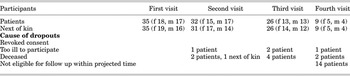
Patients and their next of kin were included in the study consecutively from January 2006 to March 2007, until the study ended in December 2007. They were examined every 4th to 6th month with a focus on the 6th month, by the ALS/MND team at the Department of Neurology, Sahlgrenska University Hospital. The participants' perceived well-being was estimated one to four times (Table 1). The total number of estimates during the course of disease was 102 for all 35 patients, and 101 for their next of kin. The physician also estimated the patients' physical function, using the physical functional scales (ALSFRS-R and Norris scale) over time, whereas the nurse estimated the patients' cognitive function, using the MMSE at entry to the study.
Number of participants at each study visit and exit from study

f, female; m, male
Analysis
All ratings performed at the first study visit were analyzed by all participants, both patient and next of kin, as well as staff. To analyze changes in well-being over time and to avoid an erroneous interpretation of multiple testing of changes over time, a regression coefficient was calculated for each patient and next of kin. The coefficient describes the slope of the graph where x-values were the time of the successive visits (at 0, 6, 12, and 18 months), and y- values were the variables investigated. Every patient with more than one visit had a calculated regression coefficient and every regression coefficient had equal weight, irrespective of whether the patient or the next of kin attended the study two, three, or four times. The number of participants used for calculation of the regression coefficients was taken from those still remaining in the study at visit two and onwards.
By using the slopes/coefficients, Fisher's test for paired comparison was used to test whether the coefficient was different from zero, which it would be, if there were a change over time. The same kind of analysis was performed when the physician and nurses estimated the perceived well-being of the patients and their next of kin. Fisher permutation test was used to analyze differences in genders, and Pitman permutation test was used to analyze age dependence. Spearman's ρ correlation coefficient was used to examine correlations. Data were presented by mean and standard deviation. All tests were two-tailed.
Ethics Approval
The Regional Ethics Review Board in Gothenburg approved the study (approval no. 297–05). Patients and their next of kin received oral and written information about the study, and written informed consent was required for inclusion.
RESULTS
Physical Function in Patients and Their Estimates of Well-Being Over Time
As in an earlier study of the same participants (Olsson et al., Reference Olsson, Markhede and Strang2010b), the physical functional scales, ALSFRS-R and Norris scale, showed a steady decline in function during the course of the disease that was studied (p < 0.001). The decline in the group of males was slightly more rapid than in the group of females. Patients' own estimates of their physical well-being correlated with the physical functional scale ALSFRS-R at the first study visit (p < 0.002, correlation coefficient 0.512**) and over time (p < 0.004, correlation coefficient 0.490**). Also, between their physical well-being and the Norris scale, there was a correlation at the first study visit (p < 0.004, correlation coefficient 0.469**) and over time (p < 0.03, correlation coefficient 0.404*). There were no differences in relation to age or sex in the study.
Nurses' and Physician's Estimates of Well-Being Over Time in Patients and Their Next of Kin
Patients did not estimate a decreased well-being over time, whereas the nurse estimated that patients' physical (p < 0.001), and psychological (p < 0.03) well-being decreased. The physician estimated a decrease in patients' physical well-being (p < 0.001) and psychological well-being (p < 0.006) over time.
With respect to gender, the nurse estimated that male patients' physical (p < 0.001) and psychological (p < 0.003) well-being decreased over time, which also partly was found when the male patients estimated themselves (physical well-being p < 0.001, general well-being p < 0.03). The physician estimated a decreased physical (p < 0.001) and psychological (p < 0.05) well-being in male patients. The physician also estimated a decreased physical (p < 0.009) well-being in female patients over time, which was not found when the female patients evaluated themselves over time.
Neither the nurse nor next of kin estimated that the next of kin had decreased well-being over time, except that male next of kin estimated a decreased psychological well-being and the nurse did not.
Correlations
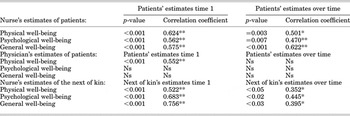
Both at the first study visit and over time there were correlations between patients' self-estimates of their well-being and nurse's estimates of the patients' well-being. There was also a correlation in physical well-being at the first study visit between the patients' self-estimates and the physician's estimate of the patients (Table 2).
Correlations between patients' self-estimate on VAS and estimates by the nurse and the physician, as well as correlations between estimates by the next of kin and the nurse

* Significance 0.05.
** Significance 0.01.
Ns, no significance.
VAS, visual analogue scale.
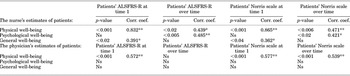
There were also correlations between the patients' physical functional scale (ALSFRS-R and Norris scale) results and the nurse's estimates of physical well-being at visit one and over time, and of general well-being at visit one and psychological well-being over time. At visit one, the physician's estimate of the physical well-being of patients and the patients' physical function in the ALSFRS-R, as well as the Norris scale, were correlated. Over time, there was also a correlation between the physician's estimate of patients' physical well-being and the Norris scale (Table 3).
Correlations between patients' physical functional scales and the nurse's and physician's estimates of the patients' well-being on VAS

* Significance 0.05.
** Significance 0.01.
Ns, no significance.
VAS, visual analogue scale; ALSFRS-R, Amyotrophic Lateral Sclerosis Functional Rating Scale-Revised.
There were correlations between the next of kin's estimates of their well-being and the nurse's expectations of their well-being, at visit one and over time in physical, psychological, and general well-being (Table 2).
DISCUSSION
In our study, there was a good correlation between patients' self-estimates and the physician's and nurse's estimate of the physical well-being of the patient in most comparisons of rating in the physical estimates, both at first investigation, and during the course of the disease. It was apparent that the physician doing the physical functional ratings (ALSFRS-R and Norris scale), and responsible for the diagnosis of disease, all bodily investigations, and the medical treatment of all complications of the disease, was able to make a fair estimate of the physical well-being of the patient when compared with the patient's self-estimate. The same was true for the estimates of the nurse of the physical well-being of the patient.
Both correlations between patients' self-estimate of their physical well-being and the physician's and the nurse's estimates of patients' physical well-being, as well as correlations between patients' self-estimates of their physical well-being and the estimates of the physical rating scales, estimated by the physician, showed that selection of simple VAS ratings were valid for this purpose.
However, with respect to the assessment of general and psychological well-being, the estimates made by the nurse correlated better with the patients' self-estimate than the estimates made by the physician did. Of course, this might be because of differences in personality and clinical strategies, but the standards for rating by the VAS were checked by the staff members before the study was started. Therefore, it seems more probable that the differences in clinical roles between nurse and physician might be pertinent: the nurse had a greater focus on the emotional and social aspects in the meetings with the patients, whereas the physician had a role more focused on the increasing and threatening medical problems, such as mobility, dysphagia, dysarthria, and respiration in patients. In agreement with other studies examining staff's estimates of QoL in neurological patients (Gauggel et al., Reference Gauggel, Böcker and Heinemann2004; Siosteen et al., Reference Siosteen, Kreuter and Lampic2005), we saw trends of equal estimates in some areas, whereas in areas focusing on psychological aspects, staff often underestimated the patients' QoL. Contrary to our results, one study of treatment effects in neurological patients before and after rehabilitation showed that physicians overestimated patients' function and effect of treatment in comparison with patients' own estimates (Farin, Reference Farin2009).
Even though studies examining staff assessments of patients with ALS or other neurological diseases are deficient, some other diseases have been studied with a similar approach. In cancer, it has been shown that staff often overestimate patients' anxiety, depression, and emotional distress and underestimate the QoL (Jennings & Muhlenkamp, Reference Jennings and Muhlenkamp1981; Sneeuw et al., Reference Sneeuw, Aaronson and Sprangers1999; Lampic & Sjoden, Reference Lampic and Sjoden2000). However, it has also been shown that physicians underestimate pain in cancer patients, whereas nurses estimate the pain to be the same as the patients themselves do (Sneeuw et al., Reference Sneeuw, Aaronson and Sprangers1999). However, nurses might also overestimate patients' physical needs (Farrell, Reference Farrell1991). In general, one review on chronic diseases pointed to the fact that there often is a moderate-to-good agreement with respect to QoL between the self-estimates by patients and the estimates of significant others (Sneeuw et al., Reference Sneeuw, Sprangers and Aaronson2002).
There is a lack of studies in ALS examining nurses' estimates of next of kin's well-being. We found that there was a fairly good correlation between the estimates of well-being of patients, next of kin, and staff. One part of the perceived care in the studied group was to focus on the health of the next of kin. Probably, that focus might affect these results in a positive way. The only difference between the nurse's estimate of the next of kin and the next of kin's own estimates was that male next of kin estimated that their psychological well-being decreased over time, whereas the nurse did not recognize that. A possible explanation may be that female next of kin receive support to a higher degree than male next of kin do, which makes it easier for a nurse to get insight into the well-being of female next of kin.
It might be seen as a weakness that this study only examined the estimates from one physician, one patient nurse, and one nurse working with the next of kin, who estimated their beliefs about the level of well-being of the patients and their next of kin. On the other hand, it should be relevant to study the intimate cooperating group of physicians and nurses who work closely together with the studied participants to get a picture of how they view the life situation of the patients and their families. That would also make it possible to evaluate and recast teamwork, helping those families.
With respect to possible errors at multiple testing, as we focused on patterns, large conclusions should not be made in relation to single p-values.
It is necessary to study how physicians and nurses estimate the effects of the disease on ALS patients and their next of kin to get a view of their conceptions of how patients and next of kin might be feeling. Without that knowledge, it is difficult to help the families and give them the support, education, and counseling they need. The staff's own preconceptions need to be declared. From that standpoint, it might be possible to discuss problems and help the families to find strategies to handle their life situations.
CONCLUSION
Our study found that the physician and the patient nurse, as well as the nurse working with the group of next of kin, estimated the well-being of the patients and their next of kin very much as the patients and next of kin did themselves. The study is relevant as it revealed some differences between the different professional roles in the working model of this part of the team. That calls attention to the importance of teamwork, where the participants share their experiences of the meetings with the patients and the next of kin. It makes different experiences visible, and it clarifies how important it is to focus on the individual's own experience of the life situation.
ACKNOWLEDGMENTS
This study was supported by the Edit Jacobson Foundation, the Foundation of Neurological Research, and the Ulla-Carin Lindquist Foundation. We thank statistician Helena Johansson for providing help and guidance with the statistical methods used in the data processing, and Inga Markhede, R.N., for providing help with data collection.