Introduction
There is widespread agreement among educators and policy-makers that low levels of literacy significantly impact people's life chances. Low English literacy has been linked to poorer education outcomes, reduced employment opportunities (Commonwealth of Australia, 2014), poorer physical and mental health (OECD, 2017) and higher levels of incarceration (Wise et al., Reference Wise, Harris, Nickson, Boughton and Beetson2018). However, the extent of the issue of low adult English literacy among Australia's First Nations peoples remains unclear. Conservative estimates put the figure at 40% but this is likely to be considerably higher in rural and remote communities (Boughton, Reference Boughton2009; Ratcliffe and Boughton, Reference Ratcliffe and Boughton2019; Boughton and Williamson, Reference Boughton, Williamson, Harper and Rennie2019).
This paper reports on the impact of an Aboriginal-led adult literacy campaign on the NSW community of Brewarrina between 2015 and 2017. The focus is on changes in the capacity of campaign graduates to take greater control of the conditions affecting their lives. These changes are analysed through the prism of empowerment. Drawing on feminist interpretations of empowerment which explicitly acknowledge the role of inequitable power relations, we consider three aspects to empowerment: power within, power with and power to.
While it is clear that graduates of the literacy campaign are experiencing increasing power within such as enhanced confidence, self-control and independence, we find less evidence of changes at the collective level (power with). We conclude that the adult literacy campaign is a significant pathway to agency and action but in order for greater empowerment at the collective level to be seen, the root causes of disempowerment (and low literacy) must be addressed.
Brewarrina: a legacy of disempowerment
The north-western NSW town of Brewarrina has a population of approximately 1600 people, of whom more than 60% identified as Aboriginal in the 2016 Census (ABS, 2016). These include the Ngemba people on whose traditional lands the town sits, as well as people from surrounding groups, including Murruwarri, Yuwaalaraay, Barkindji and Wangkumara. The current diversity of the local population is largely a product of colonial history. From 1886 to 1966 the Brewarrina Mission housed Aboriginal people forcibly resettled from other stations and reserves. In keeping with the policies of the day, relocated peoples were not permitted to practice their culture or use their language and education consisted of a programme of assimilation of young Aboriginal people into the dominant white culture. Most of the Aboriginal people of Brewarrina then were wards of the state and the state exercised total control over their movements and lives (Barker, Reference Barker1988; Goodall, Reference Goodall2008).
Despite this, in the 1930s Aboriginal people in the region began to organise and campaign for civil and land rights. Brewarrina slowly emerged as a major centre of political activism related to land rights and the establishment of community-controlled services (Goodall, Reference Goodall2008; Norman, Reference Norman2015). Local leaders mobilised and organised their community, setting up the Western Aboriginal legal Service and contributing towards the establishment of the Regional Land Council. This advocacy culminated in the Land Rights NSW Act (1983). However, this advancement towards self-determination was short lived. By 1990 the act was amended and authority and power was withdrawn from local organisations (Norman, Reference Norman2015).
An ongoing legacy of the winding back of Aboriginal activism and organisations is the loss of an important pathway towards literacy. Left to the formal school system, many adults in Brewarrina (as in wider Aboriginal Australia) have very low levels of basic English language literacy. In a recent household survey conducted as part of the mobilisation of the Brewarrina literacy campaign (N = 231), just under 62% adults reported low or no literacy. Of these, 38% had completed at least year 10 level schooling, giving weight to claims by some of the failure of the education system to meet the basic literacy and numeracy needs of Aboriginal people (Gunstone, Reference Gunstone2013; Brown, Reference Brown2018).
This educational disadvantage has been exacerbated by environmental and economic factors. The last 40 years have seen a significant decline in economic activity, caused by drought and the collapse of some rural industries. In the Brewarrina local government area 32% of Aboriginal people are unemployed compared to 3% of non-Aboriginal people. The extent of social inequality is also revealed by heath statistics. Aboriginal peoples in the Far Western and Western Local Health Districts of NSW ‘score’ significantly poorer outcomes than the state as a whole (NSW Government, 2018a). Similarly, rates of serious criminal offences are the highest in the state (Department of Justice NSW, 2018). It is hardly surprising then that the 2015 Dropping Off the Edge Report (Vinson et al., Reference Vinson, Rawsthorn, Beavis and Ericson2015) identified Brewarrina as one of NSW's 10 most disadvantaged communities.
Such chronic disenfranchisement of a community inevitably wears away social cohesion. Evidence also suggests that the cumulative effect of historical and intergenerational trauma adversely impacts people's capacity to engage effectively and positively with their community (McKendrick et al., Reference McKendrick, Brooks, Hudson, Thorpe and Bennett2013). This is certainly the case in Brewarrina where in the years immediately preceding the arrival of the literacy campaign, there was significant intracommunity conflict as well as conflict with government. This community level conflict and trauma touches everyone in Brewarrina but especially so those with low English literacy. It is these people who shoulder the greatest burdens of disempowerment: school failure, unemployment, chronic disease, addiction, incarceration and mortality. In the words of a community leader, the ‘non-literate people have almost no chance of taking control of their health, or of becoming leaders in their communities’ (S. Bell, personal communication, 2009). These people were the target of the campaign in Brewarrina.
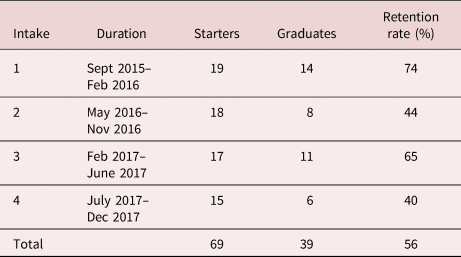
The Literacy for Life Foundation formally began work in Brewarrina in 2015. A total of 39 adults graduated from the Yes, I Can! literacy campaign between September 2015 and December 2017 (see Boughton et al., Reference Boughton, Chee, Beetson, Durnan and Leblanch2013 for a more detailed account of the campaign model and its impacts on other communities). Table 1 presents the Brewarrina campaign statistics.
Key Brewarrina campaign statistics

Students began typically at pre-level one or level one in the three domains of learning, reading and writing on the Australian Core Skills Framework. This means they could convey a simple message or idea in writing and extract personally relevant meaning from texts on highly familiar topics only (McLean et al., Reference McLean, Perkins, Tout, Brewer and Wyse2012). Testing of a small number of students was conducted around week four of the literacy classes (pre-testing) and in intakes three and four, post testing was conducted during the post-literacy phase. Five students made partial progress towards the next level on at least one writing indicator and three students achieved a full movement to a higher level in either the learning, reading or writing domains. These modest gains in literacy underscore what a difficult and long-term undertaking learning to read and write is for adults, especially those with complex and ongoing health and social issues.
Empowerment and literacy
There are few terms whose original analytical and explanatory utility has been as worn down, overlaid, and lost in interdisciplinary translation as ‘empowerment’. What began life as a word with a specific context and meaning in relation to adult popular education and literacy (Freire, Reference Freire1971, has been more recently co-opted by fields disparate as health and management: ‘Once used to describe grassroots struggles to confront and transform unjust and unequal power relations, it has become a term used by an expansive discourse coalition of corporations, global non-governmental organizations, banks, philanthrocapitalists and development donors’ (Cornwall, Reference Cornwall2016, p. 342).
Yet the criticisms made of empowerment in its more diffuse contemporary iterations—that it has been conceptually re-tooled so regularly as to blunt its theoretical efficacy (Lankshear, Reference Lankshear and Escobar1994; Youngman, Reference Youngman1996; Galloway, Reference Galloway2015; Daniele, Reference Daniele2017), or that the term has been infected by the neoliberal tendency to commodify learning (Black, Reference Black2018)—should not blind us to its enduring value. The more neatly our subtle depreciations of empowerment fit within the rubrics of academic discourse, the more they obscure the role that power, inequality and oppression play in the lives of those marginalised, disenfranchised people our work is meant to help. ‘To be radical’, wrote Marx, ‘is to grasp things by the root of the matter’. Therefore, we have an obligation to rescue and reset empowerment as a vivid carrier of meaning and a term retaining potential for positive change. But we can only do so by acknowledging the serious point embedded in Archibald and Wilson's quip, ‘you can't spell empowerment without power’ (2011, p. 25).
Drawing on the feminist writing on empowerment, notably the work of Rowlands (Reference Rowlands1997) and Cornwall (Reference Cornwall2016), it is possible to identify three forms of power—each with implications for a revivified analysis of empowerment:
-
Power from within: Empowerment is personal, requiring the development of a sense of the self as able and entitled to participate in and influence decision making processes. This shift in power relations requires undoing the effects of internalised oppression.
-
Power with: Empowerment is relational; that is, empowerment is strengthened by developing the ability to negotiate and influence the nature of a relationship and decisions made within it (Rowlands, Reference Rowlands1997).
-
Power to: Empowerment is a generative process that brings about a shift in power relations, allowing people to take control over their lives. Acts of control are not limited to participation in formal decision-making structures but can be informal, and highly local.
Viewed through this semantic prism, empowerment remains relevant and useful as an analytical and explanatory tool in the context of adult literacy in Aboriginal communities. Indeed, it was for communities such as these that Freire established his pedagogy of the oppressed. His foundational work reminds us how much more lucidly a term like empowerment captures the way in which individuals and groups may be trapped and bounded by power as it is expressed through societal structures, especially when compared with more neutral ideas such as ‘self-efficacy’, ‘capacity-building’ or even ‘self-determination’. Most significantly, empowerment has common-sense meaning that the participants in this study readily understand and invoke. Any pragmatic effort to weld together sophisticated theoretical notions and ground level survival strategies requires a term which has such broad currency.
Indicative of this relevance to First Nations contexts including decolonising research methodologies (Smith, Reference Smith1999; Sherwood, Reference Sherwood2010), empowerment has been used to both measure and explain changes in the situation of Aboriginal communities across the gamut of research fields, including social work, health, law, workforce participation and education (see Dudgeon et al., Reference Dudgeon, Scrine, Cox and Walker2017; Whiteside et al., Reference Whiteside, Tsey, McCalman, Cadet-James and Wilson2006; Miller, Reference Miller2017; Wilson et al., Reference Wilson, Abbott, Quinn, Guenther, McRae-Williams and Cairney2018 for example). Not always well defined and rarely adequately coming to grips with the connection between empowerment and social theories of power, the conceptual framing of some of these studies, particularly the work of Whiteside et al. (Reference Whiteside, Tsey and Earles2011) nevertheless emerges from the views and life experiences of communities themselves. Importantly, the models of empowerment put forward via these more collaborative research endeavours attempt to accommodate multiple levels and pathways of interaction between individuals, families and communities, organisations and society. In this way, empowerment has the ability to encompass individual and structural factors central to understanding the broader life environment of First Nations people today.
Empowerment is then a complex, multidimensional construct which is simultaneously concerned with practical outcomes and the revelation of abstract structural forces in operation—a term which accommodates both individual capacities and collective action. In the words of Ashcroft (Reference Ashcroft1987, p. 10) ‘empowerment is personal in origin and social in application’. McWhirter (Reference McWhirter1991) defines the process of the powerless becoming empowered in the following way:
(a) Becoming aware of the power dynamics at work in their life (this step is akin to Freire's concientisation and feminists' critical reflection)
(b) Developing the skills and capacities for gaining some reasonable control over their lives
(c) Exercising this control without infringing upon the rights of others and
(d) Supporting the empowerment of others in the community
Many writers underscore that empowerment is often a slow and unfolding process (Johnson, Reference Johnson, Wuyts, Mackintosh and Hewitt1992) and while the stages described above are a helpful for analysing and evaluating empowerment empirically, empowerment is anything but a linear, sequential process (Cornwall Reference Cornwall2016). McWhirter (Reference McWhirter1991) goes on to distinguish between a ‘situation of empowerment’ in which all of the above steps have been achieved and ‘an empowering situation’ in which only one or more of the steps have been accomplished or are being developed. This distinction is significant as it highlights the iterative nature of empowerment. It also reminds that empowerment, like literacy, is a difficult undertaking (Stromquist, Reference Stromquist2014). Difficult because the markers for failure and success apply a false teleology to a non-linear process, and difficult because the rhetorical force and liberatory concepts which unfurl from the larger concept do not neatly map onto real-world achievements, which may be uneven, incremental, and ostensibly modest in manifestation.
Empowerment, once viewed as an unfolding process no longer needs to be viewed as a successful or failed set of actions in place and time. Rather it is a possibility—for agency, for action on the part who previously did not possess a sense of these potential means of being in the world—which may be maintained and gradually built upon. This more complicated view necessarily calms grand claims about the empowering nature of literacy. As Stromquist (Reference Stromquist2014, p. 548) notes, ‘literacy per se does not empower students’ but is better understood as a precursor to empowerment. In this way, we can say that literacy reveals a pathway to change—a change in the very nature of the self, relations with others and individual and collective relationships to the world as it is. Literacy also offers a pathway to agency and action. It opens the possibility of autonomous accomplishment and collective achievement—of organisation, critique and resistance. Empowerment is the process by which the grounds of the self are turned from a prison into a workshop—but it does so by gifting each individual the means only: the ends are an aggregate of daily acts and decisions. In the words of Giroux (Reference Giroux1988, p. 65) ‘to be literate is not to be free; it is to be present and active in the struggle for reclaiming one's voice, history and future’.
Deep hanging out and yarning as method
This case study draws on qualitative data collected chiefly through in-depth interviews conducted by one of the two non-Aboriginal authors with 12 graduates in August 2018. For the 2 years previous to the research reported here, Frances worked as a project officer responsible for supporting local staff in implementing the literacy campaign. This role placed her in the classroom and over time, in students' lives and confidence. The other author, Bob, had worked in the community for more than 3 years prior to the research, supporting the establishment of the literacy campaign via the Community Working Party. Both authors take an Indigenist perspective, privileging Aboriginal voices and knowledge and viewing the participants themselves as experts in their circumstances both past and present (Smith, Reference Smith1999; Sherwood, Reference Sherwood2010).
The relationships between the researchers and the community afforded many opportunities for immersion in the life of research participants. Frances visited people in their homes, taking part in daily activities such as shopping, medical appointments and fishing trips. This cultural immersion or ‘deep hanging out’ (Power, Reference Power1999; Wogan, Reference Wogan2004) in which she was at once a participant in people's daily lives and a researcher allowed her to observe gradual changes as the people moved through the campaign and in the months following the campaign. In addition, the researchers' relationships in the community provided further qualitative data through interviews with key informants (campaign staff, local elders and family of graduates) about observed changes in the lives of the study participants. Together, these sources of data provide a richer and more reliable picture of the impacts of the campaign on graduates' lives, somewhat mitigating the potential for gratuitous concurrence. This broader approach is not only helpful when working with people with limited education and literacy who can sometimes struggle to articulate their experiences and opinions, but also provides a means of corroborating graduates' self-reported data. Despite the trusting and respectful nature of relationships between the researchers and the community and participants, the researchers acknowledge the difficulty of eliminating the fundamental asymmetry of power relations at work. This is the longer term goal that the adult literacy campaign as an expression of popular education works towards.
The approach adopted during the in-depth interviews was one of ‘yarning’ (Barker, Reference Barker2008) in which the topics of interest were woven through lengthy, free-flowing conversations. The role of the interviewer was to listen deeply and respectfully and to reflect back participants' views and voices (Atkinson, Reference Atkinson2000). On occasions, the opinions or stories of one participant were shared with another as a way of provoking thoughts and giving people the opportunity to build on each other's narratives. In keeping with the literacy campaign model and the research methodology, interview data were analysed iteratively using bottom-up, generative thematic analysis. Emerging codes and themes were used in subsequent interviews to ‘test’ for corroboration from other participants.
An analysis of empowerment within Yes, I Can!
Power within
As with many other studies into empowerment and literacy (see e.g. Prins Reference Prins2008; Stromquist, Reference Stromquist2009), participants reported a range of psychosocial impacts. A common view expressed by graduates was that their lives were better as the result of the literacy campaign. One graduate told us, ‘I'm awake early every morning, you know, kick the day off…and I get out and I feel you know, it's goin’ to be a good day’ (male, 53 years). Both hope and optimism are central to empowerment (Freire, Reference Freire1998) and underpin a belief in the future. This belief is shared among campaign graduates. A female staff member reported that in the student evaluation letters written at the end of the literacy class, the students ‘all said in different ways that what the campaign has given them is a belief in a future, a trust in the future’. If the main effect of disempowerment is that it hinders people from even considering that there can be an alternative to the life they're in, many graduates' hope for a different future for themselves suggests empowerment at work.
As with the general sense that life was better as a result of the campaign, every graduate mentioned an increase in their self-confidence. Some graduates attributed their new-found assurance to experiencing success as a learner, commenting that ‘I'm learning the same stuff I learnt at school, but it's good, it brings back that confidence again’ (male, aged 57). For another younger female graduate (26 years), the confidence gained from the literacy campaign was transformative, as this remark from her mother attests:
I can see that change in my daughter. If you were to see her years ago, she never talked but when we went to Dubbo the other day shopping, I didn't have to say nothing. She done all the talking. She asked them about prices, she just wanted to know things.
Another striking facet of the changes graduates experienced within themselves was greater personal control. One older male proudly told us ‘I can control myself now. Before I never, you know? If people owe me money, I don't worry about goin’ after them, smash em’ up or anything. I can control that now’ (male, 53 years). This change was also experienced by a female graduate who is known for her emotional volatility. On a recent visit, she was frustrated by a delay in having urgent plumbing repairs done but described calmly raising her grievance with the housing provider whereas ‘…before the class I woulda gone there and busted myself. At the class, I learned how to speak to people’ (female, 51 years). The change in this woman's ability to manage conflict was evident even during the class and was commented on by the local coordinator in her weekly report:
…one of the students shared with me how she ignored and walked away from an argument with her family member which was very unusual for her to do because this person was one that could never walk away, it was always about getting revenge and fighting and hitting back because that is how we always have done it (female, 50 years).
Another most obvious shift in self-control was in relation to alcohol consumption. Two male graduates who had been in and out of local drug and alcohol rehabilitation facilities over the years told us that they now only drank on payday. Another woman who had been an alcoholic when she began the literacy campaign not only stopped drinking entirely but had also developed enough self-control to be able to ‘sit around drunks without asking for a drink’ (female, 51 years). She confessed that from time to time, she still felt ‘a little urge to drink but when that urge come, I get up and go’. Even among the few graduates who continued to drink as before, there was a perception that they could control their drinking.
But the exigencies of daily life in Brewarrina present challenges to the practice of self-control. All but two of the 12 graduates who were interviewed live in public housing and so are to a large extent at the mercy of the public housing system. For one male graduate, the all too common situation of delays in having repairs done tested his self-control to the limit, as he described ‘I just been ringing up, abusing [housing provider] and abusing them up here [in person]’ (male, 56 years). Other difficult circumstances also continue to undermine graduates' self-control. One female graduate, a self-confessed ‘big-mouth’ described her continued struggles to ‘walk away’ from the police in the face of perceived harassment. This is despite her view that the Legal Aid sessions she attended in the post literacy phase of the campaign increased her knowledge about how to more calmly and appropriately assert hers and others' rights.
While it is clear that structural forces continue to be an impediment to individual empowerment, it was obvious from our trips to Brewarrina that several campaign graduates were enjoying greater independence. In one man this change was most striking. This graduate has an intellectual disability and has been reliant on family and various services all his life. When chatting to him in the park, he proudly told us that he was able to do his own shopping now. Other people in town recognised how significant this development was, reporting how they'd ‘seen him walkin’ into the shop and asking the shopkeeper about things. Pullin people up, strangers that he hardly knows and talkin’ to them. He wasn't like that before’ (female, 47 years).
Clearly underpinning the growing autonomy of this graduate is increasing competence, in this case to be able to read signage and food labels in the supermarket. All the graduates interviewed reported greater literacy competence. For example, two graduates are now able to read their own mail for the first time in their lives. For another graduate, learning to read allowed her to finally get her learners drivers licence, as she explained ‘I didn't have my licence before I started the program coz I didn't know how to read the words properly. That's why I wouldn't do the test’ (female, 51 years). Others reported being able to apply their new literacy in other domains such as using the ATM and online government services (MyGov) and writing job applications.
The final aspect of power within which we wish to discuss is critical awareness. As outlined earlier, ‘concientisation’ is considered a catalyst for individual and collective action for change (Freire, Reference Freire1971; McWhirter, Reference McWhirter1991; Cornwall, Reference Cornwall2016). However, of the graduates we observed and interviewed, only a handful seemed able to identify the larger issues facing them and their community with one telling us ‘the cotton taken our water, the ice's taken our people’ (female, aged 51 years). Instead, many graduates felt such large-scale problems were beyond their ability to influence. When we raised two recent controversial development proposals for town, most graduates had heard of them but knew little detail and had not attended any community consultation meetings, telling us ‘people don't come and tell me when they on or put a notice up’. This inertia observed in some of the graduates suggests that they still perceive themselves as an object, rather than a subject of social processes.
Closely linked to this is the lack of connections being made by graduates between the struggles of their own lives and the wider socio-political context. When prompted to think about issues such as the national push for constitutional recognition for First Nations peoples or climate change, some graduates responded with shrugs or ‘I got nothin’ in my mind about that’ (female, 27 years). In many respects this somewhat limited critical awareness is hardly surprising given the more immediate challenges to daily life many face. As one graduate put it, ‘you gotta think of your own ways first’ (male, 53 years). However, this finding also points to the impact of internalised oppression. That is, when people have been systematically denied power and influence not only in society but also in their own lives, they stop even asking questions and seeking answers as they believe they have nothing of value to add to wider debates. This conditioned response then acts as a barrier to the exercising of personal and collective power.
Power with
While there is evidence of only limited critical consciousness about larger societal issues among the graduates we interviewed, it is clear that some are actively pushing for behavioural change among their immediate circle. One graduate described how her daughter had been following her lead and had cut down on her drinking and made arrangements to pay off long standing fines. This graduate told us ‘if I wouldn't a got myself back together, she wouldn't done all this’ (female, 51 years). Similarly, another woman relayed a recent story in which she counselled her son to walk away from an abusive relationship and seek help from the police. This was particularly noteworthy as the son had been in trouble with the law many times and both mother and son placed little trust in the justice system.
Another indicator of strengthening relationships among those from the campaign was a growing capacity among the graduates to work together. Often when driving down the main street of Brewarrina, small groups of graduates would be seen gathered together and we witnessed countless instances of mutual support with people giving each other lifts. One graduate had even established a cooperative financial system whereby on his payday, he would share his pension with another graduate and then on her payday, she would do the same. There were also other examples of support used as an incentive for behavioural changes with one woman offering to drive another graduate out of town to see his children if he ‘got off the grog’ and encouraging another fellow to go to her house rather than turn to alcohol next time he felt low. This care for others might appear inconsequential if the ongoing and pervasive context of conflict, mistrust and social isolation isn't taken into account. One graduate reminded us of this stark change, at least in her mind, explaining ‘before the program come along, we all used to sit in a circle and drink and fight with one another, but the class brung us all together’. This emergence of a capacity to work together was a direct result of the campaign in the eyes of not only the graduates but also community leaders, one of whom remarked:
It's [the campaign] bringing back that sense of community I suppose, working together and sharing and caring and all those sorts of things. The combination of younger people and elders working together with a common goal and encouraging each other (female, 59 years).
It is clear then that in the minds of some in Brewarrina, the literacy campaign has contributed to community cohesion and healing. Indeed, solidarity is a key characteristic of literacy campaigns worldwide and a finding from previous studies in the literacy campaign in Australia (Boughton and Williamson, Reference Boughton, Williamson, Harper and Renniein press). However, we found little evidence of collective empowerment in terms of increased participation in existing community structures or organised action among the graduates we spoke with. This finding is echoed in many other studies in which literacy has been shown to contribute to increased individual empowerment but had far less impact on collective action and change (Rowlands, Reference Rowlands1997; Prins, 2009; Stromquist, Reference Stromquist2014). Nevertheless, the instances of concern for and trust in others witnessed among graduates no doubt lays the foundation for future collective action.
Power to
While collective action for change was not in evidence, many of the graduates had taken concrete steps to improve their lives and that of their families. By the time of the interviews some 2 years after graduating from the literacy campaign, two female graduates had managed to secure long-term public housing. This is no small achievement as the demand for accommodation is great and to qualify, people need to go through a lengthy and onerous application process. Three out of the 12 graduates had also found part-time employment in child care, aged care and cleaning respectively. A fourth graduate had recently applied for another cleaning job in town and another younger graduate had completed a certificate two in business administration at the local TAFE and enrolled in a certificate three. Finally, four out of the twelve graduates had earned their driver's license since completing the campaign. This achievement is particularly significant given the multiple barriers to obtaining and keeping a licence.
Other graduates also experienced greater control over their health. One older graduate who lives alone and has spent many years avoiding the medical services now regularly attends health appointments. He still regards the health services with some suspicion and does not necessarily understand all that they do and tell him, but the difference now is that he goes. Similarly, a mother described a noticeable change in her daughter, a younger graduate who now when going to the hospital will ‘have her say and if she sees someone or someone treats her the wrong way, she speaks up. Before, I was the one that was taking her to the hospital. But now she goes there, she goes for her medication and she takes B [her son] there’.
This observation reveals a growing capacity among some of the graduates to question the status quo. In fact, the power to speak up and raise a grievance was one of the most noticeable signs of empowerment. Two examples illustrate this outcome clearly. In the first, a young female graduate who had been painfully shy during the literacy classes found herself on live ABC radio advocating on behalf of the rights of local job seekers. When asked how she felt about this role she said, simply, ‘I was a bit shame at first and then I just got over it’ (female, 26 years). In the second example, an older graduate has decided to sue the Aboriginal Housing Organisation for damages and compensation for an injury sustained at his home. This man was very clear that his decision was the result of his time in the literacy campaign, saying ‘this school's done something for me. That's what I was thinkin all along. I woulda let it [the injury and possibility of legal action] go. Coz it sorta educated me, that class’ (male, aged 53 years).
Despite individual graduates' willingness to speak up, there was little evidence of them using existing community forums to have their say. This is most likely explained by the gulf some graduates reported between themselves and the existing power structures in the community. One graduate complained that ‘we can speak up but no one's listening’. She then went on to describe the Community Working Party as ‘the main people who reckon they're doing things for their community but we hardly see em’ (female, 51 years). This sentiment was echoed by another graduate who said ‘well I been to one meeting because I'm a member but I just don't go and even if I go there, I don't say nothing, just click on what everyone else saying’ (male, 47 years). This lack of participation is contrasted by his willingness to ‘chuck my little 2 cents worth in if I'm around a group of people like family and we talks about what's been happening in Bre’.
Conclusions
In the above analysis, we have attempted to show that the adult literacy campaign in Brewarrina has acted as an ‘empowering situation’ (McWhirter, Reference McWhirter1991). Most of the graduates we spoke to and observed over 2 years have developed significant power within themselves and have gone some way to developing the skills and capacities for gaining more control over their lives. Better literacy has led to greater independence and confidence to shop, use the ATM, read their own mail and earn their driver's license. They have also exercised this control by making behavioural changes such as dealing better with conflict, gaining accommodation, employment and drivers licenses and speaking up for themselves and their family. While in some contexts such achievements are modest, in the context of life in the small Aboriginal community of Brewarrina, these gains are extraordinary.
By catalysing a process where people perceive themselves as able to and entitled to make decisions for themselves, we can conclude that the literacy campaign builds a base from which people can take control. And, as personal control has been linked to greater health and well-being (Griffin et al., Reference Griffin, Fuhrer, Stansfeld and Marmot2002; Chandola et al., Reference Chandola, Kuper, Singh-Manoux, Bartley and Marmot2004), the literacy campaign also contributes to enhanced quality of life for many participants.
And yet, the task of undoing decades of internalised oppression in order to see more clearly the power dynamics at work in their life is ongoing for most graduates. It is clear that there is still some way to go before they begin to understand the political dimensions of their problems and blame ‘the system’, rather than each other or local groups, for their relative deprivation. Similarly, there was little evidence of collective empowerment with graduates choosing to remain outside existing community governance structures at the same time as not yet organising alternatives.
While some might argue that the absence of collective-level empowerment may ‘cast doubt upon the degree to which Freire-inspired literacy programmes lead to demonstrable political change’ (St Clair, Reference St Clair2010, p. 162), it is vital to acknowledge the limits to empowerment in an institutionally-racist environment. Lankshear (Reference Lankshear and Escobar1994, p. 174) agrees and concludes that ‘much of the success of any truly emancipatory initiative involving literacy depends crucially on factors external to the specific programme of reading and writing’. In a previous paper, we argued that ‘a literacy campaign only makes sense as part of a wider social struggle, to overcome the conditions which created the situation where some have not been able to benefit from the education system’ (Boughton, Reference Boughton2013, p. 5). This wider social struggle is not one the campaign participants in Brewarrina can undertake alone.
The literacy campaign in Brewarrina has revealed a pathway for many towards greater control over their lives. This is the starting point of empowerment as Daes (Reference Daes, Kly and Kly2000, p. 58) claims:
the true test of self-determination is not whether indigenous peoples have their own institutions, legislative authorities, laws, police and judges. The true test of self-determination is whether indigenous peoples themselves actually feel that they have choices about their way of life.
And while this study details the outcomes for only a small number of participants and much more needs to happen to create an ongoing basis not only for the consolidation of literacy but also empowerment at the collective level, it is our hope that this case study has provided cause for optimism for the future of the community of Brewarrina.
Financial support
This research has been funded by an Australian Research Council grant.
Frances Williamson is an early career researcher at the University of New England. Her work synthesises sociological and linguistic perspectives in the study of adult language and literacy development. She is currently a member of the ARC Project team investigating the impacts of the Literacy for Life Foundation's Aboriginal adult literacy campaign on health and well-being in remote communities of north-western NSW.
Bob Boughton is an Associate Professor in the School of Education at the University of New England in Armidale, NSW. His research focuses on the role of popular education in development in marginalised and impoverished communities. Since 2012, he has been researching and evaluating the Literacy for Life Foundation adult literacy campaign in Aboriginal communities in NSW. He is currently the project leader on an Australian Research Council Linkage Project, a longitudinal study of the impact of the campaign on health and well-being in remote communities of north-western NSW.