People with anxiety disorders demand psychological attention most often. Approximately, one out of three people request assistance due to anxiety problems (Labrador, Estupiñá, & García-Vera, Reference Labrador, Estupiñá and García-Vera2010; Ministerio de Sanidad y Consumo, 2007; Regier, Rae, Narrow, Kaelber, & Schatzberg, Reference Regier, Rae, Narrow, Kaelber and Schatzberg1998; Valero & Ruiz, Reference Valero and Ruiz2003). This partially explains why anxiety disorders (ADs) are one of the diagnostic groups that include the greatest number of problems. ADs also have the highest prevalence among the general population (Haro et al., Reference Haro, Palacín, Vilagut, Martínez, Bernal and Luque2006; Somers, Goldner, Waraich, & Hsu, Reference Somers, Goldner, Waraich and Hsu2006) although there are important differences in the frequency of the diverse ADs (Kessler, Chiu, Demler, & Walters, Reference Kessler, Chiu, Demler and Walters2005).
It is important for clinical psychology to be able to deliver an efficacious, effective, and efficient response to this demand, which is frequently associated with significant functional limitations in people who suffer from ADs (Demertzis & Craske, Reference Demertzis and Craske2006; Kessler et al., Reference Kessler, Chiu, Demler and Walters2005; Kroenke, Spitzer, Williams, Monahan, & Löwe, Reference Kroenke, Spitzer, Williams, Monahan and Lowe2007; Somers et al., Reference Somers, Goldner, Waraich and Hsu2006). This response must differ depending on the type of anxiety problem, as there are important differences between a phobia, an obsessive-compulsive disorder (OCD), or a posttraumatic stress disorder (PTSD). Moreover, the frequency with which help is requested for each type of AD is also probably different.
A relevant step in the development of this response is to identify the clinical and sociodemographic characteristics of the population that requests help for AD. Though many studies regarding the AD population exist, most of these data come from epidemiological research (Haro et al., Reference Haro, Palacín, Vilagut, Martínez, Bernal and Luque2006), and there is much less information from clinical cohorts (Gaston, Abbott, Rapee, & Neary, Reference Gaston, Abbott, Rapee and Neary2006; Hahlweg, Fiegenbaum, Frank, Schroeder, & von Witzleben, Reference Hahlweg, Fiegenbaum, Frank, Schroeder and von Witzleben2001; Lincoln et al., Reference Lincoln, Rief, Hahlweg, Frank, von Witzleben, Schroeder and Fiegenbaum2003; Wagner et al., Reference Wagner, Silove, Joukhador, Manicavasagar, Marnane and Kirsten2005).
Nonetheless, the literature so far emphasizes an important difference as a function of gender / sex: more than two thirds of the patients are women (Ministerio de Sanidad y Consumo, 2006; Somers et al., Reference Somers, Goldner, Waraich and Hsu2006), although this difference does not emerge in all the ADs. There are also differences in their occupational level (Haro et al., Reference Haro, Palacín, Vilagut, Martínez, Bernal and Luque2006). The study of clinical variables, such as the frequency with which the diverse problems appear, levels of comorbidity, or duration and/or chronicity of the problems, has received less attention.
Clinical Psychology is essentially a profession, and, consequently, it is important to provide appropriate solutions to the professional demands coming from the clinical sphere. Therefore, it is crucial to identify the results of the psychological treatments. In this case, part of the work has already been developed, and treatments that have shown adequate empirical support have been identified and specified (Chambless & Ollendick, Reference Chambless and Ollendick2001; Durham, Chambers, MacDonald, Power, & Major, Reference Durham, Chambers, MacDonald, Power and Major2003; Labrador & Ballesteros, Reference Labrador and Ballesteros2011; Sánchez-Meca, Rosa, & Olivares, Reference Sánchez- Meca, Rosa and Olivares2004). Techniques such as psychoeducation, exposure, relaxation techniques, cognitive restructuring, problem solving, techniques to control internal dialogue, or training in social skills are the core of these empirically supported treatments (ESTs) for ADs. Nevertheless, in this area of treatment outcomes, most of the information is obtained from the sphere of research and, as a consequence, there is extensive information about the efficacy of these treatments, but much less information about their effectiveness or their efficiency.
Taking into account this state of affairs, the goal of the present work is to identify the sociodemographic and clinical characteristics of the people who request help for ADs, as well as the characteristics of their treatment in a psychology clinic.
Method
Description of the center
The University Psychology Clinic of the Universidad Complutense de Madrid (CUP-UCM) is recognized as a Health Center by the Comunidad Autónoma de Madrid since 1998 and, among its goals is the provision of high-quality psychological assistance service. The characteristics of the clinic and of the therapists are described in Labrador et al. (Reference Labrador, Estupiñá and García-Vera2010).
Participants
All the adult patients (N = 292) who requested psychological aid in the CUP-UCM between1999–2010, and who met the following criteria were considered:
Variables
Sociodemographic variables
Sex, age, civil status, work situation, educational level, and family antecedents related to AD were obtained by means of the initial interview used as part of the procedural protocol of the CUP-UCM.
Clinical variables
The information on their diagnosis (DSM-IV-TR; APA, 2000), established by the therapists, comorbidity (presence of a second diagnosis), having received some prior treatment, number of prior treatments, and duration of the problem were obtained by means of the clinical interview and/or specific instruments for each problem.
Treatment variables
Number of assessment, treatment, and follow-up sessions, and treatment outcome (discharge/dropout) were obtained from the final treatment report written by the clinical psychologist.
Design
A descriptive cohort study, with a single group made up of an incidental cohort was used, with measurements taken at assessment and posttreatment.
Procedure
Out of the patients who came to the clinic, those diagnosed with some AD, according to the criteria of the DSM-IV and the DSM-IV-TR (APA, 1994, 2000) were selected. The diagnosis was carried out by one of the therapists of the CUP-UCM, after an individualized assessment in which the pertinent instruments were employed (interviews, questionnaires, and self-reports). Subsequently, the same therapist carried out the treatment on the basis of the ESTs for each AD. The measurements of the assessment and treatment, as well as treatment outcomes were extracted from the patients' clinical histories after they had terminated their therapeutic relation with the CUP-UCM.
Instruments
Patients were assessed using a behavioral interview schedule (Muñoz, Reference Muñoz2008). The questionnaires most often used were Beck’s Anxiety Inventory (BAI; Beck & Steer, Reference Beck and Steer1993), Beck’s Depression Inventory, revised version (BDI-II; Beck, Steer, & Brown, Reference Beck, Steer and Brown1996), the State–Trait Anxiety Inventory (STAI; Spielberger, Gorsuch, & Lushene, Reference Spielberger, Gorsuch and Lushene1970, Reference Spielberger, Gorsuch and Lushene2008), the Anxiety Responses and Situations Inventory (Inventario de Situaciones y Respuestas de Ansiedad – ISRA; Cano-Vindel & Miguel-Tobal, Reference Cano-Vindel and Miguel-Tobal1999), Millon’s Multiphasic Personality Inventory (MCMI-II & III, Millon, Reference Millon1987, Reference Millon1998) and the Symptoms Check List in its revised version (SCL-90-R; Derogatis, Reference Derogatis and Maruish1994, Reference Derogatis2001). According to the diagnosis of the patient, specific measures were used, like the Penn State Worry Questionnaire (PSWQ; Meyer, Miller, Metzger, & Borkovec, Reference Meyer, Miller, Metzger and Borkovec1990), the Maudsley Obsessive Compulsive Inventory (MOCI; Rachman & Hodgson, Reference Rachman and Hodgson1980), the Body Sensations Questionnaire (BSQ; Chambless, Caputo, Bright, & Gallagher, Reference Chambless, Caputo, Bright and Gallagher1984), the Agoraphobic Cognitions Questionnaire (ACQ; Chambless et al., Reference Chambless, Caputo, Bright and Gallagher1984), the Mobility Inventory questionnaire (MI; Chambless, Caputo, Jasin, Gracely, & Williams, Reference Chambless, Caputo, Jasin, Gracely and Williams1985), the Fear of Negative Evaluation scale (FNE; Watson & Friend, Reference Watson and Friend1969), or the Social Avoidance and Distress scale (SAD; Watson & Friend, Reference Watson and Friend1969). Behavioral self reports were also employed.
Data Analysis
Each variable was analyzed by means of the appropriate descriptive statistics (percentages, medians, means, and standard deviations) using SPSS 15.0. Given the nature of the cohort, students and participants with university degrees were compared via ANOVA with the rest of the cohort to test for homogeneity.
Results
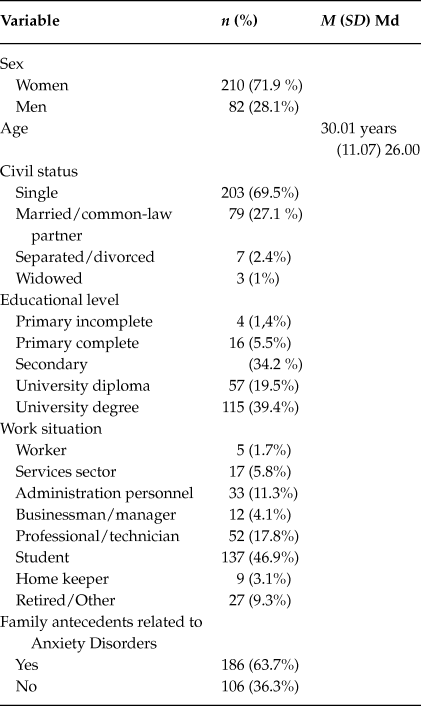
The results of the sociodemographic characteristics can be seen in Table 1. The high representation of women and single people is noteworthy, in both cases, more than two thirds of the cohort. The high educational level is also notable: 92.3% of the cohort has at least secondary studies, and more than one half have university studies. The only differences among students and the remaining members of the cohort was age, being students younger (F = 178, 218; p = .001), unmarried (F = 106, 642; p = .001) and with a shorter duration of the problem (F = 11, 288; p = .001). Participants with university degrees were significantly older than the rest of the cohort (F = 5, 193; p = .023). Two thirds of the patients presented family antecedents related to anxiety.
Sociodemographic Characteristics of the Cohort (N = 292)

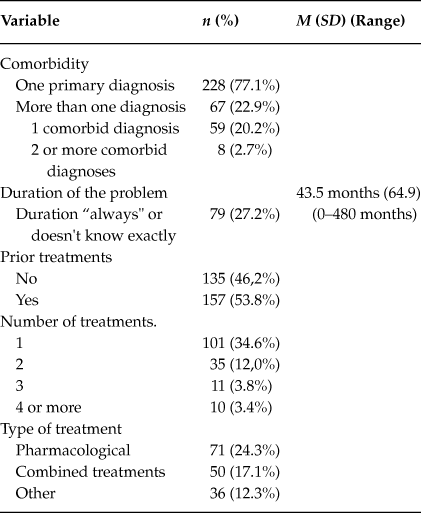
The results of the clinical characteristics can be seen in Table 2. It is noteworthy that only 22% has a comorbid diagnosis. Also notable is the long duration of the problem and the fact that most of the patients had received some prior treatment before requesting help in the CUP.
Clinical Characteristics of the Cohort (N = 292)

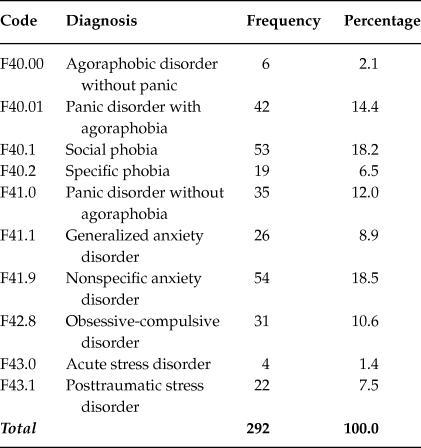
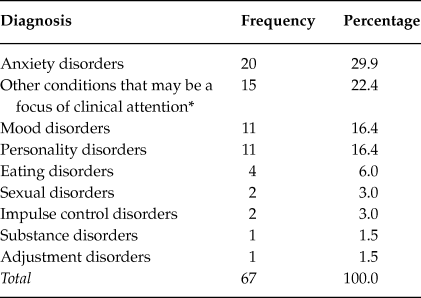
The frequencies and percentages of the diverse AD diagnoses can be seen in Table 3. The “residual” category of nonspecific ADs is the most frequent type of diagnosis (18.5%). The most frequent specific diagnosis is social phobia (18.2%), followed by panic disorder with agoraphobia (14.4%), panic disorder without agoraphobia (12%), and OCD (10.6%). In all the other disorders, the percentages did not exceed 10%. There were also a scarce number of specific phobias (6.5%). Comorbid diagnosis can be seen in Table 4. There were no significant differences in the proportion of comorbid diagnosis among the different AD. Other ADs were the most common comorbid condition, with panic disorder without agoraphobia being the most prevalent comorbid diagnosis.
Diagnosis according to DSM-IV Criteria

Comorbid Diagnosis by groups, according to DSM-IV Criteria

* ‘Other conditions that may be a focus of clinical attention’ include relational problems and psycho-social stressors
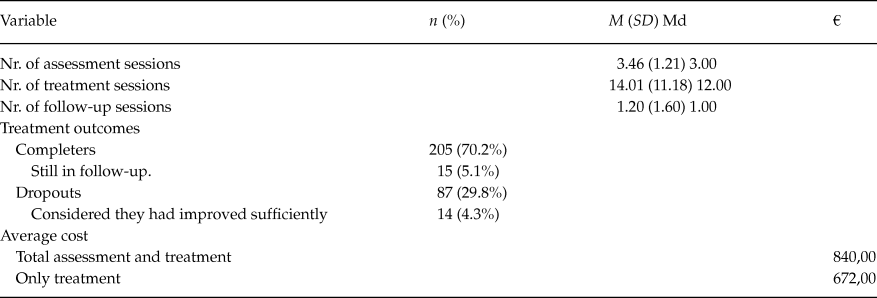
The results of the treatment characteristics can be seen in Table 5. The low number of treatment sessions (an average of 14), as well as the high rate of completers (70.2%) should be highlighted.
Characteristics of the Treatment

Discussion
According to the data obtained, the AD patient seeking help has the following sociodemographic profile: female, single, about 30 years old, either employed or a student, with university studies, does not live alone, and has family antecedents of anxiety problems. It would be interesting to know why there are twice the number of women as of men suffering from ADs, but this aspect is not very clear (Arenas & Puigcever, Reference Arenas and Puigcever2009). However, this difference does not emerge in all the ADs; Some epidemiological studies have indicated higher percentages of men in OCD in several populations (Bijl, Ravelli, & van Zessen, Reference Bijl, Ravelli and van Zessen1998; Canino et al., Reference Canino, Bird, Shrout, Rubio-Stipec, Bravo, Martinez and Guevara1987). However, this proportion—two thirds of females—is also observed in the demand for psychological help for all kinds of problems (Labrador et al., Reference Labrador, Estupiñá and García-Vera2010; Ministerio de Sanidad, 2006; Vallejo et al., Reference Vallejo, Jordán, Díaz, Comeche, Ortega, Amor and Zubeidat2008) and may be an indication that the explanation transcends the field of ADs.
The fact that 70% of the cohort is single and more than 50% have a university degree is probably biased, because the university clinic particularly facilitates demand by the university personnel, among them, students. Nonetheless, being a student or having a university degree did not pose a difference in the success of the treatment or its length.
The high prevalence—two thirds—of patients with family antecedents is underscored, as it could indicate a significant hereditary transmission of the problem. Some studies have reported rates of 43% of genetic load in panic disorder, or 28% in generalized anxiety disorder (Bienvenu, Davydow, & Kendler, Reference Bienvenu, Davydow and Kendler2011). Nevertheless, there are numerous studies that underline the importance of family transmission processes, among them, the modeling of patterns of anxious and avoidant coping or overprotection, as explanatory factors (Bayer, Hiscock, Ukoumunne, Price, & Wake, Reference Bayer, Hiscock, Ukoumunne, Price and Wake2008; Kendall, Hudson, Gosch, Flannery-Schroeder, & Suveg, Reference Kendall, Hudson, Gosch, Flannery-Schroeder and Suveg2008). It seems logical to consider the importance of both aspects.
Regarding the clinical characteristics, we note the severity of the problems in the cohort, particularly revealed by two indexes: (a) the long average duration of the problems before coming to the CUP-UCM (a mean duration of 43.5 months among the patients who could pinpoint the duration accurately, whereas 25% state that they had "always" had these problems); although they indicate long duration of the problem, these data are lower than the 7.3 years found by Bados, Balaguer, and Saldaña (Reference Bados, Balaguer and Saldaña2007) for ADs, where there seems to be a high variability, between 8.3 years for panic disorder (Hahlweg et al., Reference Hahlweg, Fiegenbaum, Frank, Schroeder and von Witzleben2001) and 13.6 years for social phobia (Lincoln et al., Reference Lincoln, Rief, Hahlweg, Frank, von Witzleben, Schroeder and Fiegenbaum2003); and (b) most of the patients (52.8%) come to the clinic after a prior treatment had failed. This prior failed treatment was habitually (41.4%) pharmacological (24.3% were pharmacological only, and 17.1% combined pharmacological treatment with some other treatment). This datum is also lower than that of Bados et al. who report 73.1% of patients with prior treatments in Spanish population. These data may be indicating the reluctance of patients suffering from anxiety to request a treatment that frequently ends in relapses, as reported repeatedly (Gould, Buckminster, Pollack, Otto, & Yap, Reference Gould, Buckminster, Pollack, Otto and Yap1997; Otto, Pollack, & Maki, Reference Otto, Pollack and Maki2000; Otto, Smits, & Reese, Reference Otto, Smits and Reese2005; Yonkers, Bruce, Dyck, & Keller, 2000). It also reveals that pharmacological treatment is the most common treatment of ADs in the assistance/healthcare sphere. According to the National Health Survey (Ministerio de Sanidad y Consumo, 2006), in Spain, 14.3% of the surveyed people had consumed tranquilizers, and 8.5% had taken antidepressants in the past two weeks. However, the European Study of the Epidemiology of Mental Disorders (ESEMeD) project, with European cohorts and the population with anxiety problems as reference, reports that 32.9% of the population consumed antidepressants, anxiolytics, or both in the past year (Demyttenaere et al., Reference Demyttenaere, Bonnewyn, Bruffaerts, De Girolamo, Gasquet and Alonso2008). Whatever the interpretation, it is clear that the AD cases contemplated herein are not easy to solve with pharmacological treatment.
However, these data also indicate a possible high recidivism or relapse rate or, in any event, one should expect that a high percentage of the people who request psychological help for ADs may have previously drifted from one treatment to another.
Only 22% present diagnoses of comorbidity, in contrast to the common belief in applied spheres that the presence of comorbidity is the rule. Although lower than those of other studies, the data are similar to those of Wagner et al. (Reference Wagner, Silove, Joukhador, Manicavasagar, Marnane and Kirsten2005). These differences are probably due to the way in which the diagnosis is established. When it is established only from structured interviews and questionnaires, the presence of comorbid diagnoses is more frequent than when the diagnosis is established by an expert on the basis of a more complete assessment (an average of 3.5 sessions), as in this case (Rettew, Lynch, Achenbach, Dumenci, & Ivanova, Reference Rettew, Lynch, Achenbach, Dumenci and Ivanova2009). Thus, this data reveal relatively low comorbidity among patients with AD. This reduced comorbidity has also been reported in general studies of all types of demand for psychological help (Labrador et al., Reference Labrador, Estupiñá and García-Vera2010; Ministerio de Sanidad y Consumo, 2006; Valero & Ruiz, Reference Valero and Ruiz2003). Reduced comorbidity is of particular value because it indicates the utility and suitability of applying ESTs developed in the research sphere—in general, using cohorts of patients with a single diagnosis—directly to the assistance/healthcare sphere. This has been supported by the results obtained when such ESTs were applied (Labrador & Ballesteros, Reference Labrador and Ballesteros2011; van Ingen, Freiheit, & Vye, Reference van Ingen, Freiheit and Vye2009).
With regard to the type of problems for which help was requested, 50% of the cases correspond to the three most frequent anxiety diagnoses: Nonspecific AD (18.5%), Social Phobia (18.2%), and Panic Disorder with Agoraphobia (14.4%). The most frequent problem was nonspecific AD, a residual category that is used when, despite the presence of symptoms of anxiety or phobic avoidance, there are not enough criteria to make the diagnosis in any of the other categories of AD. Although this category is not mentioned in most of the epidemiological and clinical studies, it is one of the most frequent diagnoses in the studies that do mention it, and in accordance with the results of this study (Caballero et al., Reference Caballero, Fernández-Liria, Ramos, Gil, Madrigal, Porras and Agüera1999; Herrero, González, Valverde, & Caballero, Reference Herrero, González, Valverde and Caballero2001). These data may reveal the limitations of the DSM-IV-TR (APA, 2000) criteria, showing that, as a consequence, a precise diagnosis cannot be established for an important group of people with anxiety problems, nor can the corresponding ESTs be identified as a result. Therefore, we emphasize that the most important aspect is the description of specific problem behaviors instead of the assignation of a diagnosis, both during the patient's assessment and when carrying out the ESTs.
The low representation of specific phobias (6.5%) is noteworthy, despite the fact that many studies report that specific phobias and social phobias are the most frequent ADs. For example, in the National Comorbidity Survey Replication (Kessler et al., Reference Kessler, Chiu, Demler and Walters2005), and the most frequent AD was specific phobia (8.7%), followed by social phobia (6.8%). The results of the ESEMeD-Spain study (Haro et al., Reference Haro, Palacín, Vilagut, Martínez, Bernal and Luque2006) differ significantly in percentages but not in the type of problems, with specific phobia (3.6%) being the most frequent AD, followed by social phobia (0.6%), and panic disorder (0.6%).
It therefore seems that the frequency with which psychological help is requested does not depend directly on the prevalence of each problem. It probably depends more on the degree of disorganization it causes, so that it is more difficult for the person to live with the problem. Thus, a specific phobia habitually generates much less disorganization than problems like social phobia or panic disorder (APA, 2000).
With regard to the characteristics of the interventions, we note that the average of 3.5 assessment sessions is high because, on the one hand, it implied an important delay (almost one month, if the sessions are weekly) before starting the treatment. On the other hand, it increases the total duration of the psychological care by more than 20%. Doubtless, reducing the number of assessment sessions is an important challenge. In this sense, it seems essential to develop empirically supported assessment protocols. Some works in this direction are particularly interesting, such as the work of Hunsley and Mash (Reference Hunsley and Mash2008).
The number of treatment sessions (a mean of 14, a median of 12) is similar to the intervention packages or protocols in the research sphere (16.2 sessions for panic disorder, according to Mitte, 2005) and lower than the data from other studies in the applied sphere, which report 27.4 sessions for ADs (Bados et al., 2007), or the 20.9 hours reported by van Ingen et al. (2009), or, more specifically, the 36.2 sessions for panic disorder reported by Hahlweg et al. (2001), or the 28 sessions for social phobia of Lincoln et al. (2003). This indicates the possibility and utility of generalizing treatments developed in the research sphere to the assistance/healthcare sphere (Labrador & Ballesteros, 2011). Nevertheless, a large variability among the cases is foreseeable, as revealed by the high standard deviation (11.18) in the number of sessions. It would be interesting to see whether this variability is a function of the type of diagnosis or of some other type of differential characteristics (sociodemographic or clinical).
The therapy could be considered effective, with a high percentage of discharges (70.2%), similar to those of other AD studies in general (73.2% in van Ingen et al.’s, Reference van Ingen, Freiheit and Vye2009 meta-analysis; or 66.7% in the study of Bados et al., Reference Bados, Balaguer and Saldaña2007). This is more remarkable if the large number of patients with a prior failure and the chronicity of their problems are taken into account. It is also likely that some of the dropouts have to do with patients feeling sufficiently recovered and therefore deciding to cease treatment, even if not all the therapist's goals were achieved. A more specific analysis of the effectiveness for each diagnosis should be developed in the future.
The costs are no less important. Given the average number of 14 sessions, plus another 3.5 for assessment, the estimated costs (in 2010) are € 840 per treatment (17.5 sessions at € 48, the minimum price set by the Psychologists' Association up to 2009). It would be interesting to compare these data: € 84€ for a 70% therapeutic efficacy compared with other interventions, in particular, pharmacological interventions. No doubt, these data could guide health managers more accurately about the suitability of each type of treatment for ADs.
When comparing the costs of psychological treatments and pharmacological treatments, the former are usually lower. Thus, in the work of Otto et al. (Reference Otto, Pollack and Maki2000) with patients with panic disorder without agoraphobia in the assistance/healthcare sphere, the mean cost for one year's treatment was: pharmacological therapy, $2305, cognitive-behavioral therapy (CBT), $1357, and cognitive-behavioral group therapy $523. Moreover, CBT was at least as efficacious as treatment with antidepressants or short treatments with high doses of benzodiazepines, and the pharmacological treatment was associated with fairly high percentages of relapses (54–70%).
This work was carried out within the framework of the Project PSI2009–13100 of the Spanish Ministerio de Educación y Ciencia.