1 Introduction
One of the most distinctive phonological features of British Received Pronunciation (RP) and, to a certain extent, of Southern Hemisphere varieties of English (Trudgill Reference Trudgill2010) is the lengthening of /a/ in words like fast, answer or after. British RP is known to present the most advanced development of the phenomenon, affecting what Wells (Reference Wells1982) terms the start, palm and bath sets. In the latter set, lengthening was never complete and spread gradually on a word-by-word basis, making it a perfect example of lexical diffusion (Labov Reference Labov1994). The lengthening of /a/ has been particularly gaining ground from the eighteenth century onwards and has been amply documented in Beal (Reference Beal1999) and Jones (Reference Jones2006). Each of the pronouncing dictionaries published in the eighteenth century as well as present-day dictionaries provide us with a different partial distribution of the phenomenon across the whole lexicon. These lexicographic sources can therefore help us identify precisely which lexical items were first or last affected by the change.
Keeping in mind that lexical diffusion is often described as a phenomenon led by word frequency (Phillips Reference Phillips, Honeybone and Salmons2015) and that the words of the bath set include a number of different phonetic environments, this study aims to test the effect of word frequency in the development of /a/ lengthening before fricatives and nasals, as it is recorded in the eighteenth-century sources of the Eighteenth-Century English Phonology Database (ECEP). The main objective is also to identify the relative chronology of the spread of long /a/ according to the phonetic environment, taking into account the current phonological systems recorded in Wells’ Longman Pronouncing Dictionary (Reference Wells2008) for British RP and General American, and the Macquarie Dictionary (2015) for Australian English (AusE).
2 Middle English /a/ lengthening and lexical diffusion
2.1 Middle English /a/ lengthening
Beal (Reference Beal1999: 138) describes the lengthening of Middle English (ME) /a/ as a phenomenon subject to phonetic, lexical and social conditioning. She notes that early lengthenings are recorded before /rn/ and /rl/ in the sixteenth century and that the dialectal realizations of father and master as /feɪðǝ/ and /meɪstǝ/ mentioned in Wright (Reference Wright1905) suggest that these words were lengthened before the Great Vowel Shift that raised ME /aː/ to /eː/ at the turn of the seventeenth century (Beal Reference Beal1999: 106). By the end of the eighteenth century, lengthening before /r/ is categorical but it was still variable in front of fricatives and nasals. The first mentions of a long /aː/ in those environments date back from the seventeenth century. The testimonies of Daines (Reference Daines1640) and Cooper (Reference Cooper1685) lead Beal (Reference Beal2004: 139) to conclude that, by the beginning of the eighteenth century, the phenomenon mainly occurs before pre-consonantal /r/, pre-consonantal /s/, /θ/, pre-consonantal /n/ and in words such as father, calf, calm.
Historically, the long /aː/ found in eighteenth-century sources stems from the following processes (Beal Reference Beal1999: 105):
• the lengthening of ME /a/ before fricatives
• the monophthongization of ME /au/ from Old French /ã/ in aunt. It also varies with /ɔː/, especially in borrowings from Northern/Old French or Anglo-Norman <-aunC > such as launch (Minkova Reference Minkova2014: 241)
• the monophthongization of ME /au/ from the loss of /l/ in palm, calf
• the reproduction of foreign values in banana, sonata
• the monophthongization of ME /ai/ in master and plaster, especially in northern dialects (see Beal Reference Beal1985)
In the course of the eighteenth century, the long /aː/ becomes associated with vulgar speech and its stigmatization reverses the trend, at least in the variety described by John Walker (Reference Walker1791).
78. … this sound of the a [the long sound of the middle or Italian a in the word father] was formerly more than at present found before the nasal liquid n, especially when succeeded by c, t or d, as dance, glance, lance, France, chance, prance, grant, plant, slant, slander, &c.
79. The hissing consonant s was likewise a sign of this sound of the a, whether doubled, as in, glass, grass, lass, &c. or accompanied by t, as in last, fast, vast, &c. but this pronunciation of a seems to have been for some years advancing to the short sound of this letter, as heard in hand, grand, land, &c. and pronouncing the a in after, answer, basket, plant, mast, &c. as long as in half, calf, &c. borders very closely on vulgarity (Walker Reference Walker1791: 10–11)
The exact phonetic realization of long /aː/ in eighteenth-century English is difficult to assert. Most eighteenth-century authors describe it as an ‘Italian’ a or as ‘a middle sound’ between the a in pat and the a in paw, which seems to indicate that it was probably close to cardinal [aː]. The retracted version of that sound, [ɑː], used in lower-class London English, was considered vulgar in Walker's time and throughout the nineteenth century according to Mugglestone (Reference Mugglestone2003: 84), before it became the standard realization of British RP in the twentieth century. On the contrary, Jones (Reference Jones2006: 193) shows that a fronted [æ] in words such as bath was equally stigmatized by Kenrick (Reference Kenrick1773: 63), who associates it with the speech of ‘flirting females and affected fops’.
The lengthening of /a/ in bath words is known as an incomplete change that never became categorical in pre-fricative and pre-nasal environments. Within the diasystem of English, Southern British English is the variety in which the phenomenon is most advanced. Southern Hemisphere dialects inherited that change but have a split system in which some pre-nasal contexts do not trigger lengthening for some speakers. Split systems are also found in Welsh English, Caribbean English and on the American east coast (see Wells Reference Wells1982; Trudgill Reference Trudgill2010; Phillips Reference Phillips, Honeybone and Salmons2015). Like most of those dialects, General American (GA) has a long /aː/ in father, before /r/ and before /lm/, which can therefore be seen as the earliest contexts triggering lengthening. Northern British English also has a long /aː/ before /lf/ in calf, which must have appeared after the American settlement, but the preservation of a short vowel in words such as bath, laugh or chance is still a marker of identity for northern speakers today (Wells Reference Wells1982: 354).
2.2 Lexical diffusion and word frequency
Contrary to the neogrammarian conception of sound change in which all the relevant lexical items are affected by an imperceptible change at the same time, lexical diffusion is a phonetically abrupt and lexically gradual change (Wang Reference Wang1969). The lengthening of ME /a/, which is an incomplete change spreading to new phonological contexts on a word-by-word basis, is often described as an example of lexical diffusion (Wells Reference Wells1982; Phillips Reference Phillips1989; Beal Reference Beal1999).
Various factors influencing which words will undergo the change first have been found. Among those surveyed by Phillips (Reference Phillips, Honeybone and Salmons2015), word frequency is a recurrent and strong one:
Evidence from frequency effects shows that lexical diffusion can be very systematic, affecting both phonetically gradual and abrupt changes, and for each type sometimes spreading to the most frequent words first and sometimes to the least. (Phillips Reference Phillips, Honeybone and Salmons2015: 5)
In her study on New England English dialects, Phillips (Reference Phillips1989) shows that /a/ lengthening in bath words affected the most frequent words first, both in RP and in the dialects of the East Coast.
Phillips (Reference Phillips, Honeybone and Salmons2015) adds that word frequency may also interact with other parameters such as grammatical category. She also emphasizes the role of phonetic analogy in lexical diffusion. Because of the connected structure of the mental lexicon, ‘the activation of a word also activates phonetically similar words’, which means that a change can spread to very frequent or even less frequent words (Phillips Reference Phillips, Honeybone and Salmons2015: 12).
In order to account for the various bath systems recorded in eighteenth-century dictionaries, it seems therefore crucial to test the effect of word frequency on /a/ lengthening and to reveal the path taken by phonetic analogy by identifying which phonetic contexts were first affected by the change.
3 Data and methodology
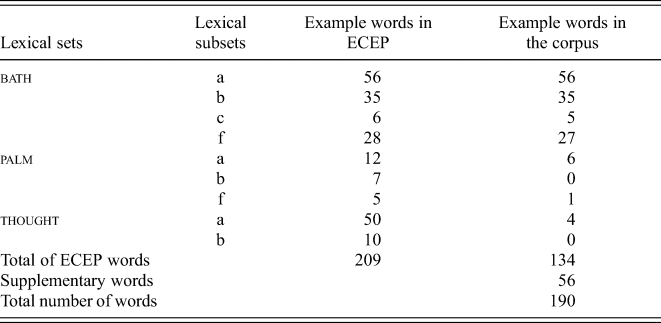
The data collected in the ECEP database constitute the core of the corpus. In order to trace /a/ lengthening before fricatives and nasals, three lexical sets were extracted: bath, palm and thought. The bath lexical set corresponds to words pronounced with a long /aː/ in RP but short /a/ in GA. According to Wells (Reference Wells1982: 134), subset (a) includes words in which /a/ is long in a majority of accents (before fricatives), subset (b) words which may be pronounced with a short /a/ in AusE and West Indian English (before nasals), subset (c) words pronounced with long /aː/ also in Northern British English, while subset (f) lists words that alternate between long and short /a/ in RP. The palm set contains words with a long /aː/ in both RP and GA before other consonants than /r/ (Wells Reference Wells1982: 143). Subset (a) represents native words such as father, subset (b) comprises recent borrowings such as cantata, and subset (f) words in which GA alternates between long and short /a/. Finally, the thought set contains words in which both RP and GA have /ɔː/ (Wells Reference Wells1982: 145). Among these, subset (a) comprises words in which /ɔː/ is the reflex of ME /au/ before a nasal. Its alternative outcome /aː/, still observable in today's RP aunt, occurred sporadically in the eighteenth century in words such as taunt. Within those three main lexical sets, the words in which /a/ does not appear before a fricative or nasal were discarded, as well as those in which /aː/ represents a foreign vowel, as in banana. Table 1 summarizes the lexical sets and subsets considered, and gives the number of items for each set. A full list of example words is provided in the appendix.
Number of lexical words selected in the corpus

A number of peripheral additions to that core have been made in order to describe more faithfully the process of lexical diffusion. As, according to Phillips (Reference Phillips, Honeybone and Salmons2015), both low-frequency and high-frequency words may play a role in lexical diffusion, it appeared relevant to collect a maximum of words subject to /a/ lengthening in the eighteenth century, including rare words, to complement the word lists of the ECEP database. In her work on the Grand Repository of the English Language, Beal (Reference Beal1999) compared Thomas Spence's (Reference Spence1775) relatively conservative pronunciations with an exhaustive list of 140 words ‘with open a’ given by his contemporary Nares (Reference Nares1784) showing that /a/ lengthening was more advanced in his variety of English. These words were therefore added to the corpus. A search for all the words containing the transcription a 2 (corresponding to the a in father) in an electronic edition of John Walker's dictionary (Trapateau Reference Trapateau2015) allowed me to complement that list. The realization of <a> in each word of that list was then looked up manually in all the dictionaries concerned when it was absent from the ECEP database.
In order to assign a frequency rate to each word in the corpus, I extracted the number of occurrences found in the wordlist of the ARCHER corpus. I first retrieved the word frequencies of a subsection of the corpus restricted to eighteenth-century British texts (535,767 words in total) and then enlarged that section to British texts written between 1600 and 1849 to obtain different frequency figures (1,154,623 words in total). The idea was to collect data for words present in eighteenth-century dictionaries but which might have become less frequent in eighteenth-century texts, and also to minimize the potential lag between the adoption of a new word in oral discourse and its integration in the dictionaries. To further compare these figures, I also included the number of occurrences of each word found in the British National Corpus (BNC, 112,102,325 words; Davies Reference Davies2004–). The data of that massive corpus were used to rank the less frequent words of the study and to provide figures based on word types rather than words since the ARCHER corpus is not lemmatized. The words that were not found in any of these corpora were considered to have a frequency value of zero.
Among the eleven dictionaries used to compile the ECEP database, three did not show any long /aː/ in the whole corpus: Buchanan (Reference Buchanan1757), Sheridan (Reference Sheridan1780) and Jones (Reference Jones1797). At first sight, it did not seem relevant to take their data into account as they do not show any phonemic split between the start, palm and trap sets, the three of them being transcribed with a symbol equivalent to short /æ/. On closer inspection, however, the absence of a long /aː/ does not necessarily reflect the absence of that phoneme in the dialect of the authors but rather the inadequacy of the transcription system these orthoepists adopted to represent it. As Walker notices in his principle number 215, Sheridan seems to indicate a long /aː/ when the stress mark immediately follows the vowel in his transcriptions, and a short /a/ when it is placed after the consonant in coda.
215. Laugh and draught, which are very properly classed by Mr. Nares among those words which have the long Italian a in father, are marked by Mr. Sheridan with his first sound of a in hat, lengthened into the sound of a in father, by placing the accent on it. (Walker Reference Walker1791: 27)
After checking it against the original work, Walker's remark proved to be relevant as twenty-five other words were found in Sheridan's dictionary and added to the corpus as instances of /a/ lengthening. Thus, despite the use of a common vowel symbol (a1) for both vowels, the presence of a long /aː/ is signalled by the position of the stress mark (′) after the vowel in words such as farm (fa1′rm), father (fa1′-the1r), while a short /a/ is expected when the stress mark is placed after the end of the syllable as in fact (fa1kt′), fathom (fa1th′-u1m).
As might be expected, the 1797 edition of Jones’ Sheridan Improved uses the same system as Sheridan's dictionary. His transcriptions rarely depart from Sheridan's except in the word aslant in which Jones has a long /aː/, which is why his data are not included in the final results. However, the edition he published the following year adopts a completely different transcription system, inspired by Walker's, that allows him to represent unambiguously the long /aː/ in a greater number of contexts. The data of the 1798 edition are therefore taken into consideration in this study. In his 1757 dictionary, Buchanan makes use of a simple binary transcription system that only allows him to indicate short and long vowels. His preface (Reference Buchanan1757: 8) mentions only three sounds for the letter <a>: short a in bad, long a in came and broad a in all, a sound which he equates with the ‘foreign’ pronunciation of the letter <a> (possibly cardinal [a]). The digraph <au> is presented as having only one sound – the broad sound of a in call (Reference Buchanan1757: 10) – and, unlike Sheridan, nothing can be inferred from the position of his stress marks as they are systematically placed after the stressed vowel. His data could reasonably be discarded in a study of /a/ lengthening if he had not published an essay (Buchanan Reference Buchanan1766) on pronunciation with a completely new and refined transcription system allowing him to represent that sound more accurately. For the purpose of this study, it seemed therefore obvious to leave aside his 1757 dictionary and integrate the data of the 1766 work into the corpus.
As the objective was to compare a great variety of dictionaries showing different distributions of /a/ lengthening, I also included the vowel transcriptions indicated in Wells (Reference Wells2008) for RP and GA and in the Macquarie Dictionary (2015) for AusE.
Finally, for further research, other information was added to the corpus such as the number of syllables of the word, its stress pattern, its first date of attestation given by the Oxford English Dictionary (OED) and the original language when the word is a borrowing, the phonological history of the vowel (l-loss, ME /a/ or /au/ for instance) and the phonetic environment following that vowel.
4 Results
4.1 Frequency and date of first attestation
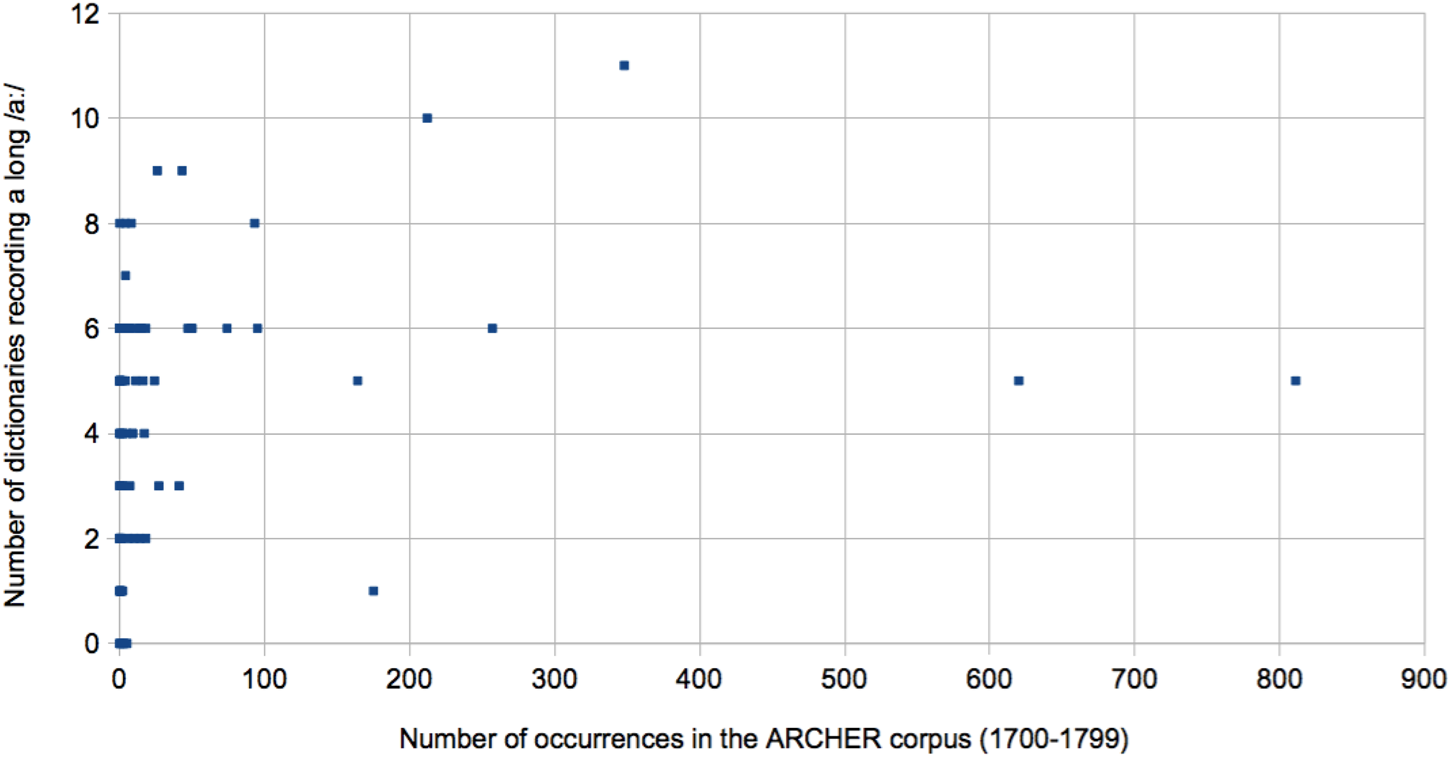
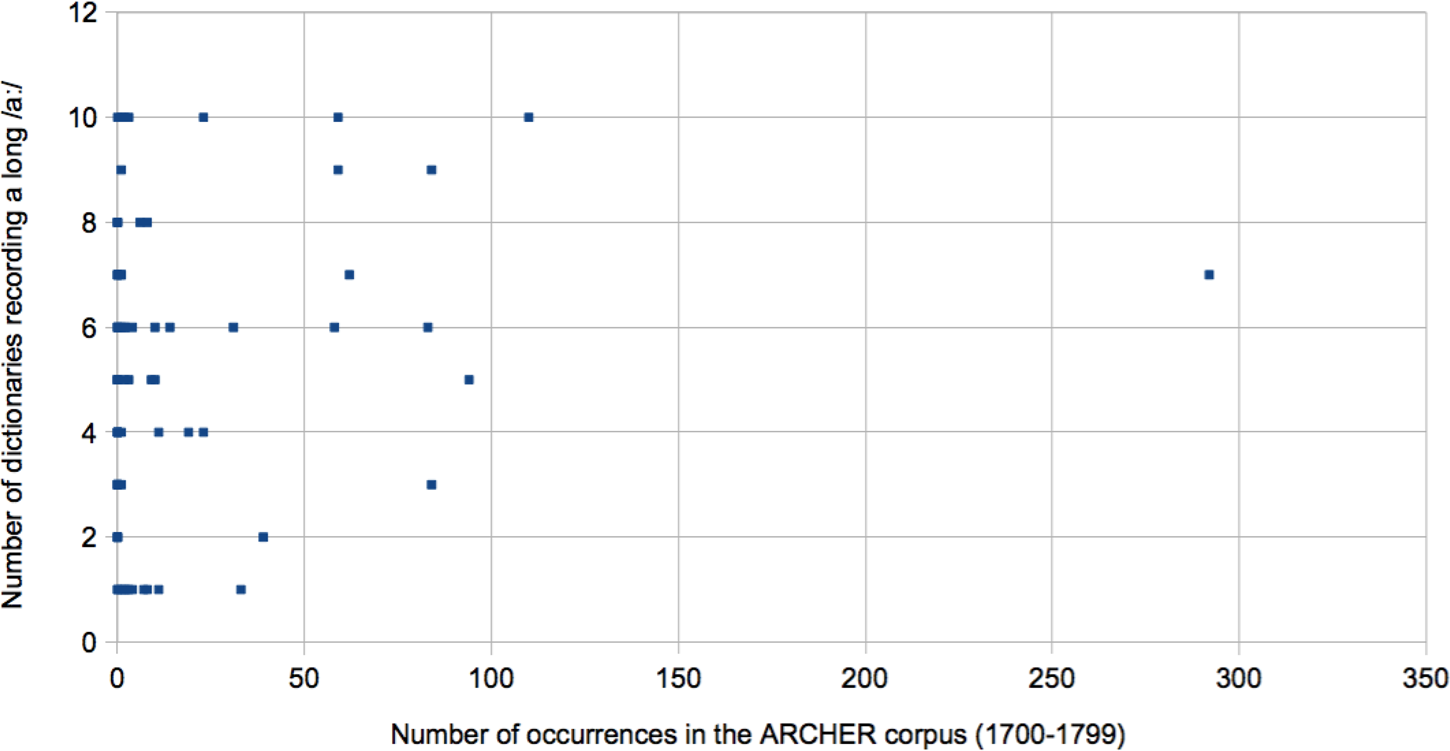
Figures 1 and 2 test the effect of word frequency on the lexical diffusion of /a/ lengthening. The frequencies extracted from the BNC and the two different subcorpora of ARCHER (eighteenth-century and seventeenth- to mid-nineteenth-century texts) all converged. I chose therefore to present only the results corresponding to the British texts written in the period 1700–99 in ARCHER. Each dot in the figures represents a word. The vertical axis represents the number of eighteenth-century dictionaries (twelve in total) recording a long /aː/ in that word, while the horizontal axis represents the number of occurrences of that word in the eighteenth-century texts of ARCHER.
Pre-fricative /a/ lengthening in eighteenth-century dictionaries according to word frequency

Pre-nasal /a/ lengthening in eighteenth-century dictionaries according to word frequency
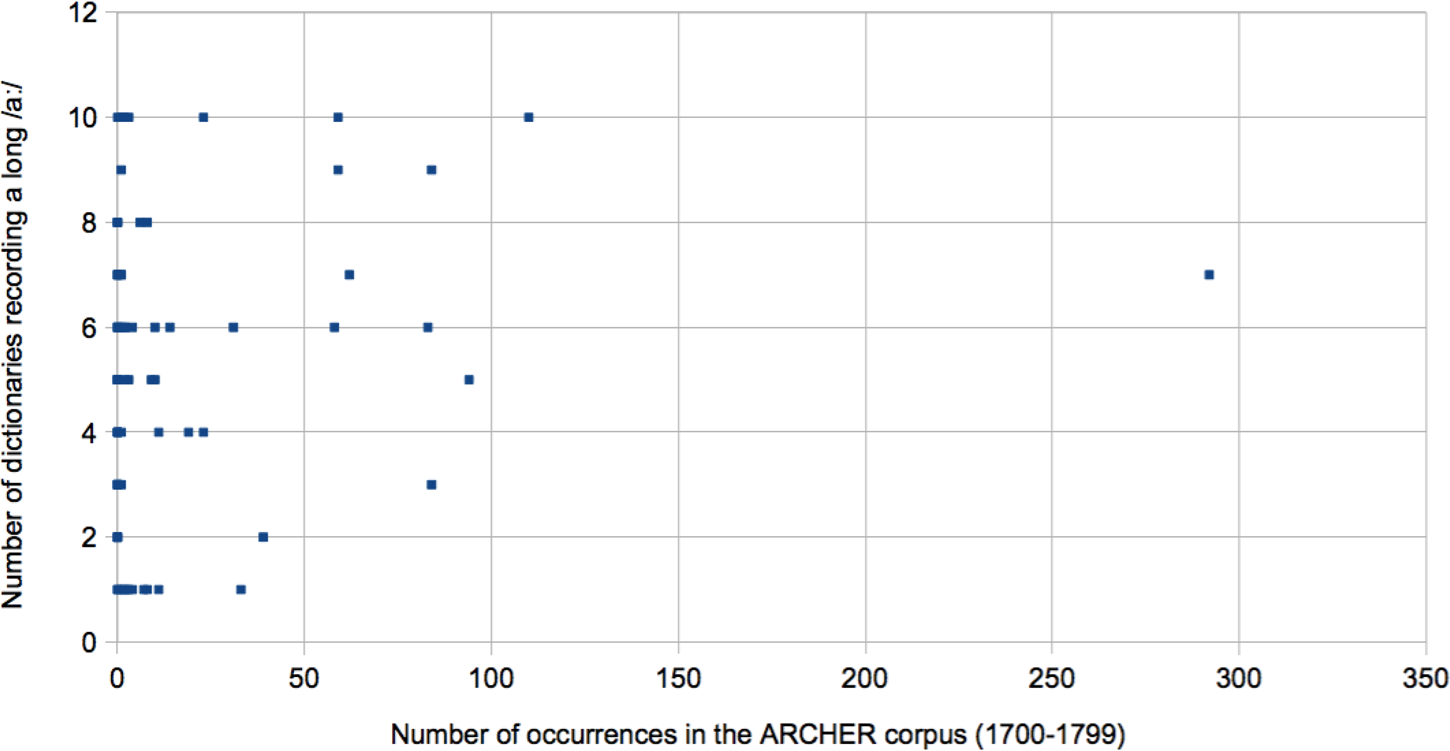
Figures 1 and 2 show a major difference in the overall frequency of each environment: the words with pre-fricative lengthening are notably more frequent (34 occurrences on average) than words with pre-nasal lengthening (17 occurrences on average). As pre-fricative contexts are twice as frequent as nasal contexts, one would expect to find more lengthening before fricatives. However, on average, pre-nasal lengthening is recorded in 5.1 dictionaries out of twelve, while pre-fricative lengthening is recorded in 4.5, which seems to indicate that lengthening before nasals is slightly more established as it is acknowledged by a higher number of authors.
Again, if lengthening affects frequent words first, one should find more dictionaries recording a long vowel in high-frequency words; that is, words whose frequency is higher than the average frequency of words in the same environment. In pre-fricative contexts, words above the average frequency of thirty-four have a long vowel recorded in 6.2 dictionaries whereas words below the average only have it recorded in 4.3 dictionaries. However, the words with maximum frequency – after (811) and last (589) – at the far right of figure 1 have a long /aː/ in less than half of the orthoepic works of the corpus. Lengthening in the least frequent words at the far left of figure 1 is extremely variable: lath, casket and lather all have a frequency of zero but are recorded respectively in eight, six and zero dictionaries. A similar pattern is shown in figure 2 in which high-frequency words show lengthening before nasals in an average 6.2 dictionaries, while low-frequency words do so in only 4.8. However, the most frequent word in that context, answer (292), is transcribed with a long vowel in only seven works out of twelve. Lengthening in the least frequent words is again highly variable: stanch, trance and supplant, which do not appear in the eighteenth-century texts of ARCHER, are transcribed with a long vowel respectively in ten, five and one dictionaries.
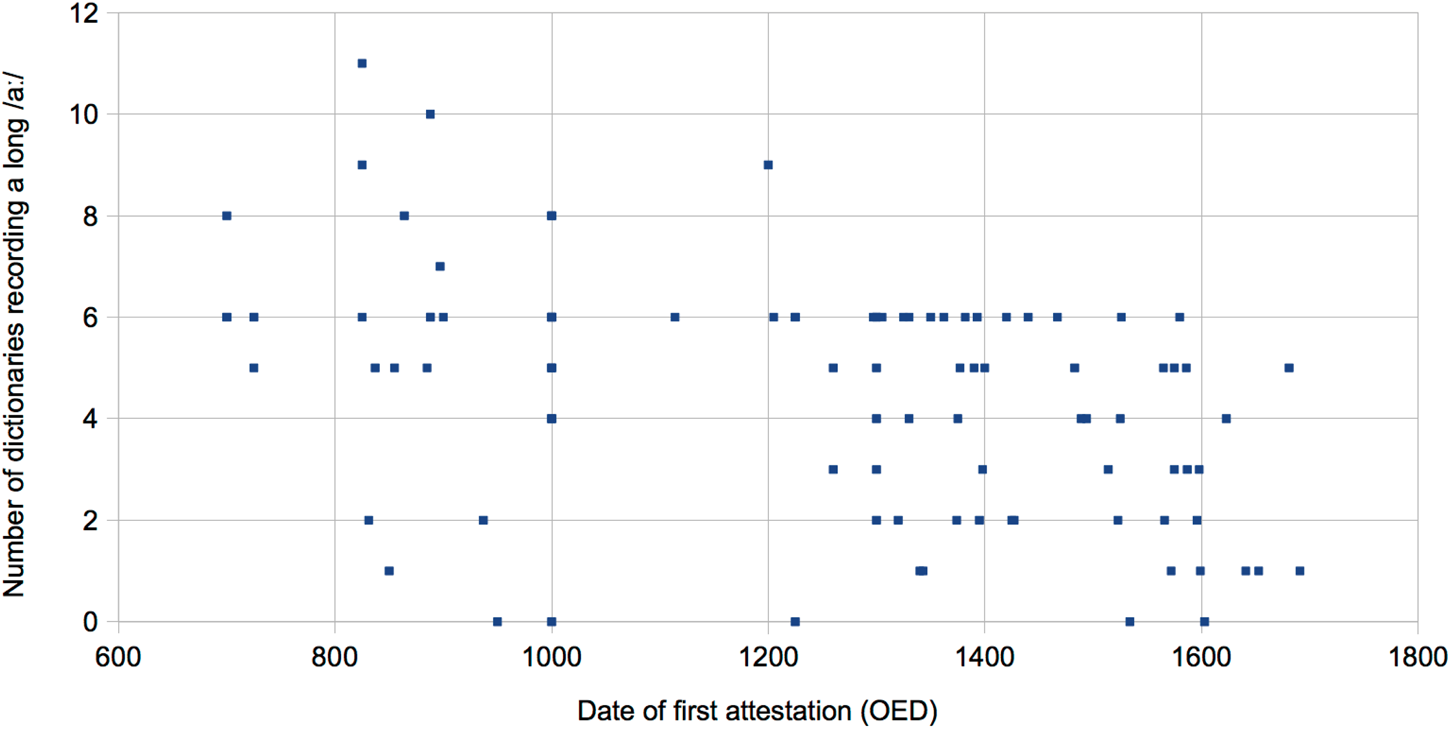
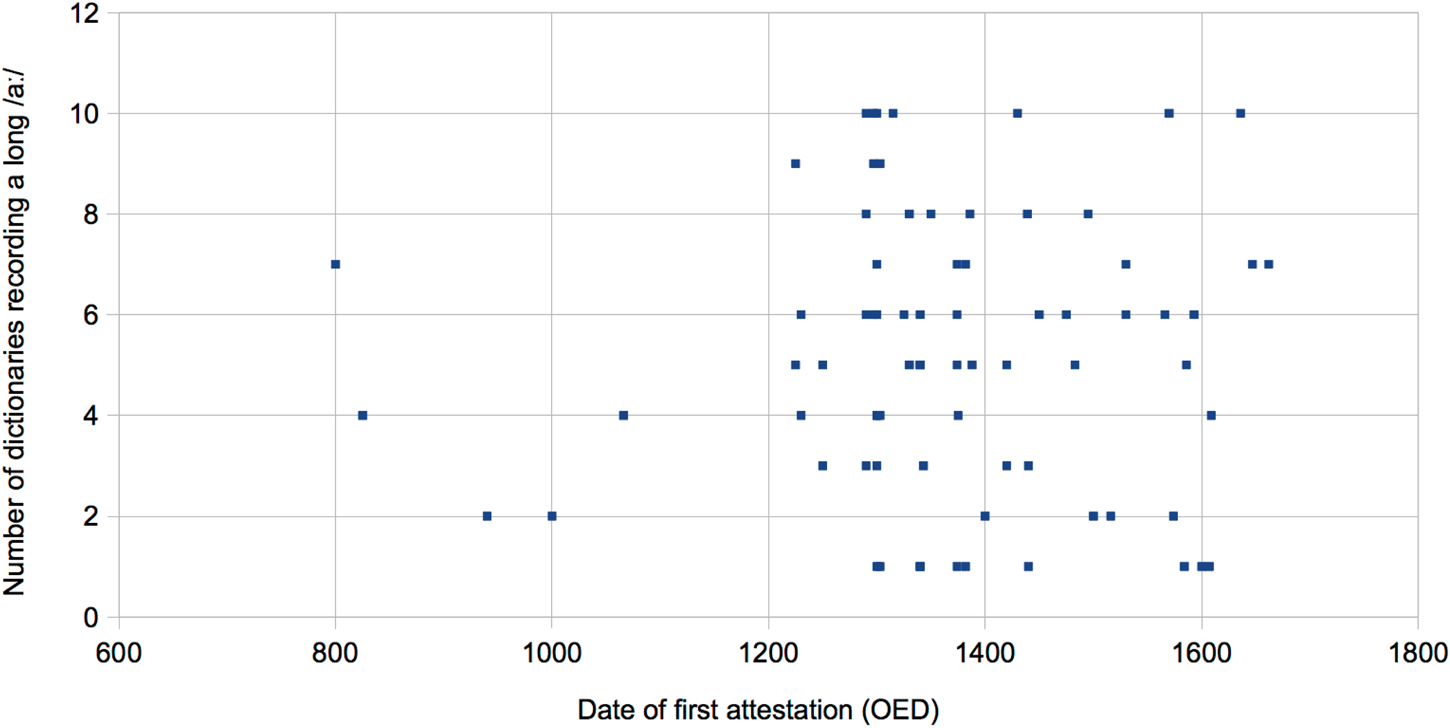
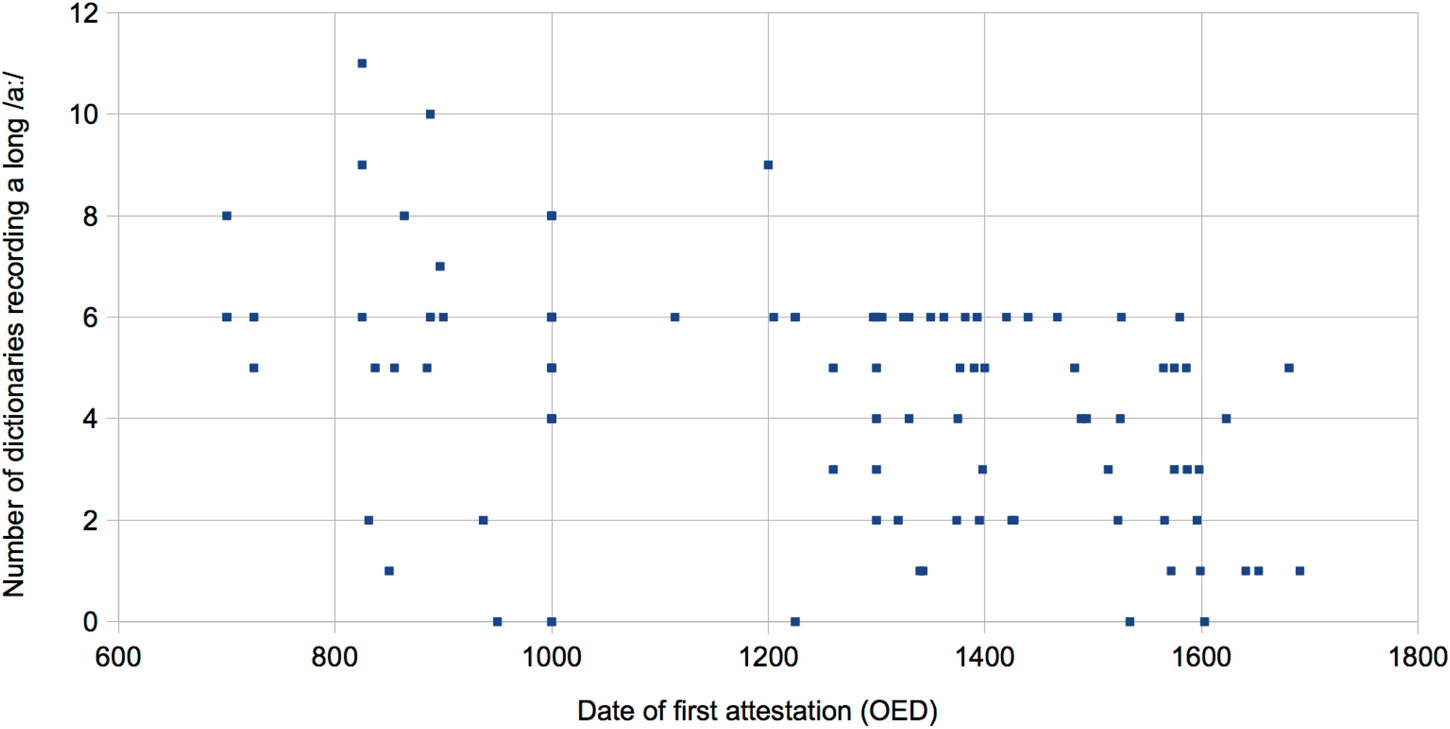
A common pattern emerges from both graphs: high-frequency words do not necessarily favour lengthening; low-frequency words do not show any clear tendency towards lengthening. Word frequency per se does not seem to have a clear effect when combined with the two broad phonetic environments (pre-fricative and pre-nasal contexts). In the case of eighteenth-century data, it might therefore be necessary either to examine its effect on each narrower phonetic context or to combine this parameter with others such as word age. In this study, word age corresponds to the extent of the period since the first occurrence of a word recorded in the OED. The date of first attestation of each word seems to have an impact on lengthening in our eighteenth-century sources. Figures 3 and 4 show diverging trends between fricative and nasal environments. In the figures, the date 1200 represents a threshold for different reasons.
Pre-fricative /a/ lengthening in eighteenth-century dictionaries according to word age
Pre-nasal /a/ lengthening in eighteenth-century dictionaries according to word age

In pre-fricative contexts (figure 3), lengthening is more likely to occur in long-standing words than in more recent words. The words recorded with a long vowel in a majority of sources are also some of the most ancient, such as path (first recorded in 700, transcribed with long /aː/ in eleven sources) or father (825, eleven sources), master (888, ten sources). From 1200 on, more recent words such as lass (1300, two sources), nasty (1400, five sources) or exasperate (1534, no source) show that lengthening is rather rare since it is never recorded in more than half of the twelve dictionaries consulted.
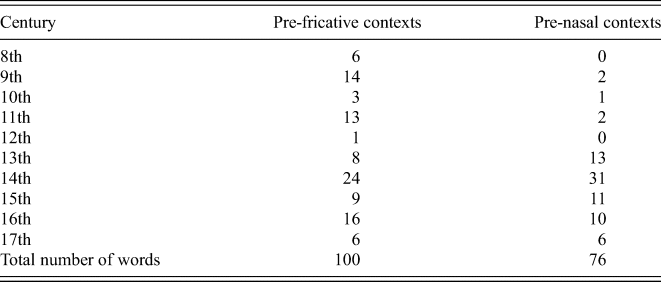
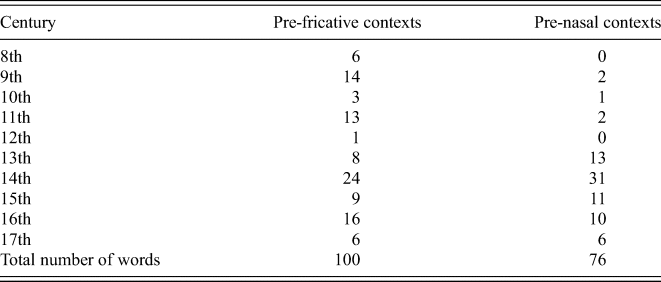
On the contrary, lengthening in pre-nasal contexts (figure 4) is more likely to occur in words introduced after 1200. Very few words were introduced before that date: answer (800, seven sources), plant (825, four sources), Alexander (940, two sources), ant (1000, two sources), chancellor (1066, four sources). After 1200, more words are introduced and lengthening is therefore more likely to occur (see table 2). However, long /aː/ is not dominant since long and short realizations are equally represented in that period, as in grant (1225, nine sources), command (1300, ten sources), supplant (1300, one source), glance (1450, six sources), circumstantial (1600, one source), reprimand (1636, ten sources).
Number of words introduced per century
4.2 Relative chronology of the diffusion of /a/ lengthening according to the phonetic context
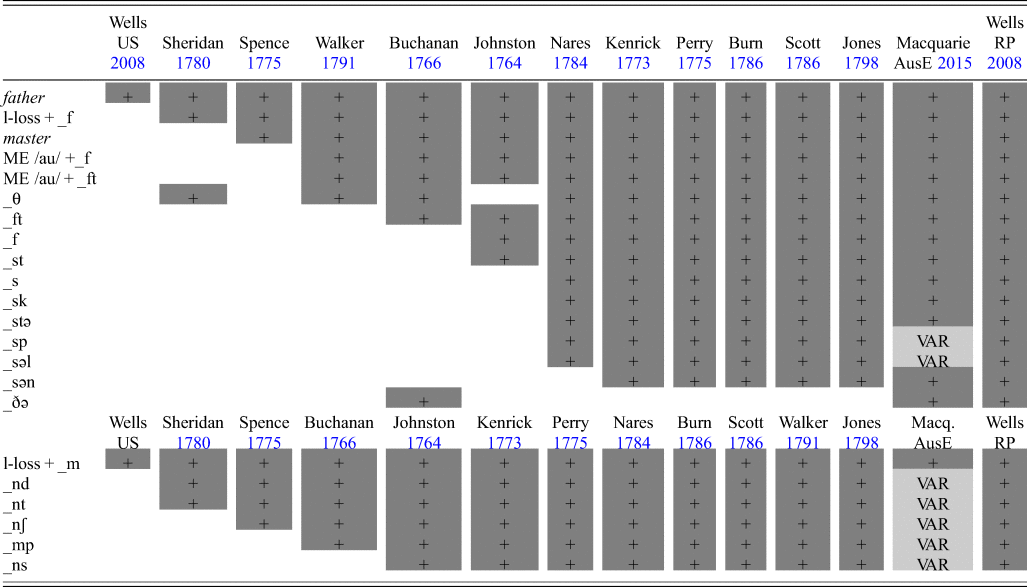
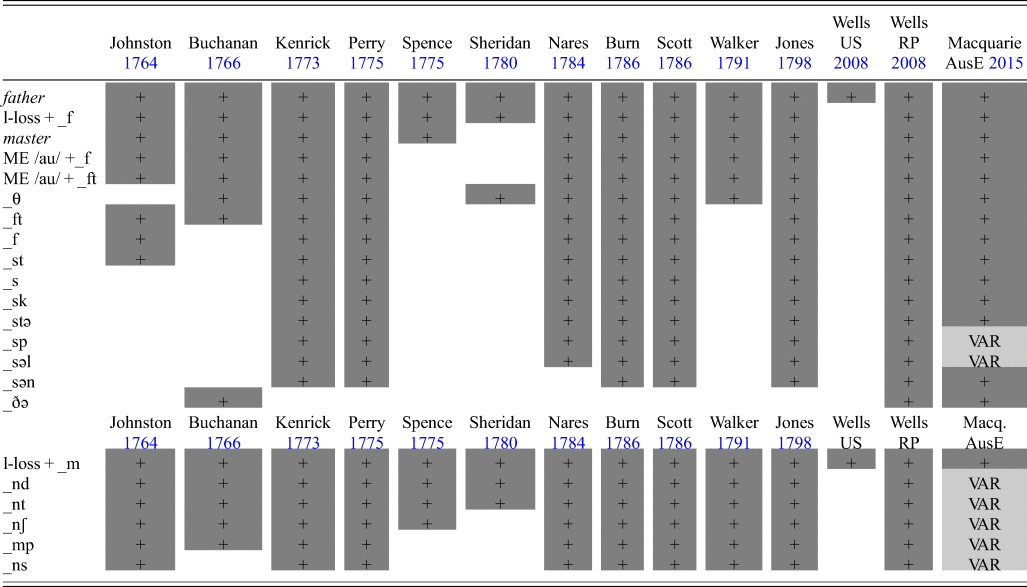
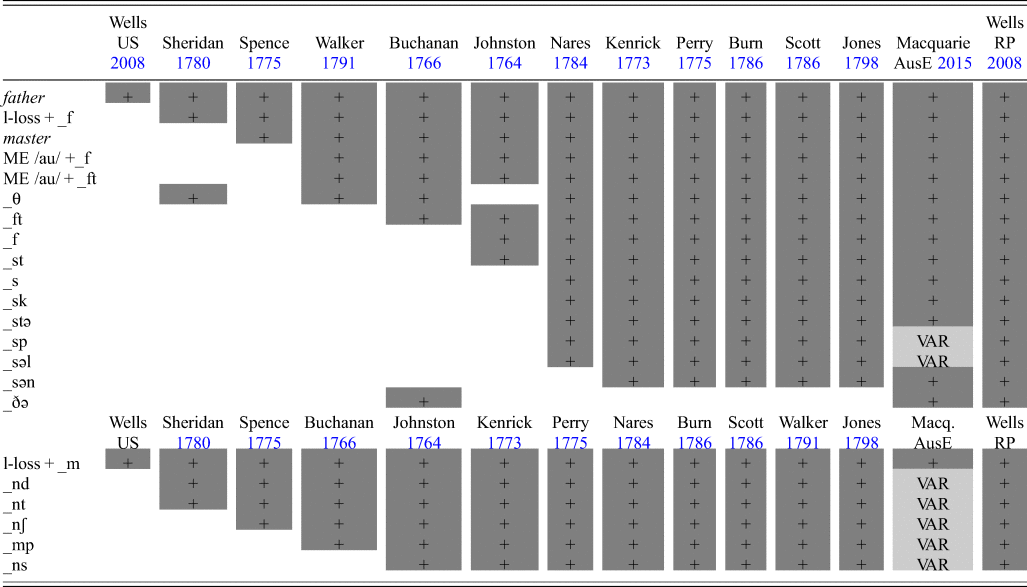
Table 3 presents a summary of the phonetic environments where /a/ lengthening occurs before fricatives (upper part of the table) and before nasal consonants (lower part) in all the dictionaries consulted. As mentioned in the previous section, the data from Buchanan (Reference Buchanan1757) and Jones (Reference Jones1797) were discarded as irrelevant or redundant compared with Sheridan (Reference Sheridan1780). The + sign indicates that the dictionary contains at least one word with a long /aː/ in the corresponding context. VAR indicates variation between short /a/ and long /aː/. The words father and master had to be separated from their respective contexts (_ðǝ and _st) as they appear with a long vowel at a very early stage before other words of the same environment. The fact that these two units are frequently used in the vocative, as a form of address, is another argument in favour of a separate treatment: it could be the cause of an expressive variation of the vowel length which then became lexicalized in all registers. In the table, a separate environment was created when phonological factors other than the following consonant may intervene (l-loss, ME diphthong) in order to distinguish the development of words such as calf, laugh and staff. The data are ordered according to two factors regardless of the chronology: the phonetic contexts which are active in a majority of dictionaries are placed nearer to the top of the table and the dictionaries which have a long /aː/ in a greater variety of environments are placed on the right of the table. Table 4 provides exactly the same data with the dictionaries listed chronologically according to their date of publication in order to trace lexical diffusion with regard to chronology. The order adopted here is undoubtedly debatable. As Beal remarks (Reference Beal1999: 104-5, note 7), the order could have been totally different if the dates of birth of the authors had been taken as a chronological reference, and the most conservative dictionary is not always the oldest. In that table, Walker, for instance, stands out as both a recent and conservative dictionary, reflecting the sociolinguistic pressures against lengthening at the end of the century. Table 4 more readily reflects the external factors affecting the change to long /aː/, while table 3 better reflects the internal factors of that change. The data analysis therefore focuses essentially on table 3.
Phonetic environments favouring /a/ lengthening in pronouncing dictionaries (relative chronology)
Phonetic environments favouring /a/ lengthening in pronouncing dictionaries (absolute chronology)

Wells’ data for GA (Reference Wells2008), which stand out for the lack of /aː/, probably represent the earliest stage of the phenomenon. Fricatives and nasals have no effect on the length of /a/ except in father, which confirms that lengthening in that word must have pre-dated the importation of English in America. The vowel acquires its length essentially through compensatory lengthening due to the loss of /l/. The comparison of the different systems present in table 3 shows that the progression of the phenomenon was not steady. For instance, Sheridan's data seem to indicate that /a/ lengthening spread first before _θ, which is known to have triggered lengthening as early as the sixteenth century. However, Johnston (Reference Johnston1764) has a broader bath system in which _θ is surprisingly inactive. The same may be observed with _ðǝ in which lengthening in analogy with father only appears in recent sources except for Buchanan's Essay (Reference Buchanan1766). The Australian data also show a distribution in which words like castle and grasp resist lengthening, but what the table does not show is whether this should be taken as a proof that _sp and _sǝl were among the last contexts to have been affected by the change or if the phenomenon started to reverse in these environments in recent times, as it did with Walker for sociolinguistic reasons.
Nevertheless, this juxtaposition of systems shows a number of plausible stages in the development of /a/ lengthening. The words with ME /au/ such as laugh and draught may have paved the way for other words in the _f and _ft contexts. Spence's system, which reflects the situation of today's northern dialects of English, shows that the absence of length in laugh and draught precludes its presence in staff or craft. On the contrary, Johnston and Buchanan show that a long vowel in the words with the ME diphthong is a condition of lengthening of ME /a/ in similar contexts. The authors who pronounce the word after with a long /aː/ all have a long /aː/ in laughter as well, but the reverse is not true.
The contexts where the fricative is followed by a voiceless stop seem to have been affected first in the following order: _ft > _f; _st > _s, which is corroborated by Cooper's (Reference Cooper1685) distinct treatment of pass (with short /a/) and passed (with long /aː/). It also mirrors the tendency for /a/ lengthening to appear in complex codas in pre-/r/ contexts: first before pre-consonantal /r/ and then before final /r/, as described by Beal (Reference Beal1999). In the case of _sp, the Macquarie Dictionary shows variation between short /a/ and long /aː/, but Horvath & Horvath (Reference Horvath, Horvath, Blair and Collins2001: 346–50) indicate that the long vowel is the norm in gasp and grasp in Sydney English and even in other local dialects like Brisbane English where /aː/ is otherwise rare.
In front of nasals, the eighteenth-century dictionaries show a steady progression of lengthening from alveolar to bilabial consonants, culminating in nasal + fricative clusters in the most advanced dialects: _nt, _nd > _ntʃ > _mp > _ns. Indeed, the word dance counts as one of the words that resist lengthening in most dialects of Australia (Horvath & Horvath Reference Horvath, Horvath, Blair and Collins2001: 250). However, the general chronology for nasals is problematic when confronted with the AusE data.
The AusE system is difficult to locate in the overall chronology of lengthening in bath words. The variation observable in that dialect shows a split system in which lengthening before nasals may not occur at all for some speakers. Wells (Reference Wells1982: 233) identifies two distinct possible developments to explain that situation:
This may well be because in eighteenth-century south-east England these dance-type words were still fluctuating between a short and long vowel; or indeed they may still generally have had a short vowel, and have gone over to the long vowel only later.
Trudgill (Reference Trudgill2010: 133), who analysed recordings of the first generation of New Zealand-born anglophones (speakers of the ONZE corpus, born between 1850 and 1889), supports the latter view. The split system shared by AusE and New Zealand speakers nowadays was already present in the speech of early nineteenth-century speakers. Trudgill concludes that lengthening before nasals can only postdate pre-fricative lengthening and cannot have become general in England before the nineteenth century. In fact, the eighteenth-century data tend to contradict that view. Even the most conservative dialect of a northerner like Spence features more instances of pre-nasal than pre-fricative lengthening. The split system of AusE might therefore be inherited from a more complex and highly variable system in which the sociolinguistic pressure against /a/ lengthening witnessed by Walker could have played a role in its recession before nasals.
5 Conclusion
The ECEP database provides invaluable information on /a/ lengthening in bath words at a time when the phenomenon was still in progress: spreading from word to word, from one phonetic environment to another. The various stages of that development recorded in each dictionary of the database allow us to reconstruct a relative chronology of that change. From a limited number of words acting as forerunners such as father, master, laugh, draught, in which lengthening often stems from the simplification of a ME diphthong (/au/ or /ai/), ME /a/ starts to be lengthened in front of other similar fricative environments. The vowels before the dental fricative _θ# and complex codas such as _ft or _st are affected earlier than final _f# and _s#, while words such as rather or lather only joined the bath set in the most advanced systems. The eighteenth-century data suggest that lengthening before nasals first developed in words in which /n/ is followed by dental stops such as grant or demand, while example and dance represent the most recent contexts to have been affected by the change.
The relative chronology between pre-fricative and pre-nasal /a/ lengthening still needs to be accounted for as most eighteenth-century dictionaries record lengthening in both environments. Even though the words with long /aː/ in RP are on average the most frequent (Phillips Reference Phillips1989), the historical development of that change as exemplified by the orthoepists does not favour the most frequent words. Further research will therefore need to examine the effect of frequency within finer phonetic environments or its interaction with other variables in order to explain the different behaviour of each word in the lexical diffusion of /a/ lengthening in bath words.
Appendix: List of example words in the corpus