


Introduction
It is well accepted that key cognitions in psychological disorders can take the form of images as well as thoughts (e.g. Beck, Reference Beck1976). This is particularly relevant to obsessive-compulsive disorder (OCD) where the presence of intrusive images is included in the diagnostic criteria, along with unwanted impulses and intrusive thoughts (American Psychological Association, 1994). Despite the relevance of imagery to OCD (Rachman and de Silva, Reference Rachman and de Silva1978; Rachman and Hodgson, Reference Rachman and Hodgson1980), the increased interest in imagery related to psychopathology (Holmes and Mathews, Reference Holmes and Mathews2010; Brewin, Gregory, Lipton and Burgess, Reference Brewin, Gregory, Lipton and Burgess2011), and the use of imagery as a tool in therapy (e.g. Edwards, Reference Edwards2007; Holmes, Arntz and Smucker, Reference Holmes, Arntz and Smucker2007), until recently investigation into the content and nature of imagery in OCD has been fairly limited (e.g. de Silva, Reference de Silva1986; Speckens, Hackmann, Ehlers and Cuthbert, Reference Speckens, Hackmann, Ehlers and Cuthbert2007).
The key features of images, impulses and thoughts in OCD have been described by Rachman (Reference Rachman1997, Reference Rachman2007). Images in OCD are thought to be primarily visual, vivid, unwelcome, uncontrollable and brief. Clinical descriptions indicate that images in OCD have a similar content to intrusive thoughts and impulses with common themes of illness and death, blasphemy, sex, disaster, insanity and violence (de Silva, Reference de Silva1986; Rachman, Reference Rachman1997, Reference Rachman2007). Like intrusive impulses and thoughts, unwanted images in OCD are thought to be distressing, perplexing and often lead to feelings of doubt, guilt and shame. They are also associated with compulsive behaviours such as checking, washing and neutralizing (Rachman, Reference Rachman2007).
To date, a limited number of studies have begun to demonstrate that people with OCD experience unwanted images that are vivid, frequent and distressing. Speckens et al. (Reference Speckens, Hackmann, Ehlers and Cuthbert2007) examined intrusive images in OCD using a semi-structured interview. Of their sample of 37 patients with OCD, 81% reported experiencing intrusive images, which tended to be memories of, or associated with, a previous adverse event. The images reported by patients with OCD were primarily visual, usually viewed from a field perspective, vivid and distressing. Additionally, Speckens et al. (Reference Speckens, Hackmann, Ehlers and Cuthbert2007) found that experiencing images was associated with increased OCD symptoms, anxiety and feelings of responsibility. More recently, Lipton and colleagues have demonstrated that people with OCD report a higher frequency of imagery, are more likely to experience imagery from a field perspective and are less likely to report images associated with memories of past events compared to anxious controls (Lipton, Brewin, Linke and Halperin, Reference Lipton, Brewin, Linke and Halperin2010). Furthermore, Lipton et al. (Reference Lipton, Brewin, Linke and Halperin2010) found that people with OCD were more likely to experience images associated with harm compared to the images experienced by anxious controls.
There is even less evidence for the role of imagery in relation to specific subtypes of OCD. Although a focus on imagery in OCD as a whole is vital, it is arguably particularly pivotal for understanding “mental contamination”, the experience of feeling polluted, dirtied, infected or endangered in the absence of actual physical contact with a contaminant (Rachman, Reference Rachman2004, Reference Rachman2006). According to the theory of contamination, it is hypothesized that in mental contamination some images can directly evoke feelings of dirtiness and contamination and generate an urge to wash. This is in contrast to contact contamination, where images evoke anxiety but do not provoke dirtiness and urges to wash (Rachman, Reference Rachman2006). One possible mechanism by which intrusive images may evoke feelings of dirtiness and urges to wash in mental contamination is via doubt and thought-action fusion (TAF; Shafran, Thordarson and Rachman, Reference Shafran, Thordarson and Rachman1996). If a person with mental contamination experiences a vivid, intrusive image they may doubt whether they actually engaged in the behaviour in the image and this may lead them to feel dirty and generate an urge to wash. Thought-object fusion, the belief that objects can become contaminated by memories or other people's experiences (Gwilliam, Wells and Cartwright-Hatton, Reference Gwilliam, Wells and Cartwright-Hatton2004), may also play a role in the development and maintenance of mental contamination.
According to the theory of mental contamination, the images themselves may be the source of the contamination, i.e. the contamination can be internally generated. This may be because: a) the content of images experienced in OCD is believed to be similar to that of intrusive thoughts, which are hypothesized to evoke feelings of mental contamination (Rachman, Reference Rachman2006); and b) images are thought to be more powerful than verbal thoughts in evoking emotion (Holmes and Mathews, Reference Holmes and Mathews2005; Holmes, Lang and Shah, Reference Holmes, Lang and Shah2009). A clinical example is provided by Rachman (Reference Rachman2006), who outlined the images experienced by a 22-year-old woman who was treated for compulsive hand-washing:
The onset of the compulsions was traced to a period during which she had been distressed by intrusive, repugnant incestuous images. She was deeply ashamed, guilty, polluted, and distressed by the images and had concealed them for years prior to starting treatment. She strongly resisted the images, but without success, and her self-esteem had been damaged by the obsessions. The images were interpreted as a sign of some latent and disgusting element in her character, and as she was incapable of controlling the images, feared that some day she might lose control of behaviour as well. By trial and error she had found that some relief was attainable by repeatedly washing her hands but the abhorrent images and their damaging effects on her self-appraisal persisted until she received treatment. (p.44)
This example demonstrates how repugnant, unwanted images can cause feelings of dirtiness and generate an urge to wash.
Feelings of contamination may also arise following imagining the contaminant itself, which in mental contamination is often a human source. For example, Rachman (Reference Rachman2006) described the case of a young actor who had been mistreated by his family and betrayed by his partner:
He was asked to form a vivid image, in turn, of his father, mother, and three other relatives. The images provoked strong feelings of contamination. . .and left him with an urge to wash. Forming an image of his former partner evoked such strong feelings of contamination that he insisted on washing his hands immediately. (p.153)
This example highlights how an image of a person considered to be nasty, unpleasant or immoral in some way can evoke feelings of contamination and washing behaviours.
Despite the theoretical links between mental contamination and imagery, there have been few systematic studies of the association. Experiments designed to induce feelings of mental contamination in healthy populations have demonstrated that imagining physical and moral violations can lead to feelings of dirtiness and contamination (Coughtrey, Shafran and Rachman, in press; Fairbrother, Newth and Rachman, Reference Fairbrother, Newth and Rachman2005; Herba and Rachman, Reference Herba and Rachman2007; Rachman, Radomsky, Elliott and Zysk, Reference Rachman, Radomsky, Elliott and Zysk2012; Radomsky and Elliott, Reference Radomsky and Elliott2009). These findings, and the clinical examples of imagery related to contamination (Rachman, Reference Rachman2006) suggest that imagery may be an area of relevance with respect to mental contamination, and that further examination of the presence and nature of such imagery is warranted.
Aims
The aim of this study was to examine the nature of imagery associated with mental contamination experienced by people with OCD, using a semi-structured interview. Additionally, this study aimed to explore the personal significance of the imagery experienced, the emotional effects associated with it, and its effect on actual washing behaviour; and to investigate whether some patients with contamination concerns used imagery to protect them from feelings of contamination or to dilute the potentially contaminating effects of negative unwanted imagery.
Method
Participants
Participants with contamination fears were recruited through poster advertisements at local mental health services and support groups. People experiencing intrusive imagery were not purposely targeted. Fifteen participants with contamination-based OCD completed the study (5 males, 10 females) with a mean age of 38 years (SD = 11.41). Participants were required to have received a diagnosis of OCD either from a General Practitioner or mental health professional. All participants were then formally diagnosed using the Anxiety Disorders Interview Schedule for DSM-IV (ADIS-IV; Brown, DiNardo and Barlow, Reference Brown, DiNardo and Barlow1994), administered by AC. All participants reported experiencing symptoms of OCD and fears of contamination for a minimum of one year. All participants reported that they were currently receiving treatment for their OCD, of which 78% were receiving cognitive-behavioural therapy. In addition to OCD, four participants reported symptoms of depression and three reported symptoms of specific phobia. No participant met criteria for posttraumatic stress disorder.
Procedure
Participants completed the Mental Contamination Imagery Interview (see below for details), administered by AC. On average the interview took 30 minutes to complete. Interviews were transcribed verbatim and data were explored using thematic analysis with descriptive statistics (Smith, Reference Smith2003), following the approach of Speckens et al. (Reference Speckens, Hackmann, Ehlers and Cuthbert2007), Lee, Roberts-Collins, Coughtrey, Phillips and Shafran (Reference Lee, Roberts-Collins, Coughtrey, Phillips and Shafran2011) and Philips (Reference Philips2011). Individual sections of material were coded, from which broader themes were derived. Themes were initially identified by AC and subsequently verified by RS. The proportion of participants endorsing different items on the interview were examined. This study received ethical approval from the local NHS ethics committee.
Measures
The Mental Contamination Imagery Interview
A semi-structured standardized interview to assess contamination related imagery was designed specifically for this study. The interview consisted of 23 questions and was designed to be used flexibly to assess imagery associated with mental contamination. The content and wording of the interview was based on previous studies that have assessed imagery in clinical populations (e.g. Holmes, Crane, Fennell and Williams, Reference Holmes, Crane, Fennell and Williams2007; Lee et al., Reference Lee, Roberts-Collins, Coughtrey, Phillips and Shafran2011; Osman, Cooper, Hackmann and Veale, Reference Osman, Cooper, Hackmann and Veale2004; Philips, Reference Philips2011). The terminology “pictures in your mind” rather than “imagery” was used following the recommendation of Philips (Reference Philips2011). Based on previous research (e.g. Holmes et al., Reference Holmes, Arntz and Smucker2007; Lee et al., Reference Lee, Roberts-Collins, Coughtrey, Phillips and Shafran2011; Philips, Reference Philips2011) mental imagery was verbally defined to participants using the following words:
As well as having verbal thoughts, sometimes you may have thoughts you picture to yourself, or experience fleeting impressions in your mind. Some of these impressions may be pictures that you see, but sometimes you may smell, hear or feel things in your mind.
Participants were also provided with a number of examples of mental imagery e.g. hearing a song in your mind, imagining the smell of fresh coffee, imagining stroking a pet and picturing a conversation with a friend.
Following Philips (Reference Philips2011), in order to facilitate discussion of imagery, the initial question focused on verbal thoughts that participants experienced when they were feeling contaminated. Participants were then asked to describe any images that they experienced when they were feeling contaminated. Of these images, participants were asked to identify the image that was the most upsetting, most frequently occurring, and the most important. The remainder of the interview then focused on the image that participants identified as the most important or significant (following Holmes et al., Reference Holmes, Crane, Fennell and Williams2007).
Participants were asked a combination of structured and open-ended questions about their most important image. This included questions regarding the frequency and nature of the image (e.g. “Can you describe this picture to me?”), their emotional and behavioural responses to the image (e.g. “How does this picture make you feel?” and “What does this picture make you want to do?”) and the personal significance of the image (e.g. “What do you think this image says about you?”). Participants were also asked about other sensory components to their images, including auditory, tactile and olfactory aspects. In addition, in response to their initial descriptive answers, participants also completed a number of verbal ratings on 11-point scales (0 = never/not at all to 10 = always/extremely) regarding image vividness, ease of dismissal, emotional impact and behavioural response. For example, if participants reported that they found their images distressing, they were asked to rate their levels of distress from 0 = not at all to 10 = extremely.
Results
Occurrence of contamination related imagery
All participants reported verbal thoughts when they felt contaminated, including thoughts related to removing contamination (e.g. “I must get myself clean”) and preventing further contamination (e.g. “I must stop the contamination from spreading”). In addition to these verbal thoughts, 10 participants (67% of the total sample) reported experiencing images when they felt contaminated, including images of contaminating triggers (e.g. “I picture dirty, grubby, weird people” and “I imagine myself touching a toilet”) and unwanted unpleasant images (e.g. “I have gruesome images of bad things, of hurting people”; “I imagine my family getting sick and dying”; and “I imagine being stuck down a drain and not being able to move”). On average, participants reported 1.90 (SD = 1.1.0) images that they regularly experienced when they were feeling contaminated. All 10 participants who reported experiencing images could easily identify the image that they regarded as the “most important” and for 7 participants this mental image was also classified as the image that was most upsetting and frequently experienced.
Imagery characteristics
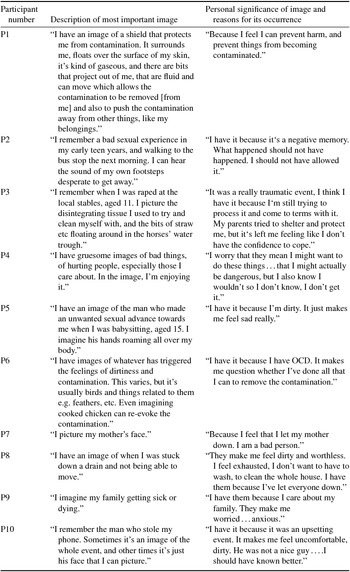
All 10 participants who reported experiencing imagery associated with contamination provided details regarding the characteristics of their most important image (index image) and its associated personal significance (see Table 1). Nine participants reported images that were involuntary intrusions and one reported an image that was voluntary and constructed in response to intrusive verbal thoughts about contamination. Participants reported that the vividness of their imagery varied, but on average they experienced images that were moderately clear, with a mean score of 5.90 (SD = 2.60) on a vividness rating scale of 0–10, where 0 = not at all and 10 = extremely. The form of the reported imagery was like a snap-shot for five participants and like a video-clip for the other five participants. Seven participants experienced their images from a field perspective, i.e. through their own eyes and three participants viewed their images as an outside observer.
Summary of participants’ most important image (Index Image) and associated personal significance

The qualitative data regarding participants’ index images were explored using thematic analysis. Eight key themes emerged: images of past and future events; multi-sensory experiences; image frequency and stability; impact of images; associated emotions; lack of control over images; behavioural consequences; and protective images. Each of these will be addressed in turn.
Images of past and future events
With regard to their most important image, seven participants described a mental image that was associated with a memory of a past event, e.g.
I remember when I was raped at the local stables, aged 11. I picture the disintegrating tissue I used to try and clean myself with, and the bits of straw etc. floating around in the horses’ water trough.
These images included memories of past negative events (including betrayals) and recalling the source of contamination. Two participants described images of future negative events, e.g. “I imagine my family getting sick or dying”, and one participant described a mental image that protected her from contamination.
Multi-sensory experiences
For all participants the primary sensory component of the index image was visual. All participants reported additional sensory components to their imagery. Four participants reported images accompanied by sounds and voices, e.g. the sound of their own footsteps running away. A further four participants experienced sensations in their bodies, e.g. feeling sick, a churning stomach, and a feeling of being generally uncomfortable; two participants experienced a tactile component to their mental image, e.g. feeling the hands of an abuser roaming over their body; and one participant reported olfactory sensations, e.g. the smell of faeces.
Image frequency and stability
The participants indicated that they experienced imagery regularly, ranging from “all the time” to “at least a few times a month”. Six participants reported that their index image occurred at least a 3 times a week.
The images reported were stable, with a mean rating of 7.70 (SD = 2.63) when asked to rate how similar the image was to previous occasions when they had experienced it (on a 0–10 scale where 0 = not at all, 10 = extremely). However, six participants reported that their image had changed in some way since its very first occurrence. For four participants the theme of the images was always the same but the exact content varied, and two participants reported elaborating the image with extra details over time. In addition to stability, participants reported imagery that was notably persistent. All participants reported that they had first experienced their most important image a long time ago, with six participants experiencing the same image for over 15 years. One participant described a mental image of a memory of a bad sexual experience that had occurred over 30 years previously.
Impact of images
Participants reported that their imagery moderately interfered with their day-to-day activities (M = 4.20, SD = 3.01 on a 0–10 scale where 0 = not at all, 10 = extremely), and six participants said that their life would be significantly different if they could be free of their image. In addition, six participants believed that their OCD would be better if they no longer experienced their contamination related imagery. The remaining four participants did not view their images as having a role in their OCD.
Associated emotions
The imagery reported by participants was distressing (M = 6.50, SD = 2.07 on a 0–10 scale of distress, where 10 = extremely) and was associated with a range of emotions. Participants reported that their imagery left them feeling sad, anxious, fearful, angry and dirty. Participants also reported feeling guilt, panic, shame, worthlessness and exhaustion when experiencing their imagery.
Lack of control over images
Nine participants highlighted a lack of control over their imagery. These participants reported that they could not control when they experienced images and said their index image would spontaneously pop into their mind. When asked to try to identify what triggered the index image, most participants (9/10) seemed perplexed saying things such as “it comes out of the blue” and “it just seems to be random”. The majority of participants (9/10) reported that they never deliberately thought about the mental image, or tried to intentionally construct it apart from describing it for the purpose of the interview. The exception was one participant who deliberately constructed a mental image of a shield in an attempt to protect herself from contamination.
Participants also reported that they found their imagery difficult to dismiss (M = 5.10, SD = 3.67 on a 0–10 scale where 0 = not at all, 10 = extremely), and six participants reported that they currently attempted various strategies to avoid thinking about the image, including pushing it away, counting, repetition and distraction. One participant reported imagining freezing her brain to stop herself from thinking about the image. These strategies were reported to have limited success in controlling the images (M = 3.40, SD = 1.14 on a 0–10 scale where 0 = not at all, 10 = extremely). The remaining four participants reported that they had tried to control their images in the past. They explained that when they had previously attempted to prevent the images from forming, the images had become more powerful and difficult to dismiss.
Behavioural consequences
When asked about the effect of their image of their behaviour, seven participants reported that they would take steps to prevent future contamination or the spread of contamination either by washing and cleaning, avoidance or by repeating actions and counting. An additional three participants reported checking behaviour and reassurance seeking in order to ensure that they were not currently contaminated. For nine participants, the index image left them with an urge to wash or clean and five participants engaged in actual washing as a direct consequence of their imagery frequently, or all of the time. For these participants, this washing was moderately beneficial in removing feelings of dirtiness and contamination (M = 5.40, SD = 3.37 where 0 = not at all, 10 = extremely); indeed one participant reported that “the only thing that works is completely immersing myself in water” – TH.
Protective images
Four participants reported experiencing helpful images that could ward-off or dilute feelings of contamination evoked by the index image. These images included happy memories, changing the negative image by viewing it in black and white, imagining a positive outcome of the event, and seeing the image from an observer perspective. Participants reported that these protective images were moderately effective in reducing contaminating images and their associated effects (M = 5.50, SD = 1.23 on a 0–10 scale where 10 = extremely). One participant explained that she would deliberately construct a mental image of a shield to protect herself from the contamination. She explained that she could control the shield in order to protect herself and her personal belongings e.g. her handbag or a piece of jewellery:
I have an image of a shield that protects me from contamination. It surrounds me, floats over the surface of my skin – it's kind of gaseous – and there are bits that project out of my, that are fluid and can move. . . which allows the contamination to be removed [from me] and also to push contamination away from other things like my belongings.
Discussion
The findings of this study indicate that people with contamination fears experienced intrusive imagery that was vivid, distressing, difficult to dismiss and generated urges to wash. Of the 15 participants interviewed, 67% experienced imagery when feeling contaminated, a finding comparable to the rates of imagery reported by patients with chronic pain (Philips, Reference Philips2011). With regard to the most important image, participants described images that were unwanted, vivid, stable and distressing. For seven participants, this image was associated with a memory, either of a time when they had previously felt contaminated, the source of contamination, or a negative event. This is similar to the findings of imagery experienced in OCD as reported by Speckens et al. (Reference Speckens, Hackmann, Ehlers and Cuthbert2007), and supports the hypothesis that people with a fear of contamination experience unwanted imagery as well as intrusive thoughts and impulses (Rachman, Reference Rachman2006).
The use of a semi-structured interview allowed for further in-depth questioning regarding imagery related to contamination. Many participants experienced imagery that was remarkably stable and persistent, lasting for many years. The images left participants feeling a variety of emotions including dirtiness, anxiety, sadness, anger, guilt, fear and shame, and in general were distressing to experience. As postulated by Rachman (Reference Rachman2007), the primary sensory component of the reported imagery was visual, but a number of participants also reported auditory, tactile and olfactory elements to their images. Further investigation of the sensory qualities of contamination related imagery would be interesting, with a particular focus on whether people can feel the contamination as part of their mental image.
The findings suggest that contamination imagery could influence behaviour. The majority of participants reported that they would engage in washing, cleaning and avoidance in order to prevent future contamination or the spread of contamination following an intrusive mental image. In addition, some participants reported that they would compulsively check or seek reassurance in order to be certain that they were not contaminated. Half of participants reported frequently engaging in actual washing as a direct consequence of experiencing their index image. This is consistent with the theory of mental contamination that postulates that internal events such as images can directly evoke feelings of contamination and compulsive washing (Rachman, Reference Rachman2006). The powerful effect of imagery on washing behaviour may be related to the finding that imagery has a more potent influence on emotion than verbal processing (Holmes and Mathews, Reference Holmes and Mathews2005; Holmes et al., Reference Holmes, Lang and Shah2009) and is consistent with findings of the casual influence of imagery on future behaviour (e.g. Libby, Shaeffer, Eibach and Slemmer, Reference Libby, Shaeffer, Eibach and Slemmer2007). Additionally, imagery related to contamination could be a form of TAF (Shafran et al., Reference Shafran, Thordarson and Rachman1996), i.e. it may be that for some people imagining being contaminated increases the chance that they will become contaminated, thus driving an urge to wash. Further research is needed to explore this hypothesis.
Participants reported imagery that was difficult to dismiss, despite engaging in various strategies to avoid thinking about it in detail, such as pushing it away, counting, repetition and distraction. The exception was a participant who described deliberately evoking an image of a protective shield, which protected herself and her possessions from contamination. Although this image was beneficial in reducing feelings of contamination and preventing its future spread, constructing it was mentally exhausting for her and it often increased her awareness of potential sources of contamination (see Coughtrey, Shafran, Lee and Rachman, Reference Coughtrey, Shafran, Lee and Rachman2013 for further details). Other participants reported deliberately thinking of images that could ward off or dilute their unwanted images. These images were reported to be reasonably effective in reducing the negative image and its associated effects; however, these images may only temporarily reduce distress and in the long-term reinforce the mental contamination fear. Further research is needed to ascertain whether these kinds of protective images are common amongst people with a fear of contamination, and whether they have any influence in maintaining OCD symptoms.
Further investigation of contamination imagery is needed, as it is likely that this may be useful in developing therapeutic techniques for the assessment and treatment of mental contamination. The assessment of unwanted intrusive mental imagery can be revealing and provide important information about the human source of mental contamination (Beck, Reference Beck1976; Coughtrey et al., Reference Coughtrey, Shafran, Lee and Rachman2013). Imagery rescripting, i.e. changing the content of negative images to promote more positive imagery, has long thought to be a useful therapeutic tool (e.g. Arntz, Reference Arntz2012; Edwards, Reference Edwards2007; Hirsch and Holmes, Reference Hirsch and Holmes2007; Holmes et al., Reference Holmes, Arntz and Smucker2007; Wild, Hackmann and Clark, Reference Wild, Hackmann and Clark2007). Further research is needed to establish whether rescripting unwanted intrusive images related to contamination is helpful in changing the meaning of contamination.
Limitations
This study has provided useful qualitative information regarding the nature of imagery associated with contamination. However, the sample size was small and replication is needed with a larger sample of OCD patients; this would allow comparison of contamination related imagery in people with a fear of contamination and other forms of OCD, as well as comparing the characteristics of people who experience contamination associated imagery with those who do not. In addition, future research should explore the influence of OCD symptom severity on intrusive imagery. In this study, all participants were currently receiving treatment for OCD; however, the nature of the intervention was not assessed and it is possible that participants receiving an imagery-focused treatment may have responded differently to the interview used in this study.
This study did not specifically address questions pertaining to TAF. Future studies would benefit from assessing this aspect of imagery in more depth, for example considering whether people with a fear of contamination who repeatedly imagine being contaminated believe that this increases the likelihood that they will become contaminated.
Due to the small number of participants in this study and the wide range of images reported, it was not possible to categorize the content and personal meaning of the images. Further research is needed to explore this issue.
An additional limitation of this study is that the analytic approach was subject to experimenter bias in the interpretation of participants’ responses. This study could have been improved by using an additional rater who was blind to the nature and purpose of the research to code participants’ answers. Further research is needed to establish the reliability and validity of the semi-structured interview used in this study.
Conclusions
These preliminary findings indicate that people with contamination fears experience intrusive images that evoke feelings of mental contamination in the absence of physical contact with a contaminant. These findings provide further support for the concept of mental contamination and indicate a potential target for treatment intervention via imagery rescripting to change the content and meaning of unwanted images. Further research is needed to explore the potential role of imagery in the maintenance of mental contamination fears, in particular the role of images used to neutralize feelings of mental contamination.
Acknowledgements
This research was supported by a University of Reading Pump Priming Fund awarded to Professor Roz Shafran. The work reported here formed part of a Ph.D. dissertation submitted to the University of Reading, May 2010. The authors are indebted to Simon Enright and Berkshire Healthcare Foundation NHS Trust for their support in this research. We would also like to thank Clare Philips for her helpful and insightful contributions to this manuscript.



Comments
No Comments have been published for this article.