Introduction
Youth mental health is a significant public health concern in Ireland with approximately one in five Irish children meeting the criteria for a mental health disorder (College of Psychiatrists of Ireland, 2005) while youth suicide rates are among the highest in Europe (HSE, 2005) and rates of self-harm continue to rise (National Registry of Deliberate Self Harm, 2010). Despite this, young people are often reluctant to engage in mental health services (National Registry of Deliberate Self Harm, 2005) possibly for reasons of stigma (World Health Organisation, 2003) or hesitance to talk about emotional difficulties. Recent youth mental health initiatives have supported the development of child friendly services (Headstrong, 2010) and encouraged the use of creative approaches to promote engagement (National Registry of Deliberate Self Harm, 2005). Group work can promote attendance with evidence suggesting that adolescents are more likely to engage with groups that are non-pathological, activity driven and future orientated rather than problem focused (Goldberg et al. Reference Goldberg, Evans and Hartman2001).
Music has been shown to have associated positive health benefits across the lifespan from premature infants (Standley, Reference Standley2002) to palliative and dementia care (Brown et al. Reference Brown, Gotell and Ekman2001) while music and other arts-based cultural activities have been shown to have health benefits in non-clinical community populations (Konlaan et al. Reference Konlaan, Bjorby, Bygren, Weissglas, Karlsson and Widmark2000; Gridley et al. Reference Gridley, Astbury, Sharpples and Aguirre2011).
There is a body of research to support the positive benefits of music-based psychological interventions in the treatment of psychiatric conditions. Randomised controlled trials comparing adjunctive music therapy to treatment as usual alone in acutely psychotic in-patients have shown positive effects with regard to positive and negative symptoms (Talwar et al. Reference Talwar, Crawford, Maratos, Nur, McDermott and Procter2006; Ulrich et al. Reference Ulrich, Houtmans and Gold2007) while a similar improvement in negative symptoms has been shown in chronically psychotic groups who also have access to musical-based interventions (Brown & Schofield, Reference Brown and Schofield1991; Yang et al. Reference Yang, Zheng, Yong-Zhen, Hong Yi and Bio1998). On the strength of this evidence, music and arts therapies have been recognised in the National Institute for Clinical Excellence guidelines as helpful adjuncts to treatment in the management of Schizophrenia (National Institute for Clinical Excellence, 2009).
Music has also been shown to be beneficial in the management of depression. A recent randomised controlled trial compared standard care plus music therapy with standard care alone. There was a greater reduction in mood-related outcome measures in the music group (Erkkilä et al. Reference Erkkilä, Punkanen, Fachner, Ala-Ruona, Pöntiö, Tervaniemi, Vanhala and Gold2011).
Music clearly plays an important role in the lives of young people. A recent music industry survey of 14–25 year olds found that 81% considered live and recorded music to be an essential aspect to their lives, ahead of mobile phones, film and sport even as expenditure on recorded music has fallen with easy, free online access (Collopy & Bahanovich, Reference Collopy and Bahanovich2012). Music provides entertainment and escapism with research finding that adolescents listen to music for an average of two and three-quarter hours a day (North et al. Reference North, Hargreaves and O’Neill2000) and that mood management and regulation are important factors in listening to music across the lifespan (Lonsdale & North, Reference Lonsdale and North2011). Music can also provide social opportunities and in the case of the youth tribe phenomenon associated with certain musical subcultures, identity and peer group (Roe, Reference Roe1999). Some authors have suggested that adolescents select music that is complimentary to a particular developmental challenge such as individuation or navigating peer and romantic relationships (Schwartz & Touts, Reference Schwartz and Fouts2001). It should therefore be reasonable to consider that a music group would serve as creative and youth friendly way of promoting engagement with mental health services. This study was developed as a pilot project to assess the feasibility of running a music group at the Lucena Clinic Rathgar, a tier three out-patient Child and Adolescent Mental Health Service (CAMHS).
Method
An ethics application was made to the Saint John of God’s Provincial Ethics Committee and approval was granted in April 2012. The study was designed as a non-randomised feasibility pilot with no control group. Recruitment was from clients aged 15–18 currently on the caseload of the clinic. Fifteen young people were invited to participate on the recommendation of clinic staff who identified young people on their caseloads who were interested in listening to or playing music. Young people who were acutely psychotic or actively suicidal were not considered for the group. Six expressed an interest in attending with one dropping out before the start of the study. Informed written consent for participating in the study as well as for audio recording was obtained from parents and participants. To obtain feedback on the group, a study specific questionnaire was designed asking the young people to rate the group out of ten in several areas including enjoyment and helpfulness with self-confidence, mood, musical ability, mental health, concentration, social skills and motivation. This questionnaire was given to the young people to complete at the end of the project and additionally invited qualitative comments on the group. Baseline and follow up Strengths and Difficulties Questionnaires were completed to gain a measure of general mental health and functioning.
Five young people attended the group on a regular basis, four male and one female. The group was diagnostically heterogeneous with some co-morbidity and included young people with attention deficit hyperactivity disorder, autistic spectrum disorder, major depressive disorder, body dysmorphic disorder and adjustment disorder. Treatment as usual for all the young people continued for the duration of the group.
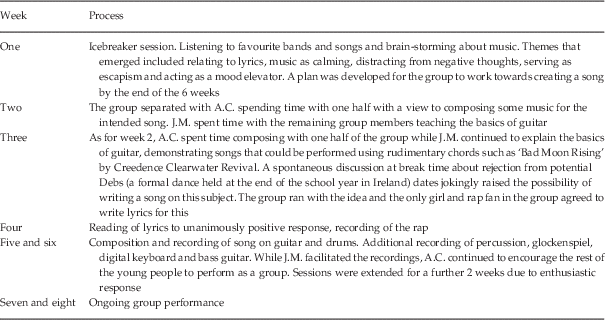
The intervention was a weekly group music session lasting approximately 90 minutes. It was initially scheduled to run for 6 weeks but was extended to 8 weeks due to the enthusiastic response. Equipment was provided by the facilitators (J.M. and A.C.) including guitars, drums, percussion instruments and electronic recording equipment. Some of the young people also brought along their own instruments. Across the 8 weeks the group discussed and listened to their favourite music, learned to play guitar, bass and percussion and composed and recorded their own music. A piece composed and recorded by the group accompanied an exhibition of paintings by another group of young people attending the clinic. Table 1 describes the schedule and structure of the 8 weeks.
Summary of group sessions

Results
Feedback from the study specific questionnaire reflected that the young people enjoyed playing and learning about music with peers. All were interested in music before the group but most had not previously played or performed in a group and appreciated the opportunity to do so in a supportive environment. With regard to mental health-related difficulties the group felt that the intervention was most beneficial with improving their mood, self-confidence and social skills. They felt the group was least helpful with impacting concentration difficulties. Three out of the five young people attending had a reduction in Strengths and Difficulties Questionnaire scores on follow-up.
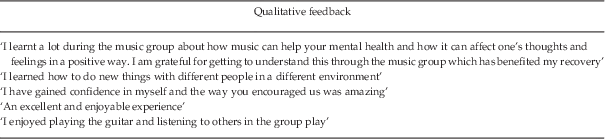
Qualitative feedback from the young people when asked for comments on their experience in the group is included in Table 2. Themes that emerged included enjoyment, positivity, managing thoughts and feelings, confidence, encouragement and recovery. Benefits derived from attending the group appear to be related to the process of playing music, interacting with peers in a structured group setting and reflecting on the effect of music on emotional states.
Statements from qualitative feedback
Discussion
Five young people aged 16–18 attended a regular music-based group intervention over the course of 8 weeks. They indicated that the group was an enjoyable experience. It took place on a regular basis over a period of 2 months and involved social interaction and working collaboratively. It allowed a group of young people with vulnerabilities towards mental health difficulties to experience a peer-based activity that was mood elevating and confidence building.
They had the opportunity over a short period of time to gain basic competencies in an activity that may previously have appeared daunting. It is reasonable to suggest that this will have positive, protective effects on self-esteem.
Reported positive impact on mood is in keeping with existing literature which supports both listening to and playing music as a mood regulating agent (Saarikallio & Erkkila, Reference Saarikallio and Erkkila2007), possibly through a process of behavioural activation (Maratos et al. Reference Maratos, Crawford and Proctor2011). A small number of randomised controlled trials have shown positive benefits of combination music and psychotherapy compared to treatment as usual in children, with higher rates of remission of anxiety disorders (Goldbeck & Ellerkamp, Reference Goldbeck and Ellerkamp2012) and a reduction in Child Behaviour Checklist scores (Gold et al. Reference Gold, Wigram and Berger2001)
From the point of view of a CAMHS, several benefits to the group emerged. It provided a youth friendly, non-clinical and safe environment that represented a space away from intense therapy sessions or medication reviews. Accordingly, discussion around mental illness did not occur with the frequency one might have expected beyond the introductory icebreaker session and one brief discussion about medication for attention deficit hyperactivity disorder. As the intention was to allow the group to be guided as far as possible by the young people, this was not actively encouraged by the facilitators. Lack of conversation on mental health topics may have been due to the teenagers’ natural reluctance to appear embarrassed in front of peers. The qualitative feedback however suggests that at least some of the group members were considering their mental health difficulties in the context of the music group and perhaps if given more clear encouragement, such discussions may have occurred.
A similar piece of work with Korean adolescent girls found that across six sessions with appropriate support, group members were able to discuss personal information and emotional difficulties (Kim et al. Reference Kim, Kverno, Lee, Park, Lee and Kim2006). There are potential benefits and risks to this. Discussing such information in a group setting would require due attention be given to confidentiality, containment and risk management of the material that did emerge. Likewise, focusing more explicitly on mental illness can pathologise the group which risks reducing the appeal of the intervention to adolescents (Goldberg et al. Reference Goldberg, Evans and Hartman2001). Conversely, the music may provide a forum for non-verbal expression of difficult emotions, or suitable distraction to allow for a safe environment to facilitate such discussions (Tervo, Reference Tervo2001). Future work may seek to find a way to reconcile these competing interests.
For those engaged in treatment elsewhere in the clinic, for example in cognitive behavioural therapy, groups provide an excellent and again safe environment for homework and exposure exercises. For clinicians, the music group environment provides an opportunity to observe patients among peers in a setting separate from the out-patient clinic which could potentially be helpful in ongoing assessment.
Some research suggests music-based group interventions can help improve interpersonal skills in adolescents (Tervo, Reference Tervo2001) and with regard to young people with autistic spectrum disorders there is evidence to support improvements in social skills and verbal and non-verbal communication (Gold et al. Reference Gold, Wigram and Elefant2006). This group allowed opportunities for young people to practice social interaction in a new setting and in the activity of creating music together, experience a new way of connecting with peers. The informal setting of the group allowed young people to have an alternative experience of interacting with adults not in a position of authority and clinicians not in a formal therapeutic role, promoting social development and possibly contributing to the sense of improved self-confidence.
With regards to feasibility and demand, the positive feedback suggests that the group was a welcome and acceptable intervention. Once the group started there was no intentional drop out, with any missed sessions being due to school exams, family holidays or other obligations rather than dissatisfaction with the group.
For the duration of the group, none of the young people attending missed other scheduled appointments within the clinic suggesting that the group may help promote attendance. Lower drop-out rates and ongoing engagement in care in music allocated groups in randomised controlled trials into the efficacy of music therapy in schizophrenia and depression (Talwar et al. Reference Talwar, Crawford, Maratos, Nur, McDermott and Procter2006; Erkkilä et al. Reference Erkkilä, Punkanen, Fachner, Ala-Ruona, Pöntiö, Tervaniemi, Vanhala and Gold2011) suggest that this may be the case. This is particularly relevant when considering the ongoing problems highlighted by non-attendance in CAMHS (HSE, 2012).
Of the 15 young people invited to attend, 12 were male and three were female. The participation was predominantly male with a four to one male:female ratio in the group. The higher proportion of males may reflect a referral bias and possibly an open invitation to all the young people of relevant age in the clinic may have resulted in more females attending.
The over representation of males in the group raises interesting questions regarding the engagement of young men with mental health services. Irish and international literature continues to highlight ongoing stigma and reluctance among young men to engage in services (Chandra & Minkovitz, Reference Chandra and Minkovitz2006; Burke et al. Reference Burke, Kerr and McKeown2008) and while it is unclear why young men were more likely to take up the offer of the group, music may represent a helpful tool in engaging this often difficult to access demographic. Creative interventions such as music or art groups may help to challenge preconceptions that young people and families may hold about attending CAMHS and serve to a challenge some of the stigma still associated with attending services.
The group was run without the input of any external agencies and therefore without any extra expense beyond the staff already employed and as such is a low cost, time limited intervention that could be potentially rolled out at short notice. It could be easily replicated within different teams and services where there is staff with some level of musical expertise but no access to a music therapist.
Limitations of this study are the low numbers, lack of a control group and its exploratory nature. It is difficult to draw conclusions about the therapeutic value of the intervention. The heterogeneous nature of the group also makes it difficult to infer if music is more beneficial in any particular patient group. Future work on a more homogenous group, for example mood disorders may shed more light on this.
Conclusions
The outcome of this study suggests that a music group can be a positive intervention in a CAMHS setting with potential benefits for patients and the service as a way of working and as a way of promoting attendance and engagement. Further work is required to fully assess the benefit of music as a therapeutic option in the treatment of specific mental health disorders of childhood and adolescence.
Acknowledgement
The authors would like to extend their thanks to the young people who participated in this project and their families.