

Introduction
Temperate grasslands are among the most threatened ecosystems worldwide, having suffered extensive conversion to croplands and pastures over the last centuries (Watson et al. Reference Watson, Jones, Fuller, Marco, Segan and Butchart2016). As a consequence, grassland-dependent birds have experienced some of the steepest and most consistent population declines among avian guilds globally (Brennan and Kuvlesky Reference Brennan and Kuvlesky2005). In South America, the native grasslands of the Pampas, Espinal, Campos, and Cerrado regions have been dramatically reduced and fragmented, leading to the decline and fragmentation of several endemic and specialist bird species (Azpiroz et al. Reference Azpiroz, Isacch, Dias, Di Giacomo, Fontana and Palarea2012b; Dias et al. Reference Dias, Bastazini, Gonçalves, Bonow and Müller2013).
In this scenario, it is essential to keep conservation assessments up to date to prioritise actions, guide effective responses, and raise public awareness about the critical environmental situation of the biome and its biodiversity. The International Union for Conservation of Nature (IUCN) Red List plays a crucial role in informing governments, NGOs, and funding agencies about the risk of extinction for various species. This information helps to mobilise legal protections, research efforts, and habitat conservation initiatives. However, for many grassland birds, including several endemic species in the Southern Cone, key data such as population size, distribution, and trends are often outdated or incomplete, which may delay necessary conservation actions.
The Pampas Meadowlark Leistes defilippii is a globally threatened species, restricted to the open grasslands of south-eastern South America. It formerly inhabited the Pampas of eastern Argentina, Uruguay, and extreme southern Brazil (Ibáñez and Grisolía Reference Ibáñez, Grisolía, Dalia, Bauni, Homberg and Giacchino2023; Short Reference Short1968), and historically was mentioned as one of the most abundant and distinctive birds of the Pampas (Doering et al. Reference Doering, Berg and Niederlein1881; Hudson Reference Hudson1920). The species has suffered a significant contraction, resulting in a 90% loss of its original range (Neyra et al. Reference Neyra, Berkunsky, Grilli and García Fioretti2024; Tubaro and Gabelli Reference Tubaro and Gabelli1999). This contraction was associated with the degradation and conversion of natural grasslands driven by the rapid development and expansion of agricultural and livestock activities in the last century (Azpiroz and Blake Reference Azpiroz and Blake2009; Fernández et al. Reference Fernández, Posse, Ferretti and Gabelli2004). Further decline in range and number is expected if this productive model remains unchanged, because the Pampas region continues to lose grasslands due to the intensification of agriculture and livestock farming, added to the threat of new technologies and new climatic scenarios favouring agricultural expansion, and the fact that there is not a single Protected Area that harbours Pampas Meadowlark populations (Azpiroz et al. Reference Azpiroz, Isacch, Dias, Di Giacomo, Fontana and Palarea2012b; Baeza et al. Reference Baeza, Vélez-Martin, De Abelleyra, Banchero, Gallego and Schirmbeck2022).
Despite the Pampas Meadowlark being considered as ‘Extinct’ in Brazil, and ‘Endangered’ in both Uruguay (EN B1a+b(i,ii,iii)+c(ii)+ 2a+b(i,ii,iii)+c(ii)) and Argentina (EN A4ac, B1ab(i,ii), C1), it is currently classified as ‘Vulnerable’ (A2bc+3bc+4bc) at the global level (Azpiroz et al. Reference Azpiroz, Alfaro and Jiménez2012a; BirdLife International 2020; ICMBio/MMA 2018; Ministerio de Ambiente y Desarrollo Sustentable and Aves Argentinas 2017). A recent severe population decline within the most important stronghold of the Uruguayan subpopulation suggests that the species will fulfil ‘Critically Endangered’ criteria in future updates of the Uruguay Red List (Azpiroz and Cozzani Reference Azpiroz, Cozzani, Azpiroz, Jiménez and Alfaro2018). A comparative study between 1996 and 2011–14 in Argentina estimated a considerable population reduction of nearly 90% (Meriggi et al. Reference Meriggi, Ibáñez and Aguirre2013, Reference Meriggi, Ibáñez and Aguirre2014). Unfortunately, the latter value was incorrectly considered, resulting in an inaccurate assessment, first at the national level and then internationally (BirdLife International 2020; Ministerio de Ambiente y Desarrollo Sustentable and Aves Argentinas 2017). The information about the range and population size of the last reassessments is outdated (BirdLife International 2020). In the present study, we assessed and updated estimates of population size, Extent of Occurrence (EOO), Area of Occupancy (AOO), and conservation and Green Status of the Pampas Meadowlark. Herein, we also propose a set of conservation actions appropriate to this new assessment.
Methods
Generation length
Generation length is a key parameter needed to assess population decline, and it can be estimated with a combination of three population parameters (i.e. maximum age, survival, and fecundity). We used the Generation Length Workbook from the IUCN Red List guidelines to estimate generation length, following the guidelines of the IUCN Standards and Petitions Committee (2024). We used a maximum age of 10 years based on a reported leg-banded individual from Uruguay (Azpiroz and Cozzani Reference Azpiroz, Cozzani, Azpiroz, Jiménez and Alfaro2018). We obtained new information on the minimum reproductive age from sightings of leg-banded individuals in Argentina (M.C. Neyra, personal observations). We used three values of the annual survival rate: as with other grassland birds, and based on reported values of nesting success, we assumed a low survival rate of 0.2 during the first year (including nest survival, fledgling success, and the first months as juveniles), a medium survival rate for the second year (i.e. 0.5), and a constant survival rate of 0.8 for adults from ages 2–9 years (Cozzani et al. Reference Cozzani, Sánchez and Zalba2004; Neyra et al. Reference Neyra, Berkunsky, Grilli and García Fioretti2024). We defined fecundity as the average number of eggs laid per female per year. Based on reported values and trying to capture the variability in fecundity by age, we assigned lower values to young and old females. We set two eggs for ages 1, 8, and 9; three eggs for ages 2, 6, and 7; four eggs for ages 3, 4, and 5.
Subpopulations
We considered three geographically and biologically isolated subpopulations, between which no exchange of individuals was expected due to habitat discontinuity and species’ site fidelity (Azpiroz and Cozzani Reference Azpiroz, Cozzani, Azpiroz, Jiménez and Alfaro2018). The south-western subpopulation (i.e. the Argentine subpopulation) is separated by more than 700 km and is genetically distinct from the two remaining subpopulations in the north-eastern Pampas, specifically the Uruguayan subpopulations (Azpiroz and Cozzani Reference Azpiroz, Cozzani, Azpiroz, Jiménez and Alfaro2018; BirdLife International 2020; Repetto Reference Repetto2017). The two north-eastern subpopulations are relatively close to each other, and in previous assessments, they were considered as one (BirdLife International 2020). However, proximity is not always a guarantee of genetic or demographic connectivity (IUCN Standards and Petitions Committee 2024). As occurs in different species with very high fidelity to both natal and breeding sites, there could be few dispersers among subpopulations within the breeding range, making it necessary to recognise multiple subpopulations (IUCN Standards and Petitions Committee 2024).
North-eastern subpopulation sizes (Uruguay)
Defining subpopulations in Uruguay is particularly challenging given the scarcity of data and the fragmented distribution of the species in this region. To address this, we relied on the consensus of local specialists and field experts, who agreed that the most consistent approach was to distinguish two subpopulations in Uruguay: (1) the northern subpopulation, composed of two spatially close groups located north of the Río Negro, and (2) the southern subpopulation, represented by the group in the department of Flores, south of the Río Negro.
The historically most abundant subpopulation in Uruguay resides north of the Rio Negro River, split into two groups, the largest in the Arerunguá area of the Salto department, and a second group in the Tacuarembó department. In 2003, the first population estimate reported a range of 78–90 pairs in Arerunguá, equivalent to 156–180 mature individuals (Table 1; Azpiroz Reference Azpiroz2005; Azpiroz and Cozzani Reference Azpiroz, Cozzani, Azpiroz, Jiménez and Alfaro2018). However, a detailed survey in this region (south-east Salto and neighbouring north-east Paysandú departments, 2004–2015) estimated 150–200 pairs (corresponding to 300–400 mature individuals; Azpiroz and Cozzani Reference Azpiroz, Cozzani, Azpiroz, Jiménez and Alfaro2018; Azpiroz et al. Reference Azpiroz, Alfaro and Jiménez2012a). The main Arerunguá breeding site had 100–140 pairs during the 2004–2015 period (Table 1; Azpiroz and Cozzani Reference Azpiroz, Cozzani, Azpiroz, Jiménez and Alfaro2018). The habitat at Arerunguá has deteriorated, and the number of detected individuals has fluctuated. In the 2016 breeding season, only five breeding pairs were recorded in the main Arerunguá breeding site (Azpiroz and Cozzani Reference Azpiroz, Cozzani, Azpiroz, Jiménez and Alfaro2018). During the 2017 breeding season, 15–20 pairs, along with a post-breeding group of approximately 120 individuals (many of which were juveniles), were observed in the area (Azpiroz and Cozzani Reference Azpiroz, Cozzani, Azpiroz, Jiménez and Alfaro2018). The second group was detected in 2013 in the Tacuarembó department, c.100 km south of Arerunguá and 130 km north of Flores (S. Carvalho in Azpiroz and Cozzani Reference Azpiroz, Cozzani, Azpiroz, Jiménez and Alfaro2018); at this site, 50–70 individuals were recorded (Table 1). The Tacuarembó group was included as part of the subpopulation that inhabits north of the Rio Negro River. Between 2019 and 2022, we visited the Tacuarembó site every three or four months and searched for Pampas Meadowlarks in natural grasslands.
Maximum numbers of estimated mature individuals of Pampas Meadowlark in north-eastern subpopulations (Uruguay; Azpiroz and Cozzani Reference Azpiroz, Cozzani, Azpiroz, Jiménez and Alfaro2018). The inclusion of both maxima aimed to illustrate temporal variation in reported counts and provide a conservative baseline
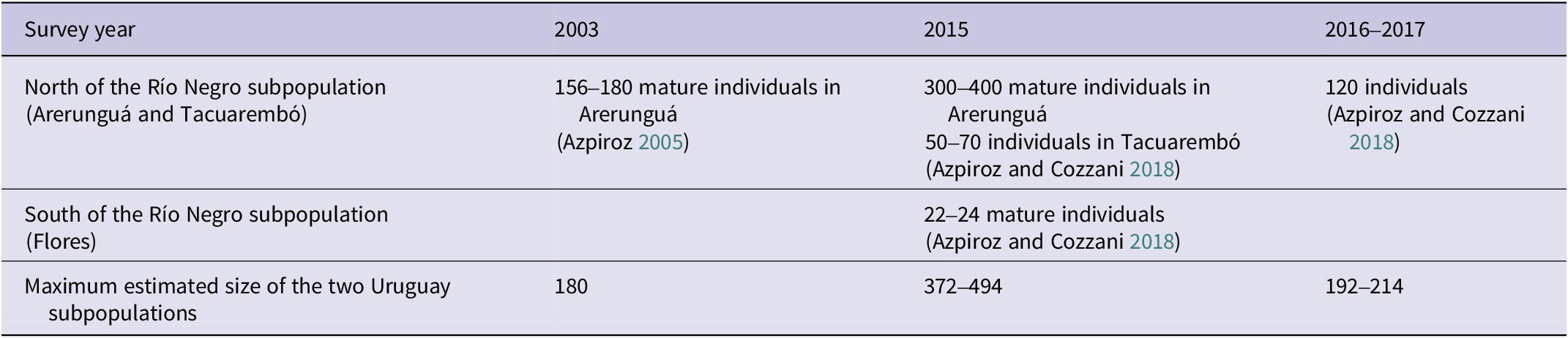
The second subpopulation, comprising 22–24 mature individuals, was discovered in 2012 south of the Rio Negro River, in the Flores department (J.C. Rudolf and S. Carvalho in Azpiroz and Cozzani Reference Azpiroz, Cozzani, Azpiroz, Jiménez and Alfaro2018). Between 2019 and 2025, we visited the Flores department every month. Most of the landscape in this region is dominated by agricultural activities (e.g. soyabean, wheat, sorghum, and pastures). We conducted surveys in all the land-use types.
To obtain current subpopulation sizes, we summed the maximum number of reported and detected individuals in each group between 2020 and 2023. The nature of this evidence allowed us to consider it as estimated in terms of the IUCN (IUCN Standards and Petitions Committee 2024).
South-western subpopulation size (Argentina)
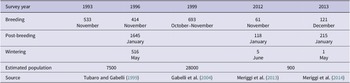
Estimates for population size in the south-western subpopulation resulted in: (1) c.7,500 individuals in 1992–1996 (Tubaro and Gabelli Reference Tubaro and Gabelli1999); (2) 28,000 individuals in 1999 (Gabelli et al. Reference Gabelli, Fernández, Ferretti, Posse, Coconier and Gavieiro2004); (3) 900 individuals in 2011–2014 (Table 2; Meriggi et al. Reference Meriggi, Ibáñez and Aguirre2013, Reference Meriggi, Ibáñez and Aguirre2014).
Reported values of the maximum number of detected Pampas Meadowlarks and reported population estimates for the south-western subpopulation (Meriggi et al. Reference Meriggi, Ibáñez and Aguirre2013; Reference Meriggi, Ibáñez and Aguirre2014; Tubaro and Gabelli Reference Tubaro and Gabelli1999)
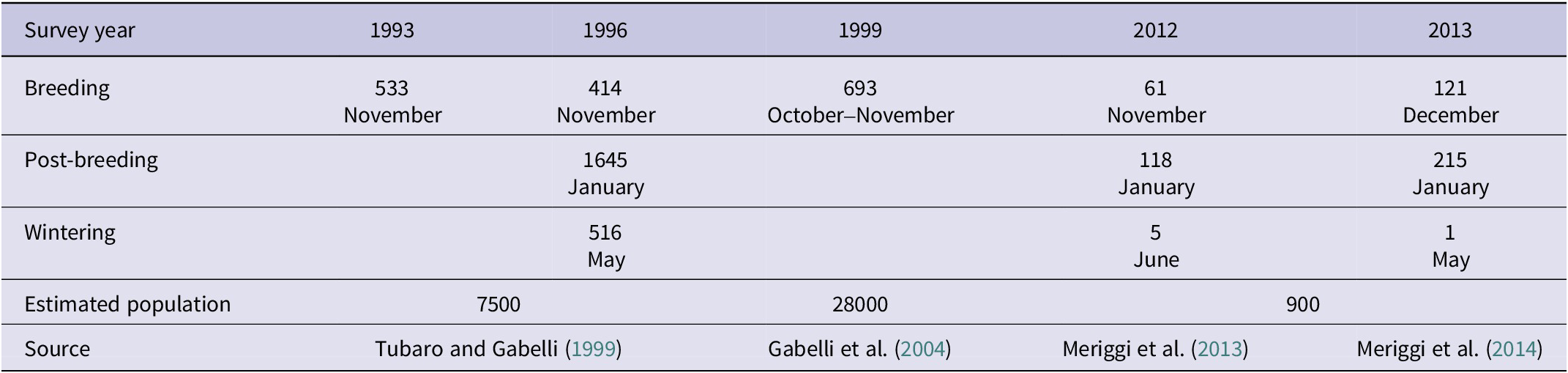
However, the Argentinian Red List states that the 1999 population estimate was an overestimation and that surveys in 2011–2014 found a population size 10% smaller than that estimated in 1992–1996 (citing Meriggi et al. Reference Meriggi, Ibáñez and Aguirre2013, Reference Meriggi, Ibáñez and Aguirre2014), which would approximately equate to 4,500 mature individuals (Ministerio de Ambiente y Desarrollo Sustentable and Aves Argentinas 2017). A thorough analysis of these reported numbers suggests that an error occurred. The Meriggi et al. cited references mentioned “tan solo un 12% de lo registrado por Tubaro y Gabelli (1996)”, which means that the population size they found represents 12% of the total number recorded by Tubaro and Gabelli in 1996, instead of a 10% reduction. The numbers reported in Meriggi et al. (Reference Meriggi, Ibáñez and Aguirre2014) are consistent with an 88% decline. The last assessments of the Pampas Meadowlark used an incorrect reported value (i.e. 5,000 individuals instead of 7,500 for the reported population estimate by Tubaro and Gabelli in 1999), overestimating the size of Argentina’s subpopulation (BirdLife International 2020).
In 2017, the Argentinian Red List also stated that the current population in Argentina was fewer than 2,500 mature individuals, but the basis of this estimate is not described (Ministerio de Ambiente y Desarrollo Sustentable and Aves Argentinas 2017).
To facilitate the comparison of population size and decline, we replicated the same transects and methodology used by Tubaro and Gabelli (Reference Tubaro and Gabelli1999) and Meriggi et al. (Reference Meriggi, Ibáñez and Aguirre2013, Reference Meriggi, Ibáñez and Aguirre2014). We conducted three road censuses along the same path in November 2021 (breeding), April 2022 (post-breeding), and August 2022 (wintering) in the south-western part of the province of Buenos Aires and the adjacent areas of the province of La Pampa. We compared the maximum number of individuals detected in the breeding and post-breeding surveys and described the decline with linear equations. We used Delaunay triangles to estimate the minimum area between all records in each period survey (i.e. 1992–1993–1996; 2013–14; 2021–2022).
Additionally, between July 2021 and January 2025, we conducted 10 exploratory trips across the whole south-western Pampas region. We actively searched for individuals during these trips, recording the number of individuals detected at each site and trip. We combined all the information gathered during these trips with the reported numbers of Pampas Meadowlarks at some of these sites for the same period (Álvarez et al. Reference Álvarez, Cozzani, Zalba and Tizón2024a, Reference Álvarez, Cozzani, Zalba and Tizónb; Petracci et al. Reference Petracci, Long, Carrizo and de Villalobos2023).
To obtain the subpopulation size estimate, we summed the maximum number of detected individuals on each site, assuming the individuals did not move considerably between sites. The latter is a reasonable assumption based on the behaviour of Pampas Meadowlark (C. Neyra, personal observations). The nature of this evidence allowed us to consider it estimated in the terms of IUCN (IUCN Standards and Petitions Committee 2024).
Temporal windows and rationale
We used distinct, analysis-specific time windows: (1) 2019–2025 for curated occurrence records, i.e. eBird, Global Biodiversity Information Facility (GBIF), iNaturalist, EcoRegistros, to estimate EOO/AOO, balancing timeliness with adequate sample size after applying misidentification filters; (2) 2021–2025 for intensive field surveys aimed at detecting occupied patches and validating presence across the south-western Pampas; (3) 2021–2022 for replicated road censuses designed to match the 1990s protocol and enable like-for-like comparison with Tubaro and Gabelli (Reference Tubaro and Gabelli1999); (4) 2020–2023 to derive current group-level maxima in Uruguay and compute subpopulation totals, coinciding with the period of systematic visits and comparable coverage. Each window is reported alongside the corresponding analyses and figures.
Subpopulation trends
Breeding-season counts expressed as pairs were converted to mature individuals as N = 2 × pairs. Post-breeding flock counts that included juveniles were converted using a conservative age-structure correction (following Tubaro and Gabelli Reference Tubaro and Gabelli1999), assuming ~0.33 immatures: N (mature) = 0.67 × flock size. When both types of counts were available for the same group/season, we prioritised adult-only or pair-based estimates. We avoided double-counting by not summing non-independent detections within a season.
We utilised the Criterion A tool, the Population Reduction Calculator from the IUCN Red List guidelines to calculate population and subpopulation size reductions over the past three generations (IUCN Standards and Petitions Committee 2024). We used a linear decline to calculate population reduction. This option is preferable to an exponential decline in cases where a species is threatened by habitat loss, and a similar-sized area of habitat is lost annually (IUCN Standards and Petitions Committee 2024).
Geographical range
To estimate the Pampas Meadowlark’s current geographical range, we compiled all reported sightings in public databases between 2019 and 2025, as well as our field observations from 2021 to 2025. Databases consulted included iNaturalist, GBIF (GBIF 2025), eBird (eBird 2025), and EcoRegistros (EcoRegistros 2025).
In the south-western subpopulation, the Pampas Meadowlark shares the habitat with another similar and much more common bird, the Long-tailed Meadowlark Leistes loyca. An inexperienced birdwatcher could easily confuse the two species. The Pampas Meadowlark is a gregarious bird species, and it is rare to find a pair alone. Most of the cases of reported lonely Pampas Meadowlark individuals or pairs in the region are Long-tailed Meadowlarks (C. Neyra, personal observation). To reduce errors associated with misidentification, we used group size as a filter for the database records by keeping records of groups of five or more individuals of reported Pampas Meadowlarks.
We estimated a disjunct EOO using the α-hull method (IUCN Standards and Petitions Committee 2024). We obtained the area of the EOO by summing the area of all remaining triangles after excluding discontinuities larger than a discontinuity distance of twice the average distance between map points of occurrence (i.e. α = 2). To estimate the AOO, we followed the IUCN recommendation using 2 × 2 km grid cells, with an area of 4 km2. We estimated the AOO by counting the number of occupied 2 x 2 km grid cells and multiplying by 4 km² per cell (IUCN Standards and Petitions Committee 2024). We used QGIS for all geospatial analysis.
Conservation and Green Status assessments
Based on the updated information, we applied the IUCN criteria version 3.1 to assess extinction risk (IUCN Standards and Petitions Committee 2024). We focused on the rate of population decline (Criterion A), the geographical range, number of locations, and continued decline (Criterion B), as well as the decrease in the number of mature individuals per subpopulation (Criterion C) (IUCN Standards and Petitions Committee 2024). Additionally, we evaluated the Green Status to quantify the species’ recovery in different scenarios (IUCN 2021). Both assessments are related and complement each other to inform the conservation status of a species (IUCN 2021).
For the Green Status assessment (IUCN 2021), we delineated spatial units to quantify representation and functionality across the species’ indigenous range. Spatial units were derived from eco-regional subdivisions of the Pampas ecoregion (Griffith et al. Reference Griffith, Omernik and Azevedo1998), refined to reflect biogeographical breaks and management relevance. We emphasise that these spatial units are assessment units for Green Status and are not equivalent to demographic subpopulations used under Red List Criteria A–C.
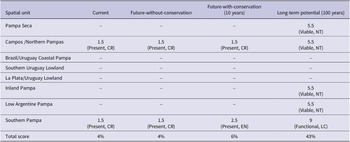
We overlaid the indigenous range (sensu historical records; see Tubaro and Gabelli Reference Tubaro and Gabelli1999) on the eco-regional map and scored only those units that overlapped the indigenous range (Figure 1). Units outside the indigenous range were displayed for geographical context but not scored. Following IUCN (2021), each scored unit was assigned a fine-resolution state value: Absent = 0, Present = 1.5, Viable = 5.5, Functional = 9. We computed the species’ Green Score for the Current, Future-with-conservation (10 years), Future-without-conservation (10 years), and Long-term potential (100 years) scenarios using these unit-level scores and the standard Green Status aggregation procedure (IUCN 2021). The Conservation Gain is the difference between Current and Future-with-conservation Green Scores.
Indigenous and current range, and Green Status spatial units (based on ecoregions and subregions; Griffith et al. Reference Griffith, Omernik and Azevedo1998) used to score the Pampas Meadowlark. Units overlapping the indigenous range were scored; units outside are shown for context and assigned 0 (Absent).

Results
Generation length
In 2023, in Argentina, we observed a nesting leg-banded individual that was marked in 2022 as a fledgling. We used this observation to set age one as the minimum reproductive age. The estimated generation length was 5 years. Consequently, a three-generation period for the Pampas Meadowlark lasts at least 15 years.
Subpopulation sizes
North-eastern subpopulation
Based on the most recent available information (i.e. data on new populations and current land-use trends in Uruguay, particularly in Arerunguá) as of 2022, we estimated 230 mature individuals for the three Uruguayan groups: 100 mature individuals in Arerunguá, between 10 and 12 in Tacuarembó, and between 25 and 70 in Flores.
Assuming the population size of the north-eastern subpopulations declined from 372–494 mature individuals estimated in 2015 to 135–182 mature individuals in 2022, the linear rates of decline for the two north-eastern subpopulations would equate to reductions higher than 80% over the last three generations.
South-western subpopulation size
The highest number of Pampas Meadowlarks counted across road surveys was 127 individuals in 14 observation sites during the 2021 breeding season, 85 individuals in three observation sites during the 2022 post-breeding season, and 87 individuals in 14 observation sites during the 2022 winter season. We found individuals in 26 different observation sites. Comparing our results with reported values from the 1993 and 1996 surveys, we estimated a 95% reduction in the maximum number of detected Pampas Meadowlarks in the post-breeding season (1996 vs 2022) and a 75% reduction in the breeding season (1993 vs 2021) (Tubaro and Gabelli Reference Tubaro and Gabelli1999). If we consider the estimated 7,500 mature individuals from 1996, a population decline of between 75% and 95% would result in 375–1,875 Pampas Meadowlarks in the south-western Pampas subpopulation. The reduction in the range of sites with detection of Pampas Meadowlarks in the south-western area was 80% (9,030 km2 in 1996 vs 1,939 km2 in 2021/2022; Figure 2).
Comparison of minimum convex polygons (MCPs) of Pampas Meadowlark observation sites along surveyed roads for 1992–1996 (Tubaro and Gabelli Reference Tubaro and Gabelli1999) versus the replicated road census in 2021–2022 (this study) in the south-western Pampas. Orange lines: census routes; red dots: detections; green polygons: MCPs by period.
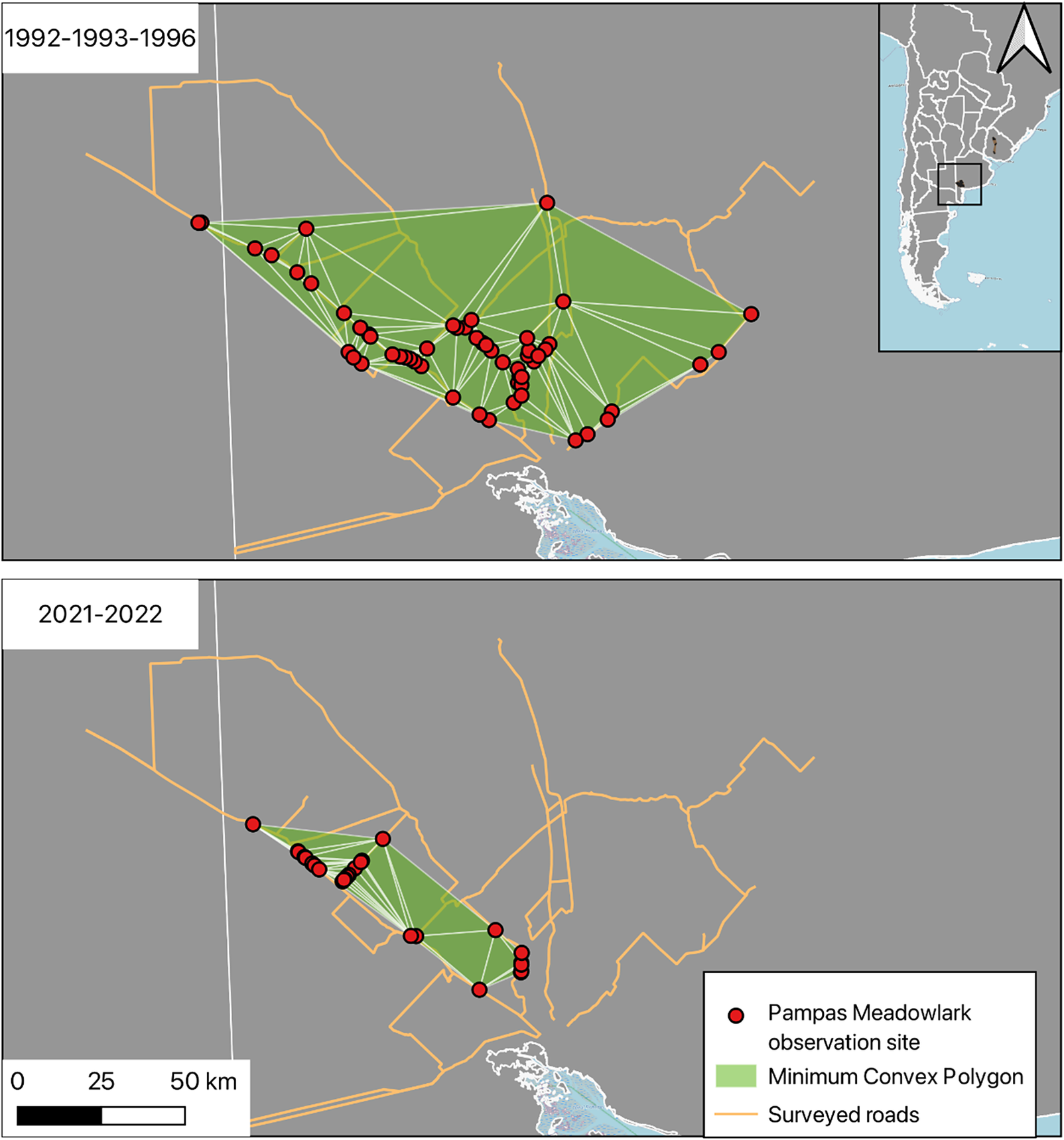
During the extensive surveys conducted from 2021 to 2025, we counted a maximum of 1,325 Pampas Meadowlarks across 10 different occupied patches in the south-western Pampas, regardless of their breeding status. Assuming the population size of the south-western Pampas subpopulation declined from 7,500 mature individuals in 1996, the linear rate of decline would equate to an 85% reduction over the last three generations.
Global population size
Based on the described evidence, the current Pampas Meadowlark global population size is estimated to be between 1,460 and 2,057 mature individuals, and it is inferred to have undergone an overall decline of between 73% and 88% over the past three generations.
Geographical range
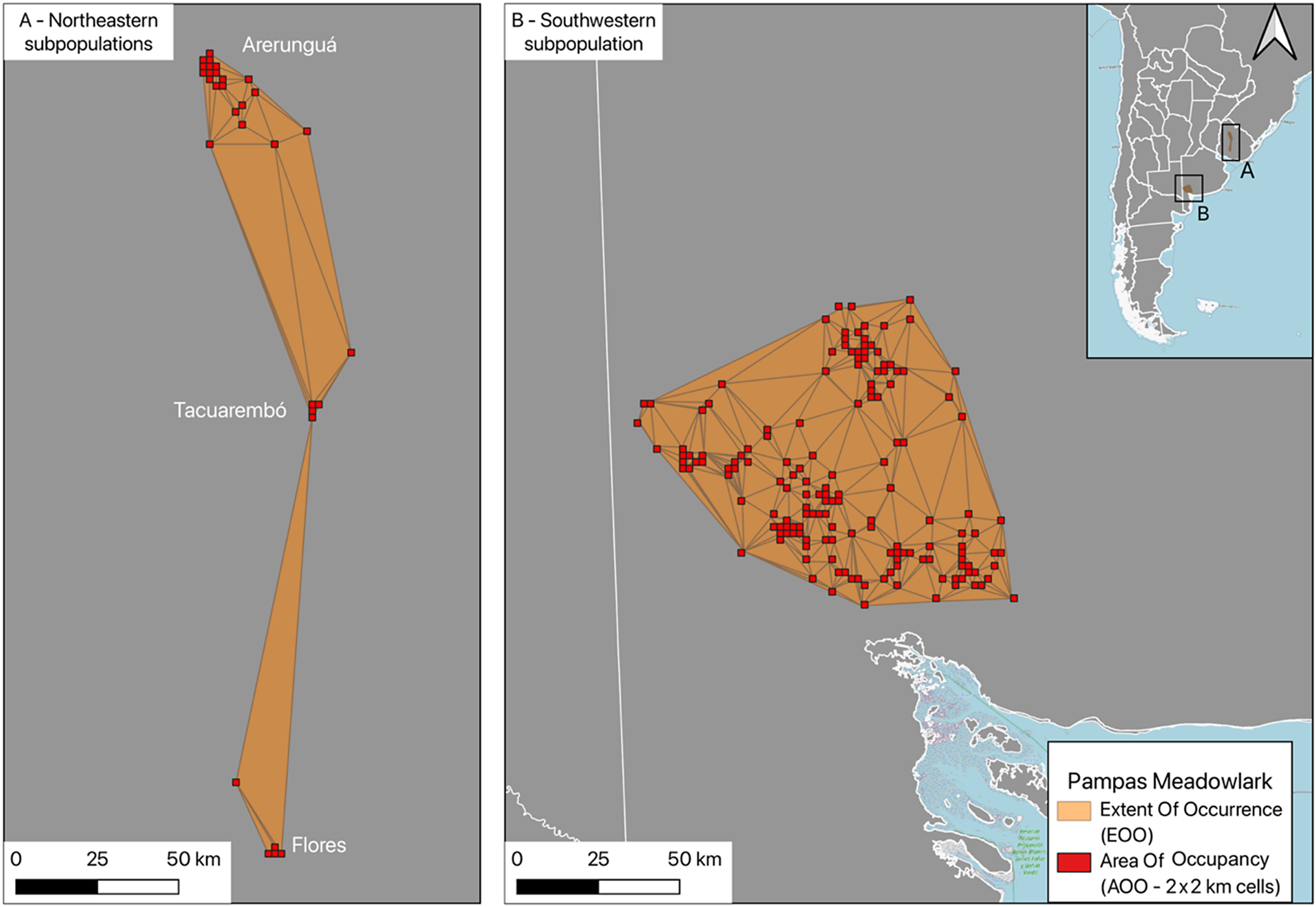
We estimated the EOO of the Pampas Meadowlark at 9,755 km2. The EOO of the north-eastern subpopulations was 2,670 km2, while the EOO of the south-western subpopulation was 7,085 km2 (Figure 2). We estimated the AOO of the Pampas Meadowlark at 756 km2. The AOO of the north-eastern subpopulations totals 124 km2, comprising 21 4-km2 cells in Arerunguá, five cells in Tacuarembó, and five cells in the Flores subpopulation, respectively. The EOO of the south-western subpopulation was 632 km2, comprising 158 cells (Figure 3).
Extent of Occurrence (EOO) (orange polygons) and Area of Occupancy (AOO) (2 × 2 km red cells) for the north-eastern (A) and south-western (B) subpopulations of the Pampas Meadowlark based on 2019–2025 curated occurrences (eBird, GBIF, iNaturalist, and EcoRegistros) and 2021–2025 field confirmations. Occurrence records were filtered to minimise misidentifications (see Methods).
Conservation and Green Status
The rate of population decline over three generations was higher than 80%, and threats are still acting; both conditions are considered Critically Endangered under Criterion A (A2, A3, and A4). The EOO (between 5,000 and 20,000) and the AOO (between 500 and 2,000) reached the Vulnerable threshold level in Criterion B (B1 and B2). The number of mature individuals, combined with the observed continuing decline and the fact that nearly 90% of mature individuals are in the largest subpopulation, is sufficient to reach at least the Endangered level under Criterion C (C1, C2aii).
Using the eco-regional Green Status spatial units defined above, the Pampas Meadowlark is currently ‘Critically Depleted’, with a Species Recovery Score of 4%. In this scenario, all subpopulations were assessed as Critically Endangered (Table 3 and Figure 1). In the Future-with-conservation scenario, the species was still assessed as Critically Depleted, with a Green Score of 6%. Consequently, the Conservation Gain from current and planned conservation actions is low (2%). Only one spatial unit would sustain a functional population in the Long-term potential scenario (Table 3).
Green Status assessment of the Pampas Meadowlark across Green Status spatial units (not demographic subpopulations). Values shown are fine-resolution state scores per unit and scenario: 0 = Absent, 1.5 = Present, 5.5 = Viable, 9 = Functional (IUCN 2021), with the corresponding Red List-style categories given for context. Of the eight mapped units, five overlap the species’ indigenous range and were scored; the remaining units are shown for context and set to 0 (Absent). The Green Score for each scenario is reported at the bottom; Conservation Gain is the increase from Current to Future-with-conservation. CR = Critically Endangered; EN = Endangered; NT = Near Threatened; LC= Least Concern
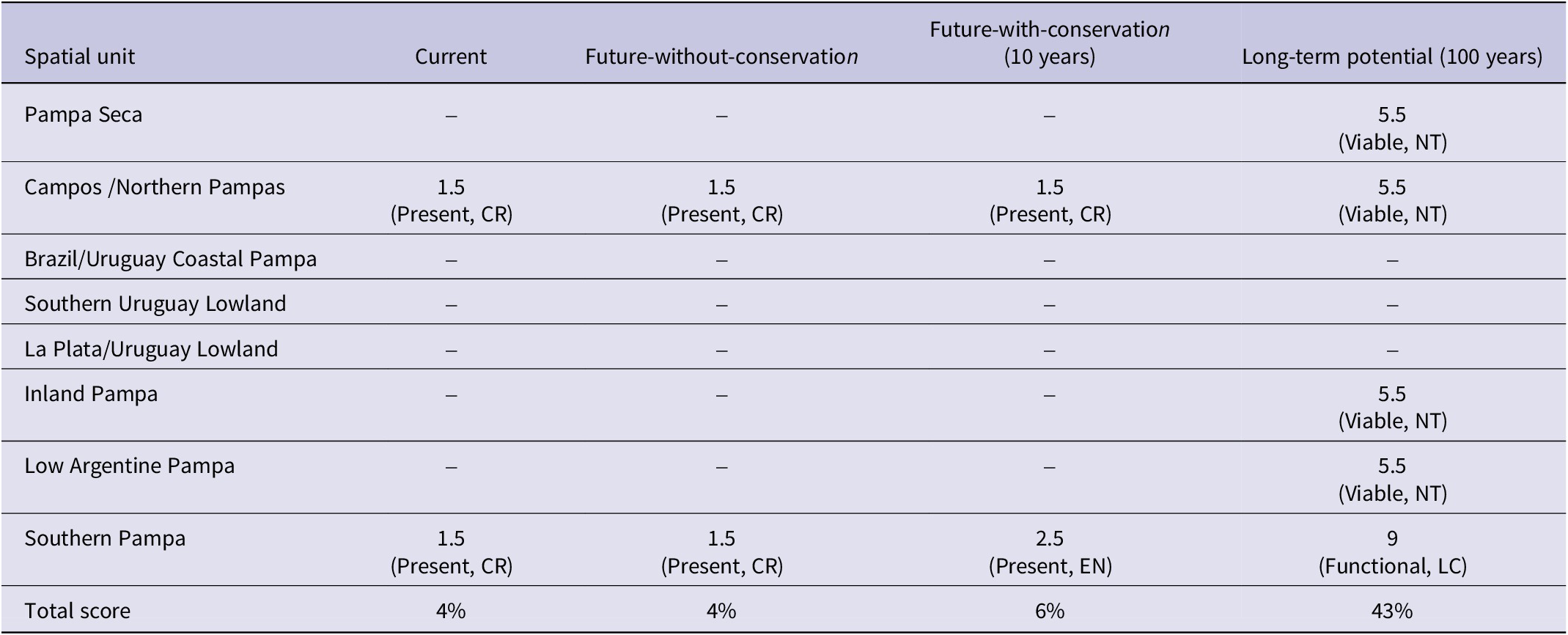
Note: Demographic subpopulations (used in Red List criteria) are: (1) south-western (Argentina) and (2) north-eastern (Uruguay, comprising northern and southern groups). These are conceptually distinct from Green Status spatial units, which are eco-regional assessment units used to evaluate representation and functionality.
Discussion
Updating Pampas Meadowlark’s area of distribution and population size is extremely timely, as the species is experiencing the effects of intense agricultural expansion over its natural habitat (e.g. soyabeans and other annual crops are replacing grasslands; Baeza et al. Reference Baeza, Vélez-Martin, De Abelleyra, Banchero, Gallego and Schirmbeck2022), and the rapid and widespread development of wind farms that replace and fragment natural grasslands, together with potential climate change-associated events that affect breeding success and survival rates (Álvarez et al. Reference Álvarez, Cozzani, Zalba and Tizón2024a; Neyra et al. Reference Neyra, Berkunsky, Grilli and García Fioretti2024; Petracci and Carrizo Reference Petracci and Carrizo2022; Petracci et al. Reference Petracci, Long, Carrizo and de Villalobos2023). Taken together, these lines of evidence support an urgent status reassessment and the implementation of targeted, range-wide conservation actions.
Our observations of banded individuals provided the first empirical estimates of longevity and minimum reproductive age for the Pampas Meadowlark. The record of a 10-year-old individual photographed in Uruguay (A. Olmos, personal communication) establishes the species’ maximum known lifespan. In addition, the documentation of a one-year-old breeding individual in Argentina indicates that sexual maturity may be reached within the first year. These data allowed us to estimate a generation length of 5 years, and consequently, a three-generation period of at least 15 years, key parameters for robust IUCN Red List assessments. Although specific demographic data are scarce for most grassland Icterids, our estimate is consistent with expectations for medium-sized passerines inhabiting temperate open habitats. For instance, the Red-winged Blackbird Agelaius phoeniceus and Eastern Meadowlark Sturnella magna are known to breed at one year of age and can live over a decade in the wild under favourable conditions (Kershner et al. Reference Kershner, Walk and Warner2004; Yazukawa Reference Yasukawa2013). The new demographic information for Pampas Meadowlark not only enhances our understanding of its life history but also demonstrates the value of long-term, individual-based monitoring in producing essential demographic data for threatened species. In particular, accurate generation length estimates enhance population viability modelling and threat assessments, improving conservation decision-making for data-deficient species.
A misinterpretation of historical survey data has likely delayed an accurate assessment of the Pampas Meadowlark’s extinction risk. In the early 2010s, Meriggi et al. (Reference Meriggi, Ibáñez and Aguirre2013, Reference Meriggi, Ibáñez and Aguirre2014) replicated the road census methodology initially applied in 1996 by Tubaro and Gabelli (Reference Tubaro and Gabelli1999) and found that only 12% of the previously reported numbers were accurate. This represented a severe population decline, which, had it been correctly interpreted and incorporated into the IUCN assessment at that time, would likely have led to the species being classified as Critically Endangered under Criterion A. However, a key error occurred in the Argentine national and global assessments conducted in 2016 and 2020, where the observed reduction was mistakenly interpreted as a 10% decline, rather than the actual 88–93% (Ministerio de Ambiente y Desarrollo Sustentable and Aves Argentinas 2017). As a result, the species was assessed as less threatened than it truly was (under the Vulnerable category). By the time this error was recognised, the baseline had already shifted: the remaining subpopulations had stabilised at low numbers or were still declining in some subpopulations, and calculating decline over the last three generations no longer yields such a dramatic trend. Nevertheless, we argue that the earlier population collapse is real, well-documented, and attributable to habitat loss and degradation, on-going threats that still constrain recovery. According to IUCN guidelines, such retrospective and well-supported evidence of reduction should be considered when applying Criterion A (IUCN 2012, 2024). Therefore, despite the apparent recent stability at low population levels, the Pampas Meadowlark meets the thresholds for Critically Endangered based on the sharp decline that has occurred in the last 15–20 years and the continued pressure on its habitat. This case highlights the importance of accurate data interpretation in extinction risk assessments and underscores the need to revisit past assessments when new evidence clarifies previous errors.
Historical warnings about the conservation status of the Pampas Meadowlark were issued long before the recent reassessment of its status. Three decades ago, Tubaro and Gabelli (Reference Tubaro and Gabelli1999) had already recommended placing the species in the Endangered category based on their analysis of its range contraction and vulnerability to grassland loss. A few years later, Gabelli et al. (Reference Gabelli, Fernández, Ferretti, Posse, Coconier and Gavieiro2004) documented a further 30% reduction in the species’ EOO compared with the 1999 estimate. Despite these early signals, the species remained listed as Vulnerable at the global level for more than two decades. In hindsight, this sequence of overlooked evidence and underestimated risk reveals a pattern in which important data and expert concern were not translated into appropriate conservation assessments or actions. Had the decline been properly acknowledged and acted upon earlier, the species’ current dire status might have been mitigated. The case of the Pampas Meadowlark highlights the crucial importance of taking early warning signals in species assessments seriously, and of risk evaluations being more responsive to emerging patterns of habitat loss and demographic decline.
The latest population size estimates of this work are between 49% and 76% smaller than the reported value (i.e. 4,000–6,000 mature individuals; BirdLife International 2020), indicating a steep and on-going decline. This reduction is primarily driven by continued habitat loss and degradation across the Pampas region. Based on prevailing land-use trends, particularly the intensification of agricultural and livestock activities, current bird population trajectories are expected to worsen over the next decade (Baeza et al. Reference Baeza, Vélez-Martin, De Abelleyra, Banchero, Gallego and Schirmbeck2022; Neyra et al. Reference Neyra, Berkunsky, Grilli and García Fioretti2024).
In addition to the changes in land use that have caused the species’ decline and continue to pose a threat, field observations and various trends in the region indicate that new important threats are emerging (Ibáñez and Grisolía Reference Ibáñez, Grisolía, Dalia, Bauni, Homberg and Giacchino2023). Quantitative evidence indicates rapid and on-going habitat loss throughout the Río de la Plata grasslands, where grassland cover declined from 67.4% to 61.4% between 1985–1989 and 2002–2004 (Baldi and Paruelo Reference Baldi and Paruelo2008). In Argentina, annual cropland expanded at ~0.27%·per year during 1988–2002, while tree plantation establishment increased from ~23,000 ha/year to ~125,000 ha/year during 1992–2001, largely at the expense of native grasslands and adjacent dry forests (Nosetto et al. Reference Nosetto, Jobbágy, Brizuela and Jackson2012; Paruelo et al. Reference Paruelo, Guerschman, Piñeiro, Jobbágy, Verón and Baldi2006). In Uruguay, approximately 20% of native grasslands have been replaced by crops and forestry in recent decades (national synthesis), out of a baseline of ~11.2 million ha of native grasslands (68.5% of the country), underscoring the millions of hectares affected (Guido Reference Guido, López-Mársico, Rodríguez, Gallego, Lezama and Baeza2025). Together, these figures quantify the scale and pace of grassland loss that underpins the species’ decline and constrained recovery.
Most notably for the south-western subpopulation, current and projected development of wind farms across the entire region represents a severe threat, both by the intense transformation of habitats at wind farms themselves and by their effects as fragmentation agents for the last remnants of Pampas Meadowlark habitat, especially considering the magnitude and speed at which these projects are being developed (Ibáñez and Grisolía Reference Ibáñez, Grisolía, Dalia, Bauni, Homberg and Giacchino2023; Petracci and Carrizo Reference Petracci and Carrizo2019). Climate change, rarely named amongst the threats to the species, could be having a significant impact on its demography. In the last decade, the species has proven to be remarkably vulnerable to extremely high temperatures during dry summers, which leads to bird drowning incidents in artificial water tanks (Petracci and Carrizo Reference Petracci and Carrizo2022), and also to severe drought events that affect breeding success (Álvarez et al. Reference Álvarez, Cozzani, Zalba and Tizón2024a). Predictions of climate change for the south-western subpopulation region indicate that both aridity and mean temperatures will continue to rise, accompanied by an increase in the frequency of extreme events such as severe droughts and catastrophic storms (Ferrelli et al. Reference Ferrelli, Brendel, Aliaga, Piccolo and Perillo2019, Reference Ferrelli, Brendel, Piccolo and Perillo2020), with the effects that such a climatic regime could have on survival rates and breeding success of the Pampas Meadowlark.
While the south-western subpopulation remains the largest, approximately 10 times the size of all north-eastern subpopulations combined, its rate of decline is alarmingly higher. These findings underscore the urgency of implementing targeted conservation actions to prevent a potential collapse of this key population stronghold. Similar patterns of rapid decline have been observed in other grassland bird species in South America, including the Ochre-breasted Pipit Anthus nattereri and Chestnut Seedeater Sporophila cinnamomea, which experienced drastic population contractions within just a few decades due to habitat conversion and fragmentation (Azpiroz et al. Reference Azpiroz, Isacch, Dias, Di Giacomo, Fontana and Palarea2012b; Jaramillo Reference Jaramillo, del Hoyo, Elliott, Sargatal, Christie and de Juana2020). These examples show how grassland birds, even when initially widespread or locally abundant, can decline rapidly when exposed to sustained anthropogenic pressures. In the case of the Pampas Meadowlark, immediate conservation measures, including habitat protection, restoration, and population monitoring, are crucial to prevent further losses and potential local extinctions. In Pampas, grassland restoration is feasible but context-dependent: it is most realistic where native remnants persist in the surrounding matrix and structure/composition can recover under assisted management (e.g. adjusted grazing, removal of exotic pastures/trees). Pilot experiences in Uruguay indicate re-establishment of native swards under these conditions (Guido et al. Reference Guido, López-Mársico, Rodríguez, Gallego, Lezama and Baeza2025). Accordingly, we view restoration as a complementary, site-specific tool, with priority on protecting and improving existing remnants and their buffers.
The new EOO is 92% smaller than the previous estimate of 127,000 km2 (BirdLife International 2020). The estimated EOO for the south-western subpopulation (7,085 km2) was slightly higher than earlier reported values (i.e. 6,989 km2 and 4,810 km2; Gabelli et al. Reference Gabelli, Fernández, Ferretti, Posse, Coconier and Gavieiro2004; Tubaro and Gabelli Reference Tubaro and Gabelli1999). This apparent stability may be partially attributed to the recent surge in birdwatching and citizen science efforts, which have intensified field observations and enhanced detection in marginal areas (eBird 2025). Additionally, remnant populations may now be restricted to peripheral strongholds near the historical limits of the range, leading to a no decrease of the EOO despite the actual reduction in population size and habitat occupancy (Figure 2). Similar patterns have been observed in other grassland specialists that experienced severe demographic declines without a proportional contraction of EOO, such as McCown’s Longspur Rhynchophanes mccownii in North America and Saffron-cowled Blackbird Xanthopsar flavus, whose range remains broad but whose populations are now severely fragmented (BirdLife International 2019; Somershoe Reference Somershoe2018). These cases highlight the limitations of EOO as a sole indicator of conservation status, especially in species with patchy distributions and declining populations.
We estimated the AOO for the Pampas Meadowlark for the first time. Previous values were reported only for the south-western subpopulation (Gabelli et al. Reference Gabelli, Fernández, Ferretti, Posse, Coconier and Gavieiro2004). Our AOO value for the south-western subpopulation, calculated according to the IUCN grid proposal, was similar to earlier reports (517 km2), which were based on the available habitat (i.e. vegetation map; Gabelli et al. Reference Gabelli, Fernández, Ferretti, Posse, Coconier and Gavieiro2004). Interestingly, the AOO of the south-western subpopulation was five times larger than the combined AOO of the three north-eastern groups, despite the latter covering a wider geographical range. The AOO of the species as a whole represents less than 8% of the current EOO, a pattern that is not uncommon among grassland birds facing habitat degradation and fragmentation. For example, similar mismatches between EOO and AOO have been documented in the Yellow Cardinal Gubernatrix cristata and Saffron-cowled Blackbird, both of which have retained a broad distribution but now occupy only a small fraction of it due to habitat loss by land-use change and habitat degradation (BirdLife International 2018, 2019). This disproportion suggests that the total amount of remaining habitat (i.e. native grassland) has not declined dramatically in extent, but rather in quality, continuity or accessibility, factors that strongly influence the species’ ability to persist and breed successfully. In the case of the Pampas Meadowlark, the intensive transformation of native grasslands into agricultural land, coupled with the introduction of invasive exotic pastures, and the degradation of native grassland remnants due to intensive livestock activities, may have left behind a highly fragmented and functionally unsuitable matrix. The latter highlights the importance of not only quantifying the area of remaining habitat but also assessing its ecological integrity and usability for target species.
Our findings provide compelling evidence that the current categorisation of Pampas Meadowlark is outdated and urgently requires reassessment. The mean estimated population decline of over 80% within three generations, combined with on-going threats, meets the thresholds for Critically Endangered under IUCN Criterion A (A2, A3, A4). Additionally, the small total population size, the observed continuing decline, and the concentration of nearly 90% of mature individuals in a single subpopulation fulfil the conditions for Endangered, under Criterion C (C1, C2aii). These risks are exacerbated by the rapid and on-going loss of native grasslands, making Pampas Meadowlark increasingly vulnerable to extinction.
There are precedents where timely reassessment of a species’ Red List status led to the implementation of more effective conservation measures. For instance, the reclassification of the Yellow-breasted Bunting Emberiza aureola as Critically Endangered following a steep population collapse prompted increased international attention and legal protections (BirdLife International 2017; Kamp et al. Reference Kamp, Oppel, Ananin, Durnev, Gashe and Hölzel2015). Similarly, the re-evaluation of Stresemann’s Bristlefront Merulaxis stresemanni to Critically Endangered mobilised habitat protection efforts and targeted searches in its restricted range (Bird et al. Reference Bird, Martin, Akçakaya, Gilroy, Burfield and Garnett2020). In this context, updating the conservation status of the Pampas Meadowlark is not merely a formal step; it is a critical prerequisite to mobilising national and international conservation resources. We strongly recommend that the evidence presented here be considered in the next assessment cycles of the IUCN Red List and BirdLife International. A revised threat category that reflects the species’ actual level of risk is essential to guide conservation actions, raise awareness, and secure the institutional and financial support required to avoid extinction.
The Green Status assessment further emphasises the critical situation of the Pampas Meadowlark. The species was classified as Critically Depleted, with an extremely low Species Recovery Score of just 4%. This reflects not only the dramatic reduction in population size and range but also the limited capacity of the species to recover under current conditions. Even under the Future-with-conservation scenario, assuming that planned or plausible conservation actions are implemented, the recovery potential remains minimal, with a Green Score of only 6% and a Conservation Gain of just 2%. These values are among the lowest reported for any bird species assessed to date, highlighting that conservation actions are not only urgently needed but must also be ambitious, targeted, and sustained over time. The near-total loss of ecological functionality and representation across the species’ historical range underscores the need for coordinated efforts that go beyond local interventions, involving landscape-level planning, engagement with producers, protection and restoration of remaining grasslands, buffer zones around key sites, legal protection, and the creation of a network of protected areas that can support viable populations.
This study represents the most comprehensive and updated assessment of the Pampas Meadowlark to date. By combining a replication of earlier methodologies with a finer-resolution survey of all potential sites, particularly in the south-western subpopulation, we ensured both comparability and thorough spatial coverage. While some gaps may remain, especially in less accessible areas or regions with low observer effort, we believe it is unlikely that large breeding nuclei have been overlooked. As a result, we now possess a much more accurate understanding of the species’ distribution and abundance than was available 10 or 20 years ago. However, critical knowledge gaps persist, particularly regarding the demographic viability of remaining populations and the pathways for integrating conservation and production in native grasslands. We still lack key information on the survival rates of individuals, the persistence and dynamics of breeding colonies, and the species’ spatial ecology, as well as social perspectives regarding local communities’ interests in conservation and transitioning towards agricultural practices that enhance native biodiversity. Addressing these questions will require coordinated, long-term monitoring schemes based on standardised protocols across subpopulations. Such efforts are crucial for tracking population trends, evaluating management actions, and informing future conservation strategies.
Acknowledgements
We would like to thank the field assistants and collaborators (Santiago Carvalho, Marion, Jonas, J.J. Bonano, Manuel Neyra, R. Nigro, F. Ramos Muiño, M. Velasco, P. Gado, C. Santiago, J.C.M. Neyra, H. Neyra, and Felisa La Pescadora) for their kind assistance and support during the fieldwork and laboratory activities. We also appreciate the collaboration of owners and managers of grassland remnants for allowing us to visit their properties: Octavio Caraballo Hirsch and Inés de Carabassa (Estancia La Josefina), G. Peralta Martínez (Estancia La Josefina), C. Doiñy Cabré (El Chasicó), A. Barquín (San José), Marcela Neyra (La Coscoja), Macá Neyra (La Cortadera y El Cardal), B. Ebinger (El Indio y Marín), and J.M. Martinez (El Productor). F. Gorleri and J. Curtis helped us with the eBird database. This study was partially supported by Consejo Nacional de Investigaciones Científicas y Técnicas (CONICET PIP 11220200100803CO), Idea Wild, The Rufford Foundation, BirdLife, ZGAP, Autos del Sur SA (Rubén Vasquez), Bhassa, and Cabaña Las Lilas. AA was supported by a fellowship from the Consejo Nacional de Investigaciones Científicas y Técnicas of Argentina (CONICET). CTF and MS work as technicians for the Comisión de Investigaciones Científicas de la Provincia de Buenos Aires (CICPBA). IB and SMZ are CONICET Research Fellows. MCN is a PhD student in the Environment and Health Applied Sciences Doctoral Program (DCAAS) at UNICEN, Argentina. We thank the Dirección de Flora y Fauna of Buenos Aires province for providing us with the necessary permits to perform this work. We thank the two anonymous reviewers and the Associate Editor for their constructive comments and suggestions, which significantly improved this manuscript.