Introduction
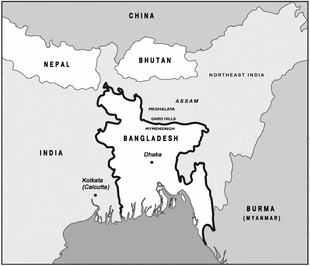
How can the exchange of teacups inspire us to rethink affinity, alterity, and state-making? I ask this question in the context of South Asia's longest international boundary—the 4,096-kilometre India-Bangladesh border—in a zone that cuts across the state of Meghalaya in northeast India and Bangladesh's Mymensingh district (see Figure 1). India and Bangladesh patrol this increasingly militarized foothill zone to contain indigenous dissidence, demands for independence, smuggling, and trans-border abductions. The heavily armed border forces that patrol the region are entrusted with enormous powers.Footnote 1 For over a century, state violence and the region's remoteness have ensured that genial exchanges between heavily armed troops and villagers became central to everyday life. The relationships that villages establish with outposts, where the troops reside, mitigate danger. Reciprocity facilitates the passages of Garo Christians, who live on both sides of the border, to maintain kinship ties, religious activities, and trade. The angst of isolation which lead the troops to engage villagers in conversation transforms an unfamiliar and remote location into a liveable one for them.
The northeast India-Bangladesh border. Source: The author.

This article shows how these reciprocal webs of exchange and conviviality brought Garo matrilineal lineage and Christian religiosity into relations with state control and border rule. I argue that affinities outside the purview of national security mandates expand the political possibilities of collective life in remote borderlands.Footnote 2 At the nation’s margin, the values of reciprocity—seen in terms of exchange, trust, generosity, dependency, and protection—have both political and spatial implications for allying unequal relations. Madeleine Reeves and Magnus Marsden's introduction to this special issue invites us to locate the margin as a productive association between reciprocity and hierarchy. At the northeast India-Bangladesh border, villagers establish meaningful relationships with state troops to negotiate difference in a dangerous location where lives are lived across national divides. The border foregrounds reciprocity's central role in brokering collective life, kinship, and religiosity for the Garos.
Borders challenge the precise, ordered logic of nation-states. Here, as state and non-state authorities intersect and clash, notions of community, identity, and belonging come up against—and sometimes transcend—national citizenship.Footnote 3 Borders not only bring into sharp relief the long-term consequences of violence and the danger of difference, but the value of affinities, both local and trans-local, in structuring space and politics. The political possibilities that derive from these affective horizons extend our understanding of kinship and the convivial relationships that support it.
Domestic objects have linked the intimate domain of Garo trans-border matrilineal lineage (the Mahari) and Christian religiosity with state rule and a non-indigenous world. Indian and Bangladeshi border forces, primarily Hindu and Muslim respectively, have historically mediated these spheres. In this article I explore the exchange of a set six porcelain teacups between Indian border troops and their owner, a Garo Christian schoolteacher whom I call Mary. The tea set facilitated meaningful affinities with the troops at a border outpost, which in turn enabled Mary's Garo trans-border kinship lines and Christian religiosity to flourish. India and Bangladesh's deployment of troops in large numbers and the increased construction of military outposts have undermined this conviviality. In the past decade, the border forces have violently intercepted travellers without passports, leading to more than a thousand fatal shootings.Footnote 4 In the concluding pages of this article, I suggest that these infrastructural changes mandate troops to circumscribe border-crossings for trans-border ethnic and religious activities as actions that transgress the nation-state. These ruptures recall prior religious persecution in this landscape and demonstrate the fragile possibilities of sustaining reciprocity in locations where its meanings and political repercussions have been historically fluid.
Frictions of kinship, frictions of conviviality
To begin, let me situate the affinities at stake in the rest of this article by briefly foregrounding a recent debate in anthropology that surrounded the publication of ‘What kinship is’ by Marshall Sahlins. He posited that local configurations, whether by birth, social construction, or a combination of both, made people interdependent. He called this the ‘mutuality of being’, arguing that such connections linked bodies, feelings, and experiences, and represented a ‘manifold of intersubjective participations’. Mutuality applied to people connected by blood and descent, but also, as Sahlins advanced—following Eduardo Viveiros de Castro's work in Amazonia—it rested on relationships with strangers and animals as well. In extending notions of kinship beyond bloodlines and property towards a focus on the ‘mutuality of being’, Sahlins included connections around love, food, land, marriage, and adoption, incorporating into kinship multiple ways of participating in collective life. Even more provocatively, he arrived at the conclusion that ‘all means of constituting kinship are in essence the same’.Footnote 5
Among the debates that Sahlins’ engagement with kinship inspired was criticism of his failure to account for the pitfalls that undergird mutuality. Janet Carsten countered that although the ‘mutuality of being’ privileged kinship's positive values, it eclipsed its negative and disruptive qualities as well as the hierarchies and exclusions that informed it. Drawing on her work in Malaysia, Carsten argued that the inclusive qualities of Malay kinship did not override their coercive connotations.Footnote 6
Veena Das's work on the partition of the Indian subcontinent in August 1947—the event that laid the early foundations of what is today the India-Bangladesh border—lucidly portrays kinship's disempowering qualities in the aftermath of a violent bordering process. The hurried division of the Indian subcontinent into the newly independent India and Pakistan created confusing borders. Indian territory bifurcated Pakistan into East Pakistan and West Pakistan. Dividing rural landholding patterns and disrupting trade routes, 1947’s large-scale confusions and displacements brutally uprooted people and unsettled existing ties.Footnote 7 In Critical Events, in relation to women who were abducted during partition, Das argues that the values of purity and honour were central to the regulation of women's sexuality and identity within kin networks. In India, these values came to be closely linked to national policies and citizenship. India forcefully ‘recovered’ women who had resettled and set up families in Pakistan. The new legal category of the ‘abducted person’ compelled women to submit to the state's disciplinary dictates. Das posits that such processes rescaled and legally codified kinship norms by transplanting them into the domain of the nation-state. As India ‘recovered’ abducted women, their families in India either accommodated them within conventional kinship structures or gave them away in marriage by explicitly manipulating affinity. Kinship rules were cautiously and strategically made flexible for women whose kidnappings were shrouded in silence and secrecy.Footnote 8 In analysing the ruptures that informed these processes, Das shifts discussions from kinship as something enclosed within intimate spheres of affinity and control to establishing its connections and, by extension its violence, to the scale of the nation-state. She compellingly shows that India's nation-building aggressively incorporated the gendered values that surrounded kinship within the folds of national citizenship.
In rereading 1947 as a series of border-making moments which deeply politicized kinship, I suggest that partition's violence not only constrained but also stretched the implications of relationality. This still bears upon our understanding of South Asia's post-colonial margins. Ethnographic and historical attention to the region's contemporary borders offer new ways of thinking about how an event that divided similar societies simultaneously expanded the political prospects of collective life at the nation's margins. If the events of 1947 separated indigenous clans like the Garos by dividing their land along the Garo foothills in India's northeastern borderlands, it also fostered new relationships between border troops which enabled kinship and Christian religiosity to persist in subsequent decades. In East Pakistan's Mymensingh district, which adjoins the Garo foothills, the state targeted Garo Christians in the urgency to establish national citizenship and weed out non-Muslim traitors. Despite this, everyday sociality was foundational to coping with the border's abrupt incursion, its ad hoc and confusing nature, as well as in addressing the deep mistrust that prevailed among communities and between the villagers and the border troops. These acts of cooperation and support extended affinity and reciprocity in multiple ways to include the border police, who were initially rural recruits.Footnote 9 Indeed, convivial exchanges between villagers and the newly appointed border police, as much as mistrust and hostility, sustained relationships to enable the production of both collective life along the boundary and, in fact, the border itself during the early post-colonial period.
For more than a decade, scholars have explored conviviality as transience, translation, negotiation, and protection to deepen their engagement with the human condition. In exploring the various ways in which people come together and the changing dynamics that inform diversity and difference, scholars have shown that reciprocal exchanges as well as conflicts inform collective life.Footnote 10 In the context of indigenous Amazonia, Overing and Passes contend that the term ‘conviviality’ represents a very different sense than its English meaning of joviality. It underscores a deeper sense of ‘affective containment’, which shapes informal and intimate everyday interactions. Such friendly affiliations, they argue, are as politically productive as they are moral and aesthetic.Footnote 11
Scholars interrogating diversity in cities argue that the political possibilities emerging from convivial exchanges provide new foundations for belonging amid difference. Three interrelated lines of enquiry that I find especially valuable emphasize conviviality's enduring qualities, its relationships to space and technology, and its tension-ridden qualities. Paul Gilroy and Ash Amin famously situate conviviality as a ‘social pattern’ and ‘an enduring social form’ (respectively), which emerge when urban groups, despite their racial and cultural differences, live in close proximity. Conviviality is central to the larger fabric of urban life as it facilitates access to collective resources within spaces of anonymous difference.Footnote 12 Addressing the failures of multiculturalism to resolve questions surrounding difference and conflicts, Gilroy further argues that the power of convivial cultures renders racial and ethnic differences ordinary and unremarkable.Footnote 13
Amin's emphasis on reciprocity's reliance on urban space and technologies has two resonances, the first in recent scholarship on Asian cities, and the second in the power of technologies and things to shape social life. A common thread connecting both fields is the close attention scholars have paid to questions of political freedom. Those investigating cities in Asia have highlighted the overarching principles of civility which guide everyday encounters of inclusion and exclusion in public places, arguing for progressive legislation to ensure that there is the time, labour, and scope for low-wage foreign migrants to make use of public spaces for sociality.Footnote 14 Such modes of engaging with affinity, as exemplified through friendship and civic encounters, pushes discussions on conviviality beyond fleeting exchanges with strangers to the creation of new political subjectivities. In the early 1970s, Ivan Illich recalled the importance of convivial tools in facilitating individual freedom and creative exchanges among people and the environment. Establishing such exchanges as intrinsically ethical, he posited that the tools and technologies that fostered communication and self-realization were fundamental to forming convivial societies.Footnote 15
Resituating Illich's privileging of convivial things for autonomy and freedom in the contemporary moment, as well as in the context of meaningful social relations, inspires a return to Mauss. In exploring reciprocity through the movement of things, we may ask, along with Mauss, ‘What force is there in the thing given that compels the recipient to make a return?’ In answering this question, Mauss drew on the Maori concept of the Hau that lies in the forest and wishes to return to its place of origin via another object that was given in exchange for the gift. Through these, he illuminates how people relate to each other through things, a theme that this article further extends via a set of six teacups.Footnote 16
However, the relationship that reciprocity has with freedom and collective life are also culturally imbricated in power. These make conviviality fraught with frictions. Nyamnjoh and Brudvig argue that genial encounters enveloped in power and wealth disparities rupture conviviality's essence in regulating the lives of insiders and outsiders in African cities. Given that globalization's messiness informs urban life and mobility, they suggest that convivial relations exemplify the precariousness of living together within urban spaces of exclusion and inequality.Footnote 17 In fact, exchanges in cities prone to violence make people's quest for protection urgent and dependent on establishing genial exchanges across differences.Footnote 18 Here, not only does the other side of conviviality show its face, but make reciprocity essential for survival and sustenance.
In a broad sense, then, conviviality's analytic potential relocates questions of interdependence in social theory from being narrowly confined within received exchanges among kin to include strangers. Departing from a narrow reading of either how conviviality provides a social glue amid diversity and inequality or situating reciprocity to test the limits of kinship and religion, the value of exploring conviviality at the nation's margins lies in the border's capacity to facilitate meaningful exchanges—no matter how uneven—across what are imagined as socially and politically distinct, self-contained spheres. Eric Beverly compellingly argues that the productivity of the frontier depends upon the partial ability of states to control space. Frontiers not only signify edges or spatial limitations, but also function as sites of creativity, power, and resources.Footnote 19 Borders work similarly. They make the brutal performances of sovereign authority most visible, as well as show how the territorial regulation of sovereign power is far from complete at the nation's edge.Footnote 20 Here, the gap between enforcing official mandates and regulating everyday life on its own terms makes borders emotionally charged ‘sensitive spaces’.Footnote 21
The nation's margin is a dynamic location that lends itself to questioning how kinship, as an all-encompassing moral sphere (as Sahlins underscores), stretches and adapts to make life liveable and collective. I suggest that it does so beyond the perpetuation of indigenous lineage and the means to revive kinship under duress. Reciprocities and frictions that transcend kinship's prior boundaries offer new ways to situate political possibilities, as well as their limits, without either reproducing conviviality's distinctly urban tone or overdetermining the border's violent ability to uniformly create spheres of difference and rule. The power of things and, by extension, the powers that the exchanges confer on the giver and the receiver, lie in reciprocal relationships that dwell simultaneously in material, religious, and economic worlds in remote agrarian borderlands. In what follows, I show how Mary's teacup exchanges with Indian border forces, which held together a cycle of borderland reciprocities, speak to forms of conviviality that escape both urban and border scholarship.
Teatime
Even after aggressively questioning me about my intentions for conducting fieldwork in border villages divided between Meghalaya (northeast India) and Mymensingh (Bangladesh), Indian and Bangladeshi troops insisted that I drink a cup of tea with them. India and Bangladesh have constructed outposts within border villages and at their outer edges. The larger outposts function as immigration and export checkpoints.Footnote 22 As the first point of defence during wars, these militarized infrastructures stand equidistant on either side of the international boundary. Fluttering national flags situate their importance in delimiting territories; at their gates, armed sentries stand to attention behind sandbag buffers. Although not a part of national armies, India and Bangladesh's border forces, who reside in the outposts, are entrusted with soldier-like functions. Along the foothill borderland, everyday forms of territorial control include impromptu patrols from the outposts to rotational village markets, intercepting agriculturalists attending to their farmlands which adjoin the international boundary, and Indian and Bangladeshi plain clothes intelligence agents surreptitiously stalking suspects.
Despite their military functions, outposts are social hubs with barracks, kitchens, badminton and handball courts, temples (in India), and mosques (in Bangladesh). Their location within villages animates everyday conversations between troops and civilians. Structurally combining dwellings with military preparedness and fortress-like functions, the outposts define access to the border. If their spatial layout facilitates the temporary confinement of border-crossers, and sometimes researchers, for interrogation, it also obscures why steaming cups of tea arrive here almost by magic, concealing the village helping hand's role in the kitchen.
Among the unstated norms of cohabiting a heavily militarized landscape was my obligation to drink tea, which was nearly as strong as my obligation to answer the troops’ pointed questions about my research. Although the interrogations were harsh, camp commanders and intelligence agents ensured that as their ‘guest’, I seldom left the outposts, no matter how angry I was at their interrogation, without drinking a cup of heavily sweetened milky tea. Tea drinking made a militarized setting convivial without displacing the border's brutal edge. While for me teatime joined together the disparate worlds of political violence and rural hospitality, for the Garo Christians, it profoundly reorganized kinship ties, collective religiosity, and sustenance that derived strength from the border.
The border that divided the Garo foothills between Meghalaya and Mymensingh provided the context for Mary's porcelain teacups and their changing meanings between June 2007, the month I first started fieldwork in her village, until March 2015, by which time India's new border fence had enclosed her village. Convivial gestures like teacup sharing were fundamental to the production and the working of the Meghalaya-Mymensingh border. In explicit recognition of local political authority and respect for Garo indigenous hierarchies, Indian border commanders ceremonially visited Garo village headmen (nokma) and elders in Meghalaya, while Bangladeshi commanders paid visits to Christian priests in Mymensingh. In 2007 and 2008, village elders recalled with pride that newly posted commanders, who had taken charge of the outpost, arrived at their doorstep with a small delegation. They persuaded the seniors to keep a watch over who arrived and left border villages. The Garo nokmas facilitated cheap supplies of firewood, vegetables, poultry, rations, and manual labourers to the outposts. In exchange, they exercised moral authority to negotiate trans-border passages as well as leniency for minor transgressions. Garo clan members crossed the border dragging live goats and carrying baskets of vegetables for Mahari (kinship) feasts and regularly sold produce from Meghalaya in Mymensingh's rotational border markets and vice-versa. Catholic priests in Mymensingh maintained relationships with Bangladeshi outposts, ensuring that the commanders were tolerant about religious travel.
In Meghalaya, Garo villagers with large courtyards accommodated the tractors that flattened the unruly landscape for border fence and road construction. They regularly lent plastic chairs and tables for official meetings, enabling the Indian border forces to function in distant and unfamiliar locations with often-limited supplies. In addition, they found work at the outposts, and worshipped in the temples and mosques located within them. Indian and Bangladeshi troops routinely sat in the outer courtyards of Garo houses while patrolling the foothill border. The Indian Border Security Force not only relied on Garo villagers for cross-border espionage but also for everyday conversations to make patrolling less isolating.
Bangladeshi troops similarly sat in the outer courtyards of Garo houses in Mymensingh, conversing with villagers in their shared language, Bengali. Commanders readily facilitated the movement of patients who needed medical care, even offering their patrolling jeeps to take critical patients to state hospitals. Even though official mandates prevented the border forces from establishing personal relationships, and routinely transferred them, stationed troops who were without their families and with only very occasional telephone contact eagerly sought out villagers for conversation. They even established ties of friendship and love that resulted in their marriage to Garo women.
In the summer of 2007, unlike other Garo villagers who were anxious about the construction work of India's new border fence enclosing their villages from Bangladesh, Mary pedalled away at her sewing machine. In order to reach this village of 30 households, I partly walked through Bangladesh's Mymensingh district after Indian border forces opened and shut two massive iron gates, noting my name and the time of my exit. They tracked farmers who needed to cross the gate for farming on their land that was situated in Bangladesh. On the left-hand side of the mud pathway that led to Mary's village, Garo Christian and Bengali Muslim agriculturalists tilled land situated in Mymensingh.
A schoolteacher, a church elder, a tailor, and the wife of a forest guard, Mary was a figure of local authority. Unlike most elderly villagers, who depended on income from fragmented agricultural land, petty trading, and remittances from children who had acquired government jobs, her position as a teacher and her location in a remote village that was strategically situated between India and Bangladesh added to Mary's status. One summer morning, as Mary spoke to me, she stitched triangular pieces of multicoloured cloth. She conveyed with pride that the long flag that she was making would mark a zone on the border. The Indian border forces would demarcate an area with this flag for a meeting with their Bangladeshi counterparts. To convey her importance as a tailor, she emphasized that Indian sentries had arrived at her doorstep to ask her to stitch their flags.
From Mary's house, when she paused to pedal on her noisy sewing machine, we could hear loud construction noises. Indian civil engineers and contractors had just started levelling land to plant new metal pillars that would form India's border fence with Bangladesh. The landscape resembled a disaggregated industrial zone. Civil engineers measured land and supervised migrant labourers who cut trenches in the foothills. In Mymensingh district, situated just a few yards away, and where I also conducted fieldwork, Bangladeshi border forces were conscious of the impending barrier. They discouraged Mymensingh's Garos, who shared kinship ties with villagers in Meghalaya, from crossing over. Villagers did not know how the new barrier would reshape their agricultural and homestead land and lives.
Confident that the new barrier would not destabilize her relationship with the Indian troops, Mary emphasized her close association with the Indian outpost. ‘The jawans’ (soldiers),’ she noted, ‘have already borrowed my porcelain cups and saucers for the next meeting. They regularly borrow it for official visits and meetings.’ Like the sewing machine, the teacups established Mary's association with the outpost, drawing her into meaningful exchanges with state authorities, vastly different from what might be expected at a highly corrupt borderland. A visitor to the Catholic church that she attended, who often ate lunch at Mary's house, had gifted her a set of six teacups. The set occupied pride of place on her modest termite-eaten bookshelf. Next to this was a Bengali Bible that her relatives from Mymensingh had given her, along with a few small statues of Jesus. Unlike the melamine teacups that traders bought in Bangladesh and sold in the border market near her house and the cheap monochromatic cups that were occasionally available in a market located ten kilometres away, the snow-white cups with tiny blue flowers outlined in gold were rare and precious in this remote landscape.
The cups’ distinction as unique objects vested them with power and prestige. Their location in an educated Christian household implied that these objects fell outside the norms of purity and pollution that would have prevented the primarily Hindu Indian troops from borrowing similar items from Muslim households in other villages. Although the sewing machine's service and the teacups made her vital for the outpost, their contrasting forms of labour and exchange structured their power as objects. Unlike the sewing machine—and the repetitive labour that it demanded to generate mutuality between Mary and the troops—the teacups’ transportability facilitated a distinct kind of reciprocity which rested on their absence on her bookshelf and related to questions of trust and care.
The tea set exchanges began with the Indian jawan arriving at Mary's doorstep. She would clean the cups with hot water, wipe them and hand them over carefully; her gestures reflected their fragility and preciousness. The cups’ relocation in the outpost and use for drinking tea represented a certain sense of order during official meetings. They enabled the troops to impress their visiting senior officers. Although this process was similar to the neighbourly practice of borrowing things for special guests in general, when the border guard arrived at the doorstep to return the cups, their return reinforced Mary's authority to a greater degree in comparison to ordinary neighbourly exchanges. The return visit affirmed that the outpost had reciprocated her trust in them by not damaging the cups. The lending and returning, which happened almost every month for several years, cemented her relationship with the outpost. More generally, such exchanges showed the interdependence of outposts and villages.
Mary emphatically stated that, ‘in remote areas looking out for each other is important’. She said, ‘It is important for the outpost to impress senior officers, and it is our obligation to provide them what they lack. After all the officers are arriving at our village.’ Mary argued that by virtue of the outpost's location within the village, part of the responsibility of creating a favourable impression on senior commanders rested with Garo villagers. On other occasions, the villagers echoed Mary's sentiments. They were well aware of the hierarchies within which outposts functioned and how senior authorities had to be appeased; villagers helped troops stationed in their villages to make a favourable impression on their seniors. These exchanges demonstrated the porous boundaries between border villages and outposts, evident in both Meghalaya and Mymensingh.
Crockery, cutlery, and furniture that villagers routinely lent to border outposts in India and Bangladesh express the inalienability of people and things, which Mauss powerfully foregrounds through the gift.Footnote 23 The objects and the exchanges that they facilitate not only reflect the status of their owners, but also reinforce the moral authority of mutuality in fostering collective life. In fact, Mary's teacups stood at the confluence of a common religious world that included sharing food and reciprocity with people who did not belong to the same Mahari or village. Indeed, the preciousness of the cups—expensive porcelain—reflected the giver's acknowledgement of the spiritual kinship and hospitality that she had received at Mary's house. If receiving food at Mary's house can be seen as a gift that facilitated bonds of trust between Garo and non-Garo Christians, the cups produced new affinities as they travelled to the outpost. Here, the webs of Garo family life and Christian religiosity translated into bonding with the Indian commanders and jawans. The ‘spirit of the gift’, in Mauss's sense of the term, deepened the trust that Mary placed in the Indian officers in lending them her most precious things.
The Indian jawans reciprocated Mary's trust by returning them carefully in the first instance. But, more importantly, this exchange ensured that they facilitated the travel of her extended family and clan members to her village from Mymensingh, Bangladesh. As travellers without passports, they depended upon the outpost to facilitate their border-crossings. Reciprocal exchanges ensured regular visits of Garo villagers to collect and trade in wood—an important commodity for fuel and furniture—that was abundantly available on the Indian side, but rare in Bangladesh. Mary especially negotiated smooth arrivals and departures during the annual feast of their clan—the Rechil Mahari—whose trans-border association she headed. From 2005 to 2008, these annual meetings had resulted in the bright calendars with religious images that adorned the wall behind her bookshelf on which she also placed her teacups. During Mahari meetings and feasts in border villages, I found Indian and Bangladeshi troops sitting and watching over the proceedings from a secluded corner in the courtyard. Large gatherings near the international boundary officially obliged them to be present. Although families offered them tea and meals, the troops declined on grounds of official duty, which prevented them from accepting food from civilians. Trans-border passages for Mahari feasts and wood collection in Meghalaya for sale in Mymensingh ensured Mary's pre-eminence as a clan leader. She interpreted Indian jawans greeting her as she went to school and returned home as a demonstration of cordial relationships as well as recognition of her authority.
The lending, use, and return of Mary's tea set affirmed a broader set of symbolic, material, and mobile relationships that surround the border. The associations that Garo indigeneity and Catholicism have with state control blur the margins that segregate the religious from the economic. Teacup gifting, lending, and receiving facilitated market transactions in ways that render fragile Mauss's opposition between gifts and commodities.Footnote 24 Writing about gift-giving and reciprocity in rural China, Yunxiang Yan has richly elaborated upon the relational configurations and webs of interpersonal transactions that surround gifts as connecting what are imagined as distinct spheres of exchange. Arguing that gifts have both use and exchange value, he shows that the nature of the exchanges facilitate new friendships, which include dependence on outsiders. The broader moral connotations that surround these affiliations, sustain long-term social benefits.Footnote 25 Although Mary did not directly benefit in monetary terms from her exchanges with Indian troops, she mobilized her relationships to gather, revive, and sustain the scattered members of her clan whose lives were divided between Meghalaya and Mymensingh.
Despite national mandates that demanded a clear division between military and civilian spaces, and restricted contact, dependencies straddled demarcated sites. Rather than being instrumental, fleeting, or superficially transactional, reciprocity structured dependencies that were essential to both social and moral life in a remote region. The broader set of exchanges that the lending and return of objects facilitated, made reciprocity intrinsically political and borders fluid. Borders located at a remote distance from either nation's urban metropolis, despite their violence, provided avenues for being in affinity with others. Reciprocity was integral to both national security and affinity. In a similar way, Mary's regular lending of the delicate teacups to the outpost showed how reciprocity between troops and villagers was central to social life at the borders, despite the troops not being a part of either a unified religious and kinship sphere, or even sharing the villagers' food.
Cycles of conviviality
Mary's teacups continued a tradition of historical dependencies between the border forces and villagers. With the partition of the Indian subcontinent in August 1947, the village where Mary now resides fell within the state of Assam, then the largest state in northeast India. India first militarized and subsequently patrolled this region as an insurgency zone.Footnote 26 As a consequence of partition, Mymensingh, including its northern territory where the mostly Christian Garos resided—and where Mary was born, resided with her family, and was later displaced from—came to be included within East Pakistan. The newly imposed border divided Garo matrilineal lineage.
In the early post-colonial period, India and East Pakistan's contrasting policies on indigeneity rearranged kinship in distinct ways on either side of the Garo foothill border. India followed a complex interventionist policy in northeast India. John Kelly reminds us that under Nehru, India's primary mode of engagement with this area involved state paternalism and reservation policies. While these enabled highland populations to be included within the Indian state, protectionist interventions infantilized them as citizens without history. In the decades that followed, such interventions came to include counter-insurgency operations in northeast India, which violently thwarted demands for independence.Footnote 27 After 1947, autonomous district councils were entrusted with matters relating to land in the Garo Hills with the intention of protecting customary practices, such as safeguarding clan landholdings by placing them in the custody of the nokma.Footnote 28 Affirmative action and supporting customary practices reinforced the primitiveness of the Garos as a tribe, although the implications of maintaining collective and customary life were far more political along the Garo foothills. East Pakistan, on the other hand, removed protectionist policies in northern Mymensingh and other regions, and labelled the Garos as traitors.Footnote 29 In Mymensingh, the Garos lived in proximity to other groups whom East Pakistan regarded as communist revolutionaries. When Garos crossed the border into India to meet their families and trade in markets, East Pakistani authorities suspected them of being spies with pro-India loyalties.
The serpentine border, which cut across this sparsely populated landscape, however, ensured that villagers and troops were enjoined in relationships of dependency. Throughout the 1950s, the border police, who were rural recruit themselves, and villagers formed complex alliances to gain control over land, as well as to survive in an isolated region. Despite their suspicion of border societies, the outposts were rarely cut off from villages. Agrarian territorialities shaded into nation building. The police relied on Garo villagers and they set about collectively producing the border with them. Despite official claims to the contrary, the border police used trans-border kinship ties for espionage. India and East Pakistan encouraged villagers to act in the interests of nation-building, either through formal employment or by assisting the police with whom they shared ethnic and religious affinities.Footnote 30 Both nations formally and informally recruited Garos and other indigenous cultivators for trans-border espionage and policing, further complicating territorial struggles. State dependencies on villagers, especially the Garos, whom India and East Pakistan classified as ‘tribes’ and ‘aboriginals’ respectively, made the border central in regulating collective life. East Pakistan vacillated between regarding the Garos as villagers who could be entrusted with guarding the border and persecuting them as Christian infidels. As dependency and suspicions politicized kinship, its expanded affective horizons came to include troops and trans-border spaces.
A series of events in 1964, which Mary referred to as the ‘1964 war’, disrupted the balance of authority between East Pakistani state agents and Mymensingh's Garo villagers. That year, in response to riots in India over the disappearance of a holy relic from a mosque in Kashmir and new legislation that deported Muslims from India as Pakistani foreigners, East Pakistan unleashed a reign of terror, dispossessing the Garo Christians. Nationalist propaganda heightened suspicions. India's anti-Muslim policies affirmed East Pakistan's pro-Muslim ones. In February 1964, Catholic priests in East Pakistan reported large numbers of Garos fleeing across the border into India because the government was persecuting them as infidels. They crossed over to the Garo foothills amid widespread political confusion and fear, leaving their crops and land vacant for Muslim refugees whom India persecuted and deported to Mymensingh.Footnote 31
Evictions and fear made 1964 a ‘war’ for Mary. She spoke about the struggles of living in Mymensingh, of trying to remain in control of agricultural land, and of the uncertainties that finally displaced her from Mymensingh. The Garos feared that East Pakistani border police, who had official instructions to persecute the Garos, would abduct women, force them to convert to Islam, and marry non-Garos. They were anxious that forced marriages would transfer Garo land to the non-Garos. Although Mary felt that 1964 was different from the ‘1947 war’, the fears and displacements that had surrounded the earlier event were similar.
Mary and Paul, her husband, hurriedly relocated to the Garo foothills, then in the state of Assam, northeast India. They joined Mary's parents who had been displaced earlier under similar circumstances. The village where Mary resettled had even fewer households. India's ‘protective’ discrimination policies towards the Garos made resettlement possible and far less controversial than for Hindu Bengali refugees from East Pakistan whom local authorities and states in northeast India regarded as land grabbers. At that time, the nearest border outpost was located ten kilometres away.
In 1971, after a protracted war, the former territory of East Pakistan became the newly independent state of Bangladesh. Since 1971, the border along which Mary has continued to live cuts across Bangladesh and northeast India. Subsequently, there was a remarkable reversal in border dynamics. Although troops continued to guard the international boundary, cordial diplomatic relations between Bangladesh and India made the border a fluid, convivial space. Throughout the early 1970s, border villages were more open to trans-border visitors without passports, while traders and families could easily cross from one state to the other. In outposts and villages, retired commanders and traders reminisced about open passages between the two states. The ambiguity of being a Garo and having members of their kin already present in the Garo foothills facilitated assimilation as well as employment in the new state of Meghalaya, which was carved out of Assam in 1972.Footnote 32
In the mid-1970s however, the Garo foothill border zone emerged as a site of armed rebellion following the assassination of Bangladesh's prime minister Mujibur Rahman and the military coup in Bangladesh. The Kader Bahini, named after its founder Kader Siddiqi, a freedom fighter in the 1971 Bangladesh war of independence, resisted military rule in Bangladesh. They waged a prolonged armed struggle against the Bangladeshi border troops (Bangladesh Rifles). India's Border Security Forces (BSF) aided the Kader Bahini's forays from the southern and western Garo Hills by providing arms and sheltering rebels in the Garo hills. The Bahini conscripted Garo Bangladeshi youths who lived in the foothill villages. Mary and others recounted how gunfire, hunger, and terror dominated their lives. Rivers and streams, which functioned as fluid zones of connection between India and Bangladesh, were transformed into burial grounds. After exchanges of gunfire between troops and rebels, the slain bodies of Garo youths were dumped in the river. Mymensingh's Garos still recall how the Kader Bahini's young fighters and the Bangladeshi border forces looted them to survive and ensure their domination of the remote region.Footnote 33 The protracted nature of the conflict, and India's role in aiding Bangladeshi rebels, further militarized this zone.
Violently displaced and fearing for their lives, Mymensingh's Garo youth, whose families were made destitute by the rebellion, arrived as exiles in India. Like Mary and Paul, they acquired Indian citizenship. From the late 1970s and throughout the 1980s, the issues of unauthorized Bangladeshi migration to northeast India and of land alienation strained diplomatic ties; nevertheless, the Meghalaya-Mymensingh borderland remained a negotiated space. Garo women who lost land in Mymensingh played a central role in regaining homestead land, even purchasing agricultural land in Meghalaya. In Mary's case, her identity as a Christian and a Garo enabled her to establish bonds of trust with the nokma who had facilitated their resettlement. Under India's affirmative action policies, she was able to acquire a teaching job, and Paul was recruited as a guard by the local forest department. If larger political transformations shattered their lives and displaced them, they soon acquired legitimacy as Garo Christians and Indian citizens, while maintaining trans-border ties.
The border's porosity, combined with militarization, had gendered repercussions. Scholars have shown that local communities and the state actively create and maintain borders, processes which, in turn, facilitate women's trans-border mobility for trade without disrupting prior cultural norms.Footnote 34 The militarization of the northeast India-Bangladesh border escalated scrutiny of Bengali Muslim and Garo men whom border forces suspected of being terrorists and dissidents. Since demands for independent homelands and political struggles in northeast India have led to the labelling of this region as a zone of political dissidence by the Indian state, both India and Bangladesh aggressively prohibit border-crossings by men. In contrast, the troops permit everyday passage for Garo women for the purpose of maintaining kinship ties as well as for trans-border trading. Outposts function as informal immigration checkpoints and travel is prevented during high-security alerts.Footnote 35
As a Christian villager, schoolteacher, and tailor, Mary has had contact with the nearest outpost since its construction in the early 1990s. Like other villagers, she willingly lent her possessions to the outpost. Gendered objects of domesticity that villagers provided to the outposts mediated their relationship to the border, joining the domestic with its mundane and valued things, with the outer world of state control and militarization. The portability of domestic items incorporated troops in cycles of conviviality. That these exchanges happened among troops and villages near the nation's margins ascribed with political meaning the things that circulated as well as the affinities that they held together. The implications of Garo matrilineal kinship and religious ties were intrinsically political, as they came to be closely associated with border-crossings. The mutuality that domestic objects like Mary's teacups engendered, made the state a familiar, neighbourly outpost instead of a distant, violent force, and conviviality, a social force that made life liveable under the duress.
Outposts as border infrastructures
In the eight years between 2007 and 2015, Indian and Bangladeshi outposts morphed from small observation posts with an occasional large barracks into sprawling complexes. Inside the residential barracks were furnished television rooms, badminton courts, handball courts, and regular supplies of water, electricity, and rations that the surrounding villages lacked. Newly constructed and refurbished as concrete landmarks, the outposts stood out in the sparsely populated rural landscape. Along the Garo foothills, the concrete outposts were even more striking, as villagers feared to even renovate or repair old houses lest the armed dissidents who demanded autonomy for the Garos demanded additional funds to support their cause.
In February 2015, long after the civil engineers and construction workers who were building India's new fence had departed, the landscape in Meghalaya's border villages was still uneven. Trucks arrived with new construction material, dumping sand and gravel for renovating old outposts and constructing new ones. When investigations into a series of terror strikes in Indian cities pointed to the porous India-Bangladesh border, India escalated the construction of outposts to counter security threats as well as to contain demands for indigenous homelands. In response, Bangladesh built new outposts for national security as well to control smuggled Indian goods, especially cheap alcohol from Meghalaya, from entering Mymensingh. The speedy construction and increasing deployment of troops undid relations that have been fundamental to life along the borderland in the previous decades.
In the border village in Meghalaya where I resided in 2015, patrolling jeeps had reduced unmetalled village roads to dusty tracks covered with broken bricks and red soil. The chaotic reordering of this zone made journeys between the villages even longer. Even though I hurried past a newly reconstructed Indian outpost and walked as fast as I could on a new tarmac road in Bangladesh's Mymensingh district, by the time I had navigated the large numbers of stationed troops on duty who stopped me every few metres, it was already mid-morning. When I finally arrived at Mary's village, she was supervising the construction of an extra room. Like other villages who feared extortion from local armed rebel groups, she intentionally kept the construction slow, lest they arrived at her doorstep to demand money.
By 2015, Mary's circumstances and her relationships with the Indian border forces had changed. Reclining on her chair, she spoke to me about her husband's kidnapping. She told me that unknown traders in Mymensingh had abducted Paul over a failed transaction involving lumber, the details of which she did not divulge. Once again, Mymensingh became a fearful space, like the ‘1964 war’. The Indian commander took charge of the situation, spoke to his counterparts at the closest outpost in Bangladesh, and arranged meetings. Emphasizing the importance of the commander's role, Mary claimed that, ‘No one across the border—our extended family, our clan, our friends and acquaintances—could find him [Paul]. A few days later, he returned home safely. Our troops had arranged everything.’ The Indian soldiers gained her respect as protectors who were able to arrange for her husband's return.
Paul's kidnapping proved to be a turning point in their lives. For one, it made their Indian citizenship far more important than simply a formal documented status paving the way for employment. If, prior to this event, their citizenship status and ongoing trans-border exchanges were not incompatible, this event, along with India's escalated security measures and the building of new outposts, had marked citizenship and mobility as mutually exclusive. In fulfilling a lifesaving role that even her clan members in Mymensingh and Meghalaya could not fulfil, the outpost gained more power as it came to represent the efficacy of the Indian state in protecting its citizens.
Paul's abduction not only reinforced the Garo foothill border as a divider that separated Indians and Bangladeshis, but also as one that segregated Indian Garo Christians from Bangladeshi Bengali Muslims. Paul's recovery unsettled Mary's position of authority as mediator of a shared landscape. While previously the Indian commander's supreme control over the border did not stand in opposition to her moral and gendered authority in relation to the outpost, to her clan, and over the borderland as a shared space of affinity, this event tilted the balance of power. The interventions of Indian and Bangladeshi troops in rescuing Paul, who never spoke about his own abduction, reinstated their authority and power over the border and, by extension, over the lives and lineage of the borderland Garos.
This incident and the official position on recovering abducted citizens recalls issues of national honour that resurfaced soon after the partition of the Indian subcontinent. Earlier, I underscored how partition, with the resulting large-scale killings and abduction of women, had politicized kinship. For India, reclaiming 30,000 abducted women was essential for demonstrating its responsiveness towards its citizens by establishing itself as a protector-state. In ‘recovering’ women against their wishes, India reinforced what it regarded as legitimate kinship relations and delegitimized the arrangements that women had, by then, made for themselves.Footnote 36 Despite the gendered and political specificities of trans-border abductions on the Meghalaya-Mymensingh border, which are aimed at men, rather than women, their recurrence, the transactions that define them, and the religious identities that they invoke, foreground Vazira Zamindar's important claims about ‘partition effects’, where histories continue to shape people's contemporary predicaments.Footnote 37 While nations exert political efficacy, moral authority, and sovereignty over both territory and people by mediating conflicts, borders deepen the sense of division and bifurcation that partitions initiate.
The tensions that defined Mary’s teacups as protective receptacles of hot liquid and as delicate objects that could easily shatter and fall apart, mirrored the fragilities which increasingly structured Garo life worlds. If genial exchanges served to mitigate the tensions, torture, and everyday harassment that the troops perpetrated on villagers more generally, in the changing circumstances, conviviality did not redeem the highly unequal relations between the border forces and villagers. While trust and respect had earlier allayed the uneven exchanges between villages and outposts, on account of their informal nature, Indian and Bangladeshi troops reprimanded and slapped villagers for minor transgressions. The spacious interiors of larger outposts, with their provision of outdoor sports and worship for troops which facilitated rest, recreation, and piety, also ensured that state violence persisted within their confines.
Over a cup of tea, Mary reflected on her altered relationships with Indian troops. She said that, ‘There are so many of them now, I do not know their names and their faces . . . the outposts are bigger; they get rations from the district.’ She highlighted that her retirement from the school had reduced her chest and lung problems, enabling her to concentrate on the activities of her clan. However, the escalated border security had confined the Rechil Mahari’s territorial expanse to her village in India. Despite her full-time involvement with the annual Mahari association meetings and feasts, her clan in Bangladesh was unable to travel to India without passports. Since Mary had a central role in making Mahari meetings trans-border, the inability of her clan to travel to her house displaced her sense of importance. The escalated expansion of military infrastructures and the increasing deployment of new battalions ensured that villagers no longer had stable exchanges with border troops. Unlike the previous border forces who patrolled this region and recognized and established meaningful relationships with prominent Garo villagers, the presence of specialized weapons teams and other security agencies eroded people's sense of familiarity with the outposts. These changes made Garo border residents nameless entities with whom nothing was to be shared. Mary's precious porcelain teacups, which the border outpost no longer needed, evinced her anonymous status. Confined to the motheaten bookshelf, their prestige waned and, along with it, Mary's pivotal role in her Mahari.
Unlike in the past, when even exchanges laced with threatening overtones held deeper implications of mutual obligation, Mary no longer gave or expected anything from the outposts. Resigned to her situation, and partly to regain her sense of self-worth that the presence of the porcelain teacups on the worn bookshelf had eroded, Mary deflected attention away from her once precious objects to India's newly constructed border fence. Emphatically stating that the ‘fence is very good, so very strong’, she held that Garo villagers needed this fence. ‘The Bangals—the Muslims—after all were constantly stealing our cattle, that has finally stopped. Everyone should realize that now we have our own countries—let things be as they are.’ Masking her anguish at the fact that her Mahari that could not even feast in each other's courtyards across the border, she directed her anger at Mymensingh's Muslims, whom she still held responsible for displacing her family in 1964 as well as for Paul's abduction. Muslims recurred in her narration as nameless and faceless demonized entities. As a final gesture towards drawing attention away from her relative isolation, her loss of authority, and to re-establish her firm faith that inspired her to proselytize, she gently probed if I had converted to Catholicism.
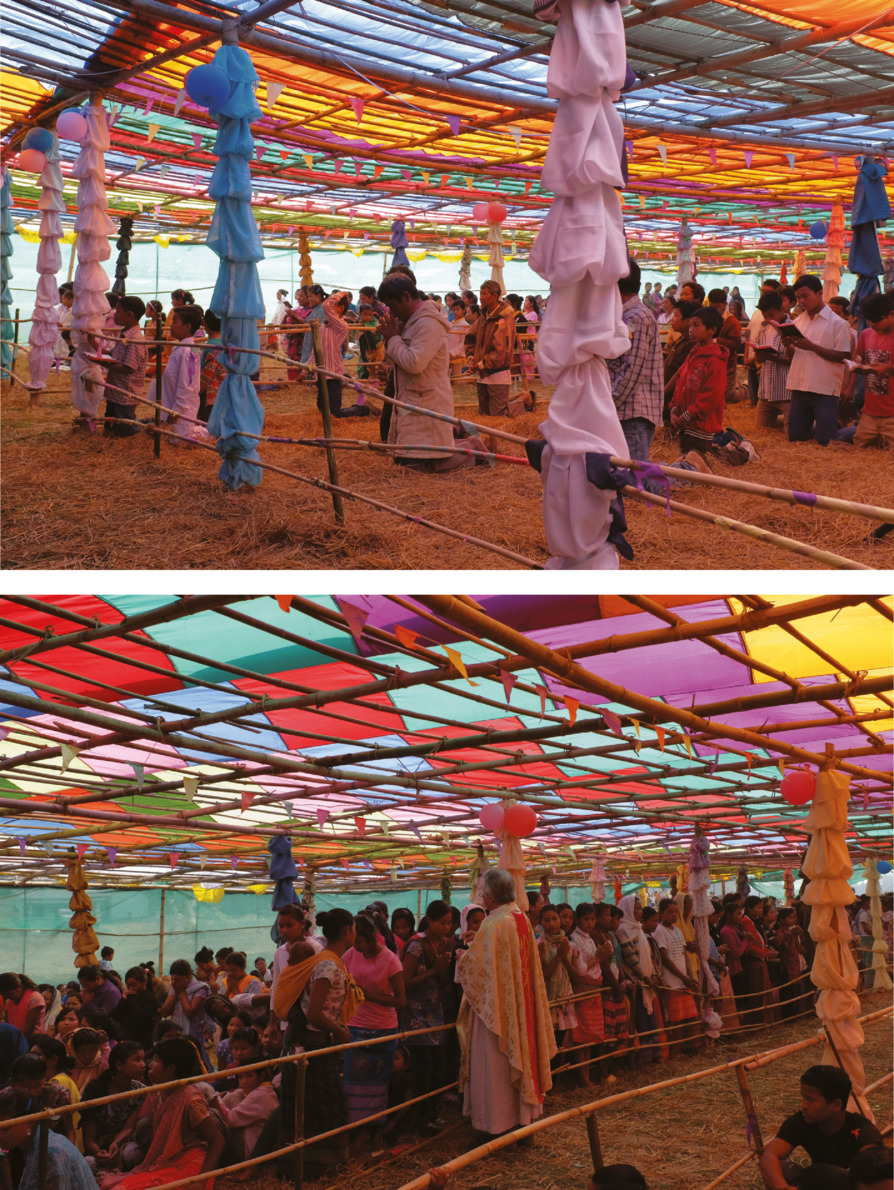
A day later, I attended the Catholic church's annual sabha (congregation) (see Figures 2 and 3). This event provided villagers in remote locations who were waiting to be baptized and have their confessions heard and who could not travel to the church, the opportunity to partake in collective worship. At this large annual gathering, priests, choirs, and the laity were all present in a newly harvested field near India's newly fenced border. Unlike the previous years, Indian troops forbade Garo Catholics from Bangladesh from crossing the border for this holy event. Despite their efforts, priests failed to negotiate their passage. Given the recent rise in trans-border abductions, Indian troops did not want to take additional responsibility for Bangladeshi Christians.
The Catholic sabha, 2015, Meghalaya, northeast India. Source: The author.

By 2015, the outposts’ powers to demarcate and control border-crossings, which were earlier confined to preventing Bangladeshi Muslim pilgrims from travelling without passports to visit tombs located in Meghalaya's foothills, had extended to include Christian festivities. India's newly deployed troops who patrolled the border ensured that Bangladeshi Garo Christians did not have additional privileges. Women and children stood in large numbers along India's new border fence, watching their clan members and extended families for several hours. They were not willing to give up hope that the Indian troops might relent later in the day. The stationed troops, however, prevented them from crossing the border.
Conclusion
The haunting image of Bangladeshi villagers standing at India's new border fence, desiring to cross, but prevented from partaking in trans-border religiosity, recalls Madeleine Reeves’ analysis on border infrastructures. She argues that border infrastructures, despite their promise of modernity and displaying the state's intention to mitigate conflicts, undermine everyday social harmony. Reeves advances that infrastructural delimitations reinforce spatial uncertainties and divides, and deepen distinctions among border societies.Footnote 38 At the northeast India-Bangladesh borderland, sprawling concrete outposts have disrupted prior cycles of conviviality. Increasingly depersonalized national security procedures have gradually transformed the landscape from a location where villagers and troops shared moral and material fabrics, despite political violence, into spaces where seemingly neutral but hyper-violent state procedures override relationships of trust and convivial bonds. The escalated construction of outposts and troop deployments embody state efforts to instil anonymity in regions where shared affinities of both blood and soil historically cut across incursive national boundaries.
Despite cycles of militarization, wars, and conflicts, troops and villagers were embedded within each other's lives along the northeast India-Bangladesh border. Their relationships exemplified the border's power to extend kinship and political subject-making from being neatly circumscribed within national territories and along clan lines. The remoteness of the nation's margin, which expanded kinship's political and affective horizons, emphasize Sahlins’ reminder about mutuality. In the Garo foothills, mutuality enabled villagers to survive the uncertainties of partition, while helping troops to map and govern a terrain that was poorly understood by faraway nations. Border conviviality redeemed the isolation of troops, while also transforming agrarian locations into governable spaces.
In this article, I have suggested that kinship's expansive connotations are essential to understanding both the relations that connected villagers and border troops through the exchange of everyday items and rations, as well as the contemporary efforts against conviviality that India and Bangladesh are aiming to produce with new infrastructures. In preventing the trans-border passage of goods and people, outposts in the form of unfamiliar garrisons and checkpoints limit the border's political possibilities. The shifts in political authority—from a deep sense of familiarity that precluded neither respect nor violence from state authorities to violent anonymity—are fundamental to creating a new militarized landscape dominated by distance and distrust.
In agrarian landscapes, outposts as newly securitized infrastructures demolish and rebuild territories by undoing trans-border and local channels of social life. Aimed at constituencies thousands of miles away from the border, in India and Bangladesh's heartlands, new infrastructures make borderland societies incidental. The recent ruptures in convivial exchanges show how new barriers and controls disrupt prior affinities, disembedding troops from their immediate rural environment and cutting off lively streams of trans-border sociality. The outposts’ isolation from the villages delimits political possibilities in privileging a distant national order rather than the immediate rural environment in which it is located. These deepen the sense of the region's remoteness as they resituate the Garos as inconsequential subjects. Villagers narrate the arrival of this insularity through the idiom of loss and longing—the loss of a shared moral world and a longing for the kinds of recognition that their prior relationships with the troops afforded them. It remains to be explored how the new garrisons will remake the border as a social fact, perhaps ushering in adapted forms of conviviality.