As the practice of paediatric cardiology has evolved and advanced, the scope and depth of work for paediatric cardiologists has expanded. Earlier diagnosis and improved survival rates have led to increasingly larger cohorts of children requiring assessment, intervention, and follow-up.Reference Dowie, Mistry and Young1,Reference Kleinman, Kleinman and Seri2 In sub-Saharan Africa, these pressures are amplified by a high burden of acquired heart disease, scarcity of resources for subspecialist services, and primary care deficits that result in delayed diagnosis and severe disease at presentation.Reference Dubé, Lipshultz, Fichtenbaum, Greenberg, Schecter and Fisher3–Reference Engel, Zühlke and Robertson6
The Western Cape Paediatric Cardiac Service is a specialised unit based in two government-funded tertiary centres, the Red Cross War Memorial Children’s Hospital and Tygerberg Children’s Hospital, and serving a population of approximately 2.2 million children with an annual birth rate of approximately 100,000.7,8 The prevalence of rheumatic heart disease is approximately 20 cases per 1000 school-age children.Reference Zühlke, Engel, Watkins and Mayosi9 The Western Cape Paediatric Cardiac Service is one of five tertiary paediatric cardiac service centres in the public health sector of South Africa. Despite increases in the surgical capacity of the Western Cape Paediatric Cardiac Service, an internal situational analysis undertaken in 2014 demonstrated that the resources of the service were not meeting the clinical demands in the region. This was exacerbated by increasing demand created by families from neighbouring provinces and other African nations seeking healthcare in the Western Cape. Through this analysis, one of the identified limitations of the Western Cape Paediatric Cardiac Service was understaffing of paediatric cardiologists. Therefore, formal research was undertaken to evaluate the workload of paediatric cardiologists in the service, providing a basis for engagement with relevant administrators.
Many methods to define and measure workload in healthcare settings have been published previously.Reference de Cordova, Lucero, Hyun, Quinlan, Price and Stone10–Reference Kwiecien, Wujtewicz and Medrzycka-Dabrowska16 However, reliable and practical measurement of workload in healthcare settings is challenging due to complexity and variability in settings of healthcare delivery. Each method has inherent limitations, and an optimal method of measuring workload must fit the clinical context to maximise utility. No previously described tool suited the context and needs of the Western Cape Paediatric Cardiac Service due to uniquely complex and diverse task requirements, and marked variation in the care requirements of different patients.
The aim of this study was the development and implementation of a novel method of measuring clinical workload: the patient encounter index. The study aimed to objectively and prospectively quantify the clinical workload of the Western Cape Paediatric Cardiac Service, in order to characterise workload- and staffing-related issues. The patient encounter index would form a basis for engagement with administrators to address staffing issues, ameliorate overload, and improve the efficiency of service delivery.
Methods
This study was conducted within the Western Cape Paediatric Cardiac Service and was approved by the Human Research Ethics Committee of the University of Cape Town.
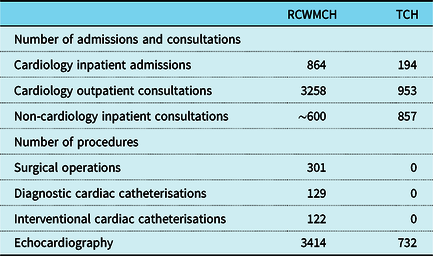
At the time of investigation, annual service delivery by the Western Cape Paediatric Cardiac Service (Table 1) entailed 1085 ward admissions, 1457 inpatient consultations, and 4106 outpatient consultations. In 2014, 301 surgical procedures, 251 cardiac catheterisations, and 4146 echocardiograms were performed within the Western Cape Paediatric Cardiac Service. The clinical staff of the unit consisted of three full-time consultants and one senior registrar.
WCPCS clinical service output (2014)

RCWMCH = Red Cross War Memorial Children’s Hospital; TCH = Tygerberg Children’s Hospital; WCPCS = Western Cape Paediatric Cardiac Service.
Patient encounter index tool development
The patient encounter index was developed to measure the workload in this specific context and then implemented as part of a prospective cross-sectional study design to evaluate the workload of paediatric cardiologists in this service.
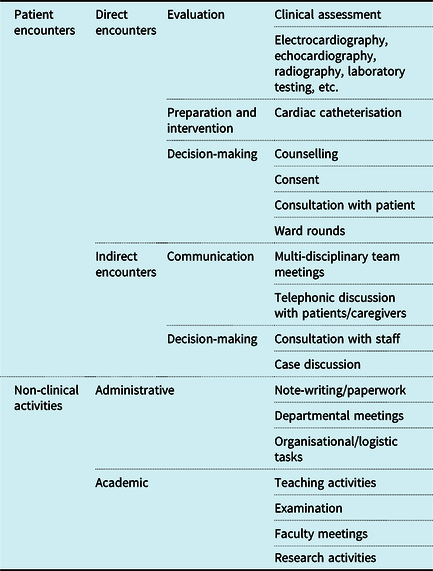
The basic unit in which workload was measured was the patient encounter. A patient encounter was defined as any activity that may directly influence the clinical outcome of a specific, identifiable patient. Patient encounters encompassed direct interactions with the patient, as well as clinical activities remote from, but with the potential to influence the clinical outcome of the patient and included (Table 2): evaluation (e.g. clinical assessment, echocardiography); intervention (e.g. cardiac catheterisation); and decision-making tasks (e.g. case discussion, telephonic and in-person consultation). Administrative and academic tasks, which have no direct impact on the outcome of a specific, identifiable patient, do not constitute a patient encounter, and were classified as non-clinical activities.
Activity classification

The patient encounter index construct conceptualises clinical workload as a ratio between the time spent performing clinical activities and the contracted time available for work. The construct effectively expresses how much clinical work there is to be done as a function of how much time there is in which to do it. Furthermore, by presuming that more complex work requires more time to perform, it removes the need for administrators to fully understand the complexity of the work.
For the purposes of this study, workload was defined as a function of the volume, duration, and complexity of tasks that must be performed in a finite period of time, as previously used and published by Hendy et al.Reference Hendy, Liao and Milgram17 Routine work was defined as all clinical work done from time of arrival at work, until the cessation of routine daily clinical demand. Contracted overtime (defined as urgent or emergency work done beyond the time of routine work, by the rostered on-call clinician) was excluded from the analysis. However, uncontracted after-hours work was recorded. Contractual work time was defined as 8 hours per day, for 5 days per week. The contracts of Western Cape Paediatric Cardiac Service providers allocate a proportion of working time to different categories of activity, which are defined as clinical work (50%), administrative work (30%), and academic work (20%).
The patient encounter index was defined as the ratio between the total duration of patient encounters and the total contractual hours of service. The index thus expresses the relationship between the amount of clinical work and the contract-specified time available for all work. A related construct, the adjusted patient encounter index, was defined as the ratio between the total duration of patient encounters and the observed hours of service, usually longer. This measure was used to understand how clinicians might adapt their behaviour to accommodate a high clinical workload, by performing additional work outside of contractual hours.
Patient encounter index implementation and data collection
Prospective data were collected by trained third-party observers over 10 routine consecutive working days in July 2014, using time-and-motion sampling. The observers were trained by following the clinicians in their daily work for 3 days. Thereafter, a full day of work sampling was performed; the data collected on this day were not included in the analysis and served as a pilot for the patient encounter index tool. This training period facilitated familiarisation of the observers with the clinical work and setting, and ensured adequate understanding of context and competency for accurate data collection. The 1-day pilot of the patient encounter index was reviewed with the observers and feedback demonstrated acceptable usability and completeness of the tool to obtain the desired data. Importantly, the training period also effectively habituated the clinicians and observers to each other, thereby minimising interaction with the observer during patient encounters.
During the study period, observers followed a single clinician continuously during his/her routine work every weekday over a 2-week period. The nature, duration, and setting of each patient encounter was recorded and time-stamped. Each patient was represented by a unique identifying number, to ensure that each patient encounter related to a specific, identifiable patient, as per the definition. Non-clinical activities were also recorded. Although contractual after-hours work was not recorded, “routine” clinical work was recorded until all that work was completed for the day. On many occasions, this work was performed outside of contractual working hours.
Statistical analysis
Descriptive statistics were used to evaluate the clinical activities of the patients, and a patient encounter index was calculated for each patient. Median values with ranges are reported for each parameter.
Results
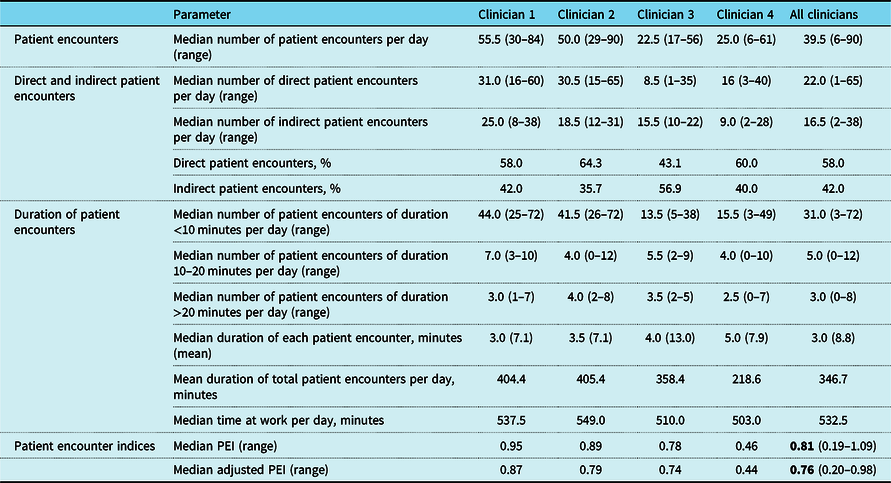
A total of 1693 patient encounters were recorded (Table 3). The median number of daily patient encounters per clinician was 39.5 (range 6–90). The majority of patient encounters were direct encounters (58.0%) and were brief (78.7%, <10 minutes duration). On average, clinicians spent 8.3 hours per day at the workplace, slightly more than the 8-hour contractual working day.
WCPCS workload

PEI = patient encounter index; WCPCS = Western Cape Paediatric Cardiac Services.
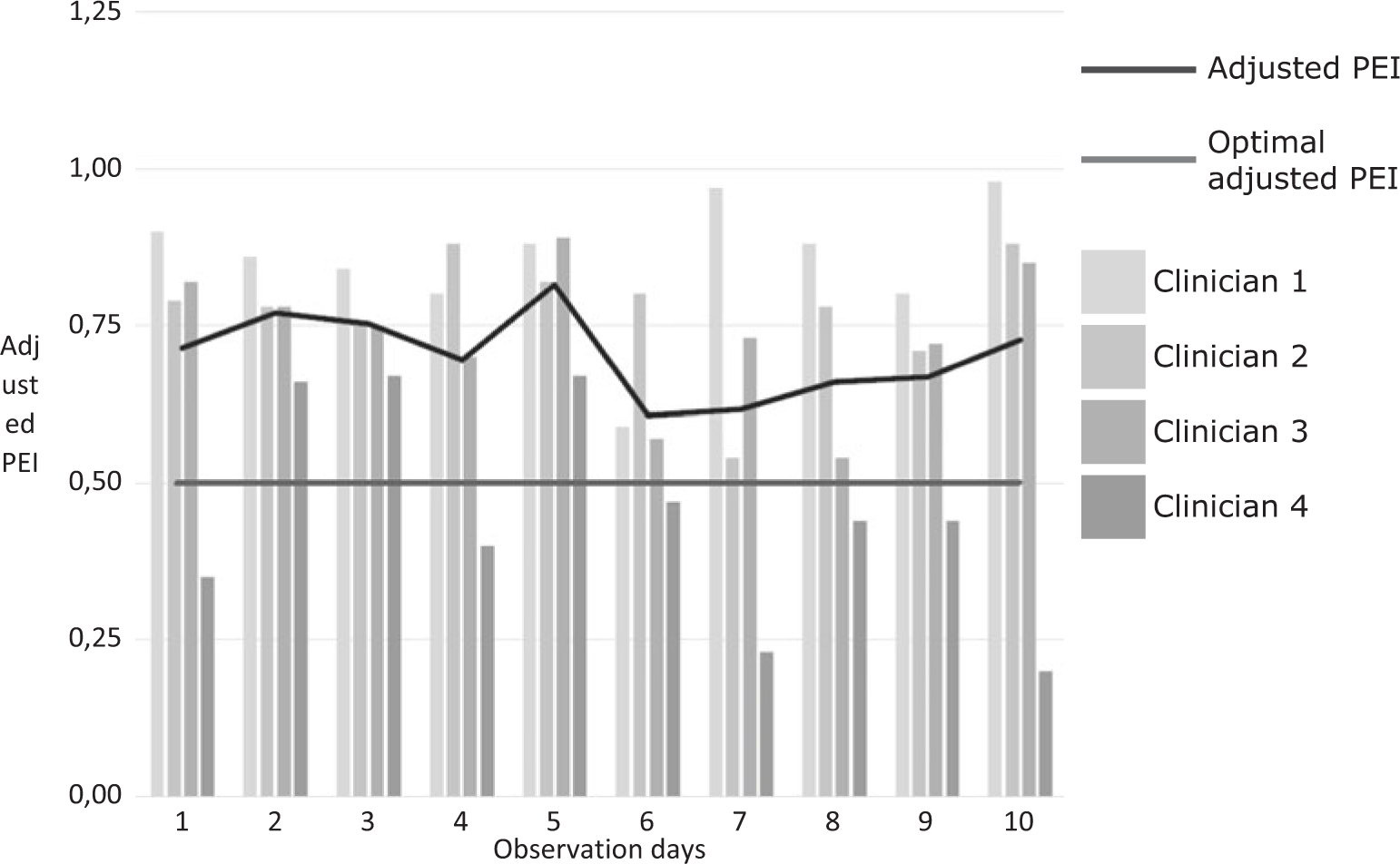
The median patient encounter index for the Western Cape Paediatric Cardiac Service unit was 0.81 (range 0.19–1.09), reflecting that 81% of contractual working time was spent on clinical activities. The median adjusted patient encounter index was 0.76 (range 0.20–0.98).
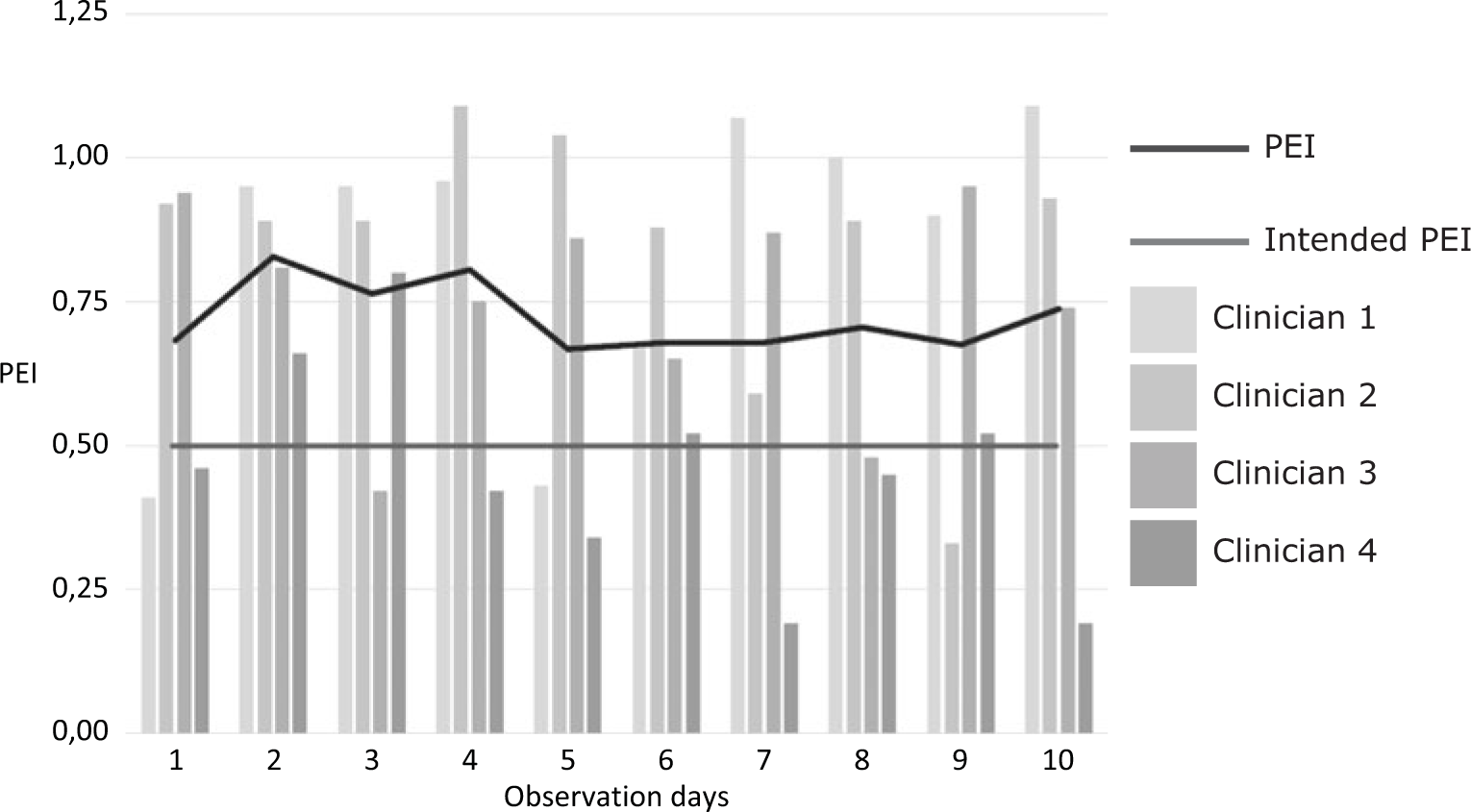
The proportion of time that is contractually allocated to clinical activities in the Western Cape Paediatric Cardiac Service is 50%, and thus the contractually intended patient encounter index is 0.50. The remaining 50% of routine work time is intended to be divided between administrative tasks (30%) and academic tasks (20%), including research and teaching, as laid out in the contracts of providers in the Western Cape Paediatric Cardiac Service. Figure 1 shows the significant difference between observed and intended median patient encounter index (0.81 versus 0.50). The adjusted patient encounter index was approximately equal to the observed patient encounter index (Fig 2).
Patient encounter index for the Western Cape Paediatric Cardiac Service.

Adjusted patient encounter index for the Western Cape Paediatric Cardiac Service.

Discussion
This study describes the development and implementation of a novel method of workload quantification, which was used to measure and describe the clinical workload of a busy paediatric cardiology service in Cape Town, South Africa. The results demonstrate that this tool measured the intended variable, namely the workload directly influencing patient outcomes, and expressed this workload in relation to relevant resources, such as working time and number of clinicians.
The difference between the median patient encounter index of the unit and the contractually intended patient encounter index suggests that the Western Cape Paediatric Cardiac Service was overburdened with a clinical workload that far outweighed the time and human resources allocated for its clinical services. On average, the clinicians’ working hours were slightly longer than their contractual obligations. A median adjusted patient encounter index of 0.76 was measured. This is approximately equal to the median patient encounter index of 0.81 and suggests that the additional, non-contractual time that clinicians spent at work was divided between clinical and non-clinical activities in a similar ratio as the rest of the day. It is likely that the gap between the demand for clinical work and resources allocated for this work resulted in less time and effort being directed to non-clinical work, such as administrative and academic activities.
Most patient encounters observed in the Western Cape Paediatric Cardiac Service were brief (78.7% were less than 10 minutes duration). We hypothesise that this finding further reflects the high demand for clinical work in a busy, overburdened care setting. The patient encounter index was generally similar across providers, although one of the clinicians was an outlier with a significantly lower patient encounter index than the others. This reflects differences in job description between the clinicians, with the outlier performing more non-clinical work than his peers. Clinician 4 was a senior clinician and as such, was responsible for a greater proportion of academic and administrative tasks than other members of the team. This person also was responsible for the clinical service at Tygerberg Children’s Hospital, which required routine travel between hospital, thus reducing time available for patient encounters.
The limitations of this study include a small sample size which reduces its generalisability. Additionally, the observation period was of short duration and was selected out of convenience, based on availability of observers for data collection. Contracted after-hours work was not observed. The patient encounter index tool development and analysis did not account for any individual provider factors, such as differences in efficiency, training or job description, which may affect workflow. An implication of our definition of a patient encounter (any activity with the potential to alter an identifiable patient’s outcome) was that meetings at which case discussions and clinical decisions took place were counted as “clinical” work time, thus influencing the patient encounter index. This is appropriate, as it measures the intended variable of clinical workload; however, this time may have been contractually allocated as “administrative”. This may have artificially widened the difference between the observed and the contractually intended patient encounter indices. In addition, there were several instances in which the observers were allowed to leave before the end of the working day, for example, when clinicians had teaching responsibilities which would theoretically not encompass patient encounters. However, if the clinician was called to attend to a patient during this time, this encounter was not recorded as the observer would be absent. Finally, time-and-motion sampling, as used in this study, is not a completely accurate representation of reality, as the state of being observed may affect workers’ behaviour. It is given in any study that the act of observation alters the observed; this effect may only be possible to eliminate by covert observation, which is impractical and unethical.
The patient encounter index is a reproducible tool, which can theoretically be applied to workload quantification in a range of healthcare settings. It is a measure of workload that is straightforward to calculate and understand, and can be implemented at minimal cost and without disrupting clinical service delivery. The patient encounter index tool is particularly well suited to clinical services that perform a wide array of clinical activities and encompass a group of patients diverse in their degrees of complexity. The index can be used to compare workload between clinicians, or between services, for the purposes of administration and resource allocation. It can also be used to model the effect of staffing changes (e.g. during leave periods) on the workload of a service.
In summary, the patient encounter index is a novel and informative tool for understanding and communicating the quantifiable clinical workload of a healthcare service. The patient encounter index was successfully used to objectively quantify and characterise the diverse clinical workload of a busy paediatric cardiology service. The Western Cape Paediatric Cardiac Service used the data generated from this study to communicate the overburdened state of their clinical service to provincial healthcare authorities. The patient encounter index construct enabled effective communication with administrators, leading to additional resource allocation with the outcome of two additional full-time Western Cape Paediatric Cardiac Service clinicians being employed in 2017.
Acknowledgements
We would like to thank Mihlali Tyilo, Yolanda Gumede, Katie Brazier, Amy Macfarlane, Tiyisani Maswanganye, Darielle Kellerman, Kamohelo Malahleha and Bevuya Mahamba for their work in following and observing the Western Cape Paediatric Cardiac Service clinicians for the purpose of data collection. We would also like to acknowledge the contributions of the other members of the Western Cape Paediatric Cardiac Service clinical team, namely John Lawrenson, George Comitis and Alicia Ferris.
Financial Support
This research received no specific grant from any funding agency, commercial or not-for-profit sectors.
Conflicts of Interest
None.